March 2026: Afghanistan Overflight Update

Key Points
  • Read to the end for an OPSGROUP Team report from a recent flight over Afghanistan.
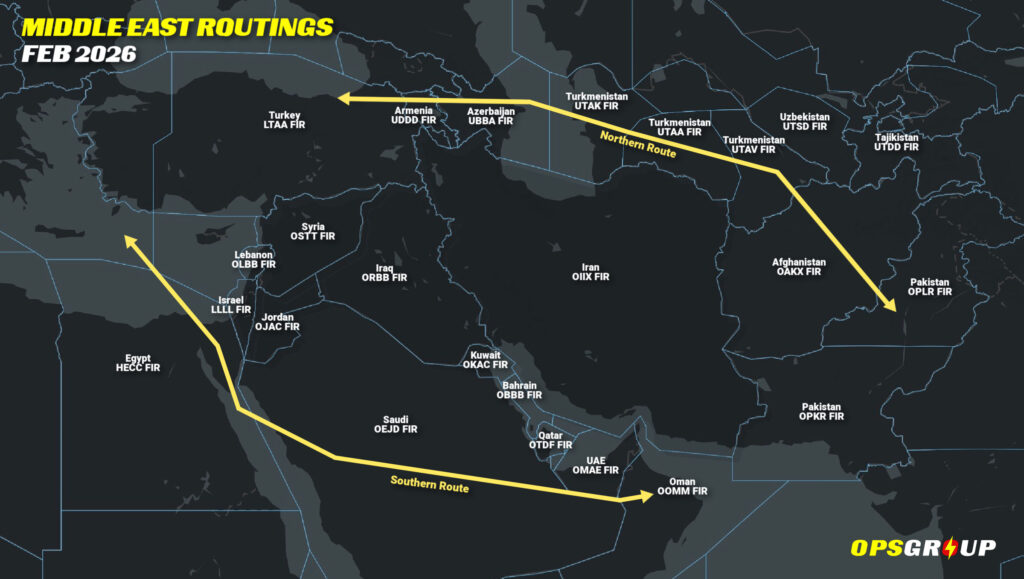
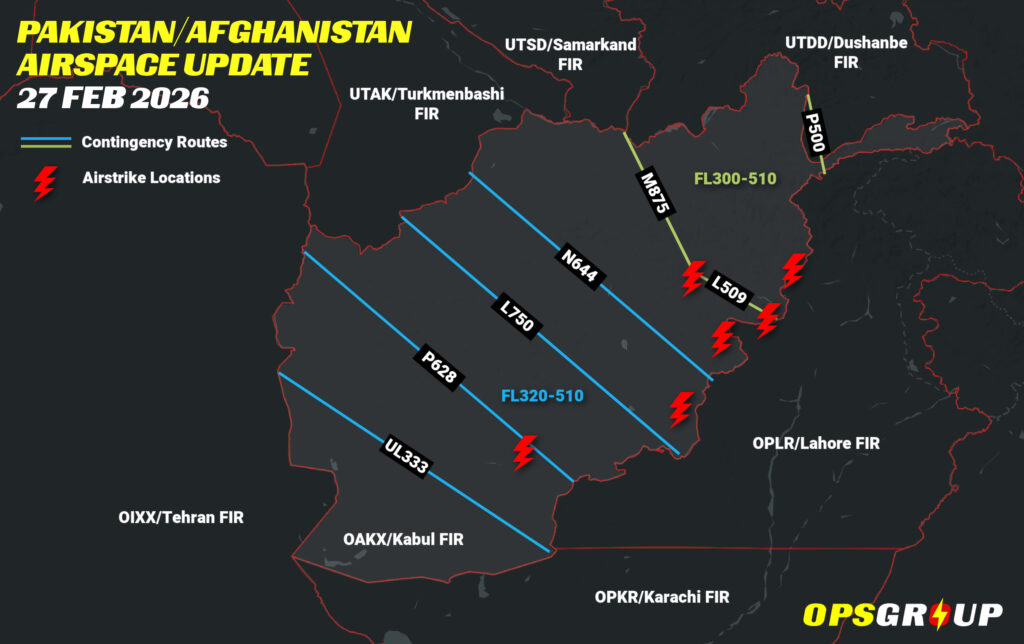
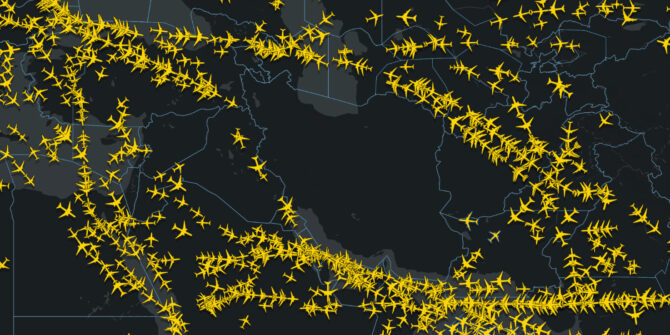
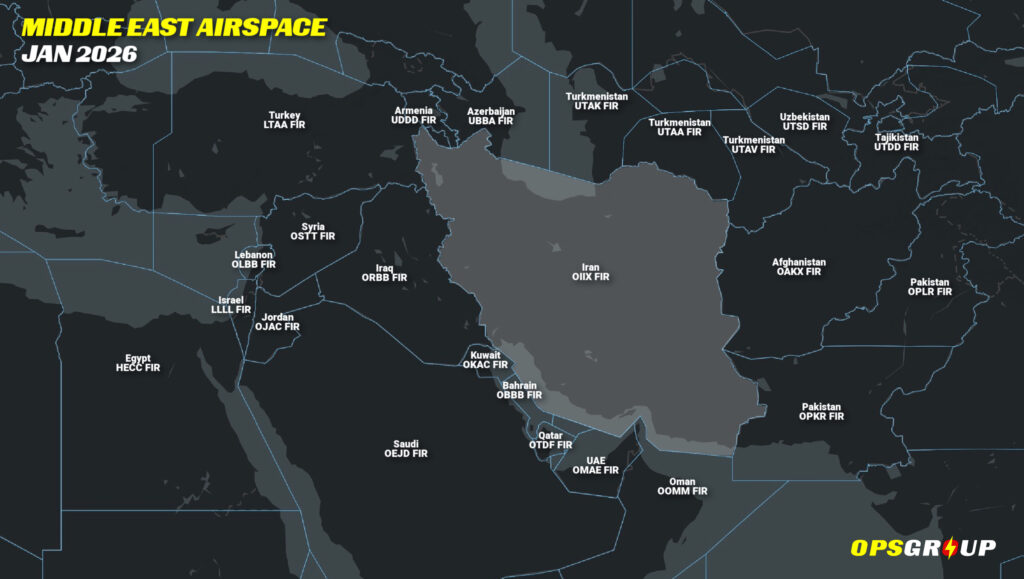
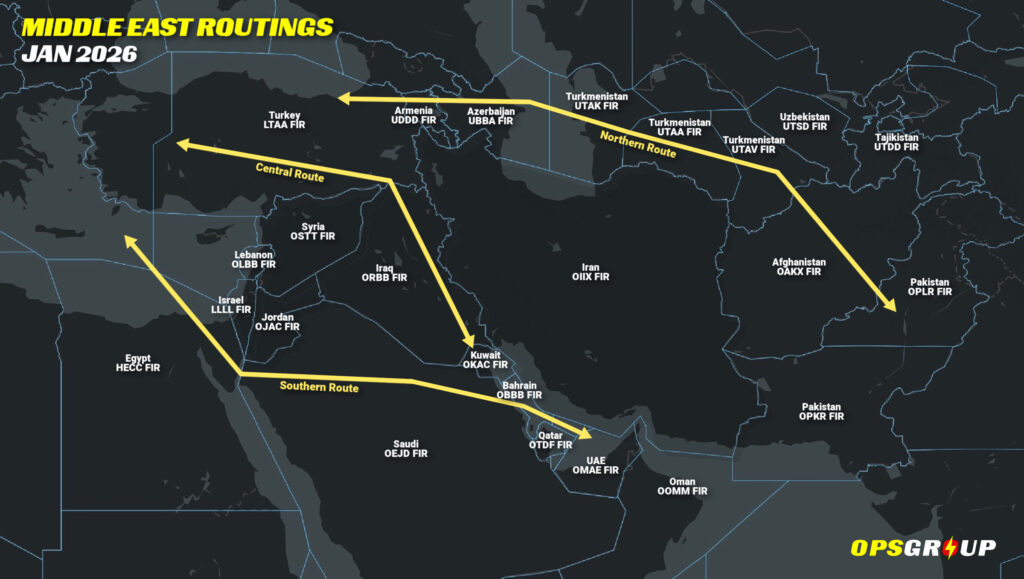
  • With the central Middle East corridor currently closed, a lot of Europe-Asia traffic is rerouting north via the Caucasus and Afghanistan. As a result, the OAKX/Kabul FIR is seeing significantly more overflight traffic than usual.
  • Afghanistan has recently re-issued several procedural Notams for overflights. These confirm that the entire FIR remains uncontrolled (Class G) with no ATS service available.
  • Aircraft are responsible for separation using TIBA procedures, on fixed high-level overflight contingency routes.
  • The US FAA warning still allows US operators to overfly OAKX at FL320 or above, and to use P500/G500 in the far east as low as FL300.
  • Given the current increase in traffic through the FIR, here’s a refresher on how Afghanistan overflights work and what risks you’re taking if you use it.

A Little Background

Afghanistan has been used as a transit corridor for several years now, but it’s suddenly become much busier as aircraft avoid the closed airspace between Israel and Iran. Many Europe-Asia flights are currently routing north via the Caucasus and then across Afghanistan before rejoining the normal routes toward South Asia.

The basic situation inside the Kabul FIR has not changed. The entire airspace is uncontrolled Class G with no ATC service available. Aircraft are responsible for their own separation and must follow procedural traffic broadcasts.

Afghanistan has recently re-issued several procedural Notams confirming these arrangements. They include requirements for aircraft to maintain 15-minute longitudinal spacing from preceding traffic at the same flight level and to make regular TIBA broadcasts while inside the FIR.

Separately, there has been renewed fighting between Pakistan and Afghanistan along their shared border. Cross-border strikes and increased military activity have been reported since late February.

There is no indication that civil aircraft are being targeted and airlines are continuing to operate over central Afghan airspace, but the border region with Pakistan should currently be treated as a higher-risk area.

On March 2 the UK issued an airspace warning for the OAKX/Kabul FIR related to these clashes. This appears unrelated to the Iran crisis but reinforces the long-standing point: while Afghanistan can be a useful transit corridor, it is not risk-free.

Before You Go

Before planning an Afghanistan overflight, check a few things:

  • PPR: All operators must obtain prior permission to enter the Kabul FIR. Plan for at least 72 hours. Requests are submitted to flightpermissions.acaa@gmail.com.
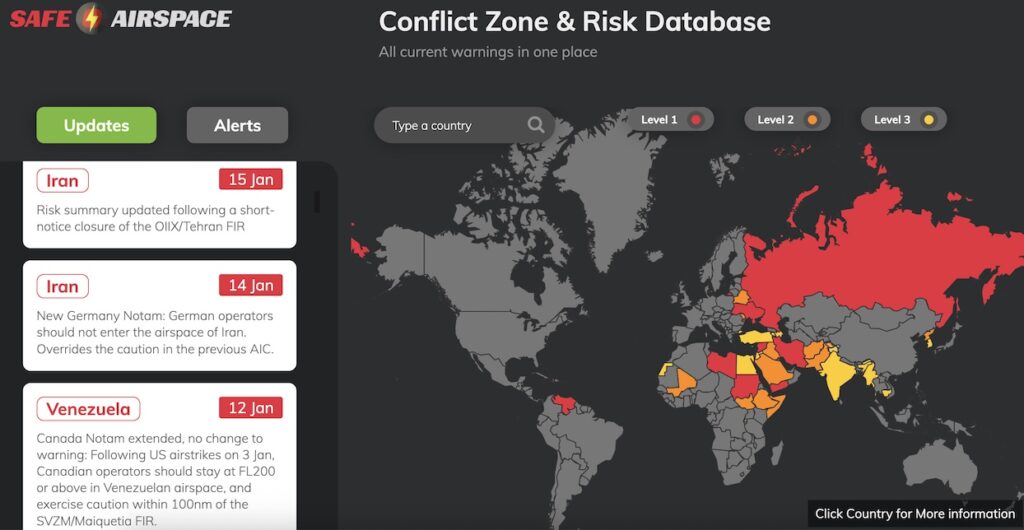
  • State guidance: Check airspace warnings at safeairspace.net.
  • Insurance: Confirm that your policy covers operations in uncontrolled or conflict-adjacent airspace.
  • Routing awareness: If you’re planning to use the eastern corridor near the Pakistan border (including P500/G500), note that recent clashes between Pakistan and Afghanistan mean this area carries slightly higher risk at the moment.

Overflights

The procedures to overfly the Kabul FIR have not changed – they’re found in a series of Notams recently republished and extended.

For the purposes of this article, these are the basics:

  • File only via one of the published high-level contingency routes as per the map above.
  • Expect entry spacing. Adjacent FIRs may delay entry to maintain 15-minute separation from preceding traffic at the same level.
  • Use TIBA procedures. Broadcast position and intentions on 125.2 MHz.
  • Make broadcasts regularly (including before entering the FIR and periodically while inside it).
  • Maintain your filed flight level and speed unless required for traffic avoidance or an emergency.
  • Contact the next FIR at least 15 minutes before the boundary point.
  • Keep lights and transponder on at all times.

Unplanned Landings

If you plan to overfly Afghanistan, treat a diversion there as an absolute last resort! According to all the state airspace warnings there’s a seemingly endless list of surface-to-air weaponry they might start shooting at you if you fly too low, and if you have to divert then good luck with the Taliban.

Plan fuel and ETPs so you can remain airborne and exit Afghan airspace before landing wherever possible.

If a diversion becomes unavoidable, OAKB/Kabul is the most likely option, but don’t expect much help when you get there – security and services are uncertain, and most governments advise their citizens not to travel to Afghanistan. For most operators, landing at an Afghan airport would be akin to ditching in oceanic airspace.

Our Pilot Report – here’s what we did …

There is a hefty dose of ‘at your own risk’ about all of this. The choice to overfly is not an easy one. To give you a much better idea of what to expect, here’s an OPSGROUP Team report from a recent flight over Afghanistan:

We operated through OAKX FIR on a EHAM/Amsterdam-WMSA/Kuala Lumpur flight

Overflight Permit: Getting the permit was relatively easy. We emailed flightpermissions.acaa@gmail.com (cc to flightpermission.atm@mota.gov.af) and received a response within 24 hours. They replied to us saying that to cross the airspace is charged a flat fee of $700 USD. You will need to fill out the form provided (this Excel document) and then forward that, plus copies of your Insurance, Airworthiness Certificate, and Aircraft Reg. If you are operating commercially, they also want your AOC. They ask for a minimum of 48 hours’ notice, although we put our application in a week in advance.

Insurance: Our insurance (like most) doesn’t allow operations within certain countries; however, they permit overflights on ATC-approved airways, and if you end up diverting due to an emergency, you are covered. We checked, and L750 was considered OK. Several air routes are “open.”

Routing: We had planned on L750, which runs from UTAV (Turkmenabat) to OPLR (Lahore). They also sent us the Kabul FIR Contingency Procedure document. The most important thing to read is the broadcast procedures since there is NO ATC service. The flight was very straightforward, and this route saved us a fair chunk of time and fuel.

ATC Comms: About 5 minutes before Kabul’s boundary, the UTAV controller asked us to “report ATC established with Kabul.” We tried calling Kabul on 125.2, knowing full well there was no ATC service. We told UTAV that we were going to continue TIBA procedures in Kabul FIR, and they told us, “Radar services terminated, frequency change approved. Good night.” All our external lights were switched on. We used Comm 2 as our TIBA box (125.2), Comm 1 stayed with the UTAV frequency, and Comm 3 (our data link was set to SAT) to monitor 121.5. Revise your TIBA calls; they suggest you broadcast them every 5 minutes. We used each fix, and it worked at about the right time.

Over Afghanistan: There was one aircraft departing OAKB/Kabul airport, a commercial jet on its way to Dubai, and aside from that, there was no one else. Up at FL450, we had a great view of the terrain – the word is “inhospitable.”

We could continue to hear UTAV on Comm 1 until about 15 minutes into Kabul when we switched to 124.1, the OPLR (Lahore) FIR frequency; about 15 minutes before we got to the boundary, we could hear calls from other aircraft. We had about 10 minutes of “dead” time on Comm 1.

I had an ETP using UTAV/Turkmenabat and OPIS/Islamabad and did not consider using any of the airports within Kabul FIR as available airports. This was treated just like a NOPAC or NAT crossing. There is nowhere to go, so if something eventful happens, you can keep going or turn back based on your ETP.

We checked in with Lahore about 10 minutes before reaching BIROS, and they told us to call overhead BIROS.

Key Points: It is relatively straightforward; brush up on the TIBA calls. There is more traffic nowadays as several airlines are using the routes for daytime flights, so it was a bit busier the last time I used it. However, at best, you will have a couple of airliners in the mid to high FL300s. There was no GPS Spoofing / Jamming or bad ATC, so I would use this route again, considering the other options in that region.

You experience is invaluable – if you are overflying Afghanistan and have some operational advice, please share it with the group. You can reach us on team@ops.group, or file an Airport Spy report anonymously here.


NAT CPDLC Route Uplinks: Crew Confusion and Errors

On Jan 27, the FAA published an Information Note for Operators (InFO) warning that crews have been responding to CPDLC route uplinks late or incorrectly when entering or while inside Gander’s oceanic airspace.

Aside from confusion, this has led to increased frequency congestion, controller workload, and interventions to prevent route deviations.

The InFO isn’t regulatory, but it highlights a persistent NAT issue that the FAA wants operators and training departments to address.

Here’s what’s going on.

The Backstory

It’s no surprise there’s confusion. Over the past few years, NAT oceanic procedures have changed significantly.

In 2023, the NAT began transitioning toward Oceanic Clearance Removal (OCR). Gander implemented this change, meaning crews submit a Request for Clearance (RCL) prior to the Oceanic Entry Point. If no change is required, they are considered cleared as filed. If a change is required, ATC issues a specific amended route or level.

In December 2024, Gander began issuing amended oceanic routes and levels via CPDLC following the RCL process. The goal was to standardise amendments via datalink rather than voice, and reduce readback/hearback error opportunities.

It didn’t go smoothly. Reports of confusion followed – especially around how amended routes were being issued and how they were being integrated into the FMS.

In May 2025, NAV CANADA temporarily reverted to issuing pre-oceanic entry amendments by VHF instead. However, Gander has indicated it intends to resume CPDLC route uplinks, potentially before summer 2026.

So this issue isn’t historical. It’s current – and likely to become more relevant again soon.

Crew Error

Gander has reported a significant number of uplinks that are not promptly or correctly actioned.

The typical sequence looks like this:

CPDLC route uplink sent → crew responds “WILCO” → about 5 minutes later ATC sends “CONFIRM ASSIGNED ROUTE” → crew replies with the route string (e.g. N47A RESNO 47N050W 48N040W 49N030W 49N020W MALOT GISTI).

ATC is verifying three things:

  • You received the correct clearance.
  • You loaded the correct route.
  • Your FMS matches what they issued.

The problem arises when crews respond to “CONFIRM ASSIGNED ROUTE” before the new route has actually been loaded and verified in the FMS.

In that case, the system transmits the currently active route – not the newly assigned one. That mismatch generates an alert on the controller’s side.

There’s a second issue as well: misinterpreting certain CPDLC uplinks.

UM79 “CLEARED TO [point] VIA ROUTE CLEARANCE” is not a direct-to clearance. It is a new route to that point.

UM80 “CLEARED ROUTE CLEARANCE” is not “cleared as filed.” It is a new route that must be loaded and executed.

In either case, these errors trigger something called an ‘out-of-conformance alert’ to controllers. This is when small CPDLC errors turn into big ATC workload.

The scale of the issue is not trivial. The North Atlantic Central Monitoring Agency reported 475 lateral errors in 2025 – a 71% increase over the previous year. Total errors across all categories rose 29%, to 600.

Out-Of-Conformance Alerts

Behind the scenes, Gander’s system compares what you are expected to fly with what you are actually flying.

When ATC issues an amended oceanic route or level, this info is entered into their system as a ‘reference trajectory’. Your aircraft reports its actual position and intent via ADS-C, and the system continuously compares the two.

If there is a mismatch – whether because the wrong route was loaded or the wrong route was confirmed – an out-of-conformance alert is generated.

These take time for controllers to clear, cause distraction and add to frequency congestion. These aren’t necessarily a loss of sep, but they are a big deal in busy NAT airspace to prevent potential for traffic situations.

In other words, if you reply to “CONFIRM ASSIGNED ROUTE” before loading it, you’re sending ATC your old one.

So, what does the FAA suggest?

The key takeaway is simple: load the new route, verify it matches the clearance, then confirm it.

The info note lists a bunch of useful resources to help with this, that we have re-produced below:

  • NAT Oceanic Clearance Removal Bulletin, 2023_001.
  • NAT Oceanic Errors Safety Bulletin (OESB), 2017_002, CPDLC section.
  • Advisory Circular (AC) 91-70D, Oceanic and Remote Continental Airspace Operations, paragraph 4.4.3 and Figure 4-1.
  • AIP Canada, ENR 7 North Atlantic (NAT) Operations.
  • ICAO Global Operational Data Link Document (GOLD) Reroute Procedures.

More Questions?

We’ll try and answer them. If we can’t, we’ll put you in touch with who can. You can reach us on blog@ops.group.

Delays and Diversions at TNCM/St Maarten

Several Opsgroup members have recently reported arrival holding and diversion risk at TNCM/St Maarten due to ramp congestion, despite having confirmed FBO reservations.

On Feb 18, a member reported being advised of likely holding and possible diversion while enroute. Additional reports followed from crews who operate there regularly.

Here’s what OPSGROUP members had to say:

‘On Feb 16, about two hours out were were advised by Miami that holding and possible diversion was likely due to ramp congestion. Then about 10 minutes later they changed their mind. We heard this happen to multiple aircraft on frequency with us…’

‘I flew in last week – absolutely true. There were five planes in a holding pattern when we arrived. We did four turns in a hold at GAB before being allowed to proceed to the airport. Multiple planes hit minimum fuel and had to divert to other airports. The problem is compounded when the winds shift to runway 10 and the commercial planes require runway 28. You have planes departing from both ends…’

‘We held for 45 minutes waiting for the airport to let GA aircraft land. We had everything booked for some time prior. We heard a couple GA aircraft divert to San Juan. I would strongly advise looking at the 121 schedule when planning an arrival time. There was simply no concrete left…’

‘For GA, it has been more difficult to arrive than during the Xmas/high season. We fly 2-3 times per week and have been told to land after 5pm…’

“This is common, even for airline ops. Single runway with backtracking, in addition to the limited ramp space that can seize up with a missed call or mistake, only exacerbates the compression on the field.  ATC is competent and familiar but extremely busy in these situations, so it’s advised to bring extra gas…”

“On arrival 50 miles out we were told no there was no ramp space…parking had been reserved for months. There was an AOG aircraft in our spot. We were told to divert to Anguilla, no parking after call to FBO .  Landed St.Kitts and waited until space opened in TNCM at 6 pm…”

Restriction on GA movements

A Notam issued Feb 14 may be contributing to the situation:

A0094/26 NOTAMN
Q) TJZS/QSLXX/IV/NBO//000/150/1802N06307W040
A) TNCM
B) 2602141100 C) 2603300359
E) GA IFR TFC RESTRICTED DLY TO
4 ACFT PER HOUR BTN 11:00 UTC AND 15:59 UTC
2 ACFT PER HOUR BTN 16:00 UTC AND 21:00 UTC
4 ACFT PER HOUR BTN 21:01 UTC AND 03:59 UTC
PRIOR APPROVAL REQUIRED FROM THE RESPECTIVE FIXED BASED
OPERATOR. FLIGHTS NOT APPROVED SHALL NOT BE ACCEPTED

But member reports suggest that even with PPR, arrival delays may still occur during peak periods.

Planning around peak traffic

Currently, the practical advice is simple: check the airline schedule and avoid arriving or departing when the airport is busy with Part 121 traffic.

This can be compounded when winds favour Runway 10 but heavier jets continue using Runway 28 for performance reasons.

As a starting point, there are typically two airline peaks each day at TNCM:

Peak 1 (main wave): Late morning through early evening. Arrivals surge roughly 1130-1500 LT, with departures from about 1430-1830 LT.

Peak 2 (smaller wave): A second departure push between approximately 1930-2100 LT.

So the best bet is to plan for an early morning arrival, or after about 1830 local.

Please keep reporting

Your reports are invaluable to the group – you can submit those (anonymously) via Airport Spy, or directly with the team on blog@ops.group.


FAA Warns on Runway Length Data and Overrun Risk

On Jan 21, the FAA issued a new Information Note for Operators after identifying cases where incorrect runway length data was being used for performance planning.

The concern is straightforward. Using the wrong numbers can skew takeoff or landing calculations, which is why the FAA says performance planning should be based on declared distances from the Chart Supplement.

What exactly is the issue?

The FAA notes that many crews default to runway lengths taken from airport diagrams, charts, FMS databases or commercial planning tools.

The issue is that these sources may not include declared distances (TORA, TODA, ASDA and LDA) which are the figures used to meet regulatory performance requirements and can differ significantly from the physical runway length.

The FAA’s concern is that crews may misunderstand declared distances, omit them entirely, or rely on FMS or third-party data that has not been updated after changes.

So a quick clarification on how runway lengths are defined helps…

About runways

When we talk about default runway length, we are talking about the physical length of the runway surface. It’s what you see on charts, airport diagrams and other sources of info.

It represents exactly that – pavement from end to end. It may include unusable bits (such as displaced thresholds, closed portions etc) and is often a single number with no context.

It doesn’t tell you how much runway is legally available for takeoff or landing and can significantly overstate what you can actually use (more on that later).

Declared distances, on the other hand, are the official, performance-relevant runway lengths published by the airport authority via the FAA Chart Supplement and other validated sources.

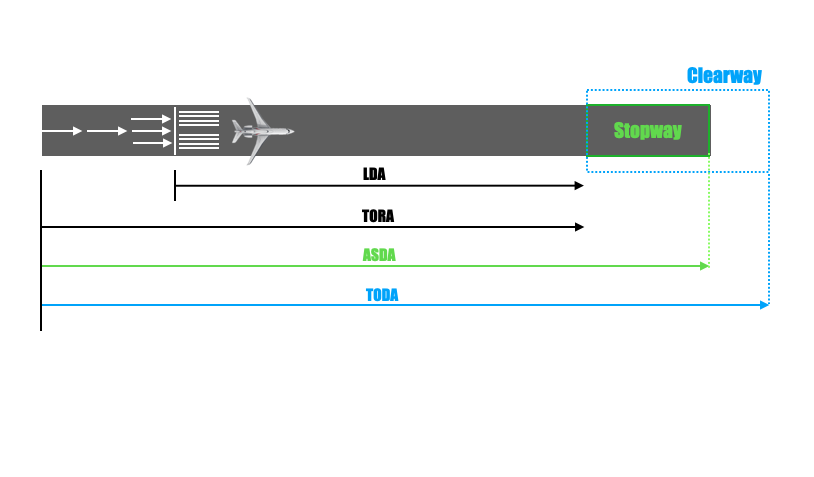
A brief reminder of what these distances include (and critically, don’t):

Takeoff Run Available (TORA). Think of this as how much runway you can accelerate on. It includes useable pavement only, starting at the take-off threshold. It doesn’t include clearways or stopways.

Takeoff Distance Available (TODA). How much distance you have to get airborne (i.e. TORA) plus the distance required to clear obstacles in the initial climb segment (clearways). Crucially, it doesn’t include stopways (usable in a rejected takeoff).

Accelerate-Stop Distance Available (ASDA). Think of this of how much distance you have if you reject the takeoff. It includes TORA and stopways. It doesn’t include clearways.

Landing Distance Available (LDA). How much runway you actually have to stop after touchdown. This includes usable pavement from the landing threshold to the end of the runway. It doesn’t include pavement before a displaced threshold, stopways or clearways.

Here’s what this all looks like:

Under the FAA regs, these distances are the authoritative performance numbers. They override any single runway length shown elsewhere. That’s the key point.

Real world example

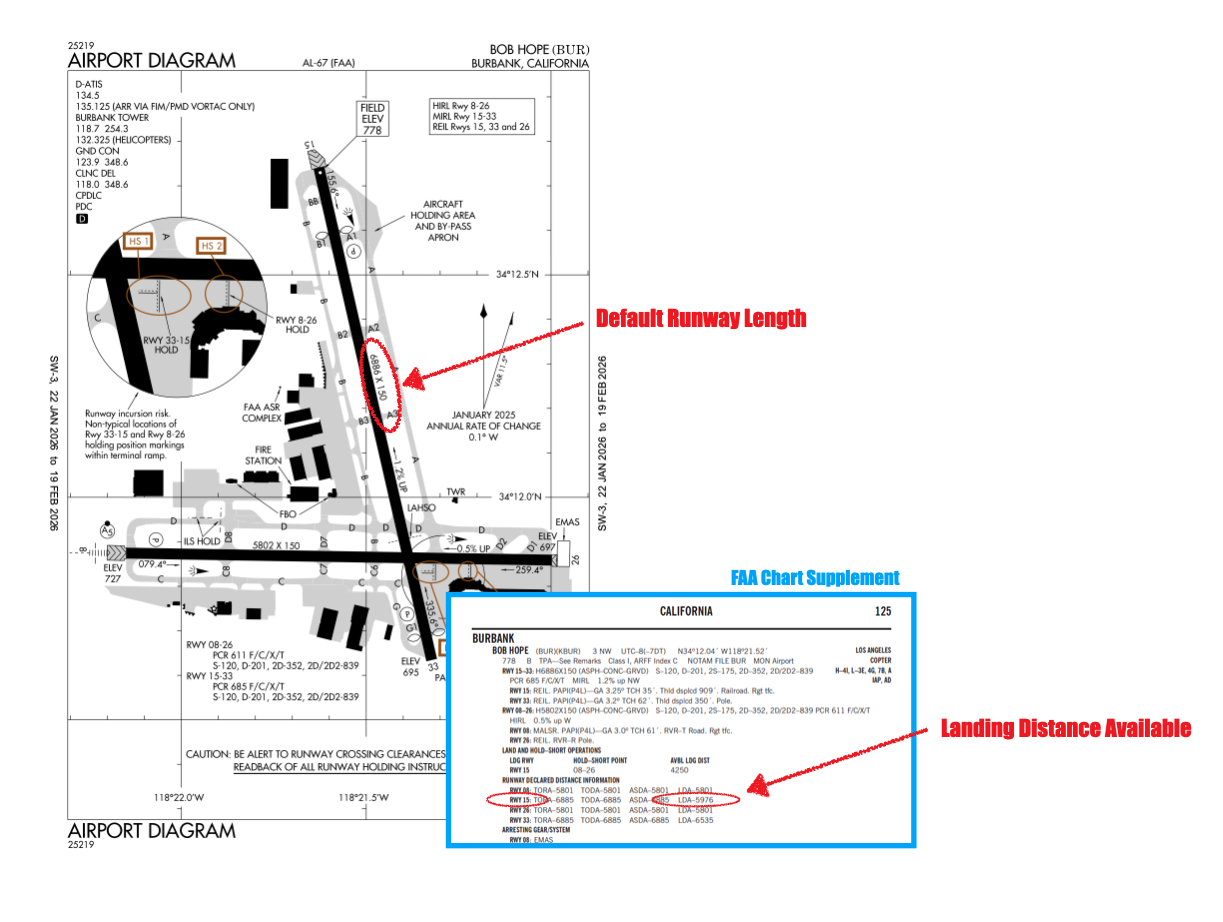
But that’s enough theory. A good real-world example is KBUR/Burbank Runway 15, where the published runway length and the declared landing distance are not the same.

Many charts and planning tools show a runway length of 6,886 ft. But the FAA Chart Supplement lists an LDA of 5,976 ft due to a displaced threshold for obstacle clearance.

If crews plan landing performance using the longer figure, they may be overestimating available runway by about 900 ft. Add tailwind, a wet surface, or a performance-limiting MEL, and that margin can disappear quickly.

That’s exactly the scenario the FAA is trying to prevent.

So what’s the FAA’s advice?

For performance calcs, the FAA says crews should use published declared distances, not the physical runway length. Just because pavement exists doesn’t mean it’s legally usable.

That expectation needs to be reflected in procedures, training and day-to-day practice.

Crews also need to be clear on which runway lengths their performance tools are actually using.

Operators should also review FMS databases and third-party performance tools, understand their limitations, and check that the data is current.

Have you spotted something risky out there?

Share it (anonymously) with the group! You can reach us via blog@ops.group, Airport Spy or Report-A-Thing.


Guided Visuals: What They Are and Why They’re So Useful

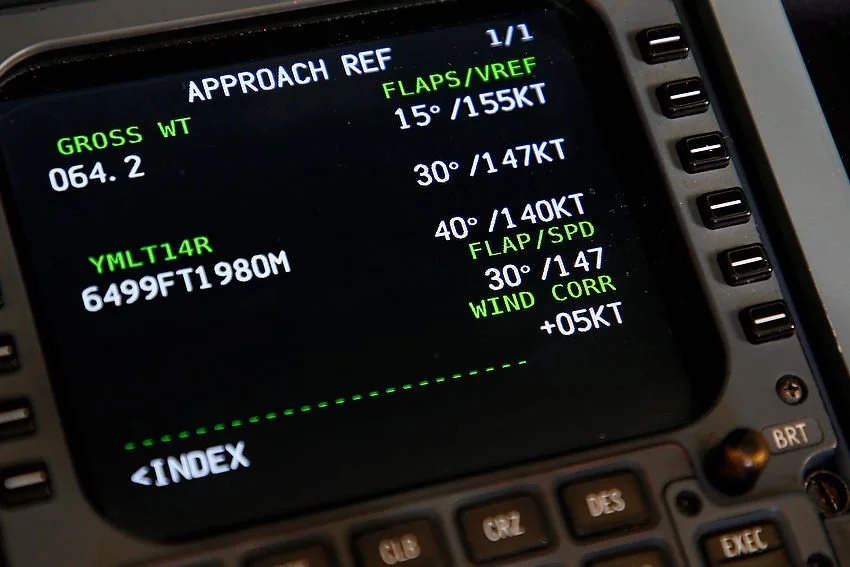
I remember the first time I tipped over on a visual approach to Runway 34 at the waypoint SHEED at YMML/Melbourne. The northerly was howling, we were heavy, and in continuous moderate turbulence. Things were busy, but under control.

At the commencement of the visual segment, we were level at 2500’ and partially configured to fly a normal decelerated, 3-degree approach. Local operators know you need closer to 4 to find ‘the groove’ by the stable call at 1000 feet. The trouble was, we weren’t local.

Instantly it became apparent 3 degrees would not be enough. The ‘bouncy ball’ (an Airbus acronym for vertical path indicator) immediately showed we were high.

And just like that, we were chasing.

Jet operators are accustomed to this ol’ chestnut: you can’t slow down and go down. Generally speaking, it’s one or the other. We were now trying to do both.

And then came the turn to final.

We disregarded Melbourne’s secondary airport to our right, with its name emblazoned brightly in white next to the runway so as to avoid any potential confusion (it has happened). As we struggled to configure and complete our landing checklist, workload soared. The final turn came late and required the maximum angle of bank our stabilised approach criteria allowed.

As we turned into 40kts of wind on the nose, our fate was sealed – the auto thrust (by design) applied a fist full of power to compensate for our falling groundspeed, and three whites on the PAPI quickly became four.

We were done. Out of altitude and out of time, we called unstable and commenced the go-around wandering how two competent pilots had let this get the best of us.

Moral of the story – visual approaches (when unfamiliar) aren’t easy. They’re supposed to be, but they’re not.

And business jet operators are the leaders in operating high-performance aircraft to unfamiliar airports.

Enter the guided visual.

Guided visuals make use of the FMS to provide guidance that keeps you on profile and track, reducing pilot workload and allowing you spare capacity to watch for other traffic, configure and all the other pilot-y things we need to do.

But it’s important you’re familiar with their limitations – and what responsibilities still lie with you.

Let’s take a closer look…

Guided Visual 101

It helps to frame what we’re talking about here.

Guided visual approaches are visual approaches flown with lateral and vertical guidance generated by the FMS. Think of it as an assisted visual approach, backed up by RNP-AR style vertical and lateral guidance.

Important point: you’re still flying a visual approach, in VMC, to a runway that’s in sight. But instead of eyeballing things, the box builds you a stabilised path to the threshold.

You can fly it like any other automated approach with full situational awareness. It’s computerised magic, but with some fairly strong caveats (more on that in a bit).

Why they’re so useful

Firstly because they’re so stable. Guided visuals reduce the need for ‘dive and drive’ visuals. You get a proper descent profile early, which enables you to manage energy with far fewer last minute flight path adjustments. They are smart and can take into account the various vertical profiles for different segments of the approach.

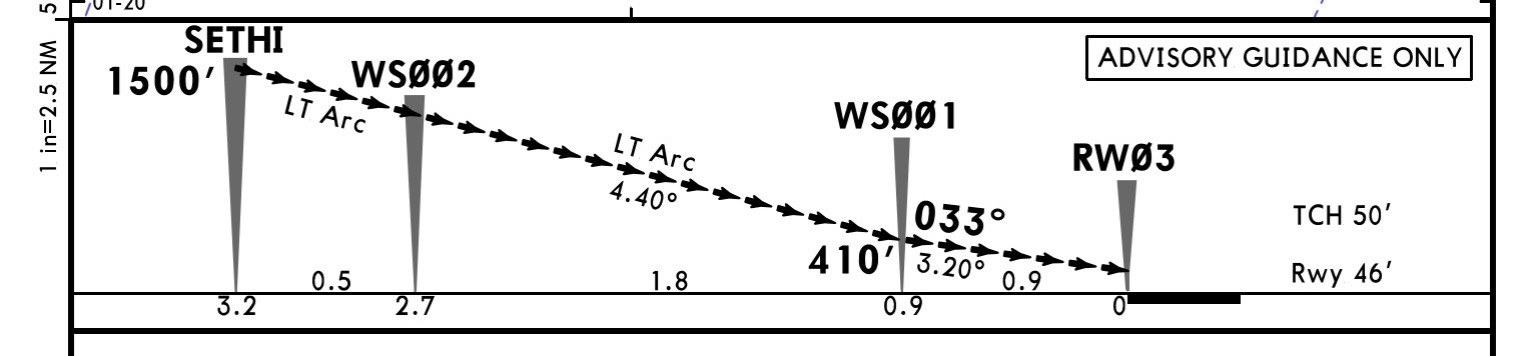
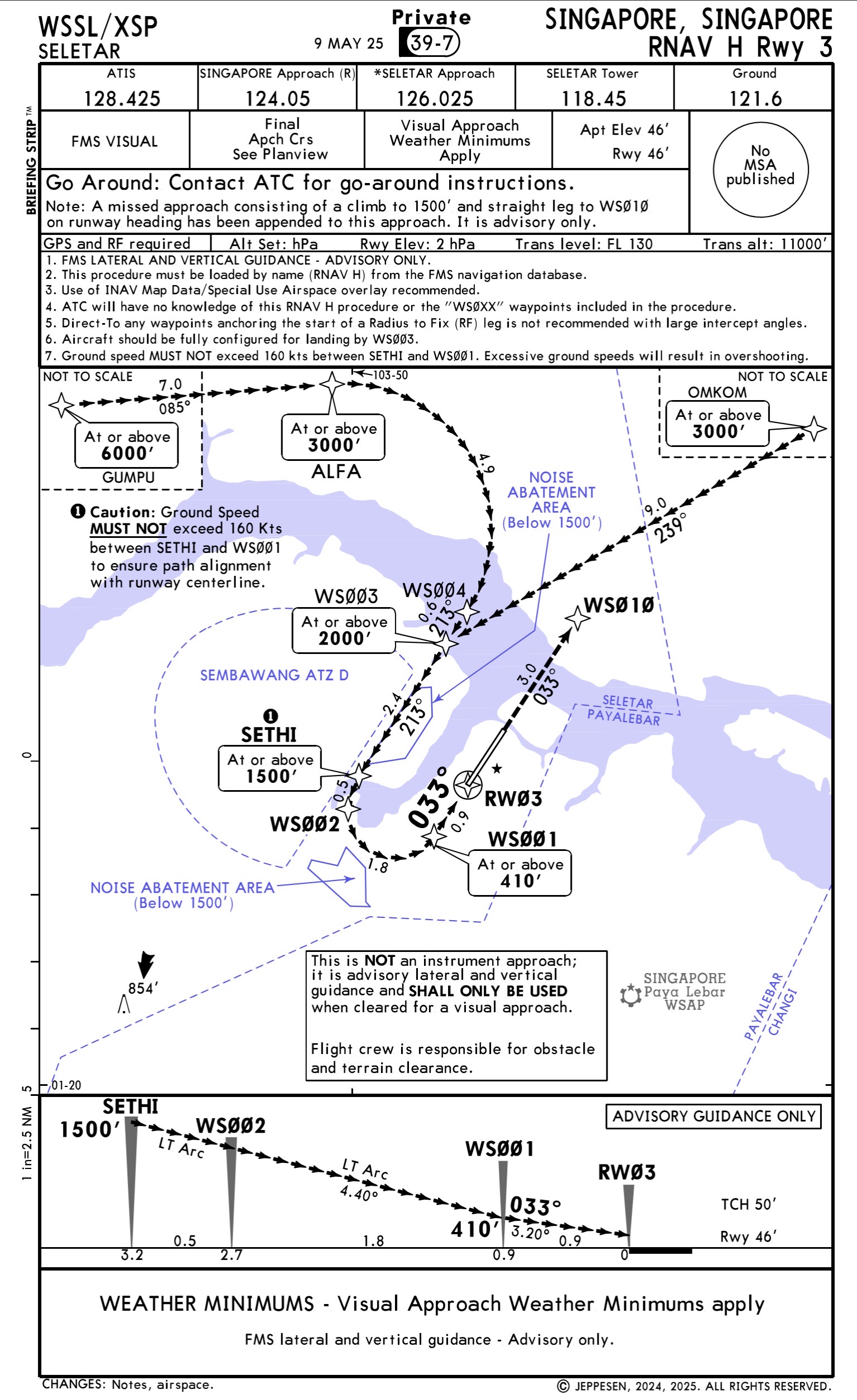
Take WSSL/Seletar Runway 03: the initial descent path from SETHI starts at 4.4 degrees until turning final at 410′ where the descent shallows out to match the PAPI at 3.2 degrees, and since there is a runway point in the FMS, the aircraft can remain coupled until it reaches its autopilot limitation altitude (200′ in a Gulfstream for instance).

Then there’s workload – the FMS empties your capacity bucket by managing your geometric flight path, leaving room to focus on things like spacing, configuration, checklists and monitoring. This is especially pertinent when cleared via a visual approach while still high, fast or under (shall we say) ‘less than optimal’ radar vectors.

Then there are visual illusions caused by flat light, water, sloping terrain or black hole effect. Our eyes are known to play tricks on us.

Finally, the elphant in the room – automation. Modern, complex aircraft are designed to be flown with high levels of automation. Whether or not this is a good thing is a can of worms that falls beyond the scope of this article. But automation is well and truly engrained in how we operate modern, complex aircraft.

It’s hard to argue that when managed well (and not used as a replacement for core piloting skills), autopilot and flight director coupling provides significant safety margins compared to simply flying by the seat our pants.

But, beware…

Rubbish in, rubbish out. The guidance an FMS provides is only as good as the data it uses, and so database accuracy matters. A displaced threshold for instance may not be captured. Always, always cross-check your approach against visual cues such as PAPI.

It’s also important to remember that obstacle clearance is on you. It’s still a visual approach. Your FMS doesn’t know about obstacles, cranes or even the ‘steel structures and silos’ that you must spot on approach to WSSL/Seletar, for instance.

What’s the bottom line? Guided visual approaches do not replace good visual flying. But they do help make it safer, more stable and more consistent. For BizAv operators flying to diverse airports, they can be one of the most useful tools in the box – provided they are understood.

What about legalities?

In the US, a guided visual approach is still a visual approach under FAA rules. The FAA previously issued this Information for Operators (InFO) to that effect, and is an important read before flying any guided visual.

Don’t confuse them with instrument approaches – even if the charts appear similar. “Looks like an approach” doesn’t equal “is an approach.”

In other words, the presence of flight director and autopilot guidance does not change anything.

There is no such thing as an ‘instrument visual approach.’

Visual approaches have no published minima. There is no FAA obstacle clearance protection, no TERPS validation or any other underlying regulatory protections. The same applies in the ICAO world, whilst you might have access to the visual guided approach, it is still legally a visual approach, don’t let the chart fool you into thinking otherwise.

You must:

  • Maintain continuous visual reference with the runway or traffic.
  • Be able to land using normal manoeuvres.

The FAA doesn’t specify whether you need to be head’s up or down – just as long as you remember that these remain your responsibility.

Another important clarification is that most guided visual approaches are proprietary, in other words not published via AIP. Avoid potential confusion by not using using weird naming conventions (such as “RNP-H”) that might not be immediately evident to the controller that has cleared you for a visual approach.

If you are specifically asked by ATC if you will be tracking via a procedure however, it is okay to say so. At several US airports ATC have been actively involved in procedural design. This highlights the benefits of these types of approaches, not just for pilots but for controllers too. They can help remove the “some fly wide, some fly close” factor which is common in a visual approaches.

And finally there is this important caveat. Flying one of these RNAV H or RNAV G procedures does not relieve the pilot of their responsibilities of right-of-rule rules – especially at uncontrolled airports where pattern rules still apply (see CFR § 91.113). The NBAA report that they are receiving increasing reports of turbine aircraft using instrument approaches to complete visual arrivals and (either intentionally or unintentionally) disregarding right-of-way rules with other aircraft. It’s important to understand that using these procedures does not grant any extra priority. 

Where do you find them?

In the US, guided visual approaches are not usually published procedures.

Instead third party vendors produce ARINC-424 coded procedures that can be used in your jet’s FMS. Just like an RNP-AR, you should not modify waypoints on the approach, since this could affect the jets trajectory.

When loaded, they usually appear in your FMS as ‘RNAV-H RWY XX’  or ‘RNAV-G RWY XX’ depending on which avionics package you are flying with.

Honeywell appears to be leading the charge. They have designed a number of them which, at the moment, are only available to aircraft with Honeywell avionics. Although we have been told that the data may soon be licensed to other avionic manufacturers the likes of Collins etc. Watch this space.

Garmin has also recently started to add some Visual Guided procedures to their products as well. While the number of airports served is less than the Honeywell offering, their offering is growing quickly

Have more to add?

Let us know! You can reach the team via blog@ops.group.

Crisis in Iran: Elevated Airspace Risk

Key Points:
  • Iran remains highly unstable, with elevated risk to civil aviation.
  • Severe internet disruption has been in place since Jan 8, with broader communications affected.
  • The OIIX/Tehran FIR was closed at short notice for several hours on Jan 14, with no public explanation.
  • EASA recommends avoiding Iranian airspace at all levels due to misidentification risk.

Situation in Iran

Beginning in late December, large-scale political protests spread across major cities due to a worsening economic crisis.

These escalated in recent weeks, with many demanding a change of political leadership. The Government has responded with a violent crack-down. Large numbers of casualties have been reported amid arbitrary arrests and severe internet disruption since Jan 8, with wider communications also affected.

Several countries (including the US) have urged their citizens to leave the country immediately.

Potential for US Military Intervention

In response to humanitarian concerns, the US Government has implied military intervention remains a possibility should violence against protesters continues.

If this were to occur, Iran has repeatedly warned it will retaliate by targeting US military bases and other assets throughout the region.

Some effects of this threat have already been felt, including the partial removal of personnel as a precautionary measure at Al-Udeid Air Base in Qatar – the largest US military base in the Middle East. Although the threat level has reportedly been downgraded in the past few days.

Airspace Risk

The current crisis has further increased risk to aircraft operating in or near Iranian airspace (the OIIX/Tehran FIR).

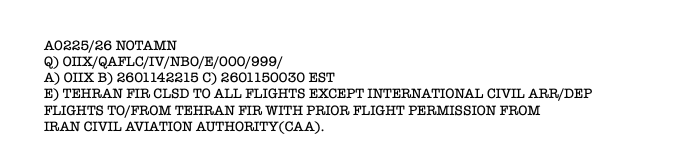
On Jan 14, the following Notam was issued unexpectedly closing the OIIX/Tehran FIR for several hours overnight, with no public explanation from Iranian authorities:

Previous events have shown that these types of closures can occur when security or military activity is taking place including a risk of missile launches or air defence operations.

Then on Jan 16, EASA upgraded its warning for Iranian airspace by publishing a new Conflict Zone Information Bulletin (CZIB) for Iran and neighbouring airspace. It suggests that recent events (including the possibility of foreign intervention) have likely placed air defence systems at a heightened sense of alert. Civil aircraft are at increased risk of misidentification.

It’s worth noting that most operators already avoid Iranian airspace. Several states (including the US, UK, France, Canada and Germany) either actively prohibit or at least strongly advise against entering. At safeairspace.net, we maintain a ‘Level 1 – Do Not Fly’ warning.

However, when referencing adjacent airspace, things become a little more ambiguous. EASA’s CZIB advises caution when overflying neighbouring countries where US military assets are present. This notably includes Qatar, Bahrain, Kuwait, the UAE, Saudi Arabia, Jordan, Iraq, Syria and Turkey.

Special care should be used on the major air corridor that skirts the western boundary of Iran via Iraqi airspace (airways UL602, UM860 and UM688) where GPS interference (including the more insidious spoofing) is prevalent.

We know of at least one incident in the past where an aircraft almost inadvertently strayed into Iranian airspace without a clearance while suffering from navigation error.

From a broader perspective, EASA are also alluding to the possibility of regional escalation should the situation deteriorate – especially in the event of retaliatory strikes against military targets.

Continue to monitor the situation

Iran sits alongside the main Europe-Middle East transit corridor via Iraq/Kuwait/Bahrain, and the June 2025 Israel-Iran missile exchange showed how quickly events inside Iran can trigger widespread airspace closures and warnings across the region.

If further military activity involving Iran escalates, expect little warning – for Europe-Middle East flights, the longer routing via Egypt/Saudi has been the more stable option and keeps you further clear of Iranian airspace.

We’ll continue to issue any updates via Opsgroup and Safeairspace.net. You can also reach us at blog@ops.group if you have any info to share.


Greenland NAT Alternates: Dec 2025 Update

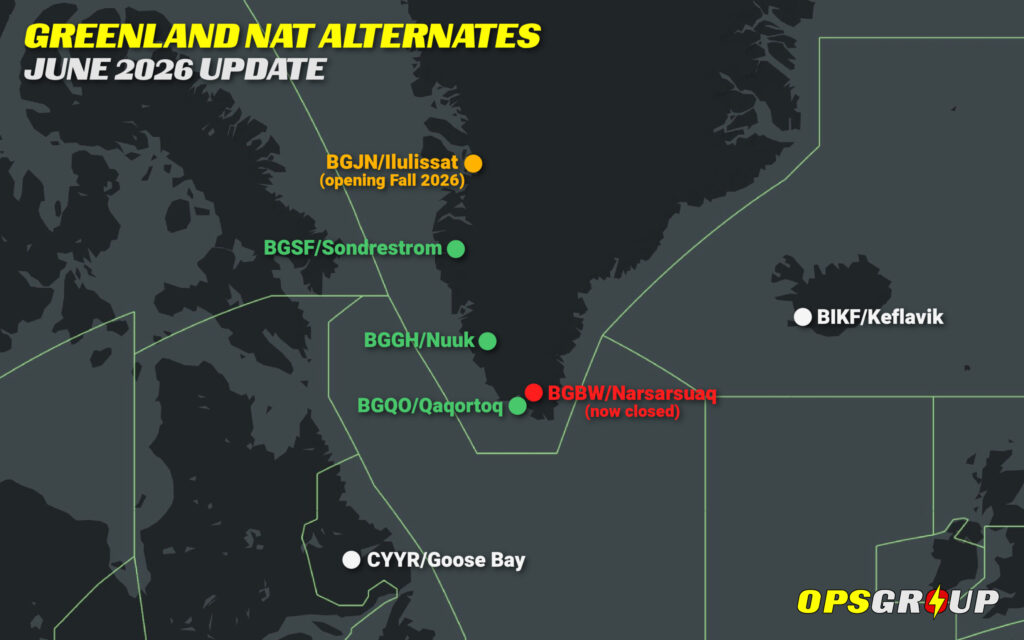
It has been a busy year of change for Greenland’s airports! Here is the current operational picture for the main NAT alternates as of December 2025.

BGSF/Sondrestrom

Plans to downgrade Sondrestrom from ATC to AFIS have been cancelled. In one of the shortest AICs we’ve ever seen, Naviair (Denmark’s ANSP) confirmed that BGSF would remain fully controlled until further notice.

Word from behind the scenes is that it was recently evaluated that ongoing demand for BGSF was solid enough to warrant full ATC.

However, radar service remains unavailable due to equipment issues, with procedural separation expected for the foreseeable future:

A1821/25 NOTAMR A1709/25
Q) BGGL/QCMAS/IV/M /A /000/999/6701N05041W005
A) BGSF B) 2510271014 C) 2601301700 EST
E) BGSF MSSR U/S. RADAR SERVICE UNAVAILABLE.

Other than that, BGSF continues to be a reliable NAT alternate thanks to its long 2800m runway and generally more stable weather conditions.

BGGH/Nuuk

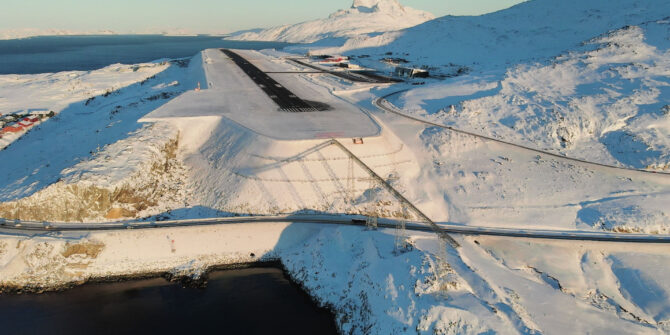
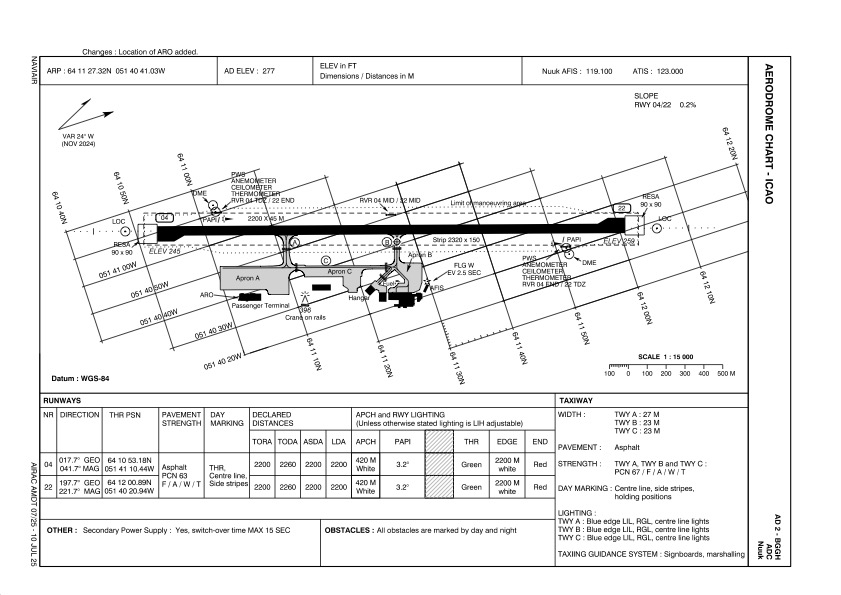
Nuuk has been extensively upgraded with a 2200m runway and precision approaches at both ends. It has been receiving heavy jet traffic for some time and is now well-equipped to serve as a NAT alternate.

However, the BGGH Notams put a lump of coal in your stocking. They say that no PPR or slots will be granted to GA (which GL airports have confirmed includes BizAv) until at least the end of Jan 2026. If you want to list BGGH as an alternate, they say you need to apply for PPR. Sounds like NAT flights needing a Greenland stopover should probably use BGSF/Sondrestrom or BGBW/Narsarsuaq instead.

We asked why, and apparently it was a decision made by the Danish CAA due to concerns over traffic. It’s not the first time Nuuk has struggled a little with its new-found size! Here’s a list of complaints we’ve received from members about BGGH over the past few months:

  • Slot confusion: Slots for BGGH must be requested via GCR to scr@airportcoordination.com, but the system is difficult to navigate – one member misread a rejection, flew anyway, and still found only light traffic despite the airport being considered “full.”
  • Last minute closures: Watch out for Notams which are popping up some days closing the airport for 30-min periods to accommodate specific one-off airline flights.
  • August security screening chaos: International flights were suspended on Aug 27 after Danish authorities halted security screening, citing non-compliant training of local staff. A United flight from Newark turned back mid-route and SAS cancelled services. Screening resumed the following day with certified staff flown in from Denmark.
  • Several other reliability issues: with members reporting unexpected holding, slow fuelling, and ground handling delays despite recent expansion.

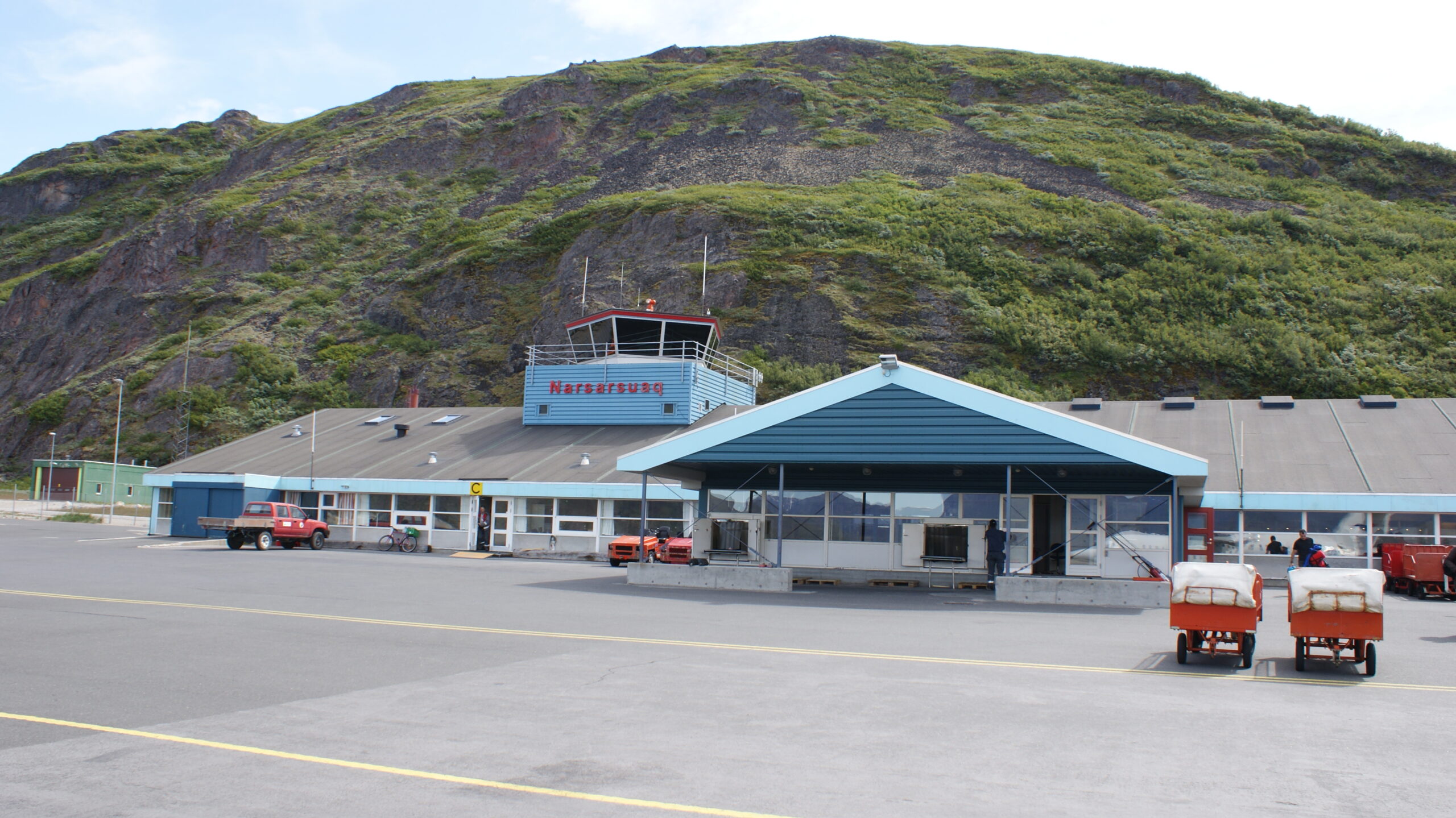
BGBW/Narsarsuaq

Narsarsuaq is still scheduled to close in Spring 2026 and will be downgraded to a heliport. Word on the street is May 1, but this may change.

Operationally, Narsarsuaq remains challenging due to non-precision approaches, frequent poor weather, and a short 1800m runway.

New runways at BGQO/Qaqortoq and BGJN/Ilulissat

Both strips are finished, but work continues on lighting and approach systems.

The new BGQO/Qaqortoq airport is on track to open in Spring 2026 with a 1500m runway. This will replace BGBW/Narsarsuaq as the southern airport option, though only for small to medium jets initially.

The new 2200m runway in BGJN/Ilulissat is due to open in Fall 2026.

A reminder about after-hours fees

Look out for surprise fees if you use BGBW/Narsarsuaq or BGSF/Sondrestrom as alternates after hours (overnight 20-11z or anytime on Sundays). You will be charged the better part of $3000 USD to keep standby equipment on watch, and runways clear of snow.

Some insider advice – advance notice reduces the cost. If you need one of these cheaper outside of normal operating hours, provide at least 24 hours’ notice.

A special thanks to our agent in the field

Spare a thought for the unsung hero of this article. The average low in Greenland at this time of year is 12 deg F (- 11 deg C). With wind chill, this can feel like -22 deg F (-30 deg C) or lower.

Apparently, high quality jackets are no joke – as evidenced below. Thank you for your help assembling this article!


Delhi GPS Interference: New Pilot Reporting Procedure

India’s DGCA has issued new pilot reporting rules after a week of GPS interference in the Delhi area.

In early November, crews approaching VIDP/Delhi saw navigation anomalies including false EGPWS warnings, incorrect position data and altitude errors – consistent with GPS spoofing.

Hundreds of flights were affected. ADS-B integrity in the Delhi TMA briefly dropped to zero, leaving ATC unable to rely on GPS-based surveillance.

The timing coincided with the temporary withdrawal of ILS for runway 10/28, which increased reliance on RNAV procedures.

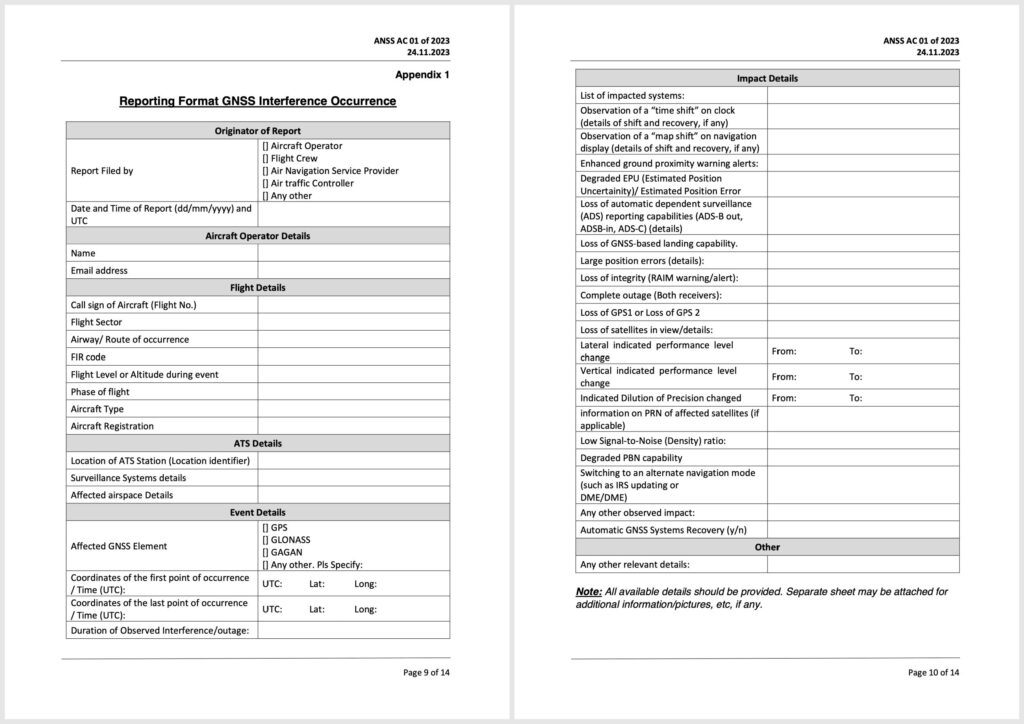
The paperwork trail

DGCA first outlined its GNSS-interference reporting process in a 2023 Advisory Circular.

On 10 Nov 2025, they followed up with a new SOP on GNSS Spoofing – which included the “report within 10 minutes” requirement.

Crews flagged parts of it as unclear, so on Nov 17, DGCA issued an Addendum to clarify exactly what pilots and operators must do!

What pilots need to do

If interference is detected before top of descent:

  1. Tell ATC as soon as possible.
  2. Notify your operator’s post holder (responsible manager) by any available means.
  3. The post holder must then notify DGCA immediately using the form below.

If interference is detected after top of descent, or only discovered after landing:

  1. Report it to the post holder as part of normal post-flight duties.
  2. The post holder must then notify DGCA using the same form.

DGCA emphasises that the goal is timely reporting, not enforcement!

What to expect

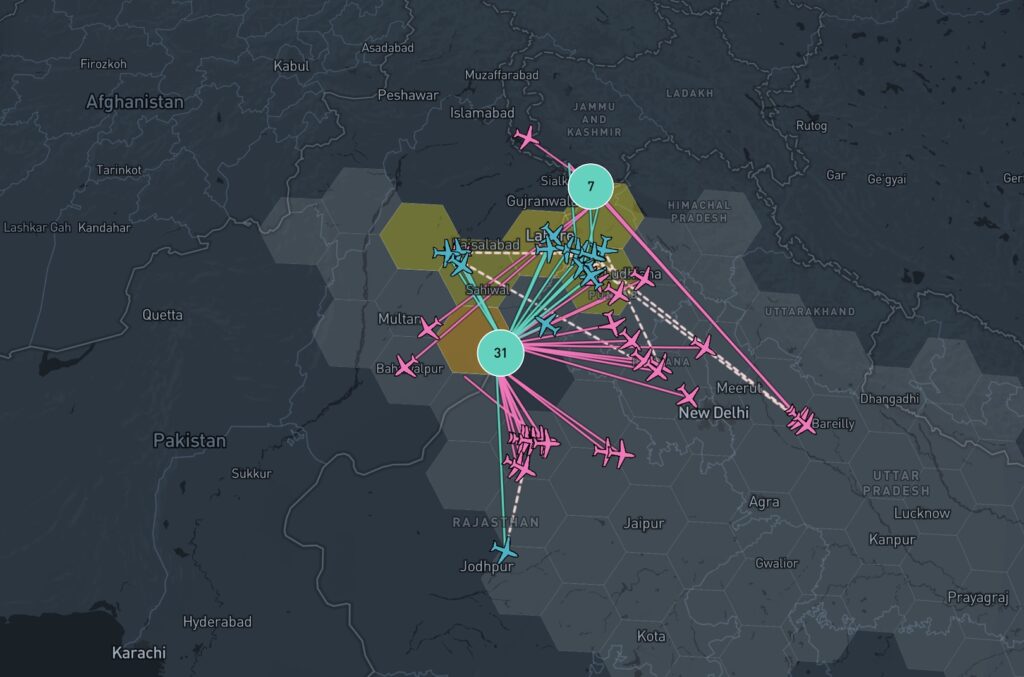
A reminder that GPSwise (powered by the experts at SkAI Data Services) provides a real time GPS Spoofing and Jamming map spanning the globe. You can access it here.

Their current data shows a steady interference patch northwest of Delhi. It isn’t constant, but it’s there often enough that crews should expect occasional GNSS issues when routing through that area and be ready to cross-check and revert to conventional procedures.


Sudan Risk Update: Aircraft Shot Down

Key Points
  • Following a military coup in April 2023, Sudan airspace remains closed to all civilian flights.
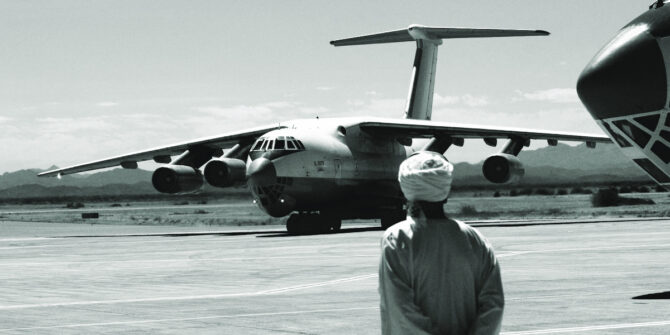
  • An Il-76 was reportedly shot down by a surface-to-air missile near Babanusa on Nov 4.
  • Multiple conflict-zone warnings exist due to the risk of anti-aircraft fire. The country should be considered dangerous at all levels.
  • A Contingency Plan provides limited overflight options via HSPN/Port Sudan, Egypt, Saudi Arabia and South Sudan (where ATC remains suspended above FL245).

Sudan’s airspace (the HSSS/Khartoum FIR) has been largely shut since 2023 and the risk profile has only worsened. Fighting around Khartoum continues, and the reported shootdown near Babanusa shows that overflights remain exposed. A US-backed truce has not reduced the threat environment.

Most operators are now avoiding Sudan entirely, routing through the published contingency corridors or staying in neighbouring FIRs. The lack of ATC above FL245 in South Sudan adds another layer of complexity for anyone trying to cross the region.

Here’s the updated risk briefing…

Context

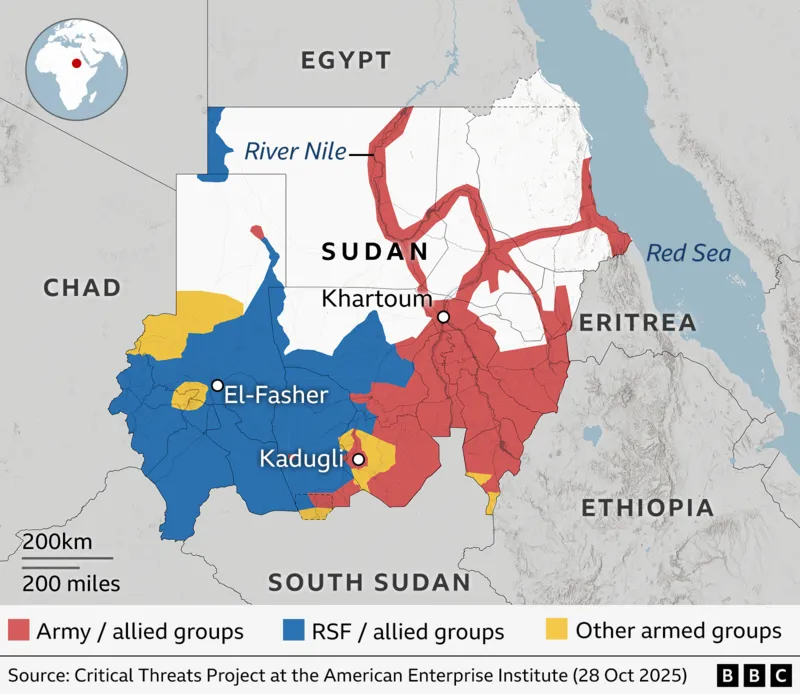
Sudan remains in a state of civil war between two major powers that used to rule together – the Sudanese Armed Forces (SAF) who control Port Sudan, and a paramilitary group called the Rapid Support Forces (RSF) who control most of Khartoum. You can read more about the background here.

The US Government (along with Saudi Arabia, UAE and several other states ) has been actively pursuing a truce that aims to stop the fighting, open humanitarian corridors and rebuild political stability.

Both SAF and RSF have said yes in principle, but not it seems in practice.

And that means risk to civil aviation will persist. There are several sticking points – SAF wants RSF withdrawn from major cities before anything starts. RSF wants overflight guarantees without any kind of intereference. Any neither is willing to budge yet.

Aircraft Shot Down

On Nov 4, 2025 an Il-76 transport plane of the Sudanese Armed Forces was reportedly shot down in West Kordofan state, southern Sudan by the RSF.

While the armed forces have indicated a structural failure of the aircraft’s wing was to blame, video footage appears to support the RSF’s claim that it was shot down using a short range air defence system of foreign origin.

If proven true, the incident underpins the presence of anti-aircraft weaponry in Sudanese contested airspace, and that even large transport aircraft are not immune to the risks of mistaken identity. Some intelligence suggests that this includes missile systems capable of reaching aircraft as high as FL500.

Conflicting claims about the incident show how unclear the situation is. Based on what we know, the highest risk is during daylight and in areas close to active fighting.

Recent Drone Strikes

On Nov 7, 2025 the RSF launched coordinated drone attacks against at least four cities: Atbara (River Nile State), El-Obeid, Al-Dailang and Omdurman (west Khartoum). Anti-aircraft fire was also reported.

This indicates that flight operations, especially arrivals and departures near the Khartoum region, face an elevated risk of indirect fire and missile activity. Secondary effects such as air-defence responses and unexpected diversions are also possible, particularly at low levels.

Bottom line: treat Khartoum/Omdurman and nearby airports as high-threat airspace. Even if an airport is “open” for domestic traffic, risk in the surrounding airspace remains dynamic.

Contingency Routes

Following the military coup in April 2023, Sudan remains almost entirely closed to all civilian flights.

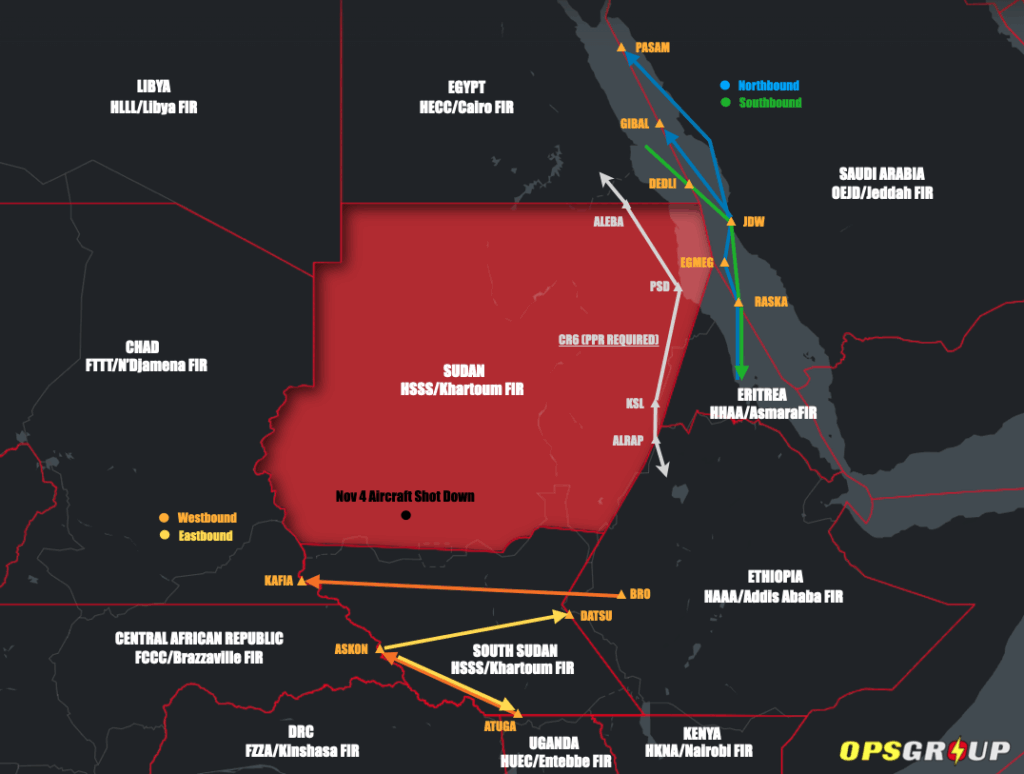
Sudan has declared its entire sovereign airspace a single restricted area called “HSR5”, and published contingency procedures for civil traffic. It contains three main options for overflights:

  1. One north-south overflight route in the far east of the country down over HSPN/Port Sudan airport.
  2. Some north-south diversionary corridors available via Egypt and Saudi over the Red Sea.
  3. Some east-west routes over South Sudan.

#1: North-South overflight route over HSPN/Port Sudan airport

They call this route ‘CR6’ – and it’s the only published track through Sudan’s restricted area HSR5.

It links the Addis and Cairo FIRs via ALRAP-KSL-PSD-P751-ALEBA. Levels are fixed for safety, FL320 northbound and FL330 southbound. There is no ATC separation, and prior permission is required.

Think of this as a narrow humanitarian corridor – it’s available but not intended to carry normal traffic.

The contingency plan points you to the Sudan AIP (GEN 1.2) for how to get permission, but the short version is this: operators must secure diplomatic clearance before the flight, and you can’t ask airborne. If you are allowed in, make sure you stick to CR6 like glue.

While technically possible, we advise extreme caution. What we don’t know are the safety margins applied to the contingency route or what may be unfolding beneath it.

#2 Red Sea Diversionary Corridors

These allow north-south traffic to move between the HECC/Cairo and OEJD/Jeddah FIRs without touching Sudan at all. They are the safest and cleanest option right now because you stay entirely within Egyptian and Saudi Arabian airspace, skirting the Sudanese coastline.

#3 South Sudan (KFOSS Routes)

KFOSS stands for ‘Khartoum FIR Over South Sudan’ and apply above FL245.

These routes allow for a safe(-ish) east-west crossing of South Sudan without entering Sudan itself. They’re RNAV 5, and mostly bi-directional. You report regularly, keep ADS-B and your transponder on and maintain 15-minute spacing.

One big caveat though – KFOSS routes are uncontrolled. Juba provides traffic advisories only.

Airspace Warnings

Several states (including the UK, France, Canada and Germany) maintain active airspace warnings that advise against entering the HSSS/Khartoum FIR at all levels due to risk of anti-aircraft fire and military activity.

For some reason, US operators technically have no legal restrictions as at the time of writing the FAA has issued no airspace advisories (Notams or SFARs) for Sudanese airspace.

Stay Updated

We will continue to report on any changes to the situation in Sudan as it develops. This includes our Safe Airspace website where you can view all active airspace warnings, along with those that exist in adjacent airspace. Our team keeps this updated around-the-clock.


Farewell, Paper Jepps

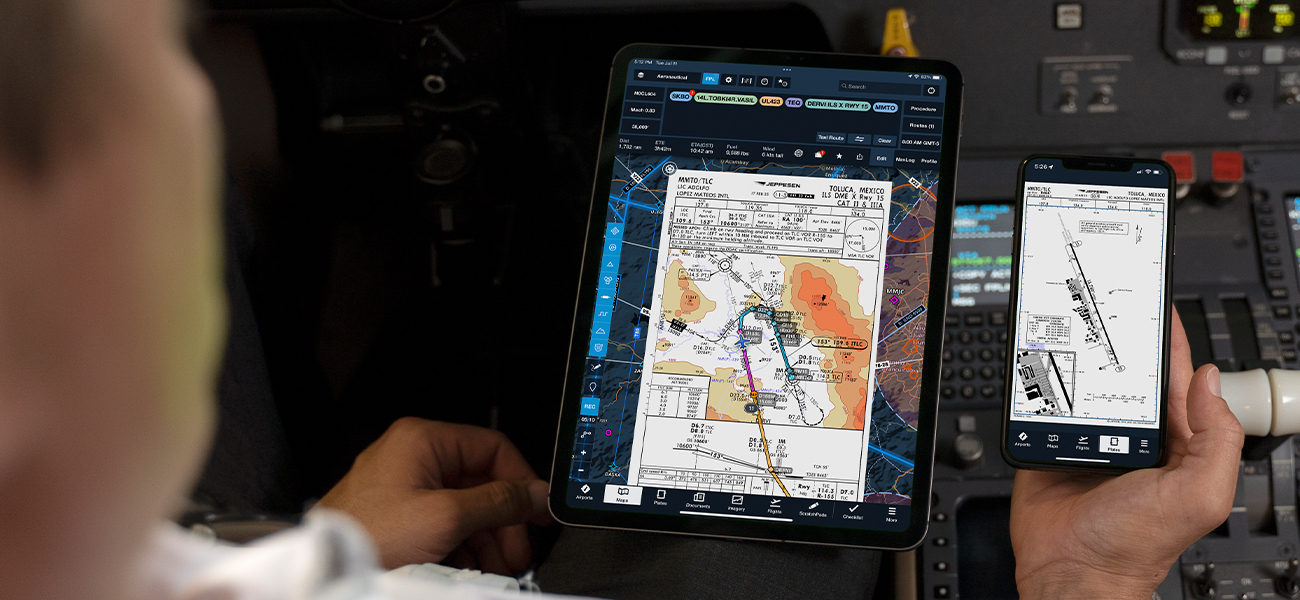
It’s the end of an era. After nearly a century of keeping pilots flipping, folding and cursing in cramped cockpits, Jeppesen is calling it a day on its paper chart service.

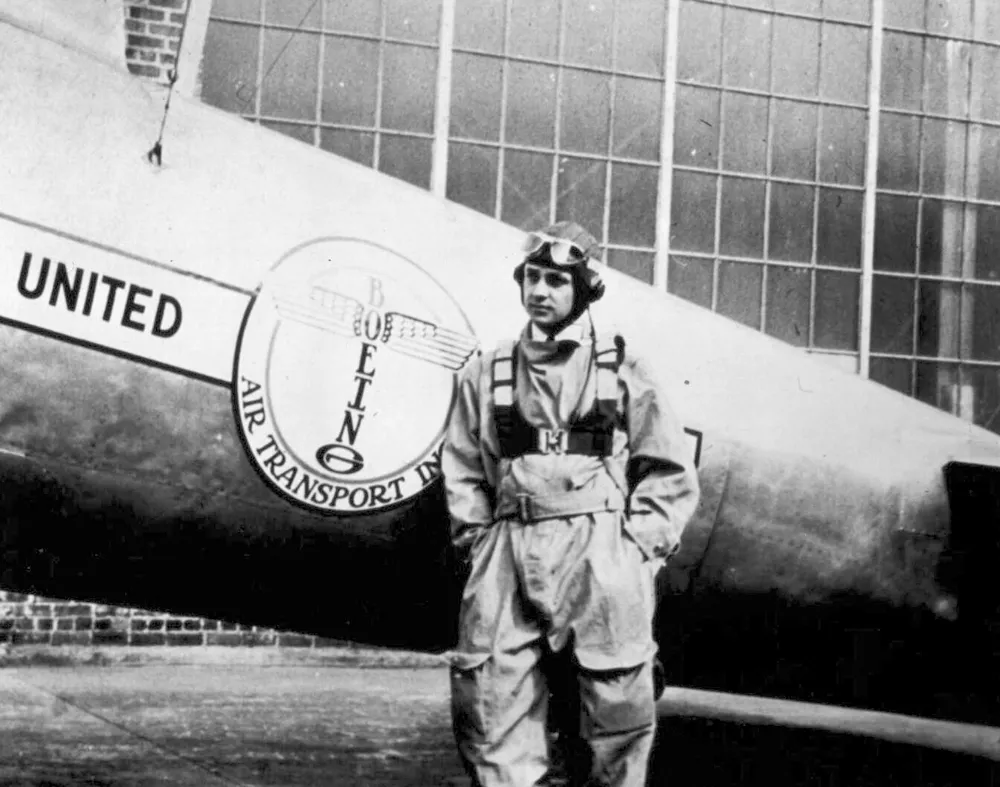
It will be retired by 31 Oct 2026, closing a chapter that began when Elrey Jeppesen first sold his little black book of hand-drawn airfield notes in the 1930s.

For many, it’s like losing an old friend. One that was heavy, expensive and always due an update. But it never froze, crashed or ran out of battery.

If you still like the feel of paper in hand, Jeppesen says a few options will remain…

Why end a good thing?

Essentially, cost. Paper chart operations aren’t cheap – printing, shipping, updates and physical inventory are all expensive. Something that Jeppesen itself refers to as the ‘growing costs of managing paper.’

The industry has overwhelmingly transitioned to digital charts thanks to the proliferation of EFBs, tablets and integrated avionics. And all good things must come to an end.

But what is the operational impact of this change? And how will you be affected if still using paper in the flight deck?

Operational Impact

If your operation still relies on paper Jepps, now is the time to plan ahead. The exact impact depends on what part of the law you operate under.

Part 91:

With the exception of Part 91K, Part 91 operators can switch from paper to digital charts without FAA authorisation.

But there are a few caveats:

  • The PIC must ensure that the electronic charts being used are current and accurate.
  • You’ll also need a backup (a second device or app). Printed charts also count (but obviously, you’ll soon need to print them yourself).

In other words, you can switch at your own discretion as long as you cover the basics above.

Parts 91K, 125, and 135:

The ‘pathway to paperless’ is a little more complicated.

All require OpSpec A061 that authorises EFB use. You’ll need to adequately show that there are procedures and training in place for crew, and that there is a backup plan for failures.

There will also need to be procedures in place for device mounting, power compliance and the update process.

For Part 91K operators, the lead time is typically 1-3 months. In the case of Part 135, this is longer. Most go through a ‘paperless transition’ period – operating with both paper and electronic charts until fully approved.

Part 121:

Most (if not all) are likely already approved for EFB use.

If there are any outliers still out there, a full formal approval is required. This typically takes 3-6 months.

This involves the airline submitting a detailed EFB program to the FAA’s Principal Operations Inspector.

The process is structured and lengthy and includes factors like power/heat analysis, training and other risk assessments. So much so that airlines have entire manuals dedicated to their EFB operations.

Jeppesen itself also provides solid guidance on this process.

I still want paper!

Fear not – it can still be done, just with a little more elbow grease.

Jeppesen will continue to sell it’s (blank) 7 hole-punch paper via its online store here.

Most popular EFB services (including ForeFlight and FD Pro) support user printing.


Beware Below: New Warning on QNH Errors

Two years have passed since we published our original piece on QNH errors, and the issue hasn’t gone away. In fact, there have been more serious incidents linked to incorrect altimeter settings below transition. Here’s what’s happened since then.

The Paris Near Miss

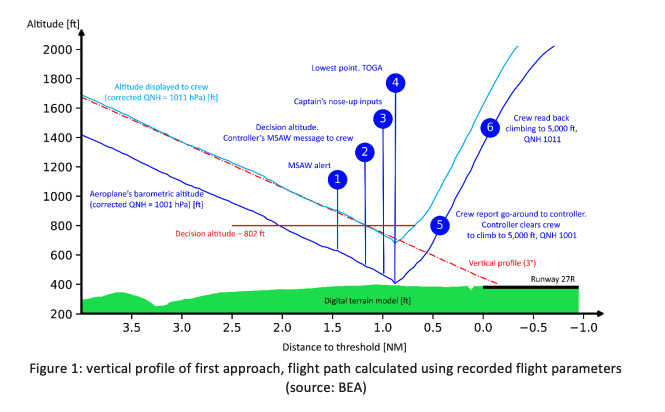
The final report is out on a serious incident at LFPG/Paris Charles de Gaulle in May 2022. An A320 was flying an RNP approach (LNAV/VNAV minima) in IMC when ATC passed the wrong QNH – 1011 instead of 1001, a 10 hPa difference.

That mistake meant the aircraft flew the approach about 280 feet lower than it should have. A ground proximity alert went off in the tower, but the controller got no reply from the crew.

At minima, with no runway in sight, the crew went around. The aircraft’s radio altimeter later showed a minimum height of just six feet – one mile short of the threshold.

The crew never realised. The wrong QNH made their instruments show they were higher than they actually were, so everything looked normal. The heights matched the chart, and EGPWS didn’t trigger.

They tried again, still with the wrong QNH set. This time they broke out and landed safely, again passing within a few feet of the surface before the threshold.

You can read the full report and safety recommendations here.

Updated EASA Guidance

On October 22, EASA reissued its Safety Information Bulletin (SIB) on incorrect barometric altimeter settings. You can download it here. It warns that QNH errors can not only lead to CFIT but also reduce separation from other aircraft, increasing the risk of midair collision.

This applies to all phases of an instrument approach, including the missed approach.

The SIB points out that QNH errors can creep in at several points – from how meteorologists determine it, to how ATC passes it, to what the crew actually sets.

The SIB contains some valuable recommendations for operators:

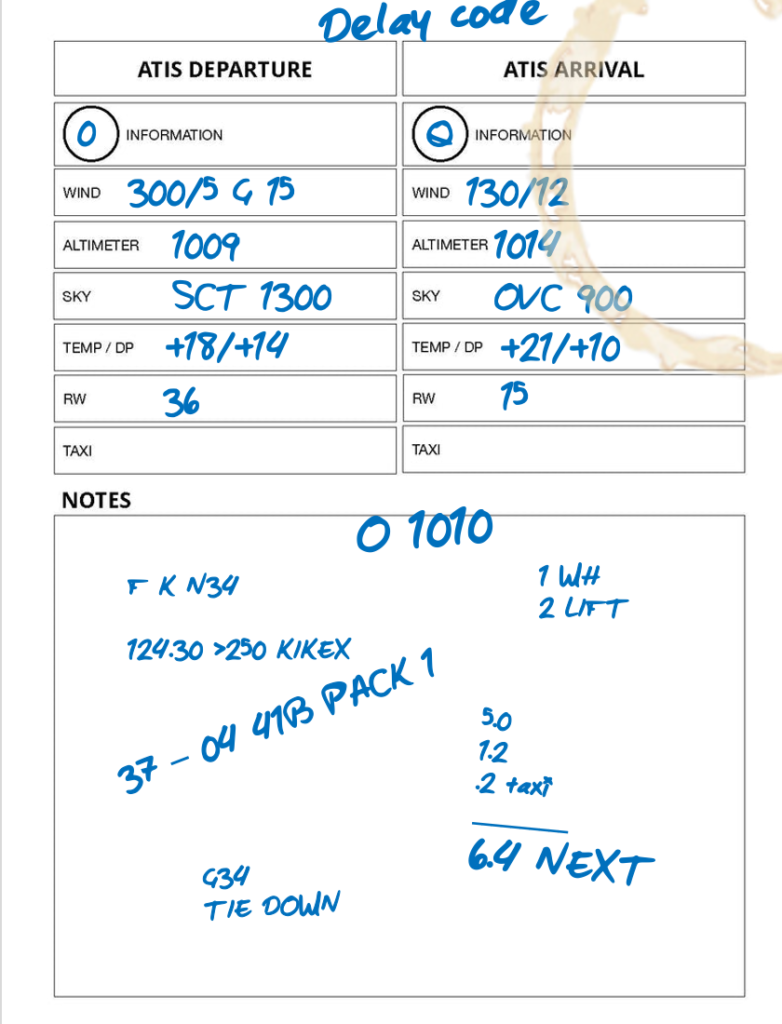
  • Develop SOPs to make sure pilots cross-check QNH from at least two independent sources (for example, ATIS and ATC). Don’t rely on handwriting or word-of-mouth!!
  • Assess these procedures, and hunt for ways in which errors may still occur. Then continue to refine them.
  • Use FDM or FOQA data to flag and investigate any altimeter mis-sets and learn from them.
Our Original Article

If you fly any baro-based approach (that’s most of them except ILS, GLS, or RNP to LPV) you need to know how a simple QNH mistake can put you below profile without you realising it.

Back in 2023, ICAO put out a warning about this. Here’s the quick version:

Key Points

  • QNH errors have led to several serious approach incidents.
  • Affected approaches: VOR, NDB, LOC, RNP, and RNP AR.
  • Main causes: bad data, misheard ATC calls, and cockpit workload.
  • Fix: raise minima, stick to SOPs, cross-check QNH from two sources, and speak up if it sounds wrong.

A Wolf in Sheep’s Clothing

An innocuous QNH error can easily place your aircraft hundreds of feet below profile in the final approach segment of a non-precision approach. And there may be very few signs – save for our eyeballs, our radio altimeter, or ultimately our EGPWS.

And perhaps the approaches most vulnerable to this threat are those which use BARO-VNAV – in other words, the use of our aircraft’s barometric altitude information to compute the aircraft’s vertical guidance.

The problem is that to fly these approaches safely, our altimeters must be accurate. That entirely depends on pilots setting the correct QNH. It is a simple task riddled with potential for insidious errors – something that no pilot (or controller) is immune to.

Which is why ICAO recently published a new Ops Bulletin on this very problem. They can’t fix it, but they can help mitigate it. Here’s a run-down on what they had to say.

Risky Business

If you’re reading this, chances are you have a reasonable idea about how an altimeter works. In the most basic sense, we calibrate these pressure-sensitive devices to provide an altitude above whatever datum we need them for – in most cases, sea level.

This essentially creates potential for two errors:

  1. Temperature: although this is less of an issue, because we can anticipate and correct for it.
  2. A mis-set: or in other words, rubbish in rubbish out. The altimeter doesn’t know if it’s telling you lies. In the same sense that a conventional clock doesn’t know that it’s wrong – it just runs from whatever time you set it to. The consequences of this type of error are far worse.

Final Approach

ICAO’s Bulletin focuses on the final approach (inside the FAF) simply because this is where altimeter errors become most critical.

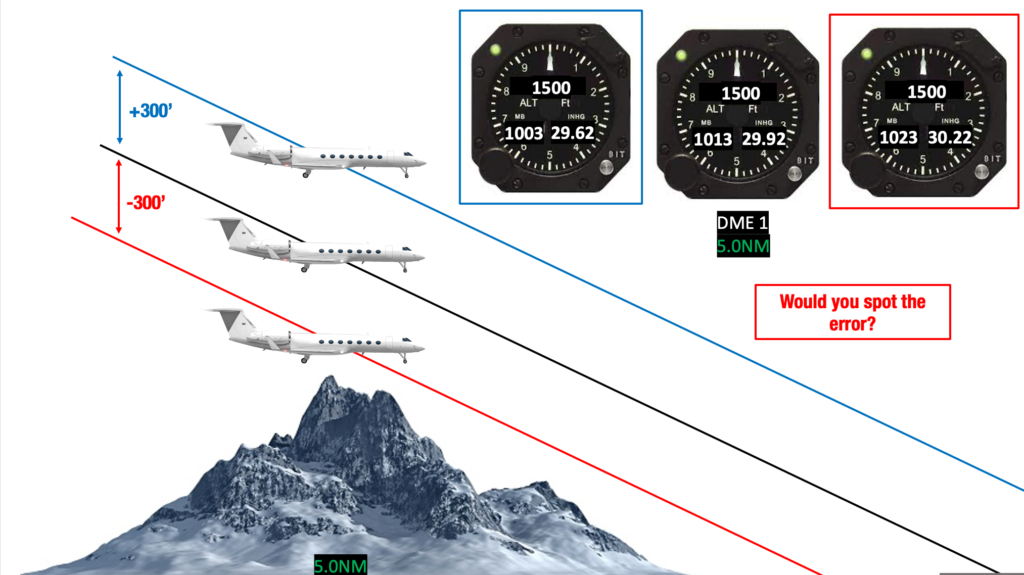
In this segment, ICAO-compliant procedures only guarantee a smidge less than 300 feet of obstacle clearance (ICAO Doc 8168 Vol II if you’re feeling bold). Interestingly, this almost perfectly correlates to an altimeter error of 10hPa…

Are you sure that 1023 QNH you just heard on that scratchy ATIS wasn’t actually 1013?

…it’s easy to see how critical errors can become. Like the example below:

Which approaches are affected?

It can be easy to get lost in the sea of acronyms out there. So let’s keep it simple:

Not vulnerable: ILS, GLS, and RNP to LPV minima. In other words, approaches that do not rely on barometric altitude to fly the correct profile. One gotcha tho – DA is still based on your altimeter. You may therefore go around early or late with an incorrect QNH but the profile itself will still be correct.

Vulnerable: Everything else – including VOR, NDB, LOC, RNP, and RNP (AR).

Why are QNH errors happening?

ICAO has some ideas:

Bogus Data: This may be incorrect information supplied by a met service provider, corrupt hardware on the ground or even by assuming area QNH will be close enough to airport QNH.

Chinese Whispers:Don’t underestimate the power of what you think you heard. This can happen anytime we are relying on voice to communicate safety critical information. It’s not just pilots either – ATC may not pick up that your read-back was incorrect. If you fly internationally, the language barrier can also be a challenge. Even domestically we form habits of talking at speed on the radio. If there is any doubt, use the phrase “Say Again Slowly.”

Workload: Have you ever been in this boat? You’re passing through transition, changing to an approach frequency, slowing to 250kts, securing the cabin and trying to run an approach checklist….all at the same time. Depending on where the transition level is (for example, FL110 in Australia) it can clash with your other flight deck duties. Crew confusion, miscommunication and even finger trouble can come into play here.

What can we do about it?

Consider other approaches: iI there’s an ILS or similar available and conditions are poor, consider using it instead.

Think about minimas: ICAO suggest raising your minima particularly if you are unfamiliar with an approach type.

Stick to the SOPs: and cross check. Treat QNH like that stove you think you left on every time you leave for a multi-day trip. Become paranoid and find that error. Cross-check the QNH across multiple sources – at least two independent ones for each and every approach.

Don’t forget to ask yourself – is it sensible? A good way to cross check this is by comparing the ATIS QNH to the TAF or METAR QNH. If there is any doubt, confirm it with ATC.

Be especially suspicious of anything hand-written: If you’ve obtained a QNH by voice, make sure you have both independently heard it.

Don’t forget other sensibility checks: Terrain permitting, your radio altimeter may give you an early clue that all is not right – especially if you’re over flat terrain or water.

ICAO also suggests that ATCOs and ANSPs have a role to play too: It’s little beyond the scope of this article, but you can find that info in the very same bulletin.

Have a story to tell?

Please share it with us in confidence. You can reach us on team@ops.group.


Spoofed Before the NAT? Here’s What to Do

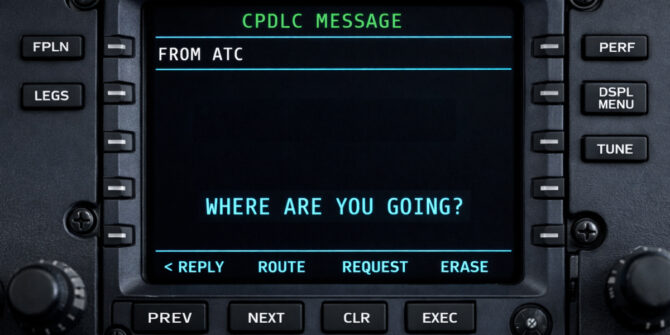
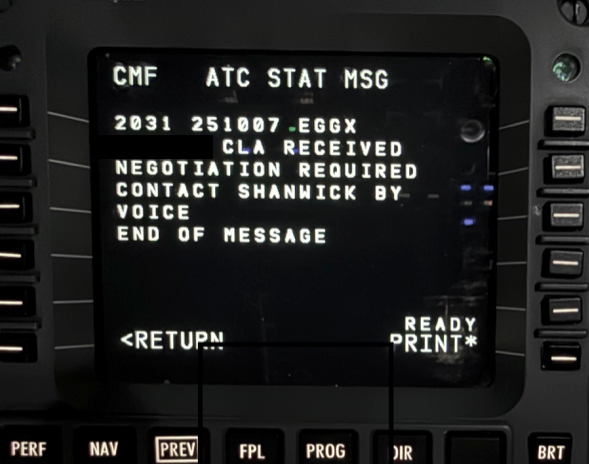
An OPSGROUP member on a recent westbound NAT flight from the Middle East received the following message via CPDLC:

The crew contacted Shanwick via HF, who requested their RNP capability and operational status.

The controller explained that due to their point of departure (OMAA/Abu Dhabi) they wanted to be certain the aircraft had not been contaminated by GPS jamming or spoofing before it entered oceanic airspace.

It’s been a while since we wrote about this procedure, and since then we’ve had this NAT Ops Bulletin published by ICAO telling operators what to do on the NAT if they’ve experienced jamming/spoofing, so we reached out to NATS directly for an update. Here’s what they had to say…

Defensive Measures

NATS reported they continue to receive a large number of flights every day that have been impacted by GPS interference prior to oceanic boundaries.

The issue is that once an aircraft’s navigation system has been ‘contaminated’ by bad GPS data, it may not be possible to recover full RNP capability in flight, even if the normal GPS signal is restored.

These aircraft may no longer meet RNP 4/10 accuracy required in the NAT HLA, even long after the trigger event occurred.

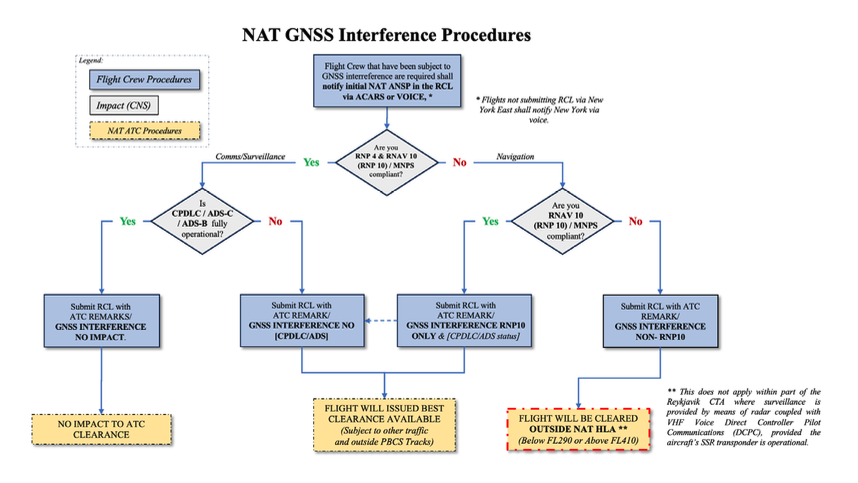
The NAT Ops Bulletin which was published back in Jan 2025 requires crew of NAT-bound aircraft that have encountered GPS interference to notify their first NAT ANSP via RCL. Even if your aircraft shows no lingering effects, ATC still want to know.

NATS advise that late notification by pilots of a RNP degradation (such as approaching an oceanic entry point) greatly increases controller workload. They often need to move other aircraft out of the way to provide increased separation (in some cases from 14nm to 10 minutes), it’s a big deal.

As a result, they are employing defensive controlling measures. Based on previously spoofed/jammed flights and regions of known risks, they may proactively contact flights assessed as higher risk to confirm status before entry – although the exact selection criteria isn’t public. Increased separation will be applied until normal navigation performance is confirmed by the pilots.

In a nutshell, this is why the OPSGROUP member received the message above.

A special thank you to NATS for their help in answering this question.

Jammed or spoofed? You need to let your NAT ANSP know

The NAT Ops Bulletin we keep mentioning – this provides the guidance for NAT traffic on how to manage GNSS interference. Here it is again, so you can’t miss it! ⬇️

Key takeaway from this: If you suspect or know that your aircraft has encountered any kind of GPS interference (both jamming or spoofing), NAT-bound traffic must let their first NAT ANSP know in the RCL – even if the aircraft appears to have recovered.

This is prefixed by ‘ATC REMARKS/GNSS INTERFERENCE’ and must include details of any system degradations.

A few messages to keep handy are:

‘ATC REMARKS/GNSS INTERFERENCE NO IMPACT.’

‘ATC REMARKS/GNSS INTERFERENCE NO CPDLC/ADS’

‘ATC REMARKS/GNSS INTERFERENCE RNP 10 ONLY’

‘ATC REMARKS/GNSS INTERFERENCE NON-RNP10

By including your status in the RCL, you are giving ATC a head’s up before you arrive.

In most cases, you will still be allowed in the NAT HLA. A loss of RNP 4 isn’t a deal breaker, as you can still enter under RNP 10. But your clearance may be less optimal (likely level changes) due to the increased separation from other traffic.

The big one to look for is a loss of RNP 10. You will not be cleared into the NAT HLA, and instead will need to remain below FL290 or above FL410. With an obvious fuel impact, this may lead to an unplanned diversion.

The Bulletin includes a handy flow chart that’s worth printing and keeping in your flight bag.

Latest ICAO Feedback

The latest three-yearly ICAO Assembly was held in Montreal from Sep 23 – Oct 3.

During the event, ICAO issued its strongest condemnation yet of both Russia and North Korea, directly blaming them for deliberate GNSS interference in violation of the Chicago Convention. Russia, in particular, has been blamed by ICAO for destabilising navigation across European airspace.

We continue to receive regular reports from OPSGROUP members of both jamming and spoofing. Interference is now a regular occurrence in the Baltic region, particularly around Kaliningrad, Eastern Finland, the Baltic Sea, and nearby airspace. Other reports have been received from Germany, Poland and Norway.

Recent airspace incursions, airstrikes and drone activity associated with the ongoing conflict in Ukraine have almost certainly escalated the use of GPS interference as a defensive measure. Civil aviation will continue to operationally grapple with this hazard. With no obvious solution in site, our best defence remains procedures like the one detailed above.


Airspace Violations: Spillover Concerns in Eastern Europe

Key Points
  • The last two weeks has seen a significant increase in Russian military activity near NATO borders, including several confirmed airspace violations involving both drones and aircraft.
  • This has been reported in Poland, Romania and Estonia. While these kinds of airspace incidents are not new, the recent spike in frequency and intensity is cause for concern.
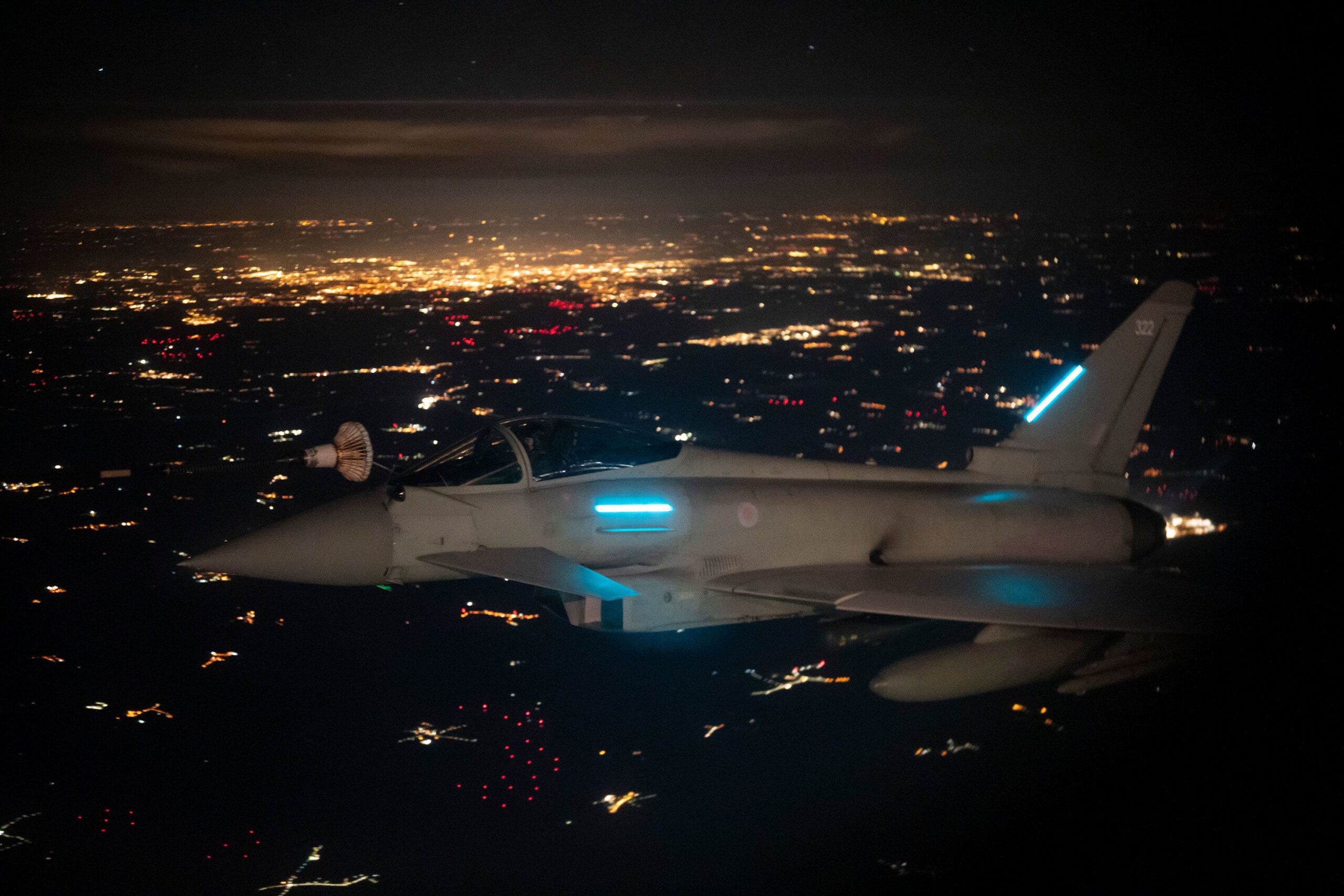
  • NATO has responded in the region by scrambling jets, enhancing surveillance, and deploying additional defensive resources along its eastern borders.
  • These events may have increased risks for civil aviation, including collision hazards, potential for escalation, activation of air defence systems and GPS interference.
Major Incidents

September 9-10: Poland (EPWW/Warsaw FIR)

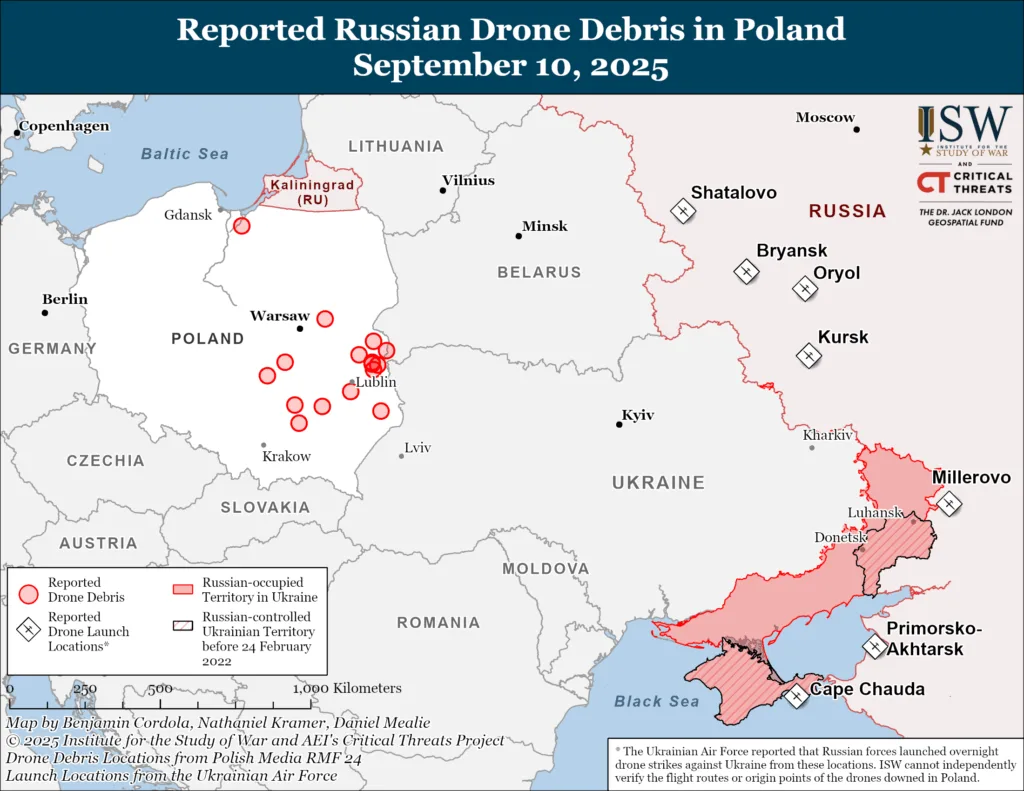
During a Russian missile and drone attack on Ukraine, multiple Russian drones violated Polish airspace.

They were detected across eastern, central and northern Poland with some reportedly entering via Belarus.

Polish and NATO fighters were scrambled, and several drones were shot down.

Poland described the event as a major provocation. It invoked Article 4 of the NATO treaty – a move that triggers emergency consultations with other member states.

This was an important political response. While Article 4 does not commit NATO to collective defence, it does require formal discussions when a member state feels its security is under direct threat.

September 13: Romania (LRBB/Bucharest FIR)

A single Russian drone breached Romanian airspace  near the Danube River during strikes on nearby Ukrainian targets.

It reportedly loitered for around 50 minutes before exiting back towards Ukraine.

Romanian and NATO fighters responded, but no weapons were fired due to concerns about collateral damage in populated areas below.

September 19: Estonia (EETT/Tallinn FIR)

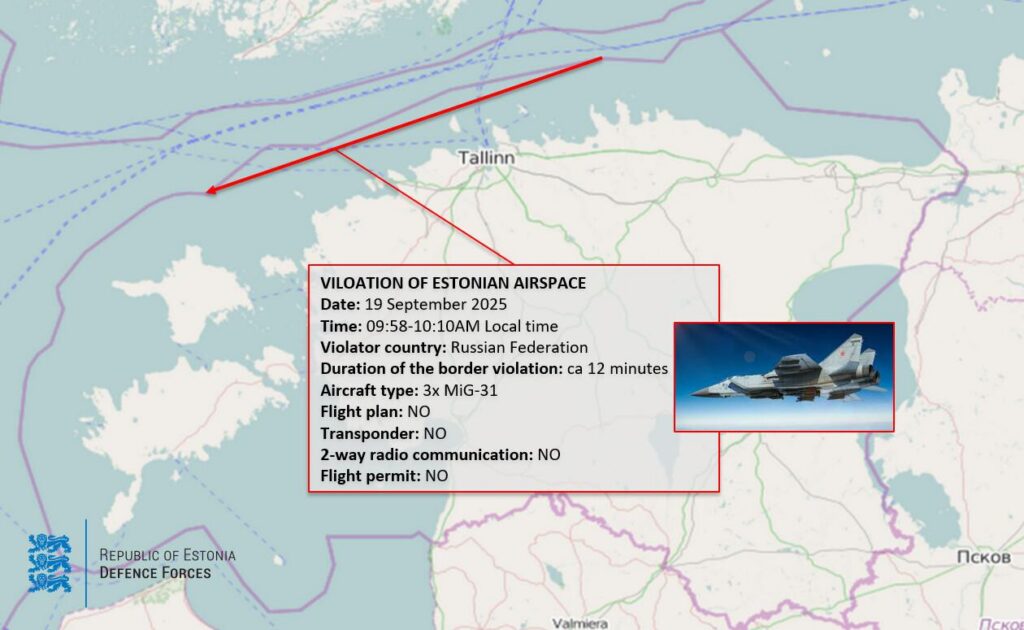
Three Russian MiG-31s allegedly entered Estonian airspace for about 12 minutes without authorization near Vaindloo Island in the Gulf of Finland, close to the boundary with Russian-controlled airspace.

The jets flew without flight plans, transponders or ATC contact for approx 12 minutes. NATO jets were dispatched to intercept them, before the Russian jets exited the area.

Estonia invoked Article 4 following the incursion.

NATO Response – Operation Eastern Sentry

On Sep 12, NATO launched Operation Eastern Sentry to bolster its posture along the eastern flank.

This mission involves ongoing fighter patrols, improved radar surveillance, and reinforced air defence systems along NATO’s eastern border.

The specifics of this deployment aren’t available, but the operation’s purpose is to detect and respond rapidly to any further violations.

Why Russia might be doing this

Analysts suggest there may be several possible motives:

  • Testing NATO’s responseviolations can be used to gather intel on detection and reaction times, radar coverage and interception procedures.
  • Posturingsignalling strength and willingness to challenge NATO in a show of force.
  • DistractionDiverting NATO resources away from other interests (such as the conflict in Ukraine).
  • DeniabilityMaintaining ambiguity by blaming navigation errors, or claiming operations only occurred in neutral airspace.

What’s the bigger picture?

Tensions have risen along NATO’s eastern boundaries in recent weeks, raising safety and operational concerns for civil aviation. Even if an outright conflict is still unlikely, these violations complicate de-escalation and increase the frequency of spill-over risks.

Flight operations in this region need to monitor the situation closely for changes – history has shown that just because airspace is open, doesn’t mean it is safe.

Key risks for operators

Collision hazards – Military aircraft operating without transponders in high-density airspace can create serious risks for civil flights – especially in Baltic states and Poland where major routes between Western Europe and Scandinavia exist.

Airspace disruption – When interceptions occur, ATC may need to rapidly clear surrounding airspace causing re-routes and unexpected fuel burn to enroute aircraft.

Sudden Escalation – A full confrontation between NATO and Russia is unlikely in the near term. However, recent lessons in the Middle East have shown us that sudden closures of FIRs can be a realistic consequence of a deteriorating political situation. This can occur in hours, not days.

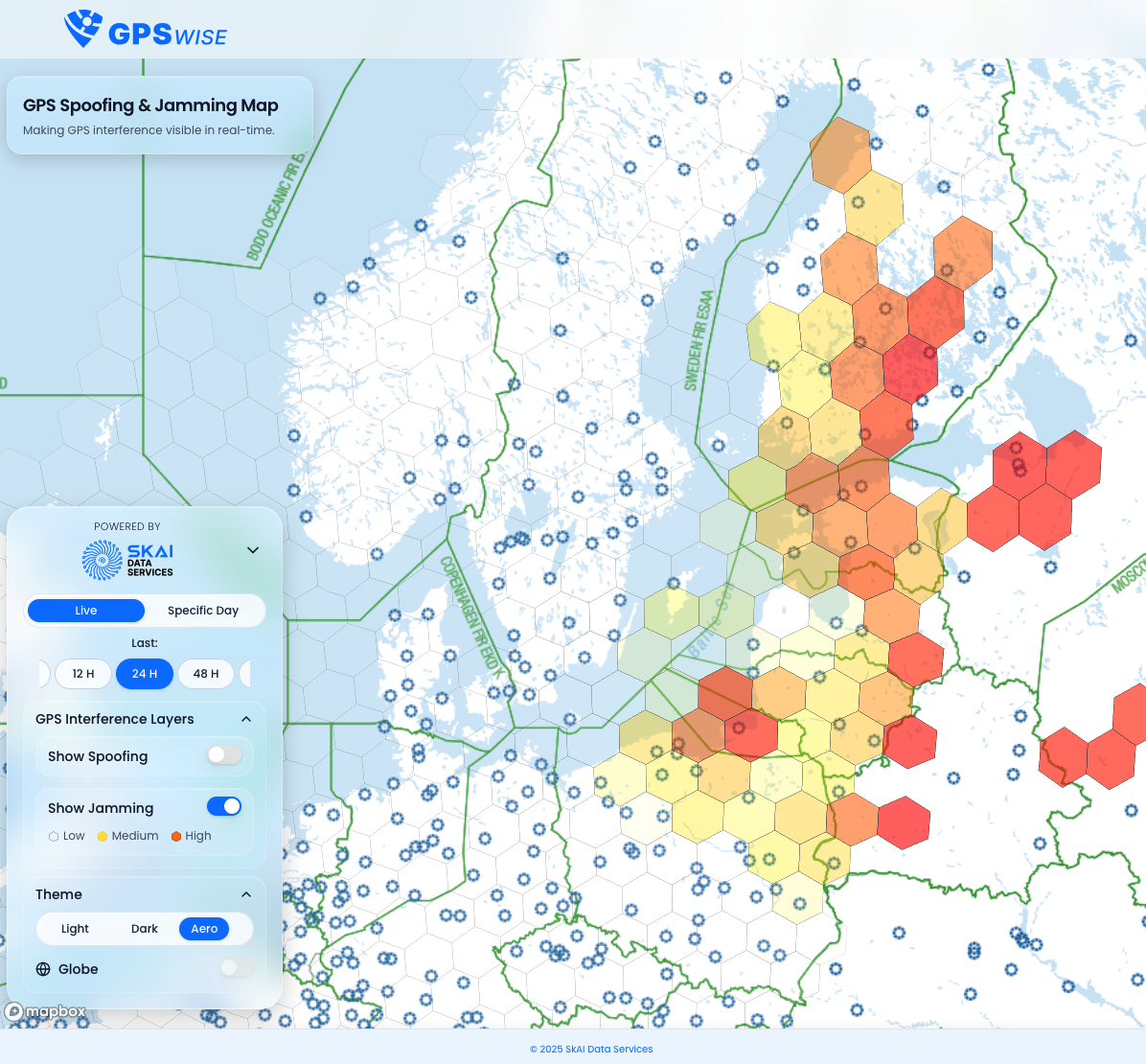
GPS Interference – Russian-origin jamming is frequently reported in the region, often traced to areas like Kaliningrad and St Petersburg. The team at SKAI Data Services kindly provided us with the following data map of recent jamming and spoofing recorded in the area -a special thanks to their team.

Stay Informed

We continually monitor global airspace for changes to risk and security at safeairspace.net. There, you can find up-to-date state-issued warnings for areas bordering Russian and Ukrainian FIRs. You can also reach the team directly via blog@ops.group.

Dishing the Dirt on Aircraft Trash

We’ve had a few reports from OPSGROUP members lately about issues with how international aircraft trash is handled when arriving in the US.

In one case at KMIA/Miami, a handler said that CBP asked them to track the tail numbers of any aircraft that disposed of trash after leaving the customs ramp. If this happens, CBP may issue fines—and if handlers don’t report it, they could be held responsible instead.

While there’s no sign of any new rules, it’s a good reminder of how strict the existing requirements are and how expensive it can get if you don’t comply.

So, what exactly counts as regulated garbage, and how should it be handled?

What Counts as “Regulated Garbage”

Certain waste can carry animal diseases or pests into the US. The USDA and APHIS require this type of trash to be handled under strict rules (CFR Title 7 330.400 – 402, and CFR Title 9 94.5.).

Regulated garbage includes:

  • Any food waste, fruits, vegetables, meats, or other plant/animal products.
  • Anything that has touched those items—like packaging, napkins, or utensils.

Time limits matter:

  • From any foreign country in the past 2 years.
  • From Hawaii or US territories in the past 12 months.

You’ll need to pass this trash to a USDA-approved service so they can dispose of it.

What Isn’t Regulated

  • Trash from Canada-only flights.
  • Clean items like magazines or unused paper towels.
  • Sealed, unopened US-origin food that hasn’t been contaminated.
  • Empty cans or bottles for recycling only if they’ve never touched food waste.

Important: If clean trash gets mixed with food waste, it becomes regulated. So bag international food waste separately and don’t let it mix with clean trash!

Common Questions

Q: I’m arriving from Hawaii or a US territory. Does this apply?
Yes. USDA/APHIS rules apply to trash arriving from outside the Continental US – be careful if arriving from Hawaii or other US territories abroad (Guam, Virgin Islands etc). You may have taken off from American soil, but the rules still apply.

Q: What about Alaska?
Alaska is considered part of the continental US for this purpose, and so trash from Alaska flights isn’t regulated.

Q: My catering came from a pre-clearance airport like EINN/Shannon. Am I exempt?
No. Pre-clearance doesn’t simply let you bypass the disposal rules. Some exceptions do exist but these require certificates/inspector actions and strict conditions. In practice, pre-clearance alone will not free you from regulated garbage rules. Apparently diseases and pests care not for our paperwork!

Enforcement: Why Miami Came Up

While USDA and APHIS make the rules, CBP enforces them at ports of entry.

Enforcement can vary by location, and some airports take a “treat all trash as regulated” approach to keep things simple.

If you want to keep unregulated trash separate, you’ll need:

  • Clear, documented segregation.
  • Advance notification to the customs inspector.
  • Records of who you coordinated with (including badge numbers).

Otherwise, CBP can assume non-compliance and issue fines.

Safest bet: Treat all international trash as regulated and dispose of it at the customs ramp.

More Questions?

Get in touch with us on blog@ops.group. For USDA/APHIS garbage and quarantine inquiries, email ppq.fsis.mail@usda.gov or AskUSDA@usda.gov. You can also find contact details for CBP at your intended arrival airport here.


Pilot vs Crew: ID Confusion in Nice

We’ve had a few reports from crews facing problems at LFMN/Nice because their ID cards said “PILOT” instead of “CREW.” In one case, a delay caused a missed slot. Other incidents have been reported elsewhere, such as LSGG/Geneva. The issue isn’t just a matter of wording—it’s about how rules are being applied differently to EU and non-EU operators.

Why the Confusion?

At the heart of this is EU security law:

  • EU-based crews: Under EU Reg. 2015/1998, airport authorities are right to insist on IDs that show “CREW.” Section 1.2.4.1 requires this wording in English, along with a validity date and other criteria. IDs showing “PILOT” do not meet the EU requirement.
  • Non-EU crews: These rules don’t apply to you. Instead, you must meet your own national crew ID requirements. ICAO provides guidance in Annex 17 and Doc 8973, but leaves specifics to each country. This means ID formats can vary widely, which sometimes leads to problems at European airports.

Reality at LFMN/Nice

Despite the legal distinctions, local security often applies a simpler standard—they just want to see “CREW” on the badge. If your ID lacks it, you could face delays, requests for extra docs (licence, passport), and additional paperwork from your handler (Signature advise that in the case of flight attendants, they will need to be listed as PAX on the Gen Dec if their IDs are not accepted).

Some members report that using IDs from services like IBAC or CrewID has avoided problems entirely.

What Should You Do?

  • EU crews: Ensure your ID meets EU requirements—“CREW” must appear.
  • Non-EU crews: Even though it’s not legally required, consider carrying an ID with “CREW” clearly displayed. It can save you time and hassle. And just brief your handler in advance if you think your ID might raise questions.

Have Something to Report?

We rely on member reports to discover these kinds of issues. If you have some extra info, chances are it will be a huge help to other operators.

Please get in touch with us on blog@ops.group around the clock.


Cybersecurity in Aviation: Growing Operational Risk

Aviation is under fire

A recent study recorded a 600% increase in attacks on the aviation sector year-on-year. 71% of these involved credential theft or unauthorised access to critical systems.

The FBI also warned on June 28 that a cybercriminal group called ‘Scattered Spider’ had turned its attention toward the aviation sector, using impersonation to compromise security.

Protecting ourselves from these attacks has become a multi-million dollar industry.

High profile attacks in recent months have impacted both Aeroflot and Qantas, the latter likely carried out by none other than Scattered Spider – the group the FBI are worried about.

The FAA is paying attention

There has been a response to this growing risk.

There is an obvious intent to include cyber security in future regulations. While not yet law, recent advisories and bulletins make it clear that operators are expected to begin taking proactive steps.

A good place to start is AC 119-1A which provides an overview of cyber security requirements, risk assessments and best practices. Also keep an eye out for cyber threat alerts which can be published by SAFO, Notam or other notices.

The FAA is also actively working with ICAO and other agencies to harmonise future cyber protection practices under Annex 17 (Security).

What about business aviation?

The examples above relate to attacks on larger airlines and IT infrastructure. A valid question remains then, what does this all mean for biz av?

While not a traditional target, many business aviation operators lack dedicated IT departments or cyber defence teams. We also frequently carry high-net worth individuals on sensitive operations which may motivate nefarious cyber activity.

Recent reports from the industry show that biz av isn’t immune:

In 2020, a major manufacturer of business jets confirmed a cyber-security breach that compromised personal and aircraft ownership information.

Another example from May this year involved a Europe-based private jet operator which appeared on a ransomware group’s leak site. Sensitive crew info was shared, which reportedly included passport photos.

It’s clear that business aviation is not under the radar – therefore we must remain measured but cautious in our approach to emerging cyber threats.

EFBs – A Soft Target?

Feedback from industry experts and OPSGROUP members suggest that a closer look at the electronic security of EFBs warrants a closer analysis.

Eye-opening research, such as the work conducted by Cyber Security Consultancy Pen Test Partners, has highlighted that EFBs could act as an additional gateway for cyber crime if not correctly managed.

Look out for an dedicated article on this subject soon.

An extra tip – don’t forget your SMS

If your flight department operates under an SMS, it may be wise to include cyber security.

This means treating digital threats like any other hazard – reportable, measurable and mitigable.

It’s important we take steps now to keep our operations secure.


Emerging Airspace Risk: Cambodia & Thailand

Update: July 28

Good news: Cambodia and Thailand have agreed to an immediate and unconditional ceasefire starting midnight local time on Monday July 28 (1700Z), following five days of intense fighting along their shared border. Both sides have committed to reopening communication lines and setting up a monitoring mechanism to maintain the truce.

While this is a major step toward de-escalation, the situation remains fragile – caution is still advised near the border region.

There are no changes so far to the Phnom Penh FIR danger area (SFC–UNL). VDPF Notam A0092/25 remains active.

Original Article: July 25

Key Points

  • A sudden military escalation began on July 24 along the central portion of the Cambodia–Thailand border, around 100–150 NM north of Siem Reap.
  • Both sides accuse each other of firing first. Thailand has carried out airstrikes using F-16s.
  • A danger area now extends along much of the border, SFC to UNL. Overflights may face elevated risk from unannounced military activity, including GPS interference.

Background

Cambodia and Thailand’s long-standing border dispute has flared since May, when a Cambodian soldier was killed in a skirmish. In the weeks since, alleged landmine incidents have endangered Thai troops.

Political turmoil in Thailand has added to the crisis – its Prime Minister was suspended after a leaked call with Cambodian leaders linked to the dispute.

By July 24, the conflict had escalated into one of Southeast Asia’s most serious military confrontations in over a decade, involving airstrikes, heavy artillery, and mass civilian displacement.

Danger Areas

Thailand and Cambodia have both issued Notams (under the VDPF/Phnom Penh FIR and VTBB/Bangkok FIR codes), activating danger areas across a large portion of the shared border at all levels.

What’s notably absent from the Notams is any mention of the reason behind the danger area activations: an escalating conflict on the ground.

Cross-border fighting has involved heavy artillery and military airstrikes. Unannounced military activity poses potential risks to civil aviation at all levels – including from air defense systems and GPS interference.

We advise caution in the open airspace above.

High altitude airways affected include:

North/Southbound

R345 – the airway connecting VDSA/Siem Reap with northern Thailand.

Y2 – connects southern Cambodia with northern Thailand.

These routes are currently off-limits, as they pass through the main danger areas.

West/Eastbound

A1/Y16/Y13 – airways connecting the Bangkok airports with eastern Thailand and Vietnam. The danger area here only extends up to FL200, with airline traffic still transiting these routes.

At time of writing, there are no new state-issued airspace warnings concerning either Thai or Cambodian airspace.


Heat Damage in Nice: When APU Rules Damage Aircraft

Key Points
  • APU use is limited – only allowed 10 minutes before TSAT, and only after towing.
  • GPU reliability is shaky – some units failed or had to be replaced during operations.
  • Heat may be damaging systems – OPSGROUP member reports of aircraft experiencing electrical failures, suspected to be caused by overheating while waiting without APU or proper cooling.

Recent reports from OPSGROUP members highlight growing concerns over the strict APU restrictions at LFMN/Nice.

Like many French airports, LFMN restricts APU use – aiming to cut noise and emissions. But as summer peaks on the Riviera, enforcement remains rigid despite the operational challenges this creates in high heat.

Beyond hot cabins, new concerns have emerged: potential electrical damage linked to the airport’s fixed ground power units (GPUs). Reports submitted to the airport remain unanswered. Here’s what we know so far.

A Little Context

Private jet flights at LFMN primarily use the ‘Kilo Apron.’ This is the designated parking area for BizAv close to FBO facilities.

The rules for APU usage are found under the airport briefing in the French AIP. Specific guidelines apply to the Kilo Apron:

  • Arriving flights must stop on a designated line labelled ‘STOP ENGINE AND APU.’ From there towing to your parking spot is mandatory.
  • Departing flights must be towed to start-up stands fitted with 400Hz/28v ground power units, along with air. APU usage is limited to 10mins prior to TSAT (Target Start-up Approval Time).

Exemptions are very limited. You either need to be operating a medivac, state or cargo flight (carrying temperature sensitive payload). Or if the plug isn’t compatible with your aircraft.

Recent Member Reports

Here are three recent member reports received from OPSGROUP members there.

Report 1:

After towing to Stand 35, the crew connected to the fixed GPU. CAS messages flickered, followed by complete electrical failure and aircraft blackout. Despite heatwave conditions and an overheated crew, APU start was denied. A portable GPU was brought in – but it was dead. When permission to start the APU was finally granted, it was too late: navigation and communication systems had already failed. The aircraft departed under MEL and required expensive repairs at the next stop. The ramp agent advised us to file a report, which we did. According to them, this wasn’t the first time such an event had happened.

Report 2:

Another crew experienced a similar issue. One of two FMS units failed after GPU connection. While the cause wasn’t immediately clear, the symptoms matched those described in the earlier report. The unit was removed for repair.

Report 3:

The GPU caused a fault on our GVII upon disconnect. Our FA that understands French overheard ground personnel stating “it’s too hot” in reference to the GPU. Surface temp at time was 24C so it was the equipment. Had to shut down aircraft to dark and restart to clear fault and get a new CTOT 40 mins later.

Potential GPU Issues

While we can’t confirm the GPUs are the direct cause, it’s plausible. Aircraft systems are sensitive, and power issues — including frequency drift, incorrect voltage, poor grounding, or surges — can trigger serious failures.

Heat may be a compounding factor. Ground air units often underperform in high temperatures, especially if hoses are blocked or airflow is weak. Aircraft may exceed thermal limits before crews can start APUs or get adequate air.

The GPUs themselves may also struggle in heat – output may sag or drift, or thermal protection systems may shut them down.

All of this increases operational risk – especially when APU use is restricted with no flexibility for safety.

And, despite being mandatory, GPU usage at LFMN comes with a charge.

If you’re going to enforce the rules on APU usage in summer there needs to be some flexibility for the operational safety of multi-million dollar aircraft and their crews. Quiet airports are great, but it’s easy to forget we are customers. In fact, Nice is the second busiest airport for business aviation in France, second only to Paris Le Bourget.

Mitigators

Following an alert issued to the group regarding these reports, another member (also a fully qualified pilot and aircraft engineer) got in touch with some practical advice to operators.

Here is what he had to say:

I thought it would be prudent to post some operational hints and tips to avoid problems like this event in the future. Not just with LFMN, but with any hot weather destination with restricted APU use (i.e. most  of Europe).

Most biz jet hydraulic pumps demand very high KVA from the GPU’s – avoid/delay applying hydraulic power to test systems and parking brake until APU start is approved.

Keep all the shades/sun shields drawn until packs are available.

Dim all the display units in the cockpit until air conditioning is available.

Open cargo and main door to allow air flow throughout the cabin. Small fans can run off the GFI plugs.

Open gear doors on some models as the exhaust for the avionic cooling fans use the wheel wells as the exit point.

Has this happened to you here, there, or elsewhere?

Please get in touch with us via blog@ops.group. We’d love to hear from you.

For ops at LFMN, if you identify a GPU issue (malfunction, incorrect configuration, electrical hazard, emissions), report it via your handling agent to the airport’s operations or safety department, or directly to Aéroports de la Côte d’Azur: +33 4 08 20 42 333, or via this contact form.


Greenland NAT Alternates: July 2025 Update

⚡ July 2025 Update

Radar services at BGSF/Sondrestrom will be ending around Nov 1, 2025. From that point, only procedural (non-radar) separation will be available. Iceland’s ADS-B offers some situational awareness over Greenland but can’t be used for control.

This follows the planned downgrade from tower to AFIS at the airport between Aug-Oct, driven by reduced traffic as BGGH/Nuuk expands. All controlled airspace will become Class G, with a radio mandatory zone within 20 NM below 7000ft, and FISCOM available via Nuuk FIC after hours.

RWY 27 is typically used for departures and RWY 09 for arrivals – be especially careful of opposite direction traffic. AIC 01/25 has more info.

⚡ June 2025 Update

The extensively expanded BGGH/Nuuk is now open, and receiving regular jet traffic.

With an operating length of 7218′ (2200m) and ILS approaches available for both runway ends, it is now a solid choice for NAT enroute alternates (and ETOPS/EDTO if that’s your thing). The Greenland AIP has been updated, and you can find the current airport chart here. Both runway and apron PCNs are 67/F/A/W/T .

The airport has an AFIS on watch Monday to Saturday, 09:00 – 18:00 LT (11:00 – 20:00z) with RFF Category 5.

For handling, contact Greenland Airports: nuuk@mit.gl

Original Article

Each day thousands of aircraft routinely cross the NAT and use airports in Greenland as enroute/ETOPS alternates – mainly BGSF/Sondrestrom and BGBW/Narsarsuaq.

It’s big business for Greenland’s major airports, but over the next few years major changes are coming that will directly impact on the operational use of these airports as NAT alternates.

Here’s the lowdown on what’s changing:

  • Opening: BGGH/Nuuk (Nov 2024), BGQO/Qaqortoq (Spring 2026), BGJN/Ilulissat (Fall 2026).
  • Changing: BGSF/Sondrestrom downgrading ATC to AFIS (Aug – Oct 2025).
  • Closing: BGBW/Narsarsuaq (likely Spring 2026).

ETOPS Airports…

Before we get stuck into the finer points of what’s changing at each airport, a big question many will have is: “What airports can I use as enroute/ETOPS alternates?”

Answering that is tricky, because it will depend on a number of factors that will be different for each operator – if the airport has a long enough runway for your particular aircraft / the necessary facilities and services / the minimum approach procedure / fire cover / weather minima etc.

But here’s a quick reference table showing what’s changing, and when, which might be helpful:

BGGH/Nuuk

Nuuk’s found on the western edge of Southern Greenland, close to the NAT HLA. It’s Greenland’s capital city but until now, the airport has not been ‘capital-sized’.

Hence why larger aircraft have not considered BGGH/Nuuk as a viable alternate due to its short runway length (3,050’/930m) in addition to poor weather and the mountainous terrain that surrounds it.

But things will soon get easier. A major expansion has been underway since 2019 to replace its aging runway and improve the airport infrastructure to accommodate the wide body airliners of the territory’s flagship carrier who are relocating their hub there.

28 Nov 2024 has been earmarked as its full re-opening – just weeks away. A new runway will now measure 7,200’/2200m. Better yet, ILS approaches will be operating at both ends with much lower minimas. A new terminal building, tower and apron are already in use.

If you have any doubts as to Nuuk’s viability as a well-equipped NAT alternate, it may be reassuring  to hear that at least one US legacy carrier will also commence scheduled services to the improved airport from Newark twice a week from mid-next year.

Keep an eye out for an upcoming OPSGROUP briefing on the new and improved Nuuk soon.

BGQO/Qaqortoq

A new airport will be opening in Spring 2026, 35nm away from Narsarsuaq on Greenland’s southern tip.

Right now Qaqortoq is a heliport (operating under a different ICAO code), but will re-open with a 4,921’/1500m runway due to a decision by Greenland’s government a few years back to convert it for fixed wing traffic.

At that length Qaqortoq will likely only be an option for small to medium sized jets, but there is also room for future expansion to 5,905’/1800m – so watch this space in years to come. Word on the street is that it will also be equipped with both LOC and RNP approaches.

BGJN/Ilulissat

A new international airport is under construction which will be equipped with a 7,217’/2200m runway. It’s scheduled to open in Fall 2026 and will replace the existing domestic airport. By in large, it will be equipped with the same equipment as the upgraded airport in Nuuk.

Next up, a look at what’s happening at the existing airports BGSF/Sondrestrom and BGBW/Narsarsuaq…

BGSF/Sondrestrom

The much-improved airport in Nuuk will undoubtedly take a heavy toll on traffic levels at Sondrestrom – in the vicinity of a 90% reduction.

But all is not lost for BGSF as a solid NAT alternate – it will continue to operate, with almost full services available with one notable exception – ATS will be downgraded to an AFIS sometime between Aug – Oct 2025.

The runway (9,186’/2800m) is longer than Nuuk, and the weather much more predictable – it should remain a solid option to consider. 

BGBW/Narsarsuaq

The airport is scheduled to close in 2026! 😱

Despite its geographical convenience to NAT traffic, it remains a difficult option. For some, it is considered only in the case of extreme circumstances (such as fire).

The reason for this is predominantly weather, and the non-precision approaches that serve the airport. The runway itself is also short at only 5,905’/1800m.

Reminder – Look out for Surprise Fees

We’ve written about this before, but worth a reminder.

Be careful – if you file BGBW or BGSF as an alternate after hours (overnight 20-11z or anytime on Sundays) you will be charged the better part of $3000 USD for the privilege of keeping standby equipment on watch, and runways clear of snow. Even if you don’t actually divert there.

A little insider advice – advance notice will reduce the cost as it allows for cheaper planning. If you need one outside of normal operating hours, provide at least 24 hours’ notice.

For regular use, operators can also apply directly for a reduction in these rates.

Know more about changes to Greenland Ops?

We’d love to hear from you. You can reach us via news@ops.group


FAA Housekeeping: Foreign Instrument Procedures, Approach Chart Clutter

Recently, the FAA has been doing some spring cleaning. You might have missed them, but recent changes to the FAA’s advisory circulars and charting notices are quite important.

This article covers two of them:

  • Effective June 2025, the FAA officially shifted the responsibility for evaluating and approving foreign instrument procedures to aircraft operators themselves.
  • From October 2, instrument approach charts will be decluttered by removing unnecessary comms data.

Let’s take a look at each of these in more detail.

Removing approvals for specific foreign procedures

Recently, the FAA advised those operating under Part 91(K), 121, 125 and 135 of changes to foreign instrument procedure authorizations.

It has removed outdated references to specific foreign instrument procedures by title from operator authorizations (OpSpec C058, C358 and H107).

Others were simplified (C059, C060, and C384) to remove references to specific foreign airports and procedures.

The end result? Operators are no longer required to obtain FAA approval for specific foreign instrument procedures listed by name — but they must still hold the required FAA authorization (OpSpec, MSpec, or LOA) to conduct the type of procedure (e.g., RNP AR, CAT II/III), regardless of where it’s flown.

So, does this mean I can now fly any foreign procedure without FAA involvement?

Not quite. While you no longer need FAA approval for each individual foreign procedure, you still need FAA authorization for the procedure type and must comply with host country requirements.

For instance, if Germany requires local authorisation for an RNP (AR) approach into EDDM/Munich, you must obtain it without FAA involvement.

ICAO (Annex 6) says operators are still required to obtain approvals when the host state mandates it, and crews must comply with any local procedures or limitations.

Why the change?

Without delving too much into the specifics, there are a few reasons:

  • Less paperwork – foreign procedural reviews are cumbersome and labor intensive, and lead to delays in approval.
  • Less workload – inspectors no longer have to approve each foreign procedure individually.
  • Improved design – there has been significant improvement in procedural design around the world thanks to the proliferation of ICAO PANS OPS.
  • Empowerment – operators can perform their own risk assessments and use globally standardised instrument procedures without the extra weight of FAA approvals.

So the onus is now on the operator – what next?

That’s where AC 120-105B comes into play. It provides guidance for US operators on reviewing and accepting foreign instrument procedures outside the US.

This includes a list of your areas of responsibility, recommended tools and checklists to help with your review, and advice on incorporating a review process into your company’s manuals, SOPs and pilot training.

If you operate abroad, it’s important you’re familiar with this revised AC. We’ve also put together the following checklist based on its advice to help get you started:

De-cluttering Approach Charts

On July 3, the FAA issued a new charting notice (advance notification of significant changes to charts and publications).

The news is that from October 2, the FAA will begin removing redundant comms data from instrument approach charts. This includes departure ATIS, CLNC DEL and the availability of CPDLC if all of this is shown on the corresponding airport diagram.

Listing it again on instrument approach charts is unnecessary and can reduce readability during critical phases of flight while critical frequencies remain prominent (don’t worry, tower and ground ain’t going anywhere).

While we have you, a couple more FAA-related tidbits to brush off the table.

  • Notams. Big changes are coming to the US system. By September, it will be completely overhauled. The new system will be a fast, cloud-based, and (hopefully) rock-solid stable. A renewed focus on improved safety throughout the US NAS has escalated the project, and the targets are ambitious – user testing is expected to start later this month.
  • FAA-license holders abroad. This is our last reminder! July 7 has come and gone, which means anyone holding US licences/ratings and living outside of the US must have provided a US based address for service to the FAA via the USAS portal. If you haven’t yet, your license is effectively now invalid until you do – whatever you do, don’t operate an aircraft while un-licensed.

Have we missed a spot?

Please get in touch with us around the clock via blog@ops.group


Lithium Battery Fires, New Safety Alert: What Are The Rules For Part 91?

The risk of lithium-ion battery fires on aircraft is on the rise, with vapes, power banks, and laptops identified as the main culprits.

The FAA has reported a sharp rise in incidents, with some sources noting two thermal runaway events per week. EASA also raised concerns, issuing a new Safety Bulletin on May 27.

While rules are strict for Parts 121 and 135, private flights under Part 91 face fewer restrictions. Arguably, private jets are more at risk, and we’re doing less to protect ourselves.

  • Business jets are smaller. A lithium-ion battery fire can quickly fill the cabin with thick, toxic smoke – up to 10 cubic meters from a single laptop battery in just two minutes. History has shown that smoke inhalation often causes the loss of an aircraft in a fire before the fire itself.
  • Fewer crew members.With only one or two pilots and often no cabin crew, response capability is limited.
  • The passengers we carry. Biz jet passengers often carry multiple personal electronic devices which increases fire risk. Some passengers may disregard or not correctly follow safety rules.
  • Less safety equipment.Compared to airliners, biz jets typically have fewer fire suppression tools and less protective gear on board.

It seems clear that for the few rules that exist for Part 91 operations, we must be aware of them, and stick to them. And it may come as a surprise to some operators that these rules are more strict when you fly internationallyeven privately.

So here’s a rundown of what you need to know.

A word about lithium-ion batteries

If you’re already familiar with a Wh rating, feel free to skip to the next section. But to understand the rules properly, it helps if you’re familiar with it first.

Watt on earth is a watt-hour (Wh)?

When we talk about how dangerous a lithium-ion battery could potentially be, we talk watt-hours. It is a measure of how much energy a battery can store and use. Think of it like the amount of fuel in a tank – it simply tells us how much power (watts) it produces over time (hours).

It also directly proportional to fire risk. If something goes wrong, all that energy can be released as heat and gas. The more in the tank, the bigger the fire.

The higher the Wh, the hotter the flames, the thicker the smoke, and critically – the harder it is to put out.

Righto, onto the rules for US Part 91.

Part 91

For domestic flying in the US under Part 91, the rules for lithium-ion batteries are pretty simple.

If the batteries are being carried for personal use, Part 91 operators are (almost) entirely exempt from the US D.O.T. HAZMAT regulations that apply to commercial flights. But it’s not a free-for-all.

The PIC is still prohibited by law from carrying hazardous items onboard an aircraft in a way that might endanger people or things. This includes knowingly carrying defective batteries or packing them in a way that is dangerous or irresponsible.

Baseline safety guidelines still apply, including FAA Advisory Circulars (AC 91-78, AC 120-76D) -along with relevant Safety Alerts for Operators (SAFOs). Deviation from these can expose the operator/PIC to legal liability in the case that something bad happens.

Here’s a summary of those:

Installed batteries (in devices):

Carry these without restriction if they’re properly secured within the equipment, show no visible damage (like swelling or leakage) and are turned off.

Spare batteries:

These must be carry-on.

  •  Little ones (100Wh or less): There’s no limit on the number carried, but each one should be protected from short-circuits (case, sleeve, taped terminals or original packaging).
  • Bigger ones (101 – 160Wh): FAA guidelines say no more than two per person. These must be individually protected using the same precautions above.
  • Biggest ones (161Wh+): Not allowed without full HAZMAT compliance and operator approval. Requires UN spec packaging, shipping papers, training etc. BE CAREFUL – some higher end power banks exceed this limit.

International operators beware!

Here’s where things get a little tricky.

Once you leave the US, some authorities no longer recognize the distinction between Part 91 (private) and other commercial flights.

Foreign authorities may enforce local rules for the batteries you carry – regardless of your Part 91 status. These are usually based upon IATA Dangerous Goods Regulations. Reportedly, this includes China, Thailand, Korea, India and the UAE.

In other words, what was acceptable in the US may not be once you’re abroad.

Foreign handlers may refuse to load spare batteries that don’t comply with IATA standards, while customs and ramp safety officers may demand battery specs and proper packaging – especially for devices like power banks, drones, camera gear and e-bikes. Devices may be confiscated if they do not comply with local guidelines.

The best solution? Just comply with IATA standards from the outset.

Where do I find these regs?

If you want to get technical – they’re defined in ICAO Doc 9284 (ICAO Technical Instructions for the Safe Transport of Dangerous Goods by Air), and further refined under the IATA Dangerous Goods Regulations.

These include packing instructions, required documents, limits of watt hour ratings, the quantity of batteries, labelling and distinctions between passenger and cargo aircraft.

Three million pages of DG-related dread building? Worry not. We’ve put together a quick checklist of requirements/suggestions for Part 91 operators to help them stay out of trouble when carrying batteries outside of the US:

Fire containment

You might already have fire containment bags onboard, but there are other types of containment devices worth considering.

Some of the newer hard-sided designs offer features like hands-free collection, blast protection for the user, and the ability to inject water to help interrupt thermal runaway. Check out this one!


These boxes aim to reduce the risk to crew during an incident and address some limitations of soft bags, which can be difficult to use safely without two people – a challenge on smaller aircraft operating under Part 91 or 135. With recent incidents showing how violent lithium battery fires can be, having an effective containment method onboard is increasingly important.

Don’t forget to report

For Part 91 private flights, the US FAA requires operators to report any case of battery fire, smoke, overheating or thermal runaway aboard an aircraft within 72 hours. The form for this is DOT 5800.1.

ICAO may also require a report if the event qualifies as a serious incident or accident. You are not required to report directly to IATA – it’s only voluntary.


FAA License Holders Abroad – You’ll Need A US Address Soon

June 10 update – look out for imminent medical renewals!

If you’re due for a medical soon, you might already need a US address in the USAS portal. Although the official FAA deadline to add a US agent for service is July 7, an OPSGROUP member recently discovered that MedXpress would not let him complete the pre-exam form without it. Since MedXpress and the USAS portal now talk to each other, the system checks for that US address before allowing you to proceed. Without it, you will not get the confirmation number needed for your medical.

Key Points
  • The FAA has published a new rule that will require certificate holders abroad to nominate a physical US address for service.
  • This is required from April 2 for any new applications; and July 7 for anyone who already holds FAA certificates, ratings or authorizations.
  • Anyone who ignores the new rule will be unable to exercise the privileges of their documents.

What’s Changing?

115,000 (give or take) FAA certificate holders currently live outside of the US.

Back in Oct 2024, the FAA issued a new rule requiring anyone with no US physical address on file to nominate a US Agent For Service.

This agent will be responsible for receiving all documents from the FAA on the certificate holder’s behalf – including legal and safety-critical stuff.

It’s already been postponed once, but there are now two deadlines for individuals with a foreign address and no physical US one on file:

  • April 2 for new applications.
  • July 7 for existing certificate holders.

The FAA is having problems serving documents to the large number of FAA certificate holders living abroad.

By using US-based agents, this process will be a lot faster and easier. Especially in the case of larger overseas-based flight departments.

Who will this apply too?

Anyone with a foreign address (and no US address on file) who holds or applies for FAA certificates, ratings or authorizations under the following parts of 14 CFR  – 47, 61, 63, 65, 67, 107.

Who can be a ‘US Agent For Service’?

It’s not as complicated as it sounds.

The new rule (CFR 14 3.302) says this can be any entity or adult (18yo+) with a US-based postal address.

One big gotcha though: this must be a physical address – PO boxes and mail drops are no-good.

It’s important you nominate someone you trust. They will be responsible for promptly forwarding you any FAA documents and must fully understand the importance of this task.

You’ll also need to provide the FAA with their full name, phone number and a working email address.

If there isn’t already someone in the US you know and trust, it may be worth engaging a professional service to be your agent instead.

What if I just ignore this rule?

Don’t! If a certificate holder fails to designate a US postal address or Agent of Service by the above dates, you will no longer be able to exercise the privileges of that document. You will effectively become unlicensed.

Another big scary rule – the FAA Enforcement and Compliance Order 2150.3 – says other enforcement actions can be taken including fines and jail time.

How will I designate my agent of service?

Via a new portal called the US Agent for Service System (USAS).

This will allow you to nominate your agent and provide all required contact details via the online prompts.

Don’t forget you will also need to keep the system updated with any changes.

I live in the US, does this affect me?

Long story short, no. As long as the FAA has your physical address on file you’re good to go!


Three Ways To Escape From New York

Key Points
  • If you’re flying out of the New York area, expect delays. ATC staffing and tech issues, along with heavy traffic, are causing slowdowns.
  • But there are three lesser-known routing options (SERMN, Deep Water, TEC) that can get you airborne faster – if you’re willing to fly lower, carry extra fuel, and meet a few added requirements.

In the middle of last year, the FAA transferred control of Newark’s airspace from New York TRACON (N90) to Philadelphia TRACON’s Area C due to a shortage of staff.

And it hasn’t been smooth sailing. Philly itself is understaffed, and has reported several failures recently with data sent from New York via aging copper lines affecting both radar and communication equipment.

Recent murmurings from OPSGROUP members indicate EDCT delays are rife – even at outlier airports. We’re talking hours here, not minutes.

And in the short term at least, it looks like things will get worse before they get better.

The Memorial Day Weekend set records for US air travel, and the Summer peak is nearly upon us.

A couple of weeks back some clever folk from the NBAA, FAA and the Teterboro Users Group (TUG) got together to talk about the recent disruptions in the Northeast and what to do about it. You can view a replay of their excellent session here.

Some of the juiciest intel was the use of not-so-secret ATC routes to significantly reduce departure delays and get you clear of New York’s airspace post-haste.

In fact, three less conventional route options were discussed to help you escape the Big Apple.

A Quick Word on Fuel

A recurring theme here is ‘operational flexibility.’ None of these options will save you fuel, only time.

To use these routes, you will need to carry more. In some cases enough to operate at low level (less than 10,000’) for up to 100nm. But letting ATC know you are willing and capable of flying them may well see you jump an extremely long queue for conventional routes.

Escape Plan #1: SERMN Routes

When weather gets in the way of things, the FAA has a literal playbook of strategic options to help manage high volumes of traffic. You can find it here.

Within this playbook, is something called SERMN Routes. SERMN stands for SWAP Escape Routes – Metro New York. SWAP stands for severe weather avoidance plan. With me so far?

They comprise a low-level game plan to help ATC manage traffic out of the NY Metro area when the regular routes are not available due to nasty build-ups.

When this happens, ATC has three plays available (depending on the direction you’re headed):

🏈 SERMN North (BUF, ROC, SYR, YYZ etc). Example routing ex KTEB: COATE → LAAYK → STUBN →BENEE → BUF→ KROC. Jets capped at 10,000′ until exiting NY  Center’s airspace.

🏈  SERMN South (DCA, CLT, ATL etc). Example routing ex KTEB: ELVAE → COL → DIXIE → T303 → LEEAH → T315→ TAPPA→ THHMP→ CAVLR6→ KIAD Jets capped at 8,000′.

🏈  SERMN East – (BOS, North Eastern Corridor). Example routing ex KTEB: BREZY → V39 → CMK → V3 → WOONS → KBOS. Jets capped at 9,000.’

Their aim is to get you under weather and away from traffic.

But here’s the kicker (football pun intended). You don’t necessarily need bad weather to fly em.’ If hit with a departure delay, communicate with Clearance Delivery that you’re fuelled and willing to accept a SERMN route. Or any of the other routes below (TEC and Deep Water) for that matter.

If you can get it, it may be good option to beat the crowds.

Hey, what about SERMN West?

It doesn’t actually exist, for a few reasons. Predominantly because western departures from the NY Metro area are heavily managed by other established routes such as J80 and J6.

Westbound traffic is also not as typically constrained by adjacent airspace as those aircraft headed in the other directions – and in any case there are other plays in the play book available for westbound traffic, they just don’t carry the title SERMN.

Escape Plan #2: Deep Water Routes

Another option to consider are Deep Water routes which run north and south off the coast between the Northeast and Florida.

If you have the right gear on board, don’t be afraid to get your feet wet.

The FAA advises they can be useful routes out of the area by getting you out of the way of traffic and restricted airspace along the coast.

But before you dive on in, it’s important you are familiar with the requirements of these routes to fly them.

For instance, in NY Oceanic airspace if you are not RNP 4 or 10 capable you need to let ATC know so that they can apply additional separation. If you do have RNP 4/10, you need to comply with those requirements which includes holding the appropriate Opspec/LOA and having the right equipment on board (such as two independent long range navigation systems).

And don’t forget your survival gear either – which can include lift vests, a raft, survival kits, an ELT and pyrotechnic signalling devices depending on what part of the law you’re operating under. You can find these under FARs 91.509, 135.167 and 121.339.

It’s also important you’re thoroughly familiar with the contingency procedures for oceanic airspace including what to do in the event of a navigation failure (especially loss of RNP capability).

Escape Plan #3: TEC Routes

If you’re not headed far from New York, consider the use of FAA TEC Routes (Tower Enroute Control).

These are low-altitude IFR routings (typically 5000 –  17,000’) used for short-distance flights (usually less than 500nm) and often link nearby metropolitan centres.

The idea behind them is to keep aircraft within TRACON (Terminal Radar Approach Control) without the need to hand them off to enroute centers. They are by design, simple and efficient.

These routes reduce controller workload, and keep you away from busier airways. They are typically used by turbo-prop aircraft, so let delivery know you have the fuel to fly them as they may not be immediately considered for jets.

You can find the NE TEC routes in the FAA Chart Supplement here.

Finally, stay clued in.

You can avoid delays by predicting when and where they are most likely. The FAA provides a head’s up via three useful sources – fly.faa.gov, nasstatus.faa.gov and X (formerly Twitter). This includes daily briefings on incoming weather, disruptions and the plans in place to mitigate against them.


Visual Approaches: When To Say No

There is a recent history in the US of serious incidents that have occurred during visual approaches – you don’t have to hunt long to find them. The reality is this: when we accept a visual approach, we accept more risk.

That isn’t to say that this risk cannot be effectively and safely managed. Visual approaches are still an important way to increase the efficiency of congested airspace. But we do have to give ourselves the room, the capacity, and the mitigations to fly them safely. And in my opinion, that’s where the true risk lies.

The FAA seems to agree. On April 2, it issued an eye-opening Safety Alert for Operators (SAFO) regarding visual approaches. The lowdown is this: visual approaches can be riskier than they seem, especially in today’s busy airspace. Let’s take a closer look.

FAA SAFO on  Visual Approaches

The FAA’s SAFO is resolute in its message – the pilot-in-command has the ultimate responsibility (by law) to say no to clearances that excessively increase workload or erode safety margins. In other words, they don’t want us to hesitate to say ‘UNABLE’. Ultimately, it’s our decision as pilots, and no one else’s.

FAA Reg 14 CFR § 91.3 specifically says:

“…The pilot in command of an aircraft is directly responsible for, and is the final authority as to, the operation of that aircraft.”

This includes the full authority to refuse or decline any clearance or instruction that they deem unsafe or beyond the operational limits of the aircraft or crew. The SAFO then continues with another important message – ATC will support a PIC’s authority to declare ‘unable’ when a clearance may reduce safety margins.

This is where the SAFO falls short a little, at least on a real-world basis. What needs to be included is ‘with impunity.’

Recent Events

In a US NAS burdened by traffic volume, aging infrastructure and controller shortages we continue to hear reports of excessive delays and even confrontation when a clearance is declined.

Check out the recent diversion of a Lufthansa A350 at KSFO/San Francisco due to non-acceptance of visual separation at night.

Courtesy of VASAviation.

There appears to be a growing disconnect here between what the FAA wants in its SAFO, and what’s actually happening in the real world.

It’s seems clear that more needs to change amongst all stakeholders before we can begin to consistently practice ‘safety over sequence’ while accommodating all traffic.

FAA Mitigations

The FAA’s recent SAFO also provides some guidance for pilots on how to mitigate some of the risks of accepting visual approaches. We’ve summarized those in the following little Opsicle.

A note about Business Aviation

In researching this article, several suggestions were also raised about the human factors involved with why pilots find it so hard to say no to challenging clearances. Attend any Human Factors course and you’ll be familiar with the common culprits – saying ‘unable’ can feel like a form of noncompliance, the need to be perceived as competent, an innate desire to ‘make it work’, or the struggle of time compression.

What’s more interesting to us on this occasion is the vulnerability (when compared to airline ops) of business aviation crew to accept challenging clearances despite the increased risk. In other words, are there unique factors? BizAv pilots are faced with a unique combination of industry culture, operational demands and perception of role.

Under Pressure:

BizAv pilots usually find no solace in the anonymity of a flight deck door, a staff number, or a large airline. They have direct contact with those who employ them (sometimes even in the cockpit). Whether we like it or not, this can have an insidious effect on our tolerance for risk. Saying ‘unable’ can feel like failing to deliver.

Professional Flexibility:

Travel by private jet can typically cost anywhere between ten to forty times more than flying commercial. Those who pay may have a certain expectation that we can land anywhere, anytime and circumvent the constraints of conventional airline travel.

No One’s Watching:

Unlike the airlines, there is no requirement for business jets operated under Part 91 to be equipped with Flight Data Recorders or even CVRs, or even under Part 135 (with less than ten seats). And it is hard to deny (even with the best intentions) that this doesn’t have some kind of impact in moments of unexpectedly high workload. Strict adherence to stabilized approach criteria for instance can become more flexible without fear of reprisal.

Safety Management Under Part 91:

The FAA SAFO also specifically mentions the use of safety management systems (SMS) to better mitigate the risks of conducting visual approaches. However a looming mandate will only apply to Part 135 operations – not Part 91, where they will remain voluntary. It’s therefore possible that some BizAv pilots will not be exposed sufficiently to the FAA’s advice.

Want to join the discussion?

We’d love to hear from you. You can reach us at: news@ops.group.


Watch Out For APU Fines at Le Bourget

The summer peak is nearly upon us, and so too is the busiest season for BizAv at LFPB/Le Bourget.

Several upcoming events will see an influx of traffic to the airport including the French Open (May 19 – June 8), the Paris Air Show (June 16 – 22) and Paris Fashion Week (June 24 – 29).

While this isn’t a new change, if you’re heading into LFPB it’s a good time to remind yourself of the strict rules for APU usage lest you fall victim to some potentially large fines.

They’re not mucking around either – two groups are involved. The Air Transport Gendarmerie is responsible for monitoring APU usage at the airport and making sure operators follow the rules. If not, a group known (in English) as the Airport Nuisance Authority (ACNUSA) will get involved and issue fines.

In a recent year, ACNUSA imposed 334 fines for non-APU compliance across French airports. Their haul? €6.9 million – that’s an average of more than €20,000 per fine. This has been confirmed as accurate and current by a local handler. Both the operator and PIC can be held liable.

The French AIP (LFPB AD 2.21) has the full rules – but here’s what you need to know…

Know the time limits

Since 2023, the rules at Le Bourget have depended on whether your parking stands have ground facilities or not:

Departing Flights – APU use limited to 10 minutes prior to the EOBT if your stand is equipped with ground air and power, or 45 minutes on stands without these services.

Arriving FlightsAPU use limited to 5 minutes after arrival if your stand is equipped with ground air and power, or 20 minutes on stands without these services.

There are limited exemptions to the rules, these include:

  • Humanitarian and medical flights.
  • Military aircraft.
  • Aircraft carrying live animals, perishables, medical or cosmetic goods that require active air flow.
  • The sake of flight safety (which specifically includes passenger, crew or handler health). For departing aircraft it’s worth noting it can take up to 30 mins to cool the cabin of a larger jet (such as a G650, or Falcon 8X) to comfortable temp when the ambient temp outside is more than 30 deg C (86 deg F).

For BizAv flights, determining whether or not the FBO is “equipped with ground air and power” is a slightly tricky business. One FBO reported the following:

We have some mobile GPUs, but not for every space. That creates two interpretations:

The first one: if we have a mobile GPU available, so it is 5 minutes on arrival and 10 minutes on departure; and if we don’t have it available, it is 20 minutes on arrival and 45 minutes on departure.

The second one: they consider that as we are not able to provide one GPU to each aircraft, we are in the 20 minutes on arrival and 45 minutes on departure category by default.

But as the second way is not an “official” one, it is only a tolerance, that’s why you might get different replies from the different FBOs about how the rules work here.

I need an exemption

This is at the PIC’s discretion, but you need to be able to justify it using one of the conditions above.

To do so, you’ll need to provide your agent with a declaration for the Gendarmerie that you intend to break the APU rules, and most importantly why.

Feedback from local agents

Here’s what handlers at Le Bourget had to say when we reached out to them directly.

  • “…the airport authorities are very strict with the use of APU’s here. The authorities may fine you for failure to comply – we are able to provide a GPU at the request of the crew…”
  • “…there are some unexpected and random inspections by the authorities, after which they write a report and impose a fine…”
  • “…the use of the APUs is randomly controlled by the Gendarmerie here in LFPB. The maximum amount of the fine for APU infractions is 20,000€…”
  • “…the Captain may only deviate from APU rules for safety reasons. Violation is heavily penalized by the ACNUSA agency, with fines generally exceeding €10,000!…”

Why the fuss anyway?

Two things – noise and pollution.

APU’s are noisy things – a typical one produces 113 decibels, an equivalent noise range to a power saw, jackhammer or even a rock concert. Le Bourget is noise sensitive and located in close proximity to residential areas.

Then there’s the dinosaurs we’re burning – carbon dioxide, nitrogen oxides and other nasties are ejected from our APU exhaust. Reducing runtime helps lower emissions and improves air quality near the field. In fact, here is a surprising statistic – approx. 30% of an airport’s carbon emissions come from aircraft on the ground (with APU use being a significant factor).

This is all in line with global and EU climate goals (such as Fit for 55 or the Paris Agreement). Agree or not, we have to play by the rules – or find ourselves paying a hefty price.

Have a report to share?

Have you been stung or know someone who has? Please share your story with us (as always, our reports are always de-identified). There are several thousand crew out there who will owe you a beer. You can reach us around the clock on news@ops.group.