


Starlink has doubled the price of its Business Aviation plans, and if your aircraft is on one, the new pricing has already reached you or lands on your next billing cycle.
The change applies to existing subscribers from billing cycles on or after August 7, 2026. New customers have been on the new plans since the change was announced. This is for the Business Jet terminal product (a hardware and installation cost that runs into six figures and varies depending on where you get it done) not the smaller Aviation Mini plans aimed at piston GA, which are a separate product.
What you were paying
Until this change, Business Aviation ran on two plans. Both had been quietly renamed earlier this year (from “Aviation Jet 20GB” and “Aviation Jet Unlimited” to Business Aviation 25GB and Business Aviation Unlimited) with a small data bump on the entry plan from 20GB to 25GB, but no price change at that point.
|
Plan |
Price | Data | Coverage |
| Business Aviation 25GB | $2,000/mo | 25GB | Worldwide |
| Business Aviation Unlimited | $10,000/mo | Unlimited | Worldwide |
The two Business Aviation plans before the July 2026 increase.
What changed
Both existing plans doubled in price, and a new middle tier was added in between them – unlimited data, but locked to a single region rather than global coverage.
Probably the biggest catch is the regional lock itself, and it wasn’t there before. A worldwide operator could previously get by on the cheaper data limited plan; now that region is actually enforced, so if you fly worldwide, Aviation Global Unlimited is the only plan that still covers you. That’s not the plan doubling – it’s a 900% jump, from $2,000 to $20,000 a month. The hardware and installation package went up too, though that’s a one-off cost rather than a monthly one, and the exact figure depends on where you get the install done.
Now, if you’re on the Global Unlimited plan, your speed will see an upgrade – but the kicker is that you also need a new antenna, which Starlink calls the performance antenna. That antenna is all new – it’s not plug-and-play, and it will require a new STC. So for most of us “legacy users,” we’re stuck with the current speeds on all the plans, at least for now.
| Plan | Price | Data | Coverage |
| Aviation Regional 25GB | $4,000/mo | 25GB | One region |
| Aviation Regional Unlimited (new) | $12,500/mo | Unlimited | One region |
| Aviation Global Unlimited | $20,000/mo | Unlimited | Worldwide |
The three Business Aviation plans as of the August 2026 pricing change.
Region isn’t the same as your billing address
The regional plans are worth a closer look before you pick one, because “region” is a defined geographic area now, not a vague label – and it doesn’t have to match the country you’re billed in. You can select a service region that’s different from your billing address, and you can change which region you’re assigned to during the billing month if your flying moves somewhere else.
Plans can also be changed mid-month. Pausing or cancelling doesn’t cut you off immediately either – service stays fully active through the end of whatever billing cycle you’ve already paid for, with no pro-rated refund. Reactivate later into the next billing cycle and you’re only billed a pro-rated amount for the days remaining until your cycled end date. For an operator who splits time between two regions in a given month rather than flying genuinely worldwide, that flexibility is what makes the $12,500 regional-unlimited tier worth comparing against the $20,000 global one, rather than defaulting straight to global coverage.
Ocean coverage inside a region
One more thing worth knowing: Starlink has also quietly clarified what regional coverage actually includes. The plan description now states that regional coverage extends over land, territorial waters, and ocean within the regional boundary – not just territorial waters (a narrow 12-nautical-mile coastal strip), which is how it used to read.
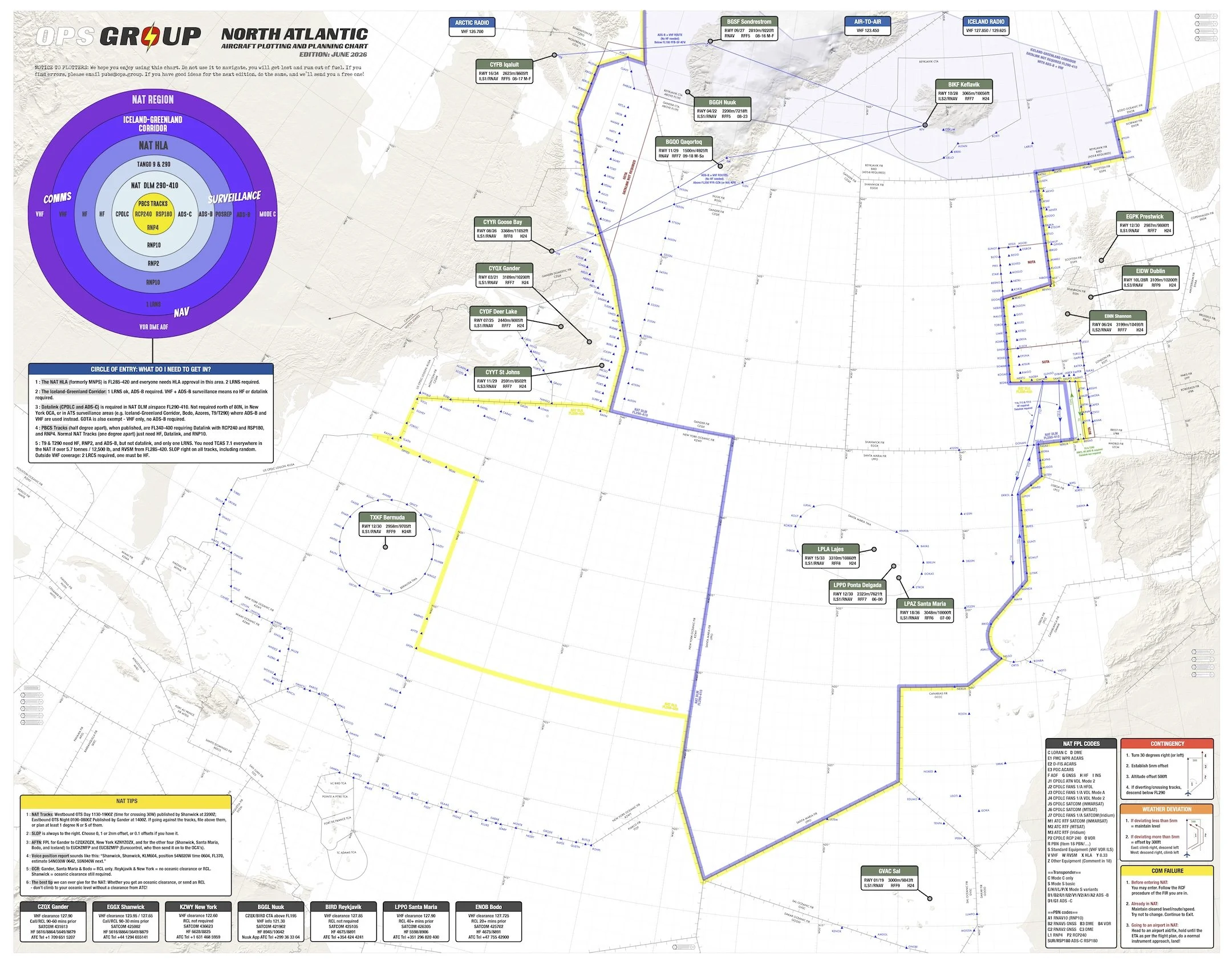
In practice, that means flying across open water that sits entirely inside your region (the Mediterranean within the Europe region, say, or the South China Sea within the Asia region) is covered on a Regional plan. It doesn’t touch the global limit, though: crossing between regions over open ocean, like the Atlantic between Europe and North America, still requires Aviation Global Unlimited.
The catch: regional plans don’t follow you across the boundary
If you’re actually flying and you cross out of your assigned region mid-trip, service cuts out the moment you cross the line. There’s no grace period and no automatic handoff to the next region. Getting it back means contacting Starlink support to have your region manually reassigned – it doesn’t happen on its own. Spend the first part of the month operating in the Asia region, then fly to Europe, and you’ll lose service the moment you cross out of the Asia boundary, and stay without it until support switches you over.
Regional plans, in other words, are built for an aircraft that’s based and flying within one region for the whole billing cycle, not one that regularly crosses between them – for that, Global Unlimited is really the only plan that works without gaps.
A real example: Asia to Boston this weekend
Here’s what that actually looks like on a real route. I’m flying Asia to Boston this weekend, on Aviation Global Unlimited, and I’ll have coverage the whole way – with one exception. Starlink geofences certain countries outright, regardless of which plan you’re on: China, Taiwan, Myanmar, Turkey, and India are all currently on that list. Service pauses for however long I’m within one of those countries’ land or territorial waters, then picks back up once I’m clear of it – that’s a regulatory restriction, not a plan limitation, and Global Unlimited doesn’t get you around it.
If I were on a Regional plan instead, the geofencing wouldn’t be the problem – the region boundary would be. A flight like this spends the first four or five hours departing the Asia region, and the last ten or so already inside the North America region. A Regional plan would only get me coverage for one end of that trip or the other, not both, and there’s no version of “regional” that spans the whole route. For anyone who actually flies across regions on a regular basis, that’s not really a choice. Starlink has made the decision for us.
What the regions actually look like
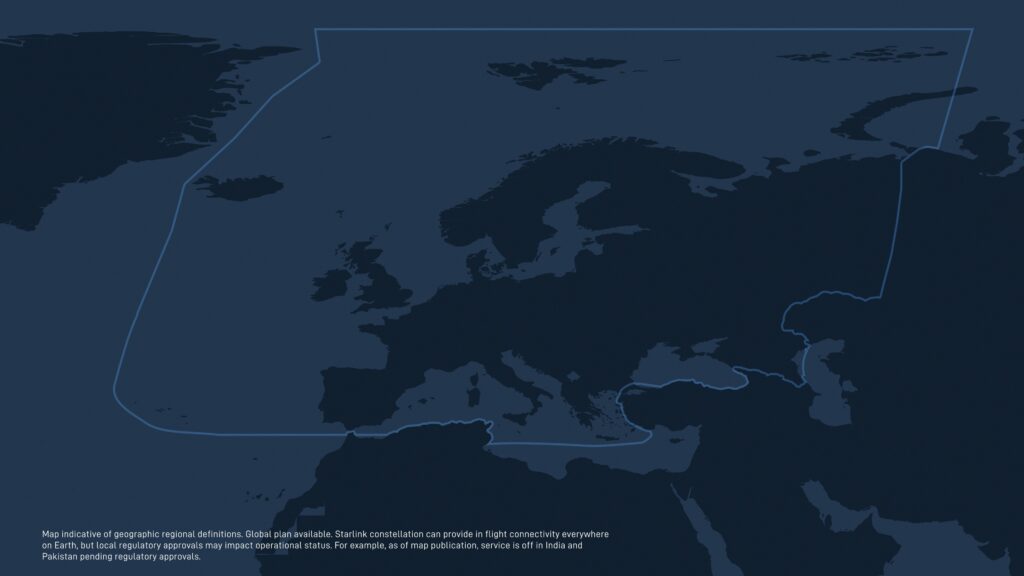
Starlink defines six regional boundaries for the regional plans. Here’s how they’re drawn:

Europe, the Mediterranean, and the Caucasus.
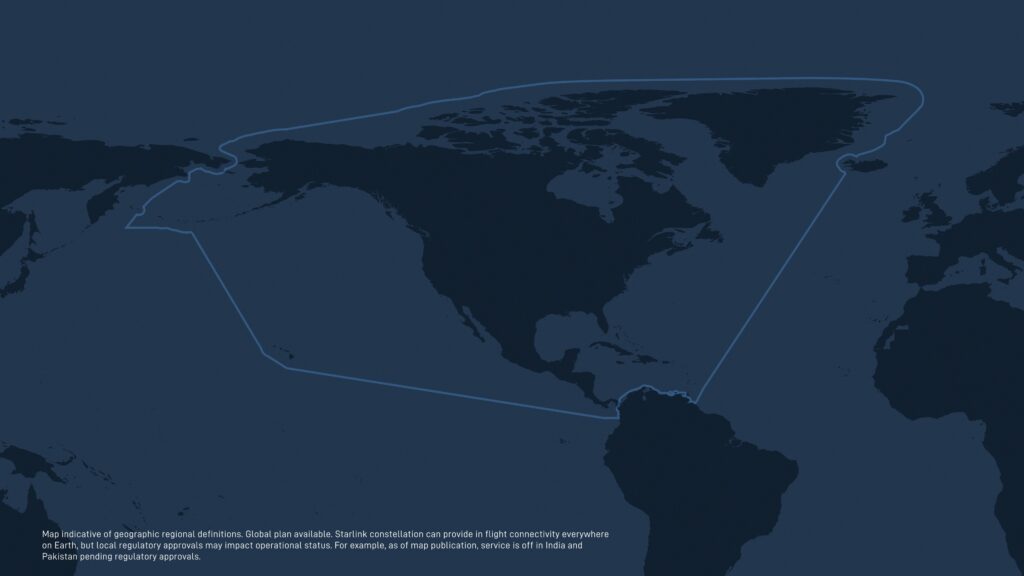
North America, Central America, and the Caribbean.
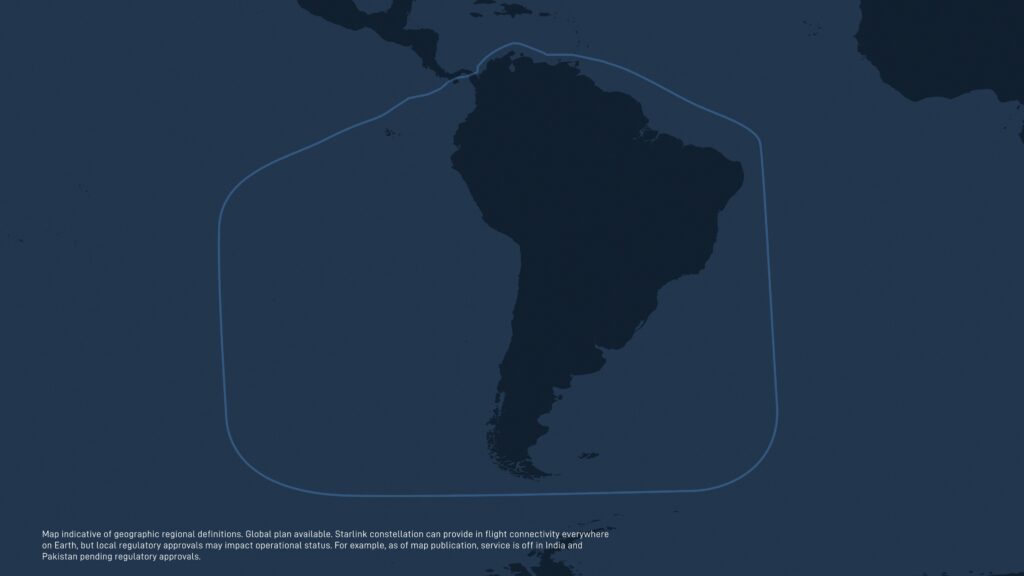
South America.
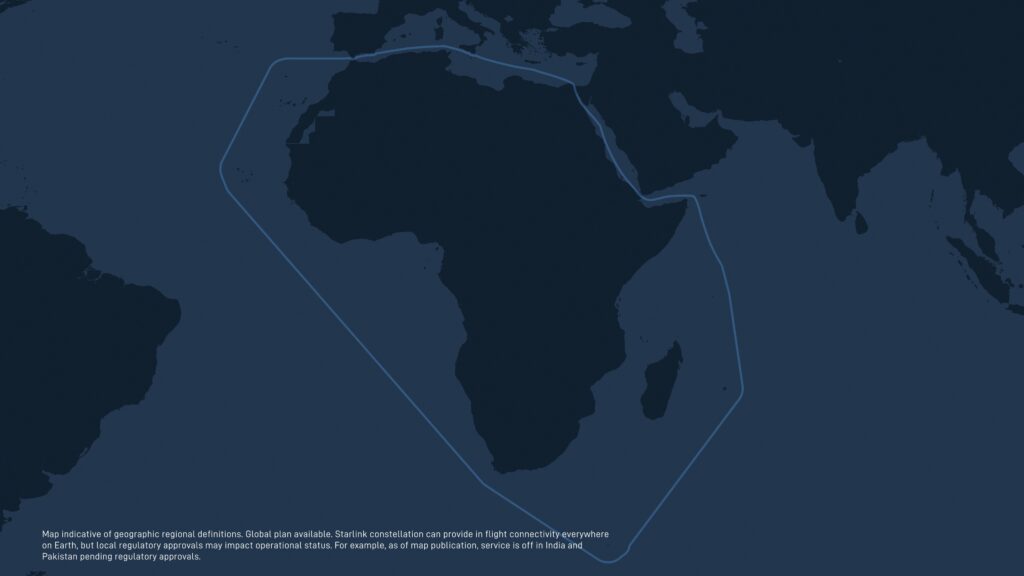
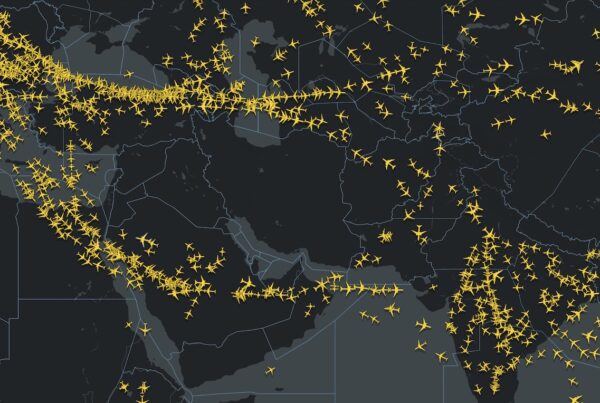
Africa, the Middle East, and out to the Caspian.
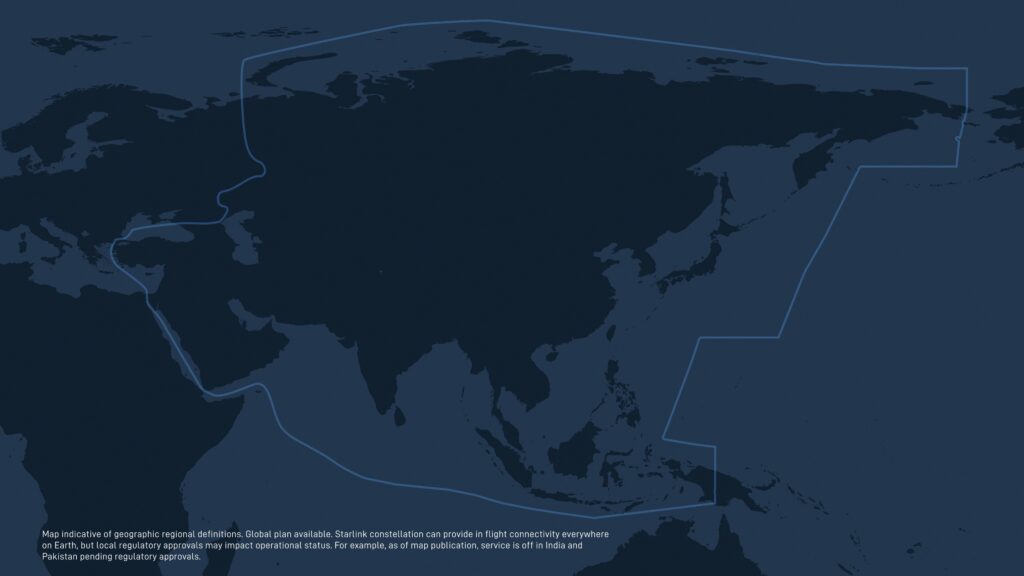
Asia (and Russia, although service does not work there).
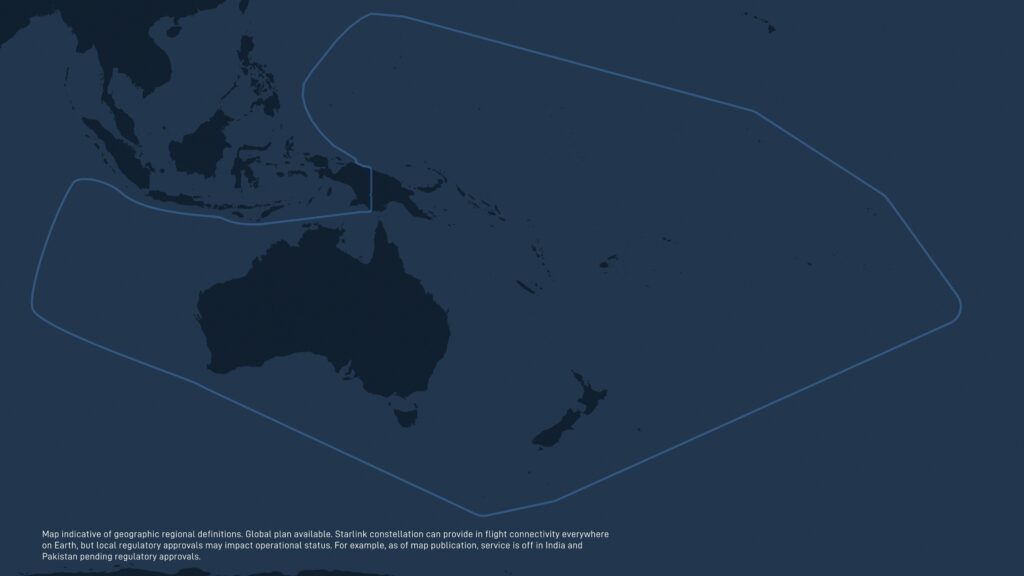
Oceania (Australia, New Zealand, and the Pacific).
Before your next invoice
None of this changes what the service does in the air (it is still BLOODY fast) – it changes what it costs, and it adds a genuine middle option for operators who fly regionally rather than globally. If you’re on a Business Aviation plan already, the time to actually compare the three plans against your real flying pattern is now, before the new pricing lands on your next invoice rather than after.
More reading:
- Latest: Starlink Doubles Business Aviation Pricing and Adds a Third Plan
- Latest: Middle East Airspace – Current Operational Picture
- Latest: SAFA Ramp Checks: What the 2025 Findings Are Really Telling Us
- Safe Airspace: Risk Database
- Weekly Ops Bulletin: Subscribe
- Membership plans: Why join OPSGROUP?








Get the famous weekly