


Last week an OPSGROUP member messaged us with this head-scratcher. And it’s not the first time this exact scenario has tripped up crews abroad.
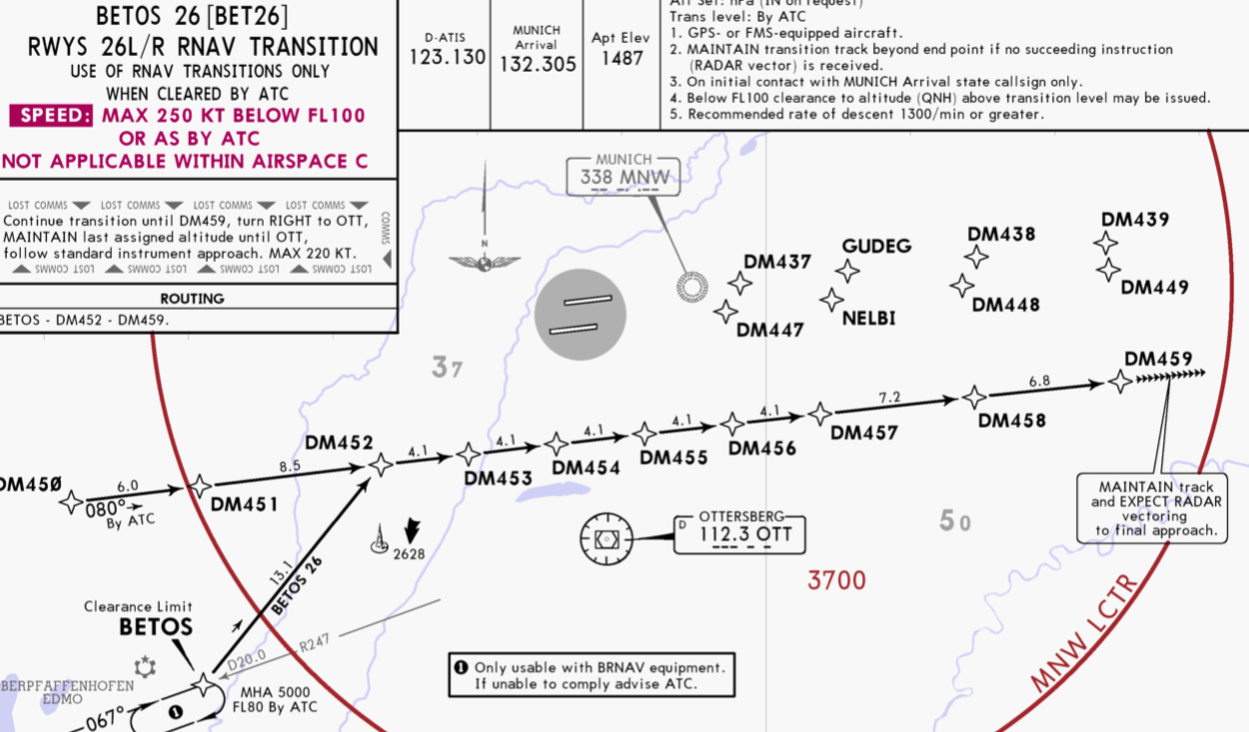
On approach to EDDM/Munich, a crew was assigned the BETOS 26 transition and cleared direct to the waypoint ‘DM453.’
Here’s the chart:
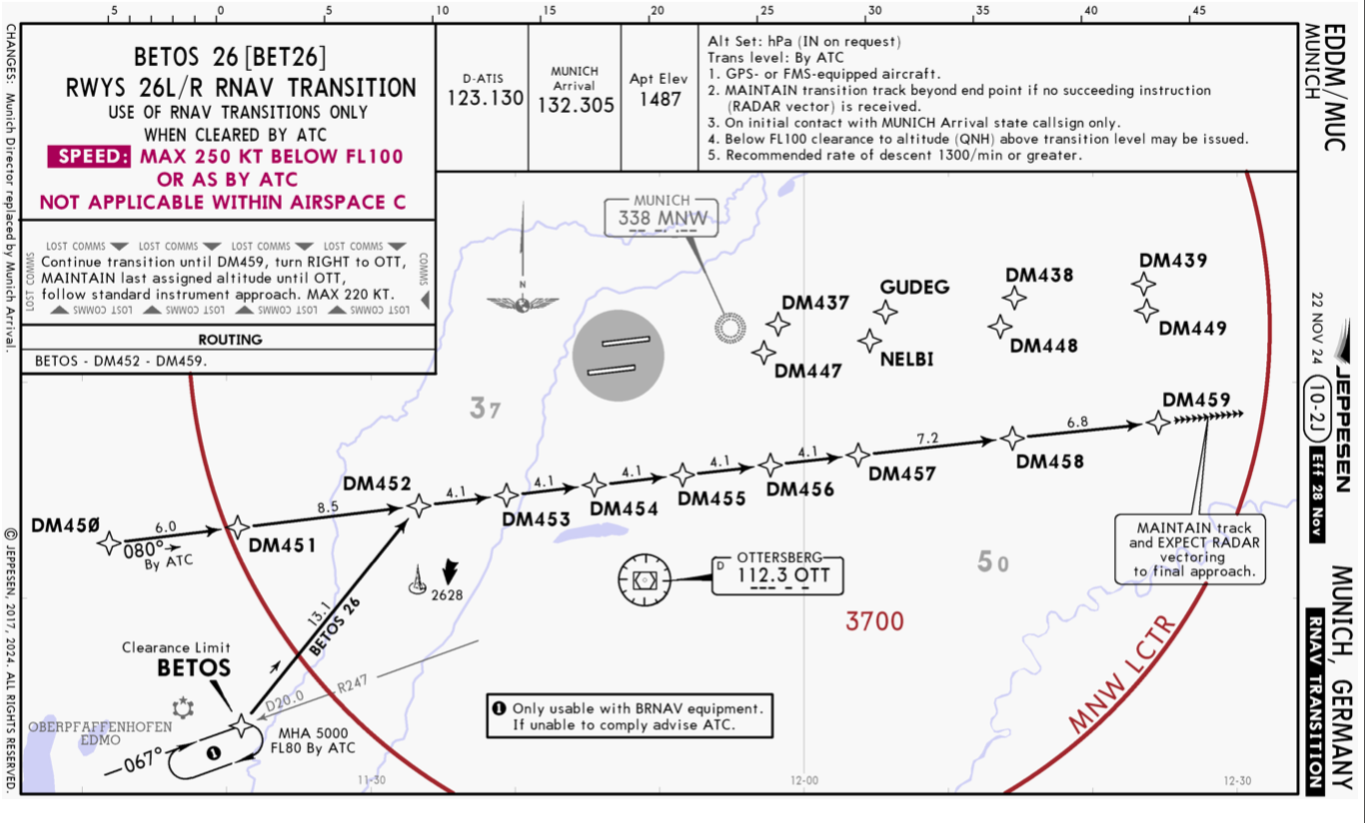
Here’s the problem: When the crew loaded the procedure, the FMS strung it as BETOS-DM452-DM459, and most of the other ‘delta mike’ points scattered across the plan view never showed up. The only way to get there was to type it in manually.
This raised two interesting questions:
1. Is this a charting problem?
Look at the BETOS 26 plate above and you’ll see a pile of waypoints in the plan view that don’t appear in the routing strip. It looks like something’s missing – but it isn’t.
Our member checked with Jeppesen, who confirmed this is deliberate. It turns out the German AIP rules only require ‘essential’ waypoints (such as turning points, or ones carrying speed and altitude restrictions) in the published route description that Jeppesen builds its routing strip from.
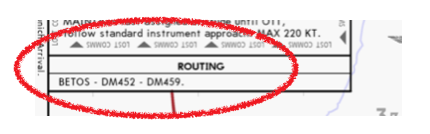
Everything else, DM453 included, exists purely so ATC can shortcut you to final when traffic’s light. Those points are still charted – but only in the plan view.
2. Can you legally insert a waypoint that isn’t in the loaded procedure?
This is the more interesting question and it’s where things get a little more technical.
In the US, the FAA doesn’t want you hand-building STARs. AC 90-100A says manual entry of the published procedure waypoints (by lat/long or place-bearing) isn’t allowed. AIM 5-4-1c backs this up, STARs must be retrievable by name from the database. AIM 1-1-17 says the same for approach procedures.
The logic behind this is that once ATC clears you for a published procedure, the safety case behind it (traffic sep and terrain clearance) depends on you flying exactly what’s coded, not a hand-edited version of it.
Europe is similar. Under EASA’s AMC 3 to CAT.OP.MPA.126 (just felt dizzy), crew flying an RNAV or RNP-based procedure (RNAV 1/2, RNP 1/2, RNP APCH etc) shouldn’t insert or modify waypoints by manual entry once the procedures been pulled from the database.
So how is manually grabbing DM453 not a violation? Simply put, because the BETOS 26 transition isn’t a PBN procedure at all.
RNAV transition vs PBN Procedure
This is where real confusion lies. Not every RNAV-looking route on a chart is a PBN procedure which have the stricter ‘don’t mess with it’ rule attached.
When ATC clear you on a published STAR or approach with a navigation specification specified, you’re flying a PBN procedure which should be flown exactly as coded.
The BETOS 26 doesn’t carry one of those specs. Take another look, you won’t find one on the chart.
Instead it is essentially a sequence of charted radar vectors: most importantly, in the shape of a trombone – our words, not theirs…

Look out for trombone shaped transitions!
ATC continues to provide radar separation and monitors terrain clearance throughout the transition.
Selecting an individual waypoint within the transition (such as DM453) is effectively equivalent to accepting another vector. It doesn’t constitute modifying a published PBN procedure!
So how can I tell if I am flying a PBN procedure?
The easiest way is to check the chart carefully.
If it includes a required navigation specification (such as RNAV 1, RNP 1 etc) it is a PBN procedure, and the associated operating rules apply.
If it is published as an RNAV transition (with no PBN specification), it is typically a radar-vectoring tool rather than a PBN procedure. You only need a GPS or an FMS capable of following the transition.
While both use RNAV tech, only PBN procedures carry the burden of restrictions associated with published navigation requirements.
So in the case of the BETOS 26 transition in Munich, no issues hitting the ol’ direct-to. You’ll get to the beer hall quicker that way.
Side note – consider Hofbräuhaus München, Augustiner-Keller or Brauhaus am Kapuzinerplatz if you’re planning a layover 🍺

Hofbräuhaus München, one of our top beer hall picks.
Have something to add?
We’re just pilots, dispatchers, controllers and professionals like you. We’d love to hear from you. You can reach the team around the clock via blog@ops.group.

More on the topic:
More reading:
- Latest: GPS trouble on the North Pacific routes
- Latest: The Luton Noise Trap
- Latest: India puts a three-aircraft limit on permits
- Safe Airspace: Risk Database
- Weekly Ops Bulletin: Subscribe
- Membership plans: Why join OPSGROUP?






 Get the famous weekly