




Eurocontrol has put out a new two-page CPDLC cheat sheet for European operations. It’s short, non-technical and really useful – especially if you don’t use CPDLC everyday.
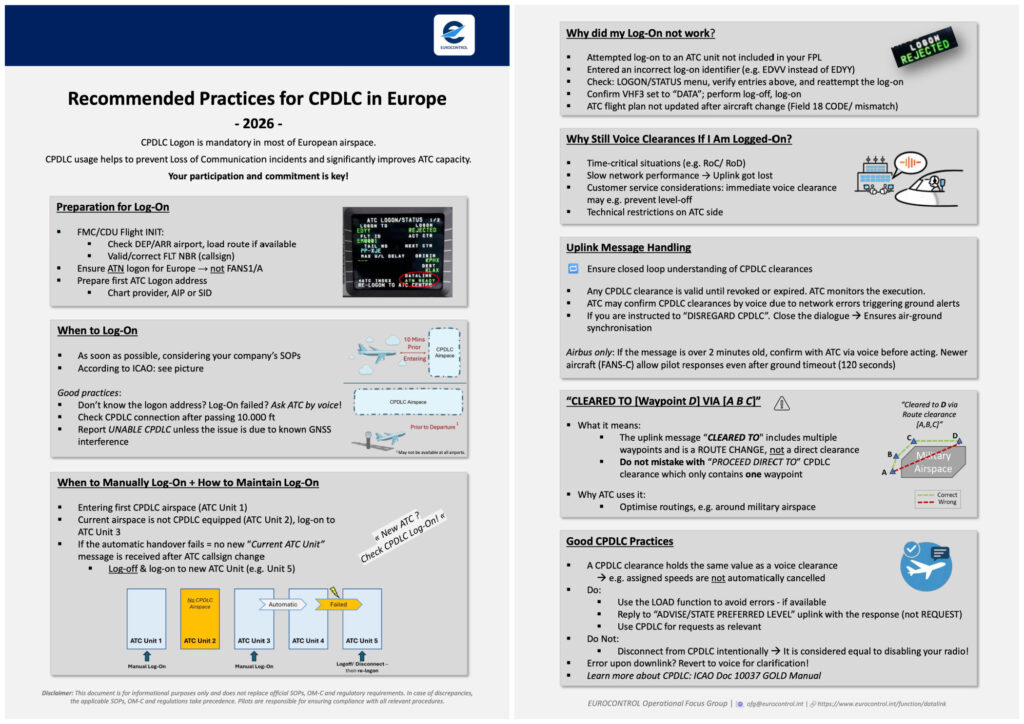
You can download the PDF on the Eurocontrol site here (best place to go in case they update it again), or if that doesn’t work, here’s one we downloaded earlier!
The interesting part isn’t the basics though. Most crew already know that CPDLC is mandatory in much of Europe. What’s more juicy is the human factors stuff – the small misunderstandings and bad habits that are still creating problems out there.
This guidance serves as a reminder of some persistent errors. Here is a brief summary of those.
CLEARED TO vs. PROCEED DIRECT TO
Make sure you follow the clearance correctly.
EUROCONTROL points out that a CPDLC uplink saying “CLEARED TO [WAYPOINT D] VIA [A B C] is a route clearance, not a direct-to shortcut.
Those are issued by the phrase “PROCEED DIRECT TO.” Apparently enough of us are still getting this wrong to be specifically mentioned in the bulletin.
Assigned speeds don’t just disappear
The guide warns crew not to assume a CPDLC speed restriction quietly disappears just because the aircraft later gets another route or level clearance. It’s no different to a voice clearance, an assigned speed sticks unless you are told otherwise.
Why would this be happening? A few suggestions.
It’s possible that pilots load the route amendment but miss the associated speed. Mixed voice and CPDLC environments can also create ambiguity about which clearance is ‘current’ – more on that in moment.
Then there’s workload – especially in dense European airspace. When we get busy, it can be easy to overlook an old datalink clearance sitting in the message stack.
Don’t deliberately log-off
This is a biggie.
EUROCONTROL reminds us that a CPDLC clearance holds the same value as a voice clearance. Deliberately disconnecting or turning off CPDLC is akin to turning off your radios. Just don’t do it. Why would crew be doing this? We don’t know – but reverting yourself to voice is no-bueno.
Why do we still get voice clearances, even when fully logged on?
Some clearances are too urgent – voice is just quicker, especially in the case of level changes. Switching to voice rather than waiting for a CPDLC message to be sent and received can avoid an unnecessary level-off.
Then there’s network performance – no technology is perfect 100% all of the time, and things can slow down.
And simple practicality for the controller. It may just be easier to hop on voice.
Failed Log Ons
We’ve all been there – a logon simply refuses to work without explanation. It’s extremely frustrating!
In many cases the problem comes down to small setup errors – the wrong logon code, an outdated flight plan after an aircraft swap, or trying to connect to a sector that’s not included in your filed route.
Even something as simple as the wrong callsign format or VHF3 not being set to DATA can stop the connection. The fall back is to immediately revert to voice, but this adds workload for all concerned.
It’s not complicated, just human
There’s nothing terribly difficult or technical in Eurocontrol’s new guidance, but it does highlight how CPDLC introduces its own traps – especially in busy, unfamiliar airspace where crews may switch between voice and CPDLC several times in just one flight.
The guide is a useful reminder that getting the basics right with CPDLC is just as important as good radio discipline.
One extra point (especially for US operators)
Europe is a little different when it comes to CPDLC. Much of the network uses the ATN system over VHF datalink rather than the FANS over SATCOM/HF more commonly associated with oceanic ops. So in practical terms, losing the aircraft’s VHF datalink capability will often mean losing European ATN CPDLC capability as well.
The transition from oceanic to European airspace can also be a little confusing! In many cases, ATC systems handle the transfer between oceanic FANS services and European ATN CPDLC automatically, and crews should avoid manually logging off unless instructed by ATC or unless the handover has clearly failed.
NATS has told us that unnecessary crew logoffs near FIR boundaries can create additional ATC workload and may interfere with automatic handovers between current and next data authorities.
That said, datalink issues during the oceanic-to-European transition still generate plenty of pilot reports – particularly among operators less familiar with European ATN operations. Different avionics setups can also behave differently during the transition, which can occasionally catch crews out.
Bottom line – monitor the aircraft’s CPDLC status during the transition into Europe, and follow ATC instructions before manually disconnecting or attempting a new logon.

More on the topic:
- More: Gander’s Bringing Back CPDLC Oceanic Reroutes
- More: NAT CPDLC Route Uplinks: Crew Confusion and Errors
- More: Datalink in Europe: What Are The Rules?
- More: EU Updates Lost Comms and Emergency Descent Rules
- More: US Domestic Enroute CPDLC Update
More reading:
- Latest: Beijing’s New 600km Restricted Area
- Latest: FAA Proposes to Loosen Oxy Rules for Part 91 and 135
- Latest: Australia TSP Lite Explained
- Safe Airspace: Risk Database
- Weekly Ops Bulletin: Subscribe
- Membership plans: Why join OPSGROUP?






 Get the famous weekly







Can’t open the pdf on Safari as well . ..
We’ve re-uploaded it here: https://ops.group/dashboard/wp-content/uploads/2026/05/Recommended_Practices_for_CPDLC_in_Europe_2026-1.pdf
Hi OpsGroup,
Do you have a better link for the PDF file? Microsoft Edge is responding: “ext.eurocontrol.int is blocked” when I try to open the page.
Thanks!
Rich Boll
We’ve re-uploaded it here: https://ops.group/dashboard/wp-content/uploads/2026/05/Recommended_Practices_for_CPDLC_in_Europe_2026-1.pdf