



Honeywell shared an interesting stat with us from the NBAA IOC held in San Diego the other week.
Most operators know about Guided Visual Approaches in the US. But when Honeywell asked crew about the European equivalent, more than 80% said they had never heard of them.
They’re called VPT approaches – Visual Manoeuvring with Prescribed Track.
You’ll find them at several European airports where terrain, noise restrictions or complex airspace make a straight-in approach impractical. Instead of flying a normal visual circuit, you follow a published visual track with defined waypoints and altitudes.
They’re relatively straightforward once you understand them, but can catch crew out if they show up un-prepared.
Let’s take a closer look.
What a VPT actually is
Traditional visual manoeuvring (especially circling) relies heavily on what we can see. That becomes challenging near hills, in poor weather or when unfamiliar with the airport.
VPT procedures aim to make this more structured.
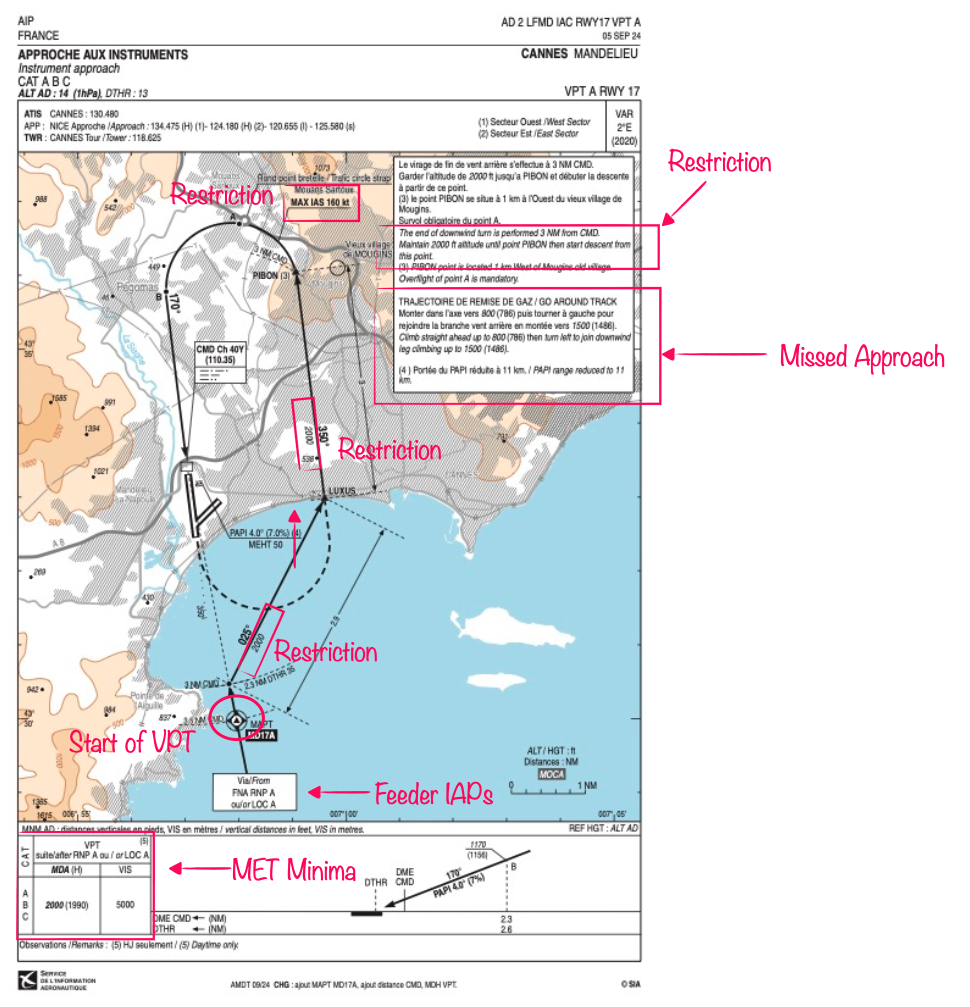
Typically (but not always), you fly an instrument approach first. At a defined point, ATC will then clear you for VPT and you continue visually along a published track to the runway. The track can include visual reporting points, RNAV fixes or both.
If visual reference is lost at any point, you must go-around.
Because the track is defined, many operators load the waypoints into the FMS for extra guidance during the visual segment.
How are these different to guided visual approaches in the US?
At first glance they look similar. But operationally, they’re quite different.
In the US, visual approaches are usually flown from radar vectors. For a standard FAA visual approach, there’s no published procedure and no protected track. ATC simply vectors you into position, and clears you for a visual approach.
To help reduce workload, avionics providers like Honeywell and Garmin offer proprietary ‘Guided Visual’ procedures that can be selected and flown using FMS guidance.
But they are still just visual aids. Guided visuals are not published procedures, not part of the AIP, and ATC will usually not refer to them. Terrain and obstacles remain entirely the crew’s responsibility. More on this in our recent article.
But in Europe, VPT procedures are published in the AIP alongside instrument approaches.
More importantly, they are designed under ICAO PANS-OPS criteria. That means the procedure includes obstacle protection – but only if you follow the prescribed track accurately.
This leads into one of the most important differences:
VPT is not circling
Many pilots assume VPT works like circling, but it doesn’t.
Obstacle protection only exists along the defined visual track (as opposed to a circling area). If you drift away from that track, terrain clearance may no longer be guaranteed.
Therefore accuracy becomes more important than normal circling. Hence why many operators prefer to fly the VPT using FMS guidance where possible.
Beware the missed approach!
One detail that often catches foreign crews out is the missed approach.
Even though final segment is visual and may leave you offset from the runway, the missed approach normally follows the instrument procedure you were cleared for earlier.
This can mean an immediate turn or climb away from your visual track. It’s worth briefing this carefully before starting a VPT manoeuvre.
VPT vs RNP Visual – what’s the difference?
They can look similar on the chart, but they’re not the same thing. A VPT is a visual manoeuvre – you fly an instrument approach first, then continue visually along a prescribed track. You must remain visual throughout, and if you lose it, you go around.
An RNP Visual (like at LPMA/Madeira) is actually an instrument approach. Despite the name, you can fly it in IMC using FMS guidance all the way down to minima, with full obstacle protection. The visual part only comes at the very end for landing.
So although both involve curved paths and can feel similar, VPT relies on visual reference, while RNP Visual relies on navigation performance.
Some guidance on how to brief a VPT approach
If you’re not familiar with VPT approaches, here are the main things you want to talk about:
✅ Where does the VPT actually start? Some kick-off at a specific fix on the instrument procedure, others after a visual reporting point. Either way, clearly define when you are going head’s up.
✅ Is the path coded? Some VPTs include RNAV fixes that can be loaded into the FMS. Others rely purely on visual reporting points. If you can, use your FMS for guidance.
✅ Are there any altitude constraints along the visual segment? These are often included for terrain or noise abatement.
✅ What do we do if we miss? You might be following the instrument missed approach procedure, or there may be a special one. Check the chart for notes!
 Want to see the approach in action?
Check out the handy video below:

More on the topic:
More reading:
- Latest: NAT Pack 2026: All the North Atlantic goodies
- Latest: New 2026 NAT Oceanic Checklist
- Latest: The Bahamas wants your cash
- Safe Airspace: Risk Database
- Weekly Ops Bulletin: Subscribe
- Membership plans: Why join OPSGROUP?






 Get the famous weekly