


Key Points
- Read to the end for an OPSGROUP Team report from a recent flight over Afghanistan.
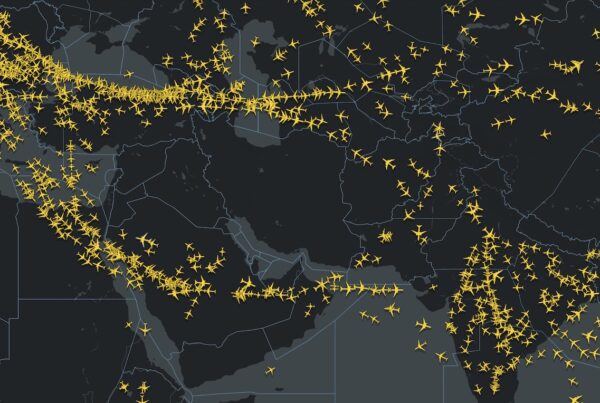
- With the central Middle East corridor currently closed, a lot of Europe-Asia traffic is rerouting north via the Caucasus and Afghanistan. As a result, the OAKX/Kabul FIR is seeing significantly more overflight traffic than usual.
- Afghanistan has recently re-issued several procedural Notams for overflights. These confirm that the entire FIR remains uncontrolled (Class G) with no ATS service available.
- Aircraft are responsible for separation using TIBA procedures, on fixed high-level overflight contingency routes.
- The US FAA warning still allows US operators to overfly OAKX at FL320 or above, and to use P500/G500 in the far east as low as FL300.
- Given the current increase in traffic through the FIR, here’s a refresher on how Afghanistan overflights work and what risks you’re taking if you use it.
A Little Background
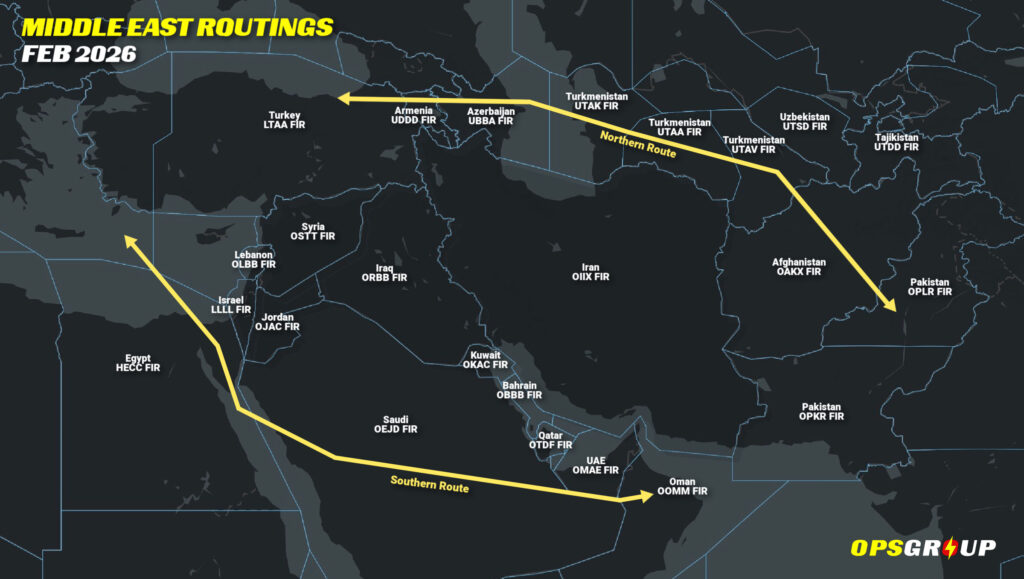
Afghanistan has been used as a transit corridor for several years now, but it’s suddenly become much busier as aircraft avoid the closed airspace between Israel and Iran. Many Europe-Asia flights are currently routing north via the Caucasus and then across Afghanistan before rejoining the normal routes toward South Asia.
The basic situation inside the Kabul FIR has not changed. The entire airspace is uncontrolled Class G with no ATC service available. Aircraft are responsible for their own separation and must follow procedural traffic broadcasts.
Afghanistan has recently re-issued several procedural Notams confirming these arrangements. They include requirements for aircraft to maintain 15-minute longitudinal spacing from preceding traffic at the same flight level and to make regular TIBA broadcasts while inside the FIR.
Separately, there has been renewed fighting between Pakistan and Afghanistan along their shared border. Cross-border strikes and increased military activity have been reported since late February.
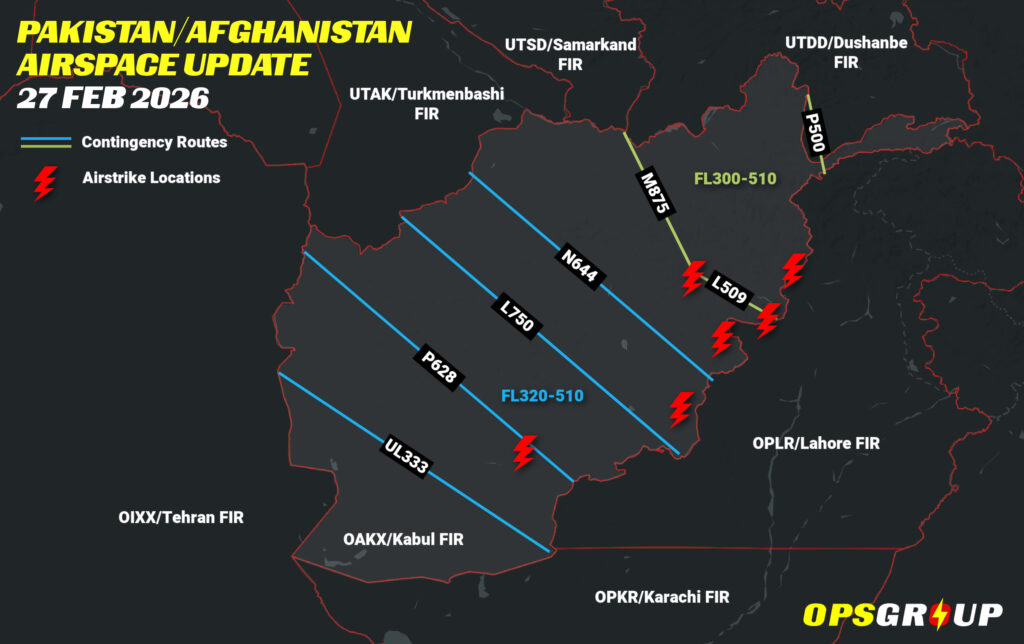
There is no indication that civil aircraft are being targeted and airlines are continuing to operate over central Afghan airspace, but the border region with Pakistan should currently be treated as a higher-risk area.
On March 2 the UK issued an airspace warning for the OAKX/Kabul FIR related to these clashes. This appears unrelated to the Iran crisis but reinforces the long-standing point: while Afghanistan can be a useful transit corridor, it is not risk-free.
Before You Go
Before planning an Afghanistan overflight, check a few things:
- PPR: All operators must obtain prior permission to enter the Kabul FIR. Plan for at least 72 hours. Requests are submitted to flightpermissions.acaa@gmail.com.
- State guidance: Check airspace warnings at safeairspace.net.
- Insurance: Confirm that your policy covers operations in uncontrolled or conflict-adjacent airspace.
- Routing awareness: If you’re planning to use the eastern corridor near the Pakistan border (including P500/G500), note that recent clashes between Pakistan and Afghanistan mean this area carries slightly higher risk at the moment.
Overflights
The procedures to overfly the Kabul FIR have not changed – they’re found in a series of Notams recently republished and extended.
For the purposes of this article, these are the basics:
- File only via one of the published high-level contingency routes as per the map above.
- Expect entry spacing. Adjacent FIRs may delay entry to maintain 15-minute separation from preceding traffic at the same level.
- Use TIBA procedures. Broadcast position and intentions on 125.2 MHz.
- Make broadcasts regularly (including before entering the FIR and periodically while inside it).
- Maintain your filed flight level and speed unless required for traffic avoidance or an emergency.
- Contact the next FIR at least 15 minutes before the boundary point.
- Keep lights and transponder on at all times.
Unplanned Landings
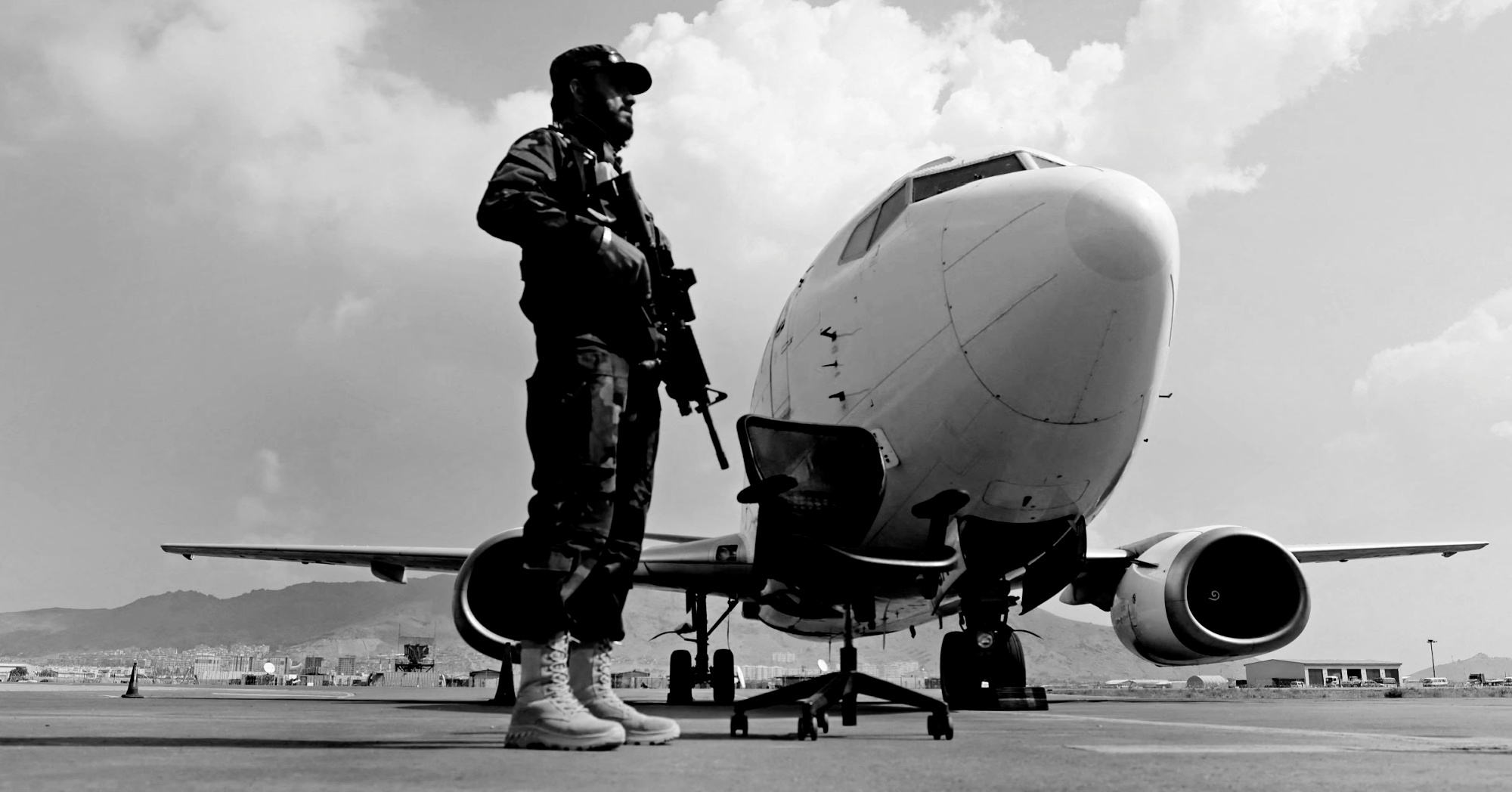
If you plan to overfly Afghanistan, treat a diversion there as an absolute last resort! According to all the state airspace warnings there’s a seemingly endless list of surface-to-air weaponry they might start shooting at you if you fly too low, and if you have to divert then good luck with the Taliban.
Plan fuel and ETPs so you can remain airborne and exit Afghan airspace before landing wherever possible.
If a diversion becomes unavoidable, OAKB/Kabul is the most likely option, but don’t expect much help when you get there – security and services are uncertain, and most governments advise their citizens not to travel to Afghanistan. For most operators, landing at an Afghan airport would be akin to ditching in oceanic airspace.
Our Pilot Report – here’s what we did …
There is a hefty dose of ‘at your own risk’ about all of this. The choice to overfly is not an easy one. To give you a much better idea of what to expect, here’s an OPSGROUP Team report from a recent flight over Afghanistan:
We operated through OAKX FIR on a EHAM/Amsterdam-WMSA/Kuala Lumpur flight
Overflight Permit: Getting the permit was relatively easy. We emailed flightpermissions.acaa@gmail.com (cc to flightpermission.atm@mota.gov.af) and received a response within 24 hours. They replied to us saying that to cross the airspace is charged a flat fee of $700 USD. You will need to fill out the form provided (this Excel document) and then forward that, plus copies of your Insurance, Airworthiness Certificate, and Aircraft Reg. If you are operating commercially, they also want your AOC. They ask for a minimum of 48 hours’ notice, although we put our application in a week in advance.
Insurance: Our insurance (like most) doesn’t allow operations within certain countries; however, they permit overflights on ATC-approved airways, and if you end up diverting due to an emergency, you are covered. We checked, and L750 was considered OK. Several air routes are “open.”
Routing: We had planned on L750, which runs from UTAV (Turkmenabat) to OPLR (Lahore). They also sent us the Kabul FIR Contingency Procedure document. The most important thing to read is the broadcast procedures since there is NO ATC service. The flight was very straightforward, and this route saved us a fair chunk of time and fuel.
ATC Comms: About 5 minutes before Kabul’s boundary, the UTAV controller asked us to “report ATC established with Kabul.” We tried calling Kabul on 125.2, knowing full well there was no ATC service. We told UTAV that we were going to continue TIBA procedures in Kabul FIR, and they told us, “Radar services terminated, frequency change approved. Good night.” All our external lights were switched on. We used Comm 2 as our TIBA box (125.2), Comm 1 stayed with the UTAV frequency, and Comm 3 (our data link was set to SAT) to monitor 121.5. Revise your TIBA calls; they suggest you broadcast them every 5 minutes. We used each fix, and it worked at about the right time.
Over Afghanistan: There was one aircraft departing OAKB/Kabul airport, a commercial jet on its way to Dubai, and aside from that, there was no one else. Up at FL450, we had a great view of the terrain – the word is “inhospitable.”

We could continue to hear UTAV on Comm 1 until about 15 minutes into Kabul when we switched to 124.1, the OPLR (Lahore) FIR frequency; about 15 minutes before we got to the boundary, we could hear calls from other aircraft. We had about 10 minutes of “dead” time on Comm 1.
I had an ETP using UTAV/Turkmenabat and OPIS/Islamabad and did not consider using any of the airports within Kabul FIR as available airports. This was treated just like a NOPAC or NAT crossing. There is nowhere to go, so if something eventful happens, you can keep going or turn back based on your ETP.
We checked in with Lahore about 10 minutes before reaching BIROS, and they told us to call overhead BIROS.
Key Points: It is relatively straightforward; brush up on the TIBA calls. There is more traffic nowadays as several airlines are using the routes for daytime flights, so it was a bit busier the last time I used it. However, at best, you will have a couple of airliners in the mid to high FL300s. There was no GPS Spoofing / Jamming or bad ATC, so I would use this route again, considering the other options in that region.
You experience is invaluable – if you are overflying Afghanistan and have some operational advice, please share it with the group. You can reach us on team@ops.group, or file an Airport Spy report anonymously here.

More on the topic:
- More: Aug 2023: Who wants to overfly Afghanistan?
- More: Afghanistan Update – September 2021
- More: The India-Pakistan Conflict: Impact on Flight Operations
- More: Afghanistan: Do Not Fly
- More: FAA issues Emergency Order for Afghanistan (Updated)
More reading:
- Latest: Middle East Airspace – Current Operational Picture
- Latest: March 2026: Afghanistan Overflight Update
- Latest: NAT CPDLC Route Uplinks: Crew Confusion and Errors
- Safe Airspace: Risk Database
- Weekly Ops Bulletin: Subscribe
- Membership plans: Why join OPSGROUP?




 Get the famous weekly