




Update Jan 2026
If you’re crossing the NAT in mid-January, expect a temporary change to how OTS tracks are built.
From Jan 12-25, Gander and Shanwick will include half-degree coordinates in some daily tracks to test whether operators can reliably file and fly them.
Nothing else changes: you still plan the NAT the same way and PBCS tracks stay labelled as normal. The goal is to see if wider use of half-degree points can give more flexibility in OTS design and free up more random-route airspace. Make sure your flight planning system and FMS handle half-degree coordinates properly, and check this doc for more info.
Update Nov 2025
There’s a special ICAO group called the NAT SPG – the North Atlantic Systems Planning Group. They meet once a year to decide what’s next for the North Atlantic, and then publish a big summary of what was agreed. It’s one of the few places you can actually see what changes are being planned before they hit the real world.
Download PDF.
Their latest meeting was in Paris in June 2025, and here’s what’s coming that will actually matter to operators crossing the NAT…
RCL messages are on the way out
Iceland and Gander both intend to discontinue the RCL (Request Clearance) message as soon as possible.
The NAT SPG report mentioned possible timelines from late 2025, but when we contacted both ANSPs they said no firm dates have been set yet. Other NAT centres haven’t announced plans to follow, so expect mixed procedures for some time.
This is the next big step in the ongoing Oceanic Clearance Removal rollout, aimed at simplifying procedures and cutting down on confusion.
OCR still needs work
The Oceanic Clearance Removal (OCR) rollout in 2024 caused more trouble than expected. Crews struggled with CPDLC message formats, leading to route errors, incorrect clearances, and heavy ATC workload.
The NAT SPG wants ICAO to remind States to tighten up crew training and operator procedures for OCR. Iceland and Gander are taking the next step by planning to drop the RCL message altogether, which should help simplify things once everyone is ready!
For the absolute latest on where we are right now with the whole OCR/RCL thing, and what crews need to do, check here ⬇️
GNSS interference now a serious NAT issue
Reports of GNSS jamming and spoofing keep rising, and some aircraft still can’t recover once affected.
The NAT SPG wants more crew training and better tools for ATC to spot and manage affected flights. We’ve already had a NAT Ops Bulletin from ICAO on this – if you missed it, we covered what to do if spoofed before the NAT.
Key takeaway: if your aircraft experiences any kind of GPS interference, you must tell the first NAT ANSP in your RCL, even if everything seems to have recovered.
For our full article on what to do if spoofed/jammed before entering the NAT, check here ⬇️
Possible end of HLA approval requirement
Iceland has reviewed the old MNPS/HLA approval system and says it may no longer be needed.
The reason: the navigation performance standards that used to be covered by an HLA approval are now built into other rules (mainly the modern PBN requirements for RNP 10 or RNP 4 operations). In other words, if an aircraft already meets current NAT HLA standards, the separate “HLA approval” adds little value.
Iceland plans to complete a safety assessment on removing the HLA approval requirement and present it to the NAT Safety Oversight Group (SOG) in Dec 2025 (that’s the NAT team that reviews safety cases before any major change goes live). The UK, US, and Spain have said they’d prefer to keep the approval requirement for now, so this is still very much under discussion rather than a confirmed change.
Safety models might be getting an upgrade
A semi-interesting one. So the NAT’s current collision risk figures look worse than reality because they use 1960s-era maths. New modelling is coming that reflects today’s surveillance environment, which should better represent actual safety levels.
It won’t change anything for crews right now, but it sets the stage for the future – once the numbers catch up with reality, we could possibly see tighter spacing or more flexible routing across the ocean.
Commercial space launches are still disrupting routes
Rocket launches are becoming a regular headache, forcing reroutes and last-minute airspace closures.
The NAT SPG is planning a workshop in late 2025 or early 2026 to develop a common approach, since there’s still no global standard on coordination or cost recovery.
Document updates inbound…
Hooray! Everyone loves document updates!
NAT Doc 007 (Operations and Airspace Manual) and NAT Doc 003 (HF Management Guidance) will both be updated soon to reflect current procedures and OCR changes – plus probably a bunch of other stuff, who knows…
In previous years this has normally happened every March, but sometimes we get a cheeky update in Jan or Feb – so stay tuned!
ADS-B now mandatory everywhere in Iceland
Here’s one that’s not actually in the NAT SPG report, but still worth mentioning! As of 1 July 2025, Iceland made ADS-B mandatory for all IFR flights in the BIRD/Reykjavik FIR.
So now the NAT datalink/ADS-B rules look something like this:
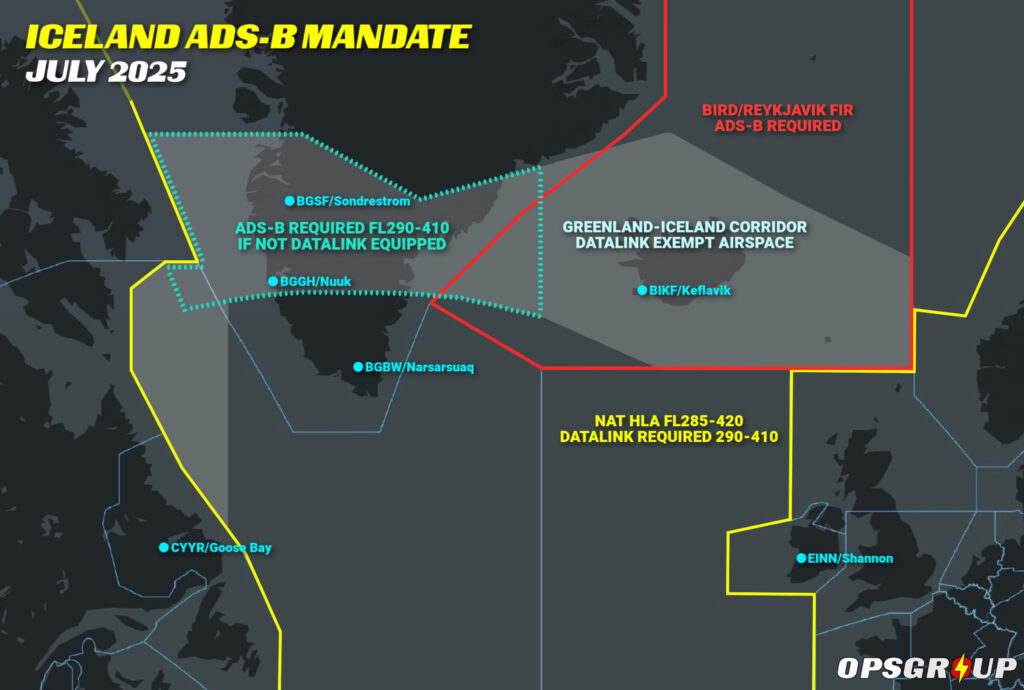
The rule applies to every aircraft flying IFR, at any altitude. Exemptions include flights to maintenance, export deliveries, or aircraft that will retire by 31 Oct 2025. If your ADS-B system fails, you can still operate for up to three days while it’s being repaired. You can check AIC 1-2025 for more info.
Give me ALL the NAT updates in one place!
Sure thing, friendo. For a nice/concise timeline of NAT changes stretching back to the dawn of time, check here ⬇️

And barring any more North Atlantic related changes in the next couple of months, we’ll see all you NAT addicts again in 2026!
More on the topic:
- More: Timeline of North Atlantic Changes
- More: NAT CPDLC Route Uplinks: Crew Confusion and Errors
- More: New NAT Doc 007: North Atlantic Changes from March 2026
- More: Spoofed Before the NAT? Here’s What to Do
- More: Shanwick Delays OCR Until Post-Summer 2026
More reading:
- Latest: Paris Ramp Checks: Illegal Charters and Tax Avoidance
- Latest: Middle East Airspace – Current Operational Picture
- Latest: Greenland NAT Alternates: March 2026 Update
- Safe Airspace: Risk Database
- Weekly Ops Bulletin: Subscribe
- Membership plans: Why join OPSGROUP?







 Get the famous weekly








Gander is not getting rid of the RCL message, only Reykjavik.
Wayne Snyder
AA B777/B787 Fleet Captain.