Update Jan 2026
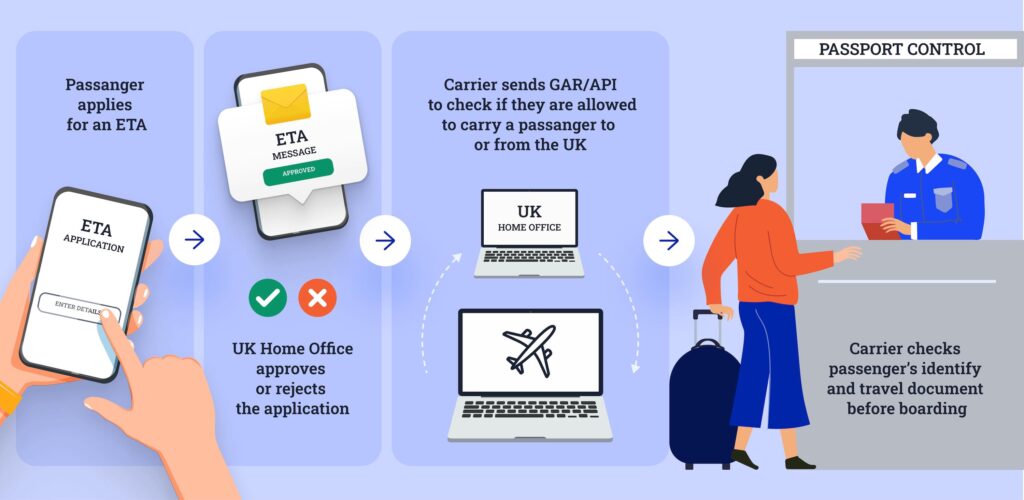
The UK’s Electronic Travel Authorisation (ETA) scheme enters full enforcement on 25 Feb 2026. From this date, when submitting a General Aviation Report (GAR), all pax must hold valid permission to travel, either a UK/Irish passport, valid visa, or a valid ETA. GAR submissions may now return a “No Record of Valid Permission to Travel” response if this requirement isn’t met. There are some crew exemptions, but these are complicated so review the latest UK Home Office FAQ for details. Ensure all documentation is checked in advance to avoid delays or denied entry, and remember the fine for a GAR screw up is hefty and falls onto the PIC!
Update Sep 2025
Since April 2024, there have been major changes to the UK’s General Aviation Report (GAR) submission for international flights. Here’s a reminder of what you need to know.
- The GAR form is now required for departures (not just arrivals).
- You have to submit it via an online portal, or through a third-party app (no longer directly to UK Border Force via email).
- If you get it wrong, you can now get fined up to £10,000 (there were no fines before). These apply to both the operator AND the captain.
These rules apply to all international flights arriving/departing the UK (including within the Common Travel Area: Ireland, the Isle of Man and the Channel Islands). Details on how the rules work within the CTA are explained below.
You can read the rules in full on the UK Government website, but here’s a summary of the main points:
How to submit the GAR
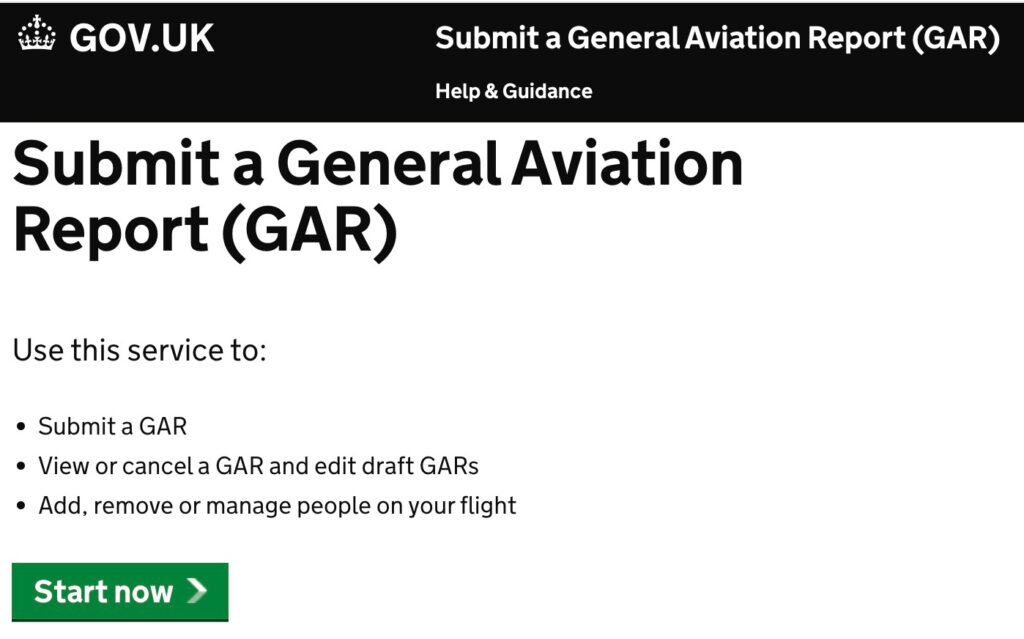
You need to submit info online about the flight and crew/pax, no earlier than 48 hours and no later than 2 hours prior to the expected time of departure. There are 3 ways to do this:
1. The government’s free-to-use online portal.
Alternatively, you can download this GAR template (Excel doc), complete it electronically and upload it to the portal.
2. Approved third-party applications: Rocket Route, OnlineGAR
3. Direct connections: FB01, Streamlane, Mobile-Edge, PnrGo
More info on the UK government site here.
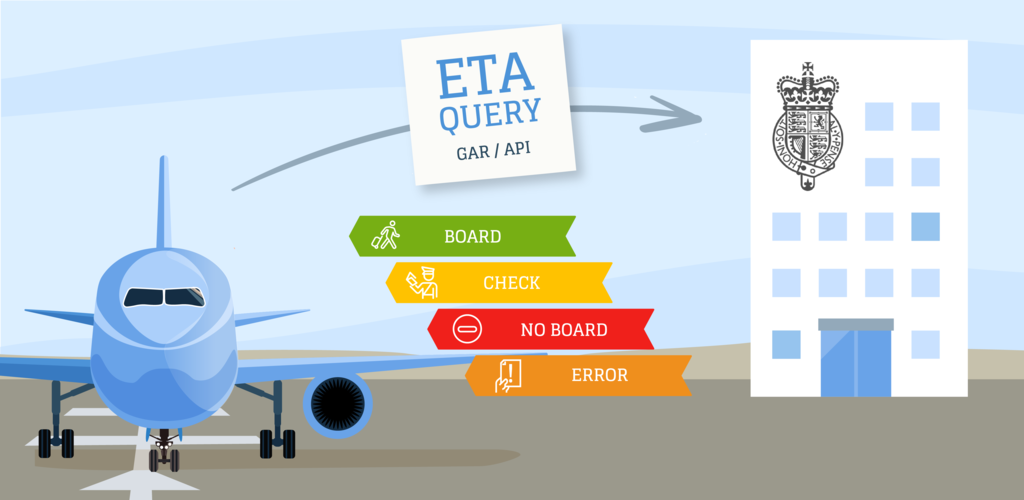
After you submit the GAR, you should get a response telling you whether that crew/pax is allowed to travel. It will be one of the following (thanks to our friends at FlyingInIreland for this table):
| Response Message | Action |
| Valid permission to travel | The Home Office can find a valid permission to travel for the person. Pilots, operators and agents are not required to check visas, but Passport or Travel Document checks still apply. They must check that the passport or travel document presented is genuine and valid, and that the person is the rightful holder.
For more information on checking passports and travel documents click here Guidance on examining identity documents (publishing.service.gov.uk) |
| Authority to carry granted | Pilots, operators and agents are required to check visas for Visa Nationals. Passport or Travel Document checks apply for all passengers. They must check that the passport or travel document presented is genuine and valid and that the person is the rightful holder.
For more information on checking passports and travel documents click here Guidance on examining identity documents (publishing.service.gov.uk) Follow this link to check visa requirements Check if you need a UK visa – GOV.UK (www.gov.uk) |
| Authority to carry refused. DO NOT BOARD. | This response message will not be displayed on the screen. Pilots, operators and agents will be instructed not to board an individual (NO BOARD) via a call and email when Authority to Carry (ATC) has been refused. |
Because fines apply if the GAR is submitted incorrectly, many handling agents may no longer be willing to do it on your behalf.
If you’re not already using a third-party application, the safest option is to set up an online account and handle the submission yourself.
Common Travel Area flights (Ireland, Channel Islands, Isle of Man, Northern Ireland)
Flying within the CTA is where GAR rules can catch people out. On top of the standard UK GAR, there are two extra layers to watch.
First, some destinations have their own local GAR forms. The Channel Islands (EGJJ/Jersey, EGJBGuernsey) require local GARs inbound and outbound, and the Isle of Man/EGNS has its own form too. Requirements can vary, so best practice is to confirm with your local handler. Opsgroup member report: At EGJJ/Jersey, Border Force has at times required full residential addresses for crew and pax, and commercial operators also need local permits separate from UK CAA permits.
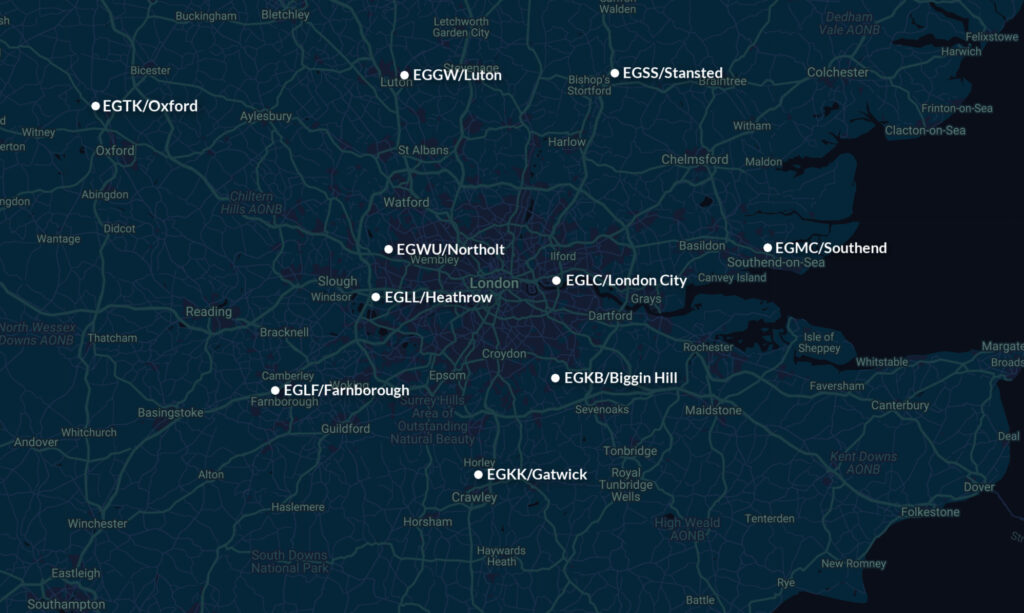
Second, the 12-hour police rule. If you are flying to or from the CTA and using a UK aerodrome that is not police-designated, extra steps apply. For private flights, you need to notify the local police at least 12 hours in advance. For commercial flights, it’s stricter: you must obtain prior police approval before operating from a non-designated aerodrome. Opsgroup member report: A flight originally planned from EGKB/Biggin Hill to EGJJ/Jersey made a last-minute stop in EGTK/Oxford. Because Oxford is not police-designated, the 12-hour rule kicked in. The crew had filed a GAR only a few hours before departure, so Border Police enforced the rule and the jet was stuck in Oxford overnight.
For Northern Ireland, the designated ports are EGAC/Belfast City, EGAA/Belfast Intl, and EGAE/City of Derry. If you use any other airport, you must notify the local police at least 12 hrs in advance (GAR@psni.pnn.police.uk).
You can find the full list of police-designated aerodromes in Annex A of the official UK GAR guidance.
Getting it wrong
Again, check the official guidance on this, but here’s what “getting it wrong” basically means:
- Failing to provide correct info about the flight and people on board.
- Not submitting it within the required timeframe (no earlier than 48 hours and no later than 2 hours prior to the expected time of departure).
- Not doing it in the fight format (i.e. through the web portal or via an approved third party).
The big things to know / watch out for:
- Fines: Getting it wrong could mean a fine for the “owner or agent and captain”. So that means the operator AND captain are subject to enforcement action and fines. These start at £5,000 for first-time offenders (ouch!), subsequent breaches start at £7500, followed by the maximum of £10,000.
- Errors on the GAR submission: Watch out for incorrect spelling of names, omitting middle names, not using the full names exactly as shown on passports, and incorrect crew assignment (which pilot is the PIC). Anything like this is likely to get you a “warning” from UK Customs on arrival, and potentially a fine if it happens again. Opsgroup member report: At EGPH/Edinburgh, Border Force issued a non-compliance report because a crew member’s middle name was missing from the GAR, even though it appeared on the GenDec. All given names (including middle names) must be included in GAR submissions. When using the GAR portal, enter the middle name(s) in the “Given name(s)” field along with the first name.
- Last minute changes: Bad news. If you get an extra passenger last minute, or someone shows up with a different passport than the one you sent on the GAR submission, you have to file a new GAR and then wait 2 hours until you depart. Same applies if you change your arrival airport in the UK. One exception here: if a passenger was provided on the GAR and they do not travel, a new GAR is not required to be submitted.
- Diverts: If you have to divert due to weather, that’s fine. If this happens, UK Border Force want you to call them if you can, on +44 300 123 2012. Make sure you’re diverting to the alternate listed on your flight plan (should also be an international airport with Customs). If you’re diverting somewhere other than what’s listed on your flight plan (i.e. it’s an emergency), call UK Border Force after you land to explain.
- Late departures: If the flight will operate on the same day, albeit later, no new GAR submission is required. If a flight is delayed to the next calendar day, a new GAR must be submitted.
- Early departures: If you depart early headed to the UK, don’t update the GAR! Opsgroup member report: We had a flight to UK that departed 45 mins early, so we thought it wise to update the GAR to correct ETA. This resulted in a UK Customs warning for ‘submitting’ a GAR once flight airborne (8hr leg). We’ve been told that we should not have updated the ETA and it is UK Customs’ responsibility to keep up to date with the ETA.
More info
Check out this page from PnrGo. It has a bunch more info for pilots and operators, including a recent webinar recording plus an extensive Q&A on this topic.


The moral of the story seems to be to take more fuel.