US FAA: Who wants to land on the runway?

  1. Flying to an airport in the US?
  2. Want to land on the actual runway, rather than some taxiway or dirt road which looks a bit like the runway?
  3. Not afraid of some basic pics showing you how NOT to mess it up?

Well then today’s your lucky day, friend!

Step right this way!

Arrival Alert Notices

The US FAA has published things called Arrival Alert Notices at several airports with a history of “misalignment risk” – i.e. where aircraft line up to or land on the wrong runway, taxiway, or even sometimes the wrong airport.

The best thing about these Notices is that they are dead simple. No superfluous symbology, no weird language, just a nice big picture of the runway with a clear instruction on what to do. 
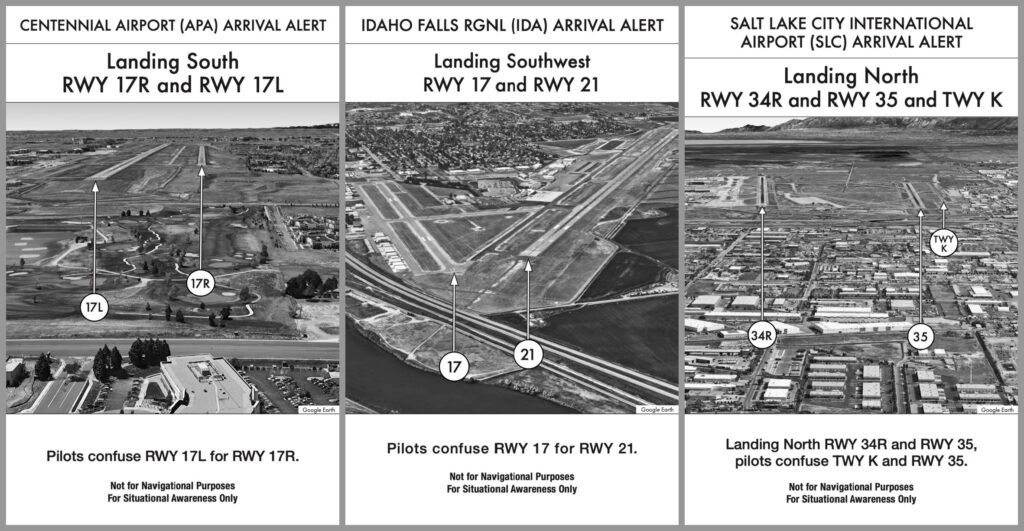
Soothing 1950’s greyscale. Quietly reassuring Futura typeface.

The FAA published the first batch of these in May 2022, and then a whole bunch more in Jan 2024. So they now have them for 41 airports in total, all of which have a history of misalignment risk or “wrong surface events” – i.e. times where folks landed on something other than the actual runway.

They say that many of these wrong surface events occur “during the daytime and in visual meteorological conditions, and the majority of the time, the pilot has read back the correct landing clearance.” In other words, folks have got it wrong even at the best of times, so it’s probably worth a quick glance at these docs.

Which Airports?

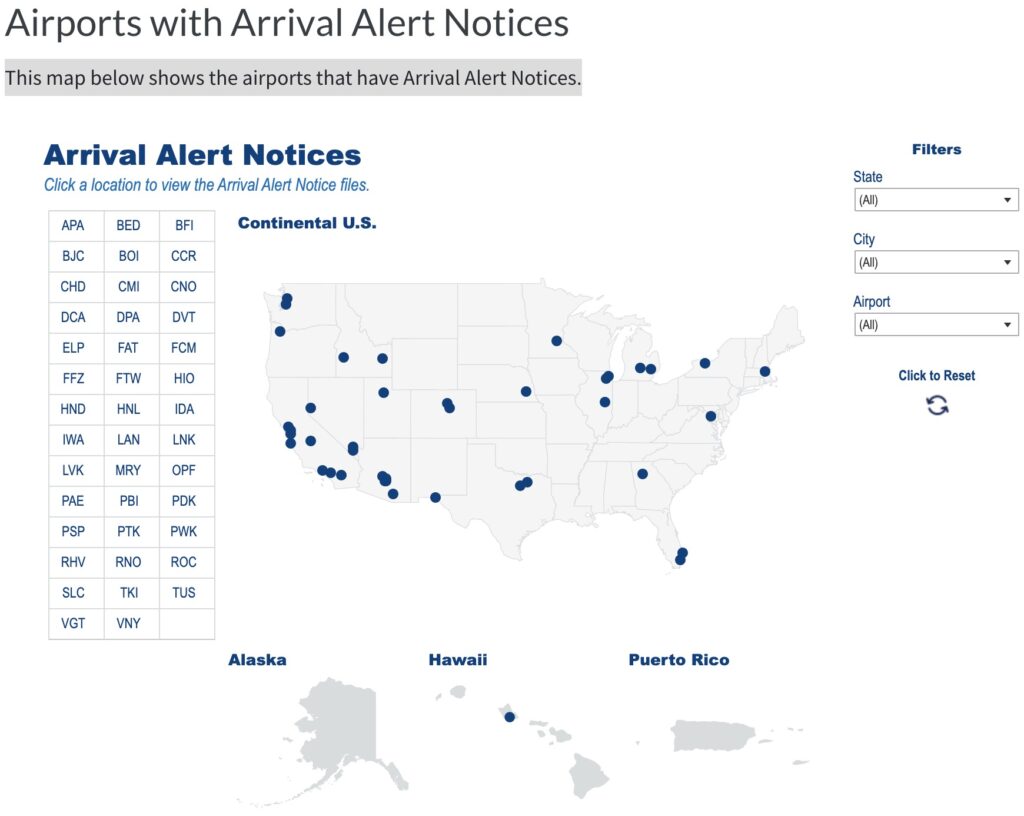
This map on the FAA AAN site shows the airports that have Arrival Alert Notices.
What else is the FAA doing to improve safety?

A whole bunch of things. You can read all about it on their Runway Safety site, but here’s a summary. And as a cheap marketing trick by way of parting, I will say that the last one on this list is probably the best – so make sure you read to the end!

  1. Runway Status Lights (RWSL): In operation at 20 airports, signals potential hazards through illuminated red lights on runways and taxiway/runway crossings. More info.
  2. Airport Surface Detection Equipment, Model X (ASDE-X): In operation at 35 airports, integrates various data sources to provide ATC with better aircraft positions, and pings up alerts for potential traffic conflicts. More info.
  3. Airport Surface Surveillance Capability (ASSC): Similar to ASDE-X, ASSC operates at 9 airports, works in all kinds of weather, and lets ATC see aircraft on approach and departure within a few miles of the airport. More info.
  4. ASDE-X and ASSC Taxiway Arrival Prediction (ATAP): ATAP is an enhancement to the previous two, and alerts ATC when an aircraft is aligned with a taxiway instead of the runway. In operation at these airports.
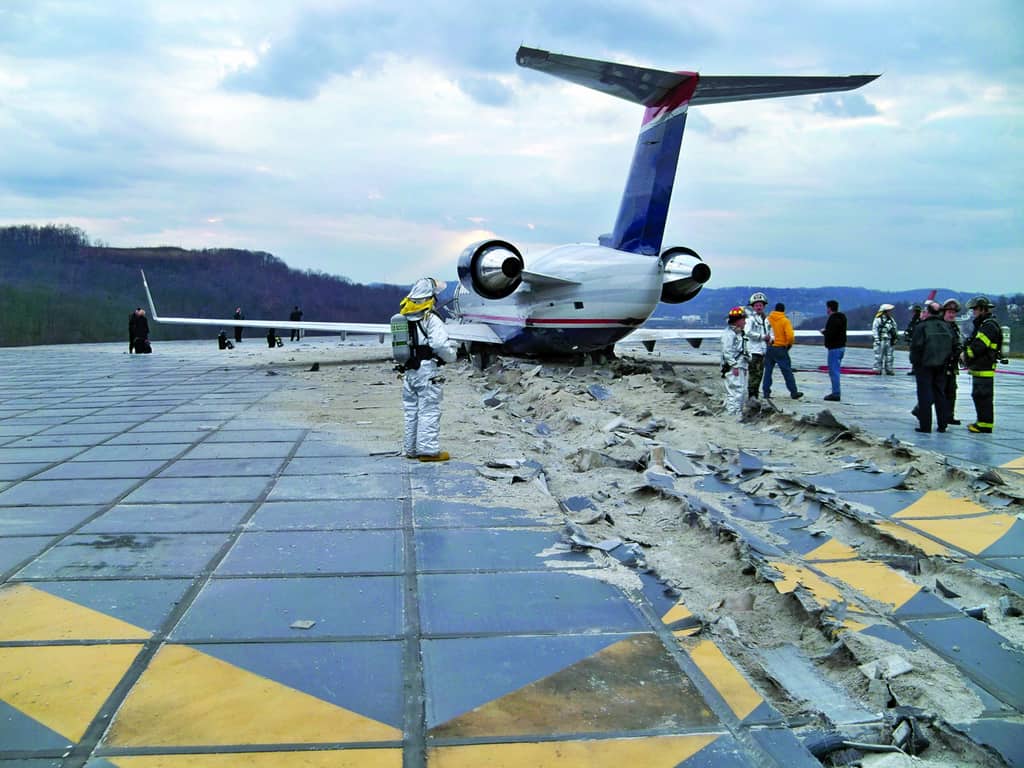
  5. Engineered Material Arresting System (EMAS): We like these things so much, we wrote an article on them. Installed at 70 airports, EMAS are those crushable bits of tarmac at the ends of runways which you can plough into to stop overruns. Very cool. More info.
  6. Electronic Flight Bag (EFB) with Moving Map Displays: Everyone loves their EFBs and moving maps. So do the FAA – they encourage pilots to use them!
  7. Runway Safety Areas (RSA): Because many runways were built before the 1000-foot RSA standard was adopted, the FAA implemented the Runway Safety Area Program which made improvements to over 1000 runways at 500 airports.
  8. Runway Incursion Mitigation (RIM): A national initiative identifying and mitigating specific risks at 80 airports that might lead to a runway incursion. Things like: unclear taxiway markings, airport signage, runway or taxiway layout.
  9. Hot Spot Standardization: The FAA now has standardized hot spot symbology on their airport charts. We wrote about this here.
  10. Arrival Alert Notices: i.e. this article!
  11. Automated Closure Notice Diagrams: They now have a site where you can get a big airport chart showing all the runway or taxiway closures on it. It looks like AI might be involved behind the scenes on this one, so it’s a bit clunky for some airports, but it’s still pretty cool. Check it out here.
  12. “From the Flight Deck”: This might just be the best of the bunch! This FAA website basically has videos showing how to land at specific airports (real footage), plus a bunch of other useful info: hotspots, things local ATC want pilots to know, airport comms, airspace details and other preflight planning resources. Take a look here!
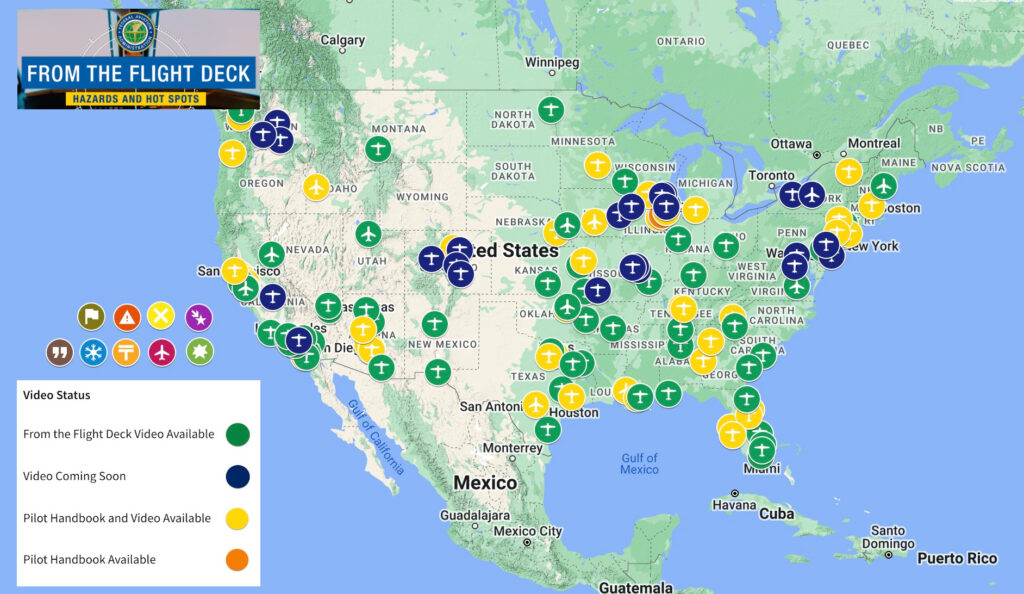
Green dots = pretty good. Yellow dots = LOADS of useful info available!
Coming soon: a new global format for runway surface conditions

ICAO’s new Global Reporting Format methodology comes in on November 4, 2021, but a few authorities have decided to implement it sooner than that.

So here is a quick rundown on what GRF is, and what the requirements are for implementing it.

Runway Excursions

We have talked about these before. So have ICAO. They are a big deal, but they shouldn’t be. Or rather, they shouldn’t still be happening.

Despite numerous incidents, accidents, reports, mitigation plans, you name it, runway excursions are still one of the most common (and often most dangerous) aviation events that are occurring.

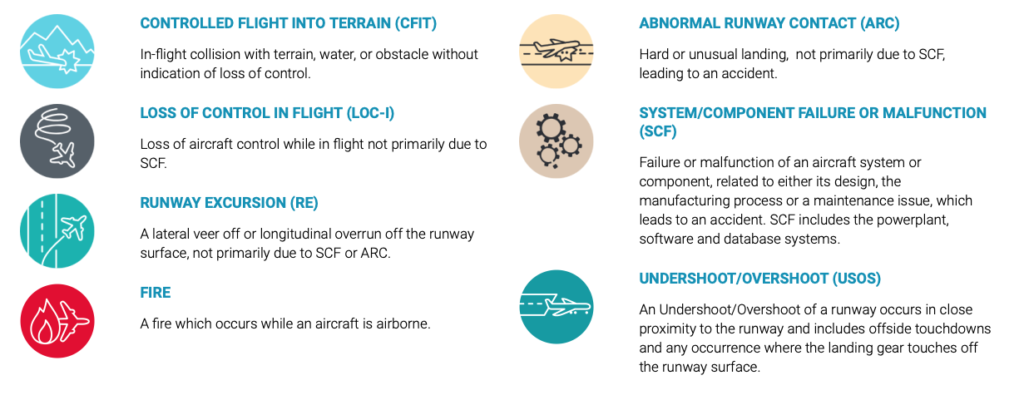
A runway excursion is any lateral of longitudinal overrun (not due to any system or component failure of malfunction, or because of an abnormal runway contact).

The primary causes for runways excursions are pretty much an unstable approach was flown, or proper performance calculations weren’t done. Or a combination of both.

A study of commercial aircraft accidents between 1999 and 2019 showed that 16% of all fatal accidents and 36% of all hull loss accidents were due to runway excursions.

So, if we can stop them from happening, a lot of aircraft and people will be saved.

What is GRF?

GRF stands for ‘Global Reporting Format’ and it is a new methodology which ICAO are implementing which aims to standardise how runway surface conditions assessments and reporting is done.

The issue in the past is that some places still give braking coefficients (not really handy because it means different things for different aircraft). Some places were not really assessing surface contamination properly, and some pilots were not really understanding the implications of what they were being told.

RCAM

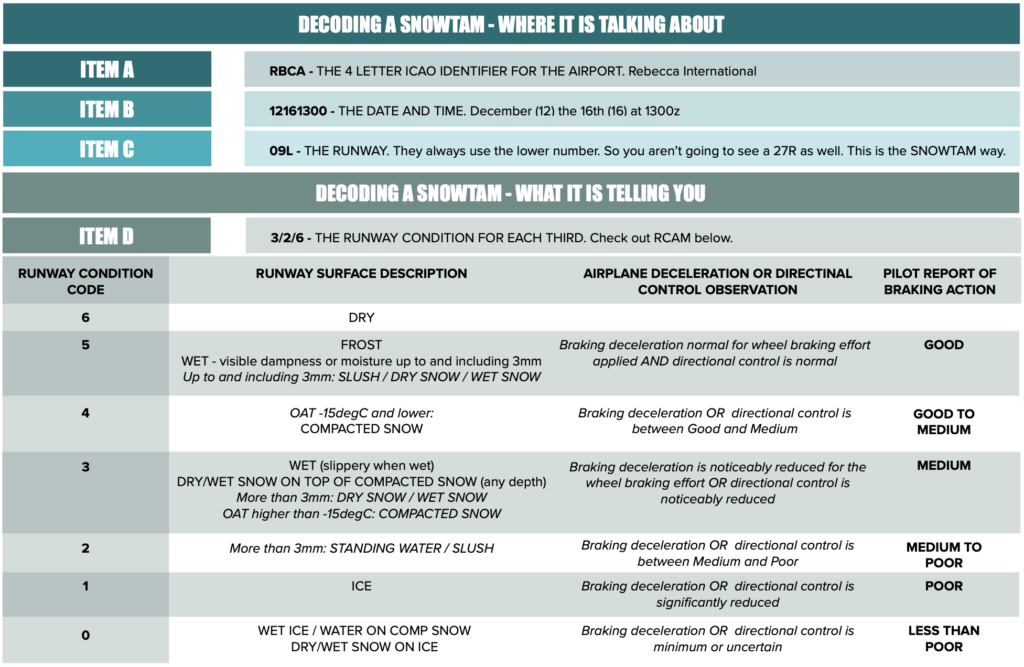
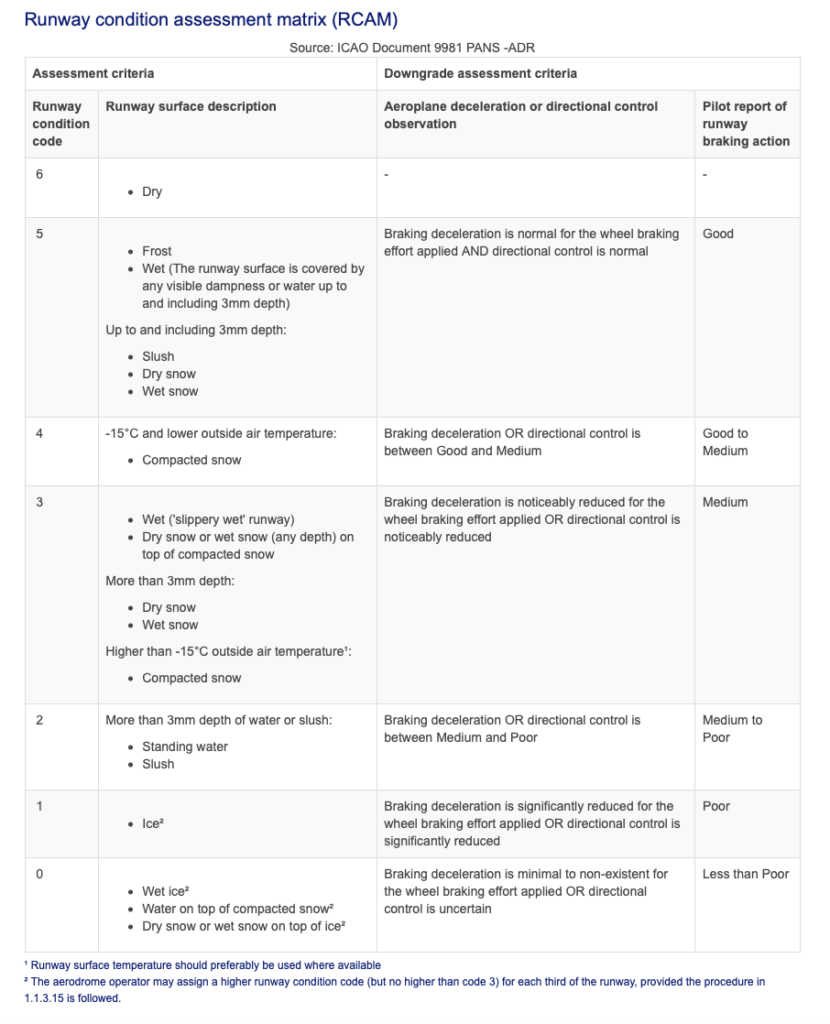
So GRF will use RCAM – a runway condition assessment matrix – and this will give pilots a runway condition code.

1-6. Nice and easy.

The code is determined by an assessment of what it is contaminating the runway. Snow, ice, water, spilt tomato soup… and then a downgrade assessment criteria is applied. This looks at how the contaminant will impact the deceleration and the directional control of aeroplanes.

It is simplified. No more coefficients and frictions. Just simple “yep, that’s slippery and slide-y” assessments. Pilots will also give braking action reports, rating the action they experience from “Good” down to “Less than Poor”.

This matrix ties in with the new Snowtam reporting format which you can read about here.

Who does it impact?

It impacts a lot of people because it is not just a case of “here is a new format, go”.

Airport authorities will be required to train their staff to ensure they are aware of how to carry out the assessments and to ensure reporting is standardised.

Operators will need to ensure their staff (flight planners and pilots) are aware of the new format, and more importantly – that they are aware of why and how to use it!

Pilots will also need to familiarise themselves with it, and ensure they have a decent grip on what the assessments mean, how to apply them to their performance calculations, and also how they too can assist in the reporting.

What’s the official source?

ICAO Annex 14. Or rather amendment 13-B to Annex 14.

Here is the amendment letter.

Here is the main ICAO page for all things GRF.

The U.K. CAA GRF page has a nice summary of all the official references too.

November 4, 2021

This is the date to know because this is the implementation date. However, familiarising yourself with all the info on it before then might be a good idea because several authorities have already implemented this.

NAV CANADA and EASA have both brought it in on August 12, 2021

EASA have a bunch of handy info on it from how it was developed to Q&As.

And here is NAV CANADA’s page on it.

The FAA have their own project – TALPA – which has pretty much already implemented exactly this so you might not notice much of a change.

Bottom line

  • Pilots should familiarise themselves with the new format and understand what it means and how to use it.
  • Operators should ensure all their staff are trained on it (and throw in some additional unstable approach, excursion mitigation and performance calculation training and awareness too if you fancy).
  • Airports and authorities should be ensuring they are implementing the new format, and training their staff on its use and importance.

Hopefully this helps reduce the number of runway excursions due contamination and performance issues. Of course, for this to work we need to make sure we are also flying a stabilised approach, and flying one to the runway we did the performance calculation for…


The Seven Deadly Things

Have you ever taken a look at a report listing the distribution of Accidents by Accident Category? There are apparently more than 40 possible ways an accident can be categorized, but there are 7 that seem to pop up way more often than any other.

Airbus took a look into all fatal and hull loss accidents which occurred between 2009 and 2019 and the results are shocking in that a lot of those accidents just should not have happened.

P is for…

Yep, pilots. We are a big problem. We mess up a lot. That is what seems to be said in the media anyway…

But, it isn’t always our fault, (sadly some of the time it also is), and we all know that the news reporter’s favorite phrase “pilot error” (or “human error” if they are feeling particularly generous about it) is rather meaningless, and very unfair.  It removes all the context of the why’s and the how’s of what led to a pilot making an error, and it is rarely ever as simple as “they just messed it up.”

There are usually countless small things that lead up to any incident, and many a CRM course has been spent discussing and brainstorming how we can better avoid all of these little things and so avoid it ending up in a “one big thing” event.

So, why are these big events still happening? And what can the pilot in the equation do to prevent them? (Because the vast majority of these definitely are preventable).

1. Loss Of Control In Flight

This is the single biggest cause of fatal airplane accidents in this period, accounting for a scary 33%, and 12% of hull losses. We are not talking about situations where something major has broken or failed – we are talking about times where aircraft have somehow managed to get into a situation they shouldn’t be in, and the crew have not able to safely get them out of said situation.

Air France Flight 447 is one of the most discussed examples of this occurring.

All these accidents no doubt had other factors involved – it was not just the pilots not knowing how to fly. There were things like startle factor, bad weather, other warnings, other traffic…

But a large number of these could have and should have been recoverable.

So, what can we do about this? Well, ICAO took an in-depth look at why these kept happening, and they came up with a great and simple thing – UPRT. 

Upset Recovery and Prevention Training

When they say simple they really mean it – all you really need to know is PUSH, ROLL, POWER, STABILISE (and maybe have had a few practice goes in the sim).

This is the recovery though. It is the point when everything has gone wrong and all you have left is fixing it.

Luckily, we pilots do have a few other tools in our toolbox which we can pull out earlier at a time when prevention might still be possible. Things like good monitoring, situational awareness, an understanding of startle factor.

In fact, we have a post right here if you’re up for some more reading on the old startle thing.

There is also that Other thing we can do. It might be one that makes a few palms get a little sweaty at the thought of it – but we can disconnect the autopilot and actually hand-fly now and then.

2. Controlled Flight Into Terrain

Second on the list of the ‘7 Deadly Things’ is Controlled Flight Into Terrain. Again, not because something has broken, but because a crew have just totally lost their situational awareness. These account for 18% of all fatal accidents, and 7% of all losses reviewed in the 20 year period.

The Korean Air Flight 801 accident report offers more insight into how these occur.

Again, other things factor into this – distractions, visual illusions, somatographic illusions – and these can be tough to handle because they are one of the few things a simulator cannot realistically simulate.

We have backups though. GPWS for one. Although this really is the final layer of the safety net. If this is going off then you’re out of the prevention and well into the recovery and mitigation part of the accident curve.

There is good old Situational Awareness again though – this is the stuff of heroes. It is something you can gain, or regain, with a simple briefing. A “What if… then what will we do?” chat. Briefing threats is important, but briefing how to avoid them is even better. Get a bit of CRM in and ask the other person next to you what they think you should be looking out for.

Situation Awareness is knowing where you have told your plane to go but, most importantly, it is knowing if it is actually going there (and this means vertically and laterally).

3. Runway Excursions

These account for 16% of fatal accidents, and a whomping great 36% of hull losses. No failed brakes or issues with steering involved, just big old “oops, didn’t check the performance properly” type situations. We have mentioned this before. It is one of the biggest “that just shouldn’t have happened” types of event.

Actually, the biggest thing that leads up to runway excursions is generally unstabilised approaches.  These are something we can definitely avoid and IATA has some great tips on how. Cut out the unstabilised approaches and you’ll probably cut out a big proportion of runway excursions right away.

There are a few things to help us here too – if you are flying an Airbus then lucky you, because these have a great system on them called ROW/ROP that squawks at you on the approach, and on the landing roll, if it reckons you’re going to go off the runway. But if you don’t have this, then checking your performance properly and managing that approach well are going to be what saves you from an embarrassing call to your chief pilot.

There is also a big change to runway friction reporting coming in on 4th November 2021 – The Global Reporting Format, or ‘GRF’ as he is known to his friends. Griff will standardize how runway surface conditions are reported worldwide and with better reporting will hopefully come better awareness of the risks.

That was the Top 3. What about the others?

The other four are lumped together into ‘Other’ which makes up the remaining 33%. (Actually, 11% of that is ‘other’ others!) Combined, our final four account for 22% of all fatal accidents and 22% of hull losses.

These are:

  • Fire
  • Abnormal Runway Contact
  • System/Componet Failure or Malfunction
  • Undershoot/ Overshoot

Now, I know what you’re going to say – fire probably isn’t your fault (unless you dropped your phone under your pilot seat and then ran over it repeatedly with your chair trying to hook it out again).

But there are still things a pilot can do to help lower the impact of these.

How? Well, by knowing our fire procedures (the what to do if something Lithium Ion powered in the flight deck does start smoking), and by knowing the comms procedures needed to help support our cabin crew if there is something going on down the back. We can also prepare in flight – be ready with something in the secondary flight plan in case we need to suddenly divert.

As for system and component failures, well, the 737Max accidents of the last few years account for a big proportion of this, however, in all cases having a strong systems knowledge and preparing for those “what if?” situations might help save your life one day.

You might have noticed a shift in the training paradigm in the industry, and with good reason – the days of focusing on practicing specific failures in the sims are vanishing and in its place is Evidence Based Training – training that focuses on building the skills needed to handle any situation. If that all sounds newfangled to you then think of it this way – a pilot is there just not to push buttons, but to manage the flight, and these skills are the tools which will enable us to do that.

Fancy reading some more?

  • A full report from IATA on LOC-I can be found right here


SNOWTAMS slip into a new style

ICAO will be updating the format of SNOWTAMs later this year – the special issue Notams that deal with surface condition reports and contaminated runways. They have published updated guidance on how SNOWTAMs should be issued when the changes take effect on November 4, 2021.

Here’s a summary of what’s changing, what the new style SNOWTAM will look like, plus a handy chart to help you decode them…

The Friction Task Force

There is such a thing, and we can only assume they wear skintight suits and body surf down runways to measure the friction. Anyway, they make recommendations on global reporting formats and also how to assess runway surface conditions.

It is quite a big thing. A lot of accidents happen because runway friction is not reported correctly. Or rather, pilots don’t understand it/choose to ignore it. Just ask (several) crews flying into UEEE/Yakutsk about it.

But if you check out the RCAM (Runway Condition Assessment Matrix) below, you will notice that offering a braking action is the preferred method nowadays. Friction coefficients are not so useful.

What is a SNOWTAM?

It is a special series Notam that provides a surface condition report to let pilots know what is on the runway, how much of that is on the runway, and what they can expect their airplane to do (braking wise) on said runway.

So, it is something that basically tells the pilot: “Watch out, slippery!” in a rather complicated sort of way.

SNOWTAMS use metric units, and a bunch of codes for deciphering. More about that later on.

What are ICAO changing?

As of 4 November 2021, the maximum validity of a SNOWTAM will be 8 hours. Currently they are 24 hours and a lot can change in that time meaning you have to try and discover what is still valid and relevant and what is not.

With the new ones, if they don’t say anything different after 8 hours then you can assume the runway surface condition is good and normal again. If anything changes, they will release a new one which will automatically replace the old one.

Each SNOWTAM will get its own serial number for identifying it.

What else is in the Guidance?

TTAAiiii CCCC MMYYGGgg (BBB)

Yep, that is written in it. It is an abbreviated heading demonstrating how certain things should be written. For example:

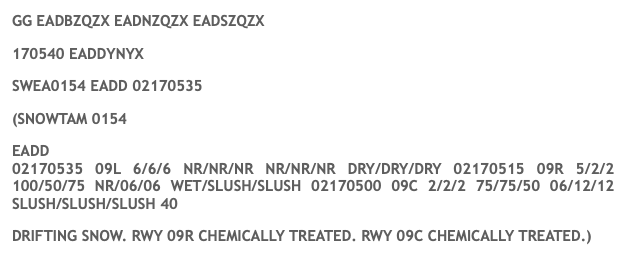
This is an example of how the new style SNOWTAM will look. Not a huge difference to the old ones, but here is a decode for you anyway.

  • GG EAD etc etc is who produced it. Not super relevant for pilots.
  • Snowtam 0154 is the serial number of the Snowtam
  • EADD is where we get interested. That is the airport identifier. Issued on the 17th February at 0535
  • Runway 09L 
  • It then gives the runway condition code for each runway third, as determined by the RCAM (runway condition assessment matrix). 6/6/6/ means dry/dry/dry.
  • Next up is the percentage coverage. NR means less than 10% or dry. Hence the many NRs
  • This SNOWTAM then moves onto 09R because frankly 09L was quite boring and dry.
  • 09R is 5/2/2 (good, medium-poor, medium-poor according to RCAM). 100% covered, 50% covered, 50% covered) and NR/06/06 is the depth – dry/ 6mm/6mm of wet/Slush/Slush
  • Then it moves onto another runway…. blah blah blah

The last bit is another change – this gives you “Situational Awareness” – a free text (i.e. real human language) section reporting other important stuff you might want to know.

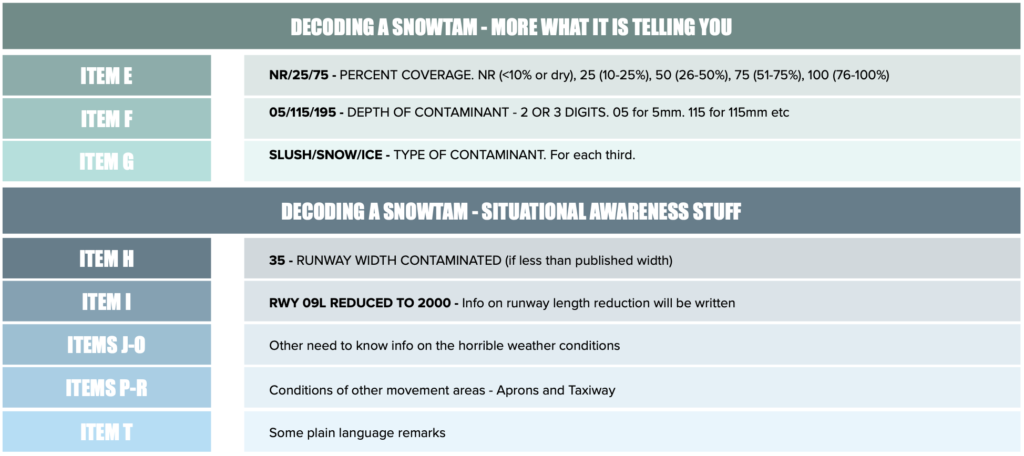
A decoding device

We aren’t going to be there to decode for you, so here is a decoding device we made earlier (by copying the ICAO one and adding some nice colours).

You might also want to download something like the SNOWTAM app on your smartphone (just make sure whatever you use is correct against your company manuals).

Why these changes?

Well, in order to make SNOWTAMS better, because they are fairly important. You might get some frosty toes if you step in a puddle of slushy snow, but you’re going to get more than cold feet if you go skidding off the end of a runway.

SNOWTAMs are there to make winter weather safer. They give critical information about the state of the runway, and this should be plugged into whatever performance calculating device your airplane needs you to use so that you can see whether you will stop before, or after, the end of the runway.


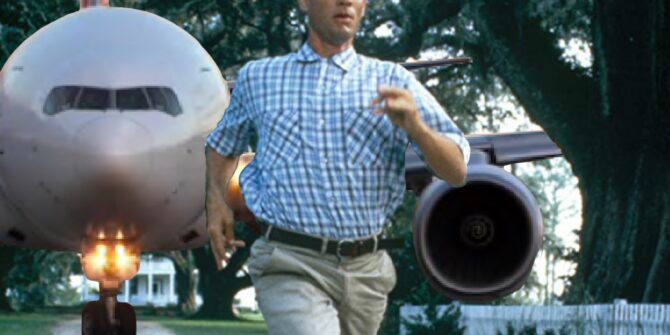
Overrun, Forrest, Overrun!

Earlier this week the Accident and Investigation reports came out about two aircraft overruns, on the same runway, that occurred within two hours of each other.

So what was going on in UEEE/Yakutsk back in 2018?

Or rather, what was going off, and why?

A bunch of factors contributed to this double whammy of airplane excursions. First up, the runway at Yakutsk airport had been shortened for works. It was, in fact, 1,150m shorter – which is quite a significant amount.

There were some Notams published about this, (and pretty decent Notams at that)

A5991/20 said –
DAILY 0000-0800: RWY 23L AVBL FOR LDG ONLY. LDA 2248M. TKOF FM RWY 23L CARRIED OUT BY REQ DURING THIS PERIOD. 2. DAILY 0800-2359: RWY 23L AVBL FOR TKOF/LDG. DECLARED DIST: TORA 2248M, TODA 2398M, ASDA 2248M, LDA 2248

And then there was A3621/ 20 which said –
AD TEMPO UNAVAILABLE FOR ACFT OF FLW TYPES: IL-96-300, IL-96-400, IL-86, IL-62, A-310, A-330, TU-154, BOEING777, BOEING747, BOEING-767-400ER, MD-11F AND THEIR MODIFICATIONS.

What about the airplanes, I hear you ask. 

Well, the Sukhoi Superjet 100LR is not included on the list of “can’t land here” airplanes. However, the Notams should have at least given them pause for thought, especially since both of them had technical issues reducing their deceleration performance.

Number 1 “First to Overrun” was found to have significantly worn out tires (which should have been spotted during a walk around), while Number 2 “Also Skidding Through” had a thrust reverser out of action. No big deal, but factors to be considered in the context of the other conditions of the day.

Talking of those conditions – the ATIS was reporting a tailwind of 6kts which is not outside anyone’s limits, and of course 150% of any tailwind is taken into account for landing calculations.

The braking co-efficient, however, was reported as 0.45
Now, ICAO and most national authorities have moved away from reporting measured friction because they decided that, really, it is a pretty useless thing to report. There is not actually any great way to work out how those contaminants on that day will result in whatever friction for whichever aircraft – because there is no way to correlate the measurements a ground measuring device can measure in a meaningful way to what an airplane will actually experience. In other words – it has limited practical use in actually characterizing the runway conditions for an aircraft operation.

To further add to its pointlessness, the 0.45 was not even accurate. The real coefficient measured that day was actually less than 0.3. 

As slippery as an oiled-up eel
Now, these pilots did do a landing performance calculation using what they thought were accurate figures. Even with their selection of only medium auto brake, and the mandatory 15% safety margin added in during in-flight performance calculations, the results looked ok and so they gave it a go.

However, had they known the coefficient was only 0.3 then they would hopefully have come up with landing results similar to those calculated during the subsequent investigation. These showed that a Superjet needs about 1,598m on a dry runway, 1,838m on a wet runway and a whopping 3,650m if the coefficient of friction is 0.3. Their 15% safety margin could not even cover the extra distance because of the poor braking action.

So, with one of the reversers out of action, a tailwind, an incorrectly reported friction co-efficient and only 2,248m available for stopping in, poor old airplane Number 2 never stood a chance of stopping in the space available.

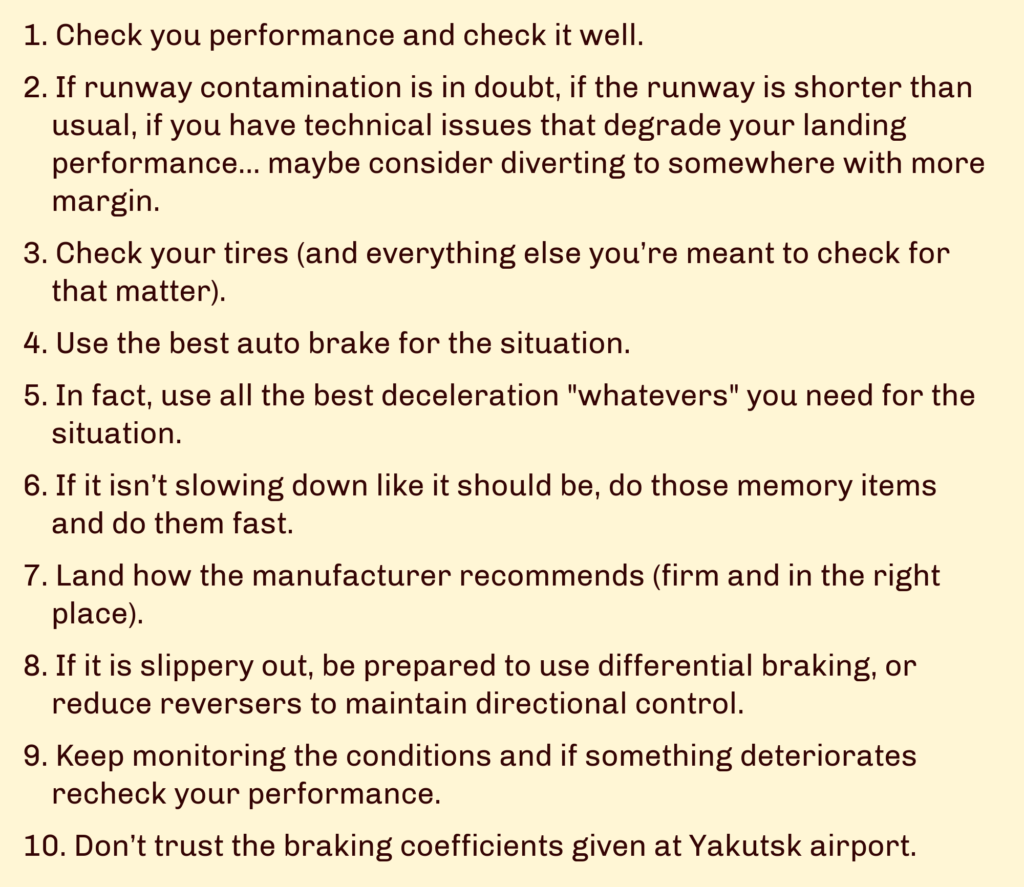
What can we take away from this?

Runway Excursions are still in the top 3 most common bad stuff that happens to airplanes, and considering the vast majority are avoidable with a bit of planning, better procedures or common sense, this is fairly shocking.

So, what can pilots do to prevent overruns?

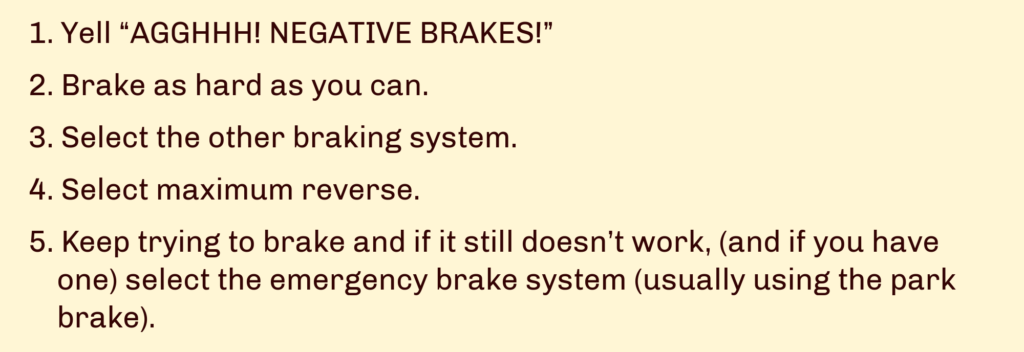
Braking, braking, broken…

Sometimes brakes do fail, or systems malfunction, and if that happens being ready with your memory items  is the best way to deal with this. They might vary slightly across different types, but the basic actions are probably something along the lines of – 

What are manufacturers doing to help stop overruns?
A lot of airplanes have some clever devices installed in them nowadays. 

Take Airbus for example. They have their ROW/ROP systems. The ROW bit (runway overrun warning) does useful things like monitoring the conditions in real time, and running speedy little calculations based on the known runway length and aircraft weight to make sure the aircraft is still stoppable in the distance available. If it isn’t, it will yell at the pilot.

The ROP bit (the protection that kicks in after landing) does something similar, and can automatically apply full whiplash effect with the brakes if it thinks you need it, as well as reminding you to “Set Max Reverse!”

Other aircraft have similar systems with warnings that trigger if an aircraft is too fast, or if the landing flare is too long, or the remaining amount of runway is too short…

What can authorities do to stop excursions?
Ensuring operators train crew and staff properly, and that information is distributed in the industry is important. 

Airlines and Operators should have in place technical and practical training for their crew to help them have a better awareness of the risks and factors that lead to overruns. Better monitoring of areas like unstabilised approaches which often precede overrun incidents, and contaminated runway and winter operations awareness, is also necessary.

Airports should makes sure Notams about works and changes to runway characteristics are up to date and correct. Giving correct information to pilots about the conditions on the day would also help…

In the US the FAA is advocating the use of  EMAS (engineered materials arresting systems) at airports within insufficient runoff space, and this has apparently prevented the severity of 15 aircraft overruns in the years they’ve been installed.


Further Reading

  • Opsgroup article: 5 Tips for Safter Winter Ops
  • Airbus “Safety First” magazine: new issues published every 6 months, a wealth of info about all things safety-related.
  • Useless fact: If you wanted to ski down a concrete slope using rubber skis, the coefficient of friction for rubber on concrete is 0.9 which means you would need a 42 degree slope to actually get moving.