South Korea Airspace Risk Update
Key Points
  • There are no official airspace warnings for South Korea, but the risk situation seems to be getting worse.
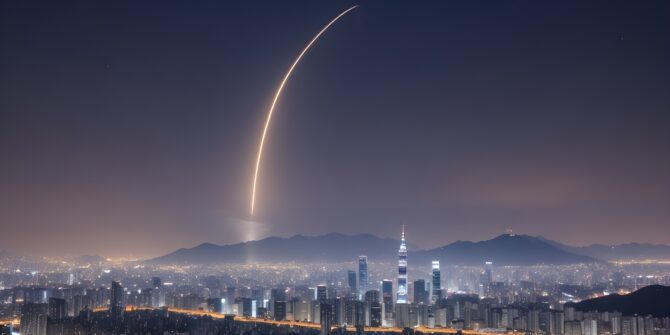
  • Airspace safety is gradually deteriorating due to several factors: GPS Interference, North Korean space launches and missile tests, military drills and failed agreements with North Korea, and weird balloon incidents.

If you’re operating in the RKRR/Incheon FIR, it is important to stay up to date with airspace risk.

In stark comparison to North Korean airspace, which is rife with warnings and flight prohibitions, operations over South Korea continue with almost no active advisories to crew – save for the odd FIR Notam.

It is not so much a matter of disinformation, but a lack of it that can create complacency amongst pilots operating there.

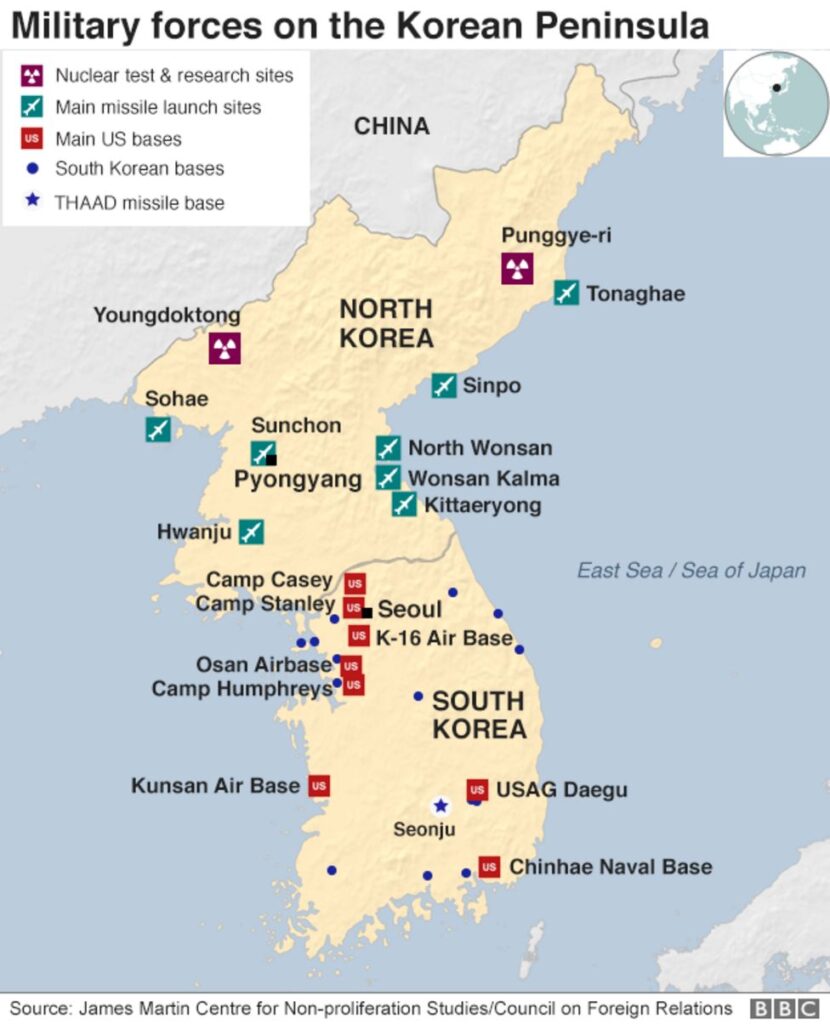
The situation on the Korean Peninsula is unique. The two nations are not at war but remain in a state of constant readiness to engage in one. They live in what was once described as a ‘reciprocal fear of surprise attack.’

This means South Korea’s airspace is at constant risk of instability caused by some kind of political crisis. Things have potential to change quickly, and without warning.

It is therefore vital to monitor changes in airspace that is considered by most to be completely safe. Here is a review of what has been happening in the RKRR/Incheon FIR lately that may have subtly been increasing risk to civil aircraft.

GPS Interference

The US FAA previously published a warning for GPS interference in South Korean airspace via a KICZ Notam – but this was cancelled back in 2018. The signs are that this advice may need to be re-visited.

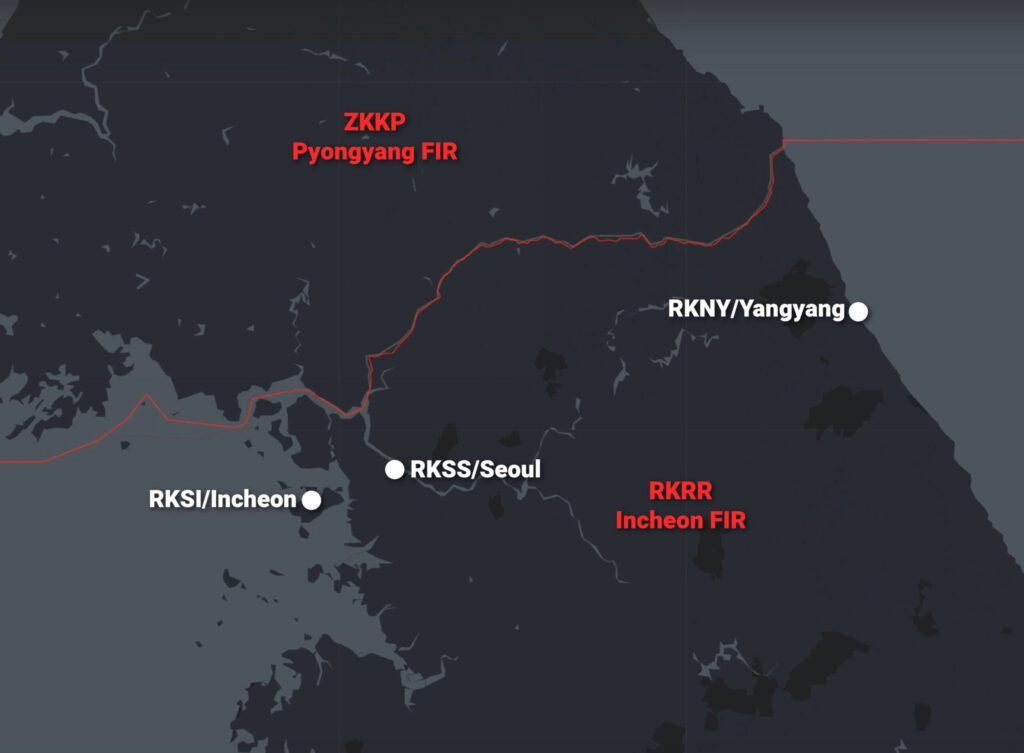
On March 11, the RKRR/Incheon FIR issued a new warning advising extreme caution for GPS interference including the vicinity of RKSI/Incheon, Seoul. The nature of the interference wasn’t specified but was likely to have included spoofing.

RKRR Z0558/24 - CAUTIONARY INFO FOR ACFT OPERATING IN INCHEON FIR :
PILOTS HAVE REPORTED THAT GPS SIGNALS ARE UNRELIABLE OR LOST 
INTERMITTENTLY IN INCHEON FIR(AROUND INCHEON AND SEOUL AREA). 
EXERCISE EXTREME CAUTION WHEN USING GPS. 
10 JUN 05:51 2024 UNTIL 17 JUN 15:00 2024. 
CREATED: 10 JUN 05:51 2024

The source of the interference was suspected to be North Korea attempting to interfere with military drills in the area.

This was followed by an OPSGROUP member report of GPS interference during an approach to RKSS/Seoul on May 16:

“GPS spoofing into RKSS/Seoul [while] on approach to RWY 32R. We disabled hybrid and deselected GPS after seeing the risk reported on ATIS…”

Any kind of GPS interference, especially when operating in and out of Seoul, is cause for concern. It’s 20nm from the North Korean border and a bunch of prohibited areas which carry chart warnings that say in very clear language that you may get shot at if you inadvertently enter.
North Korea’s Race to Space

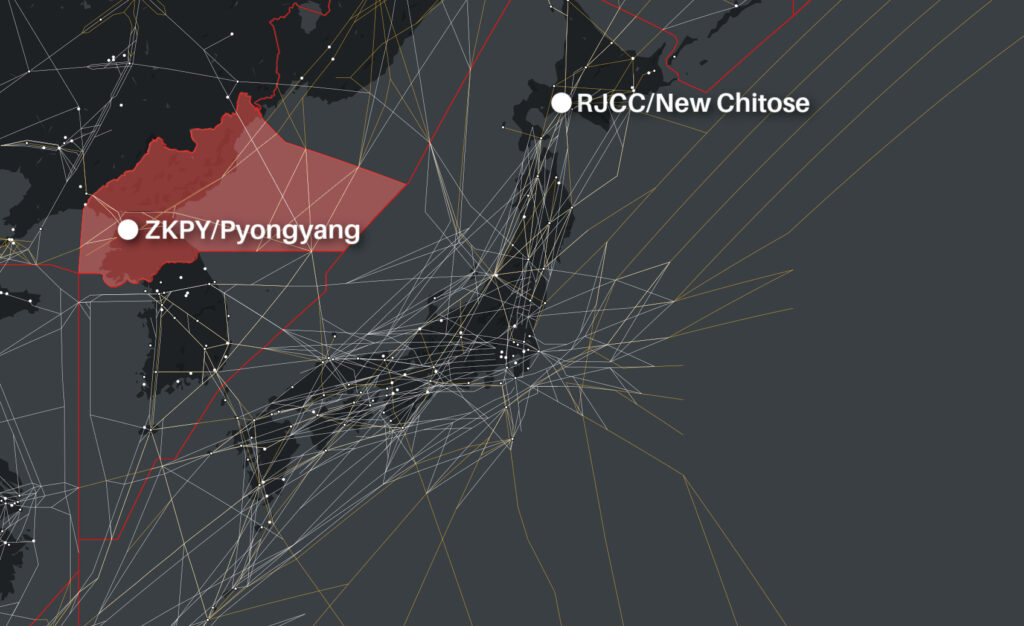
Late last year, North Korea surprised the world by launching a satellite into space creating a potential debris field in the Yellow Sea between South Korea and China. The launch prompted a missile warning in Southern Japan.
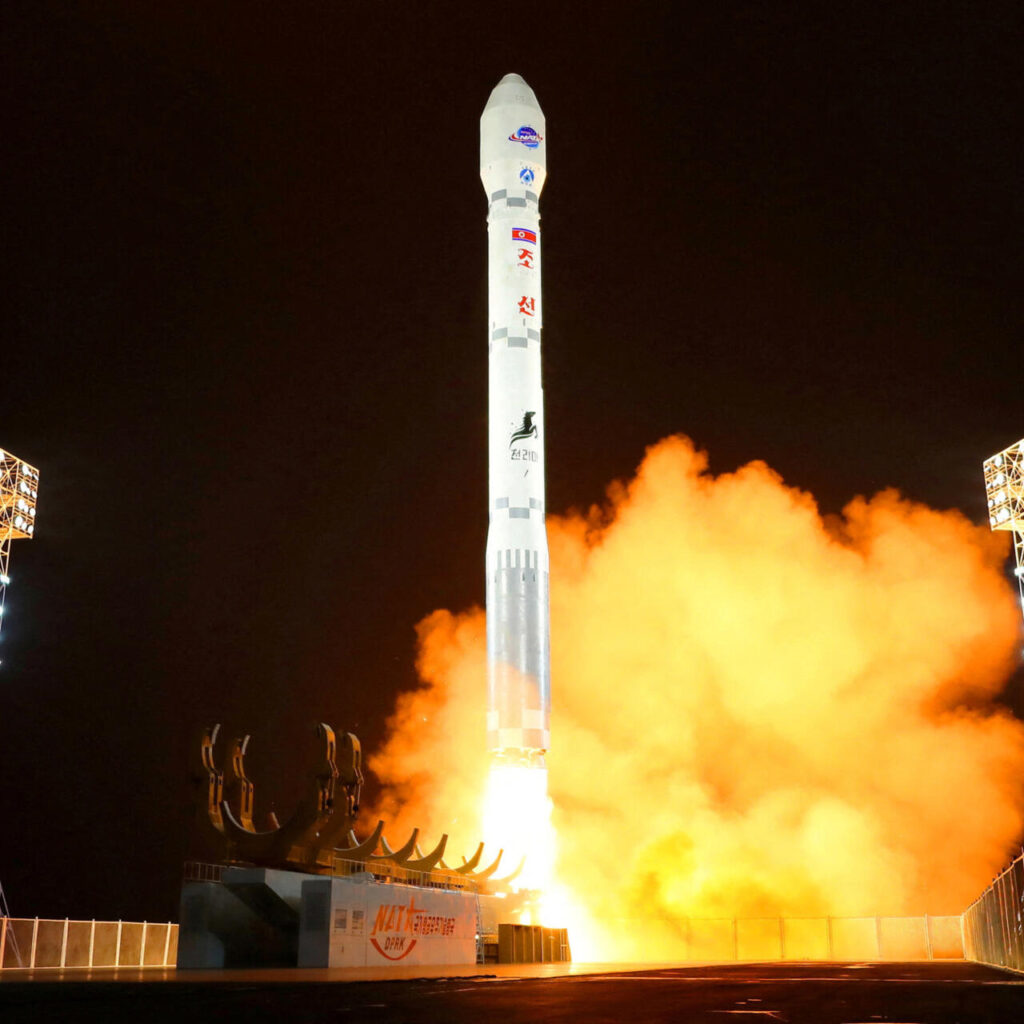
Unannounced North Korean space launches create airspace risks on a much wider scale than conventional missile tests.

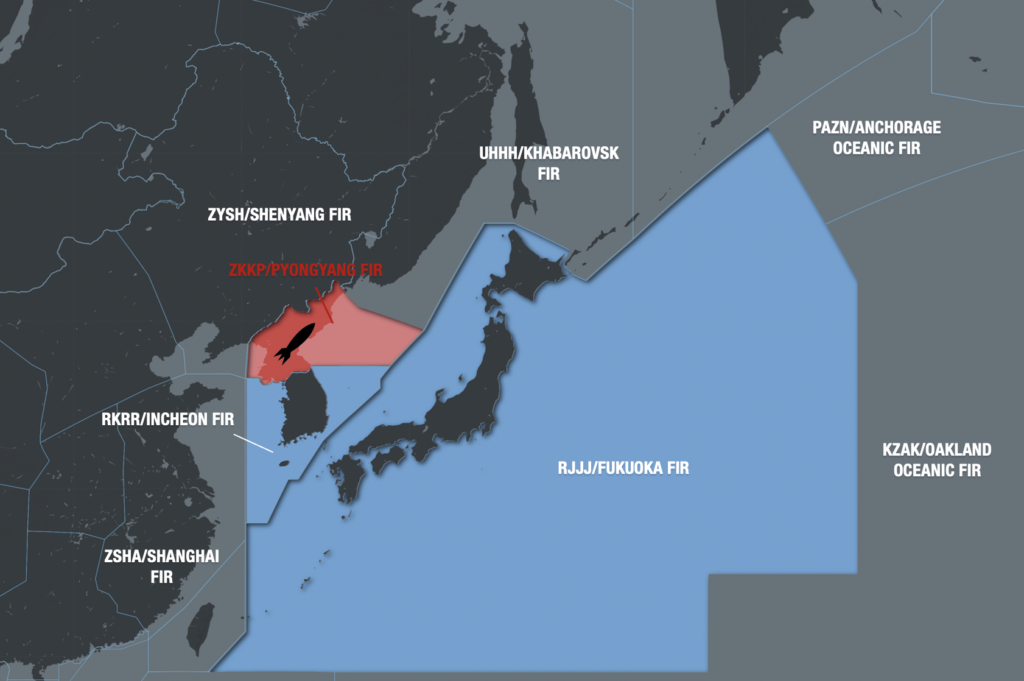
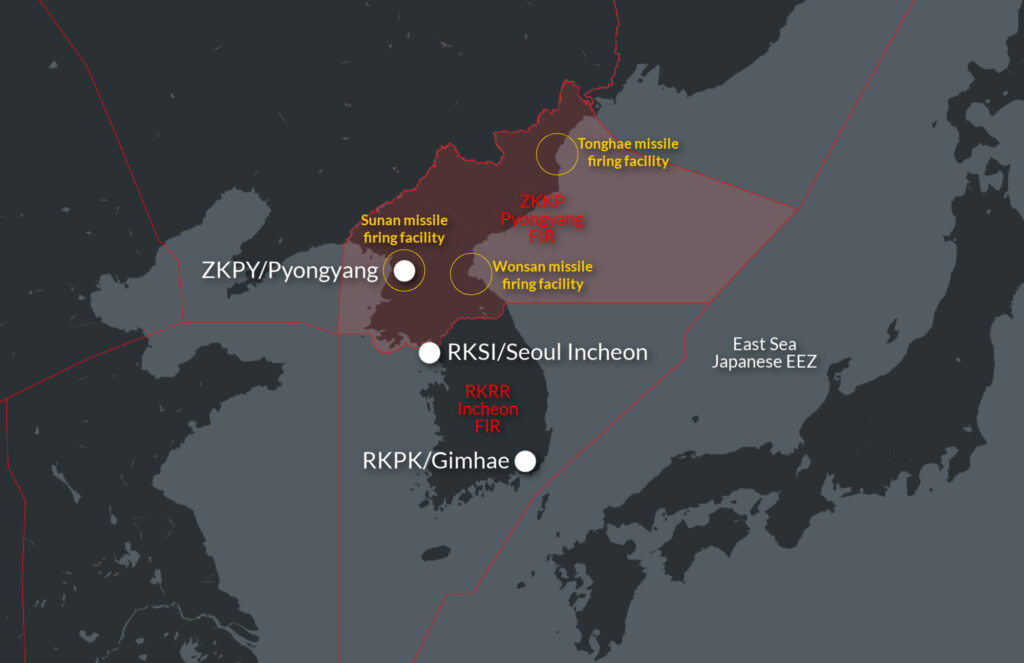
Unlike conventional missile tests, space launches create hazards to aviation that extend far beyond the ZKKP/Pyongyang FIR rendering existing airspace warnings arguably inadequate. Here is an example of a warning hurriedly issued for large portions of the RKRR Incheon FIR following a previously attempted space launch.

Then just weeks ago, North Korea attempted to launch another (with no prior warning) which failed spectacularly in a mid-air explosion. This prompted South Korea to conduct air drills with over twenty military fighter jets near the demilitarised border zone.

North Korea have since announced to Japan their intention to try again with another potential debris field near the Korean Peninsula, and the Philippines Island of Luzon. The original target was June 4 but we’re still waiting.

Behind this persistence to have satellites in space is Pyongyang’s ability to gather intelligence on South Korea should a conflict escalate – it seems that risk to civil aviation is an afterthought.

Ballooning Tensions

Earlier this month, North Korea sent at least three and a half thousand balloons across the border into South Korea carrying animal excrement, garbage and scrap paper. Some landed in Seoul.

No flight disruptions were reported, but images circulating in the media show that the balloons were not small and could easily cause low level hazards to aircraft operating in South Korean airspace near the border.

Earlier this month, North Korea sent three and a half thousand of these balloons across the border into South Korean airspace – some landing near Seoul.

Failed Pact

On June 4, Seoul axed a six-year old agreement with Pyongyang that was designed to calm things down between the two countries. It hoped to achieve this by prohibiting provocative military drills or carrying out psychological warfare near the border.

Just two days later, joint drills with the US were carried out using a long-range bomber to drop precision-guided bombs over the Korean Peninsula. It was the first time this has happened in seven years.

Existing Airspace Warnings for South Korea

They’re extremely limited. The Incheon FIR routinely issues temporary ones by Notam, under the RKRR designator but these can be easily missed in briefing packages. There are no other state issued warnings or advisories to report.

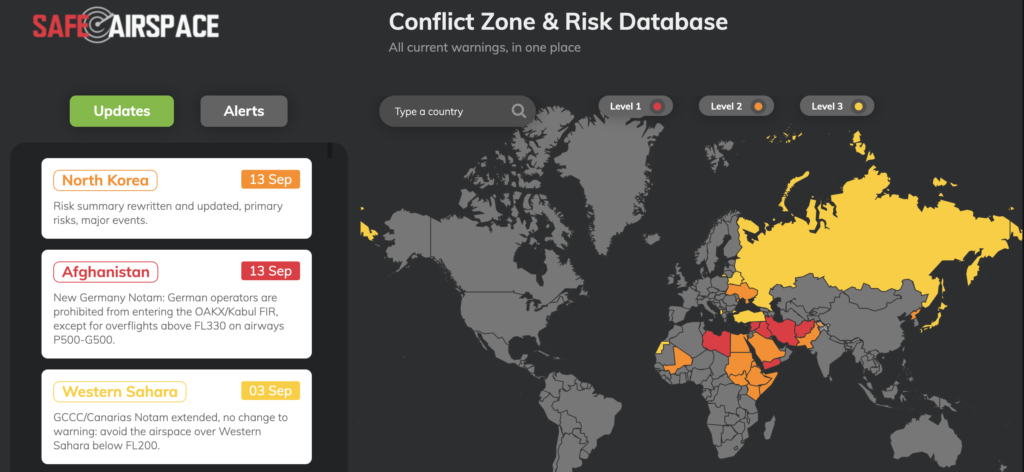
Safe Airspace

Perhaps more concerning to airspace safety than a single large event (such as the outbreak of war) are situations where risk gradually deteriorates in open and busy airspace.

This is arguably what we are seeing right now over South Korea. All of these changes are reported on safeairspace.net – our conflict zone and risk database.
If you have more information to add to this briefing, we’d love to hear from you. You can reach us on team@ops.group.
Asia Airspace Risk: Why North Korea’s Lastest Launch Matters…

**Update: June 2, 07:35z **

South Korea, the Philippines and Japan have all issued new airspace warnings by Notam due to the risk caused by falling debris. Japan’s in particular is worth noting as it also suggests an ‘anti-ballistic missile’ may be launched from several potential locations within the RJJJ/Fukuoka FIR to shoot down the craft if it enters Japanese airspace during launch.

The Notams to be aware of are:

South Korea: 
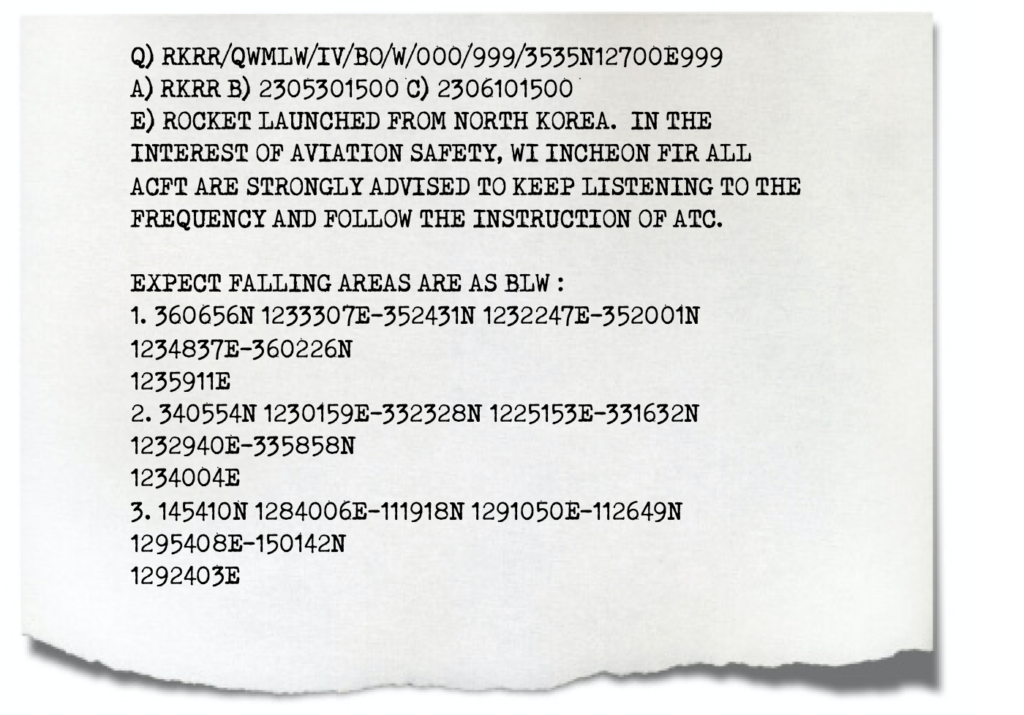
RKRR Z0298/23 - ROCKET LAUNCH WILL TAKE PLACE FROM NORTH KOREA. 
IN THE INTEREST OF AVIATION SAFETY, WI INCHEON FIR ALL ACFT ARE
STRONGLY ADVISED TO KEEP LISTENING TO THE FREQUENCY AND FOLLOW 
THE INSTRUCTION OF ATC.
EXPECT FALLING AREAS ARE AS BLW :
1. 360656N 1233307E-352431N 1232247E-352001N 1234837E-360226N 1235911E
2. 340554N 1230159E-332328N 1225153E-331632N 1232940E-335858N 1234004E
3. 145410N 1284006E-111918N 1291050E-112649N 1295408E-150142N 1292403E. 
31 MAY 08:38 2023 UNTIL 10 JUN 15:00 2023. CREATED: 31 MAY 08:38 2023
Japan: 
RJJJ P2445/23 - ALL ACFT INTENDING TO FLY WI FUKUOKA FIR ARE ADVISED TO PAY
SPECIAL ATTENTION TO THE FOLLOWING INFORMATION.
A ROCKET IS EXPECTED TO BE LAUNCHED FROM NORTH KOREA AND THE
ANTIBALLISTIC MISSILES MAY BE LAUNCHED FOR THE DESTRUCTION OF THE
ROCKET.

1.ROCKET LAUNCHED FROM NORTH KOREA
(1)LAUNCH SITE: NORTH KOREA
(2)FALLING AREAS COORDINATES:
FIRST STAGE
360656N1233307E 352431N1232247E 352001N1234837E 360226N1235911E
SECOND STAGE
340554N1230159E 332328N1225153E 331632N1232940E 335858N1234004E
THIRD STAGE
145410N1284006E 111918N1291050E 112649N1295408E 150142N1292403E

2.IN ACCORDANCE WITH ARTICLE 82-3 OF JAPAN SELF DEFENSE FORCE LAW,
THE ANTIBALLISTIC MISSILES ARE DEPLOYED AT POSITIONS BLW,
(1)NAHA-SHI : 261219N1273929E
(2)MIYAKOJIMA : 244602N1251930E
(3)ISHIGAKIJIMA : 241953N1240828E
(4)YONAGUNIJIMA : 245838N1225716E. SFC - UNL
30 MAY 15:00 2023 UNTIL 10 JUN 15:00 2023. CREATED: 30 MAY 13:57 2023
Philippines: 
RPHI B1867/23 - SPECIAL OPS (SATELLITE LAUNCH ACT) WILL TAKE PLACE WI:
145410N 1284006E -
111918N 1291050E -
112649N 1295408E -
150142N 1292403E -
145410N 1284006E. 
SFC - UNL, 30 MAY 15:00 2023 UNTIL 10 JUN 15:00 2023. CREATED: 30 MAY 02:31 2023

**********

It has been a busy week for the aspiring North Korean space program.

In an unusual turn of events, on May 29 they actually provided prior notice of an impending launch of a (suspected) surveillance satellite into orbit. Then on May 30 it actually lifted off, although unsuccessfully. Alarms were briefly triggered in South Korea and Japan. No sooner had the dust settled than Pyongyang announced their intention to try again – sometime before June 11.

Similar attempts in the past have turned out to be yet more thinly veiled missile tests. Nevertheless, the global community is taking these warnings seriously, and word is being spread by Notam.

Unlike conventional missile tests which we have frequently reported, an attempt to put something into orbit not only uses UN-sanctioned technology, but creates far broader hazard areas for civil aviation – well beyond the ZKKP/Pyongyang FIR where traditional missile tests lie. Which is why we’re collectively sitting up a little straighter.

Not all of the beans are being spilt though. Only some of them. Which is why this week’s launch window was notably broad – extending for a full ten days. Subsequent launches are likely to be same.

The risk for aircraft was from falling debris from rocket staging, or even a complete failure of the craft.

The Notam…

On May 29, South Korea (the RKRR/Incheon FIR) published the following Notam (which has since been cancelled):

There were three major hazard areas – portions of the Yellow Sea, East China Sea and the Philippine Sea.
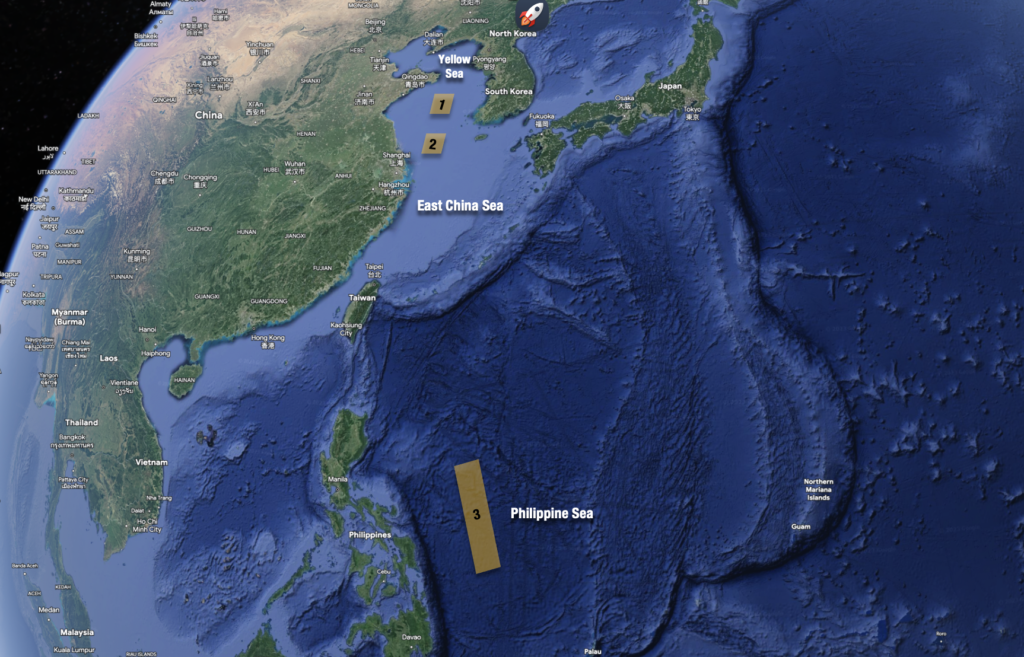
Don’t think in capitalised type-written coordinates? Neither do we. Here’s what that looked like on a map:

The official advice was avoid them completely, if practical. Otherwise, to listen out to ATC for potential updates.

The Plot Thickens…

Given the current state of affairs, any launch is politically sensitive and risks far greater political fallout. Japan has been especially vocal in denouncing them saying that they ‘threaten the peace and safety of Japan, the region and international community…’ They have vowed to shoot down any satellite or debris if it enters Japanese territory – important note: there are currently no airspace warnings for air defence activity anywhere in the RJJJ/Fukuoka FIR. With the best intentions, history has shown this type of activity can inadvertently put civilian aircraft at risk.

It’s no wonder too – there is a well publicised record of North Korean missile launches coming uncomfortably close to Japanese territory, often landing well into  the Sea of Japan.

Political Posturing

It’s unclear whether these are genuine attempts to put a craft into orbit, or more simply a political statement to flex North Korea’s ballistic missile capabilities. If subsequent launches were successful it would be North Korea’s first foray into space ops. However, it comes at a time when there have been large scale live-firing military exercises near the North Korean border by South Korea – part of a seemingly constant cycle of diplomatic muscle flexing that seems to characterise to the region – and as such we may need to take things with a grain of salt.

From an airspace perspective though, these launches should be treated as real hazards. At the very least because it is better to be safe than sorry.

We’ll continue to report on any changes as they emerge. Many of these risks are well publicised, and safeairspace.net is a great place to start for that info.


Get ready for more North Korean missiles

Exercise “Freedom Shield” is happening now – which means that more North Korean missile tests are likely in the coming days.

What is Freedom Shield?

Freedom Shield is a joint US-South Korean military exercise. They run joint exercises every year, but this one is the largest in a long while and so is likely to cause more ‘retaliatory responses’ from North Korea. Particularly as South Korea is specifically simulating responses to potential North Korean threats.

The exercises run for 11 days from March 12th.

It is not clear where the exercises will take place, but the general advice is stick to flight plan routes, maintain a very good listening watch on the radio, follow ATC instructions and keep a good look out.

What is the risk?

North Korea tend to respond to these exercises with significant missile activity, which they never announce. This exercise is likely to see similar levels of response, if their ‘announcement’ is anything to go by…

Pyongyong is resolved to respond with “overwhelming powerful forces” to so-called military manoeuvres by the “the US imperialists and the South Korean puppet forces”. So probably a lot of missile launches.

The missiles rarely have any impact, generally falling into the East Sea (Sea of Japan) outside the EEZ. However, they do pose a threat within the Pyongyang FIR, and a higher level of activity is expected this year.

Here is an earlier post covering this is more detail.

While North Korea do not announce missiles, South Korea do release notams (although generally after the event).

As of March 14, they have fired:

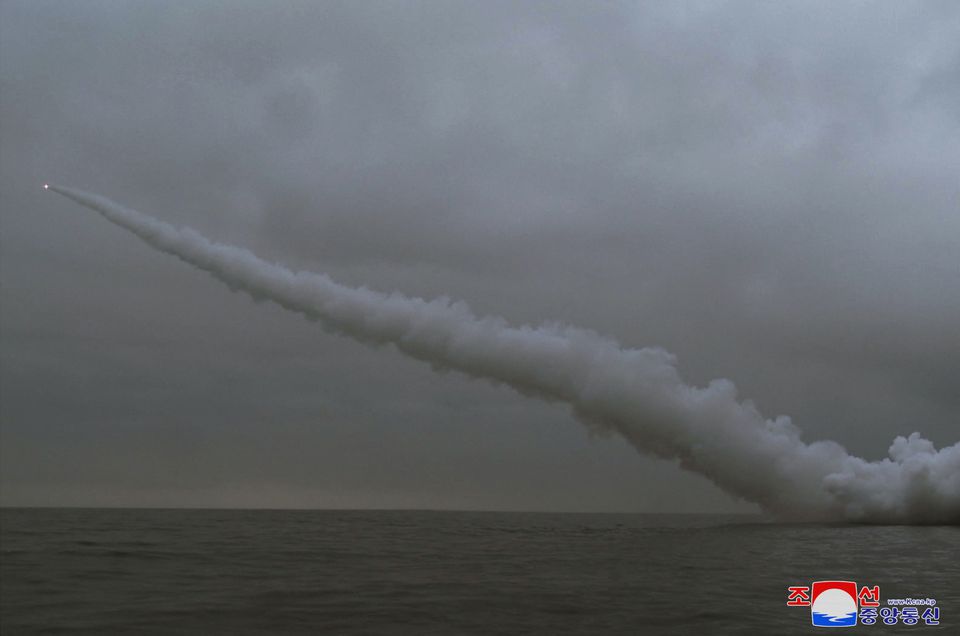
  • Two strategic cruise missiles, from a submarine off the east coast of North Korea
  • Two short-range ballistic missiles fired towards the East Sea, from Jangyon
  • They ran their own military exercises in Feb 2023, firing several long range cruise missiles
  • At the end of 2022, 180 North Korean ‘warplanes‘ were detected in North Korea, but did not infringe on South Korean airspace
  • 5 North Korean drones entered South Korean airspace in December 2022

In other North Korean news…

Not a lot.

They have been trialling ADS-B in their airspace since 2009, according to Notam A0050/09

For full updates on the airspace risk in North Korea, as well as Japan and South Korean, visit Safeairspace.


North Korean Drones Over Seoul

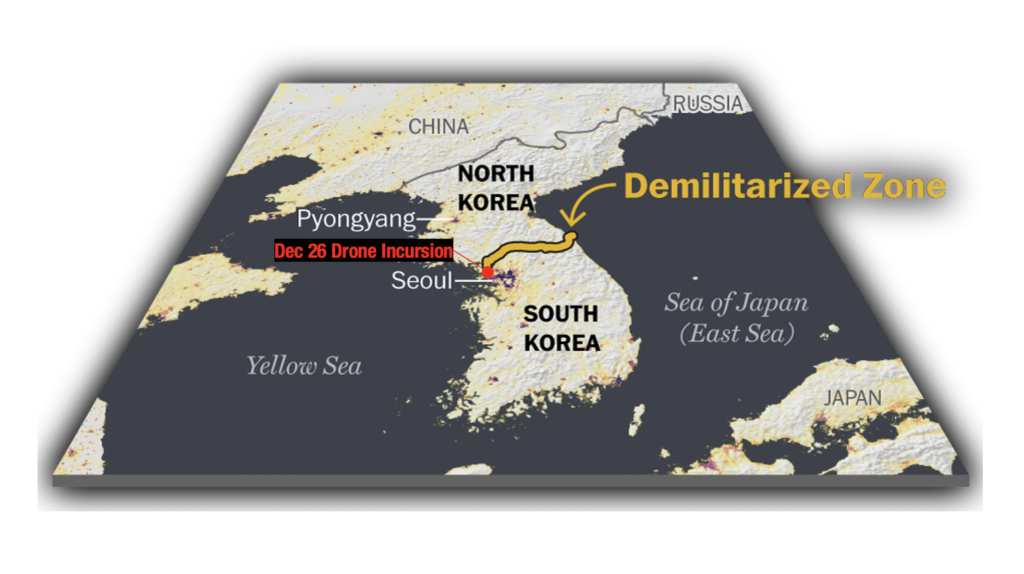
On Dec 26, several North Korean drones entered South Korean airspace. Ops at both RKSI/Seoul and RKSS/Gimpo were disrupted while military jets were dispatched to intercept them.

While it’s no secret that North and South Korea don’t get along, this is the first drone incursion in the RKRR/Incheon FIR in half a decade. And it didn’t go down well. So much so that there is now talk of ending a military pact that has stood since 2018 – especially if there is another incursion.

From an aviation standpoint, this has potential to spell trouble as it threatens the status of a military no-fly zone that buffers the two countries. In which case, the risk to aircraft in the skies of South Korea could deteriorate quickly – especially anywhere near its northern border.

In the absence of any active airspace warnings, here’s what you need to know.

The Dec 26 Incident

At around 10:30am local time, at least five North Korean drones entered South Korean airspace over the Military Demarcation Line near the city of Gimpo – just northeast of Seoul.

It appeared to have caught South Korean military by surprise, who temporarily suspended ops at RKSI/Seoul and RKSS/Gimpo to scramble military jets to intercept them. They fired at least one hundred rounds at the drones supposedly as warning shots.

There are no reports that any of the drones were shot down. One returned to North Korea, while the status of the other four isn’t known.

This has attracted some negative shade in the media, where some felt that the military’s response was inadequate.

In the days that followed, South Korea responded by sending surveillance aircraft into the ZKKP/Pyongyang FIR. The South Korean president has also said that the drone incident could cast serious doubt on a military pact between the two countries – the one that protects border airspace from military incursions.
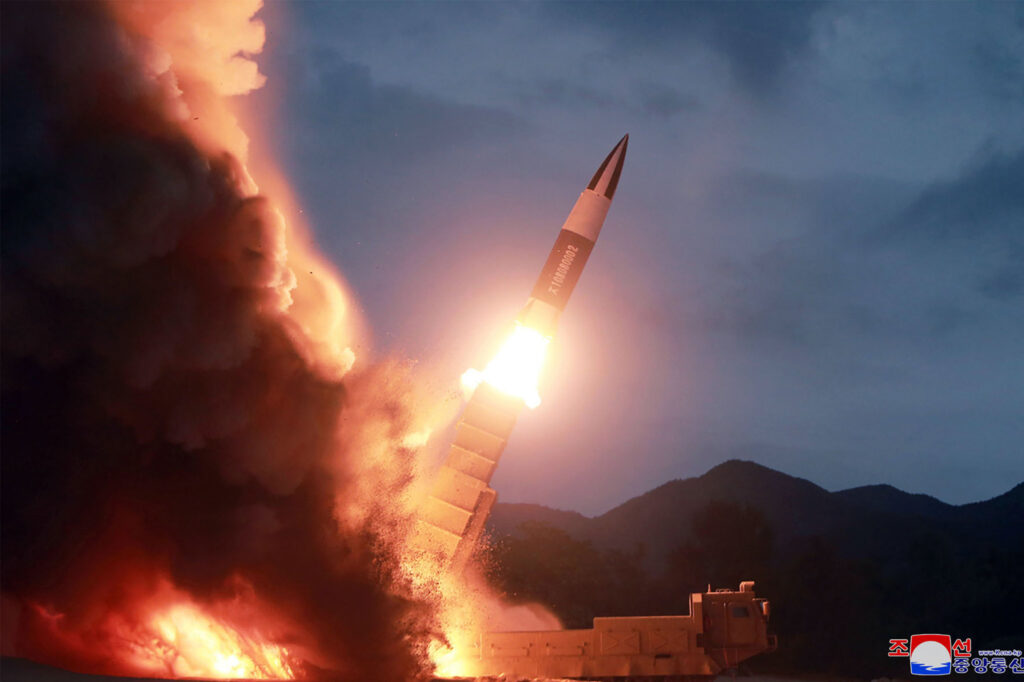
North Korea’s recent ballistic missile tests haven’t helped either – in recent weeks several unannounced launches have taken place with scant regard to civil aviation. The past twelve months have seen a huge upswing in these types of incidents, at one point triggering a ground stop on the US West Coast. And they send a very clear message to South Korea.

Political Posturing

So, are we about to see an outright conflict? Probably not, but ‘quid pro quo’ can be dangerous, especially where airspace is being used as the stage.

Add to that the potential for increased posturing on the border and civil aviation needs to take note. Mistaken identity and mis-targeting is a very real threat. This will escalate should the agreement which upholds the demilitarised buffer zone between them get dismantled.

Previous Airspace Warnings

The FAA has previously had warnings in place for the RKRR/Incheon FIR, but they have long since expired.

The first related to unannounced North Korean missile tests and regional instability. The second was a Notam on GPS interference that was cancelled back in 2019. It was purely advisory – that caution should be taken near the border as the signal may be interfered with.

Since then, things have been quiet. But it is worth keeping in mind that operations in and out of Seoul particularly, are only 30nm away from the demilitarised zone. And beyond it lies the ZKKP/Pyongyang FIR, where US operators are currently banned at all levels.

You can check Safeairspace.net for a summary of the airspace risk, including warnings issued by each country.

What does the South Korean AIP say?

Essentially, don’t stray north.

There is a large area of prohibited airspace which runs along the military demarcation line – a strip of land around 2.5 miles wide which acts as a buffer between North and South Korea more or less defined by the 38th parallel.

No aircraft can enter the area at any level, 24 hours per day. As it is just north of RKSI/Seoul, operators there are advised to give it a wide berth. So much so there is a note to exercise extreme caution in a sector of airspace north of the field. You don’t want to bust it.

As a general rule, the military can impact civil aviation operations without prior notice. This is precisely what went down on December 26.

Where to from here?

We watch and wait. Tension on the Korean Peninsula isn’t new – but the December 26 incident is a reminder of just how volatile things can be at short notice. Should the military pact between the two countries genuinely implode, the risk to civil aviation could change overnight.

North Korea Missile Threat

North Korea regularly launch projectiles without announcement. These have minimal impact on international flight operations since they fall short of the major airways.

However, this past week has seen five projectiles launched from Pyongyang, and the most recent – a ballistic missile – did pose a very significant threat due to a path which carried it directly over Japan.

Several governments have issued statements regarding the latest launch, and previous launches.

Where did the missile go?

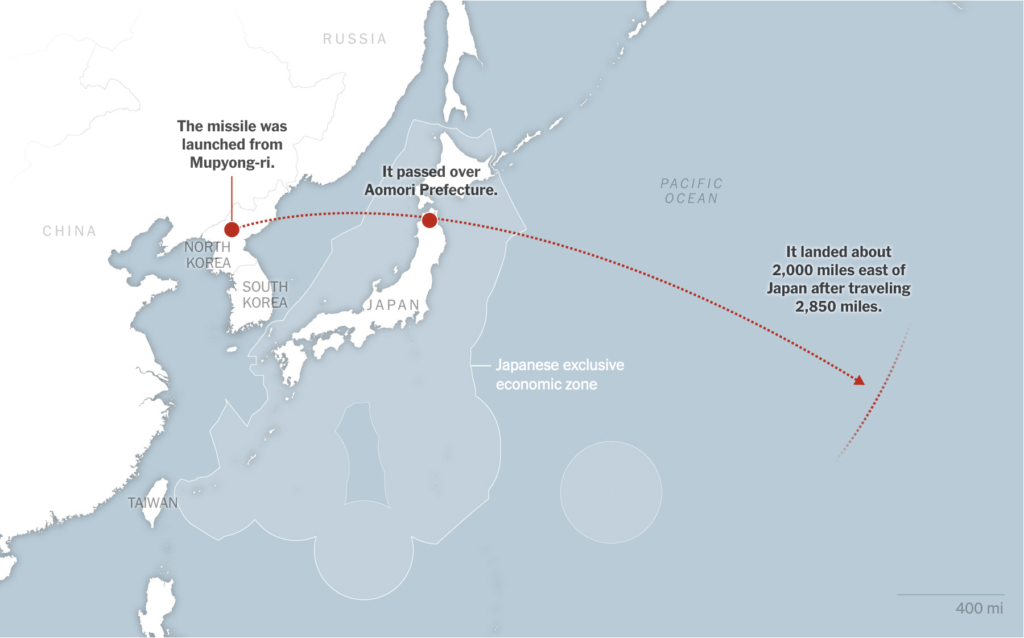
On October 4, Pyongyang launched a suspected ballistic missile over Japan. The path took the missile directly over Hokkaido island, prompting Japan to issue alerts to their citizens. It subsequently fell into the Pacific Ocean.

The 2800 mile path is depicted below. The missile reached an altitude of around 1000km.

Previous launches.

This is the fifth launch in the last week. The launches often coincide with joint US, South Korean and Japanese military drills, or political meetings. There have been a spate of them throughout 2022, with the last reported in August.

In 2018, five launches were carried out over 10 days after a US aircraft carrier made a port call in South Korea.

This is the first launch since 2017 which has seen a projectile incur on Japanese airspace.

How high is the Threat Level?

Following talks with the US in early 2018, North Korea agreed with ICAO that it would provide adequate warning of all “activity hazardous to aviation” within its airspace. However, in May 2019 North Korea resumed launching missiles into the Sea of Japan, without providing any warning by Notam.

The ZKKP/Pyongyang FIR is rarely utilised for overflights by foreign aircraft, and the missiles are usually launched into the Sea of Japan, causing little damage or disruption and falling outside the Japanese EEZ. However, there is an ongoing threat to aircraft operating in the ZKKP/Pyongyang FIR due to unannounced launches and risk from falling debris. 

North Korea has multiple airspace warnings from several major authorities. The threat level has not changed.

A full list of the current major cautions and warnings regarding the airspace, and a full briefing on North Korea can be found on Safeairspace.net

Japan threat levels.

Launches towards or over Japan pose a much more significant threat, because the path towards the sea and the debris fall area are crossing or within sections of airspace used by civilian flights.

North Korea is suspected of attempting to show how their range could impact US military bases in Guam and is not directly targeting Japan, or threatening the airspace. The missiles fall well beyond the airways, however, with the launches being unannounced and potentially growing in frequency, a higher risk level and caution should be taken with operating in the region.


US West Coast flights halted: North Korean missile threat, or coincidence?

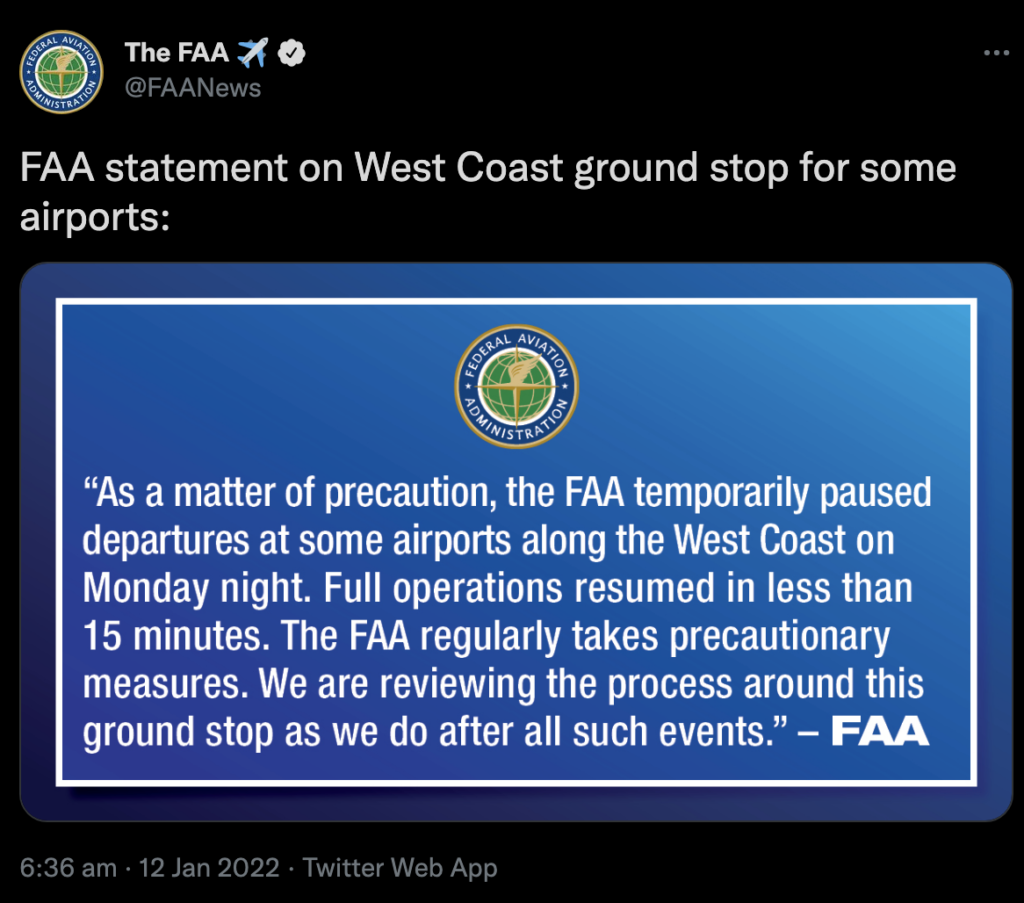
The US FAA has released a brief statement confirming that on Jan 10, a ground stop was put in place at major airports on the West Coast due to “precautionary measures.”

Around the same time, North Korea carried out a missile test – the second in a week. The missile landed well off the coast of the Korean Peninsula, in the Sea of Japan.

It is now being widely speculated that the two events were likely related, however no authority has confirmed this as fact.

Here’s what happened.

At approx. 14:30 PST (2230z) on January 10, a ground stop was ordered by the FAA at airports throughout the Western United States. There are also reports of airborne aircraft being directed to land.

The disruption was short lived (about twenty minutes), before operations went back to normal.

The speculation about why the ground stop came into effect arose for three reasons;

  • Information on why a ground stop is in place is usually provided
  • The air traffic control measure is generally used to slow or stops the flow of aircraft to a particular airport, due to weather or an operational hazard. This one impacted all west coast airports, and airborne aircraft
  • An unannounced test launch of a missile took place in North Korea, landing approximately 400nm off the coast around the same time.

Hypersonic missiles

North Korea state outlet KCNA has claimed these latest two tests were hypersonic missiles. Of course, North Korean is known for its own propaganda…

But hypersonic missiles are dangerous, for two main reasons:

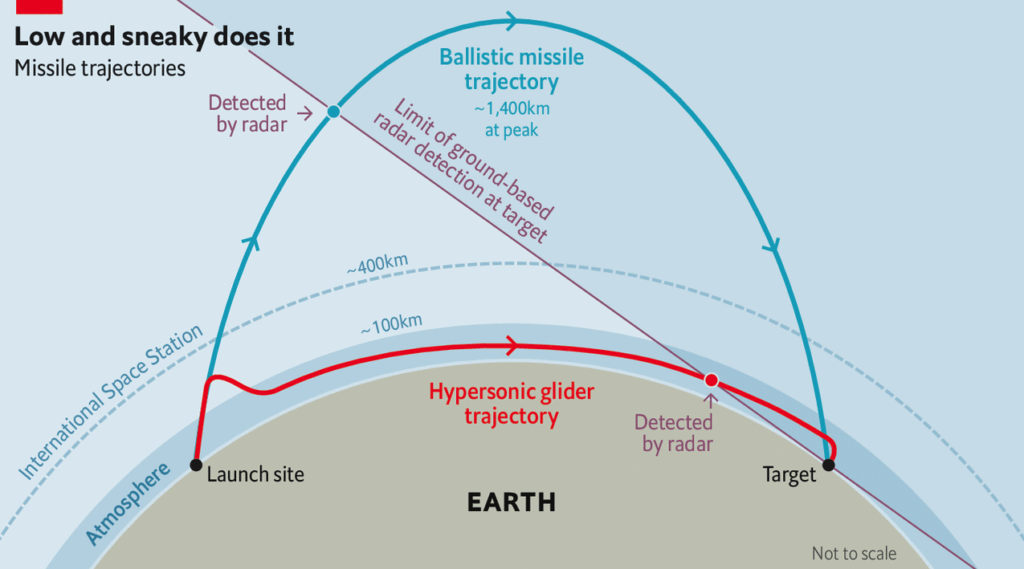
  • Unlike ballistic missiles, which have a fairly predictable trajectory, hypersonic missiles can fly much closer to the earth’s surface and are more difficult to intercept.
  • Hypersonic missiles can travel up to five times the speed of sound, meaning they can hit a target in a much shorter flight time.

Only a handful of countries are reported to be working on the development of hypersonic missiles: the US, Russia, India, and China, and North Korea.

What could explain it.

The launch in North Korea was not announced beforehand, and it is possible that it was detected as a threat leading to the activation of protocols that include notifying the FAA.

Although this looks likely, it’s important to remember that nothing official has been announced to confirm this yet.  The North American Aerospace Defense Command (NORAD) have since advised that it did not issue an official warning.

It did however detect the launch, which was assessed not to be a danger to the mainland US. It is also standard procedure for the FAA to be in constant contact with them and so the FAA may have been compelled to act as a precaution.

The North Korean Missile Threat.

There have been several test launches carried out from North Korea in the past six months. These are typically intended to be a display of capability, rather than an intent to use them.

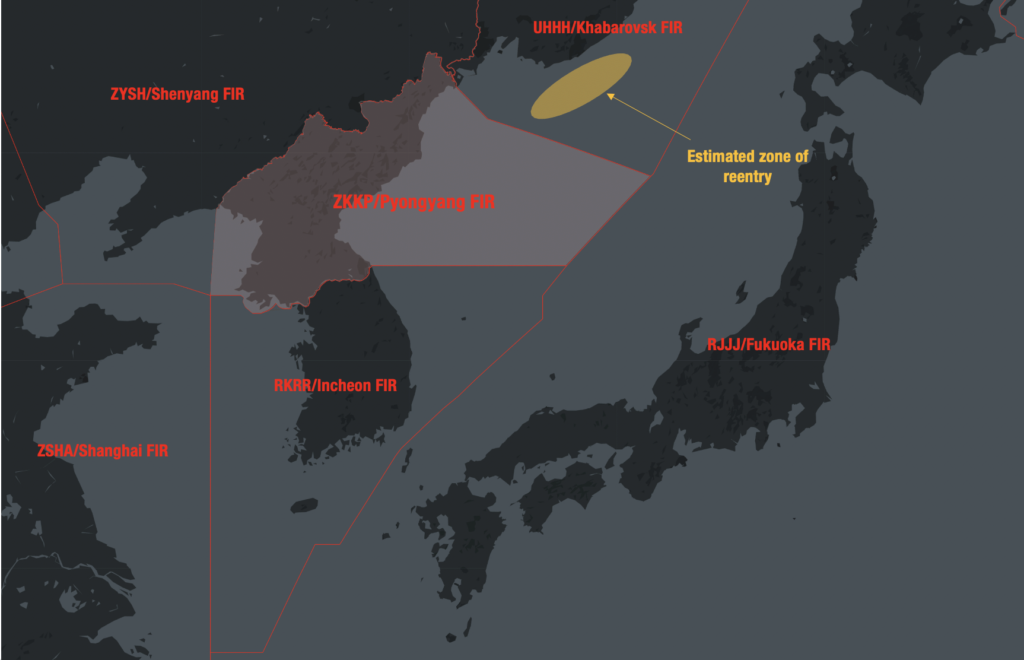
For aviation the threat is primarily based in the oceanic portions of the ZKKP/Pyongyang FIR, and UHHH/Khabarovsk FIRs west of Japan. As the launches have repeatedly been carried out with no advance warning, aircraft are exposed to risk from falling debris from missile tests. You can find more information on this in a previous article which you can read here.

Outlook for 2022

Most experts seem to agree that North Korea faces some big challenges on the home front this year, including its economy and a worsening humanitarian crisis. Its missile program has continued and there has been no recent reassurance that it intends to work on bettering its relationship with the US, or South Korea, nor any intent to provide advance warning of test launches.

These events might not be related, but the speculation itself demonstrates an ongoing concern regarding North Korean actions. The events of January 10 also show how a large impact on US airspace with little or no warning can, and does occasionally occur, and is a reminder to all operators to have policies and preparations in place for dealing with such events.

Do you have more intel, or were you flying as it happened?

We’d love to hear from you. You can reach us at team@ops.group.


North Korea missile risk in the Sea of Japan

North Korea fired two short-range ballistic missiles across its east coast and into the Sea of Japan on Sep 15. It was North Korea’s second weapons test in recent days, after the launch of a new long-range cruise missile at the weekend, which state media claim has a range capable of hitting much of Japan.

North Korea has in the past tested intercontinental ballistic missiles (ICBMs) said to be capable of reaching nearly all of the US mainland and western Europe.

UN sanctions forbid North Korea from testing ballistic missiles (the ones that go up into space and then back down again, spraying debris all over international airways), but not cruise missiles (the ones that fly at low altitudes).

As usual, North Korea did not provide any warning prior to these recent tests – which is the key issue with regards to the airspace safety risk.

A quick history of developments in the last few years:

  • Until around 2014, North Korea notified ICAO of all missile launches, so that aircraft could avoid the launch and splashdown areas.
  • In 2015, they gradually stopped doing this, reaching a point where there could be no confidence in an alert being issued to airlines by North Korea.
  • In 2016, airlines and aircraft operators started avoiding the Pyongyang FIR entirely, by the end of 2016 almost nobody was entering the airspace.
  • In 2017, more and more of these missiles came down in the Sea of Japan, increasingly closer to the Japanese landmass. OPSGROUP researched the locations and produced a map of the risk area, together with the article: “Here’s why North Korean missiles are now a real threat to Civil Aviation”. In September 2017, the US announced a ban on flights across all North Korean airspace, including the oceanic part of the ZKKP/Pyongyang FIR over the Sea of Japan. That ban is still in effect today. Several other countries have airspace warnings in place which advise caution due to the risk posed by unannounced rocket launches.
  • In 2018, following talks with the US, North Korea agreed with ICAO that it would provide adequate warning of all “activity hazardous to aviation” within its airspace.
  • In May 2019, North Korea resumed its practice of launching missiles into the Sea of Japan without providing any warning by Notam.

Determining risk

The critical question for any aircraft operator is whether there is a clear risk from these missiles in the airspace through which we operate.

The chances of a missile, or part of it, striking the aircraft are not as low as they may initially appear – particularly given that all the missile re-entries in recent years are occurring in quite a focused area over the Sea of Japan. The risk to overflying traffic is arguably greater from ballistic missiles than cruise missiles, because these can break up on re-entry to the atmosphere (as happened with the 2017 tests) meaning that a debris field of missile fragments passes through the airspace, not just one complete missile.

Advice to operators

  • Consider rerouting to remain over the Japanese landmass or east of it. It is unlikely that North Korea would risk or target a landing of any test launch onto actual Japanese land.
  • Check routings carefully for arrivals/departures to Europe from Japan, especially if planning airways which connect with the UHHH/Khabarovsk FIR at waypoints IGROD and AVGOK.
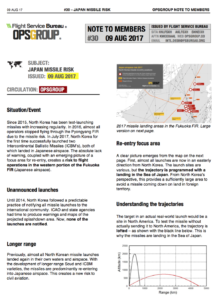
  • Read OPSGROUP’s Note To Members #30: Japan Missile Risk published in Aug 2017.
  • Monitor safeairspace.net for latest updates to airspace warnings issued for North Korea.


Risk Alert for North Korea (2/2020)

Risk Alert issued for North Korea:

North Korea has fired several missiles towards the Sea of Japan, according to South Korea’s military. No-one seems to know for sure if they were ballistic missiles (the ones that go up into space and then back down again, spraying debris all over international airways) or cruise missiles (the ones that fly at low altitudes making them hard to detect). Either way, they’re still launching missiles, and they’re still not providing any warning by Notam, and that = risk. Several countries have warnings in place for North Korean airspace, including the US which prohibits flights across the entire the ZKKP/Pyongyang FIR, including the oceanic part over the Sea of Japan. More info

For more details: https://safeairspace.net/north-korea/


Risk Alert for North Korea (12/2019)

Risk Alert issued for North Korea:

Germany has issued a new Conflict Zone Notam, valid through March 25, warning of the potential risk to overflights through North Korean airspace, due to the potential for launch of test missiles without prior notice. As a result, the Safe Airspace warning level for North Korea is now Level 2. The Notam comes as North Korea said it is planning a “Christmas gift” to the US, and the USAF believes this could be a long-range ballistic missile test. North Korea regularly launches short-range test missiles into the Sea of Japan, but halted its long-range tests after diplomatic talks with the US in early 2018. The US prohibits flights across all North Korean airspace, including the oceanic part of the ZKKP/Pyongyang FIR over the Sea of Japan.

For more details: https://safeairspace.net/north-korea/


Japan scrambles record number of jets as tensions rise with China

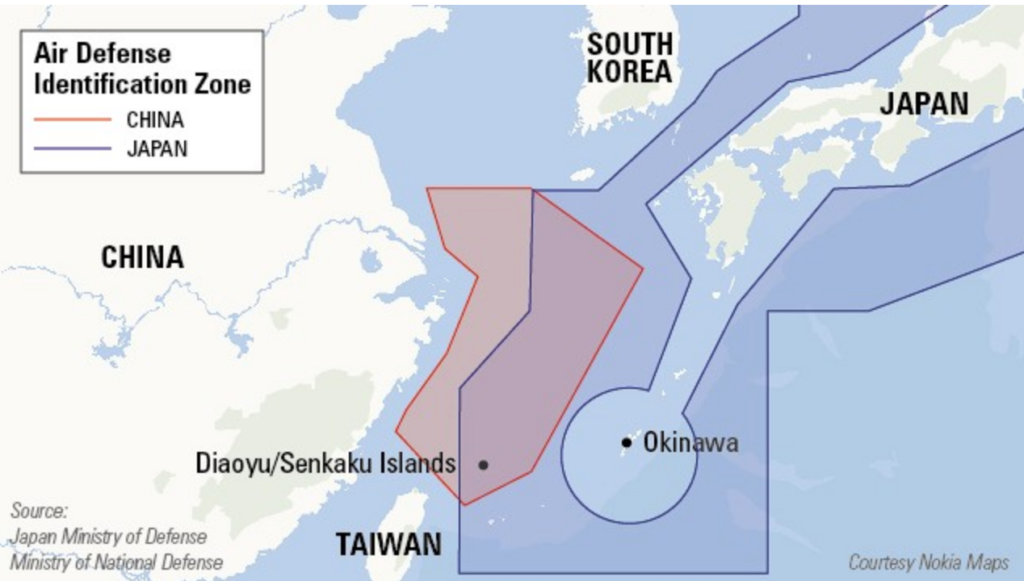
In Short: Japan scrambled a record number of fighter jets in the past year. The number rose to an all-time high of 1,168 in the year to March 2017, easily beating the previous record of 944 set at the height of the cold war in 1984. Chinese aircraft approaching Japanese airspace prompted 851 of the incidents, an increase of 280 over the previous year.

According to official figures released on Thursday, Japan’s Air Self Defense Force is scrambling fighter jets in record numbers as Chinese military activity escalates. Interceptions of Chinese planes rose by half in the year to March 31, in response to increases in the communist country’s activity in and around the East China Sea.

Japan worries that China is probing its air defences as part of a push to extend its military influence in the East China Sea and western Pacific, where Japan controls an island chain stretching 1,400 km (870 miles) south towards Taiwan. The figures highlight China’s growing assertion of military power in East Asia as it expands and modernises its armed forces in line with rapid economic growth.

For the first time, Chinese jets recently began flying through the Tsushima Strait into the Sea of Japan, and through the Miyako Strait into the Pacific Ocean.

But it’s not only China that Japan is worried about. Last week, Japanese Prime Minister Shinzo Abe warned North Korea may be capable of firing a missile loaded with sarin nerve gas towards Japan. “There is a possibility that North Korea already has a capability to deliver missiles with sarin as warheads,” he told a parliamentary national security committee.

And then there’s Russia. Scrambles by Japanese aircraft were high throughout the 1980s in response to flights by Soviet aircraft during the cold war. They fell back to 100-200 incidents a year during the 1990s and 2000s, but began to pick up again a decade ago as both China and Russia grew more assertive.

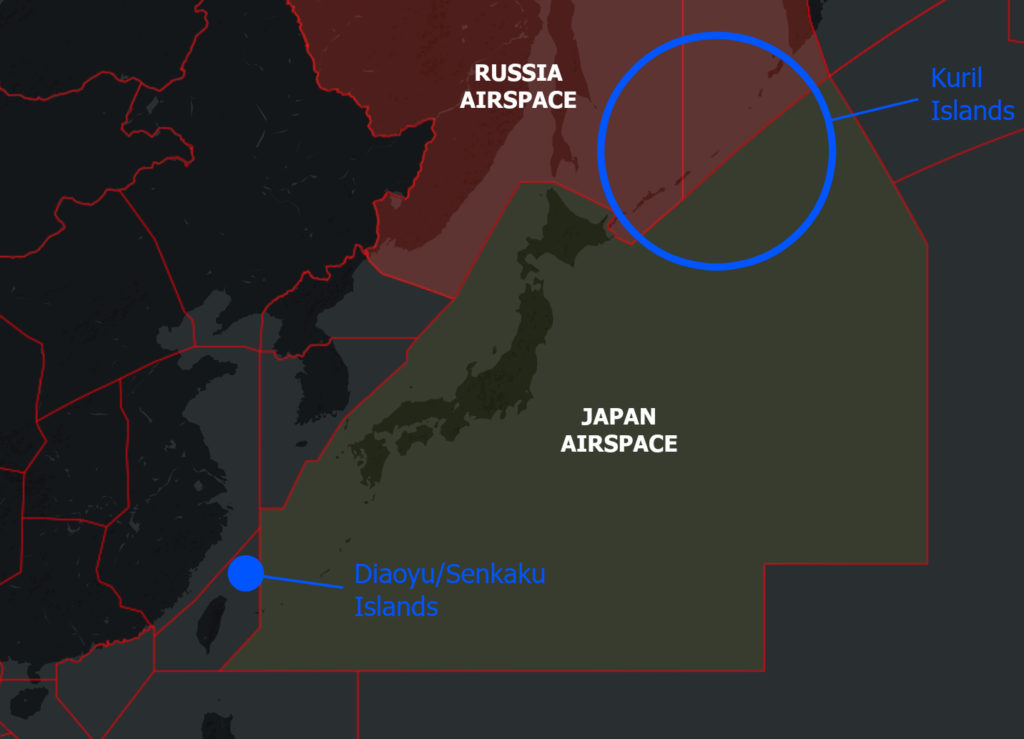
Mr Abe has been trying to negotiate with Russian president Vladimir Putin over the future of four disputed islands in the Kuril chain to Japan’s north, but has made limited progress, with the jet scrambles showing Moscow’s determination to make its presence felt on its eastern border. There were 301 scrambles to intercept Russian aircraft during the year, 13 more than the previous year, including incidents where Russian jets circumnavigated the Japanese Diaoyu/Senkaku Islands to the south.
Extra Reading:


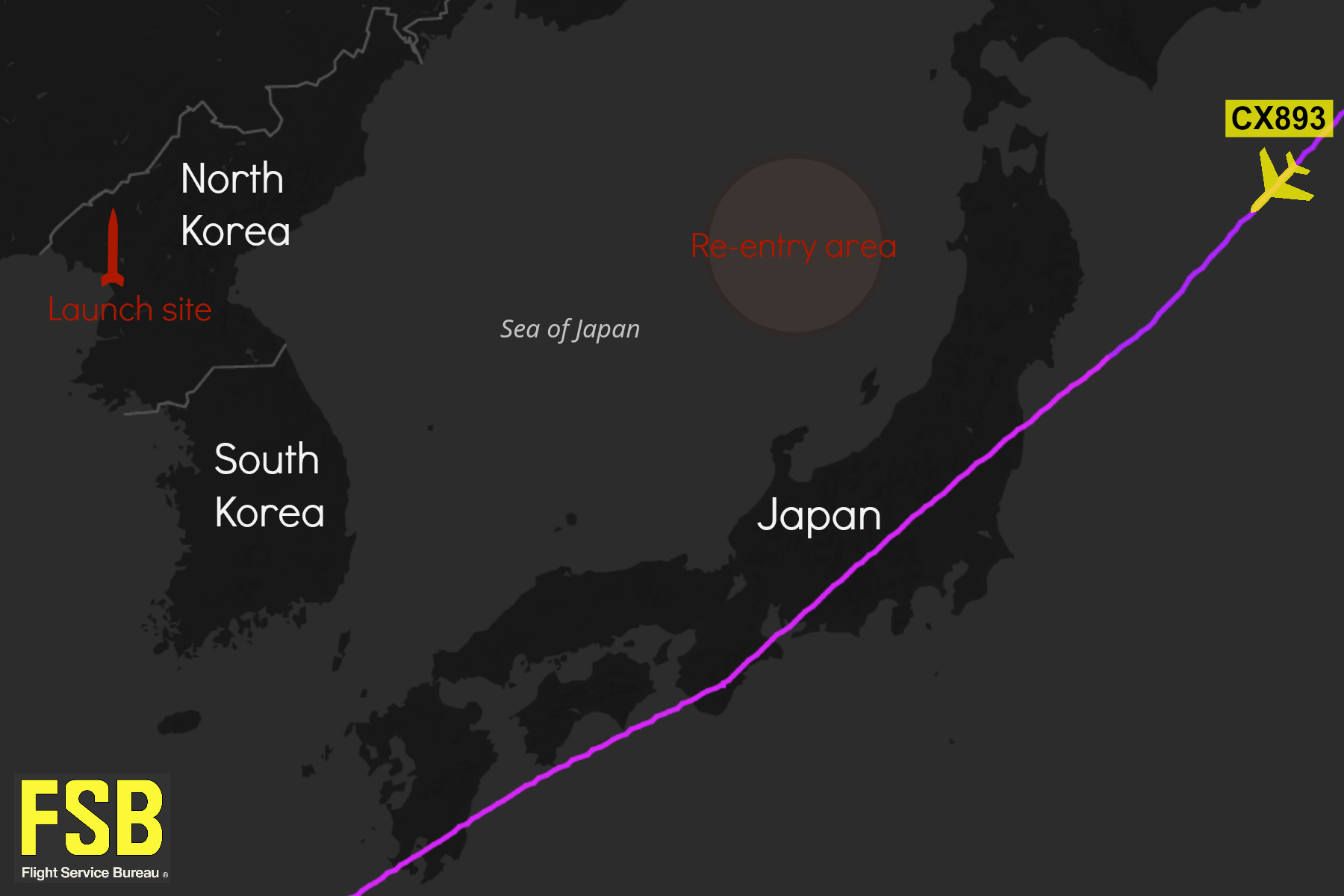
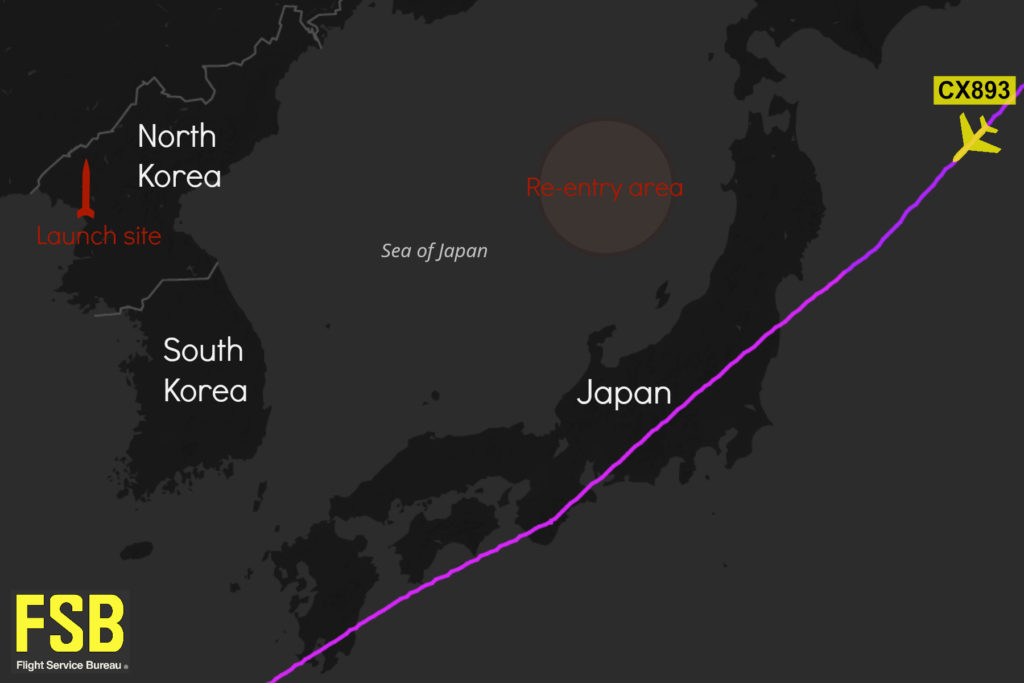
Cathay crew witness missile re-entry from North Korea

Crew onboard a Cathay Pacific flight witnessed the re-entry of North Korea’s latest missile near their position late last week. The CX893 service from San Francisco to Hong Kong on Nov 29 was over Japan at the time when North Korea launched its missile.

The crew reported: “Be advised, we witnessed the DPRK missile blow up and fall apart near our current location.”

Here’s Cathay Pacific’s full statement:

“On 29 November, the flight crew of CX893 reported a sighting of what is suspected to be the re-entry of the recent DPRK test missile. Though the flight was far from the event location, the crew advised Japan ATC according to procedures. Operation remained normal and was not affected. We have been in contact with relevant authorities and industry bodies as well as with other carriers. At the moment, no one is changing any routes or operating parameters. We remain alert and review the situation as it evolves."

North Korea’s missiles are larger, and can fly further, than the other missiles we’ve previously seen. Over the past year, most of these missiles land in the Sea of Japan, well inside the Fukuoka Flight Information Region (Japanese airspace). But as we see with this latest test, there is clearly a danger of some of these missiles not re-entering the atmosphere intact – meaning that a debris field of missile fragments passes through the airspace, not just one complete missile. If you haven’t done so already, make sure you read this: our article on why North Korean missiles are now a real threat to Civil Aviation.

This latest test is also significant because of its unprecedented altitude – 4500km (2800 miles). Experts seem to agree that if it had been fired on a standard trajectory, the missile would have been capable of traveling around 13000km (8100 miles), meaning it could have struck anywhere in the mainland US.

If you’re operating in the region, we recommend avoiding the ZKKP/Pyongyang FIR entirely and avoiding the affected areas over the Sea of Japan. For more info, check out Safeairspace.


Here’s why North Korean missiles are now a real threat to Civil Aviation

  • July 2017: First launches of ICBM’s from North Korea
  • Western portion of Japanese airspace is a new risk area
  • New OPSGROUP guidance to Members, Note 30: Japanese Missile risk

The North Korean game has changed. Even if aircraft operators stopped flying through the Pyongyang FIR last year, nobody really thought there was much of a tangible risk. The chances of a missile actually hitting an aircraft seemed slim, and any discussion on the subject didn’t last long.

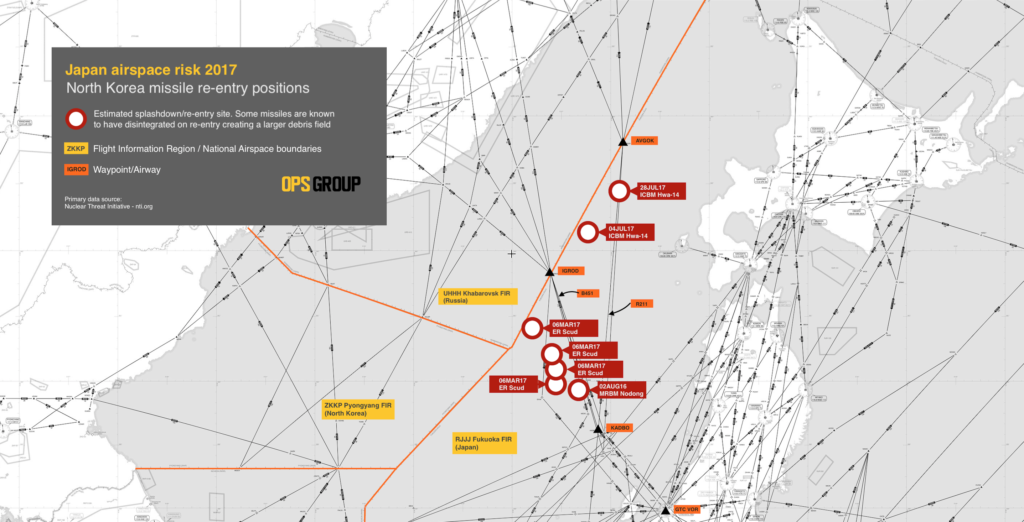
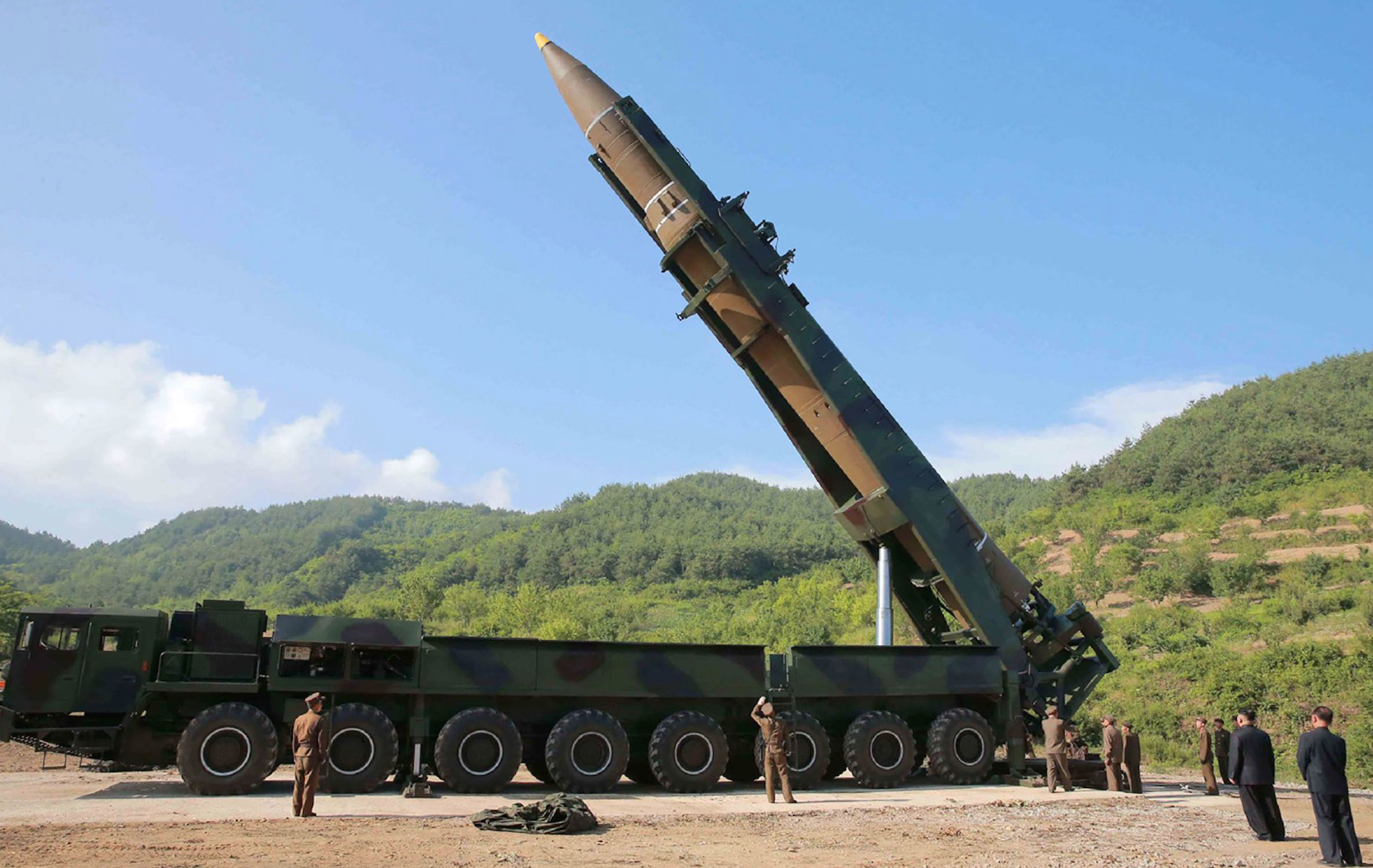
Things look different now. In July, the DPRK tested two Hwasong-14 Intercontinental missiles (the July 4th one is above), the first ICBM’s successfully launched from North Korea. ICBM’s are larger, and fly further, than the other missiles we’ve previously seen. Both of these landed in the Sea of Japan, well inside the Fukuoka Flight Information Region (Japanese airspace), and significantly, at least one did not re-enter the atmosphere intact – meaning that a debris field of missile fragments passed through the airspace, not just one complete missile.

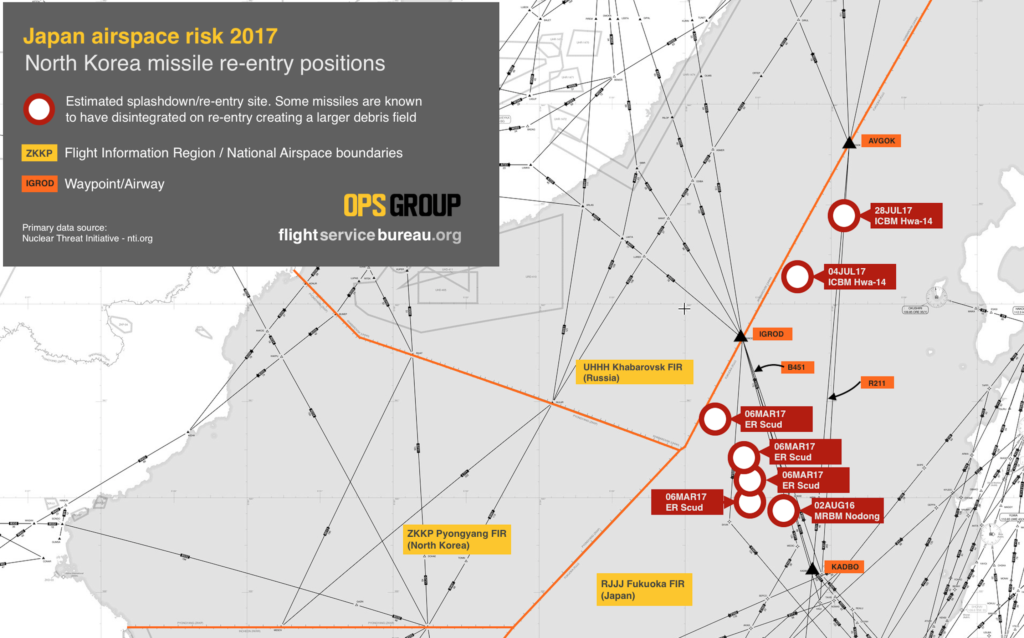
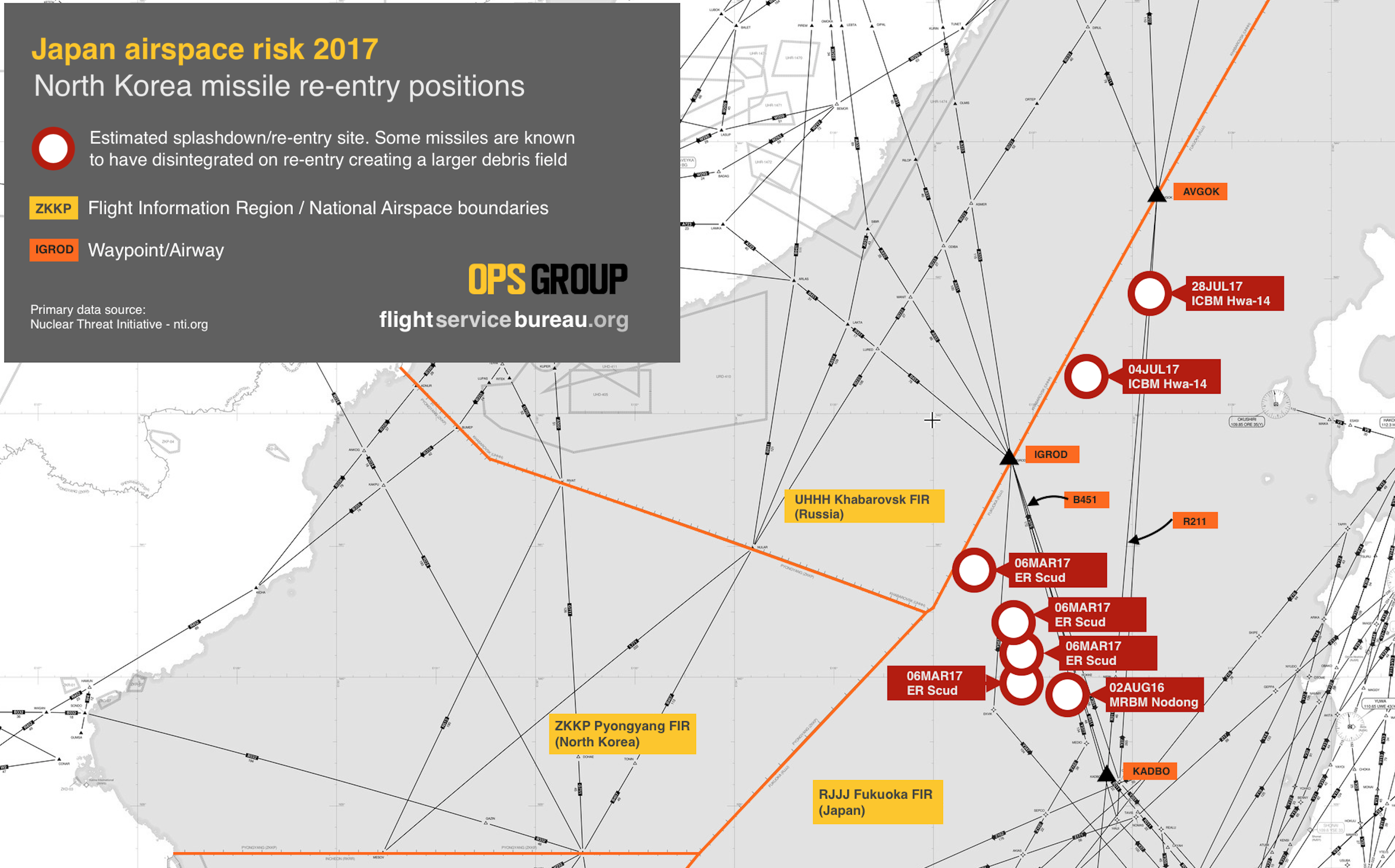
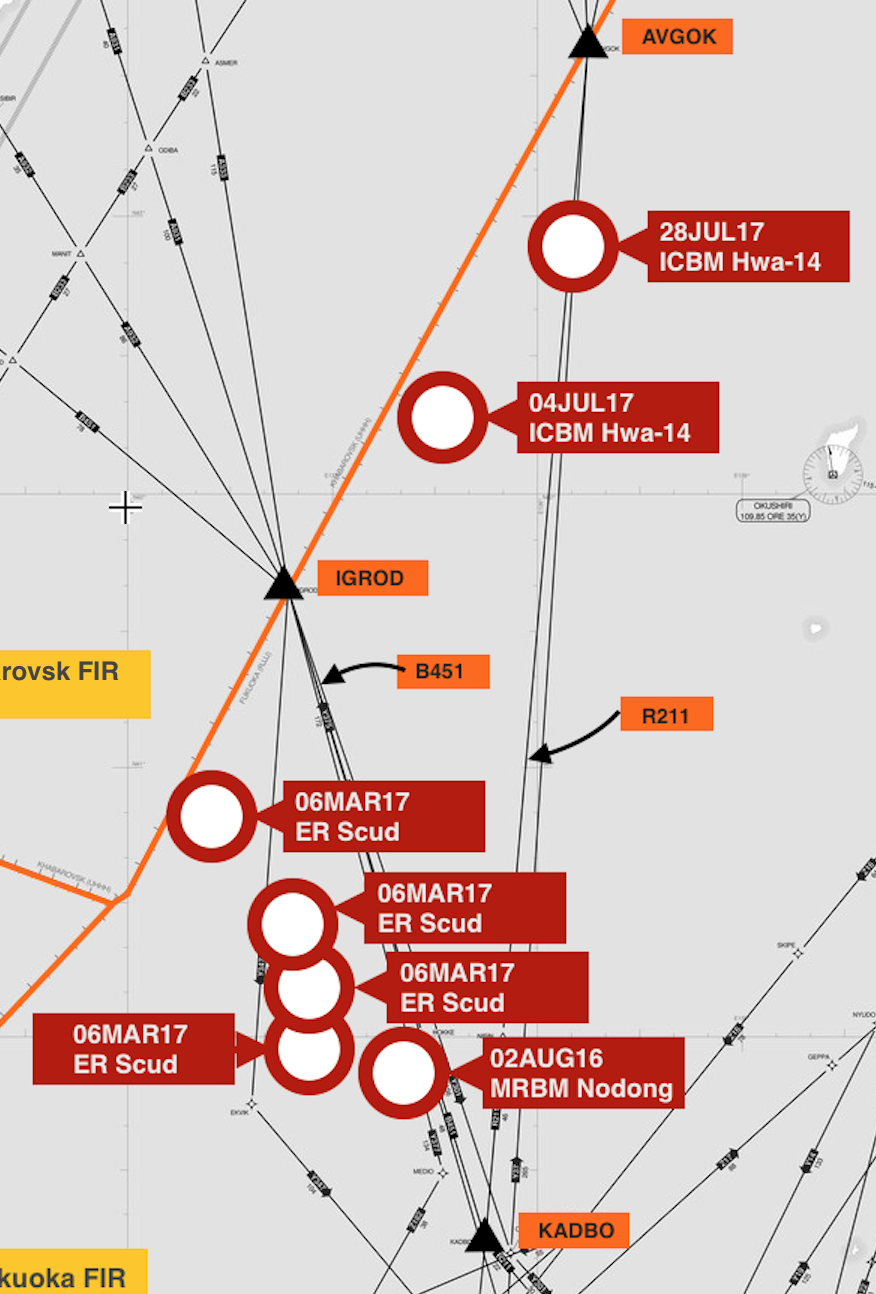
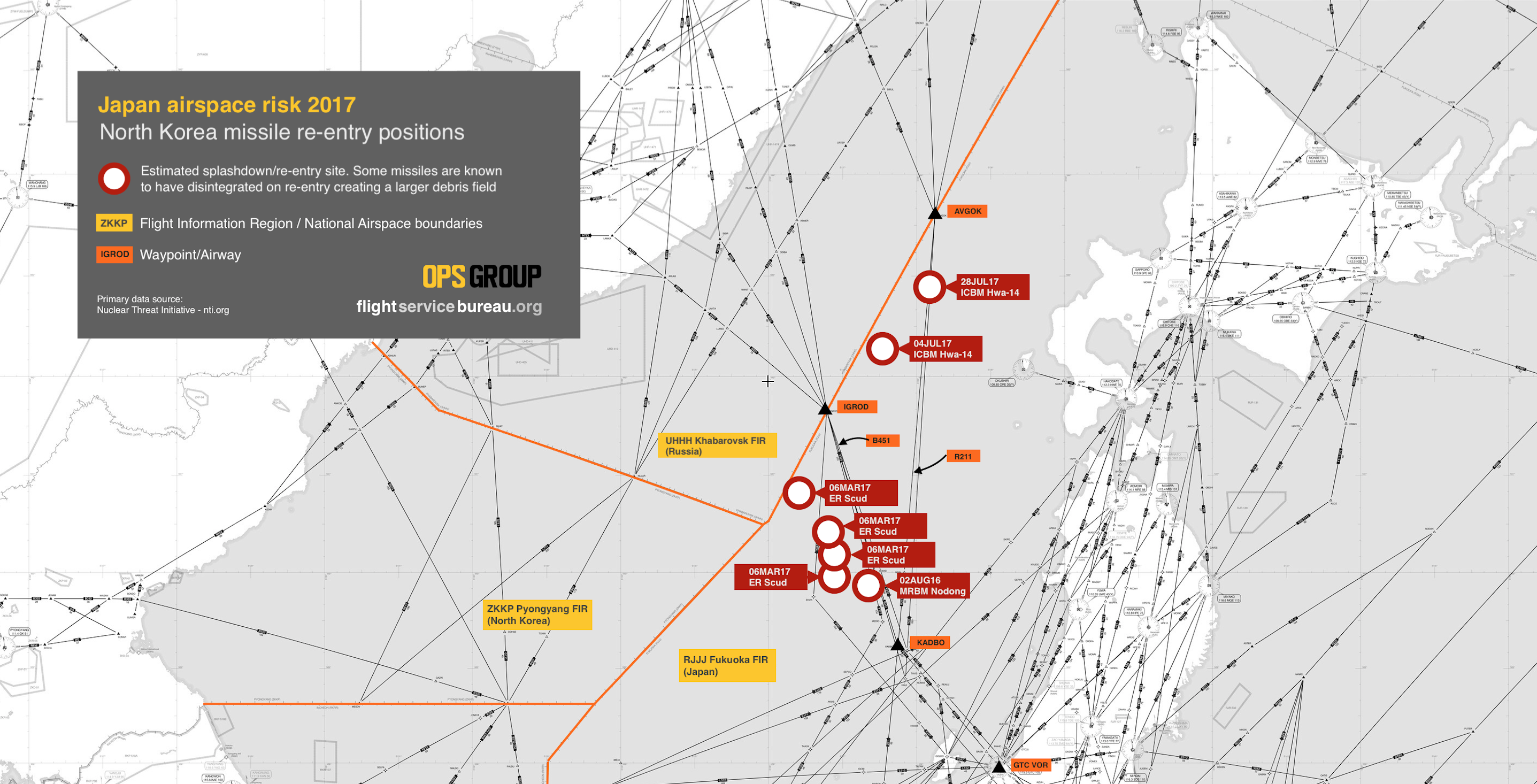
We drew a map, with our best estimates of the landing positions of all launches in the last year that ended in Japanese airspace. The results are quite clear:


View large image

Zooming in even further, we can see each of the estimated landing sites. It is important to note that the landing positions vary in the degree of accuracy with which it is possible to estimate them. The highest accuracy is for the 28JUL17 landing of the Hwasong-14 ICBM, thanks to tracking by the Japanese Defence Force and US STRATCOM, as well as visual confirmation from land in Japan. The remaining positions are less precise, but in an overall view, the area affected is quite well defined – south of AVGOK and north of KADBO. In 2017, there have been 6 distinct missile landings in this area. The primary airways affected are B451 and R211, as shown on the chart.


View large image

So, in a very specific portion of Japanese airspace, there have been regular splashdowns of North Korean missiles. As highlighted by the Air France 293 coverage, this area is crossed by several airways in regular use, predominantly by Japan-Europe flights using the Russia route.

Determining Risk

The critical question for any aircraft operator is whether there is a clear risk from these missiles returning to earth through the airspace in which we operate. Take these considerations into account:

The regularity and range of the launches are increasing. In 2015, there were 15 launches in total, of short-range ballistic and sub-launched missiles. In 2016, there were 24 launches, almost all being medium-range. In 2017, there have been 18 so far, with the first long-range missiles.

– In 2016, international aviation solved the problem by avoiding the Pyongyang FIR. This is no longer sufficient. The landing sites of these missiles have moved east, and there is a higher likelihood of a splashdown through Japanese airspace than into North Korea.

– Almost all launches are now in an easterly direction from North Korea. The launch sites are various, but the trajectory is programmed with a landing in the Sea of Japan. From North Korea’s perspective, this provides a sufficiently large area to avoid a missile coming down on land in foreign territory.

– The most recent ICBM failed on re-entry, breaking up into many fragmented pieces, creating a debris field. At about 1515Z on the 28th July, there was a large area around the R211 airway that would have presented a real risk to any aircraft there. Thankfully, there were none – although the  Air France B777 had passed through some minutes before.

– Until 2014, North Korea followed a predictable practice of notifying all missile launches to the international community. ICAO and state agencies had time to produce warnings and maps of the projected splashdown area. Now, none of the launches are notified.

– Not all launches are detected by surrounding countries or US STRATCOM. The missile flies for about 35 minutes before re-entry. Even with an immediate detection, it’s unlikely that the information would reach the Japanese radar controller in time to provide any alert to enroute traffic. Further, even with the knowledge of a launch, traffic already in the area has no avoiding option, given the large area that the missile may fall in.

Can a falling missile hit an aircraft?

What are the chances? Following the AFR293 report on July 28, the media has favoured the “billions to one” answer.

We don’t think it’s quite as low.

First of all, that “one” is actually “six” – the number of North Korean missiles landing in the AVGOK/KADBO area in 2017. Considering that at least one of them, and maybe more, broke up on re-entry, that six becomes a much higher number.

Any fragment of reasonable size hitting a tailplane, wing, or engine as the aircraft is in cruise at 450 knots creates a significant risk of loss of control of the aircraft. How many fragments were there across the six launches? Maybe as high as a hundred pieces, maybe even more.

The chances of a missile, or part of it, striking the aircraft are not as low as it may initially appear. Given that all these re-entries are occurring in quite a focused area, prudence dictates considering avoiding the airspace.

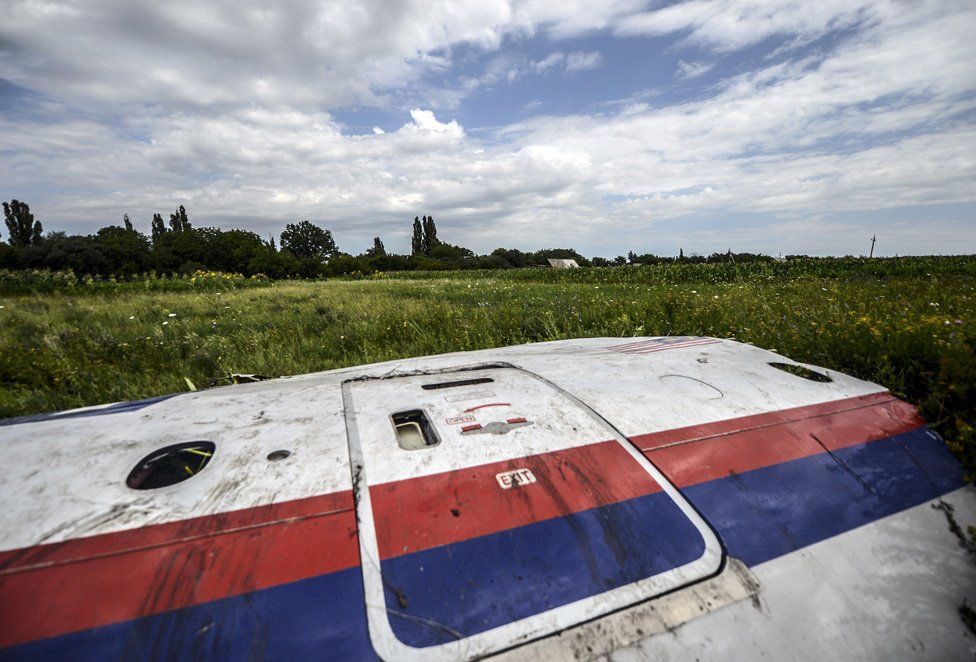
What did we learn from MH17?

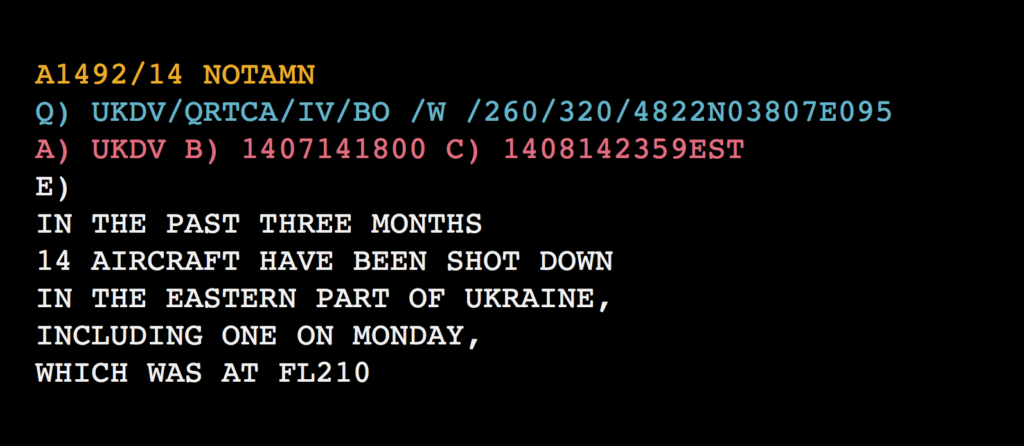
Whenever we discuss missiles and overflying civil aircraft in the same paragraph,  the valuable lessons from MH17 must be remembered. In the weeks and months leading up to the shooting down of the 777 over Ukraine, there were multiple clues to the threat before the event happened.

Of greatest relevance was that State Authorities did not make clear the risk, and that even though five or six airlines decided to avoid Ukrainian airspace, most other operators did not become aware of the real risk level until after the event.

Our mission at Flight Service Bureau is to make sure all aircraft operators, crews, and dispatchers have the data they need to make a fully informed decision on whether to continue flying western Japan routes, or to avoid them.

Guidance for Aircraft Operators

Download OPSGROUP Note to Members #30: Japan Missile risk (public version here)

Review the map above to see the risk area as determined by the landing sites in 2017.

Consider rerouting to remain over the Japanese landmass or east of it. It is unlikely that North Korea would risk or target a landing of any test launch onto actual Japanese land.

Check routings carefully for arrivals/departures to Europe from Japan, especially if planning airways R211 or B451. Consider the previous missile landing sites in your planning.

– Monitor nti.org for the most recent launches, as well safeairspace.net.

OPSGROUP members will be updated with any significant additions or updates to this Note through member mail and/or weekly newsletter.

References

– Nuclear Threat Initiative – nti.org

– Opsgroup Note to members #30 – Public version

OPSGROUP – Membership available here.

– Weekly International Ops Bulletin published by OPSGROUP covering critical changes to Airports, Airspace, ATC, Weather, Safety, Threats, Procedures, Visas. Subscribe to the short free version here, or join thousands of Pilot/Dispatcher/ATC/CAA/Flight Ops colleagues in OPSGROUP for the full weekly bulletin, airspace warnings, Ops guides, tools, maps, group discussion, Ask-us-Anything, and a ton more.

– Larger area map of Japan airspace risk 2017

– Contact news@ops.group with any comments or questions.


Germany issue new warnings, Manila may not ban GA after all

Germany issues new warnings 25JAN Germany has issued fresh warnings on the airspace of EgyptSouth Sudan, and North Korea, in three separate Notams issued in the last week. We have updated the SafeAirspace.net country information pages with the specifics. Read the article


Manila may not ban GA after all 25JAN RPLL/Manila is not moving as quickly towards a complete ban of non-scheduled and General Aviation traffic as feared. This is good news for International Operators. Read the article.


HEZZ/Egypt, HSZZ/South Sudan, ZKZZ/North Korea Germany has issued fresh warnings on the airspace of EgyptSouth Sudan, and North Korea, in three separate Notams issued in the last week. We have updated the SafeAirspace.net country information pages with the specifics.

RPLL/Manila is not moving as quickly towards a complete ban of non-scheduled and General Aviation traffic as feared. This is good news for International Operators. Read the article.

NTAA/Tahiti The airport is open again as of Monday morning local time, after closing due to flooding after torrential rains, but many taxiways remain flooded. Expect delays in handling and tech stops.

KZZZ/USA Announced yesterday and expected to come into force this week, is an immediate ban on US visas (and therefore US travel) for citizens from 7 countries: Iraq, Iran, Syria, Yemen, Sudan, Somalia and Libya. This is distinct from the Visa Waiver Program ban in effect since January 2016.

GBZZ/Gambia FSB Risk Level changed from Level Three to “No Warnings” on Jan 24. New president has taken power. Parliament revoked State of Emergency. Situation calm.
SBZZ/Brazil In the last bulletin we had a headline about a Boeing 767 shot on approach in Brazil. A bullet was found lodged in the wing. Some updates to that story are here, and safeairspace.net’s Brazilpage is updated.

VZZZ/Southeast Asia Don’t forget it’s New Year in Asia this weekend. Travel-related delays and government office and business interruptions will peak 27 Jan to 01 Feb, and could last longer in Taiwan, Vietnam and China, where the holiday will be celebrated through 02 Feb.
EDDB/Berlin Brandenburg will now not open until 2018, as they found more problems with the fire system this week. This is a recurring story, which dates back to 2012. So, for the foreseeable, you’re stuck with Tegel and Schoenefeld.

LTFJ/Sabiha Gökçen (Istanbul) Due to insufficient capacity at LTFJ, applications for individual non-scheduled flights will be refused, and private/charter flights can only be operated at “non-busy hours”.

KBPI/Palm Beach is going to see some new TFR restrictions due to the proximity of Donald Trumps Mar-a-Lago estate. If operating when he’s down here, you’ll have to depart from a gateway airport to PBI – those are TEB, HPN, IAD, MCO and FLL. NBAA has the details.

LSGG/Geneva EBACE is on from Monday, 22 May through Wednesday, 24 May 2017. Now would be a good time to get those slots booked if you’re planning to head over.

LFMN/Nice has a new procedure where ATC will alert crews to windshear.

MSLP/San Salvador‘s only runway 07/25 will be closed from 1600-1700 each day until Feb 3rd.

VGHS/Dhaka The UK Department for Transport (DfT) announced today that it recently carried out assessments of security at Dhaka International Airport. Following this, the DfT has assessed that security at Dhaka airport does not meet some international security requirements (they haven’t said which).

OMAD/Abu Dhabi (Al Bateen) is hosting the International Defence Exhibition in February, so will not be available to IFR traffic daily between 0600-0800Z until Feb 23rd. There are also restrictions on using it as an alternate.

DNAA/Abuja The latest on the Abuja closure is that it will be completely closed to all traffic from March 8th – April 19th.

SKCG/Cartagena‘s only runway 01/19 is closed daily 0530-1100Z until Feb 6th.

NVZZ/Vanuatu Health authorities have declared a dengue outbreak following a large increase in suspected cases in December 2016 and January 2017. Protect yourself against mosquito bites

WSZZ/Singapore is implementing the new ICAO SID/STAR phraseologies from March 2nd. Read AIP SUP 29/17.

LIRF/Rome Fiumicino is working on 16R until March, so 25 will be used for deps and 16L for arrivals. This means delays, especially if you want 16L/34R for departure – they say up to a 60 minute taxi time.

UKZZ/Ukraine amended the military boundaries of its airspace on Monday Jan 23rd, identifying the Donbas conflict zone region as a separate area. More details here.


View the full International bulletin 25JAN2017


Updated airspace warnings for Egypt, South Sudan, North Korea

Germany has issued fresh warnings on the airspace of Egypt, South Sudan, and North Korea, in three separate Notams issued in the last week. Germany is one of four states that provides Aircraft Operators with conflict zone and risk advice. We have updated the SafeAirspace.net country information pages with the specifics.

The current Flight Service Bureau summary of each country follows:

Egypt Since the Arab Spring, Egypt’s stability and security situation as a state has declined. In October 2015 a Russian A321 was brought down over the Sinai peninsula by a bomb loaded at HESH/Sharm El Sheikh. In the aftermath, it was initially feared that a missile had caused the crash. Multiple warnings still in place from that fear. 19 May 2016 EgyptAir Flight MS804 from Paris to Cairo disappeared over the Mediterranean, cause unknown. GPS jamming reported at HECA/Cairo several times in 2016. High threat from terrorism in Egypt. Further attacks are likely. Not recommended as a tech stop. [Read full country information]

South Sudan Conflict Zone. South Sudanese Civil War since 2013. The security situation in Juba has been relatively calm since the July 2016 crisis. Daily reports of fighting throughout the rest of the country. The security situation is especially unstable in the Equatorias in the south. MANPADS risk to overflights. In addition, the South Sudanese army has declared intention to shoot down Aircraft without permits. Most Authority guidance recommends min FL260. We think FL300 is a better minimum for overflights. [Read full country information]

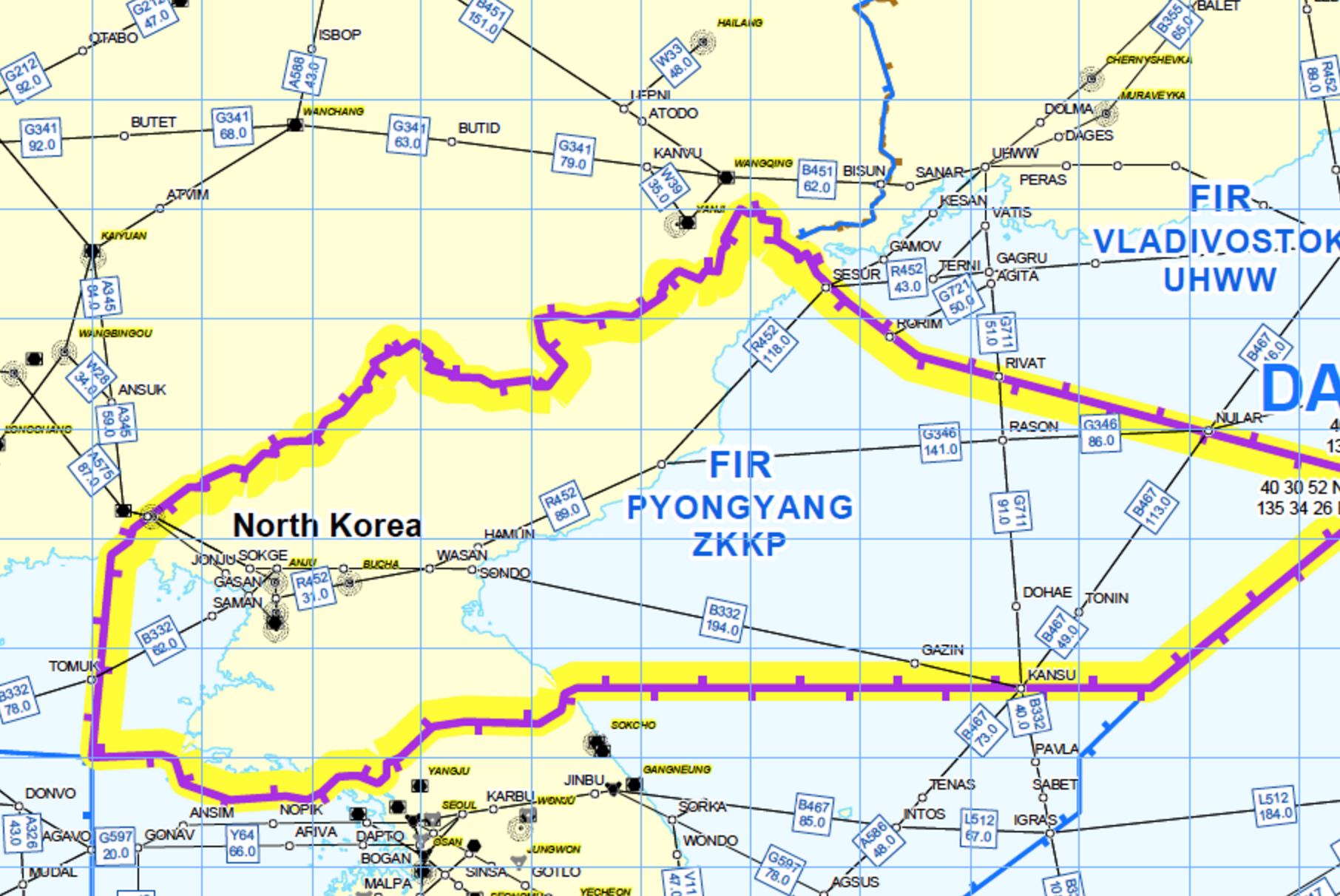
North Korea The level of tension on the Korean peninsula can change with little notice. Multiple missile launches in 2016, increasingly without prior notice to ICAO. The range of these has increased – previously safe airways B467 and G711 are now at risk. Over 1000 reports of GPS jamming issues reported by operators in the vicinity of the North/South Korean border. SFAR79 prevents US operators from operating west of 132E, other Authorities restrict operations east of that line. [Read full country information]


References:


International Bulletin: B767 shot on approach to Rio, Updated SafeAirspace Map

B767 Shot on approach to Rio 

18JAN A B767-300 was fired on last night during approach to Runway 15 SBGL/Rio de Janeiro. One 7.62mm bullet lodged in the left wing. Read the article.

Updated SafeAirspace Risk Map 

18JAN We have updated SafeAirspacewith information for Aircraft Operators on The GambiaNorth KoreaBrazilUkraine, and Turkey.


GBZZ/The Gambia State of emergency declared on 17th January. Foreign citizens being evacuated. Banjul International Airport (GBYD/BJL) and land borders remain open, for now. More at safeairspace.net/information/the-gambia.

UKZZ/Ukraine Flight Service Bureau has issued an updated summary for Ukraine’s airspace. There are two risk issues in Ukraine. First: arms fire. Including MH17, multiple aircraft (the others all military) have been shot down since the beginning of the Donbass region war in 2014. The 10th ceasefire was declared in December 2016, but not holding. This risk is contained within the Dnipropetrovsk FIR – UKDV. The second issue affects the Simferopol FIR which is Disputed Airspace. (Ukraine:UKFV, Russia:URFV). In March 2014, Russia annexed Crimea. The ATC Center is in Simferopol, Crimea, and is now run by Krymaeronavigatsiya. Russia claims the airspace. Ukraine refuses to recognise the change, and asks crews to talk to Ukrainian controllers in Dnipro/Odesa ACC instead of Simferopol ACC. Four routes are approved by EASA through the high seas portion of the airspace.

KIAD/Washington and area airports – guaranteed busy during the Presidential Inauguration this Friday, Jan 20. Updated restrictions here. Departure slots required for aircraft departing IAD between Friday, Jan. 20 and Sunday, Jan. 22. Departure slots can be obtained through an IAD FBO of choice (Ross Aviation or Signature Flight Support). Slots will be divided equally between the two FBOs at IAD.

VZZZ/Southeast Asia Lunar New Year holiday season, which falls on 28th Jan. Travel-related delays and government office and business interruptions will peak 27 Jan to 01 Feb, and could last longer in Taiwan, Vietnam and China, where the holiday will be celebrated through 02FEB.

BGBW/Narsarsuaq A seasonal reminder that if you’re planning to use Narsarsuaq as a destination, alternate, or enroute alternate outside of the operating hours (MON-SAT 1000-1900z daily until 03APR), you must contact the airport in advance to apply for them to stay open for you:
Email: bgbw@mit.gl. Also make sure you file your ATC FPL including the AFTN address: BGBWZTZX.

EKCH/Copenhagen A copy of the AOC must accompany fuel release or expect an MOT charge of approximately $1.70 USD to be charged. Next destination must be shown on the fuel release or expect delays.

EGPH/Edinburgh, Scotland Until Apr 1st, you will need PPR to operate to Edinburgh, due to reduced parking capacity.

RPLB/Subic Bay will be closed for maintenance bewtween 0100-0800z until January 20th.

SKZZ/Colombia New Tower and ACC for Bogota. From 16th Jan – 15th Feb moving of Bogota’s ACC will take place. ATS/AIS/COM/MET/ATFM services transition process should not affect operations, however, due to the large change extent foreseen, some failures might occur in the process.  AIC 1/17 outlines contingency procedures in place

SVZZ/Venezuela has closed its land borders with Colombia and Brazil periodically in the last 12 months. Border closures occur frequently, often with short notice. The Venezuelan government will withdraw the 100 bolivar note (VEF 100) from circulation as of 20 January 2017.

LYBA/Beograd If you have any outstanding navigation fees in Serbia, better get them paid, or they’ll add a 9.88% interest charge.

HSSS/South Sudan Flight Service Bureau has issued an updated summary for South Sudan’s airspace: Conflict Zone. South Sudanese Civil War since 2013. The security situation in Juba has been relatively calm since the July 2016 crisis. Daily reports of fighting throughout the rest of the country. The security situation is especially unstable in the Equatorias in the south. MANPADS risk to overflights. In addition, the South Sudanese army has declared intention to shoot down Aircraft without permits. Most Authority guidance recommends min FL260. We think FL300 is a better minimum for overflights.

ZKKP/North Korea Flight Service Bureau has issued an updated summary for DPRK North Korea’s airspace: The level of tension on the Korean peninsula can change with little notice. Multiple missile launches in 2016, increasingly without prior notice to ICAO. The range of these has increased – previously safe airways B467 and G711 are now at risk. Over 1000 reports of GPS jamming issues reported by operators in the vicinity of the North/South Korean border. SFAR79 prevents US operators from operating west of 132E, other Authorities restrict operationseast of that line.

ZZZZ/Worldwide How have you been getting on with the new ICAO SID/STAR phraseolgies? In short, some countries are implementing, and others aren’t. What is your country doing? Tell us at bulletin@fsbureau.org.


View the full International Bulletin 18JAN2017


Midweek Briefing 03AUG: TSA/eAPIS increase in US fines, Vanuatu Runway concerns

TSA/eAPIS increase in US fines 03AUG Fines and penalties for getting your CBP Arrival/Departure manifest wrong will increase from 01AUG. That means, screw up the eAPIS and you are looking at a potential fine of $1,312. Read the article.

Vanuatu Runway concerns 03AUG Following interim repairs to the runway in Port Vila (NVVV/VLI) earlier this year, concerns have been raised once again about the condition of the runway, with diversions on Monday. Read the article.


LFPZ/Paris Airports Couple of upgrades in progress, LFPO has 06/24 closed until 29AUG, and LFPG is installing a new ILS until 03OCT; both will cause some delays.

YZZZ/Australia The Australian Border Force have announced a strike for Friday, 12 August. This marks a resumption of Industrial Action in Australia after a 3 month ‘ceasefire’ was agreed. The strike period is 24 hours, precise impact not yet clear, but AQIS/Biosecurity/Quarantine will also take part to some degree.

OMDB/Dubai is reopening with a single runway following a full airport closure early on 03AUG due to 777 crash.

UIII/Irkutstk has no air starter available for large aircraft until the end of August.Irkutsk is a common enroute diversion airport.

ZKZZ/North Korea is back in action with the missile launches again, on 03AUG they fired two ballistic missiles, one of which landed in Japanese waters inside the country’s economic exclusion zone. Another missile reportedly exploded immediately after the launch. The missiles were fired at 2250 UTC on 2 August from a region southwest of the North Korean capital city of Pyongyang.

MZZZ/Caribbean Tropical Storm Earl, multiple weather warnings for Jamaica, Caymans, Belize, Guatemala, Mexico.

VABB/Mumbai continues their Continuous Descent Approach trials in the TMA. Interestingly, part of the procedure calls for pilots to call in on 121.9 after landing and report the total amount of fuel saved (how do you work that out?), and then send a detailed brief by email to cdomumbai@aai.aero. We forecast a relatively empty inbox.

AGGH/Honiara has some surface damage on the International Apron, taxi slowly.

SBZZ/Brazil On 02AUG, the mayor of Rio de Janeiro declared 4 August a new public holiday for the Olympic Games. The extra holiday comes after the mayor has already designated 5, 18 and 22 August as public holidays in Rio de Janeiro, and after the city experienced severe traffic congestion with the implementation of Olympic-designated lanes. On 1 August, the Olympic tracks caused more than 60 mi/100 km of traffic jams, with the worst traffic taking place on the Linha Amarela.

DZZZ/Lome UTA Following changes last year to the airspace over Benin and Togo (the two long thin countries squeezed between Ghana and Nigeria) – there’s still some confusion over who does what. In simple: Low Level (FL240 and below) is controlled by Cotonou Approach. High Level (FL250 and above) is controlled by Lome ACC.

EGGW/London Luton will close overnight weekends in November for some big repair work.

HLLL/Tripoli FIR Airstrikes this week by the USAF

LHPP/Pecs has no Jet A1 at the moment, back on 05AUG.

HEZZ/Egypt On 01AUG, reports announced that a semi-private company would take over responsibility for passenger and luggage screening at Sharm el-Sheikh International Airport (HESH/SSH). The same company, which is a joint public-private entity, will take over security at Terminal 2 of Cairo International Airport (HECA/CAI) beginning in October 2016 when the terminal is scheduled to reopen. The company will later take over screening procedures at Hurghada (HEGN/HRG), Borg el-Arab (HEBA/HBE), Marsa Alam (HEMA/RMF), Aswan (HESN/ASW) and Luxor (HELX/LXR) airports. Egyptian police will continue to be responsible for perimeter security around Egyptian airports, including the terminal and the tarmac.

LOWS/Salzburg starts a multilateration (MLAT) trial on 05SEP. Keep your Mode S on, they ask.

SBBZ/Brazil Olympic Games kick off in a few days, if you are operating to Brazil read through the current NOTAMS carefully, there are a bunch of flow restrictions, special routes, and procedures.

FABL/Bloemfontein is carrying out major works during August. Diversions not accepted. Jet A1 is supplied by bowser during this time, and not hydrant as this is also being worked on.

LTZZ/Turkey – post Coup. As of 01AUG, the situation in Turkey continues to stabilize, as the government continues to step up security measures and conduct operations to detain alleged coup plotters. Turkey remains under a state of emergency, which allows the government to drastically restrict civil liberties, and will likely remain so for the next three months. Raids and security operations are continuing throughout the country. Travellers should note that Turkish authorities have reportedly been conducting ID checks in the busier areas of Istanbul. 

 Demonstrations have continued over the past several days. While the threat of violence remains a concern at demonstrations throughout Turkey, most have been conducted peacefully. Travellers should nevertheless take care to avoid such gatherings as a precaution, because violence can occur with little notice. Additionally, terrorists have targeted major demonstrations in the past.

FLFI/Lusaka ACC have called out some AFTN addressing issues, if you are operating to land in Zamabia, then file to FLKKZAZX and FLHNZAZX respectively. OMMM/Muscat ACC has a radar-less day on 18th August, 0600-1700Z. Turn that TCAS up.

WADL/Lombok, Bali has reopened after a closure on Monday 01AUG due to the eruption of Mt. Rinjani. The last closure was in OCT2015.

View the full International Bulletin 03AUG2016


Midweek Briefing 27APR: Rome Airport Closures, Strike: Germany, France

Rome Airport Closures 27APR Private flights (any non-commercial traffic) will not be allowed to operate to or from LIRA or LIRF on 30APR and 01MAY, as the result of a Papal Restriction. Refer to Italian NOTAMs for details.

Strike: Germany, France 27APR Widespread, mostly without notice, strike action across Europe today affecting operations for the coming few days. France and Germany worst affected (EDDF, EDDM, EDDK in particular); Lufthansa has cancelled all domestic flights. Monitor Eurocontrol NOP for latest.


KLAX/Los Angeles Due to a runway and taxiway construction project at LAX, arrivals (mostly general aviation) from the north and west can expect to be routed to arrive on the south side of the airport via the LEENA FIVE STAR between 09MAY and 06AUG.

KTPA/Tampa Due to an unforeseen required runway repair, TPA has closed 01R/19L and 10/28 until 09MAY. The airport is operating under single runway ops so you can expect ATC delays until the runway is fixed.

KDEN/Denver has opened a new train line that connects the airport to downtown. Named the ‘A Line’, it will take passengers to downtown in 37 minutes and cost $9 USD each way.

MKJS/Montego Bay increased traffic and possible delays into and out of MBJ 27APR-29APR due to the Airports Council International Convention.

SEZZ/Ecuador As of 23APR, 654 people have been killed, 113 people have been rescued alive, 58 people remain missing, and more than 25,000 remain displaced as a result of the 7.8 magnitude earthquake that struck off the coast of Ecuador on 16APR.

LZBB/Bratislava will be introducing free route airspace in their FIR above FL245 on 28APR. All ATS routes have been withdrawn above this flight level.

MTPP/Port au Prince, Haiti On 24APR, approximately 2,000 protesters marched through Port-au-Prince in opposition of the postponement of the runoff elections. While the protest did not turn violent, it severely disrupted traffic in Port-au-Prince, as protesters set up roadblocks of burning tires in the streets

EZZZ/Europe The European Commission has officially offered citizens of Ukraine visa-free travel across Europe.

HEZZ/Egypt UK FCO Advice: there is a heightened threat of terrorist attacks targeting celebrations of Orthodox Easter (24APR-01MAY).

RJFT/Kumamoto has reopened after closing for several days following the Japanese earthquakes. At this point, the airport can only handle arrivals, due to damage the terminal building sustained, which has effected the airports ability to perform security checks and handle luggage.

RZZZ/Japan The Immigration Bureau will be closed 29APR through 05MAY for Golden Week holiday observance. Foreign nationals should expect processing delays for immigration applications filed before or after this period.

ZZZZ/Worldwide On 25APR the World Health Organization (WHO) warned of a likely increase in the upcoming months in worldwide cases of Zika. Experts believe Europe will be next to experience an increase of Zika virus cases due to the approaching summer.

ZSHC/Xiaoshan The airport authority has requested that all private flights arrive with their specific tow-bar on board to mitigate any departure delays. The expectation is in effect until SEP16.

ZKZZ/North Korea At 0930Z on 23APR the North Korean military launched a submarine-based ballistic missile off the Sea of Japan. The missile flew for approximately 16nm before falling into the sea.

VIAR/Amritsar is currently in the process of upgrading the CAT II ILS to a CAT IIIB ILS which will allow CAT III capable aircraft to land in visibility down to 50 meters. Currently the only other city in India that has a CAT III ILS is Delhi.

View the full International Bulletin for 27APR2016


North Korea overflight getting riskier

Update: FSB removed North Korea warnings on May 14, 2018

The annual posturing between the DPRK (North Korea), and the US/South Korea, follows a fairly regular pattern each year. The cycle involves escalating threats (by both sides), a cooling off process, a long period of nothing, and then a resumption of threats. History tells us that there is nothing to fear, because this is always the way it works on this peninsula, but then a slightly less micro view also tells us that we don’t always make the correct risk assessment.

Prior to MH17 (B777 shootdown, Ukraine), our view of missiles in the commercial aviation community was a little casual.  Post-incident, the rule of ‘overflights are safe’ as a standing principle was removed,  and suddenly a whole lot more interest was applied to what was going on underneath the airways, even if we were up at FL350.

In specific terms, over the last fortnight, North Korea has been launching short and medium range missiles like they are going out of style. Nobody in Pyongyang has any intention of aiming them at civil airliners, but the objective is not where the risk lies. Late last year when Russia fired 30+ missiles into Syria, at least 5 of them went off course (including way above where they should have flown).

This wayward tracking is the greater part of our concern, for all flights within the Pyongyang FIR (ZKKP). Most international overflights are using the North-South airways over water to the east of the landmass, and it’s worth considering that the missiles launched in the last week have been directed out over the sea in this direction (not coincidentally in the direction of Japan, who isn’t on the DPRK Christmas card list either).

US Operators are in any case restricted by SFAR79, but everyone else should be keeping a close eye on their North Korean overflight plans. (If this hasn’t put you off, you can read the full North Korea overflight permit requirements).

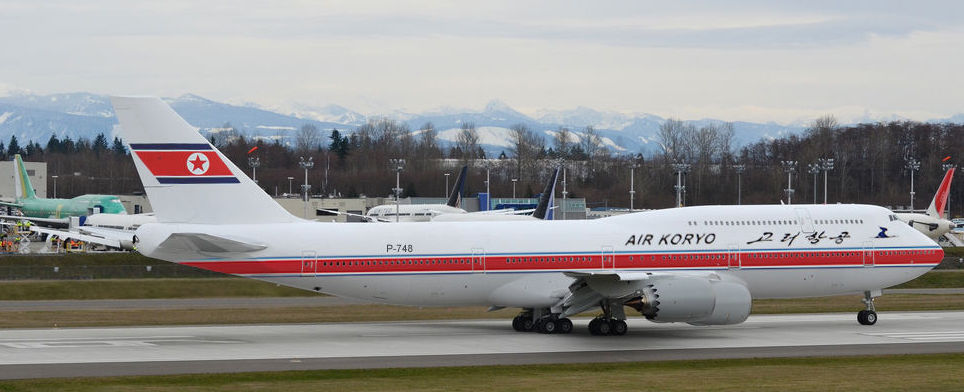
Air Koryo B747-8


Midweek Briefing: New Canada Entry Rules, Winter Storms clear Newfoundland

New Canada Entry Rules 10FEB CXXX/Canada Starting 15 MAR 2016, visa-exempt foreign nationals who fly to or transit through Canada will need an Electronic Travel Authorization (eTA). Exceptions include U.S. citizens and travellers with an existing visa, and commercial aircrew. Read more …

Winter Storms clear Newfoundland 10FEB Nova Scotia and Newfoundland (CYQX, CYHZ, CYYT) have two severe Winter Storms passing through this week; Halifax will see up to 40cm of snow, affecting diversion choices on the North Atlantic. The visualisation above shows the US Winter storm at the end of January.


MKJK/Kingston FIR Jamaica, has ongoing issues with radar coverage and serviceability, leading to ad-hoc flow management procedures including 15 minute en-route separation, and 10 minute arrival separation at international airports. Latest update indicates this will continue throughout February. We have had several reports from international airlines of delays averaging around 1 hour on departure. Further reports welcome to bulletin@fsbureau.org.

SKED/Bogota ACC, Colombia is applying 20 minute spacing for northbound flights heading into Jamaican airspace due to the increasing delays there.

SPIM/Lima FIR Peru have published new Aircraft Interception procedures for Civil Aircraft. Probably worth a look – although, we must warn you, they are in Spanish only, and exceptionally lengthy. Maybe just double check that overflight permit and keep in touch with ATC instead.

North Atlantic As mentioned last week, effective 04FEB MNPS Airspace is replaced by HLA/High Level Airspace on the North Atlantic. A popular topic. RNP4 or RNP10 now required. Read our International Ops Notice 01/2016 or our blog post: Did you know MNPS is over?

NVVV/Port Vila, Vanuatu Several airlines have suspended operations here effective 01FEB16 over concerns as to the condition of the runway. Airport remains open without restriction.

PACD/Cold Bay has no Jet A1 Fuel avaiable until 29FEB

HRYR/Kigali‘s runway is closed on a nightly basis from 0200-0700 local time (0000-0500 UTC) until 31MAR for repairs.

North Korea launched a long range rocket at 0031Z on 07FEB. According to preliminary reports, the rocket passed over the Japanese island of Okinawa and landed in the Pacific Ocean. US military officials stated that the rocket did not pose a threat to the United States or allies in the region. South Korean media reported that North Korea is preparing for another nuclear test and has the technology necessary for an inter-continental ballistic missile (ICBM).

AYPY/Port Moresby has a number of common VHF frequencies out of service because of a Telecomms fault. ATC advise to call them on HF HF 5565, 8861, 6622, or 8837, if able.

View the full International Bulletin 10FEB2016