What on earth is a Medicane?

Hurricane season in the Med is not something you hear said often. But it is a thing, sort of.

So today we thought we’d take a look at ‘Medicanes’ and try to answer two things with this post. Firstly, what is a Medicane and secondly, surely there is a better name for it?

What is it?

A Medicane is a ‘tropical like’ cyclone that forms in the Mediterranean.

Now don’t worry, the Med isn’t getting storms the size of the Atlantic ones, or Pacific ones for that matter. But they are getting ones which are bigger than seen in previous years, and this does mean additional safety considerations and threats you might not be too aware of.

For example, this area has a lot of aircraft operating in it, and high density traffic and weather avoidance often don’t go well together.

Where do they generally form?

They are seen most often developing in the watery area bounded by the coasts of Spain, France, Corsica and Algeria. They also form occasionally in the area between the gulf of Sidra up to the Ionian Sea.

They can occur year round, but tend to be most common between September and January.
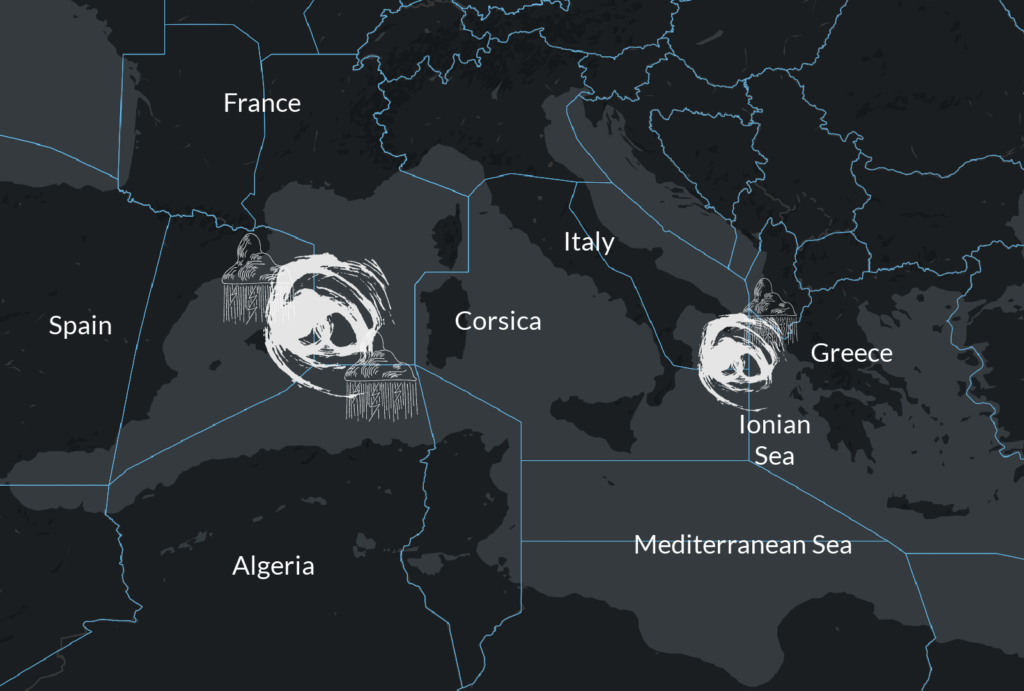
The usual spots.

How big and bad are they?

They are only seen about 1-2 times a year actually so nothing like the frequency of the Atlantic hurricanes.

They tend to only have a radius of between 70-200km, and last about 3 days. A small proportion have achieved Category 1 hurricane level winds, but this is rare.

All in all they lack the size, intensity and duration of their bigger counterparts in other regions of the world. But don’t dismiss them just yet, because they can still pack a punch and they are growing more frequent.

We mentioned the region they form in.

This is important because Europe is, at the best of times, some busy airspace to deal with. Throw an unexpected storm into the mix and things can get particularly messy.

Move them over airports and you get some serious delays and disruption.

Should we do anything?

Knowing they are there and planning routes that don’t take your poor airplane and crew through them is probably the best idea.

Deviations to avoid mean more fuel burn and effort for ATC, and like we said the airspace can be busy in this area, so planning or asking for this early is important.

Don’t underestimate how disruptive these can be, and monitor their development. A good spot to monitor is the Medicane watch centre twitter page.

And let your crew know about these so they can be on the look out on SigWx charts, (or just in the skies).
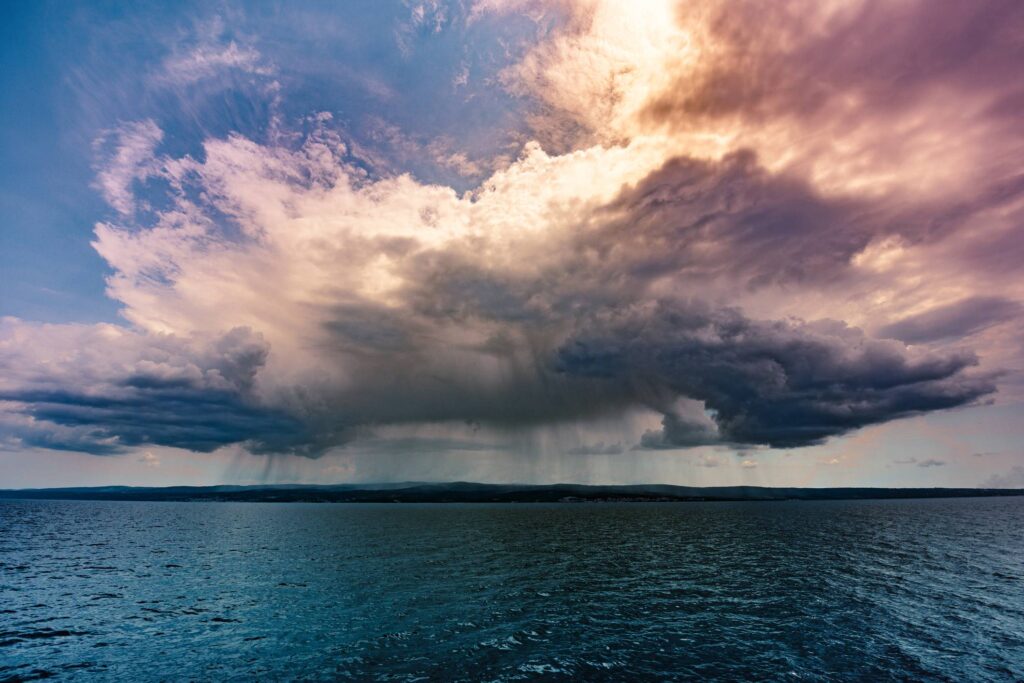
Stolen from EASA’s post 🙂

Now let’s talk about the name.

Mediterranean Hurricane. Yep, I don’t like it.

Surely ‘mediclone’ would have been more amusing? We’re guessing it sounds too, well, sci-fi – conjuring up images of evil doctors creating monsterish clones.

Medicane sounds like a boring zimmer frame manufacturer though so we would like to officially suggest a renaming, and offer these options:

  • A Mediterror (A combination of mediterranean and terror)
  • A Hurrorterranean (a mix of hurricane, horror and mediterranean)
  • An Ouragan (‘hurricane’ but in French because the French always seem a little put out that French isn’t used more in aviation lingo, and that sounds a bit Ogreish)
  • A Stormy Mcstormface (I’m British and our public vote naming system remains the best)

Anyway, not important really. 

Want some more (proper) info?

If you want more info on this weird weather phenomenon then check out this very informative EASA post (which is where we took 90% of the info here).

Check out this info on a mighty Medicane which ‘hit’ Greece in 2020.


Greece-ing the Turkey: The Aegean Dispute

The dispute between Turkey and Greece is one we have mentioned before. Not because it was having a particularly big impact on aviation operations, but because of the vaguely amusing Notam battle they have been waging against each other for the last few years.

But what appears to be a rather silly conflict actually has a more serious side to it, so we thought we would take a little look at what is going on.

What are they arguing over?

This dispute is about what disputes always seem to be about – who owns some bit of land, or in this case, a Continental Shelf (so a bit of land that is submerged under several miles of Eastern Mediterranean Sea). Turkey want it because it is a treasure chest of energy resources, while Greece want it because, well, they reckon it was always theirs.

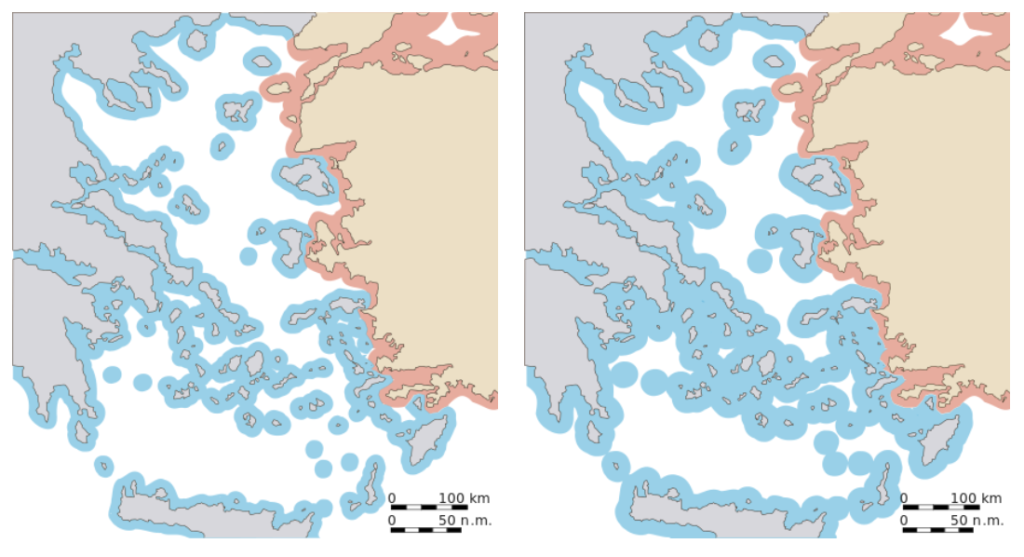
The dispute goes a bit “higher” than the continental shelf though. Like those annoying neighbours who keep pushing their fence backwards into your garden, so Greece have decided that their airspace extends not the usual 6nm (based off territorial waters), but 10nm. Turkey refuse to recognise those extra 4nm as Greek. Nor do ICAO who have a 1948 statute saying airspace must coincide with territorial water boundaries. 

So we would say that’s one:nil to Turkey, except for Greece’s point that they actually laid claim to those extra 4nm way back in 1931 before ICAO came along with their statute. Plus, this isn’t the only area Turkey has had disputes over, so maybe Greece have a bit of a point.

But do we care, or can we just let them keep bickering?

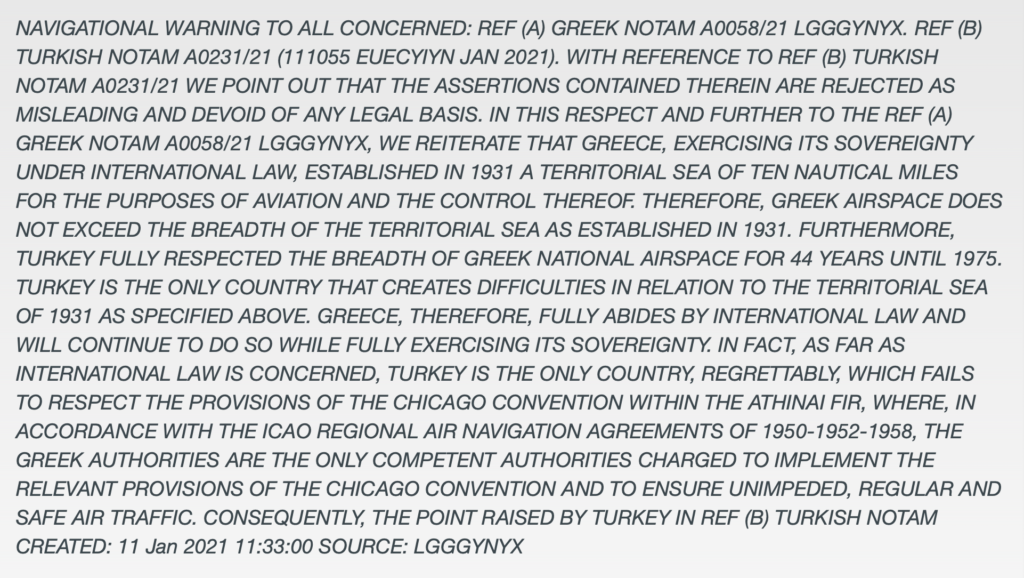
Well, the permanent Notam battle can be ignored with a simple filter that removes the likes of these from your Notam package:

However, that is not the only repercussion. Actually, all this makes for some messy airspace controlling because it impacts FIRs and with that, who controls military flight activity. This has led to a bunch of provocations from both sides, with them regularly sending military aircraft into the 4nm disputed bit just to annoy the other side. And this is a problem, because it often escalates with retaliations. In 1996, Turkey claimed one of their aircraft had been shot down by a Greek fighter jet, and in 2014 the number of Turkish incursions into Greek airspace rose to nearly 1,500.

Tensions flared up again in 2020 when Turkey finalised their purchase of Russian S-400 mobile surface-to-air missile system. Now, this wasn’t specifically aimed at Greece, but it did go against NATO and US orders, resulting in big sanctions against Turkey.

Greece spent 2020 developing stronger defensive ties with their neighbouring countries, and at the start of this year, placed an order for 18 French Rafale fighter jets to pad out their Air Force. 

A bit of a jam

Deliberate GPS Jamming is also a major issue in the Eastern Mediterranean and across Turkish airspace, adding to the list of threats commercial aircraft have to consider.

So is this a conflict to watch?

2020 was a tense year between the two nations, and 2021 seems unlikely to see much de-escalation. While direct conflict between the two will likely be prevented by neighbouring countries and the EU and NATO, the dispute is still simmering away.

For commercial flight operations, the impact remains primarily in the Notam world, but attention does need to be paid to any temporary prohibited or restricted airspaces which might pop up because of increased military activity in the region.

Additionally, Turkey is a large country and their airspace provides a major overflight route between Asia, the Middle East and Western Europe. Having an awareness of the political tensions between the two countries is important, particularly if routing to or from Greece, or carrying Greek nationals onboard, since this might compound your problems if you have to divert into a Turkish airport.


Passenger plane almost shot down over Syria

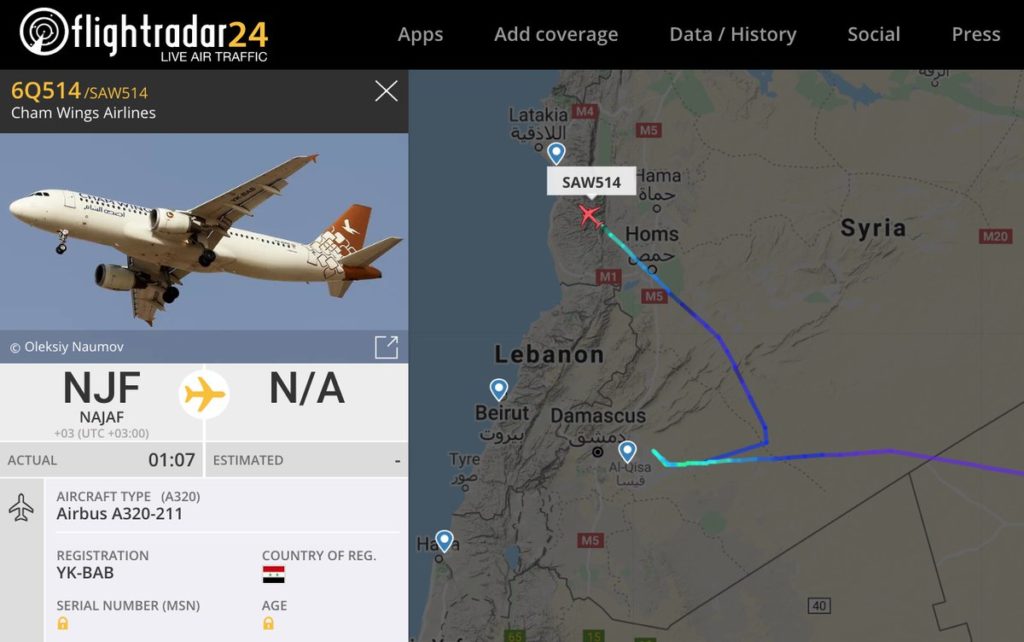
In the early hours of Feb 6, a commercial flight en-route to Damascus was forced to divert to Russia-controlled Khmeimim air base after coming under fire from Syrian air defences.

The Cham Wings A320, with 172 people on board, was flying from ORNI/Najaf to OSDI/Damascus when the incident took place. According to The New York Times, Syrian air defences directed anti-aircraft gun and missile fire against the Airbus, but failed to hit the aircraft.

Russia’s Ministry of Defense has since blamed Israel for the near-miss – at the time the incident occurred, the Syrian air defence systems had engaged four Israeli F-16s, and Russia claims that these fighter jets were using civilian aircraft as “cover” while conducting air strikes.
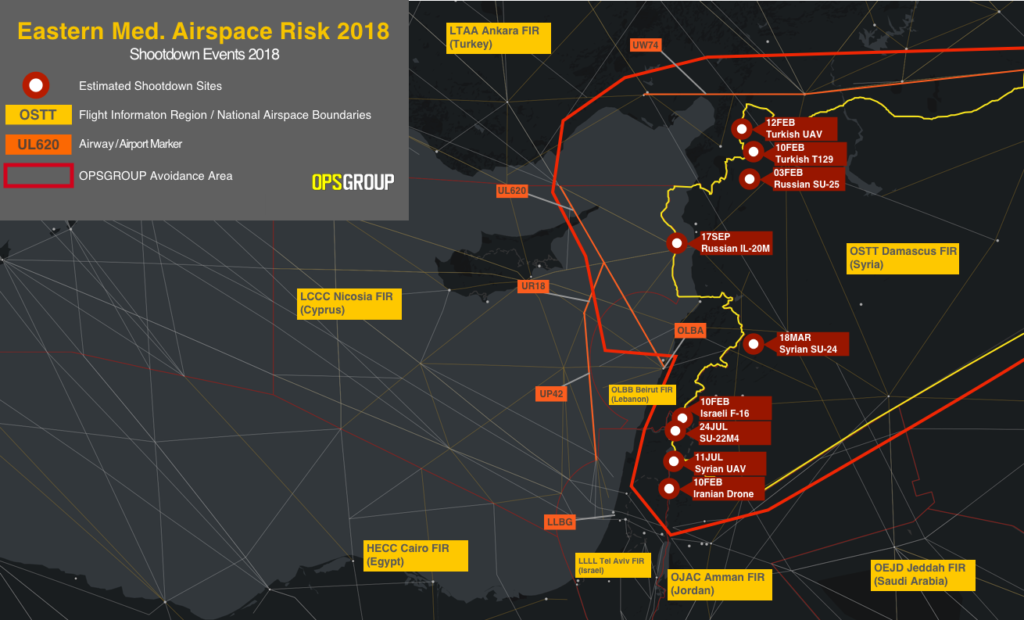
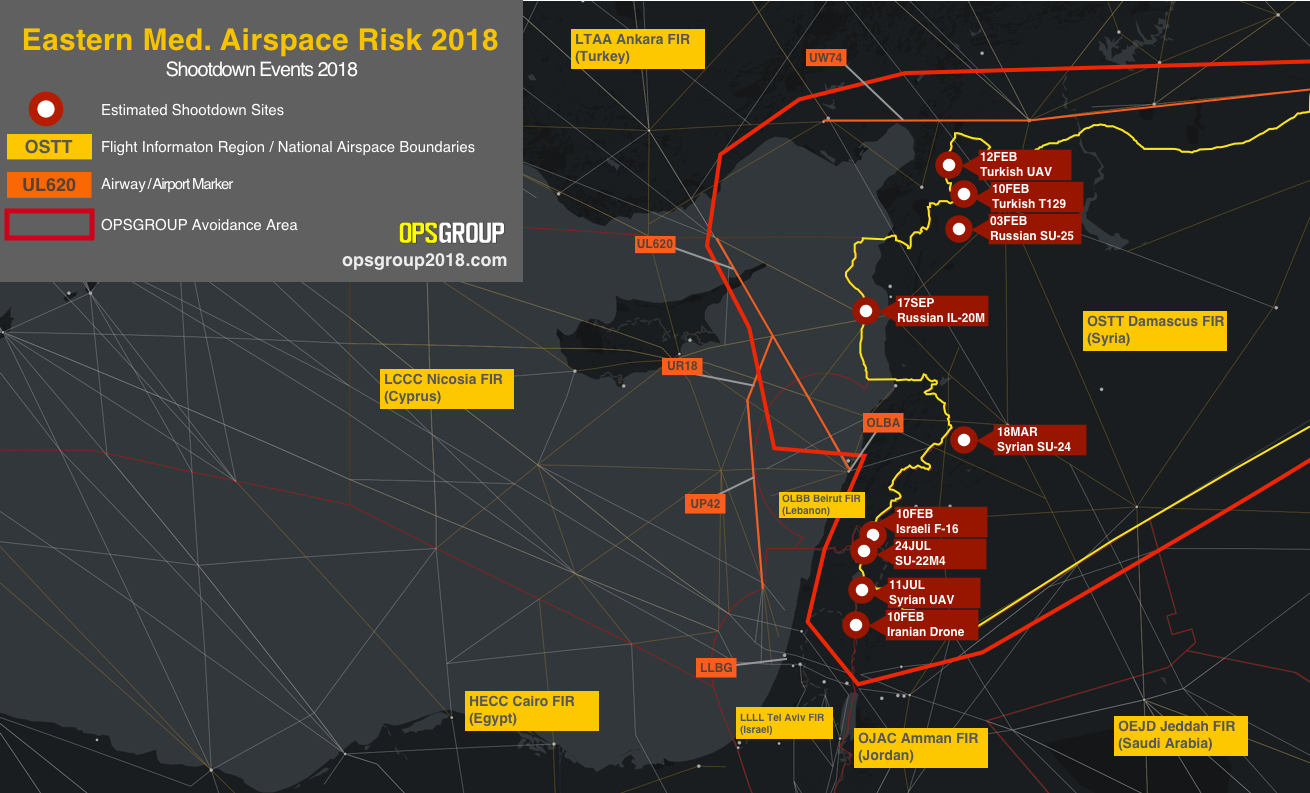
Russia has accused the Israeli military of putting commercial flights like this at risk in the past, by timing their airstrikes on Syria too close to flights arriving at Beirut and Damascus airports. In the past few months there have been a number of air strikes by Israel against military targets in Syria, including OSDI/Damascus airport, with the Syrian government firing its own missiles over Syrian airspace and along the Lebanese border to repel the attacks.

This latest incident comes just a month after a Ukraine International Airlines passenger plane was shot down shortly after take-off from Tehran, killing all 176 people on board. Iran later said its forces had shot it down unintentionally, having mistaken the aircraft radar return for an inbound missile to Tehran.

In the days following, many countries issued warnings to avoid the airspace of Iran and Iraq, and most airlines other than Middle Eastern carriers have now stopped overflying these countries entirely.

The same is true of Syria – there are multiple airspace warnings in place, including a total flight ban by the US and German authorities. Some countries add the additional warning to exercise caution when operating anywhere within 200 nautical miles of the country – advice that came into sharp focus in September 2018, when Syrian forces shot down a Russian IL-20M transport category aircraft over international waters 20nm off the coast, mistaking it for an Israeli fighter.

That event significantly changed the risk picture for civil aircraft operating in the vicinity of Syria. We wrote about it here, and the advice still stands – there is a clear risk to civil aircraft operating over Syria, as well as in the overwater airspace east of Cyprus. The risk picture is two-fold: misidentifcation of your aircraft as a military one, and an errant missile launched at another aircraft that locks onto you instead.

Further reading:

SafeairspaceManaged by OpsGroup, this is our public repository and first point of warning for Airspace Risk for airlines, pilots, dispatchers, and aircraft operators.

Why are we still flying airline passengers over war zones?OpsGroup article from Sept 2018, following the shoot-down of the Russian IL-20M off the coast of Syria, with a new note to members on the airspace risk in the Eastern Mediterranean.


Why are we still flying airline passengers over war zones?

Here’s the level of inconsistency we’ve reached in international air transport: we take each passenger, scrutinize their booking, check the no-fly-list, watch them on CCTV, pull them apart at TSA, remove anything sharper than a pen, question them, x-ray the bags, run Explosive Trace Detection tests, screen the hold baggage, background check every member of the crew, and then, once they’ve all boarded, fly this ultra-secure airplane straight into a war zone.

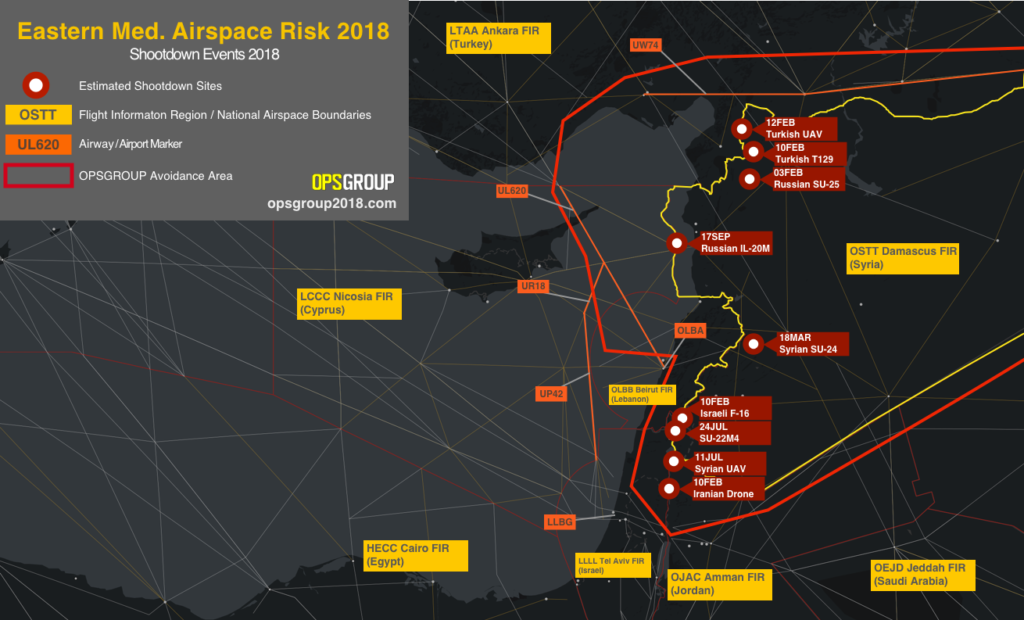
Welcome to the Eastern Mediterranean. It’s an active conflict zone. The Russian naval build up there this month is the largest since Moscow’s intervention in Syria began in 2015. Over Syria, 9 aircraft have been shot down this year.

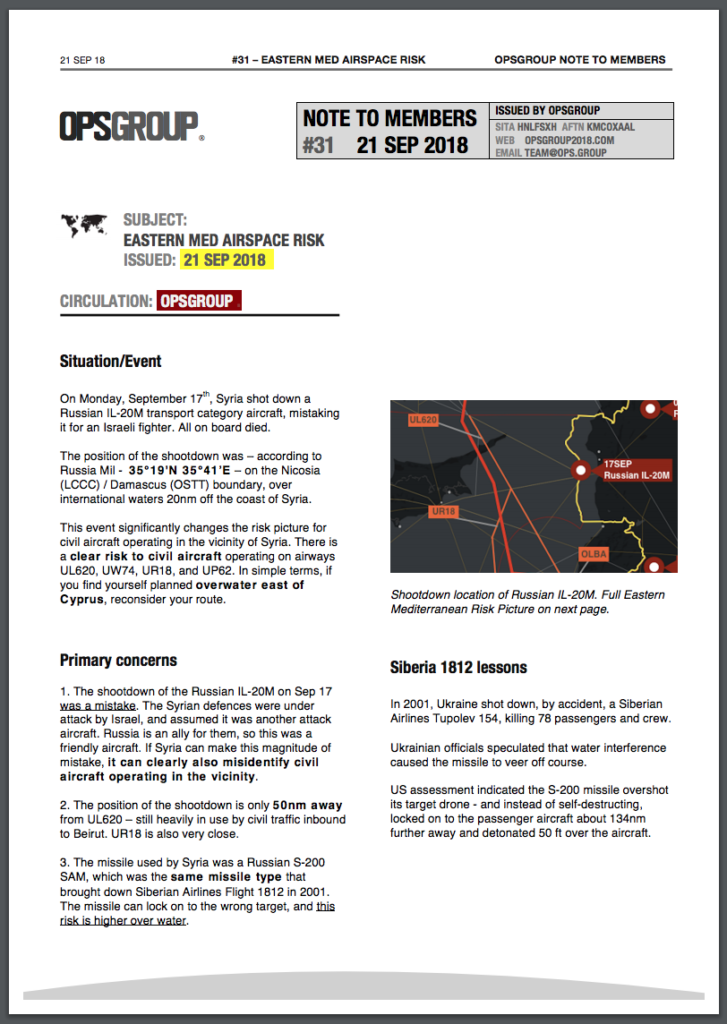
The most recent was on Monday night this week, when Syria came under attack from Israel fighter jets, and started firing indiscriminately at anything off the coast that looked like a threat. They wanted to shoot something down, and they did — except it was a friend, not foe. They took out a Russian Ilyushin IL-20M transport category airplane. Even on the worst radar, that doesn’t look anything like an Israeli F-16.

50 miles away from where the Russian aircraft plunged into the sea on Monday night is the international airway UL620, busy with all the big name airline traffic heading for Beirut and Tel Aviv. If Syria can mistakenly shoot down a Russian ally aircraft, they can also take out your A320 as you cruise past.

And yet, most airlines continue to operate. Are we really so comfortable with operating in conflict zones again?

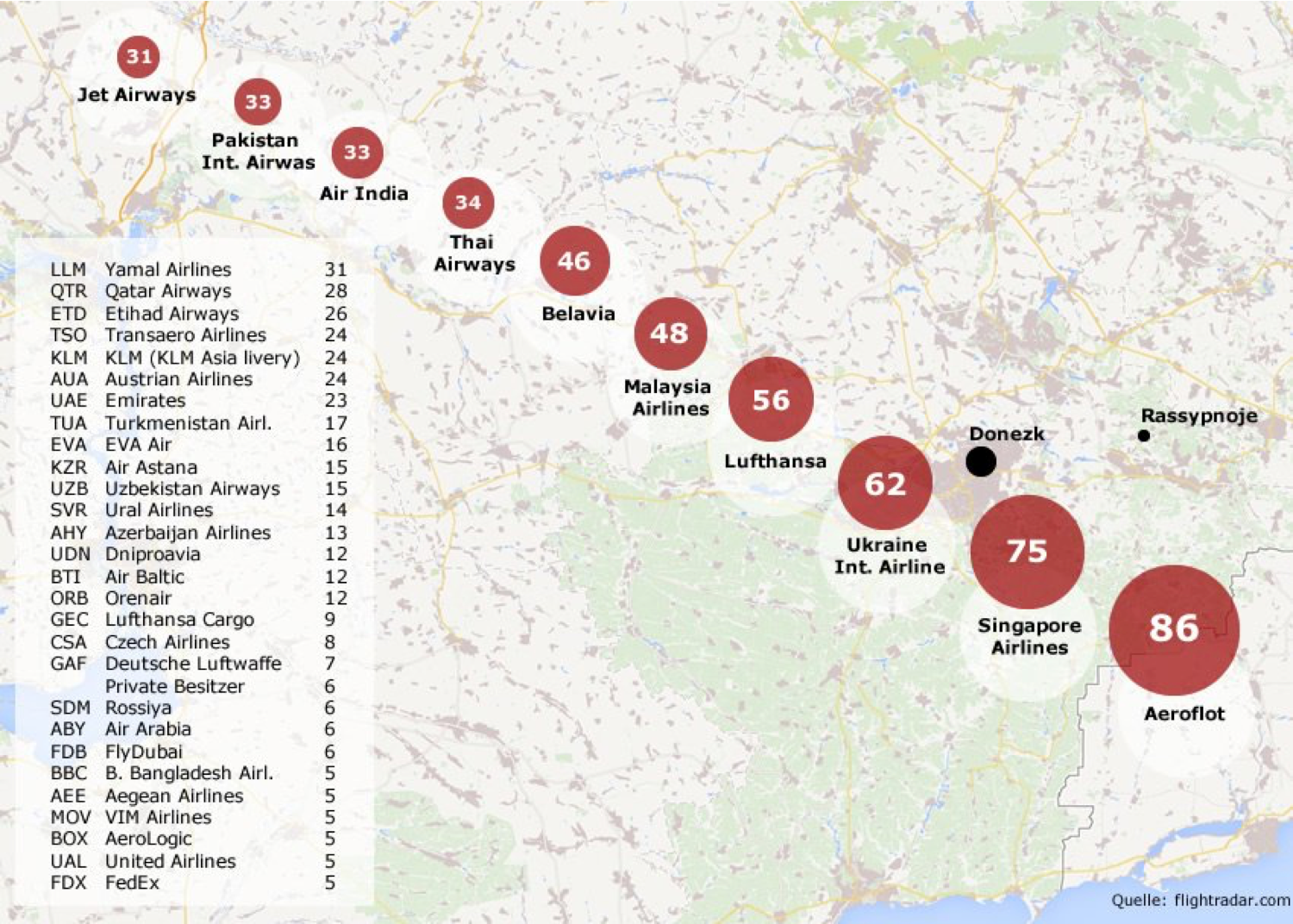
The lessons of MH17 seem to be fading fast. It’s a little over four years since 298 people lost their lives over Ukraine one summer afternoon, thanks to an errant missile fired during a civil war at an aircraft that they thought was a military threat. “Why were they over a war zone”, everyone cried afterwards.

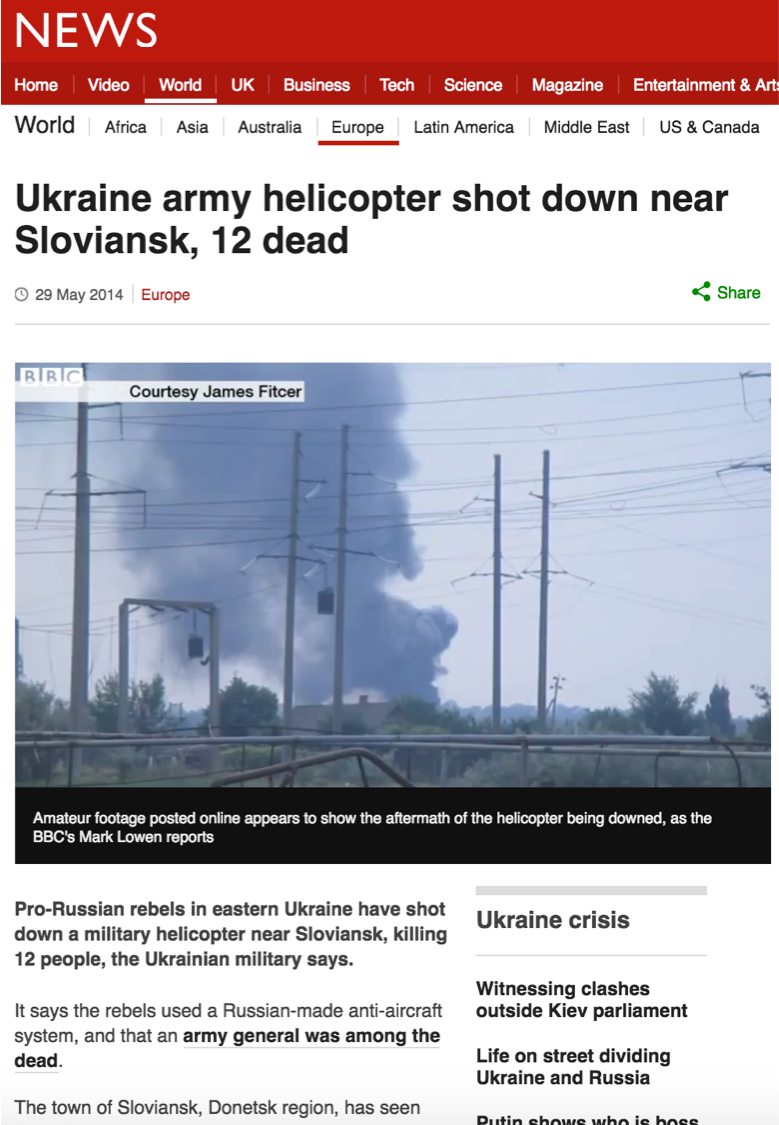
Well, we all were. Me too. I was a pilot for Austrian Airlines at the time. I recall one morning in Vienna, some months before MH17. Boarding the last of the passengers, my BBC news app flashed up a story about a helicopter being shot down in eastern Ukraine .

As we were headed east, with my colleague in the cockpit, we quickly plotted the position on our enroute chart, and noted that it was really close to our route. Maybe 30 miles north. “We might see something interesting!”, we said, and pushed back. We didn’t, nor did we think much more about it.

Do you see the thought process though? Before MH17, we didn’t consider the risks to our aircraft from war zones. Especially being so high. Helicopters might be getting shot down, but we’re at 35,000 feet. No problem.

This is why all of these airlines — mine, at the time, included — operated on the route.


Image: Der Spiegel

And then it happened, and none of us could quite believe it.

But we learned. “Conflict Zone” became a buzzword. We had task forces and committees, whitepapers and promises, and — myself included — talked at length about how this happened, why, and how to avoid it in the future.

And yet, here we are flying unsuspecting passengers along the Syrian border. If you’re unsuspecting enough, and buy a SkyTeam codeshare ticket — you’ll actually overfly Syria on the Honey Badger airline of the region, Middle East Airlines.

Here we are flying passengers in the Eastern Mediterranean war zone. Why is this happening?

My guess: because we don’t think anything bad is going to happen, because the airspace boundary lines on the charts make that little bit of sea near Cyprus feel different from that little bit of sea near Syria, but mainly because there is no clear guidance from Aviation Authorities.

Let’s start with Cyprus. The Nicosia FIR has a big chunk of unsafe airspace. The Russian aircraft on Monday was shot down on the Nicosia FIR boundary. What do the Notams say? Take a look. There are 97 of them. Mostly about fireworks at local hotels. Critical stuff indeed. Then there are 20 or 30 about “Russian naval exercises”. A clue, perhaps, but where is the black and white “An Aircraft was Shot Down on our Border on Monday?” . Or, since we are still using teletype to communicate Notams to crews, “AN AIRCRAFT WAS SHOT DOWN ON OUR BORDER ON MONDAY”. Wait, we have to abbreviate that, and use codes, for some reason. “ACFT SHOT DOWN ON FIR BDY 17SEP”. That’s better.

What about Turkey? Anything on the Eastern Mediterranean risk? Let’s have a look. Nope, just 132 Bullshit Notams, and something about an AWACS aircraft. See you back here in 30 minutes when you’ve read them all.

Remember, I’m being a pilot, an airline, a dispatcher, trying to find information on the Risk in the Eastern Mediterranean. And this is how hard it is.

EASA (European Aviation Safety Agency), how are you doing? Let’s start here, at the “Information on Conflict Zones”. Paragraph 2 tells us that ICAO have a Central Repository on Conflict Zones, launched in 2015.

No, they don’t. That died — quite a long time ago. This is where it used to live. So, there is no ICAO Central Repository on Conflict Zones. There is a new ICAO document with guidance on managing Conflict Zone risk (and it’s a bloody good one, too) — but where is the picture of current risk?

Let’s plough on through the EASA site. Aha! Seems we have a Conflict Zone alerting system, and Conflict Zone bulletins. Here they all are: https://ad.easa.europa.eu/czib-docs/page-1

The last one on Syria was issued on April 17th. But it seems to be just a list of Notams issued by other states. And these are out of date. The German Notam has expired, the French AIC has been replaced.

And there’s no guidance. No Map. No routes to avoid. Nothing about Cyprus, or Beirut. No mention of the Russian shootdown. No mention of the 9 aircraft shot down this year.

How am I supposed to know, as an operator, or pilot, what the risks are and where to avoid. We’re getting closer to the point here. You’re not supposed to rely on the Aviation Authority. That is their message. You must conduct your own risk assessment. You must research and find out about the risks yourself.

You are on your own.

If you’re a big airline, that’s probably fine. You’ll make your own decisions about where to fly, anyhow. But what about everybody else?

While OpsGroup works hard to get information out to our members — and we spend a lot of time researching risk — I would greatly prefer that we didn’t have to.

Aviation Authorities must issue better guidance for the aircraft entering their areas.

Let me remind you. Airlines are operating 50 miles from a position where an airplane was shot down at night, by a missile type that’s already taken out a passenger airliner by mistake, fired by a beleaguered Syrian defence post, at a friendly aircraft that they did not take time to identify.

And the guidance to operators from Authorities: NIL.


Opsgroup has now published Note 31: Airspace Risk in the Eastern Mediterranean. There is a clear risk to civil aircraft operating on airways UL620, UW74, UR18, and UP62. In simple terms, if you find yourself planned overwater east of Cyprus, reconsider your route.

Further reading:


Midweek Briefing 01JUN: EASA Updates ‘Suspect Aircraft’ Guidelines, 8th French ATC Strike

EASA Updates ‘Suspect Aircraft’ Guidelines 01JUN EASA has published new guidelines for inspectors to assess which aircraft should be prioritised for SAFA ramp checks in Europe and SAFA compliant states. Read the article.

8th French ATC strike this weekend 01JUN Notification has been given by French ATC Unions of a Three Day Strike this coming weekend from Friday-Monday, starting at 0400Z Friday 03JUN. Read the article.


ZZZZ/China The new 144 hour visa-free rule is extended to Nanjing Lukou Airport of Jiangsu, Hangzhou Xiaoshan Airport of Zhejiang, and all air, sea and railway ports of Shanghai, including Pudong Airport, Hongqiao Airport, Shanghai Port International Cruise Terminal, Wusong Passenger Transport Center and all railway stations in Shanghai.

CYMM/Fort McMurray is scheduled to reopen 10JUN to regular commercial operations. The airport has been closed to normal traffic due to a significant forest fire.

MMAA/Acapulco after an outage lasting several years the ILS for RWY 10/28 is operational again.

KSEA/Seattle has runway 16C/34C closed until 27JUN for repairs. ATC initiatives possible through the construction.

EINN/Shannon and EICK/Cork will be testing a new “Remote Tower” system from 06JUN until September, where at quieter times the controller in Dublin will provide the ATC service to flights at Shannon and Cork. The IAA says airspace users will not notice the change. We think you might.

LFLL/Lyon will be re-numbering their runway to 17/35 from 18/36 in September.

VOTP/Tirupati will begin International operations beginning the end of June with flights to the U.S. The airport had recently upgraded their customs systems and other procedures.

LZZZ/Mediterranean Despite some reports, NATO operations in Libya appear unlikely. There are several new airspace NOTAMs, but is anyone still flying to Libya?

LFZZ/France due to ongoing protests at french oil refineries and fuel shortages the French CAA has advised to tanker in as much fuel as possible to help mitigate any issues. Please check with local handlers for any specific fuel constraints.

SPZZ/Ecuador Volcano Sangay is producing ash that extends up to 20,000 feet. Movement is towards the west at 10 knots. Please check with the Washington VAAC for the latest advisories.

LLBG/Tel Aviv, Israel On 26-27MAY strike action in the form of a work go-slow took place.The slowdown has primarily affected outgoing flights by increasing the time between takeoffs, but it has been reported that if the slowdown continues it will begin to affect incoming flights.

NVZZ/Vanuatu 27MAY a 5.0 magnitude earthquake struck west of Vanuatu. The quake was centered approximately 60 mi/95 km northwest of Port Vila and was measured at a depth of about 6 mi/10 km. No tsunami warning has been issued.

DAZZ/Algeria At 0054 local time (2354 UTC) on 28MAY, a magnitude 5.2 earthquake struck approximately 35 mi/55 km southeast of Algiers, the capital of Algeria. The epicenter of the earthquake registered a depth of approximately 7 mi/ 12 km. Following the quake, there were no reports of injuries or damage.

FNZZ/Angola A yellow fever outbreak has caused 301 deaths so far this year. The number of suspected cases is 2,536. The outbreak began in Luanda and has since spread to areas throughout the country, particularly along the coast and in the central regions, despite a large-scale vaccination program.

VDPP/Cambodia Political tensions are high in Cambodia following contested national elections in 2013. Arrest warrants have been issued for the leaders of the opposition CNRP party and the situation is unpredictable. On 30 May police blocked roads in southern Phnom Penh to prevent opposition CNRP supporters from carrying out a planned protest march. Further disruption is possible if the remaining leader is arrested. The opposition party has announced it will hold mass, non-violent, demonstrations and a number of unions have said they will strike in support.

LFZZ/France Despite recent strikes, the French government has stated it will not back down from labor reforms despite street protests and refinery blockades. The CGT Union has threatened to disrupt the upcoming Euro 2016 soccer tournament if the government does not back down; however, after meeting with representatives of the oil industry, government officials stated that the situation at fuel depots is improving.

Ramadan starts on 06JUN, for one month. If you are operating to any Islamic countries, expect the usual slowdown in work, longer processing times for permits, and closures.

OEZZ/Saudi FIR Saudi Arabia has intercepted a ballistic missile that was fired from Yemen, after which Saudi aircraft bombarded the missile’s platform. A Saudi official stated that the country may reconsider the kingdom’s truce with Yemen, as a result of the strike. The missile launch was the second strike in May.

RCZZ/Taiwan On 31MAY, a 6.1 magnitude earthquake struck approximately 70 mi/115 km northeast of Taipei. The quake was measured at a depth of about 150 mi/240 km. There were no reports of damage, and no tsunami warning was issued.

UKZZ/Ukraine On 29MAY, attacks by pro-Russian rebels in eastern Ukraine, violating the ceasefire signed in February 2015, killed five Ukrainian military officers and wounded four others. The latest attacks follow a 24 May report released by Ukrainian authorities, stating seven soldiers were killed on that day, making it the deadliest day for Ukrainian forces since August last year.

KZZZ/USA The State Dept has issued a warning to arriving travellers this summer to make sure that they have all necessary documents to enter the United States – there have been multiple changes to the rules this year (see Active Bulletins below for more on this).

View the full International Bulletin 01JUN2016