FAA warning issued, further serious navigation failures reported
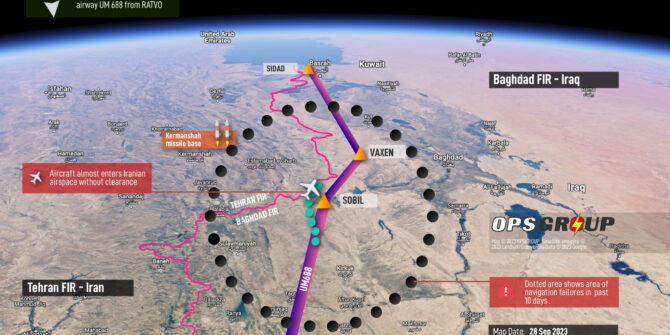
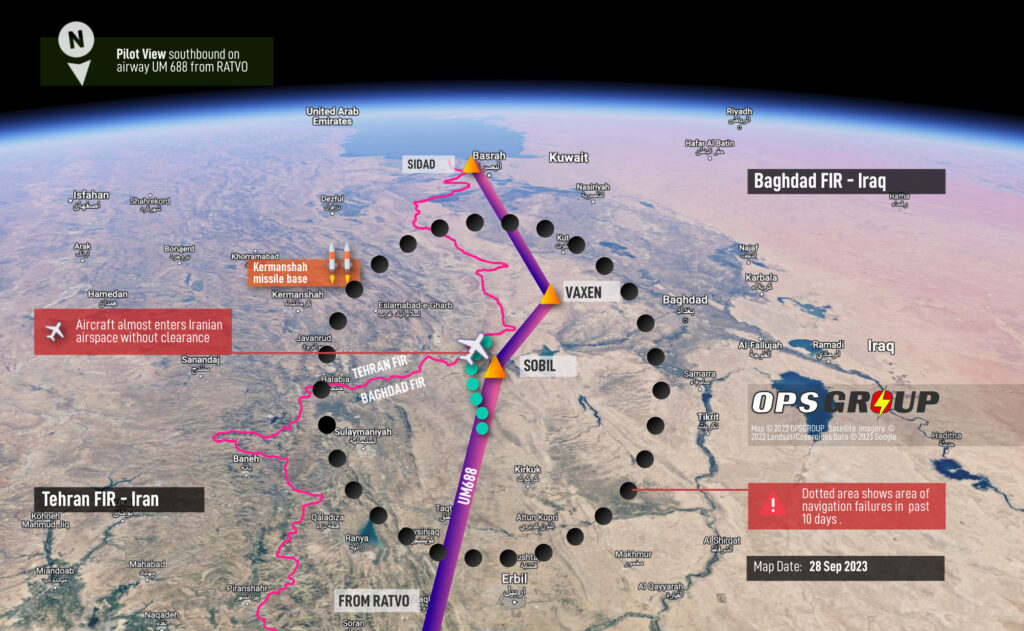
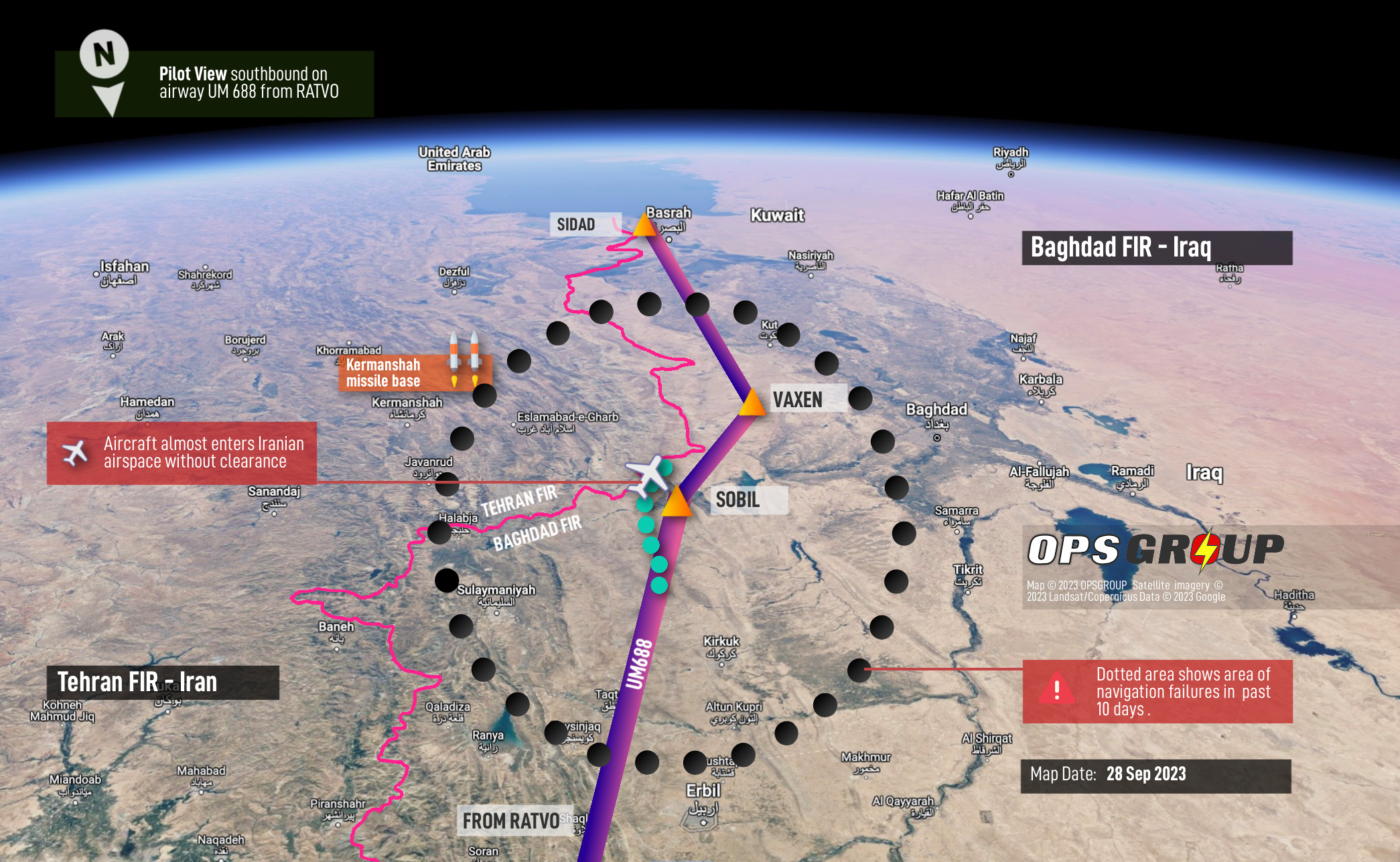
Since publishing Monday’s risk warning on complex navigation failures following fake GPS signals, we have received further concerning reports from operators, mirroring the same events. The impact of the nav failures is becoming clearer, with one operator almost entering Iranian airspace without clearance, and another left requiring ATC vectors all the way to their destination in Doha.

In total we now have 20 reports of almost identical situations. Full reports are in Version 2 of our Risk Warning (PDF), see further down.

On Wednesday evening, the FAA issued a warning memo to aircraft operators as a result of the situation, warning of increased “safety of flight risk to civil aviation operations”.


Embraer Legacy 650: We nearly entered Iran airspace with no clearance

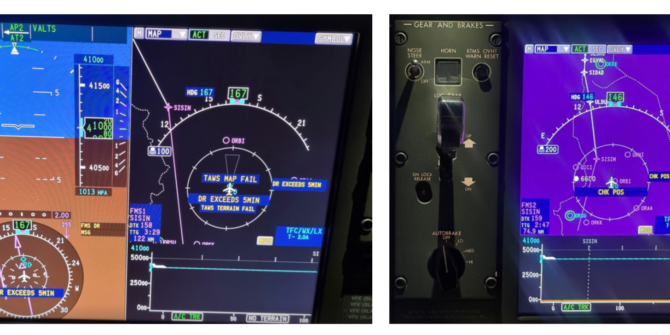
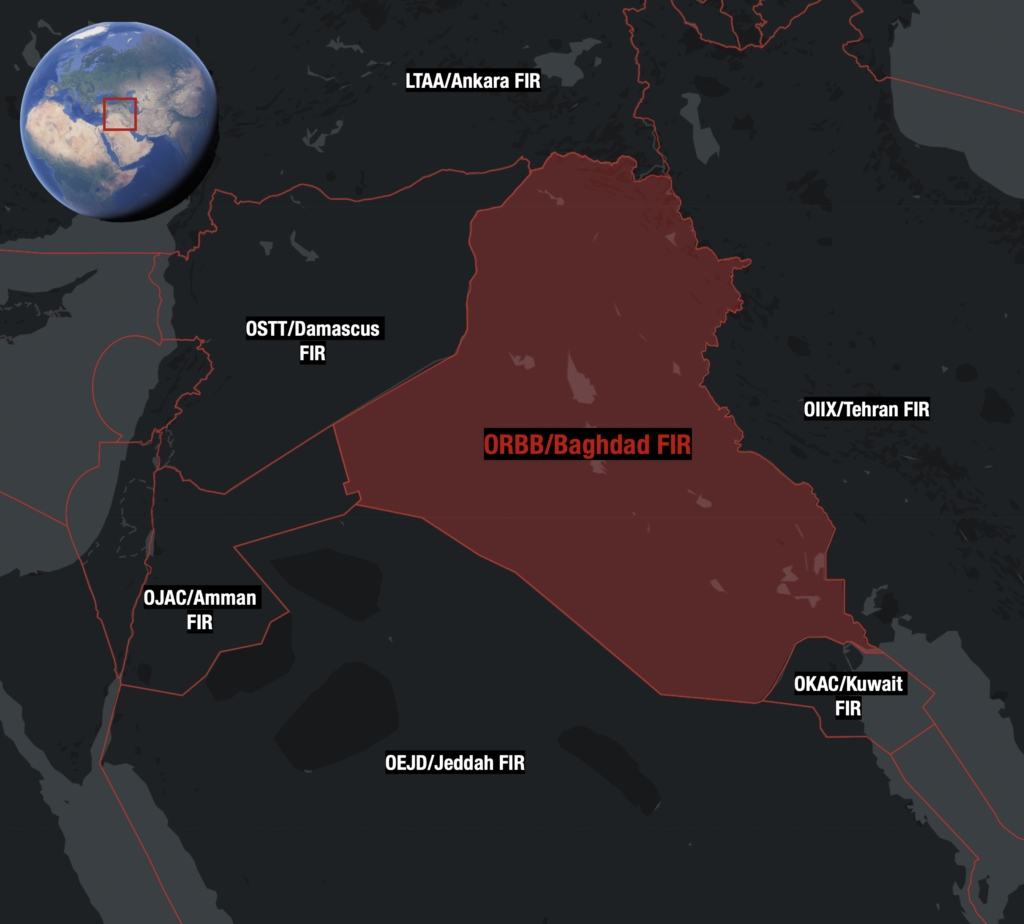
One of the new reports received since Monday was from an Embraer 650 crew enroute from Europe to Dubai. They tell us, “In Baghdad airspace, we lost both GPS in the aircraft and on both iPads. Further, the IRS didn’t work anymore. We only realized there was an issue because the autopilot started turning to the left and right, so it it was obvious that something was wrong. After couple of minutes we got error messages on our FMS regarding GPS, etc. So we had to request radar vectors. We were showing about 80 nm off track. During the event, we nearly entered Iran airspace (OIIX/Tehran FIR) with no clearance.
 

Challenger 604: Required vectors all the way to Doha

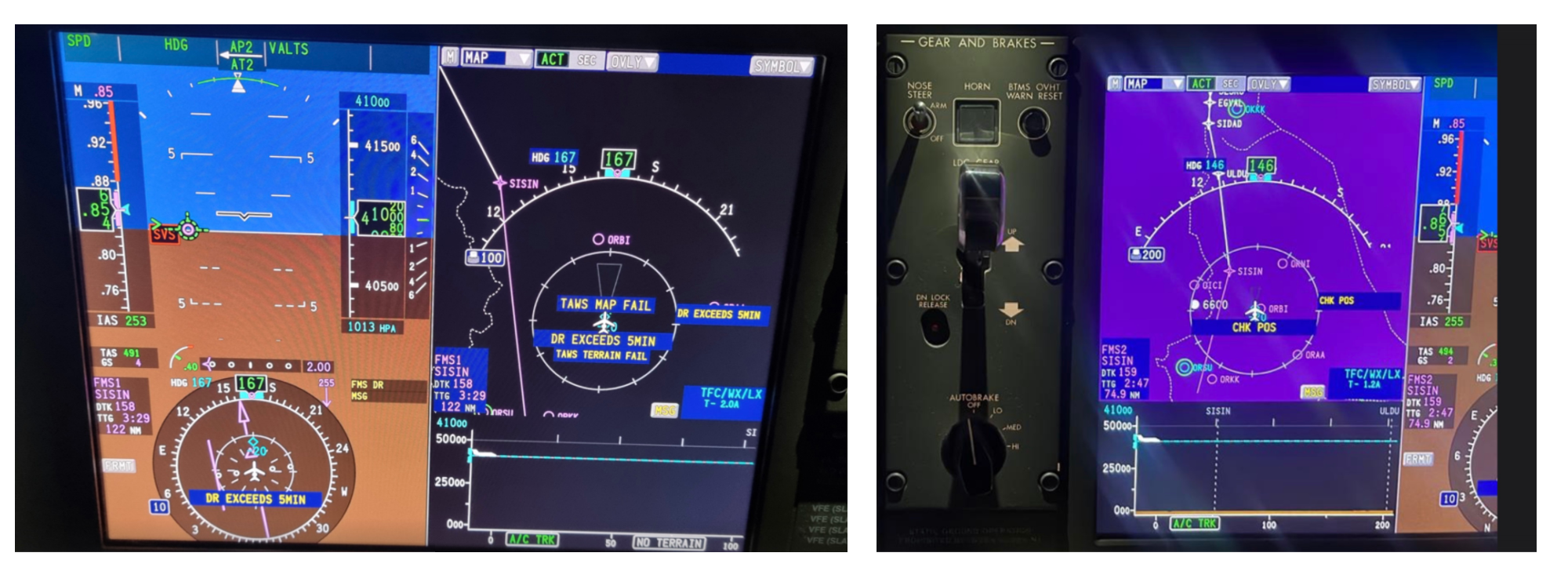
Another new crew report received since our first warning informs us: “Nearing north of Baghdad something happened where we must have been spoofed. We lost anything related to Nav and the IRS suggested we had drifted by 70-90 miles. We had a ground speed of zero and the aircraft calculated 250kts of wind. The FMS’s reverted to DR (Dead Reckoning) and had no idea where they were.

We initially took vectors to get around the corner at SISIN. Nav capability was never restored, so we required vectors all the way from Iraq to Doha for an ILS. We never got our GPS sensors back until we fired up the plane and went back to home base two days later.


Concern grows over flight risk

With these additional reports, OPSGROUP has increased concerns over the situation:

  • Security risk: Navigation failures are occuring in close proximity to the Iranian border. One aircraft reported almost straying into Iranian airspace (Tehran FIR, OIIX) without a clearance. This area of the border is considered sensitive by Iran: there are two large missile bases just across the boundary: one at Kermansah (a huge facility with dedicated anti-aircraft weapons), and another at Khorramabad. For context, Iran shot down a passenger aircraft in 2020 in Tehran (accidentally), and has been heard in September 2023 issuing warnings on 121.5 with threats to shoot down aircraft entering the FIR without a clearance.
  • The Navigation failures are severe. The second report above highlights how the crew had no option but to request radar vectors – all the way to their final destination. In many other reports, most aircraft have no reliable on board navigation, for periods of 20-30 minutes and in some cases an hour or more.
  • Compounding failures. Individually these incidents can mostly be resolved with the help of ATC. Consider however, an ATC comms failure, ATC radar failure, or an emergency situation: engine failure, decompression, or even a medical divert. The workload would quickly become extreme, and diverting at night (when most flights are transiting the area) without basic navigation capability is not a scenario we want to deal with.
  • Inadequate guidance for crews: Current FCOM/AOM procedures available to aircrew are insufficient to capably deal with this new GPS spoofing issue. Having been shown to be possible, there is potential for it to occur elsewhere in the world.


FAA warning issued

On Wednesday evening, the FAA released a memo for aircraft operators titled “Iraq/Azerbaijan – GPS Jamming and Spoofing Poses Safety Risk“.”

The memo advised that “Potential spoofing activities reported by various civil air operators in Iraq and Azerbaijan pose a safety of flight risk to civil aviation operations in the Baghdad (ORBB) and Baku (UBBA) Flight Information Regions (FIR).”

“The recent opensource reporting regarding spoofing incidents, if confirmed, would pose increased safety of flight risks, due to potential loss of aircraft situational awareness and increased pilot and regional air traffic control (ATC) workload issues, which can lead to potential accidents and/or loss of life.”

“FAA recommends that U.S. civil air operators transiting ORBB and UBBA monitor regional NOTAMs, put additional emphasis on maintaining continuous communications with appropriate air traffic control authorities while monitoring aircraft equipment performance closely for any discrepancies or anomalies, and to be prepared to operate without GPS navigational systems.”


Geopolitical background, analysis from experts

Earlier, Matthew Borie of Osprey Flight Solutions provided background context for our members: “Iran has recently deployed additional military forces to its northwest border with the Iraqi Kurdistan Region and Iraq has deployed security forces to this area as well as part of a border security pact reached between the two countries in March. Both the Iran and Iraq have Electronic Warfare equipment capable of GPS jamming and spoofing and may have these deployed to the northern border area.

The US military is present at several bases in northern Iraq (Erbil, Harir & Sulaymaniyah). Turkey has military bases on its side of the Iraq border as well as inside Iraqi territory in several areas (Amadiya, Harkuk & Bashiqa). These deployments are enduring and not new – both the US and Turkey have electronic warfare (EW) equipment capable of GPS jamming and spoofing and they may have these deployed to Iraq.

Iran has also recently deployed additional military forces to its northwest borders with Armenia and Azerbaijan in wake of the Azerbaijani military operation in Nagorno-Karabakh. In addition, tensions between the Armenian military and Azerbaijani armed forces remain high on the border between the two countries at present in wake of the Azerbaijani military operation in Nagorno-Karabakh. Iran, Armenia and Azerbaijan all have EW equipment capable of GPS jamming and spoofing and may have these deployed to border areas”


An intelligence brief from Dyami Intelligence Services issued in repsonse to Monday’s reports, adds information about this new form of GPS spoofing affecting aircraft: “The surge in GPS jamming and spoofing incidents within the Iraqi FIR, along with their widespread occurrences, strongly indicates the involvement of an airborne platform (UAV). In the past, Iran has successfully intercepted a drone by GPS spoofing. Spoofing provides an attack vector that enables control over the target UAV (aircraft) without compromising the flight control software or the command-and-control radio link. Furthermore, a GPS spoofing attack can be carried out by an attacker who is equipped with an RF transmitter that can be ground or airborne-based.”


This is not jamming: Inadequate NOTAMs

It’s clear in the initial discussions of these events that because we are used to GPS jamming, crews may make make the initial assessment that these are the same routine GPS jamming events. While there are NOTAMs issued for many FIR’s in the region, they only warn of the routine GPS jamming that crews have experienced since 2018 in the Middle East and Mediteranean areas.

The key difference between the jamming events we are used to, and these new GPS spoofing attacks is the rapid impact on our on-board navigation. Some very alert crews have been able to quickly de-select GPS and isolate the input, but for most – and depending on aircraft and avionics types – this has not been possible. In the vast majority of the pilot reports received, crews have had to resort to radar vectoring from ATC.

OPSGROUP calls on the Iraqi CAA to issue a new NOTAM warning crews of the specific risk of complete navigation failure, due to spoofed GPS signals that many aircraft systems interpret as valid information.


Aircraft manufacturer and avionics responses

OPSGROUP has received confirmation from several aircraft manufacturers involved that they are taking the issue very seriously, and are working on a solution. We will keep members updated on this.

Bombardier is actively working on a new FON (Flight Operations Notification ) concerning GNSS Spoofing; we will keep members updated on this once we hear more from them.


“The IRS can’t be spoofed” – until it can

Quite astonishing for many of us as flight crew is the idea the IRS (Inertial Reference System) can be subject to outside interference.

Exactly where the avionics problem arises as a result of these GPS spoofing signals is something that OEM’s and Avionics providers are working on. However, many modern IRS platforms include GPS updating while enroute, to correct drift.

Previously, jammed or degraded GPS signals were neatly ignored with no impact on the IRS. What seems to be happening in these cases, is that the spoofed GPS position is a strong signal, and the IRS doesn’t know that it’s incorrect. The technical details are unclear, and we await clarification from subject experts on this.

Regardless of exactly what is happening internally, the impact on navigation systems is clear.


OPSGROUP Member resources – update

Updated version of Risk Warning: Fake GPS Signal attacks (28SEP/V2) is now available in your Dashboard.
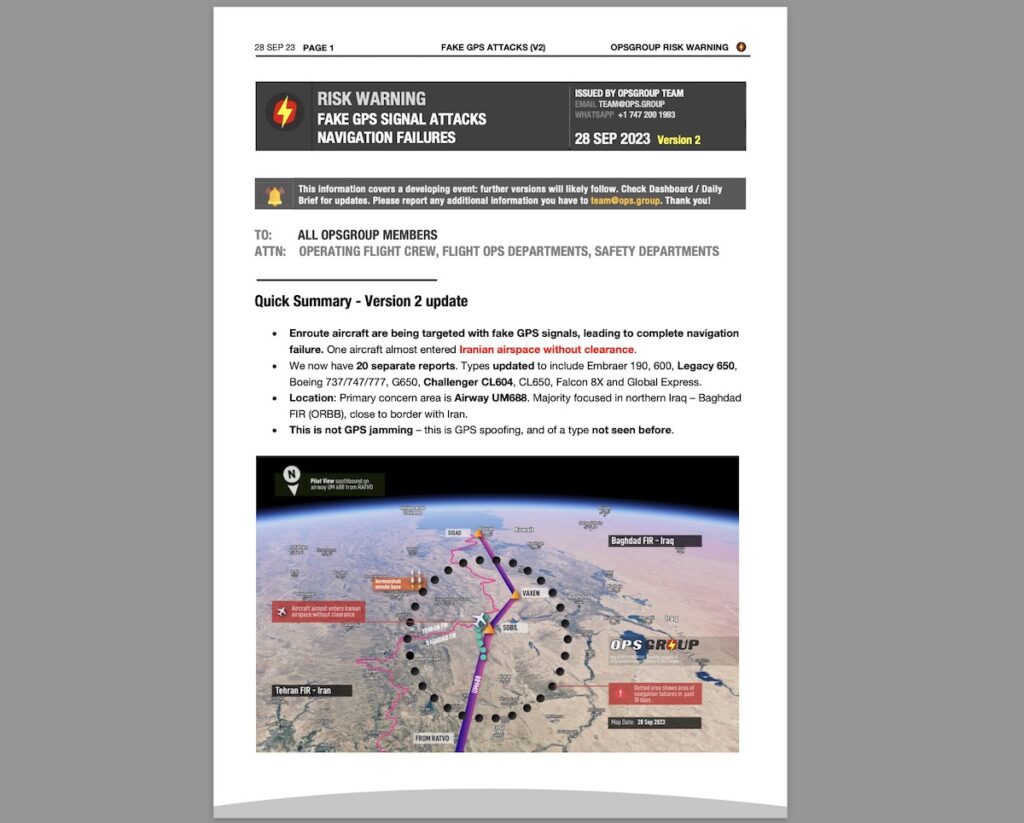
Earlier version: OPSGROUP members provided analysis of the events, and recommended guidance. This work has been collated into Briefing: RISK WARNING 24SEP/V1, available to all members in your Dashboard. Direct links are below.
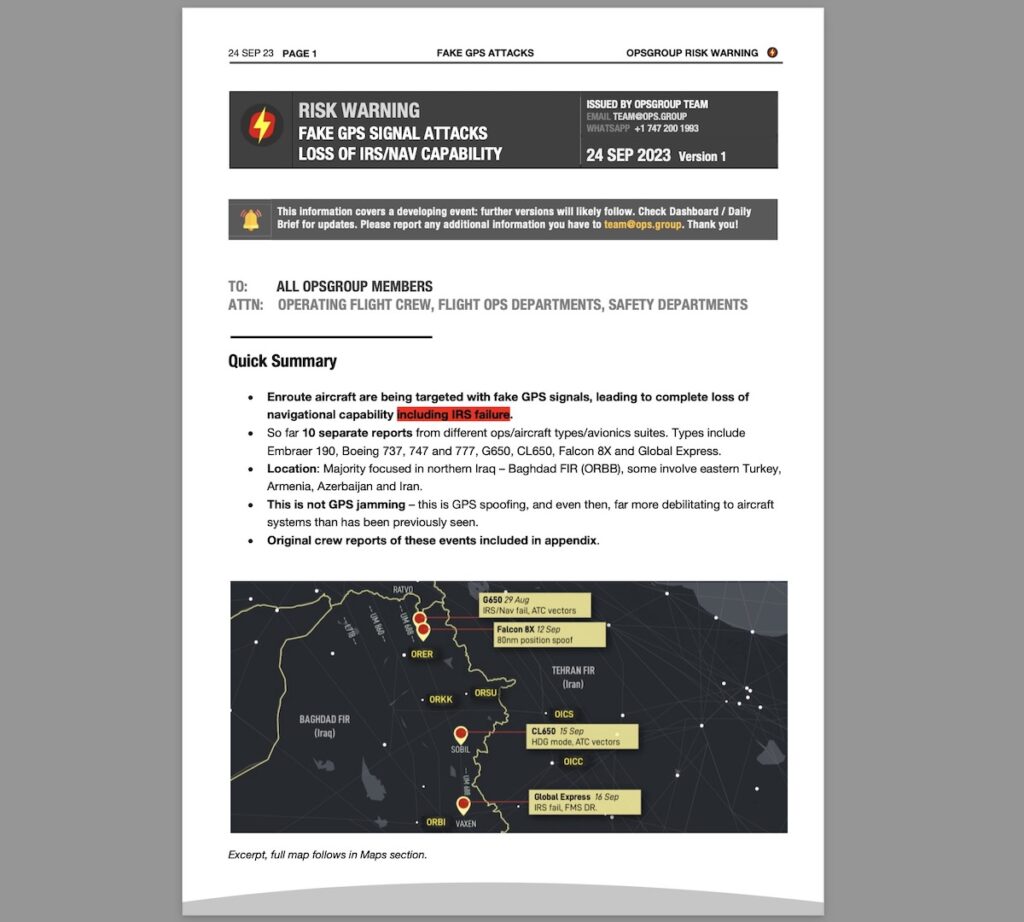
  • Download Briefing: RISK WARNING – Fake GPS signal attacks (PDF, 0.7 Mb)
    • Situation report
    • Key information for Flight Crew
    • Analysis from OPSGROUP members
    • Original Crew reports of GPS spoofing/Nav & IRS failures (First 10 reports listed)
    • Guidance and Procedures
      • Awareness of risk locations
      • Recommended Procedure – entering risk area
      • Recommended Procedure – active GPS spoofing


Further information


Flights misled over position, navigation failure follows

Update – Thursday Sep 28

Since publishing Monday’s risk warning on complex navigation failures following fake GPS signals, we have received further concerning reports from operators, mirroring the same events. The impact of the nav failures is becoming clearer, with one operator almost entering Iranian airspace without clearance, and another left requiring ATC vectors all the way to their destination in Doha.

In total we now have 20 reports of almost identical situations. Full reports are in Version 2 of our Risk Warning (PDF).

On Wednesday evening, the FAA issued a warning memo to aircraft operators as a result of the situation, warning of increased “safety of flight risk to civil aviation operations”.

See new Briefing (28SEP) – “FAA Warning Issued, Further Serious Navigation Failures Reported”


Original article follows:

Key points
  • New RISK WARNING: Enroute aircraft are being targeted with fake GPS signals, leading to complete nav failures
  • 12 16 separate reports – types include Embraer 190, 600, Boeing 737, 747 and 777, G650, CL605, CL650, Lear 45, Falcon 8X and Global Express.
  • This type of GPS spoofing has not been seen before – IRS is quickly “infected” by false position
  • OPSGROUP Members: Suggested Guidance and Procedures, and original crew reports, in Briefing PDF below


Situation

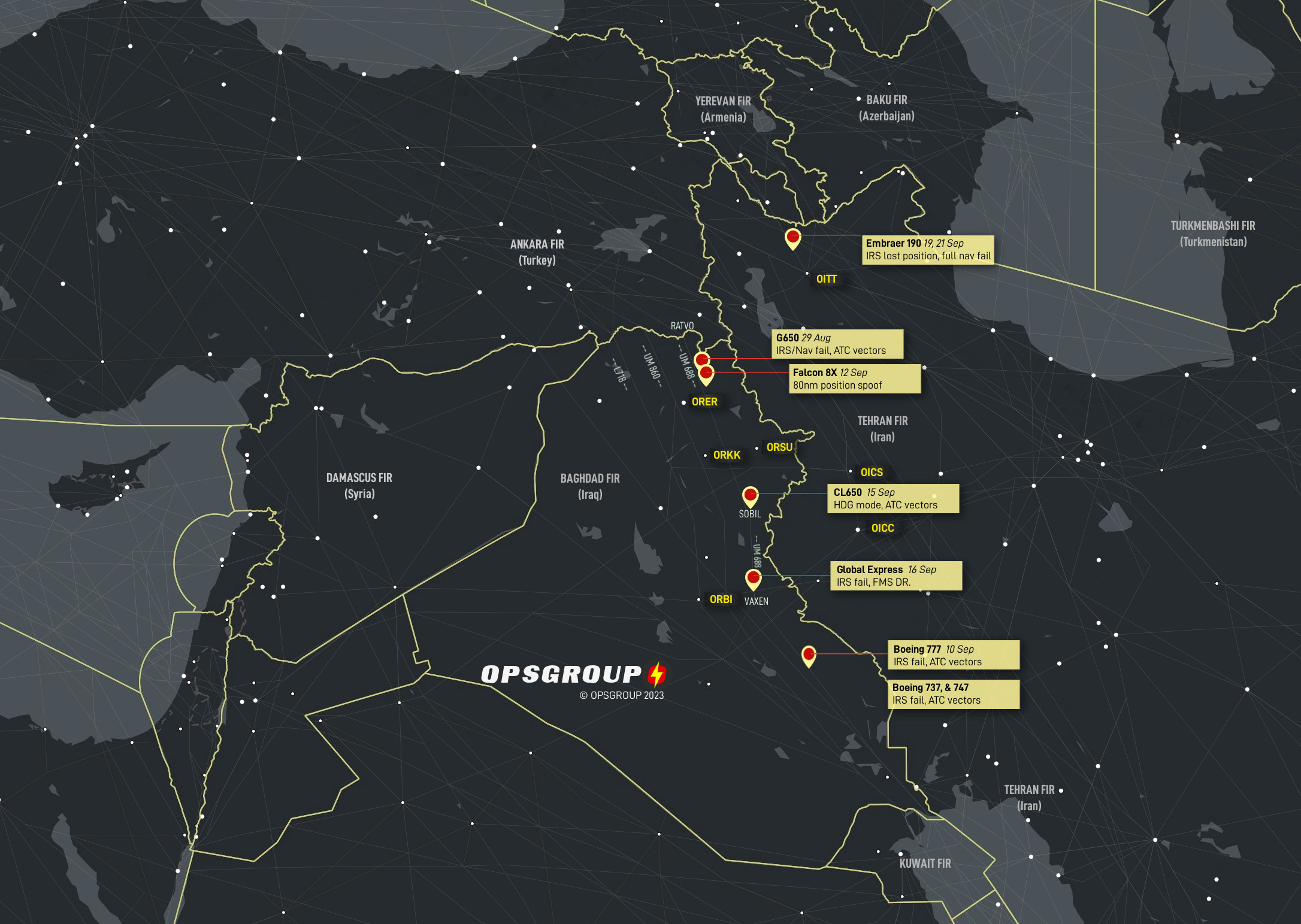
A troubling new development in enroute airspace is emerging: aircraft are being targeted with fake GPS signals, quickly leading to complete loss of navigational capability. 12 separate reports have been now received by OPSGROUP, and in most cases the IRS becomes unusable, VOR/DME sensor inputs fail, the aircraft UTC clock fails, and the crew have been forced to request vectors from ATC to navigate.

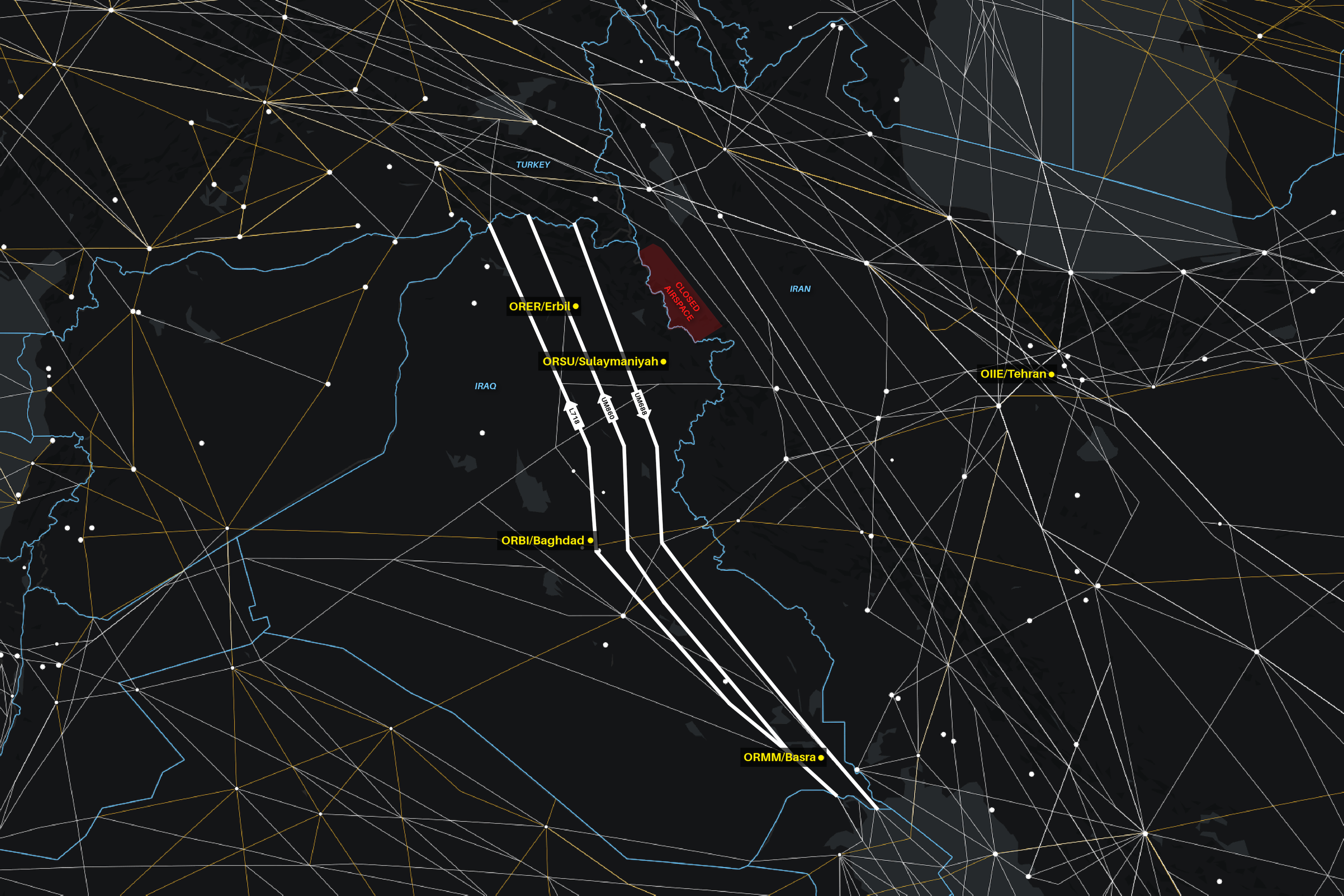
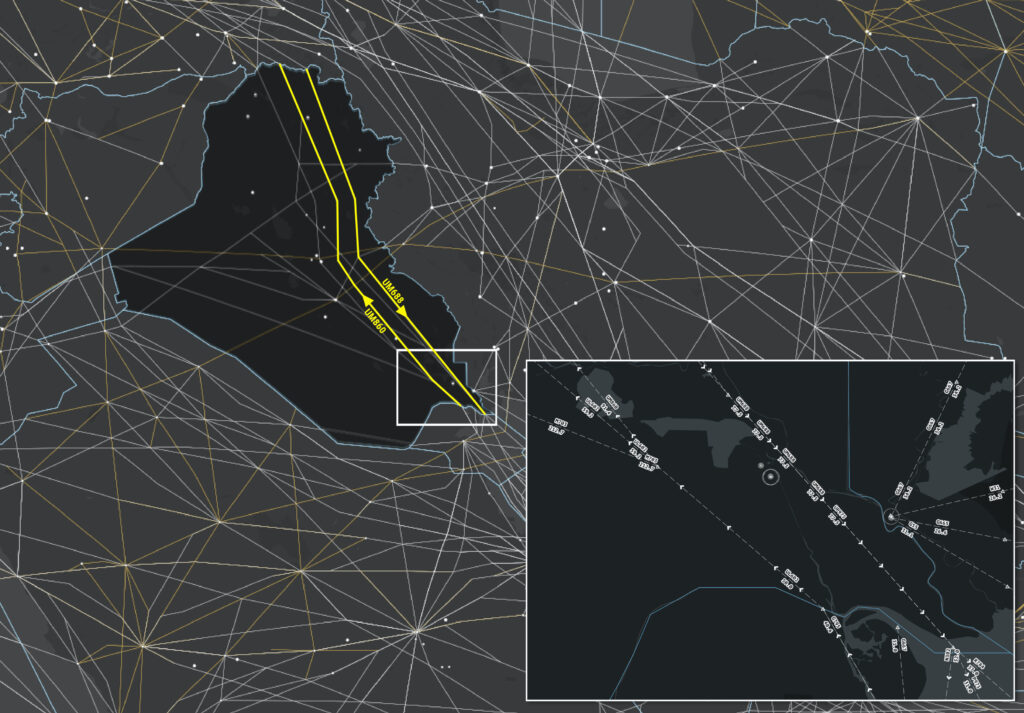
Most reports have been in the last 7 days. Aircraft involved include various Boeing types (B777, B747, B737), Embraer (190, 600), Gulfstream 650, Challenger 650, Global Express, and a Falcon 8X. The location for the majority is also quite specific: Airway UM688 in Iraq, close to the Iranian border.

This immediately sounds unthinkable. The IRS (Inertial Reference System) should be a standalone system, unable to be spoofed. The idea that we could loose all onboard nav capablity, and have to ask ATC for our position and request a heading, makes little sense at first glance – especially for state of the art aircraft with the latest avionics. However, multiple reports confirm that this has happened. The key issue appears to be the way the IRS uses GPS updates to update its position during flight. Analysis from other OPSGROUP members is contained in the Briefing (Risk Warning) below.

In the Baghdad FIR, the crew of a 777 enroute were essentially forced to ask “What time is it, and where are we? “. Almost all incidents we’ve seen result in requiring ATC vectors to navigate. Clearly, in the areas that these events are occuring, this is disconcerting.


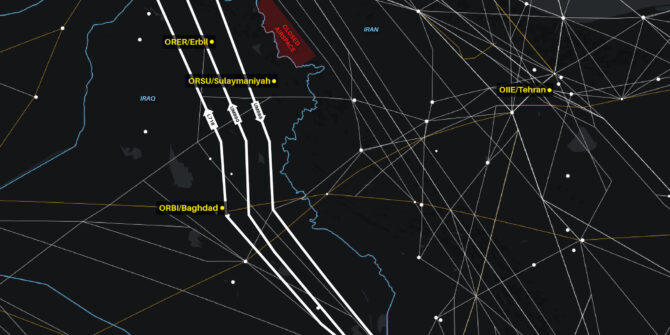
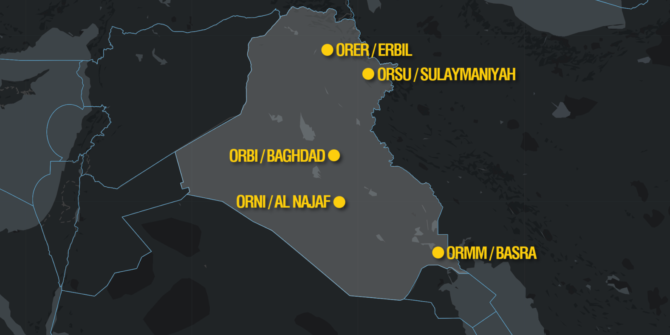
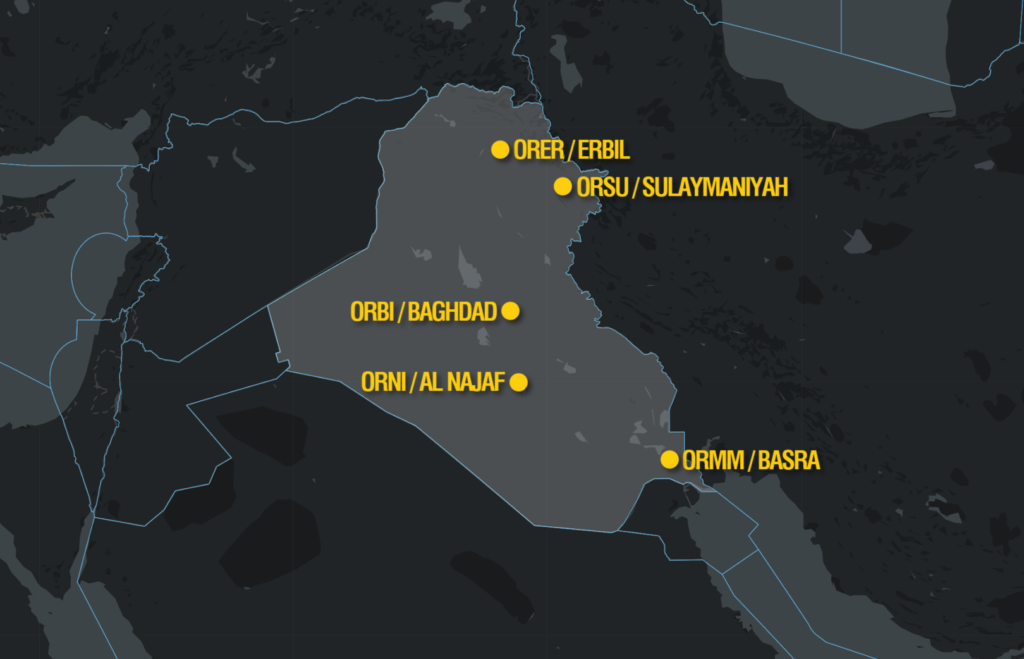
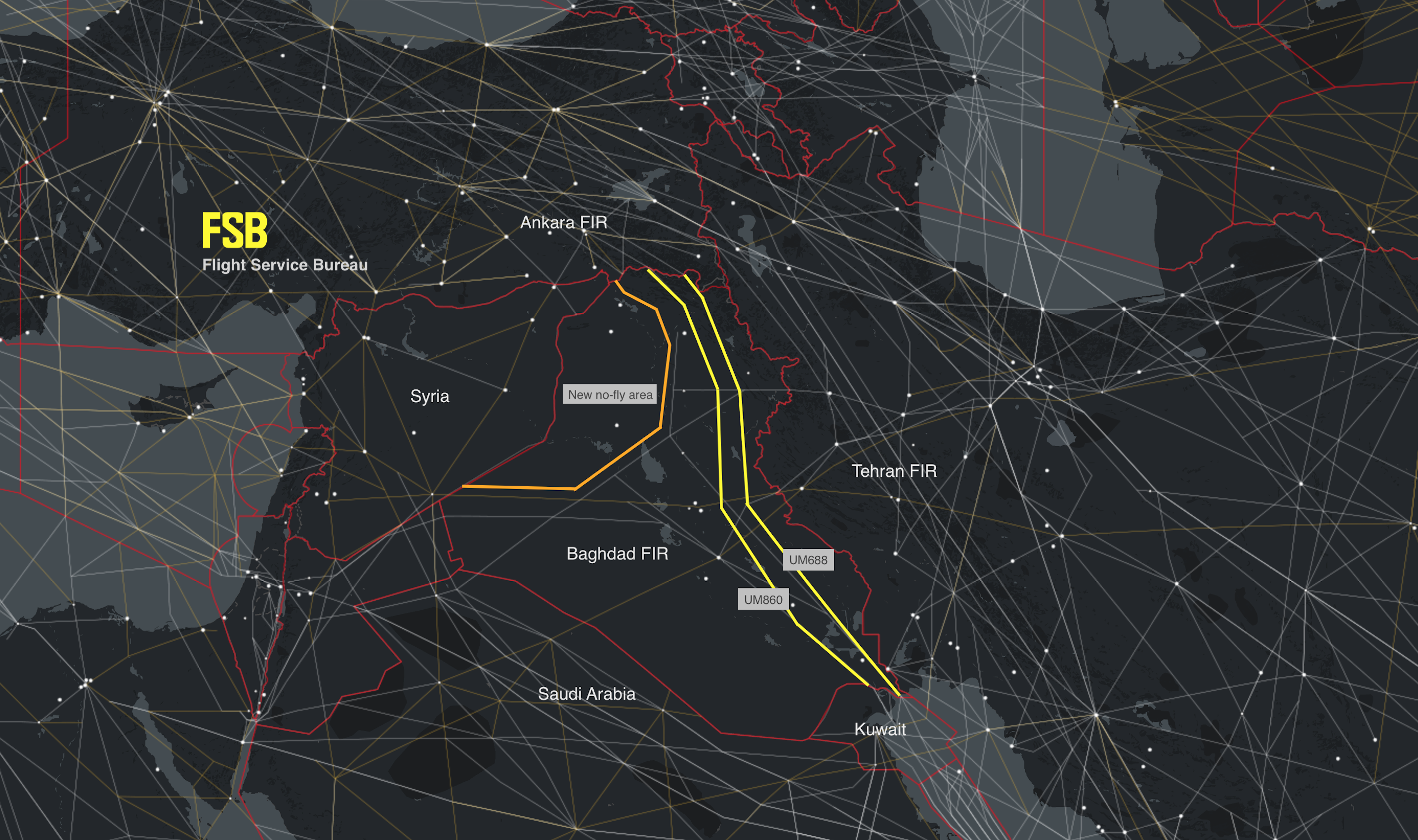
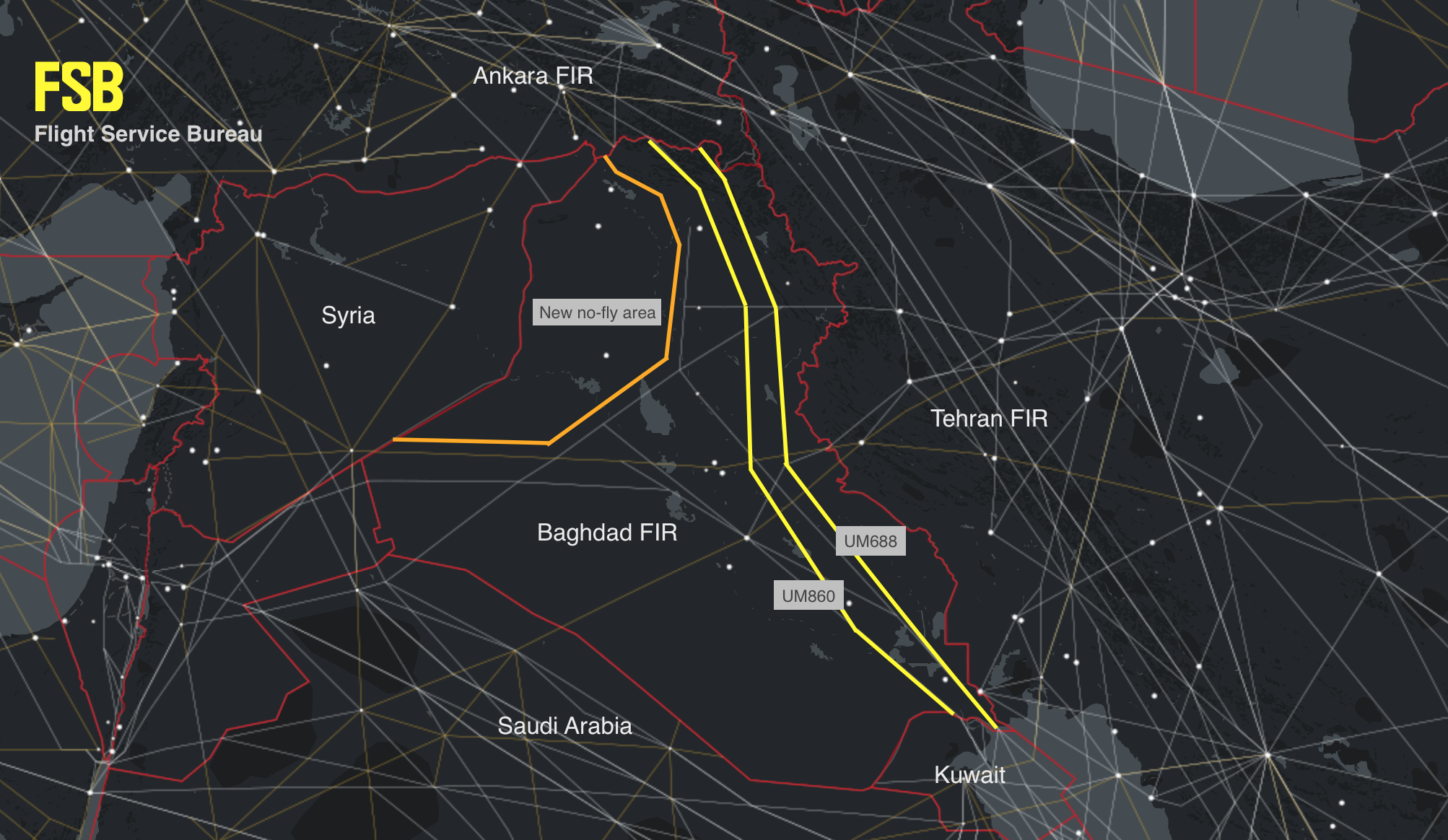
The location of reports received is mapped out below. The primary area of concern at the moment is Airway UM688 in northern Iraq. Most crews have reported the nav failures in the vicinity of ORER/Erbil, ORSU/Sulaimaniyah, and ORBI/Baghdad.


It’s important to highlight is that this not traditional GPS jamming – which we all experience almost as routine in these areas. We have become very used to GPS dropping out in Turkish and Iraqi airspace. These recent reports are GPS spoofing – and even then, not like anything we’ve seen before.

In most reports received, the situation plays out the same. A spoofed GPS signal is directed at the aircraft, or at least, received by the aircraft. The GPS position shifts by 60nm. The onboard systems start to react. Some crews have been able to quickly disable GPS inputs, but for the majority, the spoofed signal quickly leads to a nav failure.

One of the crew reports for an Embraer 190 (see below), tells us, “I have been on the aircraft for 13 years. I tried everything I know, but nothing helped. Two IRS’s, which are updated from GPS, lost position. FMS disagree messages appeared. The main point is to disable GPS inputs at the very beginning of spoofing. If you miss a moment, you will lose navigation capability!” This crew member is also Technical Pilot for the E190 type.


Worrying scenario

Of all locations that we fly through, the one place we don’t want to have any navigation issues would be along UM688. This airway runs southbound through Iraq, above an active conflict zone, and extremely close to the border with Iran. Any indavertent straying into Iranian airspace without a flight plan risks action by the Iranian military.

And yet it is precisely here that most of these events in the last week have been happening. As such, the risk to routine flight operations is extremely elevated.

OPSGROUP recommends that all operators using airway UM688, or entering the Iraq/Iran/Turkey region, review this new risk as soon as possible. Flight Crew should be made aware of the potential for fake GPS signals, the likely impact on aircraft systems, and a plan of action should this occur.


OPSGROUP Member resources

Over this past weekend (23-24 September), OPSGROUP members provided analysis of the events, and recommended guidance. This work has been collated into Briefing: RISK WARNING 24SEP/V1, available to all members in your Dashboard. Direct links are below.

  • Download Briefing: RISK WARNING – Fake GPS signal attacks (PDF, 0.7 Mb)
    • Situation report
    • Key information for Flight Crew
    • Analysis from OPSGROUP members
    • Original Crew reports of GPS spoofing/Nav & IRS failures (First 10 reports listed)
    • Guidance and Procedures
      • Awareness of risk locations
      • Recommended Procedure – entering risk area
      • Recommended Procedure – active GPS spoofing


IRS failures

An excerpt of analysis from the Briefing Document above helps us understand the issue better:

“Most avionics suites are now engineered such that the IRS position is regularly GPS updated to ensure the highest accuracy, if the GPS fails!

Therefore if the GPS is jammed, then the IRS works from its last known position. However if it receives a spoof position, the system still believes the GPS input received to be accurate as all sources “say” the same thing, and this spoof position is then updated to the IRS(s) to match. Most avionics system know that a shift/gross-error has happened as ground based updates do not compute the correct position, and will flag a navigation/map/position warning.

However, all primary navigation systems end up being corrupted as a result. It has the potential to be very dangerous, and is part of the reason why pilots should back up navigation still, with “green needles” / ground based aids wherever possible. Our dependance on GPS is not always good!

I would recommend using conventional ground based navaids (DME/VOR/NDB) as far as practical, otherwise request assistance from ATC. Some platforms may allow IRS systems to be disconnected from GPS auto-updating, but most now do it in the background with no optional pilot interaction.

Unless the IRS systems are completely independent (the old fashioned ones that have to be initialised at startup location), GPS integration for frequent position updates, is sadly the issue due to its vulnerability to spoofing. For those that can disable the updating, they may wish to consider turning this function off, however it may impact on navigation capability, AFM requirements and operational approvals.

I would recommend that pilots and operators reach out to their OEMs for their recommendations on dealing with spoofing on their platform.”

Another member (767 operator) spoke to an IRS expert for perspective – also arguing that “the IRS system is “stand alone” and the only mixing between GPS and Inertial is inside the FMS and thus, the IRS couldn’t be spoofed. He assured me it could. Not enough to lose the alignment platform, but enough to confuse the present position and thus, none of the radio navaids are where they’re supposed to be.”


Updates

This information covers a developing event: further versions will likely follow. Check your members Dashboard / Daily Brief for updates.

Much of the information is compiled from member feedback. If you have any expertise to share, or information to add – please email team@ops.group, or send a WhatsApp message to +1 747 200 1993.

Thank you!


Turkey, Syria and Iraq: Airspace Risk

The airspace risk in Syria and Iraq are both discussed regularly, with numerous warnings and prohibitions from major authorities.

However, Turkey is seeing an increase in security and safety concerns along its southern border with Syria, and the eastern region which borders Iraq, because of the conflict and tensions in this region. And not a lot is said about it.

Why is Turkey seeing increased risk?

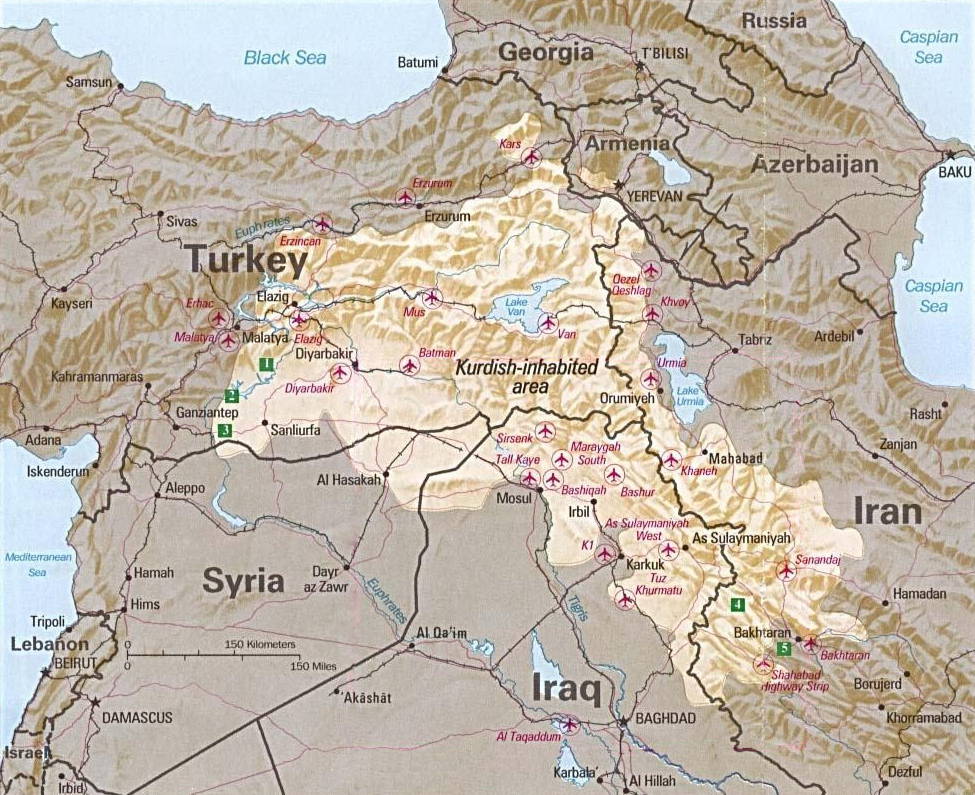
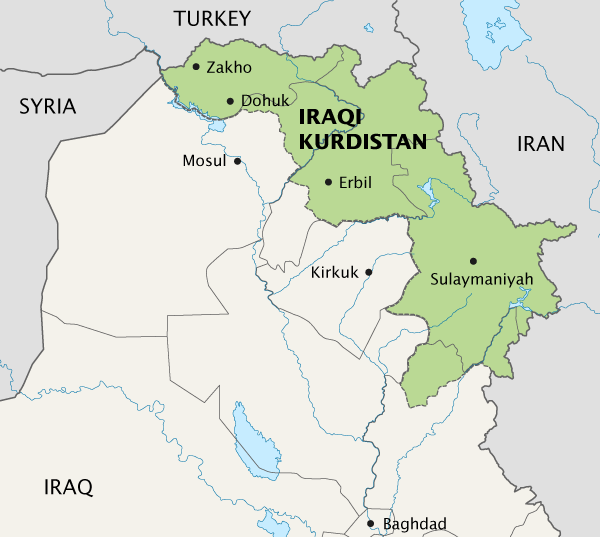
Keeping this as simple and non-political as possible because it is really just for context – Kurdish people are an ethnic group native to Kurdistan which is a big area spanning southeastern Turkey, northwestern Iran, northern Iraq and northern Syria.

Here’s a map of it:

Turkey has an ongoing conflict with armed Kurdish groups, particularly one called the PKK who have fought against Turkish authorities since the 1980’s, hoping to establish an independent Kurdish state.

In addition to this, Syria have their own civil war also involving their Kurdish population, as does Iraq. Turkey borders each of these countries, and spillover from these has led to more and more military action by Turkey.

Risks for aviation:

There are two main risks previously highlighted:

1. Misidentification and anti-aircraft weaponry

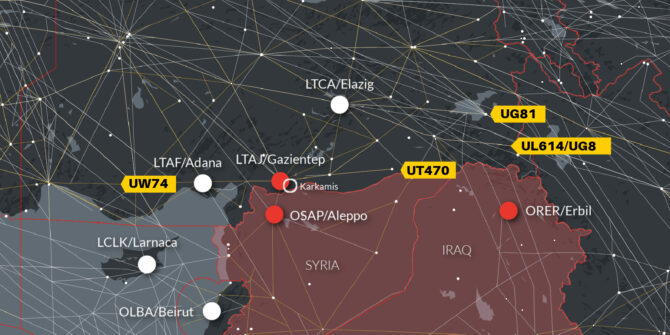
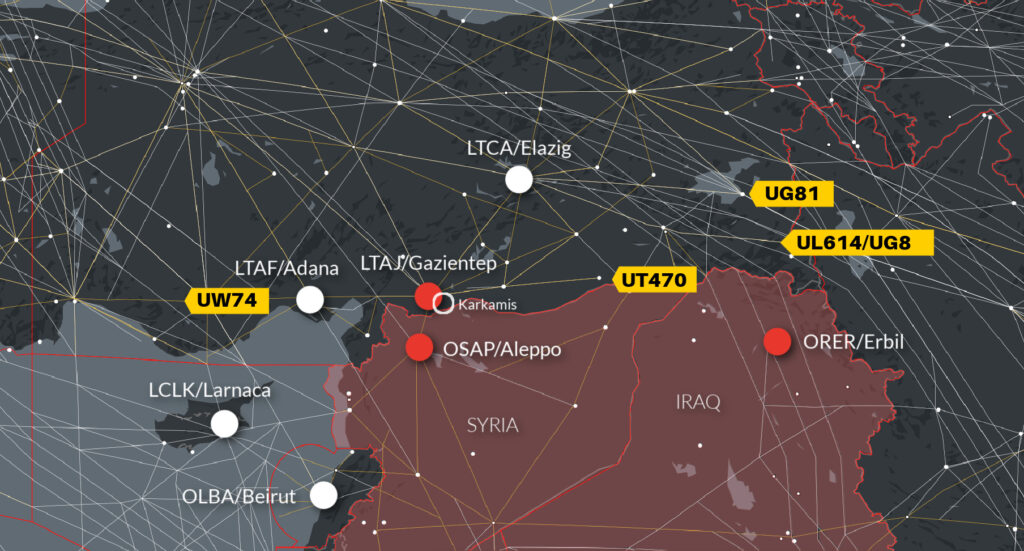
The primary risk is misidentification by local militia who infrequently target Turkish military aircraft with MANPADS and weaponsied drones. Operations to LTAJ/Gaziantep should be carefully reviewed given its proximity to the Syrian border.

The US FAA published a note on Turkey in 19 May 2021 referring to the threat from militia with access to anti-aircraft weaponry.

2. GPS jamming

The secondary risk is GPS Jamming. Turkey has long been an area which sees significant GPS Jamming. There are frequent reports from crews of GPS signal interference in Turkish airspace – with some as far away as abeam Baghdad. GPS jamming is common through the LTAA/Ankara FIR, and especially on the border between the ORBB/Baghdad and OIIX/Tehran FIRs.

Turkey Notam LTAA A6691/22, valid through to 6 January 2023 relates to GPS Jamming.

Other growing risks for air crew and air operations:

1. Security on the ground

Security in major cities, and in regions along the border, in southern Turkey is a growing concern. Crew should be aware of these and should avoid travelling close to the border regions.

Caution should be taken if visiting large public spaces and tourist areas as there is a heightened risk of terrorism.

Prepare for potential disruption and delays due heightened security in airports.

Consider the implications of diverting to airports where you have no ground contacts, engineering or support. There may be political concerns to consider as well depending on the nationality of your crew or passengers.

2. Risk in southern Turkish airspace

Along the border with Syria and Iraq in proximity to conflict zones, there is a higher level of airborne military traffic, UAS and the risk of proximity to airstrikes.

Most major authorities advise operators to exercise caution when operating in the airspace within 200 NM of the Damascus FIR (OSTT), which should be considered to include the southern region of Turkey as well as the countries neighbouring Syria to the west.

Major events

  • On Nov 21, the Turkish border town of Karkamis was hit by artillery and rockets from across the Syrian border.
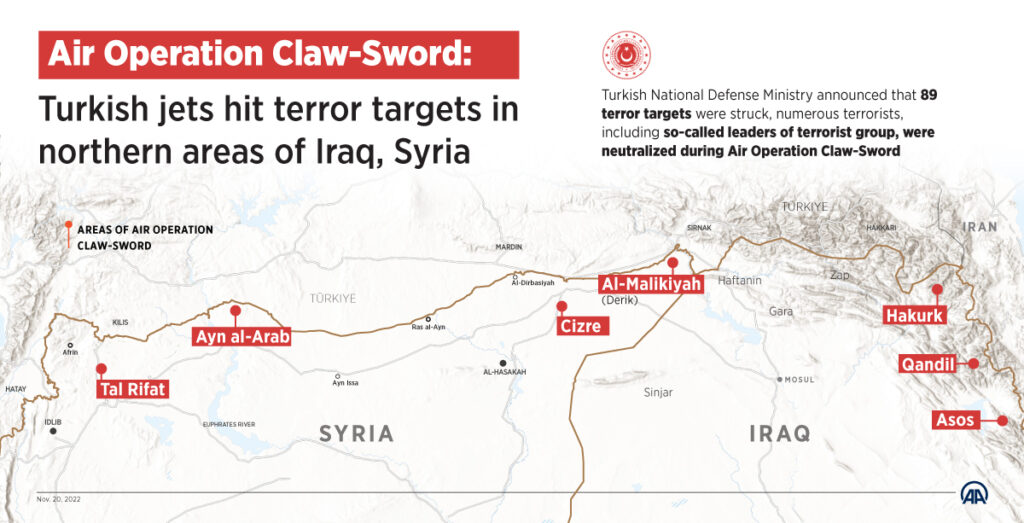
  • On Nov 13, a bomb attack in Istanbul attributed to the PKK resulted in Turkey carrying out airstrikes against Syria and Iraq. Operation Claw-Sword is reported to have involved 70 aircraft and drones.
  • In May 2021 an attempted drone attack by local militia on LTCC/Diyabakir airport in South Eastern Turkey.
  • In Jan 2019, Turkish security forces intercepted three weaponised drones during attempted attacks against sites in southern Turkey.

A full briefing on Turkey can be found on Safeairspace.net

Syria

There is a high risk to civil aircraft. Syrian airspace (OSTT/Damascus FIR) should be avoided entirely. Airspace adjoining the Damascus FIR is also at risk: Cyprus, Turkey, Israel. Total flight ban for US, UK and German operators, and several other countries have issued warnings to avoid the airspace of Syria.

The primary risk is a misidentification by Syrian air defense systems. Civil aircraft may be targeted in error, or caught in crossfire during ongoing air attacks involving Israel, Russia, Iran. Missiles may erroneously lock on to civil aircraft. Israeli airstrikes on Syria are regular, and do not show any regard for civil traffic.

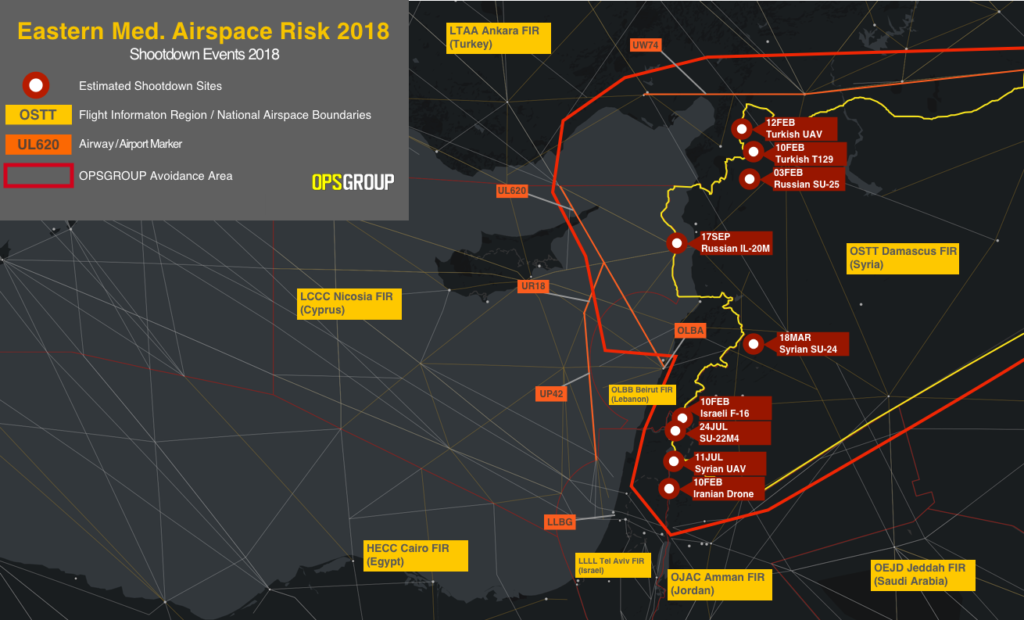
There is a clear risk to civil aircraft operating on airways UL620, UW74, UR18, and UP62. 

The FAA information on Syria warns the threat is extended to adjacent FIRs in the Eastern Mediterranean region including the LLLL/Tel Aviv, OJAC/Amman, OLBB/Beirut and LCCC/Nicosia FIRs. Use caution if operating in the area.

A full briefing on Syria can be read here.

Iraq

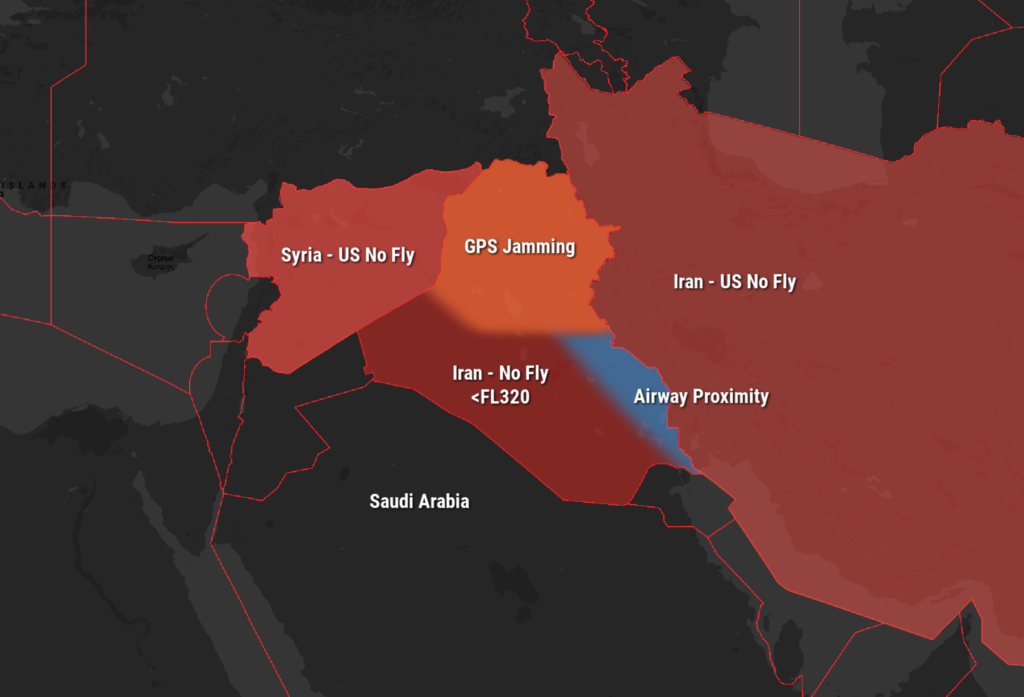
Most major authorities advise against operations below FL320 in the ORBB/Baghdad FIR. The US FAA amended their KICZ Notam from prohibiting all operations, to this in October 2021.

In Sep 2022, Iran closed a section of airspace in the north of the country along the border with Iraq, and is using the area to launch missile and drone attacks at targets near ORER/Erbil Airport. Iran are warning their own operators against flying in Iraqi airspace.

ORER/Erbil is the primary airport located in the Iraqi Kurdistan region and regular artillery, rocket and missile attacks target this region. Operations into the airports including diversions, should be avoided.

A full briefing on Iraq can be read here.


Iraq Airspace Risk For Overflights

International operators overflying Iraq should take note of recent events impacting airspace risk in the region.

Iran have closed a section of airspace in the north of the country along the border with Iraq, and are potentially using the area to launch missile and drone attacks at targets near ORER/Erbil airport, in close proximity to heavily flown international air routes.

Iranian attacks

Iran are warning their own operators against flying in Iraqi airspace, and especially at Erbil airport, which came under direct fire from Iranian surface-to-surface ballistic missiles in Feb 2021 and again in March 2022. Iran launched further attacks this week on an area 35 miles east of Erbil, reportedly targeting a Kurdish opposition group in the region – an armed opposition force that is banned in Iran.

Here is the warning issued by Iran:

OIIX A2959/22 - AIRSPACE SAFETY AND SECURITY WARNING ISSUED BY IRAN CAA IN
RESPONSE TO THE HAZARDOUS SITUATION WITHIN THE TERRITORY AND
AIRSPACE OF BAGHDAD FIR (ORBB),
IRANIAN REGISTERED AIR OPERATORS ARE ADVISED TO TAKE
ALL POTENTIAL RISKS INTO ACCOUNT IN RISK ASSESSMENT AND FLT
PLANNING DECISIONS WHEN OPERATING AT AIRPORTS WHICH ARE LOCATED
WITHIN BAGHDAD FIR (ORBB) ESPECIALLY ERBIL INTERNATIONAL AIRPORT
(ORER), DUE TO THE RISK POSED BY
MILITANT ACTIVITY AND LIMITED RISK MITIGATION CAPABILITIES IN IRAQ. 28 SEP 17:35
2022 UNTIL 05 OCT 18:30 2022 ESTIMATED. CREATED: 28 SEP 17:43 2022

Iraq airspace risk

Several countries warn against overflights of both Iran and Iraq. The US FAA bans N-reg aircraft from the OIIX/Tehran FIR, and says that overflights of the ORBB/Baghdad FIR must be at FL320 or above – and just last week they extended these rules to 2024.

But the Iranian attacks in northern Iraq raise questions and concerns about overflights of Iraq. Airways UM688 (southbound) and UM860 (northbound) through Iraq are popular routes for international flights between Europe and the Middle East. Is it really safe to fly these routes now, even above FL320?

It’s worth digging into the US FAA guidance on Iraq a bit deeper to get a clearer picture of exactly what the risk is here. SFAR 77 has the info, and this is (some of) what it says:

  • Iranian-aligned militia groups (IAMGs) have access to UAS and anti-aircraft capable weapons systems which present inadvertent risks to the safety of U.S. civil aviation operations in the ORBB/Baghdad FIR at altitudes below FL320 and at potentially targeted airports.
  • IAMGs likely lack the ability to conduct effective target identification and airspace de-confliction, increasing the risk of an accidental shoot down of a civil aircraft due to misidentification or misperception.
  • In addition, the FAA remains concerned about cross-border military activity. Both Iran and Turkey have previously conducted various no-notice, cross-border operations striking targets in northern Iraq using a variety of weapons, including short-range ballistic missiles, rockets, and weaponized UAS. In a recent example, on March 12, 2022, up to twelve Fateh-110 surface-to-surface ballistic missiles launched from western Iran and impacted near the construction site of the new U.S. consulate in Erbil, Iraq, and Erbil International airport (ORER). While this attack did not pose a direct threat to the airport, the missile trajectories possibly presented an inadvertent risk to aircraft in flight that might have been operating at low altitude in the vicinity of Erbil International airport (ORER) during the time of the attack.
  • In general, unannounced third-party cross-border operations in the Baghdad FIR (ORBB) present a low altitude safety-of-flight risk for aircraft flying in the vicinity of the targeted location(s) and for aircraft on the ground at airports co-located with, or in close proximity to, the intended targets. These activities also pose an airspace de-confliction challenge.

Should I avoid overflying Iraq?

For most Europe-Middle East flights, the route through Saudi-Egypt is a safer option than Iraq.

Even routing through Iran is probably a safer bet at the moment (although we don’t advise that either!). We received a report from an OPSGROUP member this week who routed through Iran:

“I would estimate our flights through Iran vs Iraq are taking (approximately) 10-15 mins longer, but at significantly less risk. We only consider airports that are served by either Emirates or FlyDubai as suitable for diversion, but only as a last resort, such as OIIE, OISS and OIFM. The company we use for support and handling if such diversions are required is Hadid. They are excellent for sorting any problems/permits in the Middle East.”

Here’s the Iraq risk, as we see it:

  • Potential of intentional targeting by terrorist organisations who possess portable anti-aircraft weaponry.
  • Civil aircraft may be misidentified by the air defence systems of both local and foreign military who are active in the country.
  • Iraq is politically unstable, and security and safety on the ground is unpredictable and likely to be high risk.
  • The US have pulled their troops out and so there is little protection at the major airports. 
  • ORBI/Baghdad and ORER/Erbil airports are common target for rocket attacks. Militia and terrorist groups are active in these areas.

Want a full briefing?

Just click here. Safeairspace.net is our conflict zone and risk database run by OPSGROUP. We continually assess the risk to operators the world over. It presents that information in a way that will always be simple, clear, and free. You can also add your email to our new fortnightly airspace risk briefing that contains only what you need to know, delivered every second Monday.


Iraq Overflights: A Recent Report

The US FAA recently amended their long standing Notam prohibiting US Operators from entering the ORBB/Baghdad FIR. The KICZ Notam A0036/21 used to bar flights at all levels, but now US operators are allowed to overfly Iraq provided they remain at or above FL320, as per the SFAR.

So, what can you expect if you elect to use this newly available routing, and what risks remain?

You can still expect risk

Iraq remains a political volatile country and the security there is unpredictable. Terrorist groups remains active, and have access to anti-aircraft weaponry.

What should you do?

  • Continue to monitor alerts and sites such as Safeairspace to confirm what the current situation is.
  • Flights should remain above FL320 to avoid risk from MANPADS.
  • Do not use Iraqi airports as diversion options unless it is an absolutely critical emergency situation.

All going well, here’s what expect

Plan to use the UL602, UM860 and UM688 airways. These are major airways utilised by traffic routing between Europe and the Middle East. Iraq offers the slightly shorter route compared to Iran (and Iran remains out of bounds for US operators).

The routings to plan are as follows:

Northbound:
– TASMI DCT SEPTU DCT ROXOP UM860 NINVA
– TASMI UL602 ALPET L718 DEBNI DCT EMIDO L718 KABAN (all flights need to be at or above FL280 before DEBNI to stay clear of restricted area OR/R 401).

Southbound:
– TASMI RATVO UM699 SIDAD (via airway)
– RATVO DCT SISIN UM688 SIDAD (DCT – subject to availability)

Kuwait are good at handing you over, and Bahrain and the UAE airspace is all well managed.

ATC standards are good, and standard VHF throughout, with radar. It is worth keeping your headsets on though because a good listening watch is required at all times in this region.

Routing south you might find yourself slowed down or shifted levels, or given early descents, as they manage the flow into some of the major hubs in the Middle East. If you fly into the Bahrain FIR (via RABAP or LONOS) be aware there are high levels of congestion here, particularly military traffic.

Any other considerations?

Iraq borders Syria which is an absolute no go area. There is a large prohibited area in the northwest quadrant of Iraqi airspace along the Syrian border. If you are looking to use LCLK/Larnaca as a diversion airport, consider how you will manage routing around Syria.

The main southerly airway lies extremely close to the Iranian border. The border is not a straight line so consider whether you might accidentally cross it if detouring for weather, or if offered a direct routing which cuts the corner.

You do occasionally get some major storms in this region. When they are there, they aim to be impressive!

GPS jamming is a problem, usually in the northern region from around 40nm north of the border and through about one third of the airspace. Of course, if you have INS and/or VOR/DME RNAV etc then you’ll be ok, but if you’re using something like Garmin avionics which rely solely on GPS then not so much. UAE airspace requires at least one GPS too, so update ATC if you need support!

What if I have to land there?

Security and safety on the ground is unknown and likely to be high risk.

The US have pulled their troops out and so there is little protection at the major airports. Leaving the airports will result in possible security issues and is unadvisable. While the airports are generally well maintained and serve some major international airlines, conditions are challenging particularly in the summer when temperatures regularly exceed 40°C. Terrain is also a consideration.

Cultural and religious regulations must be taken into account, and political conflict with certain nationalities should be considered. Alcohol and drugs are banned with severe penalties.

ORBI/Baghdad is a common target for rocket attacks, particularly because of its proximity to an air base. Rebels and terrorists are active in this area. The facilities and runways are decent with two ILS approaches and two runways of 4000m and 3301m. This should only be used in absolute emergencies.

ORMM/Basra is the second largest airport in Iraq and has a good length runway and an ILS. This should only be used in absolute emergencies.

ORER/Erbil offers a very decent length runway and facilities. The main area of issue is over the hills to the north of the airport. This is the only airport which may be recommended for use as a possible en-route diversion.


US FAA allows Iraqi overflights

On October 22, the US FAA cancelled a long standing Notam that barred US operators from entering the ORBB/Baghdad FIR at all levels (KICZ A0036/21).

The standard SFAR for Iraq now applies, which allows overflights at or above FL320. But does that mean it’s safe?

Iraq remains an active conflict zone which exposes aviation to high levels of risk. So, let’s take a look at the dangers of operating in the Baghdad FIR and why those risks should continue to be carefully considered at all levels before you decide to overfly.

Hang on, why was there both a SFAR and a Notam in the first place?

The political and security environment in Iraq is unpredictable. Local and foreign military continue to fight against an armed insurgency there. Things can change quickly.

To allow the FAA more flexibility with the rules, they published the Notam (now cancelled) with extra restrictions over and above the SFAR.

The idea was that they could continually assess the threat to US aircraft in Iraqi airspace, and easily reduce restrictions again to allow some operations to continue through this air corridor. This is where we are now.

But the overflight risk remains.

The primary risk to overflying aircraft hasn’t changed. Terrorist groups are still very much active in Iraq and may intentionally target civil aircraft with anti-aircraft weaponry. They are known to have conventional man portable air defence systems (MANPADS) – the ones you can move around and launch from your shoulder. These were previously assessed to reach aircraft as high as FL260, but the danger zone was later increased by the FAA to FL320.

Why?

Because these groups are being funded and armed by other political interests in the Middle East with increasingly sophisticated weapons.

Case in point. On October 21, news broke that militia in Iraq may have access to a new type high tech anti-aircraft missile. Intelligence suggests that it is ‘loitering’, or in other words that it hangs around for a while before selecting a target. While such a weapon hasn’t been used yet in Iraq, the evidence that it is there is credible.

The same militia also have a long track record of targeting US military interests at airports such as ORBI/Baghdad with rockets. We have reported on such attacks more than a dozen times already this year alone.

Don’t forget about the military – at all levels.

Iraq is an active conflict zone, so foreign and local military have their own air defences too.

The US military have systems that can reach higher than anyone can realistically fly, while the Iraqi military have surface-to-air missiles that can target aircraft as high as FL490.

In the last 12 months, there has been an increase in the use of weaponised drones by militant groups. Which means that if these air defence systems are used to target them, it may increase the risk that civil aircraft are misidentified or mis-targeted – or in other words, being in the wrong place at the wrong time.

Other recent events.

The ability is clear, but what about the intent?

It’s important to remember that airspace risk can change quickly, based on what is happening on the ground. (Not just in Iraq, but everywhere.)

And in Iraq, there are two things to be aware of in recent times…

  • The first is that Iraq is still politically unstable. There was a big election on Oct 10 which has since been disputed. Militant groups found themselves on the wrong side of the result, which may imply an increasing desire to make some kind of statement.
  • The second is that the US Government has committed to withdraw US troops from Iraq by the end of 2021. As that time draws closer, political tensions are likely to rise. If anything, recent events in Afghanistan may serve as a warning of things to come.

I still want to overfly. Are some areas safer than others?

Based on active airspace warnings alone, authorities in France and the UK agree that eastern airways UL602 (between TAMSI and ALPET), UM860 and UM688 are generally acceptable – but as always, it is up to operators to carry out their own risk assessments. The US FAA regs don’t define any specific region and consider the risk present below FL320 throughout the entire Baghdad FIR.

Want a full briefing?

Just click here. Safeairspace.net is our conflict zone and risk database run by OPSGROUP. We continually assess the risk to operators the world over. It presents that information in a way that will always be simple, clear, and free. You can also add your email to our new fortnightly airspace risk briefing that contains only what you need to know, delivered every second Monday.


Oct 2021: Iraq Airport Closures

Please note the date on this story – Oct 2021. We’re keeping the info here for reference purposes only.


Iraq is closing for a few days while their elections take place.

Here is a quick look at what this will mean for traffic who are planning to operate over or into Iraq over the closure dates.

Why and what are they closing?

They are closing all airports and border crossings for security reasons. 

The election will take place Oct 10th. The closures will run from 2300LT on Saturday Oct 9th to the morning of Oct 11th. You will not be able to operate in or out of Iraq during this time.

Any further information on this has not yet been provided, but when elections took place in 2018, there were a number of strikes which reduced public services to nearly zero, as well as violent protests and riots across the country. This resulted in a 24 hour closure in May 2018.
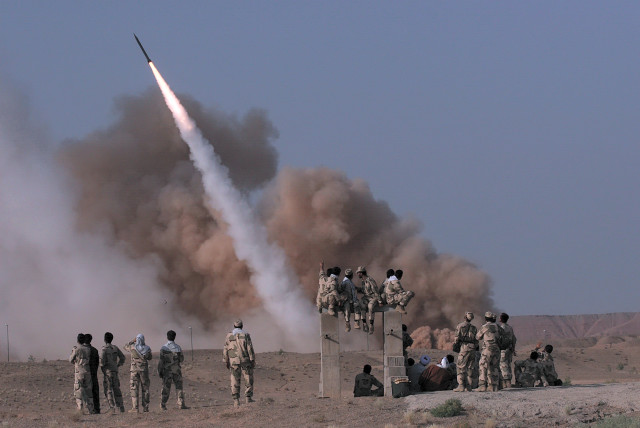
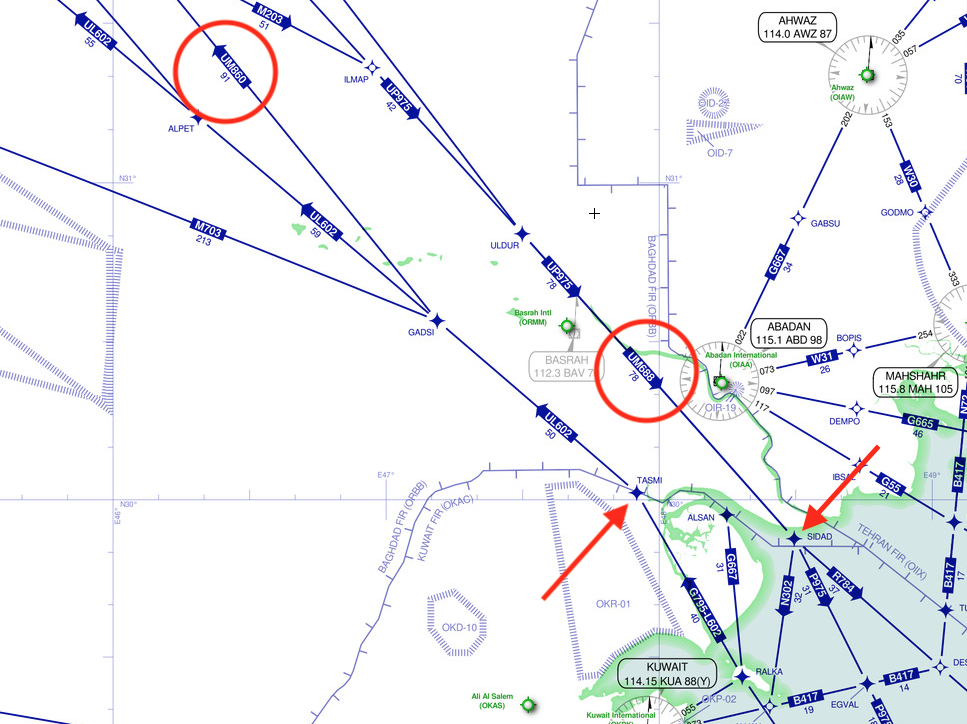
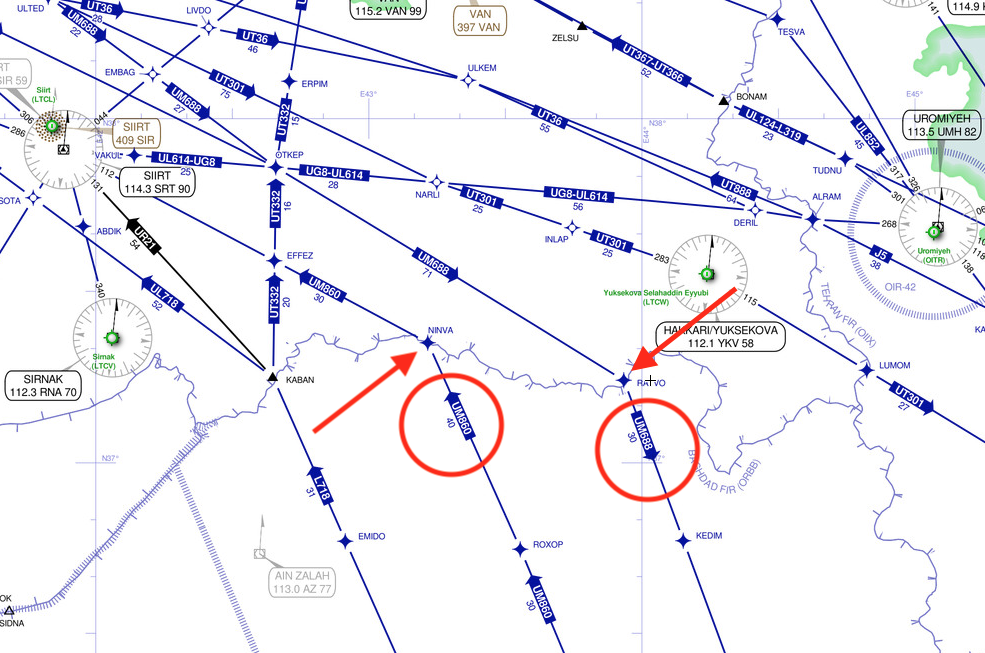
In September 2018, several Katyusha rockets were fired directly at Basra airport during further protests against the government and elections.

It is volatile at the best of times.

ORBI/Baghdad airport is situated around 100nm southeast of a major airbase which is often targeted by rockets and weaponised drones. Baghdad itself is a target for rebel groups, and while attacks are generally low level, they do pose a risk to civil aviation and also heighten the risk of misidentification by air defense systems.

But can you still overfly?

The Notam published by ORBI/Baghdad Airport suggests you can:

A0239/21 - AD CLSD DUE TO IRAQ ELECTION DAY. WITH EXEMPTION TO EMERGENCY
SITUATIONS DECLARED BY FLIGHTS OVERLYING IRAQ. 09 OCT 18:00 2021 UNTIL 11 OCT
03:00 2021. CREATED: 30 SEP 19:11 2021

ATC through Baghdad is provided by a large, international air traffic services provider, Serco, and you often hear US accents on frequency. Kuwait also provide some control of the southern sector when they hand over. So ATC control is not thought to be impacted.

The days leading up to and following the elections may well see some increased traffic across Iraq as dignitaries, government officials etc fly in, out and about.

Iraq and the ORBB/Baghdad FIR are a main connection between the Middle East and Far East to Europe. There are really only 4 options – 

  • Via Iraq
  • Via Iran
  • Via Saudi Arabia
  • Via Pakistan into Eastern Europe

ORBB/Baghdad FIR Notams A0235/21 and A0236/21 advise on the routes available for civilian aircraft overflying the region. This is also covered in their AIP ENR 1.10-2 section 4.5.3.

Heading Northbound you can file TASMI SEPTU ROXOP UM860 NINVA

Heading Southbound you can file RATVO SISIN UM688 SIDAD


Airports

The airports will be closed. All international airports (ORER, ORSU, ORNI, ORMM) have published identical Notams to the one for ORBI/Baghdad, saying that they will remain available for emergency diverts, but they will not be available for “general” en-route alternates.

Iraq borders Iran (another region with airspace warnings in place) and Syria to the other side (which is a No Fly Zone) so  you may be limited on where you can go – turning around and heading back to Kuwait and Saudi, or routing to Turkey (depending on which direction you are heading from).

Eastern Turkish airports are generally smaller and less capable than the larger ones to the West. There are also often skirmishes along the border between Iraq and Turkey, with military on both sides sometimes closing portions of airspace during military activities.

What should you do?

Continue to plan overflights, but be aware that diversions will likely not be supported during this time.

Be aware that government offices and services will likely be closed and unavailable during the election period, so don’t submit overflight and permit requests last minute because they won’t be handled until afterwards.

What is available (when they aren’t closed for elections?)

Check out SafeAirspace – US Operators are banned from operating over or into Iraq, and other authorities advise against flights below FL260.

ORBI/Baghdad airport, in the capital, has a decent runway, however they do currently have works on 15L/33R and it is closed (when the weather permits) and between 0300-0500z.

Runway 15R/33L is only available during daylight hours and in VMC because the instrument approaches are suspended. 33L also currently has a displaced threshold (400m) and the declared distances are now 2901m.

So keep an eye on the weather and be aware of what might or might not be available. Notams A0222/21 and A0193/21 are the ones to read.


Rumbles Over Riyadh: A New Threat?

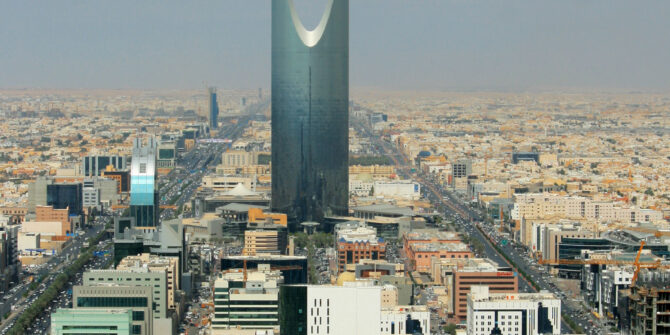
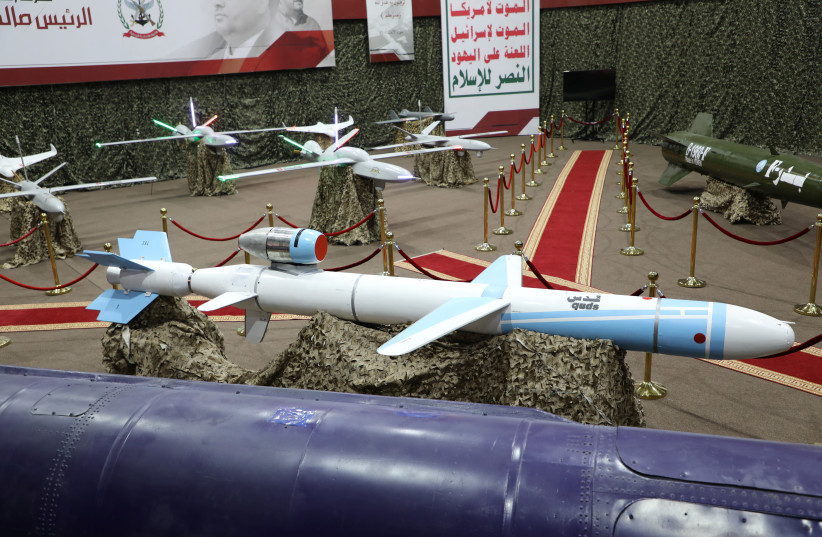
You might have seen the headlines a week or so ago. On January 23, Saudi Arabia’s capital Riyadh was attacked by a ‘hostile air target’ – likely an explosive ‘kamikaze’ drone. Saudi air defences destroyed it, causing a loud explosion over the city and flight disruptions at OERK/Riyadh.

Then a few days later it happened again. Another big bang in the skies of Riyadh and more flight disruptions. Plenty of people caught it on camera. But the silence from official channels was deafening.

So what? Isn’t there is always stuff in the news about drones over there?

Yes. They’re sporadically sent over the border from Yemen by the Houthi – the folk who overthrew the Yemeni government back in 2014. Southern regions are usually the worst hit and occasionally Jeddah and Riyadh are targeted just to remind Saudi Arabia that they can.

But here’s the kicker: this time it probably wasn’t them.

How Do You Know?

Firstly, the Houthi have adamantly denied they were to blame. They’ve actually gone out of their way to distance themselves from the attack. So why should we believe them? Because of the status quo – they want to make headlines. Their attacks on Saudi Arabia are a demonstration of their firepower and willingness to target anywhere in the country. They’re even known to claim responsibility for attacks that weren’t theirs.

Secondly, someone else has already put their hand up for the attack – a group of militants in Iraq called the Alwiya Waad al Haq. The Who? The ‘Brigades of the Righteous Promise’. It’s a fancy name but the takeaway is this: someone new is apparently taking shots at Saudi Arabia from Iraq.

Here’s why

Saudi Arabia and Iran don’t get along. The reasons are long and complicated and you can read more about them here. But in a nutshell, religious differences and a desire for regional dominance are the cause of the ongoing conflict. The attacks on Riyadh are a worry because they may reflect a changing way that Iran asserts its dominance throughout the Persian Gulf – by proxy.

Proxy conflicts are a thing. It means when someone is doing the hands-on fighting for somebody else. Remember those Brigades of the Righteous Promise people? It is alleged that Iran may have put have put them up to it, and supplied the firepower to do it.

There’s no shortage of independent militia in Iraq. They’re difficult to trace and new ones emerge seemingly from nowhere – so much so that they’re sometimes known as ‘shadow militia.’ In reality, they are usually a cover for larger and much more well-known groups. In this case, possibly the Hezbollah – one of Iran’s largest proxies.  By hiding behind different names they can cause confusion, unpredictability and can divert blame away from the prime suspects.

It is possible that Iran may now start using these proxies more often for attacks on its regional adversaries.

So why is this an aviation issue?

We get twitchy when anyone is firing things into the sky. This way of fighting is unpredictable and the weapons being used are getting more sophisticated and can cover large distances.

Case in point. Back to the Brigade guys – since their alleged attack on Riyadh they have since threatened to attack the Burj Khalifa in Dubai, and also Abu Dhabi airport. Whether or not their threats can be taken seriously remains to be seen – but if the attack on Riyadh is anything to go by, they might have the weapons and intent to do it.

For aircraft, there are a few threats to be aware of:

  • Misidentification by sophisticated air defence systems.
  • Being caught in the cross fire.
  • Simply being in the wrong place at the wrong time. Airports are often a prime target.

What can we do about it?

Continue to monitor Safeairspace.net for airspace warnings – it is our database of airspace risk and we update it all the time. Head over there and take a look – there are multiple warnings for the Persian Gulf region including four ‘no fly’ countries: Syria, Iraq, Iran and Yemen.

Understand ESCAT rules. Or you might know them as SCATANA. Either way they are a protocol for getting you out of dangerous airspace and fast. ATC may divert you clear of an FIR or ask you to land. They’re in use in Southern Saudi Arabia – but can be applied at short notice to any airspace where the risk is high. ESCAT procedures are published in GEN 1.6 of Saudi Arabia’s AIP. If you don’t have a login, you can see the relevant section here.

Lastly, carry out your own risk assessment and know what’s going on down there. Just because airspace is open doesn’t mean that it’s safe.


SafeAirspace: 2021 Update

2020 was a heck of a ride. But therein lies the risk – what else might you have missed amongst all the Covid-related noise? Sadly, conflicts and their risks to civil aviation have not taken a break during the pandemic.

As it’s a new year, we thought a summary of Airspace Risk was called for. Here’s what’s making headlines at the moment:

Saudi Arabia & Yemen

Houthi rebels in Yemen are regularly firing explosive drones and rockets across the border into Saudi Arabia, and these usually target airports in the south such as OEAH/Abha and OEGN/Jizan. Their latest attack was on OYAA/Aden airport in late December which resulted in mass casualties.

Saudi Arabia continues to retaliate with airstrikes. The latest was in the capital Sanaa just weeks ago, where multiple munitions landed near the airport.

The risk to aviation is that overflying aircraft may get caught in the crossfire or might be misidentified by Saudi air defences. Active terrorist groups in Yemen may also use anti-aircraft weaponry to target foreign interests.

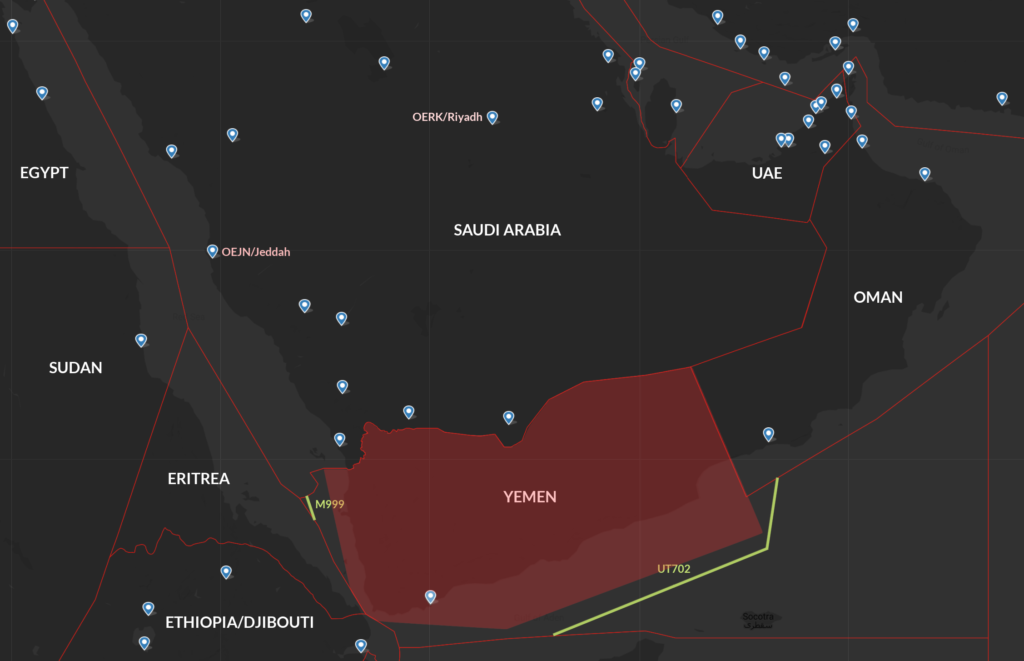
The FAA prohibit all US operators from entering most of the OYSC/Sanaa FIR at any level. Only two airways are allowed, and they are well off the coast – UT702 and M999.

There are no restrictions on Saudi Arabia but use caution in the southern regions. France and Germany have issued their own warnings.

SafeAirspace Yemen page – click here.
SafeAirspace Saudi Arabia page – click here.

Iraq

Rocket attacks on military interests at airports have become a common occurrence. They are generally fired by local militia without warning. ORBI/Baghdad is frequently targeted, along with other airports including ORER/Erbil. There is a clear risk to aircraft at low levels.

US relations were further strained through 2020 with multiple attacks on the US embassy in Baghdad. The tensions escalated to a point where the US considering closing it.

Foreign aircraft continue to be at risk from armed militia who have access to portable anti-aircraft weaponry, while misidentification by the air defence systems of multiple foreign forces in the country is also possible.

The FAA has extended its ban on US operators entering the Baghdad FIR at any level. Even though the SFAR says you can enter above FL320, the long-running Notam KICZ A0036/30 says otherwise.

SafeAirspace Iraq page – click here.

Syria

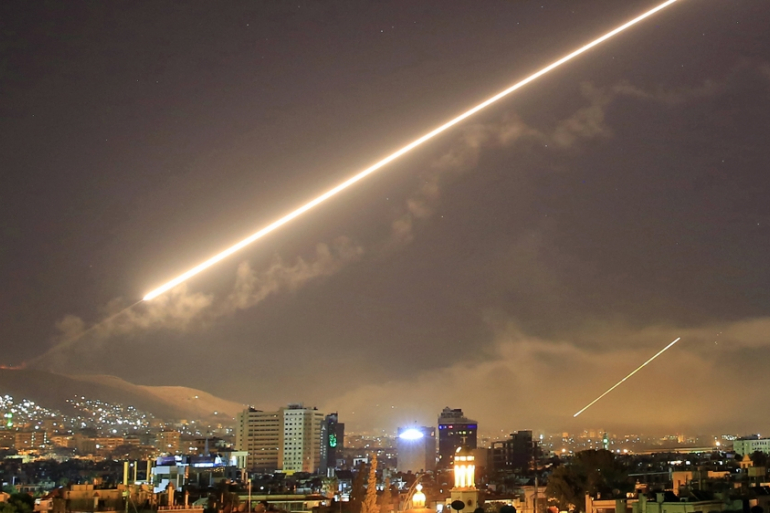
There have been several recent Israeli airstrikes on targets throughout Syria. In late December there are reports that Israeli fighters transited Lebanese airspace at low level causing alarm in Beirut before attacking targets in Western Syria. Just weeks ago, several sites around Damascus were targeted by Israeli missiles.

The primary risk is that aircraft may be misidentified by Syrian air defence systems which are regularly activated. Civil operators may get caught in the crossfire as missiles may erroneously lock on to the wrong aircraft.

The FAA are taking no chances – the ban on US operators entering the OSTT/Damascus FIR at any level has been extended a full three years to 2023.

SafeAirspace Syria page – click here.

South Sudan

Just this week ICAO issued a concerning warning about the risk to aircraft operating below FL245 in the HSSX/Khartoum FIR over South Sudan, or flying in and out of HSSJ/Juba. They are ‘gravely’ concerned about ATC disruptions, a lack of contingencies, inadequate training of controllers, limited info about equipment outages and a lack of co-ordination with other ATS units.

SafeAirspace South Sudan page – click here.

Emerging Conflict Zones

2020 saw three new conflict zones emerge, here is what is happening with them now.

Ethiopia

A civil conflict erupted in October last year in the Tigray region of Northern Ethiopia. The government went to war with the TPLF – a regional force seeking independence.

The region’s airports were closed and TPLF showed an intent to internationalise the conflict by attacking aviation interests. They fired rockets into Eritrea targeting HHAS/Asmara, and also attacked multiple airports to the South of the Tigray region.

Two airways were closed (T124, and M308) with no explanation of the risk.  Other airways remained open but uncomfortably close to the fight – especially UG300, UN321 and UL432. No airspace warnings were issued despite the dangers.

What’s the latest?

In late November Ethiopian forces captured the region’s capital Mekelle and regained control. Remaining TPLF forces have retreated leaving behind a humanitarian disaster and a vow to continue the fight. Since then, the airway closures have been removed and things have gone quiet, but an airspace risk remains – armed militia continue to be active in Northern regions and may be looking to make a statement. Be wary of operating in the area.

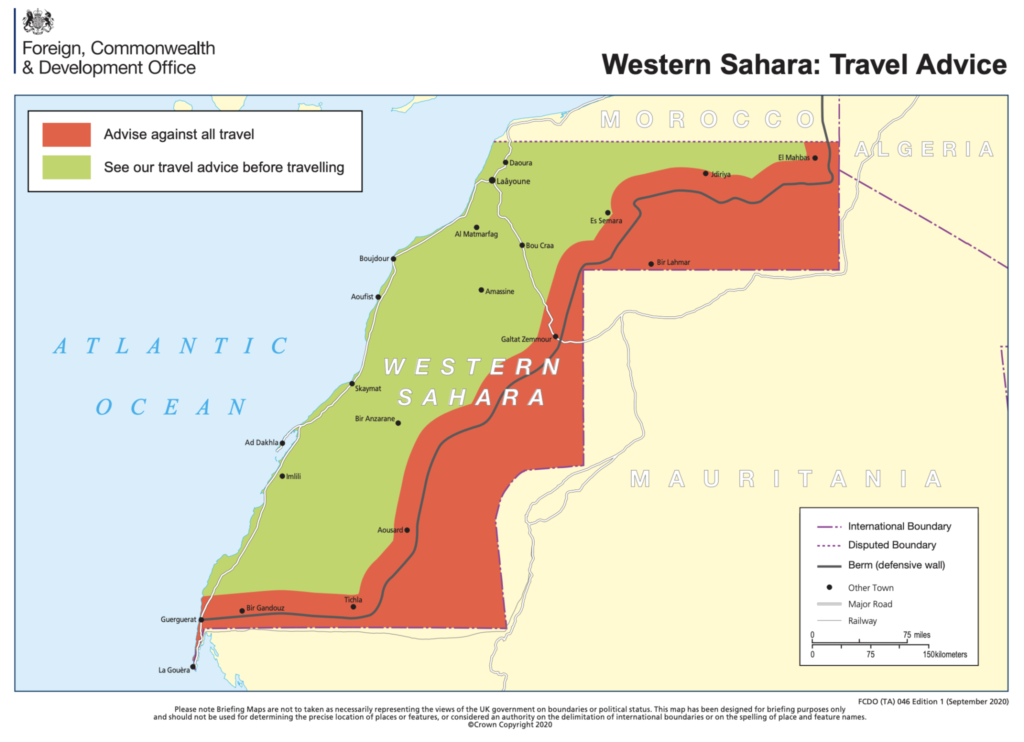
Western Sahara

Late last year the region’s independence movement (the Polisario) declared war on Morocco for breaching a ceasefire agreement. The FAA published a warning that the Polisario might have access to anti-aircraft weaponry left over from previous conflicts.

What’s the latest?

It is still an active conflict zone.  The fight has reached the international stage after the US declared their support for Morocco. The Polisario have indicated they are willing to at least talk, but so far have not put down their weapons. So, it is a wait-and-see type deal.

The risk to overflying aircraft remains. The GCCC/Canarias FIR keep extending a Notam advising operators to not fly below FL200 on the following airways: UY601, UN728 and UT975.  However, the reason is still missing: because of the risk of anti-aircraft fire. The GOOO/Dakar FIR haven’t issued any warnings despite the threat. Take care if operating in the area.

Armenia-Azerbaijan

In September last year, an ethnic conflict erupted over a disputed territory in Western Azerbaijan – Nagorno-Karabakh. The fight was between Azerbaijan and Armenia.

As a major air corridor for en-route traffic, there were significant flight disruptions. Azerbaijan swiftly closed all but one west/eastbound airway and routed traffic via Georgia. Armenia asked aircraft to take extra fuel and expect re-routes. The conflict was short but intense, with heavy artillery fire from both sides. The conflict eventually spread beyond the contested regions with longer range weapons. The entire border region posed a risk for civil aircraft.

What’s the latest?

For once the news is good. In November a ceasefire agreement was signed with the help of Russia. Armenia effectively lost and withdrew from the region and the conflict was officially over. Armenia removed its airspace warning, while Azerbaijan re-opened the affected airways and a large section of airspace near the border.

With the conflict now over, and no new reports of significant fighting since the peace agreement in November, direct crossing traffic between the two countries is now technically possible again.  However, most East-West flights are currently still electing to go further north instead, connecting between Azerbaijan and Georgia’s airspace, avoiding Armenia.

What about Safeairspace.net?

Our conflict zone and risk database is updated constantly. We assess risk with official sources and build a simple picture for you of those need-to know-places.

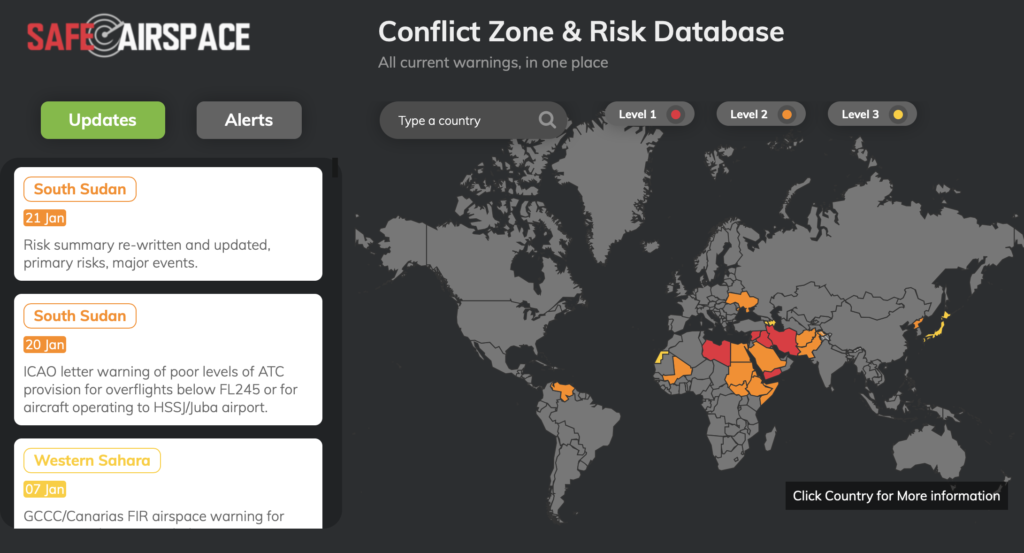
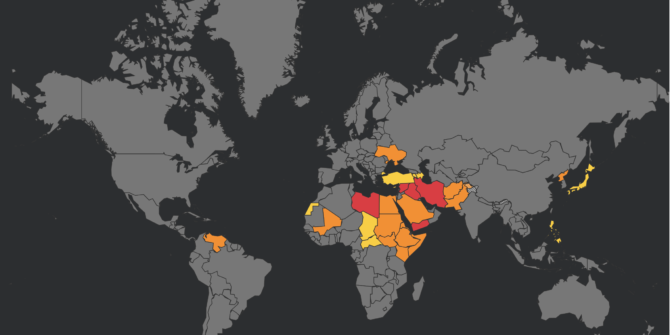
There are currently 5 regions which are assessed as a Level 1 Risk – No Fly. These are: Iraq, Iran, Yemen, Libya, and Syria.

Head over to SafeAirspace.net and take a look. With a single click you can download a risk briefing of the entire world in just a few pages of nice simple English.

The mission of SafeAirspace is this: to provide a single, independent, and eternally free resource for all airspace risk warnings, so that airlines and aircraft operators can easily see the current risk picture for unfamiliar airspace. If you know of a risk not listed on the site, or you have anything else to add, please get in touch with us at news@ops.group


Iran and Iraq airspace restrictions

Please note: This article refers to the airspace warnings for Iran and Iraq following the shootdown of UIA flight 752 in Tehran in Jan 2020. We are keeping the article here for reference purposes only. For updated airspace warnings, check safeairspace.net


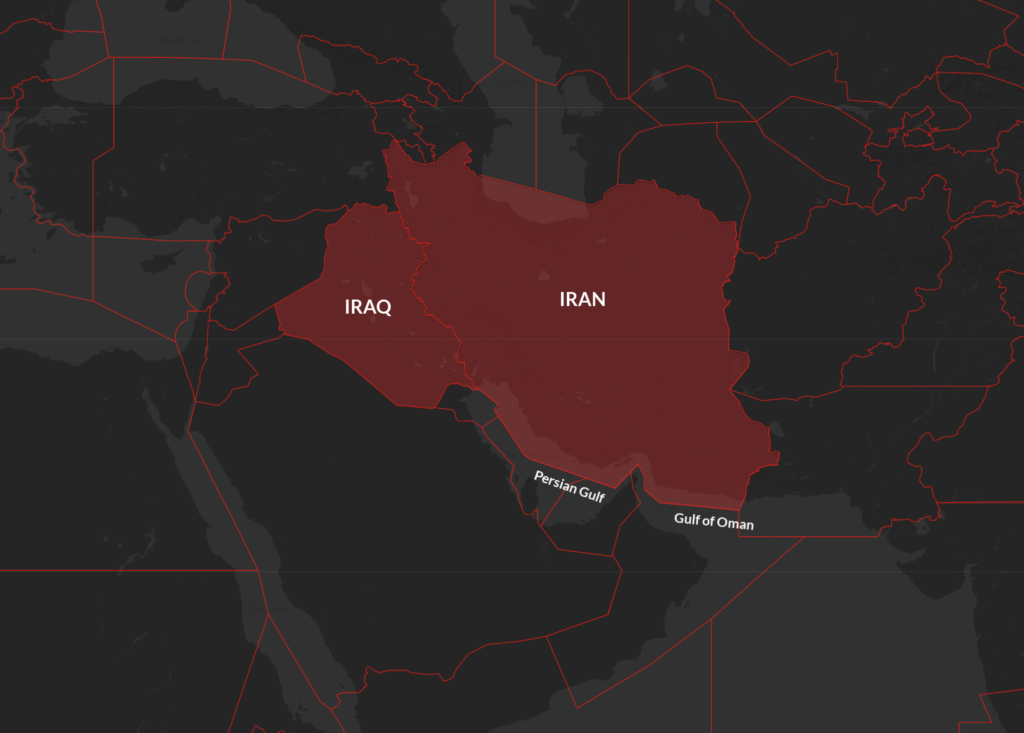
Following the events of Jan 8, when an Iranian missile strike on US military bases in Iraq was quickly followed by the shooting down of Ukraine Int Airlines flight 752 in Tehran by the Iranian Armed Forces, multiple western countries issued warnings to avoid the airspace of Iraq and Iran completely.

But in the weeks that followed, some of these countries issued updated advice, allowing overflights to resume at the higher flight levels.

Here’s a summary of what the main countries/agencies who regularly publish airspace warnings have said with regards to Iraq and Iran:

The US
As of Mar 12, the US prohibit all flights in the airspace of Iraq and Iran, but allow flights in the Persian Gulf and Gulf of Oman. Here are the details for each:

On Feb 27, the US loosened its restrictions on Iraq, issuing an updated Notam and Background Notice document which advised that US operators were now permitted to overfly Iraq at FL320 or above. They said there has been a de-escalation in military activity and diminishing political tensions in the region, but there was still a risk at the lower flight levels from armed militias who are likely responsible for multiple recent attacks on US armed forces in Iraq, as well as rocket attacks targeting the US Embassy and ORBI/Baghdad International Airport.

Then on Mar 12, the US issued an emergency order that once again banned US operators from overflying Iraq with immediate effect. This came after US warplanes hit militia weapons storage facilities in southern Iraq in a strike designed to destroy rockets like those fired at US troops earlier this week.

The US downgraded its airspace warning for the overwater airspace in the Persian Gulf and Gulf of Oman on Feb 17 – the new guidance now just advises caution in this region, and recommends to avoid the airways nearest to the OIIX/Tehran FIR whenever possible, to reduce the risk of miscalculation or misidentification by air defence systems. The crucial change with this new warning is that overflights in this region are now permitted. So for US operators wanting to transit the OKAC/Kuwait, OBBB/Bahrain, OMAE/Emirates and OOMM/Muscat FIRs – you can now do so.

The US ban on the airspace of Iran is still in place – US operators are prohibited from entering the OIIX/Tehran FIR.

Germany
Germany just advises caution for both Iraq and Iran overflights – at no point since the events of Jan 8 have they issued outright bans on the airspace of these two countries.

France
France initially issued a Notam on Jan 9 advising operators to avoid the airspace of Iraq and Iran. Then on Feb 14, they changed their advice for Iran, saying that the only chunk of airspace which should be avoided is the western half of the country (everywhere west of 54 Degrees East longitude); they recommended that overflights of the eastern half should be at or above FL320. This guidance was then incorporated into AIC 14/20. The French Notam for Iraq lapsed on Feb 12, and was not renewed – therefore the French advice for Iraq has reverted back to that contained in AIC 14/20 which says that overflights should be at or above FL320, and only on certain airways.

The UK
The UK published Notams on Jan 9 prohibiting operators from entering the airspace of both Iraq and Iran. Then on Jan 17, they issued a new Notam for Iran, and cancelled the one for Iraq, advising operators to revert back to the guidance contained in the AIP ENR 1.1 (1.4.5). Bottom line, the UK advice for both countries is now this: do not overfly below 25,000ft AGL.

EASA
EASA published a notice on Jan 11 specifically warning operators against overflying Iraq and Iran. They said this should be taken as a precautionary measure, following the events of Jan 8. EASA don’t normally issue blanket warnings/recommendations like this. Then on Jan 29, they withdrew that advice, and reaffirmed the position previously stated in their Conflict Zone Information Bulletins (CZIB) – Iraq overflights should be avoided except on two specific airways (UM688 and UM860), and Iran overflights should be avoided below FL250.

Further discussion

  • The #FlightOps channel on Slack is open for Iran/Iraq discussion
  • Email team@ops.group with any intel or analysis you can share


FAA eases Gulf airspace restriction

The FAA has downgraded its airspace warning for the overwater airspace in the Persian Gulf and Gulf of Oman.

They previously said that US operators should avoid this airspace except when flying to/from the main airports in Bahrain, Kuwait and Qatar, UAE and Saudi Arabia.

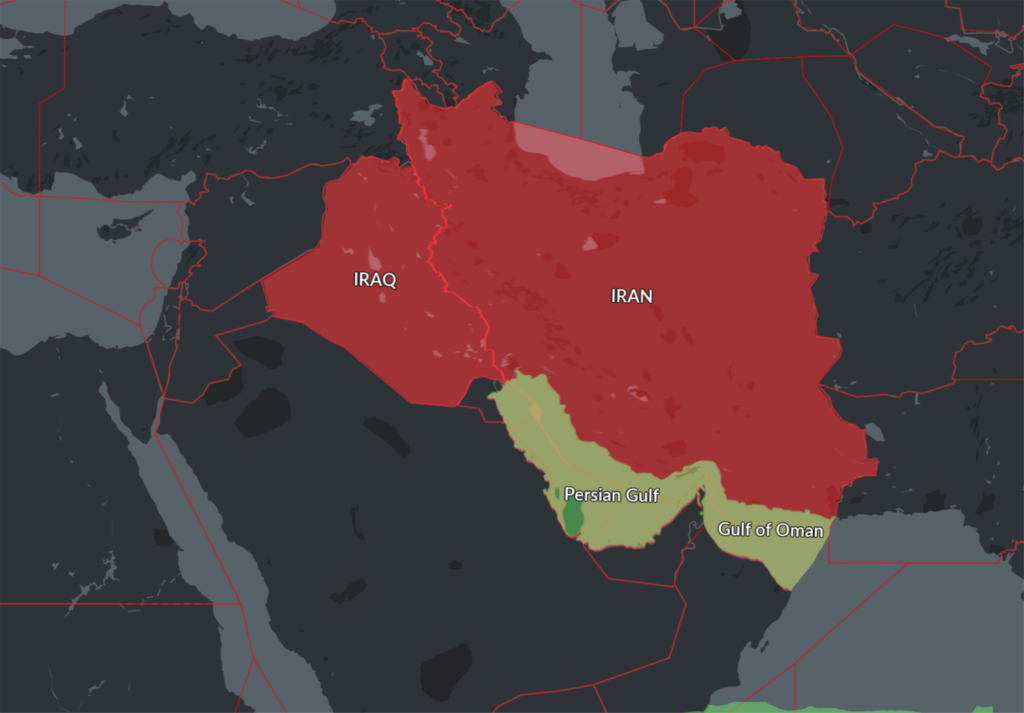
The new guidance now just advises caution in this region, and recommends to avoid the airways nearest to the OIIX/Tehran FIR whenever possible, to reduce the risk of miscalculation or misidentification by air defence systems (remember, the US ban on Iran overflights is still in place).

The crucial change with this new warning is that overflights in this region are now permitted. So for US operators wanting to transit the OKAC/Kuwait, OBBB/Bahrain, OMAE/Emirates and OOMM/Muscat FIRs – you can now do so.

This new Notam represents a further loosening of the total airspace ban on the Persian Gulf and Gulf of Oman initially applied by the FAA shortly after the Iranian missile strike on US military bases in Iraq on Jan 8, which was quickly followed by the shooting down of Ukraine Int Airlines flight 752 in Tehran by the Iranian Armed Forces, having mistaken the aircraft radar return for an inbound missile.
The FAA cited Iranian military de-escalation as the reason for the change. “The FAA assesses there is sufficiently reduced risk of Iranian military miscalculation or misidentification that could affect U.S. civil aviation operations in the overwater airspace above the Persian Gulf and the Gulf of Oman,” the agency said in their Background Information statement, issued on 18th Feb 2020.

Here’s the Background Information statement in full:

Iran has de-escalated its military posture in the Persian Gulf and the Gulf of Oman as of early February 2020. Given this de-escalation, the FAA assesses there is sufficiently reduced risk of Iranian military miscalculation or misidentification that could affect U.S. civil aviation operations in the overwater airspace above the Persian Gulf and the Gulf of Oman in the Kuwait Flight Information Region (FIR) (OKAC), Jeddah FIR (OEJD), Bahrain FIR (OBBB), Emirates FIR (OMAE), and Muscat FIR (OOMM) to permit U.S. civil flight operations to resume.

While the risk to U.S. civil aviation operations in the above-named area has decreased, military posturing and political tensions in the region remain elevated, and there remains some inadvertent risk to U.S. civil aviation operations due to the potential for miscalculation or misidentification. As a result, on 14 Feb 2020, the FAA issued Notice to Airmen (NOTAM) KICZ A0014/20 (reissued on 17 Feb as A0016/20) permitting U.S. civil flight operations to resume in the above-named area while advising operators to exercise caution and to avoid operating on air routes nearest to the Tehran FIR (OIIX) boundary whenever possible. The situation in the region remains fluid and could quickly escalate if circumstances change.

The 8 January 2020 accidental shoot down of Ukraine International Airlines Flight 752 shortly after takeoff from Tehran’s Imam Khomeini International Airport (OIIE)tragically highlights the airspace deconfliction concerns, which pose an inadvertent risk to civil aviation from air defense engagements during periods of heightened tensions and associated military activity. Following the accidental shoot down, the region has seen a lowering of tensions, despite Iran’s continued air defense coverage along its southern coast. In June 2019, there were two incidents of surface-to-air missile fire from the southern coast of Iran targeting U.S. unmanned aircraft systems operating in the Gulf of Oman.

Iran possesses a wide variety of anti-aircraft-capable weapons, including surface-to-air missile systems (SAMs), man-portable air defense systems (MANPADS) and fighter aircraft capable of conducting aircraft interception operations. Some of the anti-aircraft-capable weapons have ranges that encompass key international air routes over the Persian Gulf and the Gulf of Oman. Although Iran likely has no intention to target civil aircraft, the presence of multiple long-range, advanced anti-aircraft-capable weapons in a tense environment poses a risk of miscalculation or misidentification, especially during periods of heightened political tension and military activity.

There is also the potential for Iran to use Global Positioning System (GPS) jammers and other communications jamming capabilities, which may inadvertently affect their command and control capabilities and potentially pose a risk to U.S. civil aviation operating in the above-named area.

The FAA will continue to monitor the risk environment for U.S. civil aviation operating in the region and make adjustments, as appropriate, to safeguard U.S. civil aviation.

Here’s the new Notam in full:

A0016/20 (Issued for KICZ)
SECURITY..UNITED STATES OF AMERICA ADVISORY FOR OVERWATER AIRSPACE ABOVE THE PERSIAN GULF AND THE GULF OF OMAN.

THOSE PERSONS DESCRIBED IN PARAGRAPH A BELOW SHOULD EXERCISE CAUTION WHEN OPERATING IN OVERWATER AIRSPACE ABOVE THE PERSIAN GULF AND THE GULF OF OMAN IN THE KUWAIT FLIGHT INFORMATION REGION (FIR) (OKAC), JEDDAH FIR (OEJD) , BAHRAIN FIR (OBBB), EMIRATES FIR (OMAE), AND MUSCAT FIR (OOMM) DUE TO CONTINUED ELEVATED MILITARY POSTURING AND POLITICAL TENSIONS IN THE REGION.

NOTAM KICZ A0002/20, WHICH PROHIBITS U.S. CIVIL AVIATION OPERATIONS IN THE TEHRAN FIR (OIIX), REMAINS IN EFFECT UNTIL FURTHER NOTICE.

A. APPLICABILITY. THIS NOTAM APPLIES TO: ALL U.S. AIR CARRIERS AND COMMERCIAL OPERATORS; ALL PERSONS EXERCISING THE PRIVILEGES OF AN AIRMAN CERTIFICATE ISSUED BY THE FAA, EXCEPT SUCH PERSONS OPERATING U.S. REGISTERED AIRCRAFT FOR A FOREIGN AIR CARRIER; AND ALL OPERATORS OF AIRCRAFT REGISTERED IN THE UNITED STATES, EXCEPT WHERE THE OPERATOR OF SUCH AIRCRAFT IS A FOREIGN AIR CARRIER.

B. PLANNING. THOSE PERSONS DESCRIBED IN PARAGRAPH A PLANNING TO OPERATE IN THE ABOVE-NAMED AREA MUST REVIEW CURRENT SECURITY/THREAT INFORMATION AND NOTAMS AND COMPLY WITH ALL APPLICABLE FAA REGULATIONS, OPERATIONS SPECIFICATIONS, MANAGEMENT SPECIFICATIONS, AND LETTERS OF AUTHORIZATION, INCLUDING UPDATING B450.

C. OPERATIONS. AVOID AIR ROUTES NEAREST TO THE TEHRAN FIR (OIIX) BOUNDARY, WHENEVER POSSIBLE, TO REDUCE THE RISK OF MISCALCULATION OR MISIDENTIFICATION BY AIR DEFENSE SYSTEMS. ADDITIONALLY, AIRCRAFT OPERATING IN THE ABOVE-NAMED AREA MAY ENCOUNTER INADVERTENT GPS INTERFERENCE AND OTHER COMMUNICATIONS JAMMING, WHICH COULD OCCUR WITH LITTLE OR NO WARNING.

THOSE PERSONS DESCRIBED IN PARAGRAPH A MUST REPORT SAFETY AND/OR SECURITY INCIDENTS TO THE FAA AT +1 202-267-3333. ADDITIONAL INFORMATION IS PROVIDED AT: HTTPS://WWW.FAA.GOV/AIR_TRAFFIC/PUBLICATIONS/US_RESTRICTIONS/.

SFC – UNL, 17 FEB 19:54 2020 UNTIL PERM. CREATED: 17 FEB 20:00 2020


For more on these, and for a full list of current warnings about Iran and Iraq from other states, see SafeAirspace.net


Risk assessing Iran ops – the UIA 737 may have been shot down

Special Update Thursday 09JAN: Members, please see either your email or this post in the Members forum, for a special briefing and update.

08JAN: Iran/Iraq Information page activated with latest information.

The cause of the crash of Ukraine International Airlines (UIA) AUI/PS752 on departure from Tehran is not yet determined, and given political circumstances, may not be clarified beyond reasonable doubt anytime soon.

Purely from the perspective of making a risk assessment for operations to Tehran, and Iran in general, however, we would recommend the starting assumption to be that this was a shootdown event, similar to MH17 – until there is clear evidence to the contrary.

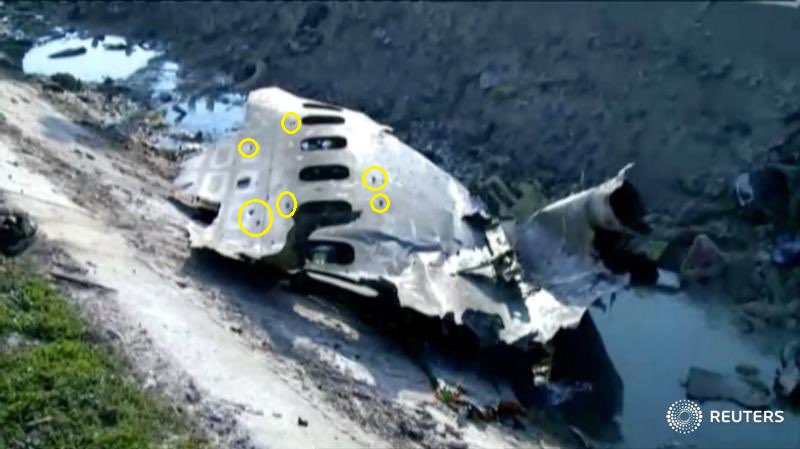
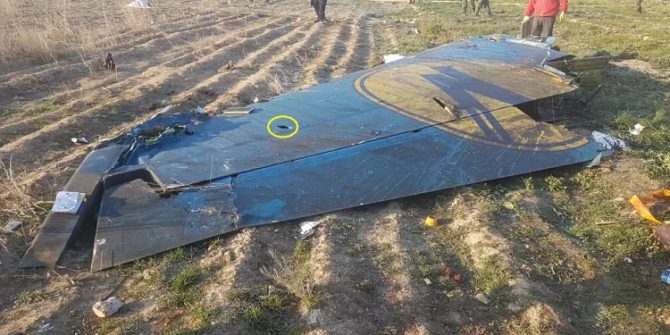
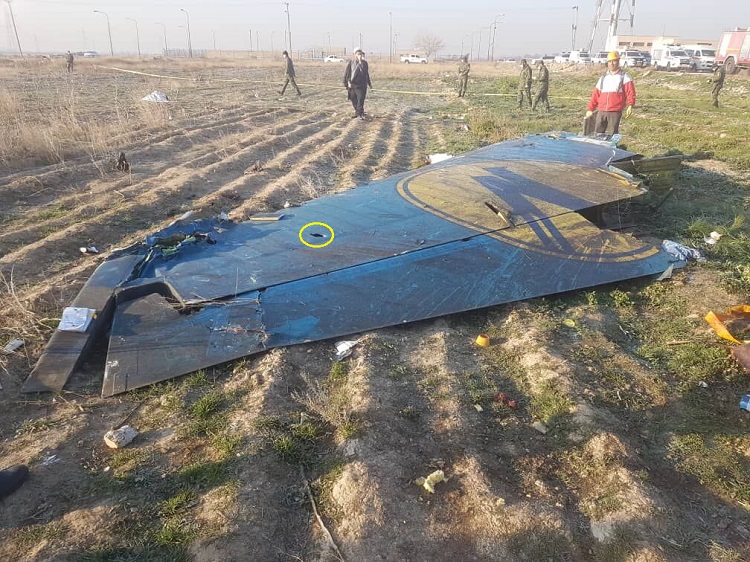
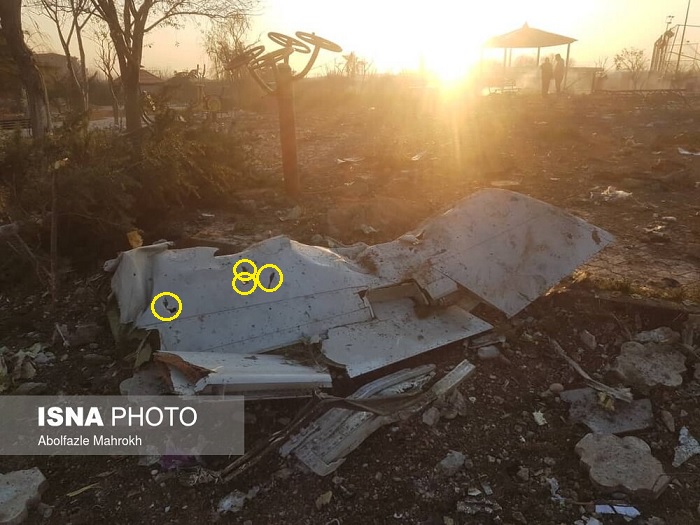
Images seen by OPSGROUP, shown below, show obvious projectile holes in the fuselage and a wing section. Whether that projectile was an engine part, or a missile fragment is still conjecture, but in making a decision as to whether to operate to Iran, erring on the side of caution would dictate that you do not, until there is clear information as to the cause.

Obviously, there is also the wider regional risk as indicated through the US FAA Notams issued late Tuesday night. US operators are covered by these clear and specific Notams – do not operate to Iran, or Iraq, or operate in the Persian/Oman Gulf area.

Other operators are free to make their own judgement, but should note that a majority of non-US international carriers have elected to avoid both countries for the time being.

See also:

  • OPSGROUP Article: FAA Bans Flights Over Iraq And Iran Following Missile Strike On US Base
  • OPSGROUP Article: Germany publishes new concerns for Iraq overflights


Images from ISNA, Reuters; marking of projectile areas from JACDEC.


Germany publishes new concerns for Iraq overflights

Late Monday evening, the German LBA published a new warning for Iraq, indicating areas of concern for overflying traffic, together with a new warning on ORBI/Baghdad Airport.

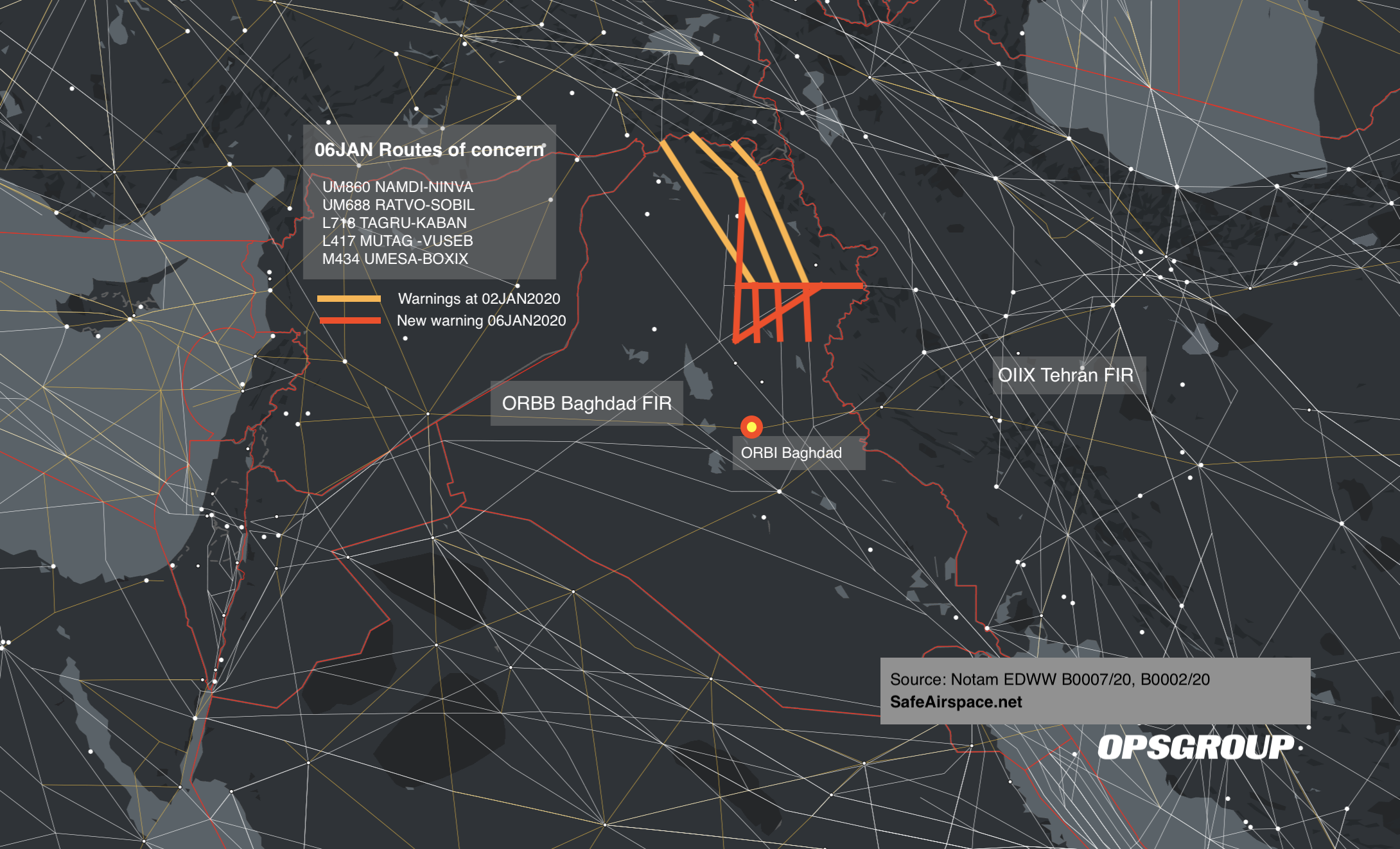
Notam B0007 of 2020 (issued Jan 6) replaces Notam 0002 (issued on Jan 2nd), and these are the routes that Germany now considers a potential risk for aircraft below FL260:

Airway UM860 NAMDI – NINVA
Airway UM688 RATVO – SOBIL
Airway L718 TAGRU – KABAN
Airway L417 MUTAG – VUSEB
Airway M434 UMESA – BOXIX
Airway R652 MUTAG – DAVAS

Seen on the map below, all these airways are in the north east of Iraq: the yellow lines are the warnings that existed on and prior to Jan 2nd, and the orange lines show the additional areas flagged in Mondays Notam.

Of the other primary states that issue airspace warnings – the UK, France, and the US – none have issued updated guidance yet this year.

There is no doubt that the events of Jan 3, 2019 at ORBI/Baghdad Airport have created an extremely tense situation between the US and Iran. The aviation security picture in the Middle East, already fragile and unstable, is now unpredictable. A response by Iran to the US airstrike of Jan 3rd seems possible.

Specific to the Baghdad Airport incident, it seems early reports of Katyusha rockets can be discounted, that it was an attack carried out on vehicles near the airport by US Apache Helicopters. Civil traffic resumed operations shortly after the attack with several departures operating ‘as normal’. Overflights continued during the attack.

As to the Iranian response, anything that looks like a US asset or ally could be a target – military or civil. US operators, at a minimum, should be avoiding the Tehran FIR, and considering security carefully when operating in other countries in the region, most notably Israel, Lebanon, and Kuwait – as a response may target airports in those countries or foreign aircraft. That said, it’s a guessing game right now, and predicting the specifics of a response is extremely difficult.

For full analysis, and a listing of all current warnings, see Safe Airspace.


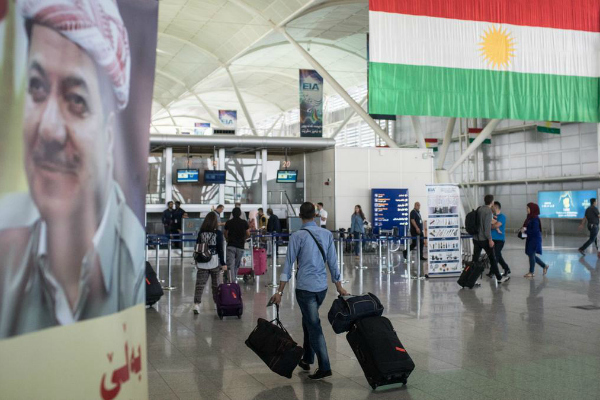
Kurdistan airports to re-open

The Iraqi Prime Minister has lifted the government ban on international flights to the Kurdish airports ORER/Erbil and ORSU/Sulaymaniyah.

The central government will take full control of the airports, and will start allowing international flights to resume in the coming days. No international flights have operated from these airports since the end September 2017. Their closure was seen as a punitive measure taken by the Iraqi central government following the September 25th independence referendum in the Kurdistan Region.

The authorities have now withdrawn the Notams that were previously in place for both of these airports advising that they were closed to international flights. Both Iran and Turkey currently still have Notams in place prohibiting flights to these airports from using their airspace – but we expect these to be updated soon to reflect the lifting of the ban.

A0661/18 NOTAMR A6765/17
Q) LTXX/QAFXX/IV/NBO/E /000/999/3901N03524E465
A) LTAA LTBB B) 1802010551 C) 1803312359 EST
E) ALL TFC FROM/TO ORSU AND ORER AERODROMES (ALSO AS ALTERNATE
AERODROME) ARE NOT AUTHORIZED TO USE TURKISH AIRSPACE UNTIL FURTHER
NOTICE EXC EMERGENCY, AMBULANCE AND HUMANITARIAN AID FLIGHTS.
A0223/18 NOTAMR A3746/17
Q) OIIX/QAFXX/E/000/999/
A) OIIX B) 1801160610 C) 1804160600 EST
E) ALL TRAFFIC FM OR TO ORSU AND ORER ARE NOT AUTHORIZED TO USE
TEHRAN FIR.

Further reading:


Iraq ATC strike – update

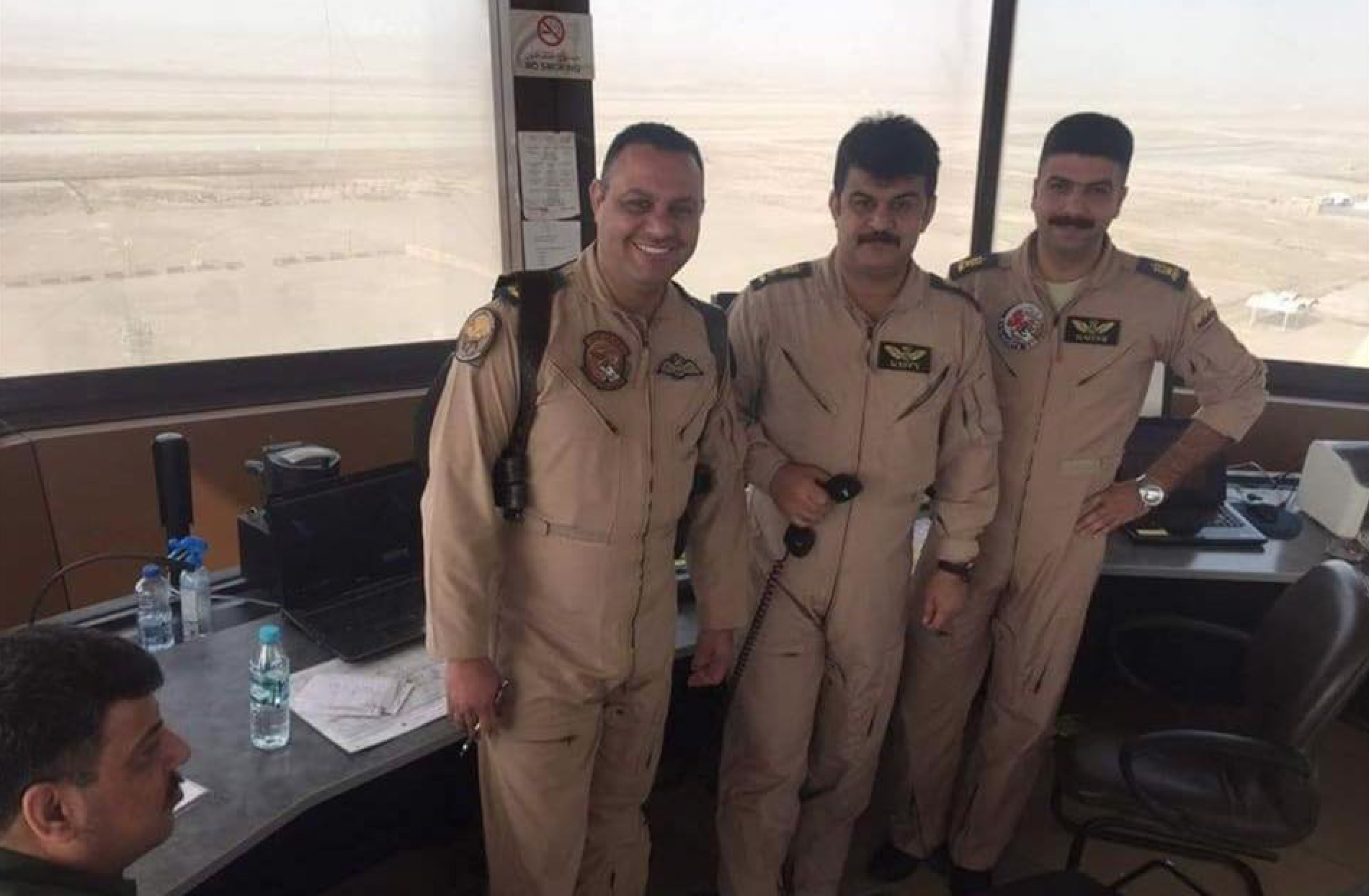
At 0800 local this morning, Iraqi controllers returned to work. For the last few days, Iraqi ATC had been on strike for better pay, effectively closing the Baghdad FIR and intermittently Baghdad and Basra airports. An 80nm in trail requirement has been removed. Military controllers, pictured above, who had been running ORBI/Baghdad Airport have completed their duties.

Local ATC controllers tell us that the strike is over – they are running what they call ‘ops normal’ for two weeks, before they will/may strike again as negotiations continue. Inside word is that a number of local controllers have been fired, and Serco were providing most of the staff to cover the centre. Baghdad FIR Control Centre and Iraqi Airports are running normally – for now.

We are still expecting the FAA to remove the restriction for US operators using the Baghdad FIR, this is a separate issue. No further news on that just yet.


Baghdad FIR still reopening – but wait a little

So, last week we told you that Iraqi Airspace was about to re-open to international overflights. It still is, though the bit where it was going to happen this week is no longer true.

The FAA were about to hit ‘publish’ on a Notam this past Monday,  which would have enabled US airlines to start overflying Iraq again. The text of this Notam included:

  • An amendment to the existing Iraq restriction
  • An authorisation for US airlines and operators to overfly Iraq at or above FL260

But then, a military operation by Iraqi forces to take control of Kirkuk from the Kurds the same day, created concern as to overflight safety. Kirkuk sits pretty much underneath the UM860 airway on the map below.

So for now, do nothing and wait. It seems the situation is de-escalating, and we expect now that the Notam may be issued as early as next week.

Once that happens, we’d expect other countries to follow suit and allow overflights in the same way, meaning that these two airways will become busy again.

Keep an eye out, we’ll let you know.

See also:


Iraq Airspace to re-open for overflights

ORBB/Baghdad FIR Overflights of Iraq may be permitted to resume as early as next week, allowing international carriers access again to several previously heavily used routes through the eastern side of the Baghdad FIR.

In May of this year, SFAR 77 – banning US operators from operating within Iraqi airspace – lapsed, and was replaced by Notam KICZ 10/2017 – which had much the same wording.

However, on October 3rd, Iraq issued a new Notam (A0477/17) – with a new restricted area in the northwest of the FIR, from Surface to FL460. The previous restricted areas 601 and 701 were withdrawn.

This re-shuffling of restricted airspace paves the way for two major international air routes to be reopened, UM860 and UM688 – which were realigned in April for this purpose, allowing operators additional route options through the Middle East to Europe and vv.

FSB expects an official announcement shortly, and will update operators further. OpsGroup members will be notified directly.


ORER and ORSU: Closed to International Ops

The Iraqi CAA will ban all international flights to/from ORER/Erbil and ORSU/Sulaimaniyah starting from Friday 29th Sep. 

From then on, those airports will only be open for Iraqi carriers and domestic ops.

Tensions around the Kurdish autonomous region of Iraq are rising following a referendum on independence.

The Iraqi govt has demanded that the KRG (Kurdistan Regional Government) hand over control of its two international airports – ORER and ORSU. Until the KRG comply with this request, the international ban on flights to these airports is set to continue.

At the request of the Iraqi govt, Iran had already closed it’s airspace to ORER/ORSU traffic earlier this week, and Turkey was considering implementing the same ban.

The KRG are now deciding whether to give up control of their airports or lose their international flights. Should it be the latter, then from now on anyone attempting to travel to the region will have to transit via Baghdad.

We will update as more information becomes available.


Unsafe Airspace – a summary

With the events surrounding the shootdown of MAS17, risk assessment of potentially unsafe airspace has given far greater weighting to the situation on the ground. Access to reliable information to determine the ever-changing risk level, is by nature of it’s inherent uncertainty, challenging.

Today we published International Ops Notice 02/16 – “Unsafe Airspace”.

Three levels of airspace risk are used in our assessment.

  • LEVEL 1. Moderate risk – No Fly
  • LEVEL 2. Assessed risk
  • LEVEL 3. Caution

The countries that issue the most relevant updates for unsafe airspace are:  The US (FAA) – through FDC Notams and SFARs, the UK (NATS) – AIP and Notam, Germany (DFS) – Notam, France (DGAC)- AIC. In general, the Civil Aviation Authorities of the countries whose airspace is determined to be unsafe are unlikely to issue reliable guidance.

Five countries are currently included in the LEVEL 1 – Moderate Risk category: Libya, Syria, Iraq, Somalia, and Yemen.

The basis for inclusion is the highly unstable current events on the ground, and in all cases the ground factions having access to RPG’s, Surface-Air missiles. We strongly recommend avoiding this airspace entirely. All countries have multiple warnings, and your country of registry is likely to have issued specific instructions not to penetrate these airspaces.

Download the full notice.

References:

ION0216 Shot


Midweek Briefing 04MAY: New US CBP Airport, Iceland ATC Strike continues

New US CBP Airport 04MAY A new US Customs facility opened in KMTH/Marathon on 20APR, to facilitate increased traffic to Cuba. Read the article.

Iceland ATC Strike continues 04MAY Icelandic controllers are in a pay dispute with Isavia, leading to multiple strike actions at BIKF/Keflavik and BIRK/Reykjavik. Last week BIKF was closed overnight at short notice. Read the article.


EHAM/Amsterdam and other Dutch airports will observe a two minute silence on ATC frequencies today, 04MAY, from 1800-1803Z. ATC will arrange traffic flow so that no aircraft will land or taxi during this period, meaning likely delays, albeit for a short period.

SECU/Cuenca, Ecuador remains closed after an E190 slid off the main runway on 29APR, latest estimate is no reopening before 06MAY.

CZZZ/Canada Visa-exempt foreign nationals can enter and exit Canada by air without an Electronic Travel Authorization until 29SEP2016. After that date, these travelers will need to obtain online authorization to visit.

BIZZ/Iceland Multiple ATC Strike actions for BIRK and BIKF are ongoing, check NOTAMS and with handler for latest. Read article.

TFFR/Guadeloupe has ongoing main runway closures due to WIP, current shown are 04MAY 0200-1015Z, 17MAY 1000Z- 18MAY 1600Z. Only helicopters will be allowed to operate during these periods.

UIBB/Bratsk has a fuel shortage until 31MAY, non-scheduled movements are by PPR only.

NWWW/Tontouta has an ATC staff shortage and requires slots for arrival until 31MAY, Tel +687 352437. Work on 11/29 is also ongoing, check NOTAMS for any current outages, which will close the airport.

EGGX/Shanwick is trialling transferring westbound flights direct to a HF frequency rather than via an initial VHF frequency, using CPDLC. The default frequencies will be HF 5649 H24, 2872 0000-0900 and 1800-2400, and 8879 0900-2100.

PAZA/Anchorage has published new procedures Eff 28APR for User Preferred Routes within the PAZA FIR, refer A0075/16.

SVZZ/Venezuela changed timezones on 01MAY to UTC-4. In addition, all public offices, including public ministries, will only operate on Mondays and Tuesdays until further notice.

TTZP/Piarco FIR is trialing ADS-C and CPDLC with ident TTZP until 31MAY. Flights entering the FIR east of 57W should log on 15 minutes prior to the boundary with TTZP.

UHSS/Yuzhno has advised that B777 aircraft are limited to 310T during the summer period.

UIAA/Chita is only available as alternate for one specific airline (Aurora) between 0930-2100Z. Outside these times ops normal.

WSZZ/Singapore has introduced a fingerprint clearance system to verify the thumbprints of arriving and departing travelers ages six and above at select immigration checkpoints. The system will be progressively implemented starting at the manned immigration counters of sea and land checkpoints, followed by air checkpoints until full implementation is completed in the months ahead. Travelers should be prepared for slightly longer immigration clearance times at manned checkpoints, especially during the initial implementation stage of the project.

YZZZ/Australia Border Force employees have been banned from taking industrial action at airports for three months; the threat of ongoing strike action caused much concern for operations in March.

RJTT/Haneda the airport authority has changed the number of slots available for general aviation aircraft. Effective 25APR, slots for GA during the daytime (0600-2259 local) will be increased to 16 total for arrival and departure (from eight in the past). Note that there are no slots restrictions for night time operations (2300-0559 local).

CYVR/Vancouver will have one of its main runways 08R/26L closed nightly between the hours of 05-13Z 08MAY-02SEPT for construction. During the day (13-05Z) the runway will have the ILS on 08R/26L out of service, along with no approach lighting on runway 26L.

SLZZ/Bolivia Certain medications prescribed for personal use are treated as narcotics in Bolivia, with severe penalties for import or export without a valid prescription from a doctor; make sure you carry a letter from a doctor describing the medical condition and any prescribed drugs and that they are in their original containers and clearly labelled.

EBBR/Brussels has partially reopened the departure hall, which has remained closed since 22MAR. 110 Check-in counters will be open in the airport departure hall along with an additional 36 counters that are housed in temporary buildings. The EBBR airport authority expects this will bring the airport up to 80% of capacity.

EZZZ/Europe Bulgaria, Turkey and Romania will begin a project to interface their ATC systems so they can handle a significant build-up of airspace traffic in the Black Sea area. New routes are expected by mid 2016.

LEZZ/Spain The Spanish F1 Grand Prix is being held from 13MAY-15MAY and will bring heavier than normal traffic to LEBL/Barcelona and LEGE/Girona.

HEZZ/Egypt Individual travellers will in the future require a visa before entering Egypt. The exact date of the implementation of this rule is not yet determined. The visa must be applied for from the Egyptian embassy and the consulate generals before departure.

GVZZ/Cape Verde Aviation officials issued a statement announcing that national airports are open and operational. The statement was released following reports that flight operations had been suspended at the country’s airports.

ORZZ/Iraq Iran canceled all flights to Baghdad following a breach of the International Area by protesters on 30APR. The demonstrations have caused problems for pilgrimage flights to Baghdad, and those flights will operate instead to ORNI/Najaf.

VIDP/Delhi has opened a new ATC tower (which is the country’s tallest at 60 metres). VIDP will also be starting construction on a 4th runway this year and is expected to be completed by 2018 which will increase the airport arrival rate to 105 landings an hour, and will mitigate the common airborne holding.

View the full International Bulletin for 04MAY 2016


Monday Briefing: North Atlantic Changes, Caspian Sea Missiles

19OCT2015 Flight operations in the NAT region will see significant changes in around three weeks time, including new ‘half-degree’ NAT tracks, new Entry Points in Gander and Shanwick OCA’s, and several procedural changes. A Special Bulletin with plotting chart, summarising the changes, will be issued by Flight Service Bureau next week.

19OCT2015 Last week 26 cruise missiles were launched across International air routes in Azerbaijan, Iraq, and Iran, with reports suggesting 4 did not travel as intended. The risk to aircraft operators is summarised in our International Ops Notice 10/15, see below for details.


RPHI/Manilla FIR, Philippines Typhoon Koppu has maintained its strength as it continues to move northward with slightly increasing forward speed along the shores of Ilocos Sur, Luzon. Current location (1200Z Monday) is to the west of RPLI/Laoag Airport. It is forecast to weaken to a Tropical Storm within 24 hours. No reports of airports affected so far.

OMDW/Dubai World hosts Dubai Airshow 08-12NOV. Landing Permit required for all flights, 3 days processing, standard documents and requirements. Slot required for OMDW, window +/- 5mins. Show details at www.dubaiairshow.aero

OPRN/Islamabad, Pakistan closed 1300-1800 daily due runway works 18-28OCT.

SEXX/Ecuador A new DGAC resolution now effective permits non-scheduled aircraft to land without a Landing Permit as long as the aircraft is operating under private ops, will not stay longer than 72 hours in Ecuador, and visits only one location in Ecuador. The official document is here (in Spanish).

VHHH/Hong Kong with effect 25OCT (IATA Winter 2015) will amend slot issuing procedures to give priority to operators with higher capacity aircraft, and where same types conflict for the same slot time, lower noise levels.

LIXX/Italy ATC Strike confirmed for 24OCT (Saturday) 0800-1600, service will be provided to Overflights and Intercontinental flights only.

LTXX/Turkey Traffic operating through the south eastern part of Turkish airspace to/from Tehran and Baghdad FIRs should check Notams for restrictions. Several restrictions up to FL310 due to military operations.

EGXX/Shanwick Large scale Military Exercise ‘At Sea Demonstration’ ASD15 affecting OEP’s ERAKA and GOMUP starts on 19OCT.

LFxx/France Datalink implemented from 22OCT LFRR/Brest and LFBB/Bordeaux ACC from 0900L. Initial phase, no ACL (Clearance via CPDLC), and aircraft must be on Eurocontrol whitelist. Ref France AIC A22/15.

VNXX/Nepal continues to experience shortages of fuel due to a halt in shipments coming from India. Available fuel for domestic airlines is rapidly decreasing, and authorities worry that domestic flights will soon be unavailable. The Nepalese government has requested that international airlines carry return fuel or refuel at airports en route, as Tribhuvan International Airport (VNKT/KTM) has no available fuel.

View the full International Ops Bulletin for 19OCT2015.