Summer Tips for Flight Planning in Europe

Summer in Europe often means one thing: traffic – and lots of it.

Eurocontrol keeps the system moving, but it can feel complex, especially when delays mount and regulations interfere with your plans.

The good news? A few smart moves can make a big difference. This guide breaks down what matters most: the tools, timing, and habits that help your flight operate on time.

For Dispatchers: Plan It Right

Keep Your EOBTs Accurate

Your Estimated Off-Block Time (EOBT) is what anchors your flight in the network. It tells the system when you plan to be ready for pushback, and everything from slot allocation to airspace planning builds on that. If the EOBT is outdated, your flight might get an unrealistic Calculated Take-Off Time (CTOT) or even be suspended.

A CTOT is a take-off window assigned based on current traffic demand. It’s valid from -5 to +10 minutes around the assigned time. You must take off within that window.

Some operators hesitate to update the EOBT, thinking it could make the CTOT worse. In fact, the system often improves the slot within a few minutes when fresh data is provided.

Tip: If a new CTOT looks worse, give it 10 minutes to settle. If there’s still no improvement, then it’s time to contact e-Helpdesk.

Don’t File YO-YO Profiles

Trying to dodge flow restrictions with unusual altitude changes (like FL360 → FL320 → FL360) only confuses the system. These so-called “YO-YO” profiles increase workload for ATC and can cause downstream problems. Use tools like NMP Flight to build efficient, compliant flight plans without trying to game the system.

Respect Arrival Slots

If your destination airport is slot-coordinated, always align your flight plan with the assigned airport arrival slot. Mismatches can lead to flight plan suspension and suspended flights aren’t included in ATFM. That means no slot, no priority, and big delays. Double-check that your slot confirmation matches what you file.

ATFM (Air Traffic Flow Management) is the system that manages demand and capacity across the network. If your flight is suspended, it’s excluded from this process – making it much harder to recover your slot.

Use IFPS Validation Tools

Before filing your flight plan, use validation tools like NMP Flight, the NOP Portal, or CHMI. These platforms let you check for errors, confirm compliance with the RAD, and fine-tune your routing. A rejected plan means wasted time, especially when the network is busy.

NMP Flight is now the main interface for flight tracking, planning validation, slot monitoring, and more. It replaces older tools like CHMI and adds useful features like custom alerts, critical flight marking, and real-time updates. If you haven’t used it yet, it’s worth getting familiar.

If you’re facing a long delay, slot swaps can help – but only in specific cases. Operators can swap CTOTs between flights under their own AOC, provided the flights are subject to the same ATFM regulation. Each flight can take part in up to three swaps, which must be submitted via NMP Flight, the NOP Portal, or B2B. Phone requests are possible but should be a last resort. Each request is reviewed by NMOC (Network Manager Operations Centre), Eurocontrol’s operational hub for managing traffic flow across Europe, so swaps aren’t instant or guaranteed. But when used correctly, they can help reduce the operational impact of delays.

Submit Slot Improvement Requests Wisely

Need a better slot? Use the e-Helpdesk, but only from EOBT minus 60 minutes. Submitting too early won’t work and flooding the system with duplicate requests won’t help either. One well-timed request is all you need. Track your flight in NMP Flight, and only follow up if absolutely necessary. 

Understanding Critical Flights

With the introduction of NMP Flight, operators now have access to a useful new feature: the ability to mark a flight as Critical. This helps Eurocontrol identify flights where delays would cause significant operational problems and gives those flights a better chance of being prioritised. This doesn’t guarantee an earlier CTOT, but it does signal urgency to the Eurocontrol network team, who may coordinate with ATC or destination airports to reduce the impact of the delay.
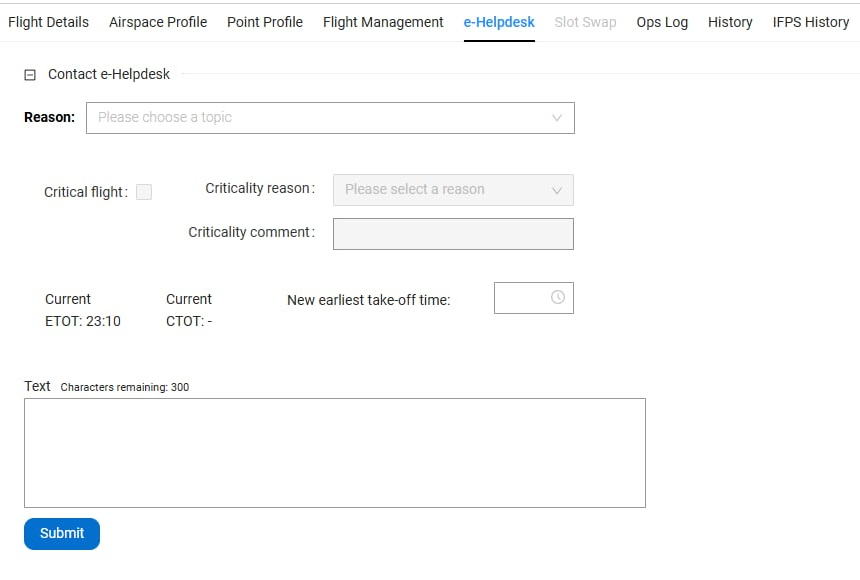
You’ll find the option in the e-Helpdesk tab in NMP Flight.

From 60 minutes before EOBT, you can tick the “Critical flight” box and choose a reason from a predefined list:
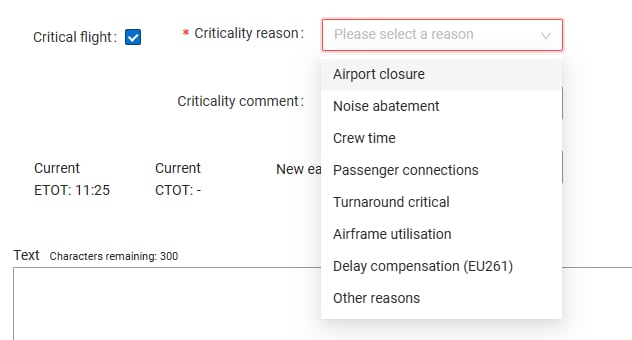
You can also add a brief comment (up to 300 characters) to explain the situation.

What to keep in mind:

  • You can only apply Critical status from 60 min before EOBT. Earlier requests won’t be accepted.
  • Once marked, you can’t change or remove the flag for that flight during the day, so be sure before using it.
  • You can mark up to 5 % of your regulated flights as Critical each day, with a maximum of 20 flights.
  • These flights are not automatically rejected, which improves the chance of receiving support from Eurocontrol.

Use this option carefully, and only for flights where delay would cause real disruption. When applied correctly, it’s a simple but powerful tool to keep your operation running smoothly.

For Pilots: Keep It Predictable

Eurocontrol doesn’t like surprises. The whole system runs more smoothly when flights do exactly what they said they would do. Sudden changes might seem harmless from the flight deck, but they can ripple through the network and cause chaos in sectors ahead. Here’s how to keep things flowing:

  • Fly what you file. Stick to your planned routing and levels unless ATC, weather, or safety require a change. That shortcut might save a minute, but it could cost someone else much more.
  • Stick to your slot. Request start-up in line with your EOBT and CTOT. Off-schedule departures can break the flow and lead to slot issues.
  • Let your dispatch team talk to Eurocontrol. The Network Manager Operations Centre (NMOC) is ready to help, but contact should come from dispatch. Unless you’re both pilot and ops – let the team handle it.
Need Help? Know Where To Go

Your first stop should always be the e-Helpdesk in NMP Flight. It’s the fastest and most efficient way to request CTOT improvements, mark Critical flights, or get slot-related support. The network team monitors it constantly and responds quicker when requests come through the system.

Calls should be a last resort, used only for urgent, time-critical situations. Phone support takes resources away from managing the wider network – so only use it when really needed.

Call only if:

  • A flight is about to miss CTOT at the holding point.
  • There’s a crew duty or curfew risk.
  • You’re repositioning a diverted aircraft.
  • You’re handling a medical or emergency flight.

Contacts:

  • AOLO (Aircraft Operator Liaison Officer) general line: +32 2 745 1992
  • Airport Function (AF) – for airport-related issues or curfew risk: +32 2 745 1903
  • AOLO Hotline – for critical/emergency issues only: +32 496 560 300
  • Airport coordination e-mail: nm.airports@eurocontrol.int 

For everything else, use the e-Helpdesk – it’s how Eurocontrol can help you best.

Want to Learn More? Start Here

If you want to go beyond the basics and build a deeper understanding of how the European network works, here are three great places to start:

EUROCONTROL Learning Zone – Free online courses and tutorials to help you better understand European flight planning and ATFM.

ThinkNetwork Guide – Summer 2025 – Eurocontrol’s seasonal briefing with key planning tips, capacity updates, and network insights.

NOP Portal Real-time source for airspace status, regulations, slots, and network operations.


Computer Says No: Why FAA RVSM Approvals Matter in Europe

An OPSGROUP member recently received the following message after their N-Reg flight plan was rejected by Eurocontrol:

Or in other words ‘computer says no – it seems you’re not RVSM approved…’

The issue stemmed from something called NAARMO – the North American Approvals Registry and Monitoring Organisation.

This is the agency responsible for monitoring the safe and proper use of RVSM throughout North American airspace including the US, Canada and Mexico. They maintain a list of every US-registered commercial and turbine GA aircraft approved to operate in RVSM airspace.

It may come as a surprise, but this same list is used across the pond by Eurocontrol (and its monitoring agency).

OPSGROUP has been advised that every three months, Eurocontrol carry out a flight plan audit using the FAA NAARMO list to identify non-approved aircraft operating in RVSM airspace.

If a registration is flagged, after further consultation, it may be added to a list of aircraft which will have their flight plans rejected. This was the case above.

Herein lies the problem: if your aircraft’s RVSM-status is recorded incorrectly on the US NAARMO list, you may find your flight plans getting bounced over in Europe.

If this happens to you, here’s how to fix it.

Contact NAARMO directly.

Yep, even though it’s a problem in European airspace the solution rests with NAARMO back in the US.

You’ll need to figure out why your aircraft doesn’t appear on the FAA’s database, and get that corrected first, before Eurocontrol can remove your aircraft from their naughty list. Once you get it corrected on the NAARMO database, they are apparently pretty good at sending Eurocontrol a specific notification so they can remove it from their list too (the day they receive the update, or the next working day).

You may not have been intentionally naughty either. There are some quite innocent reasons why this may be case – usually missing information related to airworthiness or other overlooked details.

To get in touch with NAARMO directly, use this form and email it to naarmo@faa.gov.


Big Summer Slots (a Storybook)

This summer is going to be worst ever in Europe for delays (so we’re told), which means if you’re going there you’re going to get a nasty CTOT sooner rather than later.

So rather than writing a long and helpful blog post to help you navigate the slot rules, instead we’ve put together a vacuous and infantile story book.

But, it might still help a little to figure out how NMOC (the artists formerly known as CFMU) at Eurocontrol works, how to deal with a bad slot, requesting improvement, how and when to file, and when you should or should not contact NMOC for help.

Once you’ve enjoyed (or not) storytime, be sure to scroll down for some more “adult” links to the in-depth material 😊

Click above for the PDF version (which you can also download directly).

If you prefer, try this “Book” version …


So, onto the adult version… Eurocontrol NMOC have published a really useful guide to slots this month, for the Summer of 2022. Download that here as a PDF (31 pages)

For the full bible, you want the IFPS users manual, and the ATCFM operations manual.

Do you have any other useful links or documents about European slots? Tell us! ops.team@ops.group.


PBN, RNP and what it all means

All across Europe, ‘Airspace Improvement Events’ are occurring. It sounds huge. We were expecting new regions, routes, maybe some special-filtered cleaner air being puffed out into it…

Alas, we read through all the Airspace Improvement Event notices, and from what we gather, it is part of a big, ongoing project to implement things like Free Route Airspace, more PBN routes, and to basically tidy up the airspace a little. This is not limited to just Europe though – the world is going PBN.

So, less an ‘Event’ and more a ‘Something’?

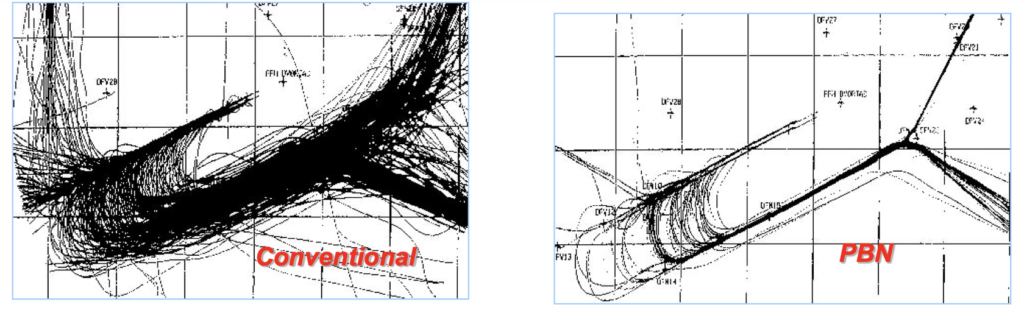
Everything is moving to Performance Based Navigation. It has something to do with being compliant with EC Regulation 2018/1048, but really just comes down to more efficient, better, safer, increased capacity airspace and approach benefits for everyone.

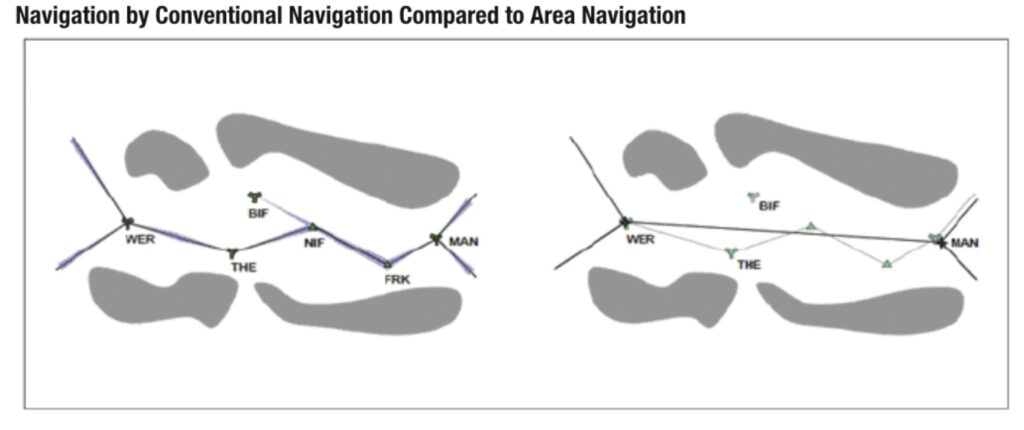
As simply as possible – VORs are out, Waypoints are in.

In a bit more detail – fixed ATS routes will continue to be implemented for better flow management and lateral separation, you’ll hear more about Free Route Space, and you’ll start seeing more RNP approaches popping up at airports.

So it is actually quite a big change, but one that will be slow to get implemented. Actually, most countries brought in things like RNAV5 routes and SIDs/STARs that use RNAV1 and GNSS instead of old-fashioned, Navaid-based manoeuvrings quite some time ago, so this isn’t something pilots will necessarily notice and there is no Big Date to look out for.

Except for one – December 1 2022 (but we will get to that later).

Why don’t we like conventional Navaids anymore?

Well, old Navaids need a lot of maintenance and they break a lot. Ok, not a lot, but they do potentially double the chance of some sort of issue for an airplane relying on them. Take your bog standard ILS for example – it has ground transmitters and aircraft receivers (and all the bits around them and in between then) and if any one of these conks out then you can’t fly the ILS (quite so well) anymore.

Your GPS approach on the other hand relies on the aircraft system only, which means less to go wrong.*

*Actually satellites can have issues too – GPS Jamming is a big problem and the plan to decommission Navaids is being delayed because of this.

So, what does this all actually mean, practically?

For operators, it doesn’t mean a whole lot. Most aircraft will have been operating to RNAV5 for a fair old while now, so the only noticeable change will probably some newly named waypoints, and some slightly more efficient routings.

You might need to pay a little more attention to any MELs that affect your performance capabilities, and be aware that approaches might no longer have conventional Navaids as backups in the future because a bunch of these are getting decommissioned.

But overall, it really means keeping an eye on them charts to see what’s happening where, and to make sure you pull the right plate out for your arrival.

PBN, Say Again?

So, PBN, again. And December 1 2022. What happens then?

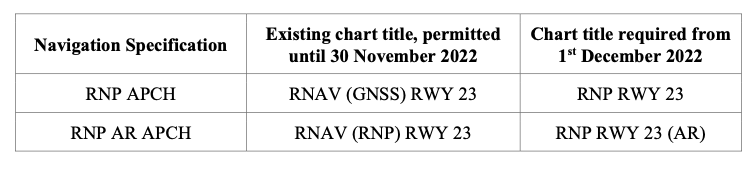
ICAO has ordered all approach charts to reflect the new specifications by December 1, 2022.

What is changing?

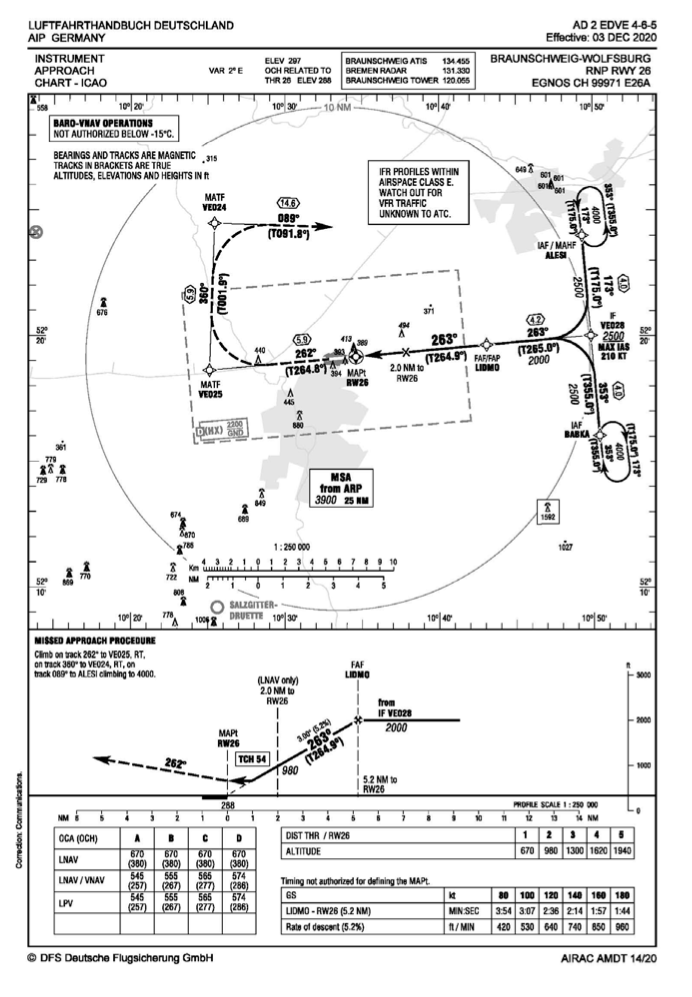
All charts will say RNP APCH on them (or RNP AR APCH) instead of RNAV, RNP (GNSS) or whatever other random title they currently have. The chart should have the three lines of minima on it which you will need to know – your LNAV, LNAV/VNAV or your LPV.

Which country is winning the chart race?

ICAO post updates on the implementation which you can follow here, although they last updated it in 2017 so let’s hope it is looking a little better now.

All the R’s

In case you are still lost at RNP instead of RNAV, here is a quick recap on some terms for you:

  • GNSS is your Global Navigation Satellite System and it is a generic terms for all satellite navigation systems including GPS, Galileo, GLONASS, and ones augmented by ABAS, SBAS, GBAS… all the BASes.
  • LNAV, VNVAV, LPV, LP are your different minimus given on an RNP approach chart.
  • PBN is Performance Based Navigation based on performance requirements of the aircraft on a route or approach or in designated airspace.
  • RNP is required navigation performance which basically means the onboard monitoring and alerting system your aircraft has.
  • RNP Approach is a generic term for any approach which uses GNSS to enable it and an RNP system to fly it.
  • RNAV Approach is what RNP approaches used to be called.
  • RNP APCH is the name of the navigation specification in the ICAO PBN manual for the 4 types of approach:
    • LNAV (GPS NPA)
    • LP (SBAS-based NPA)
    • LNAV/VNAV (APV Baro-VNAV)
    • LPV (APV SBAS or SBAS Cat I)
  • RNP AR APCH is an approach the requires a specific aircraft qualification and operational approval. Usually because it takes places in an environment “rich in obstacles”. The AR stands for ‘approval required”. So you might be allowed to fly an RNP (RNAV) but not an RNP AR and your OpSpec (and training) are going to make this pretty clear.

What is Free Route Airspace?

FRA is a specified volume of airspace in which users can freely plan a route between defined entry and exit points. It makes the sector much more efficient.

And because we mentioned it earlier, what about RNAV?

Way back in the olden days (not as far back as when airplanes just had a compass and a map to use, but before GPS came in), there used to be Navaids. Ancient relics called VORs and NDBs which helped pilots work out where they were.

But then GPS came along and brought with it a way more effective and accurate way to navigate. How accurate is defined by ICAO under their four main navigation specifications – RNAV10, RNAV5, RNAV2 and RNAV1

RNAV5 is actually fairly basic. It has been around in Europe since 1998 and is mandated in pretty much all high level airspace there. 

The 5 bit refers to the requirement for aircraft to operate to a minimum navigational accuracy of +/-5nm for 95% of the time.

RNAV1 is your precision RNAV (1 being +/-1nm). RNAV10 is generally what you find over the oceans, and RNAV2 is generally used in en-route areas of the US.

Fun fact: The UAE and Bahrain FIRs implemented RNAV1 a while back, which means you need GPS Primary to route into here. If you’ve encountered GPS jamming en-route, (common in Turkey, Iran, Iraq etc, read all about that here), then this might cause problems for you.

What do you need for RNAV5 operations?

You need some sort of FMS, 1 IRS, 1 GPS or VOR/DME receiver and 2 nav displays.

What about RNP?

If it is an RNP navigation specification then there is also a requirement for on-board performance monitoring and alerting. RNAV refers to ‘area navigation’ and it is slightly different to an RNP system (the monitoring and alerting requirements). PBN requires an RNAV or RNP system, while and RNP APCH specifically requires an RNP system.

What else?

Actually, that’s about it. Except for the poor old UK that will no longer support LPV approaches from June.

Need to know more?

Here is ICAO EUR Doc 025 which contains all the EUR RNP APCH Guidance Material.


There’s no “I” in team. But there might be an “AI”…

Back in March 2020, Eurocontrol released something called ‘The FLY AI Report – Demystifying and Accelerating AI in Aviation/ATM’. 

Now, the minute most aviation folk hear ‘Artificial Intelligence’ they generally start imagining either a Matrix type world ruled by super computers, or they are a pilot and get angry at the thought of the most ‘know-it-all’ co-pilot possible sat next to them. 

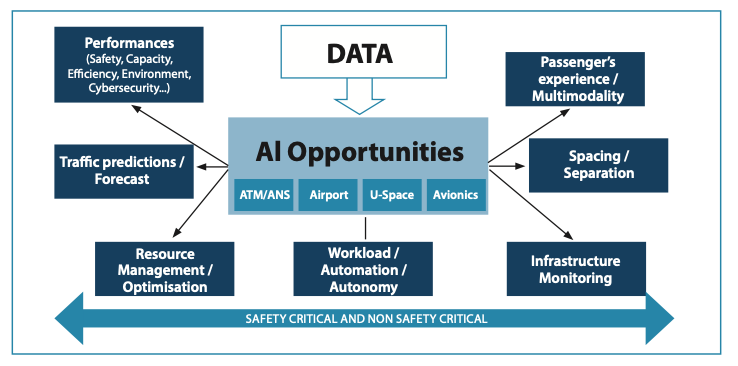
But AI has actually been used in aviation for a while now, and its integration into the aviation operations environment might be rather disappointingly un sci-fi, but it is very NOT disappointingly impressive when you start to see the clever ways it is improving the safety and efficiency in our industry.

The First Law of Robotics

First, let’s establish what is actually meant by the term ‘AI’.

It is not so much Replicant as it is Roomba – ‘Artificial Intelligence’ is used to categorize systems that have the ability to independently gather information, assess it, and (here comes the AI bit) make a decision based on it.

So your Roomba with its camera sensors and ability to make the decision to turn around rather than smash into the wall in front of it means it is categorized as an AI. A basic AI, but still, an AI.

AI is categorized into 6 levels, starting with your Level 0 – Low Automation stuff which just supports a human operator by gathering info and analyzing it. Beef up its brain a little though, and it becomes a Level 1 – Decision Support which not only gathers and analyses, but can also select certain actions in relation to some basic tasks or functions. Like, don’t run into walls.

As the levels increase, so does the ability of the systems to analyse greater data inputs, and the independence of the system to “decide” and act without any human operator involvement at all. Highly complex system are even able to determine what might happen based on data patterns, and so pre-empt actions, making decisions based not on the direct data, but on forecasts and possible things that could happen.

We aren’t talking vacuuming though, we are talking flying…

Actually, for all you pilots out there, we aren’t really talking flying. Not yet. Some airplane manufacturers are toying with automated takeoffs and that sort of thing, but no AI is currently capable of the level of autonomy which would enable it to totally replace Captain McFleshy. What we are talking is systems that support other areas of aviation operations in parallel to human operators – by providing data acquisition, analysis, action selection and implementation.

That all suddenly sounds quite boring, but the functions of AI in aviation are anything but.

The Cat-AI-logue

Most of the AI currently implemented in aviation is the “detect and avoid” type – systems that focus on precision navigation, or image detection. Sort of giant Roombas for the aviation world. Here are just a few of the current technologies that might be helping your flight without you even knowing it.

Traffic Prediction

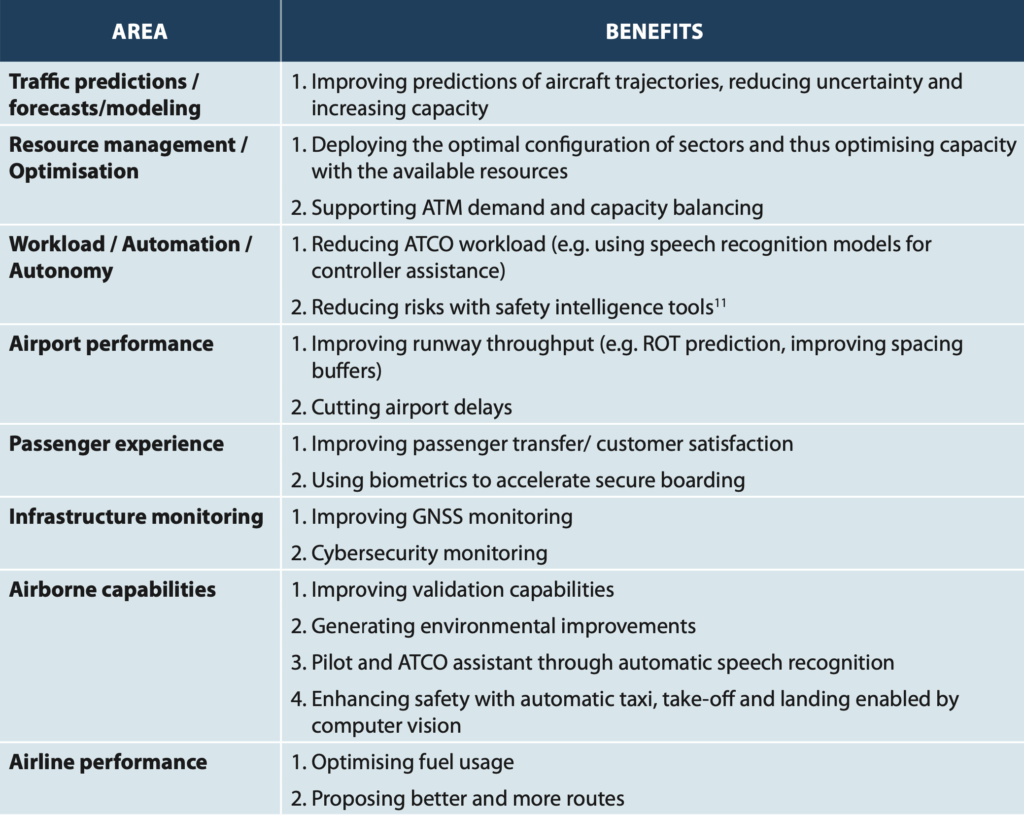
Eurocontrol in Maastricht already use what they call a “learning machine” which can predict 4D trajectories – in other words aircraft position, altitude, speed and time. Being able to predict traffic flows means they can optimize the use of ATCOs and put the people brains where they are most needed.

The clever AI algorithms have a “what if?” function which lets them “tentatively probe” (Eurocontrol’s choice of phrase, not mine) the impact of certain airspace restrictions, or regulations, on traffic flow. It can monitor workload, spot probable bunching points, and also predict traffic one or two hours in advance to work out how the handover between different control sectors might affect the flow.

Maintenance Costs and Fuel Optimization

An AI system produced by Honeywell is being used to save airlines up to $200,000 per aircraft per year in fuel costs, and up to $40,000 per aircraft per year in maintenance costs. The system has data gathered from years and years of flight statistics, across a whole bunch of airlines, and it has swilled all this data about in its big brain and can now take specific flight plans and review where fuel has been wasted before.

The system can not only determine better routes, but can help make strategic decisions on things like flight path routings, the best direct path to landing to take, engine out taxi etc. While the pilot brain is thinking “If I turn an engine off now, will I have to use loadsa thrust on the other one to get it up that hill and around the corner? Maybe I should just keep ’em both running…” the AI brain is going “click, whirrr, yeah, turn the engine off now and you’re good!”

GNSS Monitoring

GNSS is great – it lets us operate the approach, landing, departure, ground stuff in low vis conditions. But there is a big issue with it –  propagation delay caused by the ionosphere. The current models for gathering data on this are pretty limited, but a new AI system can monitor and gather so much more data, and assess it so much more quickly because it has the ability to ‘learn’ – it is not just looking at data and spitting out figures. It is constantly updating its analysis.

Image recognition to detect runway vacation

Yep, there is an AI system that is used in conjunction with digital, remote, tower operations. It can speedily determine if the runway is clear, and calculate whether there is time for the next aircraft to land or not – it can do this a lot more efficiently than person eyeballs and brain, meaning airports can be a lot more efficient, and flight delays reduced, without reducing safety.
100 million actual flight hours of experience

A system developed by Thales – PureFlyt – has the ability to draw on aircraft and outside world data like weather information. It works inside the FMS and can predict aircraft trajectory, and can offer optimized flight paths to decrease fuel consumption and improve passenger comfort, as well as maintaining safe separation from other aircraft.

AI technologies have simulated 2 billion test cases. So this system basically will have the brain of a Captain who has flown 100 million flight hours (and all the knowledge that would go with that experience).

What are the risks?

Well, automation and AI taking over and forcing humans into pots of jelly where they sap our energy seems unlikely. But there is the risk of oversight, or rather lack thereof. An AI, no matter how “intelligent”, is a system which people have programmed and inputted data into. Poor data in = poor data out.

So the quality and reliability of systems must always be closely monitored. And there’s a thin line between it supplementing operations versus it becoming the single system that people rely on and no longer control. The trick will lie in the training, and in how people interact with the systems – ensuring they understand them, and that strong contingency procedures remain in place.

AI offers new safety and security indicators that can support the early detection and predictions of new risks. It can improve performance by assisting people areas like data gathering and analysis where an AI brain is far quicker than the human brain. But the purpose is not to remove the human operator from the process, but to combine the best of computational methods and human intelligence to create a collaborative service provision.

The full FLY AI report from Eurocontrol is available here.


Contrails, Chemtrails and Climate Change

Putting ‘climate change’ in the title of a post on an aviation page probably isn’t the best way to draw in the readers. But this is not a lecture. Promise.

So, what is it about?

It isn’t about chemtrails. They aren’t a real thing.

It is about contrails. The wispy bits of whatever that your airplane engines fart out as you fly, or the ‘engine plumes’ if prefer to imagine your airplane resembling something like a peacock.

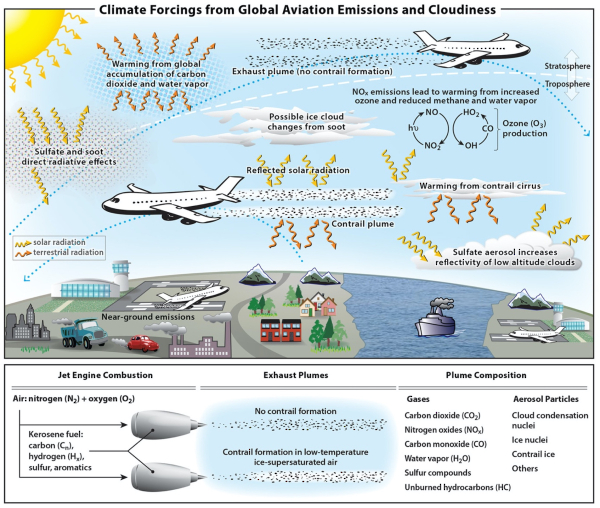
Contrails are basically water vapour. They form when the exhaust gases from the engine starts to cool and mix with the air around them. The humidity rises, the water cools and condensation occurs.

A small, small proportion of what is burped out of the engine is not water though, but impurities from inside the engine.

Things like sulphur particles. It only makes up about 0.05%, but these tiny particles give the water something to freeze onto and they cause tiny ice crystals to form.

So why do we care about this?

They are quite a useful indicator of possible wake turbulence for us, but aside from that (and unless you are one of the pilots who likes to draw amusing pictures in the sky with them) then we don’t really care that much.

But maybe we should care a bit, because some contrails loiter up there for ages – these are known as homomutatus contrails. Frankly, anything which sounds a little like ‘mutant’ should cause concern, and these definitely do, because they are responsible for the word we shall not utter.

Ok, we will, just to be clear – global warming.

Not here to lecture though! Promise!

A little bit of science (still not a lecture)

So, the airplane burps out the water, it turns into contrails which then hang up there in the stratosphere. Aviation causes only about 5% of the water present in the stratosphere, so it isn’t a terrible culprit.

Unfortunately, though, those homomutatus contrails, plus the extra water, plus the ice particles – all that stuff left up there by airplanes – causes terrestrial radiation to backscatter. It also stores up some of the radiation coming in and the result is something they call ‘radiative forcing’.

Basically, extra heating-up happens.

So, airplanes are spitting out C02 and contrails, and the contrails are thought to be responsible for something between 20% to about 40% of all the radiative forcing aviation causes to occur (they don’t really know how much, but they reckon about that amount).

So… why are we actually telling you if this isn’t a lecture?

We’re getting there, stay attentive!

Free Route Airspace (a big open area between 2 waypoints where you are routed in a straight-line between them) has already helped reduce fuel burn and C02 emissions. They reckon it saved about 40 tonnes of fuel a day, and reduced the C02 by about 150 tonnes a day.

So, the helping-the-environment plans are already helping you because it means less fuel burn.

ICAO and Eurocontrol, in conjunction with EDYY/Maastricht have now set up a project called the Contrail Prevention Trial.

The Contrail Prevention Trial will initially only take place in Maastricht and the plan is to sometimes re-route aircraft around atmospheric conditions that are most conducive to contrails.

The Contrail Prevention Trial

If you are routing through Maastricht airspace you might find you are given a re-route. It won’t be huge, it might mean a little bit of an increase in fuel burn, but it will hopefully mean a decrease in the contrails your aircraft produces.

You won’t really know, but some clever science person down on the ground hopefully will.

So, a little bit of science, no lecture, and some info on why, if you are routing through Maastricht sometime in 2021, you might be given a tactical diversion. Now you know why 😊

Here is the official announcement on it, found on the Eurocontrol homepage:

CONTRAIL PREVENTION TRIAL – MAASTRICHT UAC (EDYY) AIRSPACE
===========================================================
IN AN EFFORT TO MINIMISE THE IMPACT OF AVIATION ON THE
ENVIROMNENT, MUAC WILL BE RUNNING A CONTRAIL PREVENTION TRIAL FROM
18TH JANUARY 2021 UNTIL 31ST DECEMBER 2021 BETWEEN 1500-0500UTC
WINTER (1400-0400UTC SUMMER).

FLIGHTS MAY BE TACTICALLY REQUESTED TO DEVIATE FROM THE PLANNED/REQUESTED
FLIGHT LEVEL BY THE SECTOR CONTROLLER.

ANY FLIGHT FLYING VIA MAASTRICHT UAC SECTORS BETWEEN THESE TIMES
MAY BE CHOSEN. THE TRIAL WILL GO AHEAD DEPENDENT ON THE WEATHER
CONDITIONS.

MUAC AO HOTLINE +31 43 366 1428

NMOC ON BEHALF OF MAASTRICHT (EDYY) FMP
===========================================================


TCAS Trouble: Why We’re Getting It Wrong

Earlier this year Eurocontrol published a report on TCAS Resolution Advisories, and the results weren’t pretty…

Over a 12-month period, over the heart of Europe, only 38% of RAs were flown correctly and 34% of aircraft even manoeuvred in the wrong direction.

In other words, nearly half of crew for one reason or another didn’t follow the RA – a last-resort safety net proven to save lives. So concerned are Eurocontrol, they rank the issue as its second highest air traffic threat – it’s a big deal.

Here’s the issue in a nutshell

ICAO say that no matter what, unless the safety of your aircraft is compromised by something more dangerous (think terrain or stall etc.) if you get an RA, you have to follow it.

TCAS, ACAS or whatever you want to call it has been around for a long time. Development started back in the 50s, and it has been mandated in the US for larger aircraft since the 80s. It has become incredibly reliable.

So, if it’s that black and white, the question remains, why does this keep on happening? Turns out there are a bunch of reasons, and so it is worth taking a look at exactly what is going wrong up there.

The Elephant in the Room

We may as well address it first – when crew choose to second guess an RA. The good news is that this isn’t happening very often. Most of the time there are other factors at play. But while we’re here, a little note on TAs and RAs.

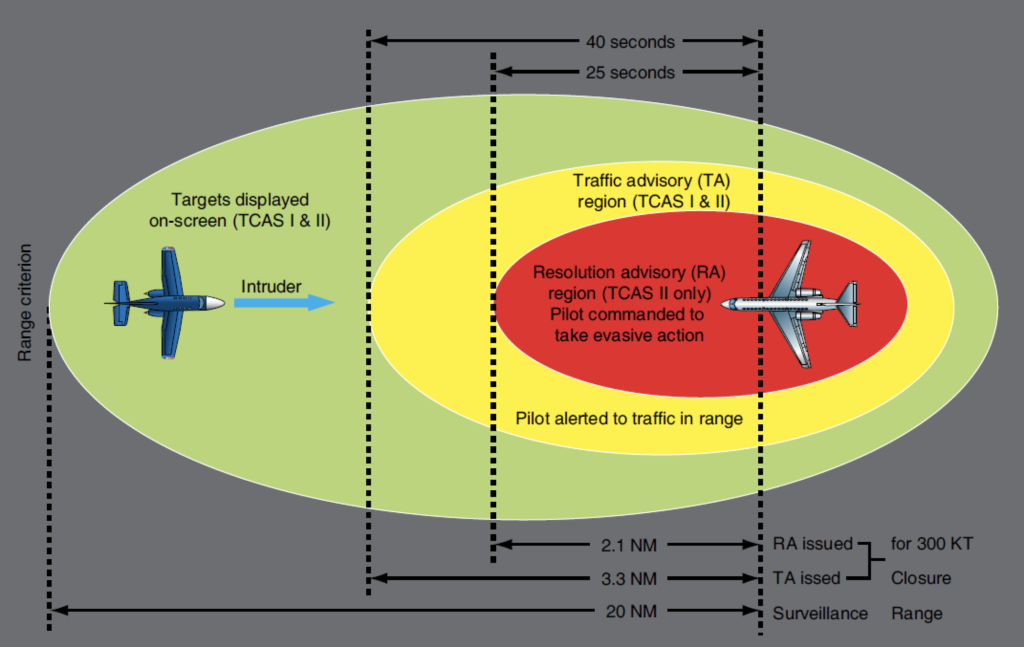
Traffic Advisories (TA) prevent. You haven’t lost separation yet, but you might. They’re a warning for us to go heads up and do something about it – make visual contact, talk to ATC, level off, you name it. This is the time for us to go to work and make decisions.

Resolution Advisories (RA) mitigate. There is no more time to prevent – that ship has sailed. RA’s typically trigger when you are within 25 seconds of a collision threat with the other aircraft. But here’s the kicker – you are expected to respond to it within 5 seconds. In other words, there is not much time for us to make effective decisions. Safest course of action? You guessed it – follow the RA.

So, what else is going on then?

Numero Uno – The number 1 biggest reason why RAs aren’t followed? Because we think we can see the threat out the window. Unfortunately, you can’t assume that the aircraft you can see is the one who triggered the RA. We’re also not very good at assessing threats visually, especially at altitude and it does not give us any info about what the other aircraft is intending to do.

Startle Factor – Put us in a stressful situation and we react in different ways. RA’s are a rare event, and they’re not always preceded with a TA. In other words, without warning they can emerge with significant ‘pucker factor’. A large number of mis-flown RAs in the EUROCONTOL report lasted for less than 8 seconds. Beware of the ‘knee jerk’ reaction – our instinct is to act but surprise can get in the way of procedure.

Beware of Contradictions – It’s not ATC’s fault, but it’s important to understand. They don’t know what your TCAS is telling you to do and they will be working hard to help. The issue is when ATC instructions contradict your RA. In 2002, a Tupolev passenger jet collided with a 757 over Germany – one crew followed the RA and the other ATC. The industry learnt an important lesson: always follow the RA. Use the phrase “TCAS RA” on the radio and ATC will understand you are following one.

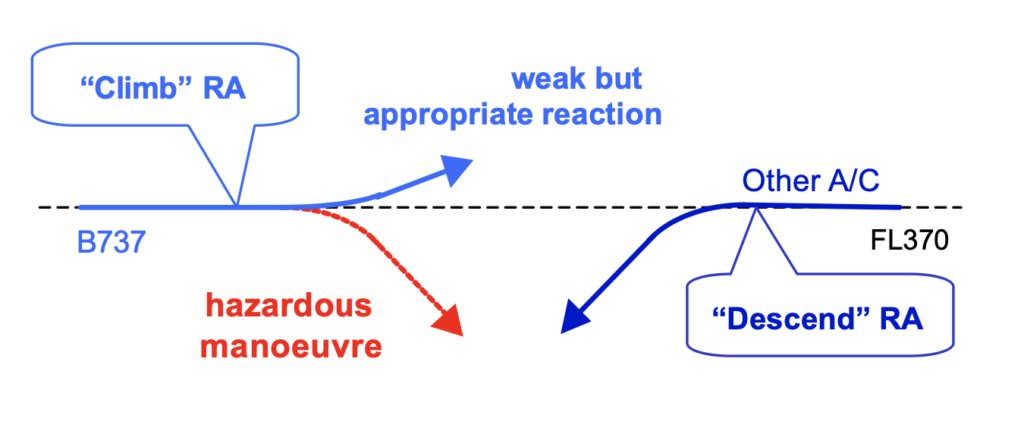
Performance – RA’s are often not followed as the crew are worried about performance. This usually happens when they’re heavy and high or near their service ceiling and get a climbing RA. So, what should you actually do? The official word is this: do your best to follow it, even if your response is weak. Even if it means maintaining your level. In most cases an RA will only result in a level change of less than 500 feet. The biggest threat by far is opposing the RA, which will put your aircraft in far more danger.

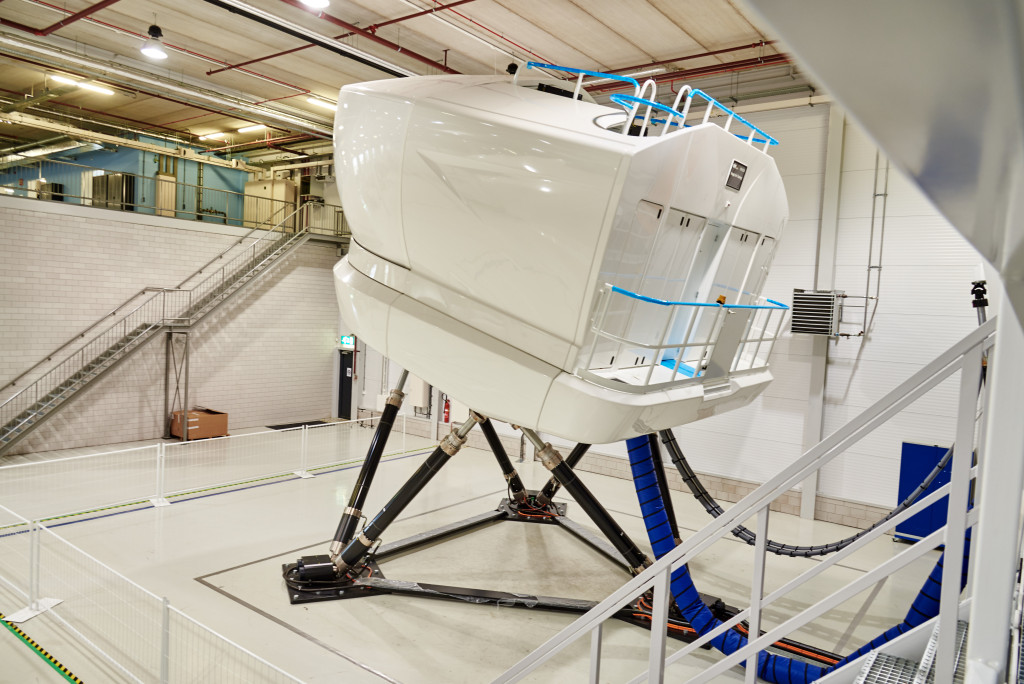
Training – That old chestnut. But the reality is it is really important to practice these things in the sim. Weird ones. Unexpected ones. Ugly ones. Ones with multiple threats. Because this is usually what we’re up against in the real world. Also keep your finger on the pulse for changes. Some modern aircraft can now fly RA’s automatically, but the sims you train in may not have had the same update.

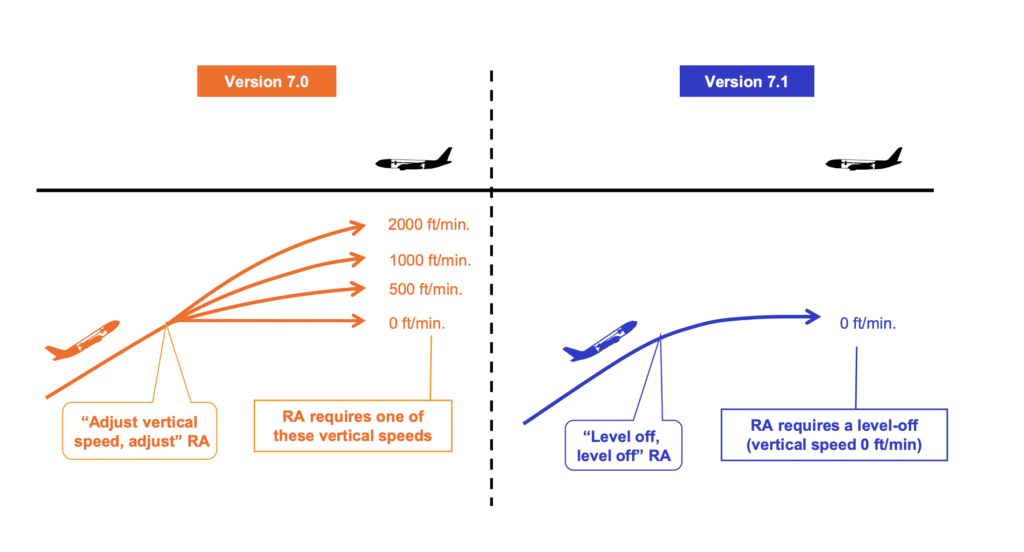
Older Versions – watch out for them. The latest one (7.1) has a number of major safety updates including clearer instructions and ‘reversals’ – a fancy term for knowing when the other aircraft isn’t doing what it is supposed to do. Older versions of TCAS are more likely to be misunderstood by crew. One phrase in particular is especially bad – “Adjust Vertical Speed, Adjust.” In many cases crew have increased their vertical speed rather than reduce it. If you’re using older versions it is important to be aware of its limitations.

TCAS is an awesome piece of kit that has made huge advances in preventing completely avoidable accidents. But it is only as reliable as the humans who respond to it. That’s why it is so important we learn about what we we’re getting wrong so it can do its job – keeping us safe up there.

Other Useful Things


Fake Navigation fees are still a problem

It’s a concern: instead of sending your Nav Fees payment to Eurocontrol, you’ve actually sent it to some guy sitting in his underpants in his mother’s basement. And you’re not going to get it back.

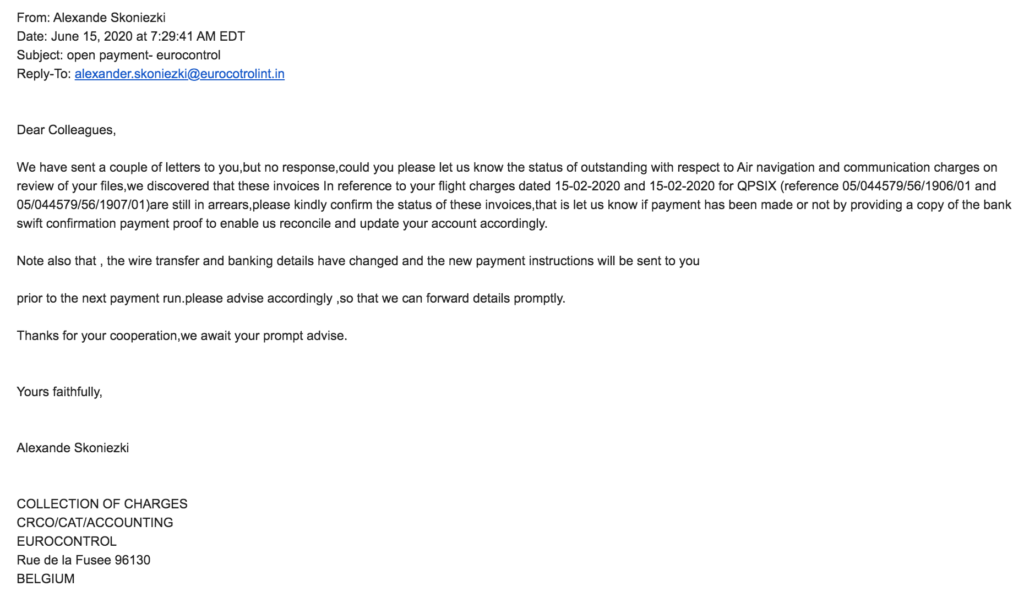
We’ve seen an increasing variety of scam emails, that at first glance look like they are from Eurocontrol – but aren’t. Here’s a good example from this week:

You’d be forgiven for glancing over it and responding to request the details of ‘their’ new bank account. And that’s where the problem begins – you’ll get a new bank account, only it won’t direct your money to Brussels.

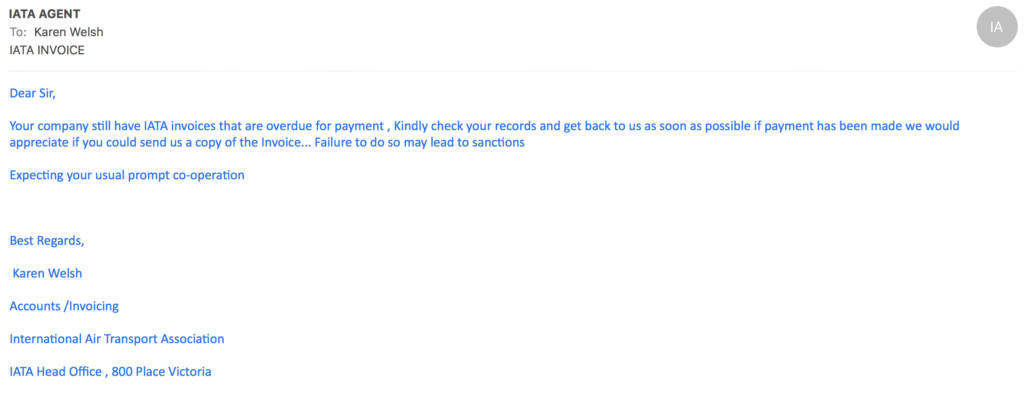
IATA has the same issue:

Fortunately, most of these emails are poorly written, and easy enough to identify as bogus – but that’s only if you are on your guard. The best solution is to simply be aware of the risk:

Eurocontrol

  1. Look at the sender address: real emails come from eurocontrol.int. Fake ones look similar, but might be something like @eurocontrolinc.com or @eurocontrolint.in.
  2. Most of the emails ask for a copy of an invoice or payment – be suspicious when you read that.
  3. Be especially alert when the email mentions a change in bank account. Eurocontrol has no plans to change bank accounts any time soon.
  4. Best advice: write to the real address: r3.crco@eurocontrol.int and ask for confirmation of any message, or call the Route Charges office on +32 2729 3838.
  5. The most secure way to handle Eurocontrol charges and payments is through their CEFA portal.

IATA

  1. Most recent fake addresses: invoice@iatahelpdesk.org, payments@iataaccounting.org
  2. Contact the real address: information.security@iata.org

The Air Charter Association have also warned that scammers have recently targeted business deals where operators charter out their aircraft to brokers. Similar to the fake IATA invoices scam, but more elaborate. Bottom line, if you’re chartering out your aircraft — or if you’re chartering one yourself — work with a reputable broker and triple-check all contact details (email addresses as well as phone numbers) and bank account details before pushing the button on any money transfers.

Even the mighty Japan Airlines fell victim to a targeted email scam back in 2017 which defrauded the company of JPY384 million yen – the equivalent of around USD $3.4 million. The airline received a series of emails purporting to be from a U.S. financial services company that had been leasing aircraft to Japan Airlines. Not realising it was scam, JAL promptly paid the money into a Hong Kong bank account, as requested. It was only later discovered to be fraudulent, when the genuine U.S. company demanded payment!

Have you been the target of similar scams? Let us know! – and we’ll add it to the list of dodgy email addresses and common scams.


Italy nationwide ATC strike on Nov 25

Update Nov 22: The Italian ATC strike on Monday 25th Nov isn’t going to be as bad as expected. The 24 hour strike has been downgraded to a 4 hour strike, from 12-16Z, 1-5pm local. Overflights and intercontinental arrivals exempt; other traffic may see a delay but it will vary from place to place. Primarily, it is the en-route center controllers that are striking.


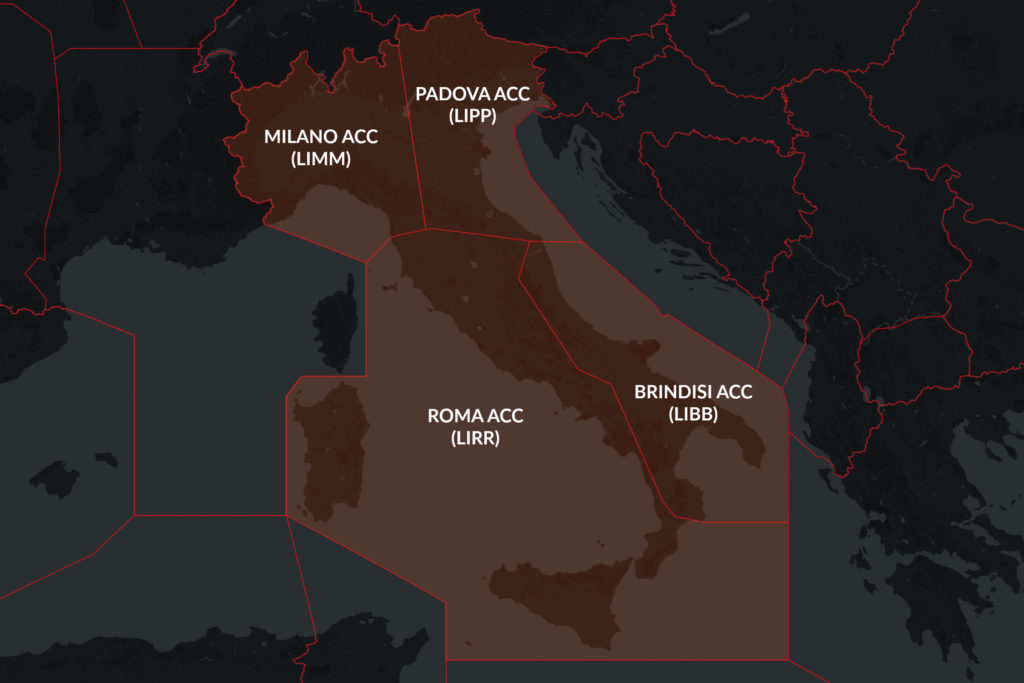
ATC staff from all four ACC’s across the country (LIRR/Roma, LIBB/Brindisi, LIMM/Milano and LIPP/Padova) will be on strike, plus local ATC at the following airports: LIRA/Rome, LIBR/Brindisi, LIBD/Bari, LIBP/Pescara.

Watch out if you’re headed to either LIPY/Ancona or LIRZ/Perugia though – ATC at these airports will still be going on strike for the full 24hrs as originally planned, so big delays expected here.

For updates, keep an eye on the Eurocontrol NOP page on the day of the strike.


European ATC delays are up 133%

In Short: European ATC delays are on the increase, caused by staffing and capacity shortages. Monitor the Network Operations Portal and be flexible in your routing options if bad weather or capacity constraints are expected.

It’s been a great few days on a sun-soaked Mediterranean island. Your passengers are onboard, you are about to close the door, and then you get told your Calculated Take Off Time (CTOT) is an hour from now! Sound familiar? You’re not alone! ?
European air travel this summer is surging and about to hit maximum intensity. Problem is, the ATC system doesn’t seem to be coping, and the misery of long flight delays keeps getting worse.

Delays are up

IATA has recently reported the following:

“Data from Eurocontrol shows that in the first half of 2018, Air Traffic Management (ATM) delays more than doubled to 47,000 minutes per day, 133% more than in the same period last year. Most of these delays are caused by staffing and capacity shortages as well as other causes such as weather delays and disruptive events such as strikes. The average delay for flights delayed by air traffic control limitations reached 20 minutes in July, with the longest delay reaching 337 minutes.”
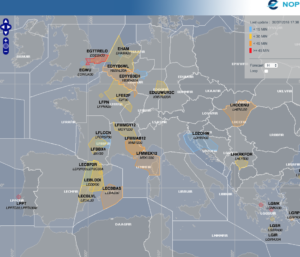
As an operator, you may be used to seeing alerts like these daily:

EDYY (Maastricht)

Several sectors regulated due to Airspace Management and ATC Staffing/Capacity.

Moderate to high delays.

LFMM (Marseille)

Several sectors regulated due to ATC Capacity/Staffing.

Moderate to high delays.

So is it a story of too many planes and not enough airspace (capacity) or just not enough controllers (staffing)?

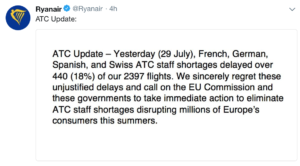
Local airlines are not impressed. Ryanair took to twitter this week calling the delays “unjustified”.

In a unusually aggressive statement IATA commented that “key ANSPs in Europe have not made needed investments in their businesses, preferring instead to make super-normal profits.”


Some of the things we recommend to keep on top of expected delays

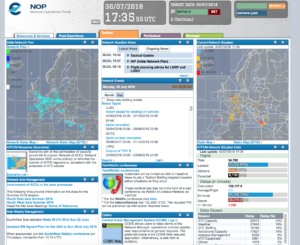
  • Review the Network Operations Portal regularly – This will assist in making operational planning decisions based on the current delays and capacity restrictions. Also keep an eye on the NOC tactical briefing for the following day which may also assist.
  • Avoid the early morning rush of departures if you can (0900z).
  • Be flexible in your routing options if bad weather or capacity constraints are expected.
  • Discuss with the local FBO for latest on-ground situation to better plan arrival and departure.
  • Monitor Opsgroup – members are always posting the latest information on recent airport and overflight experiences. Not yet a member? Go here!
  • Subscribe to our Daily Brief to get all the latest info on ATC strikes, Airport  closures, and everything else causing delays.

Got any tips or tricks on how to avoid or minimise most of these delays? Is there certain bit of airspace, airports or a time of day you’ve found that works best? Let us know!

Extra Reading:


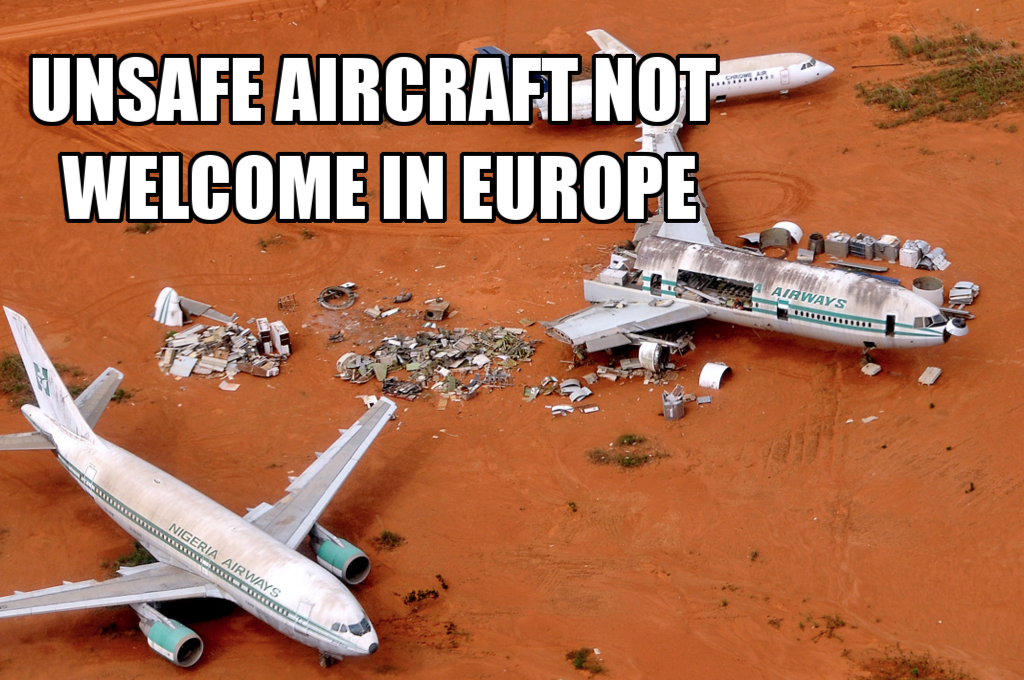
Unsafe aircraft not welcome in Europe

Eurocontrol and the European Aviation Safety Agency (EASA) have brought live an automated system which alerts air traffic controllers when unsafe aircraft enter European airspace.

How does it work?

Network Management Director at Eurocontrol Joe Sultana, explained that “We have added another parameter to our system, and this is now checking if an aircraft coming from outside of Europe is coming from a state where the regulatory environment is accepted by the European Aviation Safety Agency”.

So in short: The system will now take an automatic look at the Third Country Operator Authorisation and alert ATC if there is a flight being operated from a aircraft on the banned list.

The regulation that a plane coming from a non EU country must have a Third Country Operator Authorisation has been in place since 2014, but controllers have had no way to implement it across the 30,000 flights it receives into Europe each day, until this new component was entered into their systems.
As a reminder, Eurocontrol receives the flight plans of all aircraft entering into European air space, while the EASA holds the Third Country Operator Authorisations information which confirms that planes are from countries with recognised safe regulatory practices.


Europe squawks 7600 on ops in the Eastern Med

As we reported last month,  Eurocontrol published a ‘Rapid Alert Notification’ on their website regarding imminent air strikes into Syria.

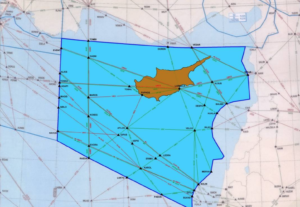
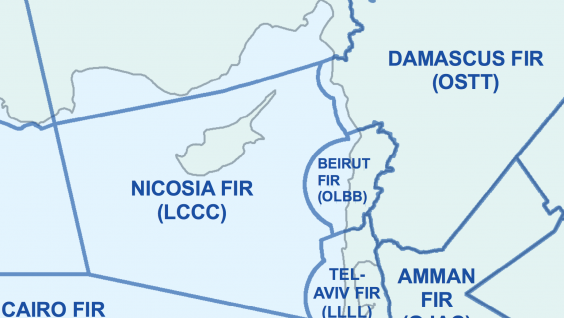
“Due to the possible launch of air strikes into Syria with air-to-ground and / or cruise missiles within the next 72 hours, and the possibility of intermittent disruption of radio navigation equipment, due consideration needs to be taken when planning flight operations in the Eastern Mediterranean / Nicosia FIR area.”

Around this time LCCC/Nicosia FIR released this vague (and now deleted) NOTAM:

A0454/18 – INFORMATION TO AIRSPACE USERS

THE DEPARTMENT OF CIVIL AVIATION OF THE REPUBLIC OF CYPRUS IS CONTINUOUSLY MONITORING THE GEOPOLITICAL DEVELOPMENTS IN THE REGION AND WILL NOTIFY THE AVIATION COMMUNITY IF AND WHEN ANY RELEVANT AN RELIABLE INFORMATION IS AVAILABLE THE DEPARTMENT OF CIVIL AVIATION IS TAKING ALL APPROPRIATE ACTION TO SAFEGUARD THE SAFETY OF FLIGHTS. 12 APR 15:25 2018 UNTIL 12 JUL 15:00 2018 ESTIMATED. CREATED: 12 APR 15:26 2018

Beyond this alert and NOTAM though; nothing else happened. A few days later, the conflict escalated.
Very few commercial flights operate over Syria, and authorities in the US, UK, France and Germany have all previously issued warnings for Syrian airspace.

But many airlines regularly transit the LCCC/Nicosia FIR: there are frequent holiday flights to the main Cypriot airports of LCLK/Larnaca and LCPH/Paphos; overflight traffic from Europe to the likes of OLBA/Beirut, OJAI/Amman and LLBG/Tel Aviv; as well as traffic from Istanbul heading south to the Gulf and beyond.

What has happened in the few weeks since then?
Normal Eurocontrol protocol is (during expected ATC strike for example) – regular teleconferences with operators, active re-routes and removal of certain overflight approval requirements. So did that happen this time? No.

Essentially just radio silence on Syria and operations in the Eastern Mediterranean Sea.

Right now, it’s a busy place. With all the normal holiday traffic in the region, there is also a large number of military surveillance aircraft from numerous nations patrolling the region. United States assets operating from Greece and Italy. UK air power from Cyprus and the French from bases in Jordan. Add to that the normal Israeli defense air frames and even the odd Swedish gulfstream surveillance flight!  Then there are the Russians conducting aerial operations and defense exercises in and around Syria.

Cyprus has activated a litany of “temporary reserved/segregated areas” inside of Nicosia FIR.

On May 3rd, Cyprus issued this vague information, to ‘exercise caution’.

A0580/18 – NAVIGATIONAL WARNING TO ALL CONCERNED. EXTENSIVE MILITARY OPERATIONS IN NICOSIA FIR PILOTS TO EXERCISE CAUTION AND MAINTAIN CONTINUOUS RADIO CONTACT WITH NICOSIA ACC. 03 MAY 12:00 2018 UNTIL 31 MAY 23:59 2018. CREATED: 03 MAY 11:25 2018

There is also a current warning about GPS interruptions.

A0356/18 – RECENTLY, GPS SIGNAL INTERRUPTIONS HAVE BEEN REPORTED BY THE PILOTS OF THE AIRCRAFT OPERATING WITHIN SOME PARTS OF NICOSIA FIR. AIRCRAFT OPERATORS OPERATING WITHIN NICOSIA FIR ARE ADVISED TO EXERCISE CAUTION. 20 MAR 10:04 2018 UNTIL PERM. CREATED: 20 MAR 10:05 2018

It may be unfair to blame the authorities completely. At the end of the day, due to the lack of appropriate communication from the various security agencies it’s hard to get accurate information out there. Still, there was enough warning to alert civilian operators of imminent strike – but then nothing else. Shouldn’t airspace customers and users expect more?

So what to make of all this?

Let’s end it with this great 2009 (and still current) NOTAM from the Cypriots.

A0687/09 – NAVIGATION WARNING TO ALL CONCERNED.

15 SEP 09:30 2009 UNTIL PERM. CREATED: 15 SEP 09:34 2009


European air traffic warned over Syria strikes

EASA are warning of possible air strikes into Syria being launched from locations within the LCCC/Nicosia FIR over the next 72 hours (Apr 11-14).

Eurocontrol have published a ‘Rapid Alert Notification’ on their website, with a statement from EASA that reads:

“Due to the possible launch of air strikes into Syria with air-to-ground and / or cruise missiles within the next 72 hours, and the possibility of intermittent disruption of radio navigation equipment, due consideration needs to be taken when planning flight operations in the Eastern Mediterranean / Nicosia FIR area.”

Very few commercial flights operate over Syria, and authorities in the US, UK, France and Germany have all previously issued warnings for Syrian airspace.

But many airlines regularly transit the LCCC/Nicosia FIR: there are frequent holiday flights to the main Cypriot airports of LCLK/Larnaca and LCPH/Paphos; overflight traffic from Europe to the likes of OLBA/Beirut, OJAI/Amman and LLBG/Tel Aviv; as well as traffic from Istanbul heading south to the Gulf and beyond.

Last year, two US warships in the eastern Mediterranean fired missiles at an air base in Syria after a chemical weapons attack by the Assad regime killed more than 80 people.

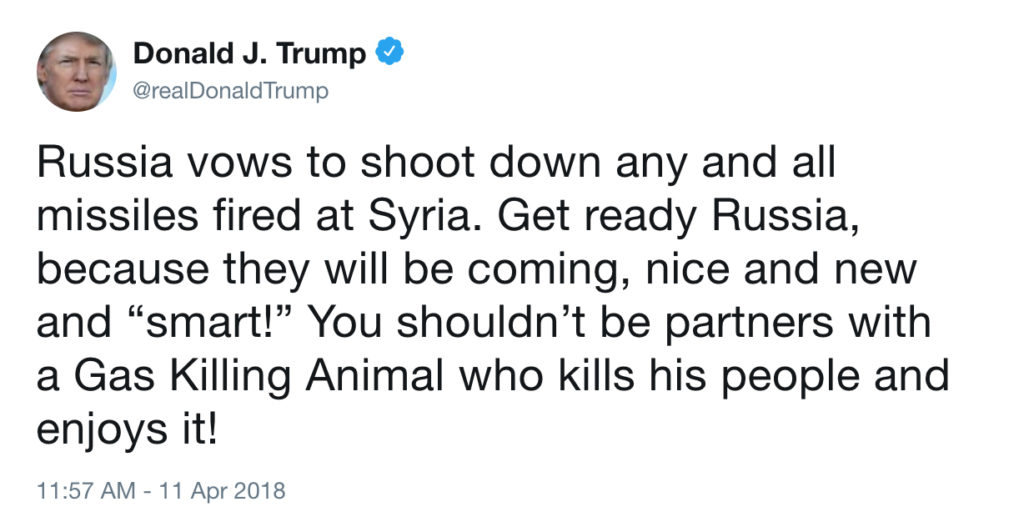
This week, following another suspected chemical attack by the Syrian government against civilians in a rebel-held town in Syria, the US President Donald Trump warned there would be a “forceful” response. On Apr 11, he took to Twitter to warn Russia to prepare for strike on Syria:

For the airstrikes on Syria last year, the US gave Russia advance warning of the attack, and Russian forces opted not to attempt to shoot down the missiles using its air defence systems stationed in the region.

However, this time round things could be very different. This week, Russia’s ambassador to Lebanon reminded the US that the head of the Russian military has said his forces in Syria would not only shoot down any missiles that threatened them but would target the source of the weapons as well.

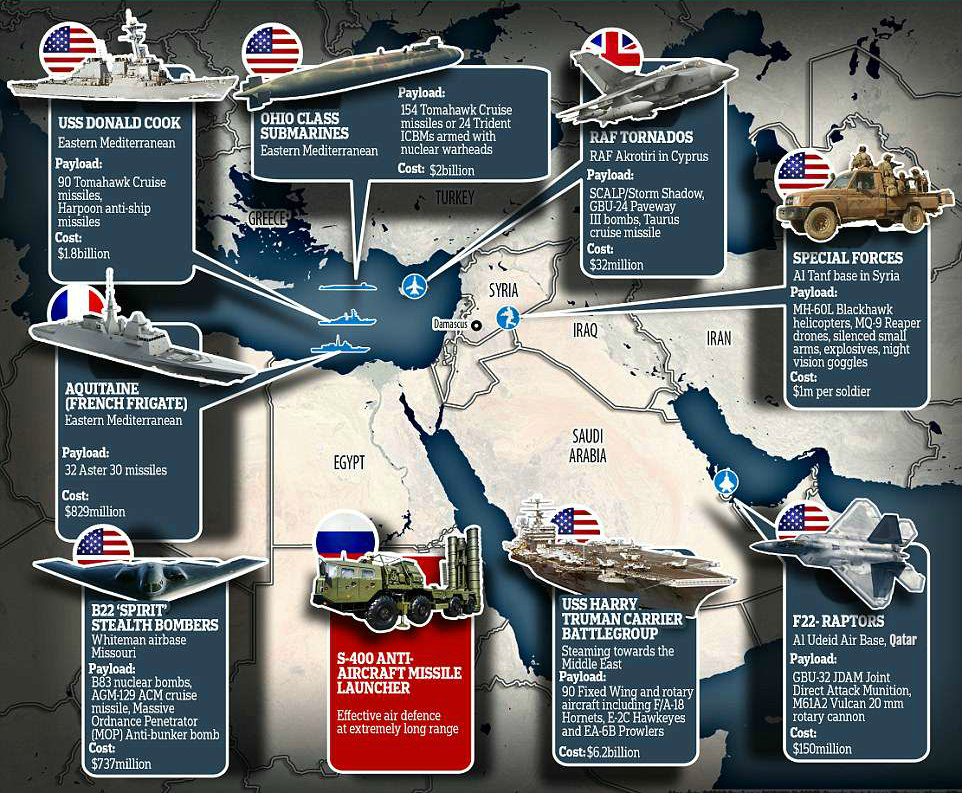
The only US warship currently in the Mediterranean and capable of a possible strike is the USS Donald Cook, which left port in Larnaca and started to patrol in vicinity of Syria on Apr 9. According to some reports, it has since weighed anchor off Syrian territorial waters, and has been “buzzed” by low-flying Russian military jets.

Another 3 warships of the Sixth Fleet are already in the Atlantic Ocean, and on Apr 11 the entire US Truman Fleet (including an aircraft carrier, 6 destroyers, and nearly 6,500 sailors) departed Norfolk, Virginia, to head to the Mediterranean Sea. However, it may take up to a week for any of these warships to arrive.

Here’s an overview of US and coalition forces’ military options currently thought to be on offer in the eastern Mediterranean:

With the downing of MH17 by a surface-to-air missile over Ukraine in 2014, as well as all the recent unannounced missile tests by North Korea, there has been increased focus by the aviation community on the risks posed by conflict zones. If any missiles are launched from the Eastern Mediterranean in the next few days, be prepared for possible last-minute reroutes, as any Notams that get published may not give much warning.

Further reading:

One of our biggest missions in OPSGROUP is to share risk information and keep operators aware of the current threat picture. Check out Safeairspace for the most up-to-date information on airspace safety around the world.


More direct routings across Europe

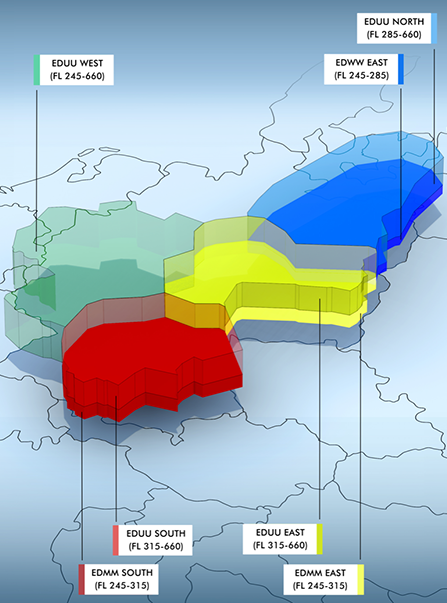
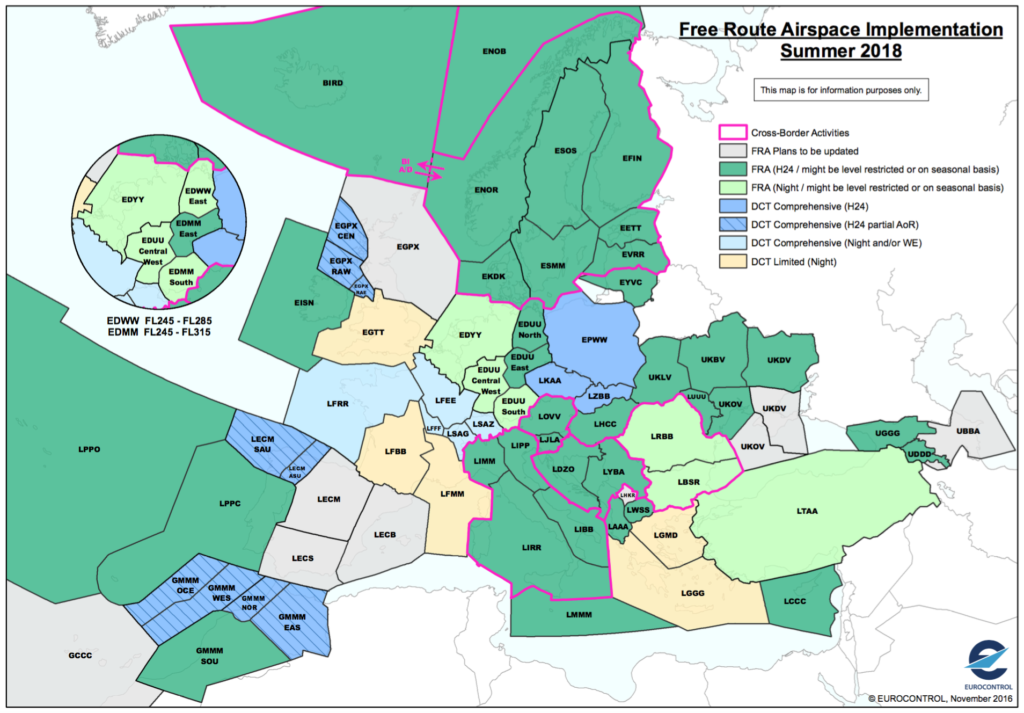
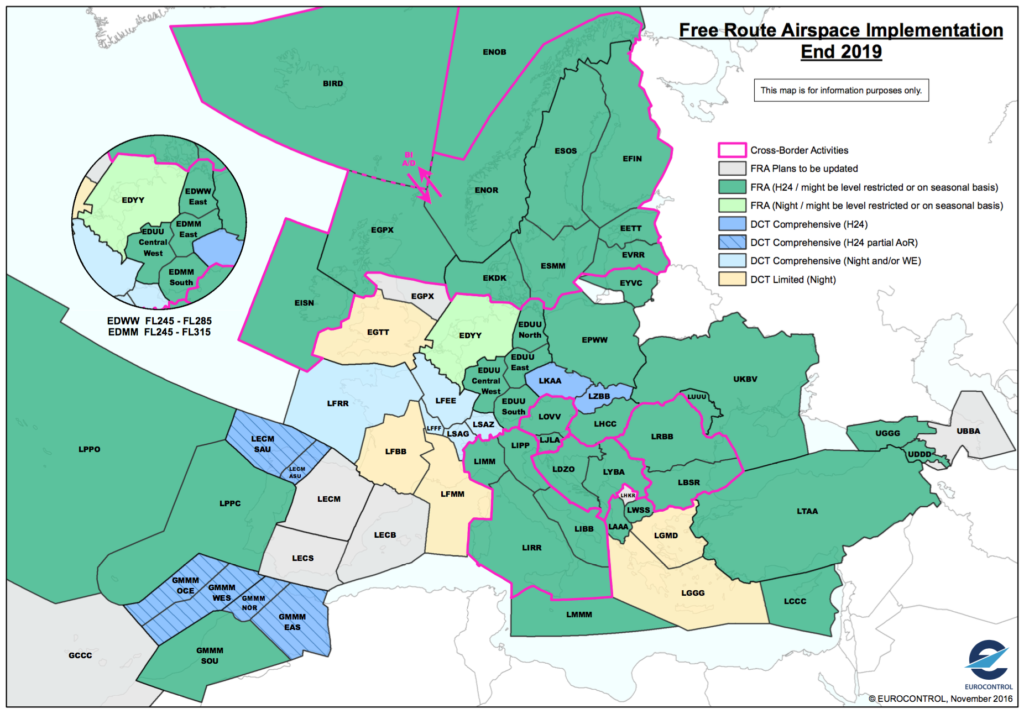
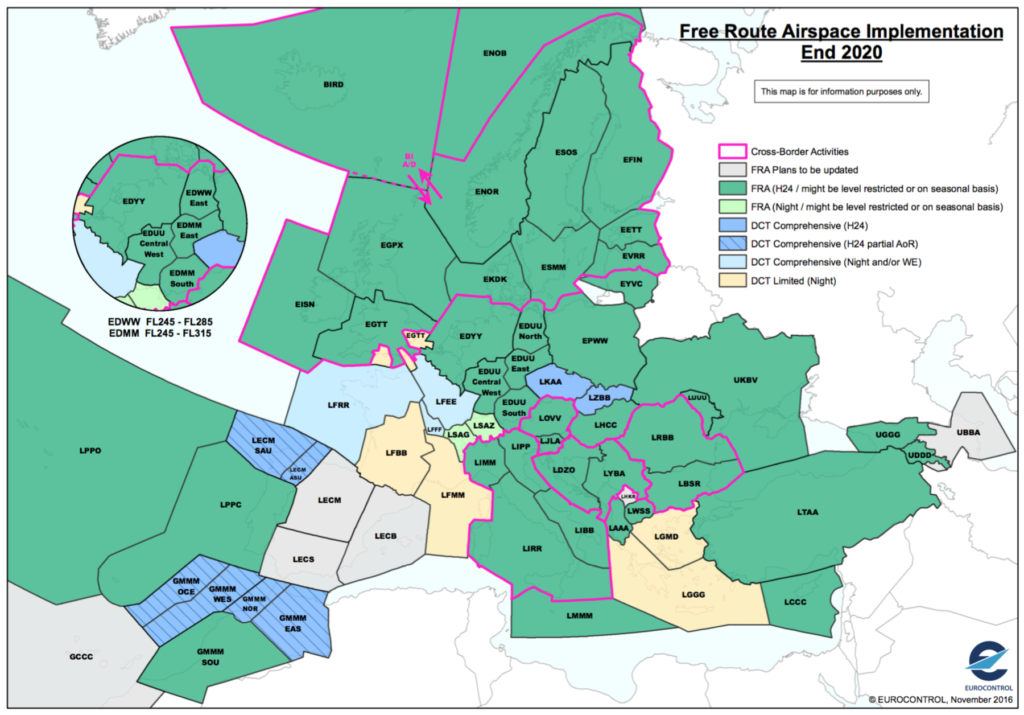
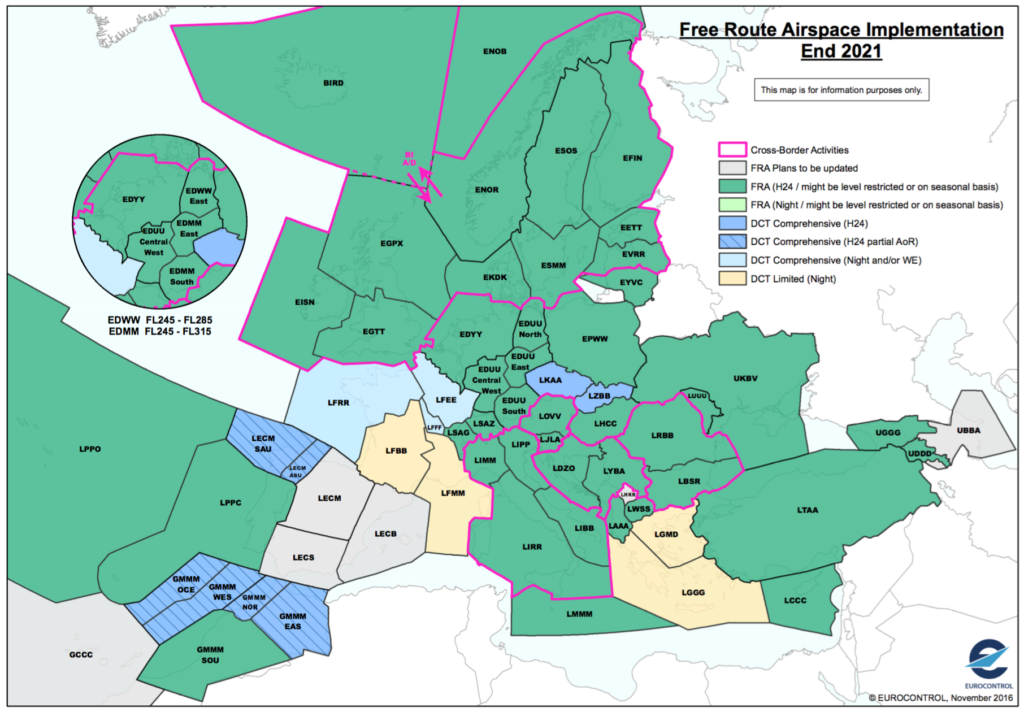
Sectors of airspace over southern Germany are ahead of schedule with plans to bring in Free Route Airspace (FRA). With effect from 1st March 2018, FRA will be implemented in the EDUU/Karlsruhe UAC, EDWW/Bremen ACC , and EDMM/Munchen ACC above FL245.

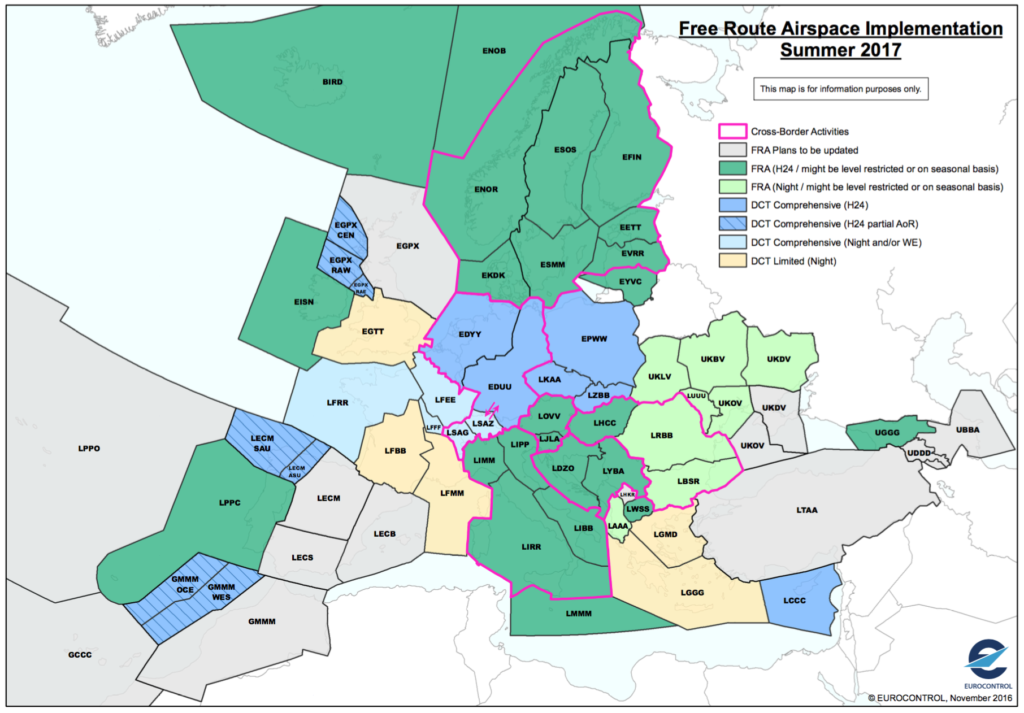
By the end of 2019, most European airspace is expected to have implemented Free Route Airspace, with all airspace having this type of operations by 2021/2022.

We like the idea of Free Route Airspace – direct routing is the way of the future. We also like cool maps. Thankfully, good old Eurocontrol have provided us with some great ones, showing where Free Route Airspace currently exists, and where it will be implemented in the future:

For everything you could possibly want to know about FRA in Europe, check out Eurocontrol’s page on it here: http://www.eurocontrol.int/articles/free-route-airspace


Europe now requires 8.33 VHF radios (almost) everywhere

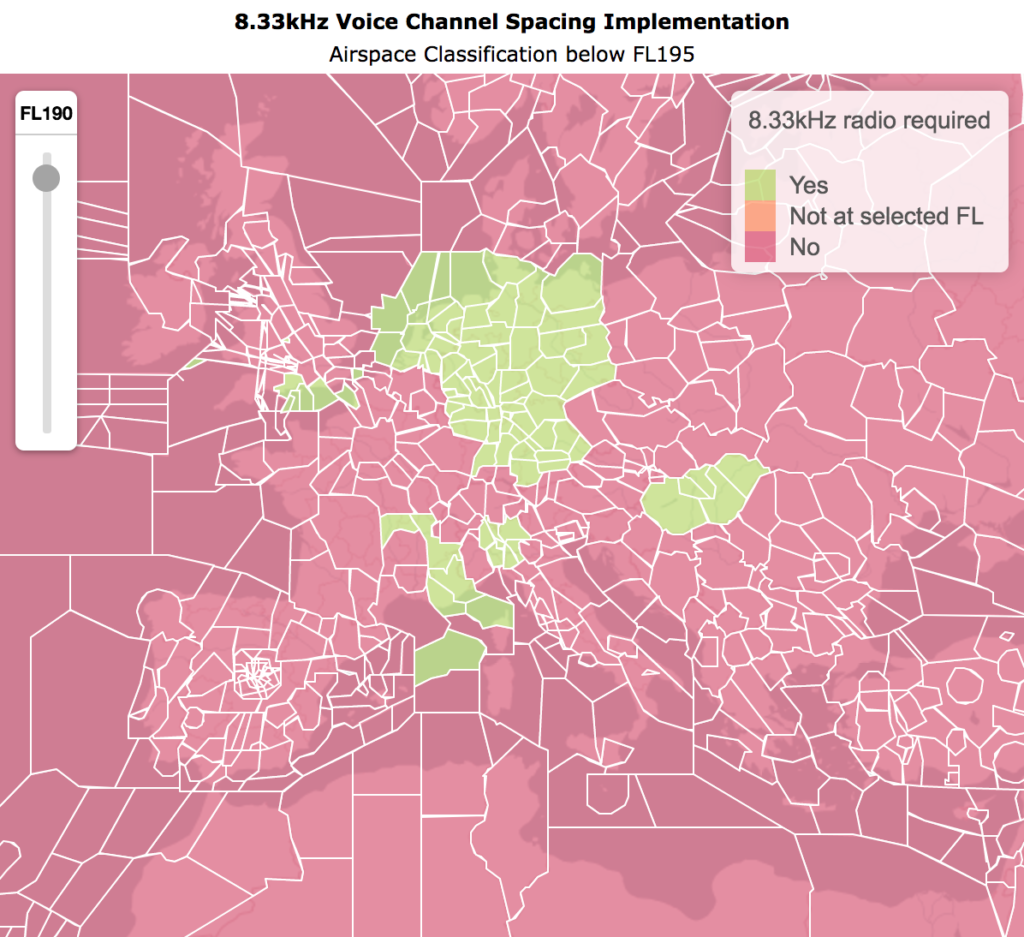
Effective January 1st, 2018, the official line is that you need an 8.33 VHF Radio to operate anywhere in Europe. If you’re heading to Europe without one, expect problems.

Until now, it’s really only been a requirement above FL195 – 8.33 has been around at the higher levels since 2007. However, Europe is keen to get everyone on the same page and make sure new frequencies can be used by all aircraft at the lower levels also.

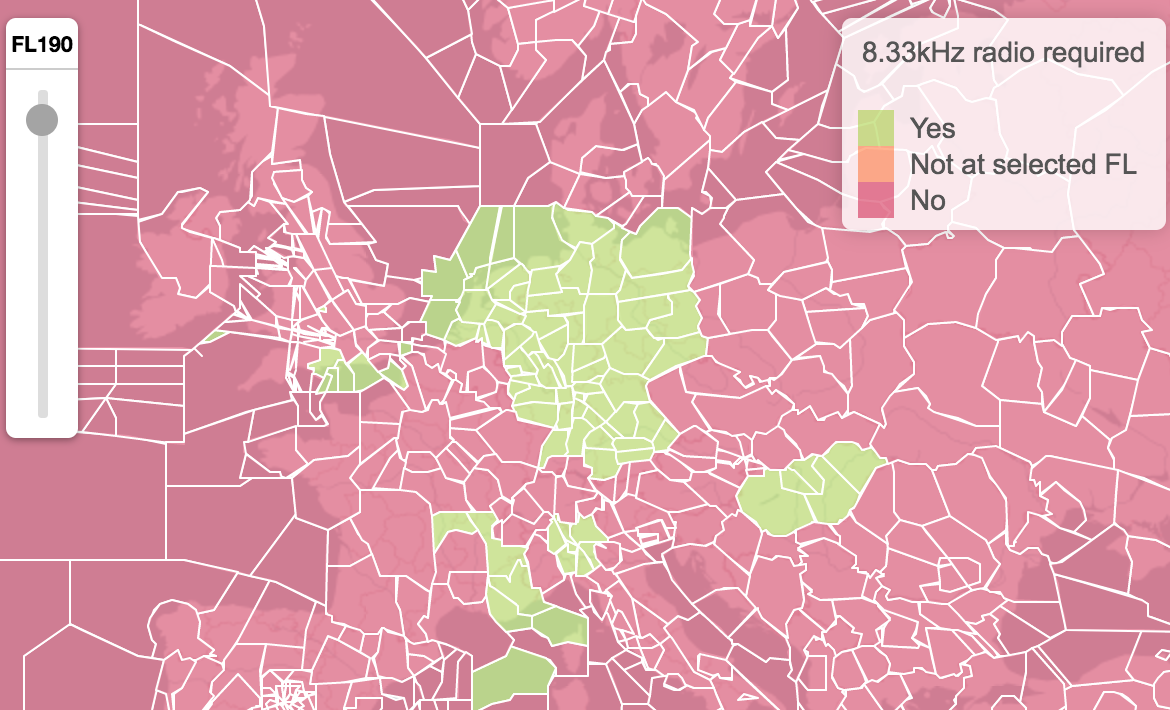
However, not everywhere is actually requiring 8.33 just yet.  Eurocontrol have built a handy tool that shows each the requirements for each airspace sector. Click on the image below to check it out.

Can I get an exemption? If you’re operating a ferry, delivery, or some other flight where you don’t have 8.33, then you should be able to get an exemption to operate without 8.33 – but it will vary state to state. Write to the Ministry of Transport for the particular state.

Eurocontrol have published all the details on this as follows:

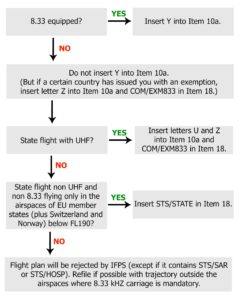
Above FL195, in the IFPZ, not equipped aircraft may be exempted from the carriage of the 8.33 kHz radios (refer to the national AIP of the state concerned to see if the flight is eligible) in which case the letter Y shall not be inserted in Item 10a (Equipment), but the letter Z shall be inserted in Item 10a as well as COM/EXM833 in the Item 18 (Other Information) of the filed flight plan.

Below FL195, in the airspace of the EU member states (plus Switzerland and Norway) some airspaces may be exempted from the carriage of the 8.33 kHz radios (refer to the national AIP of the state concerned) in which case the airspace is not inserted in the area where the mandatory carriage check takes place. Such exemption will permit a non-equipped aircraft to fly but only if the flight trajectory remains exclusively in airspaces where 8.33 kHz is not mandatory.

Below FL195, in the airspaces of the EU member states (plus Switzerland and Norway), state aircraft non-UHF and non-833 are exempted. The letters Y and U shall not be inserted in Item 10 (Equipment), but STS/STATE shall be inserted in the Item 18 (Other Information) of the filed flight plan.

In the IFPZ, State aircraft that are not equipped with 8.33 kHz capable radios but are equipped with UHF shall be permitted to fly in 8.33 kHz airspace where UHF coverage is provided or special procedures are implemented (see the national AIP of the State concerned). To indicate such, the letters U and Z shall be inserted in Item 10a (Equipment) and ‘COM/EXM833’ shall be inserted in Item 18 (Other Information) of the filed flight plan.


Confused? Here’s a quick crib-sheet of what to do:

When you file a flight plan in Europe, it goes through the automated IFPS system, which is now quite clever at checking for 8.33 kHz radio compliance.

The IFPS system will crosscheck between the concerned airspaces crossed by the flight plan and the radio communication equipment indicated in Item 10: (Equipment) and Item 18 (Other information) provided in the submitted message.

Here’s what will happen, depending on what you put in your flight plan:

  • If Item 10 (Equipment) of the submitted message contains Y, then that flight is considered to be compliant.
  • If Item 10 (Equipment), of the submitted message does not contain Y, but contains Z and U and the exemption indicator COM/EXM833 is present in Item 18 (Other Information), and the flight is a STATE flight, then that flight shall be considered compliant.
  • If Item 10 (Equipment) of the submitted message does not contain Y but contains the exemption indicator COM/EXM833 and the flight is not penetrating the 833_UHF_VHF region and is entirely within the 833_EUR_IFPS, then that flight shall be considered compliant.
  • If Item 10 (Equipment) of the submitted message does not contain Y, neither U and Item 18 (Other Information) contains STS/STATE and the flight is exclusively in the airspace of the EU member states (plus Switzerland and Norway) below FL195 then that flight shall be considered compliant.

In all the other cases, the flight shall be considered not compliant and shall fail automatic processing!


Israel moves closer to Eurocontrol

Israel has signed an agreement with Eurocontrol to work more closely together in flight planning.

Air traffic between Israel and Europe has been growing at over 9% a year for the past three years. This growth poses ongoing challenges to international civil aviation and underlines the need to improve ties between regions in order to ensure flight efficiency and safety in airspace and airports that are growing more crowded every year.

Israel is now the second country to sign the “Eurocontrol Comprehensive Agreement”.

What does this mean for operators?

The existing process is complex and multi-step: flights that transit Europe from Israel require filing at least 3 hours in advance to the Tel Aviv Coordination Centre, who then liaise with Eurocontrol to verify that the routing is RAD compliant. Changes are often then made by Eurocontrol and back down the line to the operator.

The implementation date is to be confirmed, but FPL filing out of Israel will now be the same as for any other European country, with immediate ACK from Eurocontrol.

Other benefits of this agreement are improved crisis management, more efficient traffic flows between Israel and Europe, more predictable day to day operations, improved safety and possibly airspace redesign and management.


Eurocontrol – Cargo Flights alerts

In 2012, the EU put in place the EU ACC3 program – air carriers that fly cargo or mail from a non-EU airport to an EU airport must ensure that all cargo and mail carried to the EU is physically screened or comes from a secure supply chain which is validated.

Air carrier stations in third countries are required to have undergone an audit to obtain an EU Aviation Security Validation in order to acquire or maintain their ACC3 designation. This validation needs to be reissued every five years, according to the EU Regulations.

On 01FEB16, Eurocontrol set up a NM ACC3 alerting system –  checking Flight Plans, and sending a message to the European Commission and the relevant EU Member State/s when a flight is identified as not having the correct ACC3 accreditation.


Midweek Briefing: Chinese Airport Delays, Eurocontrol NOP Changes

Chinese Airport Delays 03FEB ZXXX/China This is the busiest travel week of the year in China, with millions travelling for the Chinese New Year on 08FEB. Winter storms are forecast to impose delays across central Chinese airports; those currently affected include ZWWW/Urumqi Diwopu, ZSNJ/Nanjing Lukou, ZGGG/Guangzhou, and ZHHH/Wuhan Tianhe.

Eurocontrol NOP Changes 03FEB There are some significant changes to the daily Eurocontrol Briefings effective this week. Network News is no longer, and the D-1 daily conference is also gone. Instead, an Initial Network Plan is published each day at 1700Z on the Network Operations Portal.


TTxx/Trinidad and Tobago The annual Carnival in Port of Spain will take place on 08-09FEB . Travel and tourism activities are expected to continue for up to two weeks after the celebration and will be busiest during weekends. 10FEB (Ash Wednesday) is expected to be the busiest day of the year at the Port of Spain airport.

EISN/Shannon FIR Correction ** Due to a number of flights deviating from clearances prior to exiting Shanwick OCA, flight crews are reminded that Eastbound route clearances issued by Shannon Control for aircraft exiting Oceanic Airspace apply from AGORI, SUNOT, BILTO, PIKIL, ETARI, RESNO, VENER, DOGAL, NEBIN, MALOT, TOBOR, LIMRI, ADARA, DINIM, RODEL, SOMAX, KOGAD, BEDRA, OMOKO, TAMEL AND LASNO. Flights shall not turn before these points. In other words: wait until you enter (** Thank you to Shannon ATC for pointing out the error in last weeks bulletin).

North Atlantic Effective 04FEB MNPS Airspace is replaced by HLA/High Level Airspace on the North Atlantic – extended with Bodø joining Shanwick, Gander, Reykjavik, New York, and Santa Maria. RNP4 or RNP10 now required. Read our International Ops Notice 01/2016 or our blog post: Did you know MNPS is over?

Eurocontrol NOP Changes There are some significant changes to the daily Eurocontrol Briefings effective 01FEB. Network News is no longer, and the D-1 daily conference is also gone. Instead, an Initial Network Plan is published each day at 1700Z on the Network Operations Portal.

FMMM/Madagascar CAA have issued a reminder to inbound operators that a Passenger List must be sent 24 hrs prior to departure for Madagascar, by email to gdpx@acm.mg.

MKJK/Kingston FIR Jamaica, has ongoing issues with radar coverage and serviceability, leading to ad-hoc flow management procedures including 15 minute en-route separation, and 10 minute arrival separation at international airports. Delays appear likely. Reports welcome to bulletin@fsbureau.org.

FHAW/Ascension Island is now operating at Rescue and Firefighting Category 8/RFF8.

United Kingdom Last week the UK Registered Traveller Service, which is the equivalent of the US Global Entry program, was expanded to include a few more countries: Hong Kong, Singapore, South Korea and Taiwan. Additionally, Bristol and Cardiff will be added to the list of participating airports.

MUXX/Cuba Flight crews of US based aircraft can now remain in Cuba with their aircraft when traveling to the island nation, instead of having to reposition immediately after offloading passengers. The change took effect on 27JAN, with new amendments to the Cuban Assets Control Regulations and Export Administration Regulations issued by the U.S. OFAC and BIS.

NCRG/Rarotonga, Cook Islands has new hours of ATC service: 2050 SUN-0400 MON, 1500 MON-1930 MON, 0530 WED-1400 WED, 2100 THU-1000 FRI, 2100 FRI-1000 SAT, 1400 SAT-1930 SAT, 0600 SUN-1130 SUN. These are UTC/Z Times, local is UTC-10. Raro is an important diversion airport in the South Pacific, especially for Easter Island and Tahiti. ATC is avail with 30 mins PN outside these hours (call +682 25890/71439).

EHAM/Amsterdam has raised the minimum vectoring altitude from 1200ft to 1600ft, which seems to spell an end to those super efficient 3 mile final approaches to 06. Still the best Terminal ATC in Europe.

Europe EASA has launched a 2 person cockpit survey to open discussion on the impact of their new recommended practice of always having 2 crew members in the cockpit.

PKMJ/Majuro, Marshall Islands – ExxonMobil will have no fuel during tanker replenishment, scheduled for 13-17FEB.

ZXXX/China This is the busiest travel week of the year in China, with millions travelling for the Chinese New Year on 08FEB. Winter storms are forecast to impose delays across central Chinese airports; those currently affected include ZWWW/Urumqi Diwopu Int’l, ZSNJ/Nanjing Lukou Int’l, ZGGG/Guangzhou, and ZHHH/Wuhan Tianhe.

ENGM/Oslo Oslo Airport has started supplying Air BP Biojet via its regular fuel hydrant system, naming three large European airlines as launch customers. It is now is supplied from the main fuel farm, via common storage and distribution facilities, without the need for segregated infrastructure. Previously, it had to be provided by fuel truck.

DNKK/Kano ACC Nigeria, Area Radar Service is provided H24 from 04FEB.

View the full International Bulletin 03FEB2016