Delays and Diversions in Dubai

An OPSGROUP member reported that on Feb 21, several long-haul carriers were forced to divert due to extended airborne delays.

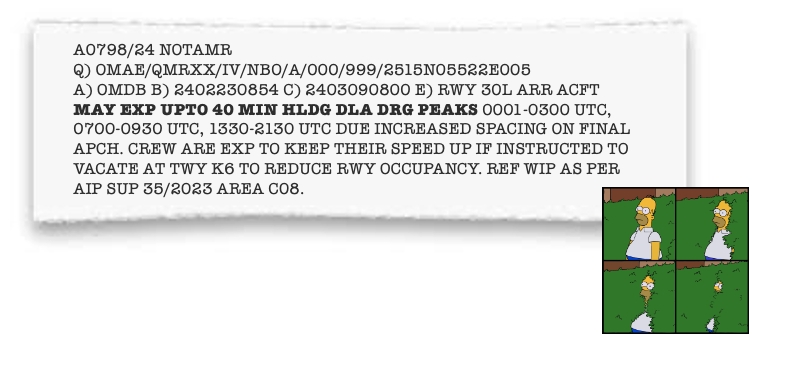
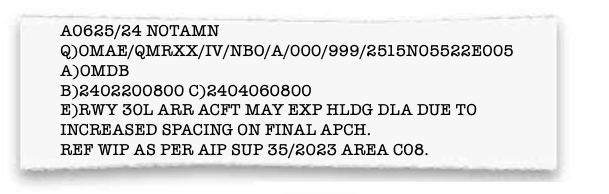
The problem stemmed from the following unassuming needle-in-a-haystack Notam…

 It was later re-issued (after-the-fact), somewhat sheepishly with an actual holding advisory …

The good news is that you can easily access the referenced AIP SUP online – provided you provide scans of your passport, your contact details, favourite colour, hobbies and the name of your first-born.

OR

You can just read the following summary of what’s been going on.

The Trouble SUP

You can read it in full here (but it’s heavy).

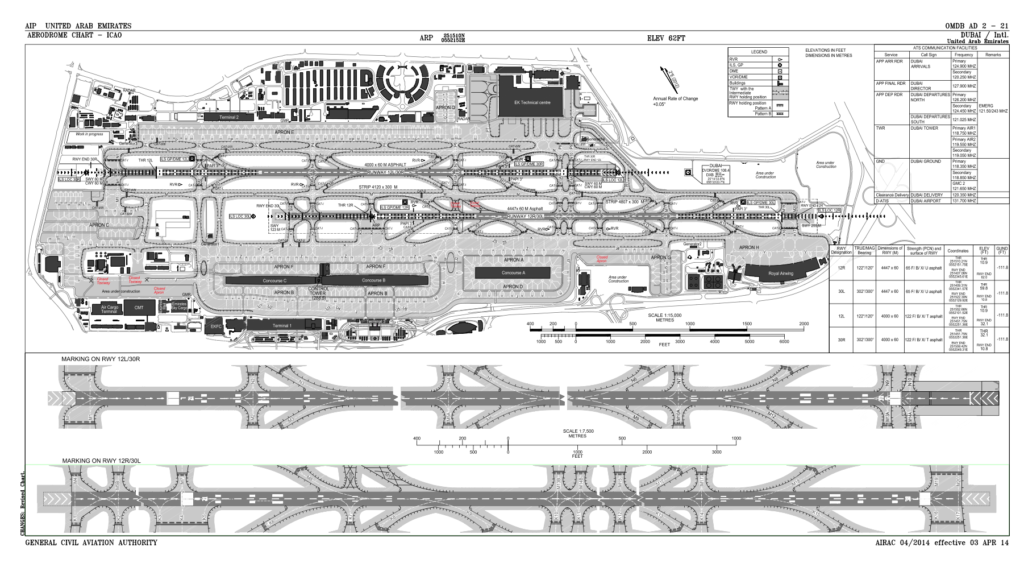
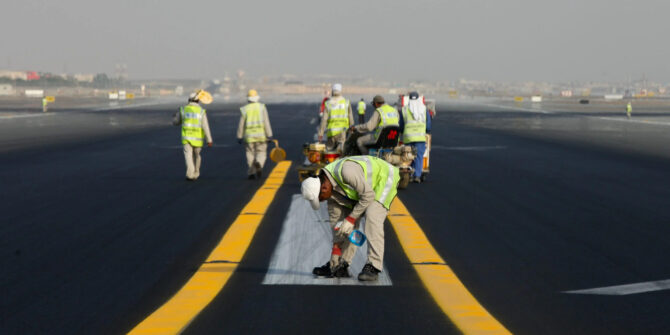
Basically, what you need to know is that there are ongoing taxiway works happening at the airport.

These are divided into areas, and the one causing issues is ‘C08’.

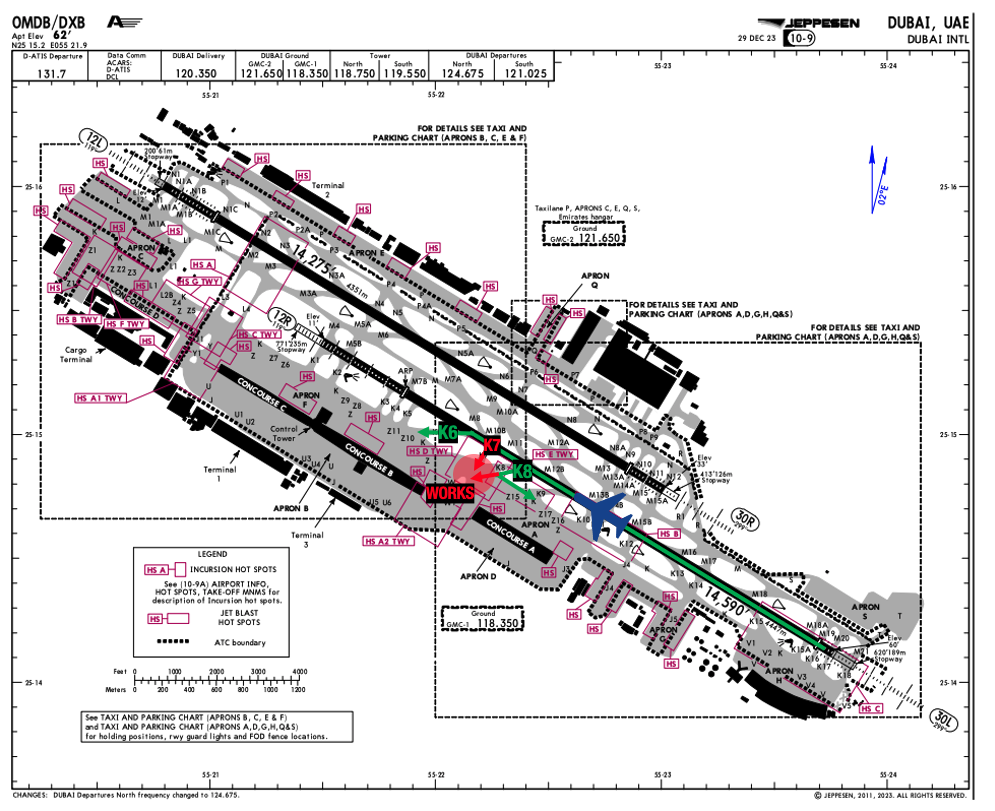
For Runway 30L, this is causing a bottle neck for aircraft exiting on the rapids bound for terminals 2 and 3.

The preferred exit (K8) is partially blocked by the works, along with the next non-rapid exit (K7) which is completely closed.

The next option is K6, which is further up the runway. The extra time needed to allow aircraft to vacate means increased spacing for arrivals. Word on the street is that frequent A380 ops are also compounding the problem.

Here’s what that looks like on a chart.

During peak times, arrivals are stacking up.

Those times are daily between:

  • 00:00 – 03:00z (04:00 – 07:00 LT)
  • 07:00 – 09:30z (11:00 – 13:30 LT)
  • 13:30 – 21:30z (17:30 – 01:30 LT)

If Runway 30L is in use, and you are arriving during one of these periods – carry at least an extra 40 minutes of holding fuel.

How long will this last?

The current Notam says until March 9, but may get extended. The SUP doesn’t provide an end date, and strangely the original Notam applied until April 6. In other words, your guess is as good as ours…

But wait, there’s more.

There are some other Notams hidden in the pile that include closures of the other runway (12L/30R) that infringe these times. That’s an average of seventy-five arrivals and departures per hour using the one problem runway – 40 minutes may still not be enough.

Please report back.

If you experience delays in Dubai related to works (or otherwise) we’d love to hear from you so we can share that info with the group. You can reach us on news@ops.group around the clock.


Say GooDubai to a runway for 45 days

OMDB/Dubai International airport (the main one in Dubai) is closing a runway again. But that’s not all. Another UAE based airport is also closing. And it is Ramadan.

So what will all this mean for operations into there?

The Dubai Runway Closure

This happens every few years. The last one was in 2019 where they shut the Southerly runway for 45 days to fix it up. Not it is the turn of the Northerly runway again – 12L/30R.

The closure is from May 9 to June 22, and it does mean a pretty big reduction in capacity at what is the busiest airport in the world in terms of international passenger numbers.

But…

The Dubai runways are actually too close together for proper simultaneous ops meaning the closure of one does not mean a halving of capacity. On top of that, the biggest operators into the airport are all planning some reduction in their flights during this period, or are sending a portion of their flights over to OMDW/Dubai Al Maktoum which is just down the road (20 miles or so).

So…

So if you operate in during peak times (the worst is between 7-11pm UTC) then take some extra fuel for holding delays. You also can’t file OMDB as an alternate during peak times (and that’s during normal ops, so definitely don’t try it during the closure period).

The other airport out in the UAE closure

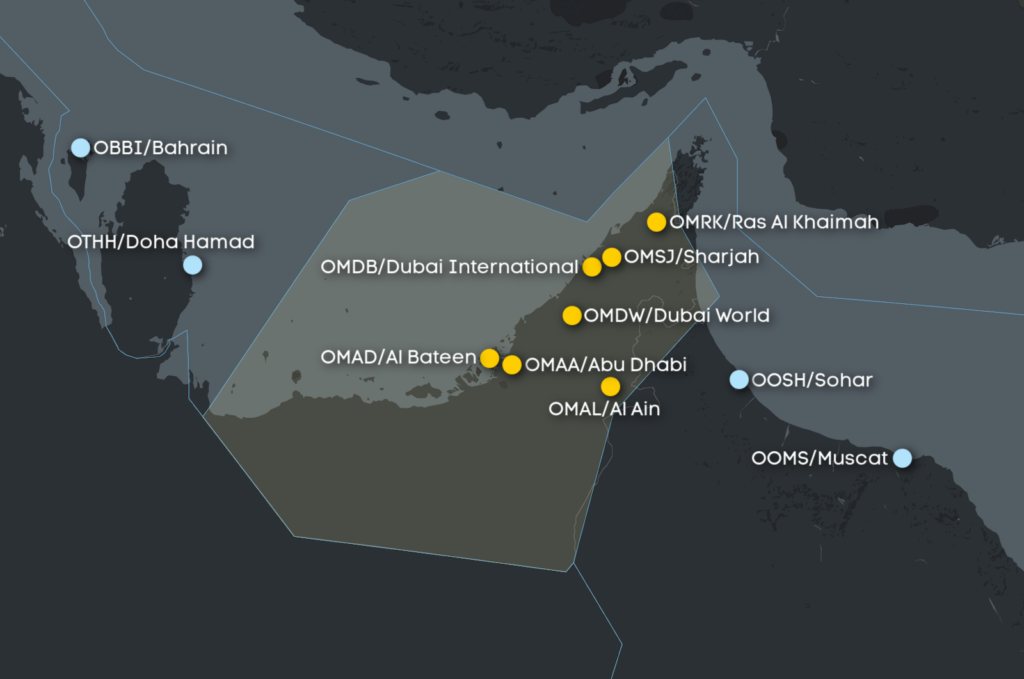
OMAD/Al Bateen is a small but quite busy executive airport near OMAA/Abu Dhabi, which just caters for private jet ops. This airport will be completely closing from May 11 to July 20.

So what options do you have?

  • OMAA/Abu Dhabi International is the main airport for the UAE. They generally prefer not to be used as an alternate for Dubai bound flights since they are very busy.
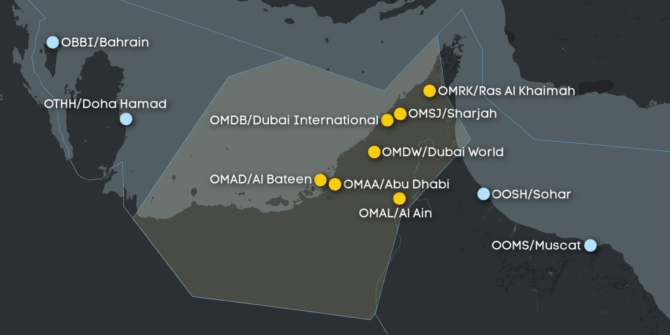
  • OMSJ/Sharjah International is the next door neighbour to OMDB/Dubai (around 20km north and you fly past it on some Dubai arrivals). Runway 12/30 is 13,320 ft long with an ILS either end. Watch out if OMDB is getting foggy though because OMSJ won’t be far behind given it is also close to the sea, and it will fill up fast with diversions if it isn’t.
  • OMDW/Dubai World is the slightly smaller international Dubai airport just next door. Mainly used for cargo flights, it offers a good alternate to OMDB. There is limited parking and fuel trucks though so if you divert here on a day a lot are diverting then expect long delays. Runway 12/30 has CAT 3 ILS both ends and is 14,764 ft long
  • OMRK/Ras Al Khaimah is a decent airport to consider as an alternate with an ILS on 34, an RNAV on 16 and 12,336 ft of tarmac between the two ends. Watch out for terrain here though.
  • OMAL/Al Ain has a 13,140 ft runway with ILS/RNAV approaches. Another UAE option for an alternate.
  • OMFJ/Fujairah can be a good alternate (especially when the weather gets foggy as it is on the Eastern side of the peninsular and less susceptible).
  • OOMS/Muscat is slightly further afield in neighbouring Oman, but included here because its often used as an alternate. 08L/26R is currently the only operational runway. It offers an ILS either end and 13,123 ft. Muscat is a decent fuel and tech stop if routing from the Far East.

Some other info on the UAE.

The UAE only became the UAE fairly recently. Before that it was seven separate emirates and a big port in Jebel Ali which the Brits took an interest in. When they got their independence from Britain, the emirates joined up, led by Abu Dhabi. Dubai is the most westernized of the all emirates.

During Ramadan, be cautious about eating and drinking in public, but beyond that there is not huge difference for foreign visitors visiting Dubai and Abu Dhabi, just remain respectful of their culture and customs. Sharjah is much stricter.

Conditions across the UAE (like all the Middle East) can be challenging:

  • Extreme summer temperatures leading to brake temperature issues, hot fuel etc.
  • Dubai can see some nasty lingering fog during the more humid months
  • Cloud seeding is common and often leads to large storms building up. When it rains everywhere (including airport aprons) tend to flood.

Other challenges?

  • Holding for Dubai can bring you close to the Iranian border
  • Departures can enter Iran quickly so ensure you call the ADIZ early if routing that way.
  • Watch out for the Burj Khalifa – World’s  tallest building. It is near the airport.
  • Conflict is common across the whole Middle East region. Monitor Safeairspace for the full lowdown on risk in the region.

For more operational info on Dubai, the UAE, and the Middle East in general – check out our earlier post here.


Middle by Middle East

A lot of people lump ‘The Middle East’ together into one singular region of “Middle Eastyness”, but actually each country is very different, particularly during Ramadan. Each has diverse cultures and rich histories, very different political interests, and of course their own unique operational and environmental challenges that pilots should know a bit about before heading in.

So, here is your ‘In the Middle of the Middle’ guide to the ‘Middle East’ (or at least the parts of it you’re likely to need to know about.)

Starting with the ‘Need to Know’

The UAE

The UAE only became the UAE fairly recently. Before that it was seven separate emirates and a big port in Jebel Ali which the Brits took an interest in. When they got their independence from Britain, the emirates joined up, led by Abu Dhabi. Dubai is the most westernized of the all emirates, and each pretty much has its own international airport.

  • OMAA/Abu Dhabi International is the capital airport for the UAE. They generally prefer not to be used as an alternate for Dubai bound flights since they are vert busy.
  • OMDB/Dubai International is the main Dubai airpot, and the busiest airport by passenger numbers in the world. You have two parallel runways 12/30 left and right with CAT III approaches.
  • OMSJ/Sharjah International is the next door neighbour to OMDB/Dubai (around 20km north and you fly past it on some Dubai arrivals). Runway 12/30 is 13,320 ft long with an ILS either end. Watch out if OMDB is getting foggy though because OMSJ won’t be far behind given it is also close to the sea, and it will fill up fast with diversions if it isn’t.
  • OMDW/Dubai World is the slightly smaller international Dubai airport just next door. Mainly used for cargo flights, it offers a good alternate to OMDB. There is limited parking and fuel trucks though so if you divert here on a day a lot are diverting then expect long delays. Runway 12/30 has CAT 3 ILS both ends and is 14,764 ft long
  • OMRK/Ras Al Khaimah is a decent airport to consider as an alternate with an ILS on 34, an RNAV on 16 and 12,336 ft of tarmac between the two ends. Watch out for terrain here though.
  • OMAL/Al Ain has a 13,140 ft runway with ILS/RNAV approaches. Another UAE option for an alternate.
  • OMAD/Al Bateen is a small but quite busy executive airport near OMAA/Abu Dhabi, which just caters for private jet ops. This airport will be completely closing from May 11 to July 20.

We put together a little regional brief on this with some handy contacts for you.
Saudi Arabia

Saudi Arabia is the largest country in the Middle East.

They are a major world economy, the third biggest producer of oil (behind the USA and Russia) and the largest exporter. It is also at the heart of the Islamic religion and you need to bear their customs and laws in mind if heading in there. Women are expected to dress modestly and cover their heads, and alcohol, swearing, gambling etc is forbidden. This will be much more strictly enforced during Ramadan.

  • OEJN/Jeddah – long taxis possible. Keep an eye on those brake temperatures. This airport can accommodate the most number of aircraft in the world so… it’s big! There are no less than three runway 16/34s here. The longest is 13,123 ft and all of them have an ILS approach. Jeddah has recently been targeted by drone attacks and the southern Jeddah FIR (close to Yemen border) should be avoided).
  • OERK/Riyadh – high elevation airport with steeper than normal GS on some approaches. You have two runways to chose from, although they tend to stick to one for takeoff and one for landing. 15R/33L is the longer of the two, offering 13,797 ft (a whole 2 ft more than 15L/33R)
  • OEDF/Damman – Often keep you high or use track shortening. 34L/16 R and 34R/16L are both 13,123 ft long with an ILS approach.

Because of the ongoing conflicts with neighbors, Saudi have a procedure called ESCAT (used to be called SCATANA) which is basically an emergency procedure when the airspace is under threat. If they announce it, be prepared to follow whatever instructions given – probably either to leave the airspace, or to land where they tell you.

  • Consider what your alternative routing options or alternates will be in advance. ESCAT has been activated more frequently of late, and this may mean long holding at the boundary of their airspace.
  • Egypt is available to the west, but Israel may not accept you if you haven’t advised them in advance. The process for landing and overflying Israel is still quite lengthy and dependant on where you come from, are registered, who you carry etc.
  • Jordan is available, but Syria is a no go country, and landing in Iraq is less advisable.
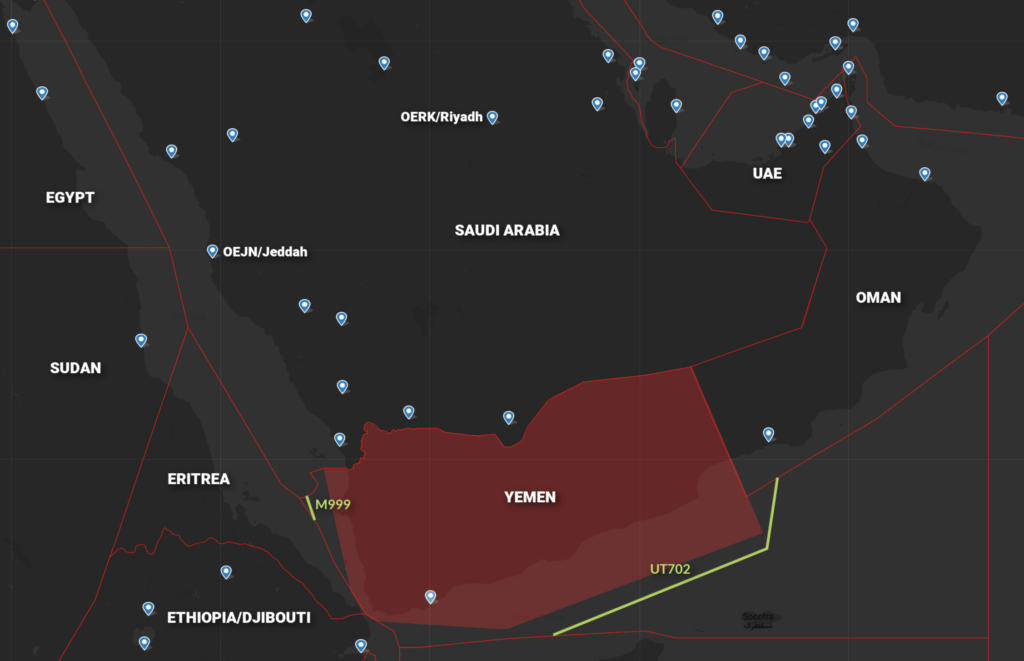
  • Yemen to the south is a no fly area.

Full info on ESCAT is found in their AIP. We wrote a bit about the Yemen conflict threat here.
Oman

Oman is a funny shaped country with a bit above the UAE and most of it below, bordering Yemen. They generally aren’t too political and get on with everyone.

  • OOMS/Muscat is the main airport. 08L/26R is currently the only operational runway. It offers an ILS either end and 13,123 ft. Muscat is a decent fuel and tech stop if routing from the Far East.

Iran

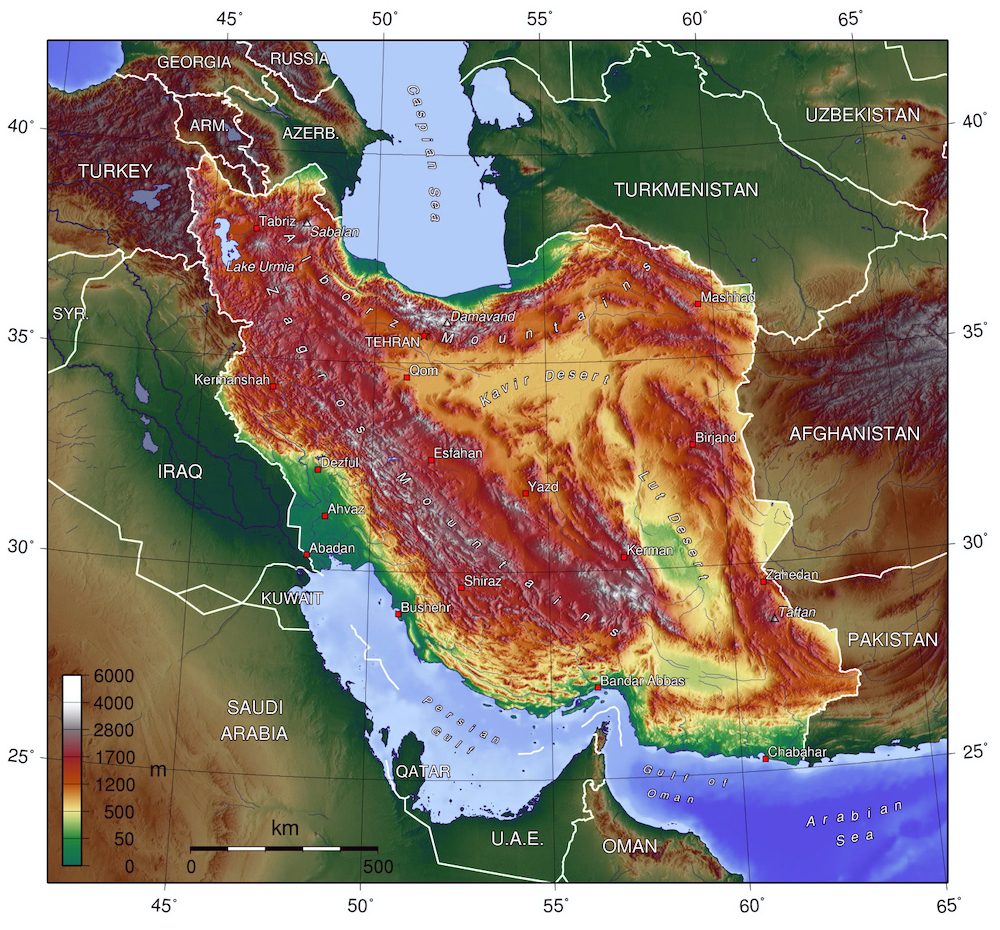
US operators are not allowed to overfly Iran, and there are overflight warnings associated with the country. If you do overfly and need to divert in the country, be aware that if you are coming from other countries, or have some nationalities onboard, this might cause some problems for you on the ground.

If you operate in with female crew, expect them to be asked to cover their heads leaving the airplane at some airports. There are also potential issues with lack of female security staff and crew have reported female pilots being asked to let their male co-pilot carry out walk-arounds to avoid difficulties with male security staff escorting a female.

The main airport OIIE/Tehran is a pretty decent one to go into though, although it is in the middle of some high terrain.

  • OIMM/Mashad – Another high altitude, high terrain airport with two decent length parallel runways (longest being 12,861 ft). Only 31R has an ILS approach (VOR DME on the rest) and you can likely expect a procedural to the ILS. Watch out on the GA because there is a large Holy Shrine which you are not allowed to fly over below 6000′
  • OISS/Shiraz – Right in the middle of a load of terrain. Not easy approaches to fly. The longest runway here is 14,200 ft and only 29L has an ILS. The GA on this is another one to watch – a lot of turns to keep you away from high ground.
  • OITT/Tabriz – Ok, all airport in Iran have high terrain around them. Tabriz is no exception. A little easier since it is only on three sides. Like the others, it has two decent length runways, but limited taxiways. There is an ILS approach onto 30 L and R but if you want to land onto either runway 12 you will need to circle…
  • Most smaller airports are not always well maintained. A quick Notam search shows up no less than 16 holes in poor runway 30 at OIIP/Payam Interational, and OIII/Tehran International (the other one), OIBB/Bushehr, OIHH/Hamadan, OINZ, OITL, OIMS… also come up

Jet Business Solutions, based in the UAE, can assist with support and handling in Iran – ops@jbs.aero
Qatar

  • OTHH/Doha Hamad is the main airport here. Doha is one of the most modern airports in the world and fantastic for passengers. The longest runway is a whopping 15,912 ft and there is a CATIII approach onto all four. The airport and ground operations here tend to be very efficient.

It is nice to operate into because it is built out on its own little bit of land. The city is quite futuristic looking and its a nice view on approach. There is high terrain close by so watch out for GPWS warnings if you mess up your tracking or speeds. The buildings also lead to wind shear and turbulence on approach.

While fairly westernised like Dubai, Qatari customs and laws can be stricter and should be carefully observed during Ramadan.

Kuwait

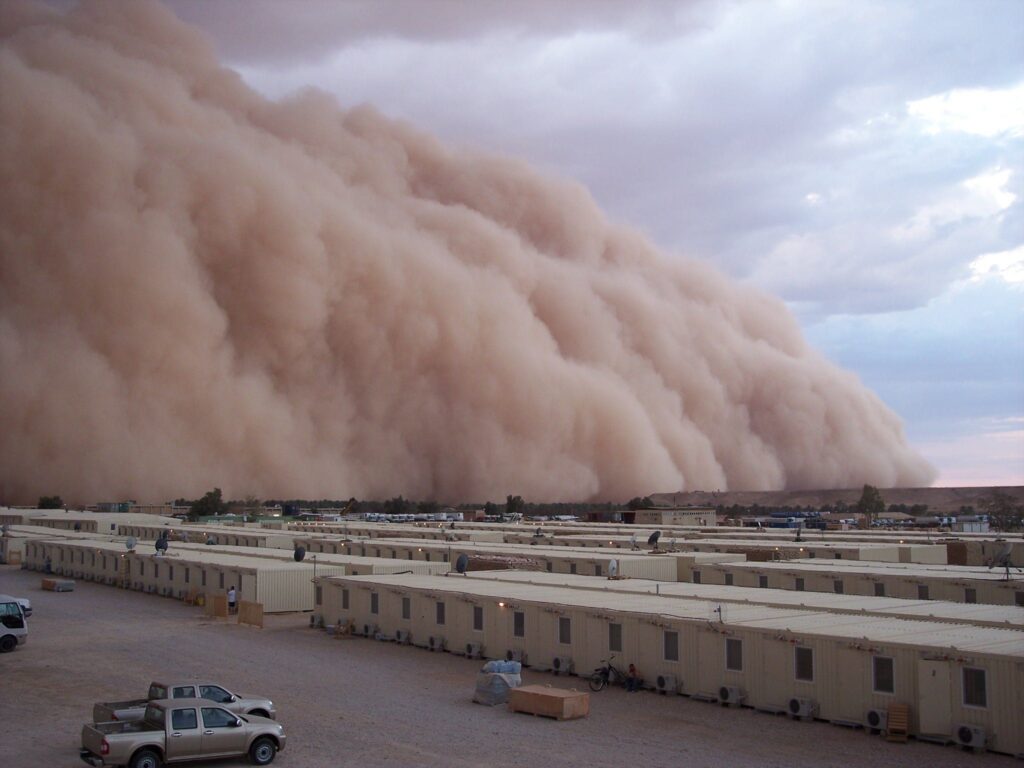
  • OKBK/Kuwait – pretty restricted airspace close into the airport so be careful if deviating. Get those calls for weather in early. This is another big airport with long but efficient taxis. Kuwait is more prone to big sand storms than some of the other areas. The longest runway is 11,483 ft and there is a CATII approach onto all four. Watch out if you’re operating on the 15s though – the taxi can be long and brake temperatures can heat up fast.
Bahrain

  • OBBI/Bahrain – This airport gets a lot of thermal activity in the summer to watch out for turbulence on short finals. The runways 30L and R have been known to confuse folk in the past as well. 30R is the long one in case you’re not sure (13,305 ft vs 8,301 ft so the difference should be quite obvious).

Iraq

  • US operators are permitted to overfly the ORBB/Baghdad FIR above FL320, but landing there would be unadvisable due to conflict, security and safety concerns.
  • ORER/Erbil, ORBI/Baghdad, ORMM/Basra, ORNI/Al Najaf international airports are all fairly well equipped.

Safeairspace

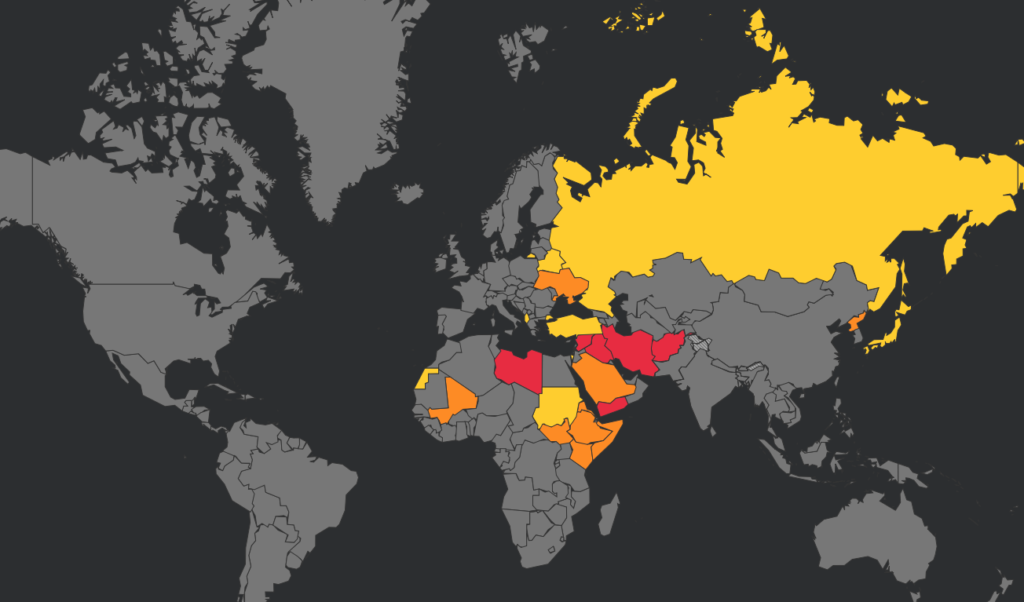
Conflict is common across the region. Currently several countries are no fly areas, with cautions applied to others. Visit Safeairspace for full information on the current status.

  • Syria is a no fly country
  • Yemen is a no fly country
  • The southern Jeddah FIR (Saudi Arabia) and OEJN/Jeddah airport have cautions due attacks from Yemen
  • Iraq can be overflown, but with certain restrictions
  • Iran is off limits to US operators
  • Israel has political tensions with neighbouring countries. Overflying and landing is possible but requires pre-planning
  • Lebanon has some risk due to proximity to other conflict nations.
Why fly to the Middle East?

It is very central and provides a connection between the west and the Far East and Asia. The main airports offer good tech and fuel stop options.

It is also an interesting region. There is great golf in Dubai, World Heritage sites in Saudi and Iran. And then of course there are the Finance and Oil Industries so corporate companies might find themselves flying business folk over. So, if you are ever operating in make the most of the layover, there are some cool sites to see and interesting things to see and do.

And ending with some ‘Good to Know’.

Some history of the region if you want to read some more. And a little mention is necessary because conflicts and Safeairspace aside, actually the political goings-on of the region are fairly important to our airplane goings-on.

For example, until the end of 2020 Israel was out of bounds. You could not fly across it if you were routing from a big old bunch of places. It was BIG news at the end of 2020 when the likes of Saudi Arabia and the UAE rebuilt their relationship with Israel and agreed to flights between the nations. Neighbors followed suit, and Jordan now also allow flights passing over Israel to utilize their airspace. Being able to fly across Israel significantly shorterns the flight time for aircraft routing from the Middle East and Europe.

A second big political/ aviation newsworthy event was the ending of the Qatar blockade by Saudi, the UAE, Egypt and Bahrain. Obviously, this primarily helped Doha bound flights, but for all operators in the region it means easier airspace and radio work, and the opportunity to once again use OTHH/Doha as an alternate. 

The politics of Iran and Iraq mean if you are routing through one airspace, you probably should not divert into the other. Iran is the bigger worry here because they have an ADIZ and need you to check in prior to entering their airspace. One of the main southbound routes through Iraq (UM688) brings you close to the Tehran FIR border, and if you meet a big thunderstorm along the way and deviate in the wrong direction, you might just find yourself accidentally edging over the border. The same goes for routing along the M677 in Kuwait. If you are heading to Dubai, the VUTEB hold sits close to the border and again, weather can push you close to the FIR boundary.

The tensions with Iran and much of the rest of the Middle East are constantly simmering. One big no-no on your routings here is to refer to the Arabian Gulf as the Persian Gulf. At least to the wrong controller.
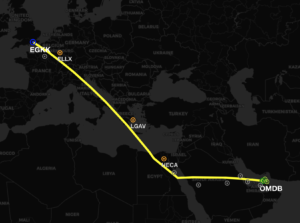
Dubai to London – which way is best?

In Short: Two main options, via Saudi and Egypt (safer, cheaper but longer) or via Iran and Turkey (shorter, busier and geo-politically more unstable). It’s a complicated planning climate at present. Review regularly based on latest risk factors.   

There are more business aviation operators flying between the Middle East and Europe than ever before. So we took the time to look over the route options between the two regions. For our example we will be using a flight from Dubai to London, but similar operational considerations are valid for the plethora of route combinations through this whole region.
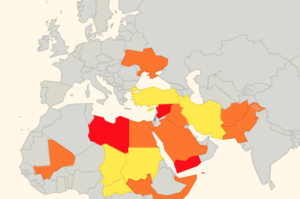
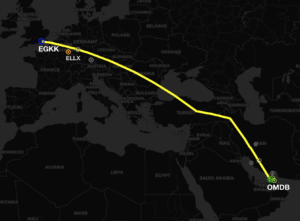
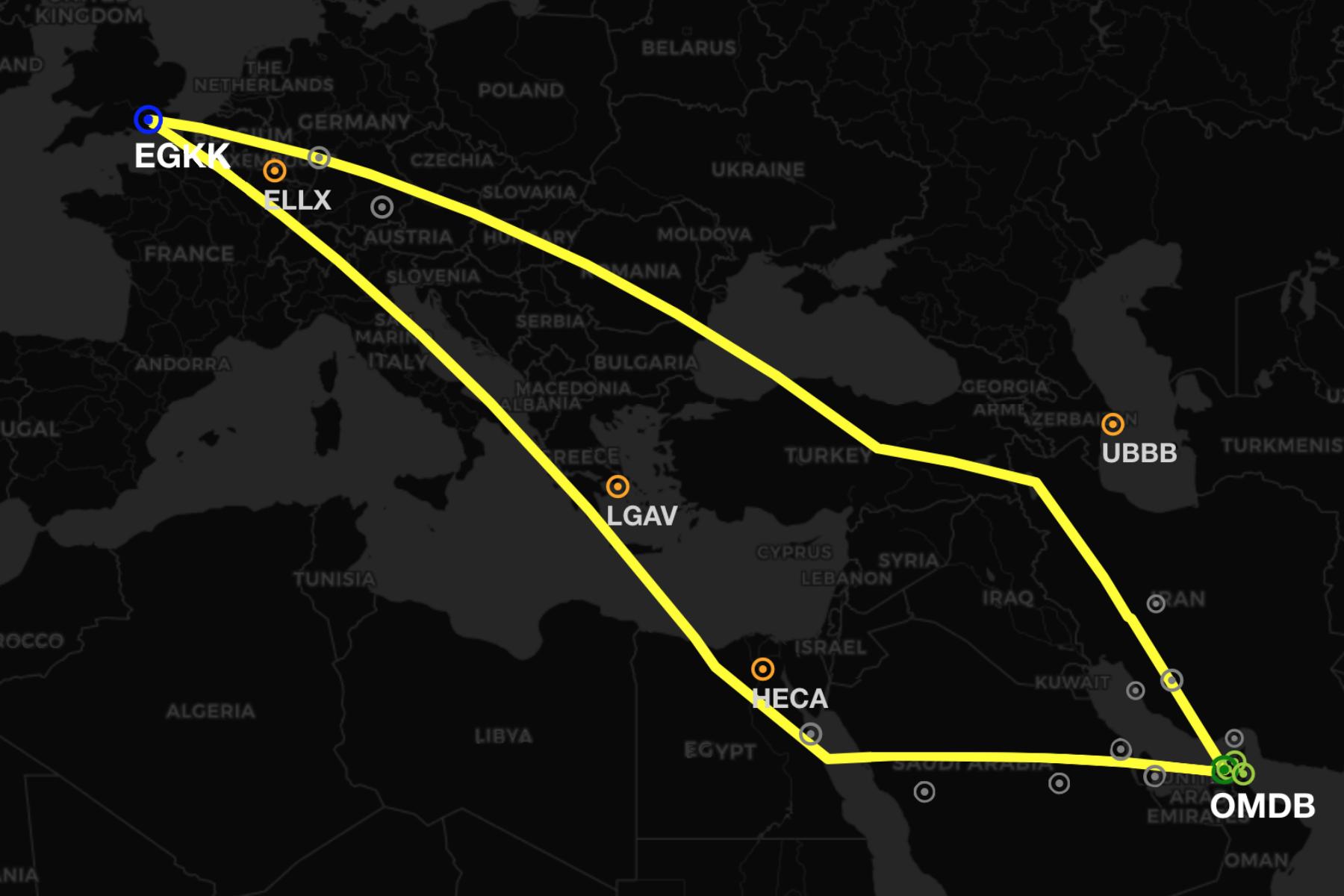
Firstly, we are sure you are a frequent visitor to our safe airspace website. Updated all the time with the latest notes and risk recommendations based on the latest intel. So, first things first, we want to avoid Syria, Libya and the Sinai Peninsula. As you can see however, this is a complicated geo-political region for flight planning. The direct great circle route would take us through Syria and would be around 3125nm. But that isn’t going to work. So, what else we got?

We will look at the two ways to head over the region. One is via Iran, Turkey and onwards to Europe. The other over Saudi Arabia and Egypt towards Europe.

Option 1: Iran/Turkey

Safety: Both Iran and Turkey are FSB Risk Level: Three – Caution. Iran is involved in the ongoing conflict with Syria and several Russian missiles crossed the Tehran FIR and several busy international routes. There are also increased tensions between the USA and Iran at present – if you had to divert in an N-reg aircraft, Iran would not be the friendliest of places to do so. Turkey borders with Syria and we have received multiple reports of GPS interference in the area.

Distance: an extra 100nm.

Time: About 15 minutes longer than great circle route.

Ease and Cost: Iran has higher overflight costs and for US based operators a reminder of the sanctions for dealing directly with Iran, or agencies in Iran. You’ll want to use an approved agent if you’re from the US (i.e.–not an Iranian company). Iran doesn’t work on Fridays, so be aware there. Turkish overflight costs are reasonable and remember that Turkish authorities require the use of an agent to apply for permits.

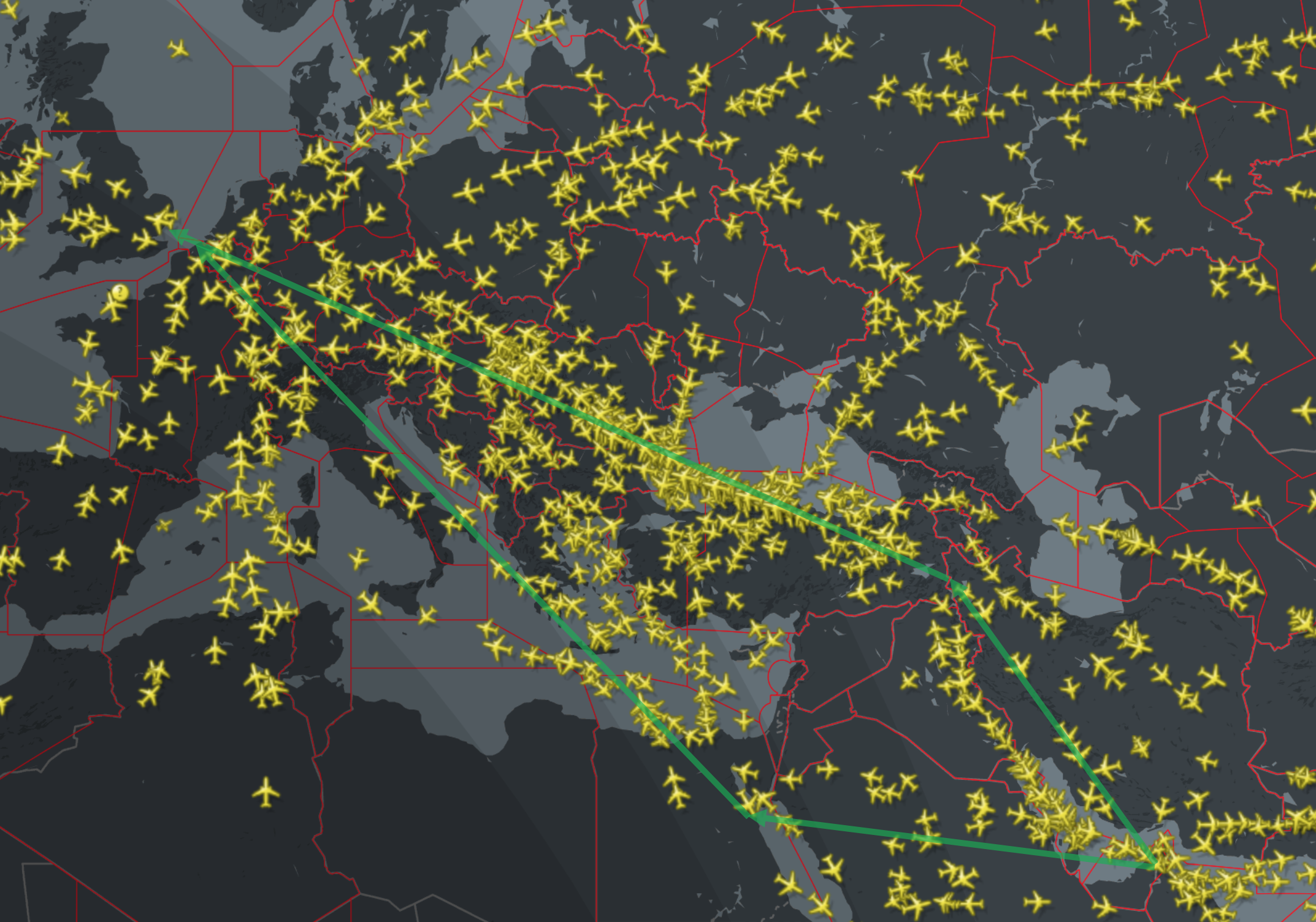
Traffic: The biggest issue with this route is that everyone is using it! It’s congested with a lot of airline traffic. It’s a major corridor for Asia-Europe flights also. So, getting the levels you want, and off route deviations are more complicated. Things get busy, as you can see!

Option 2: Saudi/Egypt

Safety: In terms of airspace warnings and risk, this route is slightly better. We have rated Saudi and Egypt airspace as FSB Risk Level: Two – Assessed Risk. Beyond the Sinai Peninsula and the Saudi/Yemen border, generally there is less of a chance of airspace security risks at present.
Distance: An extra 300nm from the great circle.

Time: Around 45 minutes longer.

Ease and Cost: Saudi and Egyptian airspace are generally a cheaper option ($1,000USD+). In Egypt, by law you have to get your permit through an Egyptian agent, but it’s a straight forward process. In Saudi, again, using an agent is best; they normally have three-day lead time – so keep that in mind. Also remember that the CAA only work Sun-Wed during office hours.

Traffic: For most of the day, much less of a traffic bottle neck.


Bottom line

Of the two options, routing via Saudi/Egypt is cheaper, and safer (as long as you steer clear of Egypt’s Sinai Peninsular and Saudi’s border with Yemen), but it’s going to take slightly longer.

What about Iraq?

We don’t think it’s a good idea. There’s a lot of information out there saying certain airways are ok but only at higher levels. But if you needed to get down fast, or even make an unexpected landing, Iraq isn’t the place you would want to go at present. Treat with caution.

Which one is your favourite choice? Let us know!

Further reading:


Missile attack on OERK/Riyadh was “warning shot”, other airports now targets

Update: Yemen-based Houthi forces fired another missile into Saudi Arabia on Dec 19. Saudi Arabia claim they intercepted it south of the capital Riyadh, with no damage or casualties reported, though a loud explosion was heard throughout the capital. The Houthi forces claim they were targeting a palace in southern Riyadh. This follows the previous Houthi missile attack on OERK/Riyadh Airport on Nov 4th, when they said: “the missile that targeted King Khalid airport was a warning shot and we warn all companies to prevent landing of their planes in the UAE and Saudi Arabia airports”. A Yemeni Army spokesman has said that the November 4 missile attack on OERK was a “warning shot”.

That missile was launched from rebel territory in Yemen, specifically targeting OERK/Riyadh King Khalid airport. Although most mainstream media carried the “missile was intercepted” story, we’re not sure that this is the case – even if it was, parts of it did fall on airport property and there was a visible explosion.

The spokesman said “the missile that targeted King Khalid airport was a warning shot and we warn all companies to prevent landing of their planes in the UAE and Saudi Arabia airports”.

Given that the Yemeni rebels have demonstrated their capability of reaching their target, there is some credibility to the threat.

Operators should consider this in operations to OE** and OM** airports.

At present, there is no indication of increased threat to overflight of Saudi or UAE airspace.

On Monday, the Saudi Arabia coalition closed all air, sea and land borders with Yemen after the missile strike on Riyadh on Nov 4, effectively closing all airports in Yemen. Yemenia airlines said that the coalition, which controls Yemen’s airspace, had declined it permission to fly out of Aden and Seiyun, the only two remaining functioning airports. OYSN/Sanaa has been closed since August 2016.

Also, all UN humanitarian flights to Yemen, one of the few international operators, have been cancelled after flights were no longer given clearance from the Saudi-led coalition to land in the country.

SCATANA remains active in the southwestern portion of the Jeddah FIR, no new Notams have been issued in relation to the last few days.

For further:

  • Monitor Saudi Arabia page on SafeAirspace
  • Monitor OPSGROUP member updates
  • Talk to us at team@fsbureau.org


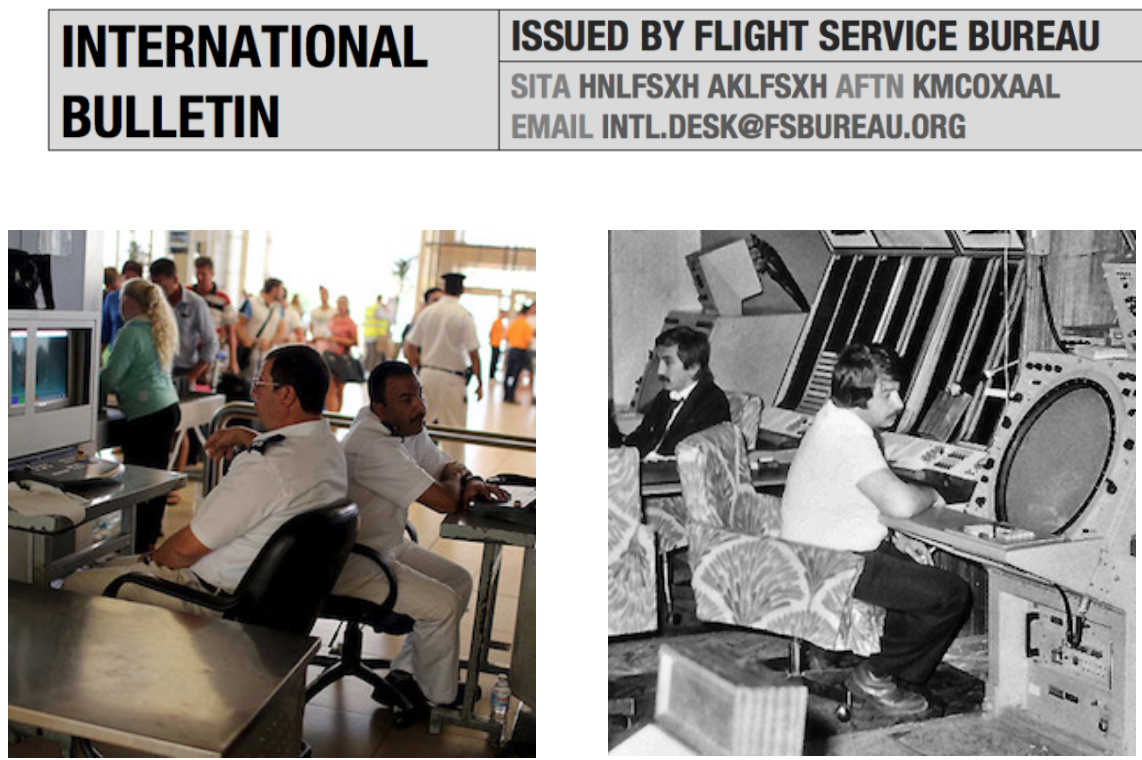
International Bulletin: Sharm El Sheikh reopens, New ICAO Phraseologies 10NOV

Sharm El Sheikh reopens 03NOV  HESH/Sharm El Sheikh, Egypt has reopened to international traffic, with a number of airlines starting services again on 01NOV. However, there are conflicting views on security at the airport, depending on your state of registry. Read article.

New ICAO Phraseologies 03NOV From 10NOV, new international aviation phraseology for SIDs and STARs is effective, but there’s a problem. Read article.


OEJN/Jeddah, Saudi Arabia On 27OCT, Saudi Arabia intercepted and destroyed a ballistic missile launched from Houthi-controlled territory in Yemen. The Houthis confirmed the launch via the Saba news agency, saying that the missile was targeting Jeddah International Airport (OEJN), not the holy city of Mecca, as some other news reports had claimed.

EHEH/Eindhoven has new procedures for PPR effective 30OCT – if you’re flying there, get PPR direct from the airport. You can read all the info on their new GA page. Oh, and there’s now a fee. €300 for PPR for a 21 ton aircraft, for example.

LFMN/Nice Runway 04R/22L will be closed during November.

WARR/Juanda Airport is closed due to works in progress except for helicopter medical evacuations from until 15NOV

UTZZ/Tajikistan Disagreement between Russia and Tajikistan may lead to operational restrictions between the two countries. Air traffic between Moscow and Dushanbe may be suspended from 08NOV.

FAZZ/South Africa Reports this week suggest that foreign nationals entering South Africa through any port of entry should expect delays up to four hours due to a new enhanced security measure that requires the capture of fingerprints and a photograph. OR Tambo in Jo’burg seems to be the worst offender.

BGKK/Kulusuk has updated opening hours: 1100-1900Z Tuesday to Saturday. They ask for 3 hours minimum notice PPR.

PLCH/Christmas Island Fuel is in short supply, notified as being only available for Scheduled service and emergency flights. PLCH is often used on Pacific crossings as an alternate, so any diversion would be considered an ‘emergency’, but check before actually planning a tech stop.

LEZZ/Spain Previously notified fuel strike now appears to be one provider only, so it looks like impact minimal.

DGAA/Accra ATC is having a few VHF issues, primarily on 126.7 – if you can’t reach them, call HF 8903 instead.

EDDT/Berlin Tegel will be busy 14-18 NOV due to state visits, they won’t accept GA/Private traffic during this time, but you can check specifics with them at vvd-txl@berlin-airport.de

HLLS/Sabha, Libya The airport has been closed for over 2 years due to fighting in the area. A new Notam has been issued which officially extends the closure period to 26DEC, as talks continue between the authorities and local groups to find a way to re-open the airport.

LYBE/Belgrade Jet A1 not available through the airport fuel service provider until the end of the month. Make sure you get a confirmed fuel release through a third-party fuel provider before operating here.

LTZZ/Turkey On 29 October, the US Department of State ordered the departure of family members of employees posted to the US Consulate General in Istanbul due to security information indicating extremist groups continued aggressive efforts to attack US citizens in Istanbul. US Operators should consider ops into airports in Turkey carefully.

OMDB/Dubai Traffic was stopped for approx 1.5 hours on 29OCT due to a drone. The Airport closed from 1930-2050 LT, and some flights were diverted. OMSJ/Sharjah was also briefly closed due to the same drone. Unauthorized drones have halted airport operations in Dubai twice in recent months.

GMZZ/Morocco is busy from 4-20NOV, GA and non-sched traffic will see restrictions. Check their Notam A0896 from 01NOV. If you’re part of the event, put RMK/COP22 in your FPL. No long stays will be allowed.

WSSL/Singapore Seletar We’ve received crew reports of challenges with visual approaches into Seletar (there are no instrument approaches). There are unlighted obstacles on the approach to Runway 21. After dark, approaches are only possible to Runway 03. More importantly, noise rules will soon demand a challenging base turn, greater than 5 degrees, to a half-mile 3.5 degree final, to a 1% down slope runway. We welcome further comments (bulletin@fsbureau.org).

LGZZ/Greece There will be a ferry strike between the Greek mainland and all Islands on 24NOV. No services will operate that day.

FTZZ/Chad Reports of nationwide public service strike including Airport operations at N’Djamena. The unions stated that the strike will persist until the government pays overdue wage arrears.

View Full International Bulletin 03NOV2016


Midweek Briefing 03AUG: TSA/eAPIS increase in US fines, Vanuatu Runway concerns

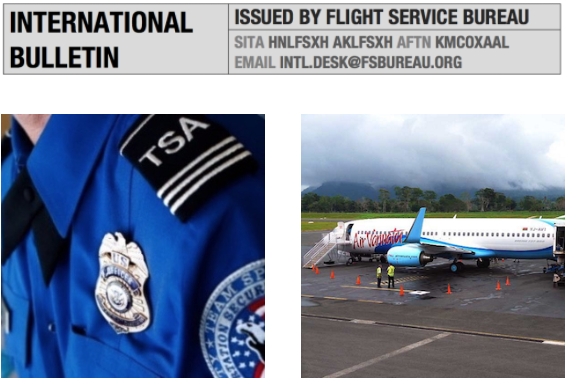
TSA/eAPIS increase in US fines 03AUG Fines and penalties for getting your CBP Arrival/Departure manifest wrong will increase from 01AUG. That means, screw up the eAPIS and you are looking at a potential fine of $1,312. Read the article.

Vanuatu Runway concerns 03AUG Following interim repairs to the runway in Port Vila (NVVV/VLI) earlier this year, concerns have been raised once again about the condition of the runway, with diversions on Monday. Read the article.


LFPZ/Paris Airports Couple of upgrades in progress, LFPO has 06/24 closed until 29AUG, and LFPG is installing a new ILS until 03OCT; both will cause some delays.

YZZZ/Australia The Australian Border Force have announced a strike for Friday, 12 August. This marks a resumption of Industrial Action in Australia after a 3 month ‘ceasefire’ was agreed. The strike period is 24 hours, precise impact not yet clear, but AQIS/Biosecurity/Quarantine will also take part to some degree.

OMDB/Dubai is reopening with a single runway following a full airport closure early on 03AUG due to 777 crash.

UIII/Irkutstk has no air starter available for large aircraft until the end of August.Irkutsk is a common enroute diversion airport.

ZKZZ/North Korea is back in action with the missile launches again, on 03AUG they fired two ballistic missiles, one of which landed in Japanese waters inside the country’s economic exclusion zone. Another missile reportedly exploded immediately after the launch. The missiles were fired at 2250 UTC on 2 August from a region southwest of the North Korean capital city of Pyongyang.

MZZZ/Caribbean Tropical Storm Earl, multiple weather warnings for Jamaica, Caymans, Belize, Guatemala, Mexico.

VABB/Mumbai continues their Continuous Descent Approach trials in the TMA. Interestingly, part of the procedure calls for pilots to call in on 121.9 after landing and report the total amount of fuel saved (how do you work that out?), and then send a detailed brief by email to cdomumbai@aai.aero. We forecast a relatively empty inbox.

AGGH/Honiara has some surface damage on the International Apron, taxi slowly.

SBZZ/Brazil On 02AUG, the mayor of Rio de Janeiro declared 4 August a new public holiday for the Olympic Games. The extra holiday comes after the mayor has already designated 5, 18 and 22 August as public holidays in Rio de Janeiro, and after the city experienced severe traffic congestion with the implementation of Olympic-designated lanes. On 1 August, the Olympic tracks caused more than 60 mi/100 km of traffic jams, with the worst traffic taking place on the Linha Amarela.

DZZZ/Lome UTA Following changes last year to the airspace over Benin and Togo (the two long thin countries squeezed between Ghana and Nigeria) – there’s still some confusion over who does what. In simple: Low Level (FL240 and below) is controlled by Cotonou Approach. High Level (FL250 and above) is controlled by Lome ACC.

EGGW/London Luton will close overnight weekends in November for some big repair work.

HLLL/Tripoli FIR Airstrikes this week by the USAF

LHPP/Pecs has no Jet A1 at the moment, back on 05AUG.

HEZZ/Egypt On 01AUG, reports announced that a semi-private company would take over responsibility for passenger and luggage screening at Sharm el-Sheikh International Airport (HESH/SSH). The same company, which is a joint public-private entity, will take over security at Terminal 2 of Cairo International Airport (HECA/CAI) beginning in October 2016 when the terminal is scheduled to reopen. The company will later take over screening procedures at Hurghada (HEGN/HRG), Borg el-Arab (HEBA/HBE), Marsa Alam (HEMA/RMF), Aswan (HESN/ASW) and Luxor (HELX/LXR) airports. Egyptian police will continue to be responsible for perimeter security around Egyptian airports, including the terminal and the tarmac.

LOWS/Salzburg starts a multilateration (MLAT) trial on 05SEP. Keep your Mode S on, they ask.

SBBZ/Brazil Olympic Games kick off in a few days, if you are operating to Brazil read through the current NOTAMS carefully, there are a bunch of flow restrictions, special routes, and procedures.

FABL/Bloemfontein is carrying out major works during August. Diversions not accepted. Jet A1 is supplied by bowser during this time, and not hydrant as this is also being worked on.

LTZZ/Turkey – post Coup. As of 01AUG, the situation in Turkey continues to stabilize, as the government continues to step up security measures and conduct operations to detain alleged coup plotters. Turkey remains under a state of emergency, which allows the government to drastically restrict civil liberties, and will likely remain so for the next three months. Raids and security operations are continuing throughout the country. Travellers should note that Turkish authorities have reportedly been conducting ID checks in the busier areas of Istanbul. 

 Demonstrations have continued over the past several days. While the threat of violence remains a concern at demonstrations throughout Turkey, most have been conducted peacefully. Travellers should nevertheless take care to avoid such gatherings as a precaution, because violence can occur with little notice. Additionally, terrorists have targeted major demonstrations in the past.

FLFI/Lusaka ACC have called out some AFTN addressing issues, if you are operating to land in Zamabia, then file to FLKKZAZX and FLHNZAZX respectively. OMMM/Muscat ACC has a radar-less day on 18th August, 0600-1700Z. Turn that TCAS up.

WADL/Lombok, Bali has reopened after a closure on Monday 01AUG due to the eruption of Mt. Rinjani. The last closure was in OCT2015.

View the full International Bulletin 03AUG2016


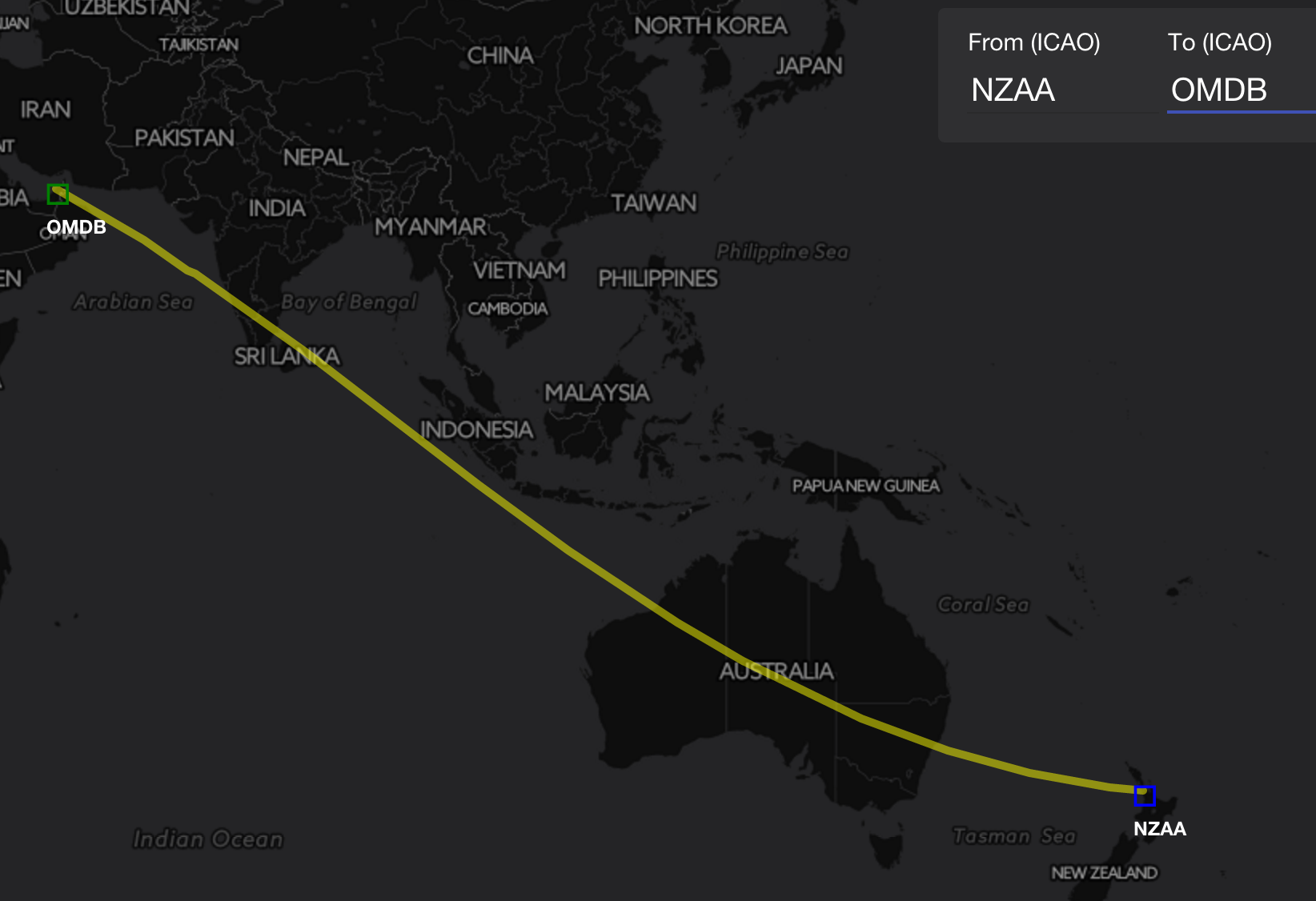
World’s longest flight? That’s about to change …

So what is the longest scheduled air route in the world at the moment? If you said Panama-Dubai, you’d be right – but only for a few more days. As things stand, the PTY-DXB route, all 7463nm of it, takes on average 17 hrs 30.

With the introduction of the Boeing 787, the number of routes around the 7000nm mark is steadily increasing, to the point that we’re probably going to have to stop calling them “Ultra Long Haul Routes”. They are becoming the new norm. United are operating a SFO-SIN route with the 787-9 at 7339nm, and LAX-MEL at 6905nm.

From March 1st, the longest route in the world will become Auckland-Dubai, operated by Emirates with a B777-200LR. The leg distance is 7668nm, and westbound this will be around 17 hrs 15. Use of the AUSOTS Track System and extension of UPR’s (User Preferred Routes) into the New Zealand FIR has allowed this route to work, so that UAE can select the optimum wind routing for much more of the flight.


Monday Briefing: North Atlantic Changes, Caspian Sea Missiles

19OCT2015 Flight operations in the NAT region will see significant changes in around three weeks time, including new ‘half-degree’ NAT tracks, new Entry Points in Gander and Shanwick OCA’s, and several procedural changes. A Special Bulletin with plotting chart, summarising the changes, will be issued by Flight Service Bureau next week.

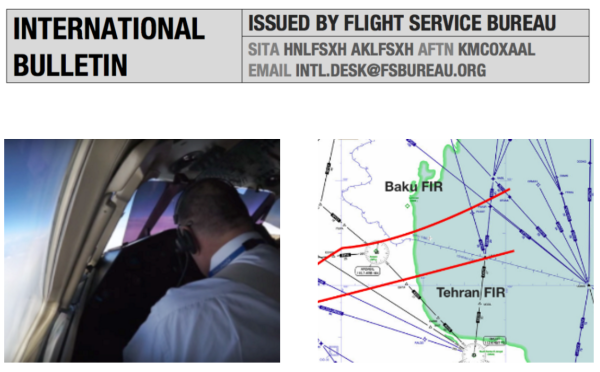
19OCT2015 Last week 26 cruise missiles were launched across International air routes in Azerbaijan, Iraq, and Iran, with reports suggesting 4 did not travel as intended. The risk to aircraft operators is summarised in our International Ops Notice 10/15, see below for details.


RPHI/Manilla FIR, Philippines Typhoon Koppu has maintained its strength as it continues to move northward with slightly increasing forward speed along the shores of Ilocos Sur, Luzon. Current location (1200Z Monday) is to the west of RPLI/Laoag Airport. It is forecast to weaken to a Tropical Storm within 24 hours. No reports of airports affected so far.

OMDW/Dubai World hosts Dubai Airshow 08-12NOV. Landing Permit required for all flights, 3 days processing, standard documents and requirements. Slot required for OMDW, window +/- 5mins. Show details at www.dubaiairshow.aero

OPRN/Islamabad, Pakistan closed 1300-1800 daily due runway works 18-28OCT.

SEXX/Ecuador A new DGAC resolution now effective permits non-scheduled aircraft to land without a Landing Permit as long as the aircraft is operating under private ops, will not stay longer than 72 hours in Ecuador, and visits only one location in Ecuador. The official document is here (in Spanish).

VHHH/Hong Kong with effect 25OCT (IATA Winter 2015) will amend slot issuing procedures to give priority to operators with higher capacity aircraft, and where same types conflict for the same slot time, lower noise levels.

LIXX/Italy ATC Strike confirmed for 24OCT (Saturday) 0800-1600, service will be provided to Overflights and Intercontinental flights only.

LTXX/Turkey Traffic operating through the south eastern part of Turkish airspace to/from Tehran and Baghdad FIRs should check Notams for restrictions. Several restrictions up to FL310 due to military operations.

EGXX/Shanwick Large scale Military Exercise ‘At Sea Demonstration’ ASD15 affecting OEP’s ERAKA and GOMUP starts on 19OCT.

LFxx/France Datalink implemented from 22OCT LFRR/Brest and LFBB/Bordeaux ACC from 0900L. Initial phase, no ACL (Clearance via CPDLC), and aircraft must be on Eurocontrol whitelist. Ref France AIC A22/15.

VNXX/Nepal continues to experience shortages of fuel due to a halt in shipments coming from India. Available fuel for domestic airlines is rapidly decreasing, and authorities worry that domestic flights will soon be unavailable. The Nepalese government has requested that international airlines carry return fuel or refuel at airports en route, as Tribhuvan International Airport (VNKT/KTM) has no available fuel.

View the full International Ops Bulletin for 19OCT2015.