



If you’re planning ops to Singapore this year, expect it to be busier than ever. Traffic into Singapore exceeded previous records last year, and slots and parking are already harder to secure than they used to be.
In addition to the capacity challenges, there have also been changes to immigration and operator procedures that can catch you out if they’re not on your radar. They’re not complicated, but they do mean doing things earlier than before. These include the new No-Boarding Directive (NBD) for passengers and updated requirements around the Singapore Foreign Air Operator Certificate (FAOC).
NBD – No-Boarding Directive
Effective 30 Jan 2026, all operators (private or commercial) must check passengers in advance for a clearance (or refusal) to enter Singapore.
You can check the official announcement on this here. The process sounds more complicated than it really is. In the past, passengers who were denied entry would only be identified after arrival, once immigration determined they were ineligible to enter Singapore. This could be due to a lack of visa, being assessed as an undesirable or prohibited traveller, or a red flag arising from their SG Arrival Card submission.
Previously, the system waited until the passenger was already on Singapore soil, which was always somewhat counter-intuitive. From 30 January, however, an operator must receive confirmation that a passenger is cleared to enter (effectively a green light). If you carry a passenger into Singapore without this clearance (even if that passenger ultimately would have been approved) the operator is liable for significant penalties under the Immigration Act.
So what do you need to do?
As the operator, your role is actually very simple. You must submit your general declaration / passenger manifest to your agent or handler ahead of departure. Current guidance is no later than two hours before departure. This allows the handler to submit the passenger details via a dedicated ICA portal.
That portal will return one of two responses: “OK to Board” or “Do Not Board.”
The key takeaway is this: you must receive one of these two responses before departure. In this case, no news does not mean good news.
The upside is that operators do not need access to the portal themselves (and cannot access it anyway). Everything is handled by your agent. Your only responsibility is to ensure the passenger manifest is submitted in good time before departure.
FAOC – Singapore Foreign Air Operators Certificate
In Singapore, any foreign AOC holder (Part 121 or Part 135) is now required to apply for a FAOC (local validation of your AOC). This process is completed online via the Flight SG portal.
You should allow 2-3 weeks to receive your FAOC, which is typically valid for 3-6 months on the first application. Subsequent approvals generally come with a longer validity period. Be aware that CAAS conducts ramp checks on all FAOC holders, and in particular, operators are more likely to be ramped during the renewal period. CAAS follows the standard SAFA inspection methodology.
The FAOC itself is not new. What has changed is the introduction of ANR-129, which is now in force. This replaces the old FOSP (Foreign Operator Surveillance Programme) and the permit rules that went with it.
So what does ANR-129 change?
Quite simply, any aircraft listed on an AOC must now hold both a valid FAOC and a permit to operate into Singapore. CAAS no longer exempts ferry, positioning, or so-called “private” flights if the aircraft is on an AOC.
The only operations exempt from the FAOC requirement are private aircraft (Part 91 / CAT 2) and certain emergency situations. Overflights are also exempt. This means that any aircraft operated commercially overseas must still hold a FAOCif it is coming to Singapore for maintenance, or even if it is operating an owner-only flight.
The FAOC application process is well documented on the CAAS website, so I won’t repeat it here. The key point is to apply well in advance of your planned operation to avoid any last-minute surprises.
CAAS is currently conducting frequent ramp checks to ensure compliance, and ground handlers are now verifying FAOC permits before confirming airport slots.
More info on Singapore ops
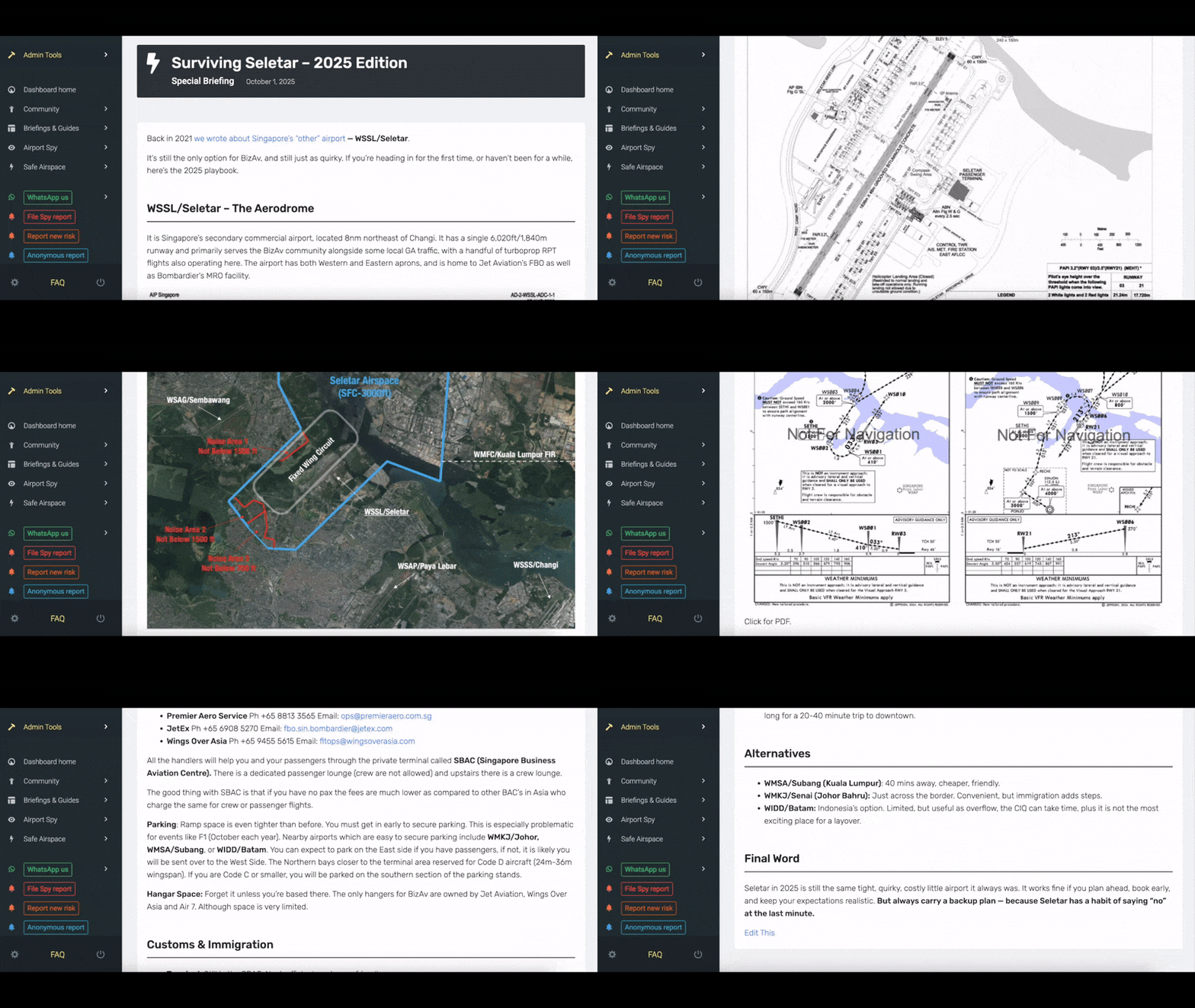
If you’re flying a bizjet into Singapore, WSSL/Seletar is your only option. Our recent guide covers the key survival tips – from managing the visual-only arrivals to dealing with limited parking and other quirks that can catch you out. OPSGROUP members can access the guide via your members dashboard here.
More on the topic:
- More: Every flight leaving Singapore will pay a SAF fee
- More: March 2024 Singapore Airspace Changes
- More: South East Asia: Open for Business
- More: Ops Planning for the 2022 Singapore Airshow
- More: Demystifying Singapore’s Entry Rules
More reading:
- Latest: Paris Ramp Checks: Illegal Charters and Tax Avoidance
- Latest: Middle East Airspace – Current Operational Picture
- Latest: Greenland NAT Alternates: March 2026 Update
- Safe Airspace: Risk Database
- Weekly Ops Bulletin: Subscribe
- Membership plans: Why join OPSGROUP?





 Get the famous weekly