The Dangers of Mixed Traffic: FAA Targets Risks at Key Airports

Key Points
  • Hotspot focus: The FAA is targeting KDCA, KLAS, LA area, and Gulf Coast airports due to helicopter/fixed-wing traffic risks.

  • Immediate changes: KDCA closed one heli route; KLAS saw 30% drop in proximity events after ATC changes.

  • More to come: The FAA is using AI and forming new rules; safety report due by Sept 2025.

April 22 was an important day for the safety of aircraft operating at major airports across the US.

The FAA held a Safety Roundtable to discuss how to best manage risks associated with intensive helicopter operations near fixed wing traffic in busy, controlled airspace.

This follows the tragic mid-air collision of a Black Hawk helicopter and CRJ700 airliner at KDCA/Washington on January 29.

The Table featured a collective of FAA leadership, ATC representatives, helicopter operators and industry safety experts.

Their purpose was to identify the specific hazards of mixed helicopter and fixed-wing operations – especially in congested airspace – and how to better protect us from them.

While the FAA has yet to release a comprehensive public report, they have been providing updates and preliminary findings via their online newsroom.

Here’s what’s being discussed.

The Targets

The Round Table’s approach to the dangers of mixed traffic identified three core issues:

  • Airspace – better strategies to segregate helicopter and fixed wing traffic are sorely needed, especially at congested and controlled airports.
  • Communication – communication protocols between pilots and ATC needs to be improved.
  • AI – using AI technology to learn from existing data (such as incident and accident reports) and identify patterns of risk. It then becomes easier to effectively mitigate these dangers quickly, and with limited resources.
Hot Spots

The Group went on to identify the US airports of primary concern…

Washington

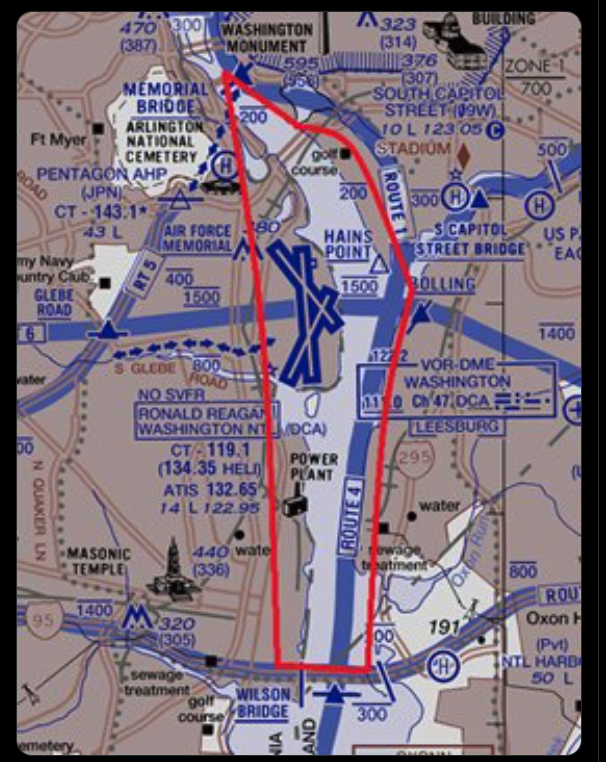
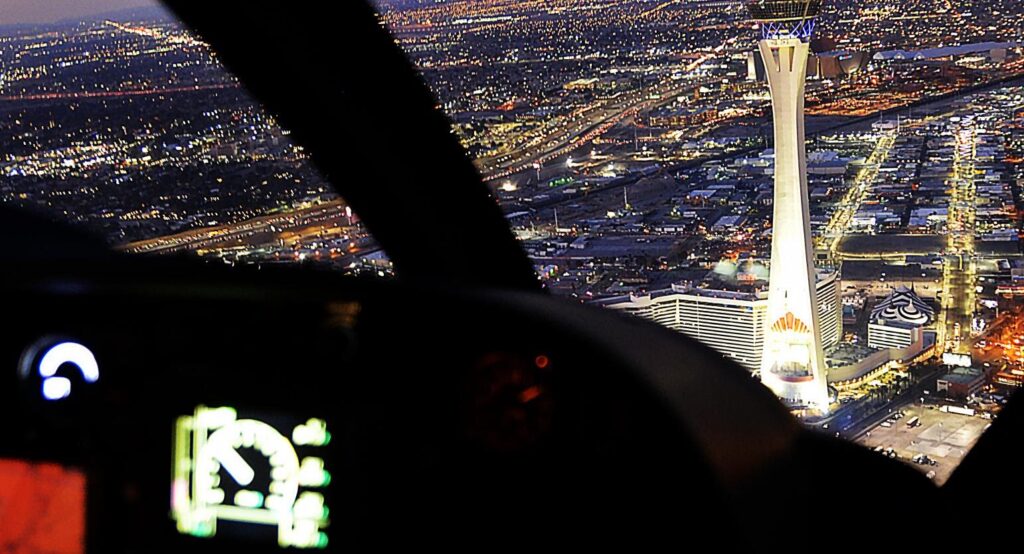
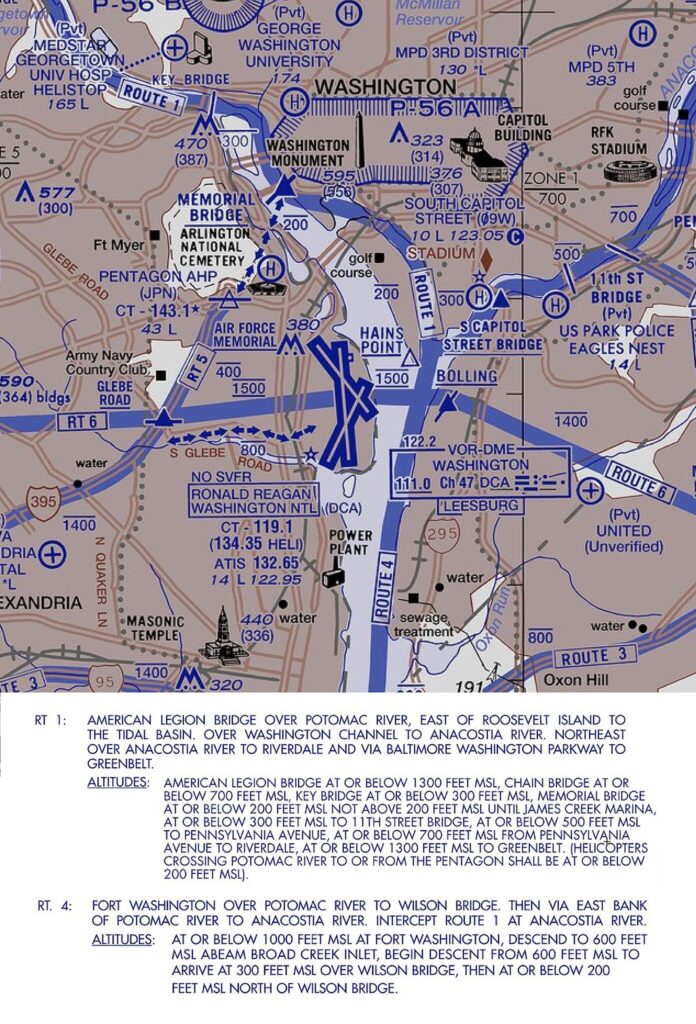
The swiftest action took place at KDCA/Washington itself in the aftermath of the Potomac disaster. The airport is situated in close proximity to the locally known helicopter alley – an area of dense rotorcraft traffic used by essential services such as the military, law enforcement and medevac.

In response to the accident, the FAA closed the low-level helicopter route in use at the time and has restricted non-essential helicopter ops. Only those engaged in ‘special missions’ will be allowed. ADS-B Out has also been mandated for all but the most secure of flights.

The FAA has permanently closed helicopter Route 4 since the accident in January.

Las Vegas

The Safety Round Table identified KLAS/Las Vegas next as perhaps the airport of highest safety concern for mixed traffic, where air tours are frequent.

Concern was raised by the group that helicopter routes used in agreements with local operators lacked effective guidance on vertical and lateral boundaries. And in many cases, tower controllers were not issuing traffic advisories to arriving and departing fixed wing traffic.

In what seems to be a case of procedural ‘slip’, normalization of deviance or even perhaps complacency the FAA has reported routine lack of compliance with Class B separation rules.

Either way, it is a potentially dangerous mix.

Immediate changes have been put in place – essentially more proactive separation by ATC and better traffic info for pilots. We’re pleased to report that according to the FAA, these efforts reduced ‘proximity events’ by 30% in just three weeks – circumstances that FAA believe might elevate collision risk (even if legal separation has been applied).

Other changes are coming in Las Vegas, but these have yet to be announced.

The FAA has identified KLAS/Las Vegas as being at high risk from mixed traffic.

Los Angeles

LA’s airports are another area of concern – KBUR/Burbank and KVNY/Van Nuys were specifically mentioned. Here airspace is complex, and hosts substantial helicopter ops including news, medical and air tours close to commercial flight paths.

The FAA is actively looking at operations near these airports but as yet, there are no major changes to report.

The Gulf Coast

The FAA has begun looking at busy airports along the US Gulf Coast which include offshore helicopter operations.

It is not going to be an easy fix, but they advise that AI technology mentioned above will be put to good use to figure out where the greatest risks lie and what can be done about them in the near future.

The FAA has identified Gulf Coast airports as another hot spot for fixed and rotary wing mixed traffic.

Better Rules

In response to these dangers among others, the FAA has also launched another safety initiative – they’ve formed a rule making committee to improve the safety of commercial helicopter tours.

Some elements of this group’s focus will have an important impact on the safety of mixed traffic operations – including potential changes to regulations.

There will also be a renewed focus flight data to ensure helicopters do not stray from established operating areas and other measures to better separate them from fixed wing traffic in busy airspace (including further ADS mandates).

A report of their safety recommendations is due by 22 September 2025.

Have Something to Add?

Please get in touch with us! You can reach the team via news@ops.group


2025 Update: BizAv Ops to Israel

Key Points
  • May 2025: Turkish airports have stopped supplying fuel to aircraft heading to Israel due to a trade embargo. BizAv flights will need to plan fuel stops enroute at one of Israel’s “approved airports.”
  • Jan 2025: Israel’s new Electronic Travel Authorization system (ETA-IL) is now mandatory for pax from all visa-exempt countries. Plus we have a new list of approved airports from which international flights are allowed to enter or overfly the LLLL/Tel Aviv FIR.
  • May 2024: Israel has tightened the rules for GA flights from the US, due to security concerns. Most flights will now need to either hire an approved security company to do screening in the US, or else make a stop en-route at an approved European airport.
  • Check below for a summary of how to get an Israel landing or overflight permit, and what to expect on how that process works.
May 2025: No fuel for Israel-bound flights in Turkey

We’ve had confirmation from a local handler that Turkish airports will no longer supply fuel to aircraft heading to Israel. This is part of a trade embargo Turkey imposed on Israel following the Gaza war, but it seems like only recently they’ve started applying the rule specifically to jet fuel for BizAv flights.

So if you’re flying to Israel and were planning to tech-stop in Turkey for fuel – that’s no longer an option. You’ll need to plan a fuel stop at another airport enroute, and make sure it’s on Israel’s list of “approved airports” for international departures (see list below).

Jan 2025: New ETA Rules

Effective 1 Jan 2025, Israel’s new Electronic Travel Authorization system (ETA-IL) is now mandatory for pax from all visa-exempt countries. The ETA will be valid for up to 2 years, and lets people stay for up to 90 days. Visitors from non-eligible countries still need to get a visa, just like before. Operating crew are exempt (official word here).

For a list of visa-exempt countries, check here. Visitors from non-eligible countries still need to get a visa, just like before.

Jan 2025: New list of approved airports for flights to Israel

Israel has published a revised list of approved airports from which international flights are allowed to enter or overfly the LLLL/Tel Aviv FIR. Download it here.

Several airports have been removed from the list: EBCI/Charleroi, GMMN/Casablanca, LEPA/Palma, LEMG/Malaga, and KIAD/Washington Dulles.

Russian airports UUBW/Zhukovsky and UUWW/Vnukovo have been added.

You can still apply to operate from airports that don’t appear on the list – but allow extra time for processing.

May 2024: GA flights from US to Israel – 3 Options

Effective May 2024, there are some new rules for GA flights from the US. These have come from ASOC (Aviation Security Operations Center), the authority responsible for the security procedures for the arrival of aircraft into and through Israeli airspace.
You can read the ASOC announcement on this here. If you want to fly from the US to Israel, you now have three options…

1. Hire an ASOC-approved security company in the US to do pre-departure security screening and fly direct. 

  • You basically pay one of two companies to send their staff to whichever US airport you want to depart from, and they will do your pre-departure security screening for you.
  • The two companies approved by ASOC are: Premier Corporate Security or Crisis 24. Contact deets for both can be found here.

2. Private flights can sign up to the Preferred Carrier/Aircraft Program and fly direct without any pre-departure screening.

  • Charter flights (Part 135) are not eligible for this – only Private flights (Part 91).
  • It’s quite a process – you have to pay for ASOC to come visit you, conduct interviews, train your crew, and the whole thing can take months. So this option is really only applicable to operators who do frequent flights to Israel or who have close ties to the country.
  • You can apply by emailing asoc-dvir@int.gov.il

3. Land at an approved European airport en-route for a security check before continuing to Israel.

  • Check this list of approved airports (published in Jan 2025). These are where you’re allowed to fly direct to Israel from. Ignore the US ones (KEWR and KJFK) as these no longer apply to GA flights.
  • For flights coming from the US, there are plenty of viable options to consider in northern Europe. (BIKF/Keflavik isn’t an option though – that got removed from the list back in 2023).
What do I need to do to fly to Israel?

So now we’re talking about permits i.e. the standard stuff that’s been around for a while.

It’s the same process for landings and overflights, except for the thing about a ‘local sponsor’ – you only need this for landing permits.

  1. You must be departing from one of the approved airports in the approved list. (For overflights, your destination airport doesn’t matter.)
  2. For landing permits: You need a ‘local sponsor’ – a contact person in Israel who can vouch for you. This person must be Israeli, and personally acquainted with all passengers – not just a travel agent or hotel representative. They will be contacted by the security services before any approval is given.
  3. For overflight permits: You don’t need a local sponsor.
  4. Your crew/pax/plane need to be from Israel-friendly countries: You must provide passport copies of the crew and passengers, who must be nationals of countries that have diplomatic relations with Israel. The same rule applies to the country your aircraft is registered in.
  5. Fill in the permit application form, and send it back to ASOC at asoc@int.gov.il.

The next step is where it can get a bit confusing. Get ready for some jargon. Check out the full guidance on ASOC’s website, but here’s the lowdown on how it works and what to do:

  1. ASOC will check your permit request, and if approved, will reply to you with a Pending Permission Notification.
  2. The Captain must then call or log in to the ASOC website to submit an Entry Code. The Pending Permission Notification then becomes a Final Security Arrival Permit.
  3. You’re good to go! On entering Israeli airspace, you’ve then got to follow the Arrival Identification Procedure. This bit is easier than it sounds – ATC will basically just ask for your Entry Code to approve you for entry. ASOC have published an example of how you can expect that conversation to go.

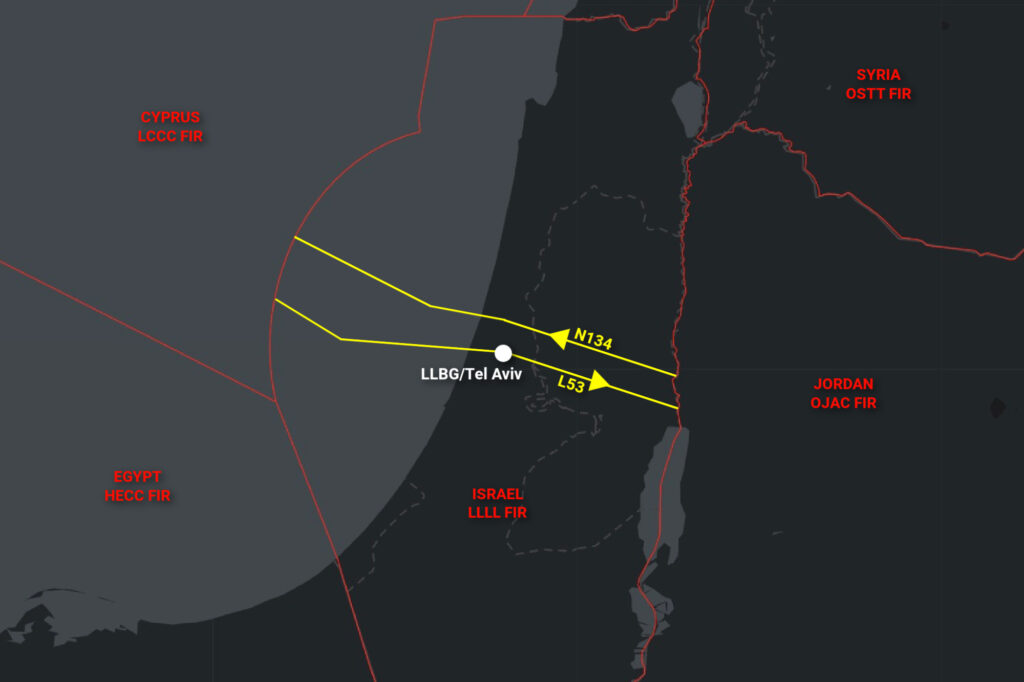
For overflights, there’s basically two options – N134 for westbound flights, and L53 for eastbound. Although check the Notams for the latest here, as they often only permit overflights at specific flight levels and times.

Security & Airspace Safety

Ongoing GPS spoofing, sporadic attacks in the north from Lebanon, and the Gaza conflict create a hostile and non-routine environment. There remains significant risk within the Tel Aviv FIR from the ongoing conflict, and a day-to-day review of the current situation is essential prior to operating.

For more info, check safeairspace.net, which also includes a report about the recent Iranian drone/missile attacks on Israel that resulted in airspace closures across the region.

Most airlines stopped flying to Israel at the start of the conflict in Oct 2023, and many have been slow to return. To read OPSGROUP member reports on flights they have recently operated to LLBG/Tel Aviv, check Airport Spy.

For overflights in the region, almost none are going over Israel. Most operators are going via Egypt and Saudi Arabia – many are choosing to transit west of Cairo, fly south, avoid Sinai, and then continue eastbound over Saudi Arabia. The northern route via Turkey and Iraq is also an option, though warnings for Iraq remain below FL320.

Send us your reports!

If you’ve been to Israel recently (or anywhere else, for that matter) and can share some info on how it went, please file a quick Airport Spy report and we can update this article and share the info with everyone!


New APIS system coming to Hong Kong

  • Hong Kong has implemented a new APIS system. BizAv flights need to do this from 29 April 2025 onwards (although non-compliance will not be enforced until Sep 2025). APIS info will be required for all crew and pax (including transit) for all flights – both private and commercial.
  • The local FBO (HKBAC) will not do this for you. The operator must complete APIS themselves, or get a third party trip support provider to do it for them.
  • The process for actually submitting APIS sounds a bit messy. Full guidance below ⬇️

So, first things first, there’s this letter that says BizAv flights need to do APIS from 29 April 2025 onwards, with full compliance mandatory from 1 Sep 2025.

In terms of how to go about doing it, there is now a website up and running where you can register an account to file APIS online:

Click on ‘Useful Information’ and you can then download the ‘Submission Guide’ which tells you what to do, but the main things to know are as follows: 

1. “No Board” = No entry, even for crew
If the APIS system returns a “No Board” message for any traveller, including crew members, they are not permitted to board the flight! You then have to contact the Command Centre if you think that decision is wrong for any reason. Phone: +852 2121 0008. Email: apisoperation@immd.gov.hk

2. Different submission deadlines for pax and crew
This is a weird one. Passenger API data must be submitted no later than 40 minutes before departure, but crew data must be submitted at least 60 minutes before departure. No idea why, but it’s in the rules! Best thing to do is just submit both crew and pax data at least 1hr prior, and forget about the whole ’40 mins for pax’ thing (and certainly don’t tell them about it!)

3. Crew data must be submitted twice
This is ever weirder still! Operators are required to submit crew API data twice for every inbound flight. The first submission must occur before departure, and the second (the Flight Close-out Message) must be submitted after the flight has departed. Even if there are no changes to the crew, the second submission is mandatory and must reflect the actual crew on board.

4. Transit crew and pax must be included
API data must be submitted for all travellers on board the aircraft, including those in transit who are not disembarking in Hong Kong. 

5. The local FBO can’t do it for you
This one doesn’t actually appear in the guidance, but was reported to us by the local FBO (HKBAC). They said they cannot file APIS for operators – they can help you to set up the account on the APIS website, but you will have to file yourself! (or get your third party trip support provider to do it for you)

6. Eventually there will be fines for getting it wrong
As seems to be standard with all things like this, they say they’ll fine you if you get it wrong. Failure to submit required data, submission of inaccurate or misleading information – stuff like that. Although they do also say that they won’t start fining anyone in the ‘transitional period’ which ends on 1 Sep 2025.

Ops to Hong Kong

This has long been a tricky old game for GA/BA flights – even before this latest thing with the new APIS requirements. 

To operate to VHHH/Hong Kong, you need all of the following to be confirmed in advance (and we recommend applying in this order): landing permit, parking, ground handling, slots… and now APIS too.

All of these need to be applied for individually. Here’s how to do it…

Landing Permit

This can be done whenever, but should probably be done first.

Apply here: www.cad.gov.hk/english/efiling_home.html

Contact: Civil Aviation Department (CAD)
Email: asd@cad.gov.hk, gcmtse@cad.gov.hk
Phone: +852 2910-6648, -6629

Parking

Parking is confirmed on a first-come-first-served basis, and can be applied for up to 30 days in advance. Ultimately, the earlier you apply the better. However, parking requests for 5 days or more can sometimes be rejected, and overnight parking is often denied during busy periods. If this happens, unfortunately the best strategy is still to just keep making new applications until you get accepted! Once your parking is approved, you’ll receive a confirmation, and this must be given to your ground handler.

Apply here: https://extranet.hongkongairport.com/baps/

Contact: Hong Kong Airport Authority (HKAA)
Email: bjetslot@hkairport.com

Ground Handling

There are plenty of agents and handlers at VHHH, but only one dedicated FBO for BA/GA flights – HKBAC. Send them an email to confirm your ground handling in advance.

Contact: Hong Kong Business Aviation Centre (HKBAC) https://www.hkbac.com
Email: hkbac@hkbac.com
Phone: +852 2949 9000

Slots

Applications will only be considered 14 days prior to flight (unless you’re applying for a last-minute cancelled or unused slot). Authorities monitor the slot system for intentional misuse – which could lead to operators being banned from using the system altogether. Other violations include any cancellations of outbound flights less than 72 hours before departure, and delays on the day by more than 2 hours – although any off-slot operations outside a tolerance of +/-20 minutes can still flag up for potential slot misuse.

Apply here: http://www.hkgslot.gov.hk/Online_Coordination.html

Contact: Hong Kong Schedule Coordination Office (HKSCO)
Email: hkgslot@cad.gov.hk
Phone: +852 2910 6898

Our Pilot Report – here’s what we did…

If you’re headed to VHHH/Hong Kong for the first time (or the first time in a long time) and want to know what to expect, here’s an OPSGROUP Team report from a recent flight:

Hong Kong is a busy commercial hub in Asia. However, they manage BizAv aircraft there. There are a few gotchas to keep an eye out for when arriving and departing.

Handling:

  • All your operations will centre around the HKBAC (Business Aviation Centre). They are helpful, and I’d suggest you contact them for help arranging your parking and slots.
  • It can get busy, so the earlier you contact them, the better your chances will be.
  • It is an expensive place to fly into. However, Hong Kong is expensive in general.

Arrival:

  • If you are coming to Hong Kong, note that the airport is beside a large mountain, so you get significant mechanical turbulence and wind shear.
  • All arrivals are RNAV; vectors are not expected for many shortcuts beyond TD for Runway 25R. There is a lot of terrain.
  • I suggest you take the RNAV 25R over the ILS. The ILS is very complicated as it is a two-part RNAV transition. It is also very high-load, and you must NOT select approach mode (i.e., switch to LOC/GS) before you hit TOPAN. Honestly, stick to the RNAV Z unless the cloud base is really an issue (which it rarely is).
  • Even with calm winds on the ground, expect the approach to be quite bumpy.
  • Generally, ATC won’t assign you the close runway for landing, so expect a long taxi. You can expect to cross 07R/25L at K6 before making a right turn onto K and then into the BAC.
  • Once you open the door, they will offload the pax and cargo (customs screens everything, so take note), and they will often reposition you quite quickly to a staging bay while you clean up.
  • If you have a short lay over the Sheraton at Tung Chung is nice, otherwise it is a good 45-minute uber ride into Town.

Departure:

  • The ramp is small, so expect to be at a remote staging area while you get the aircraft prepped. You can run the APU, etc., without issue, and then somewhere ETD-30, you can expect them to tug the plane into your departure position. These guys know what they are doing, but give them a heads-up if you wish your passengers would be late.
  • PDC is available, as is Digital ATIS. Don’t forget you need a start clearance (this isn’t the USA).
  • You can expect to depart from the closeby runway (07R/25L) unless it is closed for some reason (there is a nightly alternating closure for maintenance). So there is a short taxi; just be mindful that if you are slow with cabin prep, etc., you will be blocking the cargo aircraft that also taxi from the same side of the airport. ATC is friendly and competent but expects us to be efficient also.
  • Departure clearance will be on your SID to 5000. Be mindful of flying noise abatement procedures; they expect you to accelerate to SID speed restrictions knots as soon as practicable. It is all on the charts; remember, we operate amongst a sea of heavies.
  • One thing to note is that HK Departures only wants you to make the first call reporting your altitude passing and non-climb. There is no need to report your SID.
  • Expect to level off at 9000′ until you are about 20-30nm from the airport; this is due to the arrival traffic above. 

If you have been to VHHH/Hong Kong (or anywhere else) and have a story to share – please do! Reports like these are super useful for everyone in the group. File an Airport Spy report anonymously here.


Olá Brazil: New Entry Rules for US, Canadian and Australian Citizens

Key Points

  • Effective April 10, all US, Canadian and Australian citizens entering Brazil now need a valid visa.
  • The visa waiver which has been in place since 2019 is no more.
  • April’s news may come as a surprise to passengers who might not be aware of the new requirement – and there is no option to obtain one on arrival.
  • Operating crew are exempt (with some gotchas).

Why the change?

 Back in 2019, visa requirements were dropped for the US, Canada and Australia. The previous President did so to boost tourism and trade.

However, it was a one-way move as Brazilian citizens still needed a visa to enter those countries.

Brazil has long since had a diplomatic policy of reciprocity. The new visa rules signify a return to this principle.

For operators, it’s simply a new rule we need to navigate.

How to get a visa.

 Citizens of the US, Canada and Australia now need to apply for an electronic visa to enter Brazil.

It’s strongly recommended to do this at least 15 days’ prior as it can take some time to process.

Once issued, it will be valid for multiple entries for the next ten years.

Make sure your pax carry at least two printed copies for authorities.

Be careful, because they can’t get one on arrival.

What about crew?

 Great question. We reached out to several local agents for a clarification on the rules for crew.

 While some advice was conflicting, the general consensus was that operating crew are exempt from the visa requirement and usually granted entry for up to ten days (regardless of nationality).

Universal Aviation Brazil has confirmed that to qualify, they must meet the following conditions:

  • Are on active duty;
  • Are listed as operating crew on the GENDEC;
  • Are in uniform on arrival;
  • Present a pilots’ license;
  • And (obviously) have a valid passport.

Some trouble has been reported for flight engineers and flight attendants who are not explicitly covered by this exemption policy (even if they are listed on the GENDEC).

In some cases, they have been allowed entry but this is not guaranteed.

To avoid trouble, we recommend that a visa is obtained for these staff beforehand to avoid the problem entirely – cost is approx. $80USD per person.

Another chestnut to look out for is crew who are positioning to Brazil either with you, or on an airline service. They will need a visa to enter.

Have you just been to Brazil?

 If things were different than we’ve described, we’d love to hear from you. You can reach us around the clock on news@ops.group.

Special thanks to the team at Universal Brazil for their help clarifying the new rules!


Unapproachable Approaches: South Africa’s IFR Crisis

April 10 marks an important date for operations in South Africa — it was the original deadline for the expiry of extensions granted to a large number of instrument procedures in urgent need of re-validation.

Then just yesterday, news broke that the South African Aviation Authority (SACAA) has re-approved procedures at major airports FACT/Cape Town, FAOR/Johannesburg, FALE/Durban and FAPE/Port Elizabeth.

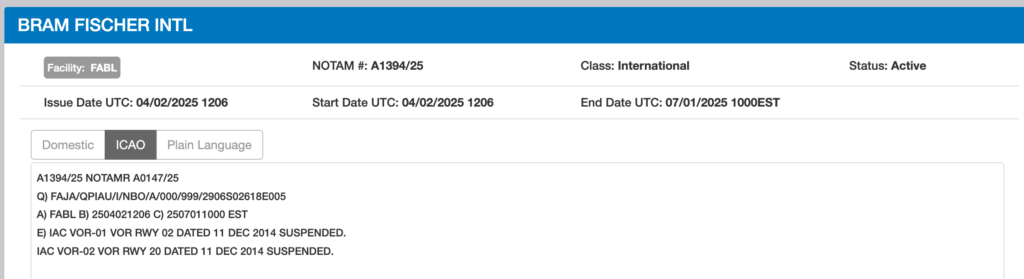
Others weren’t so lucky – IFR procedures at FABL/Bloemfontein, FARB/Richards Bay and FAUP/Upington will remain restricted until further notice.

The issue appears to be both a safety concern and a politically sensitive matter — the country currently faces what is being described as a looming ‘air navigation crisis.’

The Transport Minister is under growing pressure to provide answers, a process that has already led to the suspension of the CEO of Air Traffic and Navigation Services (ATNS). It’s clear that all is not well within the ranks.

So what exactly is going on there, and why do these procedures need revalidation anyway?

Unapproachable Approaches

Three months ago an investigation was launched into why the revalidation of over three hundred instrument procedures had lapsed leading to delays, and unnecessary headaches for pilots and flight planners.

The primary cause was identified as a critical staffing shortage.

IFR procedures aren’t just set-and-forget. Dig into the ICAO SARPs (more specifically Docs 9906 and 8168) and you’ll see that instrument flight procedures should be periodically revalidated (usually every 3 – 5 years) to make sure they remain safe and operationally relevant.

They must remain adequately clear of obstacles for instance, especially when terrain or construction has changed since a procedure was designed.

They must also comply with updated ICAO PANS-OPS or local regulations and keep up with changes to navigational standards (such as PBN). Not to mention, the charts themselves must remain correct and accurate.

It is a skill in demand, and there are comparatively few aircraft and crew in South Africa certified for this work – so much so that accusations have emerged of ‘poaching’ of staff between competing service providers.

In the case of South Africa, procedures due for revalidation are being pushed back months, especially at smaller lower priority fields. The result is a major backlog of unvalidated procedures.

It just isn’t a simple process.

Revalidations are a complicated business requiring both desk-based assessments and flight validation by specially calibrated check aircraft.

Aside from shooting an approach for instance, a full procedural design check is required by qualified designers which includes an analysis of updated obstacle and terrain data along with a cross check against changes in airspace structure and traffic flows.

‘Accelerated’ efforts are now underway to urgently recruit and train a bunch more of them, but this takes time.

Who is liable to pay for it?

While costs are circumstantial to the complexity of each procedure, it is not unreasonable to see bills for revalidations (including design, consultation and flight testing) to exceed $40,000 USD each.

In the case of smaller or regional airports this can fall on airport authorities or operators. At larger airports it is hard to know which entity is responsible for footing the bill.

A lack of consensus leads to delays, and the withdrawal of procedures.

What is the operational impact?

In a nutshell, pilots can show up expecting IFR access only to find that procedures are ‘not available until further notice.’

ATC can’t (and won’t) clear you for an IFR procedure that isn’t validated – even if it’s charted and in your nav database.

Ultimately, the onus will continue to fall upon operators to search for IFR alternates to keep their flight plan legal.

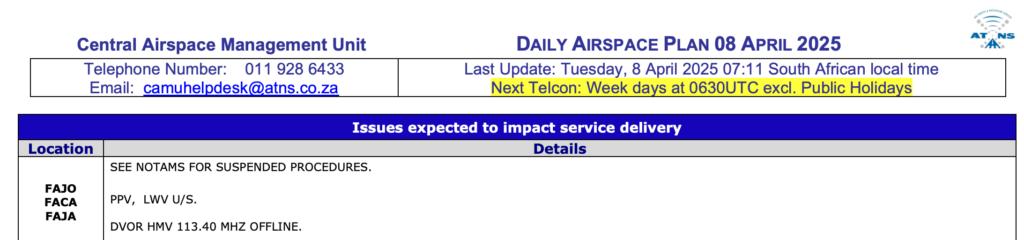
And if you’re unfamiliar with flight planning in South Africa, this can be a challenge. South Africa’s Daily Airspace Plan can provide some guidance on airports where procedures have been suspended – but it is important to consider the Notams carefully.

Look out at smaller airports.

It seems clear that there is no immediate fix to South Africa’s Air Navigation crisis.

News this week is consistent with plans to prioritise procedures at larger airports first – which will continue to be to the detriment of smaller ones. Therefore operators to South Africa’s regional airports will likely be grappling with this issue for some time yet.

Work continues between ATNS, SACAA and the Department of Transport on how best to future-proof the currency of South Africa’s IFR infrastructure. But at time of writing, a conclusive answer has yet to emerge.


Boston Parking Restrictions Are Back

Key Points
  • The BizAv PPR requirement at KBOS/Boston will be in effect from April 15 through the end of October.
  • PPR is required for all non-scheduled flights (private and charter, Part 91 and 135), and will be issued on a first-come-first-served basis via Signature Aviation.
  • This time, it’s not just about congestion – construction work is underway on the ramp.
  • If approved, aircraft are limited to a maximum of 2 days on the ground.

Boston is getting busy again, and with construction now happening on the ramp, the airport is bringing back PPR requirements for all BizAv flights.

The PPR requirement will start on April 15 and is expected to remain in place until the end of October. Operators will need to stick closely to approved schedules, especially during the construction period.

Signature Aviation remains the only FBO at Boston. They have said that if you get PPR, the max length of stay is 2 days, and they cannot accept requests more than 30 days prior to the planned flight.

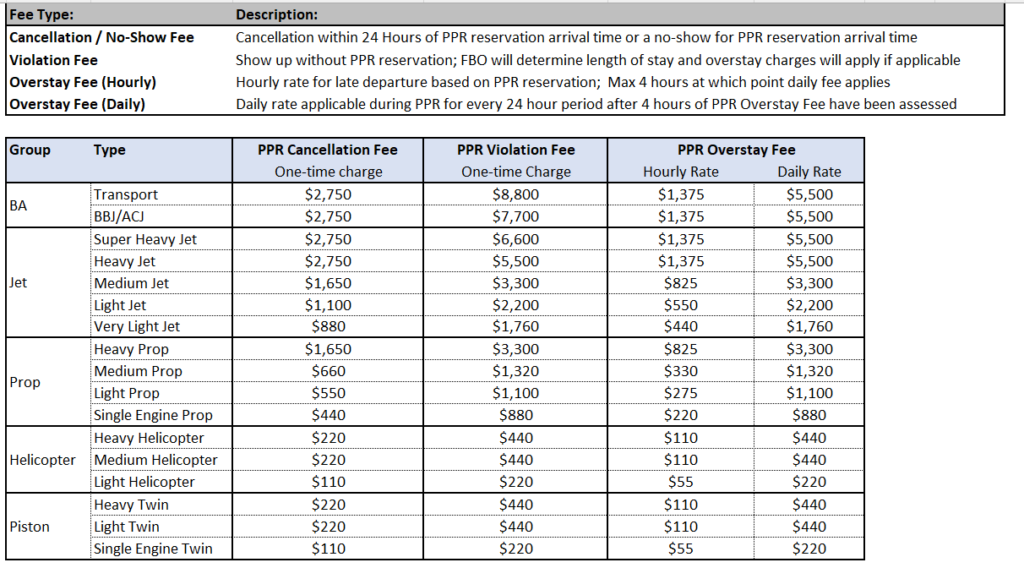
Here’s the updated table of scary costs for getting things wrong:

Where else to go?

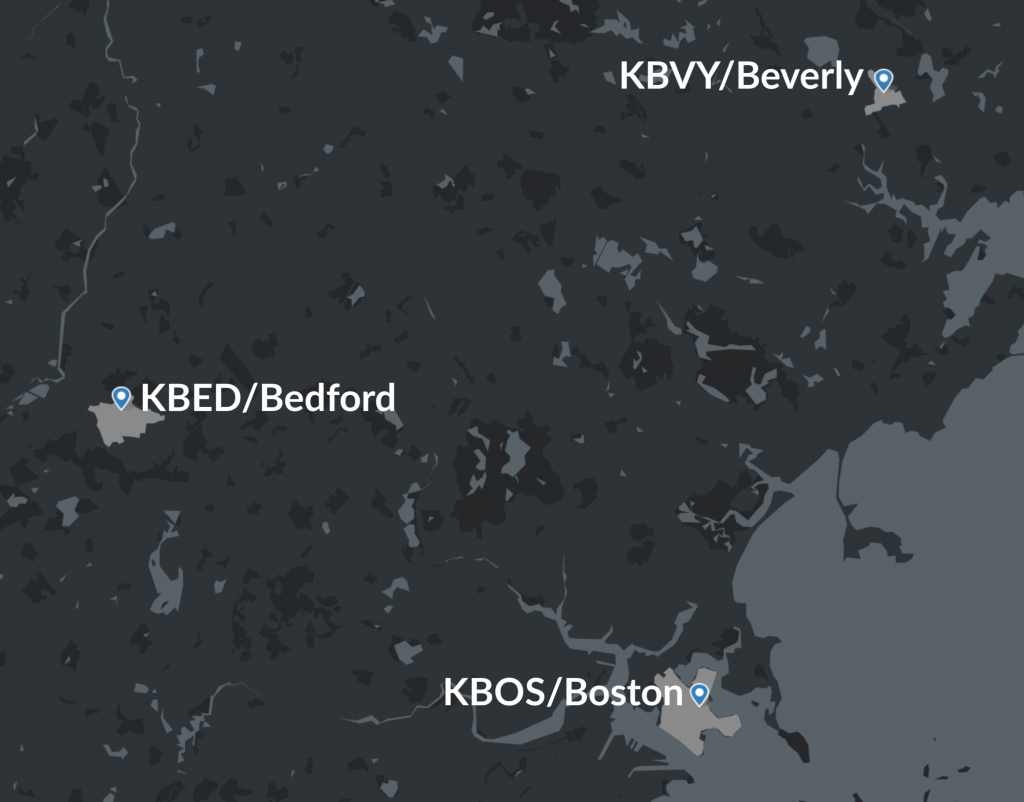
For drop-and-go’s, you could reposition to KBED/Bedford airport for parking. KBED looks like it could be a good option, as they are open H24 (tower is open from 07-23 local time), have a 7000ft runway, and the airport is only 20 miles from Boston – they do also handle international flights too, so you could always just fly there directly instead. The Signature page for KBED is here.

One other option is KBVY/Beverly airport. Flight Level Aviation is the sole FBO there, and fees can be lower than KBED. The airport only has a 5000ft runway, and does not have 24/7 Customs coverage, but you can contact the CBP office at KBED to make arrangements. Drive time from KBVY into downtown Boston is roughly equivalent as from KBED. The North Atlantic Air page for KBVY is here.


US Ops Update: Privacy, IDs & Safety

Key Points
  • FAA Enhances Aircraft Privacy: The FAA now allows private aircraft owners to request the removal of personal details from public FAA websites, enhancing privacy.
  • US Address Required Abroad: FAA certificate holders abroad must nominate a physical US address by April 2 (for new applicants) or July 7 (for existing holders) to retain their privileges, with professional services available for those without a US address.
  • REAL ID Deadline Looms: From May 7, all adult passengers on US commercial flights (including Part 135 charters) must present a REAL ID-compliant ID or other accepted identification, with private Part 91 flights exempt.
  • Notam System Fails Again: The US Notam system suffered another outage on March 22, raising concerns about its reliability.
  • FAA Tightens KDCA Helicopter Rules: After the Jan 29 mid-air collision, the FAA has closed a KDCA helicopter route, restricted non-essential ops, mandated ADS-B Out, and launched a broader safety review.
  • KDCA Drone Tests Trigger Alerts: On March 1, military counter-drone testing near KDCA triggered erroneous TCAS alerts, raising concerns over improper testing and its impact on civil aviation.

In Cognito

On March 28, the FAA began accepting requests from private aircraft owners to withhold personal details (such as name and address) from public access across all FAA websites.

It’s good news for business aviation, as it potentially makes it more difficult for members of the public to track the movement of privately owned aircraft for nefarious purposes.

Aircraft owners can now submit their request via the Civil Aviation Registry (CARES) here.

Address for Service

Attention all FAA License holders abroad – this one’s for you!

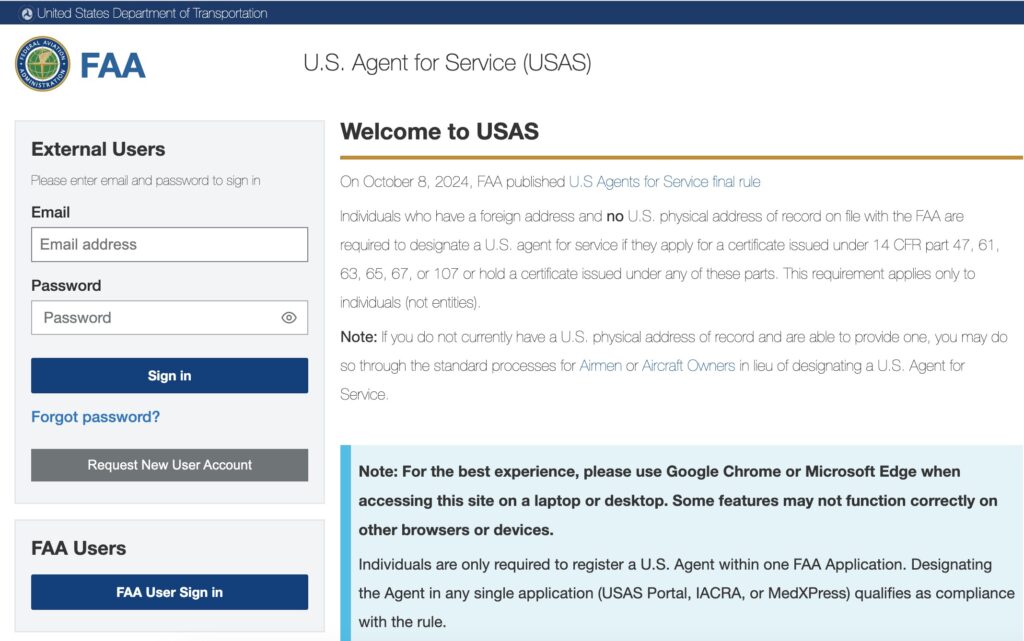
The FAA has written a new rule that will require certificate holders abroad to nominate a physical US address for service. We’ve written about it in detail here, but there are essentially two looming deadlines to be aware of:

April 2 for new applications, and July 7 for anyone who already holds FAA certificates, ratings or authorizations. You’ll need to submit this via the USAS website that is about to go live.

Whatever you do – don’t ignore this. If you don’t nominate a US based address by the applicable date, you won’t be able to exercise the privileges of your document. i.e. say sayonara to your license until you submit the right info.

If you don’t have an address to nominate in the US, don’t despair. You can use a professional service like FAA Mail Agent. These guys can take care of all it for less than 50 bucks a year. Use the code ‘Opsgroup’ and get a discount.

Passenger ID Requirements

From May 7, all adult passengers (18+) using commercial air transport within the US (including Part 135 charters) must show an ID that complies with the new Real ID Act.

The big change is that anyone who wants to use a state-issued ID or drivers licence to meet this requirement must make sure that it is REAL ID compliant –  look for one of the following symbols:

There is also a list of other IDs (such as US and Foreign Passports) that continue to be acceptable.

Operators need to take note because if they allow a passenger to board an aircraft without the appropriate ID they are effectively breaching TSA requirements and become liable for hefty penalties

Important note – private flights operated under Part 91 are exempt.

The Notam system went kaput (again).

The US Notam system was down (again) for several hours on March 22 due to a hardware failure. It was the second time since early February.

Once again we collectively flinched – a system crash in January 2023 lead to the first US ground stop since 2001, disrupting over 10,000 flights.

Questions are being asked about the reliability of the system, and its lack of redundancy.

The FAA previously announced plans to discontinue the legacy US Notam system by mid-2025, with further changes slated for the next five years.

There appears now renewed public and political concern for a faster resolution.

Mixed Traffic and The Potomac Tragedy

The FAA has responded to several recommendations made by the NTSB in its preliminary report from the mid-air collision over the Potomac River on January 29.

The immediate changes will be felt at KDCA/Washington itself. The FAA has permanently closed the low level helicopter route involved in the accident. Non-essential helicopter ops will also be banned, with increased ATC separation applied to those on ‘urgent missions.’

ADS-B out is now mandated for all helicopters, with only very limited exemptions for presidential missions.

Further afield, the FAA is also looking closely into ops at airports in other major cities with high volumes of mixed traffic (including NY, Boston, Chicago, Dallas, Houston and LA) with corrective actions looming for any risks identified.

TCAS wasn’t spoofed in Washington.

On March 1, several aircraft on approach to KDCA/Washington responded to erroneous TCAS alerts, including RAs. While recent research has indicated malicious interference of TCAS is a credible security concern, a Senate hearing last week revealed this was not the case.

The culprit was counter-drone testing by the military nearby which was operating on a similar spectrum to TCAS – a separate concern previously raised by the FAA.

Nevertheless, there are concerns that these tests were conducted improperly and caused unnecessary alarm to civil aircraft nearby. At the very least it was an unfortunate coincidence given recent events at the airport.

Other things you might have missed.

  •  TFR Busts –  The FAA has reported several instances of civil aircraft busting TFRs in recent weeks. The hot spot appears to be Palm Beach, FL where the President has a residence at Mar-a-Lago nearby. A reminder that special procedures apply, including TSA Gateway screening when active for anyone headed in or out of KPBI/Palm Beach. More on that in our recent article, here.
  • Laser Strikes – New guidance was published by the FAA on March 26. Turns out the number of laser strikes on aircraft continue to be dangerously high. There’s an online tool to see where the worst spots are here. Remember to report em!
  • Drones – DJI, the main recreational drone producer in the US, has removed its built-in geo-fencing feature that physically protects airports from incursions. Instead, an FAA database will simply warn the user when close to a no-fly zone. The issue is that this can now be maliciously ignored. DJI has said that its geo-fencing is about education, not enforcement. We’re not convinced – continue to report any illegal sightings to the FAA.

Anything we missed?

Let us know via news@ops.group, and we’ll add it to this article. As always the team is also available to help answer any questions, or put you in touch with the person who can.


ADC Numbers in South Asia: What You Need to Know

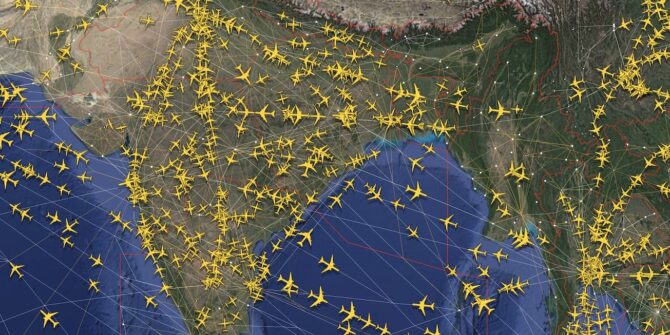
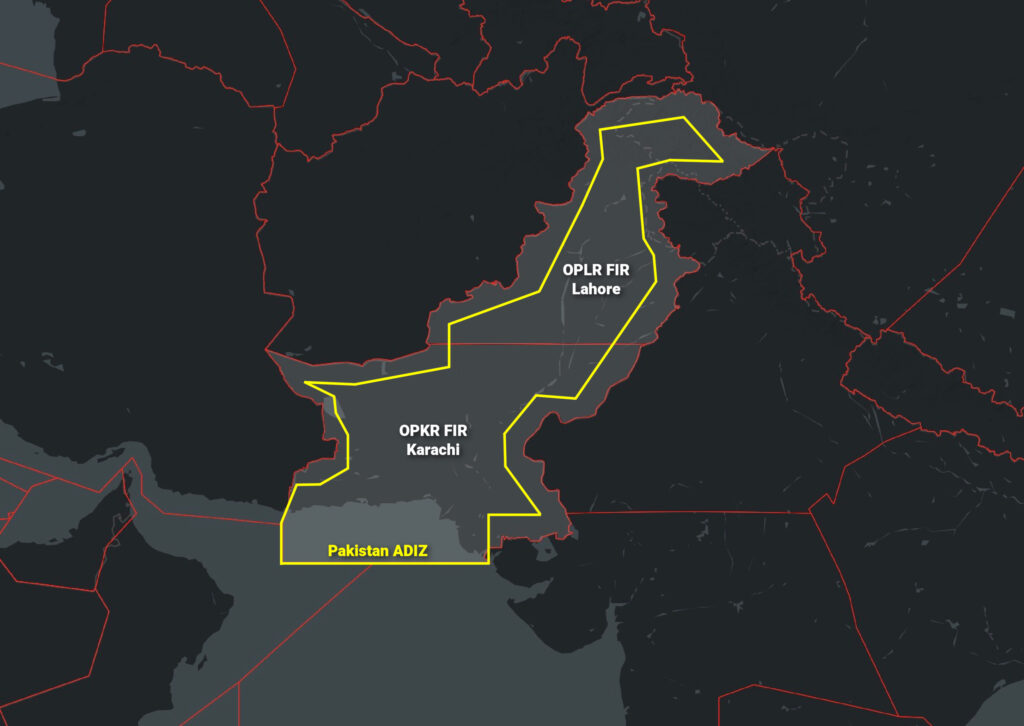
The ADC number is a security clearance required for flights operating through the Air Defence Identification Zones (ADIZ) of several countries in South Asia: India, Pakistan, Bangladesh, Myanmar, and Nepal. Without one, flights could face delays, or potentially being denied entry into the airspace.

The process for obtaining an ADC is roughly the same in each country. So we’ll start with that, then we’ll move on to some slight variations to know about for each country.

The Process!

File the Flight Plan

  • File the flight plan as usual, including the overflight/landing permit number.
  • The ADC number is normally not included in the flight plan.

Obtain the ADC number:

  • For departures from the country where the ADC is required, the local handling agent should obtain the ADC number from ATC and then inform the crew. In some countries, ATC might provide the ADC number directly to the crew along with the start-up clearance.
  • For overflights of the country where the ADC is required, ATC will typically confirm the ADC number to the crew when the aircraft approaches the country’s ADIZ. However, it’s useful if your agent (whoever got your permit number) has also given the crew the ADC number in advance.

Main gotchas to watch out for:

  • Departures: When departing from a country where ADC is required, make sure you get the number from ATC before departure! This helps avoid any last-minute issues with routing, fees, or documentation that could delay the flight. A common best practice is for the crew to contact ATC as soon as the APU is running to allow enough time to address any issues.
  • Delays: If a flight is delayed beyond the allowed window (eg. 30 minutes up to 2 hours, depending on the country), a new ADC number must be obtained.
  • Routing: Some countries, like Bangladesh, do not require an ADC number for specific routes (more on that below). However, if you have to deviate from those routes, you may be required to obtain an ADC number.

So that’s generally how it works.

Now for some country-specific info, links to AIPs, and badly-drawn maps!

India

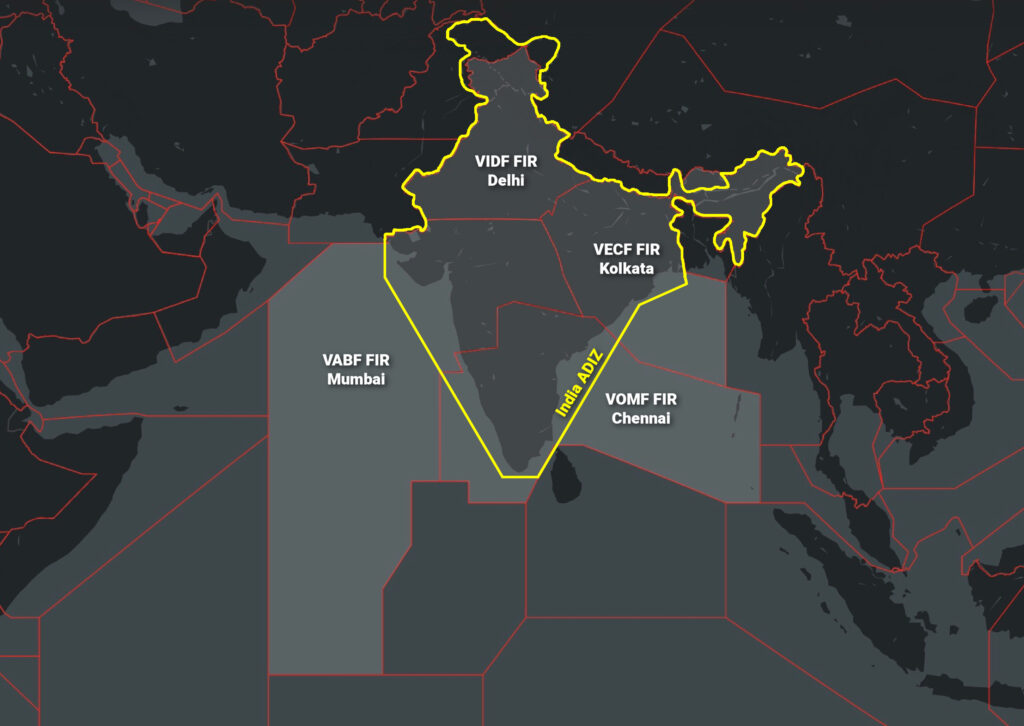
  • The process for getting an ADC number is kinda interesting here. You basically have to file your flight plan with your overflight/landing permit (YA number) on it, then ATC review it and issue you a FIC number (Flight Information Clearance), then the Indian Air Force reviews it plan and issues an ADC number!
  • The overflight/landing permit is valid for 48 hours. If the aircraft is returning to the same airport or operating another leg within that window, a new permit may not be needed, but this depends on how the routing and timings are filed.
  • Indian authorities will send the invoice for nav fees directly to the operator for payment.
  • Delays: If the flight is delayed by more than 1 hour, a new ADC number must be requested.
  • More info: India AIP ENR section 1.12.
Bangladesh

  • The handling agent is responsible for paying the nav fees (not the operator).
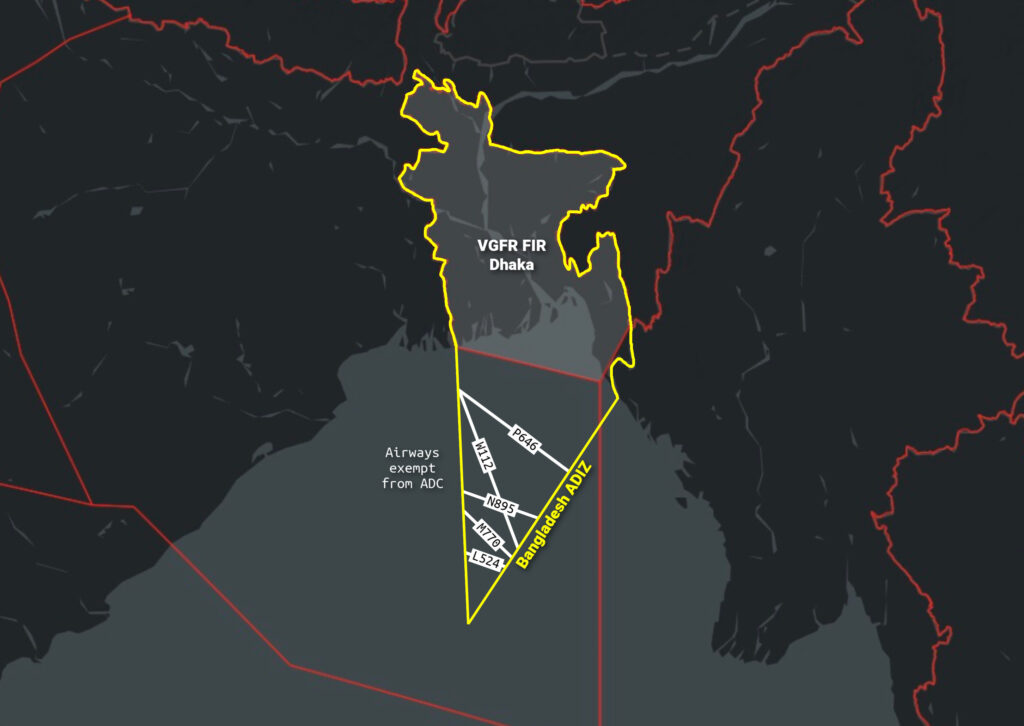
  • The Bangladesh ADIZ actually stretches down beyond Bangladesh airspace into the adjacent Indian VECF/Kolkata FIR. But overflights through this part of it (airways P646, N895, M770, L524, and W112) do NOT require an ADC number unless the aircraft deviates toward the landmass of Bangladesh.
  • After filing the flight plan, the ADC number is issued via AFTN or you can request it from the Bangladesh Air Force at adnc@baf.mil.bd.
  • Domestic flights, state aircraft, and general aviation flights within Bangladesh are now exempt from ADC requirements – a key change reflected in the latest AIP amendment.
  • Also, the option to use the same ADC number for a return flight on the same day? Gone. You’ll need to request a fresh ADC for that.
  • Delays: If the flight is delayed by more than 2 hours, a new ADC number must be requested.
  • More info: Bangladesh AIP ENR section 5.2.
Myanmar

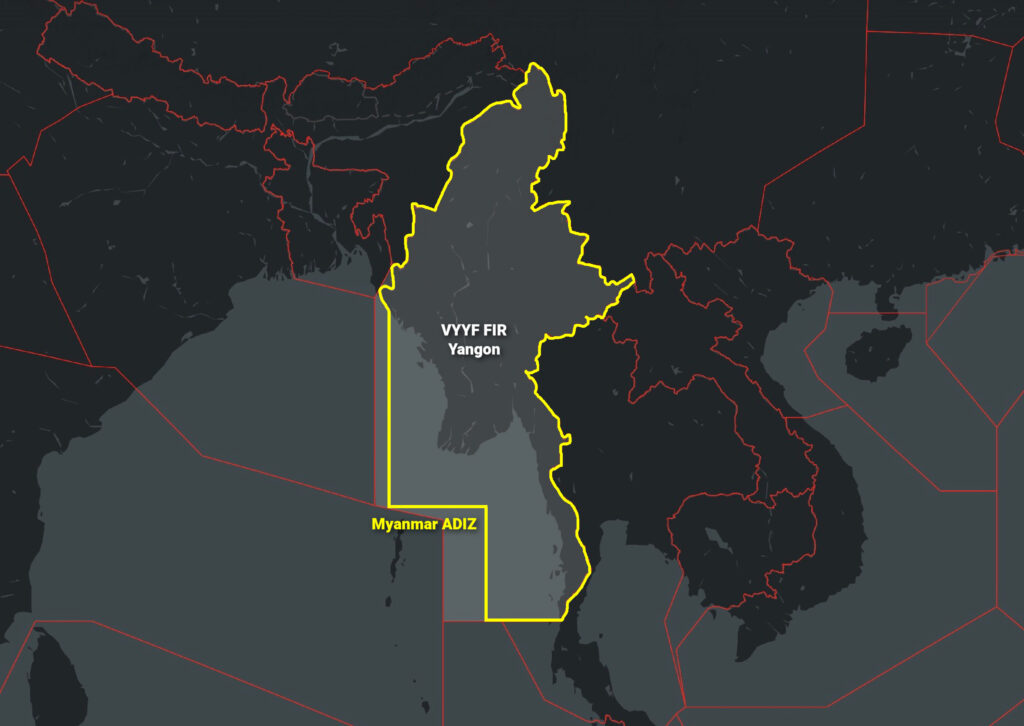
  • Some crews report being asked for the ADC number at the departure airport if entering Myanmar airspace within 30 mins of takeoff. So if you’re heading to/over Myanmar from somewhere nearby (i.e. VGHS/Dhaka, Bangladesh), try to get the ADC Number before you depart, to avoid delays.
  • Delays: If the flight is delayed by more than 30 minutes, a new ADC number must be requested.
  • More info: Myanmar AIP ENR section 1.1.
Sri Lanka

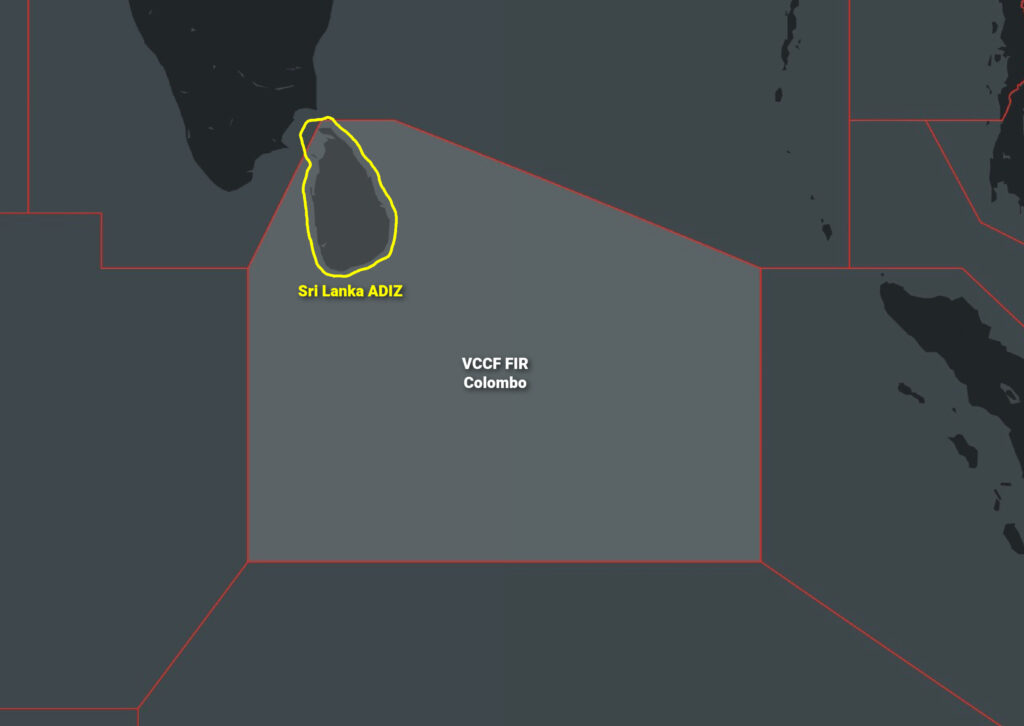
  • Unlike the other countries on this list, the ADIZ only covers the territory of Sri Lanka including its territorial waters up to 12 NM from the coastline, rather than the entire FIR. So that’s kinda nice.
  • Delays: If the flight is delayed by more than 1 hour, a new ADC number must be requested.
  • More info: Sri Lanka AIP ENR 5.2.
Pakistan

Nepal
  • Although Nepal’s AIP doesn’t mention ADC, local handling agents confirm that an ADC Number is required! We currently don’t have any specifics on the process or any possible exemptions. If anyone has more information, please reach out to help complete this section! Email us at team@ops.group

NAT Changes 2025: No More Blue Spruce Routes

Key Points: Updated 19 March 2025
  • A new NAT Doc 007 takes effect from 20 March 2025.
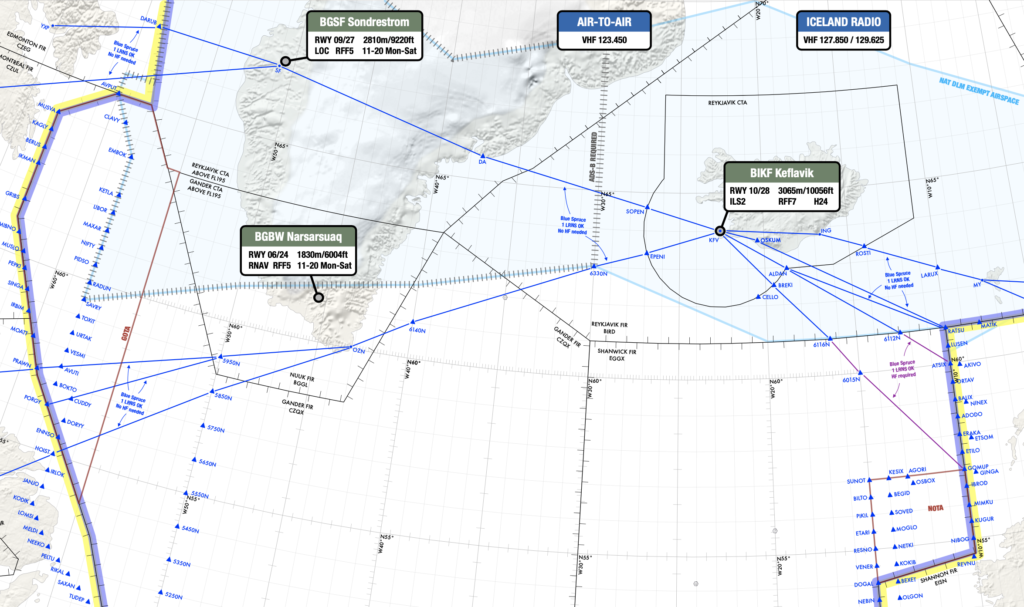
  • Blue Spruce Routes are being removed. Aircraft with only 1 x LRNS will have to go via GOTA and the Iceland-Greenland corridor instead.
  • There are new super fun chapters on Space Weather Contingencies and GNSS Interference Events.
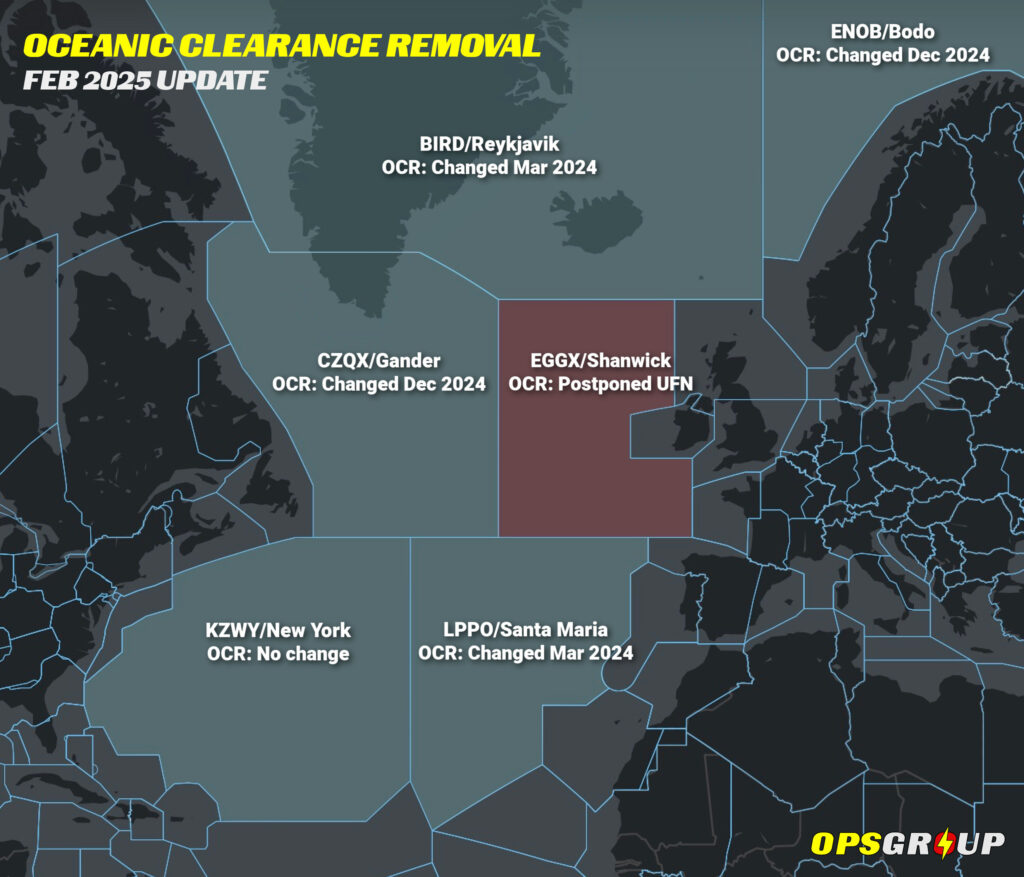
  • Other NAT news: Shanwick does not expect to implement the removal of Oceanic Clearances before summer 2025.
  • Other NAT news: There’s a big military exercise coming in May which will close large parts of the Shanwick FIR.
  • Other NAT news: Greenland airport BGGH/Nuuk now more viable NAT alternate with a brand new runway (7200’/2200m) opened in Nov 2024.

Once (or sometimes twice) every year, ICAO update their NAT Doc 007 – the main guidance doc for ops over the North Atlantic. All the specifics about how to operate your aircraft safely through the complex airspace of the region are here.

There’s a new one that takes effect from 20 March 2025, which contains a few important changes to know about if you’re planning a flight across the NAT.

You can download the new NAT Doc 007 in full, but here’s a summary of the main changes…

Deletion of Blue Spruce Routes

If you’re new to the NAT, the Blue Spruce Routes have been around since forever. These are special routes that go via Greenland and Iceland, designed to help aircraft with limited navigation capabilities.

The Blue Spruce Routes will be officially deleted in March 2025. The team behind this (the Blue Spruce Routes Project Team) has decided the following:

  • There aren’t enough ground-based navigation aids anymore to reliably support these routes.
  • Hardly anyone uses them, as very few aircraft with single LRNS rely on them.
  • The Iceland-Greenland surveillance corridor is a good enough alternative for aircraft with navigation issues.
  • The difference in flight distance between Blue Spruce Routes and alternative corridors is so small it’s not worth keeping them.

So from March 20, the Iceland-Greenland corridor will replace Blue Spruce Routes as the backup option. A review is also underway to decide whether to keep or remove remaining ground-based navigation aids.

Updated NAT Doc 007

Here’s some of the other stuff in the newly updated version of this, effective 20 March 2025:

Deleted sections, New sections, and Chapter Switcheroos

Deleted sections:

  • Chapter 12 on Guarding Against Common Errors
  • Chapter 13 on The Prevention Of Lateral Deviations From Track

New sections:

  • Chapter 10 on Special Procedures For In-Flight Contingencies now includes a section to help crews handle space weather contingencies (explains how to manage impacts on communications, navigation, and surveillance systems caused by solar activity) and GNSS interference events (guidance on what to do in case of GPS jamming or spoofing, based on lessons from recent incidents).

Chapter Switcheroos:

Not that interesting. Same content just in different places now. Over to ChatGPT for a summary of this one:

  • Monitoring of Aircraft Systems & Flight Crew Performance moved to the end of the document and renumbered as Chapter 13.
  • Navigation System Failure Procedures is now Chapter 9 (was Chapter 10).
  • In-Flight Contingencies Procedures is now Chapter 10 (was Chapter 11) and includes the new space weather and GNSS interference guidance.
  • Dispatchers’ Guidance is now Chapter 11 (was Chapter 14).
  • Flight Operations Below NAT HLA is now Chapter 12 (was Chapter 15).

GOTA

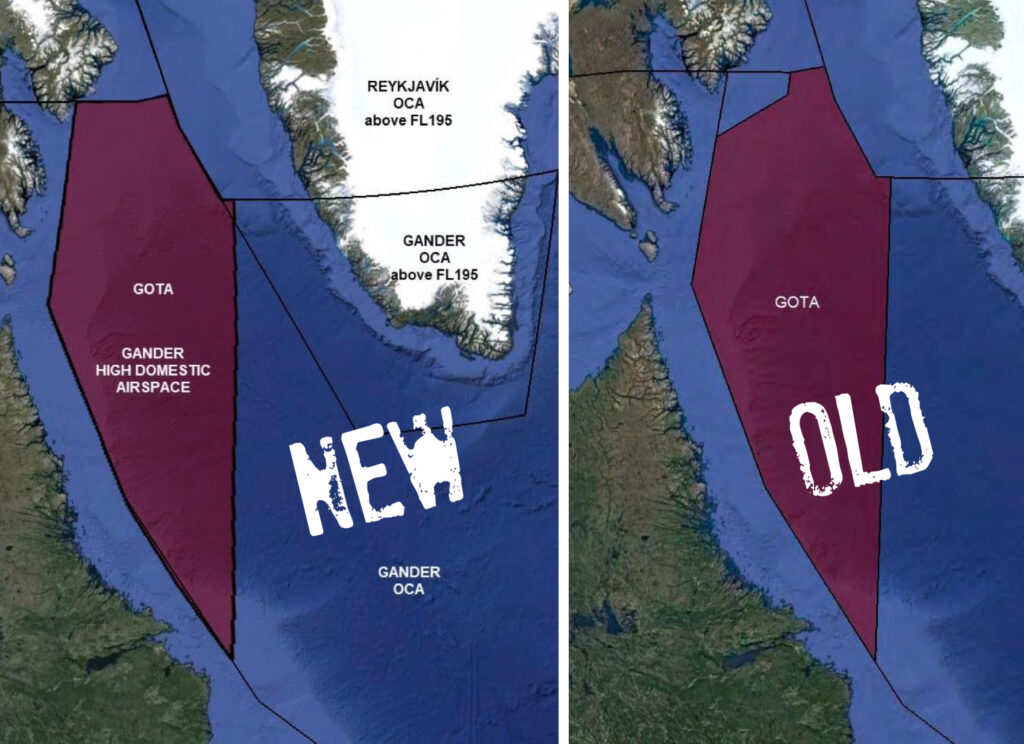
The picture of the airspace boundaries for GOTA has been corrected slightly from the previous NAT Doc. (The GOTA boundaries haven’t changed, they just had the wrong pic in before!)

RCL timings & Squawking 2000

A couple of minor updates here:

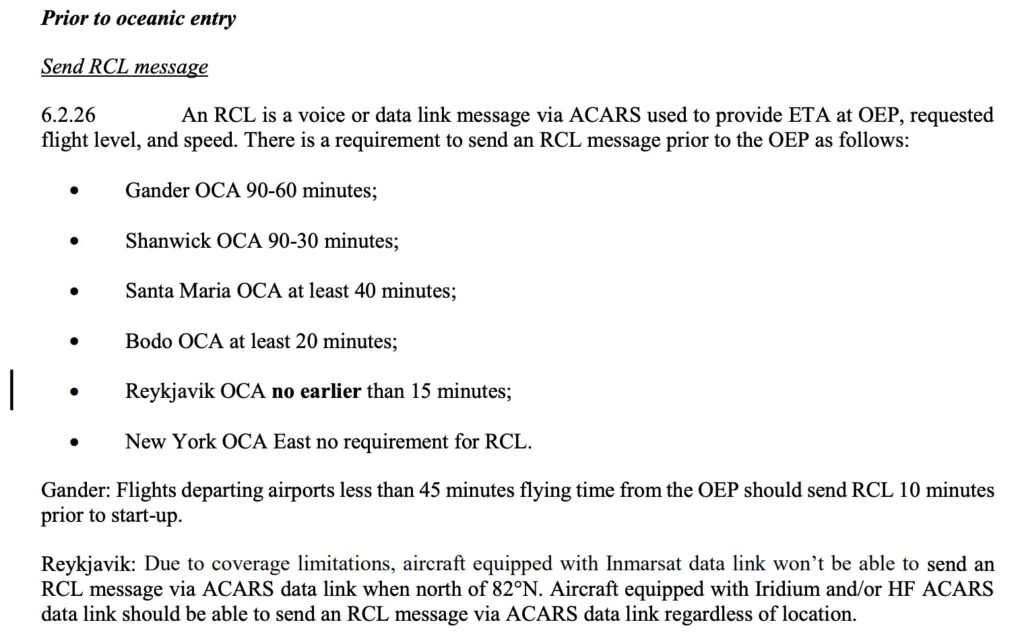
  • In the Reykjavik OCA, you must now send your RCL no earlier than 15 minutes prior to the OEP (it used to be 20 minutes).
  • They’ve also updated the bit about squawking 2000 10 minutes after passing the OEP – you should do this everywhere except the Reykjavik CTA and when transitioning through Bermuda radar (it didn’t mention Bermuda before). Squawking 2000 is not required in these areas as they have you on radar!

Continued confusion about the Removal of Oceanic Clearances

The new version of the NAT Doc 007 tries to consolidate all the changes made after the March 2024 roll-out of OCR procedures. The only problem is that it now says that “No oceanic clearance is required” without pointing out that this doesn’t yet apply to Shanwick! 

Everything about the Removal of Oceanic Clearances so far has been quite confusing for crews. What is happening, when it’s happening, what is changing, the constant implementation date changes, plus the fact that there has been a bunch of confusing documentation out there with incorrect dates and procedures that are not yet in place.

So here’s the lowdown!

  • Reykjavik and Santa Maria = removed Oceanic Clearances in March 2024
  • Gander and Bodo = removed Oceanic Clearances in Dec 2024.
  • Shanwick = still has Oceanic Clearances!

So, Shanwick is the only NAT ANSP still to make the change – and the main news at the moment is that Shanwick does not expect to implement the removal of Oceanic Clearances before summer 2025.

Until then, westbound flights entering Shanwick from domestic airspace will continue to be the only flights on the NAT that will still require an Oceanic Clearance. For more info on all this, OPSGROUP members should check this post in their Dashboard.

Other important NAT stuff to look forward to

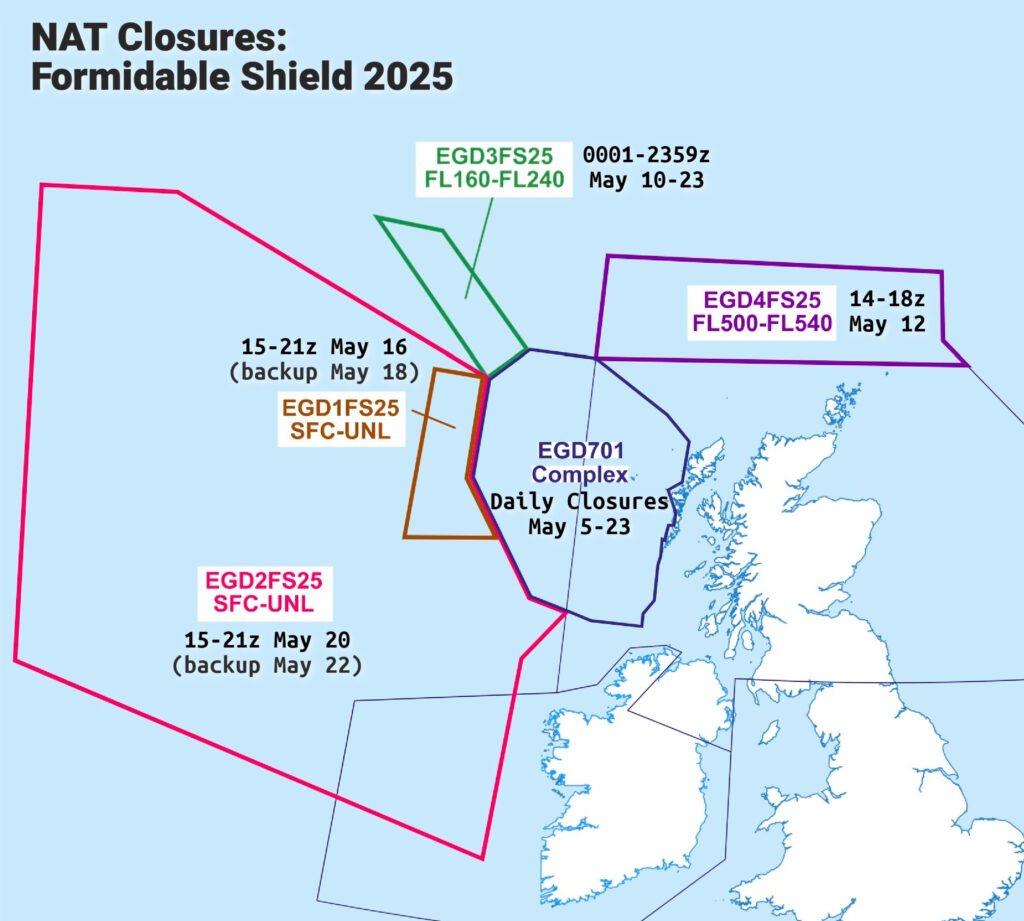
Formidable Shield military exercise expected in May 2025

Remember that big NAT military exercise a couple of years ago? Formidable Shield is happening again soon, and this year will be a fairly bad vintage. 

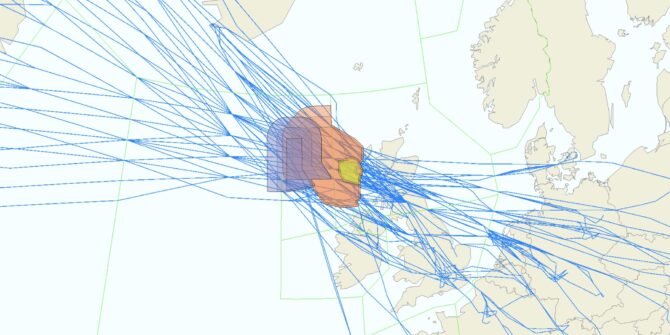
There will be daily closures in the D701 area off the coast of Scotland from May 5-23, but the big one to watch out for is a large closure of airspace across the northern half of the EGGX/Shanwick FIR on May 20 between 15-21z (with May 22 as the backup day).

The map below shows everything we know about this. For more info, check this UK SUP.

Changes to Greenland NAT alternates

BGGH/Nuuk airport’s brand new runway (7200’/2200m) opened in Nov 2024, with ILS at both ends, which on the face of it makes Nuuk a more viable diversion option for NAT traffic.

But since it opened, we’ve had reports of a few things to watch out for at BGGH/Nuuk:

  • ATC may delay your arrival and put you into a hold as only one ILS approach can be handled at a time, and 15 min separation is being applied between international arrivals. So carry up to half an hour of extra fuel if possible.
  • In practical terms the airport is effectively closed overnight. Because it’s a brand new airport, night opening is unrealistic at the moment – especially in winter. In the summer months, when there’s no snow and it’s daylight almost all day every day, there won’t be the same need for runway sweeping and using the airport as a diversion alternate might be more possible.
  • Aircraft larger than A330 should consider continuing using BGSF/Sondrestrom as an alternate instead – it may make more sense to divert here with the longer runway and less traffic compared to the marginal runway in BGGH/Nuuk.

Also watch out for changes potentially coming at BGSF/Sondrestrom, where they’re considering downgrading ATC to AFIS at the end of 2025. More info here.

Did we miss anything?

If you spotted anything important in the new NAT Doc 007 which we missed in this summary, please let us know! Email us at news@ops.group

More help with North Atlantic ops

DC False Alerts: Could TCAS Be Vulnerable to Cyber Attack?

On March 1, several aircraft reported erroneous TCAS TA and RA alerts while on approach to Runway 19 at KDCA/Washington. All aircraft correctly followed avoidance procedures, and no loss of separation occurred. Six of the incidents occurred within eleven minutes of each other.

⬆️ shared with permission, courtesy of VASAviation.

What has followed is speculation – who, or what, was responsible? It is an answer the FAA is actively seeking.

TCAS interference is rare but can occur. There are several plausible explanations including ground clutter and reflections, software issues and unintentional radio interference.

However, it would be hard to deny that these alerts came at a sensitive time both for operations at the airport following the mid-air collision over the Potomac River, and across a broader tapestry of concern for aviation safety across the US NAS given recent events.

Which begs an important question – can TCAS actually be tampered with? Is it possible these events were an act of criminal mischief or other mis-intent? While remote, a little-known alert issued just weeks ago by CISA  (the part of Homeland Security responsible for US cyber and infrastructure security) suggests it is indeed possible.

Published on January 21, CISA discussed two flaws in TCAS design that leave the system vulnerable to malicious cyber-attacks – one of which they deem a high, almost critical vulnerability.

In event that such an attack occurs, criminal interference could generate fake targets on an aircraft’s TCAS display and even disable resolution advisories.

The problem is that bulletin is quite technical. So here is a break-down of what it says in plain, simple language.

The Bulletin

There were essentially two risks identified for TCAS II Versions 7.1 or older.

1. Fake Position Signals

It is theoretically possible to broadcast a spoofed aircraft location to another target.

This could be achieved using specialised radio equipment where potential attackers could send fake signals to aircraft, causing the appearance of non-existent targets on TCAS displays, along with the associated warnings.

In other words, crews would effectively be chasing shadows.

As TCAS II systems rely on transponders that may not be able to adequately validate the data received, they remain vulnerable to unauthorised signals. The bulletin describes this risk as a reliance on ‘untrusted inputs’.

Read the report and you’ll see something called a ‘CVSS score.’

CVSS stands for Common Vulnerability Scoring System, and it is basically a danger rating for flaws in computer security. It is a measure of how serious a vulnerability is. Factors include the method of attack, the access required and the potential impact.

It is represented on a scale of 0 (non-existent) to 10 (critical).

The issue of fake position signals has been given a CVSS score of 6.1.

Perhaps more concerning is that the report advises there is no way to actively mitigate this threat with existing TCAS technology. The equipment required is accessible to the public. Therefore this threat is the most likely suspect of any erroneous TCAS interference occurring today.

2. No TCAS RA

This affects some older TCAS II systems using transponders with outdated technical standards.

It is theoretically possible for an attacker to impersonate a ground station and send a special request that lowers a system’s sensitivity settings. A TCAS sensitivity level command does exist, envisaged to reduce nuisance alerts at some airports.

This could be used to maliciously adjust sensitivities to the lowest setting and even disable a resolution advisory completely.

The threat has a concerning CVSS score of 8.1 – highly vulnerable to exploitation, but would require a high level of expertise and technology to carry out.

Fortunately, in this case there is a way to mitigate the problem – by switching to ACAS X, or upgrading your associated transponder to more recent technical standards.

There is no indication that this has vulnerability has ever been exploited.

So, could the aircraft at KDCA have been hacked?

It’s unlikely, but CISA’s report indicates it’s possible. And a new expert analysis of events at KDCA by Aireon seems to agree. In their published report they found that ‘it is possible the intruder was airborne or related to a ground-based transmitter used for testing or spoofing.’

Why does this matter?

The industry must remain responsive to security threats that are becoming increasingly sophisticated and designed to exploit vulnerabilities in safety critical systems.

The recent industry-wide interest in GPS interference spanning from the inconvenient, to major degradations including the loss of EGPWS protection, ADS-B tracking and navigational accuracy is a startling testament to this fact. This is all possible because of existing system design.

Since the events of September 11, passenger screening and security protocols have undergone a revolution, and it’s now much harder for bad actors to carry out conventional attacks. But there are still risks associated with malicious attacks that could potentially be achieved remotely – and cyber-interference seems an obvious choice.


France Hates Planes – it’s official

Key Points – updated 5 March 2025
  • France have massively hiked their passenger air tax rates, effective 1st March 2025, which also now extend to commercial BizAv flights – private flights are exempt.
  • These new rates will mean operators must pay anywhere from €420 to €2100 per passenger, depending on where you’re flying!
  • The tax applies to flights departing from both mainland France and most French overseas territories – but with some exceptions.

France has just passed its annual budget, which includes some eye-watering adjustments to the Air Passenger Transport Tax (Taxe de Solidarité sur les Billets d’Avion, or TSBA), which now extends to commercial BizAv flights (aircraft with 19 seats or less).

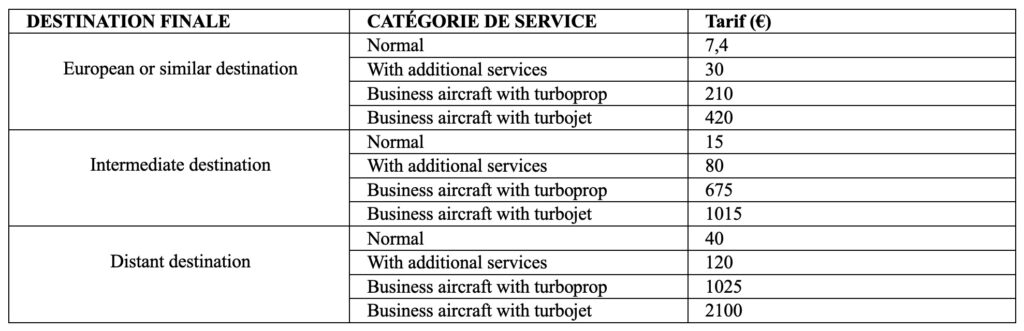
The new rates are due to take effect from 1 March 2025, and vary depending on destination. For BizAv departing from French airports, the new rates per passenger will be:

  • €420 for European destinations
  • €1015 for intermediate destinations (everywhere else up to 5500km)
  • €2100 for long-distance destinations (beyond 5500km).

And yes, those rates are per passenger! Domestic flights within France will have to pay an extra 10% VAT on top of these rates.

The airlines are getting hit too. The budget includes a rise from €2.63 to €7.40 for an economy ticket heading anywhere within Europe, and more if you’re going somewhere farther away or are traveling in business class.

There’s a weird way they calculate the distance flown here. The new law specifies that the distance used to determine the tax will be calculated from LFPG/Paris Charles de Gaulle airport (what they call the the “national reference aerodrome of the metropolitan territory”), rather than the actual distance between departure and destination airports.

For example, if you’re flying from LFMN/Nice to KTEB/Teterboro, the tax calculation will actually use the distance from LFPG/Paris to KTEB/Teterboro instead. The idea with this weird method is that it helps give a consistent and simplified way of calculating the distance for tax purposes.

Do private flights have to pay this too?

We’re almost 100% sure they don’t.

The new tax rules list a few exemptions, including: “flights undertaken by a physical or legal person for the purposes of leisure aviation or on their own behalf.”

That sounds very much like private flights.

Also, the French tax authority has an entire website where they try to answer questions like this. The best answer comes in the March 1st FAQ which clarifies three points:

“Own-account” (ie. private) flights are not subject to the tax:

“In the case of own-account flights (i.e. private flights) involving employees or managers of the operator, or employees/managers of a company that owns 100% of the operator, these are not subject to the TS.”

Non-commercial flights are not taxable:

“Article L. 422-5 of the CIBS specifies at national level the definition of commercial flight established at European level. Under these conditions, an aircraft flight that does not fall within the definition of a commercial flight is not taxable… The economic activity criteria is not met if the activity is not carried out for valuable consideration.”

Fractional/shared ownership flights are generally considered private and not subject to the tax:

“With regard to the criteria of carrying out transport on behalf of third parties: shared/fractional ownership models are part of own-account transport…”

The doc also says that even if a flight is filed as “General Aviation” (G) in the flight plan, this does not automatically mean it is tax-exempt. It sounds like the authorities pretty much ignore how the flight plan is filed – they’re more interested in determining whether the flight truly meets the definition of non-commercial private transport or commercial transport under tax law.

What about flights from French overseas territories?

This is where it gets even more complicated! The tax applies to flights departing from both mainland France and most French overseas territories – but with some exceptions.

Flights departing from these places are exempt:

  • TFFJ/Saint Barthelemy and TFFG/Saint-Martin
  • New Caledonia and French Polynesia
  • LFSB/Basel-Mulhouse Airport (flights operated under Swiss traffic rights from here are exempt).

The tax applies to flights departing from:

  • Guadeloupe
  • Reunion
  • Martinique
  • Mayotte
  • French Guyana

For flights from these places, here’s how they calculate what rate of tax you should pay:

“European or similar destination” (€420):

  • Flights within the same French overseas territory.
  • Flights to mainland France and Corsica.
  • Flights to EU, EEA, Switzerland, or within 1000 km of the departure airport.

So for example, a TFFR/Guadeloupe to LEMD/Madrid flight would qualify for this (because it’s going to an airport in the EU). 

“Intermediate destination” (€1015):

  • Flights to any airport 1000-5500km away, not covered by the above criteria.

For example, a TFFR/Guadeloupe to KTEB/Teterboro flight (approx 2000km).

“Distant Destination” (€2100):

  • Flights to any airport more than 5500km away, not covered by the above criteria.

For example, a TFFR/Guadeloupe to KSFO/San Francisco flight (approx 5530km).

How should operators pay these taxes?

The new tax rules say that operators have to work out how much they owe, and declare it using an online portal: https://taxes-aeronautiques.sigp.aviation-civile.gouv.fr/

Until 31 Dec 2025: Operators must submit declarations by the last day of the month following the reporting period (monthly or quarterly).

From 1 Jan 2026: The deadline changes to the 20th of the following month.

There’s also some text saying that if an operator fails to declare or underreports passengers, the DGAC may use aircraft seating capacity to estimate tax liability!

We have had some local reports saying that some FBOs/Handlers have been collecting these taxes from operators, and paying on their behalf. But some others have reported that they’re not doing this as it’s technically illegal. So we’re not sure we would recommend this option at the moment!

Why is France doing this?

The French government have projected these new tax rates to generate €800-€850 million in additional revenue. The country’s new Minister for Public Accounts has given a 👍 to the tax increase –

“I am in favour. It is a measure of fiscal and ecological justice,” she told Le Parisien on Jan 5. “The 20% of the population with the highest incomes are responsible for more than half the expenditure on air travel.”

So there you have it, friends. France hates planes – it’s official.


New York Southbound: FAA Suggested Routes to Spring Break

Spring is upon us, and so is Spring Break. Traffic volumes into Florida and the Caribbean typically surge in the coming weeks.

Up in New York, this is causing a traffic jam over the WHITE departure fix for southbound GA traffic departing KTEB/Teterboro and KHPN/Westchester .

The FAA has issued a request to operators to consider filing via alternative ‘offload’ routes instead during peak times – specifically, Thursday to Saturday.

This will help expedite departures from FBO ramps and reduce mile-in-trail delays over WHITE.

Here’s a quick look at those alternative options.

Departing for West Coast Florida:

File via: PARKE.J6.HVQ or LANNA.J48

Departing for South Florida and the Caribbean (*must be deep water capable):

KTEB/Teterboro – File via: ELVAE.COL.DIXIE.Y481

KHPN/Westchester – File via: JFK.SHIPP.Y488

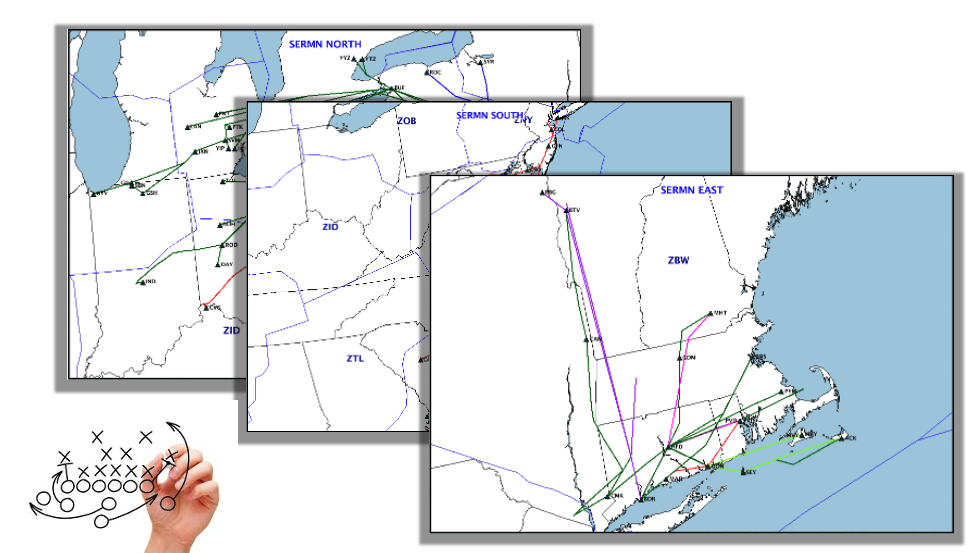
And here’s what that looks like on a map:

One other route to consider.

If departing KHPN/Westchester between 1000 and 2000z for any Florida destination, the FAA also suggests considering filing via HPN.JFK.WAVEY.EMJAY.Q167.ZJAAY.KALDA. We asked the FAA about the timings, and they were advised this is due to peak flow in and out of KJFK/New York.

It’s just an ask.

You can still plan via WHITE if you’d like too, but expect extra delays.

The best place to keep an eye on operational disruptions (including any ground delays) is the FAA NAS Status website, which you can find here.


EASA Safety Bulletin on SAF risks

EASA has published a new Safety Information Bulletin for risks associated with the use of sustainable fuels (SAF) that do not comply with the proper quality criteria.

This is due to growing demand along with potential for fraudulent business practices trying to take advantage of higher prices.

Any uplift of ‘out-of -spec’ fuel could cause serious safety concerns. EASA’s advice to operators is to make sure your suppliers comply with the correct standards listed in their bulletin, and to be especially wary of new entrants to the market.

Download the PDF of the EASA Safety Information Bulletin here.


Santorini Shaking: State of Emergency In Effect

Key Points

  • Santorini and neighboring islands are currently experiencing what is described as a ‘seismic swarm’ of earthquakes.
  • Nearly thirteen thousand have been recorded in the past twelve days.
  • A state of emergency has been in effect since the largest tremor of 5.1 struck the island on Feb 6. Large numbers of people have evacuated.
  • Experts suggest this may be a precursor a larger event, including a possible volcanic eruption.
  • The US Embassy has issued a new warning advising extreme caution before travelling there.
  • At time of writing, local agents report no damage to the airport.

An Active Earthquake Zone

Greece is one of the most seismically active regions of Europe.

It occupies part of something known as the ‘Hellenic Subduction Zone.’ Not dissimilar to the Pacific’s notorious ‘Ring of Fire,’ here shifting tectonic plates create numerous weaknesses in the earth’s crust.

The source of the current trouble is found near Anydros – just 16nm northeast of Santorini. The earthquakes began on Jan 31 and have progressively worsened which may be cause for concern.

State of Emergency

Following the events of Feb 6, a state of emergency was declared and will remain in effect until at least March 3. This includes an instruction to immediately evacuate coastal areas in the event of stronger earthquakes due to a tsunami risk.

On Feb 7 the US Embassy issued a new warning for Santorini and the surrounding islands. They advise extreme caution if travelling there.

Airports

The seismic events are occurring in a relatively constrained area of the Aegean Sea between Santorini itself, and the island of Amorgos.

As such, LGSR/Santorini is the primary airport to be impacted. At time of writing, several local agents have advised the airport is open and operating normally.

However, the situation is inherently unpredictable. If a larger quake occurs, a sudden closure of the airport is possible.

This may be preventative due to the evacuation of staff (including ATC), or more severe in the case of damaged infrastructure including instrument approach equipment, movement areas and the runway itself.

For inbound aircraft a solid contingency plan right now would be to carry healthy alternates such as LGMK/Mykonos, LGIR/Heraklion, LGSA/Chania or even LGAV/Athens.

If you must go to Santorini, we recommend stop and goes only to minimize time on the ground.

Should the airport close, damage assessments can take hours or days to complete. Any aircraft on the ground may be stuck there for an extended period of time. Crew recovery options may also be limited during rescue efforts.

What will happen next?

Experts are undecided. A typical seismic pattern usually consists of larger earthquakes (mainshocks) followed by smaller ones (aftershocks).

The pattern in Santorini is different. Some seismic events don’t consist of one single major event. Instead, a region can experience a wave of smaller quakes over a period of weeks or months. This is phenomenon is known as ‘swarms.’

On the other hand, other scientists believe recent events may be a precursor to something larger – the figure being widely thrown around is a ‘six’, defined on the Richter Scale as a strong quake with potential to damage well-built structures with strong to violent shaking near the epicenter.

We will continue to monitor the situation in Santorini and report any changes to aircraft operations as they become apparent.


Why EASA has Withdrawn Airspace Warnings for Iran and Israel

On January 31, EASA withdrew its CZIBs for both Israel and Iran.

But the question remains – what does that actually mean for the safety of civil aviation there?

A word on EASA CZIBs.

A little context here helps.

  • CZIB stands for ‘Conflict Zone Information Bulletin’ which EASA puts out when required using a combination of publications issued by worldwide states, and risk assessments performed by their own team called the Integrated EU Aviation Security Group.
  • EASA shares information on conflict zones to help operators and member states make an informed decision whether to enter risky airspace or not.
  • Unlike some state-issued airspace warnings, CZIBs are not legally binding. They are just recommendations. You can find a list of them here.
  • On January 31, EASA made some changes to this list – namely, they cancelled the CZIBs for both Israel and Iran.

Why the change?

EASA has published a brief explanation here, but it doesn’t give much away.

Ultimately, they cite an improving risk environment due to ceasefire agreements between Israel, Hamas and Hezbollah along with a reduction in short-term regional tensions.

The CZIBs were originally published in November 2024 in response to unprecedented regional hostilities. It now seems EASA believes the situation has sufficiently come back off the boil.

Those in the know

While quick to re-affirm that some risks to aviation in the region are still present, the CZIBs have been replaced by Information Notes distributed to those on a ‘need-to-know’ basis – their words, not ours.

Existing State Warnings

EASA CZIBs (and their removal) have no direct effect on existing state-issued airspace warnings. This falls into the hands of policy makers who may wish to follow their advice.

With that in mind, you can find a full list of current state-issued airspace warnings still in effect for Iran here, and Israel here.

We still think Iran is potentially risky

Five years have passed since PS752 was misidentified and shot down by an air defense system near OIIE/Tehran airport. The country still possesses the same arsenal of advanced anti-aircraft weaponry today.

The sudden closure of the entire OIIX/Tehran FIR last year is proof of how quickly the risk picture can change for overflights.

While there may not be an intent to target civil aviation itself, agencies such as the US FAA continue to warn of the danger posed by unannounced military activity and mistaken identity – so much so that its existing airspace prohibition (by SFAR) has been extended all the way to 2027.

Operate to Israel with caution

In line with EASA’s advice, we have seen improving airspace safety in the LLLL/Tel Aviv FIR. Just recently we reduced our SafeAirspace.net risk rating for Israel from ‘Do Not Fly’ to ‘Danger Exists.’

This was in response to the same ceasefire agreements and a proven track record of maintaining airspace safety in close proximity to active conflict zones. This also reflected the decision of several major carriers to resume scheduled flights there.

However, the long-term outcome of these agreements remains unpredictable – along with potential for rapid escalation in risk to previous levels should the agreements fail. Recent events have proven they remain fragile.

For that reason, we advise operators to heed existing warnings and prepare for short notice airspace closures or reroutes in Israeli airspace.
What about Lebanon?

There was another change to EASA’s list of CZIBs that was easily overlooked.

Rather than withdraw it, EASA has extended its existing guidance for the OLBB/Beirut FIR until end of March 2025.

EASA explains that the country has not sufficiently proven capability to address existing risks – including the potential for renewed escalation between Hezbollah and Israel.

Without appropriate mitigating procedures to fall back on, the airspace should still be considered dangerous. Interestingly, EASA expressed similar concerns in its recent airspace warning for Western Russia following the downing of Azerbaijan Airlines 8243 on approach in Grozny.

As such, EASA continues to advise aircraft not to enter Lebanese airspace at all levels. Over at SafeAirspace.net, we also maintain a ‘Do Not Fly’ warning for the same skies.

Need more info?

We maintain a full database of state issued airspace warnings at SafeAirspace.net, where a full global briefing is available with a single click. You can also reach us on team@ops.group around the clock.


Palm Beach TFRs: The President’s Back In Town

Key Points
  • During President Trump’s second term, TFRs will periodically be activated over KPBI/Palm Beach.
  • Two rings will apply – a 10nm inner ring, and a 10-30nm outer ring.
  • Aircraft wishing to operate inside the inner ring (all KPBI departures and arrivals) will require TSA pre-screening. Inbound aircraft must depart one of five gateway airports.
  • The 10 – 30nm ring will only be available to aircraft operating in and out of local airports but will not require pre-screening.
  • These restrictions will only apply when activated by NOTAM.
  • A local TFR request form is only required for utility aircraft required to ‘loiter’ in the TFR such as aerial survey, banner and ag-aircraft. 

Home-sweet-home

The start of President Trump’s second term in the White House also means a return of a TFRs over KPBI/Palm Beach and Southern Florida.

The Mar-a-Lago Estate has been his primary residence since 2019 – a little over 5nm east of the field. Which means that whenever he comes and goes, operations will be heavily disrupted at the airport.

The FAA has published a reminder of procedures for when the presidential TFRs are active. Here is a brief summary of what you need to know.

Flight Restrictions

The Presidential TFR is comprised of two rings, centered on KPBI airport. 

The FAA has warned operators that TFR activation will be unpredictable in frequency and duration, so make sure you continue to check the current NOTAMs.

The Inner Ring (Most Restrictive)

A 10nm radius applies and extends from surface to 17,999’ MSL.

When active, all aircraft in and out of KPBI/Palm Beach will require TSA pre-screening. Once complete, aircraft details will be broadcast over the FAA Domestic Events Network – which includes all ARTCCs and various other Federal agencies.

For departures, this is available at the following FBOs between 0800 and 1700 local: Atlantic, Jet, Net Jets and Signature.

For arrivals, you will need to depart from one of the following five gateway airports:

  • KHPN/White Plains 
  • KTEB/Teterboro
  • KIAD/Washington Dulles
  • KMCO/Orlando
  • KFLL/Fort Lauderdale

Once pre-screened, intermediate stops are not allowed unless you have a bona-fide emergency.

In both cases you’ll need to register for screening at least 24 hours before your departure. Reservations are available by calling 561-616-9650.

Air Force One Inbound

If you happen to be on the field when the President arrives, a ramp freeze will be enforced starting from seven minutes (or so) prior to his arrival.

A security inspection will be carried out on the runway after which it will be kept clear.

Once he (or any other VIP) has left the airport, the freeze will be…well, defrosted, and normal ops will resume – albeit Air Force 1 itself will remain under heavy security.

An important note from the FAA that’s easy to miss! If a pre-screened aircraft is holding for this process and reaches minimum or divert fuel, let ATC know. They may be able to get you special permission to land, but it’s not a guarantee.

Consider extra holding fuel if arriving during an active TFR. For obvious reasons, his precise arrival and departure times will not be made publicly available.

Outer Ring (less restrictive)

The outer ring extends from 10 to 30nm from PBI airport, from surface to 17,999’ MSL.

TSA pre-screening is not required, however only aircraft arriving or departing local airfields will be allowed. If things are really quiet, a transit clearance may be granted by ATC. However, any ‘loitering’ or other such tomfoolery is not allowed.

Discrete Squawks 🦆

All aircraft inside either ring will be required to squawk a discrete code and maintain constant contact with ATC on VHF.

The friendly folk at PBI ATC have clarified the following:

  • Departing PBI – code will be allocated by clearance delivery.
  • Departing a satellite airport – call TRACON prior to departing on 561-684-9047 to request a squawk and departure frequency.
  • Arriving at a satellite airport – call ATC prior to entering the 30nm ring to obtain a code and get radar identified.

Or better yet, avoid the TFRs completely.

All sounds too hard?

Presidential TFRs will only be activated when the president is in town. At all other times it will be ops-normal at PBI and nearby airfields.

If you’re planning a trip here, it’s important you monitor the NOTAMs closely. The FAA endeavors to provide at least 72 hours’ notice. You can also check the TFR website here.

Asking for a friend, what do you do if intercepted?

Don’t panic. Talk to them in plain English on 121.5 and follow their instructions.

Notify ATC that you have been intercepted – expect a number to call when you’re back on terra firma.


Clarifying Cuba Overflight Permits and NAV Fees

Key Points
  • There are several overwater airways in the north-west corner of Cuban airspace where an overflight permit is not required.
  • If using these airways, you still need to pay NAV fees, otherwise you risk being denied entry to the airspace at some point.

For the longest time, we’ve been confused about the rules around Cuba overflight permits and NAV fees. Once upon a long ago, the requirements for these were contained in the MUFH/Havana FIR Notams, but alas, no more. We couldn’t find all the info we really wanted on them in the Cuban AIP either.

But thanks to CST Flight Services, we now have some answers in the report below. CST Flight Services provides a wide range of international trip support services in Mexico, Central and South America, The Bahamas and the Caribbean. You can contact them for more info at: customersvc@cstflightservices.com

Overflight Permits

For airways that go through Cuba’s MUFH/Havana FIR and penetrate Cuba’s inner Air Defense Identification Zone (ADIZ) or overfly the island, a Cuba overflight permit is required and a permit fee, plus NAV fees, will need to be paid to Cuba.

If you’re not a US operator, you can apply directly to Cuba for your overflight permit if you like. First you’ll need to set up a customer number. After you have this number, you can apply directly to the Cuban authorities for your permits. Most get returned pretty quickly – same day or next if you apply during business hours. OPSGROUP members can use the online Permit Helper tool in the members Dashboard to help with this, which includes email contacts.

But if you’re a US operator, you’ll want to find an approved vendor for Cuba permits. CST have a service where you can apply for Cuba overflight permits online. The system determines whether you will need one, and calculates what the fee will be based on Cuba’s fee structure. You pay for it online, and CST get your permit for you.

However, there are several overwater airways in the north-west corner of Cuban airspace where an overflight permit is not required. These are:

  • B646/UB646
  • B764/UB764
  • B879/UB879
  • M346/UM346
  • UM463

But if you’re flying these airways and not paying any NAV fees, watch out! …

NAV Fees

Cuba overflight permits are issued by Cuba’s Civil Aviation Department IACC, while airspace fees are assessed by Cuba’s ECNA – a different agency of the Cuban government.

When an aircraft flies on an oceanic airway, an airspace fee is still assessed but as no permit was issued ECNA doesn’t know who to bill and the unpaid fees accumulate against that tail number.

Over time, and with enough flights, that tail number will be blocked and that information given to the IACC and to Cuba’s ATC which can result in that aircraft being denied entry into Cuban airspace.
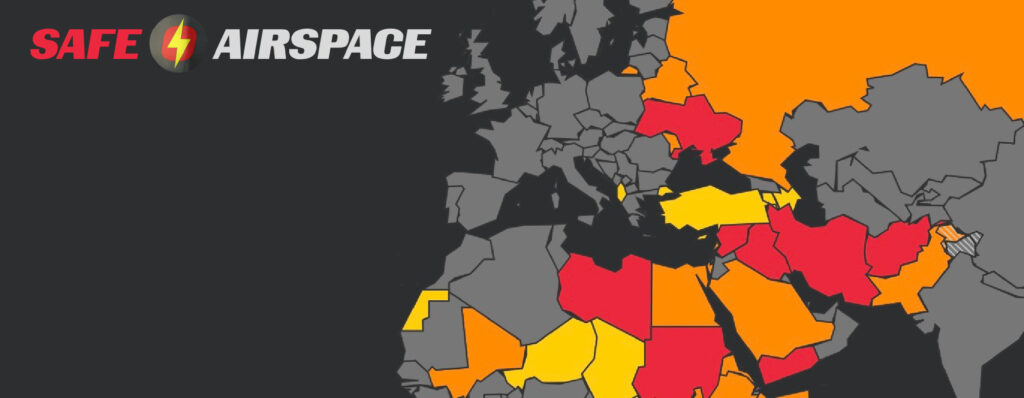
Therefore, if you have been using these oceanic airways, and have not been paying Cuba NAV fees for those flights, you may be denied entry on your next attempt to fly through the airspace.

NAV fees need to be paid to ECNA in Cuba in Euros – which becomes a bit of a challenge for many operators! Again, CST can help with this. Contact them at customersvc@cstflightservices.com for more info.

Flights TO Cuba

Now we’re getting into murky legal and political waters. If you want to actually fly TO Cuba, rather than overfly it, the short story is this:

US Part 91 (Private) flights: these have been completely banned since June 2019. Applies to all N-reg aircraft flying directly or indirectly to Cuba (i.e. from the US or another country). This was a policy introduced by the US Bureau of Industry and Security (BIS), which meant that U.S. operators could no longer operate an N-reg aircraft privately to Cuba for any reason – it doesn’t matter if your passengers meet OFAC’s “permitted categories of travel” or not, it’s a no-go.

US Part 135 (Charter) and Part 121 (Airline) flights: these are allowed to operate to Cuba. However, it’s a tricky business to do these flights and stay within the rules. Policies introduced by the Office of Foreign Asset Control (OFAC) in 2017 mean that there are only a handful of categories of permitted travel between the US and Cuba.

Non-US operators: If you’re heading to Cuba from anywhere other than US territory, it should be fairly straightforward. Get a landing permit, arrange your ground handling, file your flight plan, and off you go. Just double-check your insurance policy – if it’s provided or underwritten by a US company, you might not be covered for ops to Cuba. Check out our article for more info.


Watch out for Cape Verde Runway Closures

Two issues in Cape Verde
  1. There are ongoing runway closures at Cape Verde airports that pilots and operators would only know about if they checked the AIP.
  2. There are Notams published for these airports which do not show up in the FAA Notam search. Again, you would likely only know about them if you checked the Notams tab on the AIP website.

What are the closures?

As of Jan 2025, the runway at GVAC/Sal continues to be closed on weekday mornings (slightly different times each day) until April 2025. The runway at GVSV/Sao Pedro is also closed for an hour every morning Mon-Sat. There were similar closures at GNVP/Praia throughout 2024, but the work here is now complete and the runway is open again.

If you have a Jepp subscription, you might have seem these closures pop up in the NavData Change Notices, but if not, the only place you’ll find them is in the AIP SUPs.

Where is Cape Verde?

Here:

GVAC/Sal and GVNP/Praia are the two Cape Verde airports most popular for use as mid-Atlantic enroute alternates. GVSV/Sao Pedro and GVBA/Boa Vista are the other international airports. But GVAC/Sal is the one you’d most likely be considering for an enroute alternate, or maybe even a fuel stop, as this is the airport best set up to handle bizav and airline flights – they have a 9843ft runway, are open H24, and have an FBO run by Safeport (other ground handlers are also available: Aviation Services Cabo Verde, Cabo Verde Express, and CV Handling).

Why are we not seeing these closures on the Notams?

It’s because these are long-term runway closures. They are no longer publishing them by Notam because they exceed the 3-month time limit allowed by ICAO for publication, as per their Notam Improvement Campaign. So once the closures go on for longer than 3 months, they no longer get published as Notams but as AIP SUPs instead.

Whilst that’s great, in theory, for de-cluttering the Notam system of old Notams, it does leave pilots and operators having to scratch around to find the information. And in this case, we don’t even have a Notam warning us to check the AIP SUPs as the place to find it.

Worse than that, we don’t seem to be getting any Notams at all out of Cape Verde! They publish them on their own website, but for some reason none of them seem to show up on the FAA Notam search – the one that most of us use to check Notams.

Bottom line

For any ops involving GVAC or GVNP, watch out for morning weekday runway closures for the next little while, and know that you’ll likely be missing a bunch of Notams – make sure you check the Cape Verde official page for updates on both!


FIRE on the NAT! Where to go in an emergency?

In OPSGROUP, we talk a lot about the North Atlantic. Whether it’s a Plotting Chart you need, or an explanation of the Datalink Mandate, or a summary of big changes stretching back to the dawn of time – we’ve got you covered. We love the NAT so much we even enjoy asking ourselves annoying questions about it over and over again to see if we can answer them (we can).

But here’s something we haven’t fully looked into before – if you’re in big trouble on the NAT (like an engine on fire, for example), where can you go? 

Turns out there’s quite a bit of complexity to this. Some airports don’t have amazing levels of fire cover, some are closed at night, and some have weird setups where you have to pay them in advance to make sure they stay open in case you need them.

We’ll start with these odd ones. And we’re going to do everything in local time to keep things easy. Also, for the uninitiated, RFFS means Rescue and Fire Fighting Services (i.e. what level of fire cover an airport has), and if you’re confused about what number means what, you can read all about it here.

Odd Ones

CYFB/Iqaluit

  • Airport open: Mon-Fri 08-17, other times 12hrs notice required
  • RFFS: 5
  • Why odd? So it’s basically closed at night unless you make a special request for them to stay open in case you need them. If extended hours are needed, additional costs will apply to keep staff on standby. Requests to extend operating hours at the airport must be submitted using a specific document for either RFF5 or RFF7. CYFB provides extra RFF coverage at night on average 40 to 50 times a month. The cost for them to stay open with RFF5 is $1714 which gives you a 4 hour block of time. For RFF7 it’s $3427.

BGGH/Nuuk

  • Airport open: 06-21 every day
  • RFFS: 5 (or RFFS 8 with 4 hours notice)
  • Why odd? Technically it’s open at night, but as it’s a brand new airport, night opening is unrealistic at the moment – especially in winter. In the summer months, when there’s no snow and it’s daylight almost all day every day, there won’t be the same need for runway sweeping and using the airport as a diversion alternate might be more possible because they will only require standby personnel on short notice.

BGBW/Narsarsuaq

  • Airport open: Mon-Sat 08-17 (yep, closed on Sundays!)
  • RFFS: 7
  • Why odd? Can be requested to stay open at night most of the time. But watch out! As we reported before, Greenland airports will charge you the better part of $3k if you list either of them on your flight plan as diversion alternates when they’re closed.

BGSF/Sondrestrom

  • Airport open: Mon-Fri 08-16 (yep, recent change here is that they’re closed on weekends!)
  • RFFS: 5 (or RFFS 8 with 4 hours notice)
  • Why odd? Same as BGBW, can be requested to stay open at nights or on weekends, but same costs will apply.

EGPK/Prestwick

  • Airport open: H24
  • RFFS: 7
  • Why odd? Often at night they close the terminals building (they always Notam it) so there are no facilities for diversions at these times.

LPPD/Ponta Delgada

  • Airport open: 0615-0000
  • RFFS: 7 (can be increased to RFFS 9 with 24hrs notice at a cost of 70 Euros per hour, although they say this can usually be increased for emergencies too).
  • Why odd? At night (0000-0615), the airport has told us that they are closed and will only guarantee reopening for urgent medical evacuation flights, or humanitarian flights at the request of the Portuguese Air Force. LPLA/Lajes is the only airport in the Azores that is open all night for diverts.

LPAZ/Santa Maria

  • Airport open: It’s complicated.
  • RFFS: It’s complicated.
  • Why odd? Ok, here we go. So from 0635-2130 they are fully open with RFFS 6 (RFFS 8 available for a surcharge if you arrange in advance). Then from 2130-0000 the airport is closed but you can request they stay open for around 900 Euros (plus a fee to the handling agent). Then from 0000-0645 the airport is completely closed and cannot accept emergency diverts at all. Bottom line, just go to LPLA/Lajes instead.

TXKF/Bermuda

  • Airport open: 07-23 every day
  • RFFS: 9
  • Why odd? To get them to open at night (ATC and RFFS) for emergencies, you need to give them 30 mins notice – so not ideal if your needs are super urgent. Also, they do sometimes publish Notams saying that ATC will not be available for certain periods at night, even for emergencies.
Not Odd Ones

Ok great! Here are all the straightforward airports that are open H24 with decent fire cover:

CYYR/Goose Bay
Open H24
RFF 5 (RFF 8 on request)

CYQX/Gander
Open H24
RFF 5 (RFF 6/7/8 with 2hrs notice)

CYDF/Deer Lake
Open H24
RFF 6 (RFF 7 with 30 mins notice)

CYJT/Stephenville
Open H24
RFF 5 (RFF 6 with 30 mins notice)
In winter months, they often have a Notam saying that they might need 2hrs notice at night to clear the runway of snow.

CYYT/St Johns
Open H24
RFF 7

CYHZ/Halifax
Open H24
RFF 7

BIKF/Keflavik
Open H24
RFF 8 daytime 05-19 (RFF 7 overnight 19-05)

EGAA/Belfast
Open H24
RFF 7 (RFF 8/9 with 24hrs notice)

EINN/Shannon
Open H24
RFF 9 (may on occasion be reduced to RFF 7 depending on staffing)

LPLA/Lajes
Airport open 07-21 (but H24 for emergencies)
RFF 8 at all times

So let’s give that map another try, this time with a tasteful splash of orange colour…

So there you have it, friend! While we’re on the subject of Emergency Diverts, you might also be interested to read about NAT Contingency Procedures (what to do when you need to deviate from your ATC clearance due to an emergency). For more info about recent changes to Greenland Airports, click here. And to download the latest OPSGROUP NAT/North Atlantic Plotting and Planning Chart 2025, head over here.

As usual, any questions, let us know at team@ops.group.


Russia: Aircraft Shot Down, New EASA Airspace Warning

Key Points
  • EASA has issued a new airspace warning for Russian airspace following the likely shoot down of Azerbaijan Airlines Flight 8243 on approach to URMG/Grozny Airport on December 25 by a surface-to-air missile.
  • Operators are advised not to enter Russian airspace west of longitude 60 degree east (the entirety of Western Russia) at all levels due to the risk of being unintentionally targeted by air defence systems, and extensive GPS interference.
  • Previous state-issued airspace warnings have been confined to areas in close proximity to the Ukrainian border. The new EASA warning suggests a significant escalation in airspace risk.

What’s changed?

Ukraine has strengthened the frequency and intensity of missile and drone attacks on targets well within Russian territory.

The latest occurred this week on January 14 – a combination of cruise and ballistic missiles and the largest drone strike yet (over one hundred and forty devices) against infrastructure across Western and Southern Russia, as far as 680 miles from the border. Russian air defences reportedly shot down a number of them.

The war with Ukraine has entered a new phase which no longer limits airspace risk to the primary conflict zone.

Azerbaijan Airlines Flight 8243

EASA’s new airspace warning appears to be in direct response to the downing of an Embraer passenger jet on December 25 at URMG/Grozny airport, Southern Russia.

The crew were on approach when the aircraft suffered sudden damage which was initially misidentified as a bird strike.

The aircraft later crash landed following a diversion to UATE/Aktau airport in Kazakhstan.

Limited analysis of the wreckage appears to indicate shrapnel damage consistent with a surface-to-air missile. The most likely culprit was a Pantsir air defence system – a radar guided medium range SAM not dissimilar to the Buk system used to shoot down MH17 over Eastern Ukraine in 2014.

It was later confirmed that air defence systems were responding to a Ukrainian drone strike in the area at the time.

While not official, it is almost certain AZ 8243 was mistakenly targeted. In any event we will have more answers soon – ICAO Annex 13 requires a preliminary report to be issued within thirty days of the accident (of which Russia is a member state).

No one’s overflying Russia anyway, right?

This simply isn’t the case. It’s true the Russia has imposed reciprocal airspace bans on aircraft registered to a large number of countries (including the US, Canada and the EU). This is in response to political sanctions, not risk.

Those from China, Turkey, the Gulf States and others are still allowed. And until now, they have been overflying airspace with no active warnings in place.
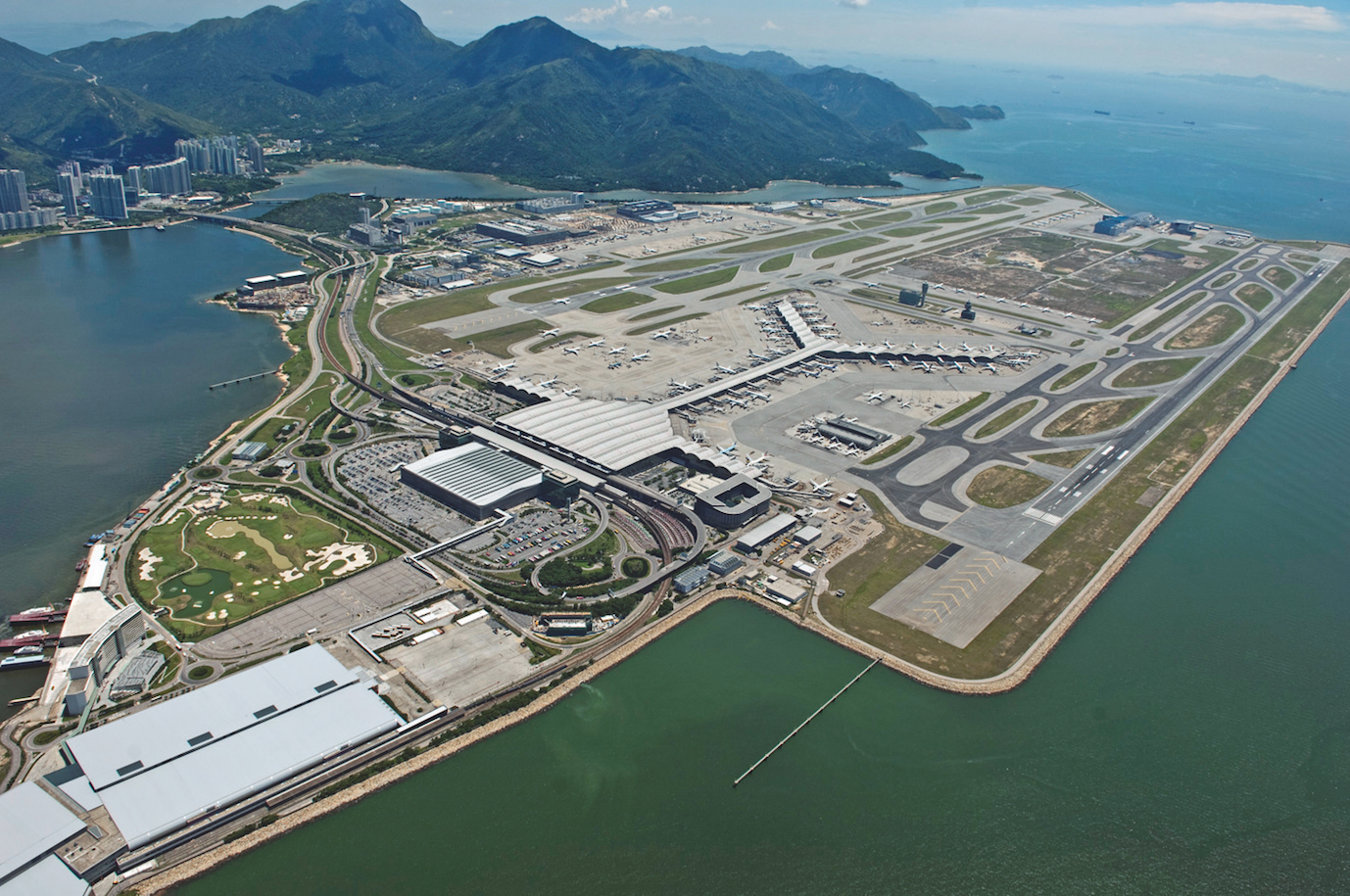
The EASA warning

EASA issued its new warning on January 9 via a Conflict Zone Information Bulletin (CZIB).

A note about EASA. Its advice isn’t binding – it is provided for the consideration of its member states and does not represent an actual flight prohibition.

However, history has shown it does have a strong bearing on the rules imposed – as a result, we are likely to see to number of new state-issued warnings for Russia in the coming weeks.

The CZIB recommends operators do not enter Russian airspace (west of longitude 60 degrees east) at all levels. This affects the Moscow, Rostov, Saint Petersburg, Yekaterinburg and Samara FIRs.

EASA advises that the deployment of Russian air defence systems to these areas in response to Ukrainian drone and missile attacks could directly threaten the safety of overflying aircraft.

It argues Russia does not have adequate protections and procedures in place to ensure the safety of civil aviation. The apparent downing of AZ8243 is testament to that fact.

Beyond the risk of misidentification, the warning also cites dangers related to GPS interference (including spoofing) being used to deter aerial threats with little regard to the effect on civil aircraft in the area.

Safe Airspace

At safeairspace.net, our team faces a conundrum.

Russia oversees well over 6.6 million square miles of sky and is transcontinental in scale.

Towards its south-eastern borders with China and Mongolia the risks associated with the conflict in Ukraine are low to non-existent.

To the west, the risk is high which is why EASA’s new warning makes a distinction based on a line of longitude that divides the country in two.

The same applies to our level of warning for Russia at safeairspace.net – where a Level 2 (Danger Exists) remains in place. But in light of recent events, we would advise against overflights of Western and Southern Russia at this time.
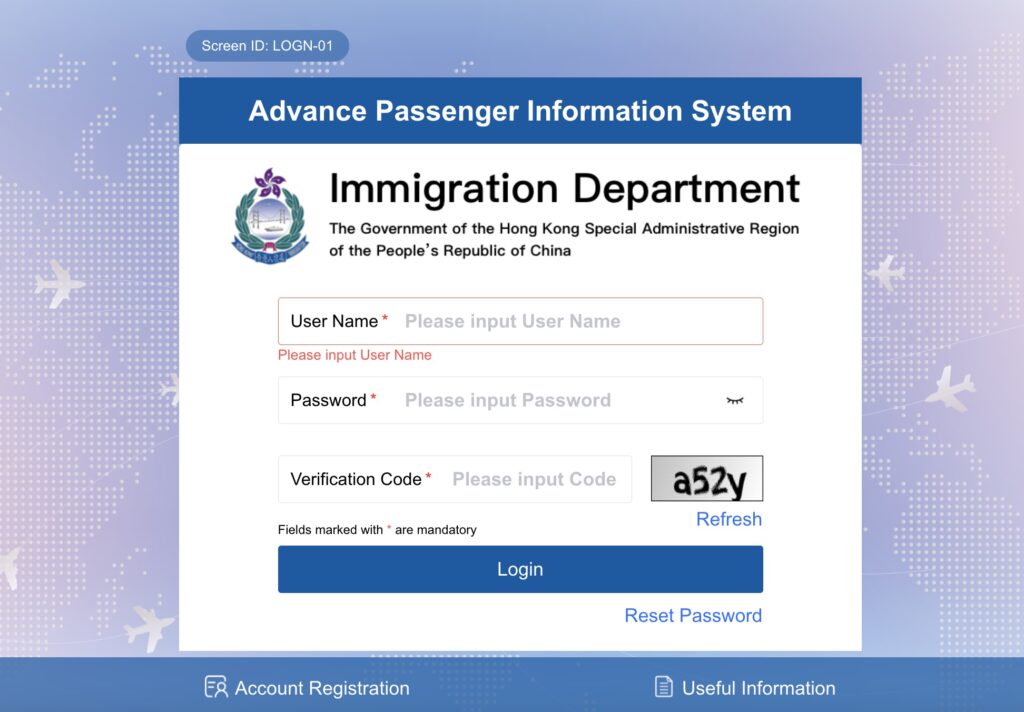

Get in touch with us

Our team is available around the clock. You can reach us at blog@ops.group – we’d be happy to help with any questions you may have.


Germany: Crew Being Charged for Sneaky Security Checks

Key Points
  • July 2024: We wrote about some strange happenings reported by OPSGROUP members at German airports – random security checks performed by LBA staff (Germany’s Civil Aviation Authority) to ensure the proper protocols were being followed by crew.
  • These are not ramp checks, they are sneaky checks to see whether crew follow the right security procedures. They basically try to enter the aircraft, and your job is to make sure you stop them.
  • Jan 2025: We’re now hearing that the LBA have started charging operators for these checks! One member reported receiving a 330 Euro invoice for a check that took place at EDDM/Munich. Another reported the same thing at EDDV/Hannover and EDDS/Stuttgart. It seems that opting-out of these checks is not possible!

Surprise invoices

In December and we received a fresh report from an OPSGROUP member. During a recent stop at EDDM/Munich, they were the unwitting recipients of one these surprise security checks.

Later, they received an invoice from the LBA for 330 Euros – despite having no ability to opt out. Here’s an excerpt:

What the LBA had to say

It was the first we had heard of crew being involuntarily invoiced for these random security inspections and so reached out to the LBA directly.

Apparently, a legal document called the Aviation Security Fees Ordinance (or Luftsicherheitsgebührenverordnung for short) was amended in February 2024 to enable LBA to collect fees to cover the costs of ‘surveillance measures’ which includes the surprise security checks in question.

Fair or not, it looks as though this practice will continue at German airports indefinitely.

The checks themselves

We previously enquired as to the legality of these checks and were referred by the LBA to another document – the EU Implementing Regulation 2015/1998 which is all about basic standards on aviation security.

We read it so you don’t have to – and couldn’t find anything in it warning crew to look out for weird notes or unwelcome visitors in high-viz vests entering your aircraft with no ID.

The legal framework is there, but from an operational perspective but we still have the following concerns:

  • Crew are being tricked into compliance.
  • These invasive checks have now been incentivized.
  • There is no ability for crew to opt out of being charged.

Aviation security is a team effort, not a commercial enterprise. And for that reason, we feel this a concerning precedent to set.

Please get in touch with us

When we write Ops Alerts to members we have a specific category for costs, as they often come as an unwelcome surprise to operators. We do our best to get the word out to help others. If you come across these in your travels, please reach out to us on team@ops.group so that we can keep the group informed.


UK Electronic Travel Authorization – The BizAv Guide

Key Points
  • The UK is bringing in an Electronic Travel Authorisation (ETA) scheme for passengers, much like the US ESTA.
  • It started in Nov 2023 for travellers from Qatar. It then applied to travellers from more Gulf states from Feb 2024. Nationals from a long list of countries (includes the US) will be able to use this from 8 Jan 2025. Then there’s another list (pretty much everywhere in Europe) who can use this from 2 April 2025 (can apply from March 5).

The UK will be implementing its Universal Permission to Travel (UPT) scheme in 2025. Under a new Carrier Liability Scheme, operators will be obliged to check immigration permissions for non-visa nationals (in addition to visa nationals). This will affect both GAR and API submissions.

With ESTA in the States, eTA in Canada, and ETIAS coming soon in the European Union, the introduction of Electronic Travel Authorisation in the United Kingdom comes as no surprise. What does ETA mean and how can operators prepare for the upcoming changes?

Part of the bigger picture: Universal Permission to Travel

ETA is a digital record linked to a person’s passport (valid for 2 years, or less if the passport expires). It is being introduced as part of a broader scheme called Universal Permission to Travel. The general aim of UPT is to strengthen the UK border security by ensuring that all travellers have a valid travel permission in advance. The plan is for the majority of these permissions to become digital-only in the future (e.g. e-visas). This way, operators will be able to check and confirm a passenger’s permission prior to travel. This will reduce the number of people denied entry at the border, and the associated detention and removal costs (which operators need to bear).

Who and when: The scope of the UK ETA

In general, the UK ETA applies to visa-exempt passengers and those who do not have a UK immigration status. There will be some limited exceptions for those who cannot be required to hold a permission, e.g. diplomats.

ETA will not be required for people with either:

  • a British or Irish passport;
  • permission to live, work, or study in the UK;
  • a visa to enter the UK.

People living in Ireland who are not Irish citizens will only be exempt if: they are legally resident in Ireland, do not need a visa to enter the UK, AND they are entering the UK via the Common Travel Area. All three conditions must be met.

It’s worth noting that ETA is also required for passengers transiting through the UK.

The launch of ETA will happen in phases:

  1. From 15 Nov 2023: the nationals of Qatar.
  2. From 22 Feb 2024: the nationals of Bahrain, Jordan, Kuwait, Oman, Saudi Arabia, and the UAE.
  3. 8 Jan 2025: loads more nationalities – basically all of the world except Europe.
  4. 2 April 2025 (can apply from March 5): pretty much all of Europe.

You can see the full lists of nationalities here.

Travellers can apply for the ETA here. Expect a confirmation within 3 working days, often quicker. The cost is £10. The ETA is valid for two years, and can be used for multiple visits, but if you get a new passport within that time then you’ll need to apply for a new ETA.

There are some nationalities who won’t be able to apply for the ETA. The ETA scheme is broadly for visitors who do not need a visa for short stays to the UK. Travellers who currently need a visa will most likely continue to need one when the scheme goes live.

New ETA: What does it mean for operators?

The introduction of ETA has affected the Authority to Carry regulations, which constitute the UK’s “no fly” scheme. Travellers who are refused an ETA, as well as those whose ETA gets cancelled, are now included on the list of people whom operators cannot carry to or from the UK.

An operators may get fined (up to a max of £50,000!) when:

  • they do not check if they can carry a person;
  • they carry a person who has no valid permission to travel.

This means that operators will need to send their API data in an ‘interactive’ way in order to check the ETA status (the submissions will trigger a response from the Home Office). There are different ways to meet this requirement (depending on the type of operation and terminal type):

  • submitting GAR data manually via the sGAR web-portal;
  • submitting API data from DCS via the UK iAPI system;
  • requesting a third-party (e.g. your Ground Handler / FBO / Data Provider) to submit the data on your behalf.

ETA status check: Four possible outcomes

Regardless of the submission method, there will be four basic results (board / check / no board / error), with additional codes or descriptions for operators to know what needs to be done:

  • BOARD: A valid permission to travel has been found. Once the identity and passport / travel document check is completed, the passenger can board the plane.
  • CHECK: There is no record of a valid permission to travel. The operator has to conduct a manual check of immigration or exemption documents as well as identity checks. If the check is satisfactory, the passenger may board.
  • NO BOARD: The permission to carry is refused. The person must not board the plane. Carrying such a passenger entails a risk of a civil penalty.
  • ERROR: The permission to travel cannot be confirmed due to some missing data. The operator should correct the data, resend it, and wait for the check result.

When carriers check passenger's UK ETA status by sending GAR or API, the Home Office can respond with four basic messages: board, check, no board, or error.

What are operators expected to do now?

Passenger scenario Action for the operator
Passenger has a Visa or Biometric Resident’s Permit Verify the visa or check the validity of the Biometric Resident’s Permit (a valid visa or Biometric Resident’s Permit is still recognized as a travel permission, just like ETA)
Passenger has an ETA OK to board
Passenger is still waiting for their ETA application to be approved OK to board
Passenger did not apply for an ETA Ask them to apply before boarding
Passenger/UK confirms that the ETA has been rejected or cancelled Do NOT board

It is also important to know that operators must continue to check the passenger’s identity and travel document (ETA changes do not affect these checks in any way).

Does this all apply to Private Flights too?

Yes. The scheme applies to all operators – including General Aviation.

Do flight crew need an ETA?

No, not for most flights. We asked the UK authorities this question, and they said:

  • Crew who arrive and depart by aircraft as operational crew within seven days of arrival will not require an ETA.
  • Crew who are arriving in the UK as deadheading or positioning crew do not qualify for this exemption – they will need an ETA. However, the UK does operate a concession for deadhead and positioning visa national crew leaving by 23:59 the day after their arrival.

Another thing to watch out for if flying to the UK with ground crew or engineers on board who are intending to work airside. These staff are not allowed to enter as crew on a gendec – you must get a work permit for them 48hrs in advance. The only alternative is to apply to the UK Border Force to make an exception, in which case you need to fill out this form and email it to them.

What about the UK GAR rules?

Effective 6 April 2024, there were some big changes to the UK’s General Aviation Report (GAR) submission for international GA flights:

  • The GAR form is now required for departures (not just arrivals).
  • If you get it wrong, you can now get fined up to £10,000 (there were no fines before).
  • You have to submit it via an online portal, or through your handler, (no longer directly to UK Border Force via email).
  • And after you submit it, you will get a response telling you whether that crew/pax is allowed to travel (you will still need to check their passport/visa/travel docs etc).

More info on these new GAR rules can be found here.


Thanks to PnrGO for help with this article! If you’re flying to the UK and are impacted by these changes, you can contact PnrGO if you’d like to save yourself some UPT/ETA/GAR/API related misery – they have some tech that lets you do all of this automatically. Click here for more info.


2024 Flight Ops Changes: The Big Ones

It’s been another busy year of change in the world of international flight ops! Here are some of the big ones from 2024…

January

  • Secret Overflight Requirements in Antigua: If you enter the Antigua TMA/TCA (the airspace around Antigua up to FL245), you’ll need to apply for a “cross-border permit”. Without it, they won’t let you enter! Read
  • Mexico Permit Chaos: New Rules Explained: Some recent changes to the permit procedures in Mexico caused stress and delays. Here’s how the new process works. Read
  • NAT Conundrums Volume IV: Contingency Procedures: We love North Atlantic conundrums so much, we’re into our fourth Volume! This one looks at Contingency Procedures in depth, for those times when you need to deviate from your ATC clearance. Read

February

  • Expanded Free Route Airspace in Africa: Free Route Airspace (i.e. you can fly direct between waypoints) is now available across all ASECNA airspace in Africa, FL250 and above. Read
  • Libya Airspace Risk: An Idiot’s Guide: Why have EASA eased their warning on flights to Libya? Here’s a look, all wrapped up in a 7-Step Idiot’s Guide to Libya Airspace Risk, with some maps, pictures, analysis, and advice for operators. Read
  • New Risk Warning: Somalia ATC Conflict: Ongoing issue in Somalia of aircraft being contacted and given conflicting instructions by fake ATC. Bottom line, if you’re overflying in the northern half of the country (i.e. where all these issues have been happening) and get a call on the radio, ignore it. Read
  • US FAA: Who wants to land on the runway? Flying to an airport in the US? Want to land on the actual runway, rather than some taxiway or dirt road which looks a bit like the runway? Not afraid of some basic pics showing you how not to mess it up? Well then today’s your lucky day! Read

March

  • Singapore Airspace Changes: Singapore and Indonesia realigned their FIRs in March 2024. There’s one thing this will hopefully fix for good – no more intercepts of civil aircraft by Indonesian fighter jets! Read
  • Haiti Crisis: Airport Attacked, Aircraft Shot: MTPP/Port-au-Prince was closed from March-May 2024 due to sustained gang violence across Haiti. Aviation came under direct threat during the worst of the violence, with several reports of several armed attacks at the airport. Then in November, two aircraft were hit by gunfire on approach, and the airport was closed again. Since then, several countries have issued new airspace warnings for Haiti. Read
  • NAT Changes March 2024: No More Oceanic Clearances: Three big changes announced for the North Atlantic: NAT Comms Failure Procedures have been simplified, squawking 2000 ten minutes after OEP are now standard everywhere in the NAT, and there will be no more Oceanic Clearances. Read (unfortunately this last one turned into a bit of a mess – check the entries for November/December below for more info!)

April

  • The MEL vs MMEL issue: US aircraft have often had ramp check findings in Europe because EASA decided that the D095 LOA wasn’t good enough (they wanted to see a D195 LOA instead). In April, the FAA announced that operators could get these D195 LOAs much more quickly. Read
  • TIBA in Australia: What’s Going On? TIBA still seems to be an issue in Australia – shortage of ATC resulting in big bits of restricted Class G airspace, often at short notice. Read
  • Outsmarting the GPS Spoofers: We came across a new tool designed to alert you if you are being spoofed. We liked it – it works, so here are the details. Read
  • Saudi Arabia Overflights – Free Route Gotcha: There is some new Free Route Airspace in the OEJD/Jeddah FIR, specifically in the south-east portion. If you don’t file the right way, you’ll be descended to FL300. This is especially relevant now, with so much EU-Asia traffic operating via Egypt-Saudi. Read
  • New GAR Procedure for UK Flights: There were some BIG changes to the UK’s General Aviation Report (GAR) submission for international GA flights. Read

May

  • Italy New Disinsection Procedures: For flights to Italy, if your aircraft has been in an affected country (including the US) in the past 28 days, you’ll need to get it sprayed and provide a certificate. Read
  • Argentina Overflight Permits Now Required: All foreign aircraft now need an overflight permit for Argentina. Here’s how you get one. Read
  • US Domestic Enroute CPDLC Update: Domestic en-route CPDLC in the US is now available to everyone. To get it, you’ve got to have the right avionics and submit a form – the FAA has published a list of aircraft types, which you will need to check to see if you comply. Read
  • Israel tightened rules for GA Flights from the US: Most operators will now need to either hire an approved security company to do screening in the US, or else make a stop en-route at an approved European airport. Read
  • Canada ADS-B Mandates: Where you need ADS-B in Canada, what equipment you need, how to apply for an exemption, plus all manner of other questions answered! Read

June

  • Mexico Permit and APIS Issues: New guidelines for landing permits caused yet more confusion for both private and commercial flights to Mexico. There are also now different options for submitting APIS, and these have been causing issues too! Read
  • Edinburgh security rules create delays: EGPH/Edinburgh airport has a rule that means all aircraft have to go through outbound security screening, regardless of weight or type of flight. Airport Spy reports suggest this can easily take an extra hour to complete, so plan for departure delays! (or go to Glasgow instead, as many members suggest). Read
  • SAFA Ramp Checks: The Top 5 Offenders (+Alcohol test): We had several reports indicating a ramp up of ramp checks in sunny Europe (especially Germany). High on the list of findings are: fuel checks not done, bogus flight planning to alternates, and for business jets – beds not folded up for landing/departure. Also increasingly popular is a breath test to get things rolling! Read
  • Don’t Climb! A Big NAT No-No: One of the most popular pilots mistakes on the NAT is to start climbing or descending when you get your Oceanic Clearance (or send your RCL). Prior to the entry point, you are still with Domestic ATC – you have to ask them for any level change. Don’t ruin your day! Read

July

  • NAT Crossing after GPS Spoofing Guide: An increasing problem on the NAT is aircraft crossing the ocean following a GPS Spoofing encounter. This reduces your capability from RNP4 to RNP10, and in busy westbound flows causes problems for Shanwick. It has also led to descents to FL280 and diversions to Iceland. Here’s the full guidance on what to do. Read
  • German Ops Gotchas: OPSGROUP members reported several strange things happening at airports in Germany – new rules about baggage holds, reports of sneaky security checks of bizav aircraft, and a snageroo for commercial flights when paying for fuel. Read
  • Afghanistan Overflight Update: An update on the risks of Afghanistan overflights, following an easing of the rules for N-reg aircraft. Plus a full crew report from a recent flight over the country – to give you an idea of what it’s really like. Read

August

  • UK Electronic Travel Authorization Guide: Travellers from a long list of countries (includes the US) will be able to use this from Jan 2025. Then there’s another list (pretty much everywhere in Europe) who can use this from April 2025. Get the full lowdown here. Read

September

  • GPS Spoofing: Final Report published by WorkGroup: We published the Final Report of the GPS Spoofing WorkGroup. Over a six-week period between July 17-August 31, the WorkGroup tackled the complex issue of GPS Spoofing affecting civil aviation. The result is a comprehensive study of the GPS Spoofing problem, including detailed analysis of the technical background, impacts to aircraft handling and operation, best practices for flight crew, and a series of safety concerns and recommendations for industry attention. Read
  • Hong Kong’s new APIS system: Hong Kong brought in a new APIS system in Sep 2024. GA/BA flights will have to start doing it from April 2025. Here’s how it will work, plus the lowdown on ops to VHHH/Hong Kong if you’re headed there for the first time – or the first time in a long time. Read
  • Watch out for Cape Verde Runway Closures: Popular mid-Atlantic tech stop airports GVAC/Sal in Cape Verde has some long term runway closures going on – but you won’t find out about these from the Notams. Read
  • TSA Waiver Guide: If you’re heading to the US and are trying to work out whether you need a TSA Waiver for your flight, we have a guide to help with that. Read
  • US Border Overflight Exemptions Guide: Want to fly from Mexico to the US and land wherever you like? You’ll need a thing called a US Border Overflight Exemption. The CBP has just increased the validity period of these to three years (previously two). Here’s how to get one. Read

October

  • Middle East / Israel Update – October 2024: Israel carried out airstrikes on Tehran on Oct 26, in response to Iranian strikes on Israel on Oct 1. The en-route traffic situation has since largely returned to normal. Most operators continue to avoid Iran and Israel. Iran in particular has a heightened risk of misidentification or interception for overflights at the moment. Middle East transits should consider going south via Egypt/Saudi instead. Read
  • EU-LISA Update: A more in-depth look at the requirements for operators when the first phase of Europe’s Entry/Exit System starts in November 2024. Read
  • Blue Spruce Routes Guide: Most flights on the North Atlantic have all the necessary bells and whistles to merrily zip along between FL290-410 right through the centre of NAT HLA. But if you fly old planes, broken planes, little planes, or planes straight outta the factory – you will most likely be flying the Blue Spruce Routes. Here’s how they work, and what to expect when flying them. Read
  • Greenland Airports Guide: Each day thousands of aircraft routinely cross the North Atlantic and use airports in Greenland as enroute/ETOPS alternates. But some major changes are coming that will directly impact on the operational use of these airports as NAT alternates. Read
  • US LOA Guide: Applying for Letters of Authorization (LOAs) from the FAA can be a tricky old process. Here’s an updated guide which tells you what LOAs are, when you need them, and how straightforward the application process can be. Read
  • US Ops: CBP Gotchas and Recent Penalty Cases: There has been a surge in CBP penalty cases recently. The top 3 reasons: failing to get Permission to Land, failing to obtain Departure Clearance, and errors in APIS data. Here’s how to avoid making the same mistakes. Read

November

  • NAT Guide 2025 – My First NAT Flight is Tomorrow: The OPSGROUP NAT Guide 2025 (aka My First North Atlantic Flight is Tomorrow) is now available to all members, as well as an updated Circle of Entry. Read
  • 2025 North Atlantic Plotting & Planning Chart: We also updated the OPSGROUP North Atlantic Plotting and Planning Chart! This is our chart showing North Atlantic Oceanic and adjoining domestic airspace, with easy to read NAT Tips, Airspace Requirements, Emergency Procedures, and much more! Read
  • US Pre-Clearance Guide: Everything you ever wanted to know about US Pre-Clearance! Where you can do it, where you can fly to in the US once you’ve done it, and how the process works on the ground. Read
  • Dodging Danger: The Three Routes Through the Middle East: Middle Eastern transits have become more challenging of late, with no “zero risk” options available anymore. Most flights are heading via three distinct routes: South via Saudi Arabia and Egypt, Central via Iraq and Turkey, or North via the Stans and the Caspian Sea. Here’s a detailed look at each. Read
  • Shanwick postpones Oceanic Clearance Removal: Shanwick has delayed its Oceanic Clearance Removal (OCR) until further notice.  Bodo and Gander went ahead with their transition on Dec 4, and Reykjavik and Santa Maria did theirs back in March. Review the full briefing, with FAQ, new procedure, and full details here. Read
  • Red Sea Conflict Zone – Airspace Risk: The Red Sea is an active Conflict Zone. A missile intercept incident near Jeddah on Nov 3 (observed at close proximity by transiting air crew) has highlighted the risk to civil aviation, and has made it clear that this area is an extension of the Israeli conflict. Many Europe-Asia Middle East routes fly over this area. Read

December

  • CENAMER Flight Planning Requirements: A couple of new things to know if you’re operating in the MHCC/Central American FIR – two countries there have ADS-B mandates coming soon, and there’s a new website where you can pay for your nav fees. If you’ve never flown here before, check out this guide. Read
  • South Atlantic Bulletin: CPDLC Warning: Some operators have been incorrectly logging onto GOOO/Dakar rather than DIII/Abidjan when transiting the South Atlantic. ATC are concerned, and so a new SAT Ops Bulletin has been published. Here’s a closer look at what it contains, and how to not mess it up on your next crossing. Read
  • High levels of Pilot Error with NAT RCL – New Briefing and Checklist: Since the Dec 4 “No Oceanic Clearance” procedure, high levels of pilot errors are creating traffic restrictions in Gander Oceanic airspace. As a result, we issued a new Crew Brief and Checklist: download it and avoid making some of the common mistakes! Read

As the year draws to a close, we want to say a big thank you to everyone in OPSGROUP for showing up, sharing stories, experiences, and information, and in turn keeping us all safe and up to date.

We’ll be taking some time off from the Daily Brief and Weekly Bulletin emails over the holiday period. Last day in the office will be Monday 23rd Dec, and we’ll be back again on Thursday 2nd Jan. Happy Holidays everyone, and see you in 2025! ❤️⚡✈️🧑‍✈️


High levels of Pilot Error with NAT RCL: New Briefing and Checklist

The number of pilot errors following the introduction of the new “No Oceanic Clearance” procedure is turning out to be far higher than expected. As a result, Gander have had to implement an evening Airspace Flow Program (AFP), restricting eastbound traffic.

Since December 4th, Oceanic Clearances are no longer being issued by Gander for eastbound flights, and a new procedure is in place using an RCL message to send your desired time, level and speed at the Oceanic Entry Point (OEP).

However, the very high level of non-compliance with this new procedure is surprising and troubling. Errors by flight crew fall into a number of different categories, but can be summed up in a “Top 5”, including sending the RCL at the wrong time, asking for an Oceanic Clearance, “DIY” level changes, wrong handling of RCL Rejected messages, and repeated voice requests for “route confirmation” blocking active ATC frequencies.

A new Crew Brief and Checklist has been published today, which you can download below. Please save a copy, and send to your crew and colleagues!

Download the Gander RCL Crew Brief and Checklist (PDF, 1Mb)


Top 5 Pilot Errors

  1. WRONG RCL TIME. Send it when you are 90-60 mins from your entry point. Not before, not after. The 1 hour cutoff is strict.
  2. ASKING FOR AN OCEANIC CLEARANCE. They are gone, finished, done. (for NAT eastbound). ATC can’t give you one, so don’t ask!
  3. CLIMBING WITHOUT APPROVAL. (Or descending). Too many are getting this wrong. ATC will ensure you are at the right level at the OEP. Don’t “do it yourself”.
  4. WRONG HANDLING OF “RCL REJECTED”. You’ll get this if you send your RCL early or late. If late, just tell ATC on the current frequency what your RCL says. Then you’re done. You won’t be handled any differently. No “Oceanic Clearance”.
  5. ASKING FOR ROUTE CONFIRMATION. Don’t do it, it blocks the frequency and increases ATC workload. ATC auto-queries your FMS to ensure it’s correct.


Notes on the RCL process

  1. The RCL is a one-and-done message with your desired level and speed. You won’t get a clearance, so don’t ask for one! Send your RCL at the right time. The 1 hour cut-off is firm. If you do have to use voice (e.g late, or no ACARS) – just read out the RCL with current ATC, and you’re done.
  2. Domestic ATC (the radar sector before the ocean) is responsible for getting you to the level Oceanic ATC has assigned you. IF your RCL level is available, they will clear you. Don’t just climb yourself. Nil comms means no change, stay where you are.
  3. At the Oceanic Entry Point, maintain whatever level Domestic ATC has assigned – this is your ocean level. Set speed to Econ/Cost Index, or a Fixed Mach if so assigned. Your route is automatically queried with a “Confirm Assigned Route” message – no need to confirm via voice.
  4. Once in the ocean and traffic permits, you can expect an advisory that your RCL level is available if you didn’t get it earlier. If you have an Assigned Mach, when able, ATC will issue “Resume Normal Speed“. This means fly RCL speed (Cost Index), and notify of +/- 0.02 changes to this speed.

Worried about getting it wrong?

Of course, it always makes sense to double check any uncertainties, but if you can keep it off the frequency, that’s very helpful for ATC. At the moment, there is a high volume of extra requests (which makes life hard for the controller). Remember one key point: ATC systems are continually monitoring your route, speed, and level, and will advise of any discrepancy. Your route in the FMS is queried by a UM137 message (“CONFIRM ASSIGNED ROUTE”), to ensure both you and ATC have the same understanding of your track, or random route acoss the Ocean.

If you’re not certain about how the procedure works, use the Crew Brief and Checklist (developed specifically for Gander Oceanic), and refer to NAT Ops Bulletin 2023_001 Rev 4, and NAT Doc 007.

Can you share? Please do.

The quicker we can get this information out to all NAT crews, the better. Please share with your flight department, fleet, or operation – just download the Crew Brief and Checklist and pass it on.


Questions? Can we help?

If you have a question about the new RCL process, just comment below or send us an email. We want to help make sure that we are all on the same page!


US FAA Improves Flight Tracking Privacy

Dec 2024 Update:
  • The FAA’s Privacy ICAO Address Program (PIA) has been updated. CPDLC services are now available for flights using a PIA. To receive it, pilots must file the PIA ICAO 24-bit address and N-reg in the flight plan.
  • Two other important changes – aircraft info held by the FAA and associated with a PIA are exempt from the Freedom of Information Act, and pilots can now request a new PIA every twenty days if they want. You view the updated FAA Privacy page here.
Feb 2024 Update:
  • The FAA’s Privacy ICAO Address program has been expanded to include some new oceanic and Gulf of Mexico routes.
  • Check below for exactly which routes this program now applies to, and our Opsicle with steps on how to register.

If you’re not familiar with this program, it prevents users’ aircraft registration from being tracked by third parties using ADS-B output during US domestic flights. We wrote about it before here. But to explain what this program is and how it works in two sentences:

All Mode S equipped aircraft are assigned a unique ICAO 24-bit address – this is uniquely identifiable to your aircraft’s registration. The FAA’s PIA program assigns you another one to use that renders you secret-squirrel.

To participate, you must tick all three of these boxes:

  1. Operating an US-registered aircraft which is ADS-B equipped
  2. Using a third-party call sign
  3. Flying in US territorial airspace (the mainland, Alaska, Hawaii, and other US territories). Additionally, the PIA has been expanded to include US oceanic FIRs too – those more than 12nm from shore.

After news broke the program had been improved, we struggled to find a summary of the changes and got in touch with the FAA directly.

They advised while there is no ‘master list’ of the newly included routes, they have updated their website to include some valid examples including:

  • NYC to LA
  • Miami to Houston (via the Gulf of Mexico)
  • LA to Hawaii
  • Boston to Miami (with offshore routes more than 12nm from shore).

If you have an enquiry about a specific route, you can reach them on adsbprivacyicao@faa.gov. Chances are, as long as you stay within US jurisdiction, your route will be valid.

How to apply?

So, you want in? We’ve put together this little Opsicle with steps on how to register.

More questions?

The FAA has quite a good FAQ section on the PIA which you can access here.