Heat Damage in Nice: When APU Rules Damage Aircraft

Key Points
  • APU use is limited – only allowed 10 minutes before TSAT, and only after towing.
  • GPU reliability is shaky – some units failed or had to be replaced during operations.
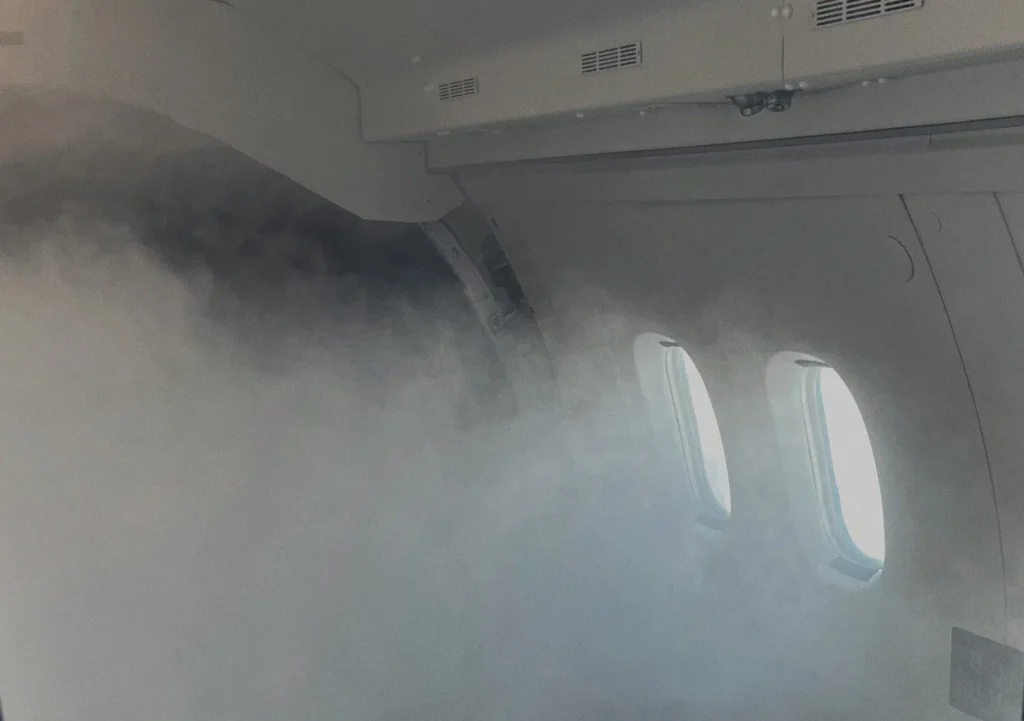
  • Heat may be damaging systems – OPSGROUP member reports of aircraft experiencing electrical failures, suspected to be caused by overheating while waiting without APU or proper cooling.

Recent reports from OPSGROUP members highlight growing concerns over the strict APU restrictions at LFMN/Nice.

Like many French airports, LFMN restricts APU use – aiming to cut noise and emissions. But as summer peaks on the Riviera, enforcement remains rigid despite the operational challenges this creates in high heat.

Beyond hot cabins, new concerns have emerged: potential electrical damage linked to the airport’s fixed ground power units (GPUs). Reports submitted to the airport remain unanswered. Here’s what we know so far.

A Little Context

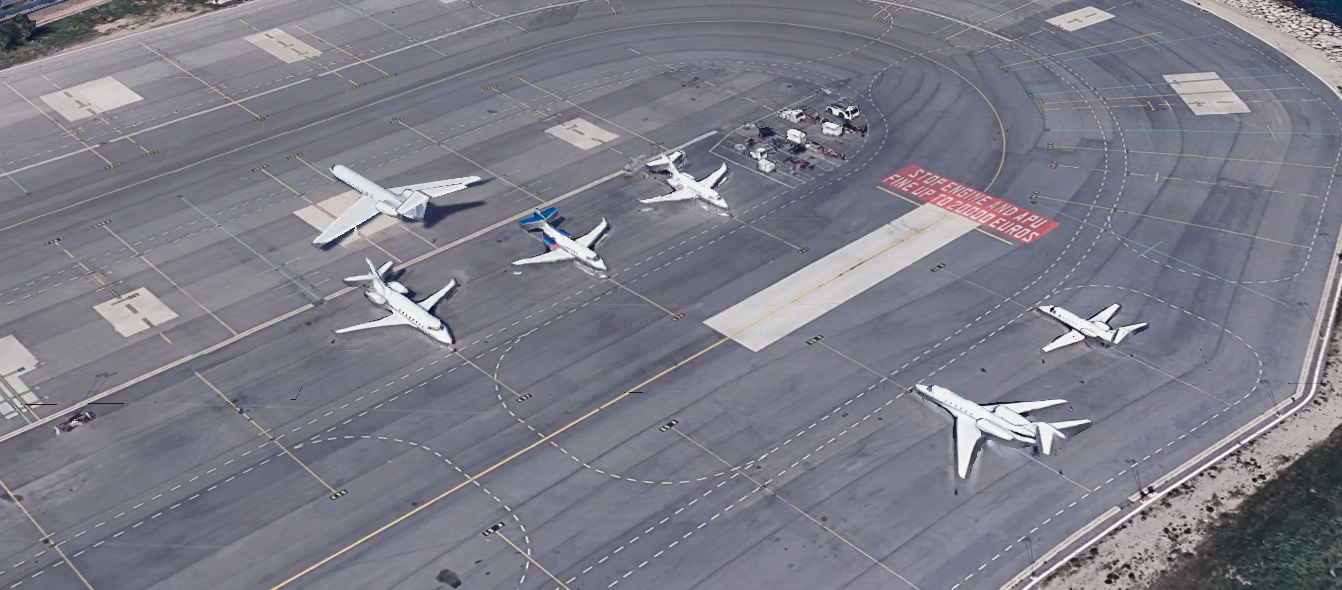
Private jet flights at LFMN primarily use the ‘Kilo Apron.’ This is the designated parking area for BizAv close to FBO facilities.

The rules for APU usage are found under the airport briefing in the French AIP. Specific guidelines apply to the Kilo Apron:

  • Arriving flights must stop on a designated line labelled ‘STOP ENGINE AND APU.’ From there towing to your parking spot is mandatory.
  • Departing flights must be towed to start-up stands fitted with 400Hz/28v ground power units, along with air. APU usage is limited to 10mins prior to TSAT (Target Start-up Approval Time).

The Kilo Apron at LFMN

Exemptions are very limited. You either need to be operating a medivac, state or cargo flight (carrying temperature sensitive payload). Or if the plug isn’t compatible with your aircraft.

Recent Member Reports

Here are three recent member reports received from OPSGROUP members there.

Report 1:

After towing to Stand 35, the crew connected to the fixed GPU. CAS messages flickered, followed by complete electrical failure and aircraft blackout. Despite heatwave conditions and an overheated crew, APU start was denied. A portable GPU was brought in – but it was dead. When permission to start the APU was finally granted, it was too late: navigation and communication systems had already failed. The aircraft departed under MEL and required expensive repairs at the next stop. The ramp agent advised us to file a report, which we did. According to them, this wasn’t the first time such an event had happened.

Report 2:

Another crew experienced a similar issue. One of two FMS units failed after GPU connection. While the cause wasn’t immediately clear, the symptoms matched those described in the earlier report. The unit was removed for repair.

Report 3:

The GPU caused a fault on our GVII upon disconnect. Our FA that understands French overheard ground personnel stating “it’s too hot” in reference to the GPU. Surface temp at time was 24C so it was the equipment. Had to shut down aircraft to dark and restart to clear fault and get a new CTOT 40 mins later.

Potential GPU Issues

While we can’t confirm the GPUs are the direct cause, it’s plausible. Aircraft systems are sensitive, and power issues — including frequency drift, incorrect voltage, poor grounding, or surges — can trigger serious failures.

Heat may be a compounding factor. Ground air units often underperform in high temperatures, especially if hoses are blocked or airflow is weak. Aircraft may exceed thermal limits before crews can start APUs or get adequate air.

The GPUs themselves may also struggle in heat – output may sag or drift, or thermal protection systems may shut them down.

All of this increases operational risk – especially when APU use is restricted with no flexibility for safety.

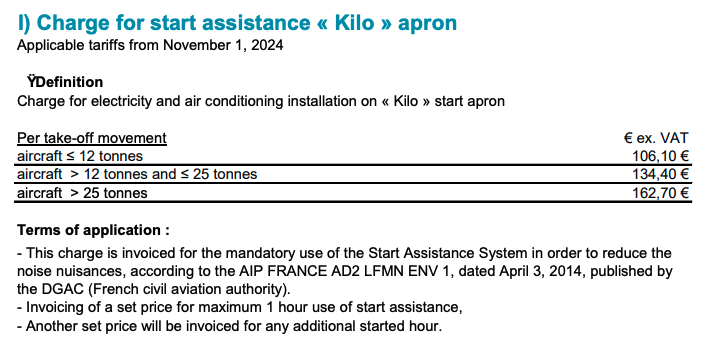
And, despite being mandatory, GPU usage at LFMN comes with a charge.

Despite their mandatory use, operators are charged to connect their aircraft to ground power.

If you’re going to enforce the rules on APU usage in summer there needs to be some flexibility for the operational safety of multi-million dollar aircraft and their crews. Quiet airports are great, but it’s easy to forget we are customers. In fact, Nice is the second busiest airport for business aviation in France, second only to Paris Le Bourget.

Mitigators

Following an alert issued to the group regarding these reports, another member (also a fully qualified pilot and aircraft engineer) got in touch with some practical advice to operators.

Here is what he had to say:

I thought it would be prudent to post some operational hints and tips to avoid problems like this event in the future. Not just with LFMN, but with any hot weather destination with restricted APU use (i.e. most  of Europe).

Most biz jet hydraulic pumps demand very high KVA from the GPU’s – avoid/delay applying hydraulic power to test systems and parking brake until APU start is approved.

Keep all the shades/sun shields drawn until packs are available.

Dim all the display units in the cockpit until air conditioning is available.

Open cargo and main door to allow air flow throughout the cabin. Small fans can run off the GFI plugs.

Open gear doors on some models as the exhaust for the avionic cooling fans use the wheel wells as the exit point.

Has this happened to you here, there, or elsewhere?

Please get in touch with us via blog@ops.group. We’d love to hear from you.

For ops at LFMN, if you identify a GPU issue (malfunction, incorrect configuration, electrical hazard, emissions), report it via your handling agent to the airport’s operations or safety department, or directly to Aéroports de la Côte d’Azur: +33 4 08 20 42 333, or via this contact form.


Greenland NAT Alternates: July 2025 Update

⚡ July 2025 Update

Radar services at BGSF/Sondrestrom will be ending around Nov 1, 2025. From that point, only procedural (non-radar) separation will be available. Iceland’s ADS-B offers some situational awareness over Greenland but can’t be used for control.

This follows the planned downgrade from tower to AFIS at the airport between Aug-Oct, driven by reduced traffic as BGGH/Nuuk expands. All controlled airspace will become Class G, with a radio mandatory zone within 20 NM below 7000ft, and FISCOM available via Nuuk FIC after hours.

RWY 27 is typically used for departures and RWY 09 for arrivals – be especially careful of opposite direction traffic. AIC 01/25 has more info.

⚡ June 2025 Update

The extensively expanded BGGH/Nuuk is now open, and receiving regular jet traffic.

With an operating length of 7218′ (2200m) and ILS approaches available for both runway ends, it is now a solid choice for NAT enroute alternates (and ETOPS/EDTO if that’s your thing). The Greenland AIP has been updated, and you can find the current airport chart here. Both runway and apron PCNs are 67/F/A/W/T .

The revitalised Nuuk is a whole new ball game for NAT crossings.

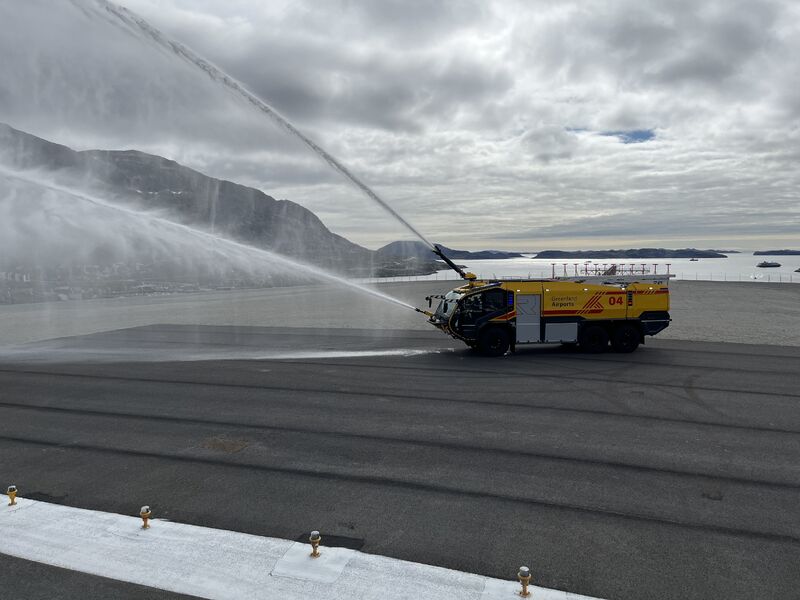
The airport has an AFIS on watch Monday to Saturday, 09:00 – 18:00 LT (11:00 – 20:00z) with RFF Category 5.

For handling, contact Greenland Airports: nuuk@mit.gl

Original Article

Each day thousands of aircraft routinely cross the NAT and use airports in Greenland as enroute/ETOPS alternates – mainly BGSF/Sondrestrom and BGBW/Narsarsuaq.

It’s big business for Greenland’s major airports, but over the next few years major changes are coming that will directly impact on the operational use of these airports as NAT alternates.

Here’s the lowdown on what’s changing:

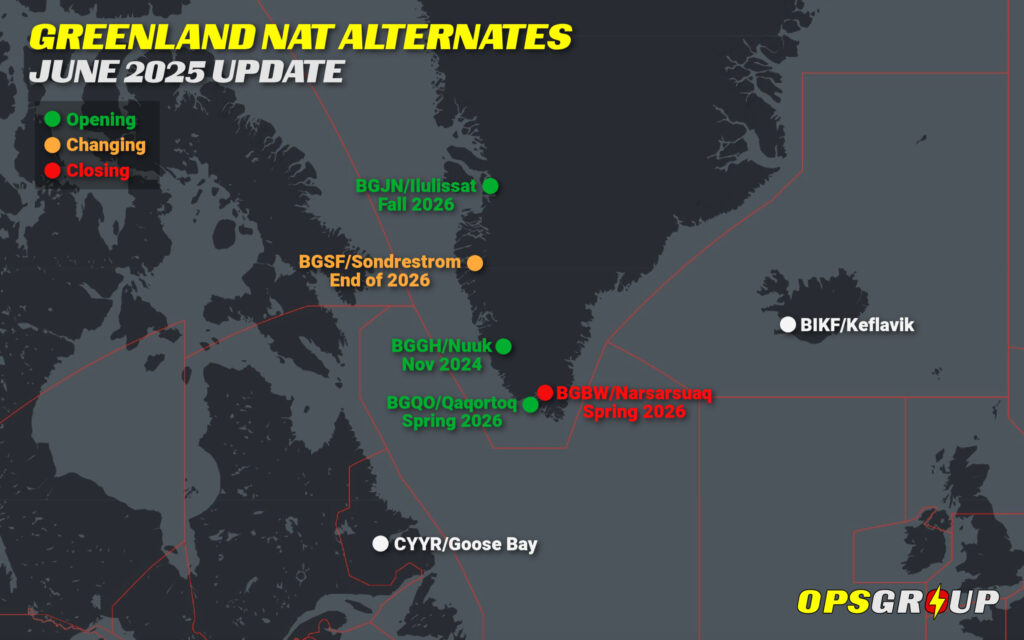
  • Opening: BGGH/Nuuk (Nov 2024), BGQO/Qaqortoq (Spring 2026), BGJN/Ilulissat (Fall 2026).
  • Changing: BGSF/Sondrestrom downgrading ATC to AFIS (Aug – Oct 2025).
  • Closing: BGBW/Narsarsuaq (likely Spring 2026).

ETOPS Airports…

Before we get stuck into the finer points of what’s changing at each airport, a big question many will have is: “What airports can I use as enroute/ETOPS alternates?”

Answering that is tricky, because it will depend on a number of factors that will be different for each operator – if the airport has a long enough runway for your particular aircraft / the necessary facilities and services / the minimum approach procedure / fire cover / weather minima etc.

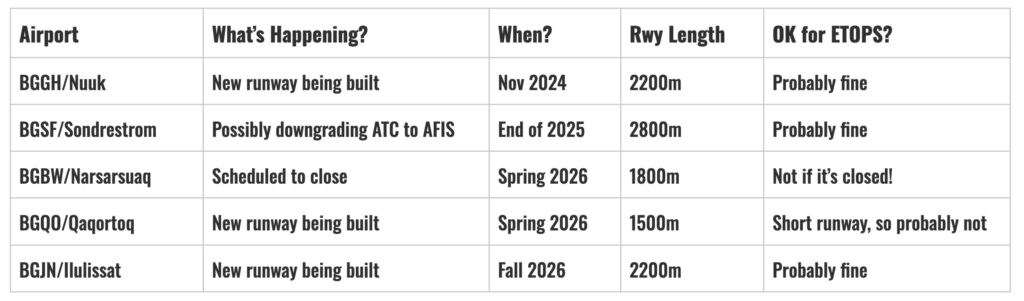
But here’s a quick reference table showing what’s changing, and when, which might be helpful:

BGGH/Nuuk

Nuuk’s found on the western edge of Southern Greenland, close to the NAT HLA. It’s Greenland’s capital city but until now, the airport has not been ‘capital-sized’.

Hence why larger aircraft have not considered BGGH/Nuuk as a viable alternate due to its short runway length (3,050’/930m) in addition to poor weather and the mountainous terrain that surrounds it.

But things will soon get easier. A major expansion has been underway since 2019 to replace its aging runway and improve the airport infrastructure to accommodate the wide body airliners of the territory’s flagship carrier who are relocating their hub there.

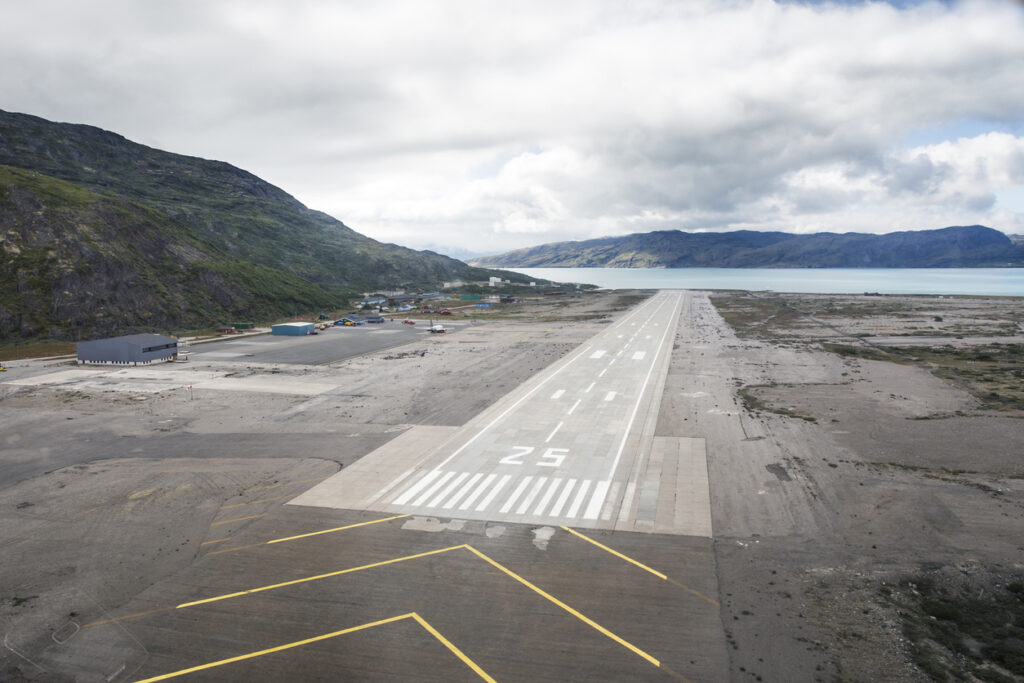
28 Nov 2024 has been earmarked as its full re-opening – just weeks away. A new runway will now measure 7,200’/2200m. Better yet, ILS approaches will be operating at both ends with much lower minimas. A new terminal building, tower and apron are already in use.

The brand new runway at Nuuk will become operational on Nov 28.

If you have any doubts as to Nuuk’s viability as a well-equipped NAT alternate, it may be reassuring  to hear that at least one US legacy carrier will also commence scheduled services to the improved airport from Newark twice a week from mid-next year.

Keep an eye out for an upcoming OPSGROUP briefing on the new and improved Nuuk soon.

BGQO/Qaqortoq

A new airport will be opening in Spring 2026, 35nm away from Narsarsuaq on Greenland’s southern tip.

Right now Qaqortoq is a heliport (operating under a different ICAO code), but will re-open with a 4,921’/1500m runway due to a decision by Greenland’s government a few years back to convert it for fixed wing traffic.

At that length Qaqortoq will likely only be an option for small to medium sized jets, but there is also room for future expansion to 5,905’/1800m – so watch this space in years to come. Word on the street is that it will also be equipped with both LOC and RNP approaches.

A new international airport in Qaqortoq will replace Narsarsuaq in 2026.

BGJN/Ilulissat

A new international airport is under construction which will be equipped with a 7,217’/2200m runway. It’s scheduled to open in Fall 2026 and will replace the existing domestic airport. By in large, it will be equipped with the same equipment as the upgraded airport in Nuuk.

A new international airport is coming in Ilulissat

Next up, a look at what’s happening at the existing airports BGSF/Sondrestrom and BGBW/Narsarsuaq…

BGSF/Sondrestrom

The much-improved airport in Nuuk will undoubtedly take a heavy toll on traffic levels at Sondrestrom – in the vicinity of a 90% reduction.

But all is not lost for BGSF as a solid NAT alternate – it will continue to operate, with almost full services available with one notable exception – ATS will be downgraded to an AFIS sometime between Aug – Oct 2025.

The runway (9,186’/2800m) is longer than Nuuk, and the weather much more predictable – it should remain a solid option to consider. 

BGBW/Narsarsuaq

The airport is scheduled to close in 2026! 😱

Despite its geographical convenience to NAT traffic, it remains a difficult option. For some, it is considered only in the case of extreme circumstances (such as fire).

The reason for this is predominantly weather, and the non-precision approaches that serve the airport. The runway itself is also short at only 5,905’/1800m.

Narsarsuaq will remain a challenging option until its closure in 2026.

Reminder – Look out for Surprise Fees

We’ve written about this before, but worth a reminder.

Be careful – if you file BGBW or BGSF as an alternate after hours (overnight 20-11z or anytime on Sundays) you will be charged the better part of $3000 USD for the privilege of keeping standby equipment on watch, and runways clear of snow. Even if you don’t actually divert there.

A little insider advice – advance notice will reduce the cost as it allows for cheaper planning. If you need one outside of normal operating hours, provide at least 24 hours’ notice.

For regular use, operators can also apply directly for a reduction in these rates.

Keeping emergency services on standby outside of normal hours is an expensive business.

Know more about changes to Greenland Ops?

We’d love to hear from you. You can reach us via news@ops.group


West Africa Ops: Routing Options and Restrictions

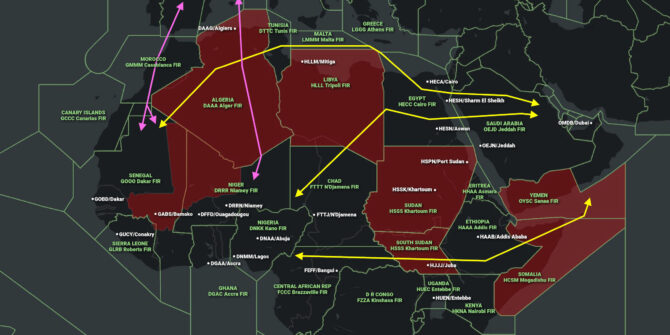
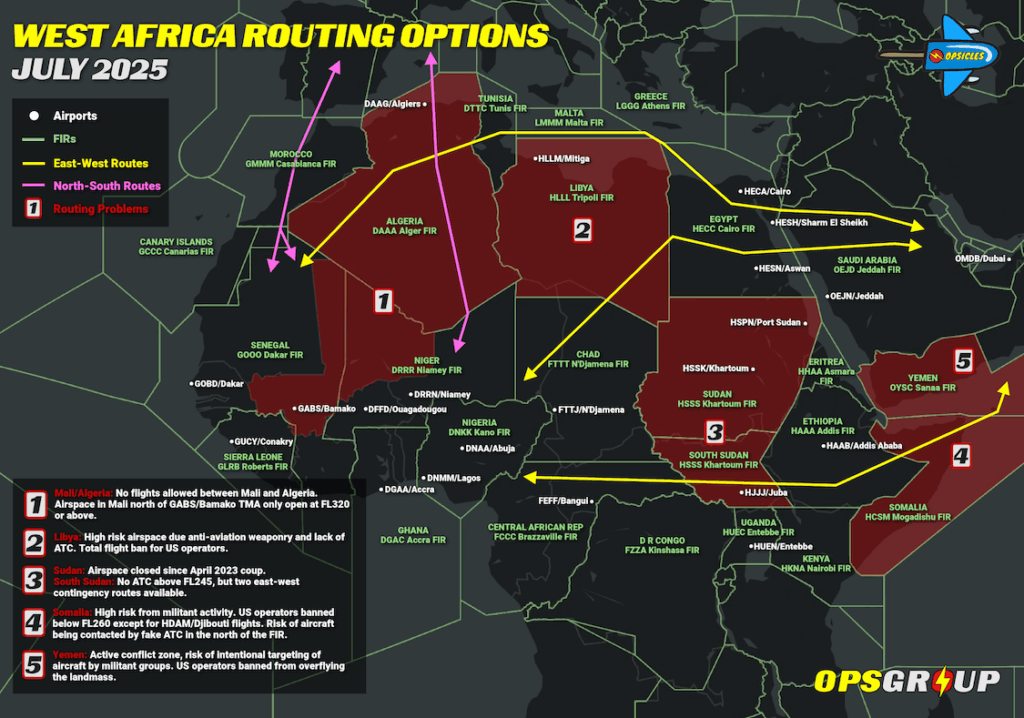
Flying into or out of West Africa is becoming increasingly tricky, with operators having to navigate a patchwork of airspace bans, conflict zones, and overflight restrictions. Two directions present the most complexity: north to Europe, and east to the Middle East.

OPSGROUP members can download this map to see exactly how these restrictions affect routing.

Click to download PDF.

There’s a cluster of major airports in West Africa — from Lagos to Accra to Dakar — that handle the bulk of international traffic in the region.

But getting to these hubs from Europe or the Middle East is complicated by airspace risks and closures in five key areas: Mali/Algeria, Libya, Sudan/South Sudan, Somalia, and Yemen. 

Here’s a more detailed look at each of these.

Mali/Algeria

  • Northern Mali remains a war zone — ongoing since 2012.
  • MANPADS, rockets, and mortars pose a threat to low-flying aircraft.
  • US advises caution at all flight levels; several states restrict ops below FL250/260.
  • Overflights above FL320 permitted, per long-standing Notams from GOOO/Dakar and DRRR/Niamey FIRs.
  • Airports GATB, GAGO, GAKL should be avoided.
  • A reciprocal airspace ban with Algeria (since April 2025) prohibits all flights between the two countries — even overflights.
  • Routing via Mauritania remains open. Algerian ATC may reroute flights via Niger.
  • More info here.

Libya

  • Active conflict zone since 2014.
  • HLLL/Tripoli FIR is high-risk. Total ban for US and UK operators.
  • Threats include misidentification by air defense systems, militia threats near Tripoli, and unreliable ATC.
  • Frequent radar and comms outages; some flights rely on Malta ATC for guidance.
  • Strongly advised to avoid all Libyan airspace, regardless of altitude. However, some airline flights between West Africa and the Middle East operate over the south-eastern corner of the HLLL/Tripoli FIR between Egypt and Chad rather than routing around Libya to the north or via South Sudan to the south.
  • More info here.

Sudan/South Sudan

  • Airspace fully closed since the April 2023 coup.
  • HSSK/Khartoum Airport is shut; no Notams are being issued.
  • There are some contingency routes available for flights to HSPN/Port Sudan, but security remains volatile.
  • Several states prohibit overflights due to military activity and anti-aircraft threats.
  • In South Sudan, there’s no ATC above FL245, but two east-west contingency routes are available for overflights.
  • South Sudan is open for flights to HJJJ/Juba.
  • More info here.

Somalia

  • Government control is limited; attacks by extremist militants are ongoing.
  • US prohibits flights below FL260 (except overwater to/from HDAM/Djibouti).
  • Risk of being targeted at lower altitudes by anti-aircraft weapons.
  • Reports of unauthorized ATC units issuing contacting aircraft and issuing them instructions in the northern part of the HCSM/Mogadishu FIR – genuine ATC here will only issue level changes by
    CPDLC or SATCOM.
  • More info here.

Yemen

  • Active warzone — avoid all land portions of the Sanaa FIR (OYSC).
  • US operators permitted to use offshore routes UT702 and M999.
  • Other states allow overwater-only routing, avoiding the landmass.
  • Threats include drones, missiles, and intentional targeting by militants.
  • Military strikes by Saudi Arabia and Israel have been ongoing for a few years.
  • More info here.
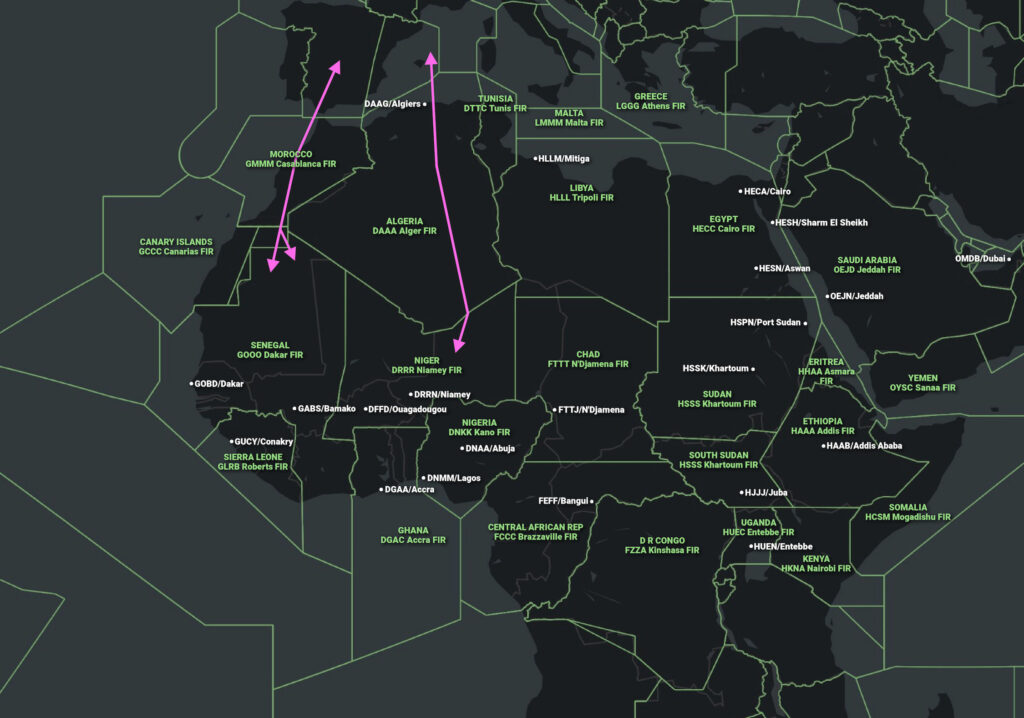
Routing Options: West Africa to Europe

Two main options here:

Central route via Niger/Algeria: Due to the Mali-Algeria airspace ban, overflights between these two countries is not possible. Add to that the security risks at the lower levels in northern Mali, many operators choose to avoid Mali entirely by routing east into Niger, and then turning north into Algerian airspace from there.

Western route via the Atlantic: Flights route westward over the Atlantic, before turning northeast via the Canary Islands or Morocco and into Europe. This route bypasses the entire Sahel region and avoids any involvement with Mali or Algeria. Common for flights heading to Western Europe (eg. Spain, France, Portugal).

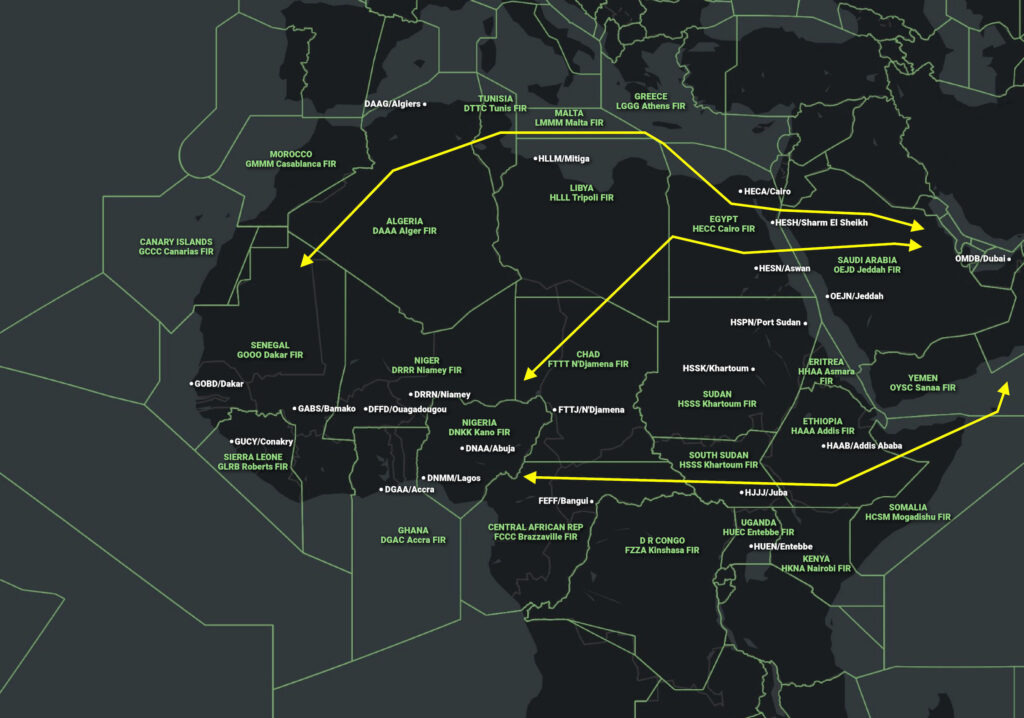
Routing Options: West Africa to the Middle East

With Libya risky, Sudan closed, and Somalia/Yemen partially restricted, operators have three main options:

Central route via Libya: The shortest option routes east from Chad into the southeastern corner of Libya, then across Egypt into the Middle East. This path clips Libyan airspace, and while still considered high-risk, some airlines are using it. ATC reliability is poor, but the routing avoids longer detours.

Southern route via South Sudan: This uses one of two east-west contingency routes above FL245, then crosses Ethiopia and exits via the Gulf of Aden off the coast of Yemen and on towards the Middle East. This avoids Libya and Sudan entirely, but adds an extra 500NM or so when compared with the central route. If South Sudan isn’t viable, flights may reroute even further south via Uganda or Kenya.

Northern route avoiding Libya: This takes a northern dogleg through Niger and Algeria, then across Tunisia and Malta and into Egypt. This route avoids all high-risk airspace but is the longest of the three. It’s commonly used by operators with stricter risk thresholds or where insurance policies exclude Libyan or South Sudanese airspace.

If you’re flying any of these routings (or know of any clever alternatives we haven’t covered here), we’d love to hear from you. Email us at blog@ops.group — we’ll update this briefing and help keep other pilots and operators in the know!


FAA Housekeeping: Foreign Instrument Procedures, Approach Chart Clutter

Recently, the FAA has been doing some spring cleaning. You might have missed them, but recent changes to the FAA’s advisory circulars and charting notices are quite important.

This article covers two of them:

  • Effective June 2025, the FAA officially shifted the responsibility for evaluating and approving foreign instrument procedures to aircraft operators themselves.
  • From October 2, instrument approach charts will be decluttered by removing unnecessary comms data.

Let’s take a look at each of these in more detail.

Removing approvals for specific foreign procedures

Recently, the FAA advised those operating under Part 91(K), 121, 125 and 135 of changes to foreign instrument procedure authorizations.

It has removed outdated references to specific foreign instrument procedures by title from operator authorizations (OpSpec C058, C358 and H107).

Others were simplified (C059, C060, and C384) to remove references to specific foreign airports and procedures.

The end result? Operators are no longer required to obtain FAA approval for specific foreign instrument procedures listed by name — but they must still hold the required FAA authorization (OpSpec, MSpec, or LOA) to conduct the type of procedure (e.g., RNP AR, CAT II/III), regardless of where it’s flown.

So, does this mean I can now fly any foreign procedure without FAA involvement?

Not quite. While you no longer need FAA approval for each individual foreign procedure, you still need FAA authorization for the procedure type and must comply with host country requirements.

For instance, if Germany requires local authorisation for an RNP (AR) approach into EDDM/Munich, you must obtain it without FAA involvement.

ICAO (Annex 6) says operators are still required to obtain approvals when the host state mandates it, and crews must comply with any local procedures or limitations.

Why the change?

Without delving too much into the specifics, there are a few reasons:

  • Less paperwork – foreign procedural reviews are cumbersome and labor intensive, and lead to delays in approval.
  • Less workload – inspectors no longer have to approve each foreign procedure individually.
  • Improved design – there has been significant improvement in procedural design around the world thanks to the proliferation of ICAO PANS OPS.
  • Empowerment – operators can perform their own risk assessments and use globally standardised instrument procedures without the extra weight of FAA approvals.

So the onus is now on the operator – what next?

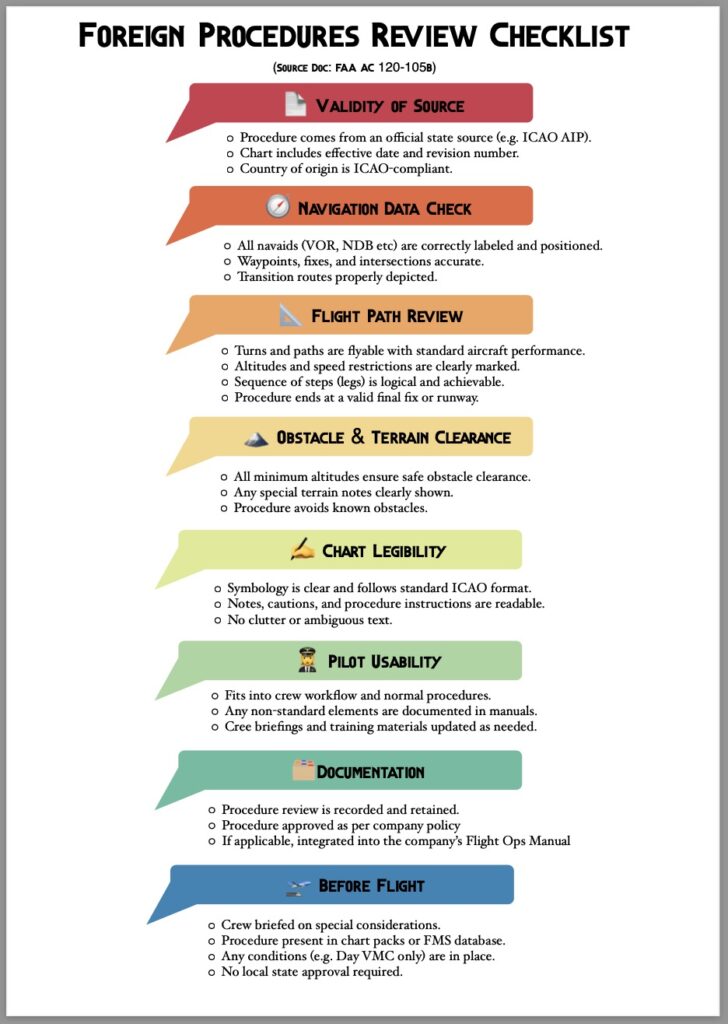
That’s where AC 120-105B comes into play. It provides guidance for US operators on reviewing and accepting foreign instrument procedures outside the US.

This includes a list of your areas of responsibility, recommended tools and checklists to help with your review, and advice on incorporating a review process into your company’s manuals, SOPs and pilot training.

If you operate abroad, it’s important you’re familiar with this revised AC. We’ve also put together the following checklist based on its advice to help get you started:

Click to download PDF.

De-cluttering Approach Charts

On July 3, the FAA issued a new charting notice (advance notification of significant changes to charts and publications).

The news is that from October 2, the FAA will begin removing redundant comms data from instrument approach charts. This includes departure ATIS, CLNC DEL and the availability of CPDLC if all of this is shown on the corresponding airport diagram.

Listing it again on instrument approach charts is unnecessary and can reduce readability during critical phases of flight while critical frequencies remain prominent (don’t worry, tower and ground ain’t going anywhere).

While we have you, a couple more FAA-related tidbits to brush off the table.

  • Notams. Big changes are coming to the US system. By September, it will be completely overhauled. The new system will be a fast, cloud-based, and (hopefully) rock-solid stable. A renewed focus on improved safety throughout the US NAS has escalated the project, and the targets are ambitious – user testing is expected to start later this month.
  • FAA-license holders abroad. This is our last reminder! July 7 has come and gone, which means anyone holding US licences/ratings and living outside of the US must have provided a US based address for service to the FAA via the USAS portal. If you haven’t yet, your license is effectively now invalid until you do – whatever you do, don’t operate an aircraft while un-licensed.

Have we missed a spot?

Please get in touch with us around the clock via blog@ops.group


Spain Summer 2025: Where to Park When There’s Nowhere to Park

Flying to Spain this summer? Be ready for one of the most challenging seasons yet. OPSGROUP members and local FBOs have confirmed that many of Spain’s key airports are either full or close to capacity, with last-minute parking denials, repositioning chaos, and growing frustration.

The Big Picture
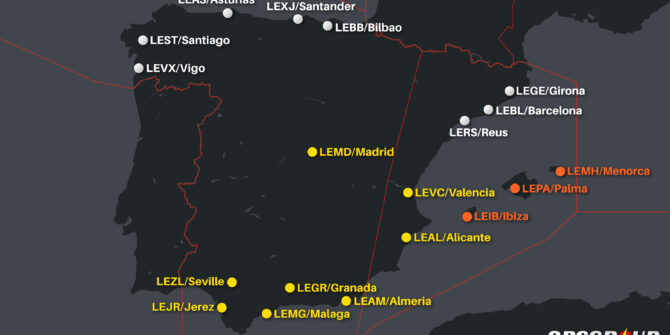
  • Balearic Islands are maxed out. LEPA/Palma, LEIB/Ibiza, and LEMH/Menorca are denying overnight parking in most cases. Even short turnarounds now require formal approval.
  • Mainland airports like LEVC/Valencia and LEAL/Alicante – once go-to repositioning options – are now also denying overnight stays, especially for ferry flights. Overflow traffic is being pushed to bigger hubs like LEBL/Barcelona and LEMD/Madrid, which can still work, but come with long taxi times, fueling delays, and strict slot restrictions. In Barcelona, non-based BizAv aircraft are limited to a maximum 96-hour stay. In Madrid, they’re allowed just one overnight, and turnarounds without passengers are not permitted.
  • The system is overwhelmed. We’ve received multiple reports from our members that due to poor infrastructure planning, increased aircraft size, and inflexible airport authority (AENA) policies, BizAv is being squeezed out of prime destinations.
  • Even second-tier airports like LEGR/Granada or LERS/Reus are turning away requests. Some smaller fields remain usable – but only with proper planning and early coordination.
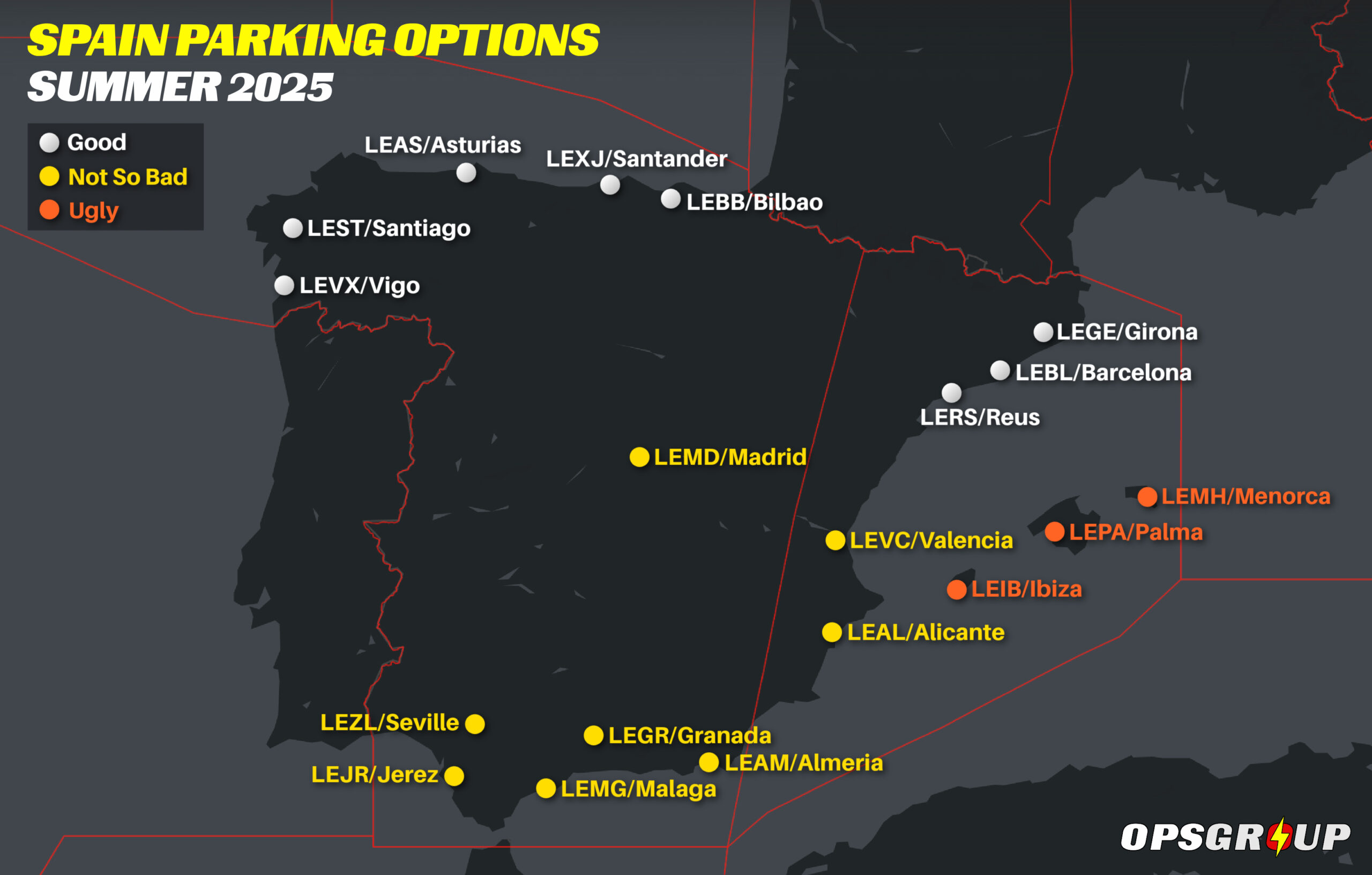
What All Airports Have in Common
  • Slot and parking coordination opens 14-15 days prior to arrival. Earlier requests are not accepted, and even short turnarounds often require prior approval.
  • No real-time availability. Handlers can’t tell you if parking is available until you’ve submitted a full handling request (aircraft type, schedule, operator details). Confirmations often take days and even then, your request may still be denied. Final decisions are made by the airport authorities.The best advice? Submit your schedule as early as the airport window allows, and always have a backup plan ready. 
A-CDM airports in Spain: Watch Your Timings

Several major Spanish airports operate under A-CDM (Airport Collaborative Decision Making) procedures – for example, LEBL/Barcelona, LEMD/Madrid, and LEPA/Palma de Mallorca. Always double-check with your local FBO to confirm whether A-CDM rules apply at your destination.

At these airports, your filed EOBT (Estimated Off-Block Time) must exactly match your assigned departure slot. If it doesn’t, ATC will not clear you to start up or taxi. There’s no flexibility – and your handler has no power to override the system.

What often happens is this: a crew files an updated EOBT without informing the handler, but the airport system still holds the original slot. That mismatch is caught by Eurocontrol, which then assigns a much later CTOT (Calculated Take-Off Time) – often causing a delay of 1 to 2 hours, or blocking the departure entirely.

To avoid this, always coordinate any time change, even a small one, with your handler first. Once they’ve confirmed your new slot, you can safely file your updated flight plan to match.

If you’re delayed inbound and won’t make your original slot, make sure to send your updated ETA asap – this gives the airport time to adjust your arrival slot accordingly.

Spain is one of the stricter countries in Europe when it comes to A-CDM enforcement. If your times don’t match, you’re not moving. For more on how Eurocontrol and CTOTs work behind the scenes, see our explainer article

The Balearics: Parking Nightmare Central

The three main airports in the Balearic Islands – LEIB/Ibiza, LEPA/Palma de Mallorca, and LEMH/Menorca – are all experiencing major congestion this summer.

Key issues across all:

  • Parking is extremely limited, especially on weekends. Overnight stays are frequently denied – sometimes even for light jets.
  • Repositioning to the mainland is increasingly common. Local FBOs recommend LEBL/Barcelona and LEGE/Girona – both H24 – as the best alternates. LEVC/Valencia is also commonly used, but recent reports say it’s already congested.

LEIB/Ibiza

Ibiza is proving the most difficult of the three. Members report that overnight parking is nearly impossible to obtain – 90% of overnight parking requests are flatly refused, regardless of aircraft size.

According to local FBOs (not published in the AIP), aircraft with a wingspan greater than 18 meters planning to remain on the ground for more than 3 hours require a PPR – which is rarely approved during the peak season. Even short turnarounds are becoming problematic without advance coordination. 

FBO contacts:

LEPA/Palma de Mallorca

LEPA is slightly more manageable, but still highly congested.

New for 2025: From 1 June – 30 Sep, aircraft longer than 20 meters are limited to a maximum of 7 days of parking, unless specifically approved by the airport. See AIP for details.

Members report first-time outright parking refusals for light jets, and fuel delays of more than an hour due to one of the two fuel trucks being out of service.  

FBO contacts:

LEMH/Menorca

Menorca is facing similar congestion pressures as the rest of the Balearics this summer, but local FBOs suggest it may still be the easiest of the three island airports to manage. While parking is certainly limited, especially on peak days (Friday through Sunday), overnight stays are not impossible – particularly if you plan ahead.

During the summer, the airport operates from 0700-0030 local time. See AIP for details. 

Slot and parking requests can typically be submitted 14-15 days before arrival. Some FBOs note that approvals are sometimes possible even on shorter notice, especially if you provide a full itinerary. Drop-and-go remains the best strategy here too.

FBO contacts:

Mainland Spain: Where You Might Have a Chance

Need local FBOs contacts or AIP links? Click here for quick access. 
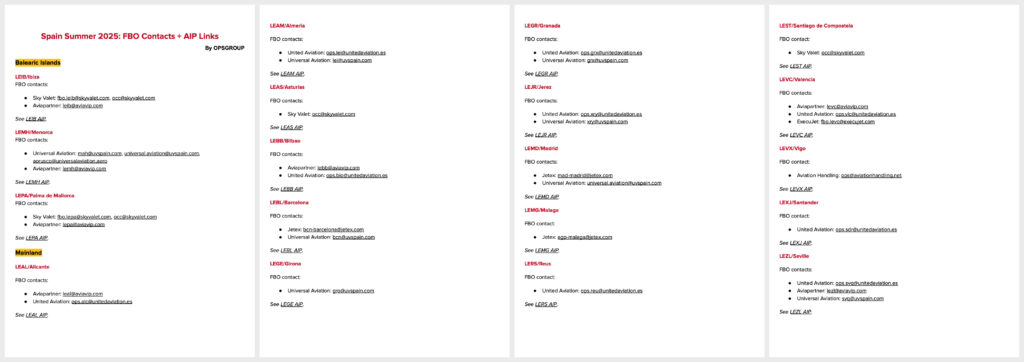
Click for PDF.

Popular Repositioning Options – but Getting Busy

LEVC/Valencia and LEAL/Alicante are among the most commonly suggested mainland alternates for traffic repositioning from the islands. But this summer, both airports are struggling with overflow demand. Overnight parking is frequently denied, even for ferry flights, and local FBOs report regular rejections, especially on peak days. 

Big Airports Still Working – with Significant Limits

LEBL/Barcelona is still one of the more reliable options for BizAv this summer. Parking is usually available and the airport operates H24. However, LEBL enforces a 96-hour parking limit for all non-based aircraft year-round, so longer stays are not possible. During the summer, aircraft with an MTOW under 15 tons are also not permitted to arrive between 0900–1159 local time. In addition, taxi times from the BizAv apron are long, typically around 20 minutes. The airport applies A-CDM rules strictly.

LEMD/Madrid is no longer an easy fallback. While it operates H24 and still offers reasonable parking availability, non-based BizAv operators are now subject to strict slot restrictions: only one overnight is allowed, and at least one leg (arrival or departure) must be a passenger flight. Turnarounds involving positioning flights only are not permitted. Crews should also plan for long taxi times (15–30 minutes), and fuel uplift may be delayed or denied without a confirmed same-day departure, as priority is given to commercial and outbound traffic.

Member report received July 2: We had an overnight 2 days ago and the airport is packed. Evidently there is no where to park in the islands and everyone is drop and go to LEMD as you have reported. We got to the airport 2.5 hours prior to our departure scheduled for 1320 local departure and waited almost 3 hours for fuel. Our slot had to be constantly updated by the handlers so we didn’t miss it.

Another member report received July 3: We were granted a week’s parking at Madrid, but on a disused taxiway arriving yesterday. The handler said it’s at capacity.

UN Summit in Sevilla – Temporary Restrictions Across Andalusia

Several airports in Andalusia are currently affected by temporary restrictions due to the UN summit in LEZL/Seville, running from June 26 – July 4. These impact BizAv ops across the region, especially in terms of parking, ground time, and access. However, once the summit ends, many of these airports may become more usable options for summer parking. Here’s a breakdown of what to expect:

LEZL/Seville is effectively off-limits for BizAv during the summit. The airport cannot be used as an alternate, and all BizAv flights require special government permission. Slots and PPR are mandatory. Local FBOs strongly advise avoiding LEZL during the summit unless absolutely necessary. Things should return to normal after July 4.

LEAM/Almeria is generally an easy airport to work with and remains a solid parking option compared to congested hubs like Palma or Valencia. At the moment, both slot and PPR are required, likely due to increased activity linked to the UN summit. Traffic may temporarily rise, but overall availability remains better than at most coastal airports.

LEGR/Granada is currently operating under an Apron Saturation Procedure until July 5. BizAv flights are limited to 60 minutes on stand and must receive prior approval, even though no official slot or PPR system is in place. All international arrivals are treated as non-Schengen, even if coming from Schengen countries, due to temporary internal border controls. Outside the summit, LEGR is a good parking fallback.

LEJR/Jerez  normally just requires a slot (no PPR) and usually has decent parking availability. Right now though, BizAv traffic is limited – only flights with a properly authorized slot are accepted, and approvals are more selective than usual. After July 3, it should return to being one of the more reliable fallback options in the region.

LEMG/Malaga is often seen as a good BizAv parking option, and we’ve received positive reports from members securing parking here. Parking restrictions relating to the summit were lifted on July 2, so there’s no issue on that front anymore.

Other Viable Options – Depends on Timing

LEGE/Girona and LERS/Reus are both decent fallback options for mainland parking and can be worth a try. While not always full, availability is limited and approvals are never guaranteed. BizAv flights to LERS require a PPR, so early coordination is essential.

Better Bets for Summer Parking

Airports in northern Spain – including LEBB/Bilbao, LEAS/Asturias, LEST/Santiago de Compostela, LEVX/Vigo, and LEXJ/Santander – are not as widely used for BizAv but are currently seeing less congestion and can be good alternatives, even for bizjets. Most require slots but not PPR. Parking is generally available, though space for long stays or bigger jets may still be assessed case-by-case. These are solid options worth exploring, especially when the more popular destinations are full. 

Situation Changing Fast – Help Us Keep It Updated

Airport conditions across Spain can change quickly during the summer – a slot that was easy yesterday might be impossible tomorrow. If you have recent experience at any of these airports, please share it with us by submitting an Airport Spy Report. Your intel helps the whole community stay informed. 

What’s Airport Spy? Well, you write a quick little postcard with “what happened” when you went to some airport somewhere. Then you, and others can refer to your notes for future flights to the same place.


Lithium Battery Fires, New Safety Alert: What Are The Rules For Part 91?

The risk of lithium-ion battery fires on aircraft is on the rise, with vapes, power banks, and laptops identified as the main culprits.

The FAA has reported a sharp rise in incidents, with some sources noting two thermal runaway events per week. EASA also raised concerns, issuing a new Safety Bulletin on May 27.

While rules are strict for Parts 121 and 135, private flights under Part 91 face fewer restrictions. Arguably, private jets are more at risk, and we’re doing less to protect ourselves.

  • Business jets are smaller. A lithium-ion battery fire can quickly fill the cabin with thick, toxic smoke – up to 10 cubic meters from a single laptop battery in just two minutes. History has shown that smoke inhalation often causes the loss of an aircraft in a fire before the fire itself.
  • Fewer crew members.With only one or two pilots and often no cabin crew, response capability is limited.
  • The passengers we carry. Biz jet passengers often carry multiple personal electronic devices which increases fire risk. Some passengers may disregard or not correctly follow safety rules.
  • Less safety equipment.Compared to airliners, biz jets typically have fewer fire suppression tools and less protective gear on board.

Lithium battery fire smoke contains an unbreathable mix of chemicals including corrosive irritants like phosphorous oxide and hydrogen fluoride.

It seems clear that for the few rules that exist for Part 91 operations, we must be aware of them, and stick to them. And it may come as a surprise to some operators that these rules are more strict when you fly internationallyeven privately.

So here’s a rundown of what you need to know.

A word about lithium-ion batteries

If you’re already familiar with a Wh rating, feel free to skip to the next section. But to understand the rules properly, it helps if you’re familiar with it first.

Watt on earth is a watt-hour (Wh)?

When we talk about how dangerous a lithium-ion battery could potentially be, we talk watt-hours. It is a measure of how much energy a battery can store and use. Think of it like the amount of fuel in a tank – it simply tells us how much power (watts) it produces over time (hours).

It also directly proportional to fire risk. If something goes wrong, all that energy can be released as heat and gas. The more in the tank, the bigger the fire.

The higher the Wh, the hotter the flames, the thicker the smoke, and critically – the harder it is to put out.

Check the battery label for its Wh rating.

Righto, onto the rules for US Part 91.

Part 91

For domestic flying in the US under Part 91, the rules for lithium-ion batteries are pretty simple.

If the batteries are being carried for personal use, Part 91 operators are (almost) entirely exempt from the US D.O.T. HAZMAT regulations that apply to commercial flights. But it’s not a free-for-all.

The PIC is still prohibited by law from carrying hazardous items onboard an aircraft in a way that might endanger people or things. This includes knowingly carrying defective batteries or packing them in a way that is dangerous or irresponsible.

Baseline safety guidelines still apply, including FAA Advisory Circulars (AC 91-78, AC 120-76D) -along with relevant Safety Alerts for Operators (SAFOs). Deviation from these can expose the operator/PIC to legal liability in the case that something bad happens.

Here’s a summary of those:

Installed batteries (in devices):

Carry these without restriction if they’re properly secured within the equipment, show no visible damage (like swelling or leakage) and are turned off.

Spare batteries:

These must be carry-on.

  •  Little ones (100Wh or less): There’s no limit on the number carried, but each one should be protected from short-circuits (case, sleeve, taped terminals or original packaging).
  • Bigger ones (101 – 160Wh): FAA guidelines say no more than two per person. These must be individually protected using the same precautions above.
  • Biggest ones (161Wh+): Not allowed without full HAZMAT compliance and operator approval. Requires UN spec packaging, shipping papers, training etc. BE CAREFUL – some higher end power banks exceed this limit.

Power banks are treated as spare batteries – this unit is equipped with a battery that exceeds 290Wh.

International operators beware!

Here’s where things get a little tricky.

Once you leave the US, some authorities no longer recognize the distinction between Part 91 (private) and other commercial flights.

Foreign authorities may enforce local rules for the batteries you carry – regardless of your Part 91 status. These are usually based upon IATA Dangerous Goods Regulations. Reportedly, this includes China, Thailand, Korea, India and the UAE.

In other words, what was acceptable in the US may not be once you’re abroad.

Foreign handlers may refuse to load spare batteries that don’t comply with IATA standards, while customs and ramp safety officers may demand battery specs and proper packaging – especially for devices like power banks, drones, camera gear and e-bikes. Devices may be confiscated if they do not comply with local guidelines.

The best solution? Just comply with IATA standards from the outset.

Where do I find these regs?

If you want to get technical – they’re defined in ICAO Doc 9284 (ICAO Technical Instructions for the Safe Transport of Dangerous Goods by Air), and further refined under the IATA Dangerous Goods Regulations.

These include packing instructions, required documents, limits of watt hour ratings, the quantity of batteries, labelling and distinctions between passenger and cargo aircraft.

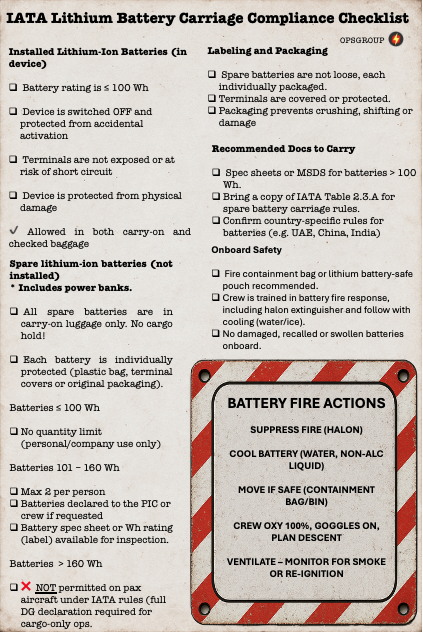
Three million pages of DG-related dread building? Worry not. We’ve put together a quick checklist of requirements/suggestions for Part 91 operators to help them stay out of trouble when carrying batteries outside of the US:

Click to download PDF.

Fire containment

You might already have fire containment bags onboard, but there are other types of containment devices worth considering.

Some of the newer hard-sided designs offer features like hands-free collection, blast protection for the user, and the ability to inject water to help interrupt thermal runaway. Check out this one!


These boxes aim to reduce the risk to crew during an incident and address some limitations of soft bags, which can be difficult to use safely without two people – a challenge on smaller aircraft operating under Part 91 or 135. With recent incidents showing how violent lithium battery fires can be, having an effective containment method onboard is increasingly important.

Don’t forget to report

For Part 91 private flights, the US FAA requires operators to report any case of battery fire, smoke, overheating or thermal runaway aboard an aircraft within 72 hours. The form for this is DOT 5800.1.

ICAO may also require a report if the event qualifies as a serious incident or accident. You are not required to report directly to IATA – it’s only voluntary.


FAA License Holders Abroad – You’ll Need A US Address Soon

June 10 update – look out for imminent medical renewals!

If you’re due for a medical soon, you might already need a US address in the USAS portal. Although the official FAA deadline to add a US agent for service is July 7, an OPSGROUP member recently discovered that MedXpress would not let him complete the pre-exam form without it. Since MedXpress and the USAS portal now talk to each other, the system checks for that US address before allowing you to proceed. Without it, you will not get the confirmation number needed for your medical.

Key Points
  • The FAA has published a new rule that will require certificate holders abroad to nominate a physical US address for service.
  • This is required from April 2 for any new applications; and July 7 for anyone who already holds FAA certificates, ratings or authorizations.
  • Anyone who ignores the new rule will be unable to exercise the privileges of their documents.

What’s Changing?

115,000 (give or take) FAA certificate holders currently live outside of the US.

Back in Oct 2024, the FAA issued a new rule requiring anyone with no US physical address on file to nominate a US Agent For Service.

This agent will be responsible for receiving all documents from the FAA on the certificate holder’s behalf – including legal and safety-critical stuff.

It’s already been postponed once, but there are now two deadlines for individuals with a foreign address and no physical US one on file:

  • April 2 for new applications.
  • July 7 for existing certificate holders.

The FAA is having problems serving documents to the large number of FAA certificate holders living abroad.

By using US-based agents, this process will be a lot faster and easier. Especially in the case of larger overseas-based flight departments.

Who will this apply too?

Anyone with a foreign address (and no US address on file) who holds or applies for FAA certificates, ratings or authorizations under the following parts of 14 CFR  – 47, 61, 63, 65, 67, 107.

Who can be a ‘US Agent For Service’?

It’s not as complicated as it sounds.

The new rule (CFR 14 3.302) says this can be any entity or adult (18yo+) with a US-based postal address.

One big gotcha though: this must be a physical address – PO boxes and mail drops are no-good.

It’s important you nominate someone you trust. They will be responsible for promptly forwarding you any FAA documents and must fully understand the importance of this task.

You’ll also need to provide the FAA with their full name, phone number and a working email address.

If there isn’t already someone in the US you know and trust, it may be worth engaging a professional service to be your agent instead.

What if I just ignore this rule?

Don’t! If a certificate holder fails to designate a US postal address or Agent of Service by the above dates, you will no longer be able to exercise the privileges of that document. You will effectively become unlicensed.

Another big scary rule – the FAA Enforcement and Compliance Order 2150.3 – says other enforcement actions can be taken including fines and jail time.

How will I designate my agent of service?

Via a new portal called the US Agent for Service System (USAS).

This will allow you to nominate your agent and provide all required contact details via the online prompts.

Don’t forget you will also need to keep the system updated with any changes.

I live in the US, does this affect me?

Long story short, no. As long as the FAA has your physical address on file you’re good to go!


Sydney BizAv Fees Set to Skyrocket

From July 1, YSSY/Sydney will move ahead with a major fee overhaul for BizAv. After strong pushback from the local community – led by ExecuJet and the Australian Business Aviation Association (ABAA) – some of the most extreme fee increases have been softened. Parking will no longer have a flat rate and now allows 180 minutes free, but fees remain steep for longer stays. Runway charges are rising sharply, and mandatory GPU/PCA fees and environmental charges will still apply. Operators should prepare for a noticeable jump in operating costs.

What’s changing?

The proposed fee increases are eye-watering:

  1. Parking fees:
    The good news is that BizAv operators will now get 180 minutes of free parking in designated BizAv areas. This replaces the originally proposed flat AUD $3,220/day rate. After the free period, fees are tiered based on aircraft weight and length of stay. For aircraft over 40,000 kg MTOW, charges start at AUD $1,000/day for days 1 to 3 and go up to AUD $2,500/day beyond 7 days. Smaller aircraft pay less, starting at AUD $500/day.
  2. Runway charges:
    The runway fee will jump from AUD $60 minimum to AUD $340 minimum, with the per-1,000 kg MTOW fee going from AUD $6.91 to AUD $17. 
  3. GPU and PCA requirements:
    Sydney Airport now mandates the use of Ground Power Units (GPU) and Preconditioned Air (PCA) where available. Even if you don’t use them, you’ll be charged a blended rate depending on aircraft code – ranging from AUD $11.35 to $21.74.
  4. Environmental spill charges:
    Expect a new AUD $300 charge for unreported fuel or oil spills, or AUD $150 if you self-report.

Why is this such a big deal?

These are not small adjustments – they represent a major change to how BizAv is charged at Sydney. Even with some softening of the original plan, the new structure will lead to substantially higher costs, especially for longer stays. Many see this as part of a broader shift toward prioritizing commercial operations.

Who’s pushing back?

ExecuJet (the main local FBO) and the Australian Business Aviation Association (ABAA) led the response, engaging directly with the airport. They submitted formal objections and encouraged all operators to speak up during the consultation. If you have any questions, contact ExecuJet directly at fbo.yssy@execujet.com.

What’s next?

The revised fee structure is confirmed and takes effect on July 1. Operators flying to Sydney should review the new rules closely and adjust planning and quoting accordingly. While the original plan was moderated thanks to community input, BizAv costs at YSSY are still about to get much steeper.


Summer Tips for Flight Planning in Europe

Summer in Europe often means one thing: traffic – and lots of it.

Eurocontrol keeps the system moving, but it can feel complex, especially when delays mount and regulations interfere with your plans.

The good news? A few smart moves can make a big difference. This guide breaks down what matters most: the tools, timing, and habits that help your flight operate on time.

For Dispatchers: Plan It Right

Keep Your EOBTs Accurate

Your Estimated Off-Block Time (EOBT) is what anchors your flight in the network. It tells the system when you plan to be ready for pushback, and everything from slot allocation to airspace planning builds on that. If the EOBT is outdated, your flight might get an unrealistic Calculated Take-Off Time (CTOT) or even be suspended.

A CTOT is a take-off window assigned based on current traffic demand. It’s valid from -5 to +10 minutes around the assigned time. You must take off within that window.

Some operators hesitate to update the EOBT, thinking it could make the CTOT worse. In fact, the system often improves the slot within a few minutes when fresh data is provided.

Tip: If a new CTOT looks worse, give it 10 minutes to settle. If there’s still no improvement, then it’s time to contact e-Helpdesk.

Don’t File YO-YO Profiles

Trying to dodge flow restrictions with unusual altitude changes (like FL360 → FL320 → FL360) only confuses the system. These so-called “YO-YO” profiles increase workload for ATC and can cause downstream problems. Use tools like NMP Flight to build efficient, compliant flight plans without trying to game the system.

Respect Arrival Slots

If your destination airport is slot-coordinated, always align your flight plan with the assigned airport arrival slot. Mismatches can lead to flight plan suspension and suspended flights aren’t included in ATFM. That means no slot, no priority, and big delays. Double-check that your slot confirmation matches what you file.

ATFM (Air Traffic Flow Management) is the system that manages demand and capacity across the network. If your flight is suspended, it’s excluded from this process – making it much harder to recover your slot.

Use IFPS Validation Tools

Before filing your flight plan, use validation tools like NMP Flight, the NOP Portal, or CHMI. These platforms let you check for errors, confirm compliance with the RAD, and fine-tune your routing. A rejected plan means wasted time, especially when the network is busy.

NMP Flight is now the main interface for flight tracking, planning validation, slot monitoring, and more. It replaces older tools like CHMI and adds useful features like custom alerts, critical flight marking, and real-time updates. If you haven’t used it yet, it’s worth getting familiar.

If you’re facing a long delay, slot swaps can help – but only in specific cases. Operators can swap CTOTs between flights under their own AOC, provided the flights are subject to the same ATFM regulation. Each flight can take part in up to three swaps, which must be submitted via NMP Flight, the NOP Portal, or B2B. Phone requests are possible but should be a last resort. Each request is reviewed by NMOC (Network Manager Operations Centre), Eurocontrol’s operational hub for managing traffic flow across Europe, so swaps aren’t instant or guaranteed. But when used correctly, they can help reduce the operational impact of delays.

Submit Slot Improvement Requests Wisely

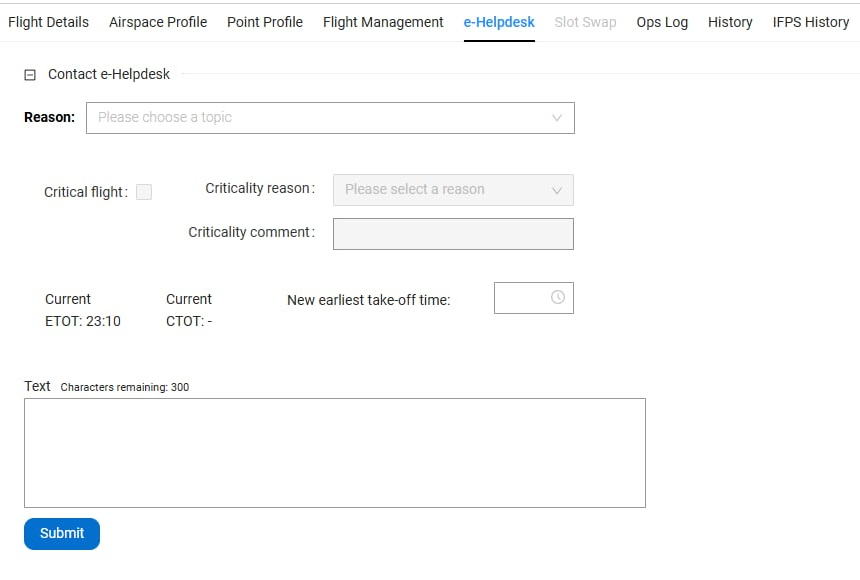
Need a better slot? Use the e-Helpdesk, but only from EOBT minus 60 minutes. Submitting too early won’t work and flooding the system with duplicate requests won’t help either. One well-timed request is all you need. Track your flight in NMP Flight, and only follow up if absolutely necessary. 

Understanding Critical Flights

With the introduction of NMP Flight, operators now have access to a useful new feature: the ability to mark a flight as Critical. This helps Eurocontrol identify flights where delays would cause significant operational problems and gives those flights a better chance of being prioritised. This doesn’t guarantee an earlier CTOT, but it does signal urgency to the Eurocontrol network team, who may coordinate with ATC or destination airports to reduce the impact of the delay.

You’ll find the option in the e-Helpdesk tab in NMP Flight.

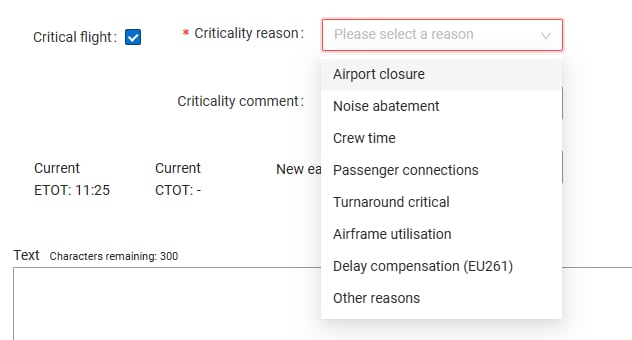
From 60 minutes before EOBT, you can tick the “Critical flight” box and choose a reason from a predefined list:

You can also add a brief comment (up to 300 characters) to explain the situation.

What to keep in mind:

  • You can only apply Critical status from 60 min before EOBT. Earlier requests won’t be accepted.
  • Once marked, you can’t change or remove the flag for that flight during the day, so be sure before using it.
  • You can mark up to 5 % of your regulated flights as Critical each day, with a maximum of 20 flights.
  • These flights are not automatically rejected, which improves the chance of receiving support from Eurocontrol.

Use this option carefully, and only for flights where delay would cause real disruption. When applied correctly, it’s a simple but powerful tool to keep your operation running smoothly.

For Pilots: Keep It Predictable

Eurocontrol doesn’t like surprises. The whole system runs more smoothly when flights do exactly what they said they would do. Sudden changes might seem harmless from the flight deck, but they can ripple through the network and cause chaos in sectors ahead. Here’s how to keep things flowing:

  • Fly what you file. Stick to your planned routing and levels unless ATC, weather, or safety require a change. That shortcut might save a minute, but it could cost someone else much more.
  • Stick to your slot. Request start-up in line with your EOBT and CTOT. Off-schedule departures can break the flow and lead to slot issues.
  • Let your dispatch team talk to Eurocontrol. The Network Manager Operations Centre (NMOC) is ready to help, but contact should come from dispatch. Unless you’re both pilot and ops – let the team handle it.
Need Help? Know Where To Go

Your first stop should always be the e-Helpdesk in NMP Flight. It’s the fastest and most efficient way to request CTOT improvements, mark Critical flights, or get slot-related support. The network team monitors it constantly and responds quicker when requests come through the system.

Calls should be a last resort, used only for urgent, time-critical situations. Phone support takes resources away from managing the wider network – so only use it when really needed.

Call only if:

  • A flight is about to miss CTOT at the holding point.
  • There’s a crew duty or curfew risk.
  • You’re repositioning a diverted aircraft.
  • You’re handling a medical or emergency flight.

Contacts:

  • AOLO (Aircraft Operator Liaison Officer) general line: +32 2 745 1992
  • Airport Function (AF) – for airport-related issues or curfew risk: +32 2 745 1903
  • AOLO Hotline – for critical/emergency issues only: +32 496 560 300
  • Airport coordination e-mail: nm.airports@eurocontrol.int 

For everything else, use the e-Helpdesk – it’s how Eurocontrol can help you best.

Want to Learn More? Start Here

If you want to go beyond the basics and build a deeper understanding of how the European network works, here are three great places to start:

EUROCONTROL Learning Zone – Free online courses and tutorials to help you better understand European flight planning and ATFM.

ThinkNetwork Guide – Summer 2025 – Eurocontrol’s seasonal briefing with key planning tips, capacity updates, and network insights.

NOP Portal Real-time source for airspace status, regulations, slots, and network operations.


Three Ways To Escape From New York

Key Points
  • If you’re flying out of the New York area, expect delays. ATC staffing and tech issues, along with heavy traffic, are causing slowdowns.
  • But there are three lesser-known routing options (SERMN, Deep Water, TEC) that can get you airborne faster – if you’re willing to fly lower, carry extra fuel, and meet a few added requirements.

In the middle of last year, the FAA transferred control of Newark’s airspace from New York TRACON (N90) to Philadelphia TRACON’s Area C due to a shortage of staff.

And it hasn’t been smooth sailing. Philly itself is understaffed, and has reported several failures recently with data sent from New York via aging copper lines affecting both radar and communication equipment.

Recent murmurings from OPSGROUP members indicate EDCT delays are rife – even at outlier airports. We’re talking hours here, not minutes.

And in the short term at least, it looks like things will get worse before they get better.

The Memorial Day Weekend set records for US air travel, and the Summer peak is nearly upon us.

A couple of weeks back some clever folk from the NBAA, FAA and the Teterboro Users Group (TUG) got together to talk about the recent disruptions in the Northeast and what to do about it. You can view a replay of their excellent session here.

Some of the juiciest intel was the use of not-so-secret ATC routes to significantly reduce departure delays and get you clear of New York’s airspace post-haste.

In fact, three less conventional route options were discussed to help you escape the Big Apple.

A Quick Word on Fuel

A recurring theme here is ‘operational flexibility.’ None of these options will save you fuel, only time.

To use these routes, you will need to carry more. In some cases enough to operate at low level (less than 10,000’) for up to 100nm. But letting ATC know you are willing and capable of flying them may well see you jump an extremely long queue for conventional routes.

Escape Plan #1: SERMN Routes

When weather gets in the way of things, the FAA has a literal playbook of strategic options to help manage high volumes of traffic. You can find it here.

Within this playbook, is something called SERMN Routes. SERMN stands for SWAP Escape Routes – Metro New York. SWAP stands for severe weather avoidance plan. With me so far?

They comprise a low-level game plan to help ATC manage traffic out of the NY Metro area when the regular routes are not available due to nasty build-ups.

When this happens, ATC has three plays available (depending on the direction you’re headed):

🏈 SERMN North (BUF, ROC, SYR, YYZ etc). Example routing ex KTEB: COATE → LAAYK → STUBN →BENEE → BUF→ KROC. Jets capped at 10,000′ until exiting NY  Center’s airspace.
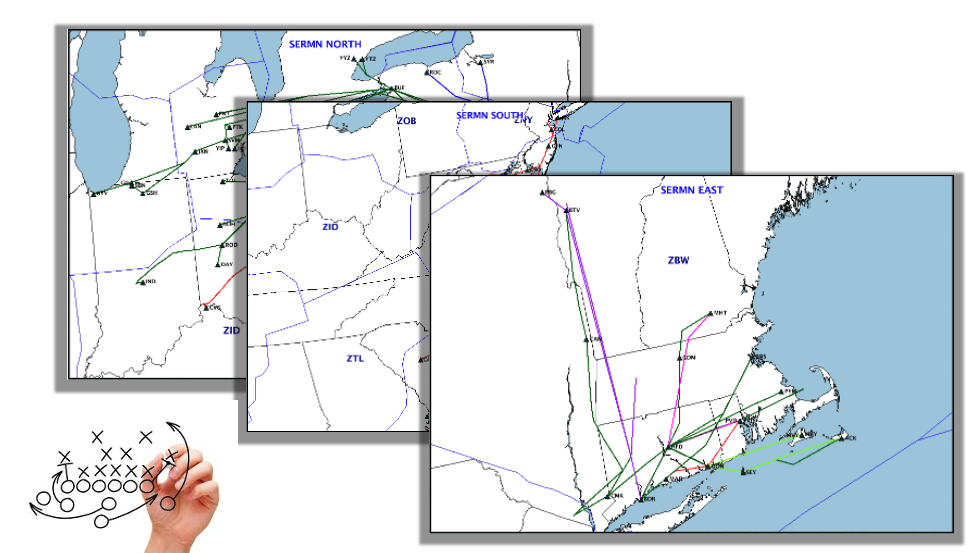
🏈  SERMN South (DCA, CLT, ATL etc). Example routing ex KTEB: ELVAE → COL → DIXIE → T303 → LEEAH → T315→ TAPPA→ THHMP→ CAVLR6→ KIAD Jets capped at 8,000′.

🏈  SERMN East – (BOS, North Eastern Corridor). Example routing ex KTEB: BREZY → V39 → CMK → V3 → WOONS → KBOS. Jets capped at 9,000.’

Their aim is to get you under weather and away from traffic.

Click for the SERMN routes in the FAA’s National Severe Weather Playbook.

But here’s the kicker (football pun intended). You don’t necessarily need bad weather to fly em.’ If hit with a departure delay, communicate with Clearance Delivery that you’re fuelled and willing to accept a SERMN route. Or any of the other routes below (TEC and Deep Water) for that matter.

If you can get it, it may be good option to beat the crowds.

Hey, what about SERMN West?

It doesn’t actually exist, for a few reasons. Predominantly because western departures from the NY Metro area are heavily managed by other established routes such as J80 and J6.

Westbound traffic is also not as typically constrained by adjacent airspace as those aircraft headed in the other directions – and in any case there are other plays in the play book available for westbound traffic, they just don’t carry the title SERMN.

Escape Plan #2: Deep Water Routes

Another option to consider are Deep Water routes which run north and south off the coast between the Northeast and Florida.

If you have the right gear on board, don’t be afraid to get your feet wet.

The FAA advises they can be useful routes out of the area by getting you out of the way of traffic and restricted airspace along the coast.

But before you dive on in, it’s important you are familiar with the requirements of these routes to fly them.

For instance, in NY Oceanic airspace if you are not RNP 4 or 10 capable you need to let ATC know so that they can apply additional separation. If you do have RNP 4/10, you need to comply with those requirements which includes holding the appropriate Opspec/LOA and having the right equipment on board (such as two independent long range navigation systems).

And don’t forget your survival gear either – which can include lift vests, a raft, survival kits, an ELT and pyrotechnic signalling devices depending on what part of the law you’re operating under. You can find these under FARs 91.509, 135.167 and 121.339.

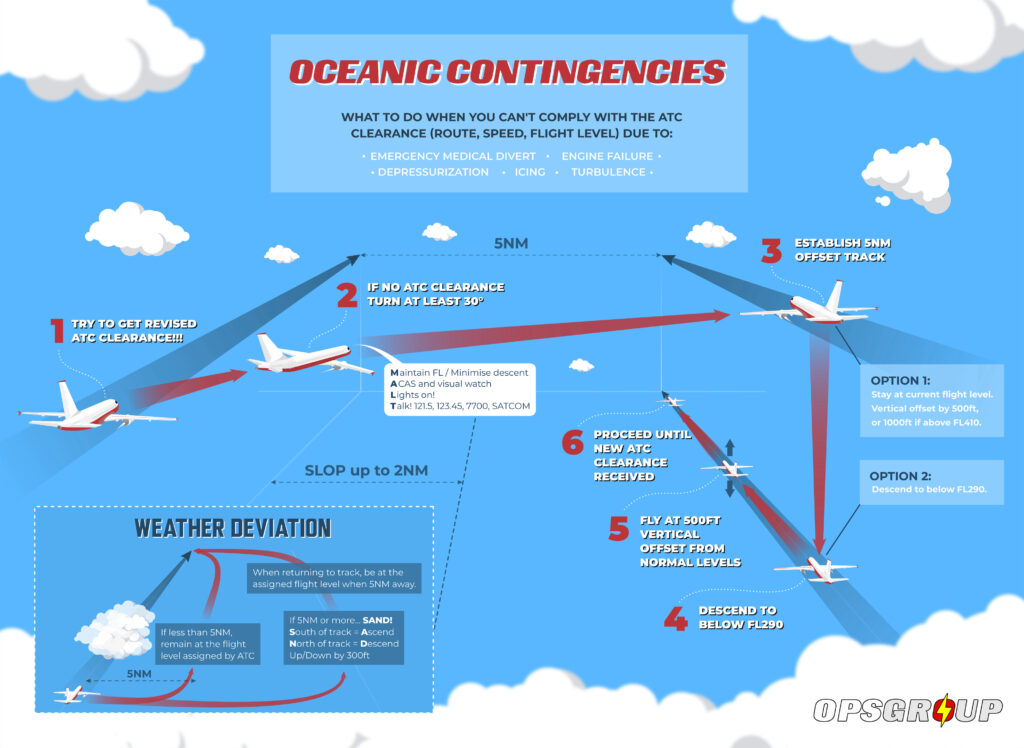
It’s also important you’re thoroughly familiar with the contingency procedures for oceanic airspace including what to do in the event of a navigation failure (especially loss of RNP capability).

Click for PDF.

Escape Plan #3: TEC Routes

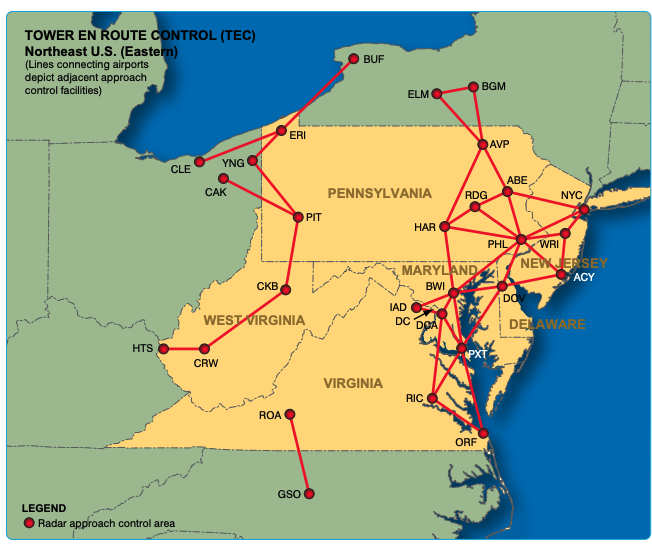
If you’re not headed far from New York, consider the use of FAA TEC Routes (Tower Enroute Control).

These are low-altitude IFR routings (typically 5000 –  17,000’) used for short-distance flights (usually less than 500nm) and often link nearby metropolitan centres.

The idea behind them is to keep aircraft within TRACON (Terminal Radar Approach Control) without the need to hand them off to enroute centers. They are by design, simple and efficient.

These routes reduce controller workload, and keep you away from busier airways. They are typically used by turbo-prop aircraft, so let delivery know you have the fuel to fly them as they may not be immediately considered for jets.

You can find the NE TEC routes in the FAA Chart Supplement here.

Finally, stay clued in.

You can avoid delays by predicting when and where they are most likely. The FAA provides a head’s up via three useful sources – fly.faa.gov, nasstatus.faa.gov and X (formerly Twitter). This includes daily briefings on incoming weather, disruptions and the plans in place to mitigate against them.


Worldwide GPS Dual Failure mystery solved

The mystery of the dual GPS failures around the world has been solved.

Last week, a slew of Dual/Complete GPS Failures began to be reported by airlines and AOs around the world. A peak of failure reports were received around May 21. Typically, the fault was first annunciated as an “ADS-B RPTG” Fault, followed by GPS 1/2 failure. Aircraft affected were mostly B737 and A320 series, though some widebodies also caught the lurgy.

Initially, no clear cause could be established. There were theories about new spoofing and jamming areas, solar flares, sunspots, and troubling new hacker activity. But none of those lined up with the symptoms.

However, over the weekend, the culprit was traced to a single faulty satellite, GPS PRN 37. Data from the broadcast of this satellite led to the on-board failures that we saw.

Thanks to all OPSGROUP members that assisted with the “ALL CALL” that went out on Friday, there was a great response and we were able to collect a great deal of information. An Ops Alert was issued to members on Sunday, which reads:

ZZZZ/Worldwide - Hazard  The mystery of worldwide dual GPS failures appears to have been solved. Over the weekend Boeing, Honeywell, and Collins collaborated to investigate the cause, and the outcome is that the faults were traced to one GPS satellite (PRN 37). A change in the data format being broadcast from it apparently led to the receiver failures. These were limited to Honeywell MMR's, predominantely on B737 and A320 series aircraft. This change has been corrected, and no further issues are expected. There was no connection to an increase in solar activity, or jamming/spoofing. The three OEM's involved consider the case closed. Thank you to all members who responded with reports and information.

A special briefing is in your member Dashboard, which includes crew reports of the issue.

NANU NANU

There was a warning (published as a NANU message) to GPS users published earlier in the year, that warned of unhealthy navigation messages being broadcast on GPS satellites 35, 36 and 37 throughout 2025. Let’s hope that any rogue signals from PRN 35 or 36 don’t have the same effect down the track.

NOTICE ADVISORY TO NAVSTAR USERS (NANU) 2025017 NANU TYPE: GENERAL
*** GENERAL MESSAGE TO ALL GPS USERS ***
Testing will be occurring through CY 2025 using PRNs 35, 36, 37 
on residual SVs broadcasting UNHEALTHY navigation messages.
*** GENERAL MESSAGE TO ALL GPS USERS ***

POC: CIVILIAN - NAVCEN AT 703-313-5900, HTTPS://WWW.NAVCEN.USCG.GOV
MILITARY - GPS WARFIGHTER COLLABORATION CELL at 
HTTPS://GWCC-WS.CCE.AF.MIL/GPSOC, DSN 560-2541, COMM 719-567-2541,
gpsoperationscenter@us.af.mil, HTTPS://GWCC-WS.CCE.AF.MIL
MILITARY ALTERNATE - JOINT SPACE OPERATIONS CENTER, DSN 276-3526. 
COMM 805-606-3526. JSPOCCOMBATOPS@US.AF.MIL


Visual Approaches: When To Say No

There is a recent history in the US of serious incidents that have occurred during visual approaches – you don’t have to hunt long to find them. The reality is this: when we accept a visual approach, we accept more risk.

That isn’t to say that this risk cannot be effectively and safely managed. Visual approaches are still an important way to increase the efficiency of congested airspace. But we do have to give ourselves the room, the capacity, and the mitigations to fly them safely. And in my opinion, that’s where the true risk lies.

The FAA seems to agree. On April 2, it issued an eye-opening Safety Alert for Operators (SAFO) regarding visual approaches. The lowdown is this: visual approaches can be riskier than they seem, especially in today’s busy airspace. Let’s take a closer look.
FAA SAFO on  Visual Approaches

The FAA’s SAFO is resolute in its message – the pilot-in-command has the ultimate responsibility (by law) to say no to clearances that excessively increase workload or erode safety margins. In other words, they don’t want us to hesitate to say ‘UNABLE’. Ultimately, it’s our decision as pilots, and no one else’s.

FAA Reg 14 CFR § 91.3 specifically says:

“…The pilot in command of an aircraft is directly responsible for, and is the final authority as to, the operation of that aircraft.”

This includes the full authority to refuse or decline any clearance or instruction that they deem unsafe or beyond the operational limits of the aircraft or crew. The SAFO then continues with another important message – ATC will support a PIC’s authority to declare ‘unable’ when a clearance may reduce safety margins.

This is where the SAFO falls short a little, at least on a real-world basis. What needs to be included is ‘with impunity.’

Recent Events

In a US NAS burdened by traffic volume, aging infrastructure and controller shortages we continue to hear reports of excessive delays and even confrontation when a clearance is declined.

Check out the recent diversion of a Lufthansa A350 at KSFO/San Francisco due to non-acceptance of visual separation at night.

Courtesy of VASAviation.

There appears to be a growing disconnect here between what the FAA wants in its SAFO, and what’s actually happening in the real world.

It’s seems clear that more needs to change amongst all stakeholders before we can begin to consistently practice ‘safety over sequence’ while accommodating all traffic.

FAA Mitigations

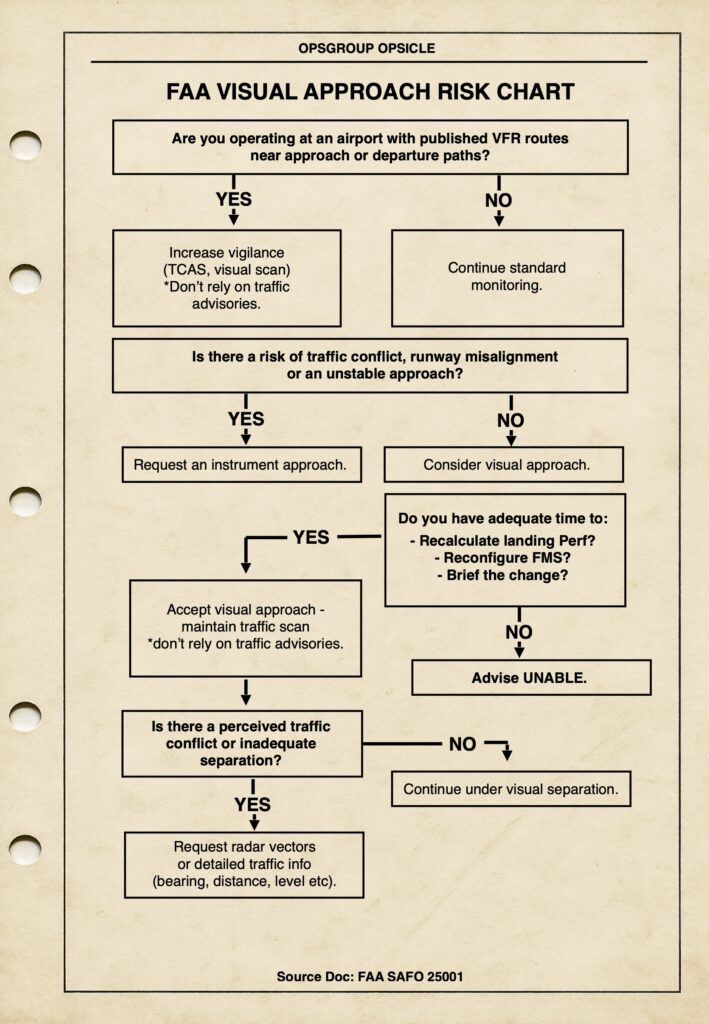
The FAA’s recent SAFO also provides some guidance for pilots on how to mitigate some of the risks of accepting visual approaches. We’ve summarized those in the following little Opsicle.

Click to download PDF.

A note about Business Aviation

In researching this article, several suggestions were also raised about the human factors involved with why pilots find it so hard to say no to challenging clearances. Attend any Human Factors course and you’ll be familiar with the common culprits – saying ‘unable’ can feel like a form of noncompliance, the need to be perceived as competent, an innate desire to ‘make it work’, or the struggle of time compression.

What’s more interesting to us on this occasion is the vulnerability (when compared to airline ops) of business aviation crew to accept challenging clearances despite the increased risk. In other words, are there unique factors? BizAv pilots are faced with a unique combination of industry culture, operational demands and perception of role.

Under Pressure:

BizAv pilots usually find no solace in the anonymity of a flight deck door, a staff number, or a large airline. They have direct contact with those who employ them (sometimes even in the cockpit). Whether we like it or not, this can have an insidious effect on our tolerance for risk. Saying ‘unable’ can feel like failing to deliver.

Professional Flexibility:

Travel by private jet can typically cost anywhere between ten to forty times more than flying commercial. Those who pay may have a certain expectation that we can land anywhere, anytime and circumvent the constraints of conventional airline travel.

No One’s Watching:

Unlike the airlines, there is no requirement for business jets operated under Part 91 to be equipped with Flight Data Recorders or even CVRs, or even under Part 135 (with less than ten seats). And it is hard to deny (even with the best intentions) that this doesn’t have some kind of impact in moments of unexpectedly high workload. Strict adherence to stabilized approach criteria for instance can become more flexible without fear of reprisal.

Safety Management Under Part 91:

The FAA SAFO also specifically mentions the use of safety management systems (SMS) to better mitigate the risks of conducting visual approaches. However a looming mandate will only apply to Part 135 operations – not Part 91, where they will remain voluntary. It’s therefore possible that some BizAv pilots will not be exposed sufficiently to the FAA’s advice.

Want to join the discussion?

We’d love to hear from you. You can reach us at: news@ops.group.


Watch Out For APU Fines at Le Bourget

The summer peak is nearly upon us, and so too is the busiest season for BizAv at LFPB/Le Bourget.

Several upcoming events will see an influx of traffic to the airport including the French Open (May 19 – June 8), the Paris Air Show (June 16 – 22) and Paris Fashion Week (June 24 – 29).

While this isn’t a new change, if you’re heading into LFPB it’s a good time to remind yourself of the strict rules for APU usage lest you fall victim to some potentially large fines.

They’re not mucking around either – two groups are involved. The Air Transport Gendarmerie is responsible for monitoring APU usage at the airport and making sure operators follow the rules. If not, a group known (in English) as the Airport Nuisance Authority (ACNUSA) will get involved and issue fines.

In a recent year, ACNUSA imposed 334 fines for non-APU compliance across French airports. Their haul? €6.9 million – that’s an average of more than €20,000 per fine. This has been confirmed as accurate and current by a local handler. Both the operator and PIC can be held liable.

The French AIP (LFPB AD 2.21) has the full rules – but here’s what you need to know…

Know the time limits

Since 2023, the rules at Le Bourget have depended on whether your parking stands have ground facilities or not:

Departing Flights – APU use limited to 10 minutes prior to the EOBT if your stand is equipped with ground air and power, or 45 minutes on stands without these services.

Arriving FlightsAPU use limited to 5 minutes after arrival if your stand is equipped with ground air and power, or 20 minutes on stands without these services.

There are limited exemptions to the rules, these include:

  • Humanitarian and medical flights.
  • Military aircraft.
  • Aircraft carrying live animals, perishables, medical or cosmetic goods that require active air flow.
  • The sake of flight safety (which specifically includes passenger, crew or handler health). For departing aircraft it’s worth noting it can take up to 30 mins to cool the cabin of a larger jet (such as a G650, or Falcon 8X) to comfortable temp when the ambient temp outside is more than 30 deg C (86 deg F).

You can enact limited exemptions for APU use, but make you have a solid case for it.

For BizAv flights, determining whether or not the FBO is “equipped with ground air and power” is a slightly tricky business. One FBO reported the following:

We have some mobile GPUs, but not for every space. That creates two interpretations:

The first one: if we have a mobile GPU available, so it is 5 minutes on arrival and 10 minutes on departure; and if we don’t have it available, it is 20 minutes on arrival and 45 minutes on departure.

The second one: they consider that as we are not able to provide one GPU to each aircraft, we are in the 20 minutes on arrival and 45 minutes on departure category by default.

But as the second way is not an “official” one, it is only a tolerance, that’s why you might get different replies from the different FBOs about how the rules work here.

I need an exemption

This is at the PIC’s discretion, but you need to be able to justify it using one of the conditions above.

To do so, you’ll need to provide your agent with a declaration for the Gendarmerie that you intend to break the APU rules, and most importantly why.

Feedback from local agents

Here’s what handlers at Le Bourget had to say when we reached out to them directly.

  • “…the airport authorities are very strict with the use of APU’s here. The authorities may fine you for failure to comply – we are able to provide a GPU at the request of the crew…”
  • “…there are some unexpected and random inspections by the authorities, after which they write a report and impose a fine…”
  • “…the use of the APUs is randomly controlled by the Gendarmerie here in LFPB. The maximum amount of the fine for APU infractions is 20,000€…”
  • “…the Captain may only deviate from APU rules for safety reasons. Violation is heavily penalized by the ACNUSA agency, with fines generally exceeding €10,000!…”

Why the fuss anyway?

Two things – noise and pollution.

APU’s are noisy things – a typical one produces 113 decibels, an equivalent noise range to a power saw, jackhammer or even a rock concert. Le Bourget is noise sensitive and located in close proximity to residential areas.

Then there’s the dinosaurs we’re burning – carbon dioxide, nitrogen oxides and other nasties are ejected from our APU exhaust. Reducing runtime helps lower emissions and improves air quality near the field. In fact, here is a surprising statistic – approx. 30% of an airport’s carbon emissions come from aircraft on the ground (with APU use being a significant factor).

This is all in line with global and EU climate goals (such as Fit for 55 or the Paris Agreement). Agree or not, we have to play by the rules – or find ourselves paying a hefty price.

Have a report to share?

Have you been stung or know someone who has? Please share your story with us (as always, our reports are always de-identified). There are several thousand crew out there who will owe you a beer. You can reach us around the clock on news@ops.group.


Greece Summer Lowdown: Parking Pain, Slot Stress, and Hidden Fees

Key Points
  • All Greek islands will be extremely busy again this summer. Athens too.
  • Very few slots are made available to BizAv flights, overnight parking is scarce, even quick turn arounds are extremely difficult in some cases.
  • At Level 3 airports, your filed flight plan must match the confirmed slot time within ±15 minutes, otherwise it will be suspended.
  • Watch out for extra fees at LGMK/Mykonos, LGKR/Corfu and LGKO/Kos.
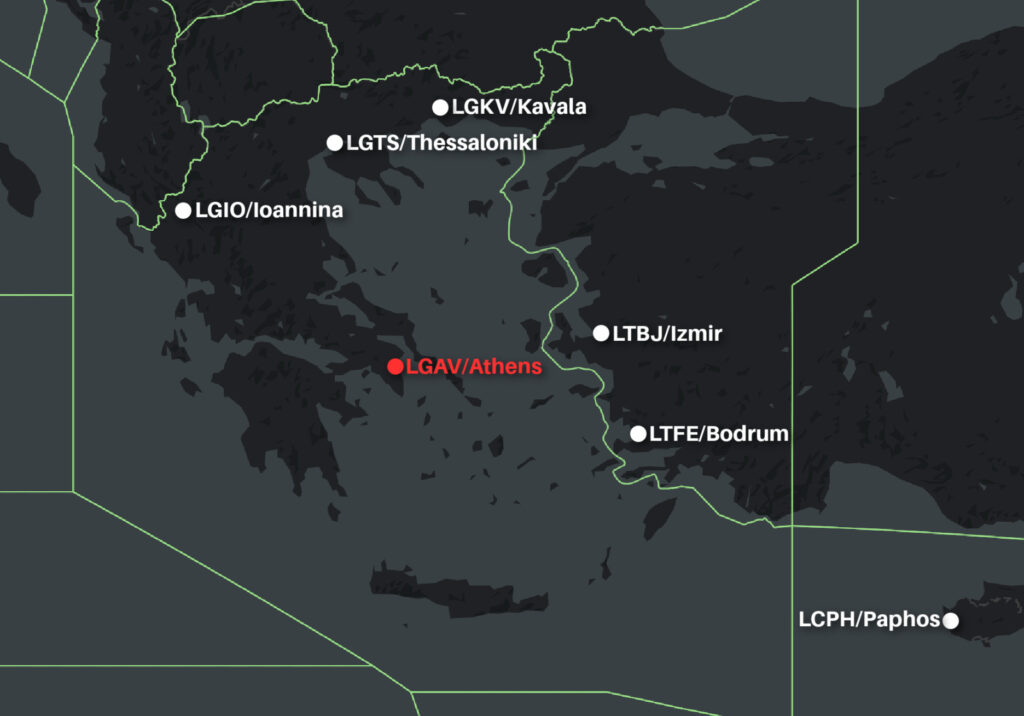
  • Consider drop-and-go’s, with parking at airports on the Greek mainland, Cyprus, or Turkey.

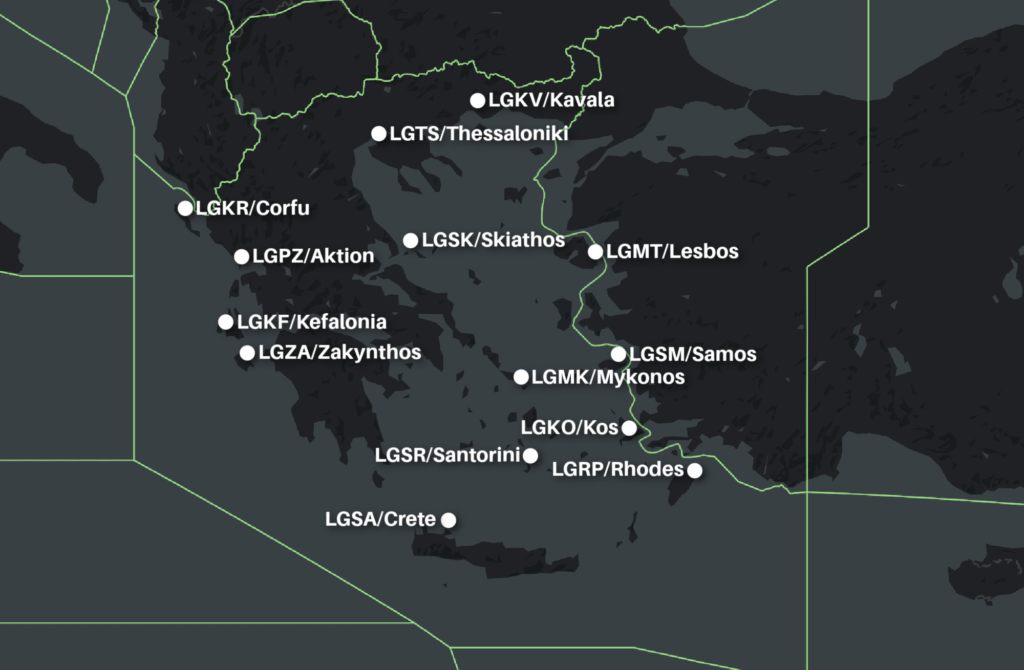
There are loads of island airports in Greece, but there’s a special collection which are managed by a company called Fraport.

The 14 Greek airports managed by Fraport.

“Special” just because operating to these particular airports has become increasingly challenging since their privatisation in 2017. Fraport initially struggled to deal with providing parking to non-scheduled and business aviation, and new slot procedures were introduced to try to better manage the volume of requests being made.

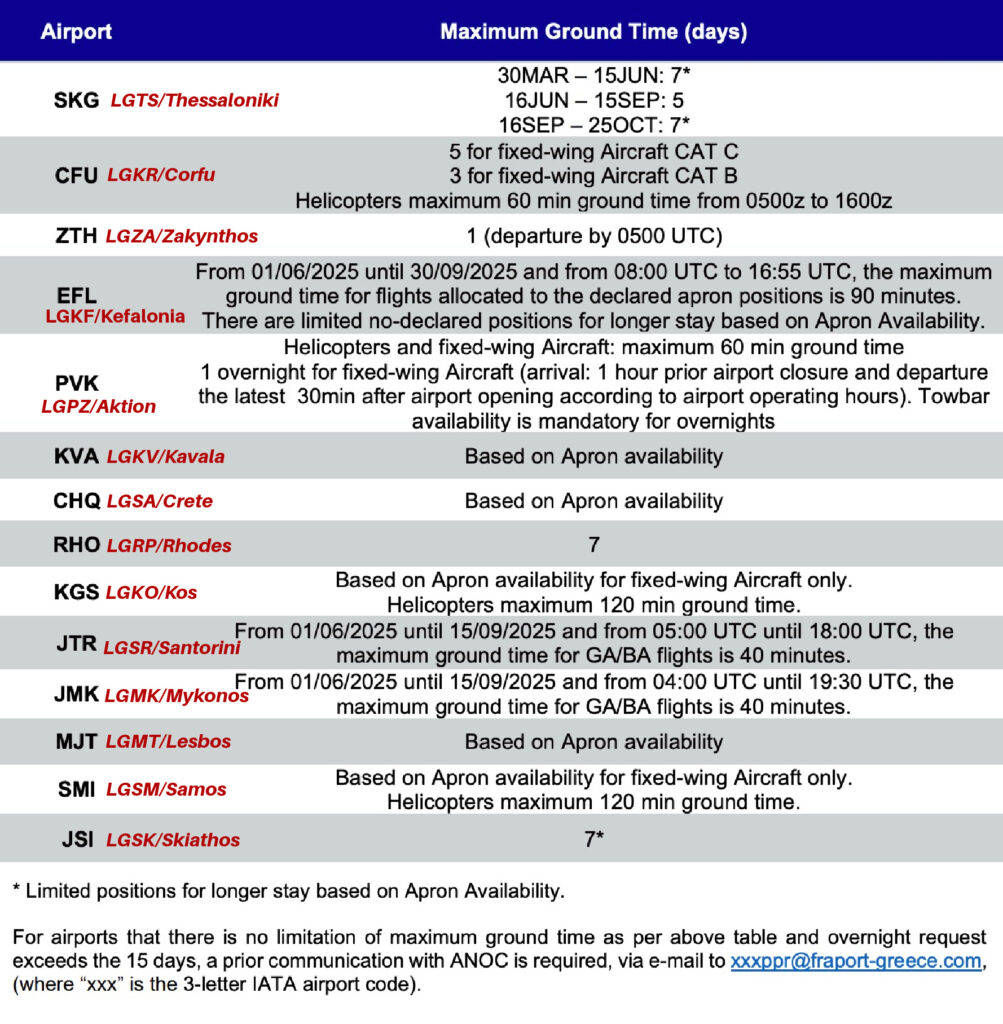
How long can I park my aircraft on the islands?

Not long. There are two places to check how long you can stay on the ground at these airports – and you need to check both.

The first is the PPR Handbook Fraport have published which includes this info in handy chart form, plus a bunch of extra info about how to actually go about applying for PPR. The chart below shows the info for the 2025 summer season:

The second place to check is the Notams, and this applies to ALL Greek airports. With peak summer season coming in July/August, expect to see even more restrictive max-time-on-ground Notams get published.

Don’t get caught without a slot in Greece

Greece has brought back the Flight Plan Suspension (FLS) system for summer 2025. It applies to Level 3 coordinated airports – which includes most of the busy island destinations – you can which are Level 3 here.

If your flight plan is more than 15 minutes off your confirmed slot time, it will be automatically suspended.

Make sure you have a confirmed slot from HSCA – your handler will usually take care of this – and that your flight plan matches the slot time.

The slot ID must be included in Field 18 of your flight plan:

  • RMK/LGXXAxxxxxxxxx for arrivals
  • RMK/LGXXDxxxxxxxxx for departures.

Even if you’re flying VFR, a slot is still required if any part of the flight is under IFR.

If you can’t reach HSCA, you can contact Greek ATS at: +30 210 997 2656 (office) or +30 210 997 22654 (24/7)

This change is published in LGGG Notam A1535/25, effective from May 30 – July 9. We’ll see if it gets extended…

Watch out for extra fees!

There are some extra costs at three airports in the summer: LGMK/Mykonos, LGKR/Corfu and LGKO/Kos.

The short story is this: all BizAv flights have to use the dedicated GA Terminal at these airports in the summer months, where you will get charged an extra 2000 Euros per passenger-carrying sector flight (so if a flight has pax inbound and outbound, 4000 Euros will be charged). VAT is charged on top of this to non-EU operators.

It doesn’t matter which handler you use – they all quote the same costs for this.

There’s no mention of these charges in Fraport’s Airport Charges documents published on their site.

A note on LGAV/Athens

Once a haven for weary BizAv operators, Athens used to guarantee a quiet remote stand where you could leave the jet for a few nights after dropping pax on the islands.

But those days are gone!

In March 2025, the airport started managing BizAv parking entirely through slots and PPRs. The free parking period was cut from 12 hours to just 90 minutes. If your ground time is 90 minutes or less, no PPR is needed, and you can request a slot up to 7 days before the flight. For stays longer than 90 minutes, you must first obtain a PPR, but this will only be issued within 24 hours of the flight. Once approved, you can then confirm your slot using the PPR. It seems this rule can only be found in the Slot Authority’s guidance doc – not the AIP or Notams.

Good options for parking?

In Greece, we’ve heard reports from OPSGROUP members on these ones: LGTS/Thessaloniki, LGIO/Ioannina, and LGKV/Kavala. In Cyprus, there’s LCPH/Paphos. And then there’s always the option of Turkish coastal airports, the likes of LTBJ/Izmir and LTFE/Bodrum.

Good options for parking.

Plus a couple more we heard about last year:

LGBL/Volos – A joint use air base 90nm north of Athens. We just relocated our aircraft there on our trip to Athens for around 9 days. Super easy in and out. Stayed at Volos town about 15 miles away. Limited operating days and hours so check notams. They have limited airline service also. Rental cars are available. All in all a great experience for storing our aircraft until the boss was ready to return to the US.

LGIR/Heraklion – We operated into LGIR a few days ago. Everything very easy and Skyserv did a really great job of taking care of our pax and us. Lots of nice hotels in the area around the city, some nice sights if you have some days off. Departure was also very smooth, catering, fuelling, gpu everything worked exactly as it should. The fees were also very moderate. LGIR is also a good candidate for parking if you can’t get it anywhere else.

And a couple of other airports which used to be okay options, but maybe aren’t so great anymore: LGRX/Araxos and LGSM/Samos. As reported by Universal handling: LGRX is very restrictive and not with so much space, I wouldn’t consider it as one of the first options, but desperate times call for desperate measures. LGSM was not so easy to approve last summer, they have also their morning peak a couple of days of the week but it is indeed a solution.

Know of any other good options? Let us know: news@ops.group


EU Updates Lost Comms and Emergency Descent Rules

On May 1, the Standardised European Rules of the Air (SERA) were updated – bringing new procedures for lost comms, emergency descents, and even a brand-new transponder code.

SERA is essentially the rulebook that ensures consistent flight procedures across EU airspace. It’s developed by EASA and is legally binding for all EU member states.

Each country still publishes its own AIP, but when SERA is updated, it overrules anything outdated in those local documents. So even if a country’s AIP hasn’t caught up yet, you’re still expected to follow the new SERA rules!

You can download the updated SERA guidance here, but here’s a quick look at the main changes:

Radio Communication Failure Procedures

Lost comms? The new SERA rules introduce a second transponder code, and defines which one to use – depending on whether or not you’re diverting.

🟦 Squawk 7600 = Not diverting

Use 7600 if you’re flying under IFR and:

  • You’ve lost radio communication, and
  • You’re continuing with your IFR flight – even if you’re in VMC.

This means you’re sticking to the standard lost comms procedures: continue based on your last clearance, possibly to your destination or alternate, and let ATC protect that airspace.
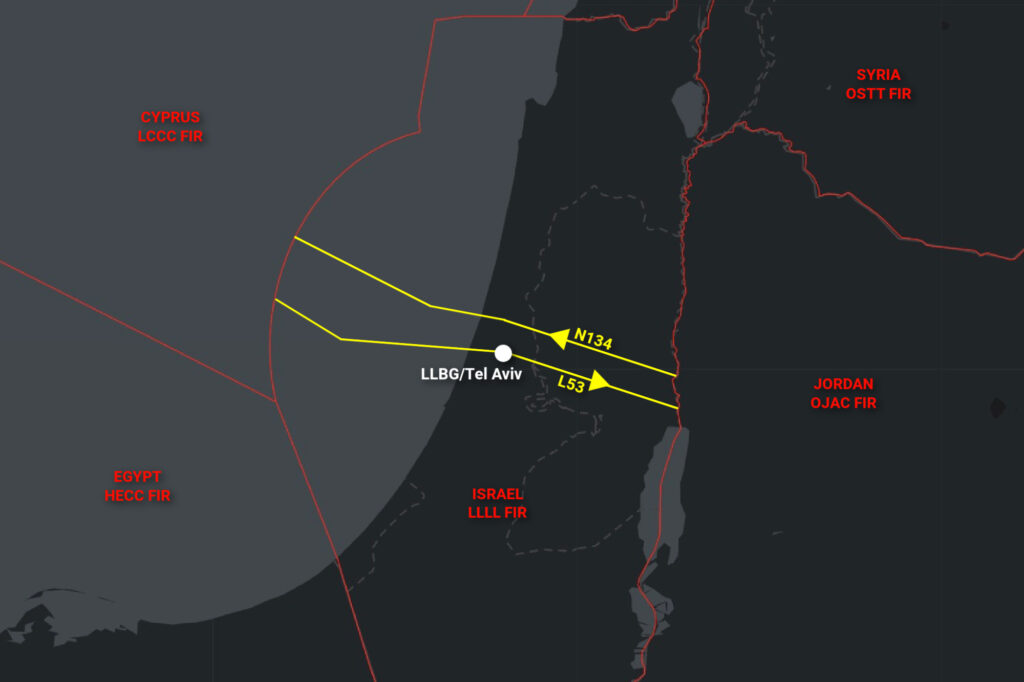
One important change to be aware of when using the 7600 code: the old 7-minute rule in lost comms situations has been replaced. Under the updated rules, if you’re continuing under IFR after losing communications, you must now maintain your last assigned level and speed for 20 minutes (instead of 7) before taking further action under lost comms procedures. This extended buffer gives ATC more time to identify your position and protect your track.

🟩 Squawk 7601 = You ARE diverting

Use 7601 if:

  • You’re flying under IFR
  • You’ve lost comms
  • You’re in VMC, and
  • You decide to land at the nearest suitable airport instead of continuing the flight.

So 7601 is a brand-new code introduced to give ATC a clear picture of what you’re doing. Instead of guessing whether you’re continuing IFR or trying to land visually, ATC knows right away: you’re diverting to land, and they can adjust separation and support accordingly.

From the helpful PDF published by Skeyes (the Belgium air navigation service provider). Click to download.

Emergency Descent Procedure

This has been updated with clearer priorities! The procedure now starts with “Navigate as deemed appropriate by the pilot” – replacing the older instruction to always turn off route before beginning the descent. So the new rule gives the pilot full discretion to navigate as needed – possibly turning, possibly descending straight ahead.

There are also some changes to what ATC should do: broadcasting an emergency message now comes first (not just “if necessary”), and there’s clearer guidance to inform other ATS units (this wasn’t explicitly stated before).

Plus some guidance on what other aircraft should do if they hear the emergency descent broadcast: keep flying their current clearance, maintain listening watch, and watch for conflicting traffic visually and with ACAS. Pretty standard stuff, but this wasn’t explicitly mentioned in the previous guidance.

Notams and AIP Updates

One issue to be aware of here – most countries won’t update their AIPs until May 15 with the next AIRAC cycle. But these new SERA rules are legally binding from May 1 and take precedence over any outdated AIP content, so you must follow the updated SERA guidance!

So far, France appears to be the only country that has issued a Notam acknowledging/warning us about the changes:

LFFF F0627/25 (Issued for LFBB LFEE LFFF LFMM LFRR) - 
APPLICATION OF THE NEW EUROPEAN REGULATION IR SERA 2024/404 
IN FORCE ON MAY 1ST, 2025 WITH THE INTRODUCTION OF POINT SERA.14083 
RELATING TO PROCEDURES IN CASE OF RADIO COMMUNICATION FAILURE. 
MODIFICATION OF RADIO FAILURE PROCEDURE : INTRODUCTION OF THE NEW 
EMERGENCY CODE 7601 AND MODIFICATION OF THE 7-MINUTE RULE TO 20 MINUTES. 
REF AIP ENR1.1. 01 MAY 00:00 2025 UNTIL PERM. CREATED: 30 APR 10:03 2025

And another issue to be aware of – some non-EU countries in Europe are not updating their rules! 

Switzerland have decided to confuse everyone by saying they won’t be implementing the 7601 code anytime soon:

LSAS A0252/25 - IFR FLT SHALL USE SSR CODE 7600 IN CASE OF RCF EVEN WHEN 
CONTINUING IN VMC TO THE NEAREST SUITABLE AD. SSR CODE 7601 AS DEFINED 
BY SERA.14083 NOT YET IMPLEMENTED. 15 MAY 00:00 2025 UNTIL 31 JAN 23:59 2026. 
CREATED: 02 MAY 10:01 2025

And the UK has published this doc saying that no changes are being made to the UK’s RCF procedures.

As the UK and Switzerland are not EU countries, they can do what they like. EU countries don’t have this option – they’re all legally required to apply new SERA rules on the effective date.

Bottom line: keep an eye out for more AIRAC/AIP updates and Notams from other European countries in the coming days as they clarify how they’re implementing the new SERA procedures!


NAT Airspace Closures: Formidable Shield 2025

Remember that big NAT military exercise a couple of years ago? Formidable Shield is happening again now, which will mean parts of North Atlantic airspace will be closed to flights for several hours at a time.

There are daily closures in the EGD701 area off the coast of Scotland until May 23, but the big one to watch out for is a large closure of airspace across the northern half of the EGGX/Shanwick FIR on May 20 between 15-21z (with May 22 as the backup day).

The map below shows everything we know about this so far, taken from this UK SUP.

For the big closure on May 20, ATC might start rerouting flights before the airspace closure starts (15z) with the use of Flight Plan Buffer Zones extending 30 NM or 60 NM beyond the closed airspace.
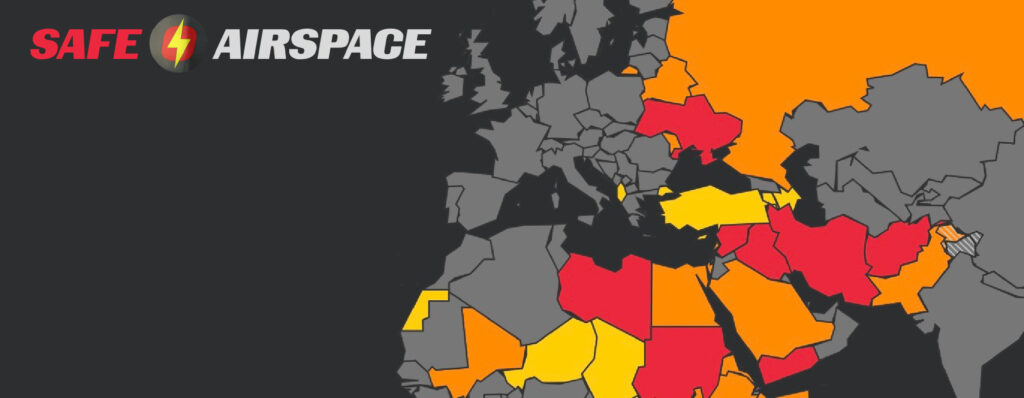
There’s no timings yet for when these might be activated, and ATC have said they won’t make any decision on this until nearer the time when they know where the jet stream is going to be and what the tracks might look like, but best advice would be plan a flight that clears the area at least 1 hour before the airspace closure (so 14z).

Keep an eye on the EGGX/Shanwick Notams – they will publish one for the big closure at least 24 hours prior, which will look a bit like this (except it will say EGD2FS25 instead of EGD1FS25).

And for any questions on Formidable Shield, you can contact the UK Airspace Management Cell at SWK-MAMC-ManagedAirspace@mod.gov.uk.


Saudi Arabia Lifts Cabotage Ban

Key Points
  • Starting May 1, Saudi Arabia has removed its cabotage limits, which means foreign charter flights can now operate domestic sectors within the country – repositioning without passengers and quick drop-offs are no longer the only option.
  • To gain approval, operators need to complete three steps: register with MISA, apply to GACA with a business plan, and comply with GACAR Part 129 requirements including safety and sustainability documentation.
Here’s what you need to do:

Step 1: Register with MISA

Before anything else, you need to register with MISA (Saudi Arabia’s Ministry of Investment). They handle investment licensing, which is the starting point for getting your charter approval. If you hit any snags here, you can reach them at logistics@misa.gov.sa.

Step 2: Apply to GACA

Next, you’ll submit an official letter to the President of the General Authority of Civil Aviation (GACA) at generalaviation@gaca.gov.sa. This letter should:

  • Request approval for domestic charter operations
  • Include your business plan (GACA has provided a template)
  • Optionally include any extra economic details you want to share

Step 3: Meet the regulatory requirements

You’ll need to comply with GACAR Part 129 – basically, Saudi’s rules for foreign air carriers. Part of this includes submitting a Safety and Environmental Sustainability Sector form.

What does this change mean?

For international operators, it’s a big deal. You can now:

  • Pick up and drop off passengers on domestic segments
  • Reposition flights domestically without worrying about cabotage violations
  • Offer more flexible services to clients operating inside Saudi Arabia

This change is part of Saudi’s big push to grow its general aviation sector into a $2 billion industry by 2030, creating thousands of jobs and expanding the private aviation market. GACA says they’ve already received plenty of interest from international and regional operators, so expect some competition.

Where to get help

If you need help or have questions, GACA and MISA have both provided contact points:

MISA: logistics@misa.gov.sa

GACA: generalaviation@gaca.gov.sa


Pakistan/India Airspace Update

Update May 12

A ceasefire between India and Pakistan, announced on May 10, appears to be holding despite mutual accusations of violations.

We continue to advise caution, particularly over the Kashmir region and along the shared border where air defense activity could resume with little warning if hostilities were to restart.

Flight tracking indicates that nearly all operators are still avoiding the area, opting instead to reroute south via the Gulf of Oman and the UAE.

Pakistan has reopened all previously closed airways. India has reopened all previously closed airports. But both countries continue to prohibit each other’s aircraft from entering their respective airspace (Notams: VIDF G0510/25 and OPLR A0220/25).

Update May 7

India launched airstrikes on multiple locations in northern Pakistan early on May 7, leading to a broader exchange of fire and escalating tensions along the border. There were drone attacks on both sides the following night.

In India, VIAR/Amritsar, VISR/Srinagar and VICG/Chandigarh airports are closed to civil flights until May 10 as a precaution. In Pakistan, flights have now resumed at all airports that were temporarily closed on May 7, including OPLA/Lahore and OPIS/Islamabad.

Despite some media claims, Pakistan has not closed its entire airspace. Instead, several airways in the northern OPLR/Lahore FIR remain unavailable until May 10, although alternate routings are still possible.

These restrictions are listed on the Pakistan CAA Notams website, many of which are not mirrored on the FAA’s site, so it’s best to check the source directly for the latest updates.

However, most major airlines are now avoiding Pakistan’s airspace altogether, with east-west traffic diverting south via the Gulf of Oman and UAE. Given the uncertainty and potential for rapid escalation, this seems a sensible choice.

If the conflict continues, there is a chance that Pakistan could impose a full airspace closure, as they did from Feb to Aug 2019 under similar circumstances. Check SafeAirspace.net for any major updates to airspace risk.


Back to the Radio: Gander Goes Voice-Only Pre-Oceanic

  • Since the removal of Oceanic Clearances in December 2024, Gander had been issuing pre-Oceanic route amendments via CPDLC. But crew confusion over these messages has led to increased VHF workload for controllers.
  • To help fix this, from 5 May to 31 December 2025, Gander will issue all route amendments before the Oceanic Entry Point by VHF voice only, even if the aircraft is logged on to CPDLC. All other OCR procedures remain unchanged.

More info can be found in Canada AIP SUP 46/25. The same update has been announced via Notam too:

CZQX H1579/25 - EASTBOUND FLT IN GANDER DOMESTIC, ENROUTE TO GANDER OCEANIC, 
WILL BE ISSUED OCEANIC ROUTE AMENDMENTS VIA VHF VOICE IN LIEU OF CPDLC LOADABLE 
ROUTE CLEARANCES. ALL OTHER OCEANIC CLEARANCE REMOVAL (OCR) PROC REMAIN UNCHANGED. 
REFER TO AIP CANADA SUP 046/2025. 
05 MAY 00:00 2025 UNTIL 04 AUG 16:00 2025. CREATED: 01 MAY 12:36 2025

We’ve written before about crew confusion and errors on the NAT following the introduction of the new “No Oceanic Clearance” procedure.

Since 4 Dec 2024, Oceanic Clearances are no longer being issued by Gander for eastbound flights, and a new procedure is in place using the same ACARS 623 RCL message process enabling you to send your desired time, level and speed at the Oceanic Entry Point (OEP) so ATC can develop an optimal Oceanic profile for your flight.

But there have been plenty of cases of flight crew getting it wrong, the top 5 being:

  1. Sending the RCL at the wrong time
  2. Asking for an Oceanic Clearance
  3. “DIY” level changes
  4. Wrong handling of RCL Rejected messages
  5. Repeated voice requests for “route confirmation” blocking active ATC frequencies due to CPDLC UM79 route clearance confusion.

We previously published this Crew Brief and Checklist, which you can download below:

Download the Gander RCL Crew Brief and Checklist (PDF, 1Mb)

⬆️ All the info in the Checklist is still accurate, except for this new change from May 5: Gander will issue all route amendments before the Oceanic Entry Point by VHF voice only, even if the aircraft is logged on to CPDLC. Note that Moncton and Montreal will continue to issue CPDLC UM79 route amendments.

Getting it wrong

Since Canada removed Oceanic Clearances in Dec 2024, things haven’t exactly gone smoothly. Crews are confused. Controllers are overloaded. Frequencies are clogged.

The ICAO North Atlantic Implementation Management Group published this report in April 2025, which gives a bit more info about what’s been going wrong. Here’s a summary:

  1. Misinterpretation of “RCL RECEIVED”. Crews wrongly believe this means their requested level and speed are approved.
  2. Expectation of Verbal Clearance. Crews continue to ask for Oceanic Clearance or confirmation, despite RCL automation.
  3. Confusion Over Clearance Level. Crews question why the cleared level differs from what was requested in the RCL.
  4. Timing Errors. RCLs sent too early or too late are rejected, leading to further confusion.
  5. Old Habits Die Hard. Habits from the previous Oceanic Clearance system persist among crews.
  6. Interpretation Problems with UM79. Some crews are reading the UM79 and thinking “direct to the Clearance limit,” which is wrong.
  7. Incomplete Route Displays. Missing route chunks – Depending on the avionics, not all of the routing shows up properly, or crews miss them.
  8. FMS Issues and Fuel Warnings. The FMS throws up alerts. Crews wonder if something’s off with the routing.
  9. Reluctance to Load Routes. Crews hesitate to load the Clearance into the FMS without voice confirmation – they’d rather check with ATC first, just to be sure.
  10. General Avionics Variability. Every aircraft is different – and so is how it shows the message. It’s not standard, which means more chances to mess it up.
  11. Incorrect or Partial Route Loading. Frequent errors like skipping waypoints or only partially loading Clearances – or just loading it wrong altogether!
  12. BizAv-Specific Confusion. Not sure how true this is, but the doc says that BizAv crews in particular are struggling with strange LL coordinate formatting.
  13. Increased Voice Frequency Use. Radio overload – all these doubts mean more calls to ATC. VHF is getting slammed.
  14. High ATC Workload. ATC are super busy with constantly jumping in to prevent route deviations due to misinterpretations.
  15. Prevented Deviations. A high number of potential lateral or vertical deviations are being caught just in time by ATC.

Phew! Who knew this whole Removal of Oceanic Clearances thing was going to be so much work!

Getting it right

In our previous post, we did attempt to draw out some straightforward guidance for crews heading eastbound on the NAT through Gander on how to get it right. But for those of us who prefer cold hard text rather than little pictures and maps, here’s some step-by-step guidance:

  1. File your flight plan. Do this as usual, including your planned route, speed, and flight level(s).
  2. Log on to CPDLC. The Gander Domestic logon code is CDQX. Gander Oceanic logon is CZQX. No need to add anything else as the transfer of connections should be automatic.
  3. Submit your RCL. Do this via the ACARS 623 process between 90-60 mins prior to the OEP for Gander. Remember, this RCL is a message you send to ATC telling them your desired route, level, and speed across the NAT. It’s not asking for a Clearance – it gives ATC the details needed to build your optimal profile.
    Submit the RCL by voice instead of the ACARS 623 process if any of the following apply:
    – You don’t have datalink capability or it’s not working.
    – You’re departing from an airport less than 45 minutes’ flying time from the OEP (send the RCL 10 minutes prior to start-up).
    – You receive an “RCL REJECTED” message for any reason.
    – You don’t receive an “RCL RECEIVED” response within 15 minutes.
  4. 🆕 Expect any Oceanic route amendments from Gander Domestic via VHF voice, not CPDLC. Between 5 May and 31 December 2025, Gander Domestic controllers will issue any route amendments via VHF voice only, even if you’re logged on to CPDLC. This is a temporary change to reduce confusion, controller workload, frequency congestion and hopefully identify mitigations for the UM79 errors. Any route changes after you progress by the OEP will still be issued via CPDLC or HF by Gander Oceanic.
  5. Don’t request a clearance! There is no eastbound Oceanic Clearance anymore, so don’t ask ATC to confirm your route!
  6. Don’t climb! Maintain your domestic cleared level. Domestic ATC (the radar sector before the ocean) is responsible for getting you to the level Oceanic ATC has assigned you. If your RCL level is available, they will clear you. Do not climb without a clearance! Nil comms means no change, stay where you are. At the OEP, set speed to Econ/Cost Index, or a Fixed Mach if so assigned. Your FMS routing is automatically checked with a “CONFIRM ASSIGNED ROUTE” message – no need to confirm via voice. If there’s a problem, ATC will contact you.
  7. Once in Oceanic airspace… Any further route or level changes will be issued via CPDLC or HF, as before. Once in the ocean and traffic permits, you can expect an advisory that your RCL level is available if you didn’t get it earlier. Continue normal NAT procedures, including position reporting (as required), speed change notifications, and monitoring of appropriate frequencies.
Back to the Radio

For crews, these temporary changes will feel like stepping back in time to the old school pre-CPDLC era. After years of progress toward datalink-driven automation, we’re now back to copying Oceanic route amendments over VHF – just like the old days. Until the system catches up, have your pens ready and your radios tuned – because Gander is going retro, at least for now.

What about flights heading the other way across the NAT?

Westbound flights are still fully doing things the old-fashioned way, as Shanwick have still not removed Oceanic Clearances yet!

They initially planned to drop these in Dec 2024, but identified some system issues at the last minute which would have created major problems in providing a full ATC service.

The latest news from them is that they don’t expect to do this before Summer 2025 – and NATS will give at least 2 months’ notice before making any changes.

For more on that, Opsgroup members can check this briefing.


The Dangers of Mixed Traffic: FAA Targets Risks at Key Airports

Key Points
  • Hotspot focus: The FAA is targeting KDCA, KLAS, LA area, and Gulf Coast airports due to helicopter/fixed-wing traffic risks.

  • Immediate changes: KDCA closed one heli route; KLAS saw 30% drop in proximity events after ATC changes.

  • More to come: The FAA is using AI and forming new rules; safety report due by Sept 2025.

April 22 was an important day for the safety of aircraft operating at major airports across the US.

The FAA held a Safety Roundtable to discuss how to best manage risks associated with intensive helicopter operations near fixed wing traffic in busy, controlled airspace.
This follows the tragic mid-air collision of a Black Hawk helicopter and CRJ700 airliner at KDCA/Washington on January 29.

The Table featured a collective of FAA leadership, ATC representatives, helicopter operators and industry safety experts.

Their purpose was to identify the specific hazards of mixed helicopter and fixed-wing operations – especially in congested airspace – and how to better protect us from them.

While the FAA has yet to release a comprehensive public report, they have been providing updates and preliminary findings via their online newsroom.

Here’s what’s being discussed.

The Targets

The Round Table’s approach to the dangers of mixed traffic identified three core issues:

  • Airspace – better strategies to segregate helicopter and fixed wing traffic are sorely needed, especially at congested and controlled airports.
  • Communication – communication protocols between pilots and ATC needs to be improved.
  • AI – using AI technology to learn from existing data (such as incident and accident reports) and identify patterns of risk. It then becomes easier to effectively mitigate these dangers quickly, and with limited resources.
Hot Spots

The Group went on to identify the US airports of primary concern…

Washington

The swiftest action took place at KDCA/Washington itself in the aftermath of the Potomac disaster. The airport is situated in close proximity to the locally known helicopter alley – an area of dense rotorcraft traffic used by essential services such as the military, law enforcement and medevac.

In response to the accident, the FAA closed the low-level helicopter route in use at the time and has restricted non-essential helicopter ops. Only those engaged in ‘special missions’ will be allowed. ADS-B Out has also been mandated for all but the most secure of flights.

The FAA has permanently closed helicopter Route 4 since the accident in January.

Las Vegas

The Safety Round Table identified KLAS/Las Vegas next as perhaps the airport of highest safety concern for mixed traffic, where air tours are frequent.

Concern was raised by the group that helicopter routes used in agreements with local operators lacked effective guidance on vertical and lateral boundaries. And in many cases, tower controllers were not issuing traffic advisories to arriving and departing fixed wing traffic.

In what seems to be a case of procedural ‘slip’, normalization of deviance or even perhaps complacency the FAA has reported routine lack of compliance with Class B separation rules.

Either way, it is a potentially dangerous mix.

Immediate changes have been put in place – essentially more proactive separation by ATC and better traffic info for pilots. We’re pleased to report that according to the FAA, these efforts reduced ‘proximity events’ by 30% in just three weeks – circumstances that FAA believe might elevate collision risk (even if legal separation has been applied).

Other changes are coming in Las Vegas, but these have yet to be announced.

The FAA has identified KLAS/Las Vegas as being at high risk from mixed traffic.

Los Angeles

LA’s airports are another area of concern – KBUR/Burbank and KVNY/Van Nuys were specifically mentioned. Here airspace is complex, and hosts substantial helicopter ops including news, medical and air tours close to commercial flight paths.

The FAA is actively looking at operations near these airports but as yet, there are no major changes to report.

The Gulf Coast

The FAA has begun looking at busy airports along the US Gulf Coast which include offshore helicopter operations.

It is not going to be an easy fix, but they advise that AI technology mentioned above will be put to good use to figure out where the greatest risks lie and what can be done about them in the near future.

The FAA has identified Gulf Coast airports as another hot spot for fixed and rotary wing mixed traffic.

Better Rules

In response to these dangers among others, the FAA has also launched another safety initiative – they’ve formed a rule making committee to improve the safety of commercial helicopter tours.

Some elements of this group’s focus will have an important impact on the safety of mixed traffic operations – including potential changes to regulations.

There will also be a renewed focus flight data to ensure helicopters do not stray from established operating areas and other measures to better separate them from fixed wing traffic in busy airspace (including further ADS mandates).

A report of their safety recommendations is due by 22 September 2025.

Have Something to Add?

Please get in touch with us! You can reach the team via news@ops.group


2025 Update: BizAv Ops to Israel

Key Points
  • May 2025: Turkish airports have stopped supplying fuel to aircraft heading to Israel due to a trade embargo. BizAv flights will need to plan fuel stops enroute at one of Israel’s “approved airports.”
  • Jan 2025: Israel’s new Electronic Travel Authorization system (ETA-IL) is now mandatory for pax from all visa-exempt countries. Plus we have a new list of approved airports from which international flights are allowed to enter or overfly the LLLL/Tel Aviv FIR.
  • May 2024: Israel has tightened the rules for GA flights from the US, due to security concerns. Most flights will now need to either hire an approved security company to do screening in the US, or else make a stop en-route at an approved European airport.
  • Check below for a summary of how to get an Israel landing or overflight permit, and what to expect on how that process works.
May 2025: No fuel for Israel-bound flights in Turkey

We’ve had confirmation from a local handler that Turkish airports will no longer supply fuel to aircraft heading to Israel. This is part of a trade embargo Turkey imposed on Israel following the Gaza war, but it seems like only recently they’ve started applying the rule specifically to jet fuel for BizAv flights.

So if you’re flying to Israel and were planning to tech-stop in Turkey for fuel – that’s no longer an option. You’ll need to plan a fuel stop at another airport enroute, and make sure it’s on Israel’s list of “approved airports” for international departures (see list below).

Jan 2025: New ETA Rules

Effective 1 Jan 2025, Israel’s new Electronic Travel Authorization system (ETA-IL) is now mandatory for pax from all visa-exempt countries. The ETA will be valid for up to 2 years, and lets people stay for up to 90 days. Visitors from non-eligible countries still need to get a visa, just like before. Operating crew are exempt (official word here).

For a list of visa-exempt countries, check here. Visitors from non-eligible countries still need to get a visa, just like before.

Jan 2025: New list of approved airports for flights to Israel

Israel has published a revised list of approved airports from which international flights are allowed to enter or overfly the LLLL/Tel Aviv FIR. Download it here.

Several airports have been removed from the list: EBCI/Charleroi, GMMN/Casablanca, LEPA/Palma, LEMG/Malaga, and KIAD/Washington Dulles.

Russian airports UUBW/Zhukovsky and UUWW/Vnukovo have been added.

You can still apply to operate from airports that don’t appear on the list – but allow extra time for processing.

May 2024: GA flights from US to Israel – 3 Options

Effective May 2024, there are some new rules for GA flights from the US. These have come from ASOC (Aviation Security Operations Center), the authority responsible for the security procedures for the arrival of aircraft into and through Israeli airspace.

You can read the ASOC announcement on this here. If you want to fly from the US to Israel, you now have three options…

1. Hire an ASOC-approved security company in the US to do pre-departure security screening and fly direct. 

  • You basically pay one of two companies to send their staff to whichever US airport you want to depart from, and they will do your pre-departure security screening for you.
  • The two companies approved by ASOC are: Premier Corporate Security or Crisis 24. Contact deets for both can be found here.

2. Private flights can sign up to the Preferred Carrier/Aircraft Program and fly direct without any pre-departure screening.

  • Charter flights (Part 135) are not eligible for this – only Private flights (Part 91).
  • It’s quite a process – you have to pay for ASOC to come visit you, conduct interviews, train your crew, and the whole thing can take months. So this option is really only applicable to operators who do frequent flights to Israel or who have close ties to the country.
  • You can apply by emailing asoc-dvir@int.gov.il

3. Land at an approved European airport en-route for a security check before continuing to Israel.

  • Check this list of approved airports (published in Jan 2025). These are where you’re allowed to fly direct to Israel from. Ignore the US ones (KEWR and KJFK) as these no longer apply to GA flights.
  • For flights coming from the US, there are plenty of viable options to consider in northern Europe. (BIKF/Keflavik isn’t an option though – that got removed from the list back in 2023).
What do I need to do to fly to Israel?

So now we’re talking about permits i.e. the standard stuff that’s been around for a while.

It’s the same process for landings and overflights, except for the thing about a ‘local sponsor’ – you only need this for landing permits.

  1. You must be departing from one of the approved airports in the approved list. (For overflights, your destination airport doesn’t matter.)
  2. For landing permits: You need a ‘local sponsor’ – a contact person in Israel who can vouch for you. This person must be Israeli, and personally acquainted with all passengers – not just a travel agent or hotel representative. They will be contacted by the security services before any approval is given.
  3. For overflight permits: You don’t need a local sponsor.
  4. Your crew/pax/plane need to be from Israel-friendly countries: You must provide passport copies of the crew and passengers, who must be nationals of countries that have diplomatic relations with Israel. The same rule applies to the country your aircraft is registered in.
  5. Fill in the permit application form, and send it back to ASOC at asoc@int.gov.il.

The next step is where it can get a bit confusing. Get ready for some jargon. Check out the full guidance on ASOC’s website, but here’s the lowdown on how it works and what to do:

  1. ASOC will check your permit request, and if approved, will reply to you with a Pending Permission Notification.
  2. The Captain must then call or log in to the ASOC website to submit an Entry Code. The Pending Permission Notification then becomes a Final Security Arrival Permit.
  3. You’re good to go! On entering Israeli airspace, you’ve then got to follow the Arrival Identification Procedure. This bit is easier than it sounds – ATC will basically just ask for your Entry Code to approve you for entry. ASOC have published an example of how you can expect that conversation to go.

For overflights, there’s basically two options – N134 for westbound flights, and L53 for eastbound. Although check the Notams for the latest here, as they often only permit overflights at specific flight levels and times.

Security & Airspace Safety

Ongoing GPS spoofing, sporadic attacks in the north from Lebanon, and the Gaza conflict create a hostile and non-routine environment. There remains significant risk within the Tel Aviv FIR from the ongoing conflict, and a day-to-day review of the current situation is essential prior to operating.

For more info, check safeairspace.net, which also includes a report about the recent Iranian drone/missile attacks on Israel that resulted in airspace closures across the region.

Most airlines stopped flying to Israel at the start of the conflict in Oct 2023, and many have been slow to return. To read OPSGROUP member reports on flights they have recently operated to LLBG/Tel Aviv, check Airport Spy.

For overflights in the region, almost none are going over Israel. Most operators are going via Egypt and Saudi Arabia – many are choosing to transit west of Cairo, fly south, avoid Sinai, and then continue eastbound over Saudi Arabia. The northern route via Turkey and Iraq is also an option, though warnings for Iraq remain below FL320.

Send us your reports!

If you’ve been to Israel recently (or anywhere else, for that matter) and can share some info on how it went, please file a quick Airport Spy report and we can update this article and share the info with everyone!


New APIS system coming to Hong Kong

  • Hong Kong has implemented a new APIS system. BizAv flights need to do this from 29 April 2025 onwards (although non-compliance will not be enforced until Sep 2025). APIS info will be required for all crew and pax (including transit) for all flights – both private and commercial.
  • The local FBO (HKBAC) will not do this for you. The operator must complete APIS themselves, or get a third party trip support provider to do it for them.
  • The process for actually submitting APIS sounds a bit messy. Full guidance below ⬇️

So, first things first, there’s this letter that says BizAv flights need to do APIS from 29 April 2025 onwards, with full compliance mandatory from 1 Sep 2025.

In terms of how to go about doing it, there is now a website up and running where you can register an account to file APIS online:

Click on ‘Useful Information’ and you can then download the ‘Submission Guide’ which tells you what to do, but the main things to know are as follows: 

1. “No Board” = No entry, even for crew
If the APIS system returns a “No Board” message for any traveller, including crew members, they are not permitted to board the flight! You then have to contact the Command Centre if you think that decision is wrong for any reason. Phone: +852 2121 0008. Email: apisoperation@immd.gov.hk

2. Different submission deadlines for pax and crew
This is a weird one. Passenger API data must be submitted no later than 40 minutes before departure, but crew data must be submitted at least 60 minutes before departure. No idea why, but it’s in the rules! Best thing to do is just submit both crew and pax data at least 1hr prior, and forget about the whole ’40 mins for pax’ thing (and certainly don’t tell them about it!)

3. Crew data must be submitted twice
This is ever weirder still! Operators are required to submit crew API data twice for every inbound flight. The first submission must occur before departure, and the second (the Flight Close-out Message) must be submitted after the flight has departed. Even if there are no changes to the crew, the second submission is mandatory and must reflect the actual crew on board.

4. Transit crew and pax must be included
API data must be submitted for all travellers on board the aircraft, including those in transit who are not disembarking in Hong Kong. 

5. The local FBO can’t do it for you
This one doesn’t actually appear in the guidance, but was reported to us by the local FBO (HKBAC). They said they cannot file APIS for operators – they can help you to set up the account on the APIS website, but you will have to file yourself! (or get your third party trip support provider to do it for you)

6. Eventually there will be fines for getting it wrong
As seems to be standard with all things like this, they say they’ll fine you if you get it wrong. Failure to submit required data, submission of inaccurate or misleading information – stuff like that. Although they do also say that they won’t start fining anyone in the ‘transitional period’ which ends on 1 Sep 2025.

Ops to Hong Kong

This has long been a tricky old game for GA/BA flights – even before this latest thing with the new APIS requirements. 

To operate to VHHH/Hong Kong, you need all of the following to be confirmed in advance (and we recommend applying in this order): landing permit, parking, ground handling, slots… and now APIS too.

All of these need to be applied for individually. Here’s how to do it…

Landing Permit

This can be done whenever, but should probably be done first.

Apply here: www.cad.gov.hk/english/efiling_home.html

Contact: Civil Aviation Department (CAD)
Email: asd@cad.gov.hk, gcmtse@cad.gov.hk
Phone: +852 2910-6648, -6629

Parking

Parking is confirmed on a first-come-first-served basis, and can be applied for up to 30 days in advance. Ultimately, the earlier you apply the better. However, parking requests for 5 days or more can sometimes be rejected, and overnight parking is often denied during busy periods. If this happens, unfortunately the best strategy is still to just keep making new applications until you get accepted! Once your parking is approved, you’ll receive a confirmation, and this must be given to your ground handler.

Apply here: https://extranet.hongkongairport.com/baps/

Contact: Hong Kong Airport Authority (HKAA)
Email: bjetslot@hkairport.com

Ground Handling

There are plenty of agents and handlers at VHHH, but only one dedicated FBO for BA/GA flights – HKBAC. Send them an email to confirm your ground handling in advance.

Contact: Hong Kong Business Aviation Centre (HKBAC) https://www.hkbac.com
Email: hkbac@hkbac.com
Phone: +852 2949 9000

Slots

Applications will only be considered 14 days prior to flight (unless you’re applying for a last-minute cancelled or unused slot). Authorities monitor the slot system for intentional misuse – which could lead to operators being banned from using the system altogether. Other violations include any cancellations of outbound flights less than 72 hours before departure, and delays on the day by more than 2 hours – although any off-slot operations outside a tolerance of +/-20 minutes can still flag up for potential slot misuse.

Apply here: http://www.hkgslot.gov.hk/Online_Coordination.html

Contact: Hong Kong Schedule Coordination Office (HKSCO)
Email: hkgslot@cad.gov.hk
Phone: +852 2910 6898

Our Pilot Report – here’s what we did…

If you’re headed to VHHH/Hong Kong for the first time (or the first time in a long time) and want to know what to expect, here’s an OPSGROUP Team report from a recent flight:

Hong Kong is a busy commercial hub in Asia. However, they manage BizAv aircraft there. There are a few gotchas to keep an eye out for when arriving and departing.

Handling:

  • All your operations will centre around the HKBAC (Business Aviation Centre). They are helpful, and I’d suggest you contact them for help arranging your parking and slots.
  • It can get busy, so the earlier you contact them, the better your chances will be.
  • It is an expensive place to fly into. However, Hong Kong is expensive in general.

Arrival:

  • If you are coming to Hong Kong, note that the airport is beside a large mountain, so you get significant mechanical turbulence and wind shear.
  • All arrivals are RNAV; vectors are not expected for many shortcuts beyond TD for Runway 25R. There is a lot of terrain.
  • I suggest you take the RNAV 25R over the ILS. The ILS is very complicated as it is a two-part RNAV transition. It is also very high-load, and you must NOT select approach mode (i.e., switch to LOC/GS) before you hit TOPAN. Honestly, stick to the RNAV Z unless the cloud base is really an issue (which it rarely is).
  • Even with calm winds on the ground, expect the approach to be quite bumpy.
  • Generally, ATC won’t assign you the close runway for landing, so expect a long taxi. You can expect to cross 07R/25L at K6 before making a right turn onto K and then into the BAC.
  • Once you open the door, they will offload the pax and cargo (customs screens everything, so take note), and they will often reposition you quite quickly to a staging bay while you clean up.
  • If you have a short lay over the Sheraton at Tung Chung is nice, otherwise it is a good 45-minute uber ride into Town.

Departure:

  • The ramp is small, so expect to be at a remote staging area while you get the aircraft prepped. You can run the APU, etc., without issue, and then somewhere ETD-30, you can expect them to tug the plane into your departure position. These guys know what they are doing, but give them a heads-up if you wish your passengers would be late.
  • PDC is available, as is Digital ATIS. Don’t forget you need a start clearance (this isn’t the USA).
  • You can expect to depart from the closeby runway (07R/25L) unless it is closed for some reason (there is a nightly alternating closure for maintenance). So there is a short taxi; just be mindful that if you are slow with cabin prep, etc., you will be blocking the cargo aircraft that also taxi from the same side of the airport. ATC is friendly and competent but expects us to be efficient also.
  • Departure clearance will be on your SID to 5000. Be mindful of flying noise abatement procedures; they expect you to accelerate to SID speed restrictions knots as soon as practicable. It is all on the charts; remember, we operate amongst a sea of heavies.
  • One thing to note is that HK Departures only wants you to make the first call reporting your altitude passing and non-climb. There is no need to report your SID.
  • Expect to level off at 9000′ until you are about 20-30nm from the airport; this is due to the arrival traffic above. 

If you have been to VHHH/Hong Kong (or anywhere else) and have a story to share – please do! Reports like these are super useful for everyone in the group. File an Airport Spy report anonymously here.


Olá Brazil: New Entry Rules for US, Canadian and Australian Citizens

Key Points

  • Effective April 10, all US, Canadian and Australian citizens entering Brazil now need a valid visa.
  • The visa waiver which has been in place since 2019 is no more.
  • April’s news may come as a surprise to passengers who might not be aware of the new requirement – and there is no option to obtain one on arrival.
  • Operating crew are exempt (with some gotchas).

Why the change?

 Back in 2019, visa requirements were dropped for the US, Canada and Australia. The previous President did so to boost tourism and trade.

However, it was a one-way move as Brazilian citizens still needed a visa to enter those countries.

Brazil has long since had a diplomatic policy of reciprocity. The new visa rules signify a return to this principle.

For operators, it’s simply a new rule we need to navigate.

New visa requirements may catch passengers off guard – especially for tourist attractions like Carnival.

How to get a visa.

 Citizens of the US, Canada and Australia now need to apply for an electronic visa to enter Brazil.

It’s strongly recommended to do this at least 15 days’ prior as it can take some time to process.

Once issued, it will be valid for multiple entries for the next ten years.

Make sure your pax carry at least two printed copies for authorities.

Be careful, because they can’t get one on arrival.

You can access the e-visa system via the link above.

What about crew?

 Great question. We reached out to several local agents for a clarification on the rules for crew.

 While some advice was conflicting, the general consensus was that operating crew are exempt from the visa requirement and usually granted entry for up to ten days (regardless of nationality).

Universal Aviation Brazil has confirmed that to qualify, they must meet the following conditions:

  • Are on active duty;
  • Are listed as operating crew on the GENDEC;
  • Are in uniform on arrival;
  • Present a pilots’ license;
  • And (obviously) have a valid passport.

Some trouble has been reported for flight engineers and flight attendants who are not explicitly covered by this exemption policy (even if they are listed on the GENDEC).

In some cases, they have been allowed entry but this is not guaranteed.

To avoid trouble, we recommend that a visa is obtained for these staff beforehand to avoid the problem entirely – cost is approx. $80USD per person.

Another chestnut to look out for is crew who are positioning to Brazil either with you, or on an airline service. They will need a visa to enter.

Engineers are one example of crew who may not be covered by the crew exemption – we advise a visa in advance.

Have you just been to Brazil?

 If things were different than we’ve described, we’d love to hear from you. You can reach us around the clock on news@ops.group.

Special thanks to the team at Universal Brazil for their help clarifying the new rules!


Unapproachable Approaches: South Africa’s IFR Crisis

April 10 marks an important date for operations in South Africa — it was the original deadline for the expiry of extensions granted to a large number of instrument procedures in urgent need of re-validation.

Then just yesterday, news broke that the South African Aviation Authority (SACAA) has re-approved procedures at major airports FACT/Cape Town, FAOR/Johannesburg, FALE/Durban and FAPE/Port Elizabeth.

Others weren’t so lucky – IFR procedures at FABL/Bloemfontein, FARB/Richards Bay and FAUP/Upington will remain restricted until further notice.

The issue appears to be both a safety concern and a politically sensitive matter — the country currently faces what is being described as a looming ‘air navigation crisis.’

The Transport Minister is under growing pressure to provide answers, a process that has already led to the suspension of the CEO of Air Traffic and Navigation Services (ATNS). It’s clear that all is not well within the ranks.

The CEO of ATNS has been placed on precautionary suspension.

So what exactly is going on there, and why do these procedures need revalidation anyway?

Unapproachable Approaches

Three months ago an investigation was launched into why the revalidation of over three hundred instrument procedures had lapsed leading to delays, and unnecessary headaches for pilots and flight planners.

The primary cause was identified as a critical staffing shortage.

IFR procedures aren’t just set-and-forget. Dig into the ICAO SARPs (more specifically Docs 9906 and 8168) and you’ll see that instrument flight procedures should be periodically revalidated (usually every 3 – 5 years) to make sure they remain safe and operationally relevant.

They must remain adequately clear of obstacles for instance, especially when terrain or construction has changed since a procedure was designed.

They must also comply with updated ICAO PANS-OPS or local regulations and keep up with changes to navigational standards (such as PBN). Not to mention, the charts themselves must remain correct and accurate.

It is a skill in demand, and there are comparatively few aircraft and crew in South Africa certified for this work – so much so that accusations have emerged of ‘poaching’ of staff between competing service providers.

In the case of South Africa, procedures due for revalidation are being pushed back months, especially at smaller lower priority fields. The result is a major backlog of unvalidated procedures.

It just isn’t a simple process.

Revalidations are a complicated business requiring both desk-based assessments and flight validation by specially calibrated check aircraft.

IFR procedural design is a complicated business.

Aside from shooting an approach for instance, a full procedural design check is required by qualified designers which includes an analysis of updated obstacle and terrain data along with a cross check against changes in airspace structure and traffic flows.

‘Accelerated’ efforts are now underway to urgently recruit and train a bunch more of them, but this takes time.

Who is liable to pay for it?

While costs are circumstantial to the complexity of each procedure, it is not unreasonable to see bills for revalidations (including design, consultation and flight testing) to exceed $40,000 USD each.

In the case of smaller or regional airports this can fall on airport authorities or operators. At larger airports it is hard to know which entity is responsible for footing the bill.

A lack of consensus leads to delays, and the withdrawal of procedures.

What is the operational impact?

In a nutshell, pilots can show up expecting IFR access only to find that procedures are ‘not available until further notice.’

ATC can’t (and won’t) clear you for an IFR procedure that isn’t validated – even if it’s charted and in your nav database.

Ultimately, the onus will continue to fall upon operators to search for IFR alternates to keep their flight plan legal.


And if you’re unfamiliar with flight planning in South Africa, this can be a challenge. South Africa’s Daily Airspace Plan can provide some guidance on airports where procedures have been suspended – but it is important to consider the Notams carefully.

Look out at smaller airports.

It seems clear that there is no immediate fix to South Africa’s Air Navigation crisis.

News this week is consistent with plans to prioritise procedures at larger airports first – which will continue to be to the detriment of smaller ones. Therefore operators to South Africa’s regional airports will likely be grappling with this issue for some time yet.

Work continues between ATNS, SACAA and the Department of Transport on how best to future-proof the currency of South Africa’s IFR infrastructure. But at time of writing, a conclusive answer has yet to emerge.


US Ops Update: Privacy, IDs & Safety

Key Points
  • FAA Enhances Aircraft Privacy: The FAA now allows private aircraft owners to request the removal of personal details from public FAA websites, enhancing privacy.
  • US Address Required Abroad: FAA certificate holders abroad must nominate a physical US address by April 2 (for new applicants) or July 7 (for existing holders) to retain their privileges, with professional services available for those without a US address.
  • REAL ID Deadline Looms: From May 7, all adult passengers on US commercial flights (including Part 135 charters) must present a REAL ID-compliant ID or other accepted identification, with private Part 91 flights exempt.
  • Notam System Fails Again: The US Notam system suffered another outage on March 22, raising concerns about its reliability.
  • FAA Tightens KDCA Helicopter Rules: After the Jan 29 mid-air collision, the FAA has closed a KDCA helicopter route, restricted non-essential ops, mandated ADS-B Out, and launched a broader safety review.
  • KDCA Drone Tests Trigger Alerts: On March 1, military counter-drone testing near KDCA triggered erroneous TCAS alerts, raising concerns over improper testing and its impact on civil aviation.

In Cognito

On March 28, the FAA began accepting requests from private aircraft owners to withhold personal details (such as name and address) from public access across all FAA websites.

It’s good news for business aviation, as it potentially makes it more difficult for members of the public to track the movement of privately owned aircraft for nefarious purposes.

Aircraft owners can now submit their request via the Civil Aviation Registry (CARES) here.

Address for Service

Attention all FAA License holders abroad – this one’s for you!

The FAA has written a new rule that will require certificate holders abroad to nominate a physical US address for service. We’ve written about it in detail here, but there are essentially two looming deadlines to be aware of:

April 2 for new applications, and July 7 for anyone who already holds FAA certificates, ratings or authorizations. You’ll need to submit this via the USAS website that is about to go live.

Whatever you do – don’t ignore this. If you don’t nominate a US based address by the applicable date, you won’t be able to exercise the privileges of your document. i.e. say sayonara to your license until you submit the right info.

If you don’t have an address to nominate in the US, don’t despair. You can use a professional service like FAA Mail Agent. These guys can take care of all it for less than 50 bucks a year. Use the code ‘Opsgroup’ and get a discount.

Passenger ID Requirements

From May 7, all adult passengers (18+) using commercial air transport within the US (including Part 135 charters) must show an ID that complies with the new Real ID Act.

The big change is that anyone who wants to use a state-issued ID or drivers licence to meet this requirement must make sure that it is REAL ID compliant –  look for one of the following symbols:

There is also a list of other IDs (such as US and Foreign Passports) that continue to be acceptable.

Operators need to take note because if they allow a passenger to board an aircraft without the appropriate ID they are effectively breaching TSA requirements and become liable for hefty penalties

Important note – private flights operated under Part 91 are exempt.

The Notam system went kaput (again).

The US Notam system was down (again) for several hours on March 22 due to a hardware failure. It was the second time since early February.

The cause of the latest outage was a hardware failure.

Once again we collectively flinched – a system crash in January 2023 lead to the first US ground stop since 2001, disrupting over 10,000 flights.

Questions are being asked about the reliability of the system, and its lack of redundancy.

The FAA previously announced plans to discontinue the legacy US Notam system by mid-2025, with further changes slated for the next five years.

There appears now renewed public and political concern for a faster resolution.

Mixed Traffic and The Potomac Tragedy

The FAA has responded to several recommendations made by the NTSB in its preliminary report from the mid-air collision over the Potomac River on January 29.

The immediate changes will be felt at KDCA/Washington itself. The FAA has permanently closed the low level helicopter route involved in the accident. Non-essential helicopter ops will also be banned, with increased ATC separation applied to those on ‘urgent missions.’

ADS-B out is now mandated for all helicopters, with only very limited exemptions for presidential missions.

Further afield, the FAA is also looking closely into ops at airports in other major cities with high volumes of mixed traffic (including NY, Boston, Chicago, Dallas, Houston and LA) with corrective actions looming for any risks identified.

The FAA has announced it will permanently shutter the low level helicopter Route 4.

TCAS wasn’t spoofed in Washington.

On March 1, several aircraft on approach to KDCA/Washington responded to erroneous TCAS alerts, including RAs. While recent research has indicated malicious interference of TCAS is a credible security concern, a Senate hearing last week revealed this was not the case.

The culprit was counter-drone testing by the military nearby which was operating on a similar spectrum to TCAS – a separate concern previously raised by the FAA.

Nevertheless, there are concerns that these tests were conducted improperly and caused unnecessary alarm to civil aircraft nearby. At the very least it was an unfortunate coincidence given recent events at the airport.

Other things you might have missed.

  •  TFR Busts –  The FAA has reported several instances of civil aircraft busting TFRs in recent weeks. The hot spot appears to be Palm Beach, FL where the President has a residence at Mar-a-Lago nearby. A reminder that special procedures apply, including TSA Gateway screening when active for anyone headed in or out of KPBI/Palm Beach. More on that in our recent article, here.
  • Laser Strikes – New guidance was published by the FAA on March 26. Turns out the number of laser strikes on aircraft continue to be dangerously high. There’s an online tool to see where the worst spots are here. Remember to report em!
  • Drones – DJI, the main recreational drone producer in the US, has removed its built-in geo-fencing feature that physically protects airports from incursions. Instead, an FAA database will simply warn the user when close to a no-fly zone. The issue is that this can now be maliciously ignored. DJI has said that its geo-fencing is about education, not enforcement. We’re not convinced – continue to report any illegal sightings to the FAA.

Anything we missed?

Let us know via news@ops.group, and we’ll add it to this article. As always the team is also available to help answer any questions, or put you in touch with the person who can.