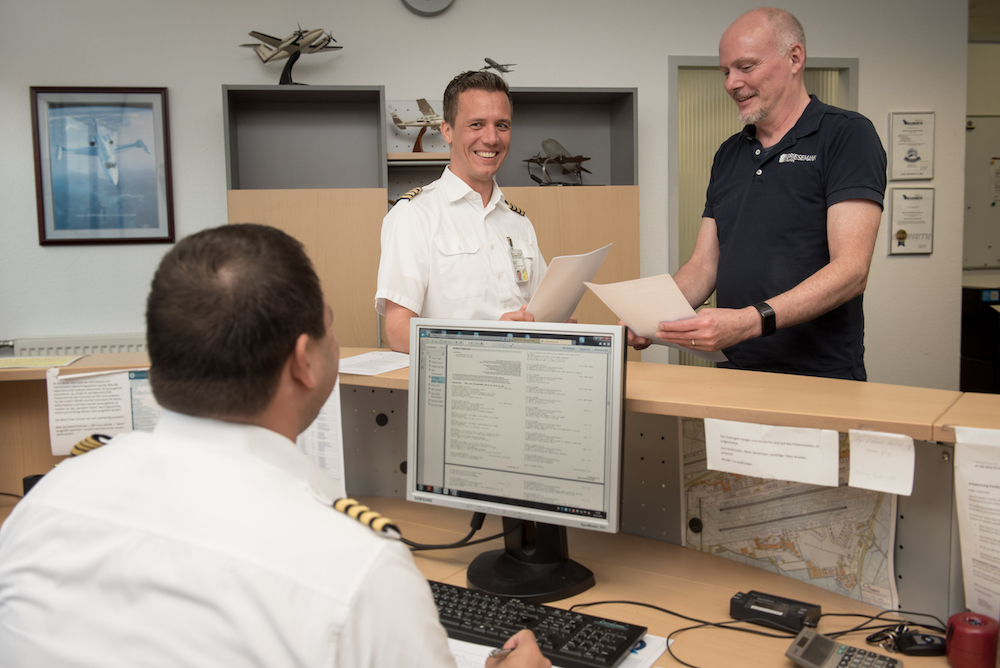
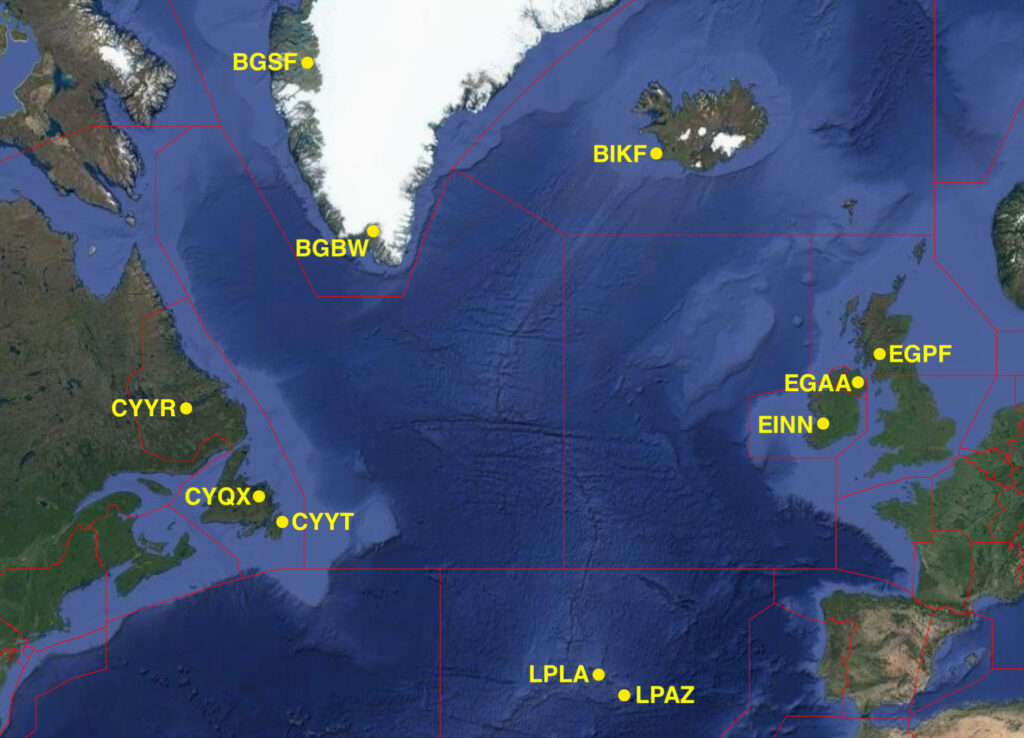
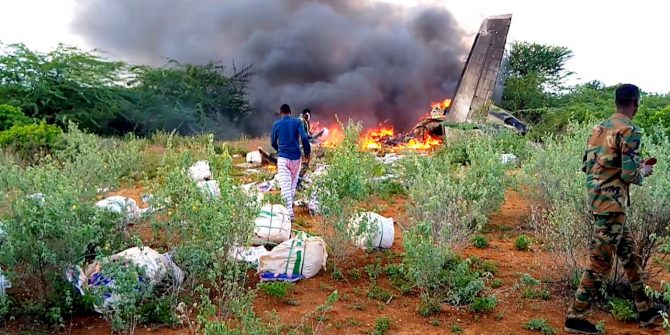
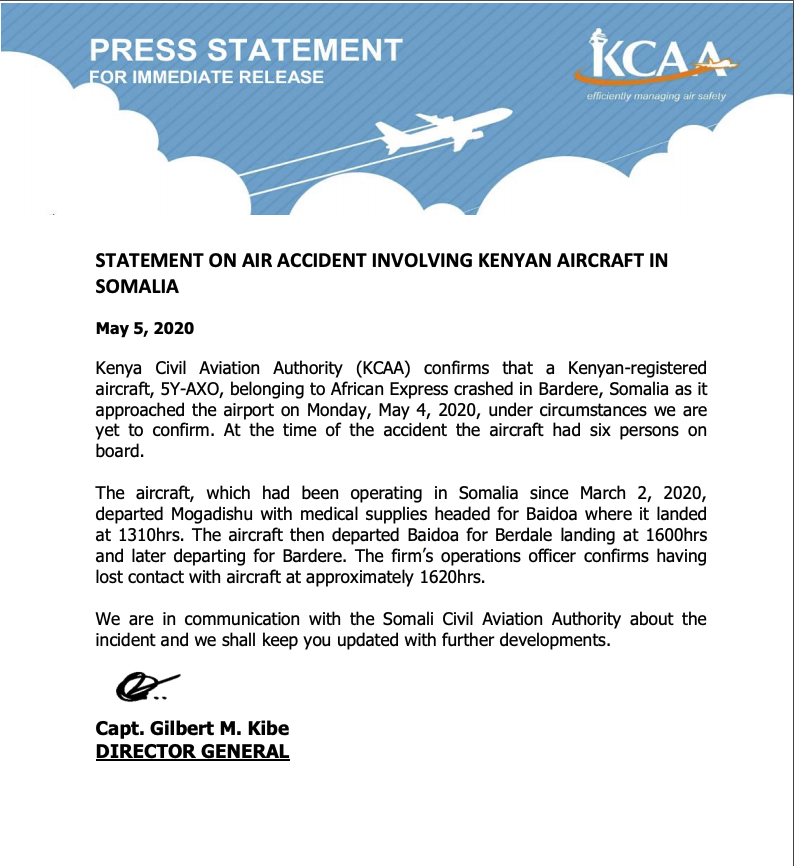
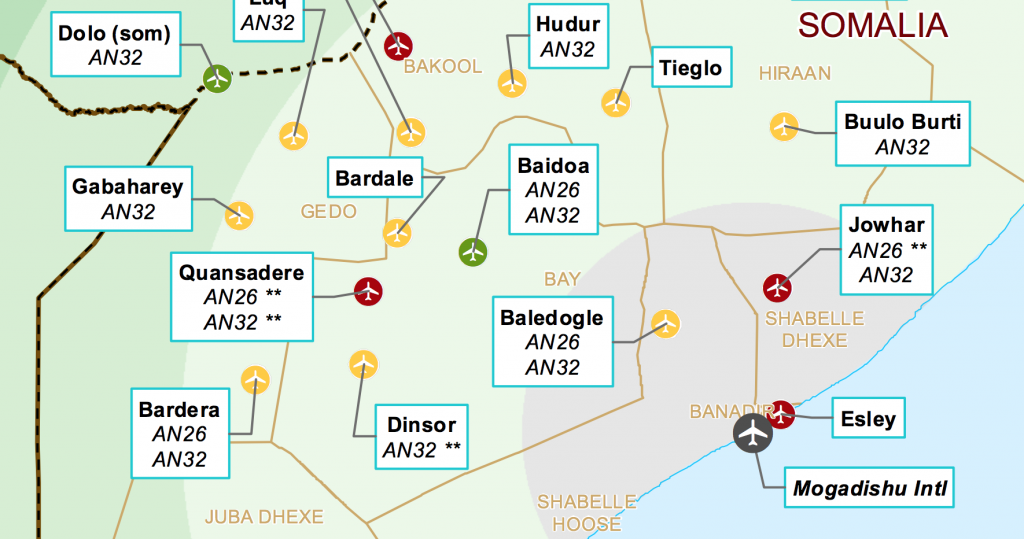
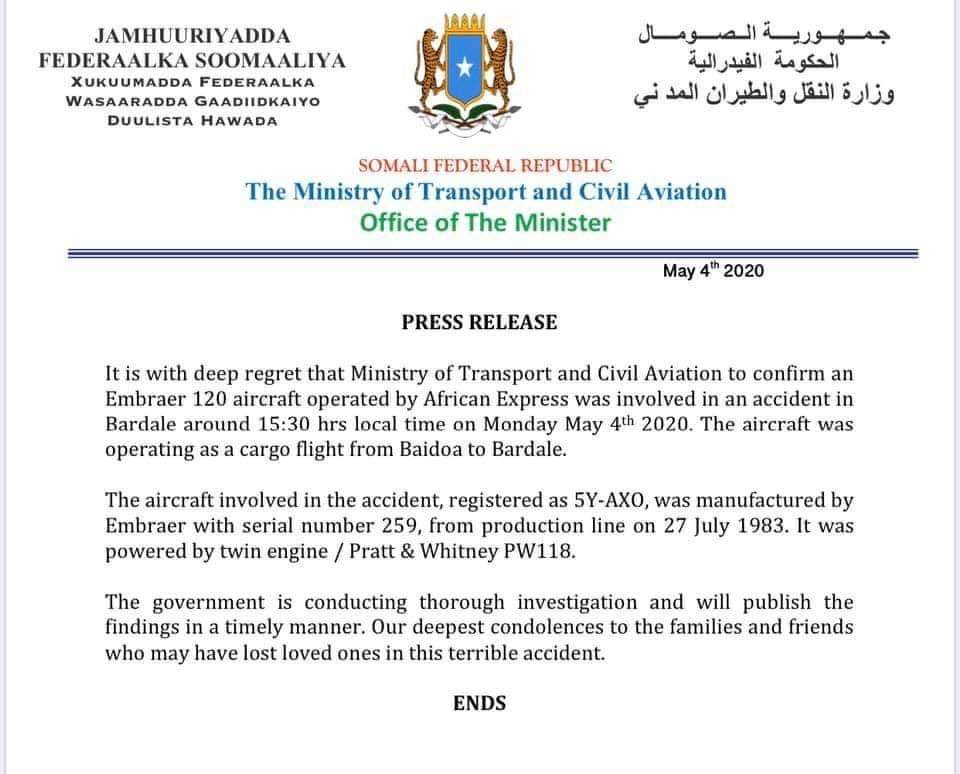
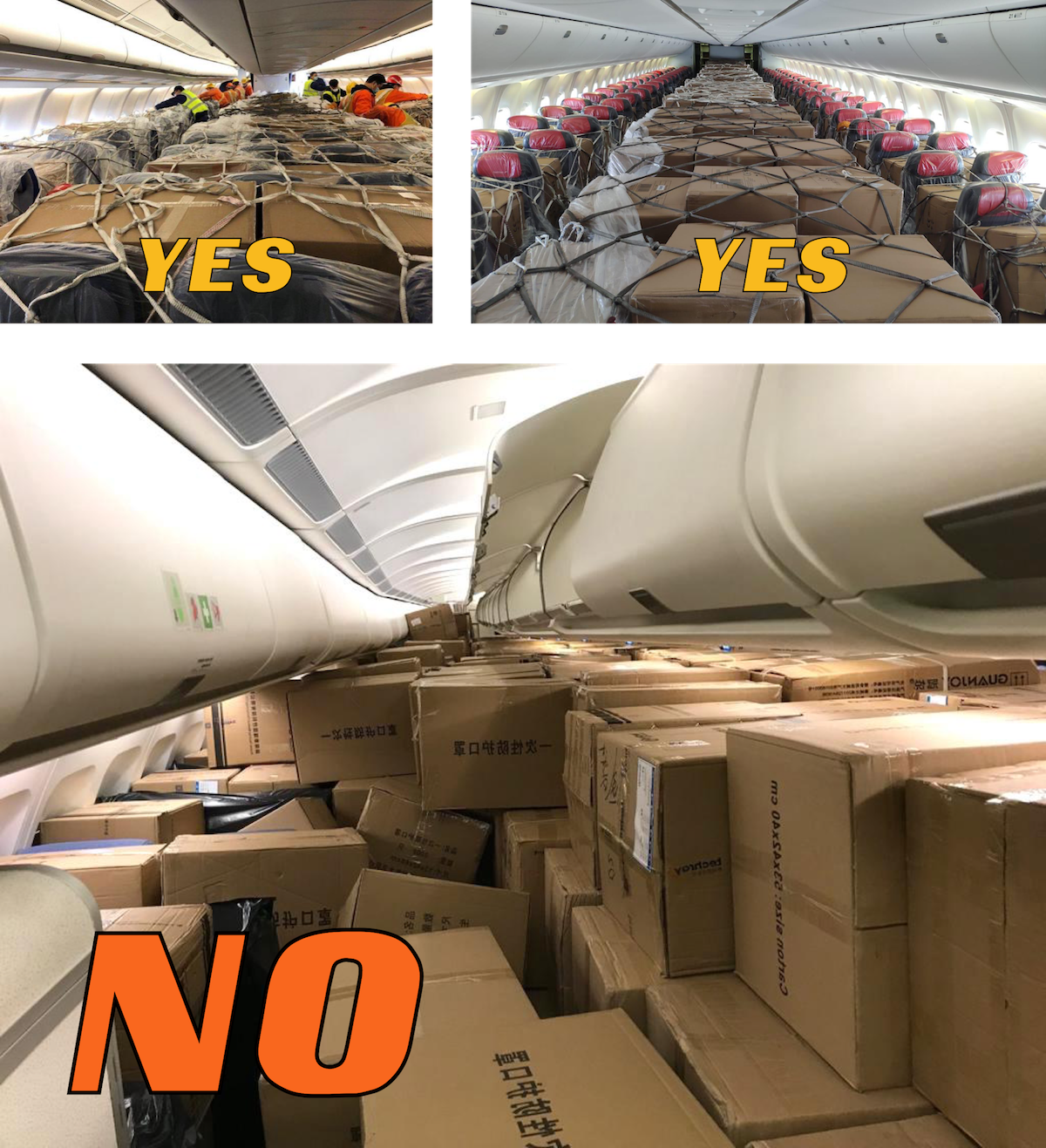
Cargo Fail: How not to convert your pax aircraft

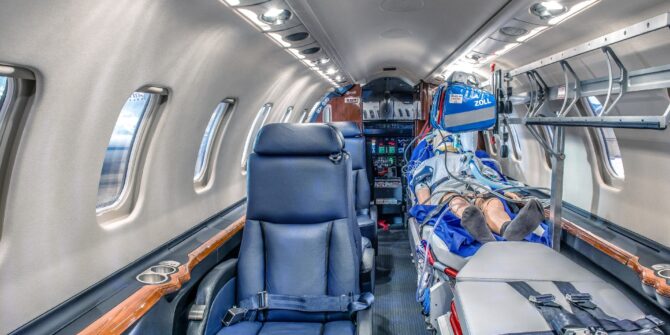
A good number of airlines are working through the process of quickly converting passenger aircraft to cargo (and a few are making a mess of it).

Here’s a simple guide to help you in the process.

Cargo Conversion Guide

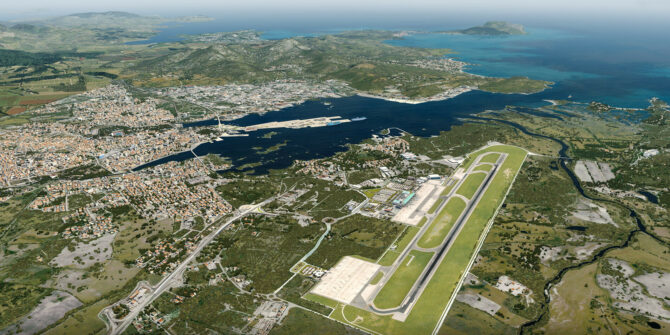
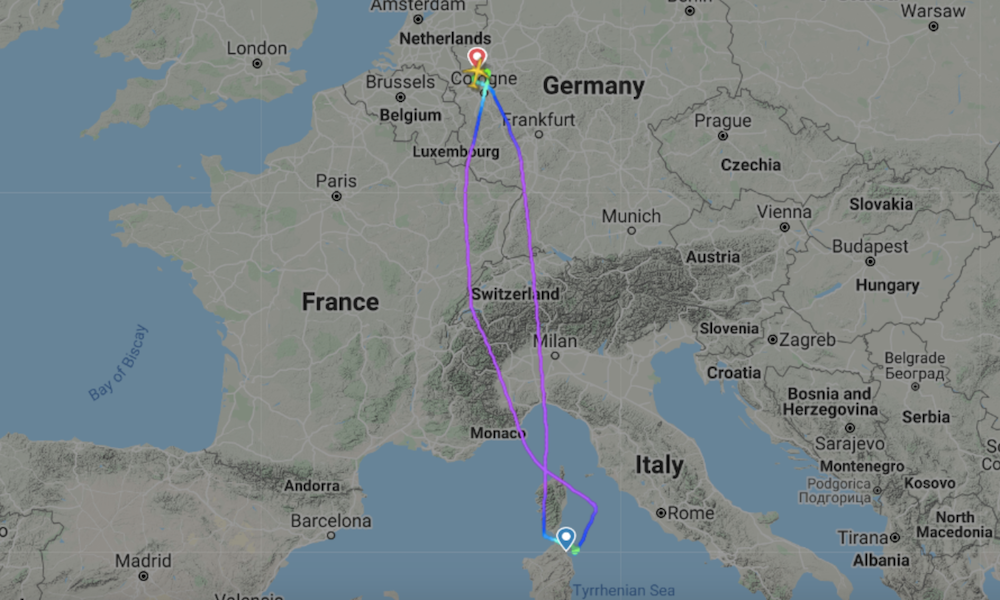
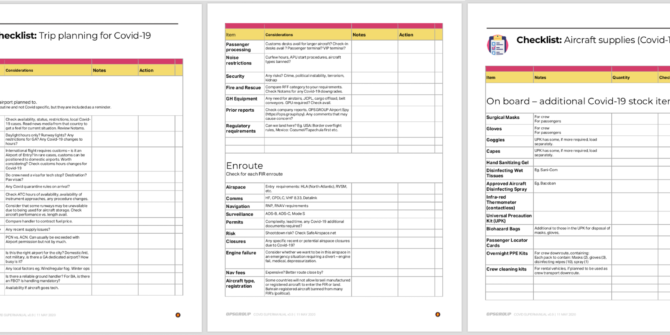
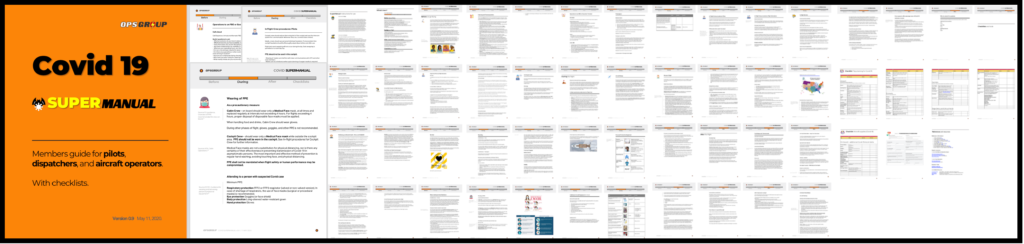
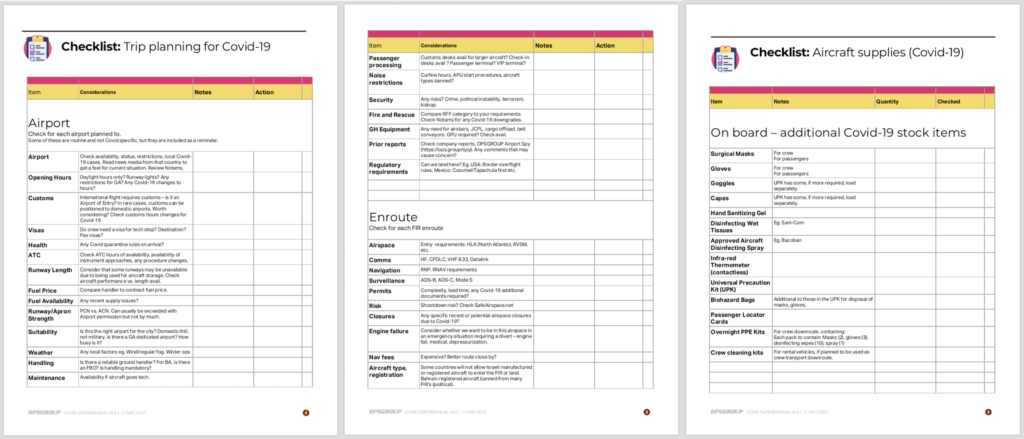
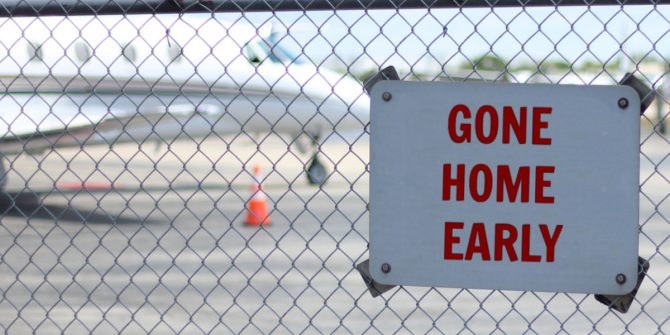
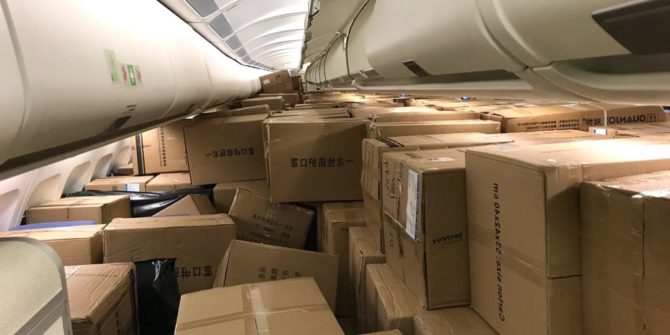
Um, that’s basically it. Avoid picture three, and you’re fine.

A few more details …

It’s not hugely complex, and there is some good official guidance on it. Based on the EASA rules (document below in the footnotes), here’s a good summary from one of our member operators:

Setting up the cargo

* The mass of the cargo shall not exceed the structural loading limits of the floor
* Aisles & exits MUST remain clear to allow for emergency action
* Loads on seats must not exceed 77kg
* Underseat stowage is only permitted if the cargo is FULLY under the seat. The weight for underseat cargo shall not exceed 9kg
* All cargo packaging must be able to handle the Delta Pressure
* The vertical CG of the cargo must be equal or lower than the
during all flight phases
passenger CG provided by the seat supplier
* Cargo carried in overhead bins must not exceed the weight stated
* Dangerous Goods MUST be carried in the hold ONLY.

During the flight

* There must be ONE empty row in-between crew in the passenger compartment and cargo
* The only persons permitted on board the aircraft are employees of the company acting in their role. Any other persons would be classed as passengers and the flight would not be operated in accordance with the exemptions
* On board crew MUST occupy Cabin Crew seats. Crew cannot share a row with cargo
* Any fire/smoke in the passenger compartment must be easily
– investigated by the crew on board and must be able to be
– extinguished by the onboard equipment.
– All smoke/fire detection equipment shall be maintained in accordance with EASA regulations

Loadsheet and monitoring

* Load Sheet to ACCURATELY reflect the position of cargo onboard
* PIC must be informed of cargo contents by NOTAC – to be including in briefing pack
* The CG of the aircraft must be operated within those for passenger flights
* Cargo to be checked during flight phase. At the minimum:
– Before Takeoff
– Before Landing
– During Cruise Phase
* At any other time on the direction of the PIC
– Avoiding making PA’s to the cargo. Unlikely to be interested.

OK, we added that last point, but other than that, it’s a good list. Now for the official stuff.

EASA Guidelines for Boxes on Seats

The approval, in Europe at least, stems from Article 71(1), so you can find those rules in full here: EASA Cargo in Pax Compartment . EASA updated this recently to allow operators to stick boxes on seats, but if you’re planning a bigger conversion, then you’ll need the info below.

EASA wider advice

(from this page)

In the context of the emergency situation created by the COVID-19 pandemic, EASA has committed to treating projects supporting the collective effort to transport medical supplies and other important goods as efficiently as possible. The following message is intended specifically for Design Organisations and Operators, and offers updated information on airworthiness and certification aspects.

We have developed further guidance on the design change classifications, certification aspects as well as use of Exemptions in accordance with Art. 71.1 of the Basic Regulation 2018/1139 for limited time periods.

In order to enable an early availability of a transport solution in the frame of the current COVID-19 situation, EASA supports the use of the provisioning of Article 71.1, also for on-going projects, through additional support to National Competent Authorities and operators as required.

For a permanent use, a design change approval is required.

Transport of medical supplies under a design change approval

Approved Design Organizations may reclassify such modification as “Minor Change” and approve these under their DOA-privileges, allowing for the use of cabin seats when related to the transportation of medical supplies (e.g. masks, gloves, clothing, etc.) provided they are not classified as dangerous goods. This has to be indicated in the approval documents and AFM Supplement.

Since this kind of installation is a change in the scope of operation of the aeroplane, and in the absence of dedicated operational requirements covering this kind of operation, the installation and the procedures for operation have to be addressed taking into account the specific configuration of each aeroplane model affected.

Transport of other cargo under a design change approval

For transport of cargo other than medical supplies as well as in case removal of seats are necessary to allow fixation of cargo onto the aircraft structure for cargo operation, a Major Change or STC application is required and will be processed by EASA with priority.

While preparing your documentation, please consider the following information:

  • For the installation of Cargo Seat Bags the CM-CS-003
  • The published Special Condition, can be used as appropriate guidance, also in the frame of Minor Changes.
  • Already approved STC
  • Guidelines published by the aircraft manufacturers Airbus (ref.: FOT-999-0028-20-00) and Boeing (ref.: MOM-MOM-20-0239) have been issued.

Aside from the advice issued by EASA, the FAA have also published a SAFO, and IATA have chipped in with some guidance of their own too.

In the US the FAA writes the aviation regulations in 14 CFR, but the Pipeline and Hazardous Materials Safety Administration (PHMSA) writes the Hazardous Materials Regulations (HMR) in 49 CFR Parts 171-180. The FAA’s SAFO contains a nod to the hazardous materials/dangerous goods regulations, but PHMSA has published some information and relief documents that might be useful such as notices and issuance of guidance and Special Permits providing limited relief to some regulation.

For the hazardous materials regulations you should go to 49 CFR Part 175.

Both FAA and PHMSA have dedicated pages which should be checked often for the most current information. Those pages can be found here:
https://www.faa.gov/coronavirus/
https://www.phmsa.dot.gov/news/assistance-public-during-covid-19

Time to swap hats

Now that you’ve got your airplane converted, you need to get yourself across to the dark side as well.

Cargo pilot conversion tips:

–  You’ll need a baseball cap, preferably old with grease stains.

– You can make even longer than normal PA’s, the boxes will probably pay more attention than the passengers used to. Just skip the ‘Please remain in your seats …’ part on the taxi in, these are the most well behaved guests you’ve ever had.

Get better stories. That one about the time you had to feather two props on an Electra out of Ostend with eight pallets of porcelain toilets. Cheat and get some good ones here.

– You can now wear your uniform for a week without changing it. Spill some coffee on it on Day 1.

– No need to deviate left or right, just plough through those CB’s. And forget the turbulence reports, the boxes can take it and so can you.

– You’ll need a new type rating: the coffee maker. Don’t worry, you’ve got 8 hours to Shanghai to figure out how to make it work.

– Good news, you qualify for membership of the Freight Dogs forum on PPRuNe.

And finally … a Cargo Pilot Ground course in 3 mins. Learn from the old masters:


A330 shot at during Covid relief flight

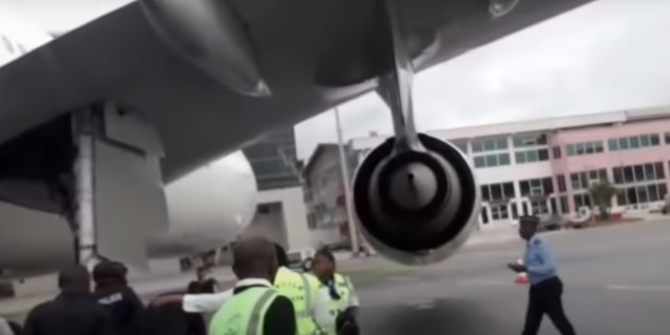
An Air France A330-200 was shot at after landing in FCPP/Pointe Noire, on the evening of April 11th. The aircraft was operating a Covid repatriation flight, picking up passengers in Congo-Brazzaville, and planned to depart back to Paris via Bangui.

Two shots were fired during the incident, with one bullet puncturing the fuselage.

Initial reports made the incident seem quite disturbing, with differing versions of the story appearing in news media.

But, it turns out to have been a little less dramatic. It seems an altercation between a security guard and his boss led to him trying to fire his gun in the air, and hitting the aircraft was unintended.


Risk Alert for North Korea (2/2020)

Risk Alert issued for North Korea:

North Korea has fired several missiles towards the Sea of Japan, according to South Korea’s military. No-one seems to know for sure if they were ballistic missiles (the ones that go up into space and then back down again, spraying debris all over international airways) or cruise missiles (the ones that fly at low altitudes making them hard to detect). Either way, they’re still launching missiles, and they’re still not providing any warning by Notam, and that = risk. Several countries have warnings in place for North Korean airspace, including the US which prohibits flights across the entire the ZKKP/Pyongyang FIR, including the oceanic part over the Sea of Japan. More info

For more details: https://safeairspace.net/north-korea/


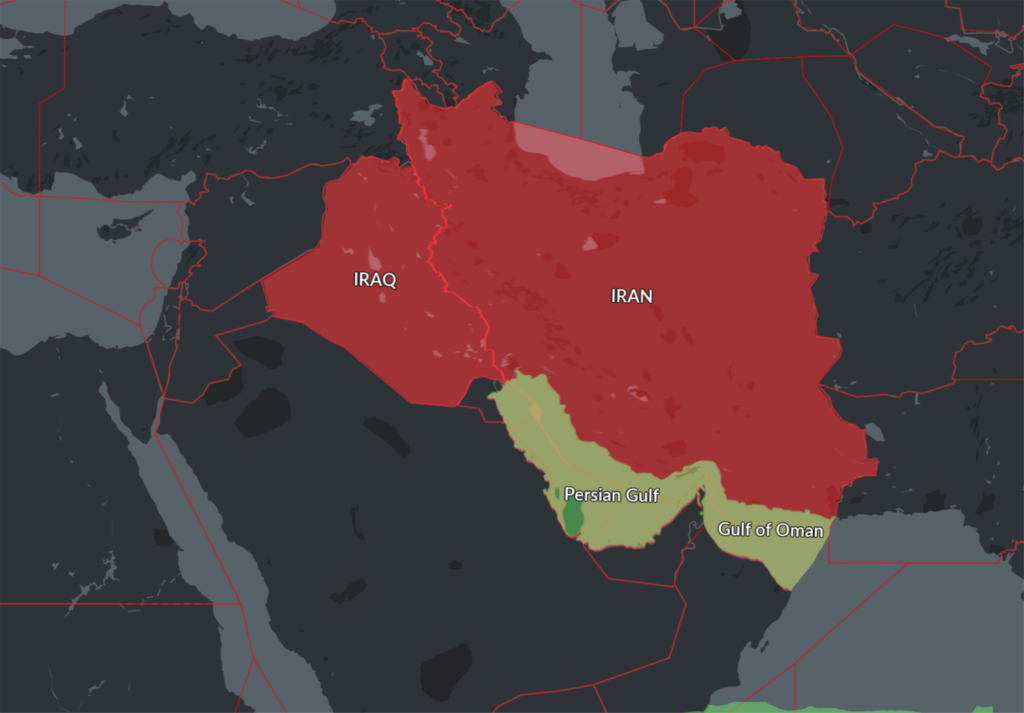
Iran and Iraq airspace restrictions

Please note: This article refers to the airspace warnings for Iran and Iraq following the shootdown of UIA flight 752 in Tehran in Jan 2020. We are keeping the article here for reference purposes only. For updated airspace warnings, check safeairspace.net


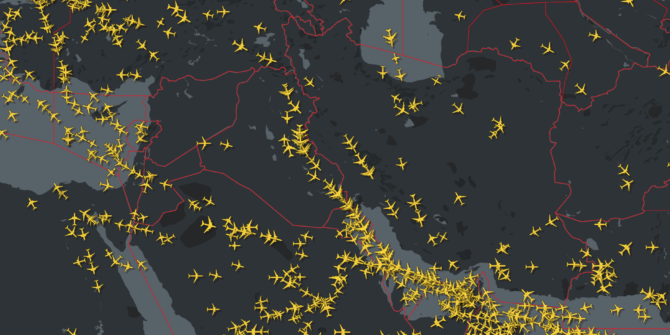
Following the events of Jan 8, when an Iranian missile strike on US military bases in Iraq was quickly followed by the shooting down of Ukraine Int Airlines flight 752 in Tehran by the Iranian Armed Forces, multiple western countries issued warnings to avoid the airspace of Iraq and Iran completely.

But in the weeks that followed, some of these countries issued updated advice, allowing overflights to resume at the higher flight levels.

Here’s a summary of what the main countries/agencies who regularly publish airspace warnings have said with regards to Iraq and Iran:

The US
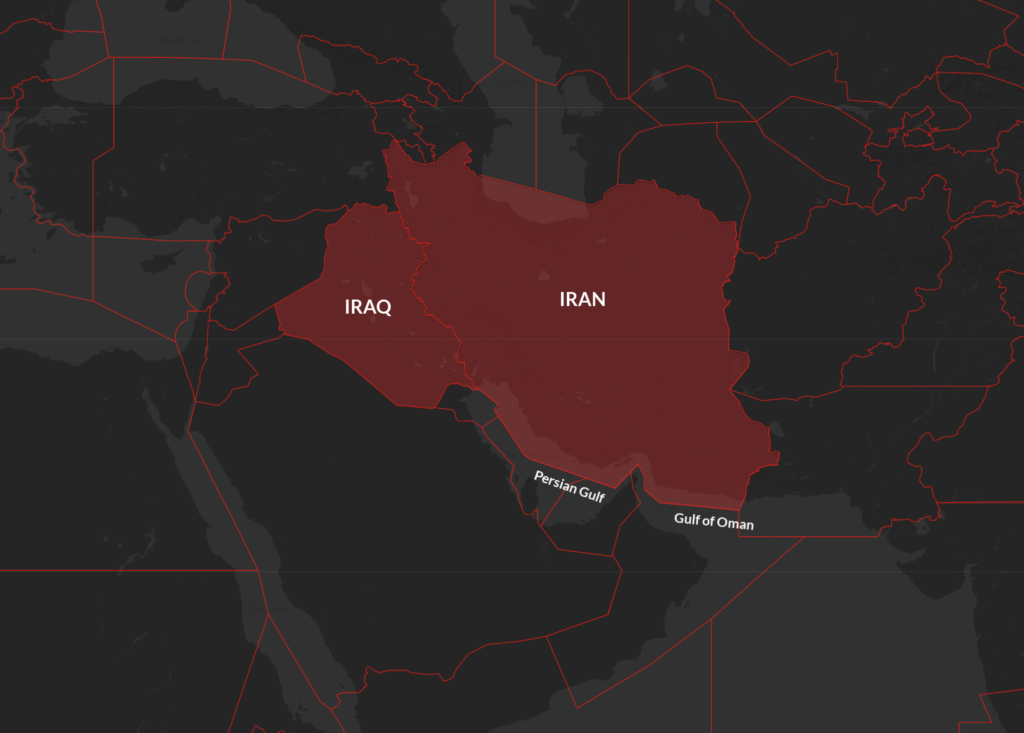
As of Mar 12, the US prohibit all flights in the airspace of Iraq and Iran, but allow flights in the Persian Gulf and Gulf of Oman. Here are the details for each:

On Feb 27, the US loosened its restrictions on Iraq, issuing an updated Notam and Background Notice document which advised that US operators were now permitted to overfly Iraq at FL320 or above. They said there has been a de-escalation in military activity and diminishing political tensions in the region, but there was still a risk at the lower flight levels from armed militias who are likely responsible for multiple recent attacks on US armed forces in Iraq, as well as rocket attacks targeting the US Embassy and ORBI/Baghdad International Airport.

Then on Mar 12, the US issued an emergency order that once again banned US operators from overflying Iraq with immediate effect. This came after US warplanes hit militia weapons storage facilities in southern Iraq in a strike designed to destroy rockets like those fired at US troops earlier this week.

The US downgraded its airspace warning for the overwater airspace in the Persian Gulf and Gulf of Oman on Feb 17 – the new guidance now just advises caution in this region, and recommends to avoid the airways nearest to the OIIX/Tehran FIR whenever possible, to reduce the risk of miscalculation or misidentification by air defence systems. The crucial change with this new warning is that overflights in this region are now permitted. So for US operators wanting to transit the OKAC/Kuwait, OBBB/Bahrain, OMAE/Emirates and OOMM/Muscat FIRs – you can now do so.

The US ban on the airspace of Iran is still in place – US operators are prohibited from entering the OIIX/Tehran FIR.

Germany
Germany just advises caution for both Iraq and Iran overflights – at no point since the events of Jan 8 have they issued outright bans on the airspace of these two countries.

France
France initially issued a Notam on Jan 9 advising operators to avoid the airspace of Iraq and Iran. Then on Feb 14, they changed their advice for Iran, saying that the only chunk of airspace which should be avoided is the western half of the country (everywhere west of 54 Degrees East longitude); they recommended that overflights of the eastern half should be at or above FL320. This guidance was then incorporated into AIC 14/20. The French Notam for Iraq lapsed on Feb 12, and was not renewed – therefore the French advice for Iraq has reverted back to that contained in AIC 14/20 which says that overflights should be at or above FL320, and only on certain airways.

The UK
The UK published Notams on Jan 9 prohibiting operators from entering the airspace of both Iraq and Iran. Then on Jan 17, they issued a new Notam for Iran, and cancelled the one for Iraq, advising operators to revert back to the guidance contained in the AIP ENR 1.1 (1.4.5). Bottom line, the UK advice for both countries is now this: do not overfly below 25,000ft AGL.

EASA
EASA published a notice on Jan 11 specifically warning operators against overflying Iraq and Iran. They said this should be taken as a precautionary measure, following the events of Jan 8. EASA don’t normally issue blanket warnings/recommendations like this. Then on Jan 29, they withdrew that advice, and reaffirmed the position previously stated in their Conflict Zone Information Bulletins (CZIB) – Iraq overflights should be avoided except on two specific airways (UM688 and UM860), and Iran overflights should be avoided below FL250.

Further discussion

  • The #FlightOps channel on Slack is open for Iran/Iraq discussion
  • Email team@ops.group with any intel or analysis you can share

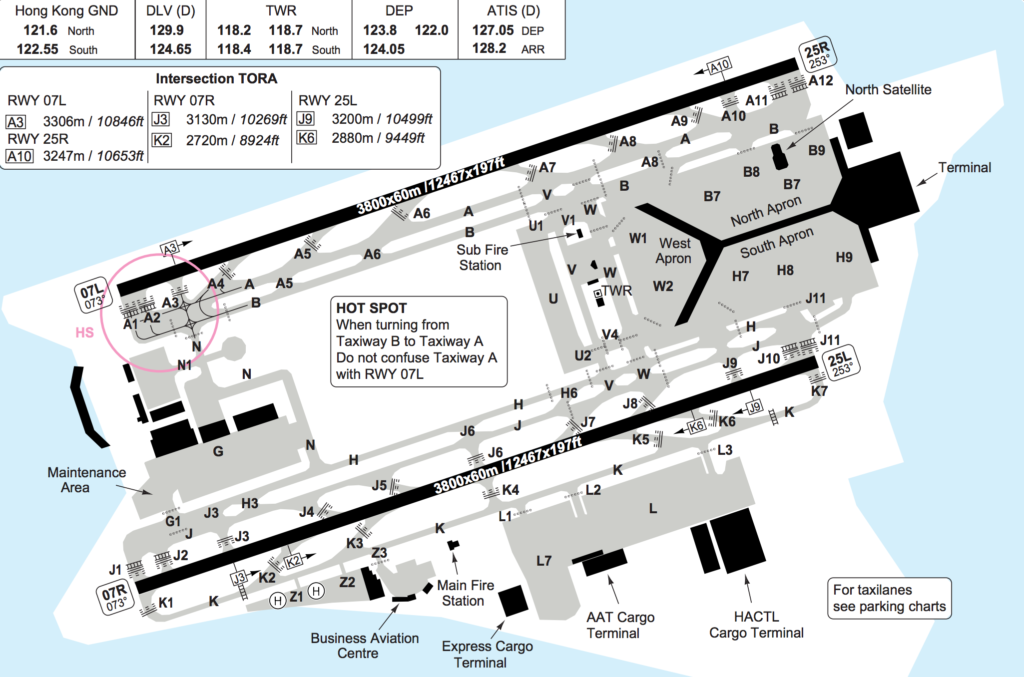
Ops to Hong Kong are getting easier

Following months of disruption in Hong Kong due to anti-government protests and then the coronavirus outbreak, the airport has decided to relax its “use-it-or-lose-it” rule for slots until the end of October 2020. This means airlines are allowed to keep their slots even if they don’t use them.

The decision follows calls for a relaxation of the policy to prevent carriers from flying empty planes between destinations to maintain the rights.

“Given the latest development of Covid-19, and in line with the recommendation made by IATA, it has been decided that alleviation of slot usage requirement at Hong Kong International Airport will be effective for the whole of the Summer 2020 Season,” a Civil Aviation Department spokeswoman said.

This means the airlines (particularly Cathay Pacific!) will now be able to announce cuts to their schedules through to October this year. So, good news for them, but also good news for GA/BA operators, as the overall reduction in traffic will mean that a lot more slots will now become available.

Since Oct 2018, Hong Kong Airport has been providing six slots to GA/BA each night between 1600-2059z, which you can apply for up to 14 days in advance online using the OCS system. You can also use the system to request any unused or cancelled daytime slots up to 2 days in advance. Getting your own access to this system can be a pain – but your trip support provider or local handler should have access, and can obtain airport slots for you. 

So it appears that ops to Hong Kong are getting easier for GA/BA – although it’s still challenging. 

To go here, you need all of the following to be confirmed in advance: landing permit, parking, ground handling, and slots. All of these need to be applied for individually. We recommend applying in this order. Here’s how to do it…

Landing Permit

This can be done whenever, but should probably be done first.

Apply here: www.cad.gov.hk/english/efiling_home.html

Contact: Civil Aviation Department (CAD)
Email: asd@cad.gov.hk, gcmtse@cad.gov.hk
Phone: +852 2910-6648, -6629

Parking

Parking is confirmed on a first-come-first-served basis, and can be applied for up to 30 days in advance. Ultimately, the earlier you apply the better. However, parking requests for 5 days or more can sometimes be rejected, and overnight parking is often denied during busy periods. If this happens, unfortunately the best strategy is still to just keep making new applications until you get accepted! Once your parking is approved, you’ll receive a confirmation, and this must be given to your ground handler.

Apply here: https://extranet.hongkongairport.com/baps/

Contact: Hong Kong Airport Authority (HKAA)
Email: bjetslot@hkairport.com

Ground Handling

There are plenty of agents and handlers at VHHH, but only one dedicated FBO for BA/GA flights – HKBAC. Send them an email to confirm your ground handling in advance.

Contact: Hong Kong Business Aviation Centre (HKBAC) https://www.hkbac.com
Email: hkbac@hkbac.com
Phone: +852 2949 9000

Slots

Applications will only be considered 14 days prior to flight (unless you’re applying for a last-minute cancelled or unused slot). Authorities monitor the slot system for intentional misuse – which could lead to operators being banned from using the system altogether. Other violations include any cancellations of outbound flights less than 72 hours before departure, and delays on the day by more than 2 hours – although any off-slot operations outside a tolerance of +/-20 minutes can still flag up for potential slot misuse.

Apply here: http://www.hkgslot.gov.hk/Online_Coordination.html

Contact: Hong Kong Schedule Coordination Office (HKSCO)
Email: hkgslot@cad.gov.hk
Phone: +852 2910 6898

Other things worth knowing:

  • Feb 2020: Revised ILS approach procedures for RWY 07L and RWY 07R based on PBN transition to connect the existing PBN STARs to ILS final for RWY 07L and RWY 07R without reliance on ground-based navigation aids guidance.
  • Jan 2020: A reminder that ramp checks can be carried out at any time, with no warning. Here’s what they check for.
  • Feb 2019: Hong Kong ATC started reducing separation from 3.5 NM to 3.0 NM – that means more chance of wake turbulence. In summary, the new advice is this: do NOT slow to less than 125kts on final approach speed to ensure that following traffic does not have to execute a go-around; and when landing on RWY 07L, make sure you get off the runway at taxiway A7 within 50 seconds.
  • Dec 2018: Hong Kong published an AIC saying that GA/BA aircraft are taking too long vacating the runway after landing. They want pilots to “consider minimizing braking to reduce the deceleration rate on the landing roll so as to be able to vacate runway expeditiously via the first available RET.”
  • Oct 2018: Following lobbying by AsBAA, the trial to increase the number of night-time slots available to GA/BA was extended until the end of March 2019, with 6 slots available instead of 4 as before.
  • Sep 2018: Chinese authorities launched the Bullet Train rail link between Guangzhou and Hong Kong. Travel time between the two cities is now approximately only 40 minutes (previously crews needed to take a ferry, or else face a long car journey!)
  • Jun 2018: Airport issued Notam A1792/18 prohibiting reduced or single engine taxi out – all engines must be started before commencement of taxi for takeoff.
  • Jun 2018: Hong Kong issued AIC 13/18 to remind operators to stick closely to ILS procedures for Runway 07/25.
  • Apr 2016: You now need RNP1 to operate to Hong Kong. 

Have you been through Hong Kong recently? We’d love to hear how it went! Drop us an email, or Opsgroup members can file a quick report on Airport Spy.


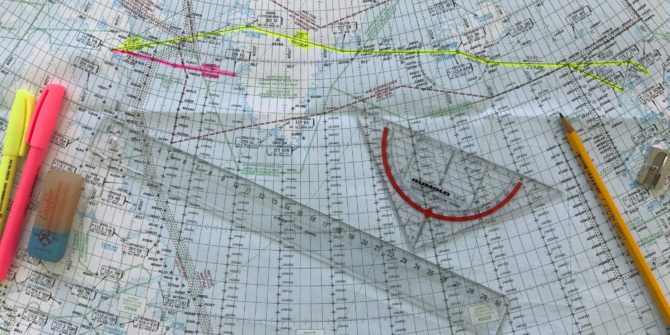
Oceanic Plotting: Classic Navigation meets New Age Tech

Flying over large expanses of ocean, one might assume the cockpit would be a quiet, boring space with little more to do than to speculate about company rumors or constantly graze on the galley snacks you long ago promised yourself you’d stop eating. But the reality is that to ensure a safe and compliant oceanic crossing, the tasks involved can be intensive and the cockpit can be a busy place!

Plotting and monitoring your route over the ocean – or any remote area for that matter – is one of those vital tasks necessary to ensure safe navigation. And with some familiarization with up-and-coming technology and hands-on training, plotting can serve as both a confirmation of aircraft navigational abilities and a last ditch resort if such capabilities fail.

Why We Plot

Legally speaking, the crew of any turbojet that flies a route that exceeds 725 nm from “the service volume of an ICAO approved ground based navaid must perform plotting procedures as a way to generate a ‘reliable fix‘ of its position once per hour (the distance decreases to 450 nm if flying a turboprop),” explains Guy Gribble, General Manager of International Flight Resources.

With the breadth and reliability of most modern aircraft long range navigational systems (LRNS) and flight management systems (FMS), it may seem archaic to manually plot an oceanic course. But studies have shown that plotting greatly reduces the chances of flying off course and causing a gross navigational error. FMS’s are NOT infallible and the pilots operating them even more so!

Plotting not only assists in ensuring you are flying your cleared AND verified route, it serves as a system of checks and balances when reviewing your (and your co-pilot’s) inputs into the FMS. In the event of a partial or complete loss of navigational abilities, the plotting chart also works as an emergency form of dead reckoning. And lastly, combined with the Master Document, the plotting chart is the trip’s legal record of compliant (or lack thereof) oceanic navigation if a state authority were to review or investigate the trip for any reason.

Requirements

The first requirement begins with the plotting chart itself. The chart must be oriented North, be based on WGS-84 (World Geodetic Standard of 1984) and mean sea level, and of a valid date. It must also be to a scale that can clearly depict the flight route and other oceanic tracks. Other than that, manufacturers are free to customize charts to whatever preferences they desire.
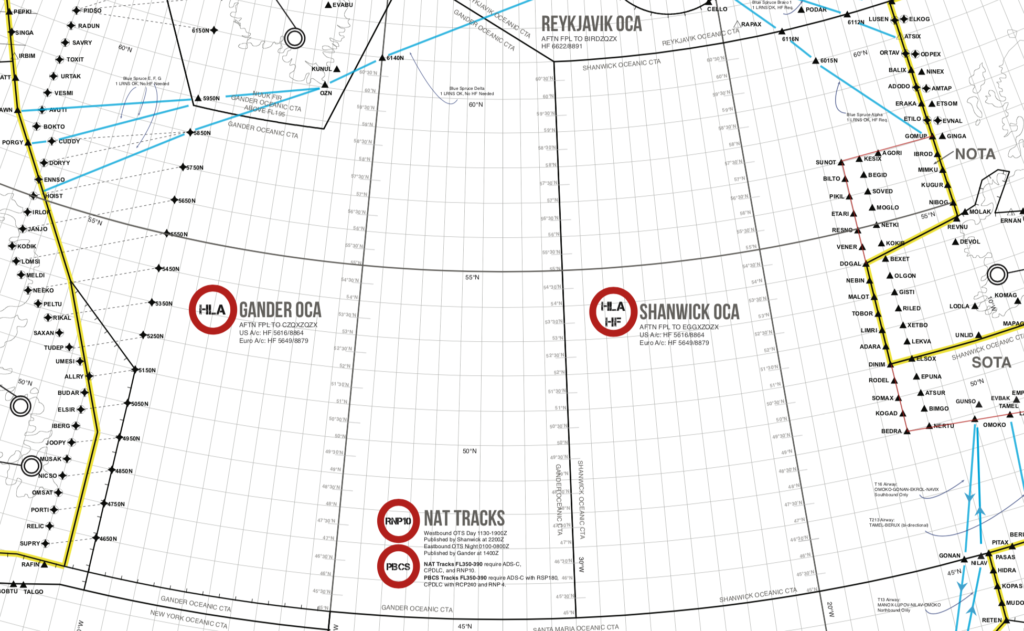
As far as chart validity dates go, many charts do not have expiration dates; rather that dates published are based upon the measurement of variation. “You may have to go to the manufacturer’s website to see if a new chart is available,” Gribble says. “If you download it on an iPad, they are updated automatically.”

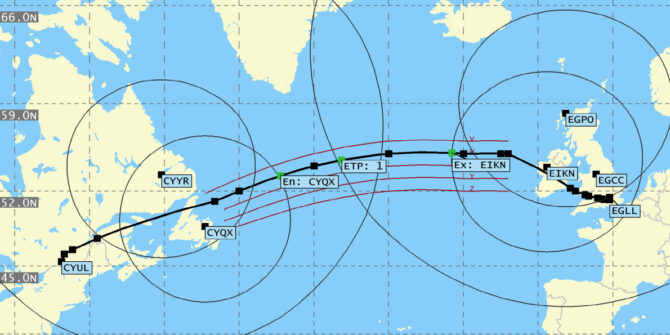
The information crews must include on the chart starts with the aircraft’s CLEARED route (reroutes are very common, and many GNE’s have occurred by crews flying the filed flight plan, not the cleared flight plan). The route’s waypoints – coast out, coast in, and lat/long positions – must be clearly marked on the chart using standard symbology. The chart should also include graphic depictions of ETP’s (Equal Time Points). ETP’s are calculated locations where an aircraft would turn around, divert or continue on its route in case of an abnormal or emergency situation. Flight planning services normally provide these points with your flight plan and are usually based on an engine failure, a depressurization event or a medical emergency. If one of these emergencies were to occur, the crew may have to perform a contingency manoeuvre and must try to avoid adjacent and underlying oceanic tracks should a diversion or descent be required. Thus, neighboring oceanic tracks published daily should be included on the chart for situational awareness. Additionally, it’s a good idea to mark decent alternate airports on the chart.

Monitoring your oceanic route is accomplished through a 10 Minute After Waypoint Check. 10 minutes (or roughly 2 degrees of longitude) after crossing each oceanic waypoint, the crew must verify their current position by 1) plotting the current lat/long on the depicted route, 2) computing both magnetic course and distance to the next waypoint and 3) comparing this information to that of the FMS. There are three methods permitted to do this:

  1. The Plotting or Paper Method
  2. The Navigational Display Method
  3. A customized and approved method

The “plotting or paper method” is for aircraft with any navigational configuration. It requires the crew to record the time and plot their present lat/long  on the paper chart by using the coordinates from the “non steering” LRNS and take immediate action if the plotted point doesn’t align with the cleared route. The “steering” LRNS – the one coupled and following the autopilot – is then used to verify that the next waypoint is consistent with the cleared route and the autopilot is steering to that waypoint.

The “navigational display method” is for aircraft equipped with an operable FMS. The crew must confirm that the aircraft symbol is on the route programmed in the FMS and set to the smallest scale and checked for any cross track deviation. The crew must take corrective action to address such deviations. And, as with the previous method, the steering LRNS is used to confirm it is headed to the next waypoint on the cleared route. “With the navigational display method, an easy way to record your fix is to have your digitally generated map zoomed in to at least 5nm. Then have your autopilot coupled FMC display the time, lat/long and RNP – the 4 pieces of info you need. Then just take a picture of that with an iPad or iPhone, and that will serve as your recorded plot,” explains Gribble.

And for the “customized and approved method… if you have created one that has been authorized, we’d love it if you shared! FedEx is one such carrier that has created its own procedures for confirming a reliable fix.

Regardless of the method, it should be spelled out entirely in the company’s operating manuals. Comparing navigation system positioning isn’t the only form of cross-checking. If a reroute is given, good crew resource management is absolutely required when copying, entering and cross-checking the new route.

Along with plotting the position, crews must calculate the magnetic course (remember your private pilot days: true course  +/- east/west variation = magnetic course) and measure distance to the next waypoint, both of which are necessary if navigational capabilities of the aircraft are compromised and dead reckoning is required. If you don’t remember how to do these, don’t worry, Code7700 has published a helpful guide on how to do it manually and electronically. There are also several apps and Excel based tools available out there, and many plotting charts have examples to walk you through it.

Ops Spec B036 authorizes navigation over oceanic and remote areas for aircraft having multiple long range navigation systems (B054 if only using a single LRNS) and B037 or 39 dictates whether over the Atlantic or Pacific oceans. “The important thing about B036 is that the operator must spell out in that authorization whether plotting will be accomplished by paper or an electronic method,” explains Gribble. “Part 135 operators must also demonstrate that they have initial and recurrent training programs along with the procedures spelled out. And for the few Part 125 operators, they are required to have a Letter of Deviation Authority.”

Gribble warns, “Operators spend all this time and effort getting LOA’s, Op Specs, and updating manuals and procedures. Then crews never read them again. Keep studying those documents! There are so many restrictions in your LOA’s. Maybe you’re not approved to fly Blue Spruce routes. Unfortunately crews forget what the documents detail, and resort to just flying the way other pilots have been operating. There’s a loss of knowledge.”

He also stresses, “Absolutely use the ICAO (NAT OPS Bulletin 2017-005) or FAA (AC 91-70B Appendix D) issued oceanic checklists! They are excellent resources and cover everything from preflight through arrival at the destination.”

Paper VS The Future

Just over a year ago at an international operators conference there was a presentation for electronic plotting. The presenter spent an hour demonstrating how to perform an oceanic crossing without paper. Although impressive, at that time there was no single app that could perform all the required plotting tasks, and the shear number of additional apps that had to be opened and closed on the iPad to substitute for whatever the main app lacked was astounding. At that point, paper was still king. But in just a little over a year, technology does what it usually does – improved exponentially. And it now looks like there are some apps that can handle all the oceanic plotting tasks, and they’re only getting better.
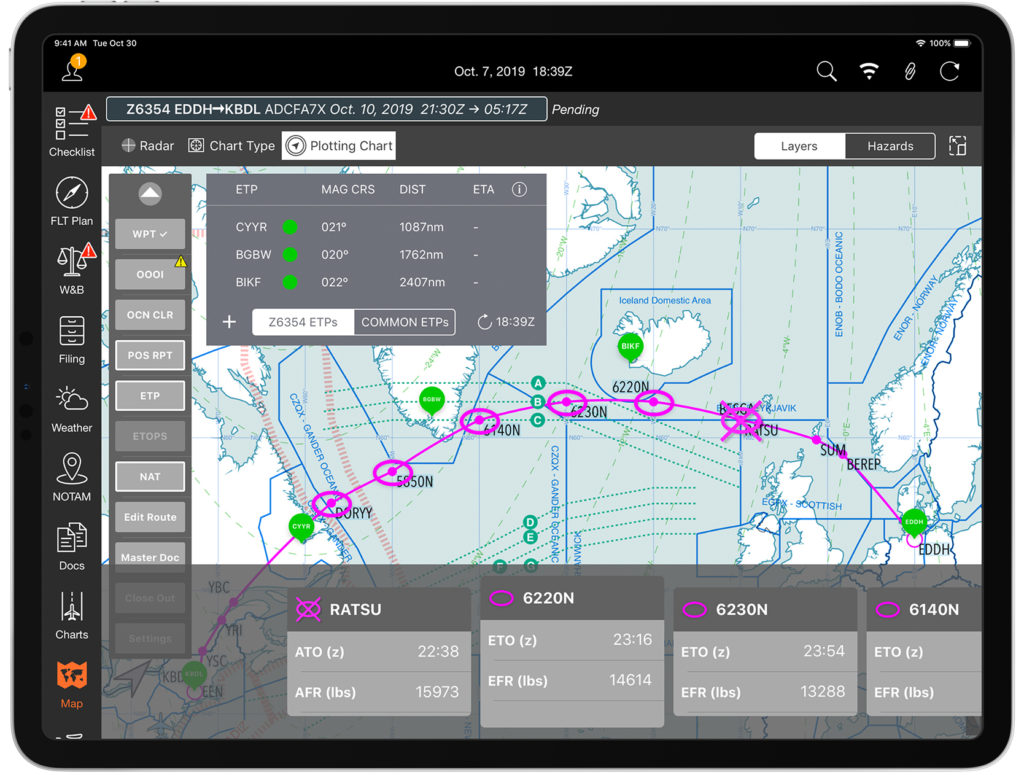
Mitch Launius, from 30West IP, sees the opportunity for increased safety as these electronic apps continue to improve. “Having another form of redundancy in the cockpit will make things safer in the cockpit. This technology is very new. You could say we’re only at Version .5 – barely out of Beta – but these programs will evolve quickly. This is just the tip of the iceberg. It’s going to happen.”

30West IP has produced several YouTube webcasts, a few which focused on the operational capabilities of some of these apps. “The FAA fully understands the opportunity electronic devices and some of these apps offer for oceanic navigation and they are embracing it – just slowly – as they want to ensure safety of changing procedures.” He points out the requirements for permitting Electronic Flight Bags into cockpit. “If you’re Part 135, you will need the POI’s authorization to receive Ops Spec A061, which would show that an operator demonstrates a change to its procedures.” AC 91-78 Use of Class 1 or Class 2 Electronic Flight Bag is also good resource to check.

However, if an operator is Part 91, there is no authorization required. “Regardless of what you hear, there is no Letter of Authorization required if you are a private operator,” explains Launius. “An inspector would like to see three things, advisory in nature only, however. They want to see that the company’s operating manuals address the addition of EFB and oceanic navigation, that the crew is trained, and that there is a document management procedure in place for recording the crossing.” AC 120-76 Guidelines for the Certification, Airworthiness and Operational Approval of Electronic Flight Bags should be used for guidance.

If transitioning a flight department from paper to electronic plotting might seem intimidating and difficult, Launius disagrees. “It might be much easier than you think. You must update your manuals with a few paragraphs to acknowledge the use of EFB and change in procedures. Then have all the pilots meet and train on the EFB’s. And if you’re a part of an SMS, you’ll just need to show a change in management policy. So perhaps have the pilots meet back up in 6 months and discuss what works and what doesn’t and restructure the procedures as needed.”

“If your department is flying to Europe 2 or 3 times a month, using electronic plotting is going to be very useful,” says Guy Gribble. “But if you’re only flying 2 or 3 times a year, I still believe the ease and affordability of paper is preferable, for now. Some of the newest models of Gulfstream, Globals and Falconjets actually will have the ability of their FMC’s to pull data of its location and wirelessly transmit it to an iPad. Now that’s truly electronic plotting.”

Code7700 has published an impressive article comparing some of the leading electronic plotting apps. Arinc, Jepp FD, Foreflight, plotNG and Garmin are just a few that offer these apps, along with some other flight planning services. Some of the benefits of going paperless is the ability to download both the flight plan and daily oceanic tracks, ETP’s can be updated as can ETA’s, and, through typing or using a stylus, the Master Document can also be downloaded and filled out as the flight proceeds without the all the chicken scratch normally seen on paper plots.

If operators perform many crossings per year, crews will become accustomed to using the apps as well as some of the creative techniques that may be required to compensate for some of the more complicated tasks. Course calculating and distance measuring still seem to be rather cumbersome tasks on most of the apps but operators have come up with some inventive and manageable ways to overcome this. Of course the cost is much greater than the affordable bundles of paper charts, but some of the flight planning companies may provide the app for free if using their services. Ultimately, it will come down to the operator’s needs and the frequency of oceanic crossings.


Thanks to Roger Harr at www.n138cr.ch for the header photo of this article!


FAA eases Gulf airspace restriction

The FAA has downgraded its airspace warning for the overwater airspace in the Persian Gulf and Gulf of Oman.

They previously said that US operators should avoid this airspace except when flying to/from the main airports in Bahrain, Kuwait and Qatar, UAE and Saudi Arabia.

The new guidance now just advises caution in this region, and recommends to avoid the airways nearest to the OIIX/Tehran FIR whenever possible, to reduce the risk of miscalculation or misidentification by air defence systems (remember, the US ban on Iran overflights is still in place).

The crucial change with this new warning is that overflights in this region are now permitted. So for US operators wanting to transit the OKAC/Kuwait, OBBB/Bahrain, OMAE/Emirates and OOMM/Muscat FIRs – you can now do so.

This new Notam represents a further loosening of the total airspace ban on the Persian Gulf and Gulf of Oman initially applied by the FAA shortly after the Iranian missile strike on US military bases in Iraq on Jan 8, which was quickly followed by the shooting down of Ukraine Int Airlines flight 752 in Tehran by the Iranian Armed Forces, having mistaken the aircraft radar return for an inbound missile.

The FAA cited Iranian military de-escalation as the reason for the change. “The FAA assesses there is sufficiently reduced risk of Iranian military miscalculation or misidentification that could affect U.S. civil aviation operations in the overwater airspace above the Persian Gulf and the Gulf of Oman,” the agency said in their Background Information statement, issued on 18th Feb 2020.

Here’s the Background Information statement in full:

Iran has de-escalated its military posture in the Persian Gulf and the Gulf of Oman as of early February 2020. Given this de-escalation, the FAA assesses there is sufficiently reduced risk of Iranian military miscalculation or misidentification that could affect U.S. civil aviation operations in the overwater airspace above the Persian Gulf and the Gulf of Oman in the Kuwait Flight Information Region (FIR) (OKAC), Jeddah FIR (OEJD), Bahrain FIR (OBBB), Emirates FIR (OMAE), and Muscat FIR (OOMM) to permit U.S. civil flight operations to resume.

While the risk to U.S. civil aviation operations in the above-named area has decreased, military posturing and political tensions in the region remain elevated, and there remains some inadvertent risk to U.S. civil aviation operations due to the potential for miscalculation or misidentification. As a result, on 14 Feb 2020, the FAA issued Notice to Airmen (NOTAM) KICZ A0014/20 (reissued on 17 Feb as A0016/20) permitting U.S. civil flight operations to resume in the above-named area while advising operators to exercise caution and to avoid operating on air routes nearest to the Tehran FIR (OIIX) boundary whenever possible. The situation in the region remains fluid and could quickly escalate if circumstances change.

The 8 January 2020 accidental shoot down of Ukraine International Airlines Flight 752 shortly after takeoff from Tehran’s Imam Khomeini International Airport (OIIE)tragically highlights the airspace deconfliction concerns, which pose an inadvertent risk to civil aviation from air defense engagements during periods of heightened tensions and associated military activity. Following the accidental shoot down, the region has seen a lowering of tensions, despite Iran’s continued air defense coverage along its southern coast. In June 2019, there were two incidents of surface-to-air missile fire from the southern coast of Iran targeting U.S. unmanned aircraft systems operating in the Gulf of Oman.

Iran possesses a wide variety of anti-aircraft-capable weapons, including surface-to-air missile systems (SAMs), man-portable air defense systems (MANPADS) and fighter aircraft capable of conducting aircraft interception operations. Some of the anti-aircraft-capable weapons have ranges that encompass key international air routes over the Persian Gulf and the Gulf of Oman. Although Iran likely has no intention to target civil aircraft, the presence of multiple long-range, advanced anti-aircraft-capable weapons in a tense environment poses a risk of miscalculation or misidentification, especially during periods of heightened political tension and military activity.

There is also the potential for Iran to use Global Positioning System (GPS) jammers and other communications jamming capabilities, which may inadvertently affect their command and control capabilities and potentially pose a risk to U.S. civil aviation operating in the above-named area.

The FAA will continue to monitor the risk environment for U.S. civil aviation operating in the region and make adjustments, as appropriate, to safeguard U.S. civil aviation.

Here’s the new Notam in full:

A0016/20 (Issued for KICZ)
SECURITY..UNITED STATES OF AMERICA ADVISORY FOR OVERWATER AIRSPACE ABOVE THE PERSIAN GULF AND THE GULF OF OMAN.

THOSE PERSONS DESCRIBED IN PARAGRAPH A BELOW SHOULD EXERCISE CAUTION WHEN OPERATING IN OVERWATER AIRSPACE ABOVE THE PERSIAN GULF AND THE GULF OF OMAN IN THE KUWAIT FLIGHT INFORMATION REGION (FIR) (OKAC), JEDDAH FIR (OEJD) , BAHRAIN FIR (OBBB), EMIRATES FIR (OMAE), AND MUSCAT FIR (OOMM) DUE TO CONTINUED ELEVATED MILITARY POSTURING AND POLITICAL TENSIONS IN THE REGION.

NOTAM KICZ A0002/20, WHICH PROHIBITS U.S. CIVIL AVIATION OPERATIONS IN THE TEHRAN FIR (OIIX), REMAINS IN EFFECT UNTIL FURTHER NOTICE.

A. APPLICABILITY. THIS NOTAM APPLIES TO: ALL U.S. AIR CARRIERS AND COMMERCIAL OPERATORS; ALL PERSONS EXERCISING THE PRIVILEGES OF AN AIRMAN CERTIFICATE ISSUED BY THE FAA, EXCEPT SUCH PERSONS OPERATING U.S. REGISTERED AIRCRAFT FOR A FOREIGN AIR CARRIER; AND ALL OPERATORS OF AIRCRAFT REGISTERED IN THE UNITED STATES, EXCEPT WHERE THE OPERATOR OF SUCH AIRCRAFT IS A FOREIGN AIR CARRIER.

B. PLANNING. THOSE PERSONS DESCRIBED IN PARAGRAPH A PLANNING TO OPERATE IN THE ABOVE-NAMED AREA MUST REVIEW CURRENT SECURITY/THREAT INFORMATION AND NOTAMS AND COMPLY WITH ALL APPLICABLE FAA REGULATIONS, OPERATIONS SPECIFICATIONS, MANAGEMENT SPECIFICATIONS, AND LETTERS OF AUTHORIZATION, INCLUDING UPDATING B450.

C. OPERATIONS. AVOID AIR ROUTES NEAREST TO THE TEHRAN FIR (OIIX) BOUNDARY, WHENEVER POSSIBLE, TO REDUCE THE RISK OF MISCALCULATION OR MISIDENTIFICATION BY AIR DEFENSE SYSTEMS. ADDITIONALLY, AIRCRAFT OPERATING IN THE ABOVE-NAMED AREA MAY ENCOUNTER INADVERTENT GPS INTERFERENCE AND OTHER COMMUNICATIONS JAMMING, WHICH COULD OCCUR WITH LITTLE OR NO WARNING.

THOSE PERSONS DESCRIBED IN PARAGRAPH A MUST REPORT SAFETY AND/OR SECURITY INCIDENTS TO THE FAA AT +1 202-267-3333. ADDITIONAL INFORMATION IS PROVIDED AT: HTTPS://WWW.FAA.GOV/AIR_TRAFFIC/PUBLICATIONS/US_RESTRICTIONS/.

SFC – UNL, 17 FEB 19:54 2020 UNTIL PERM. CREATED: 17 FEB 20:00 2020


For more on these, and for a full list of current warnings about Iran and Iraq from other states, see SafeAirspace.net


France switches to ‘ATC by Notam’ only

In a move that industry analysts have declared ‘revolutionary’, France has flipped the table on the provision of Air Traffic Control services.

With a new guide published on the topic, instead of issuing Strike Notams, France will now ‘activate ATC service’ by Notam only, on specific dates.

When ATC is available in French airspace, and when airports are running normally, France will issue an A-series Notam with the specific wording ‘Warning: Full ATC service available‘. Officials have been tight-lipped on when the first day of routine French service can be expected in 2020.

Speaking after the decision made in Paris earlier this month, a DGAC spokeswoman told us “We’re unhappy that France is only responsible for about 30% of the delays in European airspace over the last 15 years. Although commendable, we can only be truly proud of a number in excess of 50%, to ensure we retain the #1 spot for years to come.”

Adjoining ATC Centers have applauded the move, saying that the new system will bring an end to the endless Eurocontrol NOP warnings about French strikes. “It’s a much more sensible system”, said a Eurocontrol Network Manager staffer in Brussels. “With this new method, we only have to occasionally highlight a Notam that is issued when French airspace is operating normally. We anticipate this being a rare occurrence, so the workload for us is much lower and more manageable.”

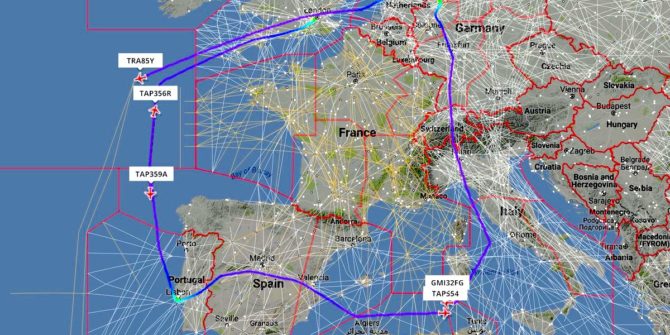
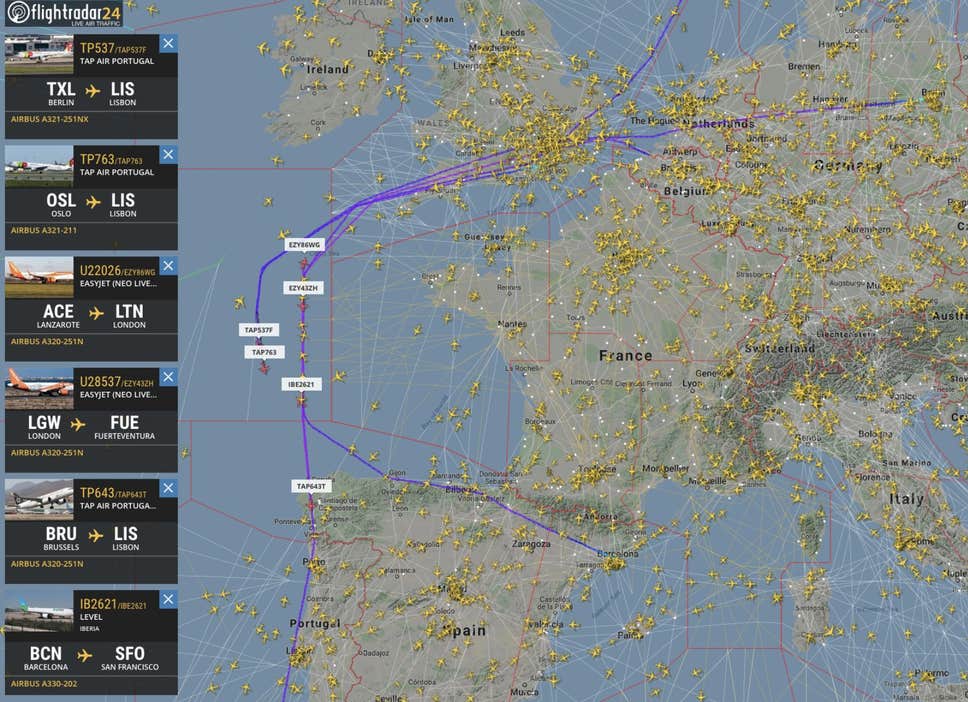
Airlines too have welcomed the new plan. “We really enjoy the banana routes“, said a pilot at Easyjet. “Too often these days we get long, straight, direct clearances from these boring, efficient controllers in Shannon, London, Maastricht, and Madrid. That means you’re just following a magenta line several hundred miles into the distance, and it’s so dull. With the French closures, we get to see parts of Europe we normally don’t. Extreme Flight Planning is fun. And there’s much more time to relax in the cockpit.”

Shanwick, too, are enjoying the extra traffic on the Tango Routes between Ireland, the UK, and Spain. A controller in the Oceanic Center at Prestwick told us, “It’s not like the North Atlantic is busy these days. Year on year we’ve seen declining traffic, there’s so few aircraft crossing east to west, so this additional boost from the French shutdowns is really a positive for Shanwick. The Tango routes are keeping us nice and busy, and the controllers here are thrilled.”

Speaking during a fuel stop in South Sudan, a Ryanair First Officer highlighted the positives of the French reroutes. “I mean, this is Africa, it’s wonderful! Who would have thought that a Stansted – Zurich flight could be such an adventure. Everyone here in Juba has been so welcoming.”

Algerian and Tunisian tourism agencies have also added to the support for the new French move, seeing an increase in travel to their countries, after passengers have experienced the beauty of their coastlines from FL350 during the reroutes around France.

Others however, are more cautious.

Representatives from Greece and Turkey are concerned about the additional strain on the Notam system, with the upcoming annual Notam Battle scheduled for late February. “Historically, we have reserved the right to use the Notam system for our border disputes. It’s essential that these can continue, and we would urge the French authorities to keep the text of these new Notams to a minimum, and keep the AFTN lines clear so we can use them.”

With so few days of routine French ATC service, we think Greece and Turkey don’t need to worry.

TL;DR: All joking aside, we’re getting another French ATC strike on Thursday 20th Feb – this will be the tenth French ATC strike since they started having them pretty much every week at the start of Dec 2019. You probably know the drill by now, but if not, check out this post on how to survive a French ATC strike!


Passenger plane almost shot down over Syria

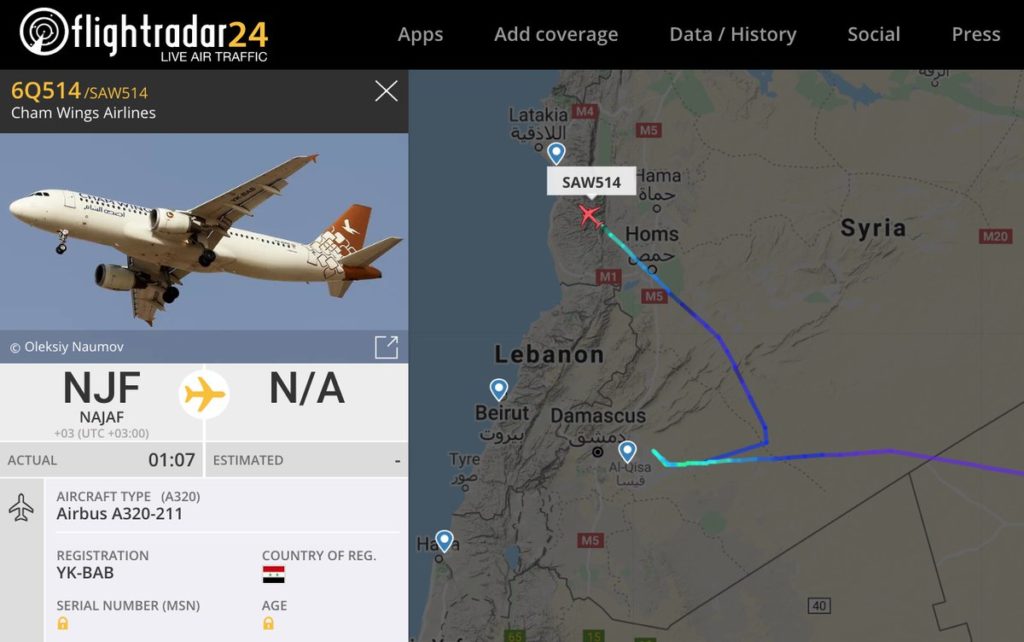
In the early hours of Feb 6, a commercial flight en-route to Damascus was forced to divert to Russia-controlled Khmeimim air base after coming under fire from Syrian air defences.

The Cham Wings A320, with 172 people on board, was flying from ORNI/Najaf to OSDI/Damascus when the incident took place. According to The New York Times, Syrian air defences directed anti-aircraft gun and missile fire against the Airbus, but failed to hit the aircraft.

Russia’s Ministry of Defense has since blamed Israel for the near-miss – at the time the incident occurred, the Syrian air defence systems had engaged four Israeli F-16s, and Russia claims that these fighter jets were using civilian aircraft as “cover” while conducting air strikes.
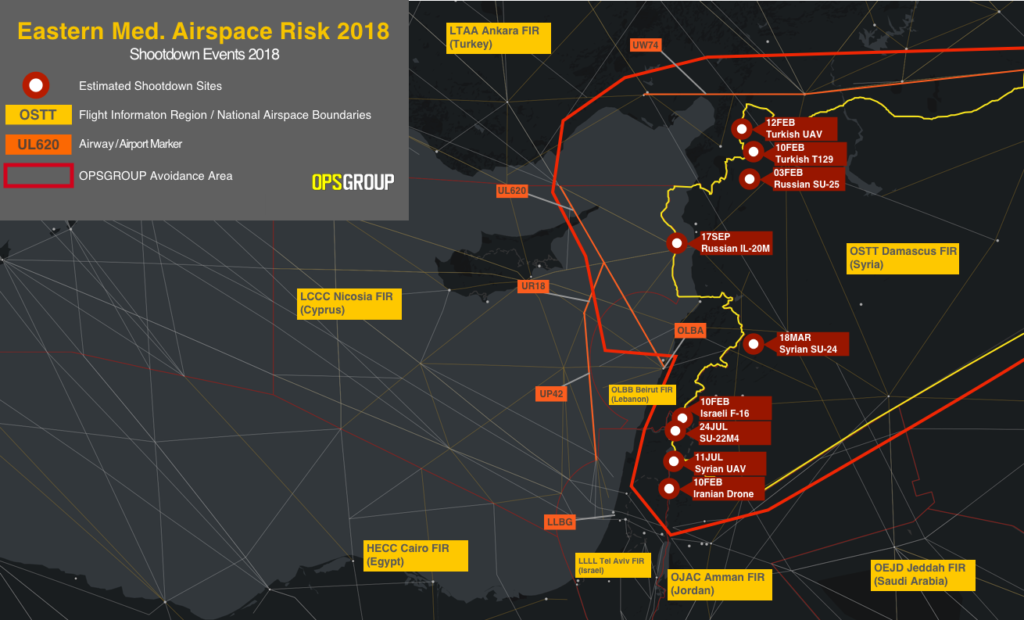
Russia has accused the Israeli military of putting commercial flights like this at risk in the past, by timing their airstrikes on Syria too close to flights arriving at Beirut and Damascus airports. In the past few months there have been a number of air strikes by Israel against military targets in Syria, including OSDI/Damascus airport, with the Syrian government firing its own missiles over Syrian airspace and along the Lebanese border to repel the attacks.

This latest incident comes just a month after a Ukraine International Airlines passenger plane was shot down shortly after take-off from Tehran, killing all 176 people on board. Iran later said its forces had shot it down unintentionally, having mistaken the aircraft radar return for an inbound missile to Tehran.

In the days following, many countries issued warnings to avoid the airspace of Iran and Iraq, and most airlines other than Middle Eastern carriers have now stopped overflying these countries entirely.

The same is true of Syria – there are multiple airspace warnings in place, including a total flight ban by the US and German authorities. Some countries add the additional warning to exercise caution when operating anywhere within 200 nautical miles of the country – advice that came into sharp focus in September 2018, when Syrian forces shot down a Russian IL-20M transport category aircraft over international waters 20nm off the coast, mistaking it for an Israeli fighter.

That event significantly changed the risk picture for civil aircraft operating in the vicinity of Syria. We wrote about it here, and the advice still stands – there is a clear risk to civil aircraft operating over Syria, as well as in the overwater airspace east of Cyprus. The risk picture is two-fold: misidentifcation of your aircraft as a military one, and an errant missile launched at another aircraft that locks onto you instead.

Further reading:

SafeairspaceManaged by OpsGroup, this is our public repository and first point of warning for Airspace Risk for airlines, pilots, dispatchers, and aircraft operators.

Why are we still flying airline passengers over war zones?OpsGroup article from Sept 2018, following the shoot-down of the Russian IL-20M off the coast of Syria, with a new note to members on the airspace risk in the Eastern Mediterranean.


Most GA/BA aircraft now exempt from Europe’s 2020 Datalink Mandate

Europe’s datalink mandate takes effect today – 5th Feb 2020!

The original plan was that datalink would be required for all aircraft operating in Europe above FL285 from this date, but then the EU announced that this would not be required for several categories of aircraft, the main two being:

  • Aircraft with a certificate of airworthiness first issued before 1 Jan 2018 and fitted prior to this date with FANS 1/A.
  • Aircraft with 19 seats or less and a MTOW of 45359 kg (100000 lbs) or less, with a first individual certificate of airworthiness issued before 5 Feb 2020.

In other words – most GA/BA aircraft! (You can read the rule here – latest version in 2023).

Added to that, in early Decemebr 2019 the EU Commission approved plans to pass an additional resolution that makes a bunch of other aircraft exempt too:

Aircraft permanently exempt:

  • Aircraft in Annex I
  • Aircraft in Annex II with a CofA issued before 5 Feb 2020

Aircraft which have up to 5 Feb 2022 to do the avionics retrofit:

On Feb 3, EASA issued a Bulletin which says that operators who are exempt from the mandate should include the letter “Z” in Field 10 and the indicator “DAT/CPDLCX” in Field 18 of their flight plan. If you don’t, ATC won’t know you’re exempt, and you may struggle to fly above FL285!

Bottom line, for operators who are exempt from the mandate, these flights should not be restricted to the lower flight levels below FL285. Logged-on traffic might just get better directs and faster climbs, that’s all.

It should be noted that the Datalink Mandate is not the same thing as the Logon List. The Logon List is the thing you need to get registered on if you want to get CPDLC when flying in Maastricht, France, Switzerland and Portugal. And it only applies to ATN CPDLC aircraft. If you’ve only got FANS1/A, Maastricht will let you log on, but France, Switzerland and Portugal will not.


The Backstory…

This mandate was actually supposed to come into force back in Feb 2015, but got delayed to Feb 2020 due to technical issues with the system, particularly disconnections, known as ‘provider aborts’ – which is where an aircraft loses datalink connection with the ground for more than six minutes.

The high amount of these provider aborts has led some sectors (Maastricht UAC, France, Switzerland, and Portugal) to implement the Logon List (formerly known as the “White List”), which effectively means that CPDLC is only provided to those aircraft with avionics that are known to suffer a lower provider abort rate. The Logon List only applies to ATN B1 equipped aircraft, not those with FANS1/A – Maastricht are planning to introduce a similar list for FANS1/A aircraft at some point in the future, to ensure that only aircraft that have the latency timer feature will be able to log on.

In their original postponement of the mandate back in 2015, the EU said the following:

“This excessive rate of random provider aborts causes a degradation in the network performance potentially presenting aviation safety risks by increasing the pilots and controllers’ workload and creating confusion leading to a loss of situational awareness.”

Their goal was to get the number of provider aborts down to 1 per 100 flight hours. By mid-2018, the number had dropped to a rate of 4.4 per 100 flight hours, and data from this year has that figure down to 3.9 per 100.

Added to that, they wanted to get at least 75% of flights across the network filing with datalink. Current data suggests this is still lingering at around the 40% mark. So if the datalink mandate had been implemented as planned in Feb 2020 without these new exemptions, that would have meant that approximately 60% of the traffic would have been restricted to below FL290!

As the EU make clear in their new ruling, that is ultimately why the new raft of exemptions has now been brought in, ahead of the Feb 2020 mandate:

“Acknowledging the ongoing data link implementation issues and corrective actions taken and recognising the objective that at least 75 % of the flights should be equipped with data link capability, the criteria for exemptions should be amended. Those criteria should remain effective, without placing an undue economic burden on specific operator categories which contribute significantly less to the overall number of flights. Such categories should include operators of aircraft with Future Air Navigation Systems (FANS) 1/A systems installed, operators of older aircraft, and of aircraft designed to carry 19 passengers or less.”

Ultimately, when the datalink mandate comes in on 5 Feb 2020, it now looks like most GA/BA aircraft will be exempt from this, meaning that those without CPDLC will be able to continue to operate above FL285.


Thanks to the European Business Aviation Association for their help with this article!

Article header photo by @Zelgomat


Business aviation prepares for the Miami Super Bowl

Everyone loves a huge sporting event like the Super Bowl – it usually even includes a fly-over! But, if you’re operating in or around Miami next weekend, the last thing you want is a flag on the play…

Super Bowl LIV is happening in Miami on Sunday, 2 February 2020, and will attract a lot of attention – some in the form of intensified aircraft operations in the vicinity of the venue. As a designated National Security Special Event, a variety of restrictions and special procedures are in place between 25 January – 04 February 2020, most significantly a TFR centred on the stadium on gameday.

Whether you are arriving, transiting, or departing the area, here are five key things to keep in mind:

1. Information can (and likely will) change

Check NOTAMs frequently, call your Flight Service Station, monitor ATIS – make sure you are operating to the most current information. Your first stop, however, should be the FAA Super Bowl Flight Advisory and the FAA Super Bowl Website.

2. Expect delays, and plan accordingly

Intensified aircraft and security operations mean that reroutes are extremely likely, as are ground and airborne delays due to potential Traffic Management Initiatives. Increase your contingency fuel, manage expectations, and build extra time into your schedule wherever you can. Preferential IFR Arrival and Departure routings are also in place for jet and turboprop aircraft, while VFR traffic may experience lengthy delays and holding.

3. Don’t lose sight of the wider picture

The main event may be in Miami, but there will be impacts further afield. In particular, watch out for POTUS/VP TFRs (KPBI/Palm Beach International will likely be impacted) and other restrictions/impacts as military, law enforcement, and medical services position throughout the event. Efforts are also being made to reduce demand on the airspace through actively discouraging training, sightseeing, and other non-essential flight activities.

4. Book ahead to avoid disappointment

FBO space is limited, and pre-booking of slots will be required for most South Florida airports between 29 January and 4 February. Signature Flight Support have a Super Bowl page with further information. Equally so, if you are relying on rental cars, hotels, or other local infrastructure – book them now!

5. Ensure your documents are in order

File your flight plan between 22 and 6 hours ahead of departure, and ensure you have your pilot’s license, company ID (if applicable), applicable aircraft documentation, and access to copies of all reservations/confirmations. Increased security operations may involve ramp checks, security searches, or routing through a gateway airport for TSA screening.


With careful planning and collaboration (and some amount of patience!) from all involved, Super Bowl LIV is shaping up to be a memorable experience. Fly smart, fly safe, and if you have information that could help the community, pass it along!


Canadian Operators need Special Authorization to keep flying in the NAT

Transport Canada has said that all old NAT MNPS authorizations are no longer valid for flights operating across the North Atlantic as of 31st Jan 2020 in NAT HLA airspace between FL290-410. In its place, a new special authorization called NAT HLA MNPS will have to be added to the operator’s PORD or AOC in order to fly in this airspace, which includes the NAT Tracks and Blue Spruce Routes. Airspace above FL410 or below FL290 is not affected by this.

Transport Canada did issue a Civil Aviation Safety Alert (CASA) about this back on 10th Jan 2020, but later admitted it was too vague and difficult to understand – therefore they will reissue the CASA. But in the meantime, the requirement to get this new special authorization still stands. Here’s how it works:

How do you apply for this new SA?

It appears to be fairly simple. The operator emails TC applying for the NAT HLA MNPS special authorization. TC will reply by email including a compliance guide to verify equipment and training requirements.

If you wish to operate in the Organized Track System, there are 4 Special Authorizations that Canadian operators must hold:

  1. NAT HLA MNPS;
  2. RVSM;
  3. RNP 4 or RNP 10; and
  4. PBCS (ADS-C with proof of contract)

What if you don’t have PBCS? Where can you operate?

If you hold the first 3 SAs listed above and the ADS-B SA you may operate on the Blue Spruce Routes only. That’s ADS-B for Broadcast.

So to summarize…

Scenario one is that you already possess RVSM, RNP 4 & 10, and PBCS (ADS-C with proof of contract). Your process is to to e-mail TC for the application for the NAT HLA MNPS special authorization. A compliance guide will be sent out to verify equipment and training requirements. Once it has been returned and reviewed, a new PORD or AOC will be issued which will contain the new NAT HLA MNPS special authorization.

Scenario two is you do not possess PBCS with ADS-C, but you are either ADS-B capable or already hold a special authorization for ADS-B. In this case the process will be to apply for the NAT HLA MNPS vis email and a similar compliance guide will be sent out to verify equipment and training requirements. The difference is that your special authorization will be restricted to the Blue Spruce Routes only. You can request the ADS-B special authorization in the email if you don’t have it already. Simply note that in your e-mail request.

Further reading

CBAA new forum information, with login credentials: https://www.cbaa-acaa.ca

CASA links can found here: https://www.tc.gc.ca/en/services/aviation/reference-centre/safety-alerts.html

Original CASA 2019-10 Issue 01 that will be replaced: https://www.tc.gc.ca/en/services/aviation/documents/CASA-2019-10.pdf


Thanks to the Canadian Business Aviation Association who helped provide the information in this post.


Additional ATS Surveillance Charges in Shanwick

As ATS services are now mandated through most of the North Atlantic Oceanic airspace, NATS has introduced increased and additional charges for ATS surveillance. These charges are to recover the costs of ADS-B usage in the Shanwick Oceanic ATC coverage area.

There are 2 different charging zones:

  1. North Atlantic Crossing Zone: comprises the Shanwick FIR/OCA. Any traffic that touches its boundaries or operates to/from or through it are to be charged a NAC zone fee UNLESS it is operating solely within separate airspace jurisdictions (i.e. BOTA, NOTA, SOTA, etc.) or operating within the newly designated “Tango Zone” area, which is the second charging zone.
  2. Tango Zone: a smaller, defined area of airspace within the Southeast corner of the oceanic airspace surrounding ATS routes T9 and T290 (does not include the more westerly Tango Routes T16, T13, and T213 – these fall within the North Atlantic Crossing Zone!)

There are 2 different charges:

  1. Core” charge: one standard charge that remains the same in each zone.
  2. Data” charge: covers ATS surveillance data usage and changes within each zone reflecting the differing costs of satellite data.

If operating through BOTH the Tango and NAC areas, flights will only be charged the NAC area fee.

Charges will NOT vary by time, weight or distance flown.

You can check out the full briefing to airlines issued by NATS here.


Read about the changes coming up for the Tango Routes on Jan 30, 2020 – the same date that the expanded NAT Datalink Mandate goes into effect.


Risk assessing Iran ops – the UIA 737 may have been shot down

Special Update Thursday 09JAN: Members, please see either your email or this post in the Members forum, for a special briefing and update.

08JAN: Iran/Iraq Information page activated with latest information.

The cause of the crash of Ukraine International Airlines (UIA) AUI/PS752 on departure from Tehran is not yet determined, and given political circumstances, may not be clarified beyond reasonable doubt anytime soon.

Purely from the perspective of making a risk assessment for operations to Tehran, and Iran in general, however, we would recommend the starting assumption to be that this was a shootdown event, similar to MH17 – until there is clear evidence to the contrary.

Images seen by OPSGROUP, shown below, show obvious projectile holes in the fuselage and a wing section. Whether that projectile was an engine part, or a missile fragment is still conjecture, but in making a decision as to whether to operate to Iran, erring on the side of caution would dictate that you do not, until there is clear information as to the cause.

Obviously, there is also the wider regional risk as indicated through the US FAA Notams issued late Tuesday night. US operators are covered by these clear and specific Notams – do not operate to Iran, or Iraq, or operate in the Persian/Oman Gulf area.

Other operators are free to make their own judgement, but should note that a majority of non-US international carriers have elected to avoid both countries for the time being.

See also:

  • OPSGROUP Article: FAA Bans Flights Over Iraq And Iran Following Missile Strike On US Base
  • OPSGROUP Article: Germany publishes new concerns for Iraq overflights


Images from ISNA, Reuters; marking of projectile areas from JACDEC.


Germany publishes new concerns for Iraq overflights

Late Monday evening, the German LBA published a new warning for Iraq, indicating areas of concern for overflying traffic, together with a new warning on ORBI/Baghdad Airport.

Notam B0007 of 2020 (issued Jan 6) replaces Notam 0002 (issued on Jan 2nd), and these are the routes that Germany now considers a potential risk for aircraft below FL260:

Airway UM860 NAMDI – NINVA
Airway UM688 RATVO – SOBIL
Airway L718 TAGRU – KABAN
Airway L417 MUTAG – VUSEB
Airway M434 UMESA – BOXIX
Airway R652 MUTAG – DAVAS

Seen on the map below, all these airways are in the north east of Iraq: the yellow lines are the warnings that existed on and prior to Jan 2nd, and the orange lines show the additional areas flagged in Mondays Notam.

Of the other primary states that issue airspace warnings – the UK, France, and the US – none have issued updated guidance yet this year.

There is no doubt that the events of Jan 3, 2019 at ORBI/Baghdad Airport have created an extremely tense situation between the US and Iran. The aviation security picture in the Middle East, already fragile and unstable, is now unpredictable. A response by Iran to the US airstrike of Jan 3rd seems possible.

Specific to the Baghdad Airport incident, it seems early reports of Katyusha rockets can be discounted, that it was an attack carried out on vehicles near the airport by US Apache Helicopters. Civil traffic resumed operations shortly after the attack with several departures operating ‘as normal’. Overflights continued during the attack.

As to the Iranian response, anything that looks like a US asset or ally could be a target – military or civil. US operators, at a minimum, should be avoiding the Tehran FIR, and considering security carefully when operating in other countries in the region, most notably Israel, Lebanon, and Kuwait – as a response may target airports in those countries or foreign aircraft. That said, it’s a guessing game right now, and predicting the specifics of a response is extremely difficult.

For full analysis, and a listing of all current warnings, see Safe Airspace.


ADS-B Mandates Around The World!

ADS-B has come to the US and many parts of the world. What do you need to know?

Firstly, what is ADS-B? Automatic Dependent Surveillance-Broadcast uses the aircraft’s GPS position information and provides it to the mode S transponder allowing ATC to track the aircraft more accurately than radar does.

As of January 1, 2020, all aircraft operating within most US airspace are required to transmit certain information using ADS−B OUT avionics.

Briefly, ADS-B OUT transmits information from the aircraft to ground stations or satellites whereas as ADS-B IN avionics receives information from ground stations or satellite based systems.

The ADS-B required airspace in the US includes everywhere Mode C is required AND:

  • Class A, B and C airspace, Class E at or above 10,000’ MSL (but not below 2,500’ AGL).
  • Within 30nm of Class B (Mode C veil).
  • Above the ceiling and within lateral boundaries of Class B and C up to 10,000’.
  • Class E over Gulf of Mexico, at and above 3000’ MSL within 12 nm of US coast. The non-contiguous US is also included: Hawaii, Guam, Puerto Rico and Alaska.

Also, according to the US AIM, operators flying at 18,000 feet and above will require equipment which uses 1090 ES (extended squitter). Those that do not fly above 18,000 may use either UAT (Universal Access Transceiver) or 1090ES equipment. For international operations 1090ES is by far the most accepted system.

Here’s the operational stuff…

For the most part you may notice very little change from radar controlled airspace and there may be no ADS-B specific controls in your cockpit.

During flight you may encounter ADS-B specific phraseology. Instead of the word ‘radar’ you may hear ‘surveillance’ as in ‘Surveillance service is terminated’. Another example would be ‘Pressure altitude is invalid’ instead of the previous ‘Mode Charlie is invalid’.

Failures may be dealt with differently depending upon avionics installations so check your manuals for any specific procedures. One example is if your left side GPS fails and you are using your number 1 transponder then ADS-B may loose data input therefore select transponder number 2 to continue ADS-B data transmission. There may be no indication of the ADS-B failure in the cockpit.

In the US, the operator is required to fly a route that has ADS-B service availability so the FAA has provided an ADS-B Service Availability Prediction Tool (SAPT) which should be used not more than 24 hours prior to the planned departure to ensure the planned route has ADS-B coverage. If there is an ADS-B outage along your planned route you must plan another route. Make sure your flight planning provider is doing this!

Flight planning codes are important as this is the only way that ATC knows you are properly equipped and authorized. The FAA’s InFO 15015 has good information on filing correctly. There are numerous codes for ADS-B equipment based on your specific installation of 1090MHz ES, UAT and/or VDL mode 4.

The FAA encourages the reporting of ADS-B surveillance malfunctions (AIM 4-5-7 f.). You can do this by phone or radio to the nearest Flight Service Station.

What if I don’t have ADS-B installed right now?

If you still don’t have ADS-B, your options aren’t great. The FAA spells it out in the Federal Register, but simply put, you must receive authorization from ATC to fly before every flight that is planned in ADS-B required airspace.

To do that, you have to use the new ADS-B Deviation Authorization Preflight Tool (ADAPT) that the FAA has developed – which allows you to request authorisation to fly from ATC. Do this online, at least one hour but not more than 24 hours before your flight. AOPA give this advice: “Don’t call the ATC facility to ask, and don’t request access from a controller over the radio – the answer will be no. Only if your ADS-B Out hardware fails in flight will controllers be able to issue an airspace authorization to an airborne aircraft.”

The word from the NBAA is that there is no planned relaxation of the ADS-B rules, so operators who have not equipped will be at the mercy of ATC for every single flight planned through ADS-B airspace. ATC might not be able to grant authorizations for a variety of reasons, including workload, runway configurations, air traffic flows, and weather conditions.

What are the ADS-B rules in the rest of the world?

ADS-B usage is expanding in many countries at different rates. We have compiled a list below of countries and requirements.

Mandates now in effect…

Australia: Requires ADS-B for operations at or above Flight Level 290. Foreign aircraft can operate without ADS-B below FL290 until June 2020. Check AC 21-45 for more info.

Hong Kong: The AIP GEN 1.5.3 states: All aircraft flying within Hong Kong FIR at or above F290 shall be installed with ADS-B. This requirement has been in place since December 2014!

Taiwan: In Jan 2020, ADS-B became mandatory for all aircraft operating within the Taipei FIR, at or above FL 290. Check our article for more info.

Vietnam: Since July 2018, Vietnam has required aircraft over MTOW 15,000kg to have ADS-B. But from 1st Jan 2020, this limit was brought down to apply to all aircraft over 5,700kg. Aircraft without ADS-B can still operate through Vietnam’s airspace, but are restricted to the lower levels. AIC 08/16 has all the details.

India: The ADS-B mandate across Indian airspace outlined in AIP SUP 148/2018 was due to take effect on 1st Jan 2019, has got delayed to 1st Jan 2020 (as advised by Notam). This AIP supplement states that all aircraft flying on PBN Routes pretty much everywhere in Indian continental airspace at or above FL290 must carry serviceable 1090 MHz ES ADS-B transmitting equipment that has been certified as meeting the requirements.

United Arab Emirates: AIC 13/2019 published in Nov 2019 says “Operators are made aware that ADS-B OUT will be mandated from 01 January 2020 within UAE airspace.” That means you need ADS-B everywhere, at all flight levels!

Malaysia: As per AIC 03/2017, from 31 December 2019 you need ADS-B to be able to operate on airways N571, P628, L510, P627, L645 and P574 between FL 290 to FL 410.

Singapore: Since May 2018, ADS-B has been required for ops at or above FL290 on airways L642, L644, M753, M771, M904, N891, N892, Q801, Q802, Q803 and T611. Check the AIP ENR 1.8 Section 7 for details.

Indonesia: Since the start of Jan 2018, all aircraft flying in Indonesian airspace at or above FL290 needed to be equipped with ADS-B. Check our article for more info.

French Polynesia/Tahiti: The AIC PAC-P A 06/19 says that from 1 January 2019, aircraft flying above flight level 195 need ADS-B. Then from 1 January 2022, this will be required for all flight levels!

Upcoming mandates…

Europe: ADS-B will be required after 7 June 2020 for aircraft over 5700kg and flying faster than 250 knots and on an IFR flight plan. There will be some exemptions for older aircraft in Europe. Check this EASA doc for more info.

Seychelles: From 7 June 2020, you’ll need ADS-B to fly through the FSSS/Seychelles FIR. AIC 1/2019 applies.

New Zealand: The CAA proposed rule change would make ADS-B mandatory for all aircraft in controlled airspace below Flight Level 245 from 31 Dec 2021.

Saudi Arabia: ADS-B will be required in Class A and B airspace starting 1 Jan 2021. The way they’ve published this is confusing: the requirements are laid out in this GACAR Part 91 document, backed up by this Notam issued for the OEJD/Jeddah FIR:
A1871/19 – ADS-B OUT REQUIREMENT ENFORCEMENT DATE IN CLASS A AND B AIRSPACE AS PER GACAR PART 91.303 IN KINGDOM OF SAUDI ARABIA HAD BEEN CHANGED TO 1 JANUARY 2021 INSTEAD OF 1 JANUARY 2020. 31 DEC 19:15 2019 UNTIL PERM. CREATED: 31 DEC 19:30 2019

Mongolia: This one straight from the AIP SUP: From 17 June 2021 at 0000 UTC, all aircraft flying within the airspace of Mongolia above flight level 6150m must carry serviceable ADS-B transmitting equipment (Mode S Transponder and GNSS source position)… Whilst aircraft flying below flight level 6150m, the carriage of ADS-B equipment remain optional.

Mexico: A Circular issued by the Mexican CAA in Dec 2019 advises that the ADS-B requirement over airspace of Mexico has been delayed until 1 Jan 2022.

South Africa: The plan was to mandate ADS-B at or above FL290 from April 2020, but they have recently issued a draft AIC that says this will be delayed to 15 June 2023.

Canada: In Nov 2019, Nav Canada announced it was delaying its 2021 ADS-B mandate. No new date has been set yet. So although ADS-B will be used for surveillance in Class A airspace (i.e. above FL180) from 25 Feb 2021 onwards, it won’t be mandatory for aircraft to be equipped.

Sri Lanka: Not mandated yet, but something’s in the pipeline. The CAA states on their website: “This is to inform all aircraft operators operating in Sri Lanka airspace (Colombo FIR) that ADS-B trial operations have been commenced and in the near future it will be fully operational covering the entire Sri Lanka sovereign airspace and extending the surveillance coverage of Colombo FIR further.”

Any countries we missed? Let us know!


Nationwide French ATC strike on Jan 9

This week’s nationwide French ATC strike looks to be going ahead as planned. It will run from 1800z on Weds Jan 8, until 0530z on Friday Jan 10; but the worst of the delays will happen during the day on Thurs Jan 9.

At LFBO/Toulouse, airlines have been requested to reduce their scheduled flights by a third from 0500-2300z on Thurs Jan 9; but that’s the only airport which has issued this kind of restriction so far.

Eurocontrol’s Mitigation Plan can be found here.

We expect this strike will be much the same as the five French ATC strikes we had in December – big delays at the major airports and for overflights, busy Tango Routes with traffic avoiding French airspace in the west, and Algeria/Tunisia will most likely let you fly through their airspace without special permission if you want to avoid French airspace in the south.

For the latter, just make sure to add the right AFTN codes on flight plans! That means – as well as filing your FPL to the normal Eurocontrol addresses, you must also include those for Algeria (DAAAZQZX and DTTCZQZX) and Tunisia (DTTCZQZX and DTTCZRZX) – and make sure these are included for any subsequent DLA messages as well.

For real-time updates of any airspace issues once the strike has started, keep an eye on this handy French ATC webpage: http://dsnado.canalblog.com/

And check out our article for everything else you need to know about how to survive French ATC strikes!


New route requirements for Iceland

There are some new route requirements for flights to BIKF/Keflavik and BIRK/Reykjavik. 

These can be found in the updated version of AIP ENR 1.8.4.1.3.7 which explains exactly how you should file your flight plans to/from both BIKF and BIRK. But to make all this blurb easier to understand, the good folks at Isavia have published some handy graphic presentations of the requirements:

If you follow the guidance and flight plan accordingly, you should avoid any nasty last-minute “FPL REJ” messages!

Further reading:

  • You can check the full Iceland AIP online here.
  • For a summary of all the NAT changes, including EGGX/Shanwick, CZQX/Gander, BIRD/Iceland, ENOB/Bodo, LPPO/Santa Maria, and KZWY/New York Oceanic East, click here.

A review of aviation in Hurricane Dorian relief efforts

The response to Hurricane Dorian was overwhelming – likely the single greatest aviation response to a natural disaster in history. Without these flights, supplies and relief would not have reached so many, so quickly.

And yet, there are many lessons to learn. We saw a lot of things that went right, and a lot of things that went wrong. And we’d like to ensure that we have a full picture of events so that we can learn those lessons. We’ll share the review with you, just tick the box on the survey.

Hence, this little survey. It’s anonymous. Just say what you saw. About 10 questions – 5 minutes of your time. To jog your memory of what happened, have a look at our Operational Summary from those first days of the relief efforts.

We would especially like input from:

  • NGO’s and relief organizations involved in Dorian (whether aviation focused or not)
  • Pilots that flew during Dorian
  • Flight ops people – ATC, Dispatch, Coordinator, Scheduler
  • Aircraft operators (Civil/Mil/Govt)
  • Anyone that was part of the aviation response

Thank you for your help! With a better process, we can save lives and get relief flowing more quickly in future disasters.

Answer the survey below, or open in a new window. When you’re done, please share the link to this page!


New rules for charter flights to Malaysia

Foreign operators doing charter flights to Malaysia now need to obtain a “Foreign Air Operator Certificate” (FAOC) to be able to get a landing permit, and this needs to be requested 90 days in advance!

This new requirement was introduced earlier this year with AIC 3/2019, but authorities have only recently started implementing it.

Private flights are not affected. The process for these remains the same as before – apply a week in advance, either direct to the authorities at airtransport@dca.gov.my, or through a third party agent (recommended!). Local agents have said that Air Ambulance / Medevac flights do not need to obtain an FAOC either.

But for charter flights, the new requirement looks like a real pain. Here’s how it works… (thank you Julie at ASA Group for helping with this info!)

1. Application needs to be sent 90 DAYS prior to the intended first trip into/out of Malaysia. The following documents need to be submitted:
– Completed FAOC Matrix form (see links below).
– Carriers liability insurance.
– If aircraft is leased, approval of civil aviation authorities of the State of the Operator of the lessee, with identification of the operator that exercises operational control on the aircraft.
– Document authorizing the specific traffic rights, issued by appropriate department or resulting from a bilateral air transport agreement (and any other document the CAAM considers necessary to ensure that the intended operations will be conducted safely).
– Letter of appointment on behalf of the operator to say that their chosen handling agent in Malaysia (i.e. ASA Group) can apply on the operator’s behalf.

The FAOC will be valid for one year.

2. Once the FAOC is issued, then you have to get your handling agent to apply for each landing/overflight permit for you via the Aerofile system. Here’s what they’ll need from you to make that happen:
– Airline/Operator Code in IATA (2 characters) & ICAO (3-4 characters) format.
– Home county of registration.
– Copy of FAOC.
– Copy of your own AOC issued in your country of registry.
– Main office address and contact for the operator.
– Copy of insurance coverage.
– Appointment letter from operator stating that the handling agent can apply on their behalf

All subsequent individual applications for landing permit requests after successful application in the AeroFile system will require a copy of the Gendec (and for bigger aircraft with 20 seats or more, you’ll also need to provide a copy of the Charter Agreement).

For these landing permit requests through the Aerofile system, your handler will need a minimum of three days notice. They should request slots at the same time as requesting the landing permit.

To clarify – an FAOC is only required for landing permits for charter flights. Overflight permits will need to be applied for via the Aerofile system, but do not need an FAOC.

Handy links:

Aerofile system – https://www.mavcom.my/en/industry/aerofile-registration/ 

FAOC forms – http://www.dca.gov.my/sectors-divisions/flight-operations/forms/foreign-air-operator-certificate-faoc/

AIC 3/2019 – https://ops.group/dashboard/wp-content/uploads/2019/12/WM-eAIC-2019-03-en-MS.pdf


5 tips for Safer Winter Ops

On November 11th this year, a regional jet slid off a snow-covered runway in Chicago.

What made this event unique was that the entire incident was caught on video from a passenger onboard the aircraft. Although no probable cause has been published yet, it does serve as a stark reminder of the challenges of operating in the winter season. While every operator and aircraft will have their own specific procedures, here are 5 golden rules that could help you stay out of trouble during these colder months.


#1 – Anticipation

Winter ops can be expensive, especially because de-ice and anti-ice fluid is a costly commodity. If the weather outlook indicates snow or frost, a good idea is to book hangar space ahead of time to keep the aircraft out of the inclement weather. This will be vastly cheaper than a steep de-ice bill. If you didn’t manage to spot the weather ahead of time, just pushing the airplane into a hangar before flight can melt a lot of ice and snow adhering to the aircraft.

Story time: Once upon a time in Teterboro Airport (KTEB) a Gulfstream crew was set to begin their trip on a non-passenger reposition flight down to Florida. It was a beautiful, crisp winter evening, with clear skies ahead. Unfortunately, the airplane that they were assigned to had been sitting outside on the ramp for nearly a week and was covered in several inches of ice and snow. There had been several days of continuous of heavy freezing rain and snowfall during the week it was left outside by the previous crew. Initially, the inclination was to de-ice the airplane so they could depart as soon as possible. However, after an inquiry with the FBO, the amount of de-ice fluid required to clear the airplane was estimated at $40,000. Instead, the crew devised another plan to help save the company’s resources. They inquired, and subsequently received, heated hangar space for a mere $700. After a few hours of defrosting, the airplane was completely clean and dry of contaminants. What’s more is that ultimately the FBO waved the $700 hangar fee, saving the company a whopping $40,000. A win for everyone all around.


#2 – Limitations you didn’t worry about in summer

ENGINE OIL
Oil takes much longer to reach its minimum temperature in the frigid winter months than usual. When it’s cold and highly viscous it may not be able to properly circulate throughout the engine, hence why engine manufactures like to see a minimum temperature on the oil before high thrust settings are used. For this reason, it doesn’t hurt to carry extra taxi fuel to bake in extra time to allow the oil to reach its minimum temperature before takeoff.

LANDING GEAR

Landing gear struts may compress and sit lower due to the colder temperatures. When walking out to the aircraft, check the strut height before opening the door. In normal conditions there may only be a few inches of clearance between the door and the ground. However, with a very low nose strut, it may result in the aircraft door coming into contact with the ground when it opens. Similarly, as the aircraft gets heavier during the boarding process, the struts will compress and the fuselage may sink closer to the ground. For aircraft that require mobile air stairs, ask the rampers to lower the mobile air stairs an extra inch or so to allow for this compression.

However, these issues can largely be mitigated on post-flight inspections. If the struts look low, call Maintenance to charge it up before your next flight. The process of recharging gear struts can take up to an hour in ideal conditions, so the sooner it is caught, the less disruption it will cause.

WATER LINES
Unless you fly for an airline, it falls upon the flight crew to remember to drain all the water tanks and purge the lines if the aircraft is being left to sit in freezing temperatures. When water freezes, it expands, which can cause the plumbing systems in aircraft to burst. This can result in significant and costly repair jobs. A good rule of thumb is to purge the water system anytime the temperature will be less than 3C at any point during the layover. Ensure all crew are in the loop, including the Flight Attendant, by instigating a cold weather brief before departure, and again when you’ve copied the destination’s ATIS. “It looks like the temperature is -2 Celsius at our destination, so we will plan on draining the tanks and lines. Can you complete that while I conduct the external walkaround and offload bags?” Even if the temperature is above 3C when you land, check the outlook overnight.

Don’t forget to empty water from the Nespresso/coffee machines and remove carbonated beverages!


#3 – Go or No Go – You decide

Once you’ve been de-iced, there’s that warm fuzzy feeling that you’re finally on your way. But you’re not quite out of the woods yet–is your de-ice fluid holding up? The clean aircraft concept requires that your aircraft be free of all frozen contaminants before take-off. When there’s even a sliver of frost or if precipitation is re-accumulating after anti-icing, you’re already in unknown territory, aerodynamically speaking. Your final determination on whether the aircraft is clean will be through a Pre-takeoff check or Pre-takeoff contamination check. Which are you approved for? (AC 120-60B).

PRE-TAKEOFF CHECK
Pre-takeoff check (typically used in Part 121 operations) is to be completed by the pilots within 5 minutes of crossing the hold short line. Pilots will visually check the representative surfaces to ascertain whether the aircraft is still free of contaminants (for the Embraer Legacy/145 these are the windshield wiper arm and blade and the visible portion of the leading edge of the wing). If necessary, hop into the back and check the wings from the cabin windows.

This check is only done from the comfort of the aircraft and does not allow you to exceed a holdover time! You’re simply checking the integrity of the fluid and looking for contamination before you try and fly that wing. If the aircraft does not appear totally clean then, regardless of whether you’re within the holdover time, its back to the de-ice pad.

PRE-TAKEOFF CONTAMINATION CHECK
Predominantly, Part 135 operators who don’t employ 121 procedures for ground de-icing will use the pre-takeoff contamination check. Here, holdover tables are “advisory only,” so in lieu of a hard cut-off time the crew conducts their own assessment of whether the wings and control surfaces are free of frost, ice, or snow. This, too, must be completed within 5 minutes prior to crossing the hold short line, and may be tactile or visual, as long as the crew can ensure the absence of contamination.

As a reminder, if anti-ice fluid fails, you cannot re-apply another coating of Type IV. You must first use de-ice (Type I) to clear off the failed anti-ice fluid from the airplane before re-applying Type IV.

KNOW YOUR LIMITS
For the following conditions, no holdover times exist:

  • Heavy snow
  • Moderate and heavy freezing rain
  • Hail.

In these cases the anti-fluid does not have the capacity to eliminate the precipitation for very long, if at all. Take FZRA, for instance. When rain from a layer of warmer air above falls through a layer of colder air below, it becomes supercooled. Upon impact with cold surfaces the water will freeze, becoming clear ice. In active freezing rain conditions, this ice is notoriously difficult to keep from forming on the skin of the aircraft. Perhaps more insidious is that clear ice is hard to detect visually, especially in the dark, and usually warrants a tactile check.

It goes without saying, but we will say it anyway – if you cannot ascertain that the aircraft is clean, do not takeoff. And if your fluid looks like this, do not takeoff!

If you feel like indulging in some reading, have a look at NASA ASRS Directline issue 5 on de/anti-icing mishaps. Although it’s from the 1990’s, it helps give crew some awareness of the difficulties that can be faced in winter. Events include, but are not limited to, crew that were inadequately sprayed by the de-ice crew, only half the aircraft being sprayed, encountering fluid failure and engine failure caused by snow ingestion on takeoff.


#4 – Expect to be faster in descent

If you are descending through icing conditions, plan ahead. With anti-ice on, the engines spool up, in order to produce sufficient bleed air for the anti-icing systems. This makes descent and deceleration much harder. If you have altitude or airspeed crossing restrictions it pays to start down a little earlier than usual. Don’t be reluctant to tell ATC if you’re unable to make a speed and/or altitude restriction.


#5 – Be careful with reverse thrust

A common construction typical of business jets is that they are designed with aft mounted engines and a T-tail design. Because of this design, reverse thrust in excessive amounts can deflect air forwards of the engines, disrupting the airflow upstream from the rudder, and thus reducing rudder effectiveness. This is sometimes referred to as “rudder blanking.” This is the last thing anyone needs in a crosswind on a contaminated runway where steering effectiveness is already compromised. Several accidents have occurred as a result of pilots using too much reverse thrust on contaminated runways, perhaps the most notable of which was an MD88 in LaGuardia, NY (KLGA).

If the aircraft begins to skid, use caution when using asymmetric thrust reversers to get back on centerline. Although once a common technique taught in corporate flight departments, using asymmetric reverse thrust has not proven to be an effective technique. Research has shown that a good technique when loss of directional control is to bring reverse thrust to idle reverse (or completely out of reverse if necessary) and use rudder to keep the aircraft coordinated. Only once directional control is regained then re-apply symmetric reverse thrust to keep slowing the aircraft down.


In a nutshell, flying in winter requires careful planning, good judgement and good execution. But don’t feel daunted! There are plenty of resources online, and remember: always plan ahead, expect things to take longer – much, much longer – than usual and don’t blindly trust the anti-ice fluid.

Merry Christmas and safe flying! If there is anything to take away from this article, it is: don’t de-ice like this…


Risk Alert for North Korea (12/2019)

Risk Alert issued for North Korea:

Germany has issued a new Conflict Zone Notam, valid through March 25, warning of the potential risk to overflights through North Korean airspace, due to the potential for launch of test missiles without prior notice. As a result, the Safe Airspace warning level for North Korea is now Level 2. The Notam comes as North Korea said it is planning a “Christmas gift” to the US, and the USAF believes this could be a long-range ballistic missile test. North Korea regularly launches short-range test missiles into the Sea of Japan, but halted its long-range tests after diplomatic talks with the US in early 2018. The US prohibits flights across all North Korean airspace, including the oceanic part of the ZKKP/Pyongyang FIR over the Sea of Japan.

For more details: https://safeairspace.net/north-korea/


Fifth French ATC strike of December happening this week

Another French ATC strike is planned for Thursday Dec 19 – the fifth strike so far this month! It starts from 1800z on Wednesday, and ends at 0530z on Friday, but the big delays should really only occur during the day on Thursday.

The airlines have not been requested to reduce their schedules so far.

The Tango Routes will be busy with traffic avoiding French airspace in the west, and you can route via Algerian/Tunisian airspace without special permission if you want to avoid French airspace in the south.

For the latter, just make sure to add the right AFTN codes on flight plans! That means – as well as filing your FPL to the normal Eurocontrol addresses, you must also include those for Algeria (DAAAZQZX and DTTCZQZX) and Tunisia (DTTCZQZX and DTTCZRZX) – and make sure these are included for any subsequent DLA messages as well.

Eurocontrol’s Mitigation Plan for this strike is here.

For real-time updates of any airspace issues once the strike has started, keep an eye on this handy French ATC webpage: http://dsnado.canalblog.com/

And check out our article for everything else you need to know about how to survive French ATC strikes!


ATC in Zimbabwe at breaking point

The Air Traffic Controllers’ Association of Zimbabwe (ATCAZ) has raised concerns with the government over airspace safety.

They say that ageing equipment is mainly to blame, with loss of air-to-ground radio comms in the upper airspace now a common problem. There have been complete radio comms blackouts on four days this year.

ATCAZ also report that ATC staff are overworked; this was made apparent last week at FVRG/Harare airport when controllers who had worked the night shift refused to extend their hours in the morning, citing incapacitation and fatigue, forcing flights delays and cancellations.

It seems this particular incident provoked letters from ATCAZ to the Zimbabwe government to be leaked to local press, which detailed the long-standing concerns that obsolete ATC systems now pose an possible danger to airspace safety.

No word yet from the Zimbabwe CAA, except one tweet claiming that there’s no problem – “our airspace is open and flights are operating as normal,” they say.

The Zimbabwe government this week have said they are attempting to acquire a new radar system. Transport and Infrastructural Development minister Joel Matiza is quoted as saying – “CAAZ long identified the requirements for replacement of airspace management systems in 2013 which systems comprised air traffic control communications system, navigational aids systems, radar surveillance and aeronautical information management (AIM) systems. The authority is in the process of procuring the airspace management systems. The project implementation will be phased starting with the air traffic control system. The cost of the radar surveillance system is about US$22 million.”

Last week, IATA issued an updated version of their Inflight Broadcast Procedure (IFBP) guidance doc for Africa, having added FLFI/Lusaka to the list of FIR’s where this procedure should be applied. There’s no mention of Zimbabwe here, but it now appears that operators should prepare for degraded comms for flights through the FVHF/Harare FIR as well. Whatever new ATC systems the government may or may not install here, such things take time in this part of the world, so don’t expect any improvement any time soon.


Samoa state of emergency due to measles outbreak

Samoa is in the grip of a serious measles outbreak right now. Over the past six weeks, the outbreak has infected nearly 4,000 people out of a population of 200,000, killing 60, mostly children under four. A nationwide state of emergency has been declared, which will remain in place until Dec 29.

Medical teams from around the world are now working with UNICEF to bring in vaccines to support the Samoan government’s vaccination programme.

Tonga and Fiji have also reported cases of measles, although the situation seems to be more under control here – largely due to the higher rates of vaccination amongst its populations. In Samoa, the World Health Organisation estimates that only around 30% of the population had been vaccinated prior to the recent outbreak.

The Samoan government effectively shut down the island on Dec 5 and 6, whilst they carried out a door-to-door mass vaccination campaign across the country.

As of Dec 16, the government says that 93% of population had been vaccinated, and announced that the state of emergency would be extended to Dec 29 to allow the authorities to reach the remainder of the population that is yet to be vaccinated.

So far, flights have been operating as usual, and no restrictions have been announced at the country’s international airport, NSFA/Faleolo.

Neighbouring American Samoa has reported two cases of measles in the past few weeks. Concerned about the spread of the virus, authorities at NSTU/Pago Pago airport on American Samoa have been denying landing to anyone flying in from Samoa (i.e. NSFA/Faleolo) or Tonga (i.e. NFTF/Fuaʻamotu) if they don’t have a measles vaccination certificate. We’ve had reports in AiportSpy that the same has been happening at PLCH/Christmas Island as well. In addition, authorities in the Marshall Islands and the Solomon Islands have announced that travellers will need proof of measles vaccination to be able to enter the country.

For operations to all airports in the region, ensure your vaccinations are all up to date, and that you carry certificates on board with you to present to the local authorities.