Delhi GPS Interference: New Pilot Reporting Procedure

India’s DGCA has issued new pilot reporting rules after a week of GPS interference in the Delhi area.

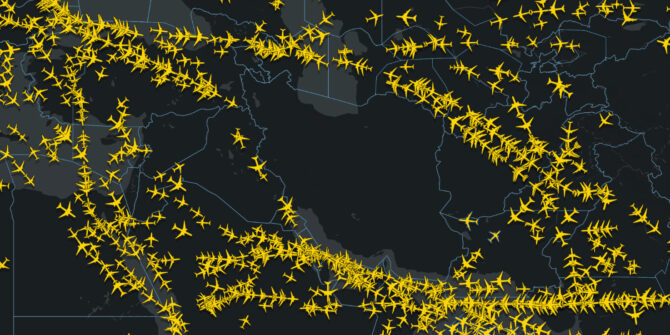
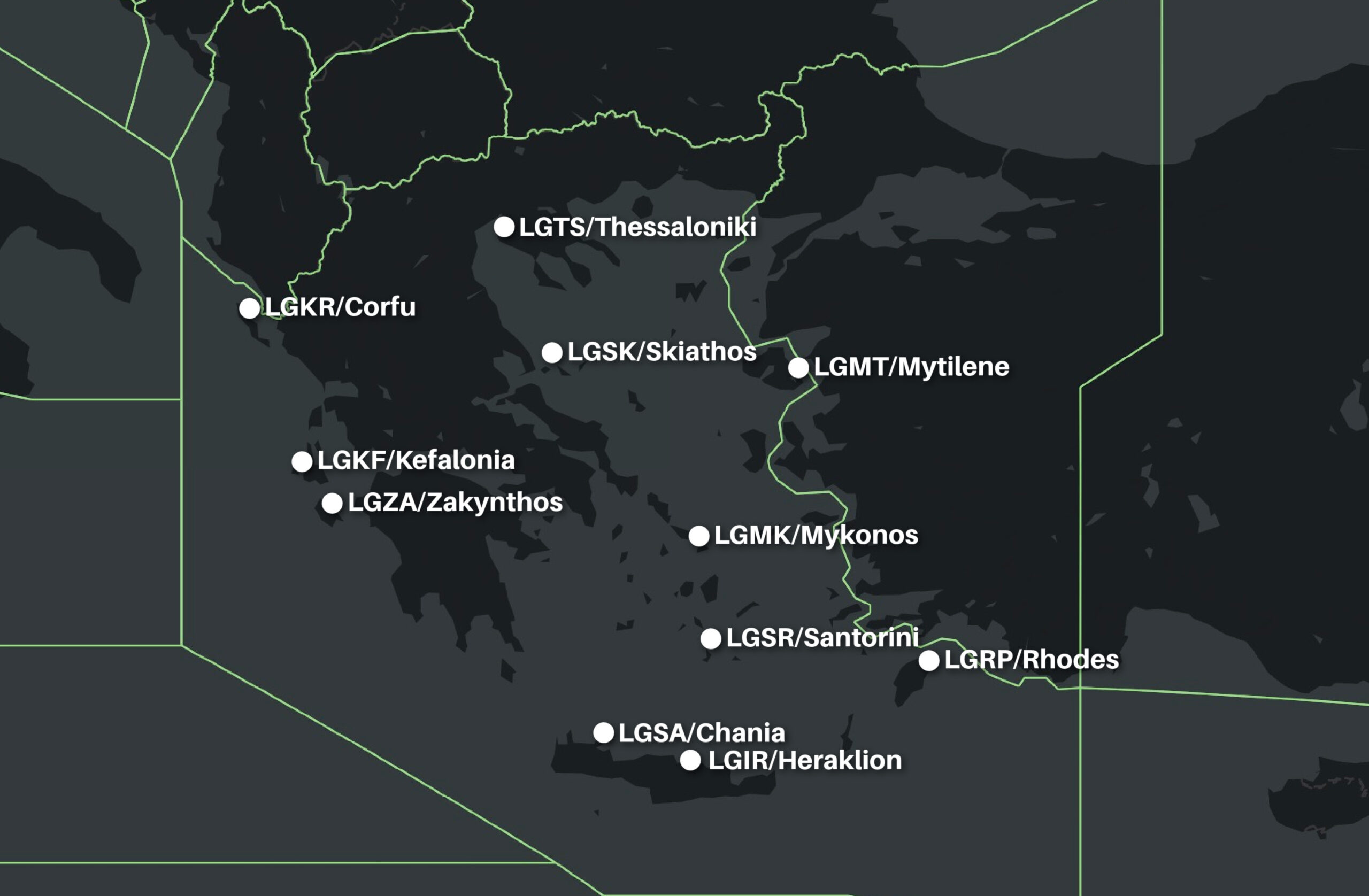
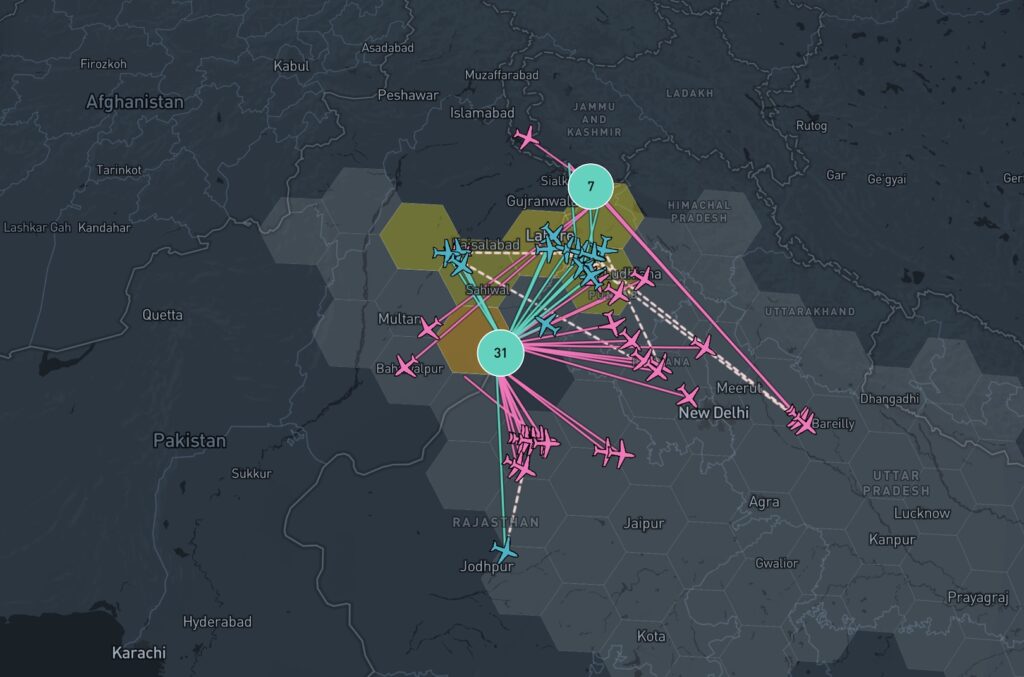
In early November, crews approaching VIDP/Delhi saw navigation anomalies including false EGPWS warnings, incorrect position data and altitude errors – consistent with GPS spoofing.

Image the work of GPSwise and SkAI Data Services.

Hundreds of flights were affected. ADS-B integrity in the Delhi TMA briefly dropped to zero, leaving ATC unable to rely on GPS-based surveillance.

The timing coincided with the temporary withdrawal of ILS for runway 10/28, which increased reliance on RNAV procedures.

The paperwork trail

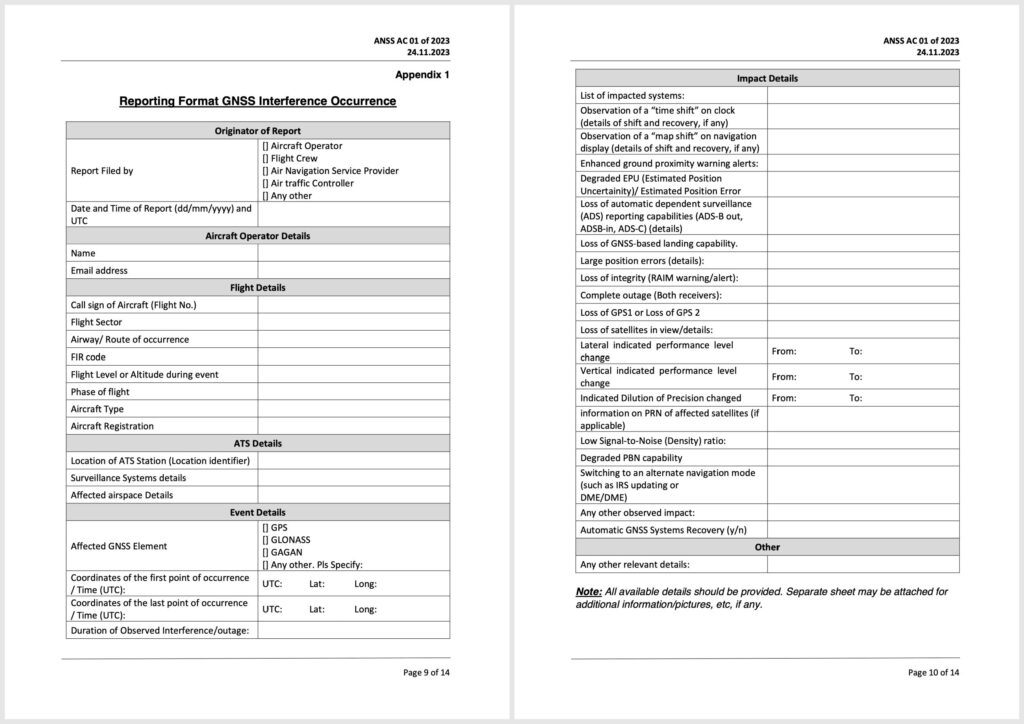
DGCA first outlined its GNSS-interference reporting process in a 2023 Advisory Circular.

On 10 Nov 2025, they followed up with a new SOP on GNSS Spoofing – which included the “report within 10 minutes” requirement.

Crews flagged parts of it as unclear, so on Nov 17, DGCA issued an Addendum to clarify exactly what pilots and operators must do!

What pilots need to do

If interference is detected before top of descent:

  1. Tell ATC as soon as possible.
  2. Notify your operator’s post holder (responsible manager) by any available means.
  3. The post holder must then notify DGCA immediately using the form below.

If interference is detected after top of descent, or only discovered after landing:

  1. Report it to the post holder as part of normal post-flight duties.
  2. The post holder must then notify DGCA using the same form.

DGCA emphasises that the goal is timely reporting, not enforcement!

Click for PDF.

What to expect

A reminder that GPSwise (powered by the experts at SkAI Data Services) provides a real time GPS Spoofing and Jamming map spanning the globe. You can access it here.

Their current data shows a steady interference patch northwest of Delhi. It isn’t constant, but it’s there often enough that crews should expect occasional GNSS issues when routing through that area and be ready to cross-check and revert to conventional procedures.


New RISK WARNING: Somalia ATC Conflict

Update Nov 2025: Somalia-Somaliland Airspace and Permit Dispute 

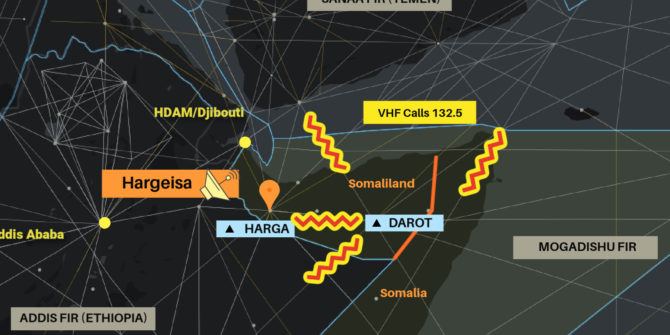
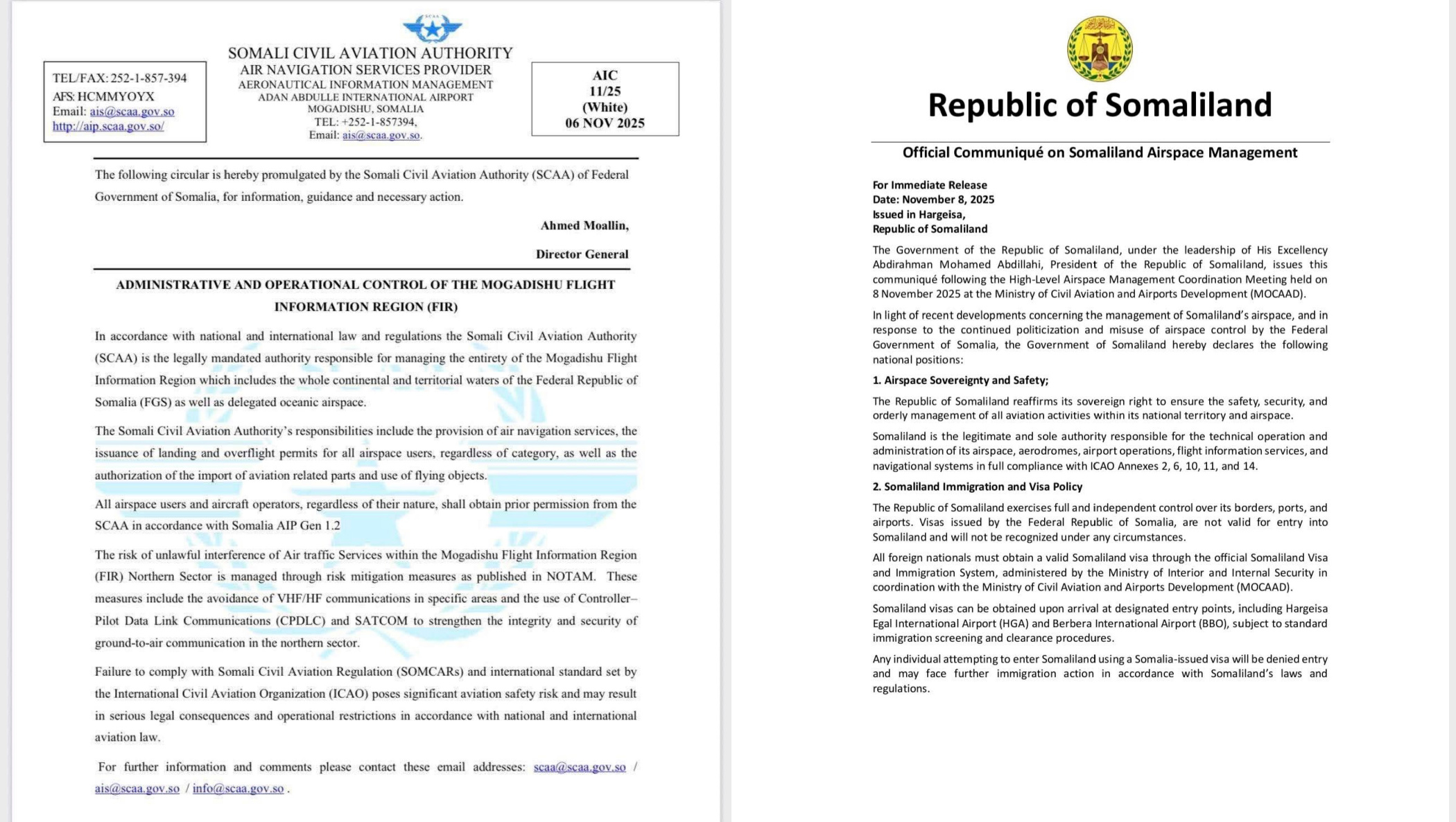
Be aware of an ongoing authority dispute in the north of the HCSM/Mogadishu FIR. Both Somalia and the self-declared state of Somaliland have issued conflicting instructions for overflights. From Nov 10, Somaliland says all flights require PPR from its own CAA, while Somalia has reaffirmed through an AIC that it controls the entire FIR and operators should follow its AIP.

Expect mixed messages on permit requirements near northern Somalia and the Hargeisa region. The Somali CAA remains the only internationally recognised authority for all Class A airspace above FL245 – be cautious of conflicting or unauthorised clearances.

For background on this long-running dispute and its impact on ATC safety, see safeairspace.net.

Ongoing since Feb 2024: ATC Conflict in Somalia

Key information for Flight Crew

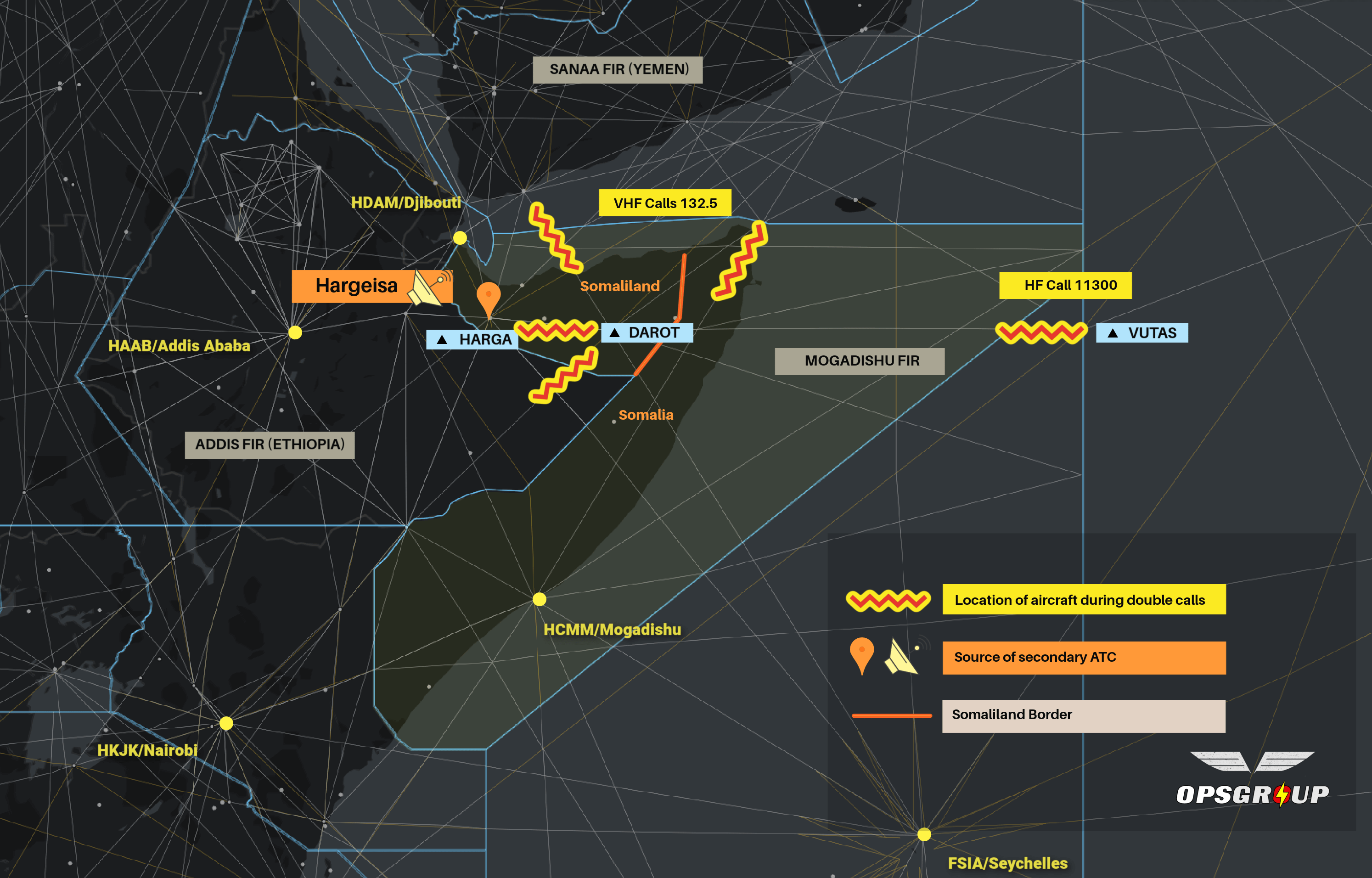
Over the weekend, OPSGROUP has received at least 10 reports of aircraft within the Mogadishu FIR being contacted by a ‘fake controller’ on the same frequency, issuing conflicting instructions.

Crews have been issued climb and descent clearances that are not from the sector controller. Incidents have been reported mostly in the northern part of Mogadishu airspace.

The situation emanates from a political dispute between Somaliland and Somalia, two different countries, though the former does not have international recognition. Both countries now claim authority over the Mogadishu FIR.  

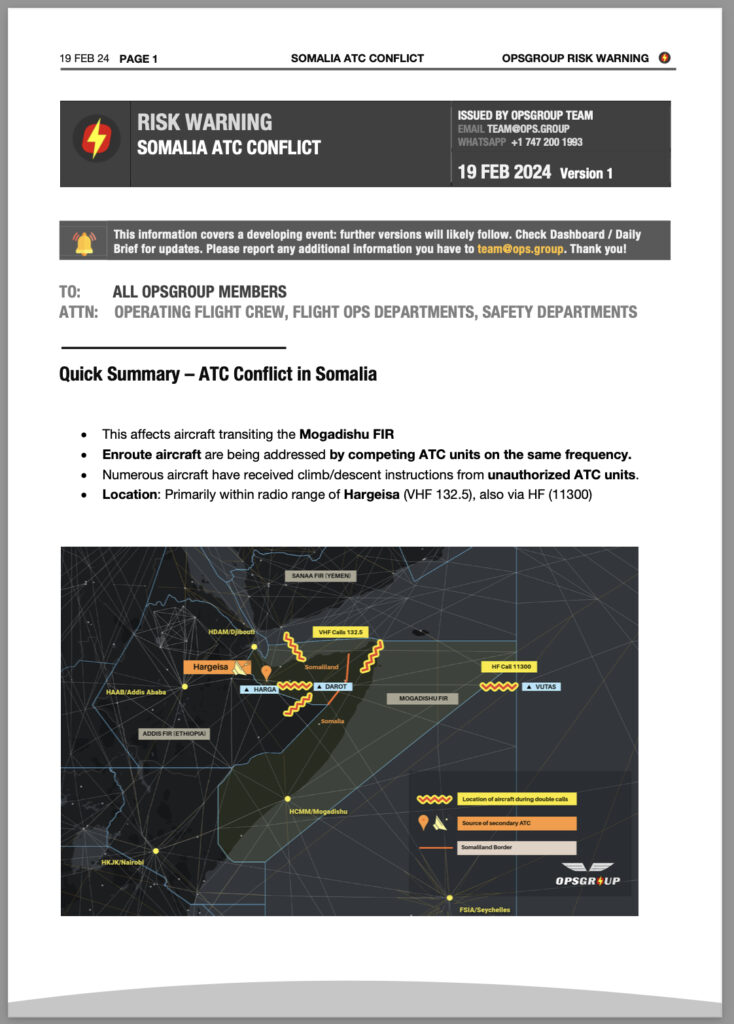
Quick Summary – ATC Conflict in Somalia

  • This affects aircraft transiting the Mogadishu FIR
  • Enroute aircraft are being addressed by competing ATC units on the same frequency.
  • Numerous aircraft have received climb/descent instructions from unauthorized ATC units.
  • Location: Primarily within radio range of Hargeisa (VHF 132.5), also via HF (11300)

OPSGROUP Members

In your Dashboard you’ll find the full Risk Warning, including Crew Reports, Maps, Analysis, and Guidance. If you can’t access, just email the team and we’ll send you a copy.

Download the Risk Warning (PDF, 9 pages, 2Mb) 

Analysis

(Excerpt from the Risk Warning in your dashboard)

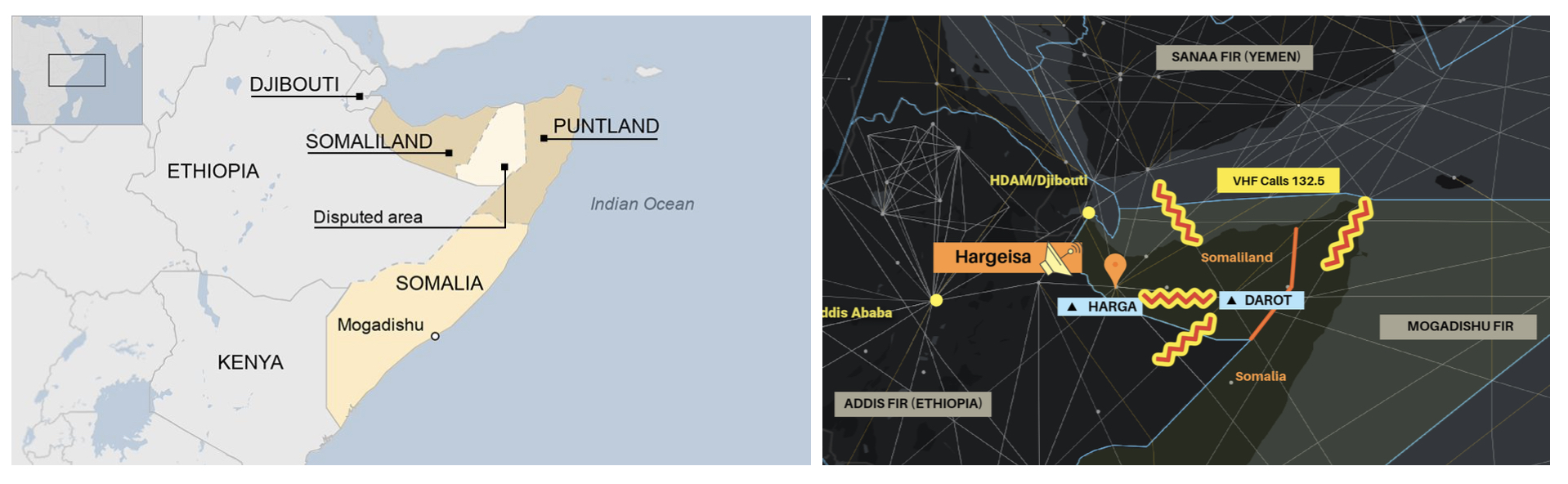
The background to the situation is an escalating political dispute between Somaliland and Somalia. Somaliland has been an independent country since 1991, but without international recognition. Somaliland has to date maintained control over its airports, but Somalia controls the upper airspace from Mogadishu.

In January 2024, Ethiopia signed an agreement with Somaliland, essentially exchanging port rights on the Red Sea for recognition of their country. This was met with condemnation by Somalia. Somalia, in response, began restricting movements into Somaliland by way of denying airspace entry to the Mogadishu FIR in some instances. This has led to Somaliland declaring its right to exercise control over their airspace.

The net result is an airspace dispute between the two territories. Both Somalia and Somaliland now claim the right to control traffic. This is why crews have been contacted by other “controllers” on 132.5 (VHF) and 11300 (HF). Although it is likely that these other “controllers” are genuine Air Traffic Controllers, they are operating outside their area of jurisdiction as things stand.

Currently, the authority over the entire Mogadishu FIR is Mogadishu Control. They remain the sole authority to control, coordinate, and provide ATS services in the Upper FIR. The secondary transmissions are coming from Hargeisa in Somaliland. Although the motive for these transmissions can be understood, they present clear danger to enroute traffic. The transmissions appear to attempt to mimic Mogadishu rather than present as “Hargeisa Control”, “Somaliland Control”, or any clear differentiator from Mogadishu.

It would also appear from the reports that we have received, that the control instructions are not being issued to de-conflict traffic, but rather to create confusion. This may be an effort to draw attention to the airspace issue, but could have tragic consequences. For flight crews, we follow with some guidance to mitigate the situation.

The situation is volatile and may escalate. On Sunday, February 18, an AIS Officer from Somaliland, working in Mogadishu, was found dead at his home. His death appears related to this situation.

Avoidance of Mogadishu airspace would provide ultimate safety, and if the situation continues, would be wise.

[Excerpt, see full Risk Warning for crew reports received, maps, guidance] 


US Shutdown Ends and FAA Lifts Flight Restrictions

Update Nov 17:
  • The US shutdown is over and the FAA says it will end the emergency order at 0600 EST on Nov 17, which means the nationwide flight-reduction limits on the US NAS are being cancelled.
  • That opens the door for airlines to get back to normal schedules. In fact, most of them had already started running full programs over the weekend because they expected the cuts to be cancelled. The system coped, but it will still need a bit of time to fully settle after weeks of strain.
  • And the big news for BizAv: the Notams that shut out GA at the 12 major airports have now been cancelled, so access is open again.
Original story from Nov 11:
  • Congress passed a funding bill late on Nov 10 that’s expected to end the shutdown once signed into law.
  • The FAA hasn’t lifted any of its traffic limits or BizAv bans yet, so everything below still applies until official guidance changes.
  • ATC recovery won’t be instant. Weeks of six-day schedules, long shifts, and financial strain have left facilities short-staffed. Even after the shutdown ends, it will take time for the FAA to rebuild staffing, lift flight-reduction orders, and restore normal capacity. Expect ongoing delays and flow programs in the meantime.

ATC staffing shortages caused by the shutdown have already changed how the country’s busiest airports are operating. Delays have surged, major metro areas are tightening up, and the FAA has put formal limits in place to keep traffic manageable. With the funding deal now in place, these measures should begin to unwind once staffing stabilises – but for now, they remain fully in force.

These limits arrived in two steps:

Nov 7: An Emergency Order issued on Nov 7 reduces airline traffic at 40 major airports and gives the FAA the option to restrict BizAv flights when staffing becomes too thin.

Nov 10: A series of Notams went further, temporarily banning most domestic BizAv flights at 12 of those same airports. These Notams effectively strengthened the restriction powers created under the Emergency Order.

Confusing! Yes indeed. Finer details as follows…

The Nov 7 Emergency Order reducing airline flights at 40 airports

You can view this here.

This applies only to Part 121 airlines and to commuter or scheduled Part 135 carriers, (and for simplicity, let’s just call these guys airlines for the rest of this article).

So, airlines must now reduce their scheduled domestic flights at 40 “High Impact Airports” during the daytime hours of 0600-2200 local. The reduction rises from 4% on Nov 7, to 10% by Nov 14.

On-demand Part 135 flights and private Part 91 flights are not part of the mandatory cuts (and again for simplicity, let’s just call these guys BizAv for the rest of this article!)

The Order also gave the FAA the option to reduce BizAv activity at these airports if staffing levels drop further – which is what then happened with the Notam splurge on Nov 10! (see below for info on that)

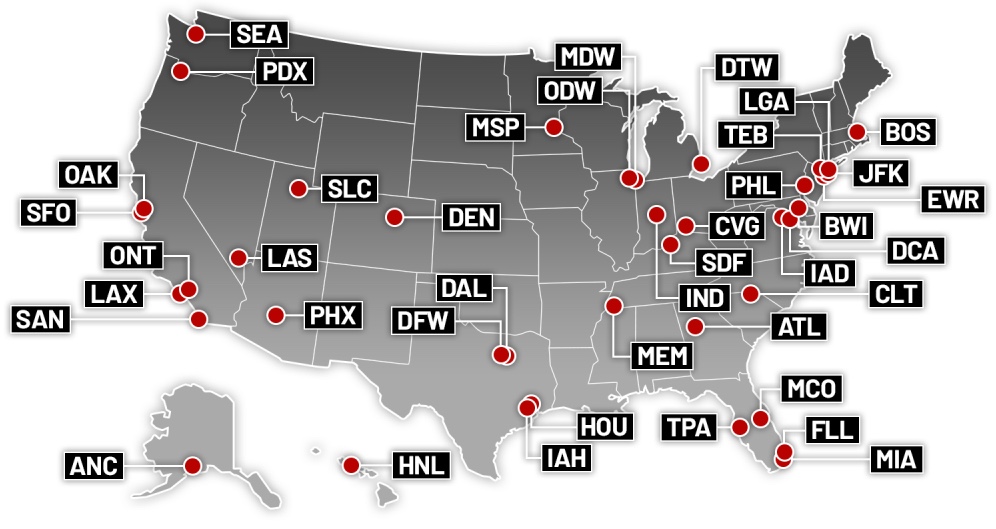
The forty airports listed in the Emergency Order are:

  • KANC/Anchorage
  • KATL/Atlanta
  • KBOS/Boston
  • KBWI/Baltimore
  • KCLT/Charlotte
  • KCVG/Cincinnati
  • KDAL/Dallas Love
  • KDCA/Washington National
  • KDEN/Denver
  • KDFW/Dallas Fort Worth
  • KDTW/Detroit
  • KEWR/Newark
  • KFLL/Fort Lauderdale
  • KHNL/Honolulu
  • KHOU/Houston Hobby
  • KIAD/Washington Dulles
  • KIAH/Houston Intercontinental
  • KIND/Indianapolis
  • KJFK/New York JFK
  • KLAS/Las Vegas
  • KLAX/Los Angeles
  • KLGA/New York LaGuardia
  • KMCO/Orlando
  • KMDW/Chicago Midway
  • KMEM/Memphis
  • KMIA/Miami
  • KMSP/Minneapolis St Paul
  • KOAK/Oakland
  • KONT/Ontario
  • KORD/Chicago O’Hare
  • KPDX/Portland
  • KPHL/Philadelphia
  • KPHX/Phoenix
  • KSAN/San Diego
  • KSDF/Louisville
  • KSEA/Seattle Tacoma
  • KSFO/San Francisco
  • KSLC/Salt Lake City
  • KTEB/Teterboro
  • KTPA/Tampa

The Nov 10 BizAv restrictions at 12 major hubs

Three days later, the FAA issued a much stronger measure: Notams at 12 major hubs that temporarily prohibit most BizAv flights (ie. private Part 91 and on-demand Part 135). You can view the list of Notams here.

These Notams apply only to airports already in the Emergency Order list, which shows they are a targeted escalation rather than a separate policy. Only based aircraft, emergency or public-service flights, or operations authorised by the ATCSCC may use these airports.

The twelve airports with these BizAv restrictions are:

  • KORD/Chicago O’Hare
  • KDFW/Dallas Fort Worth
  • KDEN/Denver
  • KBOS/Boston
  • KIAH/Houston Intercontinental
  • KATL/Atlanta
  • KJFK/New York JFK
  • KLAX/Los Angeles
  • KEWR/Newark
  • KPHX/Phoenix
  • KDCA/Washington National
  • KSEA/Seattle Tacoma

This means the FAA has used the BizAv-reduction authority provided in the Emergency Order and applied the most restrictive version of it at these 12 hubs. Instead of trimming activity, BizAv access has been mostly removed – for now.

The National Air Transportation Association (NATA) has since reported that the FAA told them these restrictions only apply to domestic non-scheduled flights. According to NATA, international Part 135 operations may still be approved with prior coordination through the FAA Command Center. This hasn’t been formally confirmed, so treat it cautiously until the FAA issues official guidance.

Operational impact for BizAv

40 High Impact Airports: Although most BizAv flights are not part of the mandatory Airline reductions, they are still affected by the resulting compression. Expect more flow programs and occasional reroutes at the 40 High Impact Airports.

12 specific BizAv-restricted airports: Access is effectively unavailable for domestic flights unless you meet an exemption. NATA says international Part 135 operations may still be possible with prior coordination through the FAA Command Center, but this has not been formally confirmed. Surrounding satellite airports will likely absorb the displaced traffic, so expect parking shortages there too.

What happens next?

Now that funding’s been approved, the shutdown should finally end – but things won’t bounce back right away. The FAA still has to rebuild staffing, unwind the flight-reduction orders, and reopen the restricted airports.

It’s a familiar story. During the 2018-19 shutdown, a single LaGuardia ground stop sparked nationwide delays and helped force a deal in Washington. This time, the same pattern has played out: rising ATC strain, mounting cancellations, and political pressure finally pushed Congress to act.

Expect a slow return to normal. Delays, flow programs, and limited capacity will likely continue for weeks as the system stabilises. We’ll keep tracking Notams and any FAA updates to the Emergency Order as the situation evolves.


Sudan Risk Update: Aircraft Shot Down

Key Points
  • Following a military coup in April 2023, Sudan airspace remains closed to all civilian flights.
  • An Il-76 was reportedly shot down by a surface-to-air missile near Babanusa on Nov 4.
  • Multiple conflict-zone warnings exist due to the risk of anti-aircraft fire. The country should be considered dangerous at all levels.
  • A Contingency Plan provides limited overflight options via HSPN/Port Sudan, Egypt, Saudi Arabia and South Sudan (where ATC remains suspended above FL245).

Sudan’s airspace (the HSSS/Khartoum FIR) has been largely shut since 2023 and the risk profile has only worsened. Fighting around Khartoum continues, and the reported shootdown near Babanusa shows that overflights remain exposed. A US-backed truce has not reduced the threat environment.

Most operators are now avoiding Sudan entirely, routing through the published contingency corridors or staying in neighbouring FIRs. The lack of ATC above FL245 in South Sudan adds another layer of complexity for anyone trying to cross the region.

Here’s the updated risk briefing…

Context

Sudan remains in a state of civil war between two major powers that used to rule together – the Sudanese Armed Forces (SAF) who control Port Sudan, and a paramilitary group called the Rapid Support Forces (RSF) who control most of Khartoum. You can read more about the background here.

The US Government (along with Saudi Arabia, UAE and several other states ) has been actively pursuing a truce that aims to stop the fighting, open humanitarian corridors and rebuild political stability.

Both SAF and RSF have said yes in principle, but not it seems in practice.

And that means risk to civil aviation will persist. There are several sticking points – SAF wants RSF withdrawn from major cities before anything starts. RSF wants overflight guarantees without any kind of intereference. Any neither is willing to budge yet.

Aircraft Shot Down

On Nov 4, 2025 an Il-76 transport plane of the Sudanese Armed Forces was reportedly shot down in West Kordofan state, southern Sudan by the RSF.

While the armed forces have indicated a structural failure of the aircraft’s wing was to blame, video footage appears to support the RSF’s claim that it was shot down using a short range air defence system of foreign origin.

If proven true, the incident underpins the presence of anti-aircraft weaponry in Sudanese contested airspace, and that even large transport aircraft are not immune to the risks of mistaken identity. Some intelligence suggests that this includes missile systems capable of reaching aircraft as high as FL500.

Conflicting claims about the incident show how unclear the situation is. Based on what we know, the highest risk is during daylight and in areas close to active fighting.

Recent Drone Strikes

On Nov 7, 2025 the RSF launched coordinated drone attacks against at least four cities: Atbara (River Nile State), El-Obeid, Al-Dailang and Omdurman (west Khartoum). Anti-aircraft fire was also reported.

This indicates that flight operations, especially arrivals and departures near the Khartoum region, face an elevated risk of indirect fire and missile activity. Secondary effects such as air-defence responses and unexpected diversions are also possible, particularly at low levels.

Bottom line: treat Khartoum/Omdurman and nearby airports as high-threat airspace. Even if an airport is “open” for domestic traffic, risk in the surrounding airspace remains dynamic.

Contingency Routes

Following the military coup in April 2023, Sudan remains almost entirely closed to all civilian flights.

Sudan has declared its entire sovereign airspace a single restricted area called “HSR5”, and published contingency procedures for civil traffic. It contains three main options for overflights:

  1. One north-south overflight route in the far east of the country down over HSPN/Port Sudan airport.
  2. Some north-south diversionary corridors available via Egypt and Saudi over the Red Sea.
  3. Some east-west routes over South Sudan.

#1: North-South overflight route over HSPN/Port Sudan airport

They call this route ‘CR6’ – and it’s the only published track through Sudan’s restricted area HSR5.

It links the Addis and Cairo FIRs via ALRAP-KSL-PSD-P751-ALEBA. Levels are fixed for safety, FL320 northbound and FL330 southbound. There is no ATC separation, and prior permission is required.

Think of this as a narrow humanitarian corridor – it’s available but not intended to carry normal traffic.

The contingency plan points you to the Sudan AIP (GEN 1.2) for how to get permission, but the short version is this: operators must secure diplomatic clearance before the flight, and you can’t ask airborne. If you are allowed in, make sure you stick to CR6 like glue.

While technically possible, we advise extreme caution. What we don’t know are the safety margins applied to the contingency route or what may be unfolding beneath it.

#2 Red Sea Diversionary Corridors

These allow north-south traffic to move between the HECC/Cairo and OEJD/Jeddah FIRs without touching Sudan at all. They are the safest and cleanest option right now because you stay entirely within Egyptian and Saudi Arabian airspace, skirting the Sudanese coastline.

#3 South Sudan (KFOSS Routes)

KFOSS stands for ‘Khartoum FIR Over South Sudan’ and apply above FL245.

These routes allow for a safe(-ish) east-west crossing of South Sudan without entering Sudan itself. They’re RNAV 5, and mostly bi-directional. You report regularly, keep ADS-B and your transponder on and maintain 15-minute spacing.

One big caveat though – KFOSS routes are uncontrolled. Juba provides traffic advisories only.

Airspace Warnings

Several states (including the UK, France, Canada and Germany) maintain active airspace warnings that advise against entering the HSSS/Khartoum FIR at all levels due to risk of anti-aircraft fire and military activity.

For some reason, US operators technically have no legal restrictions as at the time of writing the FAA has issued no airspace advisories (Notams or SFARs) for Sudanese airspace.

Stay Updated

We will continue to report on any changes to the situation in Sudan as it develops. This includes our Safe Airspace website where you can view all active airspace warnings, along with those that exist in adjacent airspace. Our team keeps this updated around-the-clock.


Farewell, Paper Jepps

It’s the end of an era. After nearly a century of keeping pilots flipping, folding and cursing in cramped cockpits, Jeppesen is calling it a day on its paper chart service.

It will be retired by 31 Oct 2026, closing a chapter that began when Elrey Jeppesen first sold his little black book of hand-drawn airfield notes in the 1930s.

For many, it’s like losing an old friend. One that was heavy, expensive and always due an update. But it never froze, crashed or ran out of battery.

If you still like the feel of paper in hand, Jeppesen says a few options will remain…

Why end a good thing?

Essentially, cost. Paper chart operations aren’t cheap – printing, shipping, updates and physical inventory are all expensive. Something that Jeppesen itself refers to as the ‘growing costs of managing paper.’

The industry has overwhelmingly transitioned to digital charts thanks to the proliferation of EFBs, tablets and integrated avionics. And all good things must come to an end.

But what is the operational impact of this change? And how will you be affected if still using paper in the flight deck?

Operational Impact

If your operation still relies on paper Jepps, now is the time to plan ahead. The exact impact depends on what part of the law you operate under.

Part 91:

With the exception of Part 91K, Part 91 operators can switch from paper to digital charts without FAA authorisation.

But there are a few caveats:

  • The PIC must ensure that the electronic charts being used are current and accurate.
  • You’ll also need a backup (a second device or app). Printed charts also count (but obviously, you’ll soon need to print them yourself).

In other words, you can switch at your own discretion as long as you cover the basics above.

Parts 91K, 125, and 135:

The ‘pathway to paperless’ is a little more complicated.

All require OpSpec A061 that authorises EFB use. You’ll need to adequately show that there are procedures and training in place for crew, and that there is a backup plan for failures.

There will also need to be procedures in place for device mounting, power compliance and the update process.

For Part 91K operators, the lead time is typically 1-3 months. In the case of Part 135, this is longer. Most go through a ‘paperless transition’ period – operating with both paper and electronic charts until fully approved.

Part 121:

Most (if not all) are likely already approved for EFB use.

If there are any outliers still out there, a full formal approval is required. This typically takes 3-6 months.

This involves the airline submitting a detailed EFB program to the FAA’s Principal Operations Inspector.

The process is structured and lengthy and includes factors like power/heat analysis, training and other risk assessments. So much so that airlines have entire manuals dedicated to their EFB operations.

Jeppesen itself also provides solid guidance on this process.

I still want paper!

Fear not – it can still be done, just with a little more elbow grease.

Jeppesen will continue to sell it’s (blank) 7 hole-punch paper via its online store here.

Most popular EFB services (including ForeFlight and FD Pro) support user printing.


Timeline of North Atlantic Changes

This page has a timeline of big NAT changes, for the six Oceanic Area Control Centres (OACC’s): EGGX/Shanwick, CZQX/Gander, BIRD/Iceland, ENOB/Bodø, LPPO/Santa Maria, and KZWY/New York Oceanic.

2025

  • Sep 2025: Shanwick’s move to Oceanic Clearance Removal is now delayed until after summer 2026, following challenges seen during Gander’s rollout. More info.
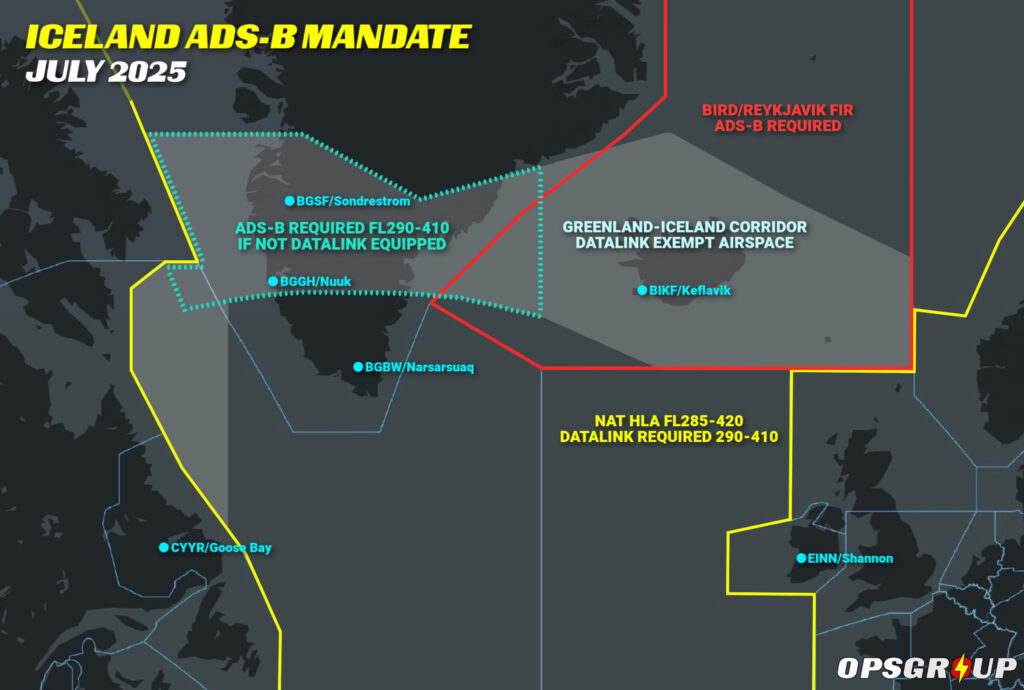
  • July 2025: ADS-B is now mandatory in the entire BIRD/Reykjavik FIR. More info.
  • June 2025: The extensively expanded BGGH/Nuuk airport in Greenland is now open, and receiving regular jet traffic. BGSF/Sondrestrom will soon downgrade ATC to AFIS. BGBW/Narsarsuaq will likely close in Spring 2026. More info.
  • May 2025: Since Canada removed Oceanic Clearances in Dec 2024, things haven’t exactly gone smoothly. Crews are confused. Controllers are overloaded. Frequencies are clogged. So from May 5, Gander will stop sending pre-Oceanic route changes via CPDLC and switch to VHF voice only. More info.
  • March 2025: Reykjavik OCA updated procedures with NAT Doc 007. Crews must now send their RCL no earlier than 15 minutes prior to the OEP (previously 20). Squawk 2000 ten minutes after the OEP is now standard everywhere except in Reykjavik CTA and Bermuda radar coverage. More info.
  • March 2025: Updated NAT Doc 007 published. Main changes: the Blue Spruce Routes were removed, new chapters on Space Weather Contingencies and GNSS Interference Events. More info.
  • January 2025: NAT Ops Bulletin #1/2025 published with procedures for flights affected by GPS jamming or spoofing. Crews should advise ATC early in the RCL message to avoid being excluded from the NAT HLA. More info.

2024

  • December 2024: Shanwick postponed its transition to Oceanic Clearance Removal (OCR), originally planned for Dec 4, 2024. By this point, Santa Maria and Iceland had already implemented OCR in March 2024, and Bodo and Gander followed in December – leaving Shanwick as the only NAT ANSP still requiring oceanic clearances to westbound flights entering from domestic airspace. More info.
  • March 2024: Beginning of the process of Oceanic Clearance Removal (OCR) for all NAT FIR’s. More info.
  • March 2024: Comms Failure Procedures simplified. More info.
  • March 2024: Squawk 2000 10 minutes after OEP is now standard in all NAT FIR’s, except Reykjavik. More info.

2023

  • Sep 2023: The US FAA officially renamed WATRS airspace to WAT. Existing B050 authorizations will be re-issued within 24 months. More info.
  • Jan 2023: There were some changes to the boundaries of the datalink exempt airspace in the northern bit of the North Atlantic. This used to extend down south to SAVRY, but now only goes as far as EMBOK. So now you need datalink in the NAT oceanic airspace over Greenland controlled by Gander. More info.

2022

  • June 2022: HF data link (ACARS) does not meet the satcom part of the NAT DLM requirement – you need Inmarsat or Iridium for that. So if you want to fly in NAT DLM airspace (FL290-410 in the NAT region) “J2” in field 10a of your FPL won’t work anymore – you need “J5” for Inmarsat or “J7” for Iridium. More info.
  • March 2022: All NAT Tracks at FL330 and below were abolished. It means operators will have the flexibility to file random routes at FL330 and below when flying between Europe and North America. Particularly for operators unable to file routes across NAT Tracks with active flight levels, this means much greater flexibility in choosing their own trajectory. More info.

2021

  • July 2021: The “MAX UPLINK DELAY VALUE TO 300 SECONDS” message will now be sent to all aircraft – and each time you logon to a new OACC. More info.

2020

  • Jan 2020: Update on the Datalink Mandate. Effective Jan 20, 2020, datalink (CPDLC and ADS-C) is now required between FL290-410 in the NAT region. There are exempted areas: North of 80N, Surveillance airspace over a section of Greenland and Iceland (where ATC can see you on radar or ADS-B), and New York Oceanic East. Aircraft without datalink can request to climb/descend through datalink mandated airspace, but will only be considered on a tactical basis – most likely you’ll get stuck under FL290. More info.

2019

  • Micro-SLOP. ATC don’t seem to like the term, but that’s basically what it is. Before, you could only SLOP centreline, 1NM or 2NM to the right. But since 2019, all NAT OACCs started allowing offsets right of centreline in tenths of a nautical mile up to a maximum of 2NM. More info.
  • ASEPS. Reduced longitudinal separation (down to as close as 14NM) has been happening since April 2019 in Gander, Shanwick, and Santa Maria. But from Oct 2019, lateral separation will be reduced to 19NM from the previous PBCS limit of 25NM for compliant aircraft. To be able to get this reduced separation, you’ll need ADS-B and to be fully PBCS compliant (i.e. meet the specs of RNP4, RCP240 and RSP180). Read the ICAO Bulletin for more info.
  • OWAFS Operations Without a Fixed Speed. In other words, you get to decide how fast you fly. It’s been happening in the Shanwick, Santa Maria, and New York Oceanic FIRs since Apr 2019. Iceland say they will start doing this some time around Oct-Nov 2019. You get a normal oceanic clearance, with a fixed Mach Number, like you always did. But then somewhere after the Oceanic Entry Point, you may get a CPDLC message saying RESUME NORMAL SPEED. You should reply with WILCO. What that means is: Fly ECON, or a Cost Index with Variable Mach. You can fly within 0.01 up or down of your cleared Mach, but if it varies by 0.02 or more you must advise ATC. Read the ICAO Bulletin and check out our article for more info.
  • PBCS From March 29th 2019, there may be more than just three daily PBCS tracks. They will continue to be only FL350 to FL390 inclusive and only on the designated tracks during the period the tracks are in effect. There may be days where there are no PBCS tracks, 3 PBCS tracks, 5 PBCS tracks, potentially even all the tracks.
  • Contingency Procedures From March 29th 2019, new contingency and weather deviation procedures were introduced. For contingencies, you now turn at least 30 degrees and offset by 5 NM. For weather deviations, you now do your 300ft up/down offset when 5 NM away from track. More info.

2018

  • PBCS From March 29th 2018, PBCS is a requirement for the daily mandated PBCS NAT Tracks (right now, that the 3 core tracks each day) between FL350-390.  PBCS for the NAT means having both RCP240 (4 minute comms loop) and RSP180 (3 minute position reporting). If you’re missing approval for either, then you can fly anywhere other than along the core NAT tracks FL350-390. Read more about PBCS in our article, and check out the NAT Circle of Change for an easier graphical representation.
  • RLAT  From January 4th 2018, Shanwick and Gander increase the number of RLAT tracks – most tracks between FL350-390 will now be RLAT – 25nm separation between them. RLAT replaced by the term PBCS.

2017

  • SLOP – Offsetting is now mandatory. Choose 0, 1, or 2nm right of track. We think 1 or 2 is best. Consider the recent A380 story.
  • TCAS 7.1: From January 1st, 2017, TCAS 7.1 is required throughout the entire NAT region.
  • Cruising Level: Effective 2017, you no longer need to file an ICAO standard cruising level in NAT airspace.
  • Gross Nav Error: This is now defined as greater than 10nm. Everywhere else in the world, it’s 25nm.
  • Datalink Mandate: Since Dec 2017, datalink now required throughout the NAT Region from FL350-390. Exempt areas: Tango Routes, airspace north of 80N, Surveillance airspace, Blue Spruce routes, and New York OCA.

2016

  • Confirm Assigned Route Introduced August 2016, you will see this message when you enter NAT airspace with datalink, and you should reply with the planned route in NAT airspace. Designed to catch errors.
  • NAT HLA The airspace formerly known as MNPS. Changed February 2016. NAT HLA = NAT High Level Airspace. Now includes Bodo Oceanic, and aircraft must be RNP 4 or RNP10. Previous MNPS approvals good through 2020.

2015

  • RLAT Started December 2015, spacing on the NAT Tracks reduced to “Half Track” (30nm) for 3 core tracks. RLAT=Reduced Lateral Separation Minima. Next phase of this (ie. all NAT Tracks 350-390) was introduced in Dec 2017.
  • SLOP Offsetting right of track by 1nm or 2nm became Mandatory.

Beware Below: New Warning on QNH Errors

Two years have passed since we published our original piece on QNH errors, and the issue hasn’t gone away. In fact, there have been more serious incidents linked to incorrect altimeter settings below transition. Here’s what’s happened since then.

The Paris Near Miss

The final report is out on a serious incident at LFPG/Paris Charles de Gaulle in May 2022. An A320 was flying an RNP approach (LNAV/VNAV minima) in IMC when ATC passed the wrong QNH – 1011 instead of 1001, a 10 hPa difference.

That mistake meant the aircraft flew the approach about 280 feet lower than it should have. A ground proximity alert went off in the tower, but the controller got no reply from the crew.

At minima, with no runway in sight, the crew went around. The aircraft’s radio altimeter later showed a minimum height of just six feet – one mile short of the threshold.

The crew never realised. The wrong QNH made their instruments show they were higher than they actually were, so everything looked normal. The heights matched the chart, and EGPWS didn’t trigger.

They tried again, still with the wrong QNH set. This time they broke out and landed safely, again passing within a few feet of the surface before the threshold.

You can read the full report and safety recommendations here.

Updated EASA Guidance

On October 22, EASA reissued its Safety Information Bulletin (SIB) on incorrect barometric altimeter settings. You can download it here. It warns that QNH errors can not only lead to CFIT but also reduce separation from other aircraft, increasing the risk of midair collision.

This applies to all phases of an instrument approach, including the missed approach.

The SIB points out that QNH errors can creep in at several points – from how meteorologists determine it, to how ATC passes it, to what the crew actually sets.

The SIB contains some valuable recommendations for operators:

  • Develop SOPs to make sure pilots cross-check QNH from at least two independent sources (for example, ATIS and ATC). Don’t rely on handwriting or word-of-mouth!!
  • Assess these procedures, and hunt for ways in which errors may still occur. Then continue to refine them.
  • Use FDM or FOQA data to flag and investigate any altimeter mis-sets and learn from them.
Our Original Article

If you fly any baro-based approach (that’s most of them except ILS, GLS, or RNP to LPV) you need to know how a simple QNH mistake can put you below profile without you realising it.

Back in 2023, ICAO put out a warning about this. Here’s the quick version:

Key Points

  • QNH errors have led to several serious approach incidents.
  • Affected approaches: VOR, NDB, LOC, RNP, and RNP AR.
  • Main causes: bad data, misheard ATC calls, and cockpit workload.
  • Fix: raise minima, stick to SOPs, cross-check QNH from two sources, and speak up if it sounds wrong.

A Wolf in Sheep’s Clothing

An innocuous QNH error can easily place your aircraft hundreds of feet below profile in the final approach segment of a non-precision approach. And there may be very few signs – save for our eyeballs, our radio altimeter, or ultimately our EGPWS.

And perhaps the approaches most vulnerable to this threat are those which use BARO-VNAV – in other words, the use of our aircraft’s barometric altitude information to compute the aircraft’s vertical guidance.

The problem is that to fly these approaches safely, our altimeters must be accurate. That entirely depends on pilots setting the correct QNH. It is a simple task riddled with potential for insidious errors – something that no pilot (or controller) is immune to.

Which is why ICAO recently published a new Ops Bulletin on this very problem. They can’t fix it, but they can help mitigate it. Here’s a run-down on what they had to say.

Risky Business

If you’re reading this, chances are you have a reasonable idea about how an altimeter works. In the most basic sense, we calibrate these pressure-sensitive devices to provide an altitude above whatever datum we need them for – in most cases, sea level.

This essentially creates potential for two errors:

  1. Temperature: although this is less of an issue, because we can anticipate and correct for it.
  2. A mis-set: or in other words, rubbish in rubbish out. The altimeter doesn’t know if it’s telling you lies. In the same sense that a conventional clock doesn’t know that it’s wrong – it just runs from whatever time you set it to. The consequences of this type of error are far worse.

Final Approach

ICAO’s Bulletin focuses on the final approach (inside the FAF) simply because this is where altimeter errors become most critical.

In this segment, ICAO-compliant procedures only guarantee a smidge less than 300 feet of obstacle clearance (ICAO Doc 8168 Vol II if you’re feeling bold). Interestingly, this almost perfectly correlates to an altimeter error of 10hPa…

Are you sure that 1023 QNH you just heard on that scratchy ATIS wasn’t actually 1013?

…it’s easy to see how critical errors can become. Like the example below:

Which approaches are affected?

It can be easy to get lost in the sea of acronyms out there. So let’s keep it simple:

Not vulnerable: ILS, GLS, and RNP to LPV minima. In other words, approaches that do not rely on barometric altitude to fly the correct profile. One gotcha tho – DA is still based on your altimeter. You may therefore go around early or late with an incorrect QNH but the profile itself will still be correct.

Vulnerable: Everything else – including VOR, NDB, LOC, RNP, and RNP (AR).

Why are QNH errors happening?

ICAO has some ideas:

Bogus Data: This may be incorrect information supplied by a met service provider, corrupt hardware on the ground or even by assuming area QNH will be close enough to airport QNH.

Chinese Whispers:Don’t underestimate the power of what you think you heard. This can happen anytime we are relying on voice to communicate safety critical information. It’s not just pilots either – ATC may not pick up that your read-back was incorrect. If you fly internationally, the language barrier can also be a challenge. Even domestically we form habits of talking at speed on the radio. If there is any doubt, use the phrase “Say Again Slowly.”

Workload: Have you ever been in this boat? You’re passing through transition, changing to an approach frequency, slowing to 250kts, securing the cabin and trying to run an approach checklist….all at the same time. Depending on where the transition level is (for example, FL110 in Australia) it can clash with your other flight deck duties. Crew confusion, miscommunication and even finger trouble can come into play here.

What can we do about it?

Consider other approaches: iI there’s an ILS or similar available and conditions are poor, consider using it instead.

Think about minimas: ICAO suggest raising your minima particularly if you are unfamiliar with an approach type.

Stick to the SOPs: and cross check. Treat QNH like that stove you think you left on every time you leave for a multi-day trip. Become paranoid and find that error. Cross-check the QNH across multiple sources – at least two independent ones for each and every approach.

Don’t forget to ask yourself – is it sensible? A good way to cross check this is by comparing the ATIS QNH to the TAF or METAR QNH. If there is any doubt, confirm it with ATC.

Be especially suspicious of anything hand-written: If you’ve obtained a QNH by voice, make sure you have both independently heard it.

Don’t forget other sensibility checks: Terrain permitting, your radio altimeter may give you an early clue that all is not right – especially if you’re over flat terrain or water.

ICAO also suggests that ATCOs and ANSPs have a role to play too: It’s little beyond the scope of this article, but you can find that info in the very same bulletin.

Have a story to tell?

Please share it with us in confidence. You can reach us on team@ops.group.


Spoofed Before the NAT? Here’s What to Do

An OPSGROUP member on a recent westbound NAT flight from the Middle East received the following message via CPDLC:

The crew contacted Shanwick via HF, who requested their RNP capability and operational status.

The controller explained that due to their point of departure (OMAA/Abu Dhabi) they wanted to be certain the aircraft had not been contaminated by GPS jamming or spoofing before it entered oceanic airspace.

It’s been a while since we wrote about this procedure, and since then we’ve had this NAT Ops Bulletin published by ICAO telling operators what to do on the NAT if they’ve experienced jamming/spoofing, so we reached out to NATS directly for an update. Here’s what they had to say…

Defensive Measures

NATS reported they continue to receive a large number of flights every day that have been impacted by GPS interference prior to oceanic boundaries.

The issue is that once an aircraft’s navigation system has been ‘contaminated’ by bad GPS data, it may not be possible to recover full RNP capability in flight, even if the normal GPS signal is restored.

These aircraft may no longer meet RNP 4/10 accuracy required in the NAT HLA, even long after the trigger event occurred.

The NAT Ops Bulletin which was published back in Jan 2025 requires crew of NAT-bound aircraft that have encountered GPS interference to notify their first NAT ANSP via RCL. Even if your aircraft shows no lingering effects, ATC still want to know.

NATS advise that late notification by pilots of a RNP degradation (such as approaching an oceanic entry point) greatly increases controller workload. They often need to move other aircraft out of the way to provide increased separation (in some cases from 14nm to 10 minutes), it’s a big deal.

As a result, they are employing defensive controlling measures. Based on previously spoofed/jammed flights and regions of known risks, they may proactively contact flights assessed as higher risk to confirm status before entry – although the exact selection criteria isn’t public. Increased separation will be applied until normal navigation performance is confirmed by the pilots.

In a nutshell, this is why the OPSGROUP member received the message above.

A special thank you to NATS for their help in answering this question.

Jammed or spoofed? You need to let your NAT ANSP know

The NAT Ops Bulletin we keep mentioning – this provides the guidance for NAT traffic on how to manage GNSS interference. Here it is again, so you can’t miss it! ⬇️

Key takeaway from this: If you suspect or know that your aircraft has encountered any kind of GPS interference (both jamming or spoofing), NAT-bound traffic must let their first NAT ANSP know in the RCL – even if the aircraft appears to have recovered.

This is prefixed by ‘ATC REMARKS/GNSS INTERFERENCE’ and must include details of any system degradations.

A few messages to keep handy are:

‘ATC REMARKS/GNSS INTERFERENCE NO IMPACT.’

‘ATC REMARKS/GNSS INTERFERENCE NO CPDLC/ADS’

‘ATC REMARKS/GNSS INTERFERENCE RNP 10 ONLY’

‘ATC REMARKS/GNSS INTERFERENCE NON-RNP10

By including your status in the RCL, you are giving ATC a head’s up before you arrive.

In most cases, you will still be allowed in the NAT HLA. A loss of RNP 4 isn’t a deal breaker, as you can still enter under RNP 10. But your clearance may be less optimal (likely level changes) due to the increased separation from other traffic.

The big one to look for is a loss of RNP 10. You will not be cleared into the NAT HLA, and instead will need to remain below FL290 or above FL410. With an obvious fuel impact, this may lead to an unplanned diversion.

The Bulletin includes a handy flow chart that’s worth printing and keeping in your flight bag.

Latest ICAO Feedback

The latest three-yearly ICAO Assembly was held in Montreal from Sep 23 – Oct 3.

During the event, ICAO issued its strongest condemnation yet of both Russia and North Korea, directly blaming them for deliberate GNSS interference in violation of the Chicago Convention. Russia, in particular, has been blamed by ICAO for destabilising navigation across European airspace.

We continue to receive regular reports from OPSGROUP members of both jamming and spoofing. Interference is now a regular occurrence in the Baltic region, particularly around Kaliningrad, Eastern Finland, the Baltic Sea, and nearby airspace. Other reports have been received from Germany, Poland and Norway.

Recent airspace incursions, airstrikes and drone activity associated with the ongoing conflict in Ukraine have almost certainly escalated the use of GPS interference as a defensive measure. Civil aviation will continue to operationally grapple with this hazard. With no obvious solution in site, our best defence remains procedures like the one detailed above.


APEC 2025: South Korea Ops Impact

South Korea is gearing up to host the APEC Leaders Summit in Gyeongju from Oct 31 to 1 Nov 1. Both Donald Trump and Xi Jinping are expected to attend, along with leaders from 21 member countries. That means tight security and plenty of disruption at airports across the country from around Oct 25 to Nov 3.

If you’re operating a BizAv flight to Korea during that week, what you can do depends on whether you’re flying with APEC pax or without them. So that means delegates, government officials, or anyone else going to the event. To not make the rest of this article too wordy, we’re going to call these “APEC-related” flights!

If you’re APEC-related

Your life will be easier, but still tightly controlled.

  • RKSI/Incheon: The main international gateway and the primary arrival point for heads of state. Only APEC-related flights will be allowed to park or operate here until Nov 3. Expect strict ramp control and ground handling reserved for official delegation movements.
  • RKTN/Daegu and RKTH/Pohang: Both near Gyeongju and being used as APEC support airports. Only APEC-related flights will be allowed in here during this period, but only for quick turns. Parking is limited to about an hour and a half, with no overnights. RKTH/Pohang is a domestic airport but will open to international flights between Oct 25 – Nov 1.

If you’re not APEC-related

For regular BizAv flights, options are limited.

  • RKSS/Gimpo: This is your best shot. It’s open for everyone – regular BizAv, diplomatic, APEC-related and non-APEC related, though ramp space is scarce. Parking is capped at five days, and slot requests should be made early. Expect congestion.
  • RKPK/Busan: A confusing one! It’s only available to diplomatic flights from Oct 27 – Nov 2. So that’s only the highest tier of APEC-related flights, we’re guessing. PPR is also required, as RKPK is a military airport.
  • RKPU/Ulsan: Domestic only, not available for APEC flights, and parking suspended.

As of now, there are no SUPs, AICs, or Notams published setting out these restrictions. Expect last-minute Notams later this week once security plans are finalised.

If you’re carrying APEC pax, expect strict time limits at RKTN/Daegu or RKTH/Pohang. If you’re flying a regular BizAv flight into South Korea, plan on using RKSS/Gimpo and book now! RKSI/Incheon and the nearby regional airports will be off-limits for you.

A high-security, high-traffic week is coming – plan accordingly and keep checking for updates! And if you need help with handling at any of these airports during this period, we recommend getting in touch with Nexus Jet Support at support@nexusjet.net.


Pilot Age Limits – The Full Picture

Here’s something we’ve been meaning to do for a long time. It seems there’s no single place online where the rules on pilot age limits are spelled out in plain English. So here you go, friends. If you’ve got suggestions, corrections, or edge cases we’ve missed, drop us a note at blog@ops.group.

The basics:

  • For international commercial flights: all pilots must be under 65.
  • For domestic commercial flights: most countries follow the same 65-year rule, but some go further – Argentina, Australia, New Zealand, Canada and Japan all allow older pilots under certain medical and operational conditions, while others, like India, apply stricter limits.
  • For private flights: there’s no age limit anywhere. The only restriction is the pilot’s medical.

Who makes the rules?

The starting point is ICAO. Annex 1 – Personnel Licensing sets the global standard for pilot age in international commercial air transport operations. The rule is simple:

  • 65 years old in multi-pilot operations
  • 60 years old in single-pilot operations

These limits apply only to commercial flights – airlines and charter. They do not apply to private flying, where ICAO sets no age restriction at all.

In Europe, EASA mirrors ICAO exactly:

In the US, the FAA applies the 65 limit only to Part 121 airline pilots:

Part 135  charter pilots face no FAA domestic age cap, but once those flights go international, the ICAO 65 rule applies to all pilots on board.

Part 91 private operations are not affected domestically or internationally – there is no ICAO age limit for non-commercial flights, only the medical.

In theory, all ICAO member States should apply the same rules. In practice, some do not. Inside their own borders, countries can be stricter, looser, or set no limit at all. For international flights, the countries that matter are: the State that issued the licence, the State of the operator, and the States being flown into or over. If any of those apply a stricter rule, that’s the one that decides whether the flight can operate.

Once a pilot reaches their 65th birthday, they are no longer eligible to serve on international commercial flights, unless every country on the route specifically authorises it. Under Articles 39 and 40 of the Convention, ICAO Doc 7300, a licence that does not meet ICAO standards such as age limits must be endorsed, and it can only be used internationally if the States concerned specifically accept it.

Medical requirements also tighten with age. According to ICAO Annex 1, pilots over 60 on commercial ops must renew their Class 1 medical every six months instead of once a year.

There used to be an additional condition: if the captain was between 60 and 64, the other pilot had to be under 60. ICAO removed that rule in 2014. Today, two pilots over 60 may operate together without issue.

Private flights

ICAO does not impose any age limits on private, non-commercial operations. A pilot can continue flying internationally at any age – provided they hold a valid medical certificate.

The type of medical required depends on the operation. A Class 1 (ICAO Annex 1) is needed for commercial flying, valid for 12 months until age 60 and then 6 months thereafter.

For private flying, a Class 2 (Europe) or Class 3 (US) medical is sufficient. Standards are lower, checks are less frequent, and validity periods are longer.

In Europe: Class 2 is valid for up to 60 months if you’re under 40, 24 months between 40-49, and 12 months once past 50:

In the US: Class 3 is valid for 60 months if you’re under 40, and 24 months once past 40:

For commercial ops, shorter medical validity periods apply – the details can be found in the same ICAO Annex 1, EASA Part-MED and FAA §61.23 references.

Different rules at home

Countries can set their own age limits for domestic operations. Many follow ICAO’s 65-year rule, but others do it differently. Here are a few examples, and if you’ve seen something else in your ops, let us know!

Argentina: Argentina dropped its old pilot age limits in 2024. Airline/charter pilots can now fly domestic ops until 66 (single-pilot) or 68 (multi-pilot). For international flights, crews must still follow the destination country’s age rules. Private flights already had no age limits here. More info here.

Australia: ICAO’s 60/65 limits don’t apply. There’s no maximum age, but pilots over 60 must pass extra medical and flight reviews. More info here.

New Zealand: Pilot licences are issued for life, with no age cap. Validity depends only on maintaining medical and competency standards. More info here.

Canada: No upper age limit and no loss of privileges after 60 or 65, provided medical and proficiency standards are met. More info here.

Mexico: Couple of issues here: first, Mexico still uses the old ICAO wording for commercial flights; and second, some local officials misapply those same rules to private operations.

  1. It looks like Mexico still uses the older ICAO wording on pilot age limits – the one that talks about the pilot-in-command (PIC) rather than all pilots. Under that version, a PIC can fly until age 60, or up to 65 only if the other pilot is under 60. The newer ICAO rule applies to all pilots and simply allows both to fly up to 65, but Mexico’s wording (Circular CO SA 14.03/20) hasn’t been updated. It still follows the old PIC-focused rule and applies only to international commercial operations, not to private or domestic flying.
  2. For private flights, there’s no official age limit – any pilot can fly as long as their medical is valid. In practice, though, enforcement can be inconsistent. Some AFAC officials, especially at MMSL/Cabo San Lucas and other tourist airports, have been known to misapply the 65-year rule even to private flights, sometimes hinting at “fees” to ignore it. If that happens, show them the Circular, which clearly limits the rule to commercial ops, and coordinate with your handler in advance if you don’t speak Spanish.

Peru: The country allows commercial pilots to fly up to age 70, based on medical findings that age alone shouldn’t determine fitness to fly. Pilots over 65 just need more frequent medical checks to keep their certification valid. More info here.

Chile: Going even further, Chile sets no maximum age limit for domestic flying. As long as pilots hold a valid medical certificate, they can keep flying indefinitely within Chilean airspace. More info here.

Japan: Commercial pilots can fly in multi-pilot operations until the day before turning 68, with extra medical and operational requirements:

China: Officially follows ICAO’s 60/65 standard, but some reports we’ve seen suggest some airlines may still apply a 60-year internal cap. Seen this yourself? Tell us!

India: For international multi-pilot flights, only one pilot may be between 60 and 65 – a holdover from ICAO’s pre-2014 “one under 60” rule. More info here.

All these national differences stop at the border. Once a flight is international, the ICAO limit of 65 applies unless a State has specifically authorised older pilots, as permitted under Articles 39 and 40 of the Convention.

Bottom line, if in doubt, always check the AIP GEN 1.7, where each country publishes its differences from ICAO!

Grey areas and edge cases

There are some places where the rules blur.

Ferry and positioning flights: These may not count as “commercial air transport” under ICAO definitions, but many authorities still apply the same limits if the aircraft is operated under an AOC, and the FAA includes ferry and positioning legs under the Part 121 age-65 rule.

Practical limits beyond regulation: Even where no regulatory age limits exist for private ops, pilots over 65 can still face practical restrictions. Some insurance underwriters set their own maximum age limits or raise premiums for older pilots, regardless of medical fitness. In addition, operators, management companies, and recruiting agencies sometimes apply informal age caps when hiring for private or corporate operations, which is a form of ageism that pilots have little means to challenge. A few countries, such as New Zealand, have human rights laws that prohibit age discrimination in employment, although these protections generally apply only to work performed within their own borders.

Wet leases and aircraft registry: When an aircraft is operated under a wet lease or similar cross-border arrangement, the stricter rule between the State of Registry and the State of the Operator may apply. Under the Article 83 bis of the Convention, these States can transfer oversight responsibilities – including crew licensing – from one to the other, meaning a tighter national age limit can override ICAO standards.

The old “no domestic age limit” lists: You’ll still find online lists of countries said to have no age limits, mostly copied from ICAO surveys in the mid-2000s. Treat these with caution! Always check each State’s AIP GEN 1.7 for the latest national differences.

Policy change in motion: IATA recently pushed to raise the international pilot age limit from 65 to 67, suggesting extra safeguards like keeping one pilot under 65 and tighter medical checks for older crews. The idea made it all the way to ICAO’s 42nd Assembly in Montreal (Sep-Oct 2025), but after some debate, it was turned down. For now, the global limit stays where it is: 65.

Corporate retirement policies: Some companies have tried setting their own age-65 limit for Part 91 pilots, but courts have often struck that down as age discrimination (except in one 2014 Exxon case). Instead of using an age cutoff, some operators take a more cautious approach by requiring their pilots to hold a First Class Medical renewed every six months – even though that’s stricter than the FAA actually requires for private or corporate flying.


How to Get Your Info to 8,000 Other Pilots

We’ve said it before, but it’s worth repeating: OPSGROUP runs on you.

Almost every Ops Alert, every Daily Brief, every Weekly Bulletin starts with someone in the group sharing a snippet. A strange new procedure. A dodgy handler. A sneaky airport fee. Or something bigger such as a new airspace restriction, a strike, or a sudden airport closure. However small it feels, if you’d tell a colleague about it in the crew room, then it’s worth telling the group too.

Over time we’ve built a few ways to make sharing easier. Some of them you might know, some you might have forgotten. So here’s the updated, all-in-one guide to reporting stuff!

How to share stuff and what to send

There are a few easy ways to get things to us.

You can drop us an email at report@ops.group if you’ve spotted something useful that others need to know.

You can also send a quick WhatsApp message to +1 747 200 1993 – pictures welcome.

If you’ve got a longer tale, something that needs more than a line or two, email it to news@ops.group and we’ll turn it into an Ops Story for everyone to read. These are the war stories, the strange sagas, the “this happened to us and it might happen to you” kind of things.

And then there’s our favourite little invention: Report-A-Thing. Or RAT, for short. 🐀

Think of it as a direct hotline to the hive mind. Built back in 2024 on a trusty Commodore-64 interface (well, almost), it lets you send in quick reports without fuss. The best part is that you can choose to do it completely anonymously. No names, no back and forth. Just your info, dropped straight into the machine. We read everything that comes in, check what needs checking, and then make sure the rest of the group hears about it.

So whether you ping us on WhatsApp from the ramp, send a quick note or a longer story by email, or fire off an anonymous RAT report, the result is the same: what you’ve seen gets shared with 8,000 members worldwide. That’s how we turn one person’s weird experience into everyone’s “good to know.”

Airport Spy

Not everything fits into an email or a quick RAT note. Sometimes what helps most is simply knowing what another crew found when they flew in before you. That’s where Airport Spy comes in.

Think of it as TripAdvisor for pilots and ops teams. You land somewhere, you notice something good, bad, or just plain bizarre, and you file a Spy Report. Two minutes of your time, but invaluable for the next crew.

For pilots and operators, a good Spy Report is the kind of detail you’d share with a colleague in the crew bus. Was ATC easy to follow or impossible to understand? Was the handling slick or painfully slow? Any odd security checks or airport quirks that could catch someone out?

Pilots and Operators can file a report here!

It’s not only for pilots. FBOs and handlers can file too. Before a crew shows up at your airport, they want to know what’s new, whether hours have changed, if there are new procedures, or if there’s some local peculiarity that doesn’t show up in the AIP.

FBOs and Handlers can file a report here!

All reports go into the group dashboard, where 8,000 members can see them. The next time someone is heading to that airport, they’ll have your notes in hand and they’ll thank you for it.

Airport Spy is getting busy lately, and that’s thanks to all of you who have been filing reports!

In the end it’s simple: one small report might save another crew hours of hassle, or even something worse. Nobody knows everything, but together we know a lot.

So don’t overthink it. Just send it. We’ll do the rest.


Uzbekistan: new ICAO codes, new transition levels

Some big changes came into effect in Uzbekistan on October 2. The country has officially dropped its old “UT” ICAO prefix in favor of “UZ”.

So the Tashkent FIR is now UZTR (was UTTR), and the Samarkand FIR is now UZSD (was UTSD). The same applies to all airports: Tashkent becomes UZTT, Samarkand is now UZSS, Bukhara is UZSB, and so on.

According to UzAeroNavigation, the national ANSP, this is part of a wider modernization effort – giving Uzbekistan’s airspace a clearer, more distinct identity and moving away from the legacy Soviet-era “UT” codes.

At the same time, Uzbekistan has introduced a unified transition altitude of 13,000 ft and transition level of FL150 (previously 6,000 ft / FL080), bringing it more in line with its Central Asian neighbors and hopefully making level changes at FIR boundaries a bit smoother.

The higher setting means crews will stay on local pressure a bit longer when climbing out from airports like UZTT/Tashkent and UZSS/Samarkand, which sit close to mountainous terrain – helping with altitude awareness until they’re well clear.

Uzbekistan handles a steady stream of east-west overflights linking Europe with China, Hong Kong, South Korea, and Japan. These routes have become even more important since 2022, as many operators continue to avoid Russian airspace, routing instead through Kazakhstan, Uzbekistan, and Turkmenistan on their way to and from Asia.

One important heads-up: the new “UZ” ICAO addresses have been published, but they’re not active for flight plan filing yet.

For now, keep using the old “UT” AFTN addresses for everything — flight plans, messages, permits, and so on. For example, file to UTTRZQZX for the Tashkent FIR (not UZTRZQZX).

According to UZTR Notam D0922/25, the switch to the new addresses won’t take effect until 29 Oct 2025, so stick with the old ones until then (or until further notice).


Datalink in Europe: What Are The Rules?

Update – 29 Sep 2025

Eurocontrol has confirmed that from 4 Nov 2025, the IFPS (Integrated Initial Flight Plan Processing System) will automatically reject any flight plans filed above FL285 unless CPDLC is filed correctly.

IFPS is the central system that processes and validates all flight plans in European airspace. If your plan is filed incorrectly, it will be rejected, and you won’t be able to depart until the error is fixed.

To avoid rejection:

  • If equipped:
    – Field 10a: J1
    – Field 18: CODE/XXX (Mode S hex code)
  • If exempt from the mandate or CPDLC is unserviceable:
    – Field 10a: Z
    – Field 18: DAT/CPDLCX

Important: Do not file both J1 and DAT/CPDLCX together, and do not leave both out. Either scenario will result in automatic rejection by the IFPS system.

Also important: You don’t need to file either J1 nor CPDLCX if your requested level is below FL285.

Also also important: Eurocontrol has also advised separately that if CPDLC is unserviceable, you may continue to operate above FL285 for up to 10 days under MEL relief, provided the flight plan is filed correctly using DAT/CPDLCX. After this period, you must either fix the issue or operate below FL285.

Also also also important: On 4 Nov 2025, IFPS will be unavailable between 2100-0000 UTC for a system upgrade. The outage is expected to last about one hour, but up to two hours if a rollback is needed. During this time, no flight plans can be filed or validated, so submit plans in advance.

For the full Eurocontrol notes on this latest update, check here.

Original Story – Key Points
  • There is a mandate for datalink EQUIPAGE for flights above FL285 throughout Europe. There are various different exemptions for this.
  • This mandate only applies to aircraft with ATN datalink. If your aircraft only has FANS 1/A, you don’t need to comply – but you also won’t be able to get CPDLC across most of Europe.
  • There are also some places where datalink LOGON is mandatory.

Datalink in Europe can be bamboozling – multiple chunks of airspace, all in close proximity to each other, all with varying levels of operating capability when it comes to CPDLC. Plus there’s a Logon List to consider. And a Datalink Mandate. And different considerations depending on what kind of datalink you’ve got onboard…

So here’s a simple guide on how it all works, and what the rules are.

Explain it to me in three sentences
  • You need ATN datalink for flights above FL285 in Europe (i.e. you need to have equipped aircraft and trained crews).
  • If you don’t have ATN datalink, but are exempt from the Mandate (as per one of the categories below), then you can still fly above FL285.
  • If you don’t have ATN datalink, but are not exempt from the Mandate, you can’t fly above FL285.
Is there a Datalink Mandate in Europe?

Yes. The European Datalink Mandate is for ATN datalink equipage for flights above FL285 throughout Europe. (Equipage – not necessarily for logon! More on that later…)

Is my aircraft exempt?

Quite possibly – many aircraft are exempt from the equipage mandate:

  1. Aircraft with a certificate of airworthiness first issued before 1 January 1995.
  2. Aircraft with a certificate of airworthiness first issued before 1 Jan 2018 and fitted prior to this date with FANS 1/A.
  3. Aircraft with 19 seats or less and a MTOW of 45359 kg (100000 lbs) or less, with a first individual certificate of airworthiness issued before 5 Feb 2020.
  4. Aircraft flying for testing, delivery or for maintenance purposes or with datalink temporarily
    inoperative (under MEL exemption).
  5. Aircraft in this list (Annex I).
  6. Aircraft in this list (Annex II) with a CofA issued before 5 Feb 2020.

You can find these rules and exemptions in this EU doc (updated in Sep 2023).

The Logon List

This is what you need to get registered on to get CPDLC service when flying in:

  • Switzerland
  • Germany
  • Maastricht UAC (i.e. the upper airspace above FL245 over Belgium, the Netherlands and Luxembourg – one of Europe’s busiest and most complex airspace areas.)
  • Poland
  • France (6 March 2025 for LFEE, LFMM, LFRR, LFBB / November 2025 for LFFF)

If you get your aircraft added to the Logon List, that means you’ll be able to use CPDLC in these areas and will probably get better directs and faster climbs. However, if your avionics are not eligible to be on the Logon List, ATC will not currently restrict you to the flight levels below FL285.

The Logon List is basically to ensure that aircraft with buggy avionics don’t ruin the network for everyone else – including ATC.

For more info, including details of how to get your aircraft registered on the Logon List, check Eurocontrol’s dedicated page here.

Important to note: the Logon List only applies to aircraft with ATN datalink – not FANS 1/A. So essentially, if your aircraft only has FANS 1/A, you don’t need to register – but you also won’t be able to get CPDLC across most of Europe (more on that below…)

Where can I get CPDLC in Europe?

As of June 2024, these places:

For more info about which FIRs provide datalink, and at what flight levels, check here.

Is CPDLC logon mandatory?

The European Datalink Mandate is for CPDLC equipage, not for logon.

But yes, provided you’ve got ATN CPDLC, there are some places where logon is mandatory ⬇️

Here’s a running list of the places we know where logon is mandatory, in chronological order of when they implemented the rule:

  • Maastricht UAC [EDYY] above FL245 (source: Eurocontrol) and Karlsruhe UAC [EDUU] above FL285 (source: Germany AIP GEN 3.4)
  • Cyprus [LCCC Nicosia] above FL285 (source: AIP GEN 3.4)
  • Hungary [LHCC Budapest] above FL285 (source: AIP GEN 3.4)
  • Finland [EFIN Helsinki] above FL095 (source: AIP GEN 3.4)
  • Denmark (EKDK Copenhagen] above FL285 (source: AIC 5/23)
  • Sweden [ESMM Malmo, ESOS Stockholm] above FL285 (source: AIP GEN 3.4)
  • Romania [LRBB Bucharest] above FL285 (source: AIP GEN 3.4)
  • Serbia and Montenegro [LYBA Belgrade] above FL205 (source: AIP GEN 3.4)
  • Czech Republic [LKAA Prague] above FL195 (source: AIP GEN 3.4)
  • France [LFFF Paris, LFEE Reims, LFMM Marseille, LFBB Bordeaux, LFRR Brest] above FL195 (source: AIC 10/23 and AIP GEN 3.4)
  • Switzerland [LSAG Geneva, LSAZ Zurich] above FL145 (source: AIP GEN 3.4)
  • Slovakia [LZBB Bratislava] above FL285 (source: AIP GEN 3.4)
  • Croatia [LDZO Zagreb] above FL285 (source: AIP GEN 3.4)
  • Bulgaria [LBSR Sofia] above FL215 (source AIRAC AMDT 5/24)
  • Slovenia [LJLA Ljubljana] above FL285 (source: AIP GEN 3.4)
  • Poland [EPWW Warsaw] above FL285 (source: AIP GEN 3.4)
  • Spain & Canaries – coming at some point soon!

Recent News: Some Logon and FPL Filing stuff to watch our for! ⬇️

From Nov 2025: Flight plans in Europe above FL285 without J1 or DAT/CPDLCX will be rejected. This was advised by Eurocontrol in their Feb 27 webinar on datalink guidance for aircraft operators (you can watch the replay here).

From Oct 2024: MUAC have started reporting to the relevant NSAs those aircraft which don’t comply with the requirement to file either J1 or DAT/CPDLCX in the FPL if filed above FL285. We heard this issue is especially true for bizjets – around half of which are capable but don’t log on.

From July 2024: Eurocontrol started checking correct flight plan filing regarding CPDLC. Flight plans indicating J1 capability, but missing CODE/XXX in Field 18 will be rejected.

From Feb 2024: After some issues with the new LYBA logon code for Serbia and Montenegro which you can read about here) Eurocontrol started asking operators to make sure their aircraft avionics ATN addressing database is up to date, to include all the right codes as per the latest version of ICAO EUR Doc 028.

So what do I put in my FPL?

Got ATN datalink? Put J1 in field 10a of the flight plan. Also put CODE/XXX in Field 18 – instead of the XXX you need to put your Aircraft/Mode S address in hex (e.g. CODE/A519D9).

Exempt from the Mandate? Put Z in field 10a and DAT/CPDLCX in field 18 of the flight plan. If you don’t, ATC won’t know you’re exempt, and you may struggle to fly above FL285! (And remember – you should either file J1 or DAT/CPDLCX, not the two together. Flight plans with this wrong filing will be rejected).

Only got FANS 1/A? Read the section below! ⬇️

My aircraft only has FANS 1/A. What do I do?

Assuming you qualify for the first exemption to the Datalink Mandate we mentioned at the top of this post (aircraft with a certificate of airworthiness first issued before 1 Jan 2018 and fitted prior to this date with FANS 1/A), you don’t need to comply with the Datalink Mandate, but you also won’t be able to get CPDLC across most of Europe – ATC will talk to you on the radio instead.

The only bits of airspace in Europe where you can still get CPDLC using FANS 1/A are:

  • EGTT/London, EGPX/Scottish, EISN/Shannon FIRs. But be aware that in EGTT there is no automatic logon transfer from FANS1/A to ATN – ie. if you’re flying from EGTT to EDYY and you are connected via FANS1/A to EGTT then you will have to log on again with EDYY.
  • GCCC/Canarias FIR.
  • LRBB/Bucaresti FIR.

Everywhere else in Europe is only capable of working with ATN datalink. Note that in Maastricht Upper Airspace (MUAC) they say that dual-stack aircraft must be reconfigured to logon via ATN, and aircraft with only FANS 1/A will continue to supported by conventional VHF.

So if you’ve only got FANS 1/A, here’s what you put on your FPL:

In field 10a:
Put Z and one of the following –
J5 – If using SATCOM (Inmarsat) for CPDLC
J7 – If using SATCOM (Iridium) for CPDLC

In field 18:
DAT/CPDLCX 

Download the Europe Datalink Quick Reference PDF

One page PDF of pretty much everything you need to know. Just click here.

Download the Eurocontrol CPDLC guidance docs

Eurocontrol’s Operational Focus Group has published some new Datalink guidance docs for pilots, effective March 2025. These include tips on when and how to log on, uplink message handling, and other good CPDLC practices. There are separate docs with specific guidance depending on whether you’re using Jeppesen, Lido, or Navblue EFBs. Download the PDFs below.

Jeppesendownload PDF.

Lidodownload PDF.

Navbluedownload PDF.

Any more questions?

This EASA Q&A site is a good place to try.

Failing that, send us an email at news@ops.group, and we’ll do our best to get it answered for you!


Shanwick Delays OCR Until Post-Summer 2026

Big update on Shanwick’s plans: they’ve now confirmed that the move to the new Oceanic Clearance Removal (OCR) system won’t happen until sometime after summer 2026. That’s a fairly significant shift, as earlier expectations were that it might roll out by the end of summer 2025.

Why the delay?

Over in Gander, when OCR went live last December, things got messy. Controller workload spiked as crews struggled with the new procedures — there were lots of extra radio calls, some confusion over routing, and even a few close calls that controllers had to step in and prevent. More on that here.

Shanwick has pointed to a mix of factors behind the delay — including their own operational complexities and the issues Gander has been dealing with since their rollout. Taking more time now gives them a chance to refine the process and avoid similar issues when they do eventually make the switch.
So, let’s have a nice clear set of steps to follow — depending on whether your headed east or west over the NAT…

Going eastbound via Gander

  1. Send your RCL 60–90 mins before the OEP via ACARS (it’s for ATC planning only, no clearance will be issued!)
  2. May 5 – Dec 31, 2025: Note that any route changes before oceanic entry will be given by VHF voice when in Gander airspace. Moncton and Montreal will continue to issue CPDLC UM79 route amendments.
  3. Don’t request an Oceanic Clearance – there isn’t one here anymore.
  4. Maintain your domestic cleared level unless ATC assigns a different one.
  5. Once in Oceanic airspace, expect further changes via CPDLC or HF.

If Gander isn’t issuing Oceanic Clearances anymore, why send an RCL? This may very well be the crux of the mass pilot confusion experienced so far. The answer: the RCL is now just a planning tool — you’re not asking for permission, only notifying them, because they still need your exact routing and timing to safely manage traffic. You continue to fly your last assigned domestic route and level unless ATC gives you a change. The confusion comes from the wording: no Oceanic Clearance is issued, but notification is still required.

Going westbound via Shanwick

  1. Send your RCL or make a voice clearance request 90–30 mins before the OEP.
  2. You’ll receive your Oceanic Clearance by ACARS or voice.
  3. Fly the Oceanic Clearance.

Also note that if entering Shanwick from another Oceanic area, no clearance is needed from Shanwick.

We think we got all that right. If not, let us know please! news@ops.group.

And if you’re still confused about OCR, check this post.

NAT Forecast: No more RCLs?

There’s also an interesting twist that could change how flights work across the NAT in the longer term. We’re hearing talk that some North Atlantic ANSPs are looking at removing the RCL process completely at some point in the future.

That would be a huge change, bringing oceanic ops much closer to domestic ones. No more sending RCL messages ahead of the Oceanic Entry Point, no more extra steps — you’d just fly your filed plan unless ATC issues a change.

But this is still very much in the idea stage. It would need to go through ICAO groups and international working groups to figure out all the technical and procedural details, and there are plenty of hurdles to clear before it could actually happen.

For now, it’s just something to keep an eye on, as Shanwick and other ANSPs continue to refine how oceanic traffic is managed.


Airspace Violations: Spillover Concerns in Eastern Europe

Key Points
  • The last two weeks has seen a significant increase in Russian military activity near NATO borders, including several confirmed airspace violations involving both drones and aircraft.
  • This has been reported in Poland, Romania and Estonia. While these kinds of airspace incidents are not new, the recent spike in frequency and intensity is cause for concern.
  • NATO has responded in the region by scrambling jets, enhancing surveillance, and deploying additional defensive resources along its eastern borders.
  • These events may have increased risks for civil aviation, including collision hazards, potential for escalation, activation of air defence systems and GPS interference.
Major Incidents

September 9-10: Poland (EPWW/Warsaw FIR)

During a Russian missile and drone attack on Ukraine, multiple Russian drones violated Polish airspace.

They were detected across eastern, central and northern Poland with some reportedly entering via Belarus.

Polish and NATO fighters were scrambled, and several drones were shot down.

Poland described the event as a major provocation. It invoked Article 4 of the NATO treaty – a move that triggers emergency consultations with other member states.

This was an important political response. While Article 4 does not commit NATO to collective defence, it does require formal discussions when a member state feels its security is under direct threat.

September 13: Romania (LRBB/Bucharest FIR)

A single Russian drone breached Romanian airspace  near the Danube River during strikes on nearby Ukrainian targets.

It reportedly loitered for around 50 minutes before exiting back towards Ukraine.

Romanian and NATO fighters responded, but no weapons were fired due to concerns about collateral damage in populated areas below.

September 19: Estonia (EETT/Tallinn FIR)

Three Russian MiG-31s allegedly entered Estonian airspace for about 12 minutes without authorization near Vaindloo Island in the Gulf of Finland, close to the boundary with Russian-controlled airspace.

The jets flew without flight plans, transponders or ATC contact for approx 12 minutes. NATO jets were dispatched to intercept them, before the Russian jets exited the area.

Estonia invoked Article 4 following the incursion.

NATO Response – Operation Eastern Sentry

On Sep 12, NATO launched Operation Eastern Sentry to bolster its posture along the eastern flank.

This mission involves ongoing fighter patrols, improved radar surveillance, and reinforced air defence systems along NATO’s eastern border.

The specifics of this deployment aren’t available, but the operation’s purpose is to detect and respond rapidly to any further violations.

Why Russia might be doing this

Analysts suggest there may be several possible motives:

  • Testing NATO’s responseviolations can be used to gather intel on detection and reaction times, radar coverage and interception procedures.
  • Posturingsignalling strength and willingness to challenge NATO in a show of force.
  • DistractionDiverting NATO resources away from other interests (such as the conflict in Ukraine).
  • DeniabilityMaintaining ambiguity by blaming navigation errors, or claiming operations only occurred in neutral airspace.

What’s the bigger picture?

Tensions have risen along NATO’s eastern boundaries in recent weeks, raising safety and operational concerns for civil aviation. Even if an outright conflict is still unlikely, these violations complicate de-escalation and increase the frequency of spill-over risks.

Flight operations in this region need to monitor the situation closely for changes – history has shown that just because airspace is open, doesn’t mean it is safe.

Key risks for operators

Collision hazards – Military aircraft operating without transponders in high-density airspace can create serious risks for civil flights – especially in Baltic states and Poland where major routes between Western Europe and Scandinavia exist.

Airspace disruption – When interceptions occur, ATC may need to rapidly clear surrounding airspace causing re-routes and unexpected fuel burn to enroute aircraft.

Sudden Escalation – A full confrontation between NATO and Russia is unlikely in the near term. However, recent lessons in the Middle East have shown us that sudden closures of FIRs can be a realistic consequence of a deteriorating political situation. This can occur in hours, not days.

GPS Interference – Russian-origin jamming is frequently reported in the region, often traced to areas like Kaliningrad and St Petersburg. The team at SKAI Data Services kindly provided us with the following data map of recent jamming and spoofing recorded in the area -a special thanks to their team.

Stay Informed

We continually monitor global airspace for changes to risk and security at safeairspace.net. There, you can find up-to-date state-issued warnings for areas bordering Russian and Ukrainian FIRs. You can also reach the team directly via blog@ops.group.


New APIS Rules for Mexico

Update: 24 Sep

We’ve heard from OPSGROUP member reports that some operators and handlers in Mexico are seeing lots of different interpretations of this new rule, and the way it’s applied can vary from one airport to another (sometimes even between officials at the same airport!). This article is simply based on the official rules as published by the authorities.

Our advice is this: always comply with the published requirements (as outlined below). APIS manifests go to Immigration HQ in Mexico City, so stick to the official standard. If an airport asks for less, that’s fine — but still meet the full rules.

Original Story: 17 Sep

Watch out for revised APIS requirements in Mexico starting from 17 Sep 2025. A new two-step submission process will apply to all private and charter flights:

  1. First submission – within two hours before departure, for both inbound and outbound flights.
  2. Second submission – a confirmation of pax on board, sent after doors close and before takeoff.

There’s been some word on the street that the second submission only applies to commercial flights, not private ones. However, the published rule in the federal register makes no such distinction — it clearly applies to all international flights, both commercial and private.

That said, in practice, some airports may be handling private flights a bit differently, which could explain why operators are hearing mixed messages. But while enforcement may vary locally, the official requirement remains two submissions for everyone.

For more info on this new rule, including the details on fines for getting it wrong, check here.

Submitting Mexican APIS

There are three ways to do it:

  • Option 1 – ARINC: According to Mexican Immigration APIS regulations, ARINC is the only authorized vendor for submitting manifests. You can set up an account directly and submit through their portal.
  • Option 2 – Email: You can email a completed Excel spreadsheet to apisinm@inami.gob.mx. The most recent official guidance we’ve located on how to complete the Excel file can be found here.
  • Option 3 – Third Party: Some service providers can handle the process for you. Depending on the provider, they may submit directly via their ARINC account or by emailing the Excel file on your behalf.

Beware the Email Option!

Whether you send the email yourself, or a third party does it for you — watch out.

This email option is limited to four trips to/from Mexico per year. Beyond that, you’ll need to use ARINC (either directly or a through a third-party service). Some operators have reported receiving emails from Mexican Immigration confirming this four-trip cap.

Another important difference: when you submit through a dedicated ARINC portal, you get an immediate response — either confirming that your Excel file was successfully uploaded or flagging errors that need to be corrected and re-submitted.

With the public email address, your message simply gets forwarded to ARINC’s system, but no response is sent back. This means you won’t know if your submission was accepted, rejected, or never received — essentially, you’re transmitting blind, which increases the risk of things going wrong!

A Brief History of Mexican APIS Headaches

Nov 2012: Mexico introduced the APIS requirement, and for years a simple Excel file emailed to Immigration was enough for compliance. This worked smoothly until a new government ended that option, requiring all operators to use the ARINC template and portal instead. Since then, enforcement has tightened and compliance has been more strictly monitored.

Oct 2023: Mexican Immigration began sending circulars to international airports, reminding officers about APIS rules and instructing them to warn private operators to comply or face penalties. More circulars followed through May 2024, with increasing emphasis on enforcement. Immigration also confirmed they can monitor APIS submissions on the ARINC server to check for accuracy and timeliness.

Feb 2024: By February, fines were being issued to private operators. Some were due to manifests submitted through third-party apps that never showed up on the ARINC server, while others involved manifests sent via the central email address but not received in the system. This created confusion, and at some airports, officers started asking operators to email copies of their Excel spreadsheets directly — raising concerns about sensitive passenger data being shared through insecure channels. Mexican Immigration headquarters later clarified that this extra step isn’t necessary if you’ve submitted correctly using ARINC, direct email, or a third-party service.

Mexico Ops: Other Recent Updates

Check below for more info on Mexico ops:

Thanks to Rick Gardner of CST Flight Services for this article. CST Flight Services provides a wide range of international trip support services in Mexico and beyond. You can contact them for more info at: customersvc@cstflightservices.com


French ATC Strike: Sep 18

Update 17 Sep 2025
  • France’s main ATC union SNCTA has called off its Sep 18 strike, but other unions are still striking.
  • The strike will run 0400z Sep 18 to 0600z Sep 19 (per LFFF Notam F1302/25).
  • Morning will be worst affected, especially LFMM/Marseille ACC east sectors, with delays expected to improve later in the day. LFFF/Paris ACC will see some regulations, but no major network-wide disruption expected there.
  • LFSB/Basel will have very limited capacity. LFBL/Limoges will be closed all day. LFBE/Bergerac and LFTW/Nimes may partially close depending on staffing levels.
  • Eurocontrol has disabled certain route restrictions and opened additional routings to help manage traffic flow, including via Italy for LFMN/Nice departures and arrivals, and special routings over DTTC/Tunis and DAAA/Algeria FIRs. Check Eurocontrol’s Mitigation Plan for more info.
  • The next planned French ATC strike is Oct 7-10, expected to cause major disruption.

How to survive a French ATC strike

Each French ATC strike is different, but there are some things that are pretty much the same every time. Here is what you need to know, in order to survive!

What happens?

There’s a normal pattern to French ATC strikes – controllers who are unhappy about a range of issues (mainly salaries and labour reforms) announce they plan to go on strike, Eurocontrol puts a plan in place to mitigate the disruption as best as possible, and airlines start cancelling flights – sometimes voluntarily, other times under the instruction to reduce their schedules.

So let’s break that down a bit…

How do strikes get announced?

Often on the Notams, to start with. And the Notams that get published prior to these strikes are often fairly similar, and tend to be a bit vague. That’s because they never know exactly how many staff will go on strike until the day itself, when they look around the control room and count the number of empty seats.

Then what happens?

Eurocontrol tell us about the Notams – in the “Network Headline News” section at the top of the NOP website.

Then they start figuring out what they think the impact will be. They normally host a teleconference or two, where a bunch of their ATC personnel jump on a call with airlines and other interested parties to discuss what they think will happen.

Then they publish a “Mitigation Plan”. This tells you:

  • Their best guess of how bad the strike is going to be
  • What to expect for flights to France
  • How best to avoid French airspace.

The big day arrives… it’s strike time!

Smaller airports – These tend to have the harshest restrictions applied, often with periods where no ATS services are provided at all.

Bigger airports – During the really big strikes, the larger airports can get hit pretty hard too, and when Notams start getting published saying “MINIMUM SERVICE”, that’s when you know that things are getting serious – as that basically means that only 50% of FPLs are being accepted (the absolute minimum allowed under French law, regardless of whether or not a strike is taking place).

Impact – The airlines will often be told to cut their schedules at the big airports. For the rest of us, expect delays if flying to airports in France as well as for French overflights – because unlike most other countries in Europe, when French ATC goes on strike, there’s no special exemption for overflights!

French ATC strikes may also impact French overseas territories – so keen an eye on the Notams at the likes of NTAA/Tahiti, SOCA/Cayenne, TFFF/Martinique, TFFR/Pointe a Pitre, FMEE/La Réunion, and FMCZ/Mayotte airports as well as those in France.

Where to look for live updates?

For real-time updates of any airspace issues once the strike has started, keep an eye on the “Tactical Update” section of the NOP, as well as this French ATC webpage: https://cdm.dsna.fr/

For smaller airports, best check the Notams directly, as they might get forgotten about in the deluge of information that gets published and endlessly updated for the other larger airports.

Routing around French airspace

The Mitigation Plan should be your first port of call here. Make sure you’re checking the latest version. It will tell you what to do!

Here’s what it normally says, every time:

  • Tango Routes are subject to higher than normal demand when strikes are on. Flights intending to route to/from Canaries, Madeira and mainland Portuguese and Spanish destinations via the Shanwick Oceanic Control Area (OCA) are usually requested to flight plan via published routes T9, T213 or T16. During the strike period, ATC normally won’t let you cross from one Tango Route to another.
  • Tunisia allow overflights without the need for an overflight permit.
  • Algeria allow scheduled commercial flights to overfly its airspace without a permit, but all other flights must have one.
  • For routes through Tunisia/Algeria, check the Mitigation Plan for the permitted routings. And make sure to add the right AFTN codes on flight plans! That means as well as filing your FPL to the normal Eurocontrol addresses, you must also include those for Algeria (DAAAZQZX) and Tunisia (DTTCZQZX and DTTCZRZX) – and make sure these are included for any subsequent DLA messages as well.
  • Shanwick always publish something on the NOP telling us what entry points to use for NAT crossings. For westbound NAT crossings heading over the central Atlantic (rather than the NAT Tracks up north), they normally want us to file via OMOKO (or west of) or PASAS in order to best avoid all the extra traffic on the Tango routes. If you’re entering the Shanwick OCA, you must have HF radio. And for oceanic clearance during the strike, you need to make sure you request your oceanic clearance 40 minutes before entry to the ocean.


Dishing the Dirt on Aircraft Trash

We’ve had a few reports from OPSGROUP members lately about issues with how international aircraft trash is handled when arriving in the US.

In one case at KMIA/Miami, a handler said that CBP asked them to track the tail numbers of any aircraft that disposed of trash after leaving the customs ramp. If this happens, CBP may issue fines—and if handlers don’t report it, they could be held responsible instead.

While there’s no sign of any new rules, it’s a good reminder of how strict the existing requirements are and how expensive it can get if you don’t comply.

So, what exactly counts as regulated garbage, and how should it be handled?

What Counts as “Regulated Garbage”

Certain waste can carry animal diseases or pests into the US. The USDA and APHIS require this type of trash to be handled under strict rules (CFR Title 7 330.400 – 402, and CFR Title 9 94.5.).

Regulated garbage includes:

  • Any food waste, fruits, vegetables, meats, or other plant/animal products.
  • Anything that has touched those items—like packaging, napkins, or utensils.

Time limits matter:

  • From any foreign country in the past 2 years.
  • From Hawaii or US territories in the past 12 months.

You’ll need to pass this trash to a USDA-approved service so they can dispose of it.

What Isn’t Regulated

  • Trash from Canada-only flights.
  • Clean items like magazines or unused paper towels.
  • Sealed, unopened US-origin food that hasn’t been contaminated.
  • Empty cans or bottles for recycling only if they’ve never touched food waste.

Important: If clean trash gets mixed with food waste, it becomes regulated. So bag international food waste separately and don’t let it mix with clean trash!

Common Questions

Q: I’m arriving from Hawaii or a US territory. Does this apply?
Yes. USDA/APHIS rules apply to trash arriving from outside the Continental US – be careful if arriving from Hawaii or other US territories abroad (Guam, Virgin Islands etc). You may have taken off from American soil, but the rules still apply.

Q: What about Alaska?
Alaska is considered part of the continental US for this purpose, and so trash from Alaska flights isn’t regulated.

Q: My catering came from a pre-clearance airport like EINN/Shannon. Am I exempt?
No. Pre-clearance doesn’t simply let you bypass the disposal rules. Some exceptions do exist but these require certificates/inspector actions and strict conditions. In practice, pre-clearance alone will not free you from regulated garbage rules. Apparently diseases and pests care not for our paperwork!

Enforcement: Why Miami Came Up

While USDA and APHIS make the rules, CBP enforces them at ports of entry.

Enforcement can vary by location, and some airports take a “treat all trash as regulated” approach to keep things simple.

If you want to keep unregulated trash separate, you’ll need:

  • Clear, documented segregation.
  • Advance notification to the customs inspector.
  • Records of who you coordinated with (including badge numbers).

Otherwise, CBP can assume non-compliance and issue fines.

Safest bet: Treat all international trash as regulated and dispose of it at the customs ramp.

More Questions?

Get in touch with us on blog@ops.group. For USDA/APHIS garbage and quarantine inquiries, email ppq.fsis.mail@usda.gov or AskUSDA@usda.gov. You can also find contact details for CBP at your intended arrival airport here.


New Rule for Qatar Overflights

Update – Sep 10:

Not directly related to this article, but thought we’d mention it here for the next few days just FYI!

Ops Alert – Sep 10: So far the Israeli airstrike in Qatar on Sep 9 has not triggered major disruptions in adjacent FIRs. There are no new airspace restrictions to report, and OTHH/Doha is operating normally. Flight tracking indicates that major airlines are still overflying Qatari airspace. Despite this, continue to monitor the situation closely. The diplomatic response to this event is still unfolding – sudden airspace closures are possible if the situation escalates.

Original story – Sep 9:

The Doha FIR might be small geographically, but it’s strategically important. A huge chunk of regional traffic passes through here, especially flights heading between the UAE and Europe that want to avoid Iranian airspace.

And now there’s a new rule: if you’re flying in the northern portion of the OTDF/Doha FIR, you need to submit a flight notification if you plan to use certain offshore routes.

These routes don’t require permission to fly – that hasn’t changed – but you do now need to tell Qatar CAA in advance that you’re going to be there. The notification is submitted through the QCAA’s online portal, the same place you’d normally go for overflight permits.

The new rule came in on 4 Sep 2025, and applies to all “non-scheduled” operators (includes charter flights, private operators, ad-hoc flights – basically everything other than airline flights).

The affected routes

The rule applies specifically to these routes:

  • M677/M708 (ASROK/OBNET)
  • P559/L704 (BORUK/NALPO)
  • L602/T557/M600 (TUMAK/EGNIM)
  • L768/M556 (ALPOB/OBROS)

These are the offshore routes running north of Qatar, in international waters.

Why the new rule?

First, a quick refresher on who controls what inside the Doha FIR:

  • The southern part of the OTDF/Doha FIR: Qatar controls everything, from SFC-UNL.
  • The northern part of the OTDF/Doha FIR: This part covers international waters, not Qatari territory. Operationally, ATC responsibility here still switches at FL245 — Qatar handles traffic below this level, and Bahrain handles traffic above it.

The rule is simple

  • Flying in the southern part of the OTDF/Doha FIR: Standard overflight permit required — no changes.
  • Flying in the northern part of the OTDF/Doha FIR: Submit a flight notification via the QCAA portal.

This flight notification isn’t a permit and doesn’t need approval, it simply lets Qatar know who’s flying there in case you dip into their controlled airspace unexpectedly.

Notifications are submitted through the same QCAA portal used for permits. Bahrain continues to provide ATC in the northern area, and you don’t need a Bahrain permit unless you’re a weird non-ICAO, military, or state flight.


Pilot vs Crew: ID Confusion in Nice

We’ve had a few reports from crews facing problems at LFMN/Nice because their ID cards said “PILOT” instead of “CREW.” In one case, a delay caused a missed slot. Other incidents have been reported elsewhere, such as LSGG/Geneva. The issue isn’t just a matter of wording—it’s about how rules are being applied differently to EU and non-EU operators.

Why the Confusion?

At the heart of this is EU security law:

  • EU-based crews: Under EU Reg. 2015/1998, airport authorities are right to insist on IDs that show “CREW.” Section 1.2.4.1 requires this wording in English, along with a validity date and other criteria. IDs showing “PILOT” do not meet the EU requirement.
  • Non-EU crews: These rules don’t apply to you. Instead, you must meet your own national crew ID requirements. ICAO provides guidance in Annex 17 and Doc 8973, but leaves specifics to each country. This means ID formats can vary widely, which sometimes leads to problems at European airports.

Reality at LFMN/Nice

Despite the legal distinctions, local security often applies a simpler standard—they just want to see “CREW” on the badge. If your ID lacks it, you could face delays, requests for extra docs (licence, passport), and additional paperwork from your handler (Signature advise that in the case of flight attendants, they will need to be listed as PAX on the Gen Dec if their IDs are not accepted).

Some members report that using IDs from services like IBAC or CrewID has avoided problems entirely.

What Should You Do?

  • EU crews: Ensure your ID meets EU requirements—“CREW” must appear.
  • Non-EU crews: Even though it’s not legally required, consider carrying an ID with “CREW” clearly displayed. It can save you time and hassle. And just brief your handler in advance if you think your ID might raise questions.

Have Something to Report?

We rely on member reports to discover these kinds of issues. If you have some extra info, chances are it will be a huge help to other operators.

Please get in touch with us on blog@ops.group around the clock.


Cuba Ops Guide: Why Most Private Jets Can’t Go

Key Points
  • Private flights: Technically banned. US BIS requires a license for any US-built aircraft (or aircraft with more than 10% US parts), regardless of where it’s registered or where it’s flying from — and those applications for private flights are almost always denied.
  • Commercial flights: If there’s any US link to the flight (a US person, company, someone physically in the US, or a USD payment), then OFAC rules apply — meaning the trip must fit into one of 12 allowed categories. You’ll also need to use the BIS AVS license exception (max stay in Cuba 7 days), apply to DOT for route/frequency approval (if you’re a US operator). If you’re heading from Cuba to the US you’ll need to land at a CBP-designated southern airport of entry.
  • Overflights: Fine, but pay NAV fees or risk being blocked. US operators must use a third-party vendor to arrange both the overflight permit and payment of fees.
  • Landings: Relatively straightforward on the Cuba side of things: Cuban permit (3 days), local handler/sponsor, e-visa on arrival.
  • Insurance: Many policies exclude Cuba. US underwriters may not honour claims unless you’ve confirmed the trip in advance.

Thinking of flying to Cuba?

Here’s the part most operators miss — and honestly, we missed it too until we dug into the rules. Almost every modern bizjet in the world is either US-built or contains enough US technology (>10%) to fall under US export law. And under those rules, private flights to Cuba are technically banned. It doesn’t matter where the aircraft is registered, who owns it, or where it’s flying from — if it’s US-origin, the US government decides whether it can go. And for private flights, the answer is almost always “no.”

This guide explains why, who the US “gatekeepers” are, and what you need to clear if you want to operate to Cuba. We’ve split it into two parts – Legal Stuff and Operational Stuff – so you can see both the law and the logistics.

Legal Stuff

Are you even legally allowed to fly to Cuba? For most operators, the answer isn’t obvious — because three US agencies can have a say. Two of them are the real gatekeepers:

BIS (Bureau of Industry and Security): Decides whether your aircraft can go, under US export control law.

OFAC (Office of Foreign Assets Control): Regulates the people and the money — who’s onboard, who’s paying, and whether the trip fits into one of 12 legal travel categories.

The third one only matters if you’re a US airline or charter operator:

DOT (Department of Transportation): Controls which routes and how many flights US carriers can operate to Cuba. Foreign operators can ignore this.

So let’s take a look at these in a bit more detail…

Gatekeeper #1: BIS (US Bureau of Industry and Security)

BIS is why almost no private bizjets can legally fly to Cuba.

Under US export law, any aircraft that’s US-built or contains more than 10% US parts is treated as a US-origin item. Flying such an aircraft to Cuba — from anywhere in the world — counts as an export or reexport under the EAR rules.

It doesn’t matter where the aircraft is registered, who owns it, or who’s onboard — BIS only cares about the aircraft’s origin and content.

Here’s what that means in practice:

  • Private flights: Need a BIS license, and BIS applies a policy of denial. In other words, your application will almost never be approved.

  • Commercial flights (airline or charter): Can operate under the AVS license exception. You don’t apply for a license each time, but you must self-certify that the flight meets the AVS conditions:

    • The aircraft remains under your control (can’t be handed to a Cuban entity).

    • Stay capped at 7 days.

    • Records must be kept to prove compliance.

What BIS told us: Even we weren’t sure at first — so we asked them directly: what about a US-built, foreign-registered jet flying privately to Cuba from outside the US? Their answer: it’s still treated as an export/reexport. Unless AVS (commercial) applies, a license is required — and private-flight licenses are almost never approved.

Gatekeeper #2: OFAC (US Office of Foreign Assets Control)

If BIS decides whether the aircraft can go, OFAC decides whether the people and money are allowed. And like BIS, OFAC’s reach is global — if there’s a US link, it doesn’t matter where the flight starts or where the aircraft is registered.

What triggers OFAC: Any one of these is enough to put the entire flight under OFAC rules:

  • A US person (citizen, resident, company, or anyone physically in the US) is involved, or
  • The transaction touches the US financial system (eg. a USD payment).

Example: A French-registered Falcon flying Paris–Havana still needs OFAC compliance if a single US passenger is onboard or the payment is in USD.

What’s allowed: Tourism is banned. Instead, OFAC only permits travel under 12 specific categories (family visits, journalism, education, humanitarian work, etc).

How you comply: If your purpose clearly fits one of the 12 categories, you don’t apply in advance. You operate under a general license — but you must keep records proving the trip qualified. If the trip doesn’t fit a general license, you need a specific license. These are rarely granted outside humanitarian or official cases and can take months to obtain.

In short: Any US link brings OFAC into play, anywhere in the world — and if your purpose isn’t one of the 12 categories, you’re not going.

Gatekeeper #3: DOT (US Department of Transportation)

DOT controls which routes US airlines and charter operators are allowed to fly — and how many flights can operate.

In 2020 they banned all US charter flights to Cuba except MUHA/Havana, but that ban was lifted in 2022. Today, US airlines and charter operators can apply for service to multiple Cuban airports, but only within the limits set by DOT. They decide both the destinations and the number of flights allowed.

DOT rules do not apply to foreign operators.

Gatekeeper #4: FAA (US Federal Aviation Administration)

Maybe surprisingly, for Cuba ops, the FAA isn’t in the gatekeeper role! The FAA’s focus is safety and air navigation, not sanctions or export rules.

If BIS and OFAC say a flight is ok, the FAA won’t block it just because the destination is Cuba.

The FAA issues airspace warnings for some countries, but not for Cuba — there are no FAA restrictions on flights heading here.

Operational Stuff

Goodness, wasn’t that tedious! Now for the slightly more interesting operational stuff to watch out for.

Cuba Overflights

If your route passes through the MUFH/Havana FIR and enters Cuba’s inner ADIZ or overflies the island itself, you will need to get an overflight permit and pay the associated fees.

For non-US operators, the process is straightforward – set up a customer number with the Cuban authorities and apply directly, often with same-day turnaround if submitted during business hours. US operators will generally need to use an approved permit vendor.

There are several overwater routes in the northwest corner of Cuban airspace where a permit is not required: 

However, these still incur NAV fees, and if you don’t pay them it can result in your aircraft tail number being blocked from Cuban airspace in the future. NAV fees must be paid to ECNA in Euros, and unpaid fees can build up quietly until you are denied entry on a later flight.

For more info on Cuba overflights and how to sort all this out, check our briefing here.

Cuba Landings

Getting approval on the Cuba side of things is usually very straightforward – secure the landing permit, arrange handling, and off you go.

US BIS 7-day limit: Remember, under the US BIS rules, US-built aircraft operating under the AVS exception are only allowed to stay in Cuba for a max of 7 consecutive days.

Landing permit: All flights to Cuba need a landing permit, regardless of the aircraft’s registry or departure point. The Cuban CAA requires at least 3 working days’ notice to process the request.

Handling: You must have a local ground handler in Cuba. The CAA won’t issue a permit without proof of handling support. In the past we’ve worked with the handling agent C2C Travel in Cuba, who were extremely helpful with arranging all services. Contact fabrice@c2ctravel.com.

Local receiving party (“sponsor”): Permits are only granted if you list a local contact or business sponsor in Cuba. If you don’t have one, your handler may be able to provide this.

Visas: Pax and crew get an e-visa on arrival with the help of a handling agent. Everyone has to fill a form online before arrival at this site.

Insurance: Watch out here, as many aviation policies exclude Cuba entirely, leaving flights there uninsured. Even if covered, US underwriting or reinsurance can block payouts due to sanctions. Confirm Cuba is included and sanctions-proof — and get written confirmation from your broker.

Cuba-US Flights

Commercial operators can depart for Cuba from any US customs-designated airport.

But on the return leg from Cuba, US CBP requires you to land at the first designated US airport of entry that is nearest to your point of crossing the US border or coastline (in some cases, there’s some flexibility here where you don’t actually have to land at the “first” airport — check our briefing for more info.)

If you want to land at a different airport instead, you will need a Border Overflight Exemption in advance.

The current list of approved southern airports of entry is published by CBP and includes key gateways in Florida, Texas, and other southern states:

This rule applies to both US and foreign-registered aircraft arriving from Cuba, and CBP will enforce it strictly, so plan your routing and arrival airport accordingly.

Been to Cuba?

Please let us know! You can also reach us directly on news@ops.group, or file an Airport Spy report.

OPSGROUP members can access the full Airport Spy database via the members dashboard here.


US Border Overflight Exemptions: A How-to Guide

Update Aug 2025: BOEs Move to eAPIS (No More Email Applications)

Until now, getting a Border Overflight Exemption (BOE) was an email game. You’d draft up a message to CBP with your operator details, compliance statement, and a few other bits depending on whether it was a new application, renewal, or name change.

That’s now changed. CBP has shifted BOE applications and renewals into the eAPIS web portal. Instead of emailing back and forth, you log in with your usual eAPIS credentials and hit the new “Border Overflight Exemption” link under the manifest options.

CBP says they’ll process these within 30 days or less (same as before). Commercial operators still need to add carrier bond info and confirm customs fees are current, but otherwise it’s a much smoother process. If you use a handler or third-party provider, they’ll continue doing it for you behind the scenes.

New to BOEs? If you’re arriving from the south, CBP normally requires your first landing to be at the nearest southern airport of entry. A Border Overflight Exemption lets you bypass that rule and fly straight to the airport you actually want to reach. More info here.

Original Story Sep 2024: BOE Guide

Back in the days when you had to email your BOE requests to CBP and everything was way more painful, we lovingly prepared a 1-page quick-ref cribsheet showing what to do.

But with the Aug 2025 switch to doing all your BOEing via the eAPIS website, that guide is now defunct! We hereby forever consign it to the great FOD bin of history!


Ops to Europe: How to Get a Third Country Operator (TCO) Approval

If you want to operate commercially into the EU (or certain associated states), you’ll need a Third Country Operator (TCO) Authorisation from EASA. The process is free and straightforward if you meet ICAO standards – just a bit time-consuming to get all the paperwork together.

What is it, and who needs one?

A Third Country Operator is any non-European aircraft operator conducting commercial air transport flights into the EU. That includes BizAv charter flights intending to operate commercially. Private flights are exempt.

There’s also a provision for “one-off” or short-notice non-scheduled commercial flights without a TCO authorisation. These are strictly limited to urgent public interest missions – such as humanitarian, disaster relief, or air ambulance flights – and can be approved for operations of up to 12 weeks.

What’s being assessed?

The regulation requires TCOs to hold an authorisation issued by EASA to confirm they meet international operational and safety standards in line with ICAO requirements

Common Gotchas

  • Do you have a Safety Management System (SMS)? Even if SMS is not required by your local regulator, EASA expects these applicable international standards to be complied with when operating to the EU.
  • You need a Flight Data Analysis Programme (FDAP) if your aircraft’s MTOW is greater than 27,000 kg (59,500 lbs).
  • Do you comply with the reinforced cockpit door regulations
  • Are you compliant with Mode S Elementary, ADS-B Out, and Mode S Enhanced Surveillance? Or do you have a plan in place to retrofit? 

If you’re a Part 121-style operator from a well-regulated state, you’ll likely already meet these standards. Part 135 operators may need to address a few gaps.

You can check who already has a TCO here: EASA TCO Holder List

How closely will EASA check? 

EASA applies a risk-based approach when reviewing applications. This takes into account:

  • Your own safety performance and history
  • The safety record of your State of Operator and State of Registry
  • Your level of exposure to European citizens

Operators from well-regulated states with a clean record and modern fleet – for example, an Australian operator with no incidents – will generally face less scrutiny than those from higher-risk environments.

Note: You do not need IS-BAO certification to obtain a TCO. If you have it, great, but EASA assesses each application individually and may request extra info if needed.

How to get a TCO?

The good news? It’s still free to apply, and the process is straightforward if you have your paperwork ready. Here’s how it works in 2025:

It’s actually pretty simple to apply:

  1. Submit your application – Download the latest application form from the EASA website, complete it, and email it to tco.applications@easa.europa.eu (cc tco@easa.europa.eu) – electronic submissions only. Attach the mandatory documents: Certificate of Incorporation, Air Operator Certificate (AOC) or Air Carrier Certificate (ACC), and Operations Specifications (Ops Specs).
  2. Complete the Basic Operator Data – Once you receive login credentials for the TCO web-interface, log in immediately and complete the Basic Operator Data within 7 days. It takes a few hours, so gather AOCs, insurance certificates, and aircraft documents in advance. The portal is still clunky, so hit “save” often. Keep your fleet and contact details up to date.
  3. Submit and respond to follow-ups EASA’s technical evaluation can take up to 30 days. They may ask follow-up technical questions; you’ll need to reference your manuals and reply via the portal.
  4. Get your approval – Once satisfied, EASA will issue your TCO authorisation. It has no expiry date, but continuous monitoring applies, so be ready to respond to periodic information requests.

For most operators, getting and keeping a TCO is free. EASA only charges fees if your risk profile warrants it – for example, if they need to hold a technical meeting (from €10,000) or conduct an on-site audit (from €19,000 plus travel costs). 

What’s next after approval?

Maintain compliance – EASA monitors operators through ramp checks and document reviews, so be prepared at all times. Keep your TCO portal information up to date, and respond promptly to any EASA communication.

Remember, your TCO authorisation is simply EASA’s safety thumbs-up. You may still need to arrange the usual overflight/landing permits from each EU Member State, depending on the nature of your flight and the national rules in place. In other words, TCO gets you through the safety gate, but you still have to knock on the door of each country you plan to operate to.

Extra Reading:


EASA Removes CZIBs: Middle East Risk Gets Harder to Read

Earlier this year, EASA withdrew its CZIBs (Conflict Zone Information Bulletins) for Israel and Iran, citing de-escalation. At the time, we wrote that the move seemed premature.

Then in June, the region saw one of its worst escalations in decades, with Israel and Iran trading missile strikes, the US and Gulf states scrambling to protect airbases, and most of the Middle East airspace system grinding to a halt.

EASA responded by reissuing updated CZIBs advising operators to stay well clear of Iran, Iraq, Israel, Jordan, and Lebanon. They also flagged the risk of spillover into parts of Egypt and Saudi Arabia.

Now, just weeks after that guidance, those CZIBs have been withdrawn again. And once again, they’ve been replaced by vague and inaccessible “Information Notes” — only available to EU-based commercial operators, civil aviation authorities, and EU agencies. Everyone else (mainly biz jets and non-EU carriers) is locked out.

What’s changed?

To recap: Following a ceasefire in early July, most FIRs across the region reopened. Iran reopened its OIIX/Tehran FIR in stages — first the east, then limited use of the west, and finally full ops. Israel began accepting traffic to LLBG/Tel Aviv on specific routings. Iraq reopened its airspace. Syria and Lebanon reopened too, albeit amid some brief re-closures. OPSGROUP members can access a full briefing here.

But the risks haven’t vanished. Most carriers are still avoiding direct routings over Iran. GPS spoofing remains widespread. FIRs across the region are fragile — especially the corridor between Israel and Iran, which could close again at short notice if the conflict resumes.

The CZIBs are gone, again.

EASA’s logic for removing them now appears to mirror their reasoning back in January — improving conditions, a reduction in active hostilities, and a belief that risk has subsided enough to no longer warrant a public advisory.

But here’s the key problem: the new “Information Notes” replacing CZIBs are not public. Unless you’re part of the inner circle of EU-based airlines or national regulators, you don’t get to see them. And the publicly accessible version doesn’t contain any detailed analysis, routing recommendations, or clarity on thresholds for escalation.

CZIBs were never binding, but they were visible — offering a common European position on conflict zone risk. The shift to restricted-access notes marks a change in how EASA communicates that risk.

A continuing need for caution

The removal of CZIBs shouldn’t be interpreted as an all-clear. The ceasefire between Israel and Iran remains fragile. Regional tensions persist. GPS interference continues to impact operations across the eastern Mediterranean and Persian Gulf. Routes through Athens and Nicosia FIRs remain congested as many operators still choose to avoid overflights of Iran and Israel altogether.

EASA’s risk assessments will of course evolve as the situation does — but for operators outside the EU system, the reduced visibility makes it more important than ever to consult a variety of sources: state-level airspace warnings, Notams, real-time airspace activity, and third-party guidance.

We maintain a full database of state issued airspace warnings at SafeAirspace.net, freely accessible to everyone.

The bottom line

While EASA’s decision to withdraw its CZIBs reflects improved conditions in parts of the region, the underlying risks remain dynamic. Operators should continue to treat Middle East operations with care — especially in and around Iran and Israel — and stay alert to changes that could result in rapid airspace restrictions or closures.

In short: just because EASA has stopped talking about it doesn’t mean the threat has gone away.


Cybersecurity in Aviation: Growing Operational Risk

Aviation is under fire

A recent study recorded a 600% increase in attacks on the aviation sector year-on-year. 71% of these involved credential theft or unauthorised access to critical systems.

The FBI also warned on June 28 that a cybercriminal group called ‘Scattered Spider’ had turned its attention toward the aviation sector, using impersonation to compromise security.

Protecting ourselves from these attacks has become a multi-million dollar industry.

High profile attacks in recent months have impacted both Aeroflot and Qantas, the latter likely carried out by none other than Scattered Spider – the group the FBI are worried about.

The FAA is paying attention

There has been a response to this growing risk.

There is an obvious intent to include cyber security in future regulations. While not yet law, recent advisories and bulletins make it clear that operators are expected to begin taking proactive steps.

A good place to start is AC 119-1A which provides an overview of cyber security requirements, risk assessments and best practices. Also keep an eye out for cyber threat alerts which can be published by SAFO, Notam or other notices.

The FAA is also actively working with ICAO and other agencies to harmonise future cyber protection practices under Annex 17 (Security).

What about business aviation?

The examples above relate to attacks on larger airlines and IT infrastructure. A valid question remains then, what does this all mean for biz av?

While not a traditional target, many business aviation operators lack dedicated IT departments or cyber defence teams. We also frequently carry high-net worth individuals on sensitive operations which may motivate nefarious cyber activity.

Recent reports from the industry show that biz av isn’t immune:

In 2020, a major manufacturer of business jets confirmed a cyber-security breach that compromised personal and aircraft ownership information.

Another example from May this year involved a Europe-based private jet operator which appeared on a ransomware group’s leak site. Sensitive crew info was shared, which reportedly included passport photos.

It’s clear that business aviation is not under the radar – therefore we must remain measured but cautious in our approach to emerging cyber threats.

EFBs – A Soft Target?

Feedback from industry experts and OPSGROUP members suggest that a closer look at the electronic security of EFBs warrants a closer analysis.

Eye-opening research, such as the work conducted by Cyber Security Consultancy Pen Test Partners, has highlighted that EFBs could act as an additional gateway for cyber crime if not correctly managed.

Look out for an dedicated article on this subject soon.

An extra tip – don’t forget your SMS

If your flight department operates under an SMS, it may be wise to include cyber security.

This means treating digital threats like any other hazard – reportable, measurable and mitigable.

It’s important we take steps now to keep our operations secure.