



Key Points
- APU use is limited – only allowed 10 minutes before TSAT, and only after towing.
- GPU reliability is shaky – some units failed or had to be replaced during operations.
- Heat may be damaging systems – OPSGROUP member reports of aircraft experiencing electrical failures, suspected to be caused by overheating while waiting without APU or proper cooling.
Recent reports from OPSGROUP members highlight growing concerns over the strict APU restrictions at LFMN/Nice.
Like many French airports, LFMN restricts APU use – aiming to cut noise and emissions. But as summer peaks on the Riviera, enforcement remains rigid despite the operational challenges this creates in high heat.
Beyond hot cabins, new concerns have emerged: potential electrical damage linked to the airport’s fixed ground power units (GPUs). Reports submitted to the airport remain unanswered. Here’s what we know so far.
A Little Context
Private jet flights at LFMN primarily use the ‘Kilo Apron.’ This is the designated parking area for BizAv close to FBO facilities.
The rules for APU usage are found under the airport briefing in the French AIP. Specific guidelines apply to the Kilo Apron:
- Arriving flights must stop on a designated line labelled ‘STOP ENGINE AND APU.’ From there towing to your parking spot is mandatory.
- Departing flights must be towed to start-up stands fitted with 400Hz/28v ground power units, along with air. APU usage is limited to 10mins prior to TSAT (Target Start-up Approval Time).
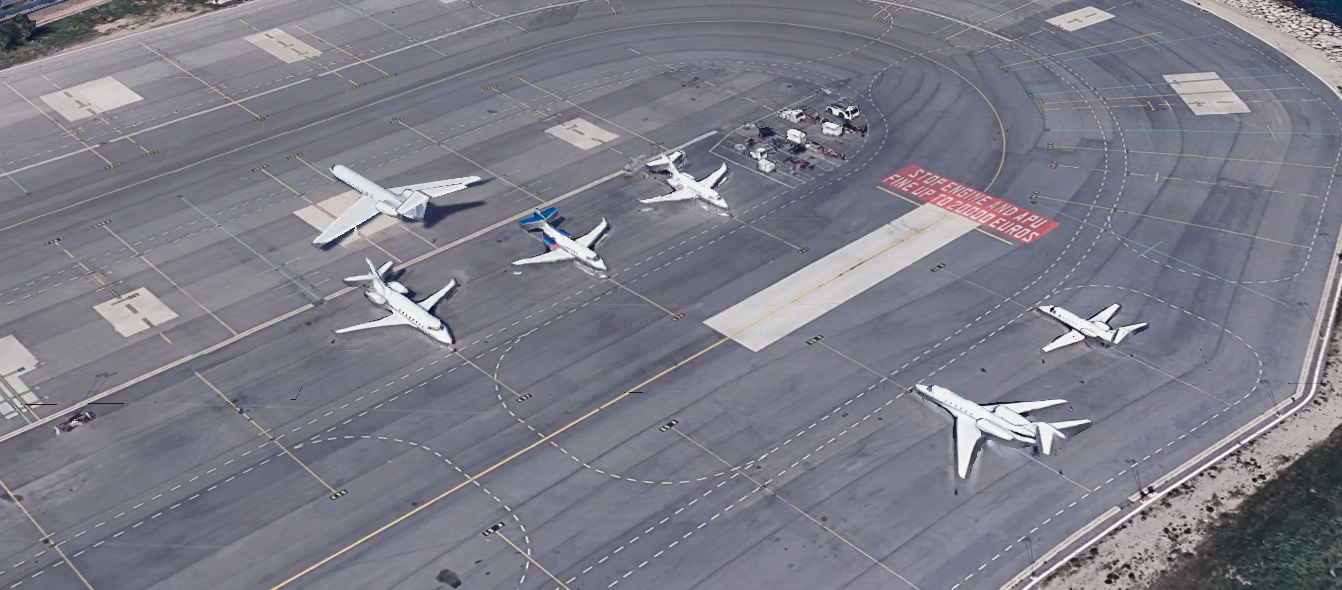
The Kilo Apron at LFMN
Exemptions are very limited. You either need to be operating a medivac, state or cargo flight (carrying temperature sensitive payload). Or if the plug isn’t compatible with your aircraft.
Recent Member Reports
Here are three recent member reports received from OPSGROUP members there.
Report 1:
After towing to Stand 35, the crew connected to the fixed GPU. CAS messages flickered, followed by complete electrical failure and aircraft blackout. Despite heatwave conditions and an overheated crew, APU start was denied. A portable GPU was brought in – but it was dead. When permission to start the APU was finally granted, it was too late: navigation and communication systems had already failed. The aircraft departed under MEL and required expensive repairs at the next stop. The ramp agent advised us to file a report, which we did. According to them, this wasn’t the first time such an event had happened.
Report 2:
Another crew experienced a similar issue. One of two FMS units failed after GPU connection. While the cause wasn’t immediately clear, the symptoms matched those described in the earlier report. The unit was removed for repair.
Report 3:
The GPU caused a fault on our GVII upon disconnect. Our FA that understands French overheard ground personnel stating “it’s too hot” in reference to the GPU. Surface temp at time was 24C so it was the equipment. Had to shut down aircraft to dark and restart to clear fault and get a new CTOT 40 mins later.
Potential GPU Issues
While we can’t confirm the GPUs are the direct cause, it’s plausible. Aircraft systems are sensitive, and power issues — including frequency drift, incorrect voltage, poor grounding, or surges — can trigger serious failures.
Heat may be a compounding factor. Ground air units often underperform in high temperatures, especially if hoses are blocked or airflow is weak. Aircraft may exceed thermal limits before crews can start APUs or get adequate air.
The GPUs themselves may also struggle in heat – output may sag or drift, or thermal protection systems may shut them down.
All of this increases operational risk – especially when APU use is restricted with no flexibility for safety.
And, despite being mandatory, GPU usage at LFMN comes with a charge.
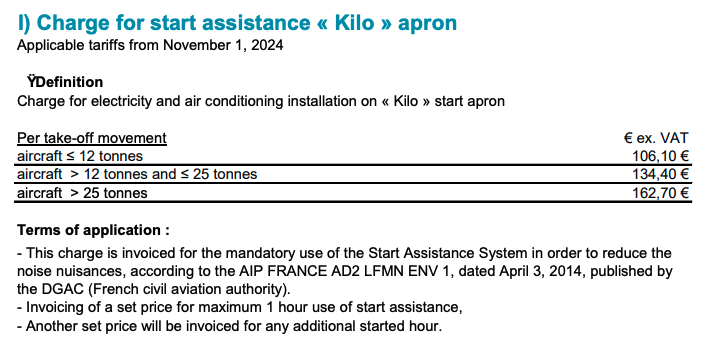
Despite their mandatory use, operators are charged to connect their aircraft to ground power.
If you’re going to enforce the rules on APU usage in summer there needs to be some flexibility for the operational safety of multi-million dollar aircraft and their crews. Quiet airports are great, but it’s easy to forget we are customers. In fact, Nice is the second busiest airport for business aviation in France, second only to Paris Le Bourget.
Mitigators
Following an alert issued to the group regarding these reports, another member (also a fully qualified pilot and aircraft engineer) got in touch with some practical advice to operators.
Here is what he had to say:
I thought it would be prudent to post some operational hints and tips to avoid problems like this event in the future. Not just with LFMN, but with any hot weather destination with restricted APU use (i.e. most of Europe).
Most biz jet hydraulic pumps demand very high KVA from the GPU’s – avoid/delay applying hydraulic power to test systems and parking brake until APU start is approved.
Keep all the shades/sun shields drawn until packs are available.
Dim all the display units in the cockpit until air conditioning is available.
Open cargo and main door to allow air flow throughout the cabin. Small fans can run off the GFI plugs.
Open gear doors on some models as the exhaust for the avionic cooling fans use the wheel wells as the exit point.
Has this happened to you here, there, or elsewhere?
Please get in touch with us via blog@ops.group. We’d love to hear from you.
For ops at LFMN, if you identify a GPU issue (malfunction, incorrect configuration, electrical hazard, emissions), report it via your handling agent to the airport’s operations or safety department, or directly to Aéroports de la Côte d’Azur: +33 4 08 20 42 333, or via this contact form.
More on the topic:
- More: Paris Ramp Checks: Illegal Charters and Tax Avoidance
- More: French ATC Strike: Sep 18
- More: Pilot vs Crew: ID Confusion in Nice
- More: France Summer BizAv Parking Tips
- More: Watch Out For APU Fines at Le Bourget
More reading:
- Latest: Paris Ramp Checks: Illegal Charters and Tax Avoidance
- Latest: Middle East Airspace – Current Operational Picture
- Latest: Greenland NAT Alternates: March 2026 Update
- Safe Airspace: Risk Database
- Weekly Ops Bulletin: Subscribe
- Membership plans: Why join OPSGROUP?




 Get the famous weekly






As the captain, the one tasked with assuring the safety of the passengers and aircraft I say start the APU when the temperature or comfort of your crew/pax necessitates it. The safety of my crew, pax, and aircraft trump that of noise and environmental concerns.
Hi Bob, thanks for the feedback. Unfortunately private jet operators can be fined for doing so, in excess of 20,000 Euro. And so undeniably this puts some burden on the decision to breach the airport’s regulations.
We lost all the cabin power sockets due to excessive heat although everything was within the aircraft limitations.
It’s sad to see that cargo perishable items have an allowance, while flight crew being exposed to excessive heat risking to feel sick after takeoff are not being taken into consideration. All happening while there are precise work law that protects employees from being exposed to uncomfortable temperatures.