Western Sahara Airspace Update

On May 4, the GCCC/Canarias FIR updated their airspace warning for Western Sahara, due to the ongoing conflict there.

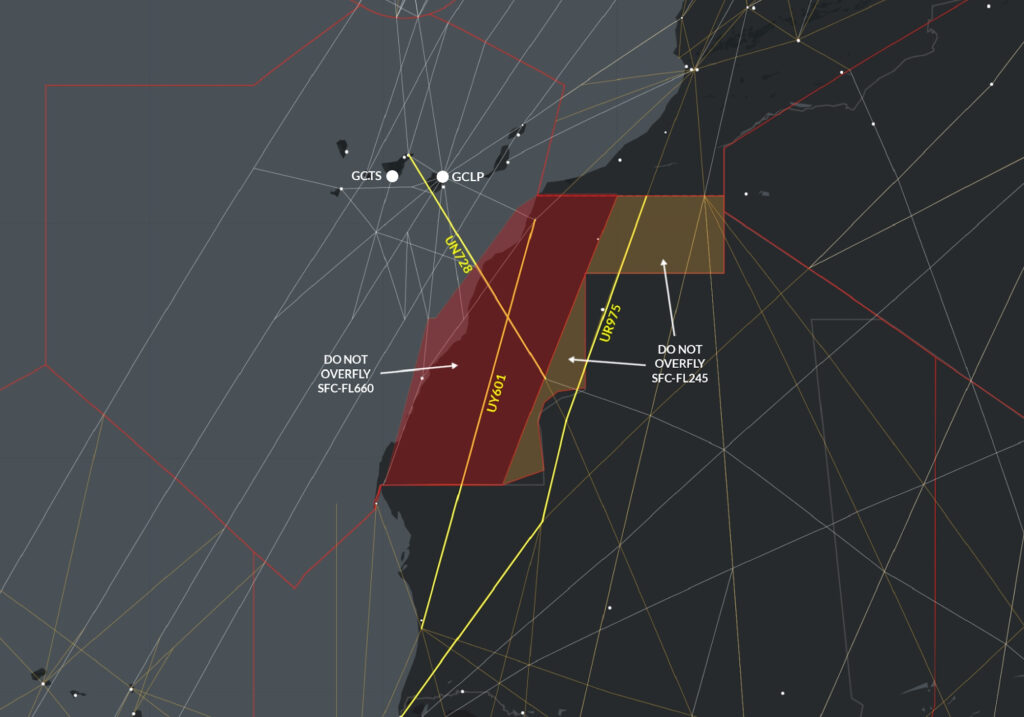
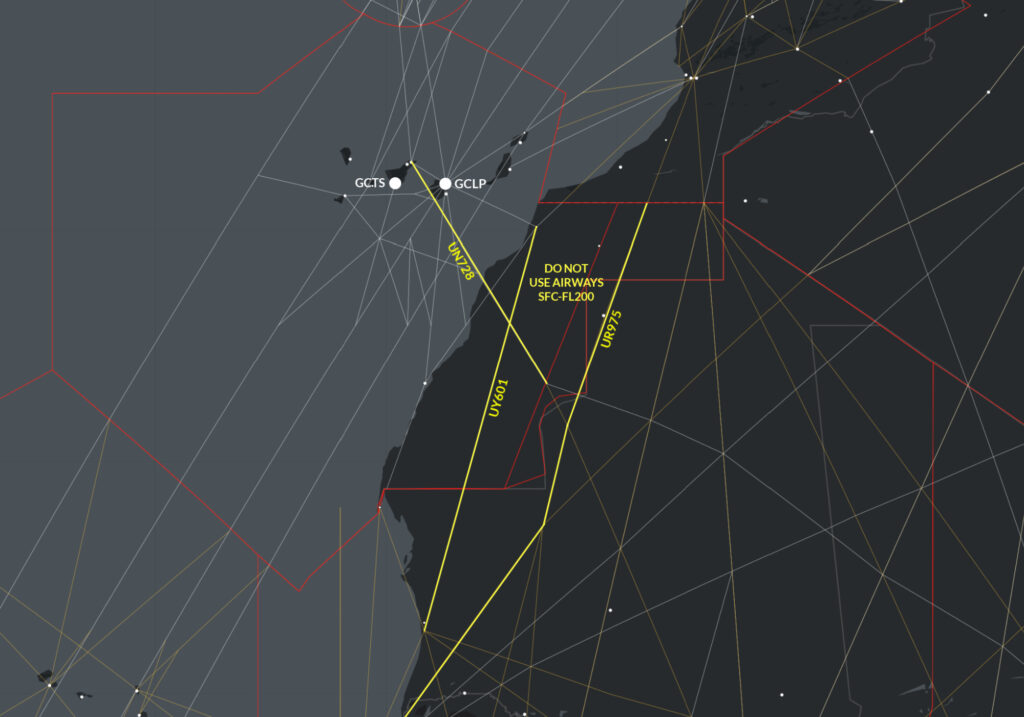
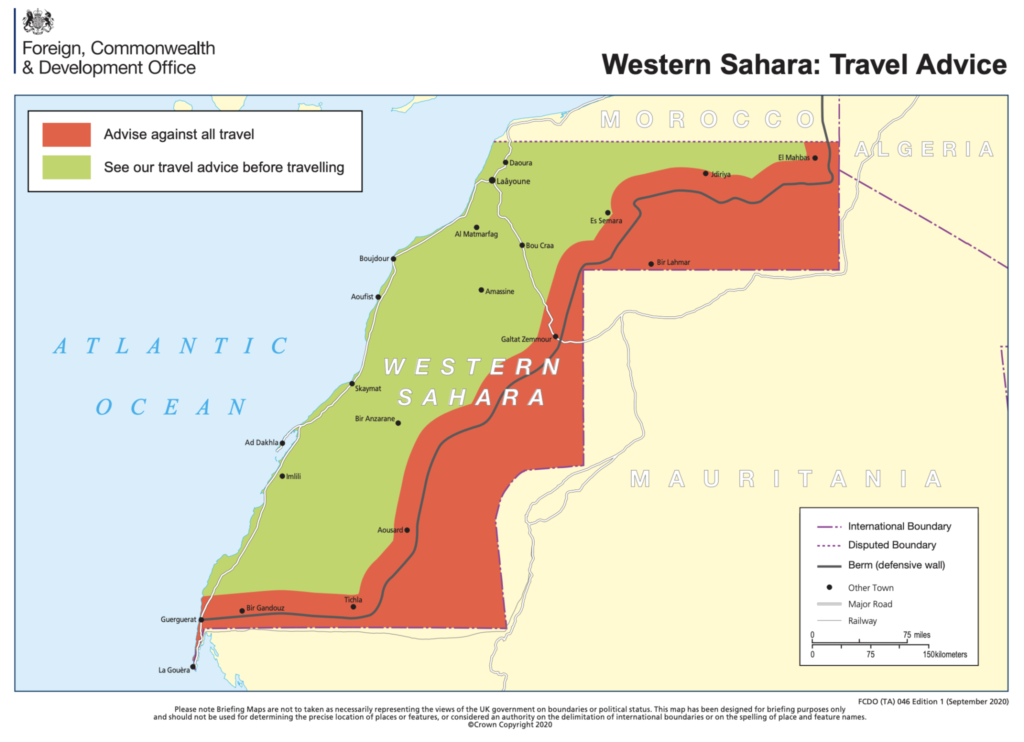
Previously, they said that aircraft overflights should be completely avoided in the eastern part of the country (i.e. airways UY601 and UN728), and should not be below FL245 in the western part. Here’s how that looked:

However, the updated warning issued on May 4 simply advises operators to avoid using the airways over Western Sahara below FL200:

Here’s the Notam:

GCCC B3323/21  - OPERATORS ARE REQUESTED TO EXERCISE PARTICULAR CAUTION 
DURING FLIGHT OPERATIONS IN WESTERN SAHARA AS PART OF FIR CANARIAS. 
IT IS RECOMMENDED TO AVOID OVERFLIGHT AT FLIGHT LEVELS BELOW FL200 
ON THE FOLLOWING ROUTES: UY601, UN728 AND UT975. 
04 MAY 08:53 2021 UNTIL 04 JUN 23:59 2021 ESTIMATED. 
CREATED: 04 MAY 08:54 2021

Still, not much of a warning. What’s really important is exactly what is missing: why.

The answer: Because the airways are over an active conflict zone, with a known threat of anti-aircraft fire.

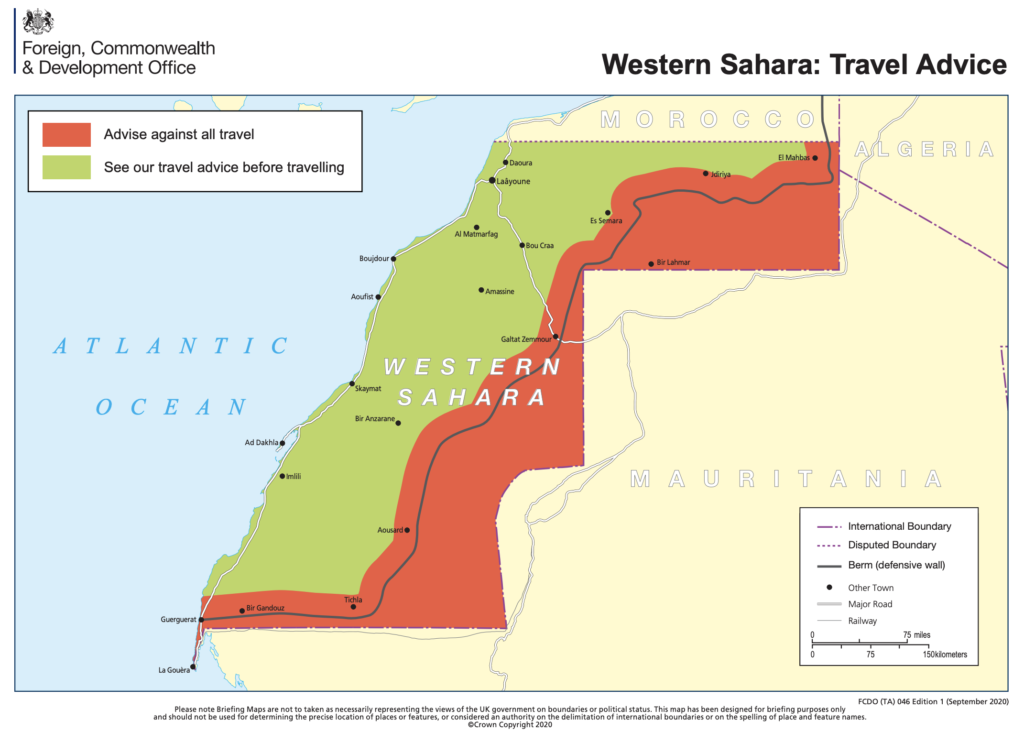
Western Sahara is effectively divided straight down the middle, literally by a wall. Morocco controls one side, while the region’s independence movement (the Polisario) controls the other. In Nov 2020, the Polisario declared war on Morocco.

Why do they want to fight?

The two have never gotten along. The Polisario want independence and were at war with the Moroccan Government for a very long time, until a fragile ceasefire agreement in 1991. Since then there has always been tension.

In early Nov 2020, a Polisario protest blocked a whole bunch of Moroccan truck drivers at the border with Mauritania, shutting down an essential route that connects Morocco to the rest of Sub-Saharan Africa. Morocco weren’t happy, and breached the ceasefire agreement by sending forces into the demilitarized zone to remove them.

The Polisario immediately declared war on Morocco, and clashes began straight away.

Why does it matter?

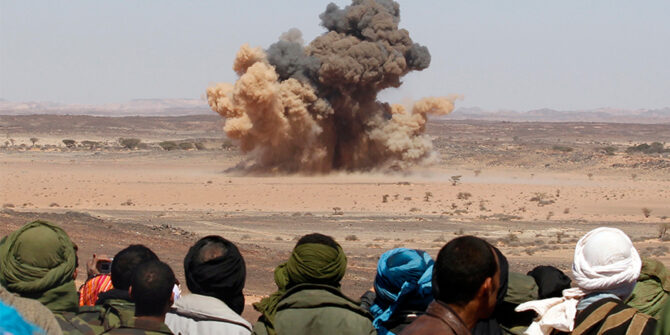
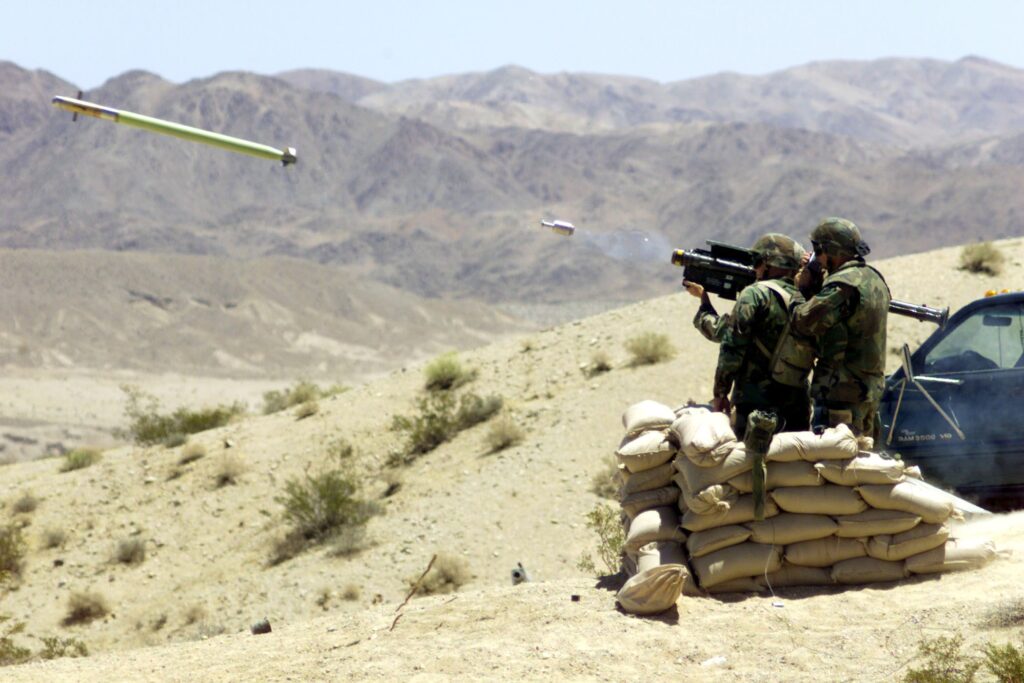
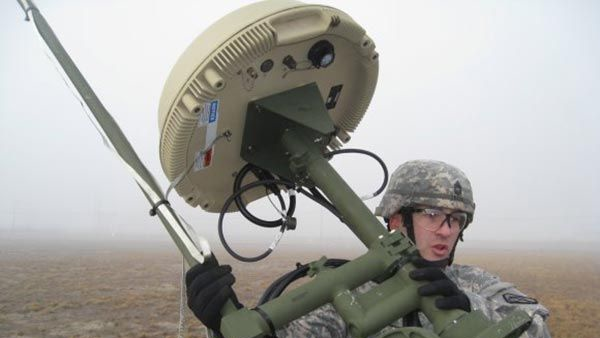
The FAA were onto it when they immediately carried out a risk assessment and published a notice. The big deal is that the Polisario are likely to have access to anti-aircraft weaponry left over from the previous war. This includes man-portable air defence systems (MANPADS) and surface-to-air missiles. The FAA think these weapons pose a risk to aircraft as high as 12,000 feet.

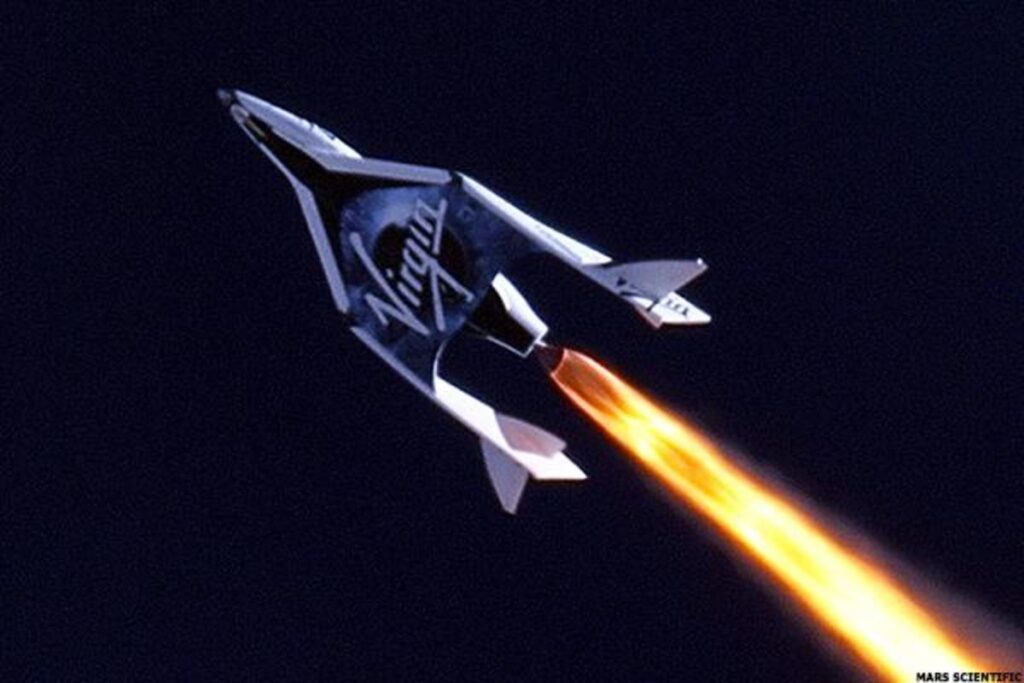
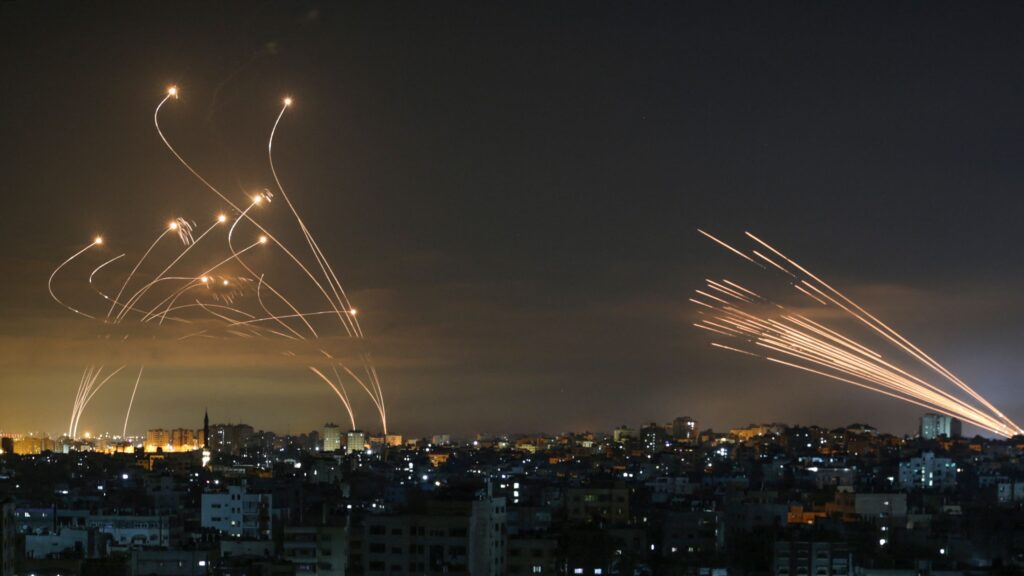
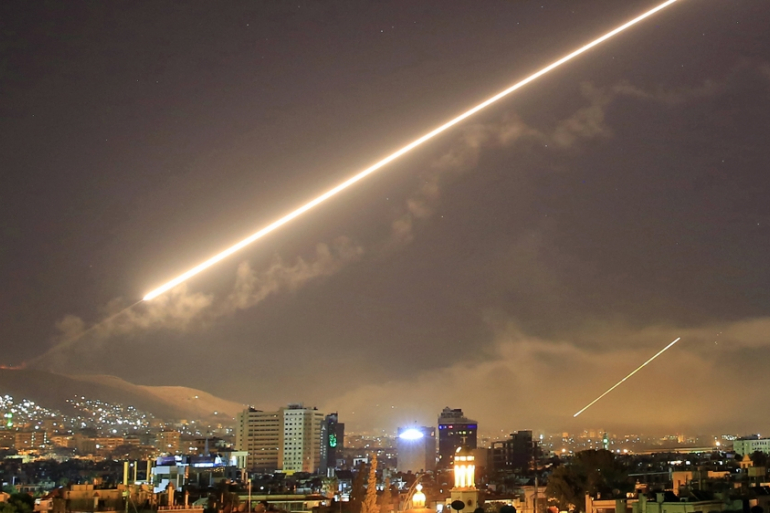
Example of a MANPAD system in action.

To make matters worse, they are suspicious that Morocco are flying drones over their territory – something that has been denied by Morocco. It wouldn’t be the first time an aircraft has been shot down there either – the Polisario downed two DC-7 airliners with missiles back in 1988.

What about airspace?

The sky over Western Sahara airspace is split between two FIRs –GCCC/Canarias and GOOO/Dakar. If the conflict escalates further, this is likely to complicate things.

So far there has been only one warning from the Canarias side – the NOTAM above. Nothing from Dakar yet.

There are currently three major airways affected. Two of them (UY601 and UT975) run the length of the region in a south westerly direction – likely to be used by aircraft transiting some routes between Europe and South America. The other airway, UN728 is a direct track from the coast to GCTS/Tenerife which may be used by smaller aircraft or those doing tech stops in the Canary Islands.

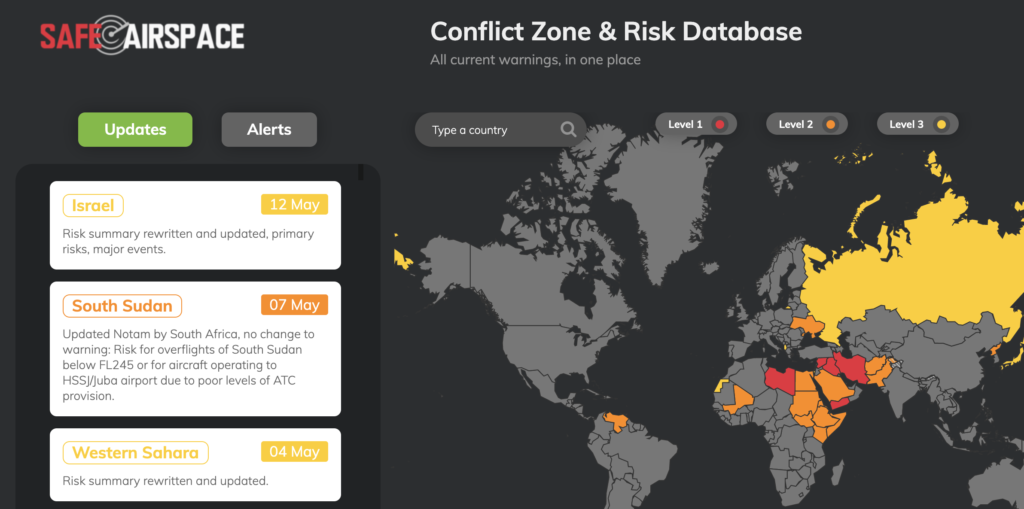
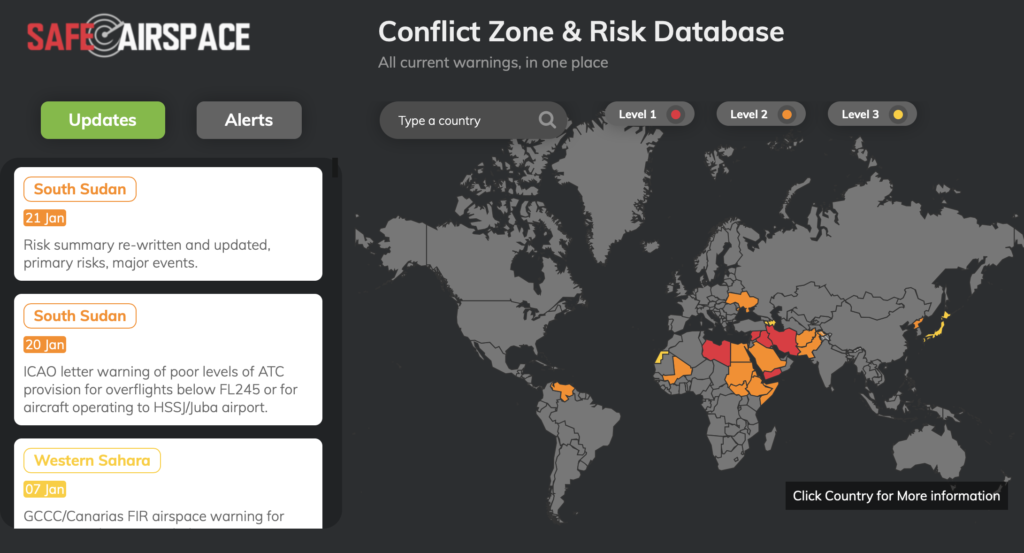
So if you’re  planning flights to the Canaries, or overflying central Africa, pay close attention to the risks involved. Continue to monitor Safeairspace.net as the situation develops.


Resisting the Pull: Should We Still Be Using Magnetic North?

In recent years NAV CANADA has been leading a charge to move the industry away from magnetic north to true north. And it makes sense.

Modern technology has arguably rendered magnetic north obsolete. So why are we still using it? The simple answer is because we always have. Delve into ICAO Annex 4 and you’ll see that bearings, tracks and radials must still be published in degrees magnetic. But this begs the question – do we actually need it anymore?

When humans first took to the skies, things were different. They needed a directional reference. Back in those days it had to be something simple and light – enter the magnetic compass. Nature was guiding the way because it had too.

With modern navigation systems these days all the magic happens reference to true north. Inertial and GPS systems both use simple conversions so that the information can be displayed to crew as a magnetic reference to match our charts and procedures.

But because we are still using magnetic north as a reference we are forced to deal with magnetic variation – the angular difference between the true and magnetic poles. It is an issue that costs the industry many millions of dollars a year to manage and can potentially lead to serious safety issues if things aren’t handled properly on the ground and in the sky.

Let’s get science-y.

The earth has its own magnetic field. That’s because its outer core contains molten iron. Writhing lobes of magnetic flux surround the earth and meet near the top and bottom of the globe – the spots we know as the magnetic north and south pole.

The earth’s ever changing magnetic field.

Open up a compass and the steel needle will align itself to the magnetic field lines around it and hey presto, it will point directly at the magnetic north pole.

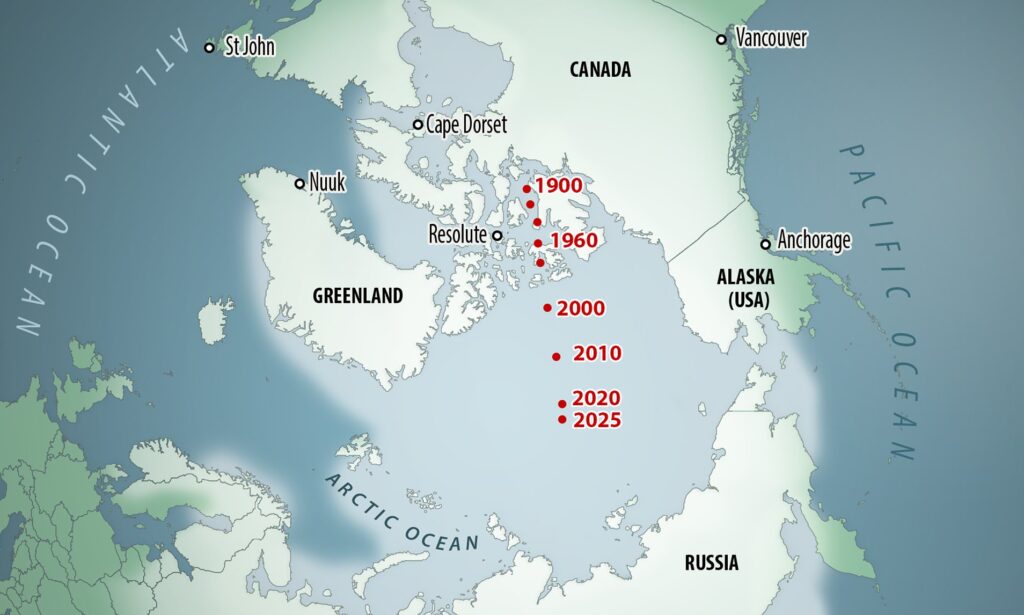
But here’s the problem – molten iron is a liquid, and it moves around. Which means the magnetic north pole does too. It never sits still. In fact in recent times it has put its foot down and is now moving close to 40 miles each year. As of last year, it was about 250nm away from the true pole and headed for Siberia.

The constantly moving magnetic north pole over time.

The magnetic north pole is of no use to modern navigation systems because it is constantly on the move. Instead, they operate using a ‘geodetic reference system’ – a really fancy name for co-ordinates that may impress people at your next cocktail party.

Two variables, the ol’ lat and long, come together and allow us to define any spot on the surface of the earth. All meridians of longitude are anchored to the true north pole because it never changes. It is simply the northern end of the axis around which the world and that globe on your desk spins. Latitude on the other hand is reference to the equator which never moves either.

In fact, the only way either could change is if the earth’s angle of tilt moved too in which case we’d have bigger things to worry about. So, when we combine the two we can divide the surface of the world into a grid and pinpoint exactly where we are – a process that both inertial and GPS systems use to stop us getting lost out there.

Lat and Long – anchored by the equator and earth’s axis of rotation.

Here are the issues.

All of our procedures, bearings, tracks, VOR radials, even our runway designators are still presented in degrees magnetic because the regs say they have to be.

And because of that every time the magnetic north pole moves, magnetic variation changes and the industry has to get out there and re-jig everything. Literally every computer that references magnetic north in some way has to be updated.

Magnetic variation is constantly changing. Credit: NOAA

All our IFR procedures from enroute, to terminal and approach phases have to be changed and re-published. Our FMS’s have to be programmed to match too. VORs have to be rotated and navaids flight tested. Radars have to be realigned and airport signs replaced. Even runways have to be repainted. It literally costs ANSPs, airports, avionics manufacturers and operators millions.

Take KTPA/Tampa for example. In 2012 changes to variation forced the airport to renumber its primary runway, no less than 140 signs had to be replaced.

It is also a safety issue. The whole system depends on everyone updating everything at the same time which seldom happens. A small change can have a big impact too. The PBN systems we rely on to keep us safe can be compromised by changes to variation if not updated. Synthetic vision systems can begin to tell pilots lies.

Anchorage in 2012 serves as a cautionary tale. The FAA updated its magnetic variation of the airport. Because operators didn’t update their aircraft’s avionics quickly enough, in some cases there was a mismatch.  Flight tests revealed that using the old value, Cat II and III approaches were no longer within lateral guidance limits  – not what you want to hear when you’re in the soup. The FAA temporarily changed procedures back to old value to allow time for operators to catch up.

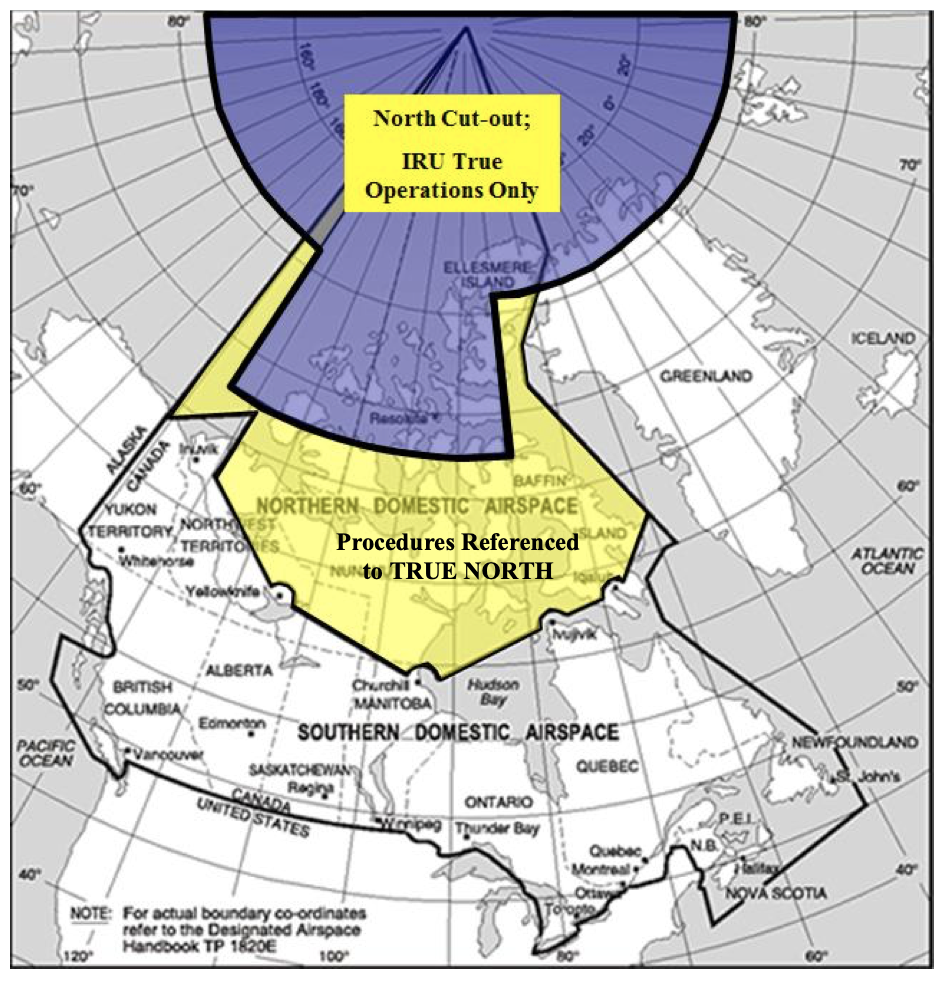
We know that it works too – Canada has been using conventional and PBN procedures using True North for some time throughout a huge chunk of its northern domestic airspace successfully, where magnetic references become unusable.

True north operations in Canadian domestic airspace.

So why can’t we just turn it off?

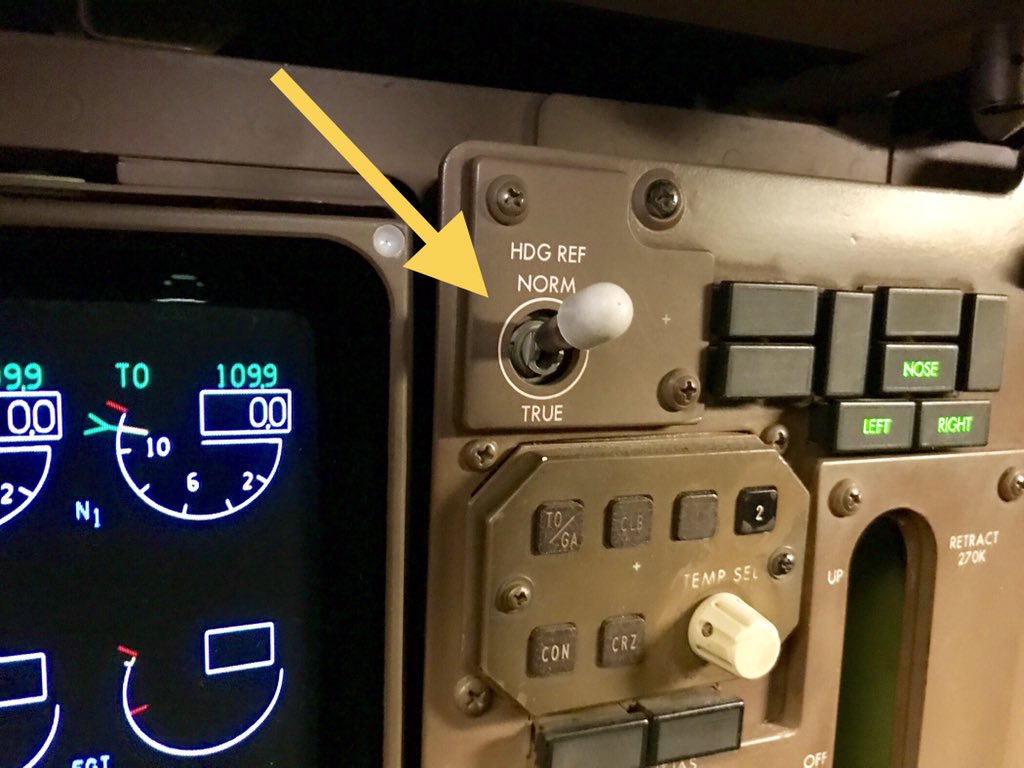
That’s the beauty of it – we can. Technically, it’s as simple as flicking a switch. Converting things from true to magnetic is just a process that we can just turn off. A lot of aircraft even have that very switch already.

As easy as flicking a switch?

Photo credit: Ken Hoke @AeroSavvy

Practically speaking though, the problem is the huge legal, administrative and legislative implications that would follow. Rome wasn’t built in a day and neither would a huge change to aviation procedures around the world. It would literally take years to implement.

But that may be no excuse for change, otherwise we will continue to expose ourselves to known risks. Take Notams for example. We are still communicating critical safety information using a format that has existed since 1924 – an invention for teleprinters.

The industry is beginning to see that the status quo isn’t necessarily the safest way forward. OPSGROUP have recently begun to work with ICAO and other partners on a global campaign to improve Notams, and it has only just begun.

No longer using magnetic north is no different – it is only a hurdle to something better, more consistent and safer for everyone.


The Hidden Risks of Automation

Over the past decades our industry has undergone an automation revolution.

Basic autopilots from eras-past were little more than wing levellers. Today they are sophisticated computers capable of awe-inspiring accuracy.

The industry has welcomed automation with open arms. And it’s no surprise. The vast majority of aviation accidents are caused by us, humans. Mechanical failure on the other hand only accounts for less than a quarter of all accidents.

So for operators and manufacturers alike the benefits of automation are clear – safety and efficiency. We are simply not as predictable or consistent as a computer because we are human. And automation has become a major line of defence.

But herein lies the problem…

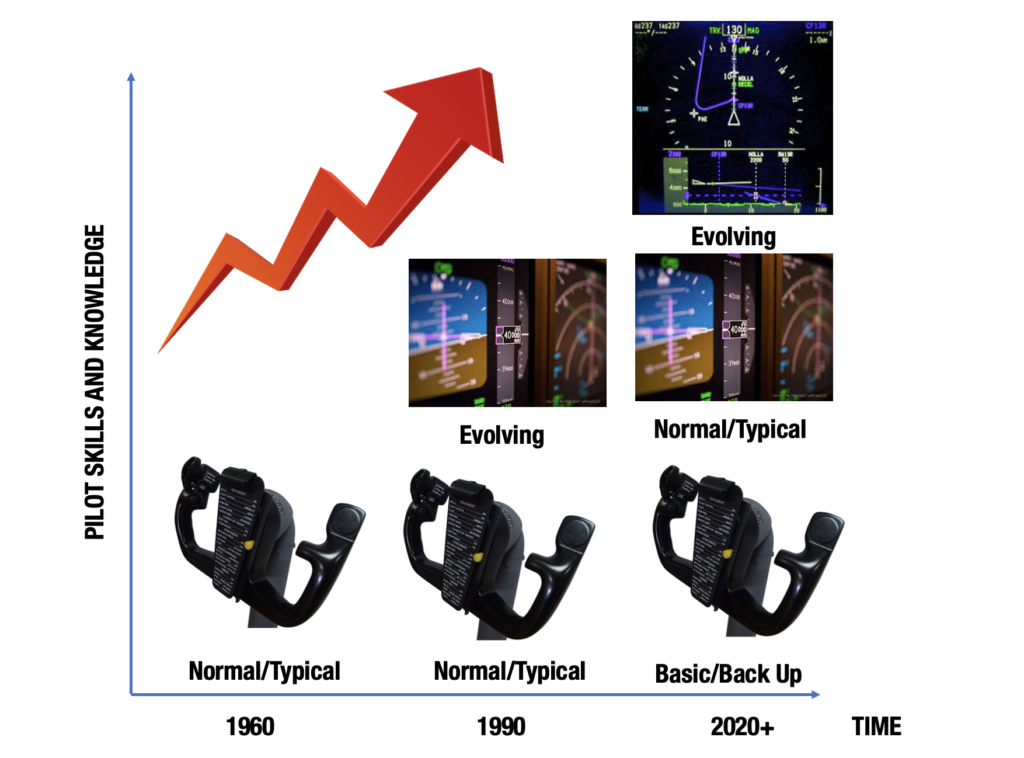
It’s easy to see that a pilot’s role in the flight deck has changed forever as we interact with higher and higher levels of automation. Some might even argue that we are being progressively designed out of the cockpit completely and to some extent this may be true. Whether we like it or not, full autonomy is coming. Take the Xwing Project for instance – their concept can be retrofitted to conventional aircraft enabling them to fly without a pilot.

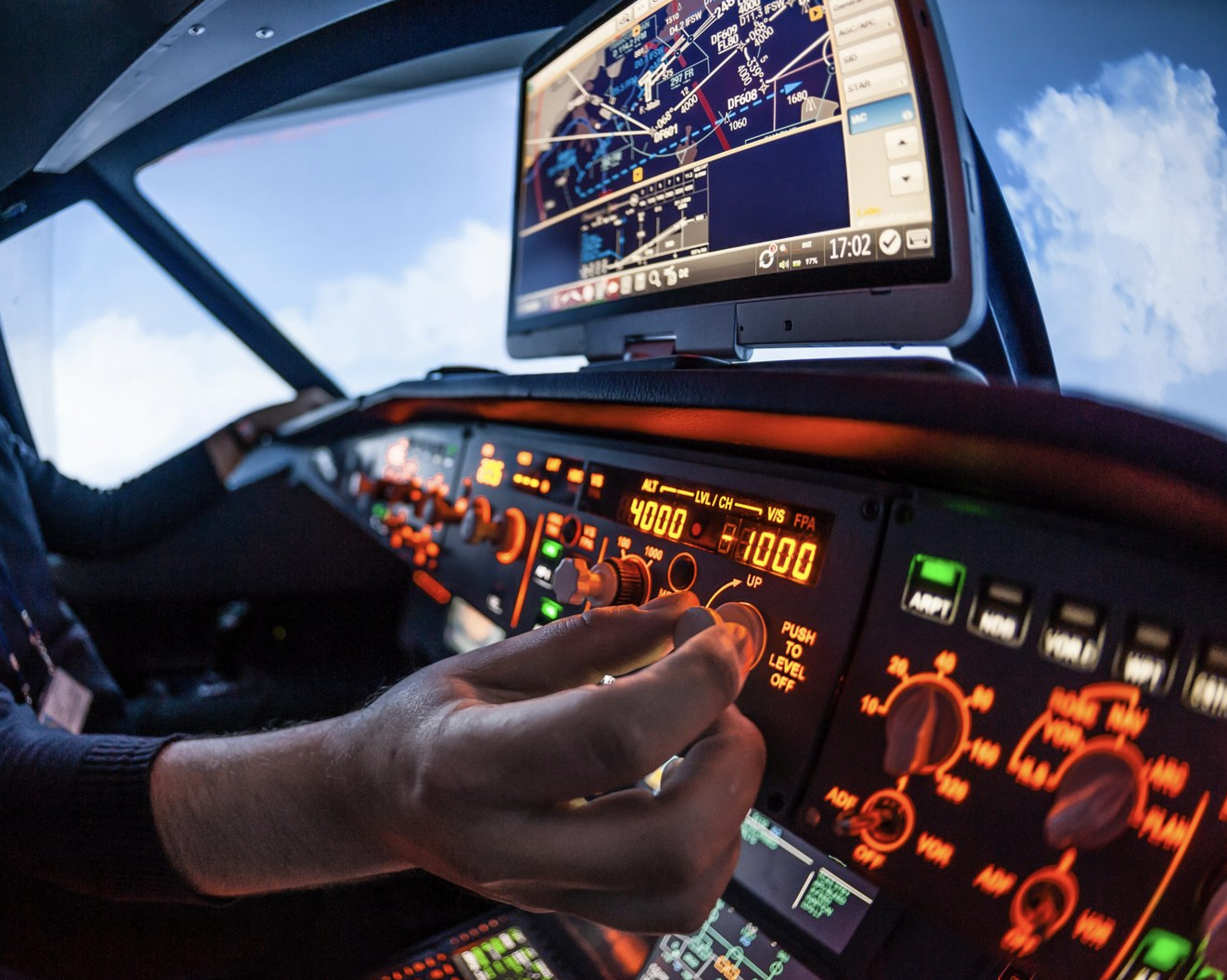
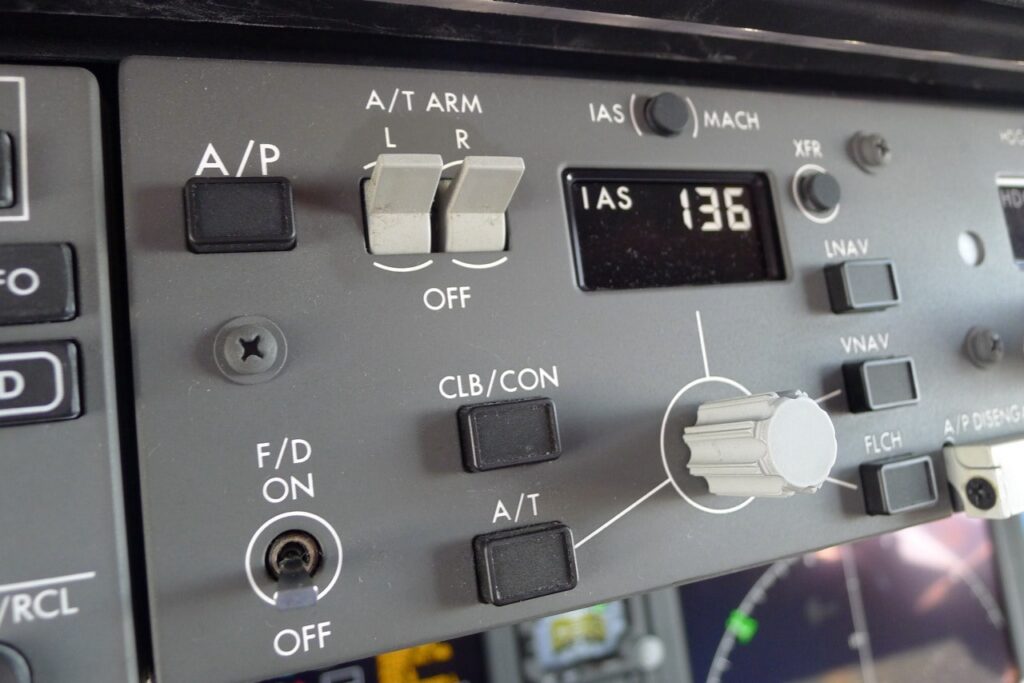
But right now the more pressing issue is that our role continues to transition more and more from flying airplanes to managing automation. Put it this way. A recent study found that across a large sample of flights aboard the Airbus A319, pilots were spending on average only 120 seconds manually flying each flight. And that was the middle of the curve.

This creates a unique set of risks that the industry collectively needs to better address.

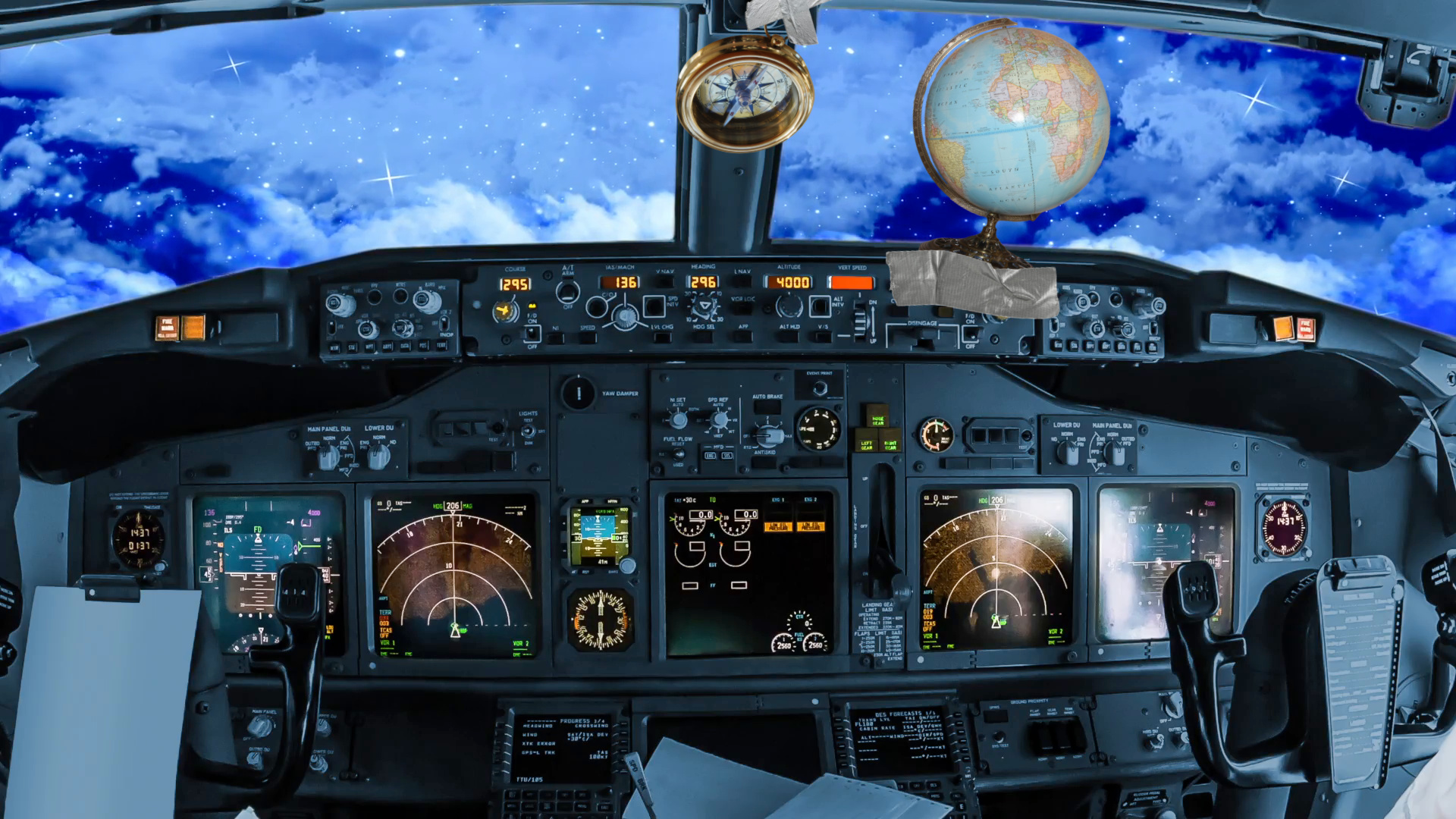
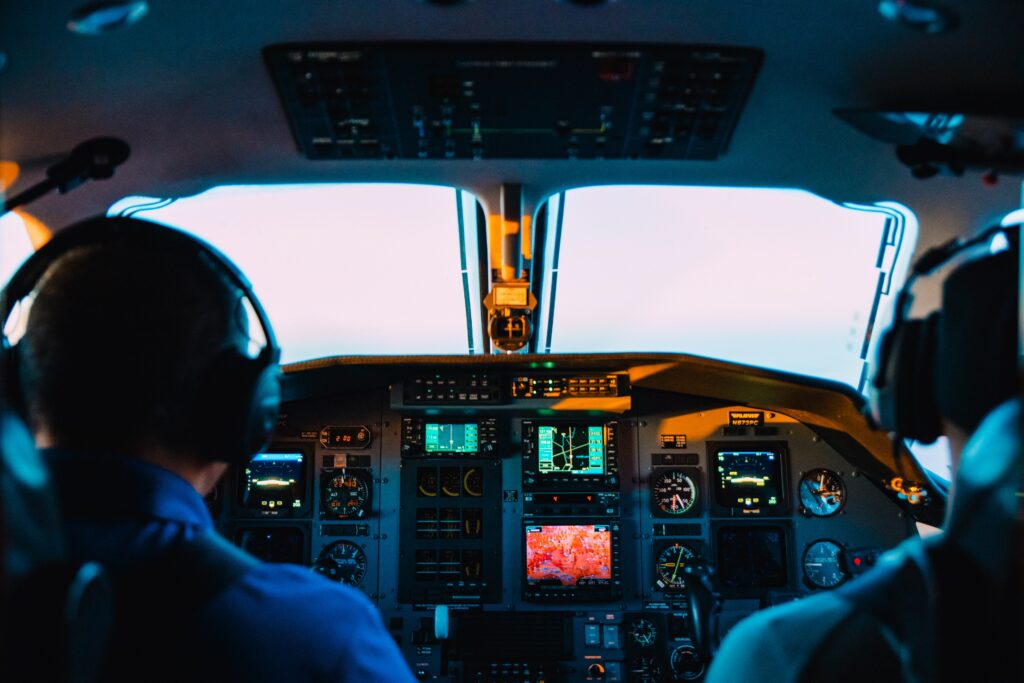
The majority of time we spend flying is through panels like these.

Good Automation

By no means is this an attempt to detract from the positive impacts that good automation continues to have in our skies. The benefits are no secret. When used as intended it is a huge work-load reducer. It allows us better flight path control and liberates us from repetitive and non-rewarding tasks – something humans are known be no good at. We become less fatigued and have more capacity to deal with other things.

It also works in unison with systems like ECAM and EICAS to better help us manage things when something goes wrong.

Automation has also improved the skies we fly in. Fantastic things like RVSM and PBN have allowed us to fly closer together and make better use of crowded airspace. While around the world minimas grow ever closer to the ground thanks to things like RNP approaches where automation can help us ‘thread the needle’ in some one the world’s most challenging approaches.

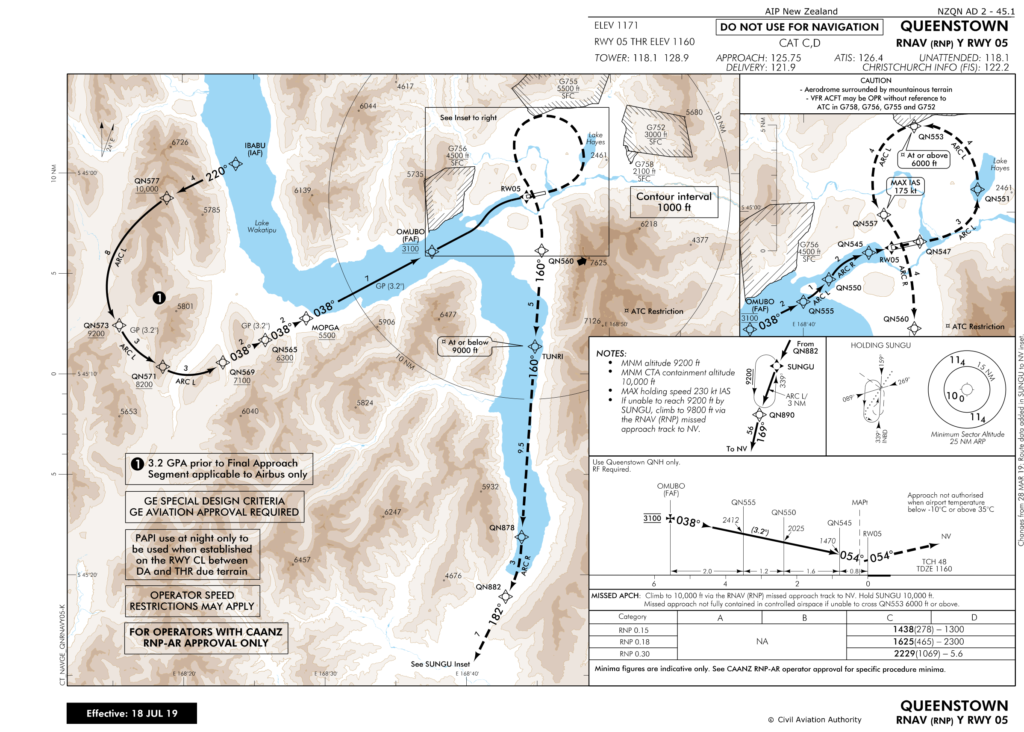
Take Queenstown for example. The notorious airport down in New Zealand boasts beautiful scenery but a reputation amongst pilots as being one of the most demanding in the world due to the intimidating terrain that surrounds it. RNP approaches have dropped minimas from over 3000 feet off the deck to less than 300. And now you can land there at night.

Threading the needle at Queenstown – check out those spot heights.

Bad Automation. Here is where things start to go wrong.

All positives aside, automation is also having an effect on us pilots. And it is important to remember  just that – we are still pilotsWe must never lose the ability to fly without automation. Back in 1997 the late and well-respected Airline Captain Warren Vanderburgh saw it coming and coined the phrase you are no doubt familiar with – Children Of The Magenta Line.

This remains true to this day. If we become too reliant on automation, avoidable accidents happen. Here’s why.

It Erodes Skills.

Slowly but surely automation is chipping away our manual and cognitive flying skills. You know the ones – your stick and rudder. We are being actively encouraged to keep automation on and control our trajectory through it. Do that for long enough and we begin to forget how to do it the other way – with our hands, eyes and feet.

It Distracts.

Because we are so used to flying our airplanes through automation, when something unexpected happens such as short notice changes from ATC our immediate response is to try and figure out how to make the automation accomplish it. We go heads-down precisely when we should be going heads-up – and the clock is ticking.

It Confuses.

Chances are if you have operated anything with high levels of automation, at least once you’ve uttered the infamous phrase “what’s it doing now?”

And yet still we are reluctant to turn it off. As soon you identify that the aircraft is not going where it should, that’s your cue to intervene. The minute you don’t, you are simply along for the ride. Pilots around the world would agree, this is never good enough.

Mode confusion is another. Modern automation features many different ways of achieving the same outcome, but with subtle and sometimes dangerous differences. We need to understand the limitations of each one because if we don’t, we know that tragedies can happen.

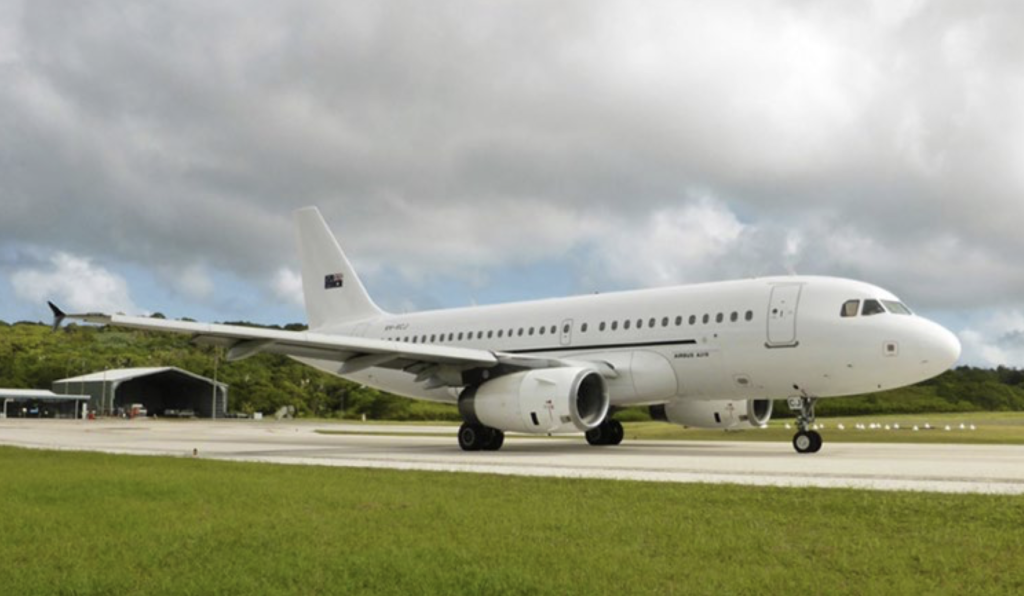
A little known incident in Australia serves as a good example. Snowbird, an Airbus A319, was on approach at YMML/Melbourne airport on a clear calm evening. A tired but highly experienced crew were flying an unremarkable STAR and ILS approach at the highest level of automation. All was going well until the pilot flying reached up to arm the approach in a dimly lit cockpit. He pressed the wrong button. Over the next 39 seconds chaos ensued.

What followed was a series of rapid fire mode changes, confusion and attempts to salvage the approach through the automation. Three EGPWS warnings were triggered and an altitude alert issued by the tower as the airplane reached just over 1,000 feet off the deck at 315 kts before they regained their situational awareness and executed a missed approach.

After the incident neither pilot could recall exactly what happened, what modes they had engaged and neither had heard any of the EGPWS warnings. The automation had performed flawlessly throughout by providing the crew exactly what it was told to do. When it all went wrong, it seems the pilots were reluctant to turn it all off.

Snowbird. A great example of when good automation goes wrong.

It Startles.

Automation is designed to give you back control when something goes wrong. For crew our first indication is usually a loud aural alert and a flashing red light. For systems that seem to operate flawlessly flight after flight, day after day, the affect can be startling.

Pilots are suddenly given full control because we are supposed to be the ultimate fail safe.

We are not even supposed to be there unless we can fly our aircraft manually without hesitation. But the problem is we are not used to flying manually anymore. We are used to flying through automation, so when it’s suddenly not there it’s like going back to school.

There have been a number of instances where pilots have been faced with failing automation and have been unable to keep the aircraft flying safely using manual control.

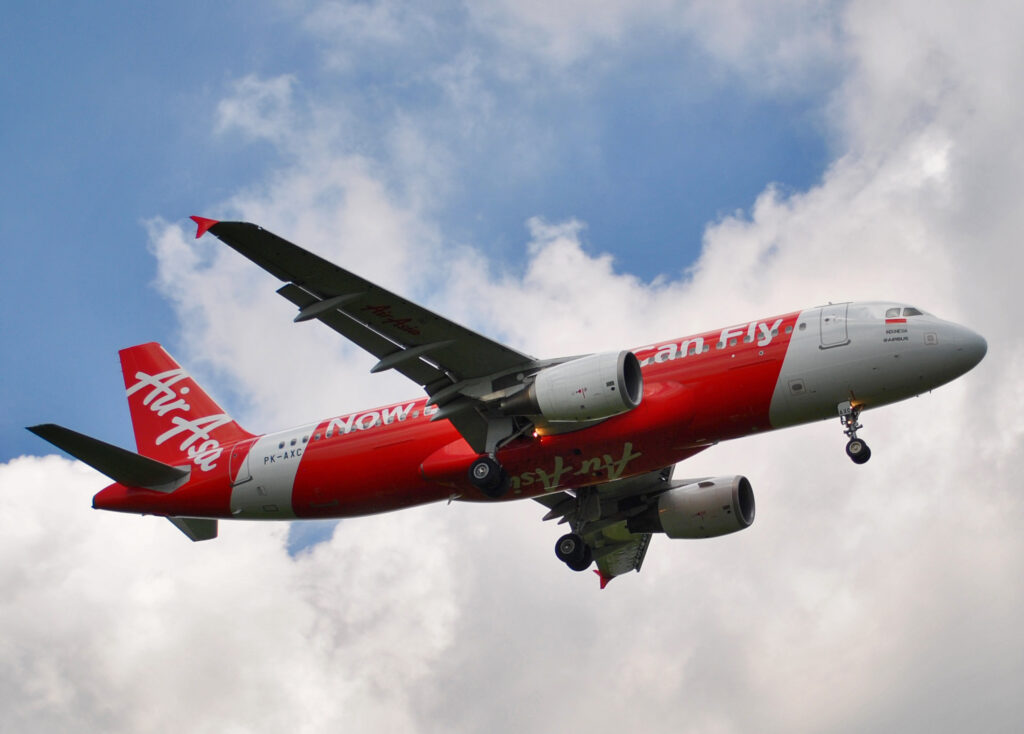
Air Asia Flight 8501 is a good example. To get rid of a nuisance alert the crew pulled a single circuit breaker to one of the aircraft’s flight control computers. As an unintended consequence the autopilot disconnected and the aircraft transitioned into a degraded mode of flight where the automation was no longer available and flight protections were removed. It had done what it was designed to do – hand back control to the pilots.

Tragically the pilot flying, startled by having to fly manually in a degraded mode, stalled the aircraft from straight and level flight. The crew never managed to regain control.

The accident aircraft of Air Asia Flight 8501 – a sad reminder on how the sudden loss of automation can lead to tragedy.

As an industry our approach to how we interact with automation has to change.

Automation dependency is not a new issue. But as automation becomes more sophisticated and complex we have to continue to manage how we interact with it.

It was never intended to replace our core skills and abilities as aviators, only to better support them. Like the image below our core ability to fly manually is supposed to be a constant.

But there are some ways to help.

SOPs. They must be flexible enough to allow pilots to turn the automation off when it is appropriate. You have to give pilots the freedom and confidence to use their hands and feet. Six months between sim sessions is too long.

Training. Evidence based training is revolutionising our sim sessions. There is opportunity there to encourage manual flight. To turn it all off without warning and give us the much needed confidence back.

Monitoring. We need to encourage active monitoring so that we can intervene quickly if we need too. We should always be mentally flying the plane even if an autopilot is flying. One way to do this is by keeping our hands on the controls during dynamic phases of flights. It is a tactile reminder that we are still in control and can take over at any stage.

Practice. It makes perfect. It’s what we got into this game for. When conditions are right and workload low, take the opportunity to turn it all off. It’s right there waiting for you again if things get busy.

Automation is here to stay.

What matters is how we use it. We cannot allow it replace our abilities to fly an airplane without it because for the foreseeable future we will still be the ultimate failsafe.


ATC Zero in Class A Airspace: Is It Dangerous?

IFALPA has issued a new safety bulletin this week expressing concerns that existing US FAA contingency procedures that allow aircraft to continue using Class A airspace during ‘ATC Zero’ events are inadequate. They argue that the procedures expose aircraft to unacceptable risk and that more needs to be done to ensure their safety.

ATC Zero Events have become more common

Before Covid, ATC Zero events were quite rare. They’d usually only occur if controllers were forced to evacuate a facility. Fire, a force of nature, bomb threat – those sorts of things.
But then Covid came along and as we all know, it is super contagious. Amidst border closures and quarantine and testing rules, a new threat began to emerge in our skies.

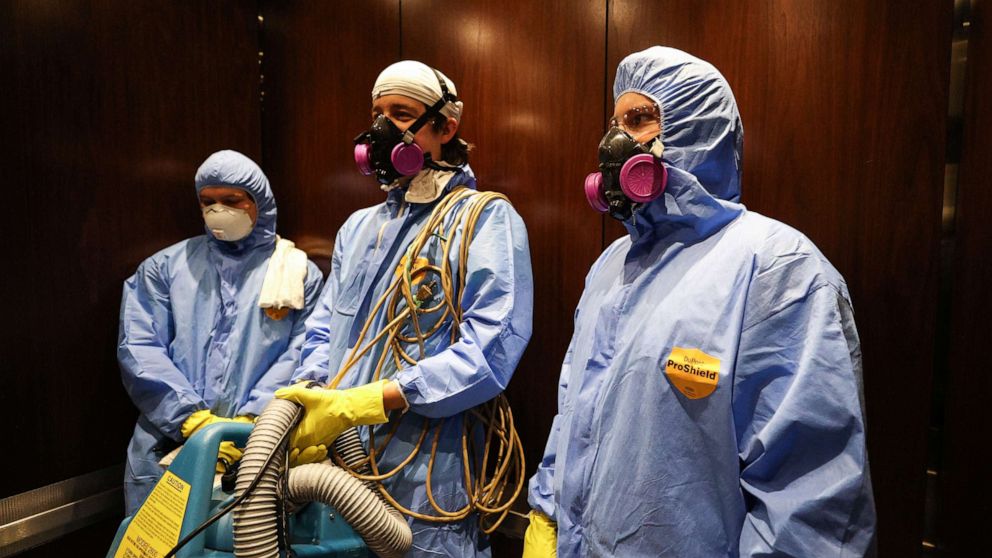
ATC facilities began to be impacted by Covid infections, and short notice closures for cleaning have become a constant risk.

Last year we published an article on how to manage ATC Zero events in Oceanic Airspace after the New York ARTCC shut down affecting traffic crossing the NAT. The US FAA were sufficiently concerned that they published their own SAFO.

However since then the US has continued to be affected by ATC Zero events over land which affect large portions of Class A airspace, often for hours at a time.

Covid cleaning can take hours.

What the FAA have to say about it

The FAA are satisfied that it is safe for aircraft to continue using Class A airspace when no ATC services are available, as long as you follow contingency procedures.

What contingency procedures?

Well, they can be broken down into two parts.

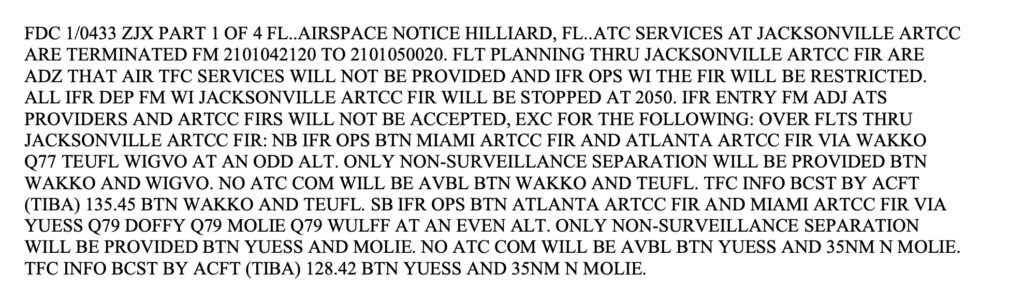
  1. When an ATC Zero event is scheduled, a NOTAM will be published. It will restrict traffic to specific routes through the affected airspace which contain compulsory reporting points. If you don’t intend to the fly the prescribed routes, you’re not allowed in.
  2. TIBA – Traffic Information Broadcasts by Aircraft. The FAA expects you to use them. Recent feedback from members who have operated under these conditions indicate that many aircraft either don’t know, or are choosing not to use them while operating in ATC Zero airspace. That in itself is concerning.

Part of a sample NOTAM with required routes through ATC Zero airspace. How’s that head ache?

So what exactly are the TIBA procedures?

You can find them in ICAO Annex 11, or buried in lengthy NOTAMs if you prefer your procedures capitalised, abbreviated and barely punctuated.

Here’s a quick unofficial rundown:

1. Dial up your TIBA frequency. If you have two VHF comms, leave one on the normal ATS frequency to listen out for a controller.

2. Maintain a listening watch on the TIBA frequency.

3. In most cases you’ll need to remember ’10 minutes’. A radio call is required 10 minutes before entering the affected airspace, or if you have just taken off from an airport within the airspace as soon as you can.

4. Enroute, you’ll need to make routine position reports:

  • 10 minutes before crossing a reporting point
  • 10 minutes before you cross or join an airway.
  • And if your waypoints are really far apart, make a call every 20 minutes.

5. If you’re changing levels you need to make a radio call 2-5 minutes beforehand.

So what do you actually need to say?

The short answer: Who you are, what level you’re at, where you are and where you’re going next.

The slightly longer answer:

- ALL STATIONS
-  Call Sign
- FLIGHT LEVEL
- AIRWAY (or direct to/from)
- POSITION AT TIME
- ESTIMATING (next reporting point or crossing/joining airway) 
  AT TIME AND FLIGHT LEVEL

Don’t forget to listen

It’s important to remember: When you enter Class A airspace during an ATC Zero event, you are responsible for your own separation. You’re on your own. Which means you need to hear and be heard.

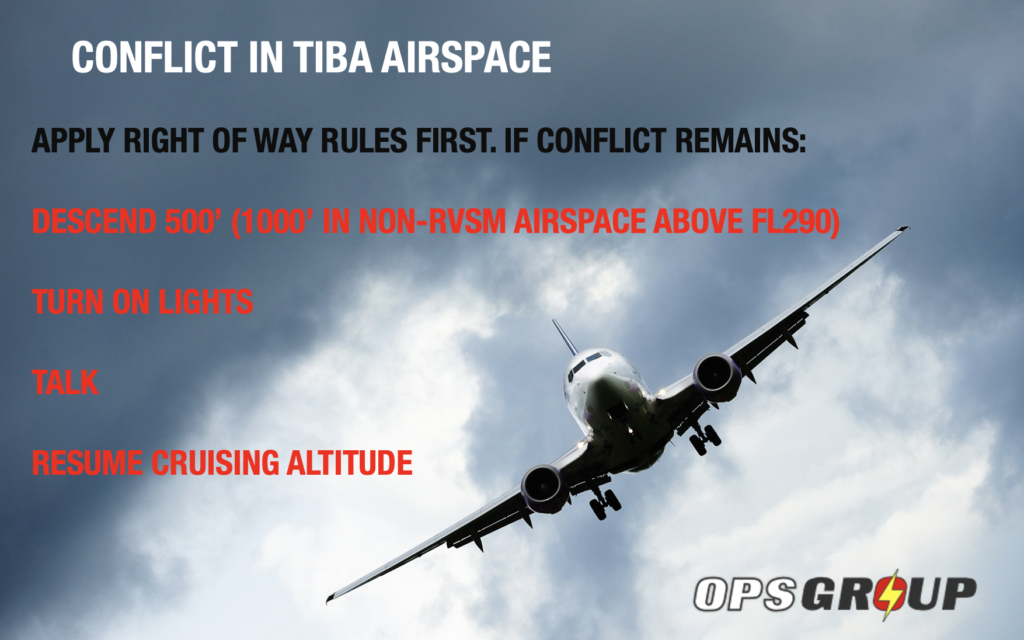
What if a conflict is likely?

There’s a procedure for that too. If you can’t solve the problem with right of way rules, here’s what you need to do:

So why are IFALPA worried?

For starters, there may be aircraft operating in Class A airspace without TCAS which greatly increases the risk of a collision. Secondly there is a lack of training standards about how to apply the contingency procedures. Lastly given that no one is watching, you may be exposed to other aircraft breaching the regs.

Until things change, they recommend you avoid the affected airspace by flight planning around it. If that’s not practical here are their suggestions:

  • Minimise the risk by taking the shortest possible path through it.
  • Make sure you review the contingency procedures beforehand.
  • Make sure there are no procedures in your in your manuals that will be affected by a lack of ATC.
  • Submit a safety report afterwards.

The threat remains

ATC Zero events are likely to continue in the near term, along with the risks they pose. It is important that pilots take those properly into account before they enter affected airspace.

Love them or hate them, sticking to the contingency procedures like glue is everyone’s biggest risk mitigator until new or better ones eventually come along.


Eruption in the Caribbean: The La Soufrière Volcano

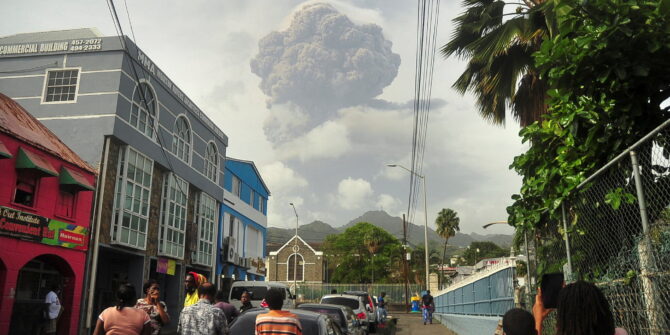
A tiny island in the Southern Caribbean has made headlines this week after a volcano, dormant for decades, suddenly erupted on Friday almost without warning. It ejected ash as high as FL440.

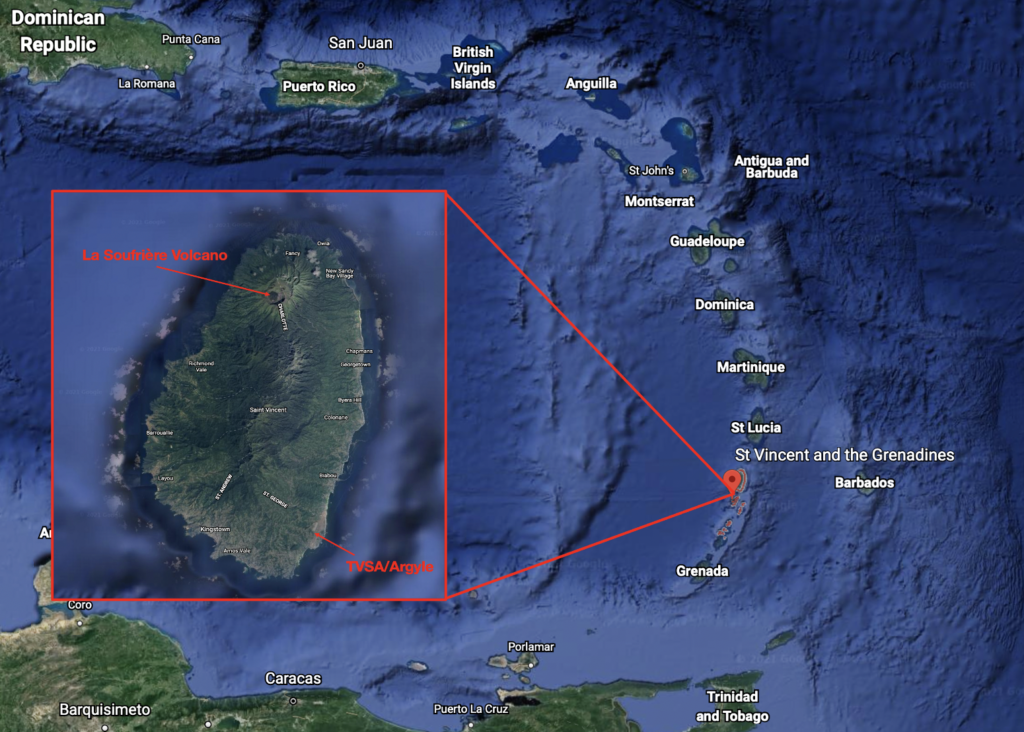
The La Soufrière volcano is found on the main island of Saint Vincent and the Grenadines, a small country nestled amongst the southeast Windward Islands of the Lesser Antilles. It is neighbours with Saint Lucia to the north, Barbados to the east and Grenada to the South.

St. Vincent and the Grenadines – home to the La Soufrière volcano.

The volcano first made headlines on Thursday when scientists detected large seismic tremors – an ominous sign that the La Soufrière volcano was stirring. It had last erupted back in 1979.

Evacuations began for people living near the volcano which is found only 10nm north of the country’s main airport, TVSA/Argyle. Scientists believed an eruption was imminent.

Then on Friday La Soufrière literally exploded back to life with several violent eruptions producing massive amounts of ash. Since then, sporadic eruptions have continued. The latest was on Monday, and scientists believe there is no end in sight. It may continue to erupt (and produce ash) for weeks.

What’s the current operational impact?

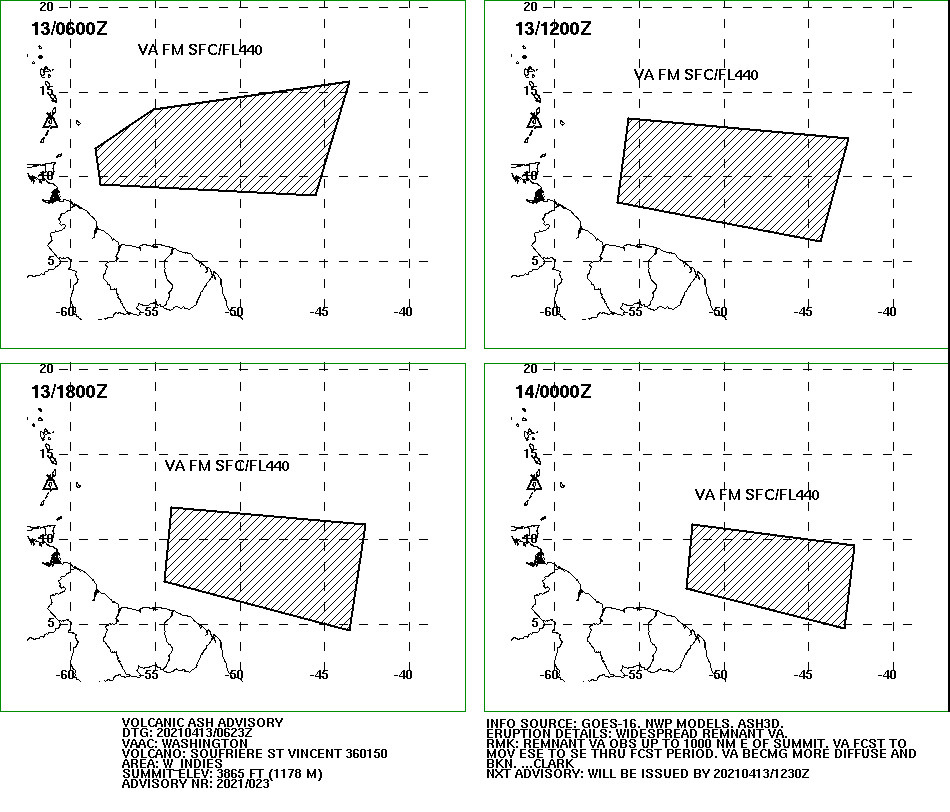
The initial VAAC advisories indicated a large ash cloud extending up to FL440 and moving in an easterly direction away from land and into the Central Atlantic:

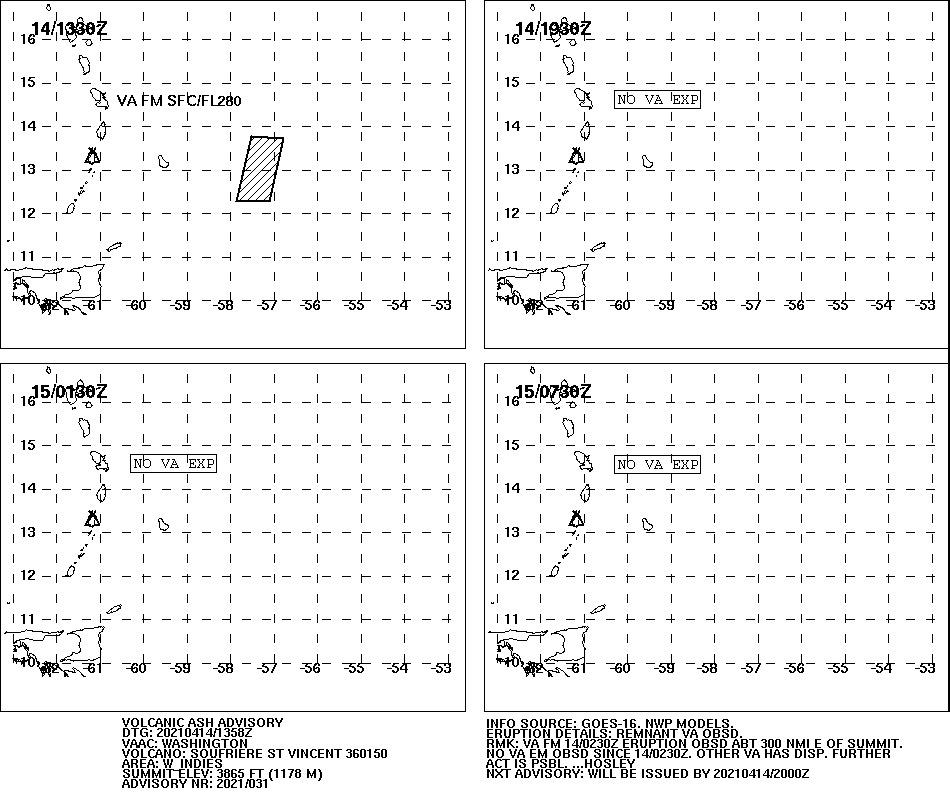
However, the most recent VAAC Advisory, dated 1358z on April 14, only shows a small area still affected by volcanic ash up to FL280, forecast to dissipate by 1930z:

Two main airports have been shut down by the eruption:

TVSA/Argyle has been closed until further notice having been coated in thick ash. TVSA Notam A0591/21 has that info and is due to expire at 00z on April 15 however it is very likely to be extended.

Further east, winds carried ash toward Barbados closing down TBPB/Bridgetown. It is due to reopen at 1600z on April 16, but further disruptions are possible (TBPB Notam A0585/21 refers).

St. Vincent Island and it’s airport, TVSA/Argyle, have been coated in thick layers of ash.

Outlook

The La Soufrière Volcano remains at Aviation Colour Code Red, meaning a major eruption is underway with significant ash emissions.

The amount of ash it produces depends on the strength of each eruption which is difficult to predict. So far they have been many and varied.

Airports in neighbouring Saint Lucia and Grenada have remained open but may be impacted by further eruptions depending on prevailing winds. Disruptions and closures are possible throughout the South-Eastern Caribbean.

Scientists have seen no sign that the volcano is slowing down and it appears to be following the same patterns as previous eruptions that lasted for extended periods of time – so things may get worse before they get better.

More info

  • You can view the latest VAAC advisories for La Soufrière here.
  • For the dangers of flying in volcanic ash along with operational advice, see our recent article here.


MAYDAY, MEDICAL: In-flight Emergencies

Fly the line long enough and chances are you’ll experience an in-flight medical emergency. They are relatively common, but also inherently challenging – they happen in a complex environment, in a confined space and with limited medical equipment often hours from help.

Just how common?

In approximately 1 per 600 flights. Or if you look at it another way, for every million passengers carried, 24 will have a medical emergency.

That may not seem like a lot but wait til you crunch the numbers. At pre-Covid levels four billion passengers were flying annually which meant at least 260 in-flight medical emergencies were happening each and every day. Other reports suggest the real numbers were much higher.

So it is a risk that we take on every time we launch upwards into the wild blue yonder and yet concerningly one we practice for far less often than almost all other inflight emergencies. It is well worth taking a closer look.

Why do people get so sick at altitude?

One of the most common thoughts we have following an in-flight medical emergency is “but he was totally fine when he boarded...”

The reality is the pressurized cabin of an airplane is a terrible environment for someone experiencing a medical situation.

Passengers with existing conditions are probably not aware of the environment they are entering and the effect that it may have on them. They may feel fit to fly on the ground, but in the sky it can be a whole other ball game.

In most cases we are breathing oxygen equivalent to an elevation of between 5000 and 8000 feet. It’s not dangerous, but even healthy people will be mildly hypoxic with oxygen levels almost ten percent lower than normal. At sea level with similar blood oxygen levels an ER would have you on oxygen. Throw in a heart or lung condition and you have a dangerous combination.

Then there’s the issue of sitting down for hours on end which can inhibit the flow of blood in your veins. This can trigger some truly nasty things such as thrombosis (blood clots) and embolisms which can lead to seizures, strokes and heart attacks.

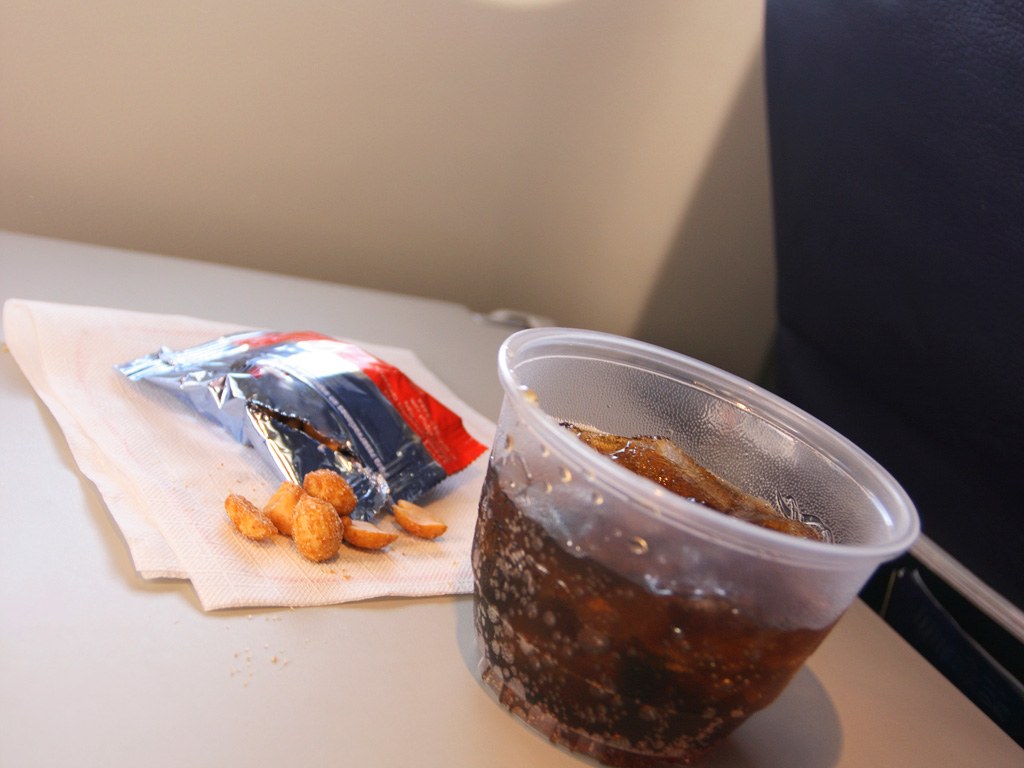
Then there’s the cabin air itself. Re-circulated air can expose passengers to allergens and potentially anaphylaxis – a life threatening allergic reaction. Ever wonder why peanuts in planes aren’t that common anymore? Even something as simple as dehydration can make a passenger become seriously unwell.

A few innocent peanuts a few rows down can lead to a life-threatening medical emergency.

So which ones are the most common?

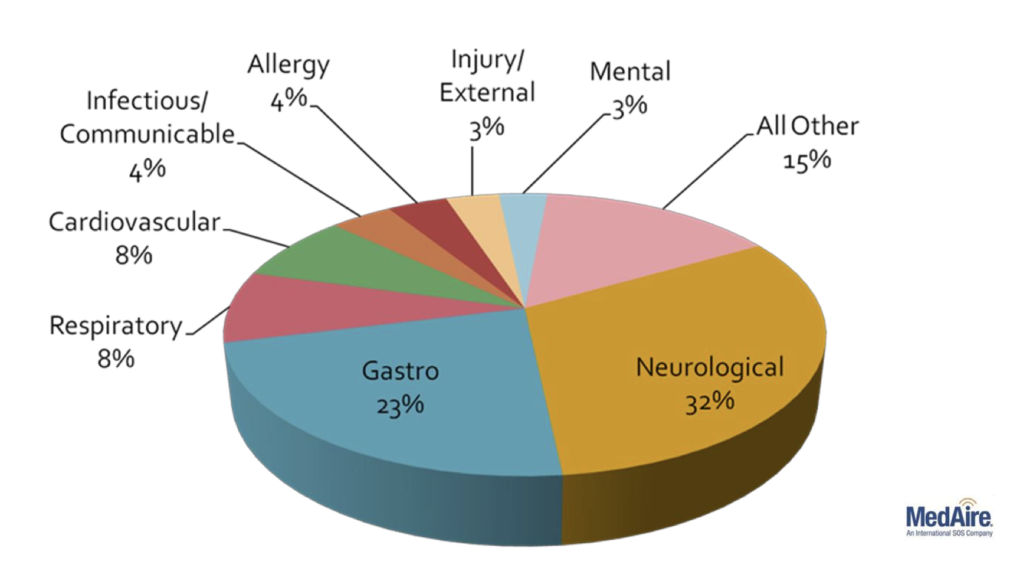
Almost half of in-flight medical emergencies are caused by neurological conditions, and the vast majority of those are headaches, fainting or dizziness. In most cases they are not serious but may indicate or lead to something far more dangerous.

In second place are gastric symptoms – yep, stomach problems. Beware the dodgy airport taco. Nausea, vomiting and cramping. No one enjoys ‘riding the porcelain express,’ especially in an airplane, but acute food poisoning can become incapacitating very quickly – and the same applies to crew as well as passengers.

And tied for third are respiratory issues (problems breathing) and cardiovascular symptoms (heart related things).

The most common causes of inflight medical emergencies.

Which symptoms do we need to be most worried about?

Human bodies are complex machines but these are historically the biggest warning signs:

  • Unconsciousness with slow or no recovery.
  • Chest Pain.
  • Seizures.

So how do we best manage in-flight medical emergencies?

Prevention is your first line of defence. Don’t board a passenger you have concerns about unless you are completely confident they are fit to fly. This may include speaking to a service like Medlink or asking for medical clearance from a doctor. They may be feeling okay now, but not so much after wheels-up.

Have a plan.

Just like you have a checklist for a mechanical issue in the air, you should have a standard operating procedure for inflight medicals.

Serious health problems often begin with very mild symptoms. Be alert for any medical issues, however minor. A report from the cabin that someone is feeling unwell is your cue to become diversion minded. Start thinking about what is around you, what the weather is doing, and of course those pesky Notams. But the point is: work hard now so if things escalate you are already ahead of the airplane.

Stay calm.

Things are going to get busy but don’t forget that your primary responsibility is to protect your airplane. Remember to fly. If you are multi-crew, make sure one pilot is actively monitoring and has the radios at all times.

Communicate.

This is vitally important. If you plan to use a service like Medlink the first thing they will need is informationand lots of it. Establish communication with the cabin and get that pen and paper out. There are also forms available online to help. Don’t wait until you have the doctor on the line.

Ask for help. You’d be surprised how often you carry passengers with medical experience. In the US they are protected from any liability by the Good Samaritan Law, while in most other countries they have their own provisions which will allow them to assist. Unless they are grossly negligent they simply cannot get in trouble for helping.

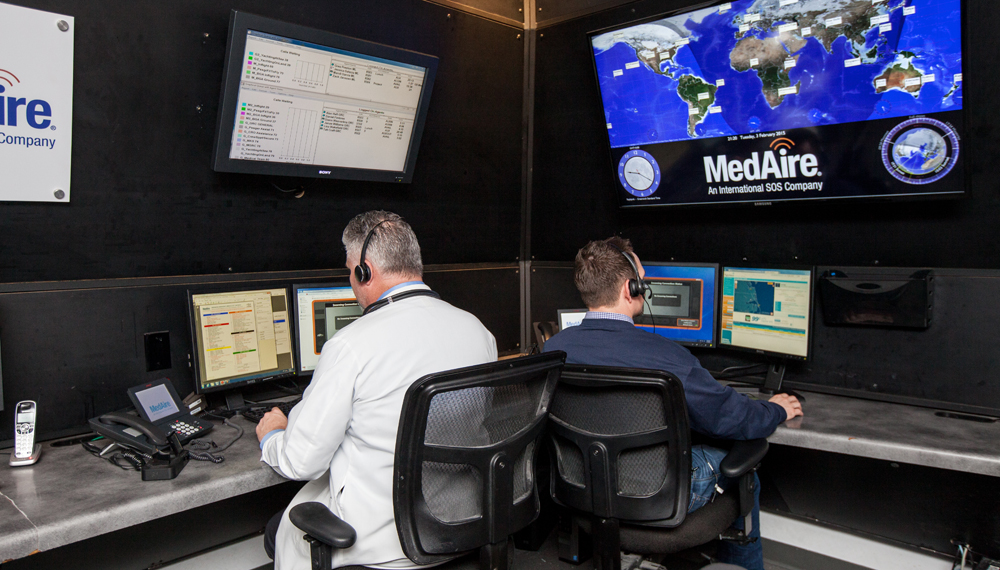
Use a medical advisory service. They are invaluable and put you in direct contact with a team of physicians who are trained in ER medicine and airline protocols. They are multi-lingual and available around the clock. They will work with your cabin crew with confident instructions including the use of a physician’s kit. Medlink is a solid example and widely used by carriers around the world. You can contact them via SATPHONE, HF/VHF radio or even ACARS.

Medlink physcians are trained in both ER medicine and airline protocols.

Don’t forget ATC. Don’t be afraid to declare an emergency, or a PAN. They will assist you with priority handling, an ambulance and paramedics on arrival and can even contact your company for you.

Remember security.
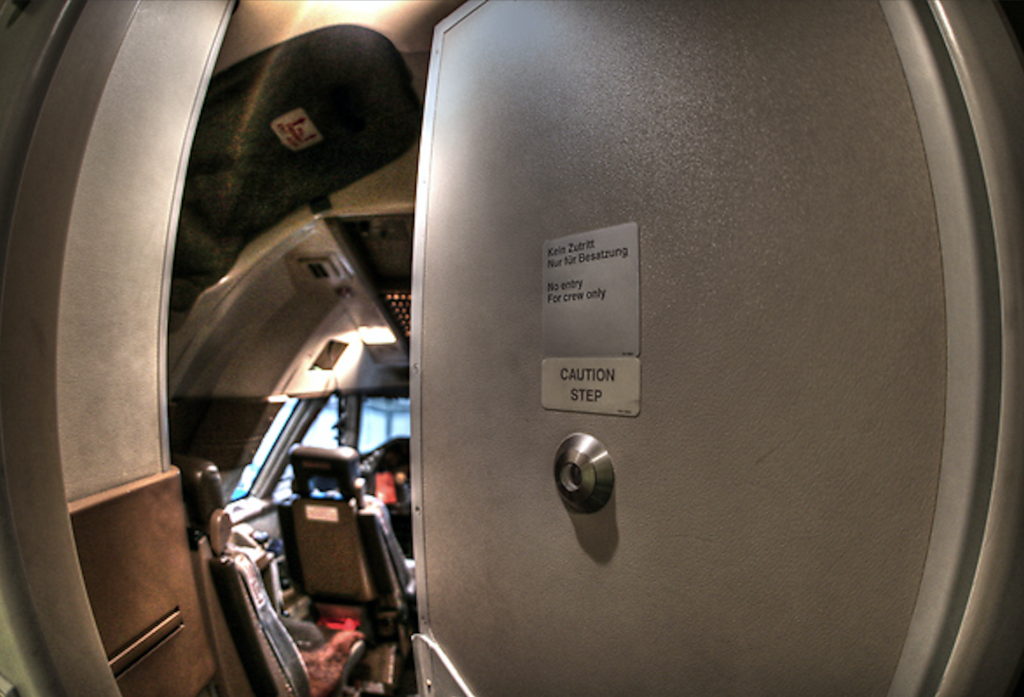
It is easy to be distracted during a medical event. Your cabin crew will likely be busy, and you may have to open the flight deck door multiple times. Be aware that medical episodes have previously been used to create a distraction for someone else to try and gain access to the flight deck. Or you may be carrying someone who simply seizes the opportunity. Stick strictly to your security and access procedures.
Don’t forget your security – beware of distractions.

Decide. The hard part. 

The decision to divert is a complicated one and unfortunately no two situations are the same. But there are a few operational considerations you need to take into account before you hit the old direct-to button.

It’s important to remember medical advice from a service like Medlink is a decision making tool. They cannot make the decision to divert for you – that responsibility sits firmly in the hands of the pilot-in-command.

They can advise you to divert, but remember, they are not aviators. They may not be familiar with the operational risks to you and your passengers of nearby diversion airports. Beware of inherent risks of where you decide to point the nose.

By no means an exhaustive list, but here are some of things you might need to consider above and beyond the emergency on hand:

  • Are we over weight? Do we need to dump fuel?
  • What’s the current weather? Can we even get in?
  • What about terrain? We’re not familiar, are there special procedures?
  • Is ATC on watch?
  • What about the NOTAMs? Is the runway open?
  • Is the runway long enough?
  • Is there customs there?
  • What do we do when we land? Are there services available?
  • Can we gas up there?
  • What about the security situation?

You get the picture.

Then there is the standard of medical care. You may give a sick passenger better odds by diverting further afield to land somewhere with better medical response. The closest airport is not always the best one.

And of course cost – the elephant in the room. Some symptoms are clearly life threatening and that must always come before cost. But in other cases it is not always so clear. Professional medical advice does not always take into account the sometimes extreme cost of diverting. For a jet aircraft this can range from $20,000 USD up to $700,000 USD for a large one in logistical costs.

The diversion decision – harder than it looks.

What about illnesses that are contagious?

Now, more than ever before, we are aware of germs. A passenger may suffer a medical emergency because they are carrying something contagious. It is very important that if you suspect a passenger might be infectious that you report it to the right people.

In fact ICAO requires it. If you delve into the depths of ICAO Doc 4444 you’ll find that the pilot-in-command must report to ATC if they suspect they have an infectious passenger on board.

How would you know? ICAO can help with that too. It you have passenger with a temperature greater than 38°C/100°F along with symptoms such as vomiting, coughing, problems breathing, rashes or confusion you can suspect they’re carrying something nasty.

The exact procedures vary from AIP to AIP, but in the US the FAA require pilots to advise either ATC or your company. You can read more about that here.

The problem’s not going away.

Unless you have discovered the ultimate cure for all things medical, in-flight medical emergencies aren’t going away. It is a risk we take every time we take passengers or ourselves into the air. It is up to us to mitigate through knowledge, procedures and preparedness. Chances are when one happens, you won’t be expecting it…


Bad Air: Fumes and Contamination

Fumes. Chances are if you’ve been flying for a while you’ve already experienced them. A recent study showed that in the US alone there are on average five fume events reported every day, and those are just the ones we know about. NASA previously eluded that these reports are just the ‘tip of the iceberg.’

It’s an industry-wide issue and there’s no magic bullet in sight to fix it. As long as we continue operating aircraft that use bleed air, the risk will persist and we need to take it seriously.

Each time we hop in an airplane we run the risk of being exposed to bad air – a threat that has potential to incapacitate both pilots. It’s happened before – just google Spirit Airlines Flight 708.

What do we actually mean by ‘fumes’?

It’s important to understand they are not the same thing as a smell. Smells can be unpleasant but are not necessarily a cause for concern. Your first officer may be to blame, or perhaps a dirty oven. They can also indicate a fume, but aren’t necessarily dangerous on their own.

Fumes on the other hand – are dangerous. In a nutshell, they are anything that produce physiological symptoms when inhaled. Fumes can be colourless, odourless and difficult to detect until they are already affecting you.

It’s important to understand the difference between a smell and a fume.

What about the regs?

So if it’s that bigger deal, why aren’t we testing the air? Both FAA and EASA airworthiness rules require cabin air to be free from harmful or hazardous gases and vapours but fall short of ongoing testing.

Detection systems are also required for safety critical systems but they have never been enforced for monitoring bleed air. Which is surprising considering it is what we breathe. Both IFALPA and ICAO have previously expressed concern at the lack of regulation out there to protect us and our passengers from contaminated air.

The reality is that most airplanes don’t have air detection – nor are they required to. Essentially it has become an acceptable risk that we need to deal with.

So, what can we do about it?

Knowledge is key. The more we know about fumes, where they come from and what to do in the air, the better we can deal with them safely.

Where are they coming from?

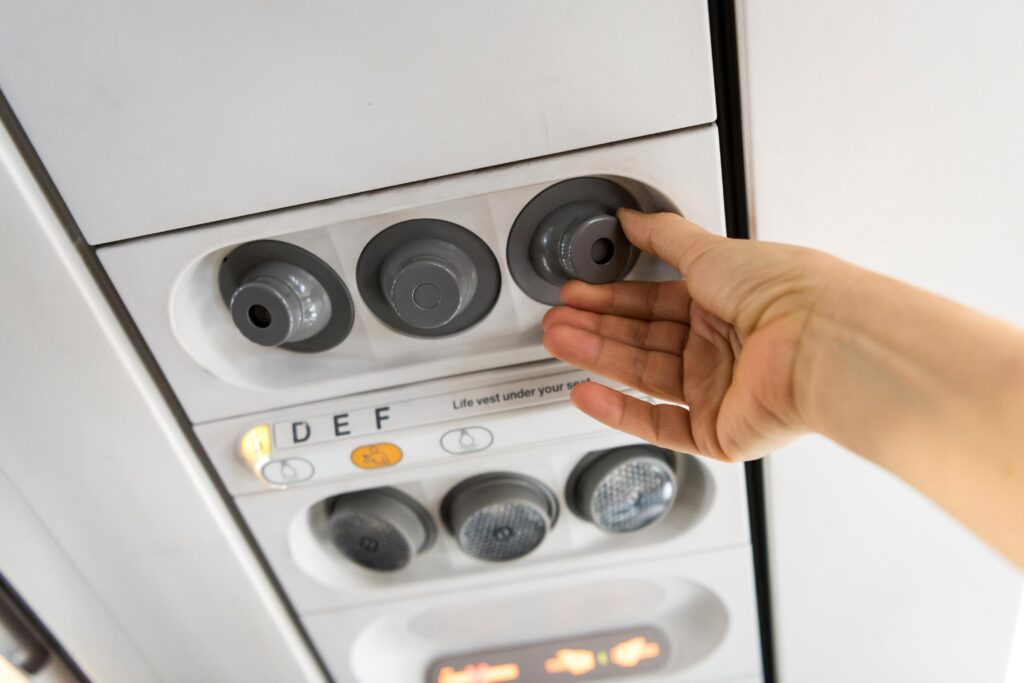
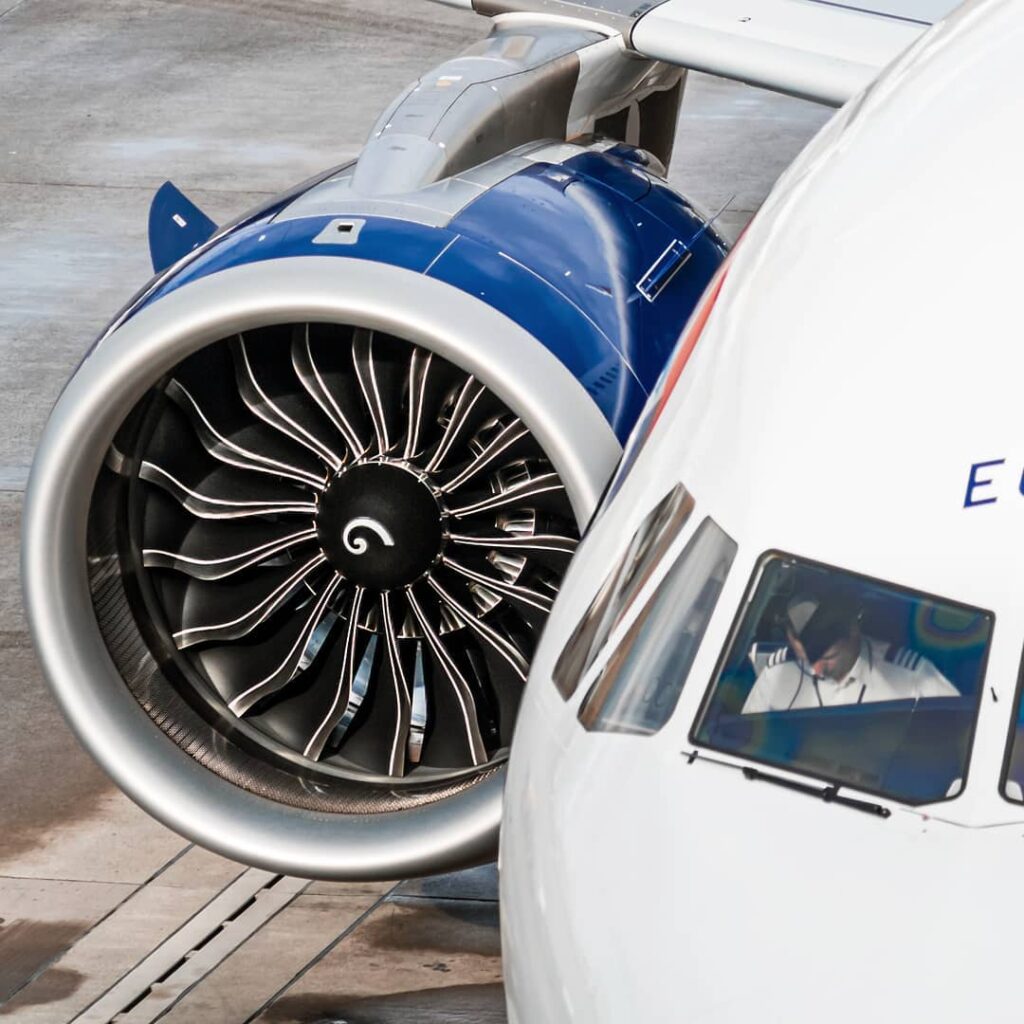
(Almost) all turbine aircraft in service use heated air drawn or ‘bleed’ from the engines or the APU for air conditioning and pressurisation. This is air is taken through ports before being cooled and mixed with recirculated air and distributed into the cabin and cockpit.

Great performance, fun to look at, but what is it exposing us too?

We rely on seals to keep the air clean of a load of nasty chemicals that turbine engines need to operate properly. Unfortunately when those seals leak or fail they allow toxic substances to enter the air we breathe.

What kind of substances?

Modern aircraft are complex, and we can be exposed to a surprising variety of chemicals – none of which do our bodies any favors.

Here are some of the major ones:

Synthetic engine oil. The number one culprit. Engines need it for lubrication and to keep bearings spinning smoothly. While accessories such as starter generators and accessory gear boxes rely on it. The problem is that it contains organophosphates – manmade chemicals that are toxic when inhaled. Oil contamination is often described as smelling like dirty socks, mustiness or ‘wet dog.’

Hydraulic fluid. Leaks and spills on the fuselage can be drawn into the APU inlet along with air intended for the cabin. They also contain organophosphates and are often characterised by a very acrid, bitter and oily smell.

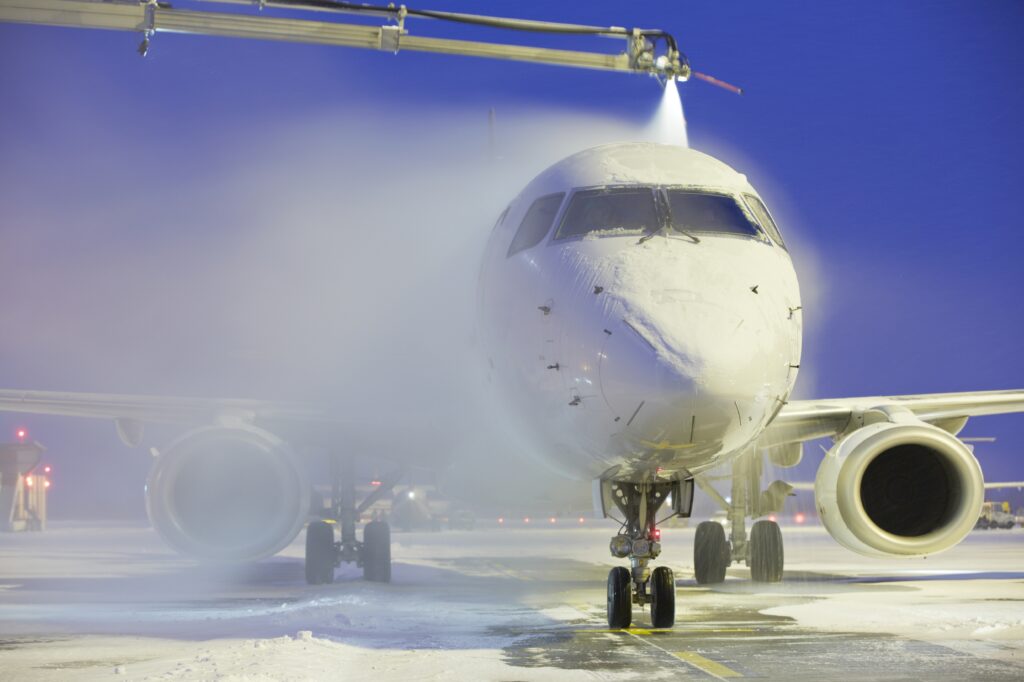
De-icing and anti-icing fluid. Be careful of this one. There are usually some pretty specific procedures to follow. If they’re not done properly fumes can enter the aircraft through a running engine or APU intake. These fluids often contain chemicals that are dangerous to humans such as Diethylene Glycol.

Great at making it safe to fly, just don’t inhale it.

Fuel. Fuelling operations at the airport, tank venting and failed relights can all allow fumes to enter the cabin. Excessive build ups will start to make people feel very unwell very quickly. Ventilation is your friend here.

Electrics. Electrical fumes can be caused by failed or faulty electrical systems and may precede a fire. Recirculation fans are also known to fail and produce smoke in the cabin.

Speaking of which, don’t forget the cabin! There are lots of things in there capable of producing fumes including what passengers have brought on (nail polish remover is a classic), cleaning products, galley equipment (dirty ovens, anyone?) and the lavatories.

Know the signs…

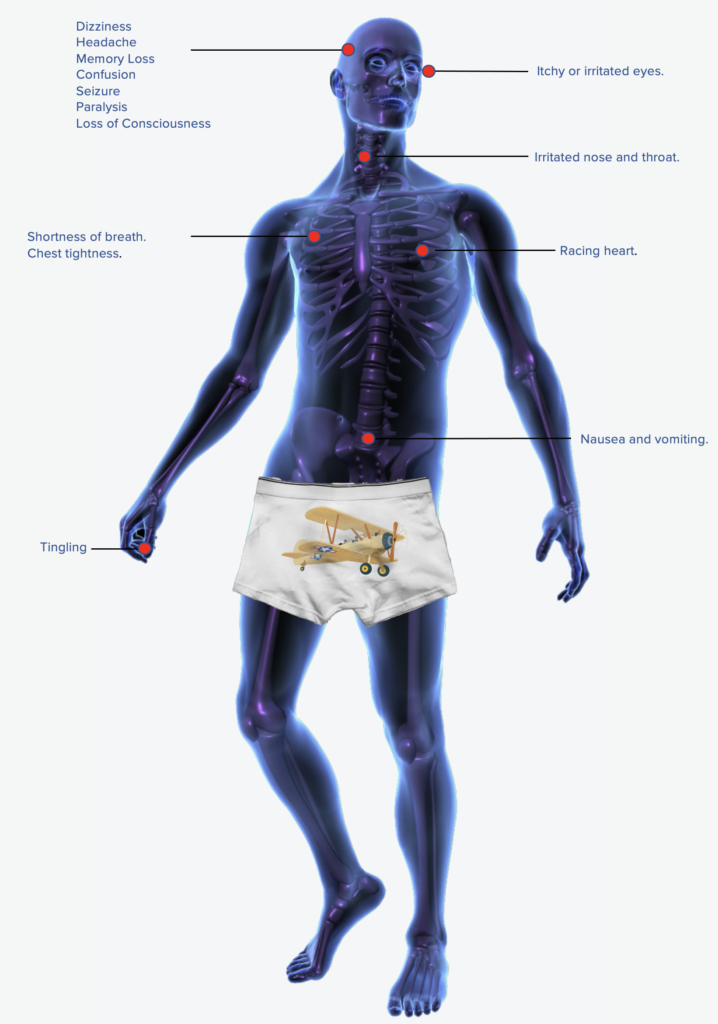
How badly fumes affect you depends on what you have been exposed to and how much of it was in the air. Generally speaking, most “fume events” result in some of the following:

What to look out for, and we don’t mean his boxer shorts.

Here’s the good news. In the overwhelming majority of cases, bad symptoms will last a few hours or perhaps a few days. Long term effects are possible but rare. The initial actions should be about protecting yourself and those in your aircraft.

So if you think you have fumes, what should you do?

Get on Oxygen. And 100% too. Don’t dilute it as you’ll still be breathing in what you’re trying to keep out.

Communicate. Get in contact with your cabin crew. At this stage you need to figure out what it is. Your two biggest clues will be where is it coming from, and it’s odour. Also talk to ATC – let them know you have an issue.

Run your safety procedures. Get that QRH out and look for a fumes removal checklist. Be careful if your checklist is combined with smoke removal. In some cases you will increase pack flow. But if that’s where the problem is coming from, it may make things worse.

Think about health. You may have incapacitated crew or passengers. If it’s a pilot, you likely have a procedure for that too. Consider getting help from a service such as MedLink. If things have gotten really bad, you may need to declare an emergency and divert.

You’re back on the ground and breathing that good ol’ fresh air again. Here’s what you need to do.

De-brief your crew. Find out whether anyone felt unwell or couldn’t perform their duties properly. If so they should stop operating right away until they have seen a doctor.

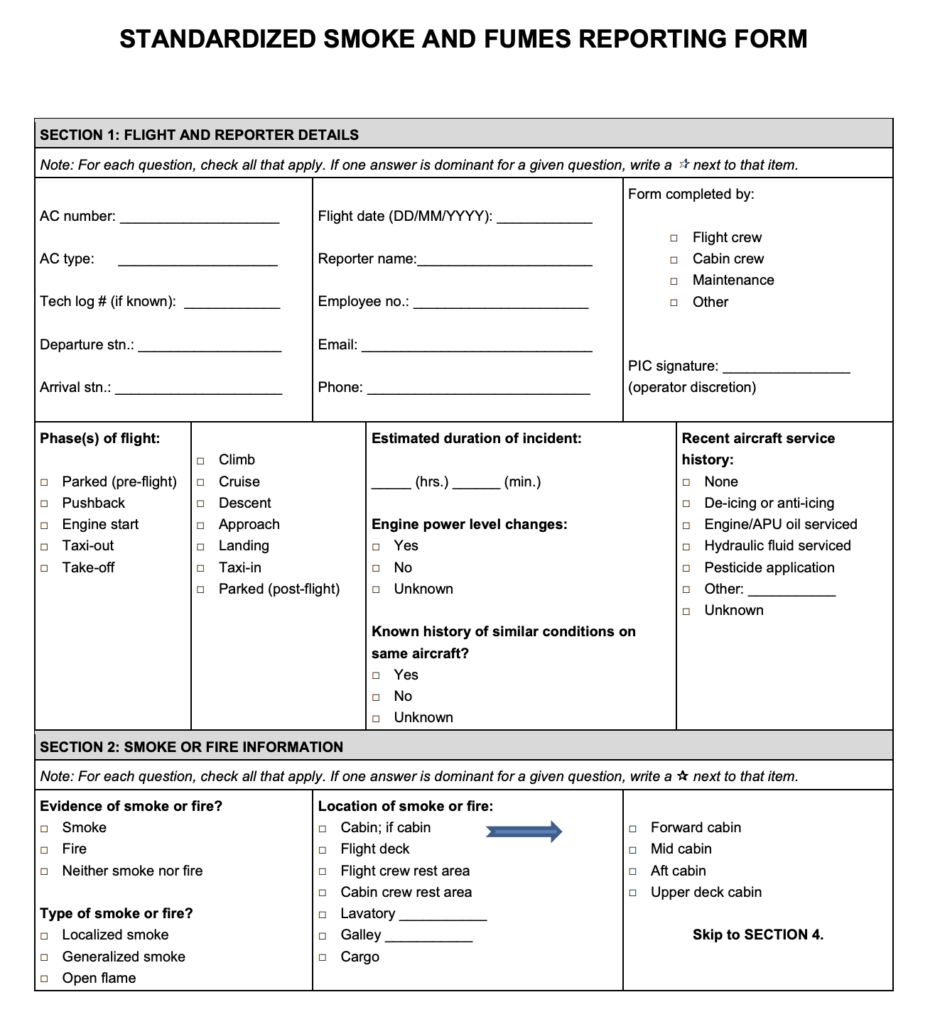
Report it! As much as you can, no matter how minor. Most operations have a form which will help you. Try and include as much detail as you can as trying to find a ‘bad smell in cabin’ is like trying to find a needle in a hay stack. Don’t forget the tech-log too – help the engineers help you.

ICAO’s fume event reporting form. Click to download PDF.

Consider visiting your doctor, particularly if you have persistent symptoms.

What can the industry do to stop this happening?

The ultimate solution is bleed free design. And the future is now – check out the Boeing 787. It’s the poster boy/girl of this huge leap forward. But for most of us out there, we’re stuck with it.

Filtration. They’re not 100% effective but bleed air filters are a far cry from simple recirculation filters which are about as useful for fumes as a glass hammer.

Better chemicals. Okay, this one is out of our hands, but the industry should be prioritising this.

Detection and monitoring. The smoking gun. We are literally surrounded by chemicals that are bad for us in our tin cans up there. More needs to be done to make sure the air we are breathing is good air. We need to be able to know when something bad is in the air we breathe. It’s a no-brainer.

The elephant in the room. Which airplanes are the worst?

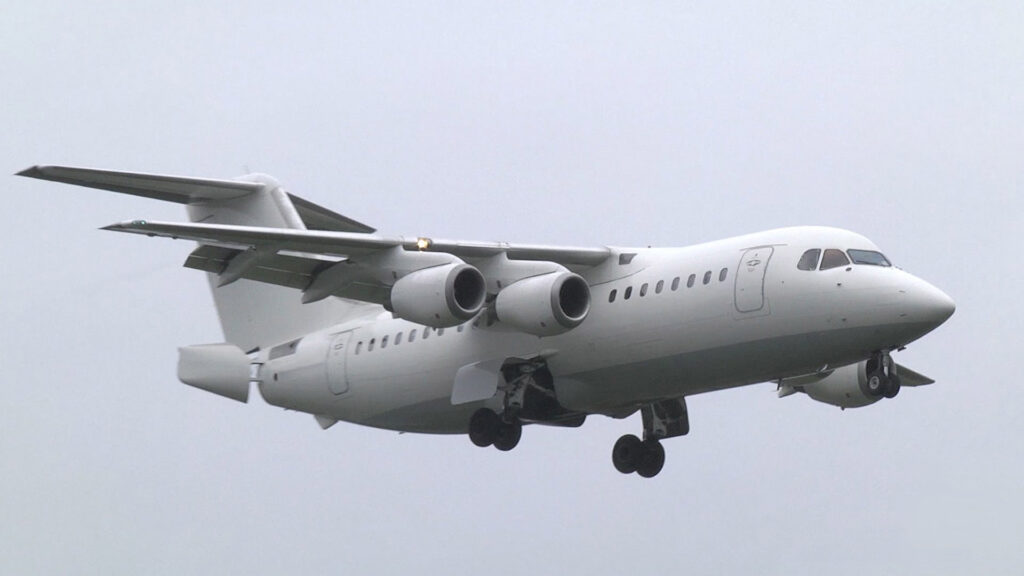
The moment you’ve all been waiting for. Don’t shoot the messenger. But statistics show that the BAe 146 and Boeing 757 appear to be the worst culprits. But the reality is if you are flying any airplane, you are at risk of fumes.

The mighty 146! Sadly one of the worst culprits.

What about Aero-toxicity?

The question of long term effects from exposure to chemicals in planes is beyond the scope of this article and the research is inconclusive. But if you’re worried about it, the Aerotoxic Association is a good place to start.

There’s a ton of reading out there too if you want it. Here are a few good ones.


Blinded By The Light: Laser Strikes

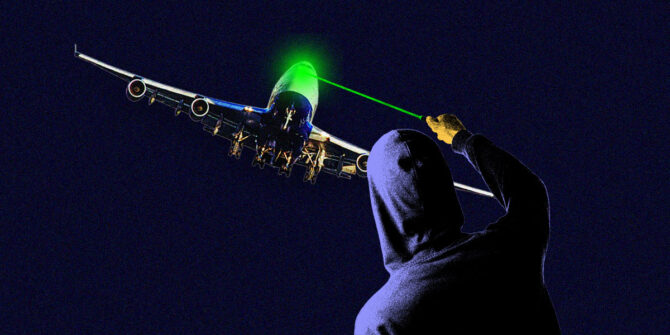
The FAA recently reported that even after traffic levels fell off a Covid-induced cliff during 2020, the number of laser strike incidents actually increased year on year. There were nearly 7,000 of them last year in the US alone – that’s almost 20 a day.

It’s a dangerous and common problem which is proving difficult to control. The FAA take it so seriously they regard a laser strike as a bona fide in-flight emergency.

Here’s why

In the majority of cases, laser strikes are intended as pranks or to cause nuisance. They tend to occur during critical phases of flight – approach, landing and take-off in other words, when you are low, slow and busy.

When struck by a laser, there are several things that can happen to the crew:

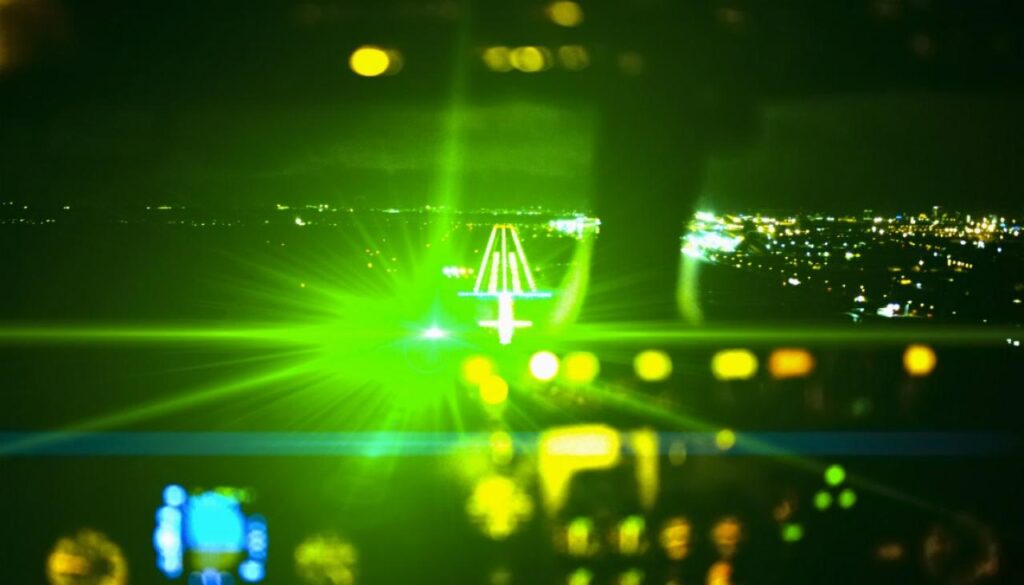
Startle factor and distraction. Right when you don’t need it. You can picture the scenario – it’s the last leg, it’s late and you’re tired. The picture outside is looking good, two reds, two whites, and you’re in the groove… and suddenly a green light appears to the side of the runway that zaps your flight deck. Your scanning breaks down, your attention is divided. Very quickly your approach can become unstable.

Distracting? The startle factor can be more dangerous than damage to your eyes.

Glare. Stronger lasers create a veil of light that obscures your ability to see your instruments. The colour green creates the worst glare.

Flash Blindness. This is potentially the most dangerous outcome of a laser strike. It is a temporary loss of vision after the laser has been turned off. An after image-remains on your retina, possibly for several minutes after exposure that obscures your ability to see. It is the same effect you experience after someone takes a photo of you using a flash.

Flash blindess – that dull patch in your vision after someone takes a photo of you at night.

Permanent Eye Damage. Fear not. Yes, it’s possible, but very unlikely. The laser would have to remain in one spot on your retina stationary for several seconds. While it is unpleasant to stare down the beam of a laser, FAA studies have shown there have been almost no cases of flight crew with permanent eye damage from a laser strike.

So there’s been reports of laser strikes in the area. What do we do next?

There are two camps here. How to avoid laser strikes in the first place (mitigate), and then what to do if you’re hit by one (react).

Mitigate

Here’s where a little background helps. We know that the vast majority of them occur between 7 and 11pm at night, and they’re far more common on Friday and Saturday nights. Public holidays such as New Years and July 4th are especially bad. Be sure to brief it as a risk.

Listen out for the phrase “UNAUTHORISED LASER ILLUMINATION EVENT.” ATC have a set process to follow if they receive a report. It will be followed by where it happened and at what altitude. They’ll broadcast it every five minutes for twenty minutes after the latest report. The same warning will also be put on the ATIS for an hour.

The FAA recommends that if you hear laser reports from ATC or other aircraft within the preceding 20 minutes you should avoid the area by requesting a re-route or alternate approach (if possible).

And keep those lights bright. An eye in a bright environment is less vulnerable to the effects of a laser strike.

React

Right, so you’ve just been blasted by a laser. Here’s what you need to do to limit its impact.

Don’t stare at it. Okay, this one may seem like an obvious one but don’t look at the beam. It will maximise your chances of encountering any of the nasty stuff above. Instead look down at your instruments.

Eye’s down, don’t look at that beam!

Protect your eyes – you can use your hand, a clipboard, iPad anything really. But try to get something between you and the laser.

Resist the urge to rub your eyes afterwards. A laser strike may irritate them or make them sore. Don’t start rubbing them – you run the risk of scratching or irritating your cornea which is going to be far worse.

Keep flying the plane! Turn on the autopilot and stabilise the aircraft. Make sure you communicate with each other.

Transfer control – if your offsider wasn’t exposed, get them flying and heads down on instruments. Don’t let them start looking out the window or you run the risk of a double exposure.

Consider a Go-Around – self-explanatory really but it may be the safest outcome.

Tell ATC. They need to know to protect other aircraft and help law enforcement find the laser-wielding halfwit and make them pay.

How to report ’em

The FAA want you to do it right away, and it’s easy. While you’re in the aircraft, get on the radio and talk to ATC. They want to know where it happened, your altitude, the colour of the beam, the direction it came from and any other information you think would help law enforcement.

Once you land there is a little paperwork to do. The FAA want you to fill in an online questionnaire. You’ll need to either fax it to (202) 267-5289 or email it to laserreports@faa.gov.

Other things to read

  • FAA Advisory Circular 70-2A – A full rundown of everything the FAA wants you to know about laser strikes.
  • FAA Laser Incident Reports You can view the full database of laser strikes including where they are happening most. The information is completely open to the public.
  • Laser Tag For Newbies: Tips, Tricks, and Strategies. How to shoot people with lasers in a way that doesn’t break the law 😊


Expect the Unexpected: Evidence-Based Training

Today’s aviation environment is complex but incredibly reliable. Our aircraft are packed full of automation, systems and redundancies designed to keep us safe up there. Fancy things like EGPWS, Flight Envelope Protection and TCAS are there to protect us.

But herein lies the issue: because things are so reliable, the circumstances of the next accident waiting to happen are ever more challenging to predict.

All that technology is still limited by us humans. One thing we do know is that human factors have played a role in between 70 and 80% of airline accidents and serious incidents over the past thirty years. In many cases these accidents have certain things in common – poor group decision making, ineffective communication, inadequate leadership and poor flight deck management.

So it is clear we have an important role to play in making ourselves more reliable too.

Enter ‘Evidence Based Training’ or simply EBT for those in the know. And it’s a revolution for pilot training.

What is it in a nutshell?

In really simple terms it is about looking at data or ‘evidence’ to find relevant threats and errors and then changing the way we train pilots so they have the competencies they need to deal with them.

Cool, so what does that actually mean? Let’s delve into things a little more.

Out with the old

Traditional airline training was based simply on events that occurred on early generation jet aircraft from yester-year. There was a belief that simply exposing crew to those same ‘worst-casescenarios over and over again would be enough.

The cyclic was born. A long list of bad things that can happen which you’d periodically face in the sim. They tended to be manoeuvre based – you know the ones. V1 cuts, rejected take offs, go-arounds. As long as you flew them within limits you were officially ‘competent.’

It was simply a tick-in-the-box approach to pilot training. But you couldn’t help but get a nagging feeling the industry was missing the point: you have no way to predict what will actually happen to you when you go to work the next day.

Modern aviation has a way of throwing things at us that we haven’t seen before. Computer failures, mode confusion, strange stuff. Just look at the tragic case of Air France 447. Training in modern fly-by-wire aircraft has never been the same but it sadly came to late for that particular crew.

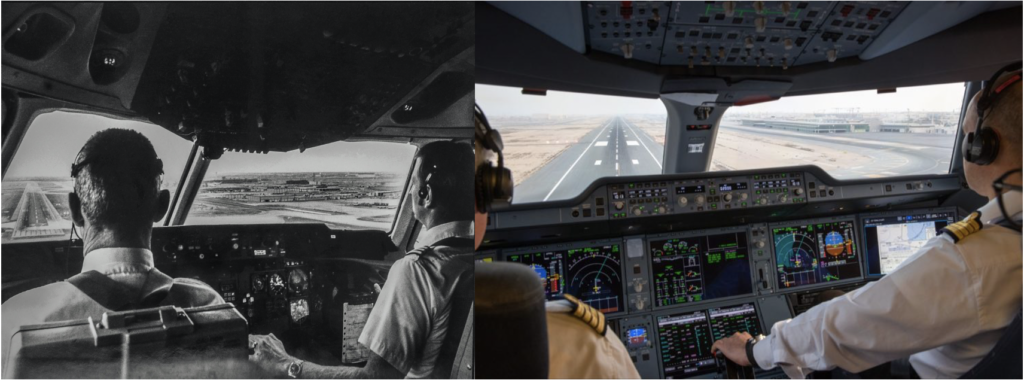
Both competent crews but can you think of unique scenarios the crew on the right may have to face compared to the crew on the left?

In with the new

Over time the amount of data or evidence out there improved dramatically. There were a bunch more sources – flight data, LOSA programs and air safety reports to name a few.

In 2007, a new industry-wide safety initiative emerged. It was led by IATA and began to use this evidence to identify relevant threat and errors that crews face for their particular operation and adjust training to better equip crew to deal with them. EBT was born. ICAO was sold on the idea too and hopped onboard in 2013.

The emphasis is on crew effectiveness as a whole by developing a bunch of competencies – tools that pilots can use in any scenario, normal or abnormal. The training uses unscripted situations to develop crew management strategies, techniques and human factors that are just as important to safe flight as technical skills.

Here is an example of the sorts of competencies that EBT training sessions look to develop (it really is the whole package):

  • Application of Procedures
  • Communication
  • Aircraft Flight Path Management, including manual flying
  • Leadership and Teamwork
  • Problem Solving and Decision Making
  • Situational Awareness
  • Workload Management
  • Knowledge

Isn’t that just Crew Resource Management?

Not really. Although CRM continues to be a solid step forward for the industry, when put into startling or surprising situations studies have shown we lack the capacity to immediately control our behaviour. What we need is practical training over time with consistency and reinforcement which is where EBT becomes so valuable.

It combines both technical and non-technical skills and focuses on the crew as a team, achieving successful outcomes when faced with the unexpected. It moves the emphasis away from checking and more toward training.

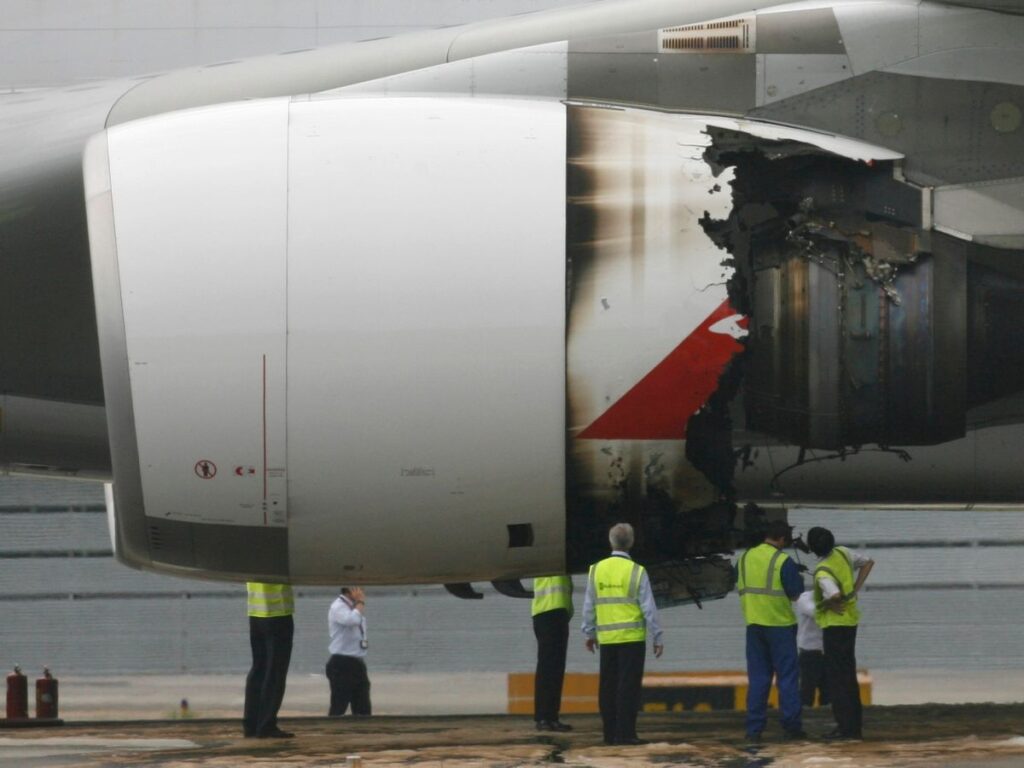
After a single engine failure the crew of QF32 were faced with 43 different failure messages in the first sixty seconds.

So how does this all work in the sim?

Good news, EBT doesn’t mean you’ll be in the sim more often. They’ll still pop up on a biannual basis. What will change is how the sessions are run.

EBT sessions are typically broken into two or three parts:

An Evaluation – this is where your baseline performance is measured. You’ll be given scenarios you may face in your own operation. This is so your trainer can get a good look at you in action and begin to identify your own personal areas of weakness that they can work on in subsequent sessions.

Proficiency Training– this is mostly manoeuvre based stuff you’re used to. Your trainer will focus on your technique. You’ll be put under pressure but the idea is to further develop your abilities in challenging circumstances. Your standard currency items will also be ticked off.

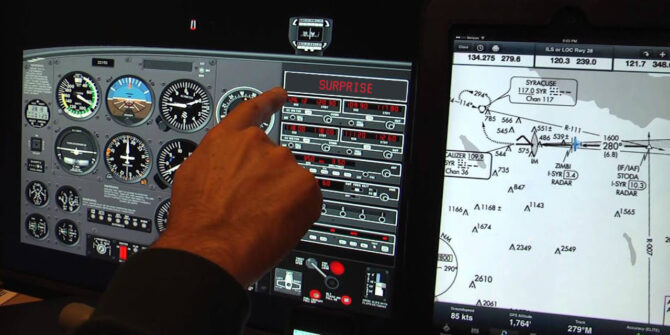
Scenario Based Training – this is the heart of EBT and where most of the work is done. The focus is on event management and the scenarios are off the script. You pretty much won’t know what is coming but you’ll have to apply your knowledge, skills and attitudes to a successful outcome. It is a journey of self-discovery in solving problems rather than simply following SOPs.

Over time these competencies will be reinforced – giving you the confidence in your own abilities to tackle whatever is thrown at you.

After all isn’t that how the real world works out there?

Expect the unexpected in the sim. It is not as bad you think…

Other things to read

EBT is fast becoming an industry standard and many operators have have their new training programs up and running. For those that haven’t, here are two things you need to get started:

EBT looks at pilot competencies – a set of ‘tools’ for a pilot to quick draw out of their metaphorical tool belt in order to help them solve whatever situation flies their way. The Decision Making & Problem Solving ‘competency’ is a big, multi-faceted one, and it turns out that making a decision is often easy, but making a good one is less so. Read our article on this here.


Unstable Approaches: Why Aren’t We Going Around?

Late last year, IATA put out a bulletin noting that the number of unstable approaches in 2020 was a lot higher than in previous years.

Look a little further back and you’ll see this has been a trend for some time now.

Fly the line and it’s not hard to see why we are getting unstable – there are a bunch of reasons including weather, other traffic, challenging clearances, complex airspace, fatigue and even currency given the state of the industry, to name only a few.

So what’s the big deal?

IATA also know that in most cases, we’re not going around.

The numbers don’t lie, and they’re scary. Get this – a recent study estimated that 97% of unstable approaches flown in IMC didn’t fly a missed approach. That’s huge.

The leading cause of aviation accidents worldwide are runway excursions. The Flight Safety Foundation looked into all of them over a fourteen-year period and found that 83% of them could have been prevented by a go-around. That’s over half of all accidents recorded. It’s a big deal.

What do we actually mean by ‘unstable’?

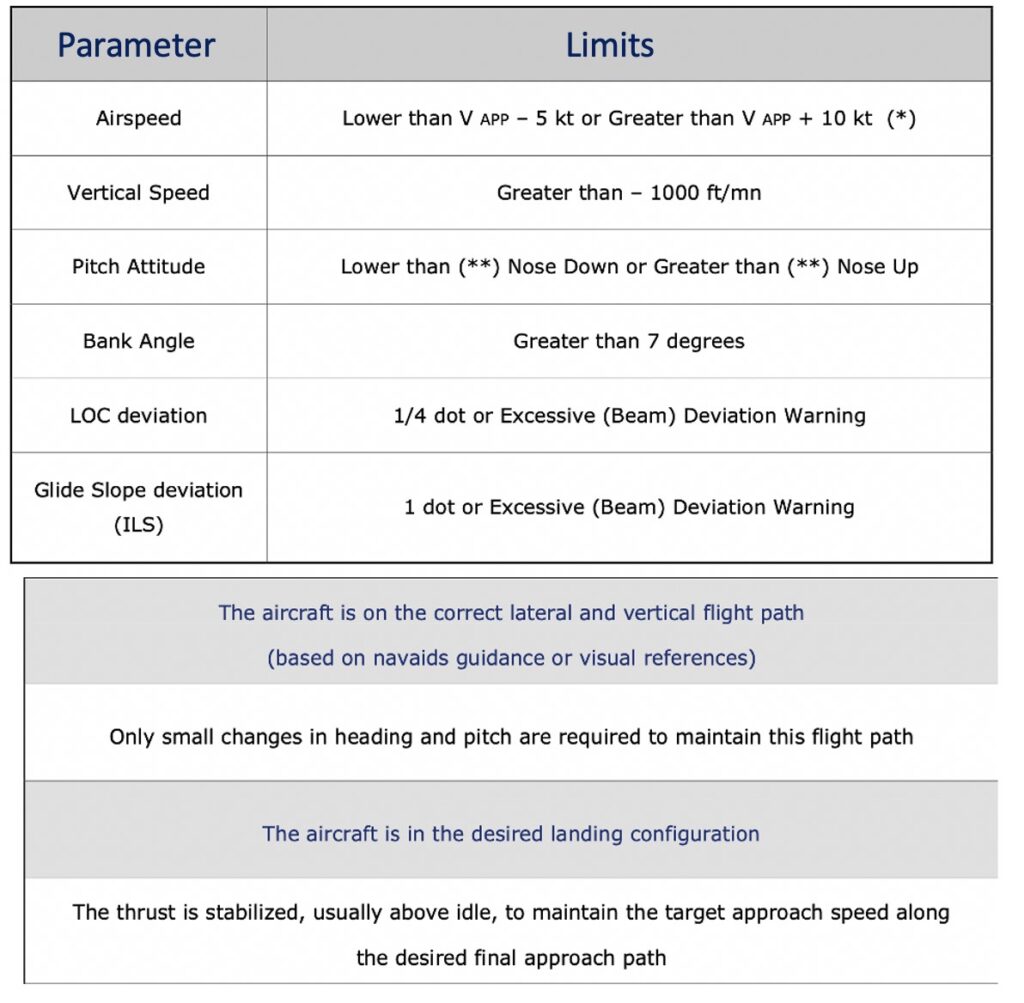
In a nutshell it is any approach that doesn’t meet the stable approach criteria in your SOPs by a certain height – usually 1,000 feet off the deck. And it’s not just the ones that have gone badly wrong either – the criteria are usually pretty tight…

Example of typical stabilised approach criteria to be met by 1,000 feet off the ground.

Like the picture, the decision appears to be black and white: If you don’t meet the criteria, you have to go-around.

So why aren’t we doing it?

Good question. There are a bunch of factors but the most important is pilot psychology. Either consciously or sub-consciously we are making a decision to not go-around. Here are some suggestions about what may be happening inside our heads.

1. We’re pilots

Which means we’re mission-orientated. We want to get in and we don’t like conceding defeat. Nor do we enjoy being reminded that we have reached the limit of our ability to fix whatever has gone wrong.

Experience also tells us that if we persist a little longer we can re-stabilise. After all a little speed brake, a little more sink rate you’ll have the thing back on rails long before the runway out the window is too close for comfort.

The problem is we’re fixating on completing the mission.

Studies have shown this behaviour is insidious. It creeps up on you and you begin to normalize the risk. Just like a speeding driver arriving home unscathed, the danger becomes typical. But it gives you far less capacity and room to deal with anything unexpected.

2. Training

A go-around is a normal procedure, but boy do things happen quickly. It’s okay when you know it’s coming. But it’s when you’re off the script that they get especially challenging. Especially after something stressful has already happened.

Studies show that pilots are more reluctant to go-around in scenarios they haven’t practiced. This includes when the aircraft is only partially configured or is very low to ground (such as a bounced landing or botched flare). Complicated airspace and procedures can also be major deterrents to hitting those TOGA switches.

3. What the other guy/gal thinks

Everyone’s personality is different, and we don’t always get along. You might like a good book, while your offsider might prefer a good base jump. When it begins to matter is when it affects safety.

We react differently depending on the dynamic with the other pilot. This can include embarrassment at going around, a lack of support for the decision or disagreement with whether the approach can be safely salvaged. But if you begin to see a go-around as a reflection of your abilities, you are already on a slippery slope. Add an offsider who might judge you for going around and you’re in for a dangerous ride together.

Cockpit gradient is another contentious issue. Too steep and it can turn a multi-crew aircraft into a single pilot one. Age, experience, rank or culture can all contribute. Take this animation of a visual approach on a calm sunny day in San Francisco a few years back. Watch the animation and decide when you would have said something. There were two Captains and a First Officer on the flight deck.

Credit: Airboyd

4. Organisational Pressure

The elephant in the room. No one is pointing fingers but now more than ever operations need to run on the ‘scent of an oily rag.’ Fuel is a big part of that. Crew may be encouraged to carry less of it in the first place which can lead to  fuel anxiety and reluctance to go-around. Or it may be the simple economic cost of using it compared to trying to re-stabilise an approach. It’s no secret that go-arounds use a lot of fuel.

Other factors may come into play too – scheduling, delays, an unwanted diversion or even duty time limits. There are a bunch of external factors which can creep their way into the flight deck and affect our decision making.

So what can we do to improve our Go-Around decision making?

IATA have made some solid suggestions:

1. Make the decision as early as you can. Historically, accidents that follow a decision to go-around usually reflect a late decision. Don’t wander down that garden path. Lion Air Flight 904  serves as another example.

2. Brief the heck out of them. Every time.  Make sure you include what you will be looking for to continue the approach, what may make a go-around more difficult on that particular day and how you will get around those challenges.

3. Encourage acceptance on the flight deck that a go-around is a possibility at any stage. Always prioritise the safest outcome.

4. Follow those SOPs. Operators should always have a mandatory requirement to go-around when stable approach criteria aren’t met. On the flipside, there should never be any punitive reaction to a crew’s decision to go-around. They show good decision making.

5. Fuel policy. Have one which always allows for go-arounds and accept they are a necessary cost of operating an airplane out there.

Up for more reading?

It’s a big issue so there are plenty more places to look. Here are a couple of really good links to get you started.

  • IATA periodically publish a whole bunch of useful stuff about unstable approaches, go-arounds and risk mitigation.
  • Flight Safety’s work on unstable approaches.


Currency and Startle Factor – How to Beat It

Good news – the vaccine is here!

Slowly but surely passengers will begin returning to the skies. Which means pilots will too. Just like a huge ship, our industry has inertia. You cannot simply take your foot off the brake and straight back onto the gas.

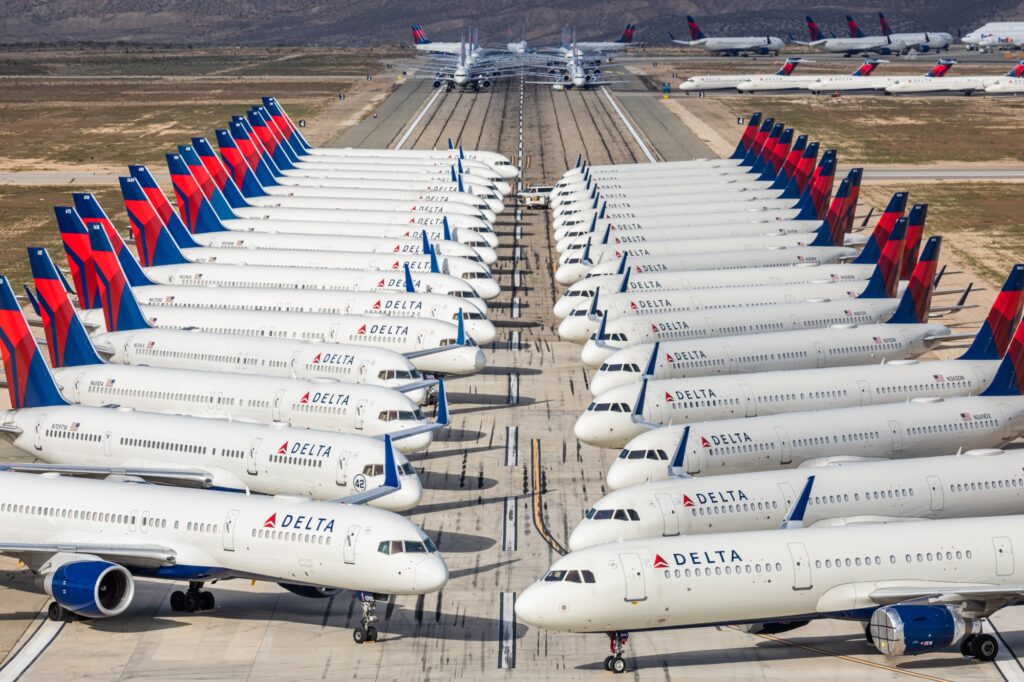
In 2020, it went into a deep hibernation. Remember those pictures? Thousands of gleaming tails stuck depressingly in the desert? Well, pilots didn’t fare much better. Thousands of pilots were put into deep storage too.

Furlough and redundancy. For now, pilots are much the same way.

To give you an idea of scale, get a load of these stats- the first post-Covid worldwide survey found that 58% of the world’s pilots are currently grounded. 33% lost their jobs completely while a big bunch are on furlough with no clue when they’ll fly next.

So as the industry begins to recover (and it will), a legion of seriously “non-current” pilots will find themselves back in the hot seat facing the same challenges they did back when things were booming and your skills were Chuck Yeager sharp.

Beginning to get the picture? I’ll give you a hint…

It’s not like riding a bike.

The seat may feel familiar, but it’s been a while.

We’re not machines and our skills degrade over time no matter how good you are.

Secondly, you might think a bunch of extra training will soon get you back to speed. The issue is resources – it is such a big task to get everyone current again you are likely to find yourself at the controls legally current, but not necessarily at your best.

So if something goes wrong, you’re likely to be further behind the 8-ball. So let’s talk about startle factor. Yep that old chestnut. We’ve all been there. Something has gone wrong and fast. One minute you’re talking about that great place that does burgers near the crew hotel, the next you’re seeing more red lights than Amsterdam. For a fleeting moment all that training and knowledge is gone. You go blank but feel compelled to act. Sadly it is in these brief moments that some crew have tragically become unstuck.

Here’s the issue.

When you’re not current you are more likely to fall victim to startle factor. And you can bet your bottom dollar that whatever is about to happen is not going to wait for you to get a few sectors under your belt first.

So if I get a call up next week, what can I do about it?

  • Understand what is happening in your brain when something goes *bang*.

    Startle factor is normal. It affects everyone because a ‘fight or flight reflex’ has been hard wired into our brains since the days we were running away from woolly mammoths and sabre tooth tigers. It is a physical and mental response to something unexpected.

    When something gives us a fright, our brain activity changes. We think less and act instinctively while our bodies are pumped full of adrenaline and stress hormones. Effectively for a short time our thought processes are hijacked. We can get into a vicious cycle of bad decisions in a hurry. This post-startle brain fog has had tragic consequences in avoidable accidents.

  • Don’t act. At least right away.

    Just for a moment, resist the knee-jerk reaction. Slow it down. By sitting on our hands even for a second or two you are giving your brain a chance to pass through its instinctive reaction and give you back control of your decision making. You have to understand what is actually happening before you can do anything to fix it.

  • Be Ready.

    Fight boredom and be alert. In each phase of flight think about what could go wrong and how you will react. For those less superstitious, dare your plane to fail. By keeping your brain in state of readiness you will overcome the startle factor more easily.

  • Get Back On the Script.

    Ah, yes. Familiar territory – nothing helps you get over a shock than what you already know. Use a robust decision making process and watch your ol’ capacity bucket grow.

    You have probably heard of some – SAFE, GRADE, FATE etc. There are lots of them but it is important to have one and practice it consistently.

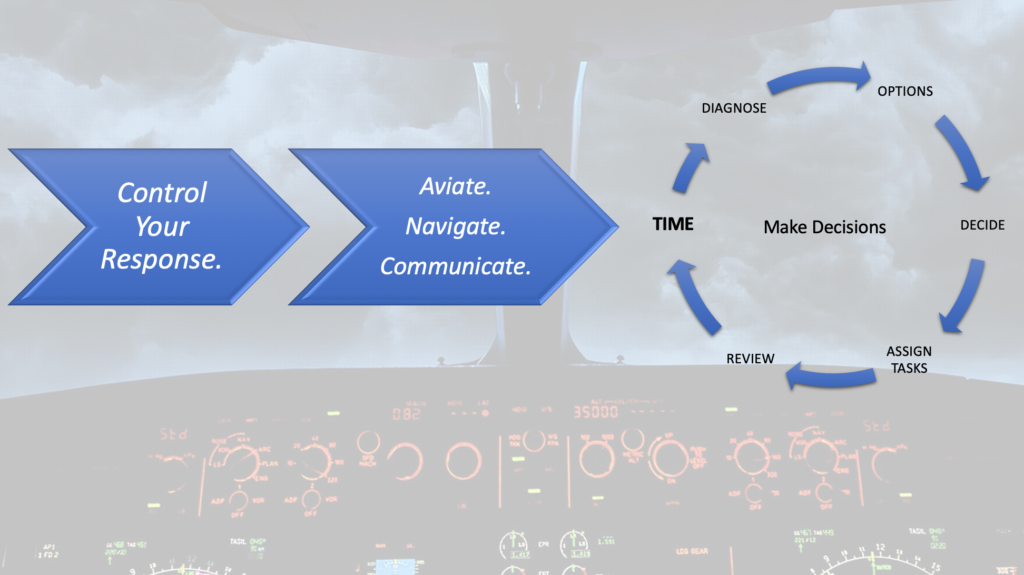
    T-DODAR is another tried and true method, and US Airways flight 1549 shows how it can be used in some of the most startling circumstances that could have been thrown at a crew.

The ‘T-DODAR’ Decision Making Model

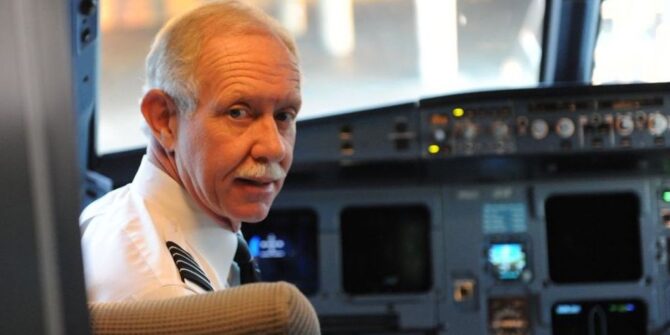
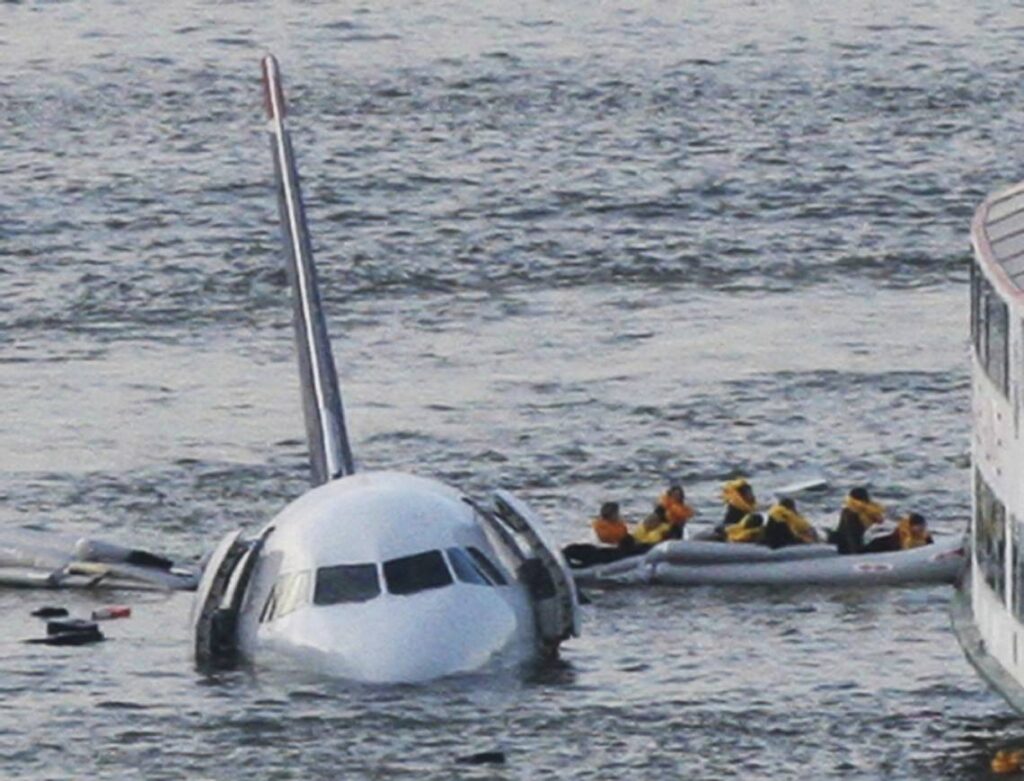
Sully Sullenberger kicked a field goal that fateful day in 2009 when they took a flock of Geese straight through both noise-makers.

The Miracle on the Hudson.

He paused, sat on his hands and tried to understand the status of the airplane. What had happened, and why. Whether he had power or not. He got himself back in the loop. He took control of the airplane, established it in a glide and turned the aircraft back towards the airport. He then told ATC. Aviate, navigate, communicate.

Once he had the capacity, he went to work. He knew he had no time and had to land. The diagnosis was obvious – a bunch of birds damaged both engines. Sully worked through his options: Return to La Guardia, go to another airport or ditch. He made his decision – “We’re gonna be in the Hudson.”

Once the decision was made, he assigned tasks. He would fly the plane, his First Officer would run checklists and try and get an engine back and his cabin crew would prep the cabin.

As they descended toward the river he turned to his colleague and with a simple question covered off his review – “Got any ideas?”. In other words, anything we haven’t tried yet? 155 people were saved by the crew’s ability to make decisions effectively. Apply a framework and you create so much extra brain space to concentrate on other things.

Oh, and about the sim.

Traditionally, airlines have followed matrices.

What’s that you say? Matrices, cyclics, whatchamacallits – predictable training programs that meant that every year or two that horrible multiple hydraulic failure would pop up yet again. That canned exercise that you were born ready for because you spent all last night studying it over a room service steak.

While I’d be the first to admit that when it comes to sim assessments, I love to know what’s coming, that’s not how the world works. The real reality is… who knows? There is an un-countable number of factors at play that will decide what an actual airplane is going to throw you at you. So the best defence is being comfortable with what you don’t know.

Spend a few minutes looking up ‘Evidence Based Training.’ Chances are you’ve already heard of it. It’s about assessing competencies no matter what’s thrown at you and it’s a revolution for pilot training. If you have the right tools in your bag you can fix almost anything – and that’s the whole point.

Simulator time is valuable, and if you get the chance use the extra time. Get something new thrown at you – because at the moment, we need all the help we can get!

Some other interesting stuff…


Dry Ice: The Silent Danger of Hauling Vaccines

We are on the verge of the largest airlift in history. The Covid vaccine rollout has begun and the world is turning to aviation to make it happen at breakneck speed.

Just how big?

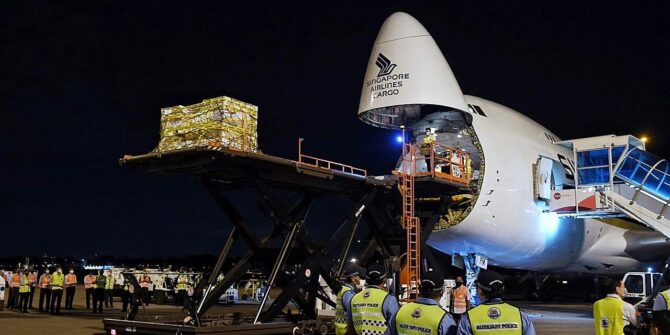
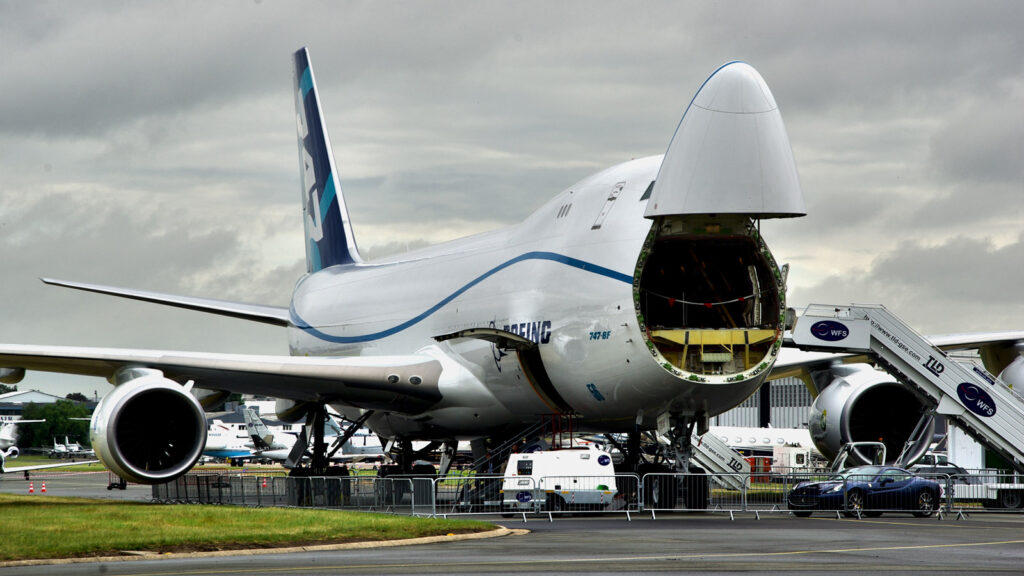
Huge. IATA think the equivalent of about 8,000 fully loaded 747 freighters will be needed to get the vaccine out to everybody. Over five billion doses of just the main ones will be produced this year alone – enough to jab nearly half the people on earth.

The world would need 8,000 of these, fully loaded to get the vaccine out to everyone.

It’s a gargantuan logistical challenge for the industry and it means crew will be carrying large quantities of vaccines throughout the world packed with volumes of dry ice we have never seen before.

The problem is that dry ice is dangerous. Put it in a confined space like an airplane and it can be really dangerous. The FAA were sufficiently concerned about it to issue a safety alert back in December, while EASA have come up with their own guidelines.

So, why is it so dangerous?

Dry ice is carbon dioxide but in solid form. It goes that way when you make it really cold. The issue is the minute it begins to warm up again, it turns straight back into gas – ‘sublimates’ if you want to get technical. While this is great news for the dance floor of your favourite night club, in airplanes it means you have a hazard that is constantly trying to fill your cargo hold or cabin with toxic gas.

You can’t see it, smell it or taste it but CO2 displaces the oxygen in your body causing you to gradually asphyxiate. It is not the same thing as hypoxia, and you can’t rely on the symptoms you were taught back in flight school. Early signs of CO2 poisoning include drowsiness, headache and difficulty breathing. Very quickly this can turn into dizziness and confusion. Left unchecked seizures and unconsciousness will soon follow.

The more you are carrying, the bigger the risk. Which is why there are strict limits set by manufacturers and operators on how much you can carry. The problem is that these limits were never designed with the global rollout of a vaccine in mind. Operators now need to find new ways to manage the dangers of hauling much more if it.

What’s wrong with room temperature?

A little about vaccines. There are two approved in the US – Pfizer and Moderna, and they both work in similar ways. They use RNA (DNA’s lesser known cousin) to tell your body’s cells to produce a spike protein – those pokey out bits you see in all the Covid pictures. This triggers an immune response and hey presto, no more Covid.

Well, there’s more to it than that. But the point is that RNA is fragile stuff – it starts to break down if you don’t keep it cold. Like really cold. The Pfizer vaccine has to be kept at -70 deg Celsius while Moderna must be kept at a comparatively tropical -20 deg Celsius. That’s where the dry ice comes in.

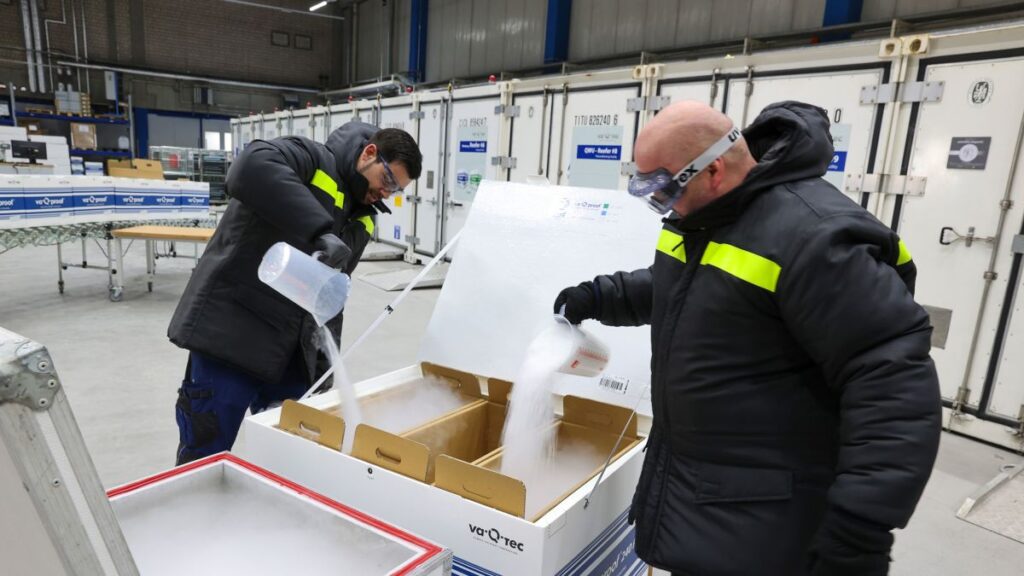
Large amounts of dry ice being loaded into vaccine shipments.

The vaccines are generally being shipped in special thermal containers – basically big coolers with layers of dry ice used to control the temperature inside.

The Pfizer Thermal Shipping Box

So how much dry ice is too much?

That depends. There are lots of factors at play including the rate the dry ice is releasing gas, the size of your aircraft, how efficient your ventilation system is and your appetite for risk. Aircraft manufacturers publish guidelines, and it is up to aircraft operators to carry out a risk assessment to find a safe answer.

If you’re looking for a starting point, the FAA have published a formula. It’s a bit dry (no pun intended) but with a little number crunching you can come up a conservative idea of how much is safe to carry. Whatever happens, the concentration of CO2 in the air of your aircraft can never exceed 0.5% – the FAA’s hard limit for transport category aircraft and the maximum level for humans flying aeroplanes.

How do we stay safe out on the line?

Keep that air flowin.’ The most important precaution is enough ventilation when carrying dry ice. Make sure you are maximising flow throughout the aircraft.

Watch those MEL’s – defects that affect your ability to ventilate are major red flags when you see dry ice on your NOTOC. This may include bleed/pack problems. Also look out for issues with your fixed oxygen system – you may just need it.

Keep things cool. The colder your cargo hold, the slower the dry ice will release gas. This includes on the ground – try and limit the amount of time the hold is open, especially in hot climates.

Use CO2 detectors. These can be carried in an aircraft or worn by crew members – don’t confuse them with carbon monoxide (CO) detectors found in smaller piston aircraft.

A Portable CO2 Detector

Get some training and have a plan if you experience symptoms or an alert is triggered. This may include getting on oxygen, declaring an emergency and diverting. Chances are the problem will get worse before it gets better.

Beware of smoke/fumes removal procedures. Every aircraft is different but in most cases they involve depressurising the aircraft. In the case of dry ice this may make the problem worse – an increase in cabin altitude has been shown to increase the rate of release and draw more CO2 from the shipments.

Keep an eye on ground staff too – high concentrations of CO2 can hang around cargo holds for minutes after opening. They may not realise the danger.

It’s not just ice. There are other risks too.

Vaccines are being shipped with lithium battery powered trackers. Manufacturers want to know that the vaccines are kept cold enough and being delivered where they are supposed to be. Which means operators have to keep following the rules for lithium batteries too. You can find more info on those here.

Lithium battery powered data logger similar to the ones found in vaccine shipments.

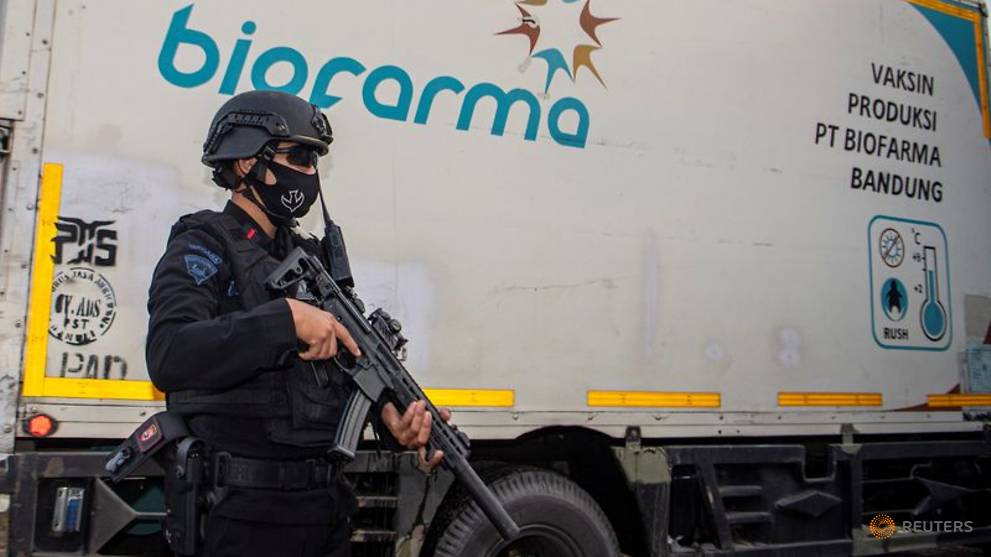
Watch your security. Vaccines are big business. In the initial stages of the rollout, demand is through the roof and there isn’t enough to go around. Unfortunately, there are concerns that this has attracted criminal interests who may try to target large shipments of vaccines. INTERPOL have issued a warning about this very threat.

Security may become a new issue.

Get Priority

Some shipments of vaccines are time critical. The US, Canada and much of Europe have a new procedure to let ATC know you fall under this category. Essentially by including ‘STS/ATFMX’ and ‘RMK/VACCINE’ in Item 18 of your flight plan, ATC will do their best to keep delays to a minimum.

Those links again…


Rumbles Over Riyadh: A New Threat?

You might have seen the headlines a week or so ago. On January 23, Saudi Arabia’s capital Riyadh was attacked by a ‘hostile air target’ – likely an explosive ‘kamikaze’ drone. Saudi air defences destroyed it, causing a loud explosion over the city and flight disruptions at OERK/Riyadh.

Then a few days later it happened again. Another big bang in the skies of Riyadh and more flight disruptions. Plenty of people caught it on camera. But the silence from official channels was deafening.

So what? Isn’t there is always stuff in the news about drones over there?

Yes. They’re sporadically sent over the border from Yemen by the Houthi – the folk who overthrew the Yemeni government back in 2014. Southern regions are usually the worst hit and occasionally Jeddah and Riyadh are targeted just to remind Saudi Arabia that they can.

But here’s the kicker: this time it probably wasn’t them.

How Do You Know?

Firstly, the Houthi have adamantly denied they were to blame. They’ve actually gone out of their way to distance themselves from the attack. So why should we believe them? Because of the status quo – they want to make headlines. Their attacks on Saudi Arabia are a demonstration of their firepower and willingness to target anywhere in the country. They’re even known to claim responsibility for attacks that weren’t theirs.

Secondly, someone else has already put their hand up for the attack – a group of militants in Iraq called the Alwiya Waad al Haq. The Who? The ‘Brigades of the Righteous Promise’. It’s a fancy name but the takeaway is this: someone new is apparently taking shots at Saudi Arabia from Iraq.

Here’s why

Saudi Arabia and Iran don’t get along. The reasons are long and complicated and you can read more about them here. But in a nutshell, religious differences and a desire for regional dominance are the cause of the ongoing conflict. The attacks on Riyadh are a worry because they may reflect a changing way that Iran asserts its dominance throughout the Persian Gulf – by proxy.

Proxy conflicts are a thing. It means when someone is doing the hands-on fighting for somebody else. Remember those Brigades of the Righteous Promise people? It is alleged that Iran may have put have put them up to it, and supplied the firepower to do it.

There’s no shortage of independent militia in Iraq. They’re difficult to trace and new ones emerge seemingly from nowhere – so much so that they’re sometimes known as ‘shadow militia.’ In reality, they are usually a cover for larger and much more well-known groups. In this case, possibly the Hezbollah – one of Iran’s largest proxies.  By hiding behind different names they can cause confusion, unpredictability and can divert blame away from the prime suspects.

It is possible that Iran may now start using these proxies more often for attacks on its regional adversaries.

So why is this an aviation issue?

We get twitchy when anyone is firing things into the sky. This way of fighting is unpredictable and the weapons being used are getting more sophisticated and can cover large distances.

Case in point. Back to the Brigade guys – since their alleged attack on Riyadh they have since threatened to attack the Burj Khalifa in Dubai, and also Abu Dhabi airport. Whether or not their threats can be taken seriously remains to be seen – but if the attack on Riyadh is anything to go by, they might have the weapons and intent to do it.

A drone similar to the ones believed to have targeted Riyadh.

For aircraft, there are a few threats to be aware of:

  • Misidentification by sophisticated air defence systems.
  • Being caught in the cross fire.
  • Simply being in the wrong place at the wrong time. Airports are often a prime target.

What can we do about it?

Continue to monitor Safeairspace.net for airspace warnings – it is our database of airspace risk and we update it all the time. Head over there and take a look – there are multiple warnings for the Persian Gulf region including four ‘no fly’ countries: Syria, Iraq, Iran and Yemen.

Safeairspace.net – head over for a full risk briefing at any time.

Understand ESCAT rules. Or you might know them as SCATANA. Either way they are a protocol for getting you out of dangerous airspace and fast. ATC may divert you clear of an FIR or ask you to land. They’re in use in Southern Saudi Arabia – but can be applied at short notice to any airspace where the risk is high. ESCAT procedures are published in GEN 1.6 of Saudi Arabia’s AIP. If you don’t have a login, you can see the relevant section here.

Lastly, carry out your own risk assessment and know what’s going on down there. Just because airspace is open doesn’t mean that it’s safe.


SafeAirspace: 2021 Update

2020 was a heck of a ride. But therein lies the risk – what else might you have missed amongst all the Covid-related noise? Sadly, conflicts and their risks to civil aviation have not taken a break during the pandemic.

As it’s a new year, we thought a summary of Airspace Risk was called for. Here’s what’s making headlines at the moment:

Saudi Arabia & Yemen

Houthi rebels in Yemen are regularly firing explosive drones and rockets across the border into Saudi Arabia, and these usually target airports in the south such as OEAH/Abha and OEGN/Jizan. Their latest attack was on OYAA/Aden airport in late December which resulted in mass casualties.

Saudi Arabia continues to retaliate with airstrikes. The latest was in the capital Sanaa just weeks ago, where multiple munitions landed near the airport.

The risk to aviation is that overflying aircraft may get caught in the crossfire or might be misidentified by Saudi air defences. Active terrorist groups in Yemen may also use anti-aircraft weaponry to target foreign interests.

The FAA prohibit all US operators from entering most of the OYSC/Sanaa FIR at any level. Only two airways are allowed, and they are well off the coast – UT702 and M999.

Only two available airways for US operators near Yemen and both are well off the coast.

There are no restrictions on Saudi Arabia but use caution in the southern regions. France and Germany have issued their own warnings.

SafeAirspace Yemen page – click here.
SafeAirspace Saudi Arabia page – click here.

Iraq

Rocket attacks on military interests at airports have become a common occurrence. They are generally fired by local militia without warning. ORBI/Baghdad is frequently targeted, along with other airports including ORER/Erbil. There is a clear risk to aircraft at low levels.

US relations were further strained through 2020 with multiple attacks on the US embassy in Baghdad. The tensions escalated to a point where the US considering closing it.

Foreign aircraft continue to be at risk from armed militia who have access to portable anti-aircraft weaponry, while misidentification by the air defence systems of multiple foreign forces in the country is also possible.

The FAA has extended its ban on US operators entering the Baghdad FIR at any level. Even though the SFAR says you can enter above FL320, the long-running Notam KICZ A0036/30 says otherwise.

SafeAirspace Iraq page – click here.

Syria

There have been several recent Israeli airstrikes on targets throughout Syria. In late December there are reports that Israeli fighters transited Lebanese airspace at low level causing alarm in Beirut before attacking targets in Western Syria. Just weeks ago, several sites around Damascus were targeted by Israeli missiles.

The primary risk is that aircraft may be misidentified by Syrian air defence systems which are regularly activated. Civil operators may get caught in the crossfire as missiles may erroneously lock on to the wrong aircraft.

Syrian air defences in action in 2019.

The FAA are taking no chances – the ban on US operators entering the OSTT/Damascus FIR at any level has been extended a full three years to 2023.

SafeAirspace Syria page – click here.

South Sudan

Just this week ICAO issued a concerning warning about the risk to aircraft operating below FL245 in the HSSX/Khartoum FIR over South Sudan, or flying in and out of HSSJ/Juba. They are ‘gravely’ concerned about ATC disruptions, a lack of contingencies, inadequate training of controllers, limited info about equipment outages and a lack of co-ordination with other ATS units.

SafeAirspace South Sudan page – click here.

Emerging Conflict Zones

2020 saw three new conflict zones emerge, here is what is happening with them now.

Ethiopia

A civil conflict erupted in October last year in the Tigray region of Northern Ethiopia. The government went to war with the TPLF – a regional force seeking independence.

The region’s airports were closed and TPLF showed an intent to internationalise the conflict by attacking aviation interests. They fired rockets into Eritrea targeting HHAS/Asmara, and also attacked multiple airports to the South of the Tigray region.

Two airways were closed (T124, and M308) with no explanation of the risk.  Other airways remained open but uncomfortably close to the fight – especially UG300, UN321 and UL432. No airspace warnings were issued despite the dangers.

What’s the latest?

In late November Ethiopian forces captured the region’s capital Mekelle and regained control. Remaining TPLF forces have retreated leaving behind a humanitarian disaster and a vow to continue the fight. Since then, the airway closures have been removed and things have gone quiet, but an airspace risk remains – armed militia continue to be active in Northern regions and may be looking to make a statement. Be wary of operating in the area.

Western Sahara

Late last year the region’s independence movement (the Polisario) declared war on Morocco for breaching a ceasefire agreement. The FAA published a warning that the Polisario might have access to anti-aircraft weaponry left over from previous conflicts.

The Western Sahara region

What’s the latest?

It is still an active conflict zone.  The fight has reached the international stage after the US declared their support for Morocco. The Polisario have indicated they are willing to at least talk, but so far have not put down their weapons. So, it is a wait-and-see type deal.

The risk to overflying aircraft remains. The GCCC/Canarias FIR keep extending a Notam advising operators to not fly below FL200 on the following airways: UY601, UN728 and UT975.  However, the reason is still missing: because of the risk of anti-aircraft fire. The GOOO/Dakar FIR haven’t issued any warnings despite the threat. Take care if operating in the area.

Armenia-Azerbaijan

In September last year, an ethnic conflict erupted over a disputed territory in Western Azerbaijan – Nagorno-Karabakh. The fight was between Azerbaijan and Armenia.

As a major air corridor for en-route traffic, there were significant flight disruptions. Azerbaijan swiftly closed all but one west/eastbound airway and routed traffic via Georgia. Armenia asked aircraft to take extra fuel and expect re-routes. The conflict was short but intense, with heavy artillery fire from both sides. The conflict eventually spread beyond the contested regions with longer range weapons. The entire border region posed a risk for civil aircraft.

What’s the latest?

For once the news is good. In November a ceasefire agreement was signed with the help of Russia. Armenia effectively lost and withdrew from the region and the conflict was officially over. Armenia removed its airspace warning, while Azerbaijan re-opened the affected airways and a large section of airspace near the border.

With the conflict now over, and no new reports of significant fighting since the peace agreement in November, direct crossing traffic between the two countries is now technically possible again.  However, most East-West flights are currently still electing to go further north instead, connecting between Azerbaijan and Georgia’s airspace, avoiding Armenia.

What about Safeairspace.net?

Our conflict zone and risk database is updated constantly. We assess risk with official sources and build a simple picture for you of those need-to know-places.

There are currently 5 regions which are assessed as a Level 1 Risk – No Fly. These are: Iraq, Iran, Yemen, Libya, and Syria.

Head over to safeairspace.net and click this button for a full airspace risk briefing.

Head over to SafeAirspace.net and take a look. With a single click you can download a risk briefing of the entire world in just a few pages of nice simple English.

The mission of SafeAirspace is this: to provide a single, independent, and eternally free resource for all airspace risk warnings, so that airlines and aircraft operators can easily see the current risk picture for unfamiliar airspace. If you know of a risk not listed on the site, or you have anything else to add, please get in touch with us at news@ops.group


Testing Times: More than just a stick up the nose

In the last few weeks, several major countries have announced that pre-departure Covid testing of all international passengers is now compulsory. And it is up to the operators to make sure that this happens.

It is now mandatory for anyone travelling to the UK, Australia and Canada from anywhere. The US will follow suit from January 26.

Covid testing is set to become a common part of our aviation landscape for the foreseeable future. Until a vaccine has had time to work, people will need to be tested to move around the world freely.

But what type of Covid test do I need?

Just google ‘Covid test’ and prepare for confusion. There are different types of test out there, and to make matters worse, there are multiple confusing names for the same test. Ask a passenger and the chances are that many will not understand why a rapid test at the airport isn’t enough to board their flight.

Rapid testing at the airport is convenient, but it may not be enough to get you in when you arrive.

So here is a super basic breakdown of the types of tests out there and how they work…

Covid Test 101

Covid tests can do two things:

  1. They can tell you’ve had it in the past by looking at your blood (Antibody test), or –
  2. They can detect if you actively have the virus by looking at your mucus or saliva (Diagnostic test).

Antibody tests = Cannot tell if you are actively sick and contagious. So for travel, they are pretty much useless.

Diagnostic tests = There are a bunch of highly technical names floating around out there but the good news is that there are only a couple of types – Molecular tests (PCR) and Antigen Tests. (The bad news is you’re getting a stick up the nose either way.)

  • Molecular tests (PCR). The gold standard in testing. These tests are super accurate and work by detecting the nucleic acid left behind by the virus. This is what most countries require. The downside is the results take much longer and it is difficult to test a whole bunch of people quickly. There are home kits available but most of the time you’ll need a lab to test you.
  • Antigen Tests. When people say ‘Rapid Test’ this what they mean. These tests are quick, cheap and work by looking for a piece of coating on the virus. You still get swabbed but the results come back far quicker. They are what you see in airports. So what’s the issue? They’re not as accurate and can return false negatives. In most cases borders just won’t accept them.

Is this a PCR or Antigen test? They both look exactly the same to passengers.

So what’s the issue with antibody tests?

All they do is look for anti-bodies in your blood and your body has to build up those defences. It can take up to 14 days after you first catch the virus before they can be detected. You can be sick and contagious before the test will even detect them. To make matters worse there is no evidence you can’t catch Covid again even if you have already had it. So what’s the point of them? They help authorities work out just how far the virus has gone out there.

An anti-body test. No anti-bodies, but you might have had Covid already for two weeks…

Moving Forward…

With rapidly changing testing rules around the world it will become super important to make sure you and your passengers get the right kind of test. Most of the time the one you will need is a PCR test. Rapid testing at airports is convenient and looks the same but in most cases just won’t cut the mustard.


TCAS Trouble: Why We’re Getting It Wrong

Earlier this year Eurocontrol published a report on TCAS Resolution Advisories, and the results weren’t pretty…

Over a 12-month period, over the heart of Europe, only 38% of RAs were flown correctly and 34% of aircraft even manoeuvred in the wrong direction.

In other words, nearly half of crew for one reason or another didn’t follow the RA – a last-resort safety net proven to save lives. So concerned are Eurocontrol, they rank the issue as its second highest air traffic threat – it’s a big deal.

Here’s the issue in a nutshell

ICAO say that no matter what, unless the safety of your aircraft is compromised by something more dangerous (think terrain or stall etc.) if you get an RA, you have to follow it.

TCAS, ACAS or whatever you want to call it has been around for a long time. Development started back in the 50s, and it has been mandated in the US for larger aircraft since the 80s. It has become incredibly reliable.

So, if it’s that black and white, the question remains, why does this keep on happening? Turns out there are a bunch of reasons, and so it is worth taking a look at exactly what is going wrong up there.

The Elephant in the Room

We may as well address it first – when crew choose to second guess an RA. The good news is that this isn’t happening very often. Most of the time there are other factors at play. But while we’re here, a little note on TAs and RAs.

Traffic Advisories (TA) prevent. You haven’t lost separation yet, but you might. They’re a warning for us to go heads up and do something about it – make visual contact, talk to ATC, level off, you name it. This is the time for us to go to work and make decisions.

Resolution Advisories (RA) mitigate. There is no more time to prevent – that ship has sailed. RA’s typically trigger when you are within 25 seconds of a collision threat with the other aircraft. But here’s the kicker – you are expected to respond to it within 5 seconds. In other words, there is not much time for us to make effective decisions. Safest course of action? You guessed it – follow the RA.

RAs – not much time to react.

So, what else is going on then?

Numero Uno – The number 1 biggest reason why RAs aren’t followed? Because we think we can see the threat out the window. Unfortunately, you can’t assume that the aircraft you can see is the one who triggered the RA. We’re also not very good at assessing threats visually, especially at altitude and it does not give us any info about what the other aircraft is intending to do.

Is this aircraft above, below or at our level? And what is it planning to do next? RAs do a lot better job of assessing a threat than our eyes can.

Startle Factor – Put us in a stressful situation and we react in different ways. RA’s are a rare event, and they’re not always preceded with a TA. In other words, without warning they can emerge with significant ‘pucker factor’. A large number of mis-flown RAs in the EUROCONTOL report lasted for less than 8 seconds. Beware of the ‘knee jerk’ reaction – our instinct is to act but surprise can get in the way of procedure.

Beware of Contradictions – It’s not ATC’s fault, but it’s important to understand. They don’t know what your TCAS is telling you to do and they will be working hard to help. The issue is when ATC instructions contradict your RA. In 2002, a Tupolev passenger jet collided with a 757 over Germany – one crew followed the RA and the other ATC. The industry learnt an important lesson: always follow the RA. Use the phrase “TCAS RA” on the radio and ATC will understand you are following one.

When a TCAS RA and ATC conflict, the TCAS takes precedent.

Performance – RA’s are often not followed as the crew are worried about performance. This usually happens when they’re heavy and high or near their service ceiling and get a climbing RA. So, what should you actually do? The official word is this: do your best to follow it, even if your response is weak. Even if it means maintaining your level. In most cases an RA will only result in a level change of less than 500 feet. The biggest threat by far is opposing the RA, which will put your aircraft in far more danger.

Performance limited? A weak reaction is safer than an opposite one.

Training – That old chestnut. But the reality is it is really important to practice these things in the sim. Weird ones. Unexpected ones. Ugly ones. Ones with multiple threats. Because this is usually what we’re up against in the real world. Also keep your finger on the pulse for changes. Some modern aircraft can now fly RA’s automatically, but the sims you train in may not have had the same update.

Practice all the nasty ones – reversal RAs, multiple aircraft, low and slow, high and heavy – you name it.

Older Versions – watch out for them. The latest one (7.1) has a number of major safety updates including clearer instructions and ‘reversals’ – a fancy term for knowing when the other aircraft isn’t doing what it is supposed to do. Older versions of TCAS are more likely to be misunderstood by crew. One phrase in particular is especially bad – “Adjust Vertical Speed, Adjust.” In many cases crew have increased their vertical speed rather than reduce it. If you’re using older versions it is important to be aware of its limitations.

TCAS is an awesome piece of kit that has made huge advances in preventing completely avoidable accidents. But it is only as reliable as the humans who respond to it. That’s why it is so important we learn about what we we’re getting wrong so it can do its job – keeping us safe up there.

Other Useful Things


GPS Jamming: All the Wrong Signals

We live in a GPS world. This fantastic technology has revolutionised aviation since the first basic unit was approved for IFR use back in 1994.  It has become engrained in day to day operations. We use it for a bunch of really important stuff – navigation, communication, surveillance, ADS-B and even TAWS. It is a technology that we rely on to stay safe.

And herein lies the problem. It relies on radio signals from satellites to work, and they can be intentionally interfered with. If you operate between Europe and Asia then the chances are this is not new. What is concerning is that it is happening more and more. In the last five years EUROCONTROL report that cases of GPS outages have risen dramatically. The number one suspect? Deliberate interference.

The Hot Spots

Almost always, widespread GPS outages occur in areas of political tension. It’s no surprise then that the Eastern Mediterranean, Middle East and Caucasus are consistently the most affected regions – last year alone there were 3,500 reports of outages there. About 10 a day. And that’s just from the people who spoke up. The LCCC/Nicosia FIR over Cyprus extending through to LLBG/Tel Aviv is particularly bad, with reports as far north as Italy, as well as Turkey and Egypt.

It is a part of the world alive with tension – spill over from the Syrian War, ongoing conflict in Libya and the current Azerbaijani conflict. Unfortunately it is also a major air corridor for flights between Europe and the Middle East and Asia. It is almost unavoidable.

But it’s not just there – There are reports of GPS sabotage throughout the world – rings of interference (also known as ‘crop circles’) have been traced to China, North Korea and even the US.

So why tamper with GPS?

Unfortunately electromagnetic warfare is real. The goal for military interests is to make things as difficult as possible for the other side including disrupting communications and navigation. GPS jamming is also used as a defence against drones – the explosive ones which we see in the headlines, and the ones that are spying. In other cases, jamming is used to protect people’s privacy, and sometimes as a source of criminal mischief. Unfortunately for us, whether we like it or not, civil aviation is along for the ride

Portable GPS Jamming Device

Jamming or Spoofing?

GPS signals are low power, which means that a weak interference source can cause a receiver to fail, or more concerningly produce false information. A basic way to achieve this is with jammers – devices that mask the signal with noise. Although they are illegal in the US, they’re not in other countries. And they’re readily available.

Readily available: jammers for your car.

A more sophisticated approach used by the military is ‘spoofing’ where a ground station transmits a fake GPS signal that overrides the legitimate one.

In simpler terms – jamming causes the receiver to die, spoofing causes it to lie.

In powerful military applications, the effect of a single device has been known to affect a 300nm radius, and it is almost impossible to locate them. They can be installed at bases, mounted in vehicles or put onboard ships.

Jammer mounted in an SUV

So why is this a problem for aviation?

The issue is getting worse, and outages are sporadic and unpredictable. Three quarters of GPS loss worldwide is occurring in the cruise, and in ten percent of these cases it lasts for more than half an hour. There have also been reports where GPS receivers never regained a signal. According to ICAO’s rules, frequent outages must be Notamed but the reality is, few states are actually doing it. To make matters worse, with so few aircraft flying during the pandemic it is unclear just how bad it is getting.

For crew, a loss of GPS forces an aircraft to rely on other means to navigate in airspace that relies on accurate navigation to separate you from other traffic. It can also lead to other issues including false alerts and even GPWS warnings. Requiring pilots to ignore them is a concerning precedent.

The plot thickens, enter 5G.

We’ve all heard about it – the revolutionary technology that will let you download your favourite episode of ‘The Bachelor’ in record time. Worrying news in the US has emerged that the federal government has allowed a new network provider to access a slice of the radio spectrum usually reserved for GPS signals to power a huge 5G network across the country. The frequencies are powerful, and there is no guarantee that they won’t won’t interfere with GPS signals.

The mighty 5G antenna

So what can we do it about?

Unfortunately, like Covid, the problem isn’t going away anytime soon. While manufacturers work on new ways to protect your aircraft, there are a few things you can do.

The most important thing is contingency – have a plan. Be aware of the threat of jamming if flying in affected areas of the world, and the issues it may create for you in the flight deck. If you lose GPS signal, report it to ATC. The more reports they get, the better. They will work to increase your separation and coordinate with other units.

When you’re flying a GPS-based approach, know what you’ll do if the screen goes blank. Be prepared for the unexpected because as recent events have shown, that super reliable technology can fail.

And stay informed, here are some useful resources:


Space Weather: Here Comes Hubble…

History has shown that every ten years or so, earth comes under attack from high amounts of space weather– and we’re about to embark on the next cycle.

Wait, there’s weather in space?

Yep, but not in the conventional sense. That big ball of burning energy we call the Sun does more than provide us with the light and warmth we all seek on vacation.

It also constantly spews gas and particles into space, in what is known as the solar wind. These particles are charged with electricity, and are flung towards earth at up to a million miles an hour.

Luckily for us, our atmosphere and the earth’s magnetic field acts like a shield. But sometimes these determined particles make it through to our atmosphere. When that happens we are often treated to the spectacular light shows we know as auroras. If you fly at high latitudes at night, chances are you have been lucky enough to see them. Sadly space weather can have more serious consequences for aviation than struggling to capture that illusive insta shot on your trusty iPhone 4.

An Aurora – the only good thing about space weather.

Like the earth weather we’re used to, space weather is changeable – its severity depends on what is happening on the sun.

Its surface is a busy place – hot gases are constantly on the move as powerful magnetic fields twist and turn. When things get especially rowdy, a storm occurs and the solar wind gets stronger. Occasionally these storms produce a solar flare – essentially the sun burps, and sends significant amounts of radiation towards earth. This is where the trouble can occur.

What kind of trouble?

Communications. During solar events, HF and satellite communications can be disrupted. In severe cases, even disabled. There may be effects on CPDLC and ADS-C services. Line of sight VHF is less likely to be impacted, but that does not help much when you’re over the middle of the ocean.

Systems. Some of your aircraft’s systems are sensitive to radiation storms. Space weather may induce sudden electrical failures that can range broadly from insignificant to ‘ruin your day.’ Systems that rely on magnetism can also be affected

Navigation. The sun’s particles disrupt the upper layers of the atmosphere, which can interfere with GNSS signals from satellites. You guessed it – the result is unexpected position errors. If it gets really bad, the signal may be lost all together. We’re using RNAV based approaches more than ever these days, and the likelihood of not having ground based aids as a backup is increasing.

The Body. During these storms, you can be exposed to unusually high levels of ionising radiation (the nasty one for humans, think Chernobyl). As a general rule, the higher you fly or the higher the latitude, the more exposed you are. The effects of this on crew is the subject of ongoing studies. But the more you can avoid higher exposure levels the better.

The broad effects of a solar flare.

What can we do about it?

Here’s the best news: space weather is predictable. And ICAO are onto it.

Solar monitoring has improved significantly in recent years. A number of countries have joined forces to create three agencies responsible for issuing ICAO Space Weather Advisories (SWX) around the clock.

Space Weather Advisories have a standardised format, and are not the same thing as a SIGMET.

They are only issued whenever space weather conditions get bad – essentially moderate and severe impacts, and only when operations above FL250 are affected. They are activated for comms, GNSS and radiation interference, so seeing an SWX advisory during your pre-flight briefing is a pretty good indicator to have a closer look.

Example of a SWX Advisory, this time for GNSS outages.

They predict the effect of space weather at six hourly intervals across a twenty four hour period. To define the areas affected, SWX advisories effectively draw a box. They divide the world into six bands of latitude, and tell you how wide the box is with longitude. Still confused? A picture always helps…

Beware the square!

For a full briefing, the FAA has recently published a helpful information bulletin which explains how Space Weather Advisories work in more detail. And if you’re really brave, more info can also be found in ICAO Doc 10100.

Some other useful stuff:


The 511 on the Nov 5th ICAO changes

A whole bunch of procedural stuff will be changing from 5 Nov 2020, with the release of a new amendment to ICAO’s Procedures for Air Navigation Services document. There will be changes to Oceanic Contingency and Weather Deviation Procedures, Wake Turbulence Separation, SLOP Procedures, and how the FAA defines Gross Navigation Errors.

What is the PANS-ATM (ICAO Doc 4444)?

Procedures for Navigation Services – Air Traffic Management. In other words, the ‘go to’ manual for aircrews who operate internationally. It explains in detail the standard procedures you can expect to be applied by air traffic services around the world, and what they expect in return.

Here is a summary of the most important changes coming on 5 Nov 2020. Thanks to Guy Gribble at International Flight Resources for this update.

Oceanic Contingency Procedures

Basically, what you should do if you need deviate from your flight path without a clearance. Weather avoidance, turbulence, depressurisation, engine failure – you get the picture. Published procedures are changing: there will be one standard set of Contingency and Weather Deviation Procedures for all oceanic airspace worldwide.

If you’ve been flying in the North Atlantic Region over the past year and a half, you’ll be familiar with how it works – the new procedures were introduced there back in March 2019, and now they’re being rolled out everywhere.

The main change here is that Contingency offsets which previously were 15 NM are basically now all 5 NM offsets with a turn of at least 30 degrees (not 45 degrees).

For more on this, check out our article.

Wake Turbulence

Flight Plan Category
There will be a new wake turbulence category for flight plans:

No longer will ‘Heavy’ rule the skies. ‘Super’ is about to be added, which will cover the largest aircraft including the A380-800, and Antonov 225. You will even get to say it after your callsign on initial contact with ATC.

ICAO Doc 8643 will shortly include all aircraft which qualify for the category.

You’ll need to tell them your category in Flight Plan Item #9 too. For Super, the letter ‘J’ is what you’ll need to include.

Here’s the new line up:

J – SUPER (Check Doc 8643 to see if you qualify)
H – HEAVY (Max take-off weight greater than 136,000kg/300,000Lbs)
M – MEDIUM (Max take-off weight greater than 7,000kg/15,500Lbs)
L – LIGHT (Max take-off weight less than or equal to 7,000kg/15,500Lbs)

Wake Turbulence Separation Categories
Countries may choose to use the ICAO wake turbulence codes above to determine how much room to give you from preceding traffic, or they can elect to use a grouping.

Currently, ICAO groupings are based simply on weight and there’s only three of them. The problem with that approach is that sometimes the separation provided is excessive which slows down the flow of traffic and creates unnecessary delays.

The US and Europe were on to it when several years ago the FAA and Eurocontrol joined forces to look at the wake characteristics of aircraft in more detail. They came up with a better system – it was a process known as Aircraft Wake Turbulence Re-Categorization or simply, RECAT.

Turns out that when you take into account factors such as approach speeds, wing characteristics and handling abilities of various aircraft it is possible to safely reduce separation.

As a result, six new categories were created. You can read about those in FAA SAFO #12007 and EU-RECAT 1.5 if you would like to know more.

The point is, ICAO is now adopting those categories.

So why does it matter?
Because the separation applied when following smaller aircraft may be reduced to as low as 2.5nm on approach. Closer than you may be accustomed to.

Out with the old, in with the new. Here’s what you can expect to see in November:

Old:
HEAVY (H) – aircraft of 136,000kg or more
MEDIUM (M) – aircraft less than 136,000kg but more than 7,000kg
LIGHT (L) – aircraft of 7,000kg or less

New:
GROUP A – ≥136,000kg and a wingspan ≤80m but >74.68m
GROUP B – ≥136,000kg and a wingspan ≤74.68m but >53.34m
GROUP C – ≥136,000kg and a wingspan ≤53.34 m but >38.1m
GROUP D – <136,000kg but >18,600kg and a wingspan >32m
GROUP E – <136,000kg but >18,600kg and a wingspan ≤32m but >27.43m
GROUP F – <136,000kg but >18,600kg and a wingspan ≤27.43m
GROUP G – <18,600 kg or less (no wingspan criterion)

Separation standards will soon be published accordingly.

Strategic Lateral Offset Procedures (SLOP)

Wait, what?
As a result of extremely high levels of accuracy in modern navigation systems, if an error in height occurs there is a much higher chance of collision. It is also greatly increases the chance of an encounter with wake turbulence.

In some airspace, when the lateral separation applied or the distance between adjacent parallel routes is greater than 6nm, aircraft can deviate up to 2nm right of track without a clearance. This is what is known as SLOP.

The way in which it is applied is changing
Where the lateral separation minima or spacing between route centerlines is 15NM or more; offsets to the right of the centerline will allowed up to 2nm.

When the lateral separation minima or space between route centrelines is less than 15nm (but more than 6nm), you will be able offset up to 0.5nm right of track.

So, it is important you are familiar with what kind of lateral separation is being applied in the airspace you are operating.

The FAA will change their definition of GNE’s

On 5 Nov 2020, the US FAA will change their definition of Gross Navigation Errors to mean anything more than 10nm (down from 25nm), to align with ICAO’s 10nm definition that currently exists on the NAT HLA. So after this date, the FAA will require you report all lateral errors, 10nm or greater worldwide.

More on this from Guy Gribble at International Flight Resources:

“Keep in mind that ATC does not always advise a crew that it files a report; therefore, the FAA inspector will try and contact the crew as soon as possible so the crew will remember details of the event. ATC keeps voice and communications records for between 30-45 days. New York Radio and San Francisco Radio keep voice communications for 30 days. The FAA directs that oceanic error investigations should be complete within 45 days of the incident.”


Ferry Flights in the time of Covid

Ferry flights are tough to operate even at the best of times. Whether it’s getting a new aircraft from the manufacturer to its customer, moving it to or from a repair facility, or just returning it to base, there are a bunch of things to consider beyond the normal planning you would do for a standard private or charter flight: extra permit requirements, insurance issues, equipment compliance, and a close eye on route planning!

Covid restrictions have made all this even more complicated, with many countries completely closing up shop to everything except repatriation and cargo flights at the start of the pandemic, only to reopen months later with complex entry rules and flight restrictions in place.

Here’s a summary of the main considerations when planning ferry flights, and a recent example of a trip we eventually managed to do despite the Covid restrictions of various different countries at the time.

Permit Requirements

One of the most important considerations for ferry flights is whether or not the aircraft will be operating on a standard Certificate of Airworthiness or on some form of a Special Flight Permit. While some countries around the world will allow an aircraft to overfly or land without permission while operating on a standard Certificate of Airworthiness, most countries will not allow an aircraft operating on a Special Flight Permit (or equivalent) to overfly or land without receiving an additional permit.

Permit Lead Time

When obtaining overflight and landing permission for Special Flight Permits, consideration should be given for the lead time. Some countries have different teams looking after these types of permits than the people who issue the permits for “normal” flights. The lead time can vary from 24 hours to five working days, or even longer. Watch out for weekends too! In some countries the working week is not necessarily Monday-Friday.

Flight support companies and local agents can be invaluable to assist with securing these permissions as they may have local contacts with the civil aviation authorities. These authorities are validating the Special Flight Permit and Operating Limitations, along with the Certificate of Registration and Certificate of Insurance to ensure they meet the requirements for their individual country.

Insurance Requirements

An important consideration when ferrying any aircraft is the Certificate of Insurance. This certificate needs to cover all areas that the aircraft will be operating in, as well as ensuring coverage for any flight crew who may be employed by the aircraft owner. Regions of the world (ex: Europe) may have minimum liability requirements that must be met and clearly stated on the Certificate of Insurance. Even though the certificate states ‘worldwide’ several countries in Central America will require that the certificate clearly states it includes their country prior to issuing the permission.

Navigation Equipment

Ferry flights are often being conducted to move older aircraft from one place to another with navigation equipment that is either out of date, due to be replaced, or unservicable. It is important to ensure that the navigation equipment and the crew qualifications are up to date and that the flight is being conducted in accordance to the requirements for the countries that the flights are overflying and landing at. A common area that local authorities will look at when conducting ramp checks is what equipment has been installed, certified and is operating.

Covid Complications!

In June 2020 we helped an operator move a Cessna 208 Caravan from the US back to Australia. What complicated this flight was that the operator had already attempted to move this aircraft in March at the beginning of the global pandemic to only end up with the aircraft being grounded for three months in Alaska while we waited for central and southern Asia to open up some of their restrictions.

This aircraft was issued an Australian Special Flight Permit which required permission from every country we were operating into or over, and was equipped with a ferry tank system to give us some additional range in our planning. As the flight was operating through Russia with an overnight stop, the crew were required to obtain Russian transit visas and due to the pandemic testing requirements, the crew were required to be tested prior to departing from the US as well as when en-route in the Philippines.

In the end, we decided on the following routing: PANC/Anchorage – PADK/Adak Island – UHPP/Petropavlosk – RJCC/Sapporo -RJBB/Osaka – ROAH/Okinawa – RPLC/Angeles – WAPP/Ambon – YBRM/Broome

We got special permission for the crew to stay overnight in PADK, UHPP, RJBB, RPLC and WAPP for crew rest.

Even without the additional Covid-related requirements, due to the Special Flight Permit, Japan required additional permissions from various government agencies, including their military. We got a local agent to assist with these arrangements, as well as the special Customs & Immigration arrangements required for the crew to remain overnight in RJBB. They were not authorized to remain overnight under any circumstances in RJCC or ROAH.

While the global pandemic raised a number of additional requirements, we needed to consider several things when determining the ferry flight for this aircraft. The most important consideration was aircraft range. Thanks to the ferry fuel system, we were able to have ample range to fly from Alaska into a customs airport in Russia. While a routing from PANC to UHMA (with or without a stop in PAOM) was considered, it was not possible at the time as UHMA was closed to all international traffic.

The routing through Japan was carefully considered with extensive consultation (and changes) with the Japanese agent. Many local authorities at different airports were back and forth on whether the crew would be allowed to overnight, and it was imperative to find an airport that would allow the crew sufficient rest.

The routing from Japan into the Philippines and through to Indonesia remained a challenge right up to the day of flight. Indonesia reopened their borders to international flights after the crew departed from the US, and required the crew to have a fresh Covid test which was arranged in the Philippines.

More info

Check out our Guide to Getting Unusual Permits. It has the details on 28 countries that have a special process for Ferry Flights and other Special Permits. You’ll find Civil Aviation Authority contact details, Agent details (when necessary), and our descriptions of the best practice for each permit.


One Contingency Procedure to rule them all

From 5 Nov 2020, there will be one standard set of Contingency and Weather Deviation Procedures for all oceanic airspace worldwide.

If you’ve been flying in the North Atlantic Region over the past year and a half, you’ll be familiar with how it works – the new procedures were introduced there back in March 2019, and now they’re being rolled out everywhere.

The FAA has already published a Notice to say that these procedures will take effect in US oceanic airspace from 5 Nov 2020, and ICAO is expected to formally publish the Standard in an update to PANS-ATM (ICAO Doc 4444) to take effect from the same date.

Rarely do we see worldwide oceanic contingency procedures undergo a formal revision. The last time a major revision occurred was in 2006 when ICAO standardized a 15 NM offset executed with a turn of at least 45 degrees. Prior to that, the North Atlantic and the Pacific had used different offset distances and a 90 degree turn.

Wait… what are “contingency procedures”?

These are basically any time you have to do things differently if you need to deviate from your cleared route, and for one reason or another you cannot get permission from ATC first.

Why would you need to bust your clearance? You may not have the ability or capacity to communicate with ATC, or they may not be able to respond to your request quickly enough for a variety of reasons – meteorological conditions (severe turbulence and weather avoidance), aircraft performance, loss of pressurisation, immediate diversion, or a loss of navigational accuracy.

What are the new procedures?

The short answer
Contingency offsets that previously were 15 NM are basically now all 5 NM offsets with a turn of at least 30 degrees (not 45 degrees).

The long answer
Read the FAA Notice.

The slightly less long answer
– Turn at least 30 degrees (reduced from 45) to the left or right of track and establish yourself on a parallel track that is offset by 5nm (reduced from 15).
– The direction of turn is up to you, but you should consider airways around you – the likely direction of other aircraft, the applicable SLOP procedures, the direction of your diversion airport and of course terrain. (If going left or right is a 50/50 choice, going right is probably better – it gets you out of the way of all the SLOP offset traffic that might be coming at you from the opposite direction!)
– When established on your offset track, maintain an altitude that is vertically offset by 500 feet from normal levels (or 1000 feet if above FL410).
– In areas of parallel airways, it is recommended you descend below FL290.
– Watch your TCAS, and if possible, keep your eyes outside for other aircraft.
– Make sure your transponder is set to TA/RA (if able).
– Be seen – turn on as many exterior lights as possible.
– Squawk 7700.
– Try and talk to ATC via voice or CPDLC, and declare a PAN PAN, or MAYDAY.
– Establish comms with other aircraft on 121.5 MHz or 123.45 MHz. Make a position/intention report as you would in TIBA procedures.

The best answer
A picture! So often the best answer. And this one’s pretty neat. Not least because you can click on it, download it, print it out, and put it in your flight bag to take with you. (If you’d also like to laminate it, we’re ok with that).

Click to download PDF.

Weather deviations

If you have to deviate from your assigned track due to anything weather-related, there’s a whole different procedure to follow.

Here’s what to do:

  • In the first instance, up the urgency with the phrase “WEATHER DEVIATION REQUIRED.” ATC will attempt to provide separation, and if they can’t they will ask you to advise your intentions.
  • If you intend to deviate, let them know. Say something like – “I am deviating under PIC emergency authority. At 5 NM from course I will employ the Weather Deviation contingency.”

Then apply the following:

  • Declare a PAN.
  • Deviate away from other airways if practical.
  • Talk to other aircraft on 121.5 and 123.45.
  • Keep an eye on your TCAS and outside.
  • Turn on all your exterior lights.

For deviations of less than 5 NM, remain at the flight level assigned by ATC.

For deviations of 5 NM or more, when you are at the 5 NM point initiate a change as follows:

If flying EAST, descend left by 300ft, or climb right by 300ft.

If flying WEST, climb left by 300ft, or descend right by 300ft.

In other words – SAND! (South of track = Ascend, North of track = Descend; Up/Down by 300ft)

Once you are back on track, resume your cleared level. If you’re already deviating and cannot get a clearance to deviate further. Change your level immediately in accordance with the table above.

Turnback procedure

The new guidance has left out any specific reference to how to divert across the flow of traffic or turn-back procedure, and instead simplified it to just “proceed as required by the operational situation”. Turning back would assume you either employ the 5NM offset as per the new contingency procedure, or else get a new revised clearance.

Bottom line

Download the pic, and give the new procedures a good read (they’re not actually that long). Beginning 5 Nov 2020, the new procedures are expected to be implemented. You might want to prepare changes for your ops manuals and checklists too.


Unreliable Airspeed and the Hidden Risks of Aircraft Storage

The dramatic effect that Covid-19 has had on the aviation industry has grounded an unprecedented number of aircraft. They have been placed into storage whilst the world waits to recover. The pandemic emerged without warning, and some operators were likely not prepared for what was coming.

Now travel bans are lifting, airports are reopening, and airlines are scrambling to return aircraft to the skies.

EASA recently released a disturbing Safety Information Bulletin. There has been an alarming trend in the number of aircraft experiencing unreliable speed and altitude indications during first flights after storage, caused by contaminated air data systems.

The result has been multiple rejected take offs and airborne returns. Most of the events have been caused by nesting insects in the pitot static system – even after covers were installed.

Modern flight instruments provide large amounts of information to crew with great precision, while automation makes flying transport category aircraft almost routine. Flight envelope protections and aural/tactile warnings keep us safe even in most abnormal scenarios.

At the heart of all of this is the air data computer (ADC) – a small piece of hardware that needs accurate information from outside of the aircraft to work correctly.  They are the “Achille’s heel” of modern electronic flight information systems. In a nutshell, these small computers obtain and process information from the aircraft’s pitot static system, and supply critical systems with information such as airspeed, altitude and temperature.

Like all computers, they don’t think for themselves. They are only as accurate as the information they receive. So, when the pitot static system is contaminated, they can only respond to what they sense. They can’t look out the window.

History has shown that unreliable airspeed events are dangerous:

February 6, 1996. Birgenair Flight 301, a Boeing 757, departed Puerto Plata in the Dominican Republic, on a routine flight. During the climb out, the Captain’s airspeed indicator began to increase dramatically. The autopilot reacted as designed, and increased pitch to reduce airspeed, while the auto-throttles reduced power.

In the meantime, the co-pilot’s ASI indicated a dangerously slow airspeed which was decreasing. Almost simultaneously, an overspeed warning was generated. The autopilot reached the limits of its programming and disengaged. The stick-shaker activated, warning the confused crew that the aircraft was flying critically close to a stall.

The Captain responded by applying full thrust. The excessively high angle of attack resulted in insufficient airflow to match demand and the left-hand engine flamed out. The right-hand engine developed full power and the aircraft entered a spin. Moments later the aircraft became inverted, before impacting the Atlantic Ocean. The three pilots had 43,000 hours of experience between them.

A Mud Dauber Wasp entering the pitot tube of a 737.

The cause of the accident was a blockage of a single pitot tube. The likely culprit was the black and yellow mud dauber – a small wasp known to nest in artificial cylindrical structures. The aircraft hadn’t flown in 20 days.

The threat of similar events is greatly increased by improper storage techniques and rushing to return to service.

Getting aircraft flying again is a complex process and presents major risks. It is up to operators to ensure adequate procedures are in place to accomplish it safely. They must anticipate the difficulties and rapid adaptation to internal procedures that this entails.

Don’t know where to start? We don’t blame you. Thankfully, EASA has published guidance which can help mitigate some of these risks. Here is a brief rundown of their recommendations:

  • Assemble your A-team. Everyone needs to be onboard. Flight operations, CAMOs, maintenance organisations, type certificate holders and aviation authorities are your first port of call. Find out what needs to be done for each individual tail number and communicate with human resources for manpower, supply chain for the tools, and flight ops for hangar spacing and crewing. Think about who you need to talk too and get started early.
  • Similar aircraft stored in similar conditions will invariably behave in the same way. Safe return to service begins with good data. It is vital that defects are reported and linked. If a nest is found in an aircraft’s pitot tube, the odds are there will be many more. The data needs to be analysed, and operating procedures (such as additional checks) need to be changed to reflect it.
  • Storage Procedures. It is possible that aircraft were not fully stored in accordance with manufacturer procedures. Implement a rock-solid audit programme to make sure things are being done properly. EASA recommend extra inspections, ground runs and flight testing of at least ten percent of aircraft before release to service.
  • Storage Environment The storage environment presents significant hazards to airworthiness. Insects, sand, salt, dust and humidity can all damage aircraft. There may not have been enough protective covers to go around. Was there biocide in the fuel? Is it even useable? It is advised that extra checks be carried out on aircraft parts that are susceptible to contamination, particularly pitot/static systems. Get additional support to add those inspections.

Jet Fuel contaminated with bacterial growth.

  • Remote Storage This presents unique challenges. Engineering services may be limited, and staff may become overwhelmed with the large number of aircraft waiting to become airworthy. You may need to send additional manpower or require ferry permits to move aircraft around. Is enough equipment on hand to complete extra checks?

A Boeing 777 in deep storage in the Australian outback.

  • Time. Nothing happens in a day. Commercial time pressure is a major risk factor. Getting an airplane airworthy can cause delays and rushing has a profound effect on safety. Plan ahead and make sure your deadlines are realistic. Communicate them with your staff to ensure confidence.
  • Inappropriate decision making. This is hazardous, particularly with unfamiliar procedures. Storage on this scale has never happened before and answers may not be in existing manuals. Key personal may not be immediately available to help. Remind staff not to act alone and create a team responsible for making decisions in this challenging scenario
  • Limited staff experience. Remember that this has never happened before and you may need the help of staff who are new to your organisation. Make sure they are aware of internal procedures that they need to know beforehand. It is a good idea to properly supervise them and assess their work.

Big teams: It takes a lot of people to get aircraft back in the air.

  • The elephant in the room. Covid-19. The virus has changed the way we can work. Staff can’t move around as freely and there may be restrictions on how many people can work together. You may need to plan ahead and establish isolated teams who work remotely if practical.
  • Overdue maintenance. Airworthiness directives, MELs, routine maintenance, inspections, ground runs, test flights. There is a lot to do. Start with comprehensive airworthiness reviews of each individual tail number.
  • They will be under the same pressure that you are. Communicate with them ahead of time and check their availability.
  • Pilot training. It is likely they are uncurrent, and operating aircraft which have just come out of long-term storage. Simulator training should be relevant to the challenges they will face in the current operating environment. Consider critical systems vulnerable to damage in storage and the affect that these might have on the first flight. In other words, expect the unexpected and provide them with the ability to react quickly and with confidence.

Covid-19 has created a lot of unknowns in our industry. Amongst the noise of statistics and global media, it is important to remain vigilant to the risks specific to aviation that the virus has created. Most of us will have heard by now that aviation itself is not inherently dangerous, but terribly unforgiving of complacency. Never has this been more important than when returning 75% of the world’s fleet from storage to the skies.


The Lajes Lowdown: Atlantic Stopover and ETOPS Alternate

In 2001, Air Transat Flight 236, a heavily laden Airbus A330, developed a massive fuel leak midway across the Atlantic and lost power to both engines. It was hundreds of miles from land. The pilots managed to glide the stricken jet to an emergency landing at a lesser known air force base, Lajes, in the middle of the ocean. Its runway saved the lives of 306 people.

LPLA/Lajes is a large military airfield located in the Azores Islands – a Portuguese territory found midway across the Atlantic Ocean. It’s nestled amongst the NAT Tracks, 1900nm east of New York City, and 800nm west of Lisbon.

LPLA/Lajes, 38°45′43′′N 027°05′27′′W.

LPLA/Lajes was approved for civilian use by ANAC (the Portuguese Aviation Authority) in 2018.

Since then, it has grown considerably in popularity as a convenient stopover, refuelling point and ETOPs alternate airport for aircraft crossing the Atlantic. Lajes is regularly used by a variety of operations including scheduled airline services, ferry flights, air ambulance, VIP and private traffic. 

The Lajes Lowdown

It’s long enough, and strong enough. The fully lit asphalt runway is 10,870 feet (3,330m) long and 164 feet (50m) wide and has no weight restriction.

It’s fully IFR equipped. ILS approaches are available for landing in either direction and the runway is equipped with PAPI slope guidance and a Category 1 approach lighting system.

The ILS equipped Runway 33/15.

There’s always someone home. The airport is open and ATC is on watch 24 hours a day. There is no curfew at night and landing fees remain competitive. RFF category 8 and emergency medical services are available around the clock, along with accurate weather forecasting. Santa Maria FIR will direct aircraft experiencing an emergency in their airspace to LPLA/Lajes.

Fuel is available.  Jet A1 is available through Petrogal/Galp (a reputable Portuguese company) in partnership with WFS World Fuel Services, Total Aviation, AEG Fuels, US Government Air Card and AML Global. They will also happily accept cash and credit card payments.

It was good enough for the Space Shuttle. Lajes was used by NASA as an emergency landing site in the event of aborted shuttle launches. Emirates have also used Lajes as a primary alternate for their A380 aircraft crossing the Atlantic since they received approval in 2013. The USAF and NATO forces regularly use Lajes for large scale air exercises.

There’s ample parking. It has a spacious ramp capable of accommodating the largest transport category aircraft in the world including the A380 and Antonov AN225.

It is an EU entry point. Customs and immigration are on hand to process entry to Europe, and the terminal has both Schengen and non-Schengen circulation areas.

It has all the usual amenities. A well-equipped terminal includes check in counters, dining, security, customs and immigration, lounges, ground handling and rental cars. The airport is located an easy twenty-minute drive from downtown where ample accommodation options exist for crew and passengers.

The civilian terminal building at LPLA/Lajes.

How do I land there?

To land at LPLA/Lajes you need prior approval.

The good news is that it is really easy to get. Your request will generally be processed within four hours by the Civilian Terminal Operations.

If it is just a simple fuel stop you need, refuelling at the airport is also now authorised with passengers onboard.

If you prefer to handle things yourself, you can apply directly here or call airport operations on +351 295 545 461.

However, there are several local handling agents who can take care of clearances, approval, fuel, lavatory servicing and catering for you:

GROUNDLINK
Phone: +351 217 923 750
Email: portugal@groundlink.pt

SATA AZORES AIRLINES
Phone: +351 295 540 033
Email: terklsp@sata.pt
By VHF radio: 131.700 MHZ

WEXJET SUPPORT
Phone: +351 218 701 025
Cell: +351 938 650 864
Email: lpla@wexjet.com

For fuel enquiries contact:

PETROGAL/GALP
Lisbon Office
Mr Joao Meneses
Phone: +351 217 240 739
Email: joao.c.meneses@galp.com

Terceira (local) Office
Mr Gilberto Pereira
Phone: +351 295 512 396
Email: galpair.lgs@mail.telepac.pt


Thanks to Miguel Santos for this post. Visit www.atlantis-lajes.com for more information.


Call for volunteers from OPSGROUP: We need flight ops people

We’re tracking this developing storm in the eastern Atlantic, which is forecast to become a tropical storm (named Isaias) in the next 24 hours – and quite possibly develop into Hurricane Isaias.

There is a huge problem this year in relief efforts: Covid. It will mean that as little as 20% of the normal relief resources are available. We want to help, and we have a request…

If you are willing to share your expertise as a volunteer, we’re looking for flight planners, dispatchers, schedulers, pilots, ops specialists, and anyone that can offer a small amount of time to help out. Very simply, there’s stuff you are good at, and it can be extremely useful in a hurricane relief situation.

Volunteer to help


Relief Air Wing: OPSGROUP helping in disaster relief

We’re making a very specific plea for help today. OPSGROUP is capable of great things, and we are focusing on how we can assist families and individuals affected by major hurricanes in the Caribbean and the Atlantic seaboard this season.

It might be next week, it might be in a month, or two – but this is already an extremely active season. Sea temperatures are extremely high – and this is the fuel for hurricanes2020 is already setting records, but the worst is yet to come.

The depth of knowledge, experience, wisdom, and compassion in this group is huge. I think we all want to help, if only we knew how. So that’s what we’re working on.

This year more than ever, the Caribbean and the Atlantic seaboard will need real help. Covid is changing the relief landscape. Relief workers will have a tough time getting in to affected countries. Many may simply not be able to travel. Priorities have shifted. For families and individuals hit by a hurricane, help will not come as easily and quickly as normal.

So, we have set up a dedicated relief organization called Relief Air Wing. Why?

Because in Hurricane Dorian, as you might remember, OPSGROUP got involved in a big way. We were able to help, but we also saw a lot of big problems how aviation worked. It was a dangerous, chaotic mess. Airspace became saturated, and there was little ATC (pilots called it the “Wild West”). Rogue pilots flew dark. Little information was known about airports. Permits were hard to get. There were streams of small aircraft, individually helpful, but overall contributing to bottlenecks and preventing larger aircraft and the USCG from doing their work. Few knew how best to help, and many just flew in based on their own assessment. There was little communication between different agencies.

Volunteer to help


One of the great mysteries of Hurricane Dorian, Warlock 48.

The simple net result: Relief flows far more slowly than it needs to. Supplies are wasted. People devastated by the hurricane suffer longer than they need to. Pilots and aircraft at put at risk.

So, how can I help?

Please sign up with Relief Air Wing and volunteer your time and expertise.

We thought of some basic ways that OPSGROUP members can help, and these are below, but you may have ideas too, and we would love to hear them. Here’s what we’ve got so far:

Overflight and Landing Permits
Make a list of the most overflown countries and FIR’s inbound to the hurricane area. For example, if it’s Dominica, relief operators from the US might need to overfly Cuba, Jamaica, Dominican Republic, Puerto Rico. What are the rules? What are the current contacts? What documents are needed? Aim: create a briefing sheet for overflight and landing permits to get in.

Operating permission
The local CAA will set up rules around what’s required for a permit to operate in the affected area. Get this information, prepare a briefing, so that crews know how to get a permit.

Security risks 
Assess the situation on the ground. What risks – new or existing – exist for relief operators. Are airports secure? What is happening locally? Aim: A set of notes highlighting risks for relief operators.

Flight Planning routes
Build flight-plannable routes to and from affected countries and airports. Look at airway restrictions, talk to ATC create routes that can be used by relief aircraft to get in and out. From this we can publish clear lists of how to flight plan in and out. This saves time and effort, and means relief can come faster.

Travel restrictions
Once it becomes clear what country is affected, we need to act quickly to create a clear briefing on how to get in. The more we can do before the storm, the better. What are the Covid entry rules? Are there exceptions for relief workers? Can you make contact with the Ministry of Health, Foreign Affairs? The CAA?

Listen in on Hurricane Telcons
The FAA and other agencies often have hurricane telcons a few times a day when big storms are approaching, and we need someone to join those calls and make notes of pertinent info to share.

Hunt down airport situation updates
Call the airport, email them, fax them, AFTN them. Try ATC. Find the airport manager on LinkedIn. Look through twitter hashtags. Ask a friend. Ask a friend to ask a friend. Whatever it takes.

Analyse situation PIREPS
Best info comes from those that have flown in. Use your network to ask crews for PIREPs, so we can tell other relief agencies what the picture at the airport is. We have a standard PIREP form for relief operations, you can help by analysing those pireps, fact check as much as possible, and add the report to the list.

Weather analysis
Track potential hurricanes, monitor their progress, alert the group when you think it might be a big one that will hit land. Monitor for further bad weather post-hurricane.

Use Tech
Maybe you know places we don’t. Secret satellite feeds. Apps, tools … wherever you think tech can help, suggest it and work on it.

Offer an Aircraft
Your owner, company, or operation may have an aircraft that you wish to offer for relief operations. Especially useful are freighters, large capacity aircraft, helicopters, and floatplanes.

Coordinate
Help to manage the relief efforts in Relief Air Wing. Take charge of specific items, and direct and guide volunteers.

Contactors
Reach out to people on our list of relief organizations. Find out who is responding. What flights are planned. What they know. What their needs are.

Local Networks
Lead a WhatsApp group of local people. We’re setting up small local networks, connecting ATC, Airports, FBO’s, Fuellers. The aim: Get the information on the local situation out … . Help them to report on critical info: is the airport open, what are the runways like, is there fuel, is there ATC, what are traffic levels like, what frequencies are working. More about Local Networks here.

Administration
Keep the info documents, maps, spreadsheets up to date. Add new information as it comes in. Filter and remove information that is not useful. Keep things simple.

What else?
You might have ideas of other ways that our OPSGROUP community can help. There are 7,000 of us. 75% are pilots. Even with a low average of 2,000 flying hours TT, that means we have a minimum of 10.5 million flight hours of experience in the group. How do we leverage that? We also have dispatchers, flight planners, ATCO’s, tech gurus, agencies, organizations. How else can we provide support? Ideas please!

Volunteer to help


How will it work?

1. We have a dedicated Slack group for Relief Air Wing. Here, we can all talk to each other, discuss, share information. This is the hub of our work. Specific channels for flight planning, permits, weather, airport status.
2. We set up international groups to coordinate with relief agencies responding (WhatsApp)
3. We set up local networks to bring aviation contacts together on the ground (WhatsApp)
4. We will prepare simple briefings for relief operators flying in.
5. We will coordinate between relief organizations, host nation government, CAA, and the relief operators to determine where help is needed.
6. We will help to match empty seats, capacity, and offers of aircraft with relief organizations that need it.

How do I sign up and get involved?

1. Start by reading Lessons from Dorian: aviation problems in relief, and read the story of Relief Air Wing
2. Sign up to volunteer here, and your details will be added to our list of volunteers.
3. You’ll get an invite to join the Relief Air Wing slack group. Post a quick intro.
4. When a storm looks like it will hit, we’ll contact you.
5. If you’re free and available, jump in and take part. Choose the area you can help in best, and get stuck in. We’ll guide you on how to best help.

Volunteer to help


In advance, thank you for your kindness, help, and generosity. There’s no obligation to take part when the time comes if you’re not able to, but if you are able to help at all in any way, we will be very grateful to get your volunteer registration.

Also, if you know of someone that might like to get involved, it doesn’t matter if they aren’t an OPSGROUP member – the more hands we have on deck, the better. Please share, or forward this post.


Covid impact on North Atlantic diversion airports

Planning diversion alternates is always fun – particularly when flying across vast tracts of open ocean like the North Atlantic. Check a few Notams, google some airport pics to work out just how scary the runway is, stick a couple of en-route alternates into your flight plan, and away you go…

The reality is it’s a bit more complicated than that. For use as a diversion alternate, an aircraft operator must ensure that the airport concerned meets basic criteria to be classified as ‘adequate’. In other words, just a runway is not enough – if only it were that simple!

Here are the kinds of things we’re interested in:

  • Sufficient weather forecasting.
  • ATC (or Flight Information Service) hours of operation.
  • Runway availability.
  • Instrument approach availability.
  • Runway Lighting.
  • Runway slope guidance (PAPI, VASI, Glideslope or similar).
  • RFF (Rescue Fire) operational status.
  • Status of facilities: refuelling, handling, parking bays etc.

During the course of the Covid-19 pandemic, a number of airports have used the lull in traffic to undertake work that can affect their operational status. As a result, these changes may create additional operational issues for pilots and flight planners seeking diversion alternates that meet their requirements.

Also, due to the general chaos of Covid-19, many airports have limited staff which has an effect on how your aircraft, passengers and crew will be handled on the ground if you do need to divert.

Here’s a summary of changes to operational status of airports commonly used as diversion alternates for aircraft crossing the North Atlantic. (Unless stated otherwise, airports listed below are open H24 for emergency diverts).

The Biggies

BGSF Kangerkussuaq Airport, Greenland – Airport is open 1000-1900z Monday to Saturday. Closed on Sundays. If you want them to stay open for you outside their opening times, you have to request it in advance – watch out for hefty fees if doing this, which get charged even if you don’t end up actually diverting there. Same applies if you just casually list BGSF as an en-route alternate on your flight plan if operating out of hours. More info on that here.

However, until at least June 10 the airport is classified as ‘non-instrumental.’ Effectively you can only use it during daylight hours in good conditions (NOTAM A0283/20 refers).

BGBW Narsarsuaq, Greenland – Similar deal to BGSF – airport is only open 1000-1900z Monday to Saturday, and closed on Sundays. And again, extra fees which get charged if filing BGBW as an en-route alternate on flight plans. RFF category 5, but grab a coffee because it requires 3 hour’s notice (NOTAM A0098/20 refers). Officially, the current rules for Greenland are that crew and pax will not be allowed to disembark, not even for diverts. Unofficially, the local handler says that if a divert was to happen, they’d “find a solution”.

LPLA Lajez, Azores – Several restrictions apply due to Covid. Essentially you can go there if you really need somewhere to land but expect chaos once you do. The airport is currently closed to international arrivals unless it’s an emergency. And even then you cannot disembark without permission and strict quarantine measures apply (NOTAM A1487/20 refers). Unscheduled arrivals of emergency aircraft can expect ‘extensive handling delays’ (NOTAM A1485/20 refers). All passengers and crew must wear face masks, and once you and your passengers leave the aircraft you will be quarantined in the local air force base (room service is unlikely).

LPAZ Santa Maria, Azores. If you have to divert there, no crew or pax are allowed to disembark. For medical emergencies, they actually recommend you go to LPLA instead!

EINN Shannon, Ireland – Aerodrome is currently only operational from 0500-2100z due to the impact of Covid (NOTAM A1062/20 refers). The airport has confirmed they are not available outside of these hours for emergency diverts – so if you’re operating overnight, the nearest available H24 airports are EGAA/Belfast and EIDW/Dublin.

And watch out for these potential ‘gotchas’

CYYR Goose Bay, Canada – Until June 29, runway 16/34 is closed. In strong northerly or southerly conditions, cross wind limitations may be reached – so keep an eye on your ETOPs alternate minima (NOTAM E3107/20 refers).

CYQX Gander, Canada – In case of divert, crew/pax all need to fill out a Government Declaration COVID form to stay overnight, and need to have proper PPR (Masks, Gloves and Sanitary Cleaner). RFF category 5 which requires at least 30 minutes notice.

BIKF Keflavik, Iceland – RFF category 8 from 0500-1900z, RFF category 7 from 1900-0500z (NOTAM A0123/20 refers).

EGAA Belfast, Ireland – Until June 13, RFF category 6 overnight between 1800-0600z (NOTAM A1968/20 refers). And until June 11, this is reduced to just RFF cat 4 between the daytime hours of 0600-1800z (NOTAM A1993/20 refers).

EGPF Glasgow, Scotland. Until June 16, available RFF category is 6 for the majority of the day due to staffing issues caused by Covid (NOTAM A1983/20 refers).


In other NAT-related news, the datalink mandate rules have been relaxed until the end of June, due to the fact that there’s now significantly less traffic because of all the COVID restrictionsNon-datalink mandate compliant aircraft may therefore flight plan and operate between FL290-410 until June 30. ICAO are saying that due to the decrease in traffic, there is a significantly higher chance of flights being cleared as requested, and are encouraging operators to file and request their optimal profiles at all stages of the flight. More info on the NAT Datalink Mandate can be found here.