




Summer in Europe often means one thing: traffic – and lots of it.
Eurocontrol keeps the system moving, but it can feel complex, especially when delays mount and regulations interfere with your plans.
The good news? A few smart moves can make a big difference. This guide breaks down what matters most: the tools, timing, and habits that help your flight operate on time.
For Dispatchers: Plan It Right
Keep Your EOBTs Accurate
Your Estimated Off-Block Time (EOBT) is what anchors your flight in the network. It tells the system when you plan to be ready for pushback, and everything from slot allocation to airspace planning builds on that. If the EOBT is outdated, your flight might get an unrealistic Calculated Take-Off Time (CTOT) or even be suspended.
A CTOT is a take-off window assigned based on current traffic demand. It’s valid from -5 to +10 minutes around the assigned time. You must take off within that window.
Some operators hesitate to update the EOBT, thinking it could make the CTOT worse. In fact, the system often improves the slot within a few minutes when fresh data is provided.
Tip: If a new CTOT looks worse, give it 10 minutes to settle. If there’s still no improvement, then it’s time to contact e-Helpdesk.
Don’t File YO-YO Profiles
Trying to dodge flow restrictions with unusual altitude changes (like FL360 → FL320 → FL360) only confuses the system. These so-called “YO-YO” profiles increase workload for ATC and can cause downstream problems. Use tools like NMP Flight to build efficient, compliant flight plans without trying to game the system.
Respect Arrival Slots
If your destination airport is slot-coordinated, always align your flight plan with the assigned airport arrival slot. Mismatches can lead to flight plan suspension and suspended flights aren’t included in ATFM. That means no slot, no priority, and big delays. Double-check that your slot confirmation matches what you file.
ATFM (Air Traffic Flow Management) is the system that manages demand and capacity across the network. If your flight is suspended, it’s excluded from this process – making it much harder to recover your slot.
Use IFPS Validation Tools
Before filing your flight plan, use validation tools like NMP Flight, the NOP Portal, or CHMI. These platforms let you check for errors, confirm compliance with the RAD, and fine-tune your routing. A rejected plan means wasted time, especially when the network is busy.
NMP Flight is now the main interface for flight tracking, planning validation, slot monitoring, and more. It replaces older tools like CHMI and adds useful features like custom alerts, critical flight marking, and real-time updates. If you haven’t used it yet, it’s worth getting familiar.
If you’re facing a long delay, slot swaps can help – but only in specific cases. Operators can swap CTOTs between flights under their own AOC, provided the flights are subject to the same ATFM regulation. Each flight can take part in up to three swaps, which must be submitted via NMP Flight, the NOP Portal, or B2B. Phone requests are possible but should be a last resort. Each request is reviewed by NMOC (Network Manager Operations Centre), Eurocontrol’s operational hub for managing traffic flow across Europe, so swaps aren’t instant or guaranteed. But when used correctly, they can help reduce the operational impact of delays.
Submit Slot Improvement Requests Wisely
Need a better slot? Use the e-Helpdesk, but only from EOBT minus 60 minutes. Submitting too early won’t work and flooding the system with duplicate requests won’t help either. One well-timed request is all you need. Track your flight in NMP Flight, and only follow up if absolutely necessary.
Understanding Critical Flights
With the introduction of NMP Flight, operators now have access to a useful new feature: the ability to mark a flight as Critical. This helps Eurocontrol identify flights where delays would cause significant operational problems and gives those flights a better chance of being prioritised. This doesn’t guarantee an earlier CTOT, but it does signal urgency to the Eurocontrol network team, who may coordinate with ATC or destination airports to reduce the impact of the delay.
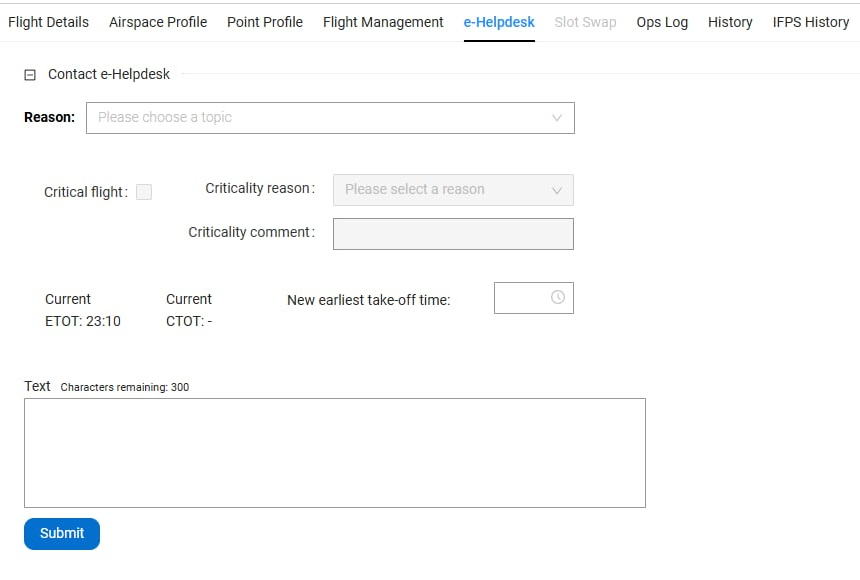
You’ll find the option in the e-Helpdesk tab in NMP Flight.
From 60 minutes before EOBT, you can tick the “Critical flight” box and choose a reason from a predefined list:
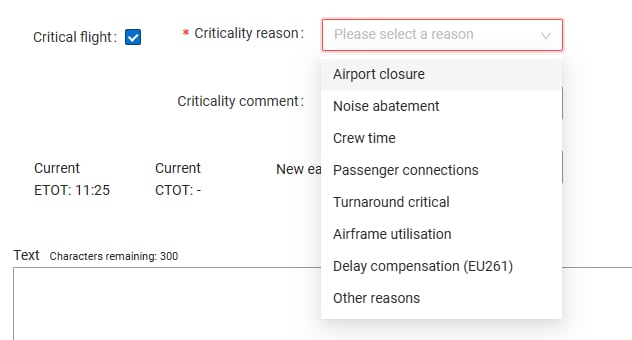
You can also add a brief comment (up to 300 characters) to explain the situation.
What to keep in mind:
- You can only apply Critical status from 60 min before EOBT. Earlier requests won’t be accepted.
- Once marked, you can’t change or remove the flag for that flight during the day, so be sure before using it.
- You can mark up to 5 % of your regulated flights as Critical each day, with a maximum of 20 flights.
- These flights are not automatically rejected, which improves the chance of receiving support from Eurocontrol.
Use this option carefully, and only for flights where delay would cause real disruption. When applied correctly, it’s a simple but powerful tool to keep your operation running smoothly.
For Pilots: Keep It Predictable
Eurocontrol doesn’t like surprises. The whole system runs more smoothly when flights do exactly what they said they would do. Sudden changes might seem harmless from the flight deck, but they can ripple through the network and cause chaos in sectors ahead. Here’s how to keep things flowing:
- Fly what you file. Stick to your planned routing and levels unless ATC, weather, or safety require a change. That shortcut might save a minute, but it could cost someone else much more.
- Stick to your slot. Request start-up in line with your EOBT and CTOT. Off-schedule departures can break the flow and lead to slot issues.
- Let your dispatch team talk to Eurocontrol. The Network Manager Operations Centre (NMOC) is ready to help, but contact should come from dispatch. Unless you’re both pilot and ops – let the team handle it.
Need Help? Know Where To Go
Your first stop should always be the e-Helpdesk in NMP Flight. It’s the fastest and most efficient way to request CTOT improvements, mark Critical flights, or get slot-related support. The network team monitors it constantly and responds quicker when requests come through the system.
Calls should be a last resort, used only for urgent, time-critical situations. Phone support takes resources away from managing the wider network – so only use it when really needed.
Call only if:
- A flight is about to miss CTOT at the holding point.
- There’s a crew duty or curfew risk.
- You’re repositioning a diverted aircraft.
- You’re handling a medical or emergency flight.
Contacts:
- AOLO (Aircraft Operator Liaison Officer) general line: +32 2 745 1992
- Airport Function (AF) – for airport-related issues or curfew risk: +32 2 745 1903
- AOLO Hotline – for critical/emergency issues only: +32 496 560 300
- Airport coordination e-mail: nm.airports@eurocontrol.int
For everything else, use the e-Helpdesk – it’s how Eurocontrol can help you best.
Want to Learn More? Start Here
If you want to go beyond the basics and build a deeper understanding of how the European network works, here are three great places to start:
EUROCONTROL Learning Zone – Free online courses and tutorials to help you better understand European flight planning and ATFM.
ThinkNetwork Guide – Summer 2025 – Eurocontrol’s seasonal briefing with key planning tips, capacity updates, and network insights.
NOP Portal Real-time source for airspace status, regulations, slots, and network operations.

More on the topic:
- More: Computer Says No: Why FAA RVSM Approvals Matter in Europe
- More: Big Summer Slots (a Storybook)
- More: PBN, RNP and what it all means
- More: There’s no “I” in team. But there might be an “AI”…
- More: Contrails, Chemtrails and Climate Change
More reading:
- Latest: NAT Pack 2026: All the North Atlantic goodies
- Latest: New 2026 NAT Oceanic Checklist
- Latest: The Bahamas wants your cash
- Safe Airspace: Risk Database
- Weekly Ops Bulletin: Subscribe
- Membership plans: Why join OPSGROUP?





 Get the famous weekly






excellent work keep up the efforts
Correction to the NMOC phone numbers provided :
+32 2 745 1992 is the AOLO (Aircraft Operator Liaison Officer) standard phone number.
+32 2 745 1903 is the AF (Airport Function) phone number. As of this summer the AF is a new NMOC Flow Management function fully integrated to the FM/TACT team, that AOs can amongst other reasons also contact for any Airport-related issue or for critical risks of night curfew infringement.
+32 496 560 300 is the AOLO “Hotline” to be called only for reasons qualifying as such (as described in the NOP Headline News).
You missed out the extra fun of A-CDM airports – in most places the handling agents say “never touch the flight plan, let uns handle it”. Any change in ETA or ETD must first be coordinated with the A-CDM system by the handling agent, before changes to the flight plan are possible.