


Update Nov 17:
- The US shutdown is over and the FAA says it will end the emergency order at 0600 EST on Nov 17, which means the nationwide flight-reduction limits on the US NAS are being cancelled.
- That opens the door for airlines to get back to normal schedules. In fact, most of them had already started running full programs over the weekend because they expected the cuts to be cancelled. The system coped, but it will still need a bit of time to fully settle after weeks of strain.
- And the big news for BizAv: the Notams that shut out GA at the 12 major airports have now been cancelled, so access is open again.
Original story from Nov 11:
- Congress passed a funding bill late on Nov 10 that’s expected to end the shutdown once signed into law.
- The FAA hasn’t lifted any of its traffic limits or BizAv bans yet, so everything below still applies until official guidance changes.
- ATC recovery won’t be instant. Weeks of six-day schedules, long shifts, and financial strain have left facilities short-staffed. Even after the shutdown ends, it will take time for the FAA to rebuild staffing, lift flight-reduction orders, and restore normal capacity. Expect ongoing delays and flow programs in the meantime.
ATC staffing shortages caused by the shutdown have already changed how the country’s busiest airports are operating. Delays have surged, major metro areas are tightening up, and the FAA has put formal limits in place to keep traffic manageable. With the funding deal now in place, these measures should begin to unwind once staffing stabilises – but for now, they remain fully in force.
These limits arrived in two steps:
Nov 7: An Emergency Order issued on Nov 7 reduces airline traffic at 40 major airports and gives the FAA the option to restrict BizAv flights when staffing becomes too thin.
Nov 10: A series of Notams went further, temporarily banning most domestic BizAv flights at 12 of those same airports. These Notams effectively strengthened the restriction powers created under the Emergency Order.
Confusing! Yes indeed. Finer details as follows…
The Nov 7 Emergency Order reducing airline flights at 40 airports
You can view this here.
This applies only to Part 121 airlines and to commuter or scheduled Part 135 carriers, (and for simplicity, let’s just call these guys airlines for the rest of this article).
So, airlines must now reduce their scheduled domestic flights at 40 “High Impact Airports” during the daytime hours of 0600-2200 local. The reduction rises from 4% on Nov 7, to 10% by Nov 14.
On-demand Part 135 flights and private Part 91 flights are not part of the mandatory cuts (and again for simplicity, let’s just call these guys BizAv for the rest of this article!)
The Order also gave the FAA the option to reduce BizAv activity at these airports if staffing levels drop further – which is what then happened with the Notam splurge on Nov 10! (see below for info on that)
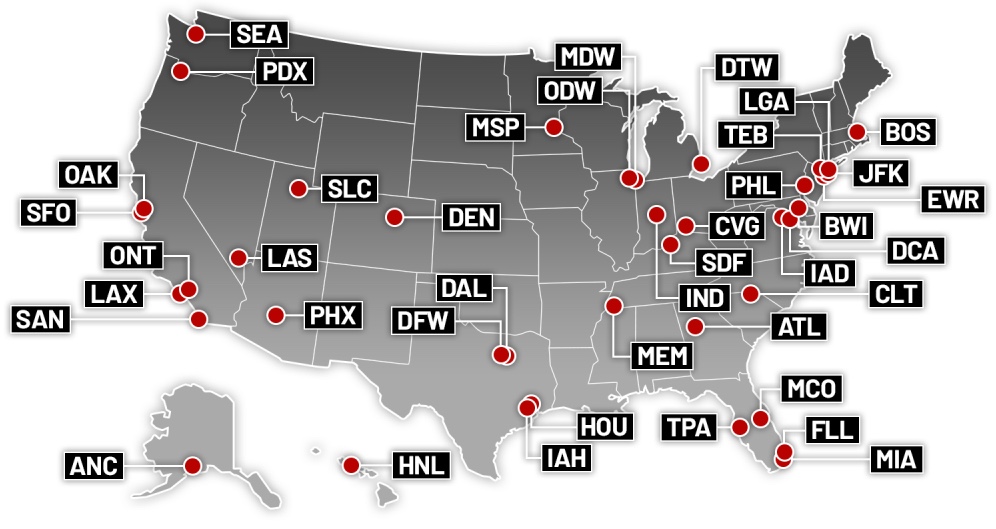
The forty airports listed in the Emergency Order are:
- KANC/Anchorage
- KATL/Atlanta
- KBOS/Boston
- KBWI/Baltimore
- KCLT/Charlotte
- KCVG/Cincinnati
- KDAL/Dallas Love
- KDCA/Washington National
- KDEN/Denver
- KDFW/Dallas Fort Worth
- KDTW/Detroit
- KEWR/Newark
- KFLL/Fort Lauderdale
- KHNL/Honolulu
- KHOU/Houston Hobby
- KIAD/Washington Dulles
- KIAH/Houston Intercontinental
- KIND/Indianapolis
- KJFK/New York JFK
- KLAS/Las Vegas
- KLAX/Los Angeles
- KLGA/New York LaGuardia
- KMCO/Orlando
- KMDW/Chicago Midway
- KMEM/Memphis
- KMIA/Miami
- KMSP/Minneapolis St Paul
- KOAK/Oakland
- KONT/Ontario
- KORD/Chicago O’Hare
- KPDX/Portland
- KPHL/Philadelphia
- KPHX/Phoenix
- KSAN/San Diego
- KSDF/Louisville
- KSEA/Seattle Tacoma
- KSFO/San Francisco
- KSLC/Salt Lake City
- KTEB/Teterboro
- KTPA/Tampa
The Nov 10 BizAv restrictions at 12 major hubs
Three days later, the FAA issued a much stronger measure: Notams at 12 major hubs that temporarily prohibit most BizAv flights (ie. private Part 91 and on-demand Part 135). You can view the list of Notams here.
These Notams apply only to airports already in the Emergency Order list, which shows they are a targeted escalation rather than a separate policy. Only based aircraft, emergency or public-service flights, or operations authorised by the ATCSCC may use these airports.
The twelve airports with these BizAv restrictions are:
- KORD/Chicago O’Hare
- KDFW/Dallas Fort Worth
- KDEN/Denver
- KBOS/Boston
- KIAH/Houston Intercontinental
- KATL/Atlanta
- KJFK/New York JFK
- KLAX/Los Angeles
- KEWR/Newark
- KPHX/Phoenix
- KDCA/Washington National
- KSEA/Seattle Tacoma
This means the FAA has used the BizAv-reduction authority provided in the Emergency Order and applied the most restrictive version of it at these 12 hubs. Instead of trimming activity, BizAv access has been mostly removed – for now.
The National Air Transportation Association (NATA) has since reported that the FAA told them these restrictions only apply to domestic non-scheduled flights. According to NATA, international Part 135 operations may still be approved with prior coordination through the FAA Command Center. This hasn’t been formally confirmed, so treat it cautiously until the FAA issues official guidance.
Operational impact for BizAv
40 High Impact Airports: Although most BizAv flights are not part of the mandatory Airline reductions, they are still affected by the resulting compression. Expect more flow programs and occasional reroutes at the 40 High Impact Airports.
12 specific BizAv-restricted airports: Access is effectively unavailable for domestic flights unless you meet an exemption. NATA says international Part 135 operations may still be possible with prior coordination through the FAA Command Center, but this has not been formally confirmed. Surrounding satellite airports will likely absorb the displaced traffic, so expect parking shortages there too.
What happens next?
Now that funding’s been approved, the shutdown should finally end – but things won’t bounce back right away. The FAA still has to rebuild staffing, unwind the flight-reduction orders, and reopen the restricted airports.
It’s a familiar story. During the 2018-19 shutdown, a single LaGuardia ground stop sparked nationwide delays and helped force a deal in Washington. This time, the same pattern has played out: rising ATC strain, mounting cancellations, and political pressure finally pushed Congress to act.
Expect a slow return to normal. Delays, flow programs, and limited capacity will likely continue for weeks as the system stabilises. We’ll keep tracking Notams and any FAA updates to the Emergency Order as the situation evolves.
More on the topic:
- More: FAA Warns on Runway Length Data and Overrun Risk
- More: US CBP biometrics: BizAv rollout still unclear
- More: Updated FAA Oceanic Guides
- More: FAA Housekeeping: Foreign Instrument Procedures, Approach Chart Clutter
- More: FAA License Holders Abroad – You’ll Need A US Address Soon
More reading:
- Latest: Paris Ramp Checks: Illegal Charters and Tax Avoidance
- Latest: Middle East Airspace – Current Operational Picture
- Latest: Greenland NAT Alternates: March 2026 Update
- Safe Airspace: Risk Database
- Weekly Ops Bulletin: Subscribe
- Membership plans: Why join OPSGROUP?






 Get the famous weekly