Taking the Trash Out: Let’s fix NOTAMs

After a hiatus of a year or so, we’re back working on NOTAMs. In 2021 we ran a campaign with ICAO (and IFALPA, and IFAIMA) to improve NOTAMs. We focused on “Old” NOTAMs, ones that sit in the system for no good reason, sometimes for as long as 20 years. They are mostly gone – including the Albanian NOTAM about the Y2K problem.

That’s good, but the NOTAM problem isn’t fixed. Rob, below, summed it up nice and simply last week.

So, let’s continue the work. Why do we have a system that makes it extremely easy to miss critical items? And how do we fix it? Let’s visualize the problem.


NOTAMs are like containers on a ship

Imagine you’re the pilot of a Boeing 787 about to sit down at a briefing table to review NOTAMs for your flight from Copenhagen to Bangkok today. You will get a folder containing a printout of NOTAMs for your route. Here they come.
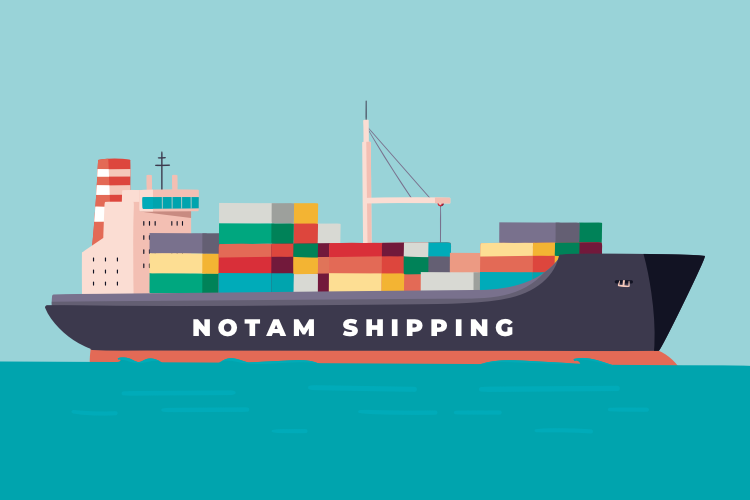
Each container is a NOTAM. Unlike actual containers on actual ships, there is no manifest. We don’t know what’s in the container until we open it and take a look. That means that we can’t automatically sort them out beforehand, and we can’t put them in any order of importance. Therefore, the pilot gets a random list of NOTAMs, and it’s up to them to make sense of it.
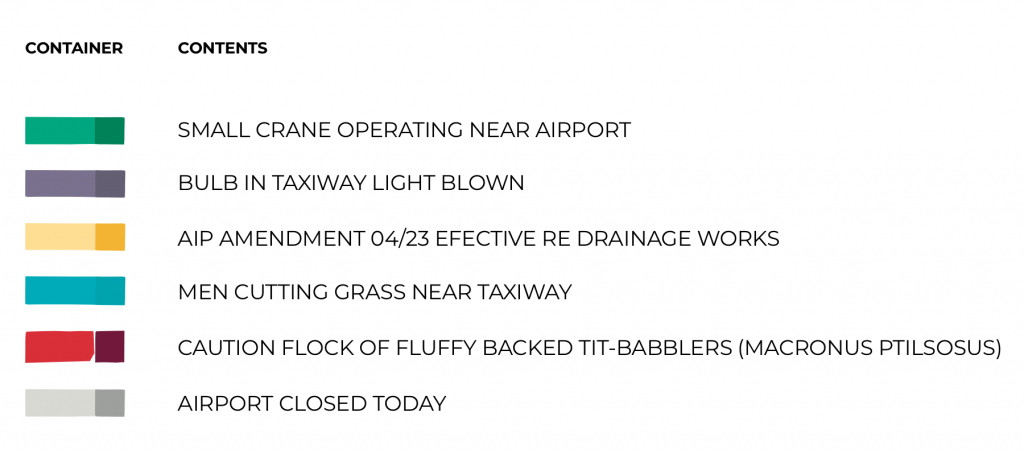
If you only had six NOTAMs to take a look at, no big deal. You’ll spot that the airport is closed today. But we usually have somewhere between 100 and 1,000. The result? A system that makes it extremely easy to miss critical information.


Finding the simple fix

This is a simplified version of the problem, but not by much.

Question, then: How do we improve the NOTAM system so we can sort and filter them? 

Let’s get a technical for a moment, since we’re going to need some smart people that understand the system architecture. Here are some basics that are important.

  1. There isn’t really an international “NOTAM system”. Each country issues NOTAMs for their airspace, and keeps a local list of them for pilots in that country. Other countries can query that list (done via the AFTN, with an RQL message), and get a copy of new NOTAMs (by sending an RQN message). Not every country does this, but if they do, they’ll then have a limited database of NOTAMs from selected other countries. A tiny handful of countries, regions, and organizations do this for every country, which makes for a fairly reliable international database of NOTAMs. Examples of this are the FAA (NOTAM Search), US DoD (DINS), and Europe (EAD). These databases form the source data used by pilots and operators, often via service providers like Jeppesen, LIDO, Foreflight etc. who may apply some final processing to attempt to sort and filter them for their customers.
  2. Since there isn’t an international NOTAM system, then logically, nobody is in charge of it. ICAO sets the standards for when a country should issue a NOTAM (Annex 15), how they are formatted (Doc 10066), and what codes to use (Doc 8400). Eurocontrol publishes a guidance manual (called OPADD). That’s about it. Nobody has the job of monitoring all international NOTAMs for quality or quantity.
  3. The NOTAM structure is very limited. It uses a limited character set called ITA2, which pre-dates ASCII. This limits messages to UPPER CASE. The format is set in Doc 10066, giving a NOTAM 7 sub-parts from A to G, preceded by a Qualifier called the “Q-code“. In theory, the Q-code tells the reader what the NOTAM is about (magically solving the container problem above), but in practice, it doesn’t work. Why? There are too many choices, and therefore they are often applied incorrectly, or not at all. The Q-code categories were dreamed up in 1950, and there are 13,783 possible Q-codes. 20% of NOTAMS don’t have a Q-code at all (The NOTAM office often enters XX or XXXX, meaning “not sure”).


What’s in the NOTAM container?

Let’s get back to the yard, and lower down one NOTAM container and take a look.
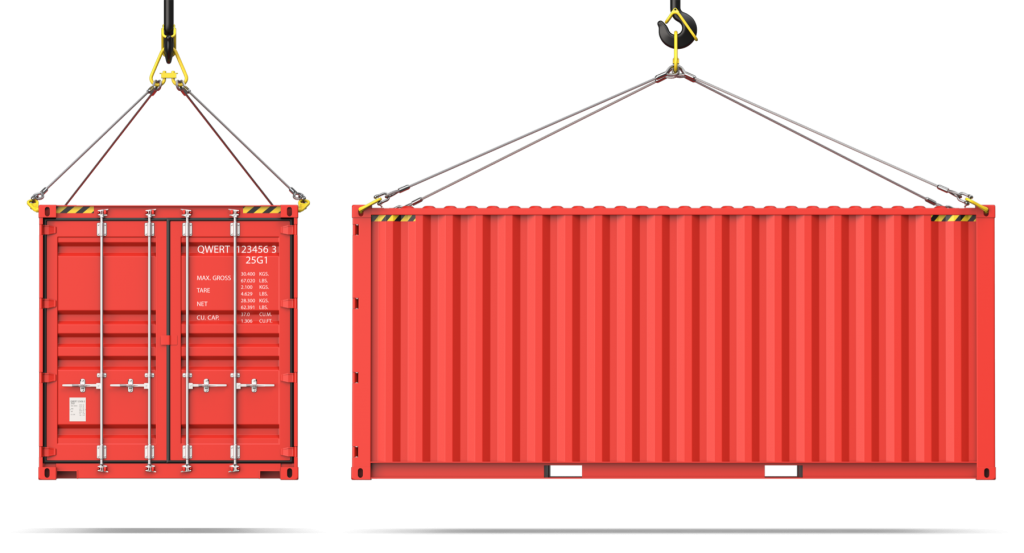
We know it came in on the NOTAM ship so it relates in some way to our route today, but we don’t know what’s in it. Therefore, we can’t sort it or filter it out. It just joins all the other NOTAMs that we load up into the pilot’s briefing, and leave it to them to make sense of.

But if the shipper (the originating NOTAM Office) puts a label on it saying “BIRDS“, then we immediately know what to do with it.
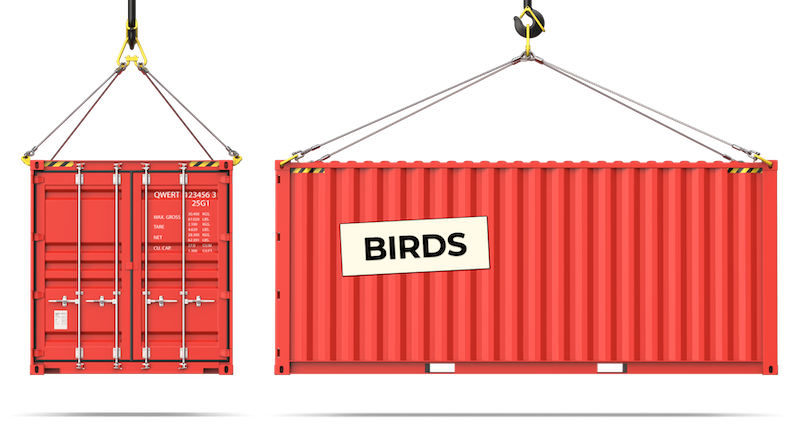
Pretty quickly we can start organizing the containers. Each operator can figure out the order they want to put them in, and which ones to leave at the back of the yard.

By knowing what the NOTAM is about, in advance, we can set up some basic processing rules. Each aircraft operator is different: Airlines don’t care about broken obstacle lights 5 miles from the airport, but a Police helicopter does. Perhaps someone cares about birds, most pilots don’t. It doesn’t matter; let the operator decide for themselves how important each label is, and what order to put them in (or discard).


Sounds easy, but is it?

In a huge list of NOTAMs, the ability to sort and filter them is the key to making them manageable. If they are sorted and filtered, then it’s unlikely a pilot will miss the big ones. Back to what Rob said (⬆️)  the problem is that it’s extremely easy to miss critical items, and that’s what we want to change.

We have some limitations:

  1. It must be a simple change. There are 193 countries that are ICAO members, each one ultimately resistant to a system-wide change that will cost money and require infrastructure investment. It would be lovely to start from scratch with a new system, but it’s not feasible. We need a simple change to the format with big impact. Conversely, if you think even that is impossible, just remember that Snowtams changed format in 2021.
  2. We can’t use Item E. To be able to sort and filter, a computer has to be able to know what the NOTAM is about, without having to read the content text. It can’t make sense of the text in Item E (the text of the NOTAM) – we tried this some years ago with machine learning, and after 2 millions passes, AI wasn’t able to formulate an algorithim that worked. There are just too many countries with different ways of writing NOTAMs to use Item E. So we must have a label of some kind.
  3. We must change the back end, not the front end. This must be a change available to everyone. Sure, Foreflight does good stuff, especially with US domestic NOTAMs. There’s a bunch of software and apps that can help to make NOTAMs more digestible. Some can be displayed graphically, but not many. Big airlines have back-office staff to organize and even rewrite some NOTAMs. But they all do it differently, and not many of them solve much of the big problem. We’re still getting dozens, even hundreds, of pages of NOTAMs to read.

That’s where the work begins. We don’t have all the answers, and we need some smart NOTAM-folk to help. It’s not the intention here to present a vague solution and say “This is it” – this article is intended to generate some critical thought and discussion on what the “Big Fix” looks like. Labelling them in some way seems the way to go, but we’re not sure.


Remember this …

There’s nothing like saying “NOTAMs, what do you think?” to generate a slew of pilot complaints, jokes (some great memes after the January outage!), and things that need to be fixed. We’ve been working on this here for a couple of years, but efforts to fix the b*rds date back almost 60 years. With that in mind, addressing the most common talking points may help.

  1. NOTAMs suck. We know. We’re just a bunch of pilots and dispatchers that really don’t like them, and we’re doing our best to make change happen. But if we want to solve them, we have to find the one thing that fixes most of the big problem in one hit. UPPER CASE is tough to read, but that’s not the big problem. Abbreviations are annoying, but that’s still not the big problem. The Big Problem is that we can’t see the critical stuff because we have to read hundreds of them before flight in no particular order. If we can sort and filter them, that means we’ll see the important stuff first, and don’t have to read such a long list.
  2. General ranting at the FAA, ICAO, IATA, or even the government doesn’t help. Instead, help us to help find a sensible solution, draw it out, think it out, test it, and we can then present it to those that can help implement it.
  3. Digital Notams. Sometimes this comes up as a solution that’s on the horizon, and will fix everything. That conversation has been happening for at least 20 years, and while a lot of good people are working on this, it doesn’t fix the problem we have right now. In a perfect world, SWIM and Digital Notams will come online in 2028 (five years from now), and start to solve some of the issues. Problem is, we live in an imperfect world, and the chances that this will solve our woes as they exist today are slim.
  4. Hey, I made a thing that solves NOTAMs. Like we said above, yes, there are some really great apps, graphical tools, and software that help make some sense of NOTAMs. Foreflight is a favourite amongst us pilots. But despite some of the advances, the originating NOTAM is still a brutalist remnant of the early 20th century, and the vast majority of pilots still get giant chunks of NOTAM text to plod through. We want to fix the problem at source. At the same time, it’s likely that the smart people that made these things can also be the smart people to solve the source problem!


So, what now?

We want to hear from you! Write to us at team@fixingnotams.org. We can only solve this as a community group, and we’re working on a few events to get people together for some discussion. We’ll set up a few group chats on Zoom to get the discussion started and some ideas flowing.

Ultimately, the plan is to start funnelling some ideas along the pipeline until we reach one that really seems to work, and take that to the organizations that can implement it. So, it’s up to you. Want to get involved? You’re awesome! Please reach out to us.

FAA NOTAM Change: It’s not all about the Missions

On December 2, the FAA introduced some amendments to NOTAMS. Amongst these revisions, was a change to the meaning of the acronym ‘NOTAM’ to create more inclusive terminology.

The acronym change has been stealing the limelight from the other revisions, so we thought we would take a look at what the other changes are, and what the overall impact might be for you when reading NOTAMS.

ICAO Standards

There have been various revisions to terminology used within NOTAMS, in order to bring the FAA issued ones more in line with that of ICAO.

Braking action will no longer be termed as “good”

Which is good, because ‘good’ doesn’t really mean an awful lot. What’s good for one aircraft might not be for the next. This is part of an update in Change to Field Conditions (FICON) reporting and a second change is that FICONs will not be issued for closed runways.

This is in line with the new Global Reporting Format for runways which ICAO brought into force in November 2021.

“Unserviceable” is being clarified

Where certain systems are not functional, the impact of this on the primary systems which they are a component of will be identified. For example, if the runway alignment lights are u/s a NOTAM stating this doesn’t give us much information on what the reduced condition of the full ALS is. So NOTAMS will clarify this better.

Housekeeping

  • KLAS/Las Vegas’ (formerly known as) McCarran airport has had its name change added into the system. It is now known in NOTAMs as Harry Reid.
  • ASOS and AWOS automated weather systems are now treated the same in NOTAMs. For info, AWOS is an automated weather observing system which provides continuous real time info and report and which can be fully configured while ASOS is an “all in one” Automated Surface Observing System which also provides continuous weather reports.

The Acronym

Because it is getting so much attention, we figured we would add a little perspective here on it.

A NOTAM is still a NOTAM. We’ve not heard anyone ever call it anything except that. But what it stands for has changed – rather than Notices to Airmen, it now stands for Notices to Air Missions.

A very quick history lesson on the NOTAM – they first came into being in 1947 after the Convention on International Civil Aviation. There was even a special NOTAM meeting in 1949 which was when AIS really came into being. But NOTAMs themselves actually originated from the older Notice to Mariner system, set up for navigational safety in the seas. Later, SNOWTAMs came into being (1968) and then they branched out into ASHTAMs (1980s). 

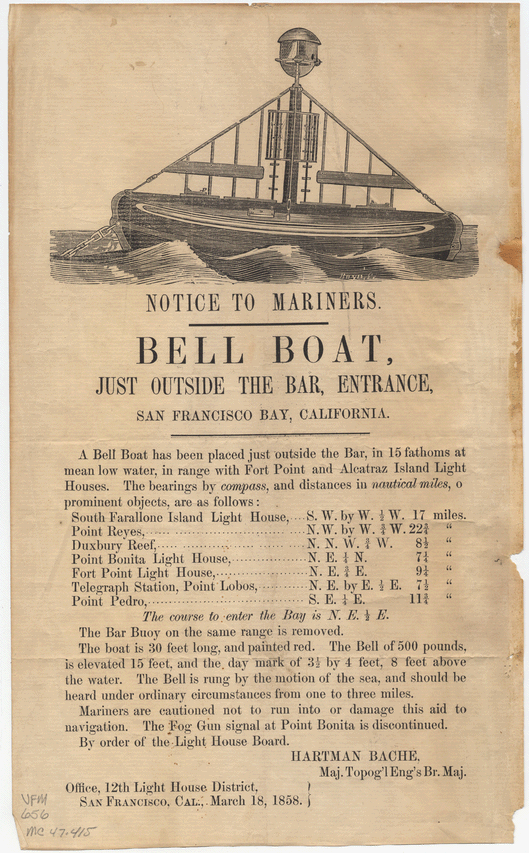
What I find interesting with the NOM is just how close this one (written in 1858) is to some of our modern day NOTAMs. All wordy and full of complex and confusing bearing to work out, similar to the Lat/Long ones we see nowadays.

Anyway, why the change in terminology? Well, because ‘Airmen’ is not very inclusive of any other gender. Now, a lot of folk feel this change is unnecessary and we aren’t going to weigh in on either side. All we have to say on the matter is:

  • If you don’t think it is necessary – it doesn’t actually impact anything. Keep calling them NOTAMS like you always did.
  • If you do think it’s necessary – hopefully this is a step towards everyone feeling that aviation is inclusive.

If you are looking for further discussion on the FAA’s move to gender neutral language then you can find a link here to the FAA ‘Medium’ page where the discuss this.

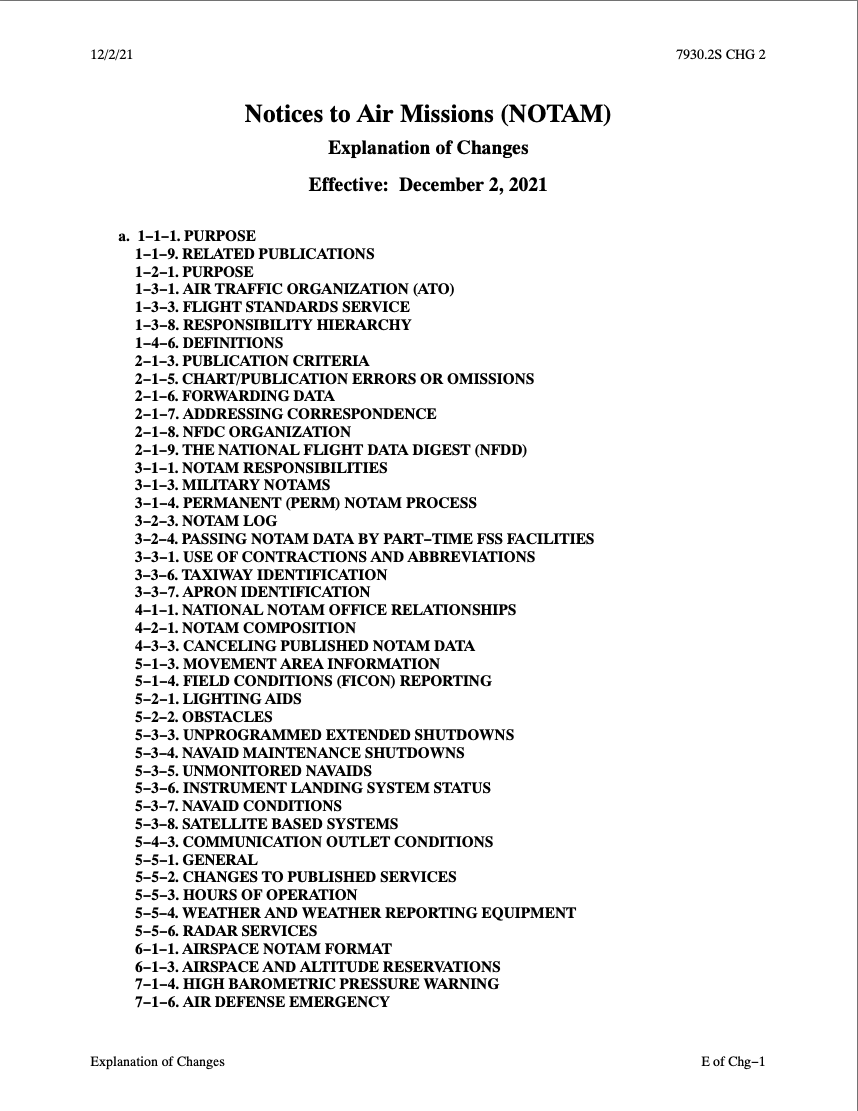
JO 7930.2S CHG 2

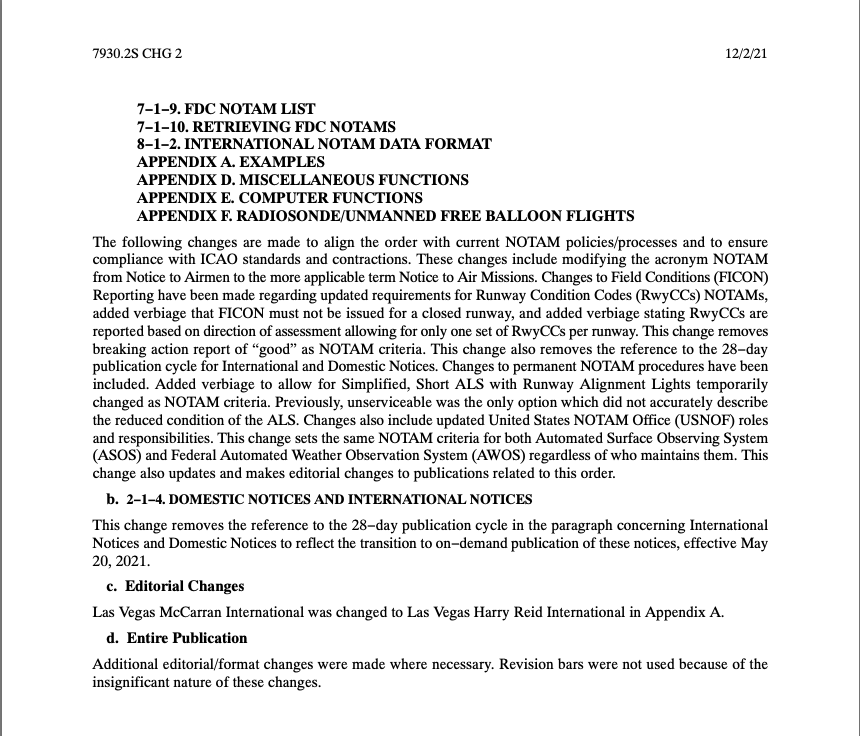
Who is Jo? Actually, it is the official FAA notice of change which you can find here.

Here are the full list of changes pages:


The Impact?

Well, not a tremendous amount overall. The acronyms is worth knowing about to avoid confusion should you ever see it written in full, while the move to more ICAO standard terminology will hopefully bring a little more clarity and standardisation to NOTAMs for any international operators.


Global Campaign on NOTAM Improvement

Update: The NOTAM campaign was launched with 1,500 attendees on April 8th – and yes, it was the largest virtual event in ICAO history! The first update webinar on progress being made is on June 16th at 1200Z – register with this link, and join the call.


The Global Campaign on NOTAM Improvement is being launched on April 8th, 2021. Spearheaded by ICAO, and supported by OPSGROUP, IFAIMA, and IFALPA, the campaign will focus on making significant improvements to the NOTAM system to enhance its effectiveness, usefulness, and reliability as a mechanism for pilots to receive critical flight information.


Kick-Off Webinar, April 8th 2021

At 1200Z on April 8th, 2021, we will launch the campaign with a worldwide webinar. So far, we have 600 registered participants. We are on track to make this the biggest virtual event in the history of ICAO. If you think about it, that’s pretty amazing for a meeting about NOTAM’s!

This webinar is open to everyone, and we would be delighted to have you join it – to show your support for the Notam Improvement campaign, to learn more about what the plans are, get the latest update, and see how you can get involved: this is a collaborative, shared mission that needs your help, whether you are a pilot, dispatcher, AIS officer, software developer, Flight Planning provider, ANSP, CAA, or are in any other way a user or provider of some aspect of the Notam system.

So, please join us – it’s open to all:
Register for the Worldwide Webinar on Thursday, April 8th, 2021 – 1200 UTC

1200 UTC = 7am Lima, 8am New York, 1pm London, 2pm Berlin, 4pm Dubai, 7pm Bangkok, 10pm Sydney, 12am Auckland.


Why should I join the Webinar?

Over the last few years, as many as 10,000 pilots and dispatchers have supported a move to fix Notams – through petitions, surveys, comments, emails, and joining the OPSGROUP Notam Team to help fix the problem. Your voice has been heard: this work is the result. Now, we need your support for this campaign – to reinforce the message that as an industry, we really care about this. Your presence will encourage those working on solving the Notam Problem, and you will get the full picture of where we stand in the progress to fix things.

We will speak about the mission, demonstrate the problem with some real world examples of pre-flight briefings, showing how these impact the daily lives of pilots and dispatchers, clarify the definition of “Old NOTAM’s”, and show how AIS staff can use the existing regulatory framework in Annex 15 and Doc 8126 to become a gatekeeper for NOTAM quality, demonstrate the Notameter, address regional challenges, and have a Q&A session.

Our presenters and speakers will include Stephen Creamer (Director of the Air Navigation Bureau at ICAO), Alex Pufahl (ICAO Technical Officer), Mark Zee from OPSGROUP, Capt. Lauri Soini from IFALPA, Fernando Lopes and Antonio Locandro from IFAIMA, Marco Merens from ICAO, and ICAO Regional Officers.


What is the Notam Campaign all about?

First, the problem: Pre-Flight NOTAM Briefing packages are often far too big to be fully read and understood by pilots before a flight. The result: critical information is missed. Finding safe ways to decrease that volume is the key focus of this campaign.

In the Global Campaign on Notam Improvement, our aim is to solve the Notam Problem in manageable chunks, gathering energy as we solve them and make progress. Rather than re-invent the wheel, we will fix the system from within, starting with the easier aspects and progressing from there. The first phase of this campaign focuses on Old Notams. At any one time, there are about 35,000 active Notams globally, and 20% of these – one in five – are old; in other words, not respecting the existing rules of Notams being issued in principle once only for a maximum of three months (everything else should go into the AIP, an AIC, or some other publication).

We are drawing on the collective cooperation of the AIS community – the Notam Officers – to uphold the rules and get rid of Notams that don’t follow them. The result will be a potential decrease of 7,000 Notams per month, and a 20% reduction in the size of the average briefing packet. For more on the Notam Problem itself, have a look at “Why pilots are reading a Reel of Telegrams in the Cockpit“.


Who is behind it?

The Global Campaign is a meeting of minds, agreeing on one thing: Notams need fixing.

ICAO is spearheading the campaign, in the recognition that the Notam Problem is a worldwide issue that affects flight operations in every country.

Providing support, energy, and huge enthusiasm to help solve things are IFAIMA, representing the Aeronautical Information community, IFALPA, voicing the concern of Airline Pilots, and OPSGROUP, whose pilot, dispatcher, and flight operations members have been tirelessly involved in the mission to fix Notams since 2017.


What can you do to help?

Thank you for asking! If you are in the AIS community – perhaps as a Notam Officer, AIS Officer, Publisher, or Promulgator – please tell your colleagues, join the webinar, and get involved in this Campaign. If you are a Pilot or Dispatcher, join the webinar, share the news of this campaign (#NOTAM2021), voice your support, and monitor progress – we’ll want your help down the track as well. If you are a Flight Planning Provider or Software Developer – again, join the webinar, and when the time comes, get involved in the collaboration around technical improvements. If you work for an ANSP or Civil Aviation Authority – join the webinar, encourage your colleagues to join too, and help support the Campaign. If you work for an Organziation, tell your members, and share news of this campaign (#NOTAM2021). Oh, and join the webinar!


How we got here …

This is a Global Campaign for a very good reason. We only solve this problem when we solve it for all countries – so we take the lessons learned domestically from those countries that have seen NOTAM wins, and amplify that across the rest of the globe.

In terms of change so far, most notable is the work done by the AIS Reform Coalition in the United States, chaired by Heidi Williams from the NBAA. This group of people from NATCA, ALPA, AOPA, IATA, A4A, ACI, the NBAA and others have been working feverishly in partnership with the FAA to drive change and improvement. And it has had remarkable results – the US has radically improved NOTAMs in the last 2 years: NTAP gone, a big reduction in PERM Notams, a single office for AIS, a transition to the FNS, and NOTAM Search replacing Pilot Web. Canada has transitioned to ICAO format for Notams, and provided a new delivery mechanism through CFPS.

We must also recognise huge efforts from the members of OPSGROUP, who as pilots, dispatchers, and other flight operations specialists have made their voice heard, sharing support, input, ideas, and enthusiasm for change; the efforts of IFALPA to bring attention to the issue, and IFAIMA who have given full support to solving things on the AIS side.

An important distinction to make here is that this work is on “NOTAMs, Now“. There is separate, ongoing work in the field of the “Future of NOTAMs”. You may have seen acronyms like SWIM and AIXM, and terms like Digital Notams or Graphical Notams. The FAA, ICAO, Eurocontrol, and other agencies are building a model for the future, when NOTAM’s will change from the current AFTN format and transmission into an internet, IP based, transmission and follow a service-oriented approach. This work is valuable, but with a target implementation date of 2028, has a different focus. Even if it goes smoothly, it would not instigate change until 2028. Needless to say, if we don’t fix the underlying issues now, it may not even solve them then, either.


The AIS Community, Pilots, and Dispatchers, working together

Here’s the really exciting part of this Campaign: for the first time we are seeing pilots, dispatchers, and AIS staff working together on solving the issue. This is a core tenet of the campaign: only when you have all parties involved, do you have a shot at success.

The AIS Community is invaluable in solving the problem, but they need our help. First, they need to know exactly the impact of the Notam Problems we describe – this drives their will to make change and improvement. Second, they need the support – which this Campaign will provide – to stand as gatekeepers for Notams. They themselves are often under pressure to publish Notams that they know don’t align with the rules, but have no alternative.


Phase One

So, once the Campaign is launched, what does the roadmap look like? Logically enough, we start with Phase One. A simple, bite-size chunk of the problem – Old NOTAM’s. In volume terms, it’s a lot more than bite-size – it’s actually 20% of the problem. The key is that it’s easy to understand, and therefore easy to work on. We don’t need to make any structural changes, or change how the system functions. This is simply about focusing on a known issue – that 7,000 of the 35,000 active Notams that should not be there.

Even more importantly, the focus is also on the energy, enthusiasm, and goodwill to make the changes necessary. As we gain momentum, we get encouragement from each and every Old NOTAM that is removed forever. We see that through collaboration, community, and support for each other, we can make change happen.

Remembering that this is a decades old problem that has been on the agenda since 1964, and that there are 193 countries on this journey, progress may feel slow at first. But we’re going to learn from each other, and go as fast as feels right. We’ll be celebrating the small wins!


Phase Two

The next phase will look at technical improvements. In other words, what structural and systemic changes can we make to NOTAM’s to leverage quick improvement.

We envision that this stage will be best served by a great deal of collaboration and discussion. One of the key groups here will be Flight Planning software providers. The vast majority of NOTAM briefings today are provided by these companies. As things stand, each one has a different, in-house method of processing the Notam flow – usually with algorithms, keyword searches, date/time validity ordering, and some Q-code assessment. So we might ask, how can we best structure the Notam data to provide a robust, reliable format with metadata that allows sorting and filtering – the two big asks from the pilot community. In other words, show me the critical stuff first, and skip the fluff.

We also, again, need full collaboration with AIS to see what the impact of those technical improvements will be, and whether they support them. Adding pilots and dispatchers into the mix will allow us to verify that the changes being discussed will actually have an impact by the time they reach the cockpit. If they don’t, then we’re not doing it right.


More about #NOTAM2021


NOTAM 2021 update: progress, at last

Here’s something you might not have been expecting: at long last, true progress on fixing NOTAMs.

If you’ve been following the story over the last few years, you’ll know that there has been an ever brightening spotlight on the problem. Here at OPSGROUP, we’ve certainly been vocal about the issue. The response to our first blog post back in 2017 was huge, and so we made it our mission: Let’s Fix NOTAMs.

We started out with a campaign to bring attention to the problem: We wrote the Field Guide to Notams, ran a Worst NOTAM competition at EBACE, held a Notam Summit in New York, conducted a pilot and dispatcher survey with 2100 responses, asked OPSGROUP members for support and input, ran a design contest, and through all of this gathered ideas on how to fix things. That led to an updated article in 2019 titled “Why Pilots are reading a Reel of Telegrams in the Cockpit” – which gathered more energy and interest around the problem. We then formed a Notam Team, started the “Fixing Notams” website, worked with other industry groups looking at the issue like the AIS Reform Coalition, and saw the FAA host the first industry gathering on NOTAMs in November 2019. We started a petition to keep momentum going, with 8800 people signing our plea to fix Notams.

In terms of specific solutions, we tried a bunch of things. We built an AI bot with ICAO, called NORM – to see if we could use machine learning to sort out the mess. In the Notam Team, we looked at the problem from the ground up, and looked at building an entirely new system, called N2. We also collaborated further with ICAO to build the Notameter, a tool to analyse the quality of existing Notams. Internally at OPSGROUP, our small team spent many hours researching, pondering, idea generating and data analysing.

The result? Much learning, much discussion, much collaboration – but no concrete results or fixes. This the way of things. NOTAMs are harder than they look. The AI was not able to make sense of Notams in the way we’d hoped, the initial Notameter was interesting but wasn’t changing anything. A brand new system wasn’t going to work: despite the failings, the existing system has buy-in and trust, and attempting to circumvent that with an entirely new mechanism sounds inspiring, but isn’t practical.

But progress doesn’t always come along the path that you expect. And in the quiet, dark days of a Covid-dominated December, a small group of die-hard Notam Fixers formed to continue the battle. Taking all the learnings of the Notam journey over the last few years, we sat down together once a fortnight over the last few months, and forged a new path. Each of us represented our own group of allies in the mission: ICAO, IFAIMA, IFALPA, and OPSGROUP. This togetherness created a renewed energy to solve the problem.

And now, we have traction.

Next month, ICAO will spearhead the launch of a Global Campaign on NOTAM Improvement. Our aim is to solve the Notam Problem in manageable chunks, gathering energy as we solve them and make progress. Rather than re-invent the wheel, we will fix the system from within, starting with the easier aspects and progressing from there. The first phase of this campaign focuses on Old Notams. At any one time, there are about 35,000 active Notams globally, and 20% of these – one in five – are old; in other words, not respecting the existing rules of Notams being issued in principle once only for a maximum of three months (everything else should go into the AIP, an AIC, or some other publication).  We are drawing on the collective cooperation of the AIS community – the Notam Officers – to uphold the rules and get rid of Notams that don’t follow them. The result will be a potential decrease of 7,000 Notams per month, and a 20% reduction in the size of the average briefing packet.

The ICAO Global Campaign on Notam Improvement will kick off with a worldwide webinar on April 8th, for which ICAO has issued an invitation to member states by State Letter. After this, a series of bi-monthly progress webinars will start on June 16th.

The backing of ICAO means we are now tackling the Notam Problem head on, with the fullest force.

The focus on “Old Notams” is just the first phase of this campaign. As well as tackling this particular aspect of the Notam Problem, we will be creating awareness of the wider issue, especially in the AIS community, and forming support mechanisms for AIS offices around the world to deal with not just Old Notams, but also further improvements down the track. In Phase Two, we plan to look more closely at how we can improve the mechanics of the system itself.

NOW, versus Later

An important distinction to make here is that this work is on “NOTAMs, Now“. There is separate, ongoing work in the field of the “Future of NOTAMs”. You may have seen acronyms like SWIM and AIXM, and terms like Digital Notams or Graphical Notams. The FAA, ICAO, Eurocontrol, and other agencies are building a model for the future, when NOTAM’s will change from the current AFTN format and transmission into an internet, or IP based, transmission and following a service-oriented approach. This work is valuable, but with a target implementation date of 2028, has a different focus. Even if it goes smoothly, it would not instigate change until 2028. Needless to say, if we don’t fix the underlying issues now, it may not even solve them then, either.

Thing-Labelling

For the enthusiasts, I’ll delve some more into the Notam Problem, what we’ve learned, and what the next phase of fixing might look like.

In Phase One, the brief is simple and clear: remove Old Notams, and reduce the count. That count – or total volume of Notams – reached about 1.9 million in 2020. Reducing that count by 20% means a reduction in the volume of Notams that pilots are presented with pre-flight. It’s a simple, quick win.

In Phase Two, we will be able to look at the first systemic change – not just reducing the count as in phase one, but finding ways to improve the quality and usability of the system as a whole.

One potential option is how we can label Notams. You might recall we built an Artificial Intelligence bot with ICAO, called NORM. The terms Artificial Intelligence (AI) and Machine Learning are in essence still interchangeable, and the latter makes things easier for most of us to comprehend. Machine learning is really just “Thing Labelling” (see this article from Cassie at Google). Very simply: tell me what this thing is about, and I can do something with it. NORM wasn’t able to “thing label” quite as well as we’d hoped, but the concept remains valid for Notams – if you can tell me what this Notam is about, I can do things with it.

We have a manual thing-labeller for NOTAMs built in: the Q-code. This five letter code, like QFAHX, which means “This NOTAM is about Birds“. The trouble is, that there are far too many choices. There are 179 Subjects (60 AGA, 47 ATM, 40 CNS, 27 Nav Warnings, 5 Other) and 77 Conditions (16 Availability, 16 Changes, 26 Hazards, 19 Limitations). The number of permutations, or possible 5 letter Q-codes, is therefore 13,783.

The result? As you might imagine, the person putting a NOTAM into the system has to choose a Q-code, and with that many choices, the same subject can have a host of different Q-codes. In a review of all Notams issued in 2020, we found 1,063 different Q-codes in common use. In addition, we found that 47% of Aerodrome Notams, and 25% of FIR Notams, used the Q-code “XX” or “XXXX”, which translates as “I don’t quite know which one to use”.

Net result: The Q-code isn’t a reliable thing-labeller as it stands. However, if we refine the number of available Q-codes to a set amount, like 50, or 100, we then have a robust and reliable way of labelling the Notam. And if we have a reliable label, then we can do two magical things: SORT and FILTER them. Sorting means that we can present critical items first (like a runway closure), and Filtering means we can exclude things we don’t care about (Birds, perhaps).

A key item on the Pilot wishlist is “Show me the critical stuff first”. If the NOTAM can be labelled to show “What is this NOTAM about”, it would allow end users (directly, or through the NOTAM distributors like Lido, Jeppesen, ARINC, etc.) to reliably filter and sort them. In other words, Closed Runways appear first and Birds and Grass Cutting appear last, if at all. The magic of refining the Q-code field to achieve this is that we don’t need to build anything new, make any structural changes to a Notam message (exceptionally challenging), nor create a burden on states to invest in new technology. It’s a simple, very effective, tweak.

There are other recognised issues: for example, the Upper Case format, Plain English vs Abbreviations, and in time, I believe we can solve those too.

Getting closer to the solution

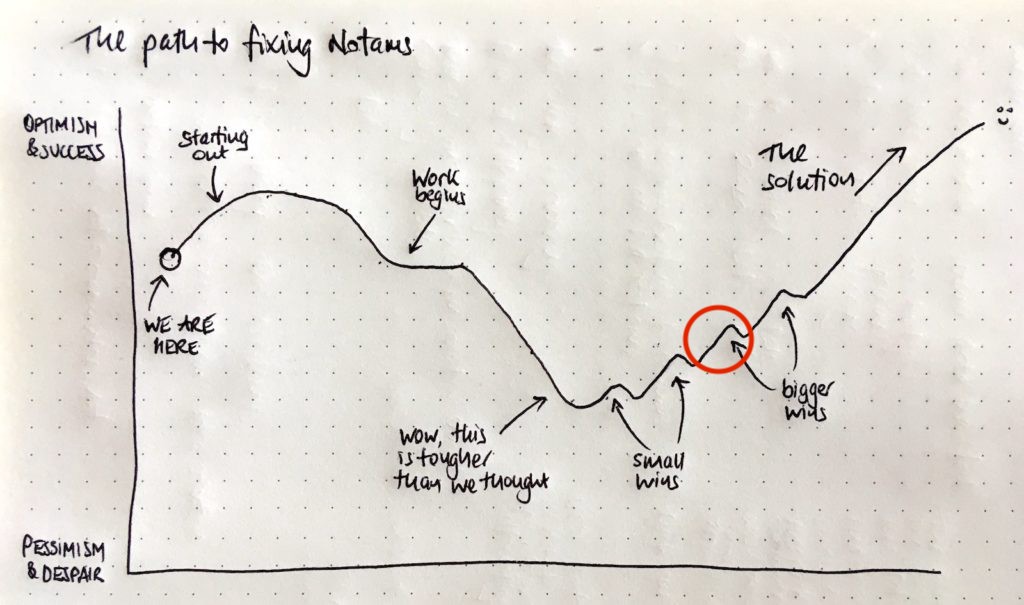
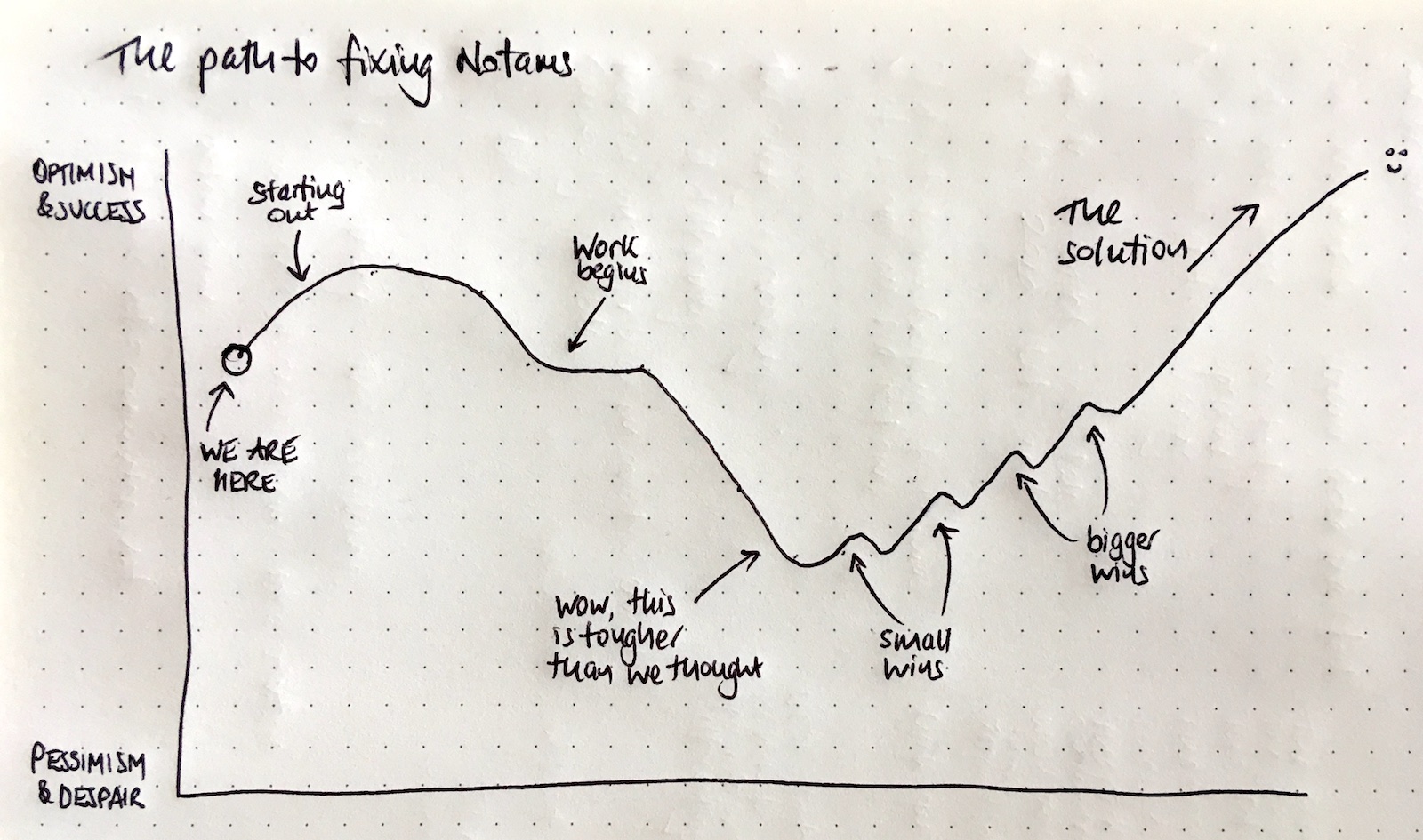
For those of you that have been with us for a longer period,  you might remember the little chart I drew a year or two back. Fixing Notams was never going to be easy.

I think we’re somewhere around the red circle area. We have done so much, and we now have global attention, a harmonious, energised group of organizations working on the problem, and as of April 2021, the backing and full force of ICAO in this Global Campaign for Notam Improvement.

I’m excited to see what we can achieve from here.

Further reading and links


NOTAMs: Creating the solution through community collaboration

Update: November 1st, 2019: The Notam Team is up and running – we’re fixing Notams. Follow our progress at fixingnotams.org.

There cannot be a more agreed upon problem in aviation. Every single airline, every single flight: the most critical information about that flight is passed to the pilots in the style of a Telegram from the early 1900’s. Coded, abbreviated, often undecipherable, upper case chunks of text: the least human-friendly format imaginable.

A news story in 2013 declared “Plug pulled on the world’s last commercial electric telegraph system”.

Shhh. Don’t tell them. Not true. Our NOTAM system is still proudly flying the flag. We use the ITA-2 International Telegraph Alphabet character set from 1924, instead of ASCII, which the rest of the world switched to in 1963. Ever wonder why Notams are all upper case? That’s why. We use Q-codes (from 1909) to categorize the message. We use abbreviations heavily, because it costs more money to send messages in plain text format. Wait, scratch that – that logic ended in the 90’s because, well, the internet.

And so, while the passenger is choosing emojis for their last What’sApp message before the aircraft doors close, in the cockpit the pilot is deciphering what the impact of this Telegram might be 🤷‍♀️:

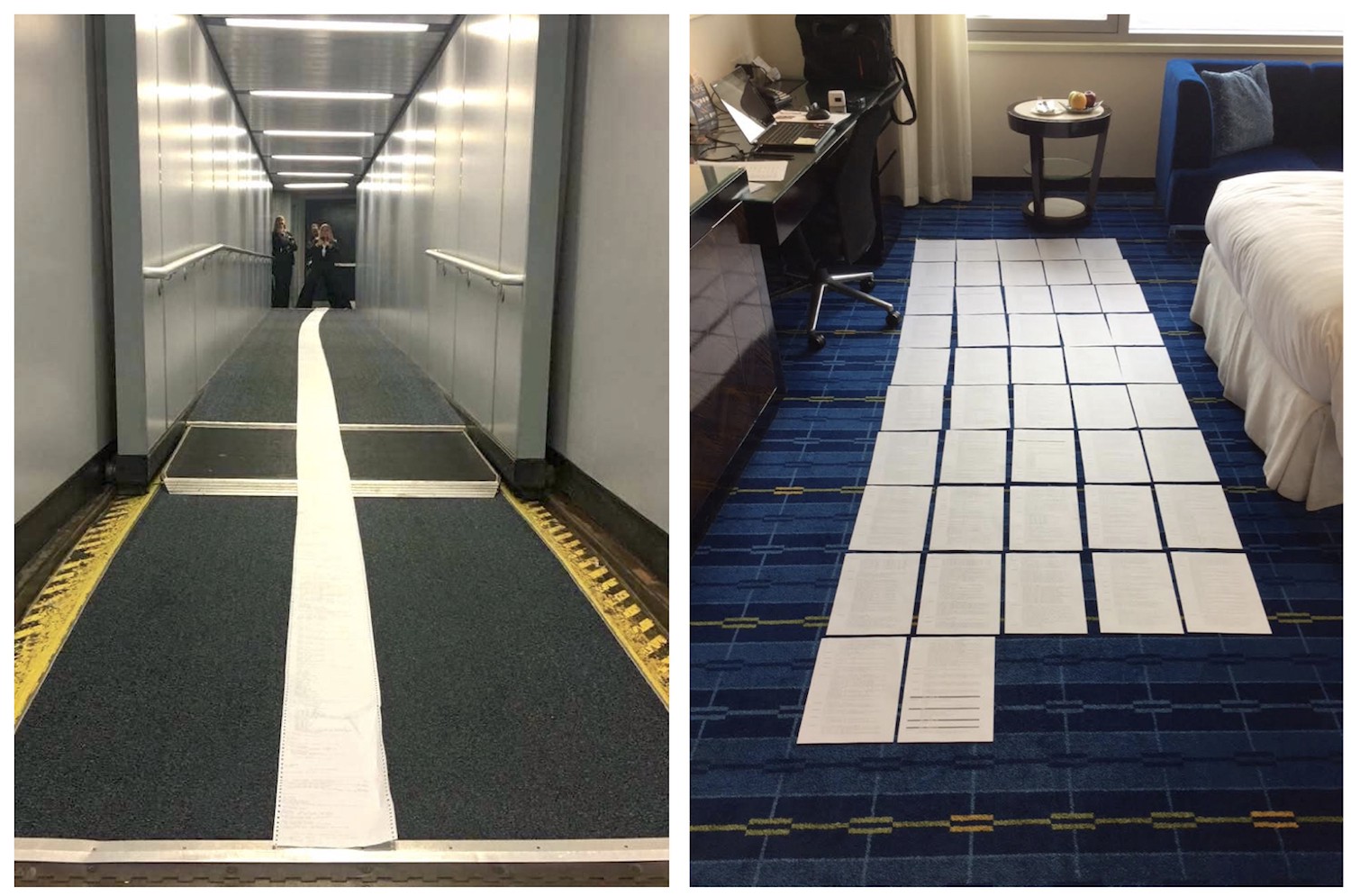
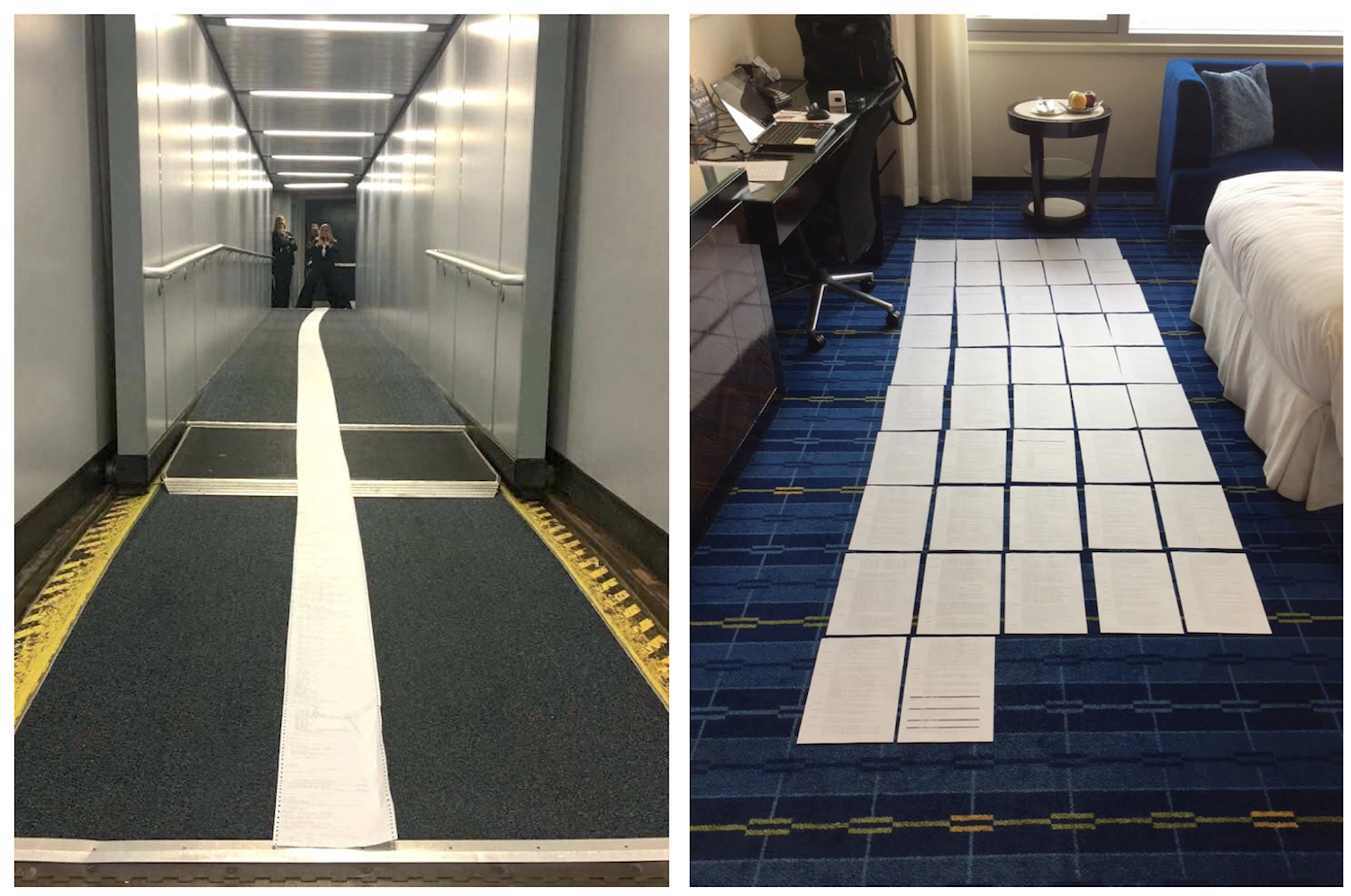
🙏. If that seems tough to get through, now consider what 50 pages of it looks like:

That is the average size of the Notam Briefing package that each crew is given. And so, your job as a pilot at briefing time, is to find the one Notam that will end your career or endanger the aircraft, in a package the same size as a short novel. Buried deep in Birds of Bangkok, War and Peace by Greece and Turkey, Unlighted Tiny Obstacles, Goat grazing times, Grass cutting timetables – is a runway closed, a diversion airport unavailable, a decision height changed. And you’ll miss it.


Air Canada 759 missed the one telling them that 28R was closed in San Fransisco, so they tried to land on the taxiway. Only an alert United crew prevented the worst crash in American history, and then only by 14 feet, or 1 second. That led to the NTSB to declare “Notams are Garbage”.

From the Final NTSB Report: “Concerns about legal liability rather than operational necessity, drive the current system to list every possible Notice to Airmen (Notam) that could, even under the most unlikely circumstance, affect a flight. The current system prioritizes protecting the regulatory authorities and airports. It lays an impossibly heavy burden on individual pilots, crews and dispatchers to sort through literally dozens of irrelevant items to find the critical or merely important ones. When one is invariably missed, and a violation or incident occurs, the pilot is blamed for not finding the needle in the haystack!”

Thank you, Robert Sumwalt, for calling the problem out.

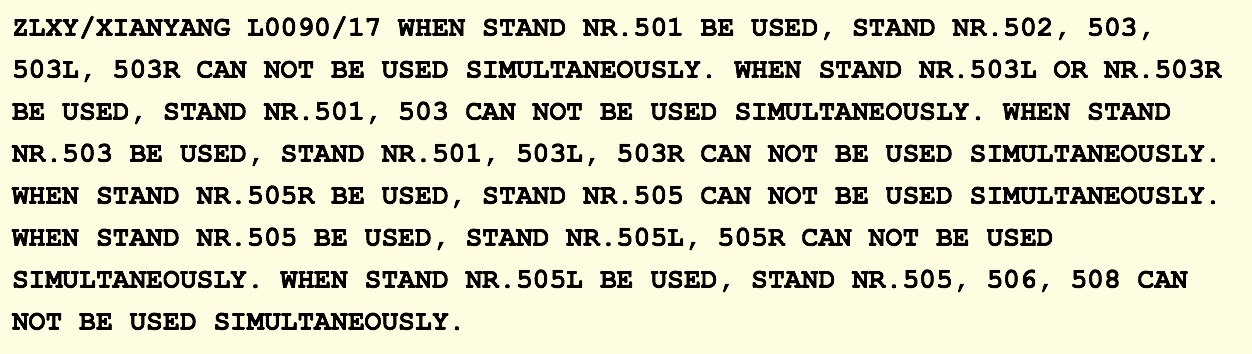
It’s not just the volume, or readability – it’s the Mensa-level problem solving skills required to parse the contents. Answer this question: If you’re on Parking Stand 505 Right, can someone else use Stand 503 Left?

If you did figure it out, how long did it take? Now multiply that time by 250, a straw-poll average number of Notams in a briefing. Think this is manageable in the 20 minutes the crew have to brief the flight?

In 2007, the annual count of Notams reached 500,000. This year, 2019, we are on track for 2 million Notams. The problem is intensifying, and rapidly. We are drowning in the data, but missing the message. Every change imaginable is stuffed into the system:

And this Chinese entry is the best one of 2019 so far …

Say it out loud.

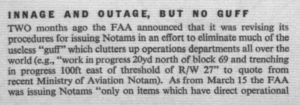
In 1964, Flight International published a snippet from the FAA, declaring that the Notam system was being revamped, and from March 15th that year only essential, critical Notams would be allowed to remain. That was 55 years ago. We’ve tried, and we’ve failed, many, many times, to solve the problem.

But – enough about the problem. If you are a pilot, dispatcher, or controller, you know only too well the problem, and its impact.


How about we talk about how we find the solution instead?


Let’s start here.

I’m gathering a team of people that understand the problem from the user perspective. A team of pilots, dispatchers, controllers, and anyone else that wants to help. A team of people that care about solving the problem because of how it affects us every day, and because we know that one day, we’ll be bitten by it. A team motivated by a desire to make this better for our colleagues, and those that will follow us.

We’re not fixing it because we have to, but because we want to.

We’re not fixing it to make a profit, or because it enhances the bottom line somewhere. We’re fixing it because we want it to change.

Most importantly, we’re fixing it as a community, collaborating to create the space to allow the solution to come.

Zooming out a little, if we look at this as not an aviation problem, but a communication problem, it becomes less unique, less challenging. Many bigger problems have been solved by looking at them differently.

So we’re going to collaborate with smart thinkers, problem solvers, designers, coders, creatives. We’re going to work together as people, rather than agencies or companies. We’re going to jump into a process that might be messy, challenging, difficult, and will often seem impossible.

As per this handy graph I’ve drawn:

Don’t join us to force change – this is the change. Don’t join us to shout louder – this problem is bigger than any one agency or organization. Don’t join us if you think this is someone else’s problem to fix – it’s our problem, and we’ll fix it together.

The first step is creating the space for this magic to happen. Join us if you have no idea how to solve it yet, but you have positive energy to contribute.

The Notam Team needs you! We start July 1st (yep, you’re already late, so jump in). We have set a lifespan of 9 months – do, or die.

The first part of the process is the gathering, the coming together. Once we’ve all said hello and had a look around, we’ll start with the first and most important step – creating that space for the solution. Figuring out how best to collaborate, invite creativity in, think differently. Then, the research – the science, the data, the hard facts. Identify the problem, and the impact. And from there … well, it’s unwritten. Not knowing is part of the approach. Oh, and we’re going to have fun. There’s no creativity without fun.

I believe the problem is eminently solvable, but only as a community. And I hope you’ll join us! If you’re in – just write to me at mark.z@ops.group.


Fixing Notams – we’re on it. Help us.

Update: November 1st, 2019: The Notam Team is up and running – we’re fixing Notams.
Follow our progress at fixingnotams.org.


OK. We’re done writing articles about it, and making goat jokes – we’ve moved the “Fixing Notams” job to the top of our list..

OpsGroup is all about information – getting the essential risks and changes that flight ops personnel need to know about into their hands without delay. Our group agrees – plenty of colourful comments on Notams from members.

Now we want your ideas and opinions on the fix.

Here’s our ask:

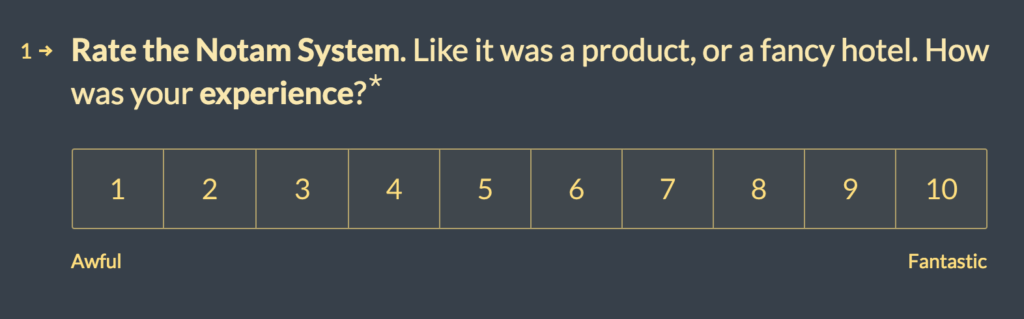
1. Rate the current system – and then click the things you would like to see.

2. If you’re in charge of a group of people – whether you are the Chief Pilot at Lufthansa, the Tower Chief in Shannon, or manage an Ops team of two – Get this out to your people and ensure everyone has their say.

Forward this to your team of ATCO’s, Pilots, Dispatchers:

We especially want to hear from pilots, controllers, and dispatchers, and if you read on, you’ll see why.

Do it like this:

  • Send them the survey link: https://fsb1.typeform.com/to/irZiFM
  • OR, click here for a magic pre-written email
  • OR, send them a link to flightservicebureau.org/notams
  • OR, share this facebook post:

The survey direct link is: https://fsb1.typeform.com/to/irZiFM


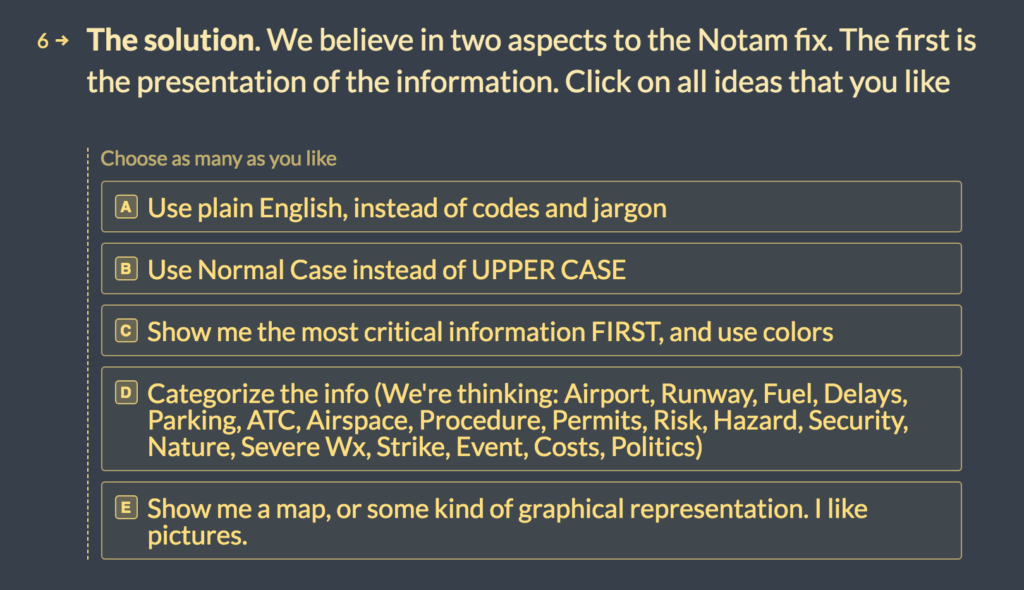
The Solution

If you took the survey, you saw this:

That part is pretty easy – presenting the Output of the system is a straightforward enough task.

The Input part – that’s where the real work is.

First, we are working on an Artificial Intelligence answer to finding Critical Notams in the current legacy system. This will allow us to present the data flow in order of what matters, and leave those cranes, birds, and grass cutters right at the bottom.

Second,

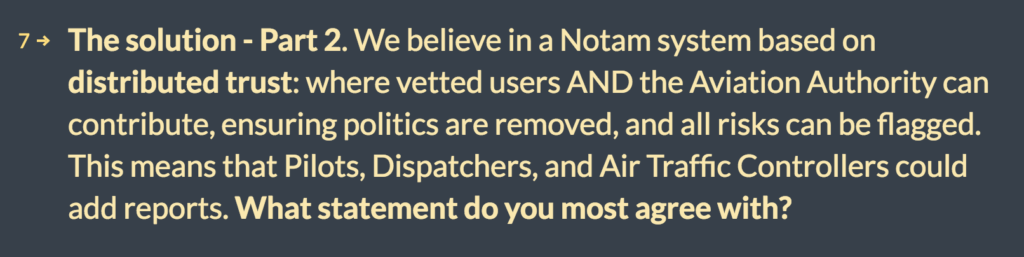
If you read my article on MH17 – a darker truth, you’ll understand why it’s important to open up the system to allow a trusted group to shape the information flow.

That begins with Pilots, Air Traffic Controllers, and Dispatchers. I have the great fortune to be all three, and it’s very clear to me that just like Trip Advisor – and our own “Airport Spy” in OpsGroup – this idea will work. We’ve already seen in OpsGroup how much we trust the information from other users in our group.

It’s key to the future trust of the Notam system. Which we should rename, but that’s another days work.

If you got this far, thank you for being part of the solution! You can always write me a note at mark@fsbureau.org

Thanks!
Mark.


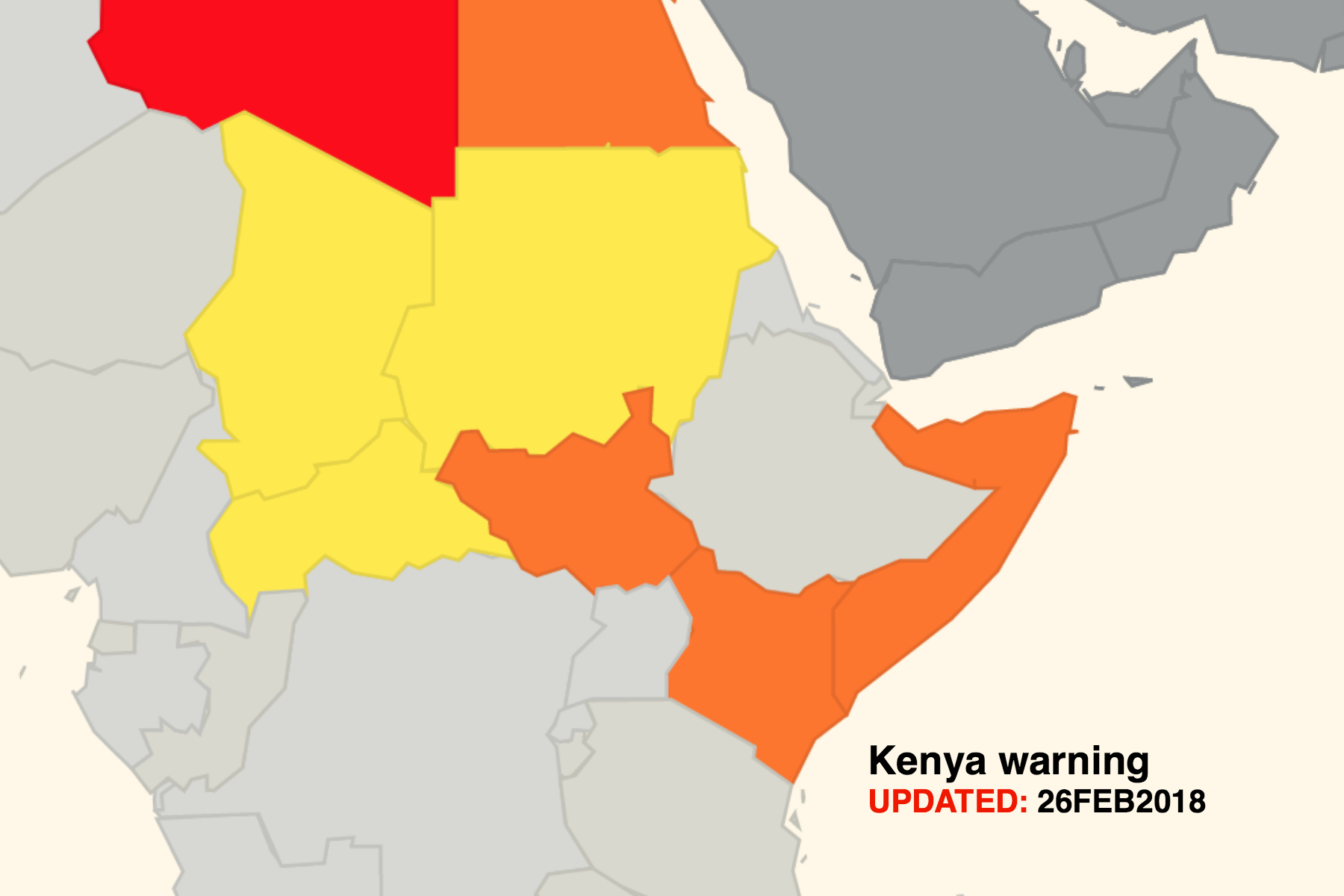
Kenya airspace threat downgraded

The FAA has revised its warning for Kenyan airspace – the area to ‘exercise caution’ is now limited only to that airspace east of 40 degrees East longitude below FL260 (i.e. the border region with Somalia, and 12nm off the east coast of Kenya). Prior to this, their warning applied to all airspace in Kenya below FL260.

Published on 26 Feb 2018, the warning maintains the same wording to clarify the type of weapons and phases of flight that the FAA is concerned about, specifically:

  • fire from small arms,
  • indirect fire weapons (such as mortars and rockets), and
  • anti-aircraft weapons such as MANPADS.

The scenarios considered highest risk include :

  • landings and takeoffs,
  • low altitudes, and
  • aircraft on the ground.

The updated guidance is intended for US operators and FAA License holders, but in reality is used by most International Operators including EU and Asian carriers, since only four countries currently provide useful information on airspace security and conflict zones.

The Notam uses FL260 as the minimum safe level, though we would suggest, as usual, that a higher level closer to FL300 is more sensible.

You can read the NOTAM in full on our Kenya page on SafeAirspace.net, a collaborative and information sharing tool used by airlines, business jet operators, state agencies, military, and private members of OPSGROUP.