Mexico Customs Surprises: Pills, Vapes, and Laptop Rules

Key Points
  • Crew warning: AFAC officials at MMSD asked a crew member to carry unknown pills back to the U.S. – possible setup. Decline, document, and don’t touch.
  • Vapes banned: Mexico officially outlawed vapes in January 2025. A new federal law now criminalises almost any activity involving them, including production, storage or transport for commercial purposes. Penalties can exceed USD 14,000 or result in prison sentences of up to eight years. Since the law does not define what counts as commercial activity, authorities may treat multiple devices as intent to distribute.
  • Device limits: Customs is enforcing a one-laptop/tablet rule per person. Extra devices may be taxed at 19% – no crew exemptions.

Flying to Mexico has always come with a few quirks, but there have been a few notable developments recently that crews should be aware of. Here’s a quick look at some of the latest updates – from strange inspections to unexpected customs issues. Might be worth a heads-up to your team before your next trip south.

The “would you mind taking this bag?” situation

A recent report out of MMSD/San José del Cabo raised eyebrows. After clearing customs and immigration without issue, a crew member was asked to step into the AFAC office. There, officials presented them with a ziplock bag full of prescription pill bottles and asked if they could take it back to the U.S. The crew member wisely declined.

Was it a test? A setup? It’s unclear – but it looked staged, and could easily have ended badly. If something like this happens to you, the advice is simple: stay calm, politely say no, ask for everything in writing, and don’t touch anything you haven’t personally verified. Accepting unknown items could lead to serious legal trouble or even aircraft seizure.

Vapes are banned. Like, officially.

Mexico has not only banned the import and use of vapes. A new federal law now makes almost anything involving them a criminal offence. It covers acquiring them, storing them, transporting them and selling them, and it uses the term “for commercial purposes” without explaining what that actually means. Because the wording is so vague, authorities can interpret it as they see fit. Penalties can reach fines of around USD 14,000 and prison sentences of up to eight years.

This vagueness is the real issue. You may think that bringing a few vapes clearly counts as personal use, but an inspecting officer may reach a different conclusion. There is no defined threshold, so the final judgement is entirely in the hands of the person checking your bags.

The message for passengers and crew is simple: do not bring any vapes to Mexico. Even someone who believes they are carrying only harmless extras can suddenly find themselves facing a much more serious problem.

It is much easier to avoid the situation completely and leave them at home.

That laptop in your flight bag might cost you

Mexico has a long-standing rule that only one laptop or tablet is allowed per person when entering the country. We’ve heard from members that customs officers are starting to enforce this again. One crew reported being stopped at MMSP/La Paz because they had more than one device and were told they’d be charged 19% of the declared value.

And no – aircraft iPads, iPhones or EFBs don’t get special treatment. The rule applies per person, regardless of what the devices are used for. Declaring them as commercial equipment can actually make things worse. So best to split up the gear among the crew and passengers or avoid overpacking the electronics.


If you have been to Mexico recently and have a story to share – please do! Reports like these are super useful for everyone in the group. File an Airport Spy report anonymously here.


New APIS Rules for Mexico

Update: 24 Sep

We’ve heard from OPSGROUP member reports that some operators and handlers in Mexico are seeing lots of different interpretations of this new rule, and the way it’s applied can vary from one airport to another (sometimes even between officials at the same airport!). This article is simply based on the official rules as published by the authorities.

Our advice is this: always comply with the published requirements (as outlined below). APIS manifests go to Immigration HQ in Mexico City, so stick to the official standard. If an airport asks for less, that’s fine — but still meet the full rules.

Original Story: 17 Sep

Watch out for revised APIS requirements in Mexico starting from 17 Sep 2025. A new two-step submission process will apply to all private and charter flights:

  1. First submission – within two hours before departure, for both inbound and outbound flights.
  2. Second submission – a confirmation of pax on board, sent after doors close and before takeoff.

There’s been some word on the street that the second submission only applies to commercial flights, not private ones. However, the published rule in the federal register makes no such distinction — it clearly applies to all international flights, both commercial and private.

That said, in practice, some airports may be handling private flights a bit differently, which could explain why operators are hearing mixed messages. But while enforcement may vary locally, the official requirement remains two submissions for everyone.

For more info on this new rule, including the details on fines for getting it wrong, check here.

Submitting Mexican APIS

There are three ways to do it:

  • Option 1 – ARINC: According to Mexican Immigration APIS regulations, ARINC is the only authorized vendor for submitting manifests. You can set up an account directly and submit through their portal.
  • Option 2 – Email: You can email a completed Excel spreadsheet to apisinm@inami.gob.mx. The most recent official guidance we’ve located on how to complete the Excel file can be found here.
  • Option 3 – Third Party: Some service providers can handle the process for you. Depending on the provider, they may submit directly via their ARINC account or by emailing the Excel file on your behalf.

Beware the Email Option!

Whether you send the email yourself, or a third party does it for you — watch out.

This email option is limited to four trips to/from Mexico per year. Beyond that, you’ll need to use ARINC (either directly or a through a third-party service). Some operators have reported receiving emails from Mexican Immigration confirming this four-trip cap.

Another important difference: when you submit through a dedicated ARINC portal, you get an immediate response — either confirming that your Excel file was successfully uploaded or flagging errors that need to be corrected and re-submitted.

With the public email address, your message simply gets forwarded to ARINC’s system, but no response is sent back. This means you won’t know if your submission was accepted, rejected, or never received — essentially, you’re transmitting blind, which increases the risk of things going wrong!

A Brief History of Mexican APIS Headaches

Nov 2012: Mexico introduced the APIS requirement, and for years a simple Excel file emailed to Immigration was enough for compliance. This worked smoothly until a new government ended that option, requiring all operators to use the ARINC template and portal instead. Since then, enforcement has tightened and compliance has been more strictly monitored.

Oct 2023: Mexican Immigration began sending circulars to international airports, reminding officers about APIS rules and instructing them to warn private operators to comply or face penalties. More circulars followed through May 2024, with increasing emphasis on enforcement. Immigration also confirmed they can monitor APIS submissions on the ARINC server to check for accuracy and timeliness.

Feb 2024: By February, fines were being issued to private operators. Some were due to manifests submitted through third-party apps that never showed up on the ARINC server, while others involved manifests sent via the central email address but not received in the system. This created confusion, and at some airports, officers started asking operators to email copies of their Excel spreadsheets directly — raising concerns about sensitive passenger data being shared through insecure channels. Mexican Immigration headquarters later clarified that this extra step isn’t necessary if you’ve submitted correctly using ARINC, direct email, or a third-party service.

Mexico Ops: Other Recent Updates

Check below for more info on Mexico ops:

Thanks to Rick Gardner of CST Flight Services for this article. CST Flight Services provides a wide range of international trip support services in Mexico and beyond. You can contact them for more info at: customersvc@cstflightservices.com


Mexico Permit Confusion – The Latest

Right on the heels of the implementation of the new Single Entry Authorization, known as an “AIU”, the Mexican Civil Aviation authority (AFAC) has issued a new Mandatory Circular which is causing issues at certain airports for BOTH Part 91 and Part 135 operations. Here’s the lowdown:

Issue #1: Private flights might get mis-identified as Commercial flights. The Circular claims that the “majority” of non-mexican registered aircraft indicate the type of service they are authorized to perform in their Registration or Airworthiness Certificates. Mexican registered aircraft identify their intended use through their tail number XA-Commercial, XB-Private, XC-Government. However, this claim in the circular could lead to an incorrect interpretation of Standard Airworthiness Certificates in the commuter, or transport categories to be an indication of the type of operation being performed. With this incorrect interpretation, a Private operation could be mis-interpreted to be a Commercial operation.

Issue #2: You need a noise certificate to get a landing permit. The minimum documents required now include a noise certificate. While required under 14 CFR 91.703 (a) (5) many pilots and operators do not know where to find it. In turboprop and turbojet aircraft, it is usually in the AFM. Smaller aircraft may need to create their own using the FAA Circulars AC 91-86 and AC_36-1H

Issue #3: You also need a Journey Logbook. An aircraft Journey Logbook is indicated as a required document. The aeroplane journey log should contain aeroplane nationality and registration, dates of flights, crew member names and duty assignments, departure and arrival points and times, purpose of flight, observations regarding the flight, signature of the pilot-in-command.

Issue #4: You also need Radio Station Licenses.Radio Station Licenses are now specifically required. While required under US law, many pilots/operators have chosen to ignore this and could be in for a harsh surprise.

Issue #5: Watch out for cabotage rules. Charter flights can only extract from Mexico those passengers that they brought in and cannot make any flights from one Mexican airport another.

Issue #6: You might need Mexican insurance for private flights. The circular states that the insurance policy for all aircraft must be a Mexican approved policy. It does not indicate that for private aircraft, the policies issued in their country of registry are accepted. This may be interpreted that ALL aircraft must now buy Mexican policies. More news to follow!

Issue #7: You might need a copy of the Mexican AIP. The circular states that the Aeronautical Information Publication (AIP) must be carried aboard in physical or electronic form. In the past, an equivalent document (Jeppesen Trip Kit) was accepted in lieu of the AIP. More news to follow!

Issue #8: You might need a review of your AOC. The circular states that for charter/freight/ambulance flights, a Mexican AOC must be obtained. There is no guidance on whether this is simply a review of the existing AOC of the operator or they actually want operators to undergo some new procedure to obtain a Mexican AOC. More news to follow!

The circular is sufficiently ambiguous and referring to numerous articles and sections of Mexican laws and Circulars that it will require a lot of homework to understand. As such, much appears to be left to interpretation which will most likely go against a pilot rather than to their benefit.

We recommend that you contact the civil aviation authorities at the Mexican airport of your intended arrival to determine what they are going to require of you.

If you are a Part 135 charter operator AND even if you have a blanket Mexican Charter Permit, you should contact your handler immediately to determine whether you will be allowed to operate at your intended Mexican airport of landing.  We were informed that over the past weekend, well over a dozen charter flights were denied entry as a result of this Mandatory Circular.

Unfortunately, this Mandatory Circular is sufficiently vague that it is being handled differently airport to airport. However, we are receiving reports of charter flights being denied entry into Mexico at huge cost to all involved. We have not heard any reports yet regarding Part 91 but the ambiguity in this Circular leaves that door open as well. Just check in advance to avoid unpleasant surprises on arrival in Mexico.

Thanks to Rick Gardner of CST Flight Services for this article. CST Flight Services provides a wide range of international trip support services in Mexico and beyond. You can contact them for more info at: customersvc@cstflightservices.com


Mexico Permit Chaos: New Rules Explained

Key Points
  • From 1 Jan 2024, Single Entry Permits and Multiple Entry Permits for private flights have been replaced by the Single Entry Authorization (AIU).
  • This AIU is valid for 180 days. With it, you can fly to Mexico as much as you like during this timeframe, and can do as many internal domestic flights as you want.
  • You should apply for the AIU at least 2 days prior to the flight.
  • Before the AIU can be issued, they Mexican airport you’re flying to must obtain the authorization number from AFAC Headquarters in Mexico City. Timeframe for this is varying between 5 minutes to 2 days. 
  • These changes only impact private flights. Rules for charter flights work the same as before (i.e. you get a blanket charter permit).

All these recent changes to permit procedures have been causing stress and delays for ops to Mexico. Before we get stuck into all the painful details, let’s begin with a story…

A Cautionary Tale

I just completed my first trip to MMSL/Cabo San Lucas since the new procedures came into effect, and thus needed the new permit. I use the local FBO for all of my permit applications, etc.  All paperwork was submitted and accepted days in advance. This FBO is unquestionably one of the best that I ever use.

When I landed, they said “we now wait for Mexico City to issue your Special Use Permit which they will only do after landing”.  I suggested that my passengers (family and friends) go on to the hotel in case it took a little while. Good decision.

While sitting in the FBO waiting, I started to chat with other waiting crews. One crew had been waiting for 3 hours already, another crew was down for 2 hours.

The FBO manager indicated that the new Mexican permit process has been total chaos since it went into effect with huge delays. In the end, I waited 3 hours, and then was told to come back the next day.

As I left, one crew was still waiting. They had done a part 135 drop-off and had planned to head back to the US. They had been delayed so long that customs at their US destination airport was closed, and they couldn’t reliably file a return eAPIS into the US because they didn’t know their departure time (and you have to give the US at least one hours notification).

Hopefully, the new permit process settles down in the weeks ahead, but in the meantime, crews should be ready for a many-hour or overnight delay. Another pilot who flies regularly into Mexico told me that his delay (at a different airport) was less than 30 minutes. So, your mileage may vary, but in the meantime we all have to anticipate some delays.

The Full Story

Thanks to Rick Gardner of CST Flight Services for the report that follows. CST Flight Services provides a wide range of international trip support services in Mexico, Central and South America, The Bahamas and the Caribbean. You can contact them for more info at: customersvc@cstflightservices.com

Ancient History

To understand the impact that the recent change to Mexico’s entry procedures has had on private aircraft arrivals, one has to understand the history of how foreign private aircraft have been allowed to enter Mexico in the past.

For well over 20 years, Article 29 of Mexico’s Civil Aviation law decreed that foreign (non-Mexican) aircraft could enter Mexico by landing at an official international Airport Of Entry (AOE) in Mexico and obtaining a Single Entry Authorization (subsequently called the single entry permit) or a Multiple Entry Authorization (subsequently called the multiple entry permit).

In 2014, a Mandatory Circular (CO SA 02/14 R1) was generated that updated the procedures and documents required for authorizing the issuance of a single, or multiple, Entry Authorization. This circular was a heavy-handed intent to address illegal charters and illegal cabotage in Mexico which caused great confusion because it inserted confusing procedures for recording, and updating, the list of passengers authorized to fly on board a private aircraft and it eliminated an essential federal document that was relied upon by not only Mexican Civil Aviation officials but also by Mexican Immigration and by Mexican Customs.

The fallout of this new procedure resulted in several Mexican AOE’s being unable to receive international flights for many months while the issues were resolved but eventually work-arounds were found and things settled down despite the confusing procedure.

Although tweaked periodically, Article 29 of Mexico’s Civil Aviation Law remained unchanged until May 05, 2023 when the entire Civil Aviation Law received a major update in many areas. Amongst the many changes made in the new version of the Law, the concept of “single entry” and “multiple entry” authorizations were eliminated and the ambiguous phrase “corresponding authorization” was inserted.

December 2023 changes

On December 27, 2023, 4 days before the end of the year, an internal AFAC document (Oficio 4.1.2.4197) was published to all of the Civil Aviation offices at Mexico’s AOEs informing them that a new procedure was being issued for the authorization of private aircraft entering Mexico. This internal document specified the following:

  • This internal document had a validity of 180 days.
  • The changes to how entry authorizations were to be handled would go into effect January 1, 2024.
  • It clarified that the reference to a Single Entry Permit and a Multiple Entry Permit were not correct and contrary to law and that the concept of a “Single Entry Authorization” (Autorización de Internación Única – AIU) was being adopted.
  • That the AIU would be valid for 180 days from the date of issuance.
  • That during the 180 day period, aircraft could freely travel in Mexican territory in a manner similar to the prior Multiple Entry Permit.
  • That to issue an AIU the foreign operator needed to present their request for an AIU at least 2 days before their planned arrival in Mexico.
  • That the Civil Aviation officials at the AOE could no longer unilaterally process an entry authorization but rather needed to request an AIU authorization number from Civil Aviation headquarters in Mexico City before the AIU could be issued. The request for the AIU number must be sent via email to a central email address and accompanied by:
    • Make of aircraft
    • Model of aircraft
    • Registration (Tail) number
    • Number of crew
    • Number of passengers
    • Name of Civil Aviation Inspector in charge of the AIU request
    • Name of Civil Aviation Comandante (or acting representative) who approved the AIU request
    • The request needed to be emailed to a central email address in Mexico City
  • As a measure of added security and due to different legal “issues”, a Layout Of Passenger Accommodations (LOPA) needed to be presented.
  • That for additional guidance on how the authorizations should be issued, AFAC officials needed to refer to the confusing 2014 Mandatory Circular (which was created for Entry Permits, which are now prohibited) until a new Circular could be published.

Confused? You are not alone.

January 2024 onwards

Almost immediately, there was an outcry about what was indicated, and not indicated, in the new procedure such as:

  • Had the AFAC headquarters in Mexico City calculated how many aircraft arrive in Mexico per day and ensured that they had the email systems and staffing required to receive and process requests and issue the AIU authorization number for all AOE’s in Mexico?
  • How long would it take to get the authorization number?
  • Many aircraft don’t have the luxury to provide the 2-day required notification. (This was unofficially quickly watered down to a 2-day recommendation.)
  • The Authorization is NOT VALID without the authorization number provided by the central AFAC headquarters.
    • What if an aircraft needed to make a quick turn and depart Mexico before the AIU was issued?
    • What if an aircraft needed to continue on to another airport in Mexico before the AIU was issued?

Almost immediately, we saw a divergence in how each of these scenarios was being addressed and how the new procedures were being implemented across the many Mexican AOE’s across the country. Amongst the most notable issues we have seen are:

  • It has been clarified that aircraft that were already in Mexico under the old Single Entry Permit that was issued in 2023 could remain in Mexico but needed to depart before those permits expired.
  • The time to obtain an AIU authorization number was taking from several minutes to multiple days with no evident criteria for what made one request take longer than another.
  • If the AIU authorization number is not received, some airports were allowing the aircraft to depart but without a valid AIU. This means that if they make a subsequent international flight to another Mexican airport, they will be treated as a new arrival and be obligated to process yet another AIU and pay the fee again because the AIU they had requested on their previous trip was never received.
  • At some airports, flights wanting to fly on to another Mexican airport were approved on a discretionary basis by the local AFAC comandante with the requirement that they return to the original AOE where they entered the country.
  • Aircraft that had been issued an AIU and reentered Mexico with different crew and/or passengers are being required to process a new AIU.
  • Some airports are requiring a picture of the inside of aircraft, in addition to a LOPA, in order to approve an AIU. Without it, approvals are delayed.
  • Some airports require a picture of the exterior of the aircraft in order to approve an AIU.
  • Some pilots who had completed the forms to request an AIU left Mexico believing they had received an AIU when all they had was the request form (they are all in Spanish).

One always has to look for a bright side to things, and the one bright side of this new procedure is that it resolves an issue that had plagued the old Multiple Entry Permit which expired on December 31, 2023.

Aircraft operators who entered Mexico with a Multiple Entry Permit who had an AOG at the end of December or who wanted to spend New Years in Mexico could face severe fines if they did not remove their aircraft from Mexico before their permit expired. With the new AIU, you always have a 180 day window for its use with multiple entries during that time.

What now?

At the present, there is a lot of confusion, frustration and miscommunication at all levels within the AFAC as well as at airports and FBO’s in Mexico. The implementation of the AIU approval procedures will remain in flux while AFAC headquarters, regional comandantes and airport comandantes address the issues and come up with a better way to handle this.

In the meantime, expect some turbulence ahead – have pictures and LOPA’s, expect to have to pay multiple times for AIUs if you travel to different airports in Mexico and expect possible delays. The good news is that the beaches are still nice, the food is still delicious, the people are still friendly and the beer is still cold.


Ops to Mexico? Prepare to get ramp checked!

Authorities have announced a ramp check program will be in place from now until mid-Jan 2024.

They had a similar surge in ramp checks last year during the same period – the official line then was that this was instituted to ward off cabotage.

Make sure you have all the required docs on board – big fines apply for anyone missing anything important. Local agents advise these checks are taking up to 40 mins to complete. 

Ramp Check Reports 

We’ve had a few recent reports from OPSGROUP members who have been ramp checked at airports in Mexico:

MMZO/Manzanillo (Jan 2024)

Part 91 trip, Falcon. The Mexican ramp check/arrival was a bit more detailed than we’ve previously experienced. We frequent this airport and the customs/immigration officers opened every available panel, bag onboard, AND wanted us to open the avionics nose cone which was odd. We explained screwdrivers and a ladder were required – and they didn’t make us open it. An important note: we were repositioning empty into the airport and leaving with Pax that the handler is quite familiar with (in a good way).

Airport Permit /paperwork was issued without problems, but every potential crew member will need to be listed on the aircraft’s paperwork.  Handler suggested operators should submit all possible names to prevent delays to their future ops. We requested the permit 48 hrs prior to landing and it came through just a few hours before we headed down there. Short notice trips will be unlikely.  Permit good for 6 months, at this airport only. 

MMTP/Tapachula (Oct 2023)

Part 91 customs stop, the whole process took exactly one hour from Block in to Block out. G600 with 15 pax and three crew.

– Upon arrival, the military and drug sniffing dogs were plane-side waiting for all the bags to come off(including crew bags).
– They were snapping photos nonstop.
– They did not want us to take our trash bags out. We just double bagged and left them in the lav.
– Myself, our FA, along with our pax and handler walked about 100 yards to the customs building, in a light drizzle.
– Bags got x-rayed and we waited while there was some back and forth between the customs agents. They stamped docs and permits which took a good 30-40 minutes.
– Walked back out to the jet and departed with no issues.

MMTO/Toluca (Aug 2023)

Part 91 operator came in from the Caribbean on our way to Toluca. The ramp and customs personnel were there waiting for us and marshalled us to an area of the GA ramp. 30 yards or so from a covered entrance to the terminal. We were able to Leave the APU running with a crew member onboard. Passengers and crew were escorted into the terminal to clear. They did an exterior sweep and came on board the aircraft. I do believe all bags came off and went through security in a private area. I don’t recall any specific questions but the whole process took probably 25-30 minutes.

Been to Mexico recently? How did it go? Please file a quick report here!

What docs to carry onboard?

Here’s the list of everything you should carry on board for trips to Mexico in case you get ramp checked:

1) Airworthiness Certificate
2) Registration Certificate
3) Worldwide and/or Mexican Insurance stating Private use when flying Far Part 91 and Charter use when flying Far Part 135. When flying Far Part 135, it is mandatory to have both insurances: worldwide and Mexican.
4) Pilot’s licenses: both sides and stating aircraft type rating.
5) Pilot’s medical certificates: valid document according to crew role (Pilot in Command or Second in Command), type of flight and according to pilot’s age.
6) If holding Multiple Entry Authorization (MEA), this document and its corresponding payment receipt, must be on board.
7) For Charter operations, the following additional documents are required:
a. Valid Air Operator Certificate (AOC): Copies are accepted considering this document might include many tail numbers (fleet). Payment receipt should also be included.
b. FAA OST 4507 FORM copies are accepted considering this document might include many tail numbers. Alternatively, the appropriate exemption document, Certificate of Public Convenience and Necessity is also accepted.
c. If holding a Mexican Indefinite Blanket Permit (IBP), this should be accompanied by the Mexican AOC, and the Yearly Verification (including payment receipt) for it to be considered valid. Copies are accepted considering this document might have many tail numbers.
8) The logbook (maintenance logbook) stating the most recent information about maintenance performed on the aircraft.
9) The authorization to operate as a mobile radio aeronautic station; (Aircraft radio station license/authorization).
10) The Flight Manual.
11) Noise Certificate.
12) The Minimum Equipment List (MEL) when the type certificate indicates it.
13) Mexican AIP (for Private flights, a Jeppesen Airway Manual has been sufficient in the past for this. Charter operators, however, are required to carry a copy of the Mexican AIP – you will need to subscribe to the AIP through AFAC and carry electronic copies onboard).
14) The preflight checklist.
15) If full or partial (inbound/outbound Mexico) route involves overflying the ocean, then a life raft and/or life jackets are required to be on board, according to the type of aircraft. Please note this is also a usual requirement, but Mexican CAA will also be double checking for this.
16) Weight and Balance Manifest.
17) First Aid Kit.
18) Jeppesen Manuals, (at least electronic format).
19) If operating Far Part 91 – Private flights, it is required to present a document stating the purpose of the flight, to include the name of the lead passenger and to declare its connection with the aircraft (owner, employees, etc). If accompanied, letter must declare the relationship of the passengers with the lead passenger (family, friends, employees, etc). This will prove there is no commercial purpose under any circumstance. To present this letter, having it notarized is not necessary.

Private flights watch out!

Private flights to Mexico on aircraft that are used for both private and charter flights should watch out – the authorities in Mexico will likely require further proof that you are, in fact, a private flight. So if the aircraft is not registered in the name of the pilot or one of the pax, the best thing to do is prepare a notarized letter identifying the legal owner of the aircraft and that the owner is authorizing the crew and pax to be on board. The letter should also clarify that the flight is a private, non-commercial flight. 

Further Reading

For a look at some of the long-standing challenges affecting General Aviation ops to Mexico, as well as some of the more recent issues which maybe haven’t been widely reported yet, check out our article.


Mexico City Airport Safety Alert

There have been several recent reports of loss of GNSS signal in the terminal area at MMMX/Mexico City Airport. This can lead to navigational errors, and a raft of related system failures all of which have potential to ruin your day.

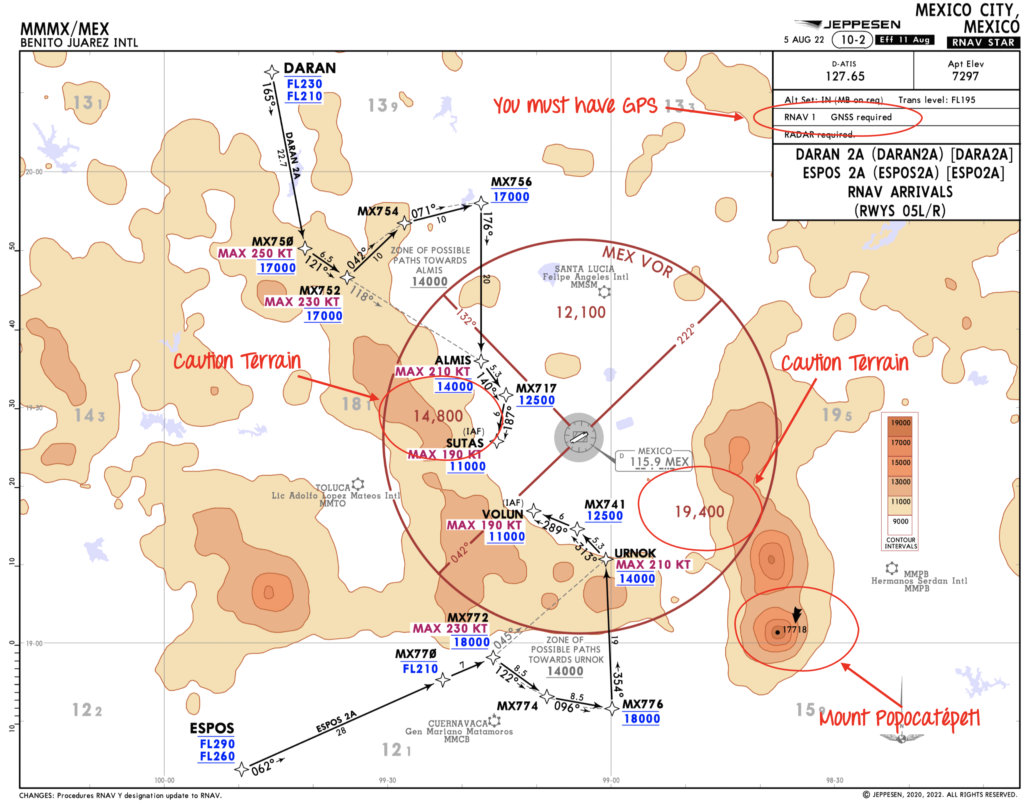
GNSS interference is hardly new. The issue with MMMX is that the vast majority of procedures became RNAV based back in 2021. Add to that high altitude operations with a healthy dose of terrain and you begin to get the picture.

IFALPA have just published a new safety bulletin for MMMX/Mexico City Airport, which you can read here. But strangely, at the time of writing there has been radio silence on the issue from both Navigation Services for Mexican Airspace (SENEAM), and the Mexican Federal Civil Aviation Agency (AFAC).

Let’s dig a little deeper.

The Specifics

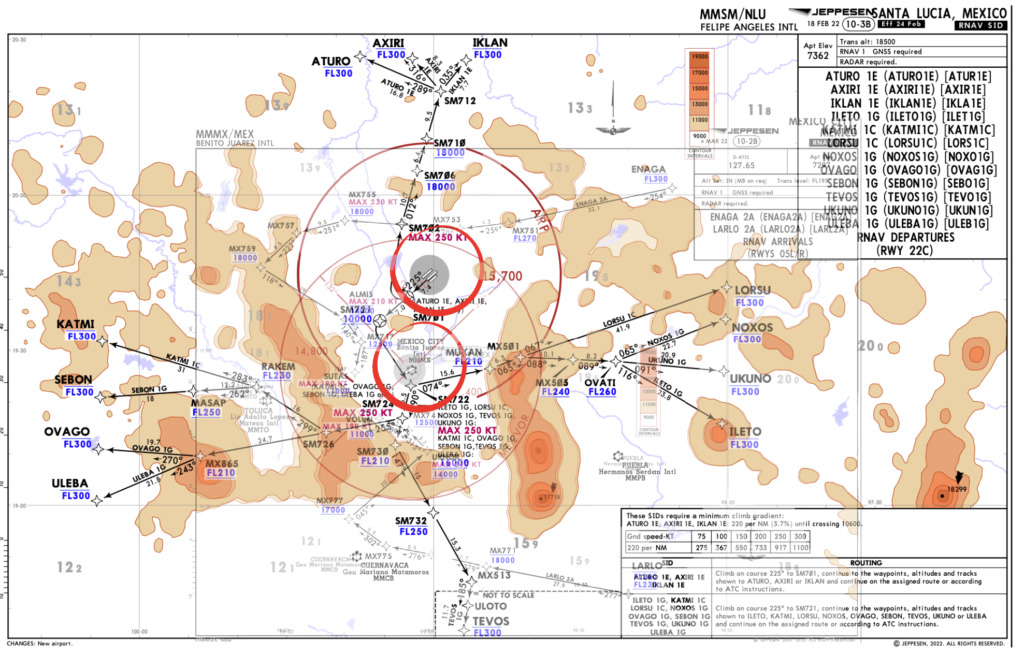
The first problem relates to the terminal area itself. All SIDs and STARs are RNAV 1. This means that to ensure terrain protection your aircraft must not exceed a track error of 1nm.

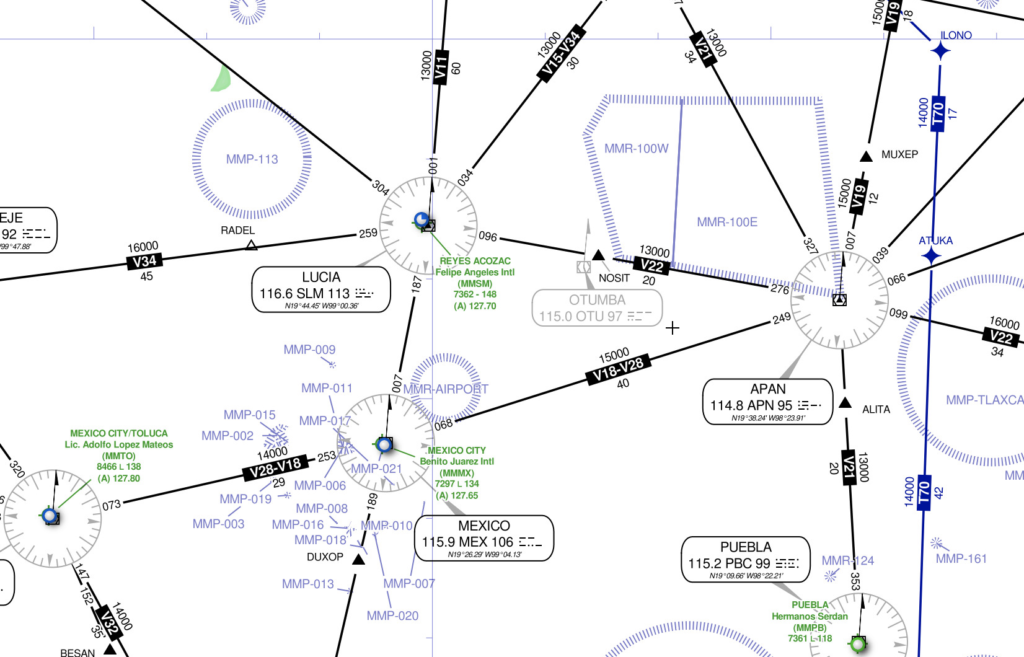
One look at the Jepps and you can see why. 25nm MSA towers as high as 19,400′ to the east of the field, and 14,800′ to the west. Mount PopocatEpetl – an 18,000’ volcano is just 35nm away from the field. It’s easy to see why GNSS interference could become a major safety issue.

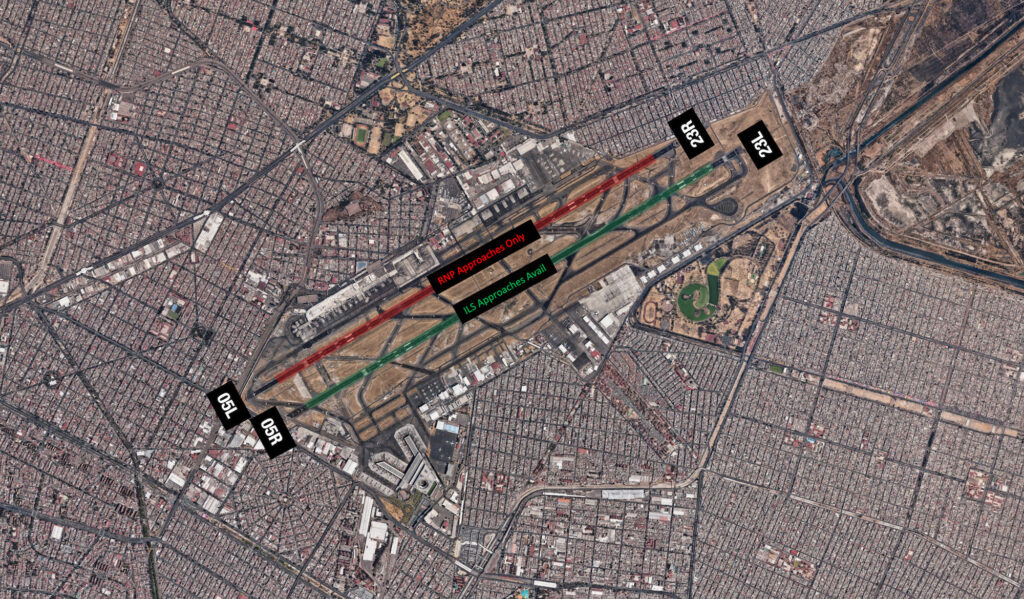
The second problem relates to the approaches. Only one of the two runways has ILS approaches available (05R/23L). The other runway relies entirely on RNP approaches – where the eye of the needle narrows to just 0.3nm in the final approach segment.

What could go wrong?

Aside from the obvious, a loss of GNSS can affect other safety critical systems too. IATA has also written about this, and it turns out losing the signal can open up a whole can of worms.

At the simpler end of the scale, a crew may receive a message that their navigational ability has been downgraded. And at worse, they may lose GNSS navigation completely including functions as simple as direct-to.

Depending on your aircraft type, you may find your aircraft reverting entirely to ground based and inertial navigation. Your nav display may tell you lies too, including nasty things like map shift.

EGPWS can also be affected – the system that has your back around terrain when you can’t simply look out the window. Its predictive functions can be disabled, or spurious warnings triggered. Additionally the position reporting function of ADS-B can become corrupt, which is bound to upset ATC.

If your aircraft has them, runway alerting systems can also stop working properly. Things like runway overrun protection may simply now be redundant.

There’s more to it than meets the eye.

So, I’ve lost signal at Mexico City. What should I do?

Put extra attention towards monitoring the performance of GNSS during operations at MMMX, because it really matters. A sterile cockpit is also important here as distractions can help mask some of the more insidious symptoms of an interrupted signal.

If GNSS signal is lost, be prepared to fly alternative procedures.

What are those you say?

There are no SIDs or STARs which use ground-based aids anymore at MMMX.

There are two options, radar vectors or the MEX VOR. The former is likely the easiest. Otherwise, it is back to raw data – the likely outcome being a descent in a hold or a procedure turn. Either way, you’ll need to let ATC know.

Without GNSS, you are effectively down to one runway (unless of course you are flying the visual). 23R/05L has no ground-based approach option – it is all RNP.

That leaves 23L/05R where the news is better. There is an ILS at each end, and even a VOR approach on 23L in a real pinch.

Whichever option you choose, if you are in cloud you need to be sure of your terrain clearance reference something that’s not RNAV specific – whether it be the controller, or the MSA sectors on your chart.

Do you have info to share?

If you’ve been to Mexico City (or anywhere else, for that matter) and can share some info on how the trip went, please file an Airport Spy report!

OPSGROUP members can see all the Airport Spy reports filed for airports around the world on the members Dashboard here.


Mexico General Aviation Challenges: Old and New

This article is from Rick Gardner of CST Flight Services. We asked if he could talk to us about some of the long-standing challenges affecting General Aviation ops to Mexico, as well as some of the more recent issues which maybe haven’t been widely reported.


Mexico has been a popular destination for General Aviation pilots and aircraft owners for many years and for good reason. Mexico is a country rich in culture, a diverse geography, incredible cuisine, a fascinating history and a warm and welcoming people. The fact that it sits right on the US border makes it easy to reach by most GA aircraft.

However, there are some long-standing issues affecting GA aircraft arrivals in Mexico which many veteran travelers may be familiar with that continue to exist.

Customs

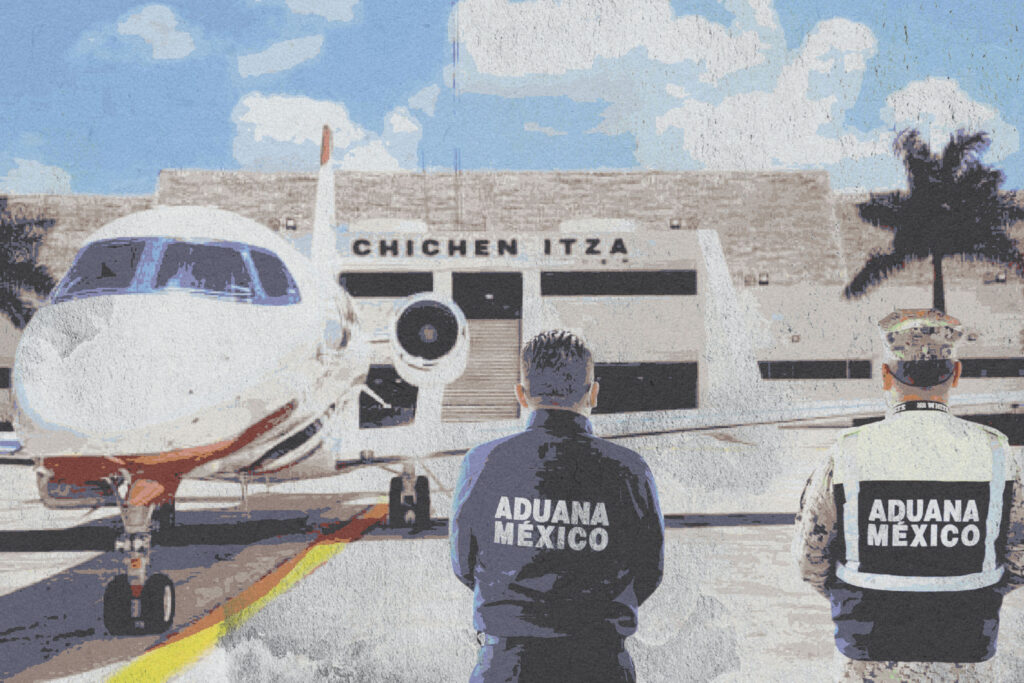
Under Mexican Customs law, only a pilot who can prove that they are the owner of the aircraft they are flying is allowed to bring anything into Mexico other than basic clothes and personal effects. Sporting equipment, electronic equipment other than a laptop or an ipad and anything else that you might want to have with you is not allowed entry and can be taxed or confiscated.

Even though the law allows the owner-pilot to have passenger privileges in this regard, many customs agents are unaware of this allowance and frequently deny them this privilege.

If the Mexican Customs agents do not have access to a working x-ray machine to scan bags when arriving or departing the country, then customs agents may open all bags of crew and passengers for manual inspection. This means that any personal contents inside your bags may become public knowledge very quickly to all those present in the customs arrival area.

Immigration

Mexican Immigration officers are usually very courteous and professional although sometimes they misapply article 14A of the Mexican Tax code which assesses an approximately $100 USD fee on GA aircraft if they arrive outside of “normal” operating hours or on weekends and/or holidays. The Mexican Tax code specifically states that this fee is NOT to be applied to private flights, yet immigration officers at certain airports apply this fee to all aircraft arrivals regardless of the type of flight or the hours of operation.

Another caveat of Mexican Immigration law is that pilots do not pay certain immigration taxes unless they remain in the country for more than 1 week. This sometimes catches pilots by surprise when immigration officers tell them that they have overstayed their time and are charged an additional fee. This is not a fine but simply the same charge that passengers have to pay.
Permits

When you enter Mexico in a private aircraft, you must obtain an Entry Permit for the aircraft. There are two types of Entry Permits: a Single Entry Permit (SEP) and a Multiple Entry Permit (MEP).

A SEP is valid for 180 days or until the aircraft departs the country, whichever comes first. A MEP is valid for the calendar year and an aircraft can enter Mexico as many times as the operator wishes during the year without paying for a new Entry Permit, provided that the aircraft does not remain in the country continuously for more than 180 days at a time.

A MEP specifies the crew that brought the aircraft into the country when the permit was issued and use of the aircraft by a different crew can invalidate the MEP.

Be aware that neither a Single Entry nor Multiple Entry Permit is valid unless it is accompanied by the original receipt for payment of that permit. If you have a Mexican Multiple Entry Permit (MEP) and you plan to enter Mexico towards the end of the calendar year, or if you plan to spend New Years in Mexico, you should obtain a SEP when you enter. The MEP expires on December 31st and if you have an AOG incident or if you decide at the last minute to remain in Mexico for the New Year, you could face a tricky situation.
Pilot Docs

Another issue that pops up at certain airports is where AFAC officials require that the pilot’s Medical Certificate Class matches their Airman Certificate and not the privileges being exercised.

For example, a pilot with an Airline Transport Pilot Certificate may be required to have a 1st Class Medical Certificate even though they are flying their own personal Cessna 182. Trying to explain to some AFAC officials how a 1st Class Medical Certificate can become a 2nd Class and then a 3rd Class per 14 CFR 61.23 becomes even more entertaining.

Ramp Checks

Ramp Checks have always been an issue in Mexico and that has not changed. Always be prepared to have valid aircraft and crew documents ready along with the appropriate Entry Permit.

Insurance policies of private aircraft, issued in their country of registry, are valid in Mexico if they include Mexico in the territory coverage and the liability insurance minimum is at least $ 300,000 USD.

For Charter aircraft, it is a completely different story. Operators of aircraft that are used for both private and charter use need to be extremely careful that if the aircraft is being flown privately into Mexico and an insurance policy (Non-Mexican or Mexican) is presented to the Mexican AFAC that indicates that the policy is for COMMERCIAL purposes, then the entire operation could be considered as commercial and the operator will have to present additional proof that the operation is actually private. Otherwise, the operator could be detained, fined, etc. for not having the appropriate permits for charter operations in Mexico.

While not required by regulation, we strongly recommend that if the aircraft is not registered in the name of the pilot or one of the passengers, that you prepare a notarized letter identifying the legal owner of the aircraft and that the owner is authorizing the crew to fly the aircraft and the passengers to be aboard the aircraft on an international flight to Mexico. The letter should also clarify that the flight is a private, non-commercial flight. This letter can serve to defuse any misconceptions that a private flight may be a charter flight or that the aircraft may be stolen. Sometimes, this letter can help to avoid the $100 fee mentioned above that is erroneously charged by Mexican Immigration by proving that the flight is private. Sometimes……
SENEAM airspace and overtime

This is a topic worthy of its own article. Mexican airspace fee calculation and payment is a topic that will confuse and frustrate even the most seasoned international operator. Suffice it to say that if you flew through the Mexican FIR, even if it was due to a vector by US ATC at the border, and you neither landed nor departed from a Mexican airport on that flight, you owe Mexico airspace fees.

If you depart, or arrive, at the beginning, or at the end, of an airport’s normal operating hours, you may incur SENEAM overtime fees which cannot be paid at the airport. Furthermore, if you requested an extension to the airport’s normal operating hours for an early or late operation, the SENEAM overtime fees cannot be paid along with the airport fees.

SENEAM overtime fees, like Mexican airspace fees, are paid through a separate process via a Mexican bank. Contact us for instructions on how you can inquire directly with SENEAM if airspace or overtime fees are owed.

Safety

The elephant in the room. While theft of aircraft in Mexico has not been an issue for many years, personal safety has gained a lot more attention since 4 US Citizens were kidnapped in the border town of Matamoros leaving 2 of them dead.

For a crime to occur, you need a victim and the right environment. Avoid being a victim – don’t draw attention to yourself by wearing expensive clothes, jewelry, personal effects and/or by bragging about your success and/or wealth. Don’t create the environment. Avoid going “off of the beaten path”, don’t interact with strangers no matter how innocuous they might appear, avoid using the same taxi driver unless you really know who they are. Avoid border towns.

Another issue pertains to using app services like Uber. While Uber is a legally protected service in Cancun, there have been major conflicts between the taxi drivers in Cancun and Uber drivers.  These conflicts have spiraled into violent encounters between taxi drivers, Uber drivers and passengers. Until the authorities get a handle on this simmering problem, be very careful with what ground transportation service you use while in Cancun.

Planning for the worse is usually the mantra of pilots. We recommend fueling on arrival in a foreign country and leaving enough fuel on board to at least get back to the US border or to another country known to be a safe haven.

We also recommend having 2 satellite based communications devices, one for the crew and one for the passengers. While sat phones are ideal, they are also terribly expensive. However, devices like the Garmin InReach bring satellite connectivity to a more reasonable level using text messaging. If you are dependent on cellphone or landline technology, you are exposed to getting cut off from the rest of the world and from each other if there is a natural or manmade disaster that interrupts those services.

The US State Department has a couple of useful services for international travel:

New Challenges: Changes to agencies that interact with General Aviation

There is a new political party in Mexico, led by the current president, that has swept into power at the federal, state, and municipal level across the country. This new party has been making significant changes to laws and leadership across those institutions that interact with GA arrivals.

The following is a summary of what those changes have been, and the impact they are having in varying degrees to GA flights to Mexican Airports…

Security

The Mexican Federal Police (Federales) have been disbanded and replaced with a new entity called the National Guard (Guardia Nacional) which was formed in March of 2019 and staffed primarily by military personnel. While still technically a civil organization, it is controlled by the military. The Guardia Nacional now provides security at international airports and at many domestic airports in Mexico, and they are usually the first government agency that an arriving aircraft will encounter. Their degree of interaction with aircraft crews and passengers varies widely between Mexican airports.

Civil Aviation Authority

Mexico’s CAA formerly known by its acronym of the DGAC was also replaced with the Agencia Federal de Aviación Civil (AFAC) in October of 2019. During the transition process, the top leadership at the central level, as well as the airport level, were replaced by former military personnel, primarily from the Mexican Air Force. The AFAC is the agency that issues Entry Permits to foreign aircraft via their central office and local offices at the Mexican international airports and they are the ones who can conduct random ramp checks on aircraft arriving at Mexican airports.

Customs and Immigration
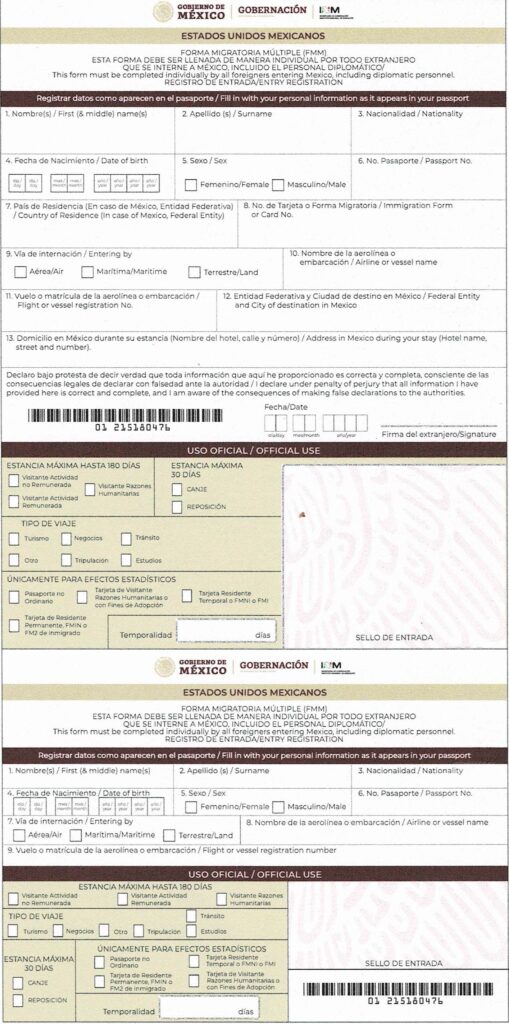
In July 2021, another decree replaced Mexican Customs with a new entity called Agencia Nacional de Aduanas de México (ANAM) which falls under the control of the Mexican military. The former civil servants that functioned as Customs officers were terminated and replaced by military personnel. Mexican Customs is present at all Mexican international airports and reviews crew and passenger luggage and cargo on arrival into the country and again when departing the country.

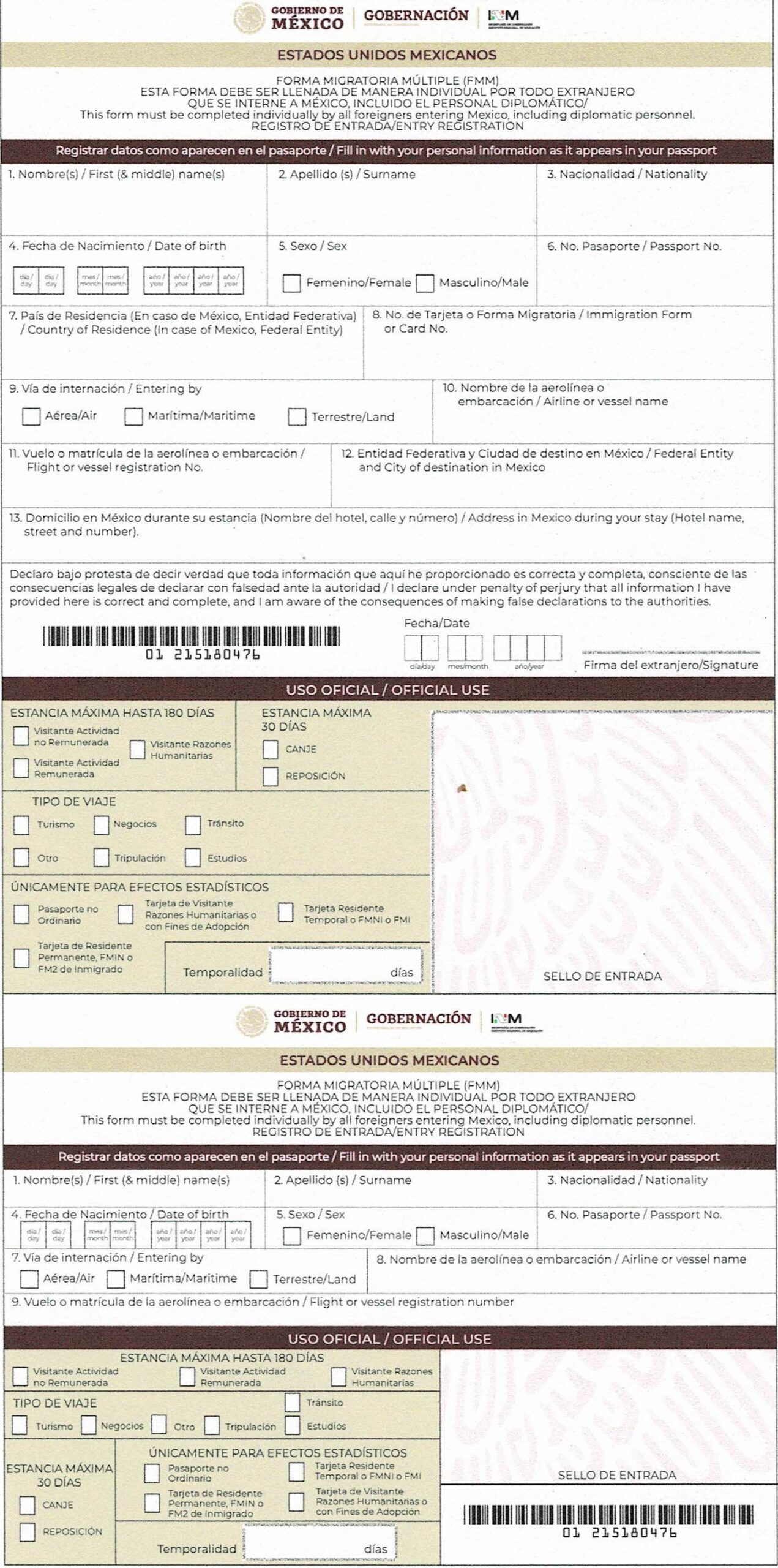
In the past, visitors entering Mexico had to complete a Multiple Immigration (FMM) for Immigration control.

The FMM is a two part form that you fill out upon entering Mexico and the immigration officer would stamp both parts of the form and return one part to the visitor. Upon departing Mexico, the visitor would surrender their part of this form.

However, the present government is phasing out that form and it is being replaced with a simple Entry and Departure stamp in the visitor’s passport. Depending on the International airport that you operate from in Mexico, you may, or may not, have to complete the form. It will depend on what stage of the implementation process they are in at that airport.

ATC

In March 2023, a new law went into effect empowering the Mexican military to guarantee the security, sovereignty and independence of Mexican airspace. How this new law will affect the AFAC and SENEAM (the civil entity that provides ATC services in Mexican airspace) has yet to be seen.

How do these changes affect General Aviation?

It is difficult to imagine that these massive changes to so many different federal government agencies that interact with GA would be trouble-free during the transition.

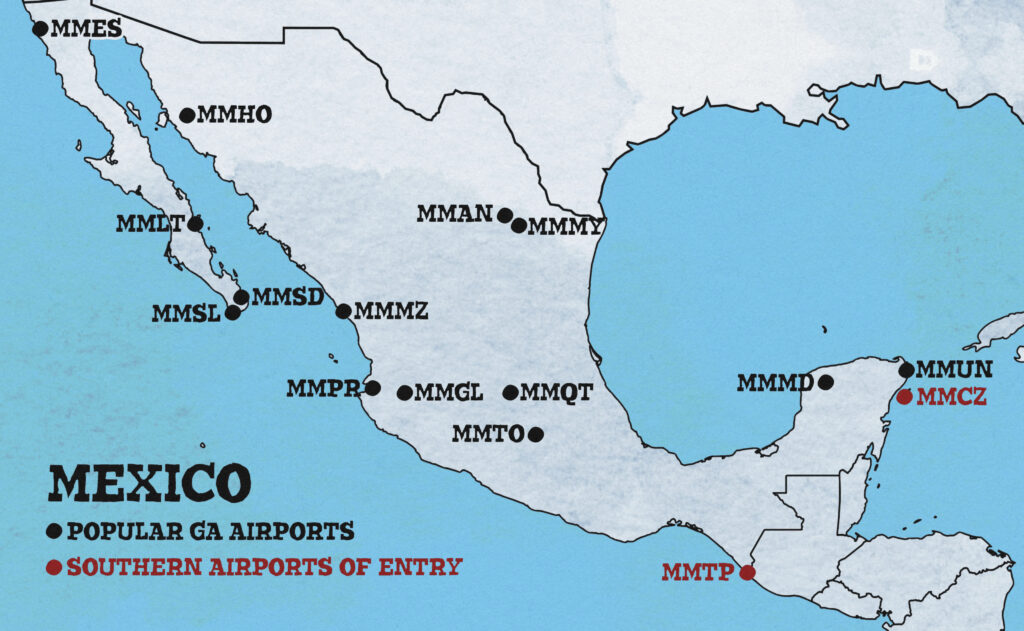
The reality is that at the major airports that receive the highest volumes of visiting GA aircraft, like Cancun, Puerto Vallarta, the 2 Cabo airports, Toluca, Guadalajara and Monterrey, the impact has been less significant due to the efforts of the airport operators and local FBOs to keep things operating smoothly. Operators using ground handlers typically fare better because they have somebody on the ground who understands the proper procedures and speaks the language.
However, in all fairness to ground handlers, they cannot interfere with the actions of federal officials doing their duties. So, their abilities to minimize the inconveniences can sometimes be very limited and it is also not in their best interests to antagonize those federal officials that they must interact with every day.

At the other end of the spectrum, international airports and domestic airports that receive little GA traffic can sometimes be more onerous. What we have experienced firsthand is a lack of coordination between the different agencies which has provoked delays in arrival and departure processing, frustration on the part of crew and passengers as well as misplaced documents.

For example, the National Guard (Guardia Nacional) will often request that all contents of the aircraft be removed and placed on the ramp to be searched on arrival and departure. Once complete, they may tell you that you can return your items to the aircraft only to have the Customs agent come behind them and tell you to unload everything again and to bring it into the airport building. As these agencies rarely identify themselves, it is sometimes hard to tell who is who.

Another area of concern has been that these government officials are using cellphones to take pictures of crew and passenger documents containing Personally Identifiable Information (PII) such as Airmen Certificates, Medical Certificates and Passports. The ownership of these cellphones, the location where the images are being stored and the steps being taken to protect that data has never been explained.

Unfortunately, we have seen the AFAC deny entry into Mexico of Experimental Aircraft or pilots using BasicMed, even though their own published regulations specifically state that Experimental aircraft and BasicMed are allowed with no specific individual approvals.

Another issue that continues to pop up are AFAC inspectors wanting to see Type Ratings on Airman Certificates for aircraft that do not require Type Ratings. Fortunately, we have been able to clear up Type Ratings issues by working with the AFAC inspectors.

Bottom line

With so many new personnel entering these Mexican government agencies, some inconveniences are to be expected as they become proficient at the new tasks they are being assigned to do. In the meantime, the best strategy is to pack an extra case of patience and a large bottle of good humor. After all, it could be worse, you could have flown on the airlines…


About the author:
Rick Gardner of CST Flight Services, a company which provides a wide range of international trip support services for both owner-pilots and professional pilots. Rick is also the representative for the Aircraft Owners and Pilots Association (AOPA) in Mexico, Central America, The Bahamas and the Caribbean as well as a Bahamas Flying Ambassador, member of The Bahamas Civil Aviation Council and has participated on aviation committees of other foreign countries.

For many years, several individuals and flying organizations like CST Flight Services have collaborated with the heads of the different government agencies in Mexico that interact with US General Aviation arrivals in an attempt to simplify and standardize the entry process. CST’s efforts over the years have been successful on a number of fronts such as: obtaining official notification from DGAC that US Issued insurance policies are valid for private aircraft and that you do not have to buy “special” Mexican insurance from 3rd parties, obtaining deferrals for almost 10 years for the requirement of 406 MHz ELTs, obtaining official permission for Experimental Aircraft to enter Mexico in September of 2008 and again in February, 2021, and obtaining an alternate means of filing Mexican APIS for private flights by sending an Excel template via email to Mexican Immigration.

www.cstflightservices.com / customersvc@cstflightservices.com / +1 786 206 6147


Mexico City says no to cargo

The Mexican government hinted at it in December 2022, and IATA got involved and said “please don’t do that”, but then the government decided to do it anyway.

So here is a little summary on the Cargo Conundrum at MMMX/Mexico City for all those who fly cargo into Mexico. And also for anyone who flies into Mexico because we have added some other handy things in for you too.

The Cargo Ban

MMMX/Mexico City will no longer allow cargo operations. This means scheduled and Ad-hoc cargo only ops.

This doesn’t apply to belly cargo on passenger flights. You are still fine to head in.

The Presidential order came out sometime around 18 February, and gave airlines 90 days to shift their operations. It was then extended to 107 days because folk pointed out that 90 days would be a bit tight.
Anyway, by sometime in May/June you won’t be able to operate cargo flights into MMMX/Mexico City.

Good news though – right up the road (literally about 40km) is MMSM/Felipe Ángeles International Airport, and they would love to handle your cargo.

No-one likes MMSM though…

OK, that isn’t entirely true. The problem is, according to IATA, that it lacks the infrastructure and getting the entire cargo chain to up sticks and move in 90 (or even 107) days is problematic and challenging.

Here is what IATA said about it all.

Why do we care if we don’t fly cargo?

Well, on the one hand it might be good news for you because it will mean more capacity at MMMX/Mexico City, and that is something it is definitely lacking.

On the other hand, it might cause issues for operators who carry belly cargo in on passengers flights in large quantities, because cargo handling companies might not want (or be able) to maintain the capacity and standards to handle it across both airports, and the cargo only airport is going to get priority.

For operators who fly both dedicated freighters and cargo on passenger flights it also means one more airport now having to be operated into, with all the support, contacts, coordination and what have you to worry about.

There are questions over whether MMMX/Mexico City will accept diversions from MMSM/Felipe Ángeles. We haven’t heard no so will assume it is a yes, but it is worth considering where you will go.

No-one likes MMSM…

It is not that they don’t like it, but the airport has issues. Or at least it did.

The main issue is to do with its proximity to MMMX/Mexico City (only about 40km away). Back in 2022 this led to a fairly severe near miss between aircraft operating into the two airports.

That’s all in here if you want a read.

They do want your cargo though

They say on their website that they are –

“Equipped with the most advanced security technology for the transport of national and international merchandise, this terminal has 22 bonded areas and 8 MARS positions (Multi-Aircraft Remote Stands), in an area of ​​345,881 m2. Its purpose is to meet the need for infrastructure for handling foreign stuff things blah exciting something about a gate nose and containers 12 meters long.”

Wonderful stuff.

We also noticed two things about the website:

  • There is no FBO contact. We can’t find any contacts except for their social media email. If you have any contact info for FBO, cargo handling or anything other useful airport contact please share it because we can’t find it anywhere.
  • They are really proud of their themed toilets. Two of the home page slide show pictures are of toilets and they have a dedicated section discussing them (fourth on the corporate Airport Services list in fact). Check out the photos!

So, in summary

  • Don’t plan on flying cargo into MMMX/Mexico City from Mayish time.
  • Do let us know if you have any contacts for MMSM/Felipe Ángeles.
  • Do send us Airport Spy reports on both (all) Mexican airports so other pilots and operators can see what horrors/joys befell you and can plan for them.

Mayhem in Mexico: Airports Closed Amid Cartel Violence

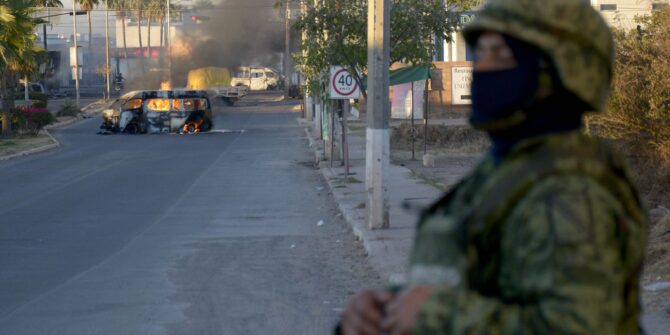
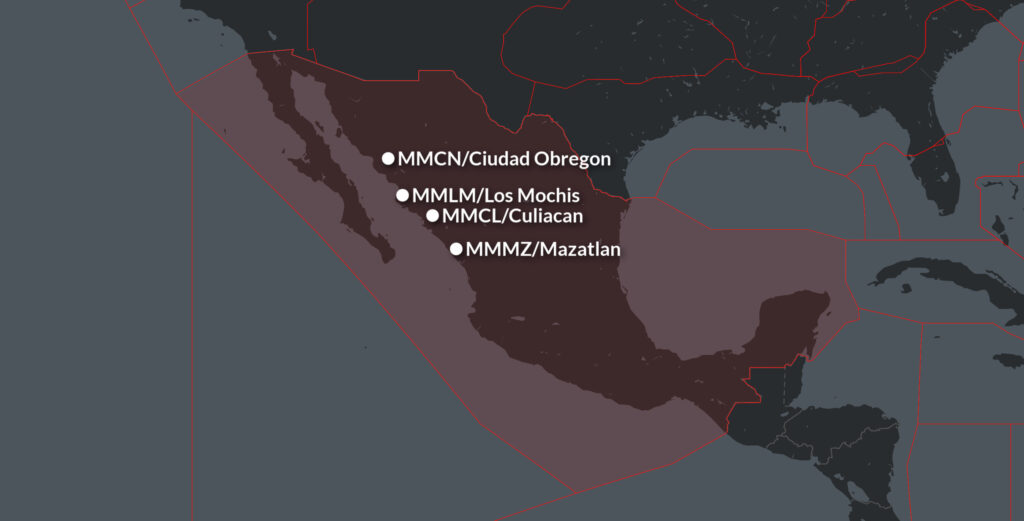
There were violent clashes between cartel members and security forces in Culiacan on Jan 5, after the arrest of a son of notorious drug kingpin “El Chapo”. Further clashes were reported throughout Sinoloa state in response – cartel members set up road blocks, set fire to vehicles and attacked a local airport, where two planes were hit by gunfire.

Airport closures

Several airports in the region were forced to close:

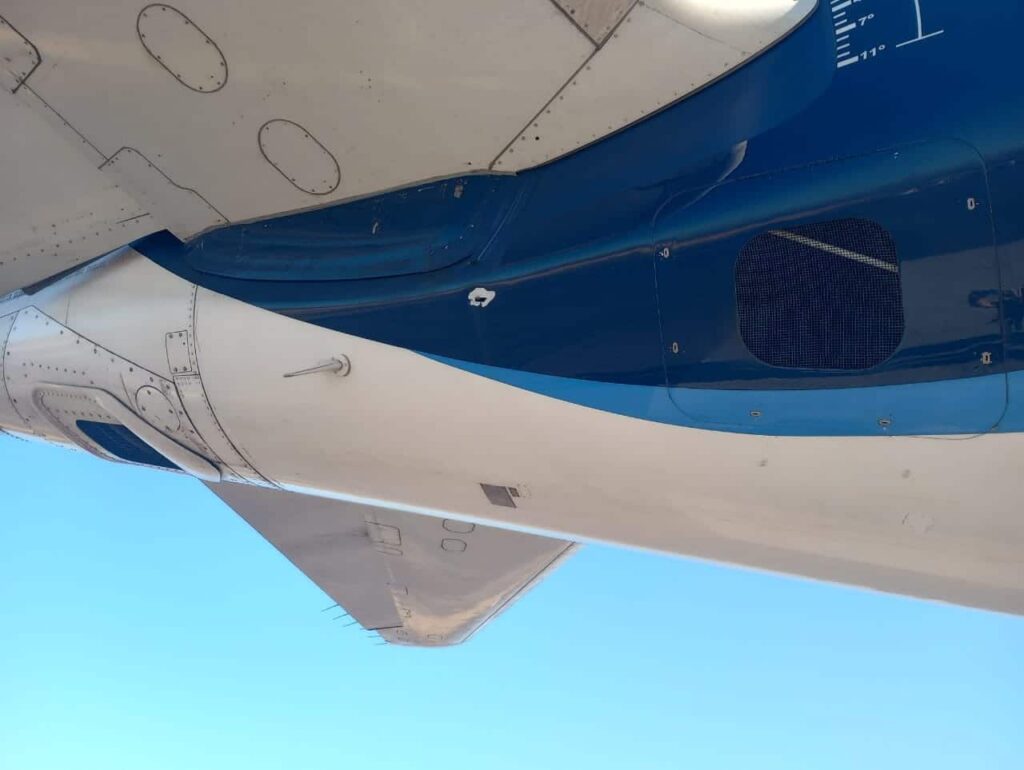
MMCL/Culiacan – during the clashes on Jan 5, an Aeroméxico E190 was hit by gunfire on departure here, resulting in an aborted takeoff. One bullet hit the tail of the aircraft.

Elsewhere in Sinaloa, other airports remain closed on Jan 6 – MMMZ/Mazatlan, MMCN/Ciudad Obregon, and MMLM/Los Michos.

All airports have now re-opened, but operators should continue to be cautious. It is recommended to pre-arrange transportation and hotels, and check that routes are not affected by any airspace closures.

Mexico overview

Up until now safety and security issues have been relatively few and far between for Mexico.

The following alerts are currently active (Jan 2023):

  • MMUN/Cancun If you are a GA operator heading to Cancun then keep an eye on notams restricting when you can operate there. A0064/23 and A0065/22 are currently active, with restrictions on Jan 7 and 8. Issued Jan 04, 2023
  • MMTO/Toluca There’s a new form that all passengers and crew of international flights need to fill out before arrival at MMTO/Toluca. It’s fairly standard stuff – just health screening. Issued Jan 02, 2023
  • MMZZ/Mexico Local agents have reported that operators should expect increased ramp checks at Mexican airports through to Jan 20. Check our article for a list of everything you should carry on board for trips to Mexico in case you get ramp checked. Issued Dec 22 2022
  • MMZZ/Mexico Mexico has scrapped daylight saving time (DST) in most parts of the country, which means that clocks won’t change come April. Standard time will apply all year round, apart from in the municipalities that border the US – these will continue to observe it. Issued Dec 06, 2022
  • MMZZ/Mexico Fifteen Mexican airports have changed their fuel from Jet A1 to Jet A (actually it happened back in March but we didn’t spot it until now). The list includes some big international airports – MMMY/Monterrey, MMPR/Puerto Vallarta, MMCL/Culiacan, and a few more. The main difference is the freezing point (minus 40 degC for Jet A). So check what you’re filling up with. Issued Oct 20, 2022
  • MMMX/Mexico City A near-miss and last minute go-around at the airport on May 7 follows a series of other events which have caused concerns over safety standards at the airport. Many of these are attributed to the recent opening MMSM/Felipe Angeles airport leading to increased airspace complexity. The government plan to reduce capacity at MMMX/Mexico City over the next few months to improve the situation. Issued May 11, 2022

Do you have any further information?

Please contact us at team@ops.group if you have any more information on the current situation in Mexico.


What’s the Time, Mr Mexico?

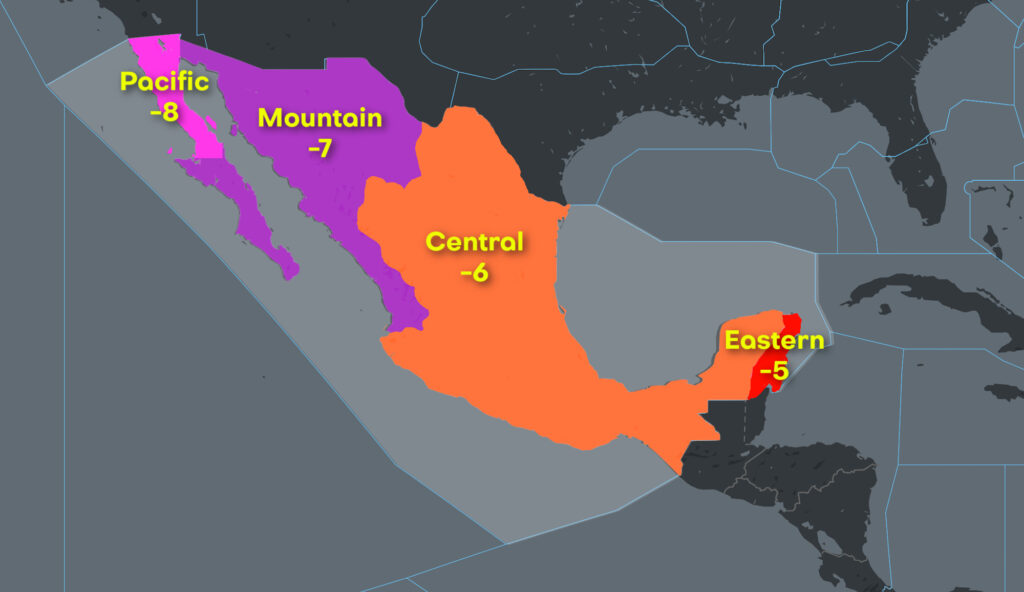
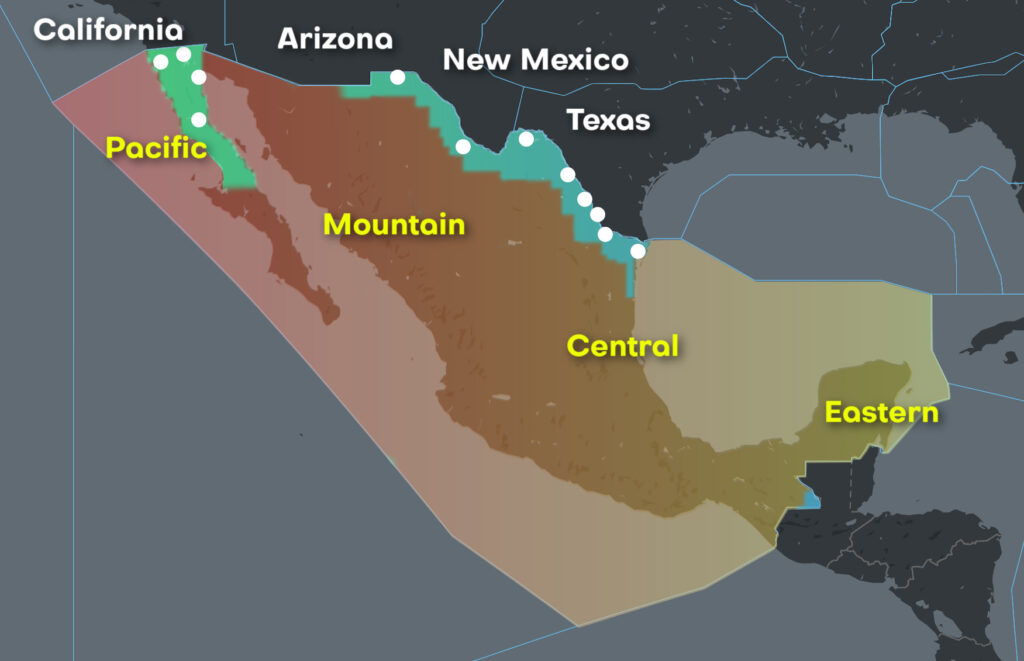
Mexican time is changing! They currently have 4 time zones:

  • PST (Pacific standard time) GMT-8 (which is just Tijuana)
  • EST (eastern) GMT-7
  • CST (central) GMT-6
  • MST (mountain) GMT-5

Here is a map (complete with ticking times) showing these. Or a more fixed one below if you prefer.

So what’s the problem?

Daylight saving is the problem!

Most of us forget/are confused by it/just let our phones do their thing and wake up feeling slightly less/more well rested depending on which way they’re moving. (Just remember: Spring Forward, Fall Back.)

In other words, when daylight saving starts (in the summer which frankly is confusing because there is already more sunlight then so why is it called ‘saving’) then you wind the clock forward an hour, losing one, and you wind it back again in the fall (autumn) meaning you live the same hour twice, to help make better use of the natural daylight.

Then there is the confusion of who does it and who doesn’t. Arizona, USA for example opted out of DST. Except for the Navajo Nation who opted in.

Who should we thank for this confounding thing? Some say the USA’s Benjamin Franklin, some say NZ’s George Hudson, some say the UK’s William Willett, some say “I have no idea who two of those three people are, tell me something useful?!”

Back to the Mexico problem

Mexico is cancelling DST from 2023. Which isn’t the worst thing ever given the confusion (see above)

The problem is… not all of Mexico is going to. Some border towns are not not going to do DST.

Wait, now I’m confused.

The ten municipalities bordering the USA have decided to stay synched with their American neighbors, presumably to avoid confusion with border crossing.

  • Acuna
  • Anahuac
  • Juarez
  • Matamoros
  • Mexicali
  • Nuevo Laredo
  • Ojinaga
  • Piedras Negras
  • Reynosa
  • Tijuana

So all of these will still apply DST, which means it will look something like this:

When is this all happening?

Well, the no-more-DST starts in April 2023 when the rest of Mexico just won’t wind their clocks forward.

The clocks will still wind forward in those 10 places though. Which, for you, might mean confusion if you’re heading into any airports along the border area. Like MMCS/Ciudad Juárez International.

Some fun time zone facts

If asked which country has the most time zones, most probably guess the USA or Russia. Both actually “only” have 11 though. The top spot goes to France with a whopping 13 different zones (ok, they own random bits of land all over the world so not really a fair game).

Next up are the countries with 9, which includes Australia, Antartica and the UK. Yup, the UK boast a fair few ‘unattached’ areas in the world too.

China is another oddity. It should have 5 time zones. It only has 1, based off what suits the Beijing sun best! 😎 🇨🇳


Mexico City: Safety concerns

What is going on around Mexico City (or should we say ‘Mess-ico City) at the moment? Aircraft near misses, security and safety concerns, ATC errors…

IFALPA has issued a new safety bulletin for MMMX/Mexico City airport, highlighting several concerns.

  • Aircraft have been landing with low fuel due to unexpected holding
  • Diversions (due excessive holding) have increased
  • There have been reports of EGPWS warnings
  • And reports of confusion over STAR clearances

IATA report there have been at least 17 incidents of EGPWS warnings in the past year, and have written to the Mexican Airspace Navigation Services expressing concern –

The situation seems to be compounded by the recent opening of nearby MMSM/Felipe Ángeles which is causing control challenges for ATC (more on that below).

The near-miss incident at MMMX/Mexico City

On May 7, two Volaris aircraft had a near-miss, potentially due to controller error, when an aircraft was cleared to land runway 05L while another had been cleared to depart 05L. The last minute go-around was prompted by crew in another aircraft:


What’s being done about it?

The Mexican Government have launched an investigation, but have already commented that the incident was most likely caused by an ATC mistake, noting Mexico has a shortage of about 250 controllers, which means they work longer hours.

They have also said that the airport will reduce capacity by 25% over the next 12 months while the situation is sorted. This is reportedly due to start in August 2022, with flights transferring to Mexico City’s new MMSM/Felipe Ángeles airport as well as MMTO/Toluca airport.

The MMSM problem

MMSM/Felipe Ángeles (formally known as Santa Lucia) opened in March 2022. The government decided to upgrade an existing airbase following the scrapping of the Texcoco airport project.

MMSM boasts three runways, all with CAT I ILS approach facilities, and two 4,500m (14,764′) in length. The airport sits at an elevation of 7362′, and has an MSA of 15,700′ making it a relatively challenging spot (although MMMX/Mexico City is arguably more challenging).

The proximity to MMMX

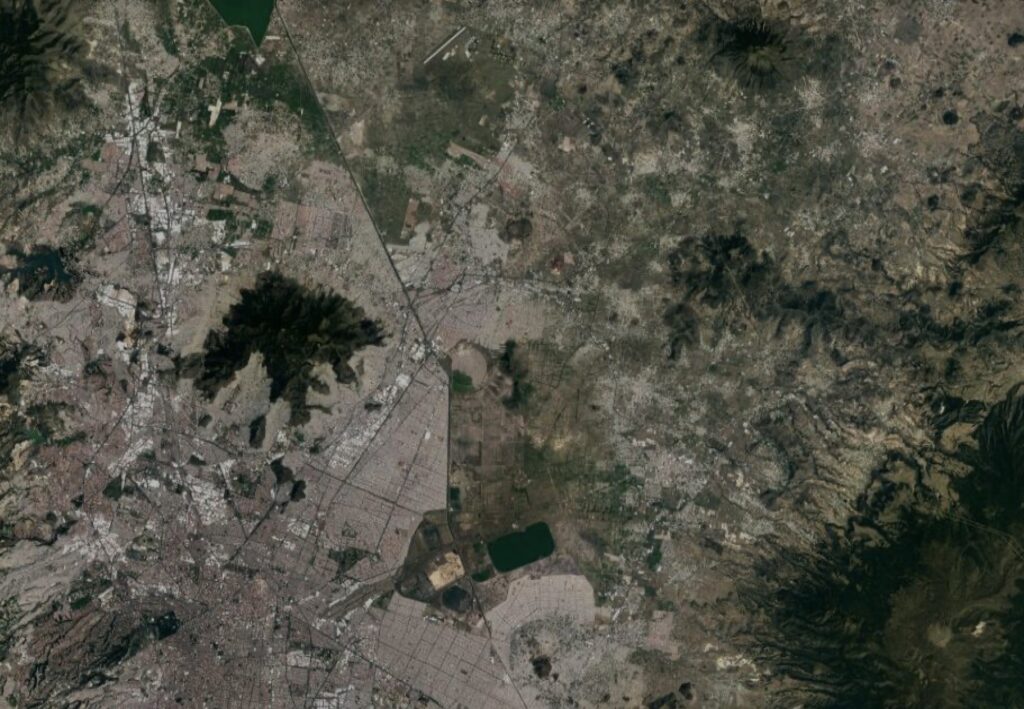
Both airports serve Mexico City and are only about 40km apart meaning ATC have suddenly found themselves dealing with much more complex airspace, and still have that pesky terrain threat to contend with as well.

According to air traffic controllers cited in local press, the number of aborted landings has doubled at MMMX/Mexico City airport this year due to the redesign of airspace to allow MMMX and MMSM airports to operate simultaneously. Insufficient training and lower than standard phraseology are not helping the situation. You can read more on this here.

Reports on MMSM

Sometimes folk write in with reports on airports. Someone did this about MMSM, and it wasn’t great.

We have paraphrased below –

“The airport is still not fully constructed from the sounds of it, having been opened speedily by the government. The airport is not ready to support international operations and to reach it from Mexico City involves a pretty bad 2 hour drive through so rough neighbourhoods. Be safe – don’t use this airport.”

Safety and security

Mexico does have some safety and security issues, and these do impact operations, particularly into MMMX/Mexico City international.

The airport comes out one of the highest for:

  • Security incidences at the airport – from illegal cargo being loaded to passenger documents not adding up
  • “Follow-home crime” (ie getting followed back to your hotel and then robbed)

Both airports lie near (or in) neighbourhoods with high crime rates, so crew security if on a layover should be taken seriously.

Mexico, overall

The FAA downgraded Mexico’s safety rating back in June 2021. Here’s our post on it if you want a read.

This downgrade doesn’t mean the FAA thinks the country isn’t safe to operate into. It is generally aimed more at the safety of the airlines registered there. But it is often based off the level of oversight, quality assurance and maintenance in the country.

Which means when you see a downgrade, you should have a little more caution because the infrastructure, training for the likes of ATC etc, or general regulatory oversight might not be up to scratch and this could have some safety impact for you.

What to do with all this info?

Well, avoiding going would be extreme, but being extra cautious when you do – especially with regards to looking out for other traffic, and paying special attention to your terrain clearance – might not be a bad call.

You might want to carry extra fuel as well to deal with those holding issues as well.

Please send us your reports.

We can only share on the info we receive from folk heading there so if you do, we would love a report from you (and will keep it anonymous if you want) – news@ops.group


Mexico ADS-B Mandate Coming Soon

Mexico’s ADS-B mandate, delayed a year, is coming into effect January 1, 2022.

Why was it delayed?

Apparently it came down to supply of ADS-B equipment issues meaning a lot of Mexican registered aircraft were unable to get it installed in time.

What do you need?

Mexico have mandated the use of 1090-MHz Mode S squitter transponders and as yet have not agreed to extend the mandate to allow 978 MHz Universal access transceivers, which are allowed in the US. The main difference is 978 MHz transponders are not allowed above 18,000′ while 1090MHz ones can be used at any altitude.

The mandate is for ADS-B Out. If you’re unsure on the difference then the FAA have a handy page on it here, but the simplified difference is Outtie’s broadcast an aircraft’s GPS location, altitude, groundspeed etc to ATC ground stations and other aircraft. Innie’s provide the aircraft with weather and traffic info delivered directly to the flight deck.

Where will you need it?

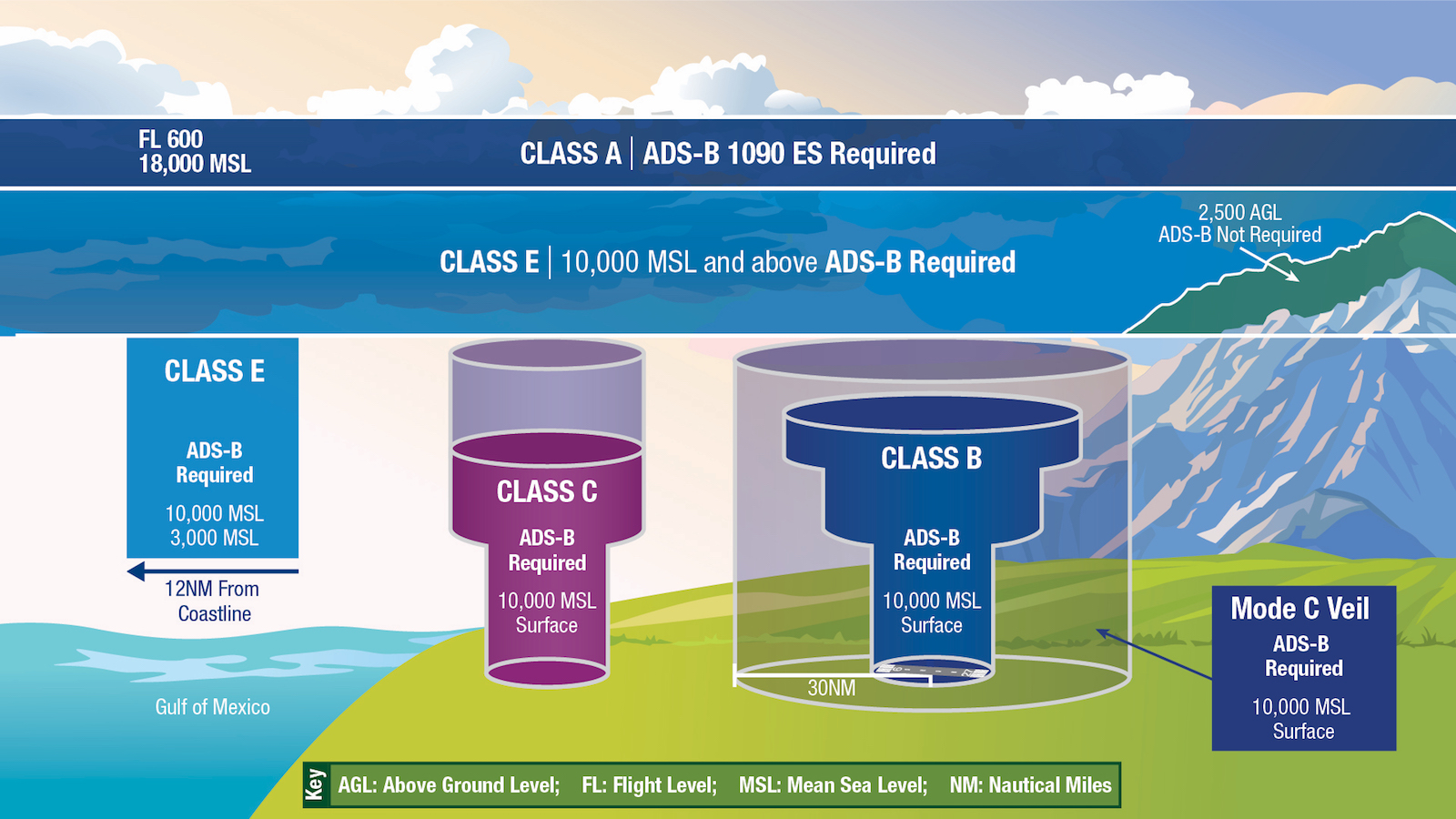
The rules look similar to those in the US:

  • Class A
  • Class B
  • Class C
  • Class E above 10,000 feet
  • Class E over the Gulf of Mexico, above 2,500 feet
  • Within 12nm of the Mexican coast, above 3,000 feet
  • Within 30nm of MMMX/Mexico City International Airport, above 10,000 feet

What if mine breaks?

There is a process for operators to request permission, in advance, if their ADS-B is inoperative. You can also request to fly without ADS-B equipment installed if you submit the request at least an hour before departure (probably a good idea to do it a little earlier).

Where is the official info?

All we have discovered so far is this Advisory which unfortunately is in Spanish. Watch this space for info on how to request the no ADS-B permission.

Where else do I need ADS-B?

We have a whole post on ‘ADS-B Mandates Around the World’ which you can read here.


The Mexican Downgrade: What’s the impact to ops?

Mexico have recently found themselves downgraded by the FAA under their IASA program.

So, what does this mean for Mexico, and what does everyone else need to know about this?

First up, what is the IASA program?

It might sound confusingly like a combination of EASA and IATA, but ‘IASA’ is actually the International Aviation Safety Assessment Program run by the FAA, and used to determine the safety standards in foreign countries.

It was set up in 1992 to monitor air carriers operating in and out of the US – not to monitor the operators specifically, but to check the authority in the country is up to scratch with ensuring their operators are up to scratch. If not, the US don’t want to let them into their airspace.

What do they look at?

They are focusing on the country (not the operators in the country), to see how well they adhere to international aviation safety standards and recommended practices, as suggested by ICAO in Doc 9734.

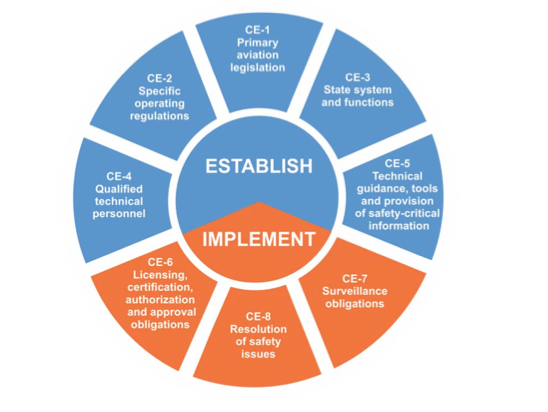
There are 8 elements that the FAA/ICAO reckon a decent aviation safety oversight authority should be doing well:

  • Legislation
  • Operating Regulations
  • The State civil aviation system and safety oversight functions
  • Technical personnel qualifications and training
  • Technical guidance, tools and provision of safety critical information
  • Licensing, certification, authorization and approval obligations
  • Surveillance obligations
  • Resolution of safety concerns

I feel like they combined a few there, and its actually more than 8. But there’s the list.

How do they do the assessment?

If you visit the IASA site, on the FAA main site, then you’ll find each of those areas has its own checklist. These are thorough, lengthy things. The Operating Regulations alone is 19 pages with a whole bunch of points to check off per page. Oddly, all that checking leads to only two possible outcomes.

A country either meets the standard or it doesn’t. There is Category 1, or there is Category 2, no in-between.

  • Category 1, Does Comply with ICAO Standards
  • Category 2, Does Not Comply with ICAO Standards

Basically, if one or more deficiencies are identified, it’s a Category 2 ranking, and Santa won’t be bringing you a present that year.

What does it mean to be on the naughty list?

Well, if you already have air carriers flying to the US then you can continue but they are going to monitor them pretty closely. If you don’t already have air carriers operating in and want to, then you’re going to have to improve before they give you permission.

But why should we all care?

After all, the oversight is to do with their air carriers and nothing more? Surely it just means their aircraft might be a risk coming into US airspace, or their pilots might not follow procedures properly?

Well, actually no. The problem is these air carriers share airspace with you. If their pilots are not licensed or trained correctly (think Pakistan’s recent problem) then this can degrade the safety for all aircraft operating in their vicinity.

If a state is failing to ensure minimum safety standards in areas such as the promulgation of safety critical information (notams), technical personnel qualifications (the maintenance folk who might be fixing your aircraft, or the CAA inspectors checking compliance) then this is something any international operators might want to be aware of as well because there are potential knock-on safety impacts for those heading into the country in question.

So does it tell me if another country is safe to fly to?

No. The FAA is not saying every country ranked 1 is safe, no issue, no problem.

It also isn’t telling you a country is unsafe to operate to if they don’t meet compliance standards. Remember, it is purely looking at the regulatory and safety oversight and asking if they ensure minimum ICAO standards. There are countries out there that pose significant threats (just not because of any deficiencies in the authority’s oversight).

It might also mean that the FAA have not ranked that country, because no-one from that country is flying or planning on flying to the US.

Remember, these rankings are looking at how a state ensures its air carriers are safe and compliant. It does not consider whether services or infrastructure within the state itself are safe or compliant.

How should operators and pilots use this list?

For operators and pilots, if a country is ranked Category 2, it means you might want to be doing your own risk assessment before heading in. No-one is saying that country isn’t going to be safe, but they are saying there are deficiencies with the authority, and since that authority looks after a lot, it is worth asking whether there might be other deficiencies as well.

You should be looking at the following:

  • What are the standards of the handling agents and maintenance services you are going to require there?
  • How reliable are Notams, and are they providing the information required?
  • What level of service and safety will ATC provide?
  • Will procedures and regulations be correctly adhered to there, and if not, what will this mean operationally for your flight safety?

You can get this info from sites like Safeairspace, Airport Spy, and through talking with colleagues who have operated into there before.

Who is on the Category 2 list?

So the big news this week is that Mexico were downgraded. Again, actually.

Along with Mexico the FAA also have the following countries ranked at Category 2:

  • Bangladesh
  • Curacao
  • Ghana
  • Malaysia
  • Eastern Caribbean States
  • Pakistan
  • Thailand
  • Venezuela

It changes though.

In 2014, the FAA downgraded India, citing inadequate oversight by local regulators, and in 2001 South Korea found themselves downgraded due to unskilled technical staff, pilot screening problems, issues with flight operations rules and a lack of objectivity in air crash investigations.

Both made it back on again relatively quickly.

Let’s take a closer look at Mexico…

The FAA have not yet given the reasons for their downgrade. However, Mexico was downgraded previously – back in 2010 – due to shortcomings in technical expertise, trained personnel, record-keeping and inspection procedures.

Actually, Mexico has a pretty decent infrastructure in terms of airports, although these do pose some operational challenges of their own (things like high terrain, high elevation). The CAA was actually “revamped” back in 2019. We put out this post about ramp checks.

Mexico’s political problems seem to be at the root of most issues here for the aviation industry. A project to build a new airport was recently cancelled (Texcoco airport was partially constructed already.) Now the government are instead looking to improve MMTO/Toluca and build new runways at an Air Force base near Mexico City. Plans are also under way for a third terminal at Mexico City Juarez, but given it is already congested and operating over its designed capacity, this might not be any solution.

Combined with Covid Pandemic problems, the latest downgrade will mean a big financial impact for various Mexican airlines now unable to access the major Mexico-USA market, and the knock on effect from this might be further felt in the aviation industry there as a whole.

The Big Taco-way?

If you are operating into an FAA IASA Category 2 ranked country, doing your own risk assessment on the standards and compliance you can expect to experience there might be worthwhile.


Mexico’s revamped CAA to make permit applications even tougher

If you thought that applying for Mexican landing permits couldn’t possibly get any more complicated, then think again!

On 16th Oct 2019, the Civil Aviation Authority in Mexico (DGAC) became the Civil Aviation Federal Agency (AFAC), and it sounds like they mean business. Local handlers are saying that policies and procedures that were typically overlooked or handled with lax criteria in the past are now expected to be more strictly enforced.

The following changes apply to Part 135 commercial operators looking to obtain Mexico landing permits. (For Part 91 private operators, no changes to the current rules and requirements are expected at present).

Insurance Policies

It’s long been the case that you need two insurance policies for ops to Mexico: your standard worldwide one, and a specific Mexican one issued by a Mexican company.

Authorities are now saying that for both of these policies, the original copies must be submitted in full; with coverage details, proof of payment, and aircraft details clearly shown. Digital copies are not good enough, and there have been some cases reported where applications have been rejected due to seemingly trivial things such as the signatures being too blurry, or even the “courtesy translation” stamp being on top of a signature.

Power of Attorney

To get a landing permit for Mexico, you need to nominate a local handling agent, sign a Power of Attorney saying that they are your legal rep there, and then the CAA will release the permit to them.

Previously, authorities were happy enough with a scanned copy of this Power of Attorney, but they are now saying this must be submitted as a notarized original with an Apostille. If you’re applying for Single Landing Authorization (see below) for short notice operations, you will have to send a digital copy of this, and commit to follow-up by sending the original copy too once available.

Single Landing Authorizations (one time shots):

The CAA traditionally allowed operators up to five Single Landing Authorizations before requiring an Indefinite Blanket Permit if operators continued flying into Mexico. The AFAC is now cracking down on this. So “one and done” will be the new rule with Single Landing Authorizations. After that, the Indefinite Blanket Permit must be applied for (although you should still be able to obtain SLA’s on a case by case basis, once your application for the Blanket Permit is underway).


Whether these implementations will continue to be enforced in the long-term remains to be seen. But for now, it looks like operators should prepare to apply for the Indefinite Blanket Permit if they are planning on doing more than just one flight to Mexico. Here is the original post on this topic by local Mexican agent Manny Aviation – we thank them for their help with alerting us to this!


Tropical Storm Nate headed for U.S. Gulf Coast

Tropical Storm Nate is currently just off the northern coast of Nicaragua, moving NW at 8kts with sustained winds of 35kts.

It’s forecast to move on towards Louisiana over the weekend as a Cat 1 Hurricane.

Heavy rain expected across Nicaragua, Costa Rica, Panama, Honduras, Belize and Mexico’s Yucatan Peninsular.

No airport closures anywhere yet, but keep an eye on the forecast for MMUN/Cancun, as that’s directly in the path of the storm.


Midweek Briefing: Tokyo Typhoon, New NAT Procedure

Typhoon for Tokyo 07SEP Tropical Storm Malou is tracking towards Tokyo and expected to intensify. Multiple Japanese airports are likely to be affected … Read the article

New Shanwick / NAT procedure 07SEP Shortly all FANS 1/A flights will get a “CONFIRM ASSIGNED ROUTE” message from Oceanic ATC (Shanwick, Reykjavik, Gander) shortly after entering their OACC, to mitigate against Gross Nav Errors. Read the article


HHZZ/Eritrea The US State Dept has issued a Travel Warning for Eritrea which warns of the risks of travel to Eritrea due to the unpredictable security situation along Eritrea’s borders and restrictions imposed by local authorities on travel within the country. All foreign nationals, including U.S. government employees, must obtain permits to travel outside of the capital Asmara. This restriction limits the ability of the U.S. Embassy to provide consular/emergency services anywhere outside of Asmara. This replaces the Travel Warning dated May 6, 2015. Avoid travel along all border regions. In June 2016, fighting in the Ethiopia-Eritrea border region reportedly caused several deaths. Continued political and military tensions between Eritrea and the neighboring countries of Djibouti and Ethiopia pose the threat of possible renewed conflict. Due to regional sensitivities, the State Department also recommends against travel to the border region with Sudan.

WSSS/Singapore will be super busy during the Grand Prix weekend 14-18SEP. Ask for a slot before operating, if you don’t get one, use Seletar instead.

RPLL/Manila has a couple of new procedures for non-scheduled flights. First, traffic arriving between 2200-0400Z daily – the peak period – should look for a slot from Manila FSS – who are at mfss.staff@gmail.com, or call 2 944 2098/99. Once you have the slot, get your EDCT from Manila ATC. If operating domestically, file the flight plan between 2 and 24 hrs prior departure.

DNBC/Bauchi is a new airport designator in Nigeria for the Tafawa Balewa International Airport.

VLVT/Vientiane, Laos The 28th and 29th ASEAN Annual Heads of State Summit is being held in Vientiane from 5 to 9 September; there will be road closures and delays in arrivals and departures of both international and domestic flights at Wattay International Airport.

FOZZ/Gabon has seen multiple security warnings in the last few days, following a disputed election result. Widespread, violent demonstrations, rioting, looting, and road blocks continue, both in Libreville and other cities throughout Gabon. At this time the airport in Libreville is open and operational and commercial flights are available. The US Embassy recommends U.S. citizens remain in a safe location and avoid non-essential movement.

MMSD/Los Cabos, Mexico Hurricane Newton has passed and Los Cabos airport has officially re-opened its commercial operations, no major damage reported.

EBOS/Ostende Air BP is no longer providing Jet A1 fuel here.

EKOD/Odense will be closed on 22SEP due to an event. Jet fuel not available. You can email twr@hca-airport.dka for further.

HELX/Luxor Radio, which previously operated on HF5859 and 2562, is now off the air.

LZIB/Bratislava will required slots for all operations 15-17SEP, small GA aircraft not welcome on these days. Email slots@bts.aero.

FNZZ/Angola The WHO has provided an update on the yellow fever outbreak in Angola and the Democratic Republic of Congo (DRC). The WHO estimates that there have been 6,000 suspected and 1,000 laboratory confirmed cases of yellow fever since the outbreak began in Angola in December 2015. More than 400 people have died from the mosquito-borne disease since that time. However, the last confirmed case in Angola was on 23 June and in the DRC was on 12 July, which the WHO believes is an encouraging sign. Nevertheless, the organization still characterizes the outbreak as “serious” and as requiring “sustained, controlled measures.” Thus far, 22 million people in Angola and 14 million people in the DRC have received vaccinations against yellow fever as part of a large-scale initiative that was prompted by this outbreak.

SARI/Cataratas is permanently downgraded to RFF Category 6.

URRR/Rostov wins the prize this week for clogging up the Notam system; the runway there is closed 29 times between now and October 21st, and they have therefore issued 29 Notams. Perfect.

SPQU/Arequipa, Peru is not allowing overnights until 11SEP due capacity. Non-scheduled flights limited to 3 hours parking.


View full International Bulletin 07SEP2016


Midweek Briefing 06JUL: Hong Kong capacity problems, Iceland: The fun continues

Hong Kong capacity problems 06JUL During this year, the Hong Kong CAA has issued a couple of warnings to operators to stick carefully to their allocated slots, but it’s not making much of a difference to operations there. Read the article.

Iceland: The fun continues 06JUL Last week there were some really positive indications that the ATC strike in Iceland was coming to an end, but it’s now worse than ever, with Westbound, Eastbound, and landing traffic all affected. Read the article.


HECC/Cairo FIR A restriction exists for traffic to and from the Amman FIR, so if overflying Jordan and then Egypt, or vice versa, you can only use the waypoint METSA.

OMAE/Emirates FIR has some updated peak times. Departures need a slot between 0630-0730Z and 1700-0000Z. Arrivals will be spaced 5 mins apart during these times also, as will aircraft entering the OMAE FIR from nearby airports like Muscat, Isa, and Baghdad.

EIDW/Dublin Runway 10/28 is closed overnight until 09JUL.

OERK/Riyadh, Saudi Arabia will be hosting the ‘Global Ministerial Aviation Summit’ 29AUG-31AUG. 55 different ministers from various countries are expected to be in attendance. Be aware of potential restrictions leading up to and after the event.

CYFB/Iqaluit Another NAT alternate favourite, CYFB has some runway closures throughout July.

EGCC/Manchester is doing some work on 05L/23R overnight until 08JUL and has advised operators to carry some extra gas due possibility of holding.

LOWW/Vienna has published a helpful list of rush hour periods – worth avoiding these times as holding is common at VIE. The times are: 0530-0750, 0920-1030, 1140-1240, 1340-1500, 1615-1800, and 1840-1940Z.

BIZZ/Iceland Despite optimistic reports of a resolution to the ATC dispute in Iceland last week, the situation remains unresolved. Last night BIRD Oceanic was closed to most Eastbound traffic once again, as was BIKF. A new addition to restrictions is a closure to many Westbound flights on Wednesday 06JUL – “DUE TO STAFF SHORTAGE IN REYKJAVIK OACC WESTBOUND TFC PLANNING TO ENTER BIRD FROM ENSV VIA GUNPA,VALDI, IPTON, INGAL, ISVIG AND EGPX VIA LIRKI, GONUT, OLKER, MATIK AND RATSU AND THEN PROCEEDING INTO EGGX OR CZQX SHALL REMAIN SOUTH OF BIRD CTA” Read the article.

EDYY/Maastricht ATC have requested crews operating through the Maastricht UIR to log on to CPDLC EDYY, if you have datalink. While voice remains the primary comms method, you might get an uplink message if the frequency is busy – it’s not a test, you should confirm – most of these uplinks are likely to be frequency changes.

EPZZ/Poland has advised operators to check carefully whether permission is required in advance of operations at airports other than EPWW/Warsaw. Many countries including Poland have reinstated Border Controls within the Schengen zone. Best advice is to treat each country as having full Border Controls for the moment (so think Passport, GenDec, etc.)

SPIM/Lima FIR (Note that the airport is now SPJC, distinct from the FIR code) is shutting down airway UG427 after 21JUL.

SUEO/Montevideo ACC (Uruguay) has some comms issues in it’s airspace, and has advised of some extreme spacing between aircraft irrespective of FL – 40nm. For now, this ends today (06JUL) but may happen again.

WSZZ/Singapore Qualifying citizens of Singapore are now eligible to apply for US Global Entry membership – and benefit from expedited entry to the United States at designated airports. Similarly, qualified U.S. citizens are eligible for enrolment in Singapore’s enhanced-Immigration Automated Clearance System (eIACS).

ZMUB/Ulaanbaatar, Mongolia is downgraded to RFF Cat 7 until 10JUL. Also, from 12-16JUL, you can’t file this as an alternate which may limit your options somewhat.

LFPG/Paris due to maintenance on the ILS for Runway 08L/26R from 18JUL to 02OCT. The only approaches that will be available will be RNAV based procedures (LNAV/VNAV, LPV, LNAV) and VOR/DME.

GQNN/Nouakchott, Mauritania has moved to a new international airport this June. Located approximately 10nm north of the city, it has an annual passenger capacity of 2 million. Infrastructure from the capital’s old airport was transported to the new one.

SECU/Cuenca Following the landing incident on 28APR of an E190, all inbound flights will be reportedly be held if the runway is wet – until end of August.

LFMH/St Etiennee Fuel outage on 07JUL, 0800-1100 UTC.

Canada/Mexico From 01DEC2016, Mexican nationals will be able to travel to Canada without a visa for business and tourism for up to 90 days.

Turkey/Russia Russia has lifted the travel restrictions on tourists between the two countries. The ban was put in place following the downing of a Russian military aircraft last year.

Bangladesh Germany, Australia and the U.K. have banned direct cargo flights from Bangladesh due to security concerns.

Israel/China The Israeli parliament has ratified a multiple-entry visa agreement with China, under which Chinese business visitors and tourists can enter Israel multiple times with the same ten-year visa and vice versa.

EZZZ/Europe the European Union updated Air Safety list (aka the Airline Blacklist) on 17JUN, and lifted a ban on Zambian air carriers.

Uganda Introduction of ‘e-visa’ system. You must show a valid yellow fever vaccination certificate on arrival.

ZJSA/Sanya FIR, China has an ADS-B trial up and running on L642 and M771. Radar is still the primary separation tool, but ATC ask that you check your Flight ID matches your FPL.

View the full International Bulletin 06JUL2016


Midweek Briefing 25MAY: Cairo airspace -GPS jamming, Australia: new RNP rules (again)

Cairo airspace – GPS jamming 25MAY Egypt notified operators yesterday that GPS jamming is a concern to HECA/Cairo arrivals and overflights, and warned against conducting RNP/RNAV arrivals or approaches. Read the article.

Australia: new RNP rules (again) 25MAY A last minute relaxation by CASA has exempted Foreign private operators from having to be RNP2 compliant, ahead of many Navaids being switched off on Thursday. Foreign Commercial operators have a two year window to comply. Read the article.


LFZZ/France A French national strike is being called for on 26MAY by the DNSA. French Strike Regulation plan will be applied from 26/0400 UTC to 27/0400 UTC. Monitor NOP.

NTAA/Tahiti may not have fuel available from 25-28MAY due to strike action.

KZMA/Miami FIR A Falcon 9 rocket is set for launch from Cape Canaveral on 26MAY, a 2-hour launch window opens at 2140Z. 27MAY is the back-up day for the launch. Check KZMA/KZJX FIR NOTAM’s for restrictions.

VECF/Kolkata has updated SATCOM and local phone numbers: Kolkata Oceanic is at 441921 or 00870762092876 and Area Control is at 441902 or 00913325119520. The Satcom numbers are routed through the public telephone system.

EBLG/Liege Not available from 1530-2000 due to Staffing issues (which may recur later in the week).

MZZZ/Mexico A new law in Mexico expands the business, tourist and transit visa exemption for up to 180 days to visa nationals with a Canadian, Japanese, Schengen or UK visa, effective immediately, and to visa nationals who are permanent residents of Chile, Colombia or Peru effective July 1. APEC Business Travel Card (ABTC) holders, certain airplane crew members remain eligible for this exemption.

MROC/San Jose On 21MAY Mount Turrialba erupted. The volcano is located approximately 30NM west of MROC. Some flights were cancelled in response to the eruption. Please monitor the Washington VAAC for further advisories.

EZZZ/Europe Eurocontrol has confirmed the date of 01JAN18 for all aircraft to be 8.33 kHz compliant. Currently 8.33 kHz is required only above FL195 but as of 01JAN18 it will be required below FL195 to the surface. Europe has an ongoing shortage of voice communication frequencies.

KZZZ/USA The U.S. Department of Transport has banned e-cigarettes from checked airline baggage over fire risks. This includes both passengers and flight crew.

USHH/Khanty-Mansiysk is closed until 30MAY at 1500Z due to the runway being repaired.

FACA/Cape Town FIR CPDLC/ADS-C is not available until 31MAY.

LLLL/Tel Aviv FIR has updated their security procedures for entering the the LLLL FIR. Please see AIC 2/16.

VGEG/Chittagong Flight operations at Chittagong airport have resumed after suspension due to cyclone Roanu.

OPZZ/Pakistan has issued AIC 03/16 covering NAVAID outages due to scheduled maintenance until June.

NZQN/Queenstown New Zealands most challenging airport is now open for night traffic but only for airlines that meet CAA approval to operate to very specific RNP procedures. The first are Air New Zealand and Jetstar.

View the full International Bulletin 25MAY2016


Midweek Briefing: Mexico Volcano Eruption, Atlantic MNPS is over… Introducing HLA

Mexico Volcano Eruption 29JAN Popocatepetl Volcano, which is 55 kilometres southeast of Mexico City, had its last major eruption in 2000; it erupted on Tuesday this week affecting flight operations at MMPB/Puebla, and with the risk of further eruptions affecting operations in Mexico City itself.

Atlantic MNPS is over… introducing HLA 29JAN Effective next week, 04FEB, there are another round of changes on the North Atlantic – HLA/High Level Airspace is the replacement for MNPS, and the airspace is extended with Bodø joining Shanwick, Gander, Reykjavik, New York, and Santa Maria. Read our International Ops Notice 01/2016.


North Atlantic Effective 04FEB MNPS Airspace is replaced by HLA/High Level Airspace on the North Atlantic – extended with Bodø joining Shanwick, Gander, Reykjavik, New York, and Santa Maria. RNP4 or RNP10 now required. Read our International Ops Notice 01/2016 
or our blog post: Did you know MNPS is over?

TTxx/Trinidad and Tobago The annual Carnival in Port of Spain will take place on February 8 and 9, 2016. Travel and tourism activities are expected to continue for up to two weeks after the celebration and will be busiest during weekends. February 10, 2016 (Ash Wednesday) is expected to be the busiest day of the year at the Port of Spain airport. February 8 to 9, 2016 is also expected to be a congested time for departures.

KSFO/Super Bowl 50 The FAA will not be imposing a slot-based special traffic management program for the game on 08FEB, but ramp reservations, made through specific FBOs, will be required for all arrivals and departures from 04-08FEB. The rule will apply to all airports in the region, including San Francisco International, Oakland International, Hayward Executive, Norman Y. Mineta San Jose International, Livermore Municipal, Buchanan Field, Napa County, Charles M. Schulz-Sonoma County, Monterey Regional, Watsonville Municipal and Salinas Municipal. NBAA has set up a Super Bowl 50 information page that includes links to the FAA arrival/departure routes.

Uxxx/Tajikistan The U.K.’s Foreign and Commonwealth Office (FCO) issued updated travel advice for Tajikistan that reads as follows: “In early September 2015, armed clashes involving security forces resulted in a number of deaths close to Dushanbe International Airport and in the Romit Valley not far from Dushanbe. While tensions have eased, security remains heightened. You should continue to take extra care, monitor the local media and check this advice regularly.”

KFZZ/Falcon Field, Arizona In January and February, Runways 4R/22L and 4L/22R at Falcon Field Airport (FFZ) in Mesa, AZ will be closed non-concurrently for the taxiway ALPHA realignment construction project. These are hard closures with no potential for runway recall. Runway 4L/22R had closed Jan. 12, at 6 a.m. (1300Z) and will remain closed until Saturday, Jan. 30, 2016. Runway 4R/22L is expected to close Monday, Feb. 1, at 6 a.m. (1300Z) and remain closed until Sunday, Feb. 15.

Kxxx/United States A few weeks ago we reported on new FAA FDC NOTAMs that eliminate the need to obtain a TSA Waiver for domestic flights in the US. on 17JAN The FAA has corrected an error in these (in simple terms, they forgot to include some previously issued exceptions), and so there are 3 brand new NOTAMS effective – these are 6/4255, 6/4256 and 6/4260. Got some time?Read the original NOTAMs in full.

Mxxx/Mexico The U.S. Department of State warns U.S. citizens about the risk of traveling to certain places in Mexico due to threats to safety and security posed by organized criminal groups in the country. U.S. citizens have been the victims of violent crimes, such as homicide, kidnapping, carjacking, and robbery by organized criminal groups in various Mexican states. This Travel Warning replaces the Travel Warning for Mexico, issued May 5, 2015

EISN/Shannon FIR Due to a number of flights deviating from clearances prior to exiting Shanwick OCA, flight crews are reminded that Eastbound route clearances issued by Shannon Control for aircraft exiting Oceanic Airspace apply from AGORI, SUNOT, BILTO, PIKIL, ETARI, RESNO, VENER, DOGAL, NEBIN, MALOT, TOBOR, LIMRI, ADARA, DINIM, RODEL, SOMAX, KOGAD, BEDRA, OMOKO, TAMEL AND LASNO. Flights shall not turn before these points.

Uxxx/Russia The Russian Institute of Volcanology has issued a code orange alert after Russia’s Zhupanovsky volcano began erupting earlier this week, sending clouds of ash and gas to 27,000 ft. A code orange advises pilots to avoid flying near the ash cloud, reportedly moving over the North Pacific Ocean driven by prevailing easterly winds.

UIII/Irkutsk has issued NOTAM A0134/16 closing RWY 12/30 weekly on Tuesdays from 1210-1450Z beginning Feb 02 and ending March 22. UIII is not available as an alternate during those times.

UHSS/Yuzhno is closed daily between 0330-0500Z due to preventative maintenance. No end date has been issued.

RPHI/Manila FIR has begun Phase 1-b of an ADS/CPDLC trail. The specific details of the plan can be found here.

Wxxx/Indonesia  As of 19JAN, Mount Egon has been erupting on Flores Island, which is located east of Bali Island. Egon emitted large amounts of ash and noxious gas. As of yet, the eruption has not caused any flight delays or cancellations; however, previous volcanic eruptions in the lesser Sunda Islands have caused extended delays in Denpasar and Mataram.

Zxxx/China Talks with the Zhuhai municipal government, Chinese government, Zhuhai Airport Authority and the Civil Aviation Authority China (CAAC) resulted in temporary International China Inspection and Quarantine (CIQ) services at Zhuhai Airport for non-scheduled business aviation movements. Following the approval late last month, China’s National Port Administration Office opened a temporary customs port on January 1. The approval is renewable on a six-month basis. During the “approval period” from January 1 to June 30, crewmembers of foreign business aviation flights can enter and exit China via the temporary business aviation port at Zhuhai Airport.
View the full International Bulletin 27JAN2016