LOA Guide for US Operators

Applying for Letters of Authorization (LOA) from the FAA can be a tricky old process. Because there are so many different things you need permission for, you might need various LOAs.

An LOA is a formal “you’re allowed to do that” certificate given to an operator, permitting them to conduct a specific flight operation, fly in certain airspace, or use a particular bit of equipment, or document.

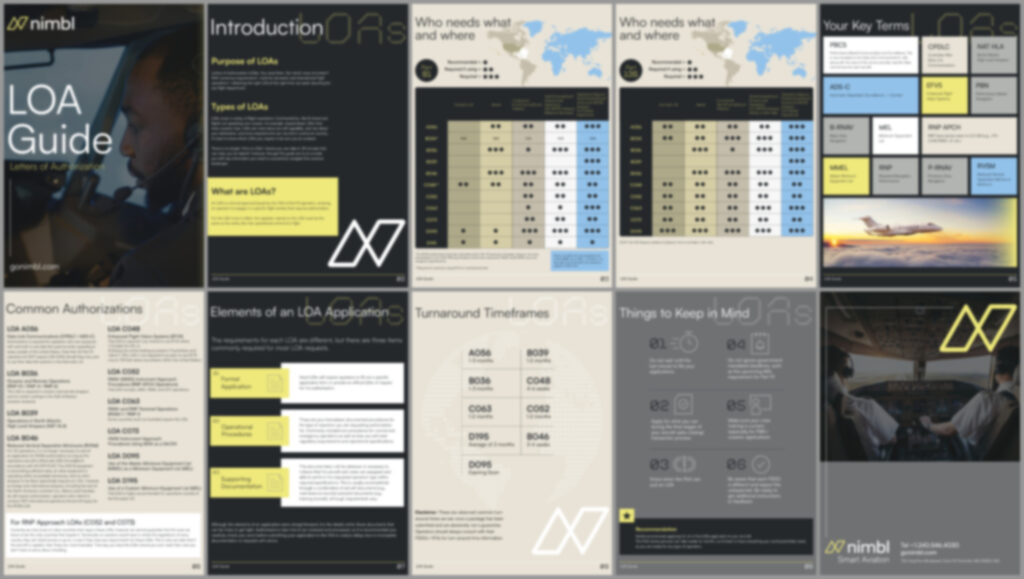
The folks at Nimbl (the new name for AviationManuals) have issued an updated guide which tells you what LOAs are, when you need them, and how straightforward the application process can be.

You can download a copy of the guide here.

Click for PDF.

The guide includes:

  • Who needs what and where, for Part 91 and Part 135 operators.
  • List of key terms, and explanations of the most common LOAs and why you would need them.
  • Separate elements of an LOA application – some discussion on the process.
  • Turnaround timeframes for different LOAs.

Who issues me my LOA?

The FAA, but more specifically, your local FAA Flight Standards District Office (FSDO). You can find a location of those here.

So, a Principle Operations Inspector, known as a POI is the person at the FAA FSDO who will issue your LOA. Don’t you just love aviation acronyms 😃

How to apply

  1. First things first, check the guide, and work out what LOAs you need.
  2. Then decide who the actual operator is. The FAA say this is “the person or entity who has operational control of the aircraft.” But they don’t mean the pilot flying it – they mean the person who has legal control, not operational control.
  3. Decide who is the responsible person, what your primary address is, and then work out which FSDO is going to be the closest. Sometimes operators get confused about this point and think they are able to choose which FSDO they can submit to, not realizing that the address on the documents matters a lot to where they can submit.
  4. Contact your local FSDO, work out what they need you to send them, and send it.
  5. Now the FAA will review your application. Turnaround times vary according to which LOA you’ve applied for – it can take anywhere from three weeks to six months, so you’ll want to get it right the first time! If it gets rejected, they will send you a detailed list of why to help you when you re-apply.

Anything else?

If you have any questions about the process, or if you need help with any of the above, visit www.gonimbl.com or send them an email at info@gonimbl.com. They have a dedicated team of LOA experts who provide support to operators in preparing all the paperwork, plus ongoing support as you go through the FAA submission process. (Also, we’ve known them for a long time, and can confirm they’re nice people!)


US LOAs: What’s the point of the C052?

Someone asked us about C052. Here’s the answer.

Do you need it?

Well, my friend, to answer that you will need to answer these:

  1. Are you Part 91, registered in the US?
  2. Do you want to fly approaches that uses GPS RNAV stuff?
  3.  Do you want to fly these outside the US National Airspace System?

If you answered ‘yes’ to the above 3 then you probably need a C052

Are you now wondering ‘Why exactly do I need it?’ or ‘I have no clue about the C052!“?

If you answered yes, read on. If you answered no, then move on.

Tell me about the C052

The C052 is a LOA.

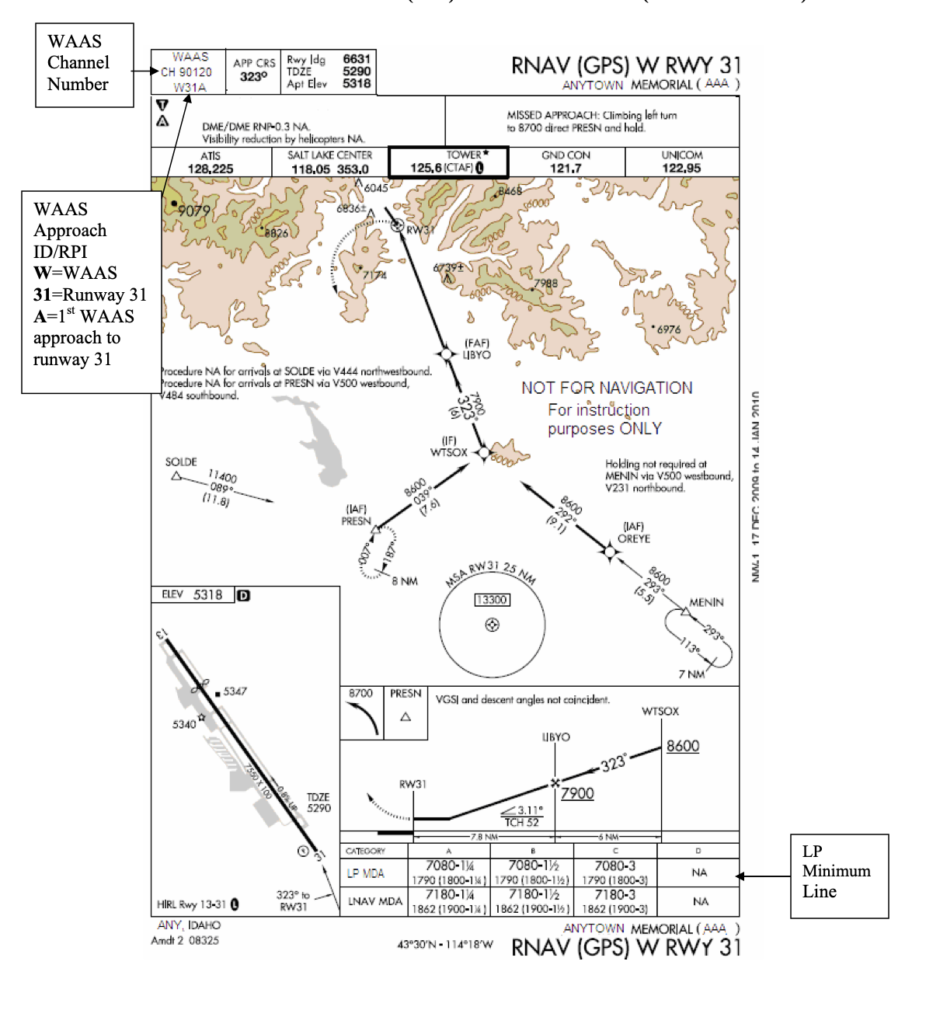
In fact, it is ‘an optional LOA provided upon the request of part 91 operators in order to show evidence of authorization and training to conduct Area Navigation (RNAV) Global Positioning System (GPS) approaches should they be required to provide such evidence to a civil aviation authority (CAA) outside of the United States.’

So you need C052 if you want to fly RNAV GPS approaches outside of the the US, in countries where approval from your home state is required. Like anywhere that falls under EASA for example.

The C052 tells foreign authorities that you are trained and approved to fly GNSS based approaches, and this keeps them happy.

Hang on, do I actually want to fly GNSS based approaches?

Well, take a look at airports you visit and see if they have the following –

  • A non-precision approach without vertical guidance, like an LNAV or an LP?
  • An approach with vertical guidance like an LNAV/VNAV or LPV?
  • A GLS approach?
  • Titles which say RNAV (GNSS) or RNP approach?
  • PRM?

Ok, then yeah, C052 is still for you.

I don’t fly to Europe though. So where else do I need it?

Europe is the main spot, but there are others as well. Hong Kong for example. This LOA will allow you to fly them anywhere that authorisation is required.

One of the best ways to confirm is on the approach charts (it might say authorisation required) or in the Country Rules and Regs.

The UK used to have more stuff like LPV approaches, but since the UK lost access to EGNOS after Brexit, these LPV approaches haven’t been possible.*

*Good news here though – Inmarsat have recently run tests on the new satellite system stuff that will replace EGNOS access for the UK. Watch this space for LPVs again. And C052 requirements for the UK. We aren’t sure yet if it will be needed (it wasn’t in the past).

Something else to know about it.

The older LOA C052 used to mention LOA B034, but this is now out of use.

Because you also don’t need approval to fly RNAV GPS approaches in US airspace, the best way to confirm your aircraft is eligible and airworthy for C052 stuff is through your airplane flight manual (from the manufacturer).

You might also want to get the C052 if you want a C073. The C073 authorises you to use MDA as a DA/DH, and you gotta have the C052 to get the C073

These guys can help.

Aviation Manuals can help you actually get the LOA if you want. We’ve mentioned them before, and actually they’ve mentioned the subject of C052 LOAs before, so here’s a link to that.

I’m sure there are other places who can help too, we just happen to find these guys really helpful because they always answer our questions on stuff.

Some useful other things to read.


Kathmandu got RNP-AR (and so should you)

RNP AR approaches are not your standard stuff. They need special authorisation and training for you to fly them. But it is worth it because these complex looking approaches are generally used in some of the most challenging places, to make your life easier (and safer).

So here is a quick look at them, some insights into why you might want to fly them, and how to sort that out.

What does this acronym mean then?

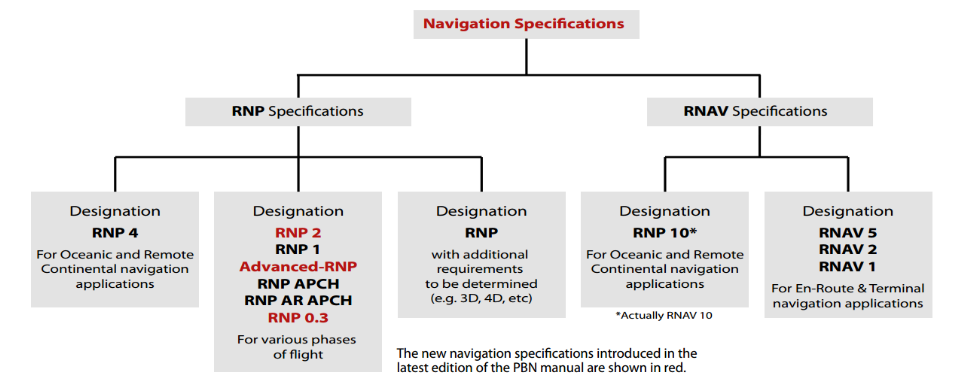
RNP means Required Navigation Performance. Which is something under the whole ‘PBN’ thing which basically lets aircraft fly along a nice, precise path with a lot of accuracy.

It’s the newer, better version of RNAV that has performance monitoring and alerting involved.

You’ve probably come across it in a bunch of different places and with different numbers after it. RNP 4 over the oceanic and remote spots, RNP 1 on approaches… the number is the accuracy requirement. So 4 means accurate to 4nm 95% of the time. Or your system tells you (that’s the alerting bit).

AR means authorisation required.

RNP-AR you allowed?

You can get that authorisation with an LOA and a bunch of training. In the US this is covered under section 9 of your En-Route / General Rules and Procedures / Holding, Approach and Departure Procedures which you can find here.

The FAA issues RNP AR authorization via operations specification (OpSpec), management specification (Mspec), or letter of authorization (LOA C384). There are no exceptions. Operators can find a lot of info on RNP AR aircraft eligibility, operating procedures, and training requirements in AC 90-101.

Which (because we’re generous with our links) can be read here.

Like anything, it comes down to the equipment you have in your aircraft as well. It requires certain GNSS and an on-board inertial system (IRU/IRS) setup, an FMS navigation with multi-sensor capability (so there is something as a backup to maintain RNP if the GNSS is lost)…

Surprisingly few BizJets seem to have what is needed. Good news though, companies do offer retrofit options.

So, what does an RNP AR look like?

Well, it should look accurate to 0.3 (that’s about 40m with SBAS), and sometimes even 0.1.

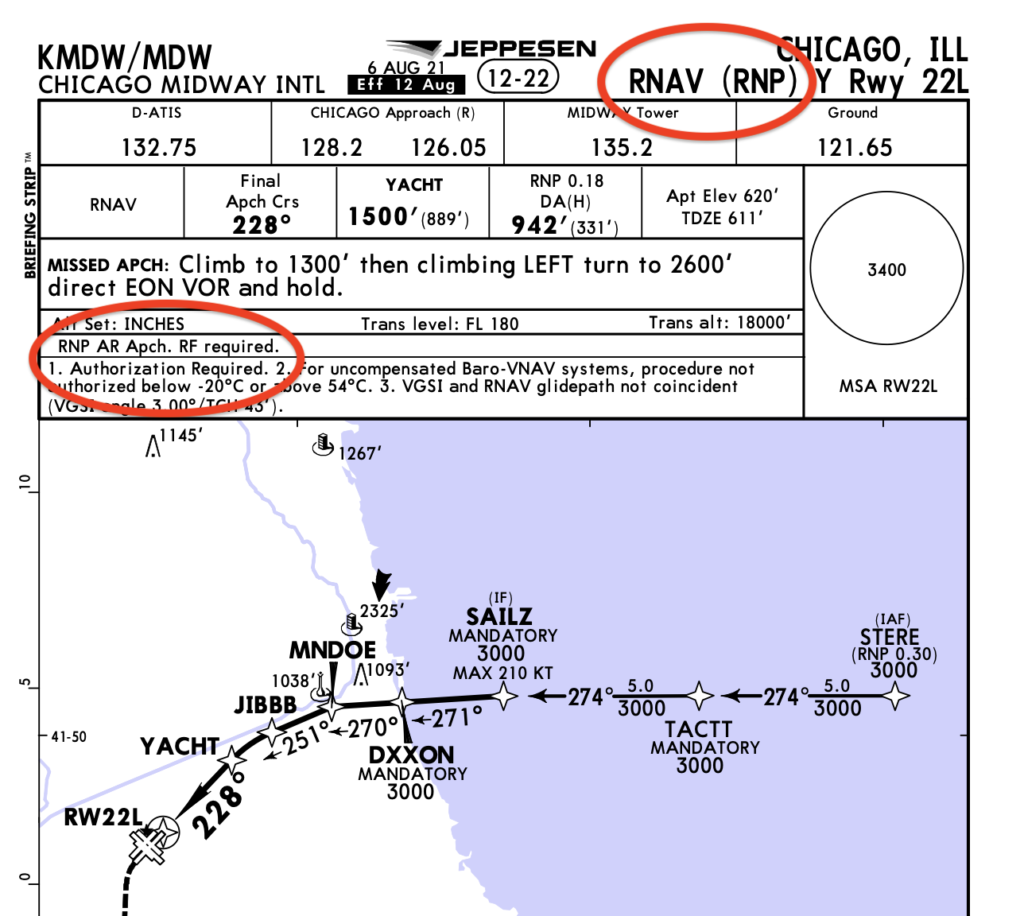
If you’re in the US then your RNP AR APCH is probably going to be called an RNAV (RNP). It should have AUTHORISATION REQUIRED scribbled somewhere on the chart too because, you know, you need it…

You do also get ones for departures too.

Why do we like them?

“An RNP AR APCH (approach) is a procedure that allows for narrow, linear obstacle clearance corridors in the procedure design…”

In other words they help you get into tough places by giving more guidance in a more sort of 3D way.

This means they can have some real funky stuff going on in them like swirly turns, RF (radius-to-fixes) and all that sort of stuff. But if you know how to fly them and are allowed to then this is going to save you a whole bunch of woe in some challenging spots.

Like VNKT/Kathmandu…

Kathmandu?

Yep, Nepal’s main international airport. (They only just built their second international airport in April 2022 over at Bhairahawa).

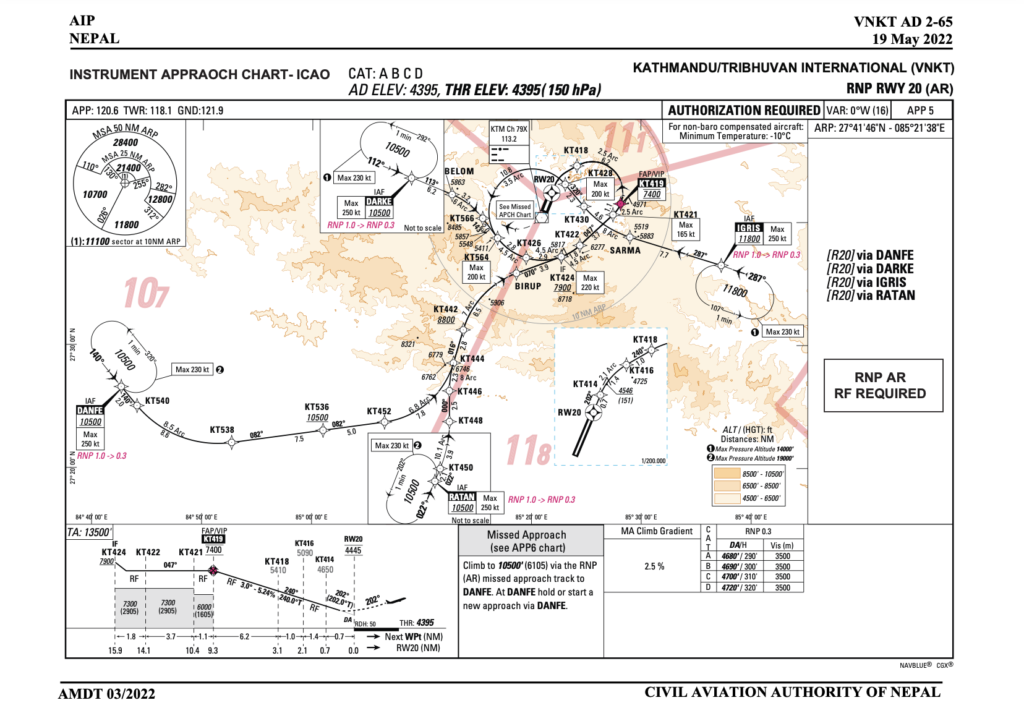
At VNKT/Kathmandu, they just installed some RNP AR approaches which came into effect May 19. And about time too, because this is a mean airport with all that terrain, and before these new approaches you just had some VORs.

You can find the full AIP here.

If they remind you of that old snake game then that’s because there is a lot of vicious terrain in Kathmandu. Which is why RNP AR approaches which let you zigzag between all the mountainy bits are helpful.

Where else are these handy?

Anywhere there is nasty terrain. Alaska, New Zealand, Peru, Chile, Ecuador, Indonesia… There is one for Cape Town that massively reduces track miles, another in Guatemala for departure that will help with your payload restrictions…

KPSP/Palm Springs makes excellent use of them, and you will even find them at some major airports which don’t have terrain, because they can ensure traffic remains clear of other airports in particularly congested airspace (KMDW/Midway and KORD/O’Hare for example).

Want more info?

This is a good article from AvBuyer which goes into more depth for those of you looking to retrofit your aircraft.

Here is a presentation from ICAO on it, because who doesn’t love a good powerpoint.


LOAs: Got Your Number?

LOAs. Letters of Authorisation. We have mentioned before about how to get an LOA approved by the FAA. You can read that here.

This post is less about the process of getting them and more about what you actually need them for.

There are a lot of LOAs…

First up, if you’re a Part 121 operator, or a non-US registered operator then this probably isn’t going to be very useful for you. Go read something more interesting like this story about a guy who definitely didn’t have an LOA for his operation.

For those it does apply to – you need an LOA for any operation which needs a “long term, specific permission”. It lets you do stuff, and what you are approved to do via your LOAs is recorded in your Opspec. Any specific operation probably needs an LOA which is why there are a lot of them, and also why it can get confusing trying to work out what you need – when, where and for what.

Now, we find the folk at AviationManuals really helpful with all this. They have a great (free) guide on how to get LOAs and it includes a handy bunch of tables which show you what you need for where and for what. Like this one for Part 91 ops.
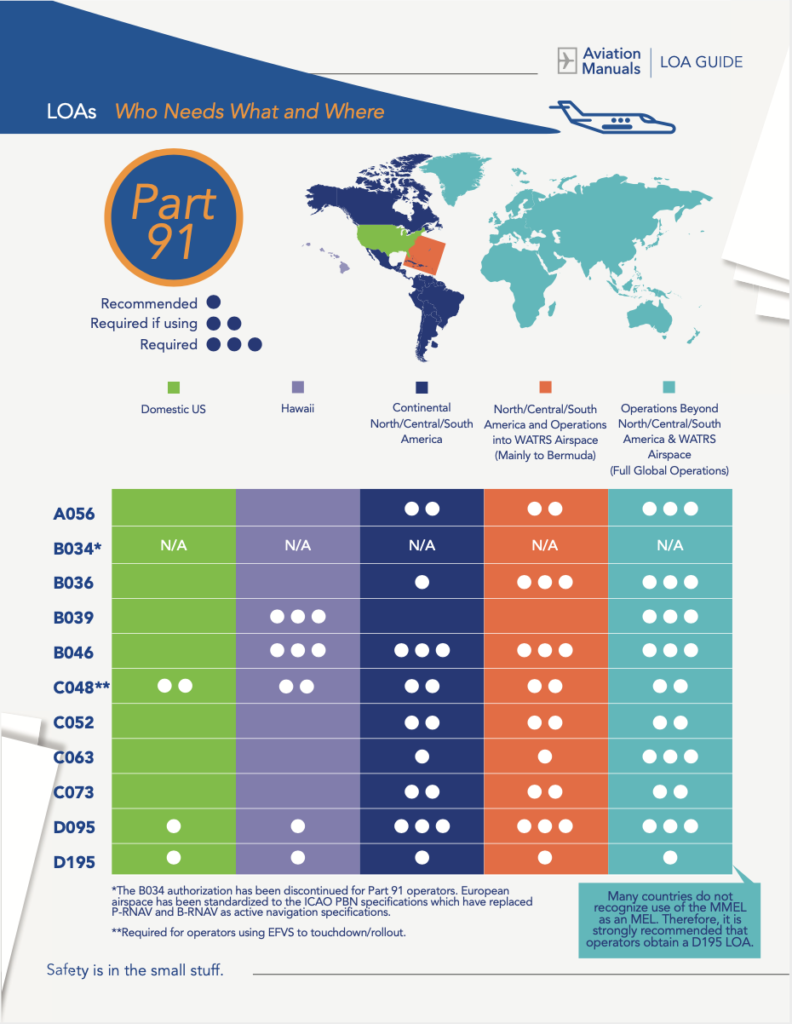
Here is a quick rundown on the main LOAs you might need for your operations. If you still have questions afterwards then you know who to go ask for more info.

So, the ones to know.

Like we said, there are a lot of LOA options. The “big ones” that you are probably going to need are these…

A056

This is your Datalink Communications LOA (for CPDLC / ADS-C). If you have datalink systems installed and plan to use them outside of the US then you need this LOA. If you are Part 91 and only plan on using your datalink domestically then you don’t need an LOA.

This is not constrained by altitudes but rather to where FANS 1/A+ is mandated. If you think you will go through an airspace with a Datalink mandate, then having this LOA is probably a good idea.

B036

Oceanic and Remote Operations (RNP-10 / RNP-4 / RNP-2). This one looks at stuff like the long range navigation systems you have onboard, and your procedures for using it.

If you are planning on flying in oceanic and remote airspace, and in some spots in the Gulf of Mexico then you are going to need this LOA.

B039

Flights in the NAT HLA will want this LOA. It lets you put an ‘X’ in item 10a on your flight plan – confirming that your aircraft meets the new RNP10 PBN specifications (instead of the old MNPS stuff) and again, that procedures and training is in place.

Now, because this is a little more than just what equipment you got, in order to get LOA B039, you are also going to need a B036 which covers the Oceanic stuff and a B046 which covers the RVSM stuff – two other things you need to know about if you are flying across the big, reduced separation, remote oceanic area that is the NAT HLA.

You might have a B054 instead of the B036 (B054 covers Oceanic and Remote airspace using a single LRNS).

B046 

The RVSM LOA.

RVSM airspace is between FL290 and FL410. Even if you plan on flying above this, it is probably necessary to have the LOA for RVSM because there is a good chance you will, at some point, route through it or potentially have to fly in it if you are too heavy, or meet some mean turbulence or something.

Now, for US ops you don’t need RVSM authorisation if you have ADS-B installed.  Since January 2019 you are automatically authorised so long as you have ADS-B Out fitted (which is compliant with 14 CFR 91.227) and a few other things… one of which is that you don’t operate outside the USA.

So if you’re planning on taking a trip beyond the USA into Mexico or Canada, or further, then you are going to need this LOA.

The C0…s

The big Cs to think about getting are 52, 63 and 73. These give you the authorisation to fly things like RNAV (GNSS) approaches, RNAV and RNP Terminal Operations and VNAV instrument approach and approaches which use an MDA as a DA/DH.

ILS approaches are still a fair old way off becoming obsolete (mainly because of the problems with GPS jamming affecting aircraft capability to fly satellite based approaches), but having the authorisation to fly these might get you out of a spot of bother because there are a lot of parts to an ILS and they do breakdown from time to time.

And the future of navigation is satellite based so it is probably time to think about getting these now, if you haven’t already.

D095

This is the one you need if you want to use a Master Minimum Equipment List (MMEL) as a Minimum Equipment List (MEL).

We talked about that a bit here. The best plan is really to just get an MEL sorted though because the FAA are looking to change the rules on this, and the D095 actually expires fairly soon. Plus, if you fly internationally and only have an MMEL it can get very messy, even with the LOA.

Common Questions

We have covered the basics of what these main LOAs cover. Here are some answers to questions we have seen pop up from time to time.

What is an LOA and do I need it?

Go back to the top and read it all again.

How do I get an LOA?

Check out this post.

I am still confused, who can I talk to?

Talk to these people, they know a lot.

What does “getting an LOA” require?

An LOA is an authorisation to carry out a specific sort of operation. That means you are probably going to need
a) the equipment required for that operation,
b) procedures within your company which refer to that operation, and
c) certain training for your crew related to that operation (which might be required yearly).

So if you are considering taking on ‘some sort of operation’, looking into the requirements for the LOA in advance is a good plan – just having the equipment will not tick all the LOA boxes by any stretch, and an LOA can take several months to be approved.

I am flying internationally but plan to route above the NAT HLA say at FL430, what LOAs do I have to have?

The simple answer if we are just talking “have to have” is B036 or B054 which covers you for the Oceanic and Remote operations.

  • However, you might also want the RVSM one because there is a fairly good chance you will, at some point on that flight, be in RVSM airspace. So throw a B046 in as well.
  • There is also a good chance you will find yourself in some Datalink mandated airspace – it is pretty much all over Europe and beyond – so your A056 might be a good idea.
  • If you have those and are able RNP-10 then you really might as well get the B039 as well since you meet the requirements for it and it might save you a whole bunch of fuel (and trouble) if you have it “just in case”.

That’s all we’ve got to say on the LOA.

For now anyway, but if you think of something we haven’t covered then get in touch or drop those helpful folk at AviationManuals an email.

Our final tip – be careful ‘googling’ LOA because there are some pictures you really don’t want to see of the Loa Loa ‘eye worm’.


Regulatory deadlines on the horizon

Regulatory compliance – nothing quite warms the heart like reading those two words, side by side. This year has seen quite a few changes in this department already (thank you, NAT HLA!), but here is a list of some other regulatory deadlines on the horizon…

Dec 31, 2019 – Operations in North Atlantic

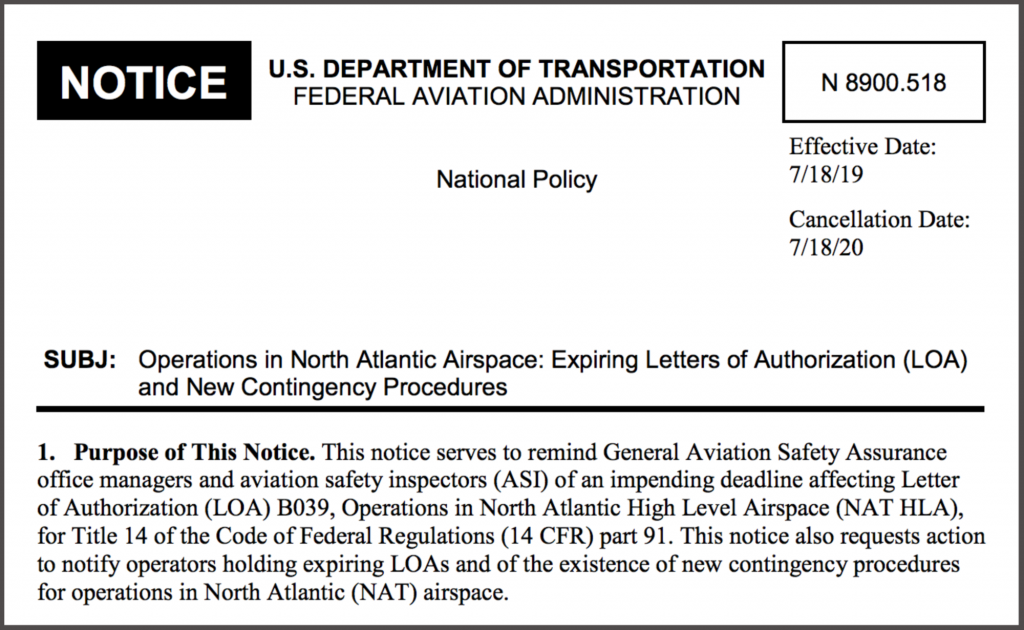
  • U.S. operators must have the revised LOA BO39: “Operations in North Atlantic High Level Airspace (NAT HLA)”. Operators holding the old MNPS LOA BO39 will not be permitted to fly in the NAT HLA beyond this date. Requirements include: RNP10, crew training and new contingency procedures incorporated in company operating handbooks. Read our article here.

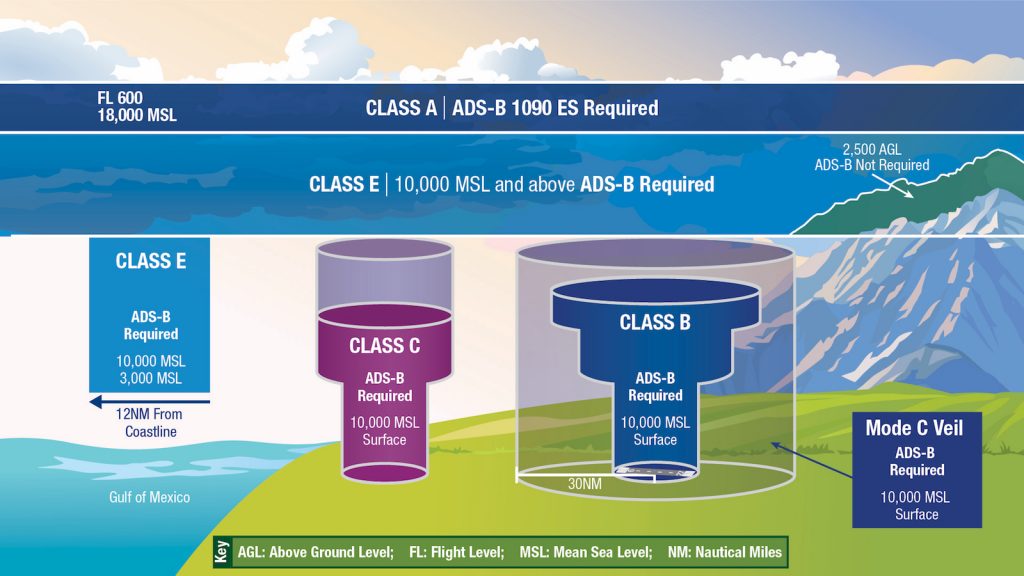
Jan 1, 2020 – US ADS-B Out Mandate

  • ADS-B Out will be required where Mode C is required AND:
  • Class A, B and C airspace, Class E at or above 10,000’ MSL (but not below 2,500’ AGL).
  • Within 30nm of Class B (Mode C veil).
  • Above the ceiling and within lateral boundaries of Class B and C up to 10,000’.
  • Class E over Gulf of Mexico, at and above 3000’ MSL within 12 nm of US coast.

Jan 30, 2020 – Expansion of Datalink Mandate in the North Atlantic

  • Phase 2C of North Atlantic Datalink Mandate. FANS 1/A CPDLC and ADS-C will be required between FL290-FL410 throughout the entire NAT region (previously FL350-390). Read our article here.

Feb 5, 2020 – European Datalink Mandate

  • Initially legacy aircraft flying above FL290 in European airspace were to be equipped with CPDLC capability by Feb 2015. But due to equipage requirements and technical issues the mandate was delayed to Feb 2020, AND, even better, most GA/BA aircraft will be exempt from this. Read our article here.

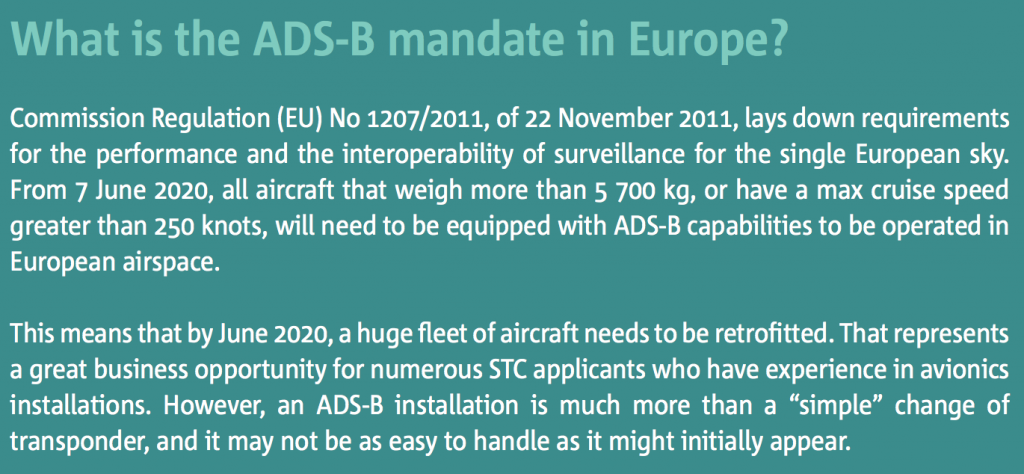
June 7, 2020 – European ADS-B Out Mandate

  • Aircraft flying IFR in Europe with max certified takeoff weight of more than 5700kg (12,566lbs) OR max cruising TAS of more than 250kts must be equipped with ADS-B. GPS sensor with at least WAAS accuracy coupled to a 1090 Extended Squitter transponder required.


DELAYED:

Canada: ADS-B Out Mandate

  • This was planned to be implemented in Class A airspace from Feb 2021, and Class B airspace from Jan 2022. But Nav Canada has now postponed this mandate. They still plan on using ADS-B for surveillance, and this will be used on a priority basis for suitably equipped aircraft starting in 2021, but they say – “non ADS-B Out equipped aircraft will be accommodated within the airspace until a performance requirements mandate can be implemented.”

ALSO ON THE HORIZON:

August 14, 2020 – EU: SAFA Ramp Checks & Pilot Mental Health

  • EASA regulations requiring alcohol testing during ramp checks will take effect across all SAFA participating countries (although some countries have already started doing this: Austria, Belgium, Czech Republic, France, Germany, Greece, Iceland, Ireland, Italy, Netherlands, Portugal, Spain, Switzerland, UK, and Singapore). Tests may also be carried out by local police at any time.
  • All pilots working for European airlines will have access to mental health support programs.
  • European airlines will perform a psychological assessment of their pilots before the start of employment.

Any other biggies that we missed? Let us know!


Your top three PBCS questions answered

PBCS has been an ongoing PITA for some time now. We wrote about it back in March. Here are the top three questions we’ve had on it since then – and now we finally have some answers!

Question 1: What happens if I still haven’t received my updated A056 LOA?

After the PBCS tracks were introduced in March 2018, the FAA published a Notice requiring all N-reg operators to update their A056 LOA authorization – regardless of whether or not they intended to fly these PBCS tracks. For private (Part 91) operators, the deadline to submit the application was 30th September 2018.

There was a barrage of applications, and the FAA still seem to have a bit of a backlog, as even now some operators have still not received their updated approvals.

The FAA’s unofficial policy is that as long as you have applied for a revised LOA, you can continue to use your old authorization after September 30th, while you wait for the new one to be issued.

Bottom line: This means you are allowed to keep flying in the North Atlantic, just not on the PBCS tracks.

Question 2: What about that problem with aircraft with Honeywell systems installed?

Back in March, a latency timer issue with certain Honeywell FMS systems meant that there were bunch of aircraft which weren’t able to get the PBCS approval.

In June, Honeywell issued a service bulletin fix for the issue, available at varying times for different aircraft. Since then, the FAA has been issuing the updated A056 LOA approvals to those aircraft with the Honeywell systems that reflect the new capabilities but the still don’t meet the PBCS requirement of RCP240 due to the latency timer issue.

Bottom line: Now those affected aircraft are able to receive the updated A056 LOA approvals, just with a PBCS restriction – meaning they can continue to operate in the North Atlantic, just not on the PBCS tracks.

Question 3: What the heck is PBCS anyway?

PBCS stands for ‘performance-based communication and surveillance’.

PBCS involves globally coordinated and accepted standards for Required Communication Performance (RCP) and Required Surveillance Performance (RSP), with the goal being to allow the application of reduced lateral and longitudinal separation to aircraft which meet the criteria.

To be PBCS compliant, you basically need CPDLC capable of RCP240 and ADS-C capable of RSP180; this effectively means having a 4 minute comms loop, and 3 minute position reporting.

PBCS has been implemented in various different chunks of airspace around the world, but most notably in the North Atlantic, where the three core daily NAT Tracks are assigned as PBCS tracks between FL350-390. To fly those, you will need to be PBCS compliant (read above) but also have RNP4 (the rest of the NAT only requires RNP10).

Feeling queasy? That’s okay, reading about PBCS makes us feel that way too. If you’re still hungry for more though, check out our recent article on all things PBCS!

More questions? Get in touch!