US Domestic Enroute CPDLC Update
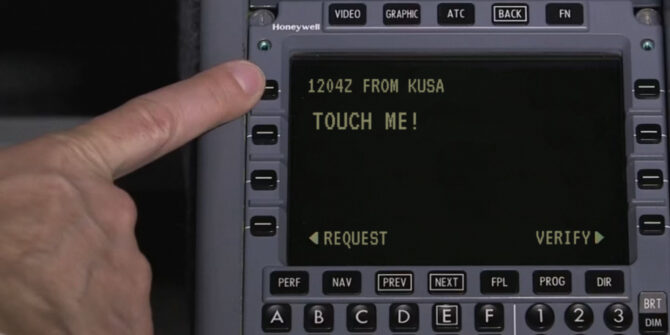
Key Points
  • Domestic en-route CPDLC in the US is now available to everyone – the Notam limiting GA/BA participation to approved trial participants has been removed.
  • To get CPDLC, you’ve got to have the right avionics and submit a form – the FAA has published a list of aircraft types, which you will need to check to see if you comply.

Here’s a very brief summary. For the full, untarnished info, head to the dedicated FAA site here.

So for a long time, domestic en-route CPDLC in the US was only available to operators of bizav aircraft who were signed up to the FAA trial. That trial has now ended, and as long as your avionics make the grade, you can now make use of this service.

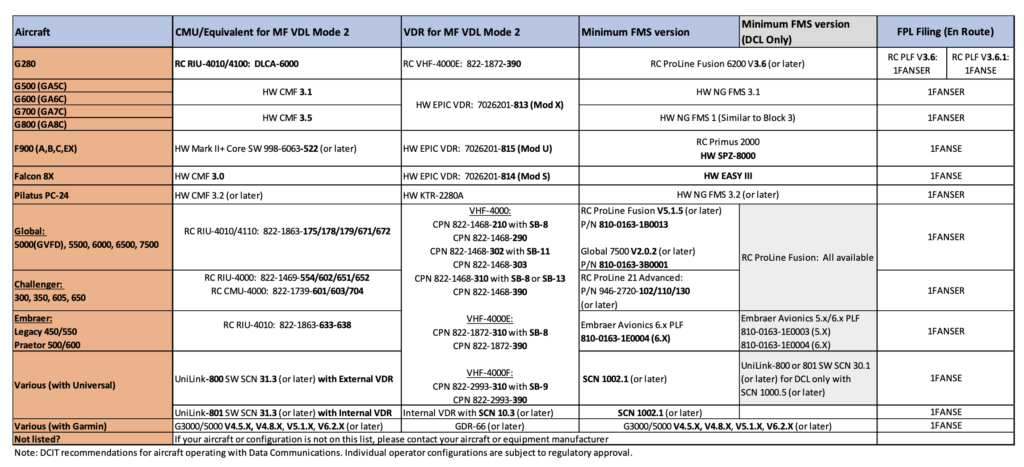
The FAA has published a list with a whole bunch of aircraft types on it.

If your aircraft is highlighted in yellow or green, you can get datalink (as long as you complete and submit the participation form).

If it’s highlighted in red (or not on the list at all), you can’t get datalink.
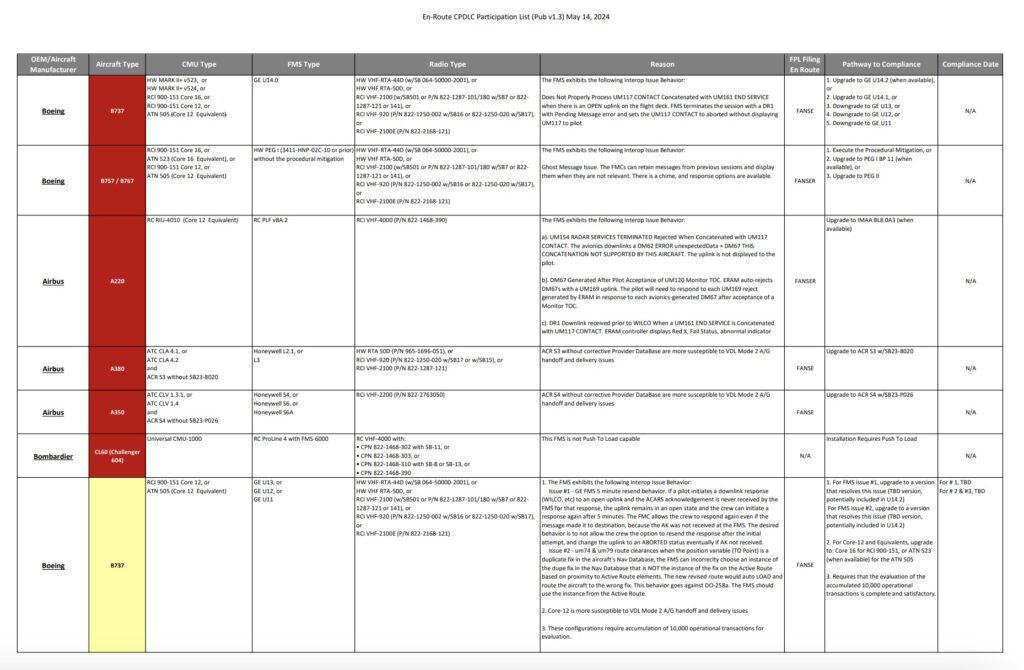
Click for PDF.

L3Harris have provided this guidance:

  • Ensure that your avionics are configured to use VDL Mode 2 as the primary media for U.S. Domestic En Route CPDLC. VDLM2 is the only approved media for participation in the domestic U.S.
  • Ensure that both the ‘J4’ code in the field 10a equipment field as well as the FANSE (e.g. ‘1FANSE2PDC’) DAT Code in field 18 (other information/DAT) are both included on the flight plan to indicate eligibility for U.S. Domestic En Route CPDLC (see the US Domestic Flight and Planning Guide for more information).
  • Verify that VHF3/COM3 is set to DATA.
  • The aircraft registration/tail in field 18 (other information/REG).
  • If you are still researching your avionics in response to questions from L3Harris, please continue to file for CPDLC-DCL only (FANS) until your verification of eligibility is complete.

Also, a member has reported that if you’re now eligible but tried to log on in the past when you were not eligible, your aircraft reg might have been placed on a “blocked list”. To get off this list, you need to contact L3Harris, who will forward to the FAA to ask to unblock you (should take less than 24hrs).

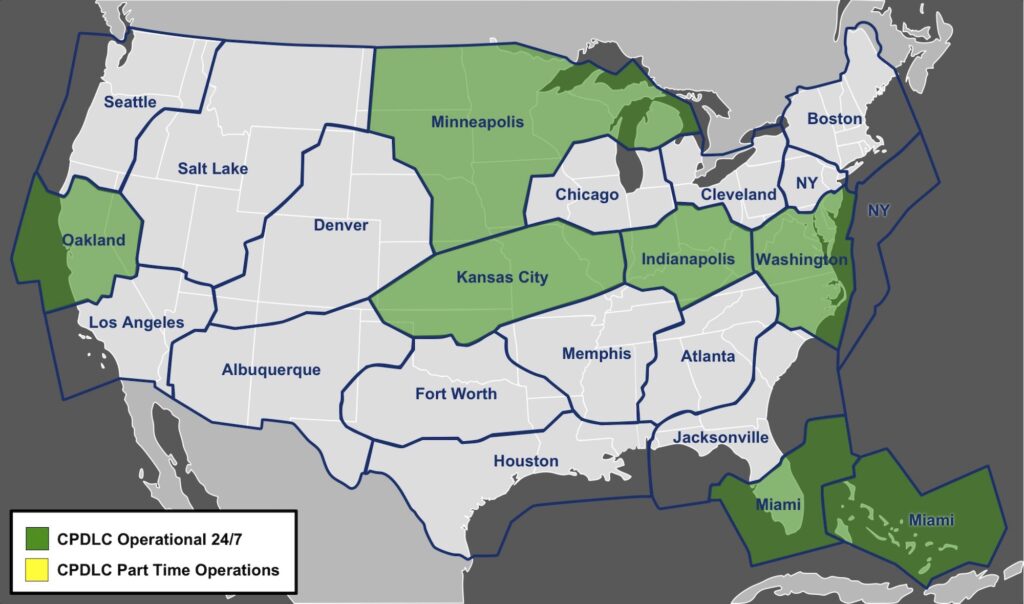
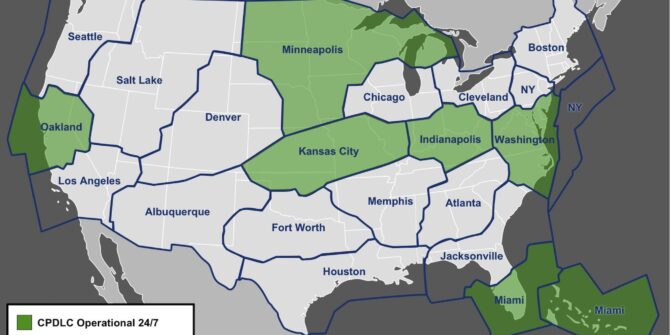
Where is CPDLC available in the US?

L3Harris published this updated map on 3 June 2024:
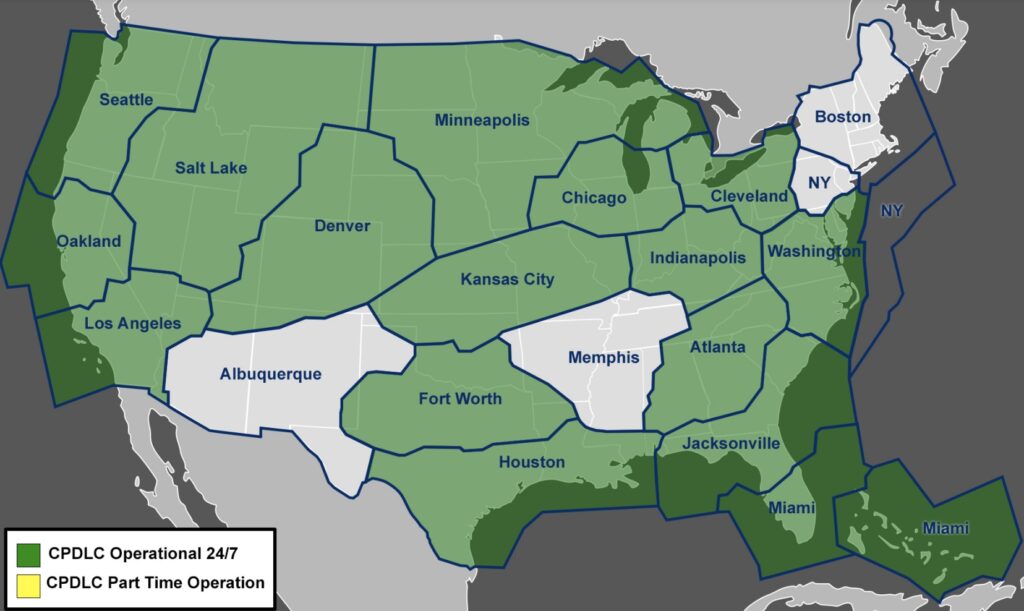
Come on, Albuquerque and Memphis!

So do I need CPDLC now?

No. US domestic datalink is not mandated.

What if I’m flying into the US internationally?

L3Harris have published a guide answering this very question. You can access it here:
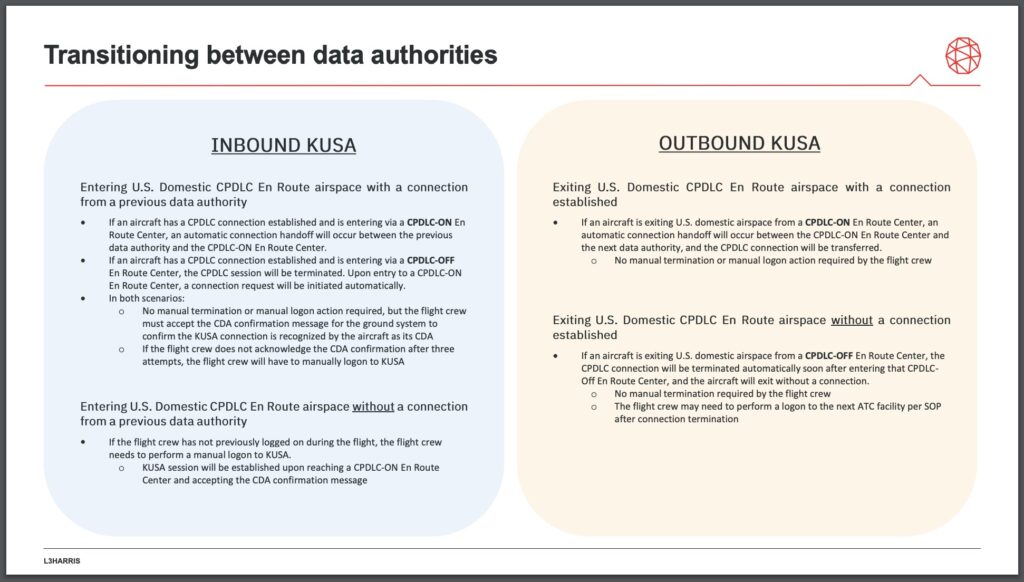
Click for PDF.

For those of you who aren’t so familiar with the US, KUSA is the CPDLC logon code – and that is the one and only logon code you need, all the way across.

What we know about the US CPDLC trial

There is a CPDLC trial running in the US, but it isn’t open for everyone…

General CPDLC stuff

CPDLC is basically a sort of ‘text messaging’ system that lets ATC contact you, and you contact them.

Combine it with ADS-C and you’ve got Datalink, which is mandated in a bunch of places like the NAT HLA, Europe and the UK above FL290 etc.

Some other useful info:

  • Europe have a logon list. If you want an answer then register.
  • Europe use ATN, everywhere else uses FANS. If you only have FANS then you can still call yourself ‘CPDLC in Europe’ if your original certificate of registration is pre 2018.
  • Just to be clear, the US requires FANS 1/A.
  • If your airplane is younger than 2014 then the system also needs a message recording function.
  • PBCS tracks need a performance standard of RCP240 (ADS-C is RSP180).
  • AO56 is the LOA to get (or maybe A003).

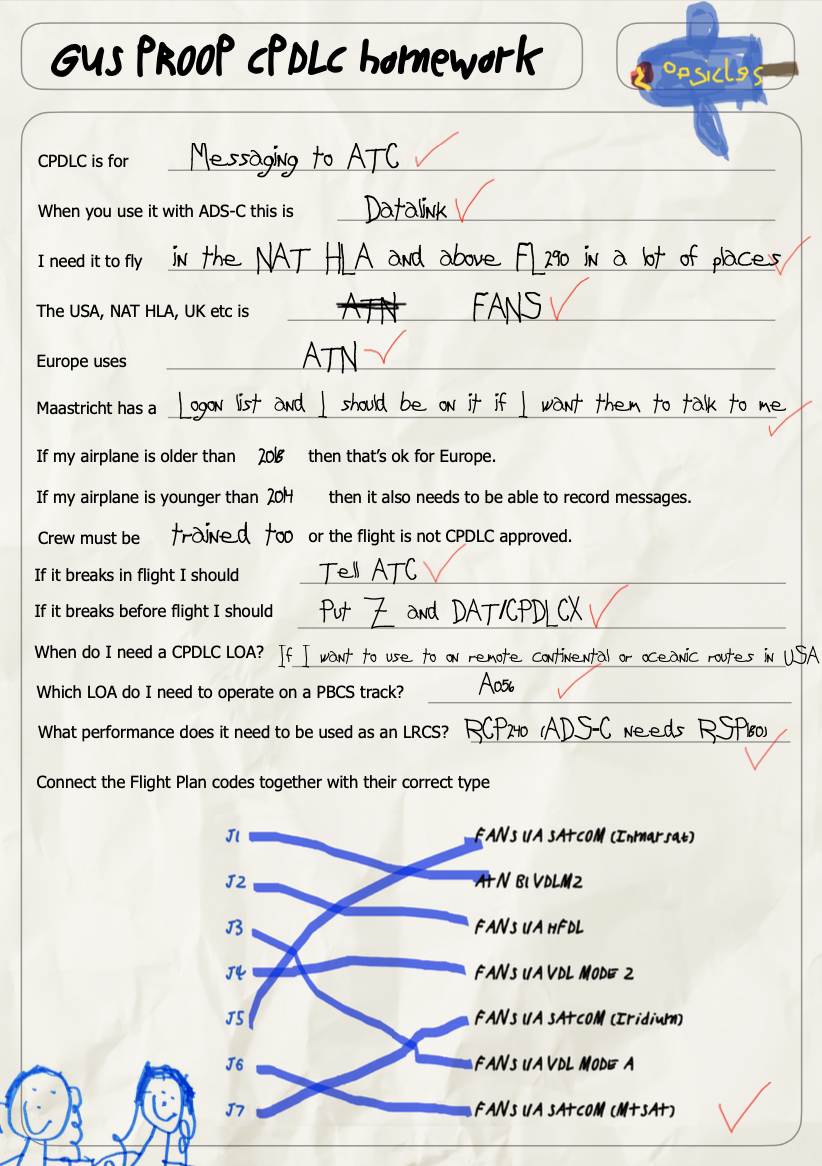
We actually made A little Opsicle on CPDLC just the other day. It is quite a silly one, but here it is if you want a look:

CPDLC in the US

The US has CPDLC in a bunch of places. It isn’t really mandatory yet though. At least not the domestic en-route CPDLC. This is the bit they are running a trial for, and they’re doing it with L3Harris.

The trial is actually, specifically, for the business and general aviation community. The likes of Boeing and Airbus (or rather their avionics configurations) have already been approved.

So, here is the FAA info on it. Or rather, this is the notice talking about who can participate in the trial. They released this because a bunch of folk were participating, but their avionics version or configuration wasn’t good enough and it was messing up the results.

So how do you know if you’ve got what it takes?

All the systems are listed on the L3Harris site. If your aircraft type is missing from the Trial List (shown below), this means that operational acceptability hasn’t been determined yet for that specific aircraft type. If that’s you, you can fill in the form and email it to them at DCIT@L3Harris.com and they will check to see whether you have the spec to participate in the trial.

If your aircraft type (system) is not on it, then don’t file as capable of en-route CPDLC and don’t try and ‘participate’.

For those of you who are on it…

Here is a map of current active CPDLC sites:

ZID/Indianapolis, ZKC/Kansas City, ZMP/Minneapolis, ZDC/Washington, ZOA/Oakland, and ZMA/Miami en-route control facilities are all up and running 24/7 now.

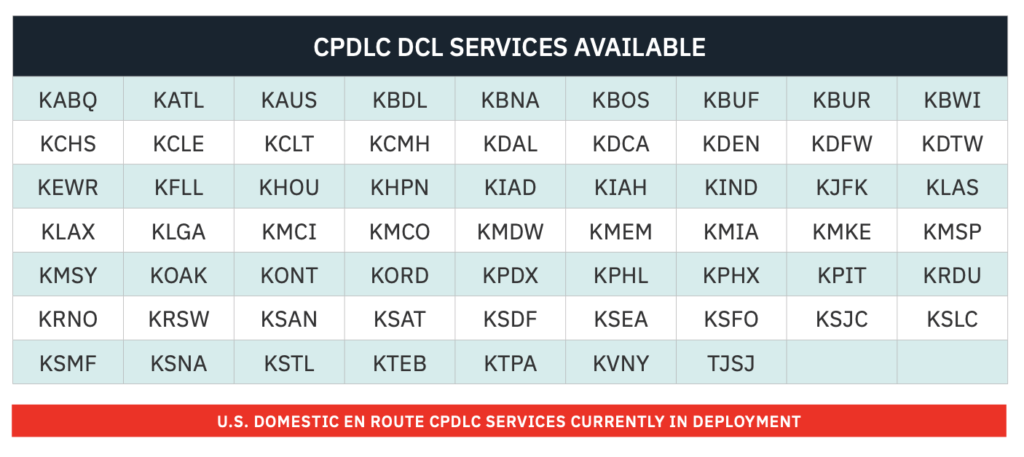
We’ve so far only found a table showing 61 airports where CPDLC DCL services are currently available:

But we know this is a bit out of date. We’ve counted 65 airports currently operational including these:

  • KJAX/Jacksonville
  • KPBI/Palm Beach
  • KCVG/Cincinnati/Northern Kentucky
  • KADW/Joint Base Andrews

Some stuff on using it

OK, so if you take-off from an airport that has CPDLC DCL and which is in an en-route CPDLC area then KUSA (because they’re who you’ll basically be logged onto on the ground) is going to stay active and there is nothing else to do once airborne.

If you take-off logged onto KUSA and only get into the en-route CPDLC bit later then again, KUSA stays on and there’s nothing more for you to do.

If you take-off logged onto KUSA and then are leaving all CPDLC airspace, it will auto log off when it needs to.

For all other scenarios, you probably need to manually log on when you reach the place where CPDLC is available.

KUSA is available on the ground in the lower 48 states, San Juan and Puerto Rico.

This info is all available here.

L3Harris are very active in all this and get in touch if they spot any irregularities with aircraft involved in the trial (nice to know they’re out there, watching).

Handing over the ‘info baton’

So far, all this has been snatched from a bunch of very handy guides that L3Harris publish, so here are the links to those for further info:

And if you are an operator in the US with questions about this, then speak to these folk – DCIT@L3Harris.com


CPDLC Departure Clearance for US Airspace – 22Oct

Earlier this month we reported about the transition of the United States ATC system to a National Single Data Authority (NSDA). https://ops.group/blog/cpdlc-for-us-airspace-the-implementation-process/

The initial phase of this process is scheduled to start this weekend on 22Oct at 0330Z with a single CPDLC logon ID for domestic US airspace (KUSA) and ATC issuing departure clearances using CPDLC.

You can read more details about Controller-Pilot Data Link Communication–Departure Clearance (CPDLC-DCL), general procedures for logging on/notifying, loading the flight plan, receiving the CPDLC-DCL, responding to the CPDLC-DCL message, and disconnecting/logging off  here:

NAS Data Communications Guide