Aug 2023: Who wants to overfly Afghanistan?
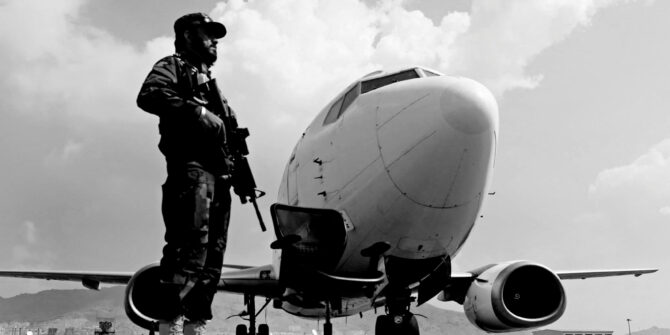
No one! There’s no ATC service across the entire country, there’s a seemingly endless list of surface-to-air weaponry they might start shooting at you if you fly too low, and if you have to divert then good luck with the Taliban.

US operators can now overfly Afghanistan

The US FAA has just published a new SFAR for Afghanistan which amends its airspace warning for the country. US operators are now permitted to overfly the OAKX/Kabul FIR at FL320 and above.

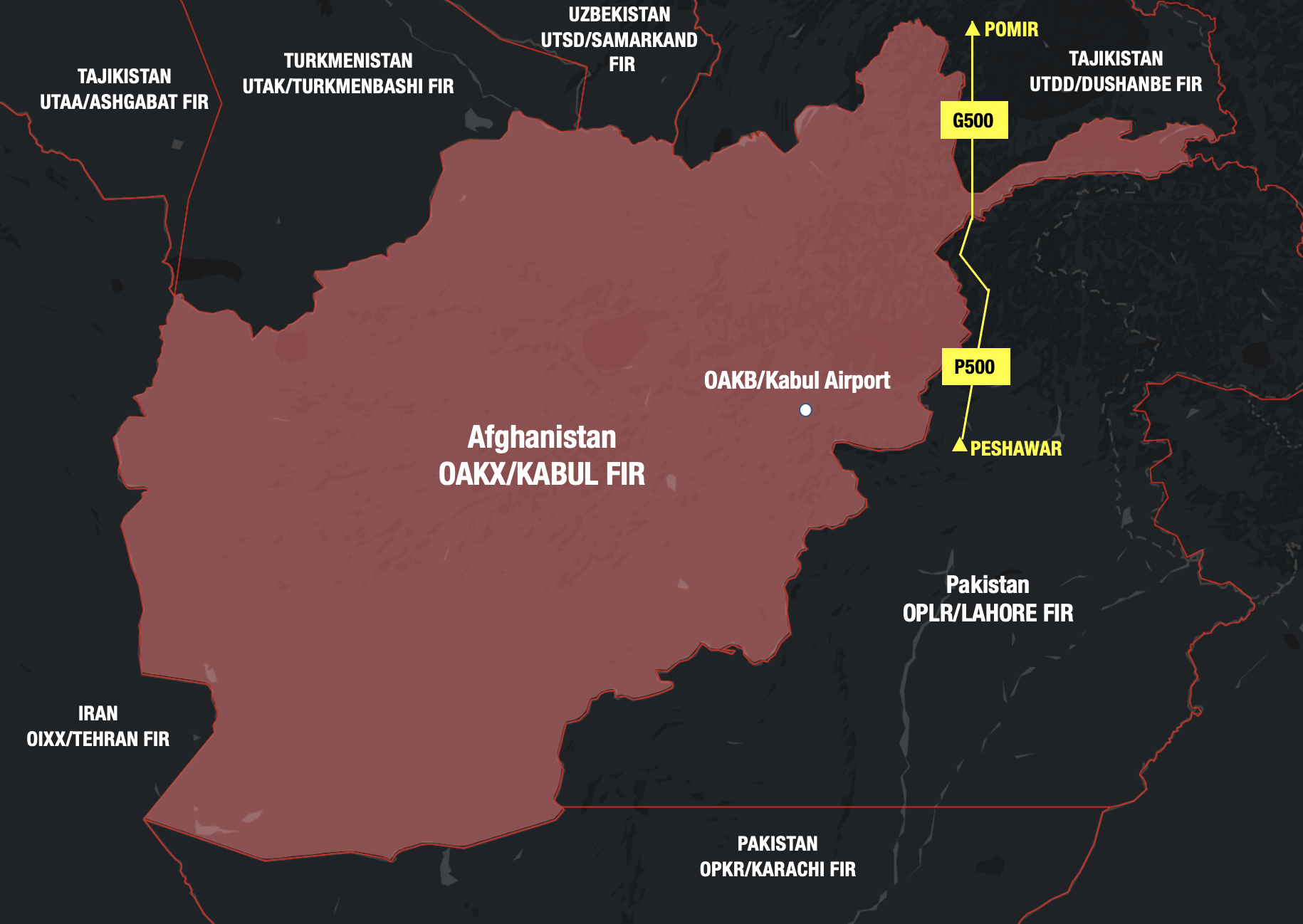
Previously, flights were only allowed on airways P500/G500 in the east of the country. This made more sense from an airspace-risk point of view, as flights on these routes transit Afghan airspace only very briefly.
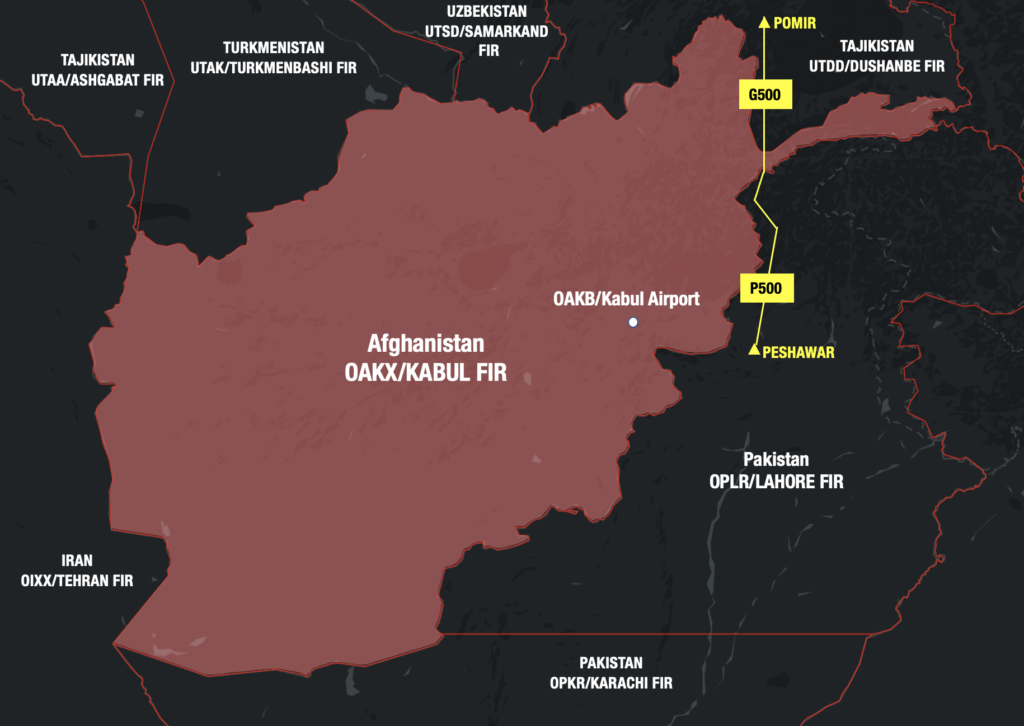
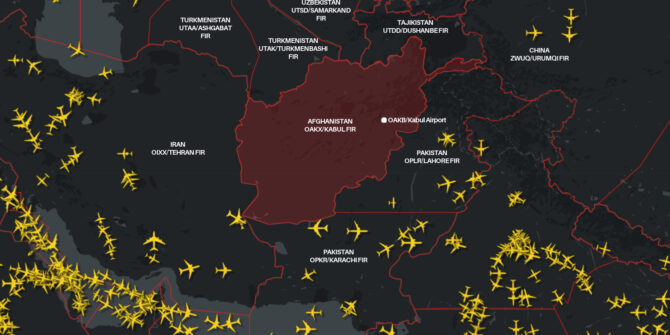
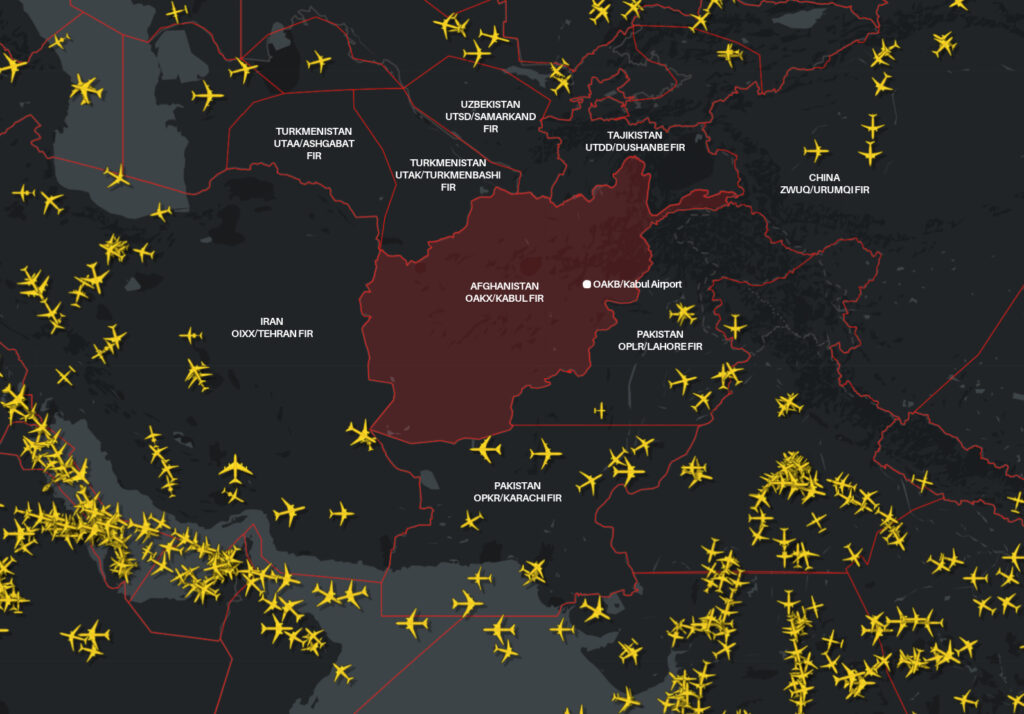
But now, if you’re a US operator, you’re no longer limited to those two airways – you can fly where you like across that big red blob as long as it’s at FL320 or above.

The US are not the only ones who have eased their airspace warning in this way. EASA also recommend FL320 or above, and Germany say FL330 or above. All the other countries who regularly issue airspace warnings – France, UK, Italy, and Canada – say that overflights should only be on those P500/G500 airways.

Why the change?

To understand the rationale behind the FAA’s easing of the airspace warning, the place to head is the “Discussion of the Final Rule” section in the SFAR.

Here’s a summary:

  • Essentially, the FAA think the only risk at the higher flight levels is the lack of ATC.
  • After the Taliban takeover of Afghanistan, ICAO made contact with Afghanistan’s CAA. Together with neighbouring ANSPs and IATA, they published a Contingency Plan for the resumption of overflights of the OAKX/Kabul FIR. 
  • With this specific risk diminished, the FAA now allows US operators to overfly Afghanistan at FL320 and above.
  • The FAA still considers altitudes below FL320 hazardous for flights due to ongoing security risks from Taliban and ISIS. They cite the possibility of access to various weapons by terrorist groups, including MANPADS. Cross-border attacks into Pakistan by VEOs pose additional risks below FL320.

How do the Contingency Procedures work?

You can find these on the Afghanistan CAA homepage, or by clicking below:
Download PDF.

This Contingency Plan is activated by Notam, and applies when the Kabul FIR is unattended – which has been the case for some time now.

In a nutshell it relies on adjacent FIRs coordinating with one another, and with aircraft to make sure they follow assigned routes and assigned levels while transiting Afghan airspace to reduce collision risk.

They are effectively broken down into two sections – lower airspace (FL160 – FL290) and upper airspace (FL300 – 510).

Lower Airspace

We’re not really interested in this, because we don’t want to fly at these lower levels! But anyway, here’s how it works:

  • OAKB/Kabul, OAMS/Mazar-e-Sharif and OAHR/Herat airports will all provide surveillance services in their terminal areas.
  • When outside them, you must follow a published low-level route. When descending or climbing, remain right of track unless you’re below MSA on an IFR procedure. You’ll also need to make TIBA broadcasts on 125.2.

Upper Airspace

OK, the bit we’re interested in!

The Contingency Plan mentions all the available routes, and the Notams make it clear what levels are available:

OAKX G0306/23 - ALL OVER FLIGHTS SHALL USE THE FOLLOWING 
LATERALLY DE-CONFLICTED HIGH ROUTES (HIGH SECTOR) STARTING 
AT FL360-FL510 EXCEPT ON M875/L509 ROUTES SHALL USE
FL310-FL510 AND P500 SHALL USE FL300-510
TRANSMISSION SHALL TAKE PLACE EVERY 5 MINUTES ON TIBA
FREQ 125.2MHZ FOR THE TEMPORARY PURPOSE ONLY.)
1.FIRUZ-P500-MOTMO(FL300-FL510)
2.AMDAR-M875-TAPIS-L509-LAJAK(FL310-FL510)
3.LEMOD-N644-DOBAT(FL360-FL510)
4.RANAH-L750-BIROS(FL360-FL510)
5.PAMTU-P628-ASLUM(FL360-FL510)
6.SOKAM-UL333-SERKA(FL360-FL510). 
10 JUL 06:50 2023 UNTIL 05 OCT 23:59 2023 ESTIMATED. 
CREATED: 10 JUL 11:34 2023

So here’s what that looks like:
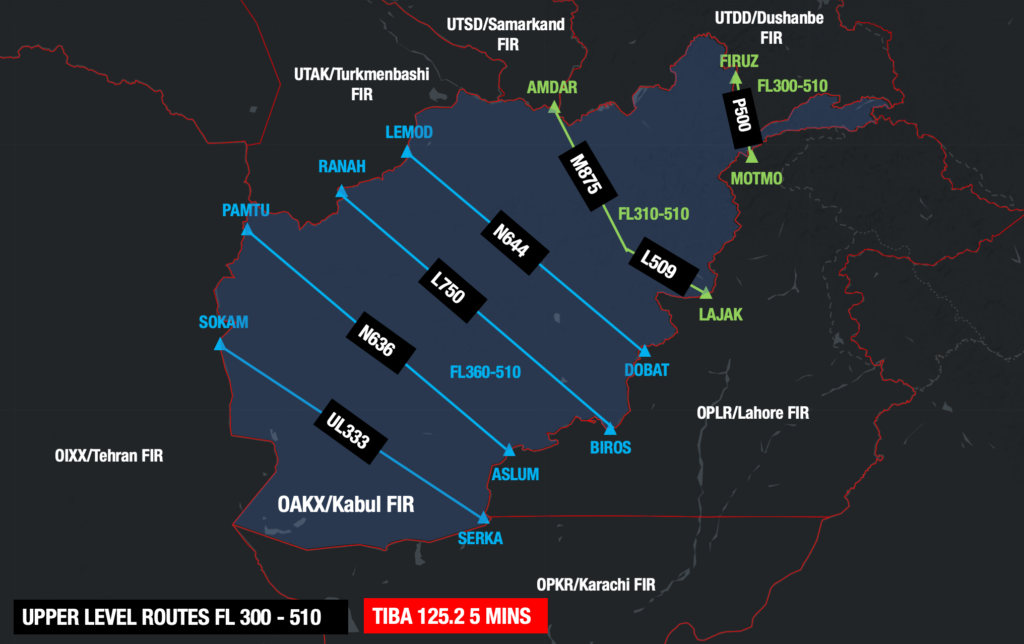
  • These are bi-directional routes, and only available between certain levels (as per the map above!).
  • Try and avoid using FL300. It is sometimes reserved for military traffic as advised by Notam.
  • On entry to the Afghan airspace: adjacent FIRs will apply in-trail spacing of 15 mins on each route at each level. The routes provide at least 50nm lateral spacing. As per usual, westbound traffic should be at an even level, and eastbound at an odd one.
  • While inside the Class G airspace: TIBA procedures will apply at all times on 125.2. Expect to contact the next FIR at least 10 minutes before the boundary on VHF.
  • The good news is that the ‘up-stream’ FIR will also coordinate with the ‘downstream’ FIR to let them know you are coming.

Other Gotchas

  • Despite being Class G, flight plans must still follow the rules found in Afghanistan’s AIP. This includes the requirement for RNAV10 or better, and the submission of your plan to the Kabul FIR via AFTN.
  • Priority will be given to ‘long haul’ international flights in the higher levels. Regional and domestic operators needs to remain in lower airspace.

What are most operators doing?

Avoiding Afghanistan! Just like they did before.
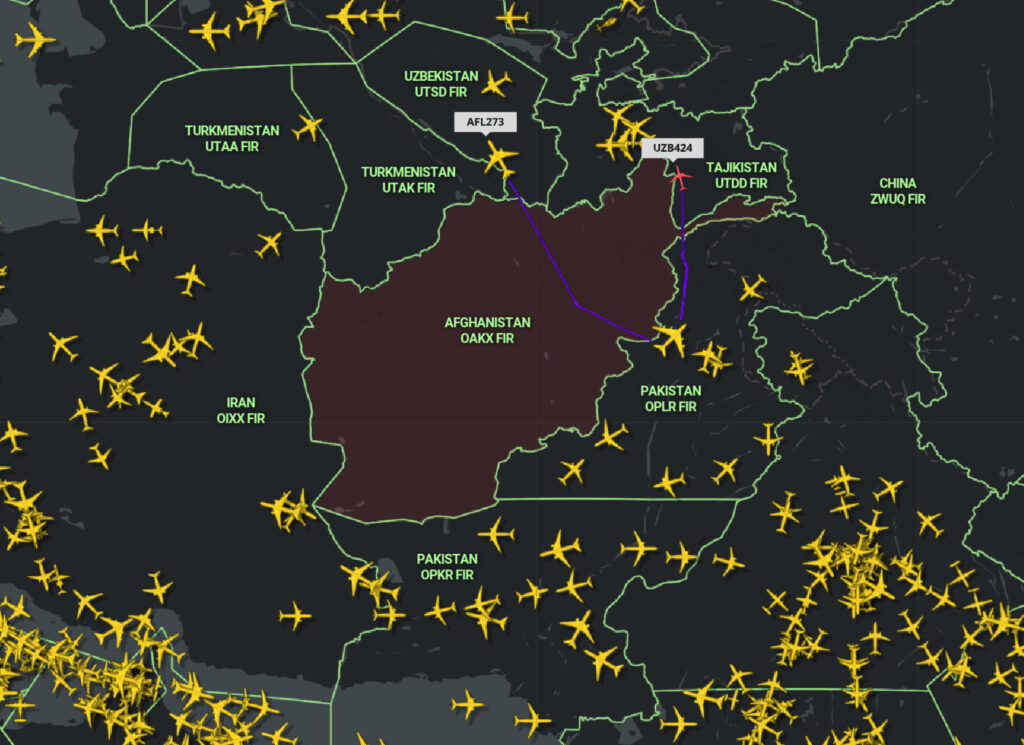
Some are using the LAJAK-AMDAR routing (Aeroflot), some are still using the good old P500 airway in the east of the FIR (Uzbekistan Airways), but most are avoiding the airspace completely.

  • Most major international airlines still appear to be avoiding Afghanistan’s airspace for overflights, although some are still using airways P500/G500 in the east of the country like they did before.
  • Most traffic continues to route south via Pakistan/Iran, or even further south via the UAE and Arabian Sea.
  • There are risk warnings to consider for the airspace on this southerly routing too. Several countries have warnings in place for Iran’s airspace (the OIIX/Tehran FIR), including a total flight ban by the US. The southern part of Saudi Arabia’s airspace (the OEJD/Jeddah FIR) carries risk as well, although there have been no reported drone strikes from Yemen in the past year.
  • To the north of Afghanistan: the options for overflights are fairly limited – via Turkmenistan, Uzbekistan and Tajikistan, avoiding Russia – potentially useful if operating from Europe to the Far East (China, Hong Kong, Japan, etc.)

Should I overfly Afghanistan?

Despite there being contingency routes now in place, and despite the easing of the airspace warning by the FAA, there are still several risks here: lack of ATC, and serious safety and security risks at both the lower flight levels and on the ground.

If you have an engine failure or depressurization, will you be able to stay above FL320 all the way across the FIR? If you had to divert to an airport in Afghanistan, how confident would you be that you would be able to get out again in one piece?

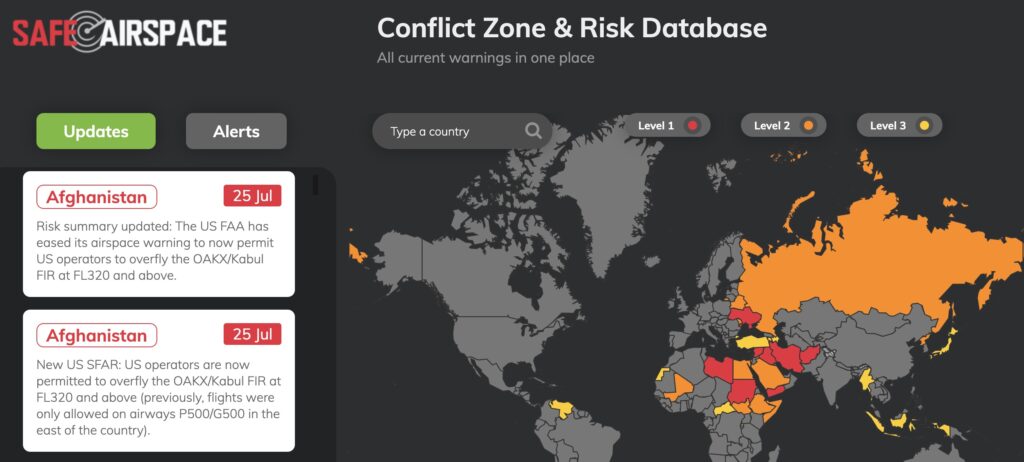
For more info, check Safeairspace.net – our Conflict Zone & Risk Database.

Afghanistan Update – September 2021

The situation in Kabul remains dynamic. An update was issued today regarding ongoing changes within the OAKX/Kabul FIR and at OAKB/Kabul airport.

The full notice issued by ICAO following their most recent video-teleconference is available here.

The ongoing situation

Qatar and Turkey continue to work with the new Afghanistan government to help bring Kabul airport back to operational status, and to restore safe overflights. This includes the repair of damaged radar and other facilities, as well assisting in restructuring the CAA.

Qatar officials are coordinating with the Afghanistan CAA are conducting assessments on capacity and needs. They have apparently deployed a technical team to Kabul to carry out work. The DME has been re-established but notams suggest the VOR remains out of operation.

Turkey maintains a military presence at Kabul airport to assist and is apparently in discussions to help run the airport again – having done so for 6 years previously.

ICAO remain in contact with the Afghanistan Civil Aviation Authority who have provided updates confirming newly appointed members, and a designated point of contact.

Operational updates

  • OAKB/Kabul airport and OAMS/Mazar-e-Sharif airport are both reported to now have limited ATS services. There is a limited tower service to support VFR operations at Kabul between 0330-1330 UTC. Mazar-e-Sharif has an FIS available, but the scope of this is unknown.
    • A shortage of ATC staff continues to reduce capability.
  • Pakistan is assisting Afghanistan in the restoration of the Afghanistan NOTAM service. The service has been partially restored as of Sep 6, and is available via https://www.afgais.com/
    • Out of date Notams remain in the system so caution is advised using the site.
  • The Kabul FIR remains effectively closed to overflights – the OAKX/Kabul FIR is uncontrolled.

Updated OAKX Notams

The following Notams are the up-to-date Notams issued by the restored office.

  • A0721/21 address contingency procedures and advises that aircraft requiring emergency descent should follow ICAO Doc 4444 procedures, but rather than advising ATS, should broadcast on the relevant TIBA frequency. 
  • A0720/21 advises flights will encounter delaying action prior to entering the Kabul FIR to ensure 15 minute separation. This is as per Notam A0715/21 which requires all traffic below FL280 to be spaced at 15 minutes prior to the FIR entry point.
  • A0719/21 advises that the AIS services including Notam office is now operational 24/7.
  • A0718/21 advises that all flight plans must be filed at least 24 hours prior to the flight. The contact email is permissions.acaa@gmail.com.
  • A0717/21 advises PSR and SSR are now available at OAKB/Kabul, with an advisory information service only.
  • A0716/21 advises that OAKB/Kabul is open for domestic and international flights. Operating hours are 0330-1330 UTC.

Our previous post covering the background to the situation can be read here.

The ICAO presentation from the recent video teleconference is available to view here.

IFALPA have updated their Safety Bulletin

Following the notice issued by ICAO, IFALPA updated their safety bulletin for the OAKX/Kabul FIR.

Here are the key changes:

  • Unknown aircraft have been observed on random tracks between FL220 and FL250.
  • There is limited ATS at OAKB/Kabul – radar services are advisory only.
  • The ILS is working, but should be monitored closely.
  • People and vehicles have been seen entering the runway.
  • The status of other airports isn’t known.

Germany have changed their warning

EDWW has issued a new Notam B1244/21 valid from Sep 13. German operators are prohibited from entering the OAKX/Kabul FIR, except for overflights above FL330 on airways P500-G500. The only change is the exception of those airways which connect Pomir in Tajikistan to Peshawar for alternate routing from Europe to Pakistan and Asia.

The US has published some new background info

On Sep 14, the US FAA published a new Background Information note for Afghanistan, following their flight ban issued in August as per KICZ A0029/21.


The primary risk on the ground and at lower altitudes relates to the ongoing threat of weapons activity and terrorist attacks – and following the withdrawal of US and coalition forces there are no longer any risk mitigation capabilities available at OAKB/Kabul airport. Although it is unlikely that Taliban would target civil aviation now that they have assumed control of the country, ISIS and other militant group are still operating in Afghanistan outside of Taliban control.

The primary risk for overflights relates to the lack of ATC service, functioning CAA and air navigation service provider.

Bottom line, US operators are banned from the OAKX/Kabul FIR except for airway P500/G500.

To view all current published airspace warnings for Afghanistan, head to SafeAirspace.net.


Afghanistan: Do Not Fly

US and allied forces have now pulled out of Afghanistan, and the Taliban have taken control of the country. Afghanistan’s airspace is now effectively closed to overflights – the OAKX/Kabul FIR is uncontrolled, and overflying traffic should route around the country.

Overflights

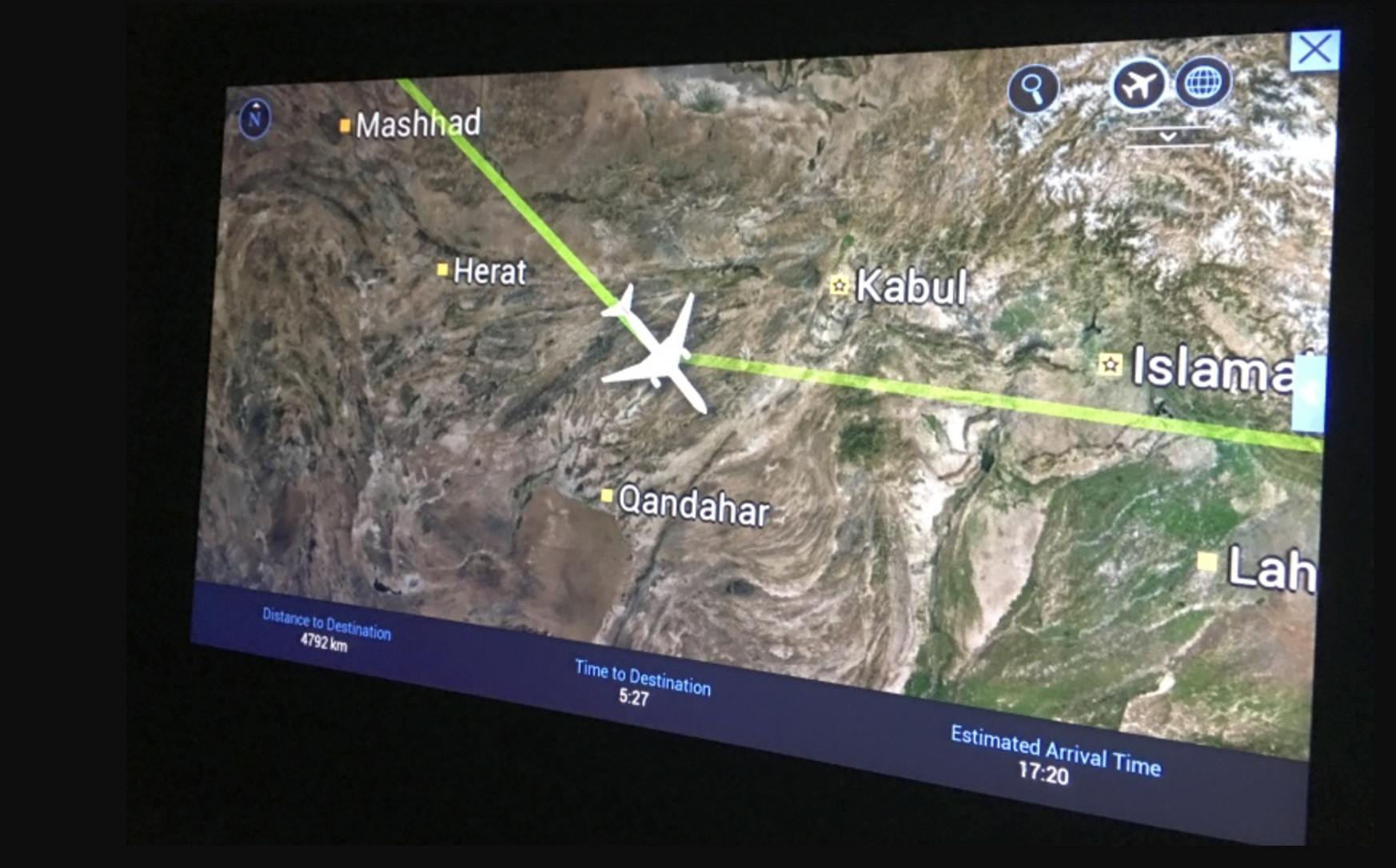
For overflights of the region, flights between Europe and parts of Asia will be those most affected by the effective closure of the OAKX/Kabul FIR. All major international airlines have now stopped using Afghanistan’s airspace for overflights, most electing to route south via the airspace over the United Arab Emirates and Arabian Sea off the south coast of Pakistan.

However, there are risk warnings to consider for the airspace here too. Several countries have warnings in place for Iran’s airspace (the OIIX/Tehran FIR), including a total flight ban by the US, which were issued following the shoot-down of Ukraine Int Airlines flight 752 over Tehran in Jan 2020. The southern part of Saudi Arabia’s airspace (the OEJD/Jeddah FIR) carries risk as well, with increasing Houthi drone and missile attacks over the past year.

To the north of Afghanistan, the options for overflights are fairly limited – via Kyrgyzstan, Kazhakstan, or even farther north via Russia. So these are not really practical unless operating from northern Europe to China, Hong Kong, Japan, etc.

Airspace Warnings

Following the Taliban takeover, several countries have updated their airspace warnings for Afghanistan. The FAA now bans US operators from Afghanistan’s airspace, only permitting overflights on airways P500 and G500 in the far east of the OAKX/Kabul FIR. EASA, along with authorities in several western countries, are now advising operators to avoid Afghanistan’s airspace entirely.

At SafeAirspace.net we are now listing Afghanistan as Level One: Do Not Fly. Check here for a full briefing.


FAA issues Emergency Order for Afghanistan (Updated)

On August 30, the FAA revised its Emergency Order for Afghanistan, with a new KICZ Notam.

Effective immediately, US operators and flight crew are prohibited from operating in the Kabul Flight Information Region (OAKX) at all levels. The FAA cites three specific risk factors: extremist/militant activity, limited risk mitigation capabilities, and disruptions to Air Traffic Services.

The main change is that flights to and from OAKB/Kabul airport are no longer exempt. 

Therefore the only exceptions are now as follows:

1. You can operate in the Kabul FIR (OAKX) if another US government agency authorizes it together with the FAA, or by way of “deviation, exemption, or other authorization” issued by the FAA Administrator. If you do plan to fly, you must call the FAA Operations Center in Washington.

2. You can overfly on one airway: Use of airway P500/G500 is authorized for transiting overflights. (That airway cross the sliver of Afghan airspace in the east of Afghanistan between Pakistan and Tajikistan)

3. If you are experiencing an emergency.

The NOTAM is issued with permanent validity, and is presented in full below.

For further on Afghanistan, pilot and local situation reports, procedures, and assistance:

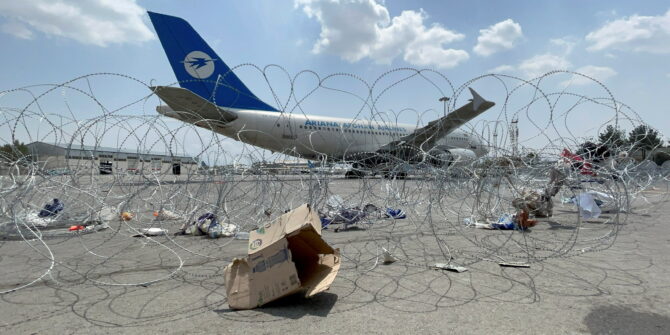
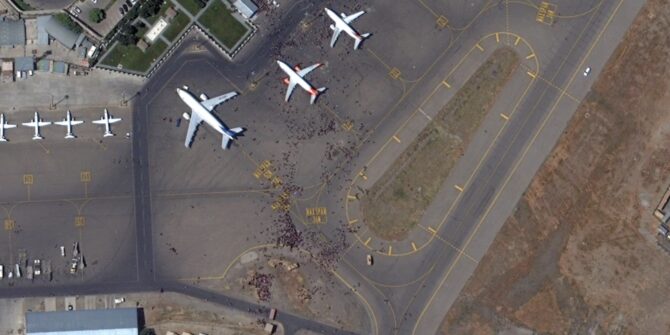
Satellite image via Washington post, Maxar Technologies 2021.


KICZ Notam A0029/21
Issued Aug 30, 1955 UTC
Valid until: Permanent

SECURITY..UNITED STATES OF AMERICA PROHIBITION AGAINST CERTAIN FLIGHTS IN THE KABUL FLIGHT INFORMATION REGION (OAKX)

THOSE PERSONS DESCRIBED IN PARAGRAPH A (APPLICABILITY) BELOW ARE PROHIBITED FROM OPERATING AT ALL ALTITUDES IN THE KABUL FLIGHT INFORMATION REGION (FIR)(OAKX), EXCEPT AS PROVIDED IN PARAGRAPH B (PERMITTED OPERATIONS) AND PARAGRAPH C (ALLOWANCES) BELOW, DUE TO THE RISK POSED BY EXTREMIST/MILITANT ACTIVITY, LACK OF RISK MITIGATION CAPABILITIES, AND DISRUPTIONS TO AIR TRAFFIC SERVICES.

A. APPLICABILITY. THIS NOTAM DOES NOT APPLY TO THE UNITED STATES DEPARTMENT OF DEFENSE. IT DOES APPLY TO: ALL U.S. AIR CARRIERS AND COMMERCIAL OPERATORS; ALL PERSONS EXERCISING THE PRIVILEGES OF AN AIRMAN CERTIFICATE ISSUED BY THE FAA, EXCEPT WHEN SUCH PERSONS ARE OPERATING U.S.-REGISTERED AIRCRAFT FOR A FOREIGN AIR CARRIER; AND ALL OPERATORS OF AIRCRAFT REGISTERED IN THE UNITED STATES, EXCEPT WHEN THE OPERATOR OF SUCH AIRCRAFT IS A FOREIGN AIR CARRIER.

B. PERMITTED OPERATIONS. THIS NOTAM DOES NOT PROHIBIT PERSONS DESCRIBED IN PARAGRAPH A (APPLICABILITY) ABOVE FROM CONDUCTING FLIGHT OPERATIONS IN THE ABOVE-NAMED AREA WHEN SUCH OPERATIONS ARE AUTHORIZED EITHER BY ANOTHER AGENCY OF THE UNITED STATES GOVERNMENT WITH THE APPROVAL OF THE FAA OR BY A DEVIATION, EXEMPTION, OR OTHER AUTHORIZATION ISSUED BY THE FAA ADMINISTRATOR. OPERATORS MUST CALL THE FAA WASHINGTON OPERATIONS CENTER AT 202-267-3333 TO INITIATE COORDINATION FOR FAA AUTHORIZATION TO CONDUCT OPERATIONS.

C. ALLOWANCES. USE OF JET ROUTES P500-G500 IS AUTHORIZED FOR TRANSITING OVERFLIGHTS.

D. EMERGENCY SITUATIONS. IN AN EMERGENCY REQUIRING IMMEDIATE DECISION AND ACTION FOR THE SAFETY OF THE FLIGHT, THE PILOT IN COMMAND OF AN AIRCRAFT MAY DEVIATE FROM THIS NOTAM TO THE EXTENT REQUIRED BY THAT EMERGENCY.

THIS NOTAM IS AN EMERGENCY ORDER ISSUED UNDER 49 USC 40113(A), 44701(A)(5), AND 46105(C).

ADDITIONAL INFORMATION IS PROVIDED AT:

HTTPS://WWW.FAA.GOV/AIR_TRAFFIC/PUBLICATIONS/US_RESTRICTIONS/

SFC – FL999, 30 AUG 19:55 2021 UNTIL PERM. CREATED: 30 AUG 19:59 2021


New overflight charges for Kabul FIR

Effective August 1st, the new charge for overflying the Kabul FIR is a flat fee of $700 USD.

Previously, the charge was $400 USD. The Afghanistan Civil Aviation Authority (ACAA) has determined the increase was necessary to support the additional infrastructure costs now that it manages its own ATC.

The fee applies to all civil flight operations using the FIR to transit enroute, regardless of aircraft size or distance flown.


Midweek Briefing 13JUL: South Sudan off limits, New Zealand airport strike off

South Sudan off limits 13JUL The security situation in Juba, and South Sudan, has deteriorated in the last week, with HSSJ/JUB becoming off limits due to fighting. Read the article.

New Zealand airport strike off 13JUL A planned strike by Aviation Security across airports in New Zealand, which would have led to wide scale disruption, has been called off at the last minute. Read the article.


BGBW/Narsarsuaq Current hours are Monday to Saturday 1000-1900Z. If you want to plan a visit outside these hours, or even use BGBW as an alternate, get permission from bgbw@mit.gl in advance. There will be additional costs, especially heavy on a Sunday.

SBZZ/Brazil is the latest country to wield the threat of shooting down aircraft. Last month we reported on the same language from Sudan, in reference to overflight permits. Brazil’s firm stance is in relation to the Olympic Games, and says that unidentified aircraft that violate the protected airspace around facilities of the Olympic Games in Rio de Janeiro. “We are not playing,” said Defence Minister Raul Jungmann. This is more of concern to a lost C172 than commercial flights (unlike Sudan, which is the reverse), but worth being aware of.

EGPZ/Poland has effectively dispensed with the Schengen agreement for now, expect full border controls at all international airports (ie. Passport check, Gendec).

EGPZ/Scottish FIR The military are carrying out some GPS jamming trials over the ocean from 12-29JUL. If you’re operating in the region of Benbecula VOR, especially west of it, be aware that your GPS might stop working.

OAKX/Kabul Aircraft in the eastern sections of the Kabul FIR can expect some radio issues, as a comm unit (VSAT at Ghanzi) is out of action. The advice from ATC in Afghanistan is to keep trying the assigned frequency until within range of a different transmitter; in the meantime, a bit of SLOP, IFBP and TCAS should keep you out of trouble. See full article.

MKZZ/Jamaica Significant increase in the number of confirmed cases of Dengue fever in Jamaica during the first half of 2016. Dengue fever is endemic to Latin America and the Caribbean and can occur throughout the year.

ENZZ/Norway FIR Plans are afoot to raise the transition altitude to 18,000ft. It’s an age old question, why does Europe have different TA’s, and the US has just one? Together with surrounding countries, and the Irish FAB, this looks to be changing – but it may take a little while. See Norway AIC 7/16.

YBBB/Brisbane FIR (and Melbourne) will be updating their software on the night of 20JUL, with a hefty 6 hour outage of CPDLC and all the other good stuff.

OAMS/Mazar-E-Sharif Fuel payment is now only accepted in cash.

NZZZ/New Zealand A planned strike by two airport workers’ unions and New Zealand’s Aviation Security Service (Avsec) will now not go ahead. The unions sought increases in compensation, and negotiations on their demands will take place in the coming weeks. Read the article

EYPH/Paluknys is a new location indicator for the airport in Lithuania.

ZBDS/Edros – Ejin Horo, China will open to foreign flights this month. We did battle with AIP China for 30 mins to get further info but lost the fight. If you know more, tell us and we’ll share.

HSZZ/South Sudan The ceasefire announced on 11 July is holding. Juba International Airport (HSSJ/JUB) is open to charter operations; however, commercial flights have yet to resume. U.S. government aircraft evacuated personnel on 12 July; however, a security message issued by the embassy later in the day advised U.S. citizens to continue to shelter in place and not attempt to travel to the airport. Meanwhile, other countries, such as Japan, Uganda, and Germany plan to send military aircraft to evacuate their nationals.

SEZZ/Ecuador A large earthquake (6.4) struck on 10JUL just east of Muisne, on the northwest coast of Ecuador. The quake had a shallow depth and followed 10 minutes after another earthquake that had a magnitude of 5.9. Although strong tremors were reported in Esmeralda and Quito, there were no immediate reports of damage. The Pacific Tsunami Warning Center did not issue a tsunami warning following the quake.

UZZZ/Mt. Klyuchevskoy, Russia continues to produce ash that extends up to 25,000 feet. Movement is towards the east at 10 knots.

PZZZ/Pacific Two hurricanes to monitor: The National Hurricane Center is issuing advisories on Hurricane Celia, located more than 1000 miles west-southwest of the southern tip of the Baja California peninsula, and on Tropical Storm Darby, located several hundred miles west-southwest of Manzanillo, Mexico. Tropical Storm 05E (Darby) is on a strengthening trend…and may reach category 1 hurricane stage over the open ocean in a couple of days. For now both are expected to remain offshore.

DGZZ/Ghana African Union nationals whose countries do not have a visa-free agreement with Ghana are now eligible for a 30-day visa-on-arrival for business and tourism. The visa-on-arrival program will be piloted for three months starting at Kotoka Airport and will be extended to other ports of entry in the future. Travellers can extend their visa upon expiry in Ghana, and business travellers can apply for a longer-term visa at a Ghanaian consular post.

BIZZ/Iceland ATC Strike continues, primarily affecting BIKF/Keflavik, BIRK/Reykjavik, and BIRD/Reykjavik Oceanic for International Operators. Restrictions on landing, eastbound, and westbound overflying traffic. Read the article

LTBB/Istanbul FIR If you’ve got some time on your hands, have a look at the Greece-Turkey great NOTAM argument of 2016. This is an almost annual performance, the equivalent of a street argument between two kids.. If you’re busy, just skip all of it when they appear on your Pre Flight Briefing for Turkey or Greece (which they will).

View the full International Bulletin 13JUL2016