Japan BizAv Ops: Haneda, Narita, and Nagoya Explained
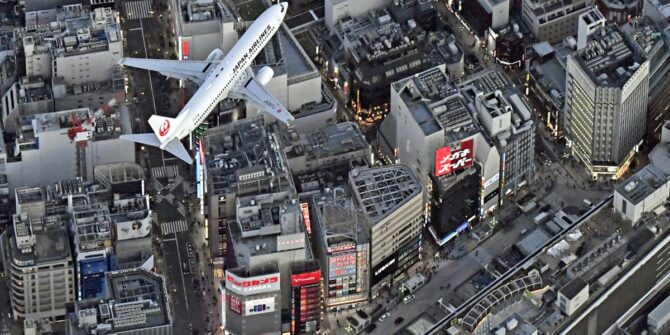
Japan is a great place to pilot a BizJet. It has super efficient ATC, spotlessly choreographed ground handling, and some of the best customer service you’ll find anywhere. But it also comes with a maze of rules, slot systems, strict curfews, and a cultural operating style that does not reward improvisation.

If you have not been to Tokyo recently, or ever, here is the short version. It is brilliant. It is also very easy to get yourself boxed in by paperwork, curfews, and slot rules if you do not understand how the system works.

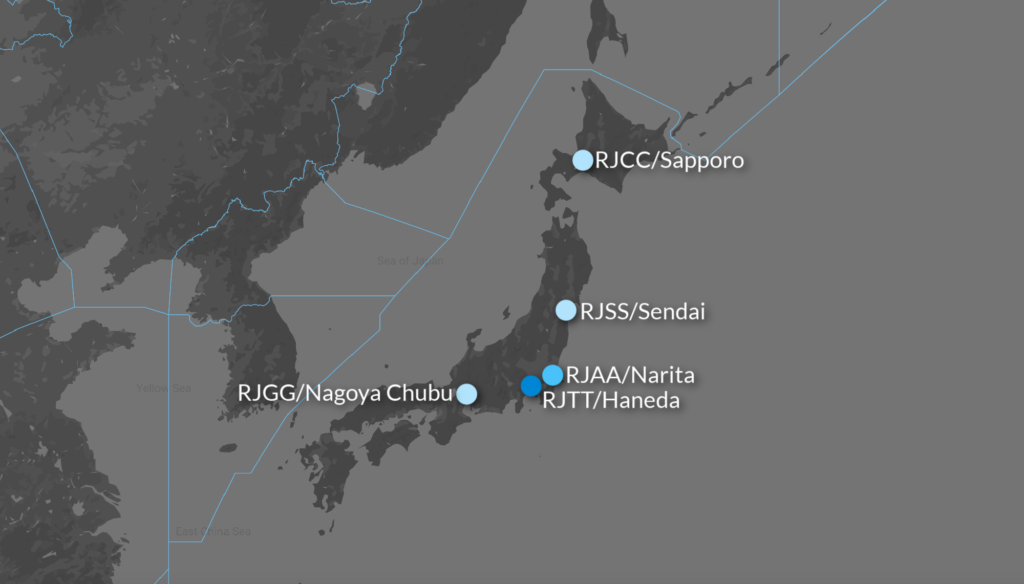
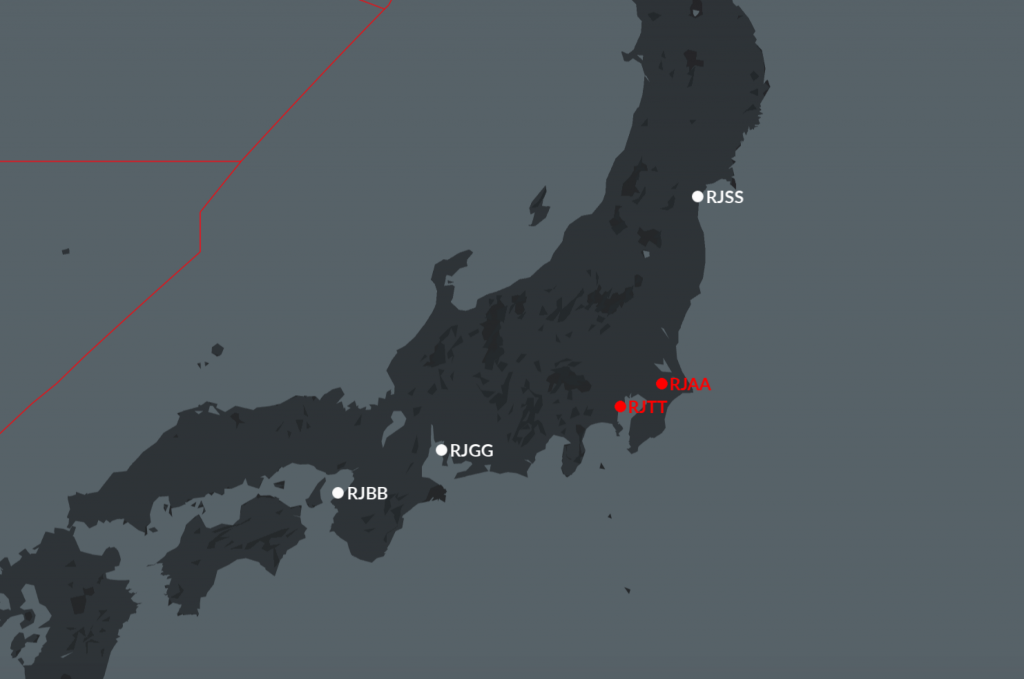
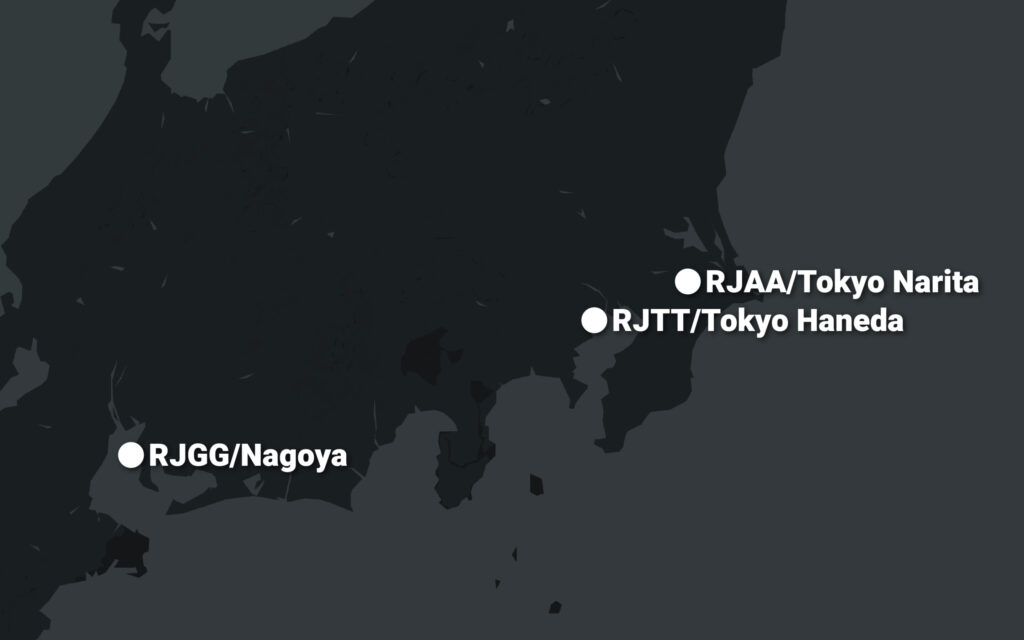
This guide focuses on what actually matters for BizAv crews operating into Tokyo and nearby alternates – RJTT/Haneda, RJAA/Narita, and RJGG/Nagoya.
What Makes Japan “Different”

Three concepts matter above everything else:

  1. Japan is a PAPERWORK country – everything begins and ends with approvals: Airport slots, runway slots, parking slots, customs/CIQ slots… your trip will succeed or fail based on how early and how accurately your handler books these. This is why it is hugely important to work with one who you can trust and have a good relationship with.
  2. They expect you to follow EXACTLY what you filed: Japan does not like late changes, creative ground routing, early arrivals, or “we’ll see how it works out on the day.” If you change anything (ETA, ETD, passenger count) then you can expect to have to get a new approval. You can expect to loose your departure slot if you are not ready on time, and if you are ready early, most likely you will be waiting on the ramp for your allowed departure time.
  3. ATC is world-class, but extremely procedural: Local slang is not a thing in Japan. Phraseology is pure ICAO. But be ready for long STARs, strict speed control and a lot of traffic. Controllers accents can be strong, but what they say, and what they expect pilots to say comes right out of the ICAO rulebook.
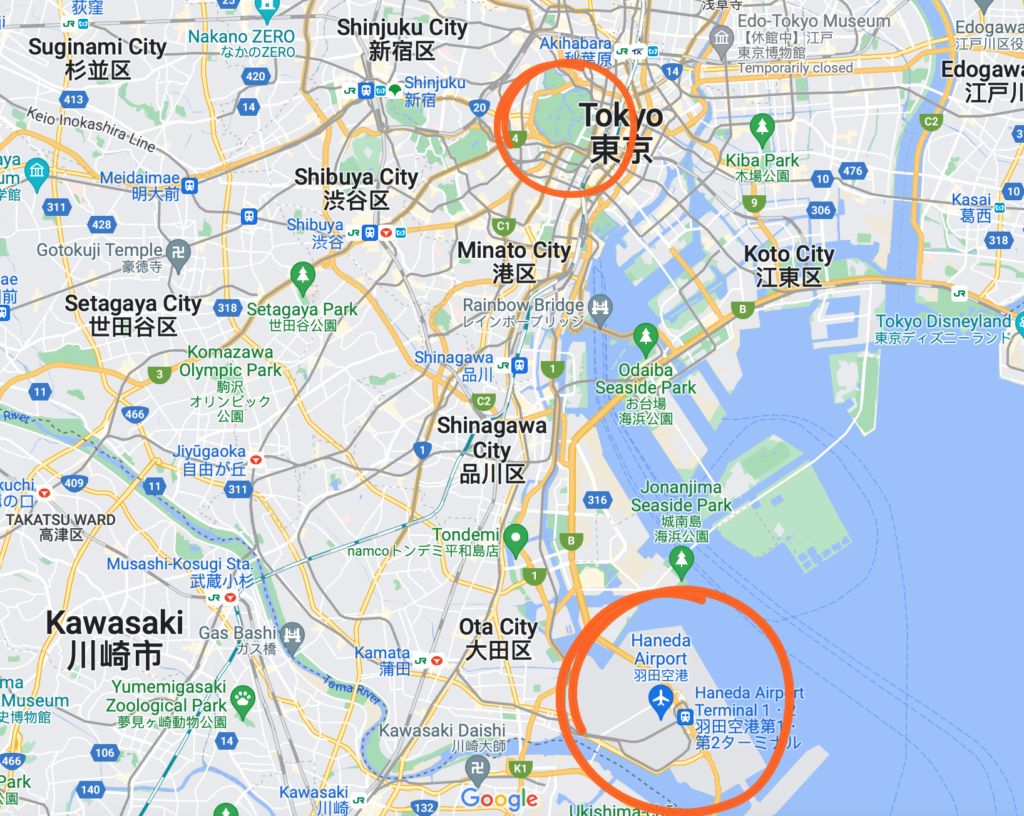
RJTT/Tokyo Haneda: The BizAv Trophy Airport (with a very bad slot hangover for Winter 2025/26)

Haneda is the airport everyone wants, it’s close to the city, has plenty of runways, and easy for pax transfers.  But it’s also the hardest airport in Japan for BizAv access. And right now, it is worse than ever.

The Big New Gotchas at Haneda

  • Slots are at crisis level: Since early 2025, the slots available for BizAv operators have been seen to be drying up, and unfortunately it has only become worse since the Winter 2025/26 schedule began. Day time slots (0800-2300LT) are nearly never available which leaves just some overnight slots open for BizAv operators to pick up. However what you can do with a good handler is secure slots for RJAA/Narita and ask them to keep an eye out every half day for a slot which may have opened up due to a cancellation. I recently had a slot open up in RJTT/Haneda, 30 minutes prior to engine start for our flight into RJAA/Narita, this is how to the wire it can be.
  • Parking remains another challenge: Even if you secure a slot, securing apron/parking is increasingly difficult for BizAv. Remember that you need three slots for operating at RJTT/Haneda. Parking slot, landing slot and a departure slot. 
  • Slot allocation process is rigid: Your handler will take care of this, but the trifecta is a tough one to manage. Your pax need to understand that there must be flexibility in both their arrival and departure time.
  • Competition from the airlines: Haneda prioritises scheduled airline traffic above BizAv. As traffic has recovered since the end of Covid, BizAv has been squeezed out.
  • Parking limitations: There is a hard rule of 4 nights parking, non negotiable. If you need to park for a 5th night or more, than it is time to reposition to RJAA/Narita or RJGG/Nagoya.

Operational Notes

  • Long RNAV STARs: The RNAV STARs into RJTT are long and usually flown in full due to noise over the city. Do not plan on shortcuts, although you may occasionally get a vector or track shorten late.
  • Strict arrival speeds: ATC will assign speeds on arrival and expects full compliance. You will normally be told “resume normal speed” before the approach – that is your cue to slow down, not speed up.
  • Long taxis after landing: Taxi distance depends heavily on the runway in use. Most BizAv parking is on the GA ramp in the N-Area, which can mean a long roll.
  • Turnaround parking exception: If you are doing a quick turn, ATC will often park you on P11 near Terminal 3, which saves time and crew walking.
  • Tokyo Bay fog risk: Sea fog and low cloud are common, especially on winter mornings. Conditions can change quickly.
  • Runway use driven by noise: If weather allows, arrivals favour 34L and 34R. If not, expect 22 or 23 via the LDA approaches. When those are not usable, the airport switches to 16L and 16R. This is all about noise mitigation for the city below.
  • Arrival runway logic: South and westbound arrivals usually get 34L or 22. North and eastbound arrivals usually get 34R or 23.
  • Departure runway logic: North and eastbound departures normally use 34R. South and westbound departures use 05. When the 16s are active, 16L is north or eastbound and 16R is south or westbound.
  • No approaches to 04 or 05: Runways 04 and 05 have no published approaches, so do not expect to land on them.
  • Wind and turbulence warning:When there are strong winds forecast, you can expect a lot of mechanical turbulence and sheer, bug up the speed and stabilise early would be my recommendation. Also watch out for the 1000’ winds, they can often be 50knots or greater and this leads to a very sporty final approach.

Noise Restrictions, Curfews and Operational Hours

  • Noise-driven runway assignment: Haneda uses strict noise abatement and time-based runway patterns. You will be assigned a runway and there is no negotiation. BizAv is typically sent to 34L or 22.
  • Performance-based refusal only: If you genuinely cannot accept the assigned runway, use the phrase “unable due performance”. ATC may accommodate you, but this is not a free pass. The JCAB has been known to meet aircraft on arrival for a ramp check to verify the performance limitation.
  • 24-hour BizAv passenger gate: The business aviation gate at Terminal 3 operates 24 hours, but it is for pax only.
  • Crew screening: All crew clear via the standard crew channel in Terminal 3 alongside airline crew. This can be slow and congested. I would allow at least 45 min from arrival at the terminal to having the APU up and running, an hour would be more comfortable.
  • No APU restrictions: RJTT/Haneda does not enforce any APU restrictions on arrival or departure. This is handy since in the winter it gets very cold (with some snow) and in the summer it is very hot!

Fuel & Handling & Parking

  • Handling: is excellent, extremely polite, and English is solid. But crew must follow the handler’s instructions exactly they’ll tell you when to tow, taxi, reposition.
  • Late changes: Given the slot/parking squeeze, late changes on the day may trigger re-filings with the authority. It is often impossible to shift an arrival or departure time. You have a slot buffer of 30 minutes, be careful not to exceed this, you will be required to report the reason for this to the JCAB.
  • Fuel: Fuel is available in Tankers on the N apron, it is up to 5000USG, so if you need more than that, let them know in advance. For large fuel orders, you can ask for a bay on the P11 apron, they will assign this 1 hour prior to your ETD. But the good thing for this apron is that Fuel is via the underground network so there is not need for a tanker, and it is close to the Passenger BAT.
  • Parking: There are a handful of Power in/out bays (951-954 & 151-155) but the rest are push back (961 – 969) so keep your pins handy. There are some extra bays which could be used, for mid sized aircraft spot 984 & 985 can be opened up.

Crew Logistics

  • Hotels: Haneda is around 15-30 mins to most of the big hotel chains, this is the reason it is so popular for the owners of a Bizjet. Some good options are the AC Hotel Ginza, Tokyo Westin, Prince Sakura Autograph hotel or the Sheraton Miyako. Be prepared to pay though, hotel rates are high, unlike the cost of Jet A1, which is cheap in Japan. especially compared to the US.
  • CIQ: Crew are usually processed as a regular passenger, so they are given a passport sticker, this is good it allows you to roam anywhere in Japan. Watch out if you get given an Orange Shore Pass as this only allows you to roam within 100km of the airport on entry. You will get yourself into trouble if you try and jump on the Shinkansen.
RJAA/Tokyo Narita: The BizAv Workhorse Airport

Narita is the airport that quietly saves every BizAv trip to Japan. The biggest downside is the distance from down town Tokyo. However it could really depend on where the boss’s meetings are, since Tokyo is northeast of Haneda. Generally you should allow 60-90 minutes via limo to CBD Tokyo.

Why BizAv Operators End Up at Narita

  • Parking availability: Far better than Haneda for overnight and multi-day stays. The airport allows up to a months parking and there are some hanger slots available which can be good for the winter time since Tokyo does get below 0c and snows.
  • Slots are still required, but far more achievable: There are 2 runways at RJAA/Narita, but since the majority of domestic flights run from RJTT/Haneda, the airport is not as busy. You generally will get your arrival and departure time of choice. But be wary of the 2300-0600LT curfew. 
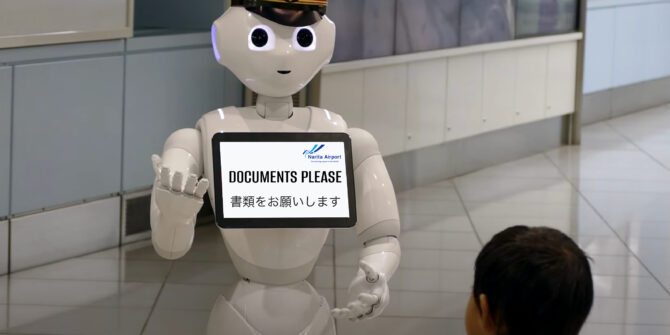
  • Customs/Immigration is smoother for BizAv: The dedicated BAT processes both passengers AND crew so this saves you at least 30 minutes compared to RJTT.

Operational Notes

  • Expect long taxi times: Narita is spread out and there is a farmer who lives nearby the threshold of Runway 34R, he refuses to sell his land, so the airport built around him, give them a wave when you are on Kilo or Lima 😁
  • Arrival and departure runways: You will always land on 34R/16L, and departures are mostly 34L/16R. The only way to get assigned the “long” runway for landing is if it is required due to aircraft performance, and the key here is REQUIRED. If this is the case a simple “Require 34L due landing performance” will suffice and approach will do the rest. But remember the JCAB has been known to ramp check aircraft to take a look at the performance requirements.
  • Seasonal winds can be strong: In the winter, NW winds across the runway 34s are a known challenge. You can expect 50knots or more at 1000’ and it gets very bumpy, so bug up the speed and buckle up. 
  • Take a look at the arrival and departure chart: You will notice that when 16L/R are in use, they will keep you high until abeam the airport and then descend you late downwind and base, this is to keep you clear (to the north) of the departing traffic. Remember that you will always be north of the airport, there is no circuit to the south since that interferes with RJTT.

Noise Restrictions, Curfews and Operational Hours

  • Narita has a hard 2300L-0559L curfew: No exceptions. Well, ok, there is a one hour buffer which the airport can enact if there has been heavy snowfall and they are dealing with deicing. But that’s the only time it happens, and no matter how much you ask, they won’t change this.
  • If your schedule pushes late arrival or early departure, plan accordingly: Let the pax know the hard limit, many flights have been grounded over night because of this. It is an airborne time, not off blocks time.

Crew Logistics

  • Hotels: Lots of hotels nearby, not many western brands (Marriott / Hyatt) but the local hotels are clean and do the job. The airport is a big travellers hub, so the hotels in Narita tend to cater for airline layovers. For longer stays head downtown to Tokyo and you will find a lot of options, although be prepared to spend big.
  • CIQ: Just like RJTT/Haneda, crew are usually processed as a regular passenger. The shore pass issue is the same.
RJGG/Nagoya: The Best-Kept Secret

Nagoya is the dark horse of Japanese BizAv ops. If you need Japan but don’t need Tokyo itself, RJGG is often a dream. Located 150nm south of Tokyo, Nagoya is a smaller city with an airport that punches well about its weight. Your passengers probably won’t choose this place to be dropped off, but when parking becomes an issue further north, then Nagoya is your saviour.

Nagoya is my choice of tech stop when heading westbound from the SA. Many people overlook it, but it’s one of the most efficient stopovers for some fuel before you continue.

What Makes Nagoya Great

  • Parking: nearly always available as are some hangers if you need them
  • Slots: easier to secure.
  • Customs: fast and polite.
  • Ops more predictable: way less congestion than Tokyo. And you can get super quick turnarounds with power in / power out bays and hydrant refuelling.

Nagoya is a great option for quick tech stops on long-range Pacific or Europe legs, or simply as the pressure valve when Tokyo is full – an easy place to park, lay over cheaply, and wait things out while the passengers are in the city.

Operational Notes

  • Winter winds: the bay can produce mechanical turbulence and gusts. So you can except some strong crosswinds
  • Approaches: these are straightforward with no major “hidden” quirks (compared to Tokyo). You will get a nice easy STAR and there is little to no track shortening to cause you foul.
  • More flexible: less stressful from an ops planning standpoint. There is hardly any traffic so very little delays, and you can plan for very quick turn arounds.
Permits, Paperwork, & the “Japan Style” of Operations

Permits – Landing & Overflight

Foreign BizAv flights generally need a landing permit. Lead time for part 135 is at least 3 days but be wary of national holidays. For Part 91 Ops there is no lead time and the permits can be applied for up to the day prior to your operation.

Overflight permits are only required if you are using an aircraft which has special airworthiness permits.

The earlier you submit, the better. And remember that any revision of timing will need to have an updated permit – this can be the tricky part.

Passenger Lists & Crew Data

Japan expects accurate final pax/crew counts ahead of time. There is no passenger e-APIS, a GD to the handler will suffice. Last-minute changes (especially add-ons) can trigger re-submissions and delays.

Domestic Cabotage

If you are a Part 135, then it is impossible. Domestic cabotage is prohibited unless it’s an empty repositioning leg. Passengers cannot join for domestic legs only. As a Part 91 flight, there are no cabotage restrictions.

Handlers

The handler is your trip’s linchpin. They deal with all the bureaucracy (airport authority, customs/quarantine, parking, ramp). If your handler says “this is the only slot/stand we’ve got”, you have to believe it!

Like most places there are many handlers to chose from. I have personally always use Aeroworks (fltops@aeroworks.jp), another very reliable one is Universal Japan (japan@universalaviation.aero).

ATC, Airspace & Flight Planning Quirks

STARs/SIDs

The RNAV/STARs are long and structured. Don’t assume direct routing once inside Japanese airspace. There is Datalink Airport ATIS and the STARs always link up nicely to the runway in use. Pay attention to the ILS since they have both Y and Z iterations. 

Speed Control

The JCAB have a 250kts at 10’000’ and below. Even if you get a “cancel speed restriction” this speed limit remains, only the STAR or SID restriction are cancelled. You will be given speeds to fly. On arrival this is monitored closely so do pay attention to the instructions.

Holding

Tokyo is congested and you could well find yourself in a hold during the STAR. The holds are standard ICAO PAN holds, with a slight twist. The speeds are based on the old PANS OPS doc.

Altitude (feet) Speed (knots)
0-6000 210
6001-14000 220
14001-20000 240
20001-34000 240
34000 & Above 240

Comms & Datalink

Japan now is using Datalink for En-Route control, you can log in via RJJJ.

VHF radio coverage is excellent but remember to keep it standard ICAO phraseology to make everyones life easier

ATIS for most airports can be downloaded via Datalink.

Weather – Don’t Underestimate It

Winter (especially Winter 2025/26)

Expect stronger cold air intrusion earlier than usual in the 2025/26 winter. This is thanks to a La Niña-like system. It will bring an early-season arrival of cold air and increased risk of localised heavy snow on the Sea of Japan side, so RJAA and RJTT will be affected.

Snow does fall in Tokyo although it is not that common. However both RJAA and RJTT do have deicing with Type 1 & 4 fluids available. Expect delays when these procedures are in use. Both airports have Cat III LVO approaches.

Summer

Expect typhoons and thunderstorms! Typhoons will have you relocating the jets and a thunderstorm weather band will give you massive delays. Northern Japan gets very very warm, particularly in late July – September.

Shoulder Seasons

Fog, low ceilings, early morning dew/frost. Strong winds bring turbulence and gusty approaches – bug you speed as needed.

Crew Experience & Cultural Nuances

Precision Matters

Japan expects precision: paperwork, timing, process. This means it is a great experience to operate here, because what you expect is what you get. But make sure you read up about the operation, and check out the airport briefing pages (10-).

Time is precise, if they say your slot is 0900, then you should aim for 0900 at the threshold. But one thing to check with your handler is the slot tolerance, it is generally +/- 30 minutes. It’s worth briefing your passengers that the slot isn’t optional – so a late arrival by them could result in a cancelled flight plan.

Don’t Improvise on the Ramp

Ask your handler for instructions. Turn directions and start up procedures are strictly enforced. Unauthorised stepping into restricted zones, opening panels, crew wanderings are flagged and can slow you down. And you should always wear a safety vest.

Fuel spills are a big deal in Japan. If one occurs the refuel operator will call the airport authorities and you can expect a visit from the JCAB and fire truck. You will have to clean up on the spot (prior to you moving) and there are many pages of reports to fill in.

Cultural Nuances

You may need to use Google Translate or similar – but the locals are very friendly and will help however they can

Don’t tip, it is considered to be rude and so it should be avoided. In the bigger cities, the locals are becoming more tip aware and so if you are in a big city and feel like you would like to tip, then you could.

Keep your voice down, don’t use your phone on the train and make sure you queue up properly (there is always a queue!). Public drinking is legal, however don’t make a nuisance out of yourself!

Final Thoughts

Japan is predictable, structured, and extremely polite – as long as you play by the rules. Tokyo works well if you plan early, lock the slots, and stay disciplined, especially at Haneda during Winter 2025/26. When Tokyo fills up, Nagoya usually saves the day without any drama.

Your handler is everything here. Trust them, follow the plan, and things run smoothly. Try to wing it, and Japan will very calmly, very politely, say no.
Japan Boosts ATC Procedures and Lessons from Haneda

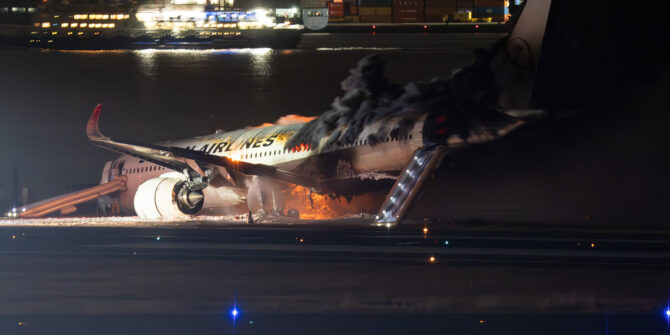
Japan has announced changes (in Japanese) to ATC protocols at airports throughout the country. This follows the tragic collision of an Airbus A350 and Dash 8 on an active runway at RJTT/Haneda on Jan 2.

While we wait for more answers, authorities have been quick to implement new procedures. Here’s what you need to know (translated), if you’re headed to Japan tomorrow.

Visually Clear

Authorities are urging operators to mandate a check by aircrew that the runway is visually clear before landing or entering. In other words – don’t rely on a clearance alone.

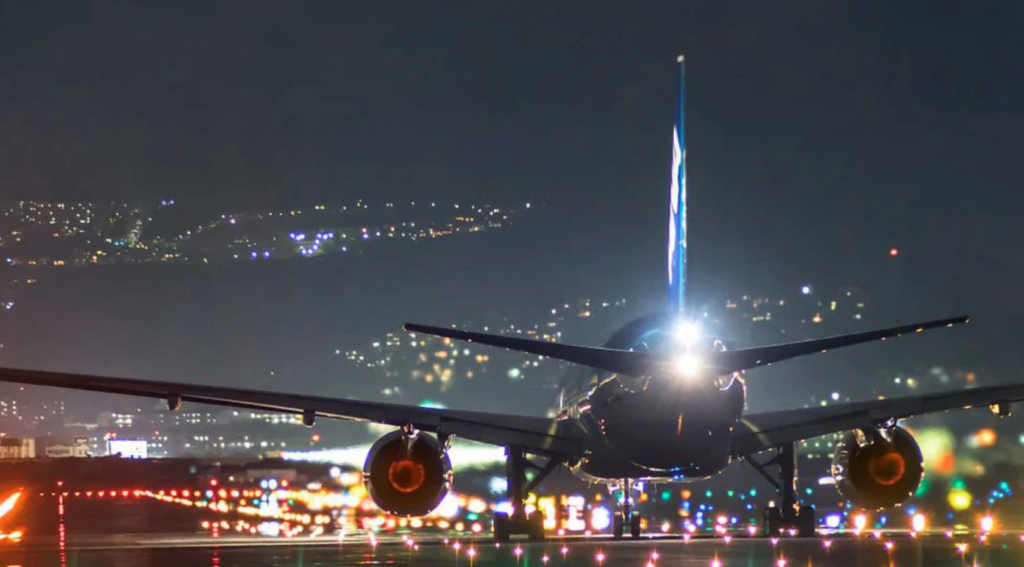
You may need to take this one with a grain of salt. For a myriad of reasons, it may not be practical or possible for pilots to make an accurate assessment that a runway is vacant. Take the example below – how would you fare?

But from an airmanship perspective, the intention is that our eyeballs may become the last line of defense.

Forget your place in the queue

Early indications from the accident transcript indicate that the crew of the Dash 8 may have misinterpreted the use of the phrase ‘number 1’ when cleared to the runway’s holding point.

To a fluent English speaker, the implication may appear quite simple – you are number one in the queue to depart.

But to the crew of the Dash, it may have meant you are number one for the runway.

So, from now on ATC will no longer advise aircraft of their place in the sequence for departure.

Their official note says there are now only four phrases that will be used to imply an aircraft can enter a runway. These are:

  • Cleared for take-off.
  • Line up and wait.
  • Cross runway.
  • Taxi via runway.

If you hear anything else, it is non-standard. Stop and make sure you clarify the clearance.

Behind the Scenes

There are changes happening in the tower too. While they have no operational impact for pilots, it may be reassuring to know about them.

Essentially the bulletin reinforces there will be more staff on hand to constantly monitor ground radar for early detection of potential runway incursions.

And work is underway to improve the visibility of paint and signage at runway holding points, especially where no stop-bars are installed or working.

As a collective, the industry needs to do more

Can I address an elephant in the room?

Having read the above bulletin, I find myself flipping the page over to see what’s on the other side.  I can’t help but ask myself… is that it? 

Japan’s bulletin is, for all intents and purposes a reminder of what should be happening anyway.

In my opinion, it seems to offer little more than a gesture of reassurance that authorities have been seen to act in the face of another tragedy.

The reality is that this wasn’t just a Japan problem. All the warning signs were there before Haneda, around the world.

Have you seen this report? Back in November it was assembled by a team of specialists who cast doubt over the future safety of the US NAS.

In a six-week period, there had been no less than five near-miss incidents involving runway incursions and passenger jets at major US airports. Five, in six weeks – the highest rate in over half a decade.

In the report they identified risk factors (such as staff shortages, aging infrastructure and inconsistent funding) as issues endemic to these near-misses. No amount of bulletin-writing can fix these problems.

With the news that traffic levels will soon surpass those seen before the pandemic, I feel unsettled that the bullish outlook for global aviation is quickly outgrowing the safety infrastructure that protects us.

Perhaps it’s time for us to collectively tap the brakes and put safety ahead of profit, lest Haneda be the first of a number of lessons.

As a parting shot, it’s important to note that technologies already exist to solidly improve runway safety far beyond bulletins like the one above. Take for instance, the final approach runway occupancy signal (FAROS).

This independent and fully automatic safety addition to runway status lights warn pilots on final approach in real time that a runway is occupied. Consider the impact this may have had that evening in the darkness of Haneda’s Runway 34R.

What’s needed is the time, money and willingness of industry stakeholders to implement them. We need to do more to prevent accidents like Haneda, rather than react to them. At the very least, Haneda is a wake-up call that the time to act on truly preventing runway incursions at busy airports is now, and not next time.


Japan Reopens: Crew & Passenger Entry Rules Explained

Japan will reopen for individual tourist travel from October 11. Prior to this, travellers needed to be part of tourist groups, or heading there for business or study purposes. But from Oct 11 anyone can enter!

Passenger rules.

  • Visa free entry has resumed for the 68 countries it previously applied to. Passengers from everywhere else will need a visa.
  • Passengers will need either proof of vaccination (3 doses) or proof of negative test taken within 72 hours before departure.
  • There’s no testing on arrival and no quarantine, regardless of vaccination status. And there’s no more checking of which blue/yellow/red countries you’re coming from – that whole matrix has been scrapped.
  • Passengers are still encouraged to use the MySOS app and register required docs, for fast track entry.

The full passenger rules can be found here.

Crew rules.

  • Just like for pax, you need either proof of vaccination or proof of negative test taken within 72 hours before departure. If you can’t provide either of these, they’ll let you in but you’ll have to quarantine in the hotel.
  • If you have a passport from one of the 68 visa exempt countries, that’s all you need. If not, you’ll get issued a crew shore pass on arrival which allows you to stay in Japan for up to 7 days without holding a visa.
  • Crew don’t need to use the MySOS app. Instead, they should submit a “plan of stay” form on arrival.

The basic crew rules can be found here, which we fleshed out with help from local handling agent Aeroworks. Contact them at fltops@aeroworks.jp for further info.

Are you heading to Japan?

Let us know how it goes! Send us your Airport Spy reports so we can share the gotchas, the things to know, contacts to contact and anything else useful.

What’s Airport Spy? Well, you write a quick little postcard with “what happened” when you went to some airport somewhere. Then you, and others (that’s the magic), can refer to your notes for future flights to the same place. Try it here if you haven’t already.

If you have any further knowledge or recent experience to share, please let us know!


Japanese Prime Minster Funeral: Tokyo Restrictions

Japan is hosting a state funeral for former Prime Minister Shinzo Abe in Tokyo on September 27.

While airport operations should not be disrupted to the extent London airports have been for Queen Elizabeth’s funeral (a noise thing), you can expect some disruptions (a capacity thing).

The Funeral

The funeral will take place on September 27th, in Tokyo. 

Around 190 foreign dignitaries are expected to attend and RJTT/Haneda will likely be accommodating the majority of flights coming in for it.

Ground disruption

Activists are planning to hold protests in the city on the same day, and will most likely gather at major public spaces. 

This probably won’t include airports given the higher levels of security, and more restricted access at them. Security across the city will be increased though, with additional check points in place, and police monitoring.

Ground transport delays are therefore likely, and access across the city is probably going to be reduced.

Airport Disruptions

There are no planned restrictions for scheduled commercial flights into RJTT/Haneda or RJAA/Narita, in fact the Japanese CAB (Civil Aviation Bureau) are yet to release any specific restrictions.

However, previous ceremonies have resulted in restrictions, and restrictions which particularly impact General/Business Aviation so here’s what we think might happen:

  • Loads of visiting dignitaries means loads of visiting aircrafts which means loads less parking and handling capacity for other aircraft.
  • From Sep 24-29, no non-commercial or general aviation will be accommodated at RJTT/Haneda unless approved though diplomatic channels.
  • It is a big event which is already generating good and bad reactions in Japan, so security is going to be higher, which means some airspace restrictions may be put into place. You can definitely expect something like a 25nm radius around the Imperial Palace as a prohibited area.
  • More restrictions at the already busy RJAA/Narita. Mostly night ones (2300-0559 local type things).

Other options

Narita and Haneda aren’t your only two airports. You have a few more worth looking at.

And remember Japan has an amazing high speed train so it’s easy to get from airport to airport.

RJCC/Sapporo New Chitose Two 3000m runways, all equipped with ILS approaches (CAT II/III on the southerly direction runways). But, it has construction going on, so a lot of stuff is unserviceable. Check notams and temporary charts before heading in here.

RJBB/Kansai Two 4000m runways, CAT II equipped, and all they have amusing “human” names for a lot of their arrivals and departures. Another one with works on though so look out.

RJGG/Nagoya Chubu A 3500m runway, CAT II/III equipped.

RJSS/Sendai 3000m runway, CAT I both ends.

These all have restrictions on overnight parking with priority given to VIP flights.

What about the Covid entry rules?

Ah yes, we almost forgot! Japan’s Covid-related entry rules are different for passengers and crew.

For passengers: you can check the (fairly straightforward) info on entry rules on the official website here.

For crew: technically, the rules are written here, but with some extra info supplied from local agents, here’s the lowdown:

  • To avoid hotel quarantine, crew who have been in a ‘blue’ listed country within the past 14 days need to be either vaccinated (3 doses) or get a PCR test issued within 72hrs of departure. Crew who have been in ‘yellow’ countries must be vaccinated – they don’t have the option of a PCR test. You can see the list of yellow countries here.
  • Crew don’t need to complete the form at the MySOS site, and they don’t need to get a visa in advance – they get issued a shore pass on arrival.

If you need the help of a local handling agent in Japan, we recommend you get in touch with Aeroworks at fltops@aeroworks.jp


Declassified: New Crew Rules in Japan

On June 13, crew entry rules were eased – under certain conditions, you no longer have to isolate in your hotel room. It’s great news for layovers – icy cold Asahi beer and delicious gyoza await.

The problem is where to find that information. The guidance online is all for passengers. So, we reached out to a local agent, who provided us with an ‘Administrative Circular’ recently issued by Japan’s CAA with all the rules just for crew.

But for some reason, we are not allowed to share it. Why? We’re not sure – it is apparently top secret. Before it becomes mission impossible and self-destructs, here is a rundown of what it contains. But you’ll have to take our word for it…

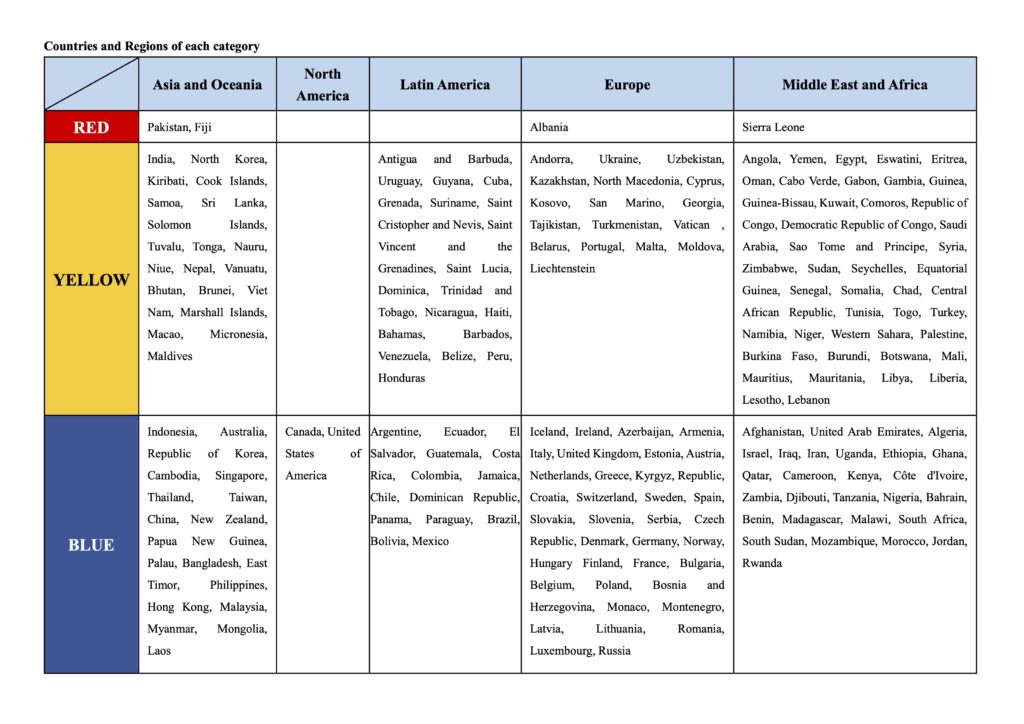
Blue, Yellow and Red

Japan has broken the world’s countries down into three categories – yep you guessed it, the colours above.

The rules you need to follow depend on where you have been in the past fourteen days – the most restrictive country applies.
Blue Countries:

This includes the US, Canada and much of Western Europe. If you haven’t been outside the list of blue countries, you will only need to provide a Covid test that is less than 72 hours old – more on that in a moment.

There is no need to provide proof of vaccination.

Yellow Countries:

Many South American, Caribbean and Eastern European countries fall into this category.

If you’ve been in one of these, you will need the same test as above with the additional requirement of being triple vaccinated – yep, all three jabs of an approved vaccine.

Red Countries:

There’s only a few of these. At the time of writing, just Pakistan, Fiji, Albania and Sierra Leone .

Unfortunately, if you have been in one of them, you will need to isolate in the hotel in addition to all the other requirements.

What Covid tests are accepted?

You can view the list in full here, which of course includes the gold standard PCR test.

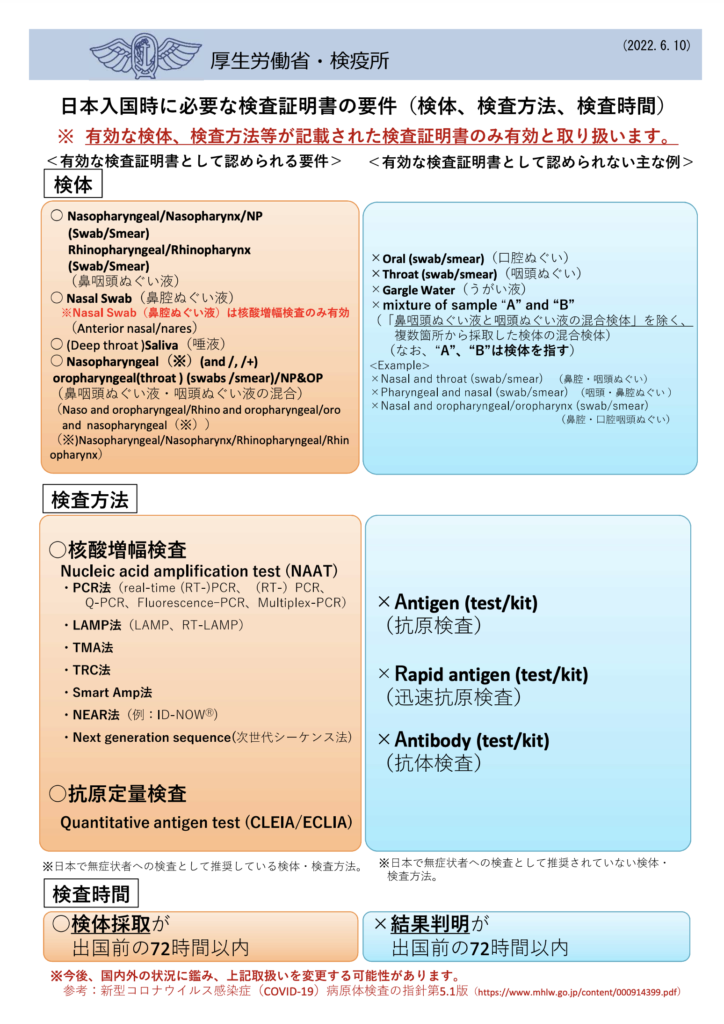
The biggest gotcha is that rapid antigen tests (the super easy ones you can do at home) are not allowed. They are what are known as ‘qualitative’ antigen tests, and Japan has said no bueno. ‘Quantitative’ antigen tests are allowed, but they are not the same thing.

Here’s a little graphic that might help you get your head around which tests are okay for entry. Some of the details are in Japanese, but effectively the ones on the left in are okay, the ones on the right with crosses are no good.

A word about vaccines too.

 Any vaccine certificate must be issued by the government, or other official source. In either English or Japanese is fine.

You need to have received one of the following:

  • Pfizer
  • Astra Zeneca
  • Moderna
  • Janssen
  • Bharat Biotech
  • Novavax

In some cases, a single dose counts as two. You can also mix vaccine doses. More on that here.

I don’t meet some of these requirements – can I still go?

 Yep! But you’ll have to isolate in a hotel and use private transport to and from the airport.

Can I present a ‘Certificate of Recovery’ instead of a Covid test?

 It’s not mentioned in the official guidance, but local agents advise the answer is no. At this stage, you’ll have to stick to the guidelines above if you don’t want to isolate.

What do operators have to do?

Effectively screen all crew for symptoms beforehand – anyone with signs of cold and flu are not allowed to operate to Japan.

In flight, if someone starts feeling unwell, the operator needs to let the authorities know – the crew member will be tested on arrival. It will then be on the operator to get the rest of the crew tested too.

Just a note though – pilots and cabin crew are considered as being in ‘segregated’ areas. So there is no need to test a pilot if a flight attendant becomes unwell, and vice versa.

So, there you have it.

Crew are free to enjoy their layovers in Japan, as long as they meet these requirements. It also goes without saying that common precautions apply when out of your hotel – including hand washing and mask wearing.

Never washed your hands before? We’ve got you covered. Here is a detailed ‘how-to’ video along with some soothing electric keyboard.

Still have a question?

Reach out to us on news@ops.group, and we’d be happy to help.


South East Asia: Open for Business

The world is steadily emerging from the pandemic, and the Northern Hemisphere has arguably been leading the charge.

South-East Asia on the other hand has been lagging behind. The region’s countries have resisted joining the world’s ‘new normal’, instead relying on strict ‘zero-covid’ strategies that kept foreigners out, citizens in hotel quarantine, and crews cooped up in hotels. Until now.

In recent weeks and months, we have seen several major announcements from these countries that at last, they are willing to re-join the rest of the world – and that’s good news for the industry.

Here’s a rundown of the biggest changes happening right now.

Singapore

The News

From April 1, fully vaccinated foreigners (from anywhere) are once again be able enter the city-state without quarantine.

The existing ‘Vaccinated Travel Lane (VTL)’ scheme has been scrapped. For operators this means that passenger flights flying into the Lion City will no longer need approval to operate under strict VTL protocols.

Passenger Rules

For fully vaccinated passengers, click here.

For non-vaccinated passengers, click here. *Special approval is required, and in most cases non-vaccinated foreigners will not be allowed. Seven days of self-quarantine also applies.

Crew Rules

There are new rules for crew – one set for vaccinated crew (no restrictions on movement), and another set for unvaccinated crew (you have to stay in one of three approved hotels, and you’re confined to your room!).

But watch out for one important stipulation: if any crew are unvaccinated, ALL of you have to follow the unvaccinated set of rules.

Check new CAAS Circular 18/2022 Rev 2 for full details.

Malaysia

The News

It’s also good. From April 1, the country completely reopened to fully vaccinated passengers with no quarantine. Foreigners also no longer need to seek approval before travelling.

Passenger Rules

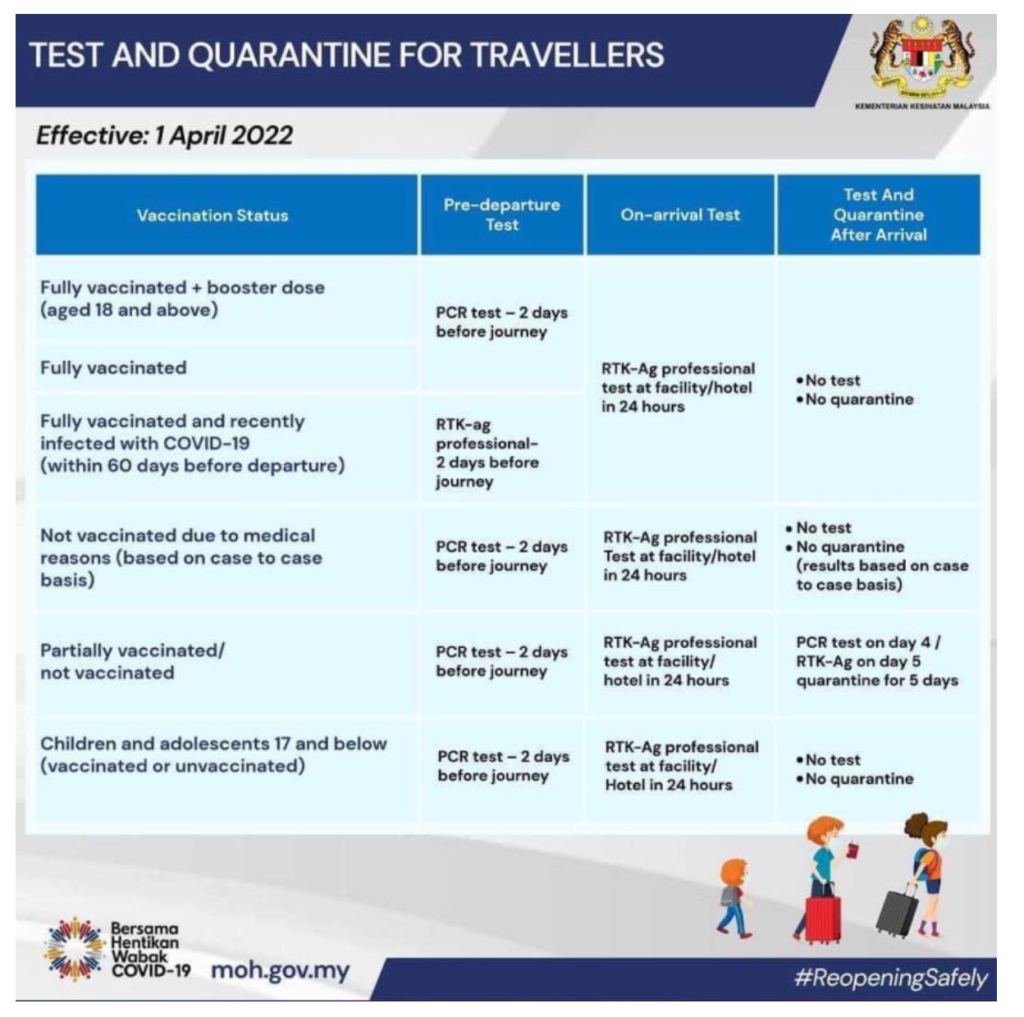
They’re complicated. And depend on vaccination status (they also take into account whether you have received a booster dose).

You can find that information here, but here’s a picture, because pictures are always better:

Crew Rules

Crew can only enter Malaysia through WMSA/Subang, WMKK/Kuala Lumpur or WMKL/Langkawi airports.

In all cases they require a PCR test that is less than 72 hours old at time of arrival. Subang seems to be the best option, with no quarantine or maximum stay. In Kuala Lumpur crew can only stay for 24 hours and must isolate in the hotel, while in Langkawi crew can stay for 72 hours and don’t have to isolate if they follow the same rules as tourists.

Indonesia

What’s the news?

They’ve dropped quarantine for both passengers and crew throughout the entire country. This follows a successful trial on the holiday island of Bali.

Passenger Rules

They’ll need a PCR test taken within 48 hours before departure for Indonesia. Keep in mind this can be a tight turn around for busy labs – the global standard seems to be 72 hours.

Crew Rules

You’ll need a certificate or card proving you are fully vaccinated, along with a PCR test. The rules are a little easier for crew – you have 72 hours to get that done before you leave for Indonesia. There will also be a travel declaration to fill out, but you’ll be free to leave the hotel and enjoy your layover.

Vietnam

What’s the news?

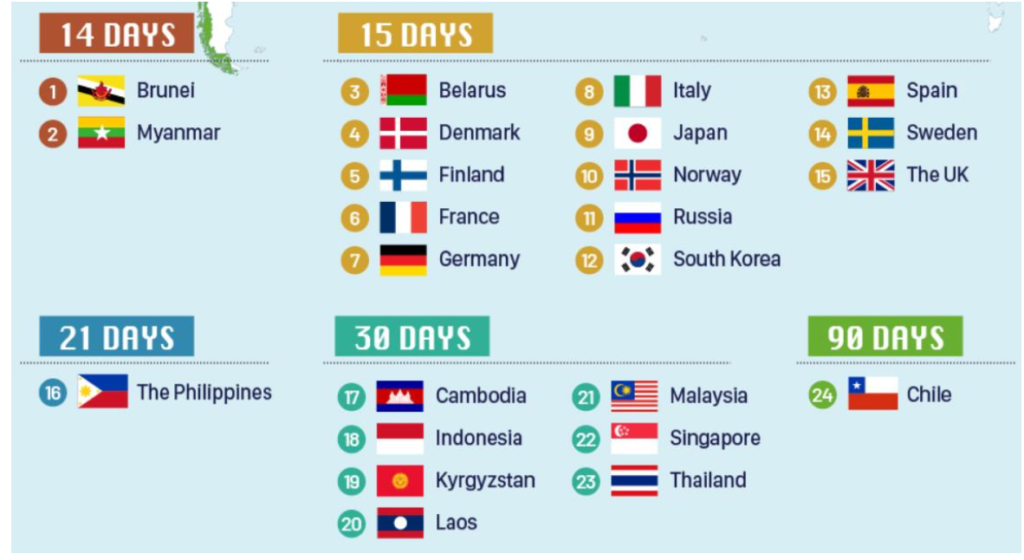
Borders are now open to all foreigners, with no quarantine, as long as they hold a valid visa. Watch out for this gotcha though: the only visas available on arrival are currently for business travellers (not tourists). Everyone else will need to apply beforehand online. There’s a long list of countries that this applies to (including the US, Canada and UK) which you can access here. There are also visa exemptions available for select countries, see the image below.

Passenger Rules

They’ll need to get tested first, and there’s two options. A PCR test that is less than 72 hours old, or a rapid antigen test that is less than 24 hours old – both at time of departure for Vietnam. There’s an opt clause too, if they can’t provide proof of a test they can still travel but will need to get tested within 24 hours of touching down.

Crew Rules

Local agents advise that all the same requirements apply to crew as for passengers (including a valid visa or exemption) – that is if you want to enter the country.

Japan

What’s the news?

Ok, so not really South-East-Asia but we thought we’d include it anyway – given that Japan lifted its entry ban on foreigners from over a hundred countries on April 8 (including the US and UK). One big gotcha though – tourists will still have to wait. Pax will need to be entering for business, study or some other essential reason.

Passenger Rules

Depending on their vaccination status, where they are travelling from, and whether they are identified as a close contact of a positive case, they may be subject to up to 7 full days of quarantine and/or self-isolation on arrival.

For Japan’s horribly complex entry rules in their official format, click here.

Crew Rules

The crew rules remain a bit of a mystery. We’ve had some reports from crew saying they were unable to apply for any of the visas available to passengers (business, study, etc).

We haven’t seen any published rule changes here from how it worked before – crew can enter on a ‘shore pass’ arranged through their handler, but must self-isolate in the hotel for 7 days or until departure.

Opsgroup members have reported the following: “The guidance we received from our company is that crew members must stay in their rooms but can leave the hotel for exercise and to obtain food to bring back to eat in the room. No dining out, no shopping for anything other than food to eat in your room. We enter on a shore pass. For quarantine, we fill out two forms that ask about where we have been in the world and if we are feeling healthy, where we are staying, and if we have transportation (another quarantine requirement is that we don’t use public transportation). We also sign a pledge that we are going to follow the rules. They then give us a quarantine card to go with our shore pass. When we arrive for our return trip, we initial a paper saying that we followed the rules.”

If you’re considering a trip to Japan, try contacting a local handler (iajops@interavia.co.jp and fltops@aeroworks.jp are decent options) and check if there’s any update to these rules – especially those for crew (and please let us know what you find out!)

A note on Thailand.

Borders have been open to foreigners for a while now via three main entry schemes:

  • Test and Go (a quarantine free option)
  • Sandbox (restricted movement)
  • Alternative Quarantine Scheme (quarantine reduced to five days from April 1).

The main news is that in all cases the requirement for passengers to get tested before arriving has been scrapped from April 1. Crew can make use of the same schemes and enter under the same conditions as pax.

For more info on passenger entry rules, check out the official page here, as well as the handy checklist document put together by local handling agent Asia Flight Services (eff Apr 6).

Still closed for business.

Not all of South East Asia is open to foreigners yet, watch out for these ones:

Myanmar – International passenger flights are still not allowed to land. Visas are not currently being issued for foreigners.

Brunei – Entry is still severely restricted. Any foreigner needs approval first and non-essential travel is off limits.

Laos – Special permission is still required for foreigners, and tourism is a no-go.

Unsure? Ask the team.

Entry rules change quickly and can be frustratingly confusing to get your head around. If there is a specific country you are looking for info on, try the #questions channel in Slack, or reach out to us at team@ops.group and we’ll do our best to help you find the answers you’re looking for.


Tokyo airports set to ban GA/BA ops for a week

Plans are afoot for the big event happening in Tokyo in October – the enthronement of the new emperor!

The bad news for operatorsauthorities are now telling local handlers that GA/BA will be completely prohibited from both RJAA/Narita and RJTT/Haneda airports in Tokyo from 19-26 Oct.

The only flights that will be considered are those carrying official delegations – but even most of those will have to find parking elsewhere. Japan Civil Aviation Bureau (JCAB) anticipates around 150 official delegation flights will visit Japan for the event, but with the Tokyo airports only having space for around 50 aircraft between then, the remaining 100 or so aircraft will be forced to reposition elsewhere.

So far, the only advisory JCAB have officially published on this is here – a vague warning that basically says head of state flights will be given priority at the Tokyo airports, and to expect congestion at all the other main international airports across the country. Local handlers expect RJGG/Nagoya, RJBB/Osaka, and RJSS/Sendai to be worst affected.
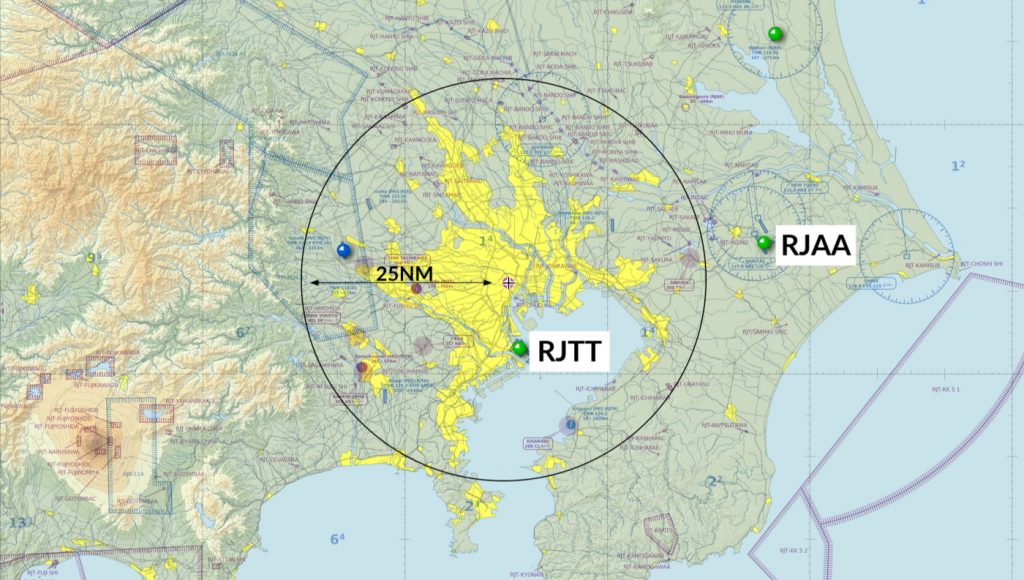
Airspace Restrictions

JCAB have published these already, available here. Ultimately, between Oct 21-25, SFC-UNL, no one will be allowed to fly within 25NM of the Imperial Palace in Tokyo, unless they have special approval from ATC.

We will keep this page updated with further restrictions and announcements as we get them. If you have any news to share, please email us at news@ops.group


New rules for ops to Japan

Operators to all the main airports in Japan must now sign a statement saying they will take measures to ensure objects don’t fall off the aircraft. The authorities also want you to agree to pay compensation for any incidents where damage is caused by falling objects – potentially also when the falling objects don’t even come from your aircraft!

For the past ten years, Japan has required its own airlines to report any objects falling off aircraft during take-off or landing. But from March 2019, this applies to all foreign operators too. 

Japan published AIC 7/19 on 28 FEB 2019, which outlines the measures they require all crews to take when operating at Japan’s airports. It comes with two attachments which both need to be signed and returned to the Japanese authorities by post, prior to ops.

Technically, you must send hard copies of these to each airport you will fly to in Japan. However, local handler Aeroworks has told us that operators can email them copies of everything by email, along with a power of attorney letter, and they are authorised to pass everything on to local authorities – they can provide this service for most airports in the country.

Attachment 1: This lists all the measures to take, including: completely draining the lav/waste pipes prior to take off to prevent ice blocks from forming, confirming all panel doors are closed, inspecting for leaks, removing rainwater or snow from cargo when loading.

Attachment 2: This is a strange one. It says the following:

“In case that it is unable to identify one specific aircraft which caused the damage by falling objects from aircraft (hereinafter referred to as “the causing aircraft”) and to identify a person responsible for the compensation of the damage, and if the Falling Object Confirmation Committee established in Regional Civil Aviation Bureaus of Ministry of Land, Infrastructure, Transport and Tourism determines a presumably causing aircraft (hereinafter referred to as “the acknowledged aircraft”), the operator of the acknowledged aircraft shall bear the amount of expenses for compensation of the damage, proportionally divided by the number of the acknowledged aircraft.”

If we’re reading that right, that basically means if something falls off a plane and causes damage, and they can’t figure out which specific one it came from, whichever aircraft were in the area at the time may all be required to share the cost of paying for any compensation that may be due!

Over the past few years there have been a number of high-profile incidents in Japan where objects have fallen off aircraft. In September 2017, an aircraft panel fell onto a car driving on a busy street in Osaka; and in May 2018, a hospital in Kumamoto was sprayed with metal fragments from an aircraft that had suffered engine failure after taking off from RJFT/Kumamoto Airport. 

With the Tokyo Olympic Games coming up in July 2020, local authorities are keen to ensure no such incidents occur here.

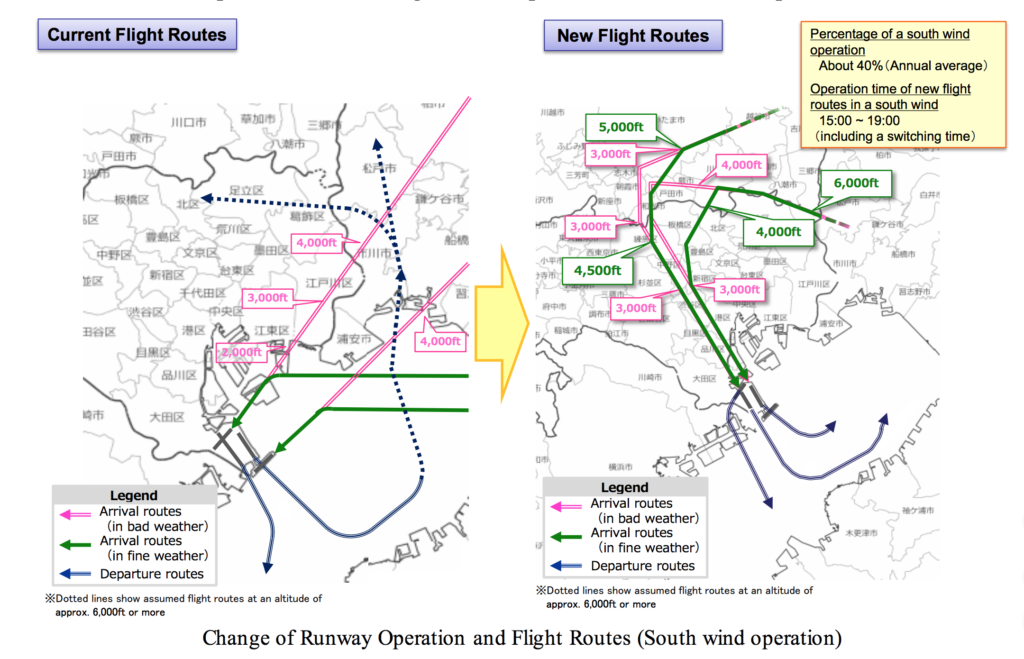
Airport authorities are looking at ways to increase slot capacity at Tokyo’s airports, and one such measure will be to revise the arrival routes to RJTT/Tokyo Haneda, which will mean that flights will operate almost directly over the city centre – and these new rules regarding objects falling off planes have been implemented in response to this.

Further reading
The presentation made by the Japanese delegation to ICAO’s Air Navigation Oct 2018 Conference, regarding the various measures taken to prevent objects falling off airplanes in Japan. Check it out here.
IFALPA has published a Safety Bulletin which provides some great info on the various different approaches that are available at RJTT/Tokyo Haneda, depending on the wind direction and the time of the day, with a focus on the reduced options available if operating overnight. Definitely worth a read if operating to RJTT. Check it out here.


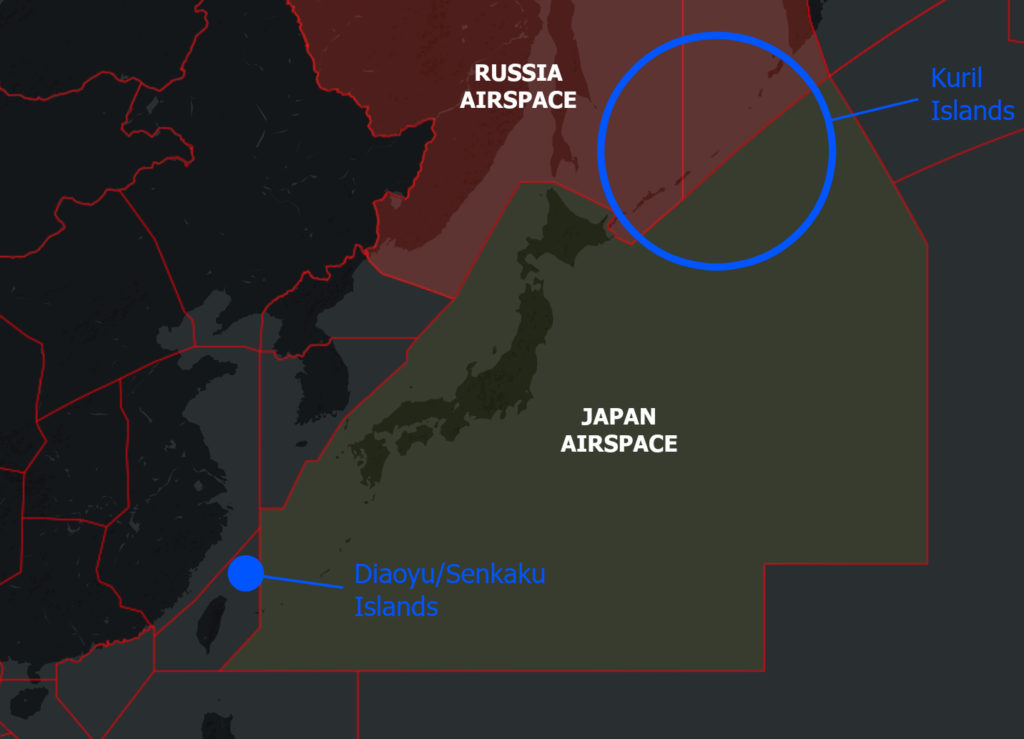
Japan scrambles record number of jets as tensions rise with China

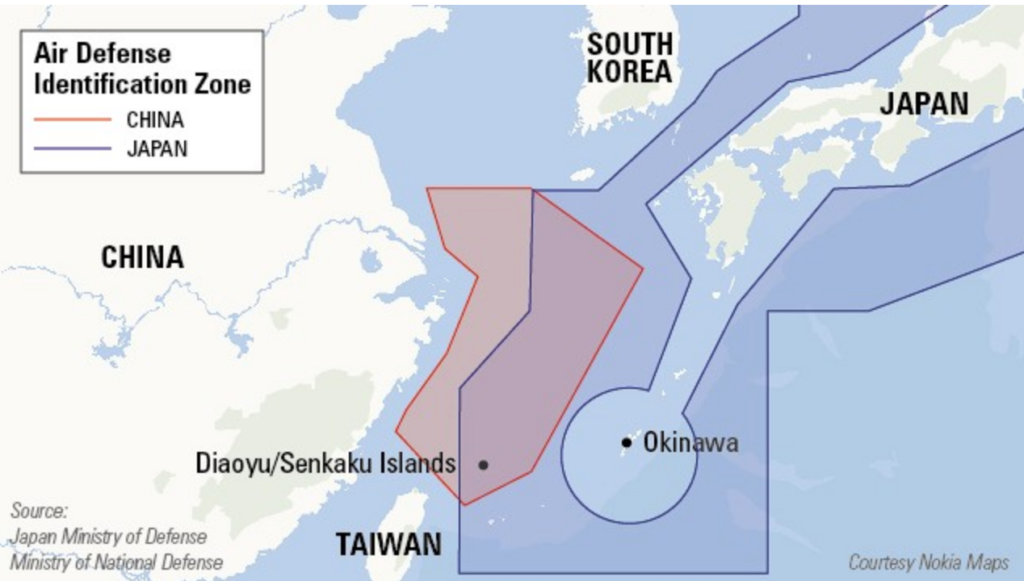
In Short: Japan scrambled a record number of fighter jets in the past year. The number rose to an all-time high of 1,168 in the year to March 2017, easily beating the previous record of 944 set at the height of the cold war in 1984. Chinese aircraft approaching Japanese airspace prompted 851 of the incidents, an increase of 280 over the previous year.

According to official figures released on Thursday, Japan’s Air Self Defense Force is scrambling fighter jets in record numbers as Chinese military activity escalates. Interceptions of Chinese planes rose by half in the year to March 31, in response to increases in the communist country’s activity in and around the East China Sea.

Japan worries that China is probing its air defences as part of a push to extend its military influence in the East China Sea and western Pacific, where Japan controls an island chain stretching 1,400 km (870 miles) south towards Taiwan. The figures highlight China’s growing assertion of military power in East Asia as it expands and modernises its armed forces in line with rapid economic growth.

For the first time, Chinese jets recently began flying through the Tsushima Strait into the Sea of Japan, and through the Miyako Strait into the Pacific Ocean.

But it’s not only China that Japan is worried about. Last week, Japanese Prime Minister Shinzo Abe warned North Korea may be capable of firing a missile loaded with sarin nerve gas towards Japan. “There is a possibility that North Korea already has a capability to deliver missiles with sarin as warheads,” he told a parliamentary national security committee.

And then there’s Russia. Scrambles by Japanese aircraft were high throughout the 1980s in response to flights by Soviet aircraft during the cold war. They fell back to 100-200 incidents a year during the 1990s and 2000s, but began to pick up again a decade ago as both China and Russia grew more assertive.

Mr Abe has been trying to negotiate with Russian president Vladimir Putin over the future of four disputed islands in the Kuril chain to Japan’s north, but has made limited progress, with the jet scrambles showing Moscow’s determination to make its presence felt on its eastern border. There were 301 scrambles to intercept Russian aircraft during the year, 13 more than the previous year, including incidents where Russian jets circumnavigated the Japanese Diaoyu/Senkaku Islands to the south.

Extra Reading:


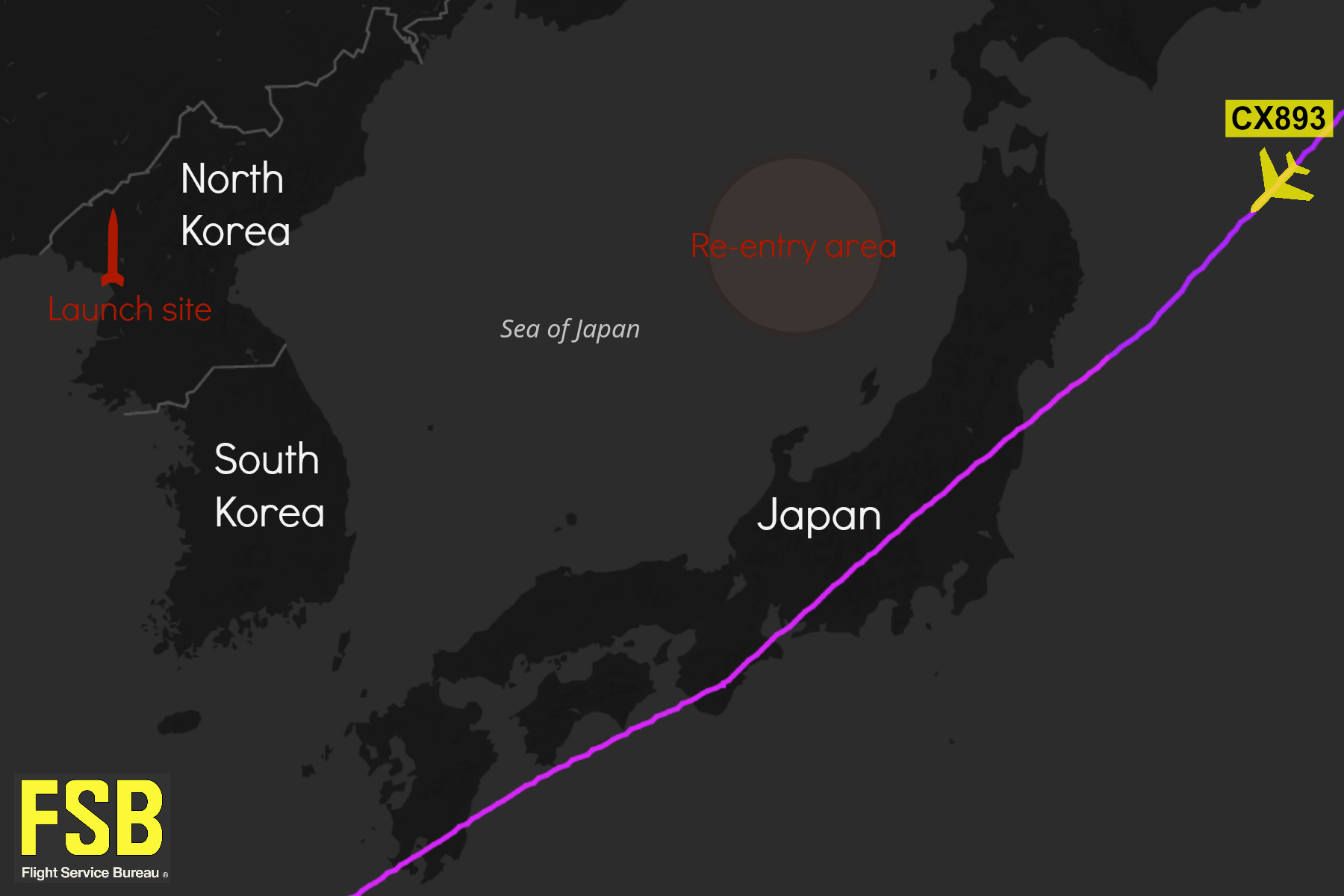
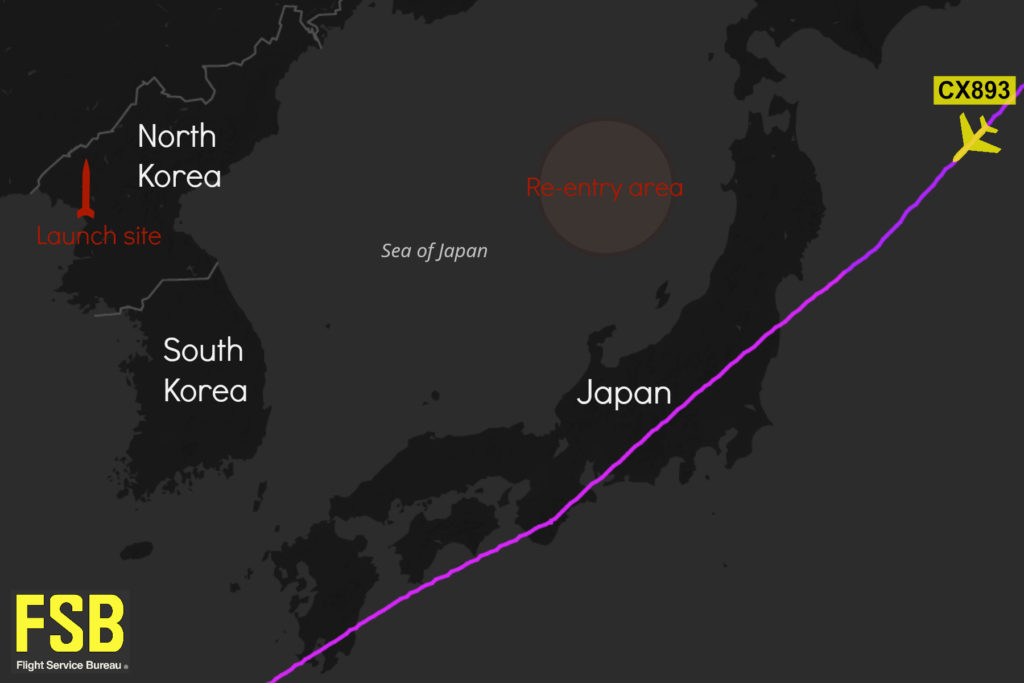
Cathay crew witness missile re-entry from North Korea

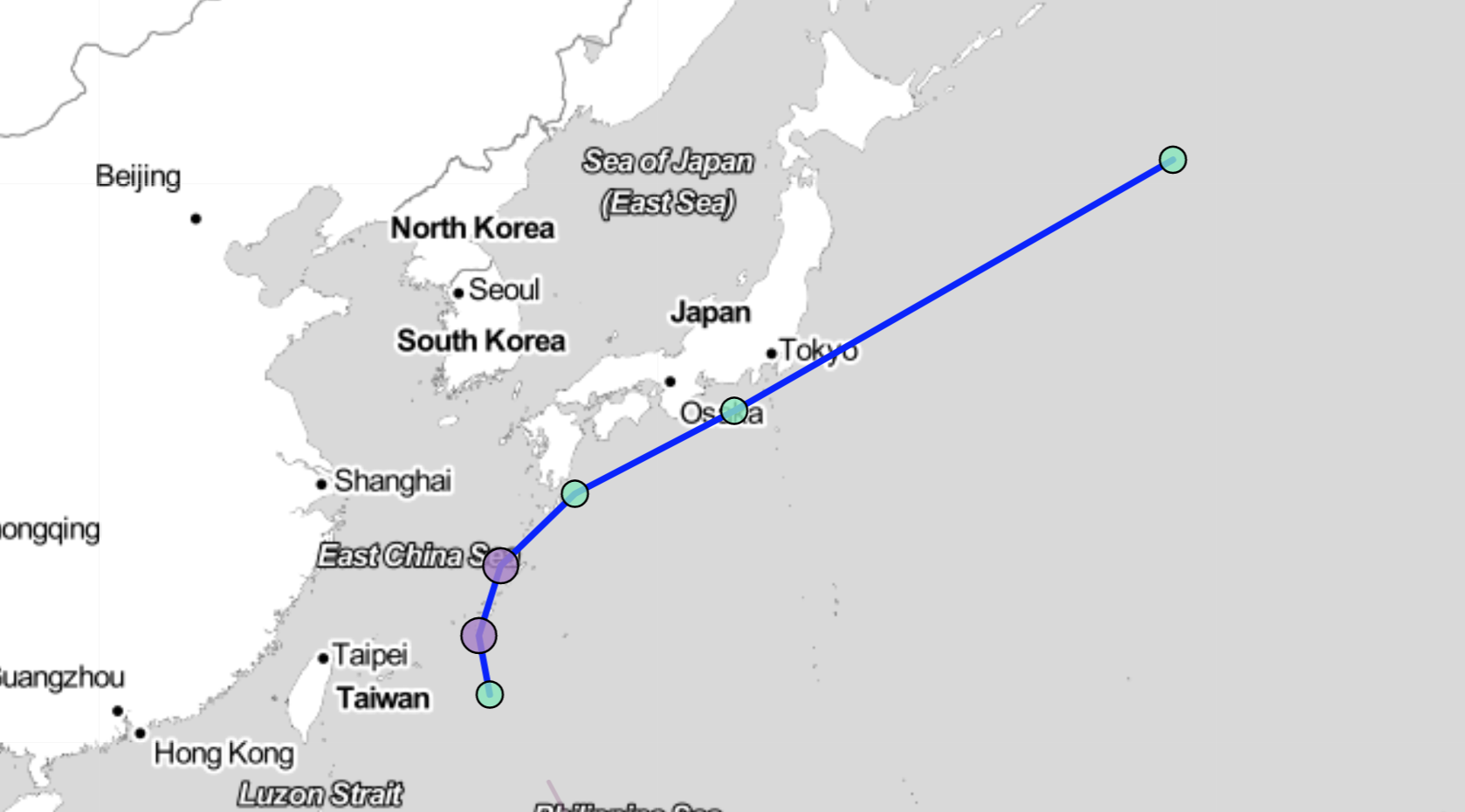
Crew onboard a Cathay Pacific flight witnessed the re-entry of North Korea’s latest missile near their position late last week. The CX893 service from San Francisco to Hong Kong on Nov 29 was over Japan at the time when North Korea launched its missile.

The crew reported: “Be advised, we witnessed the DPRK missile blow up and fall apart near our current location.”

Here’s Cathay Pacific’s full statement:

“On 29 November, the flight crew of CX893 reported a sighting of what is suspected to be the re-entry of the recent DPRK test missile. Though the flight was far from the event location, the crew advised Japan ATC according to procedures. Operation remained normal and was not affected. We have been in contact with relevant authorities and industry bodies as well as with other carriers. At the moment, no one is changing any routes or operating parameters. We remain alert and review the situation as it evolves."

North Korea’s missiles are larger, and can fly further, than the other missiles we’ve previously seen. Over the past year, most of these missiles land in the Sea of Japan, well inside the Fukuoka Flight Information Region (Japanese airspace). But as we see with this latest test, there is clearly a danger of some of these missiles not re-entering the atmosphere intact – meaning that a debris field of missile fragments passes through the airspace, not just one complete missile. If you haven’t done so already, make sure you read this: our article on why North Korean missiles are now a real threat to Civil Aviation.

This latest test is also significant because of its unprecedented altitude – 4500km (2800 miles). Experts seem to agree that if it had been fired on a standard trajectory, the missile would have been capable of traveling around 13000km (8100 miles), meaning it could have struck anywhere in the mainland US.

If you’re operating in the region, we recommend avoiding the ZKKP/Pyongyang FIR entirely and avoiding the affected areas over the Sea of Japan. For more info, check out Safeairspace.


Inbound Japan this weekend: Tropical Storm Saola

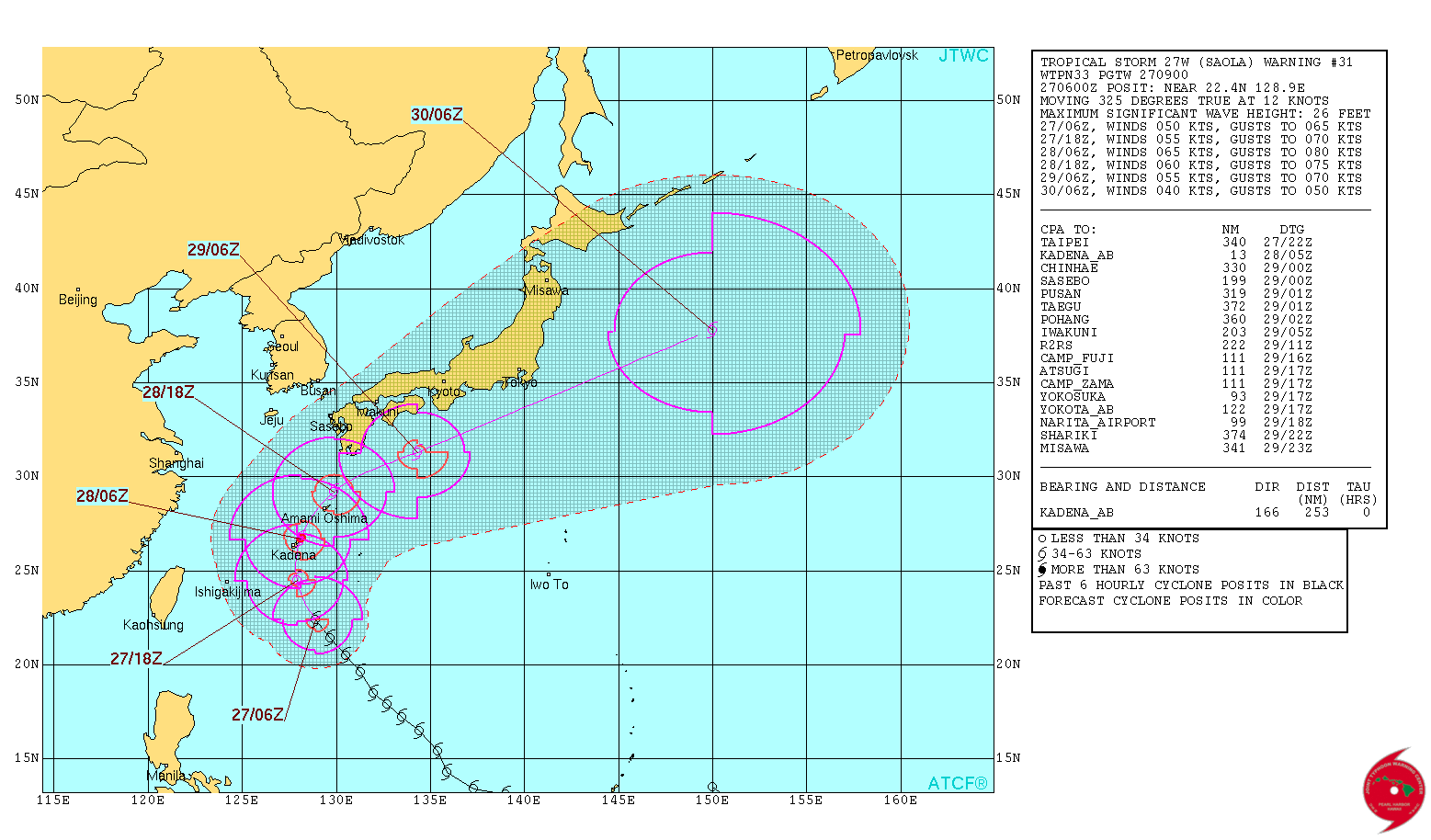
Tropical Storm Saola is south of Japan, gusts to 80kts, will affect southerly Japan airports ROAH, RJFF, RJFK on Sunday and on current track Tokyo likely affected by Monday.

Monitor:

  • http://www.usno.navy.mil/JTWC/
  • https://www.cyclocane.com/


Here’s why North Korean missiles are now a real threat to Civil Aviation

  • July 2017: First launches of ICBM’s from North Korea
  • Western portion of Japanese airspace is a new risk area
  • New OPSGROUP guidance to Members, Note 30: Japanese Missile risk

The North Korean game has changed. Even if aircraft operators stopped flying through the Pyongyang FIR last year, nobody really thought there was much of a tangible risk. The chances of a missile actually hitting an aircraft seemed slim, and any discussion on the subject didn’t last long.

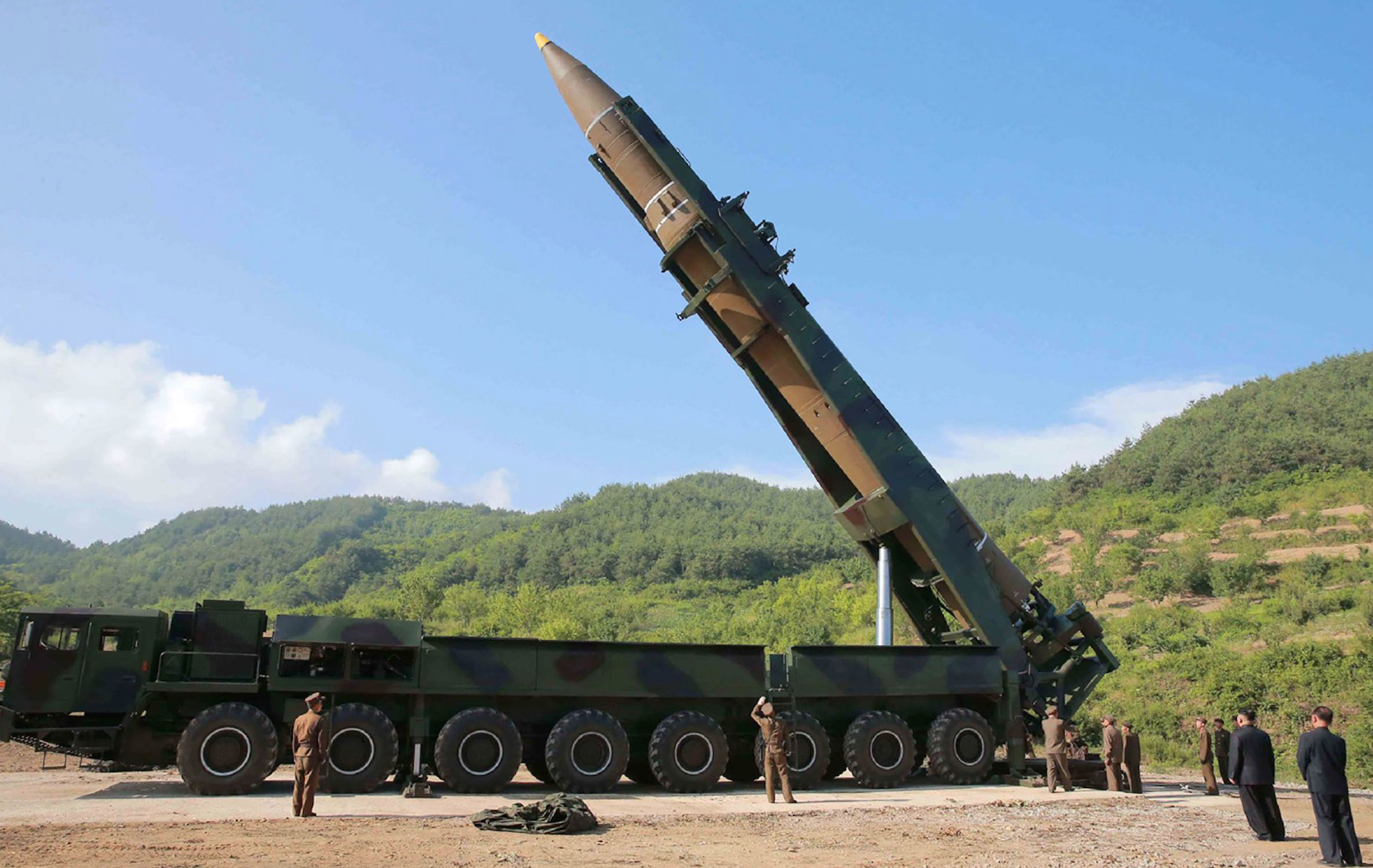
Things look different now. In July, the DPRK tested two Hwasong-14 Intercontinental missiles (the July 4th one is above), the first ICBM’s successfully launched from North Korea. ICBM’s are larger, and fly further, than the other missiles we’ve previously seen. Both of these landed in the Sea of Japan, well inside the Fukuoka Flight Information Region (Japanese airspace), and significantly, at least one did not re-enter the atmosphere intact – meaning that a debris field of missile fragments passed through the airspace, not just one complete missile.

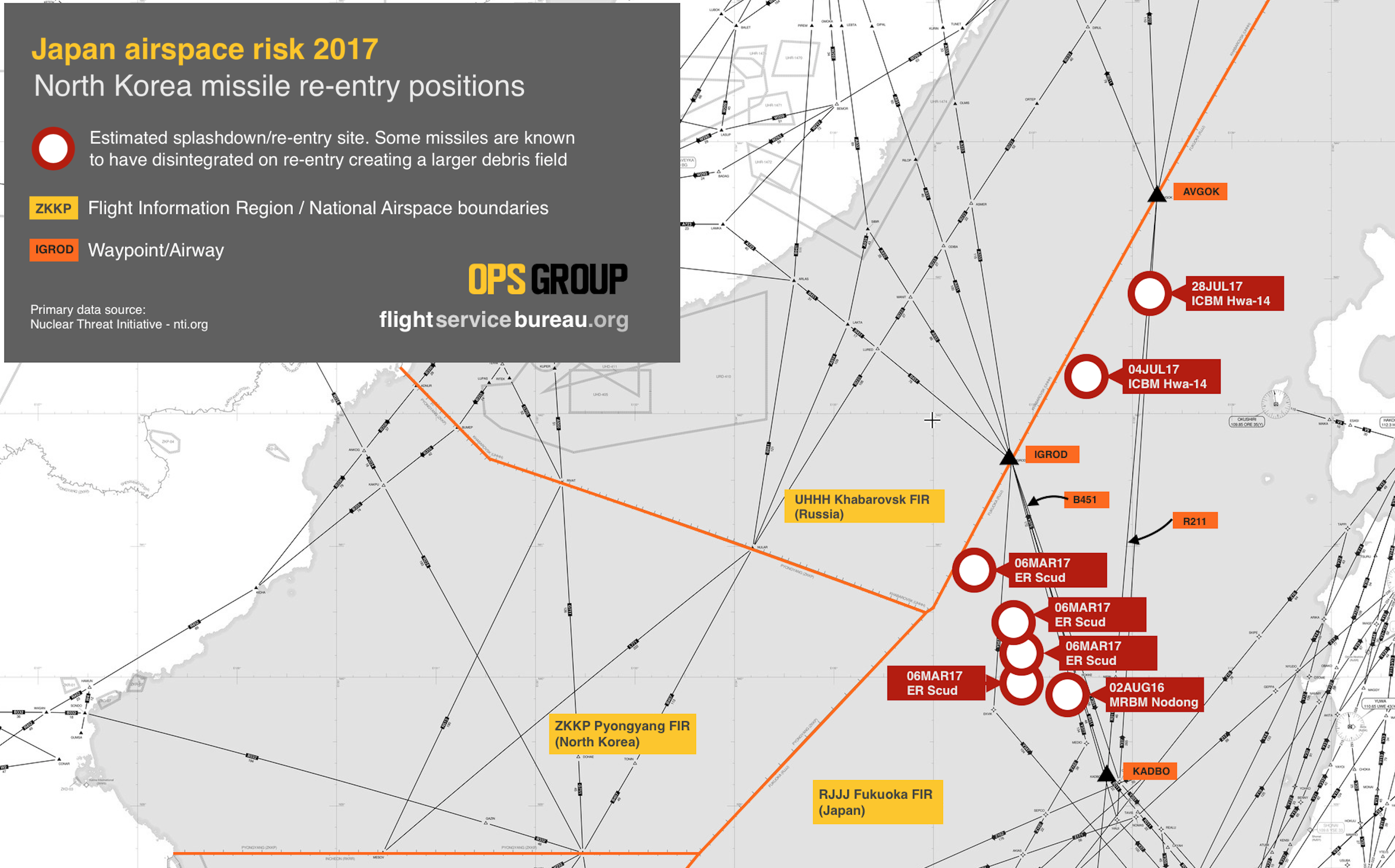
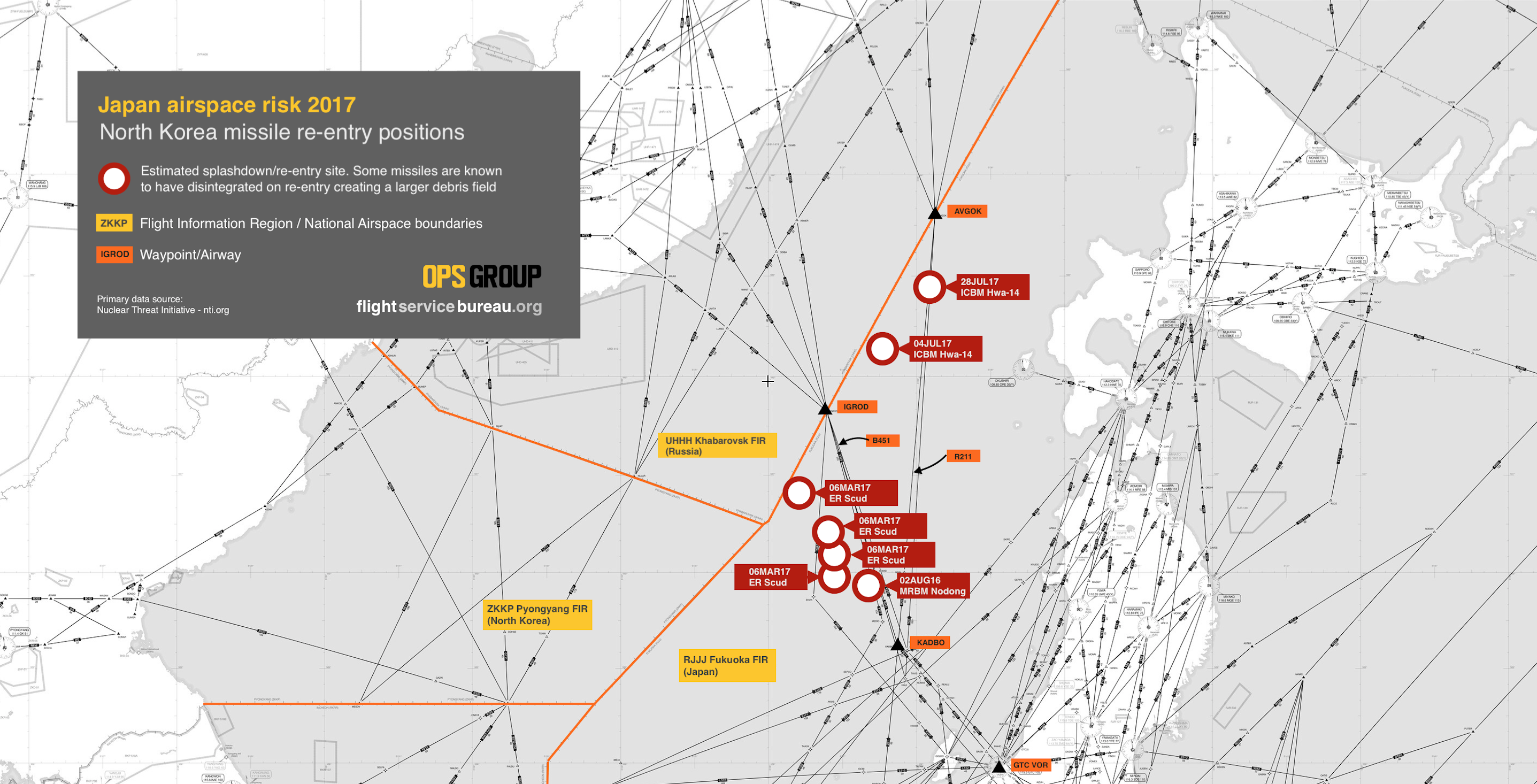
We drew a map, with our best estimates of the landing positions of all launches in the last year that ended in Japanese airspace. The results are quite clear:


View large image

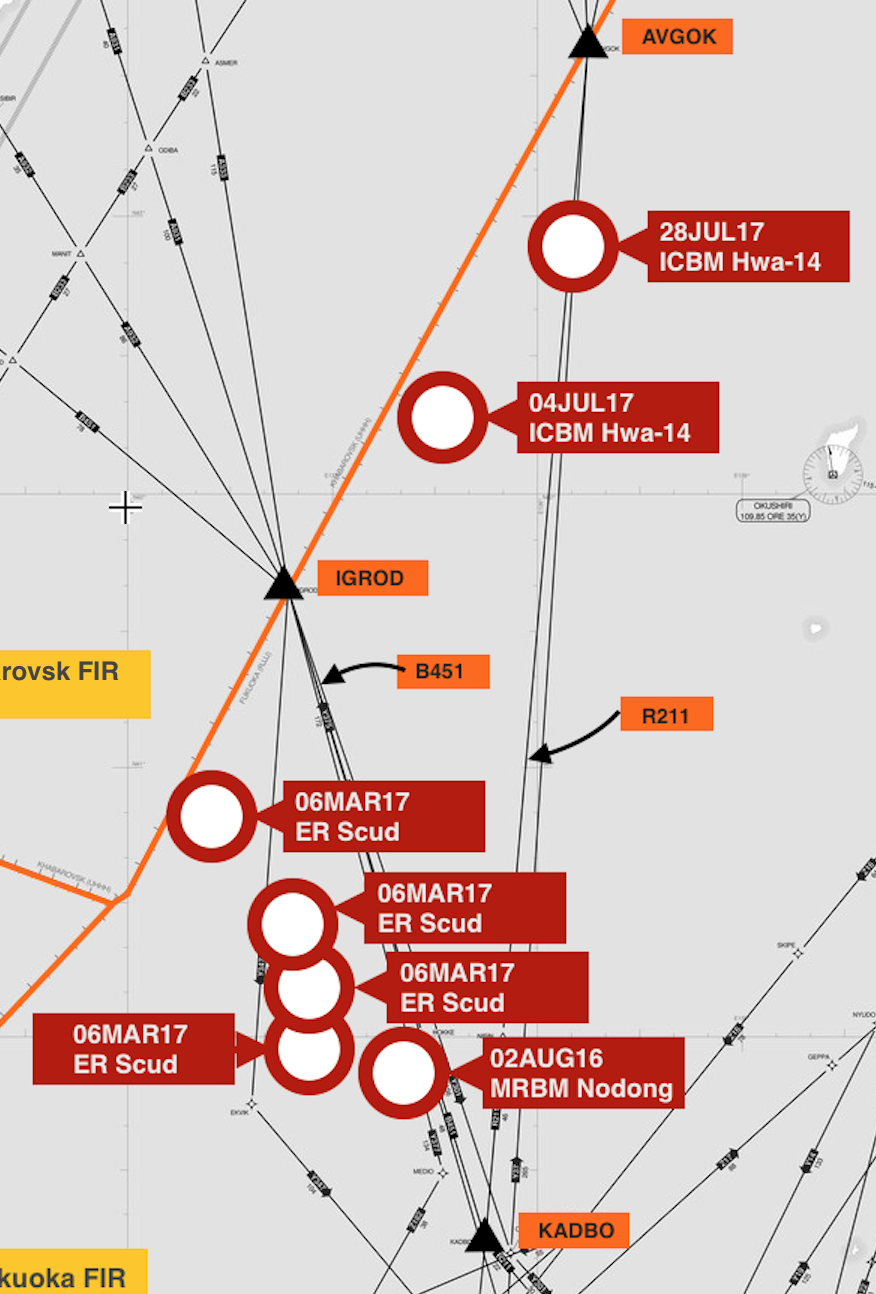
Zooming in even further, we can see each of the estimated landing sites. It is important to note that the landing positions vary in the degree of accuracy with which it is possible to estimate them. The highest accuracy is for the 28JUL17 landing of the Hwasong-14 ICBM, thanks to tracking by the Japanese Defence Force and US STRATCOM, as well as visual confirmation from land in Japan. The remaining positions are less precise, but in an overall view, the area affected is quite well defined – south of AVGOK and north of KADBO. In 2017, there have been 6 distinct missile landings in this area. The primary airways affected are B451 and R211, as shown on the chart.


View large image

So, in a very specific portion of Japanese airspace, there have been regular splashdowns of North Korean missiles. As highlighted by the Air France 293 coverage, this area is crossed by several airways in regular use, predominantly by Japan-Europe flights using the Russia route.

Determining Risk

The critical question for any aircraft operator is whether there is a clear risk from these missiles returning to earth through the airspace in which we operate. Take these considerations into account:

The regularity and range of the launches are increasing. In 2015, there were 15 launches in total, of short-range ballistic and sub-launched missiles. In 2016, there were 24 launches, almost all being medium-range. In 2017, there have been 18 so far, with the first long-range missiles.

– In 2016, international aviation solved the problem by avoiding the Pyongyang FIR. This is no longer sufficient. The landing sites of these missiles have moved east, and there is a higher likelihood of a splashdown through Japanese airspace than into North Korea.

– Almost all launches are now in an easterly direction from North Korea. The launch sites are various, but the trajectory is programmed with a landing in the Sea of Japan. From North Korea’s perspective, this provides a sufficiently large area to avoid a missile coming down on land in foreign territory.

– The most recent ICBM failed on re-entry, breaking up into many fragmented pieces, creating a debris field. At about 1515Z on the 28th July, there was a large area around the R211 airway that would have presented a real risk to any aircraft there. Thankfully, there were none – although the  Air France B777 had passed through some minutes before.

– Until 2014, North Korea followed a predictable practice of notifying all missile launches to the international community. ICAO and state agencies had time to produce warnings and maps of the projected splashdown area. Now, none of the launches are notified.

– Not all launches are detected by surrounding countries or US STRATCOM. The missile flies for about 35 minutes before re-entry. Even with an immediate detection, it’s unlikely that the information would reach the Japanese radar controller in time to provide any alert to enroute traffic. Further, even with the knowledge of a launch, traffic already in the area has no avoiding option, given the large area that the missile may fall in.

Can a falling missile hit an aircraft?

What are the chances? Following the AFR293 report on July 28, the media has favoured the “billions to one” answer.

We don’t think it’s quite as low.

First of all, that “one” is actually “six” – the number of North Korean missiles landing in the AVGOK/KADBO area in 2017. Considering that at least one of them, and maybe more, broke up on re-entry, that six becomes a much higher number.

Any fragment of reasonable size hitting a tailplane, wing, or engine as the aircraft is in cruise at 450 knots creates a significant risk of loss of control of the aircraft. How many fragments were there across the six launches? Maybe as high as a hundred pieces, maybe even more.

The chances of a missile, or part of it, striking the aircraft are not as low as it may initially appear. Given that all these re-entries are occurring in quite a focused area, prudence dictates considering avoiding the airspace.

What did we learn from MH17?

Whenever we discuss missiles and overflying civil aircraft in the same paragraph,  the valuable lessons from MH17 must be remembered. In the weeks and months leading up to the shooting down of the 777 over Ukraine, there were multiple clues to the threat before the event happened.

Of greatest relevance was that State Authorities did not make clear the risk, and that even though five or six airlines decided to avoid Ukrainian airspace, most other operators did not become aware of the real risk level until after the event.

Our mission at Flight Service Bureau is to make sure all aircraft operators, crews, and dispatchers have the data they need to make a fully informed decision on whether to continue flying western Japan routes, or to avoid them.

Guidance for Aircraft Operators

Download OPSGROUP Note to Members #30: Japan Missile risk (public version here)

Review the map above to see the risk area as determined by the landing sites in 2017.

Consider rerouting to remain over the Japanese landmass or east of it. It is unlikely that North Korea would risk or target a landing of any test launch onto actual Japanese land.

Check routings carefully for arrivals/departures to Europe from Japan, especially if planning airways R211 or B451. Consider the previous missile landing sites in your planning.

– Monitor nti.org for the most recent launches, as well safeairspace.net.

OPSGROUP members will be updated with any significant additions or updates to this Note through member mail and/or weekly newsletter.

References

– Nuclear Threat Initiative – nti.org

– Opsgroup Note to members #30 – Public version

OPSGROUP – Membership available here.

– Weekly International Ops Bulletin published by OPSGROUP covering critical changes to Airports, Airspace, ATC, Weather, Safety, Threats, Procedures, Visas. Subscribe to the short free version here, or join thousands of Pilot/Dispatcher/ATC/CAA/Flight Ops colleagues in OPSGROUP for the full weekly bulletin, airspace warnings, Ops guides, tools, maps, group discussion, Ask-us-Anything, and a ton more.

– Larger area map of Japan airspace risk 2017

– Contact news@ops.group with any comments or questions.


Midweek Briefing 10AUG: EASA Cockpit Rules, Ukraine extends Russia Ban

EASA: New Cockpit Rules 10AUG EASA has published a new SIB with guidance for operators on, well, how best to arrange the swap of pilot-taking-a-pee and flight-attendant-now-up-front … Read the article

Ukraine extends Russia ban 10AUG Ukraine has extended the ban on Russian registered operators overflying or landing, until November 10th, 2016. In an operational notice.. Read the article


UUZZ/The Moscow Area will get busy between 26AUG and 04SEP (we’re not entirely sure why), but … The Main Air Traffic Management Centre (MATMC) has issued notice that there will be increased regulation for flights to UUWW, UUDD, and UUEE. Permission to depart will expire 30 mins after planned off blocks time, after which the Operator (that’s you) must call MATMC for a completely new permit.

MWCR/Cayman recorded its first local transmission of the Zika virus on 08AUG. Several other people on the Cayman Islands have reported symptoms of the virus; however, authorities stated that in these cases the patients contracted Zika during travel abroad.

MKJK/Kingston, Jamaica is carrying out work on its Comms lines until the end of the week, and is expecting to lose some Flight Plans. The outage is 0415-1100Z daily. If you are operating to Jamaica, or through the FIR, it’s worth sending your FPL early, and not during that time. Maybe send it a few times to be sure, should minimise delays due to missing FPL’s.

VIZZ/India Independence Day on 15AUG. Multiple restrictions. No overflights within 150nm of Delhi. VIDP/Delhi will not allow non-scheduled flights 0030-0430Z, and 1030-1330Z. Check with your handler for specific restrictions on 15AUG.

LIRA/Rome Ciampino will be completely closed from 14-29OCT for runway maintenance and upgrades. According to CIA, maintenance work will be carried out on a 24/7 basis on parts of runway 15/33, at various junctions and taxiways.

EVVA/Ventspils is closed for the week from today, due to repairs to the main runway. One of the three main airports in Latvia, it reopens on 15AUG.

GUCY/Gbessia, Guinea Opposition leaders have announced the postponement of opposition demonstrations planned for 10-16AUG. Marchers will reportedly demonstrate on the Autoroute Fidèle Castro, between Aéroport International de Gbéssia (GUCY/CKY) and the Palais du Peuple. The demonstration was originally slated to occur on 4 August but was later postponed until 10 August.

WIZZ/Indonesia Travel advice updated: Political tensions have given rise to occasional mass demonstrations in cities in Papua; take extra care and seek local advice on your travel plans.

SOCA/Cayenne FIR has broken it’s SITA system and has no CPDLC or ADS-C until, they think, at least 14AUG. Revert to HF and use 8855/5526; failing that try 3023.

RJZZ/Japan On 08AUG, Japanese military officials placed the country’s armed forces on alert for the potential of a North Korean missile launch. According to an official statement, the Japanese military will be ready to strike any North Korean missile that threatens Japan. Because some North Korean missile tests are difficult to detect, the current state of alert will last for three months. Previously, Japanese defense officials issued a series of temporary orders in response to imminent North Korean missile launches.

LWKS/Skopje Flooding on 6-7AUG2016 in Skopje and neighbouring areas has resulted in over 20 deaths. Some roads, including part of the Skopje ring-road, are closed. Alternative routes are available, but traffic may be slow moving. You should travel with extreme care.

LTZZ/Turkey Per new dictat from the DGAC in Turkey, all Ambulance flights entering Turkish airspace are to report “ACTIVE AMBULANCE FLIGHT” on first contact with Turkish ATC.

DIZZ/Cote D’Ivoire Effective 15SEP2016 Ivory Coast will withdraw the following HF frequencies: BOUAKE 5710KHz, 1578KHz; DALOA 5701KHz, KHOROGO 6673KHz; Man 5710.5 KHz; ODIENNE 6673 KHz; SAN PEDRO 6012KHz

EDDV/Hannover has special runway configurations on 14AUG due to (yet another) bomb from WW2 being removed. Between 1100-1400Z all approaches to 27L/09R are suspended.

VVZZ/Hanoi ACC reports that a lot of flights operating through the Hanoi ACC area of responsibility have not been submitting flight plan messages to VVHNZRZX or VVHNZQZX. In order to avoid missing / delay of FPL messages, copy these AFTN addresses when submitting your FPL’s.

EGZZ/United Kingdom 8AUG Rail staff in southern England, including London, began a five-day strike, which will reduce rail services by 40 percent. Travellers should expect major delays and large-scale traffic disruptions

BGSF/Kangerlussuaq Daily Closures between 09AUG and 30AUG for runway work. Double check NOTAMR A0295/16 for complete list of timings. Only Medivac, Search and Rescue and PPR confirmed operations allowed.

KTEB/Teterboro Landing Fees here are to increase by about 25% on September 1st. Comments regarding the fee changes can be submitted to The Port Authority of New York and New Jersey, and must be received by 10AUG2016.

Measles Myanmar/Taiwan On August 6th health officials confirmed a measles outbreak in the Sagaing region, a mountainous area located in northern Myanmar, bordering eastern India. We have also received report from Taiwanese health officials confirming a link between two cases of measles and Taipei’s Songshan International Airport (RCSS/TSA). The two cases, which were first detected on 15JUL, involved an airline ground crew worker and a passenger who traveled to the airport.

SECU/Cuenca, Ecuador Operations at Cuenca airport will be suspended from mid-August 2016 for 3 weeks to 1 month due to the need for additional runway works.

OMDB/United Arab Emirates On 04AUG both runways at Dubai International Airport (OMDB/DXB) resumed full operations following the 03AUG 777 accident. Expect delays and some cancellations as the airport is still struggling to catch up.

UTZZ/Turkmenistan and UAZZ/Kazakhstan On 04AUG Turkmenistan temporarily closed its border with Kazakhstan, citing security concerns. Officials stated that the closure will last for five days. Turkmenistan instituted a similar border closing on 20JUL. Authorities did not release details on the purported security concerns that prompted 04AUG closure.

UZZZ/Russia 03AUG Polish officials stated that they did not have a specific date to reopen visa-free border traffic between Poland and the Russian enclave of Kaliningrad. Security concerns associated with the NATO Summit and Roman Catholic Church’s World Youth Day led officials to temporarily restart border checks at Poland’s borders. Residents of border areas, however, will be able to travel across the border for cultural, social or family reasons.

UNKL/Yemelyanovo Runway11/29 is closed for all types of aircraft THU 0600-0700, WED FRI 0610-0710, MON TUE SAT SUN 0500-0700, 01SEP until 29OCT

View the full International Bulletin 10AUG2016


Midweek Briefing 22JUN: Iceland ATC strike – end in sight, Israel FPL changes

Iceland ATC strike – end in sight 22JUN Operators on both sides of the Atlantic have been frustrated over the last 6 weeks with continual sporadic ATC Industrial action. And end may be in sight, but in the meantime keep a close eye on BIRK, BIKF and BIRD Notams. Read the article.

FPL changes: Israel 22JUN Current Flight Planning procedures for flights across Europe from Israel will change in light of a new agreement signed between Israel and Eurocontrol. Read the article.


LFZZ/France ATC Strike Number 9 gets underway today until 24JUN at 0400Z, usual disruption and restrictions apply. Avoid France where possible. NOTAM F1171/16 refers.

EGGX/Shanwick is having an 80’s party on the 28th of June at 1600Z. For engineering work, all the new technology is being taken offline for three hours, so no CPDLC, ADS-C or OCL. Instead we have Voice Reports, HF, Manual Clearance Requests (123.95 or 127.65), and so on; just like the good old days. When you hit 30W log on to Gander manually.

UMZZ/Belarus The Minsk FIR has updated its table of cruising levels and altitudes below Transition; view the AIC.

Gambia The UK FCO issued updated travel advice for The Gambia : “Demonstrations took place in April and May 2016 in Banjul. Demonstrations could occur at any time in any part of the country prior to presidential elections planned for 01DEC. You should be vigilant, avoid all demonstrations”

LPZZ/Portugal is joining the International ATC Strike Club and will begin with industrial action, for two hours daily on: June 30th, and July 8th,15th, 22nd and 29th.

KCXO/Houston Regional will be opening a new customs facility mid July. KCXO serves the Metro-Houston area and is 46 miles outside of town. The new CBP facility adds more choice to international operators over the already saturated Houston area airports.

KZZZ/United States The U.S. Navy has scrubbed the planned military GPS interference testing across the U.S. Southwest that was supposed to happen this month.

LWSS/Skopje is implementing Free Route Airspace in the Skopje ACC above FL245, effective 23JUN. FRA is available H24 with DCT limit unlimited. The ATS network above FL245 is withdrawn. Additional info is available in the Republic of Macedonia AIP AMD 58/16. New RAD measures can be found in the increment file and will become part of Annex 4 on AIRAC 1608.

LWZZ/Macedonia Late on 20JUN, tens of thousands of anti-government protesters gathered in central Skopje, Macedonia’s capital, to conduct another demonstration. The protesters gathered outside the Special Prosecution building before then marching to the Ministry of Justice building, where they broke some of its windows and threw red paint at its exterior.

EZZZ/Scandinavia Another Free Route Airspace update is happening in the two Functional Airspace Blocks NEFAB and DK/SE FAB. NEFRA Phase 1 will be implemented as of AIRAC 1607 on 23JUN, to implement H24 cross border Free Route Airspace between DK-SE FAB and NEFAB, except Norway, above FL285. ATS routes will be kept. Norway plans to implement cross-border Free Route Airspace spring 2017.

CYZZ/Canada has introduced “No Drone Zones” around airports that includes fines for offenders caught operating drones in the restricted areas. They are also drafting new legislation to strengthen rules regarding drone operations.

LEMD/Madrid may have industrial action on 28JUN, the Apron controllers are making noises about a strike. Not confirmed.

WAZZ/Indonesia FIR Ujung Pandang FIR has a couple of radar outages from 19-27JUN. Reroutes or delays are not likely, but strong potential for lower than optimum Flight Levels.

HECC/Cairo FIR If for some reason you are operating flights to or from Libya, then A: You’re probably not reading this bulletin carefully enough, and B: Be aware that you are required to obtain PPR from  Egypt via AFTN to HECAYNYX, at least 48 hours before the flight, in order to overfly Cairo FIR.

EGAA/Belfast ILS 25 out of service along with other ongoing runway and taxiway closures until 11AUG16. Please check EGAA NOTAM’s for specific closures.

EGLF/Farnborough Temporary restricted airspace will be in effect for the annual Farnborough Airshow 16-17JUL. AIC M 033/2016.

France The French authorities have extended the document checks at their borders, these measures will apply to all airports in France and also to Basel airport. Especially during the period of the European Football Championships, passengers travelling to/ from French airports are asked to ensure they have a valid identity document (passport or identity card) with them whilst travelling. A drivers license is not an acceptable document.

VTBB/Bangkok FIR Monsoon season runs July-September. Big potential for holding and airport closures in the region, taking extra fuel is recommended.

OEZZ/Saudi Arabia FIR is introducing new Navigation Charges on 01JUL. All the maths is here.

LSZA/Lugano will close 10-19OCT due to heavy maintenance work on the main runway. No traffic will be able to operate. The airport operator has said 20OCT should be the reopening day but risk that this may be extended.

WMZZ/Malaysia Following a directive by the Malaysian Immigration Department, all foreign nationals travelling on all domestic flights will be required to produce passports upon passing through Immigration control, effective immediately.

Azerbaijan An online e-visa issuing system, called ASAN Visa, will be established that should streamline the visa application process. Eligible foreign nationals will be able to obtain supporting documents, submit their visa applications and receive an e-visa within three days of submission through the portal. The list of eligible nationals is expected to be available soon on the Foreign Ministry website.

EGPK/Prestwick has ongoing overnight closures due to ATC staffing problems, keep an eye on NOTAMs.

EIDW/Dublin will closed for 15 minutes at 1500Z on 23JUN due to a VIP departure.

NWWW/New Caledonia The South Pacific is not exempt from ATC strikes either; overnight closure of the NWWW airspace means no enroute traffic accepted in the FIR tonight – and sporadically ongoing. Note that the Fire Service also has reduced RFF category at specific times. Check Notams.

SKED/Bogota FIR NOTAM of the month award: Colombia Notam A1947 issued on 17JUN. Be aware of the potential for your Cabin Crew to request a change to the SID from ATC, unbeknownst to you. In full: “CHANGES TO STANDAR (sic) INSTRUMENT DEPARTURE (SID) COULD BE DONE BY RADIOTELEPHONY BETWEEN CABIN CREW AND THE CORRESPONDING ATS DEPARTMENT WHILE COMMUNICATION INTERCHANGE, IN ACCORDANCE WITH AERODROME OPERATIONS REF. AIP ENR 1.10”.

We actually have no idea what they mean. Let us know, and keep an eye out for those sneaky flight attendants.

LEPA/Palma has a bunch of outages, and runway and taxiway closures at present that will create restrictions and delays. Take a close look at your arrival and dep times before operating.

Suriname Immunisation checks for Yellow Fever are being carried out throughout June at all border check points, ports and international airports in Suriname; make sure you have a valid yellow fever certificate if required.

RJZZ/Japan On 22JUN heavy rains caused building damage and fatalities in southwestern Japan. At least six people died, as a result of the rain and mudslides across the island of Kyushu. Emergency personnel evacuated several hundred people due to the threat of further mudslides.

Uzbekistan has increased security due to a major summit, from 23-34JUN which may result in changes to flight departures and lengthy check in and security clearance at airports across the county.

View the full International Bulletin 22JUN2016


Midweek Briefing 27APR: Rome Airport Closures, Strike: Germany, France

Rome Airport Closures 27APR Private flights (any non-commercial traffic) will not be allowed to operate to or from LIRA or LIRF on 30APR and 01MAY, as the result of a Papal Restriction. Refer to Italian NOTAMs for details.

Strike: Germany, France 27APR Widespread, mostly without notice, strike action across Europe today affecting operations for the coming few days. France and Germany worst affected (EDDF, EDDM, EDDK in particular); Lufthansa has cancelled all domestic flights. Monitor Eurocontrol NOP for latest.


KLAX/Los Angeles Due to a runway and taxiway construction project at LAX, arrivals (mostly general aviation) from the north and west can expect to be routed to arrive on the south side of the airport via the LEENA FIVE STAR between 09MAY and 06AUG.

KTPA/Tampa Due to an unforeseen required runway repair, TPA has closed 01R/19L and 10/28 until 09MAY. The airport is operating under single runway ops so you can expect ATC delays until the runway is fixed.

KDEN/Denver has opened a new train line that connects the airport to downtown. Named the ‘A Line’, it will take passengers to downtown in 37 minutes and cost $9 USD each way.

MKJS/Montego Bay increased traffic and possible delays into and out of MBJ 27APR-29APR due to the Airports Council International Convention.

SEZZ/Ecuador As of 23APR, 654 people have been killed, 113 people have been rescued alive, 58 people remain missing, and more than 25,000 remain displaced as a result of the 7.8 magnitude earthquake that struck off the coast of Ecuador on 16APR.

LZBB/Bratislava will be introducing free route airspace in their FIR above FL245 on 28APR. All ATS routes have been withdrawn above this flight level.

MTPP/Port au Prince, Haiti On 24APR, approximately 2,000 protesters marched through Port-au-Prince in opposition of the postponement of the runoff elections. While the protest did not turn violent, it severely disrupted traffic in Port-au-Prince, as protesters set up roadblocks of burning tires in the streets

EZZZ/Europe The European Commission has officially offered citizens of Ukraine visa-free travel across Europe.

HEZZ/Egypt UK FCO Advice: there is a heightened threat of terrorist attacks targeting celebrations of Orthodox Easter (24APR-01MAY).

RJFT/Kumamoto has reopened after closing for several days following the Japanese earthquakes. At this point, the airport can only handle arrivals, due to damage the terminal building sustained, which has effected the airports ability to perform security checks and handle luggage.

RZZZ/Japan The Immigration Bureau will be closed 29APR through 05MAY for Golden Week holiday observance. Foreign nationals should expect processing delays for immigration applications filed before or after this period.

ZZZZ/Worldwide On 25APR the World Health Organization (WHO) warned of a likely increase in the upcoming months in worldwide cases of Zika. Experts believe Europe will be next to experience an increase of Zika virus cases due to the approaching summer.

ZSHC/Xiaoshan The airport authority has requested that all private flights arrive with their specific tow-bar on board to mitigate any departure delays. The expectation is in effect until SEP16.

ZKZZ/North Korea At 0930Z on 23APR the North Korean military launched a submarine-based ballistic missile off the Sea of Japan. The missile flew for approximately 16nm before falling into the sea.

VIAR/Amritsar is currently in the process of upgrading the CAT II ILS to a CAT IIIB ILS which will allow CAT III capable aircraft to land in visibility down to 50 meters. Currently the only other city in India that has a CAT III ILS is Delhi.

View the full International Bulletin for 27APR2016


Monday Briefing: Thanksgiving ATC Traffic Plan, New Missiles Warning – Baghdad FIR

Thanksgiving ATC Traffic Plan 23NOV The FAA have published details of Traffic Management plans for the east coast of the US during the Thanksgiving holidays, effective 24NOV to 30NOV. The highest volume days will be 25NOV and 29NOV, expect delays on north/south routes to Florida during this period. Read the full details of the airspace initiatives here.

New Missiles Warning – Baghdad FIR 23NOV A NOTAM issued today by the Iraqi CAA indicated anticipated cruise missile traffic across the FIR from the Caspian Sea, leading also to the closure of Erbil Airport until Wednesday. See below for further.


EGGX/CZQX Shanwick/Gander The new NAT Track Structure and Reduced Lateral Separation Minima procdures, initially planned for 12NOV, are now re-planned for Monday 30NOV, following the resolution of computer issues related to the new format.

UIII/Irkustk will close the main runway on 01, 08, 15 and 22DEC from 1210-1450Z for repairs, not available as alternate during these times. As this is a common Polar alternate, check NOTAMS for current information.

UEEE/Yakutsk will close 31DEC-02JAN, not available for movements or as alternate after 0500Z on 31DEC.

EINN/Shannon has a runway closure on 23NOV from 2345Z-0500Z, not available as alternate. Caution before using as NAT alternate on this date. If another ETOPS alternate is required, consider EIDW/Dublin, EGAA/Belfast or EGPF/Glasgow.

ORBB/Baghdad FIR Iraq published the following NOTAM (A0413/15) effective today 23NOV CRUISE MISSILES CROSSING NORTHERN PART OF IRAQ, FROM CASPIAN SEA TO SYRIA,NORTH OF REP OTALO,NO CRUISE MISSILE OPS IN THE REST OF ORBB FIR,FLIGHTS OPERATING AT FL310 OR ABOVE AND FLIGHTS OPERATING AT ORBI,ORNI AND ORMM NOT AFFECTED. SFC – 30000FT MSL, 23NOV 0500Z – 25NOV 0500Z. In addition Erbil and Sulamaini airports will be closed until Wednesday.

OLBA/Beirut FIR Initially issued a NOTAM on 20NOV, closing a large part of the FIR including routes G2/UG2 , R219/UR219, L620/UL620, in response to Russia’s request for a training exercise in their airspace. Subsequently the government reversed their decision, and the NOTAM was cancelled on 22NOV, reference A0293/15.

BKPR/Kosovo Airspace to the north of Kosovo was released from UN/KFOR restriction, to Serbian control, on 20NOV, meaning that arrivals and departures from Europe will no longer have to make a circuitous approach and can depart to the north. Procedures are not yet in place, but technically the airspace is no longer restricted. For most operators this will see a route saving of up to 100nm.

GABS/Bamako, Mali. With great sadness we must report that 6 crew members of Volga-Dnepr Airlines were amongst those killed in the attack on the Radisson Hotel in Bamako on Friday.

KXXX/USA Thanksgiving Holidays 26NOV and 27NOV leading to increased traffic flows across US, but anticipated reduced traffic across the NAT region.

KXXX/USA Runway Closures DTW-RWY 4L/22R CLOSED SEA-RWY 16C/34C CLOSED LAS-RWY 7L/25R CLOSED LAX-RWY 6R/24L CLOSED 23/1430

FJDG/Diego Garcia Parking Stands A6-11 and B4-8, as well as some taxiways, closed for repair effected 19NOV.

NWWW/Noumea continues with runway closures 23-26NOV affecting the main runway.

FABL/Bloemfontein, South Africa will not accept widebody diversions 19-26NOV.

GCCC/Canarias FIR will have a HF outage today 23NOV from 0900-1500Z. In case of non-contact, use CPDLC, or HF via Santa Maria or Sal for relay.

LIXX/Italy ATC Strike planned for 24NOV 1200-1600Z has been postponed, refer NOTAM A8227/2015.

HLLL/Tripoli FIR Additional new southbound route available via RASNO UY751 LOSUL, for those operators using the airspace.

LFEE/Rheims ATC Strike 23NOV/0500Z – 28NOV/0500Z Confirmed for Monday only at this time – NOTAM F2093/15 refers. AOs are advised to reroute, avoiding LFEE area of responsibility. Those that are not able to reroute may expect delay.

RJJJ/Japan FIR will have a comms outage affecting Flight Plan filing on 25NOV, from 1410-1720Z. To avoid delays and missing plans, Flight Plans should be filed earlier than normal to RJJJZQZX for overflights and landings. Refer to J7545/15 for specifics.

SPJC/Lima, Peru Effective 12NOV the Location Indicator for the main airport in Lima, Jorge Chavez, changes from SPIM to SPJC.

TTZP/Piarco ATC has issued a request for operators to include KNYCZZZX when filing plans entering New York Oceanic airspace from the Piarco FIR, or operating east of 58W within the Piarco FIR, in order that New York has details of the aircraft.

With regard to business aviation, but equally interesting for airlines and private operators, the NBAA has published a useful list of the Top10 Issues for International Operators in 2016.


View the full International Operations Bulletin for 23NOV2015