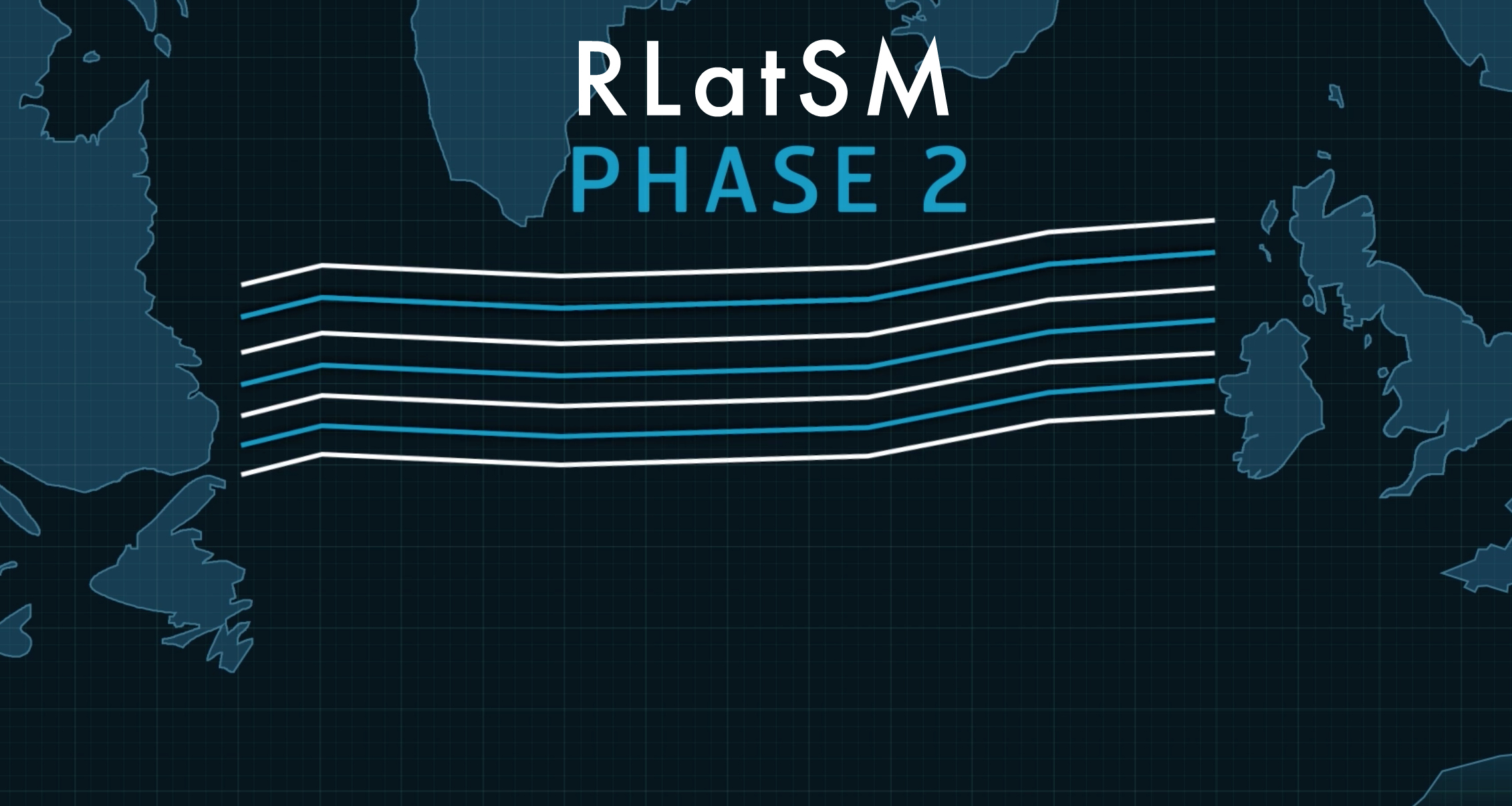
Back to the Radio: Gander Goes Voice-Only Pre-Oceanic

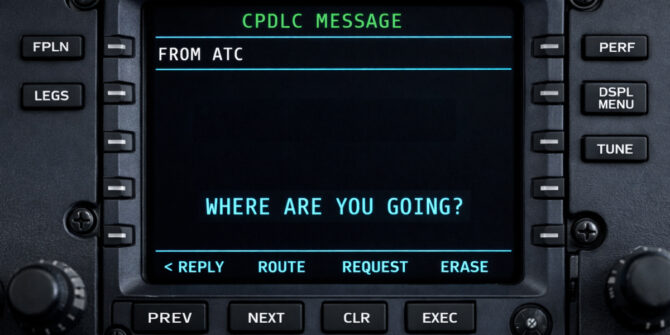
  • Since the removal of Oceanic Clearances in December 2024, Gander had been issuing pre-Oceanic route amendments via CPDLC. But crew confusion over these messages has led to increased VHF workload for controllers.
  • To help fix this, from 5 May to 31 December 2025, Gander will issue all route amendments before the Oceanic Entry Point by VHF voice only, even if the aircraft is logged on to CPDLC. All other OCR procedures remain unchanged.

More info can be found in Canada AIP SUP 46/25. The same update has been announced via Notam too:

CZQX H1579/25 - EASTBOUND FLT IN GANDER DOMESTIC, ENROUTE TO GANDER OCEANIC, 
WILL BE ISSUED OCEANIC ROUTE AMENDMENTS VIA VHF VOICE IN LIEU OF CPDLC LOADABLE 
ROUTE CLEARANCES. ALL OTHER OCEANIC CLEARANCE REMOVAL (OCR) PROC REMAIN UNCHANGED. 
REFER TO AIP CANADA SUP 046/2025. 
05 MAY 00:00 2025 UNTIL 04 AUG 16:00 2025. CREATED: 01 MAY 12:36 2025

We’ve written before about crew confusion and errors on the NAT following the introduction of the new “No Oceanic Clearance” procedure.

Since 4 Dec 2024, Oceanic Clearances are no longer being issued by Gander for eastbound flights, and a new procedure is in place using the same ACARS 623 RCL message process enabling you to send your desired time, level and speed at the Oceanic Entry Point (OEP) so ATC can develop an optimal Oceanic profile for your flight.

But there have been plenty of cases of flight crew getting it wrong, the top 5 being:

  1. Sending the RCL at the wrong time
  2. Asking for an Oceanic Clearance
  3. “DIY” level changes
  4. Wrong handling of RCL Rejected messages
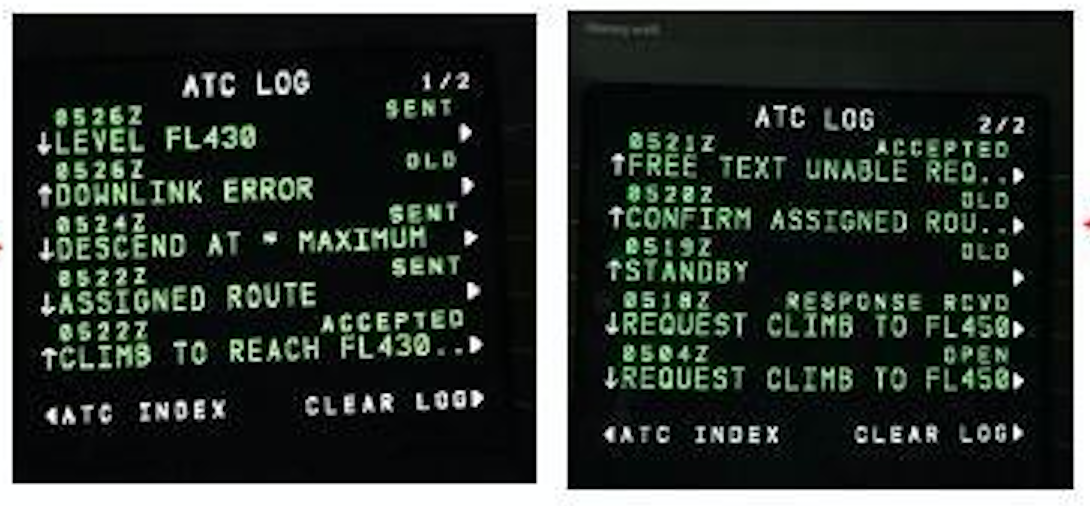
  5. Repeated voice requests for “route confirmation” blocking active ATC frequencies due to CPDLC UM79 route clearance confusion.

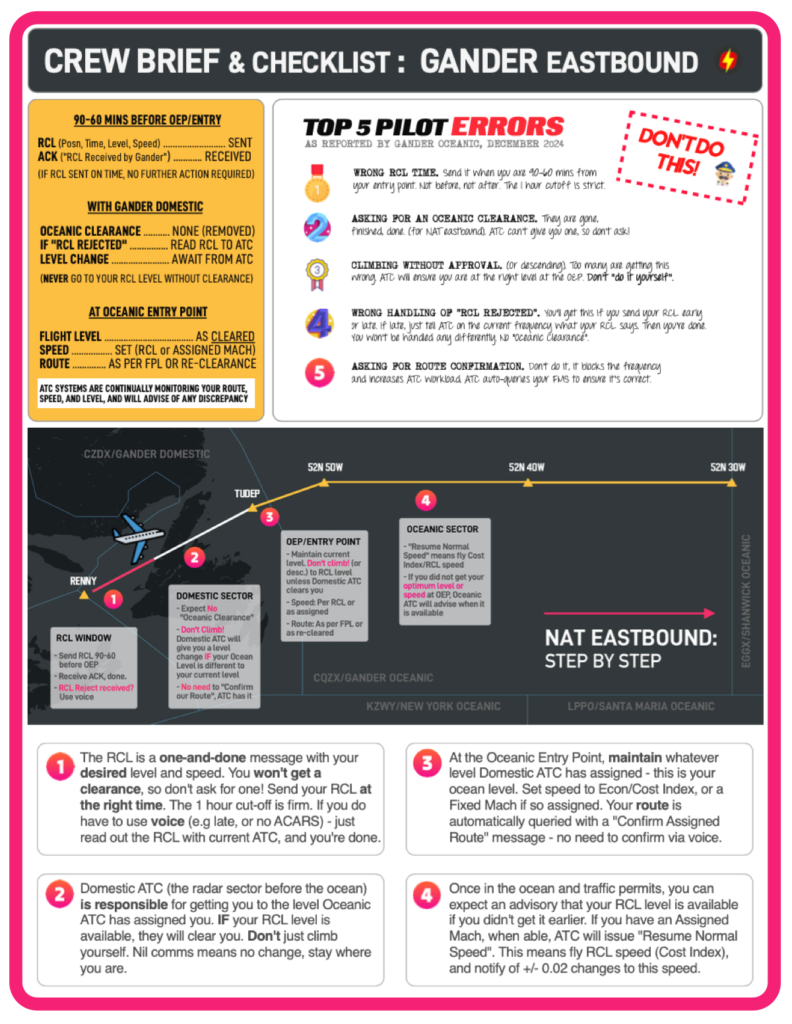
We previously published this Crew Brief and Checklist, which you can download below:

Download the Gander RCL Crew Brief and Checklist (PDF, 1Mb)

⬆️ All the info in the Checklist is still accurate, except for this new change from May 5: Gander will issue all route amendments before the Oceanic Entry Point by VHF voice only, even if the aircraft is logged on to CPDLC. Note that Moncton and Montreal will continue to issue CPDLC UM79 route amendments.

Getting it wrong

Since Canada removed Oceanic Clearances in Dec 2024, things haven’t exactly gone smoothly. Crews are confused. Controllers are overloaded. Frequencies are clogged.

The ICAO North Atlantic Implementation Management Group published this report in April 2025, which gives a bit more info about what’s been going wrong. Here’s a summary:

  1. Misinterpretation of “RCL RECEIVED”. Crews wrongly believe this means their requested level and speed are approved.
  2. Expectation of Verbal Clearance. Crews continue to ask for Oceanic Clearance or confirmation, despite RCL automation.
  3. Confusion Over Clearance Level. Crews question why the cleared level differs from what was requested in the RCL.
  4. Timing Errors. RCLs sent too early or too late are rejected, leading to further confusion.
  5. Old Habits Die Hard. Habits from the previous Oceanic Clearance system persist among crews.
  6. Interpretation Problems with UM79. Some crews are reading the UM79 and thinking “direct to the Clearance limit,” which is wrong.
  7. Incomplete Route Displays. Missing route chunks – Depending on the avionics, not all of the routing shows up properly, or crews miss them.
  8. FMS Issues and Fuel Warnings. The FMS throws up alerts. Crews wonder if something’s off with the routing.
  9. Reluctance to Load Routes. Crews hesitate to load the Clearance into the FMS without voice confirmation – they’d rather check with ATC first, just to be sure.
  10. General Avionics Variability. Every aircraft is different – and so is how it shows the message. It’s not standard, which means more chances to mess it up.
  11. Incorrect or Partial Route Loading. Frequent errors like skipping waypoints or only partially loading Clearances – or just loading it wrong altogether!
  12. BizAv-Specific Confusion. Not sure how true this is, but the doc says that BizAv crews in particular are struggling with strange LL coordinate formatting.
  13. Increased Voice Frequency Use. Radio overload – all these doubts mean more calls to ATC. VHF is getting slammed.
  14. High ATC Workload. ATC are super busy with constantly jumping in to prevent route deviations due to misinterpretations.
  15. Prevented Deviations. A high number of potential lateral or vertical deviations are being caught just in time by ATC.

Phew! Who knew this whole Removal of Oceanic Clearances thing was going to be so much work!

Getting it right

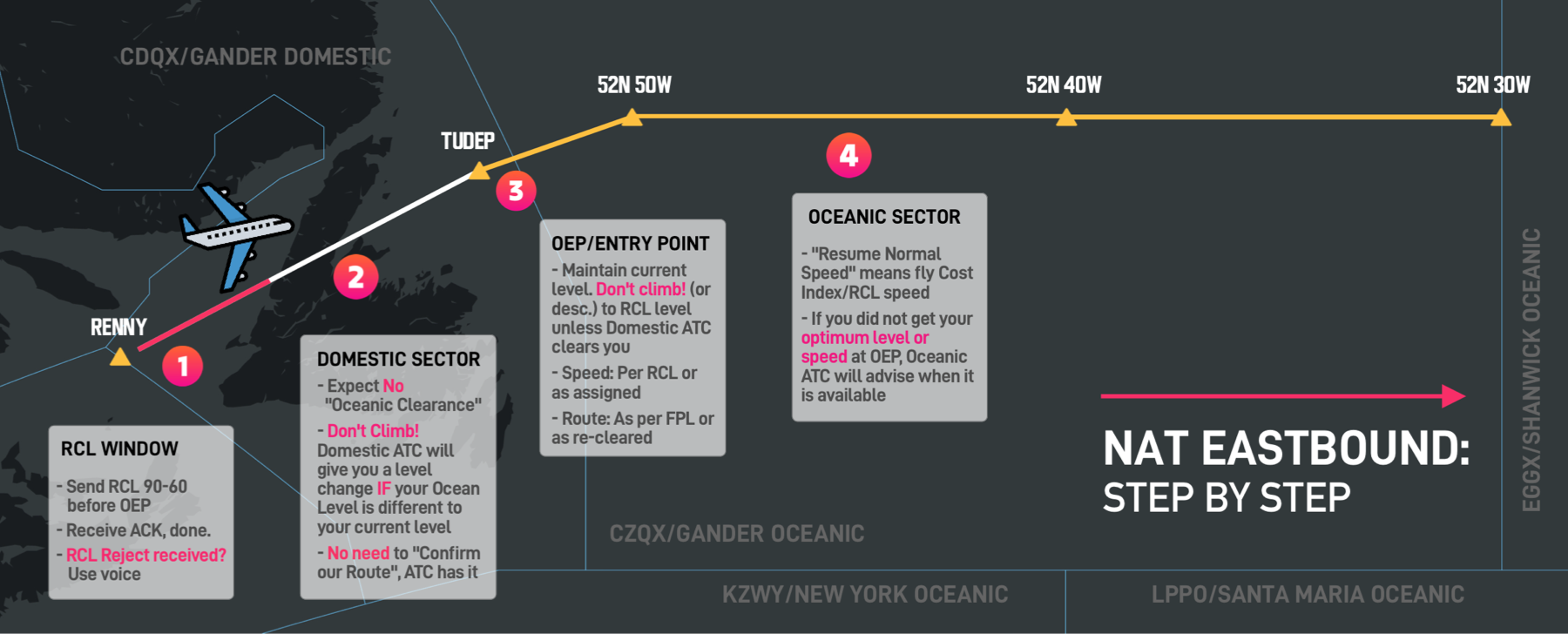
In our previous post, we did attempt to draw out some straightforward guidance for crews heading eastbound on the NAT through Gander on how to get it right. But for those of us who prefer cold hard text rather than little pictures and maps, here’s some step-by-step guidance:

  1. File your flight plan. Do this as usual, including your planned route, speed, and flight level(s).
  2. Log on to CPDLC. The Gander Domestic logon code is CDQX. Gander Oceanic logon is CZQX. No need to add anything else as the transfer of connections should be automatic.
  3. Submit your RCL. Do this via the ACARS 623 process between 90-60 mins prior to the OEP for Gander. Remember, this RCL is a message you send to ATC telling them your desired route, level, and speed across the NAT. It’s not asking for a Clearance – it gives ATC the details needed to build your optimal profile.
    Submit the RCL by voice instead of the ACARS 623 process if any of the following apply:
    – You don’t have datalink capability or it’s not working.
    – You’re departing from an airport less than 45 minutes’ flying time from the OEP (send the RCL 10 minutes prior to start-up).
    – You receive an “RCL REJECTED” message for any reason.
    – You don’t receive an “RCL RECEIVED” response within 15 minutes.
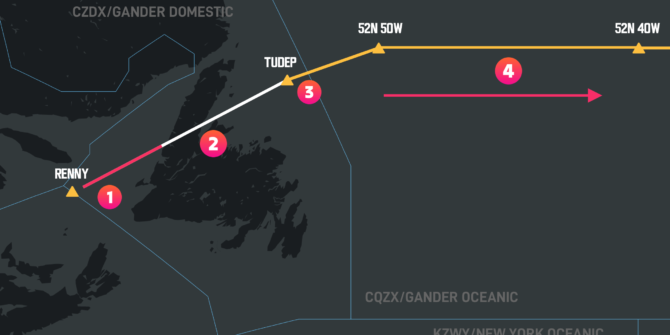
  4. 🆕 Expect any Oceanic route amendments from Gander Domestic via VHF voice, not CPDLC. Between 5 May and 31 December 2025, Gander Domestic controllers will issue any route amendments via VHF voice only, even if you’re logged on to CPDLC. This is a temporary change to reduce confusion, controller workload, frequency congestion and hopefully identify mitigations for the UM79 errors. Any route changes after you progress by the OEP will still be issued via CPDLC or HF by Gander Oceanic.
  5. Don’t request a clearance! There is no eastbound Oceanic Clearance anymore, so don’t ask ATC to confirm your route!
  6. Don’t climb! Maintain your domestic cleared level. Domestic ATC (the radar sector before the ocean) is responsible for getting you to the level Oceanic ATC has assigned you. If your RCL level is available, they will clear you. Do not climb without a clearance! Nil comms means no change, stay where you are. At the OEP, set speed to Econ/Cost Index, or a Fixed Mach if so assigned. Your FMS routing is automatically checked with a “CONFIRM ASSIGNED ROUTE” message – no need to confirm via voice. If there’s a problem, ATC will contact you.
  7. Once in Oceanic airspace… Any further route or level changes will be issued via CPDLC or HF, as before. Once in the ocean and traffic permits, you can expect an advisory that your RCL level is available if you didn’t get it earlier. Continue normal NAT procedures, including position reporting (as required), speed change notifications, and monitoring of appropriate frequencies.
Back to the Radio

For crews, these temporary changes will feel like stepping back in time to the old school pre-CPDLC era. After years of progress toward datalink-driven automation, we’re now back to copying Oceanic route amendments over VHF – just like the old days. Until the system catches up, have your pens ready and your radios tuned – because Gander is going retro, at least for now.

What about flights heading the other way across the NAT?

Westbound flights are still fully doing things the old-fashioned way, as Shanwick have still not removed Oceanic Clearances yet!

They initially planned to drop these in Dec 2024, but identified some system issues at the last minute which would have created major problems in providing a full ATC service.

The latest news from them is that they don’t expect to do this before Summer 2025 – and NATS will give at least 2 months’ notice before making any changes.

For more on that, Opsgroup members can check this briefing.


High levels of Pilot Error with NAT RCL: New Briefing and Checklist

The number of pilot errors following the introduction of the new “No Oceanic Clearance” procedure is turning out to be far higher than expected. As a result, Gander have had to implement an evening Airspace Flow Program (AFP), restricting eastbound traffic.

Since December 4th, Oceanic Clearances are no longer being issued by Gander for eastbound flights, and a new procedure is in place using an RCL message to send your desired time, level and speed at the Oceanic Entry Point (OEP).

However, the very high level of non-compliance with this new procedure is surprising and troubling. Errors by flight crew fall into a number of different categories, but can be summed up in a “Top 5”, including sending the RCL at the wrong time, asking for an Oceanic Clearance, “DIY” level changes, wrong handling of RCL Rejected messages, and repeated voice requests for “route confirmation” blocking active ATC frequencies.

A new Crew Brief and Checklist has been published today, which you can download below. Please save a copy, and send to your crew and colleagues!

Download the Gander RCL Crew Brief and Checklist (PDF, 1Mb)


Top 5 Pilot Errors

  1. WRONG RCL TIME. Send it when you are 90-60 mins from your entry point. Not before, not after. The 1 hour cutoff is strict.
  2. ASKING FOR AN OCEANIC CLEARANCE. They are gone, finished, done. (for NAT eastbound). ATC can’t give you one, so don’t ask!
  3. CLIMBING WITHOUT APPROVAL. (Or descending). Too many are getting this wrong. ATC will ensure you are at the right level at the OEP. Don’t “do it yourself”.
  4. WRONG HANDLING OF “RCL REJECTED”. You’ll get this if you send your RCL early or late. If late, just tell ATC on the current frequency what your RCL says. Then you’re done. You won’t be handled any differently. No “Oceanic Clearance”.
  5. ASKING FOR ROUTE CONFIRMATION. Don’t do it, it blocks the frequency and increases ATC workload. ATC auto-queries your FMS to ensure it’s correct.


Notes on the RCL process

  1. The RCL is a one-and-done message with your desired level and speed. You won’t get a clearance, so don’t ask for one! Send your RCL at the right time. The 1 hour cut-off is firm. If you do have to use voice (e.g late, or no ACARS) – just read out the RCL with current ATC, and you’re done.
  2. Domestic ATC (the radar sector before the ocean) is responsible for getting you to the level Oceanic ATC has assigned you. IF your RCL level is available, they will clear you. Don’t just climb yourself. Nil comms means no change, stay where you are.
  3. At the Oceanic Entry Point, maintain whatever level Domestic ATC has assigned – this is your ocean level. Set speed to Econ/Cost Index, or a Fixed Mach if so assigned. Your route is automatically queried with a “Confirm Assigned Route” message – no need to confirm via voice.
  4. Once in the ocean and traffic permits, you can expect an advisory that your RCL level is available if you didn’t get it earlier. If you have an Assigned Mach, when able, ATC will issue “Resume Normal Speed“. This means fly RCL speed (Cost Index), and notify of +/- 0.02 changes to this speed.

Worried about getting it wrong?

Of course, it always makes sense to double check any uncertainties, but if you can keep it off the frequency, that’s very helpful for ATC. At the moment, there is a high volume of extra requests (which makes life hard for the controller). Remember one key point: ATC systems are continually monitoring your route, speed, and level, and will advise of any discrepancy. Your route in the FMS is queried by a UM137 message (“CONFIRM ASSIGNED ROUTE”), to ensure both you and ATC have the same understanding of your track, or random route acoss the Ocean.

If you’re not certain about how the procedure works, use the Crew Brief and Checklist (developed specifically for Gander Oceanic), and refer to NAT Ops Bulletin 2023_001 Rev 4, and NAT Doc 007.

Can you share? Please do.

The quicker we can get this information out to all NAT crews, the better. Please share with your flight department, fleet, or operation – just download the Crew Brief and Checklist and pass it on.


Questions? Can we help?

If you have a question about the new RCL process, just comment below or send us an email. We want to help make sure that we are all on the same page!


NAT Conundrums Volume III: To GOTA and beyond!

Ah, NAT conundrums! We love them so much, we’re into our third Volume already!

Volume I covered the following three conundrums:

1. To SLOP, or not to SLOP?
2. What’s the difference between the NAT Region and the NAT HLA?
3. Can I fly across the North Atlantic without Datalink?

Volume II covered these additional three:

4. Do you need to plot on Blue Spruce Routes?
5. Do we still fly Weather Contingency Procedures on Blue Spruce routes?
6. When can we disregard an ATC clearance and follow the contingency procedure instead?

And this post, Volume III, looks at GOTA airspace. It’s such a juicy topic, it gets an entire Volume all of its own.

So here goes…

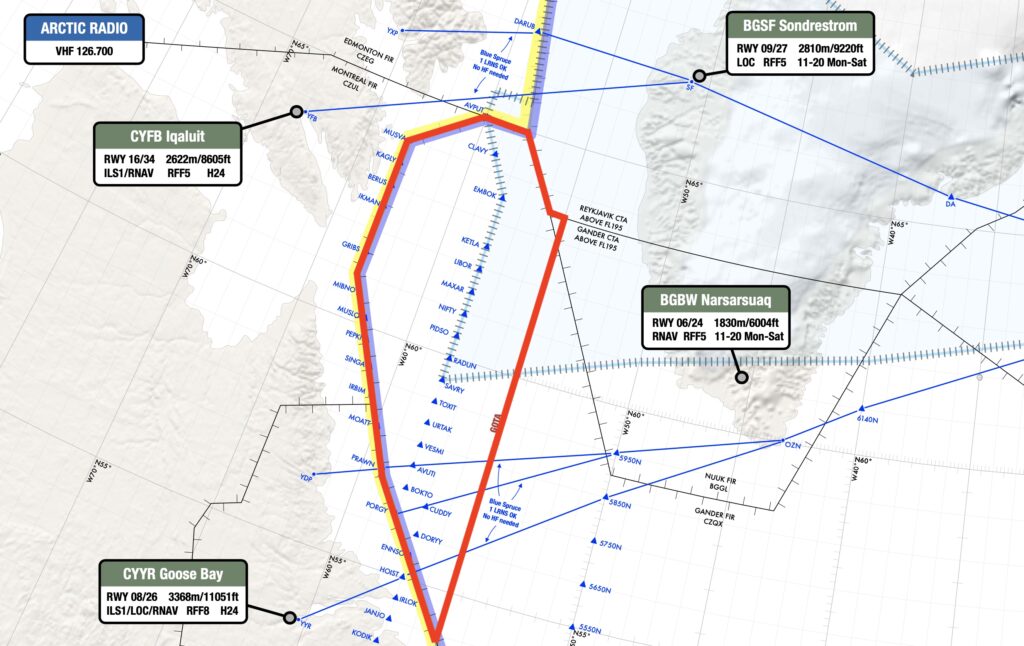
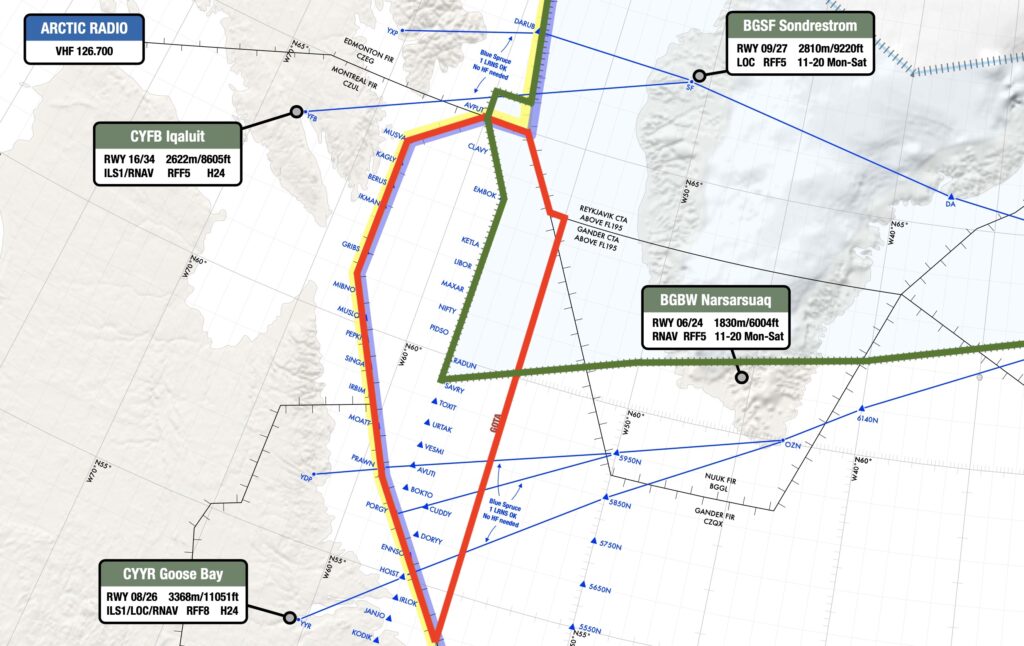
Where is GOTA airspace?

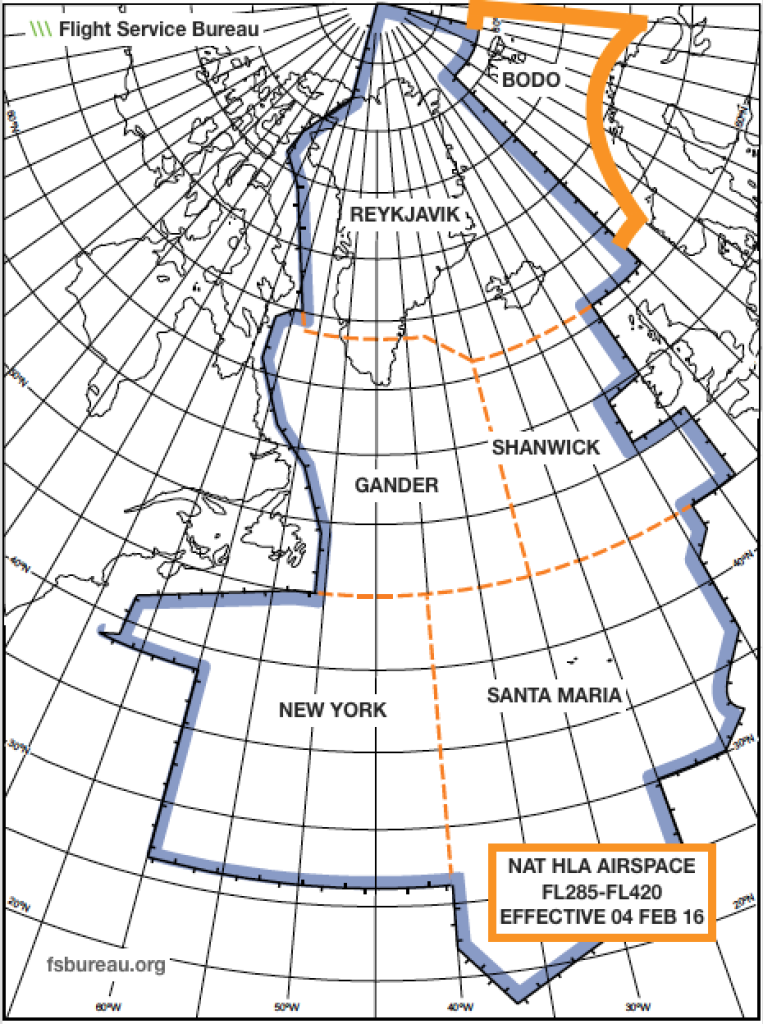
This section of airspace is found off the coast of North-eastern Canada, FL290 to FL600 inclusive.

Here it is, outlined in red:

Why are we talking about it?

Because lots of aircraft transit this area when flying across the North Atlantic. Also because the requirements here were very tricky for us to track down on “paper” (i.e. the Canada AIP, NAT Doc 007, etc), and were only really made clear after speaking with a real human being at Transport Canada. We like human beings!

So here’s what we discovered…

You don’t need datalink in GOTA airspace

No, you don’t. We thought you did, but we were wrong.

When we sat down to update our North Atlantic Plotting chart last year, we wanted to draw nice clear lines on the map to show where datalink was required. But we were bamboozled by GOTA.

The ICAO NAT Doc 007 says that you don’t need datalink in:

“Airspace where an ATS surveillance service is provided by means of radar, 
multilateration and/or ADS-B, coupled with VHF voice communications as depicted 
in State Aeronautical Information Publications (AIP), provided the aircraft is 
suitably equipped (transponder/ADSB extended squitter transmitter).”

It then says to check in State AIPs to see if any of their airspace fulfils this criteria.

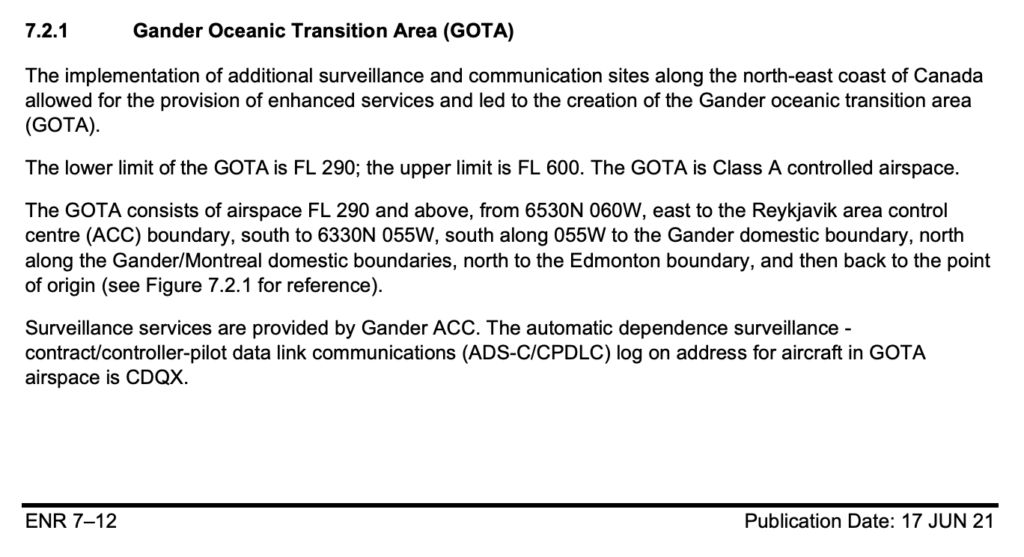
So that’s what we did. But checking in Canada’s AIP brought up this for GOTA:

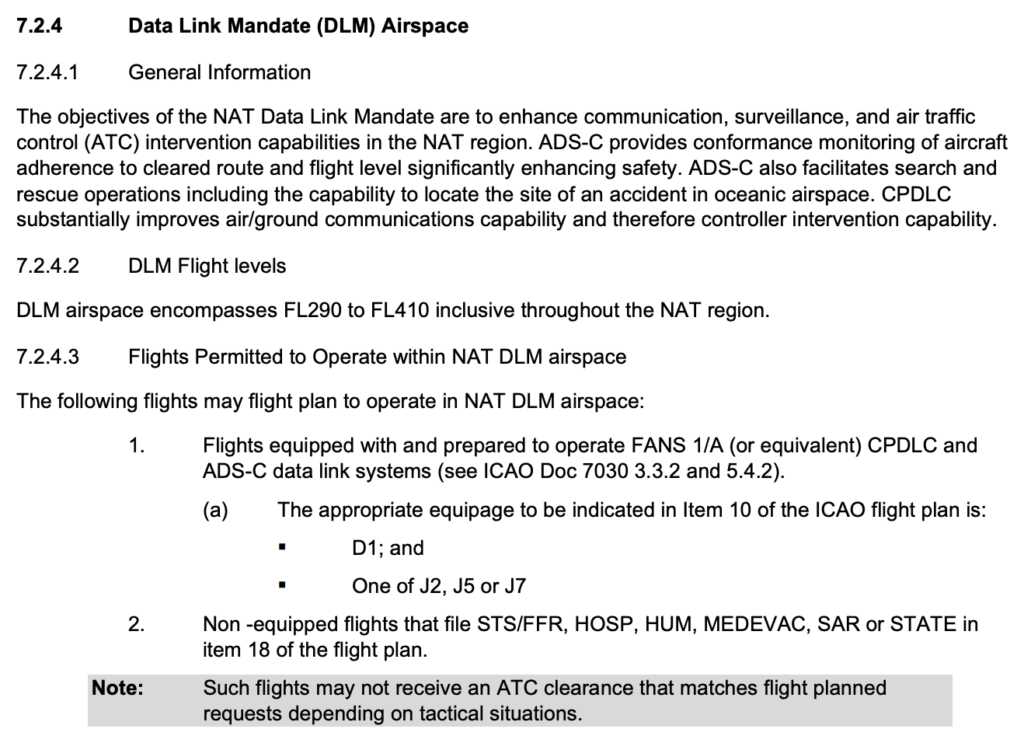
And this for Data Link Mandate (DLM) Airspace:

So none of that really answered our question of whether or not you need datalink in GOTA airspace. The trail went cold…


via GIPHY

Our chat with Transport Canada in 2021:

Deep in the doldrums of lockdown, we sent Transport Canada (TC) some emails asking them the question directly. Here’s a massively paraphrased transcript of that email exchange:

Us: We have been trying to determine if the GOTA requires datalink? It appears to meet the definition of ATS Surveillance Airspace but we can’t identify anywhere in the Canadian AIP which specifically states this.

TC: The GOTA is in fact DLM airspace.

Us:  Really? So operators without datalink must cap their flight below FL290 through the GOTA airspace until they reach that datalink exempt airspace over Greenland, at which point they can climb to the higher levels?

TC: Yes. Well… flights equipped with ADS-B may operate at DLM levels within the GOTA.

Us:  Oh. Now we’re confused. Oh well, it’s Christmas now. Chat next year!

TC: Merry Christmas.

Our chat with Transport Canada in 2022:

Us: We have been trying to determine if the GOTA requires datalink? It appears to meet the definition of ATS Surveillance Airspace but we can’t identify anywhere in the Canadian AIP which specifically states this.

TC: Didn’t you ask this exact same question last year?

Us: Yep. But then… you know… Christmas…

TC: Ah yeah. Ok. As long as you are HLA Certified (MNPS & RVSM) and you have ADS-B, transponder and VHF you wouldn’t require all the DLM equipage. GOTA is technically Gander Oceanic airspace (NAT HLA airspace), but as they have Ground based Radar sources, space-based ADS-B and VHF coverage in the area it has been delegated to Gander Domestic. Due to this, the airspace is considered Class A surveillance airspace and follows the similar regulations as you would in other Canadian domestic Class A airspace.

Us: What about that ADS-B requirement?

TC: Well, technically ADS-B isn’t required as it is considered class A surveillance airspace. So lack of ADS-B wouldn’t prevent you from entering the GOTA area. That said, ADS-B equipage is preferred by many of the controllers. This is because the ground based radar isn’t always guaranteed to the outer limits of the GOTA airspace. This makes identification and separation easier for the domestic controllers when the aircraft have ADS-B.

Us: So tell us again, what do you need in GOTA airspace?

TC: Required equipment for GOTA airspace is transponder, automatic pressure-altitude reporting equipment and VHF. As soon as you leave that airspace you would need other equipment depending on what airspace you enter.

“As soon as you leave that airspace…”

Yes indeed, a good point, worthy of further investigation! Because no-one just zips around solely in GOTA airspace, do they?

So here’s a look at the airspace adjacent to GOTA, and what you need where…

Datalink Exempt airspace over Greenland, Iceland, and a bit of Gander Oceanic

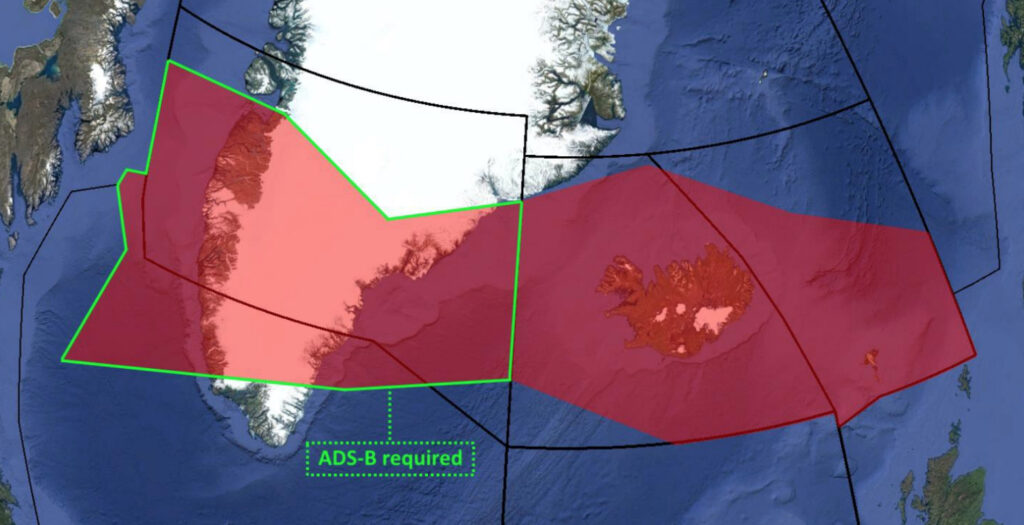
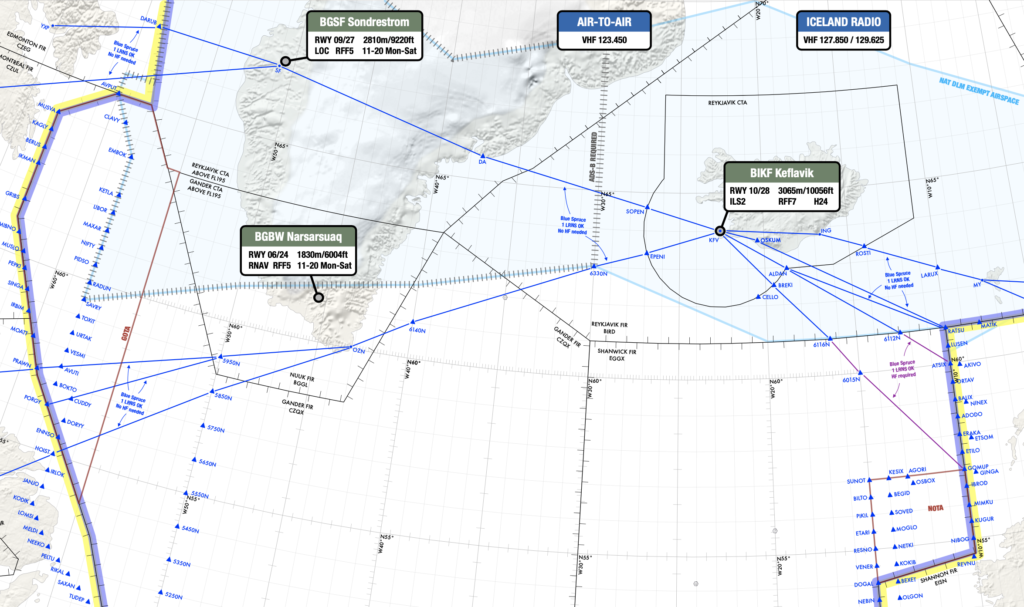
There’s an interesting picture in the NAT Doc 007 doc that looks like this:

This the datalink exempt ATS Surveillance airspace over Greenland, Iceland, and a bit of Gander Oceanic where you can still fly if you don’t have datalink.

This area is bounded by the following:

Northern boundary: 65N000W – 67N010W – 69N020W – 68N030W – 67N040W – 69N050W – 69N060W – BOPUT.
Southern boundary: GUNPA – 61N007W – 6040N010W – RATSU – 61N020W – 63N030W – 62N040W – 61N050W – SAVRY

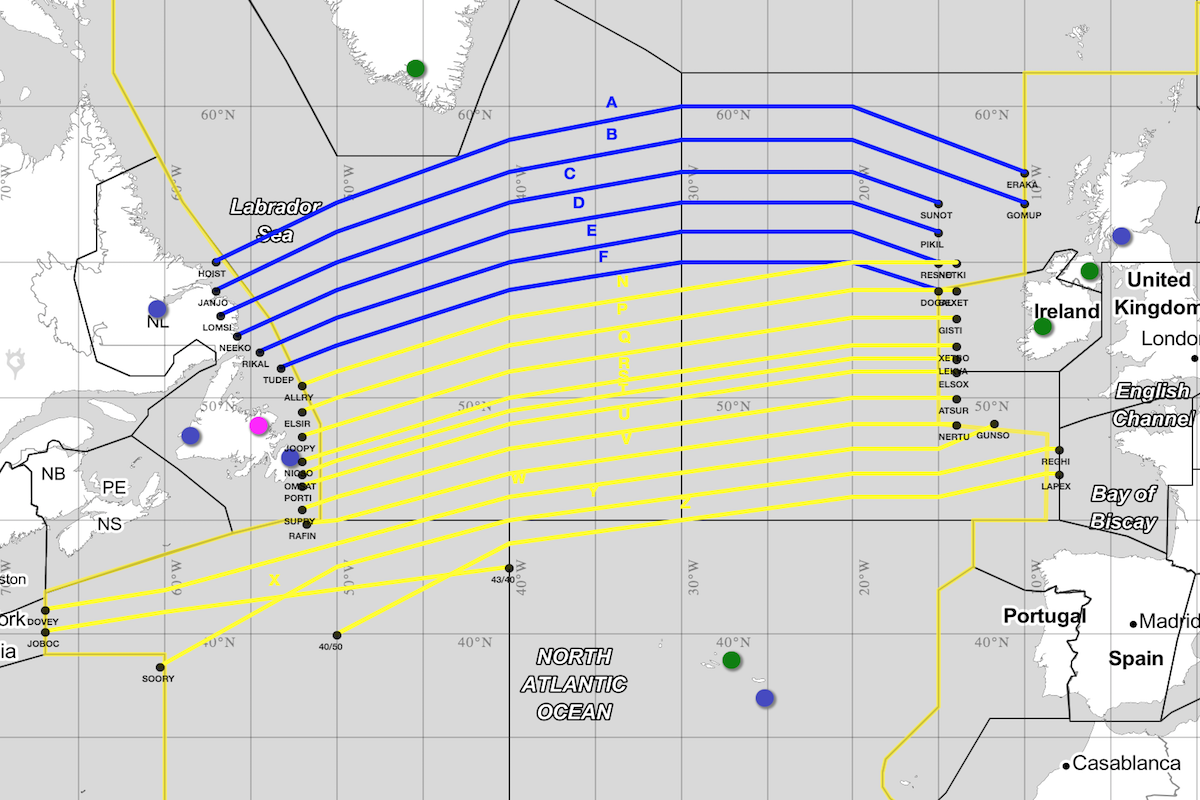
So, putting that on our nice NAT Plotting Chart, it looks like this (outlined in green):

Us: What are the requirements for this airspace?

TC: HLA Certification (MNPS & RVSM), ADS-B & VHF.

Us: Nice.

HLA airspace

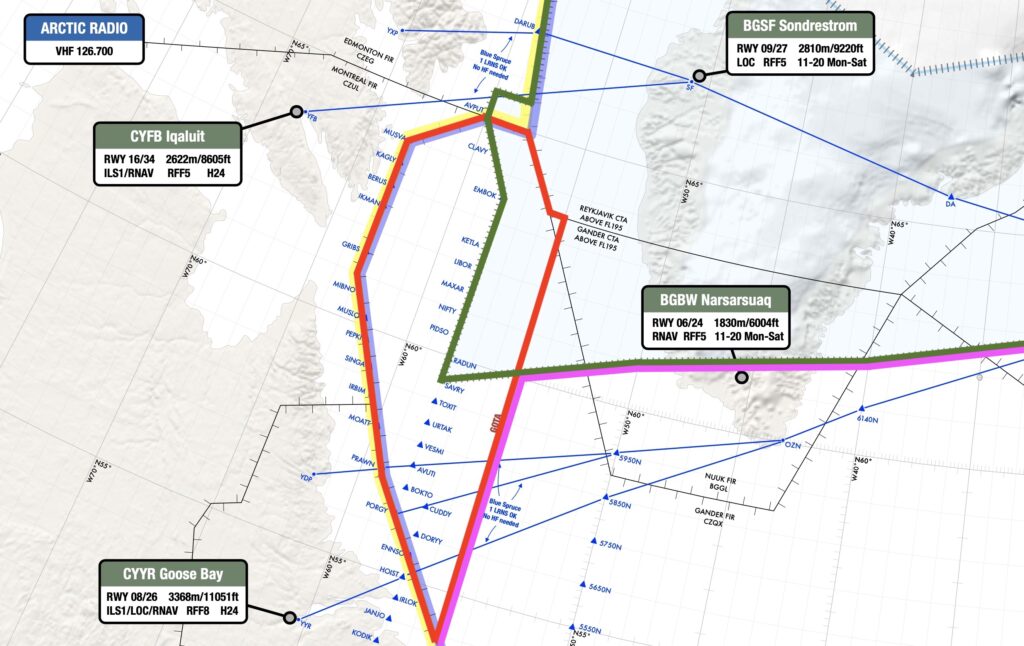
So now we’re talking about the bit to the south of the datalink exempt airspace, outlined here in fruity pink:

Us: What are the requirements for this airspace?

TC: HLA Certification and full DLM certification, FANS 1/a (ADS-C(D1) & CPDLC(J2, J5 or J7)). Depending on the route of flight and the tracks that day there may be other requirements as well (ie. PBCS Certification for PBCS tracks).

The Blue Spruce Routes

So here’s what we said in a previous post on these…

The Southerly ones: These go over Greenland linking Canada with Iceland via waypoint OZN, and are not fully contained in the exempted airspace. So if you’re flying these southerly Blue Spruce routes you will have to meet the NAT DLM requirements or fly outside of the vertical parameters of DLM airspace (i.e. below FL290 or above FL410). In other words: you need datalink to fly on the southerly Blue Spruce routes between FL290-410.

The Northerly ones: These are the ones going overhead BGSF/Sondrestrom airport. These do fall within the exempted area of airspace – so datalink is not mandatory if you’re flying here.

Us: All that stuff we told people in our previous post… did we get that right?

TC: Yeah, pretty much. The primary purpose of Blue Spruce routes is for aircraft with only one long range navigation system. This would normally exclude them from the exemption area anyway, as they are usually kept below HLA airspace (FL280 or below) as they would normally need state HLA approval to fly a blue spruce route with one long range navigation system at FL290 and above.

Gander’s datalink exempt airspace won’t be datalink exempt for much longer!

You: Hold on… which bit of airspace are we talking about now??

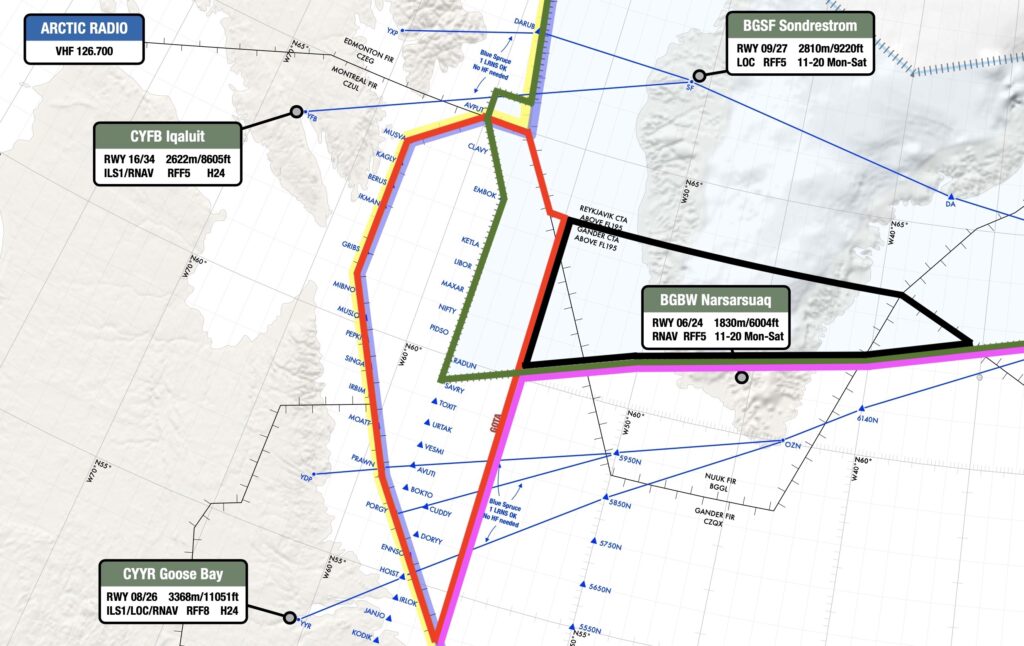
Us: This bit, outlined in black. It’s the bit of airspace in the datalink exempt area which is controlled by Gander Oceanic.

So, this is where the plot thickens!

Us: Can you tell us why the plot has thickened, exactly?

TC: Yes, we can. Do you guys actually know anything, or do just come to us for all your answers?

Us: We only know how to massively paraphrase email exchanges.

TC: Okay. So here’s the deal. As we are decommissioning the VHF and ground based ADS-B sites in southern Greenland we will no longer have the datalink exempt area in the northern portion of Gander oceanic HLA airspace. At that point, all Gander oceanic airspace will become DLM airspace. Although GOTA will stay datalink exempt.

Us: Decommissioning VHF and ground based thingies, you say?

TC: That’s right. Nav Canada put out a circular last year and updated it again this year advising that the ADS-B and VHF sites in that area will be decommissioned. The current circular is AIC 15/22. The tricky part is, it discusses just the ADS-B and VHF sites, but many people don’t make the connection from that to the exemption area. When the VHF sites are decommissioned we won’t have the equipment to qualify for DLM exemption in that area. Nav Canada is keeping one frequency until December 29, 2022 to enable users to continue to use the area for this year, but that final one will be decommissioned at that time. The 127.9 frequency will continue to be used by Gander IFSS for the Blue Spruce Routes. When it gets closer to that date, there should be an ICAO NAT Ops Bulletin out and NAT Doc 007 will be amended. So just to clarify, barring any major unexpected changes, that airspace will become strictly DLM airspace on December 29, 2022. At that point it will follow the same regulations as the rest of the NAT DLM airspace.

Us: Bonza.

So, to recap…

  • Datalink Airspace: Remember, NAT DLM airspace only applies from FL290-410. Below or above that, you don’t need datalink in the North Atlantic.
  • If you have full datalink (CPDLC and ADS-C): You can go where you like, and you didn’t really need to read this post.
  • For GOTA airspace: You need a transponder, automatic pressure-altitude reporting equipment and VHF. If you have ADS-B, that’s helpful for ATC.
  • For the Blue Spruce Routes: You need datalink for the southerly ones, but not the northerly ones. (If you’re flying on these then you’re probably doing so below FL290 anyway, in which case you’re below NAT DLM airspace and don’t need datalink).
  • For the datalink exempt airspace over Greenland, Iceland, and a bit of Gander Oceanic: You don’t need datalink, but from 29 Dec 2022 you will do in the bit controlled by Gander.

Questions

Just send us an email at news@ops.group and we’ll try to find out the answer.


NAT Tracks NIL – an experiment

The long-awaited and much discussed scenario on the North Atlantic finally happened this week: No published NAT Tracks, with all aircraft on Random Routes. The concept of free-routing on the NAT is one that airlines in particular have been keen to see for a long time: the ability to decide their own routes, unconstrained by an overlay of tracks that may be tangential to their flight-planning whims.

This is an experiment being led by NATS and Nav Canada (or Shanwick and Gander, if you prefer), and on the face of it, it appears straightforward. Traffic levels are lower at present – about 40% of normal. In January 2021, Shanwick managed 15,241 flights (averaging 491 flights per day), 41% of the January 2020 figure of 36,782 (averaging 1,189 flights per day). A reduction in volume goes hand in hand with a reduction in complexity from an ATC perspective. Without published tracks to assist in separation, the burden on the controller is increased – but the lower traffic levels mean it can be safely managed. Ideal time to try it out.

The concept has garnered much media interest, not least because of the timing of a scientific research paper from Reading University that suggests efficiencies of up to 16.4% can be achieved with this “new idea”. As a result, in the past 10 days the NAT Tracks have featured on CNN (“Airlines can now pick their own routes across the Atlantic. Huge fuel savings could follow”) and the Independent (“‘Surfing the wind’ could allow aircraft to cut carbon emissions and reduce flight times”). Headline: New York-London journeys could be cut by 21 minutes.

The media, and even our own industry news coverage, would have us believe that somehow we’ve just stumbled onto some preternatural scheme of harnessing the power of the wind, to spirit our hulking lumps of metal across the pond. Jet streams, you say? Pray tell.

Let’s clarify something first. Aviation contributes around 2% of global CO2 emissions. Global warming is a danger to our entire existence. We are an industry founded on innovation and ingenuity, and we should be looking for every opportunity to do something more than just shave a few dollars off a route cost. We need to open our minds, stop being quite so defensive about aviation, collaborate with science and research, and above all recognise the impact that aircraft are having on the environment. We need dramatic change.

In the cold light of operational reality, however, all is not as the public coverage seems. The Shanwick/Gander No-Tracks experiment itself is founded on solid ground – the results will provide useful insight, and the reasoning for it is sound. The research paper, however, and associated media fanfare, has shakier foundations. In fact, there are fundamental flaws in the assumptions made to reach the headline proclamations of 16.4% and 230km (125 nautical mile) savings on route distance.

We’ll look at three things in this article …

One: How an aircraft operator actually chooses a route across the NAT
Two: The ATC perspective; why No NAT Tracks is not as easy as it might sound.
Three: A review of the research report from Reading University.

Part One: How does a NAT route get chosen?

The hardest thing in life is knowing what you want. It’s no different on the NAT. The process for selecting a route across the ocean is more complex than it might seem. At first glance, it might appear that the most logical route is the best wind route, in other words, the track across the ocean where we can take maxium advantage of the jet stream. In the Reading University report, this is called the “OFW: Optimized for Wind Route“. Let’s see why this is not the case.

There are four track calculation options available to most aircraft dispatchers and flight planing systems:

A. MDT: Minimum Distance Track. Departure to destination with shortest distance (ie. Great Circle track). Only sensible if there is no wind, which never happens.
B. MFT: Minimum Fuel Track. Departure to destination with lowest possible fuel burn. Equivalent to the OFW/Optimized for Wind Route.
C. MTT: Minimum Time Track. Departure to destination in shortest possible time. Often very similar to the MFT.
D. MCT: Minimum Cost Track. Departure to destination with lowest cost – considering not just fuel, but navigation fees, and the cost of time (eg. knock on schedule effects, missing curfews etc.)

Which is the most commonly used? Minimum Cost Track, by far. Minimum Fuel is good. But for aircraft operators, we have to consider whether saving 100 kgs in fuel results in being 10 mins late to stand, or makes us overfly a much more expensive country, or miss a curfew time at the airport.

A North American OPSGROUP airline dispatcher told me: “To give you an idea of cost, a Minimum Time Track (MTT) or Minimum Fuel Track (MFT) for our Boeing 777 from the west coast of North America to east Asia can cost anywhere from $10,000 to $15,000 more than taking an MCT. The difference? The MTT and MFT will go through Russia [where navigation fees are much higher]. The MCT stays on the North Pacific in Oakland and Fukuoka airspace. But that cheaper route can be 30+ minutes longer.

And even then, that’s not the track the operator might want to fly. One big consideration: Turbulence.

In the winter months in particular, the eastbound jet stream can be nasty. The place where the most efficient route lies is efficient because that’s where the winds are strongest. This is often also where the core ‘efficient’ NAT Track Xray or Zulu lies these days. A 200 knot tailwind is great, but it comes with a sting in the tail: severe turbulence. The same dispatcher told me: “In the last week, we’ve not flown the NAT Tracks because of multiple patches of severe turbulence, both forecast and reported by other airlines”.


Planning a real-life NAT route from start to finish: eight steps

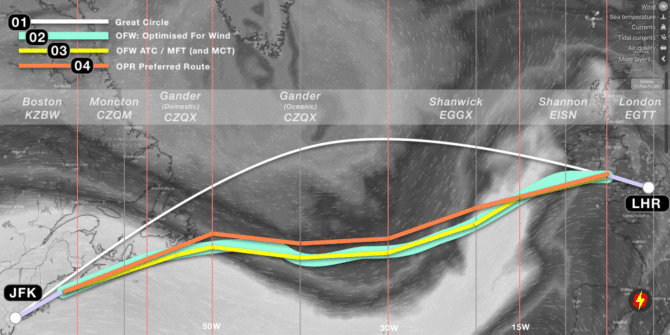
We’ll look at an eastbound flight from New York Kennedy (JFK/KJFK) to London Heathrow (LHR/EGLL). Given that the research paper mentioned above identifies maxium fuel savings eastbound of 16.4%, this is a good example to choose. On the maps that follow, you will see the there are eight steps, starting with the great circle track, and working through what happens in practice until we reach the actual route flown. The aircraft in this example is a Boeing 787, which has an optimum altitude of FL390 (presure level of 200 hPa) at operational weight (~85% of MTOW). Therefore, the winds shown are those at FL390. For track planning, we will consider only the track from Top of Climb (first point of cruising altitude) to Top of Descent (beginning of descent into LHR). The map also shows the ATC areas that will control the flight in the enroute phase. The jet stream is shown as background: the whiter, the faster.
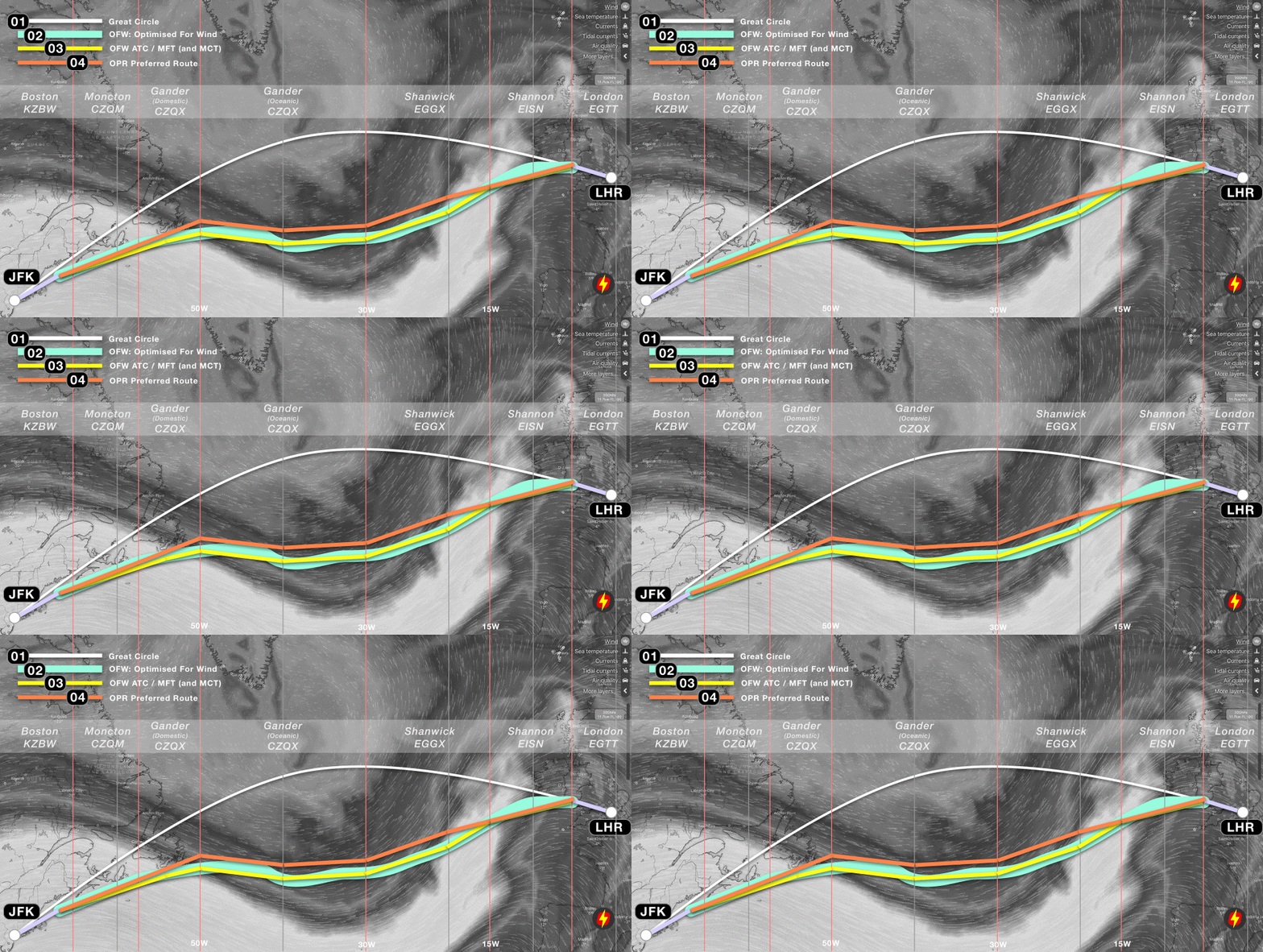
01: GC: Great Circle Route. The shortest distance between JFK and LHR. This does not take winds into account, so to find the best wind route, we must add wind from the forecast for FL390 for our time of flight.

02: OFW: Optimised For Wind route. The track taking maximum advantage of the winds at FL390 (39,000 feet, or the 200 hPa pressure level in ISA).

03: OFW ATC route. The OFW route as adjusted for oceanic ATC flight planning limitations – which are: 1. You must use fixed 1/2 degree latitude points at every 10 degrees of longitude from Oceanic Entry Point to Oceanic Exit Point. 2. You must fly a straight line from that point to the next 10 degree longitude line. This route equates to the MFT (Minimum Fuel Track) in flight planning systems, and in our case here, also the MTT (Minimum Time Track). For some NAT routes, overflight fees will be a consideration (for example, avoiding higher charges in UK and Swiss airspace on routes that go further into Europe) – but here, they are not, so MCT (Minimum Cost Track) is also the same. In other words, OFW ATC = MFT = MTT = MCT.

04: Operator Preferred Route. The next big consideration is turbulence. In this example flight, there are moderate-severe turbulence warning patches at several points on the ATC OFW/MCT route above, so the dispatcher elects to move it a little further north – still gaining from the eastbound jetstream, but outside the core jetstream which has the highest turbulence.

We can now move on to the next stage of planning in a real-world scenario: accounting for a high volume of other traffic, ie. matching the Operator Preferred Route to the closest NAT Track of those published for the day of flight.
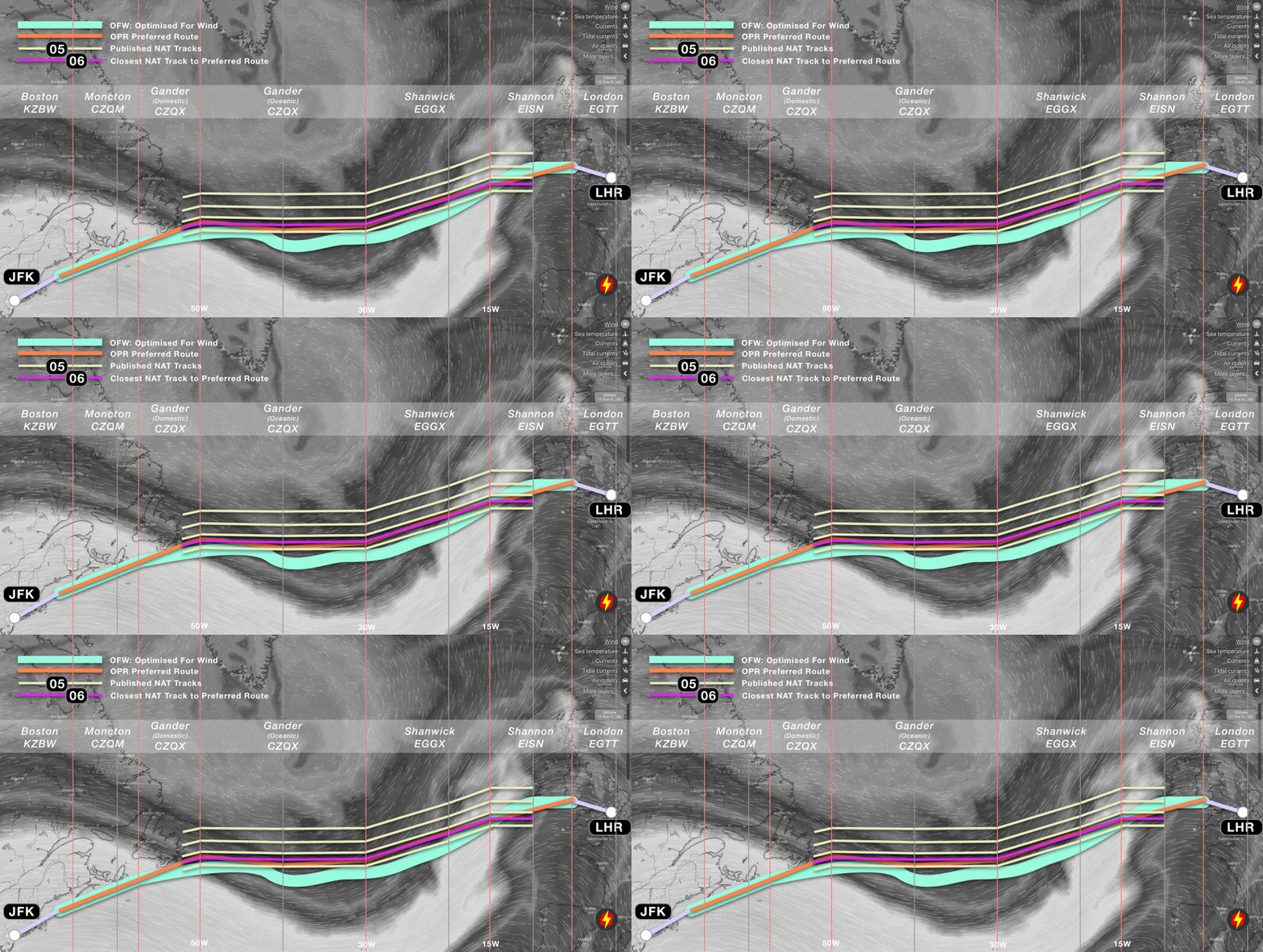
05: Published NAT Tracks. Once a day, Gander issues the NAT Track Message for Eastbound Tracks, which allows Air Traffic Control to safely separate the peak flow of flights from the US to Europe. In this case, there are five tracks.

06: Closest NAT Track to Preferred Route. This is a simple calculation – which NAT Track most closely matches the Operator Preferred Route across the ocean. In this case, it is highlighted in purple, and is a relatively close match.

Finally, we can account for what will happen at the time of flight …
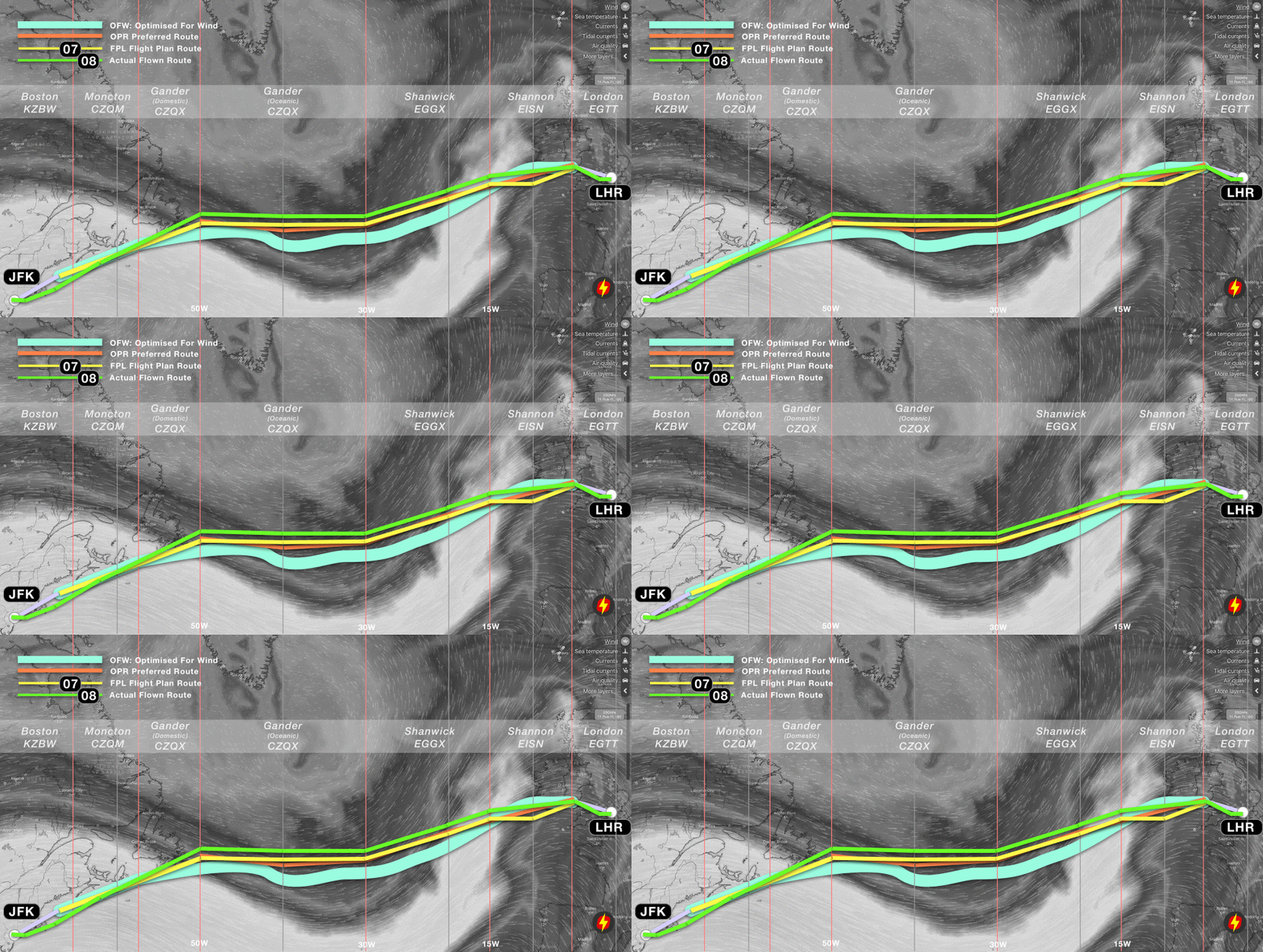
07: Flight Plan Route (FPL). With the choice of track made, the operator will then file the Flight Plan with their requested route, several hours in advance of the flights’ departure from JFK. The purple track above at Step 6 (closest NAT Track) becomes the yellow track in this step, to which the domestic ATC routings are added. Once airborne and enroute, about an hour from the Oceanic Entry Point at 50W, the crew will request their Oceanic Clearance from Gander, as per this flight plan route.

08: Actual Flown Route.  For this flight, the requested track was not available at FL390 (because of other traffic ahead). The crew were given a choice of either a more notherly NAT track at their preferred level (FL390), or their requested NAT track at FL370. The altitude difference would have made for a greater fuel burn than a slightly longer distance, so the crew elected to take the more northerly track (30 nautical miles further north laterally, but in terms of distance flown adding about 20 nautical miles). At 15W, the flight is under radar coverage from Shannon, and was cleared direct to the Strumble (STU) beacon in Wales (which was the original planned Top of Descent). The green track therefore depicts the actual route flown.


Where did we lose most efficiency?

Since the background to this article is considering the benefits of not having to follow prescribed NAT Tracks, the key question is – where has most efficiency been lost on this flight?

  1. Loss 1: The difference between the Minimum Fuel Track (MFT) (or “ATC OFW”) and the Optimized for Wind Route (OFW). Some efficiency is lost because the OFW is constrained by flight planning requirements – specifically having to flight straight lines between each 10 degrees of longitude, and having to cross each 10 degrees of longitude at 1/2 degrees of latitude. The “route of straight lines” is, of course, longer.
  2. Loss 2: The difference between the MFT and the Operator Preferred Route. In this case, the operator chose to move the track further north to avoid turbulence. This decision creates an efficiency loss in terms of fuel burn, because the minimum fuel track is no longer being followed.
  3. Loss 3: The difference between the Operator Preferred Route and the closest matching NAT Track. This is the key efficiency difference when considering gains from the “No NAT Track’s” experiment.
  4. Loss 4: The difference between the NAT Track requested (Flight Plan Route) and the Actual Route flown. There is a mixed bag here. On the one hand, if the operator has to fly anthing other than the requested route, they lose efficiency to some degree. In this case, ATC could only offer a lower level, or a more northerly route. On the other, domestic ATC (using radar) often provide shortcuts which lessen the track miles flown.

A scientific analysis of a series of actual flights would reveal the numbers involved in the four different areas of efficiency loss – and this is roughly the aim of the OTS NIL experiment that Shanwick and Gander are conducting,


Part Two: Why we might still need NAT Tracks

The narrative in the majority of recent reports about the North Atlantic tell us that because we now have ADS-B satellites, and thereby excellent surveillance, this changes the entire landscape, and allows for the disbanding of NAT Tracks. But this overlooks a key point: it’s not a surveillance problem, it’s a comms problem.

We’ve got surveillance nailed – it’s basically the same as radar, now that the full complement of Aireon ADS-B satellites are up and running, complementing the ADS-C coverage already in place. So, controllers can see the aircraft in much the same way as a domestic radar controller. That’s exciting.

However, it’s a bridge too far to assume that just because surveillance is good, we can start treating the Air Traffic Control of NAT aircraft as if it were somewhere in the centre of Europe.

And the reason: instant communication. In a domestic ATC environment, the approximate sequence of events goes like this (callsigns dropped from some calls for clarity):

Controller (thought):Hmmm, Delta and Speedbird are getting a little close. I’ll climb the Delta.
Controller: Delta 63, climb FL360.
Delta 63: Sorry, unable 360, we’re still too heavy.
Controller: Delta 63, roger, turn right 10 degrees due traffic.
Delta 63: Roger, right turn heading 280.

And Delta turns. Conflict solved. That entire sequence of events takes about 10 seconds. Now consider the Oceanic environment. CPDLC is a hell of a lot better than HF, but the target time for the same sequence of events is 240 seconds, or 4 minutes. That’s the basis of RCP240.

See the ATC problem? We can see the traffic now, but we can’t be sure that we can move it around in the same way as a real radar environment, because we don’t have VHF.

This is why the new satellite coverage does not go all the way to allowing a full reduction in separation to the standard enroute value of 5 nautical miles. Oceanic ATC, even with this additional surveillance, remains more of a procedural environment – and separation standards cannot yet drop. In the same vein, we’re not yet at the point where we can solve enroute conflicts with a few vectors and “on your way”.

And therefore, removing the NAT Organized Track Structure for high volumes of traffic is a big challenge.

Part Three: The Reading University Report

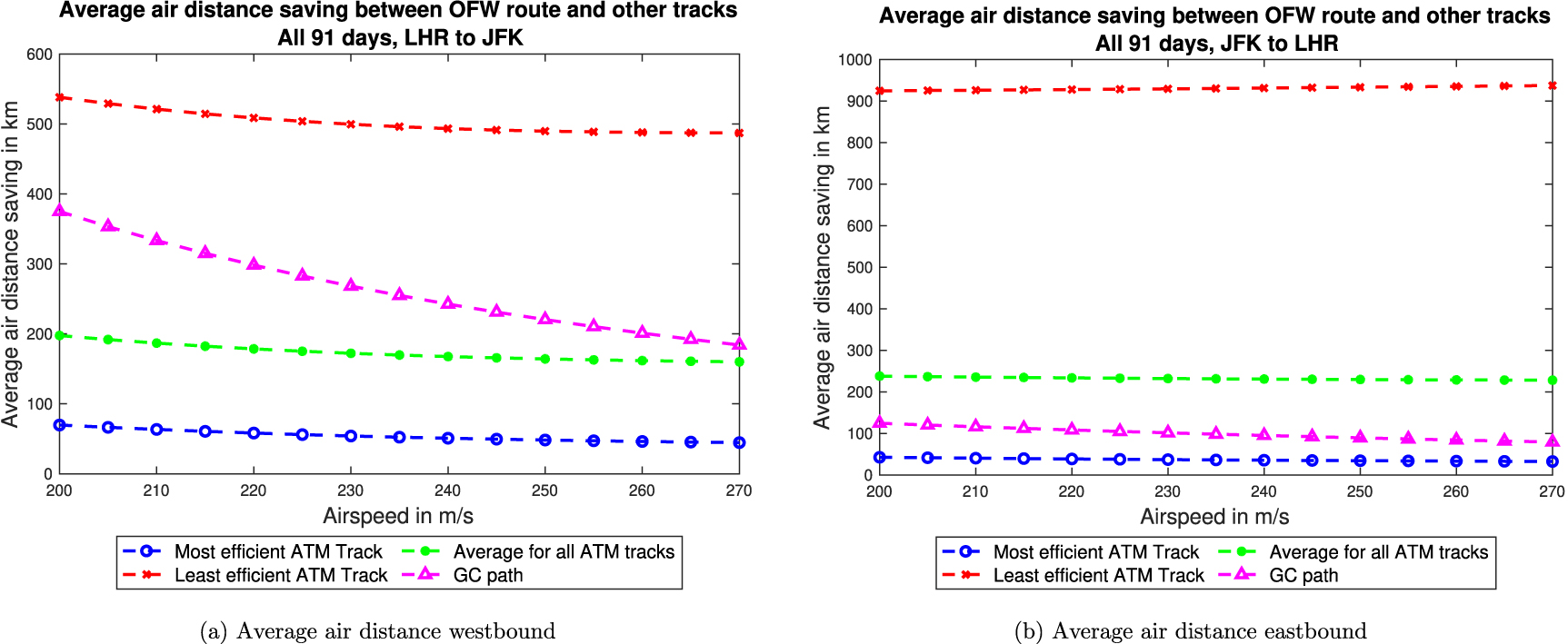
Published in January 2021, a paper from Reading University titled “Reducing transatlantic flight emissions by fuel-optimised routing” suggested that “current flight tracks [on the North Atlantic] have air distances that are typically several hundred kilometres longer than the fuel-optimised routes”, that by using the optimal wind route eastbound flights would save on average 232 km, and that an efficiency gain of up to 16.4% would be possible. These headline figures are the ones taken by the media in the last few weeks resulting in articles suggesting that the average New York-London flight could arrive 21 minutes earlier [Independent >].

The paper shows these graphs, with the eastbound plot on the right:
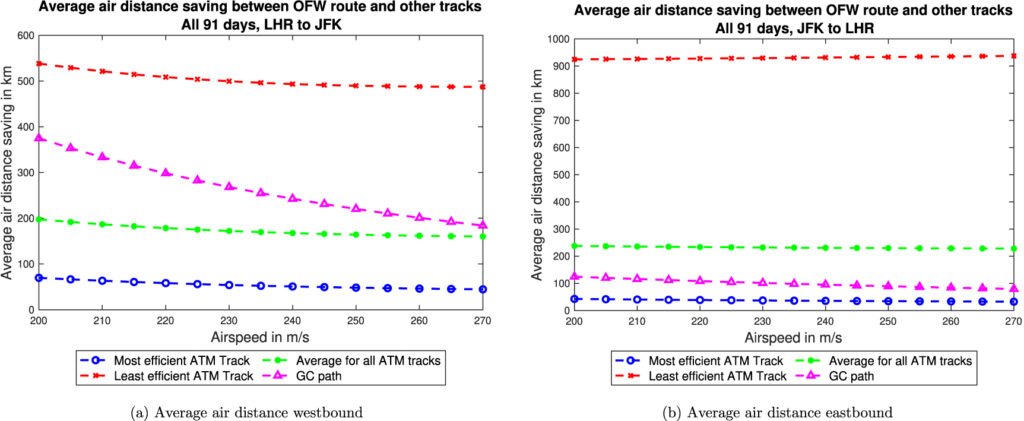
 

From an operational perspective, however, the promise of 232km (125nm) average route savings, and 16.4% increases in efficiency do not ring true. If you are a dispatcher, or pilot, you will share my instinct that this number feels extremely high.  The term “potential increase in efficiency” really means “current inefficiency” – and my gut feeling says it’s not always ideal, but far from that bad. Many plans are indeed sub-optimal, and crossing the NAT certainly has the potential to result in a track a half-degree north or south of the one requested or a level below the optimum – but is the inefficiency really that high?

Closer analysis shows that at least some of the assumptions in the report to be fundamentally flawed.

The report itself makes the flaw clear here: “Taking the results for an airspeed of 240 m s−1 and averaging savings in air distance between the most efficient ATM track and the OFW route across all 91 days of winter 2019–2020 for flights from JFK to LHR, gives an air distance saving of 37 km, but the saving for the least efficient ATM track is over 931 km. The average saving for all ATM tracks is 232 km”

The problem is that to reach these high numbers, the paper is assuming that “airlines use all provided tracks equally“. This is not what happens in reality, by any stretch. There are normally 8-10 NAT Tracks eastbound. An airline, or aircraft operator will request their Preferred Track, as we have seen in the example above. Almost all of the time, the requested track is granted, albeit with potentially a lower level (or higher) than requested. Very ocasionally, a track one north or one south is given by ATC.

The efficiency figure of 16.4% is created by dividing the air distance between LHR-JFK by additional distance flown on the least efficient eastbound NAT Track (2,997nm/503nm ~ 16.4%). That least efficient NAT Track (which will usually be Track Zulu in non-Covid ops for an eastbound flight) is normally a southerly Caribbean area route intended for traffic departing places like Miami, the Bahamas, or even Trinidad and Tobago. It will never be flown by a New York-London flight.

Therefore, we have to disregard these higher numbers entirely.

The report does identify, when looking at actual flights, that efficiency savings of “2.5% for eastbound flights and 1.7% for those flying west” would be obtained by flying the optimum wind route (OFW). Those numbers look far closer to what we might expect as total efficiency losses identified at the end of Part One, above.

However, consider further that we looked at four different types of efficiency loss: flight planning constraints, avoiding turbulence, the NAT Tracks requirement, and tactical routing by ATC. It is clear, then, that the presence of the NAT Tracks accounts only for a portion of those inefficiencies. Again, real world analysis of actual flights with the full compendium of information as to what caused the ineffciencies would give the most insight, and this is what we will hopefully see from NATS and Nav Canada as a result of the “OTS NIL” experiment.

A further paper as an iteration of the first, applying a collaborative approach with the operational world (ATC, Airlines, Aircraft Operators, Flight Crew), would be beneficial.

Over the past 25 years, there has been continual improvement in ATC efficiency. The NAT region was the first to implement reduced vertical separation (RVSM), in March 1997, and subsequent improvements in surveillance (ADS-B, ADS-C), and communications (CPDLC), have led to lateral separation improvement from 60nm to 19nm, and longitudinal from 80nm (or 10 minutes) to as low as 14nm – in addition to the altitude separation reduction from 2,000 to 1,000 feet. In simple terms, the number of aircraft that can fly closer to the optimum route for a city pair has dramatically increased.

Despite the inaccuracies in the numbers, we should look at the bigger picture: The paper does identify a key point that we should digest in this industry: “Airlines currently choose routes that minimise the total cost of operating a flight (by specifying a Cost Index, which is the ratio of time-related costs to fuel costs), not the fuel consumption or emissions.”

This, I think, is important to consider. We are not currently flight planning to minimise emissions – we flight plan to minimse cost. With the reality of our warming planet, and the thankfully growing recognition that a corporation’s profit should not come ahead of the greater good of humankind, focus should be placed on how we can operate flights more efficiently – where ‘efficient’ does not mean reduced costs, but reduced emissions.

2019: Safety Net on the NAT

2019 seems so long a go. A golden age for aviation with airplanes swooshing happily through the skies, and none so happy as those crossing the NAT.

Or were they?

Well, now we can check because the NAT Systems Planning Group 2019 Annual Safety Report has just been released. 2019 might seem a fair old while ago, but the report speaks of a time before Covid when aviation was at normal levels and so offers good guidance on what’s up in the NAT world normally.

What is monitored?

If you were thinking the only things you’re monitored on are your competencies and KSAs in sim assessments, then think again. You are being watched all the time, and especially so in the NAT where 12 Safety Key Performance Indicators are watched like a hawk watches a juicy mouse in long grass.

Targets for reducing the number of errors in these areas are set using three year rolling data.

So, how did we all do?

Well, in 2019, six of the targets were met and there were notable improvements in these three areas:

  • Percentage of long duration height deviations
  • Rate of long duration height deviations where datalink was not in use
  • Number of minutes spent at wrong fight level for aircraft not using datalink

So, pilots have got better at reading their altimeters and not flying at the wrong altitude.

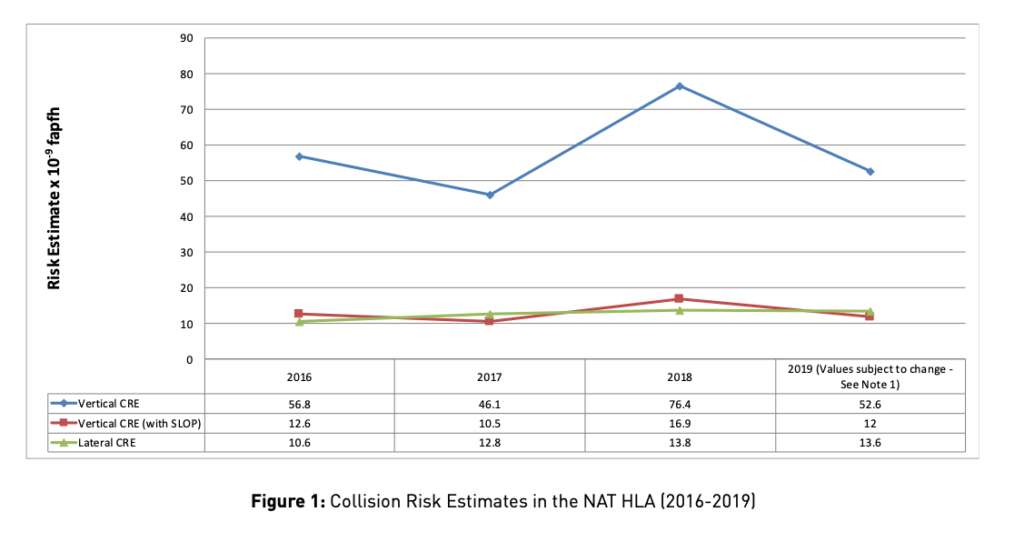
The risk of vertical collision estimate saw an impressive 30% improvement, and they reckon with the use of SLOP this can be reduced another 77% making it… 30/100*77{equation stuff}#100[somethingbysomethingoversomethingelse]… a lot less likely we will fly into each other. Good job all.

What is going less well?

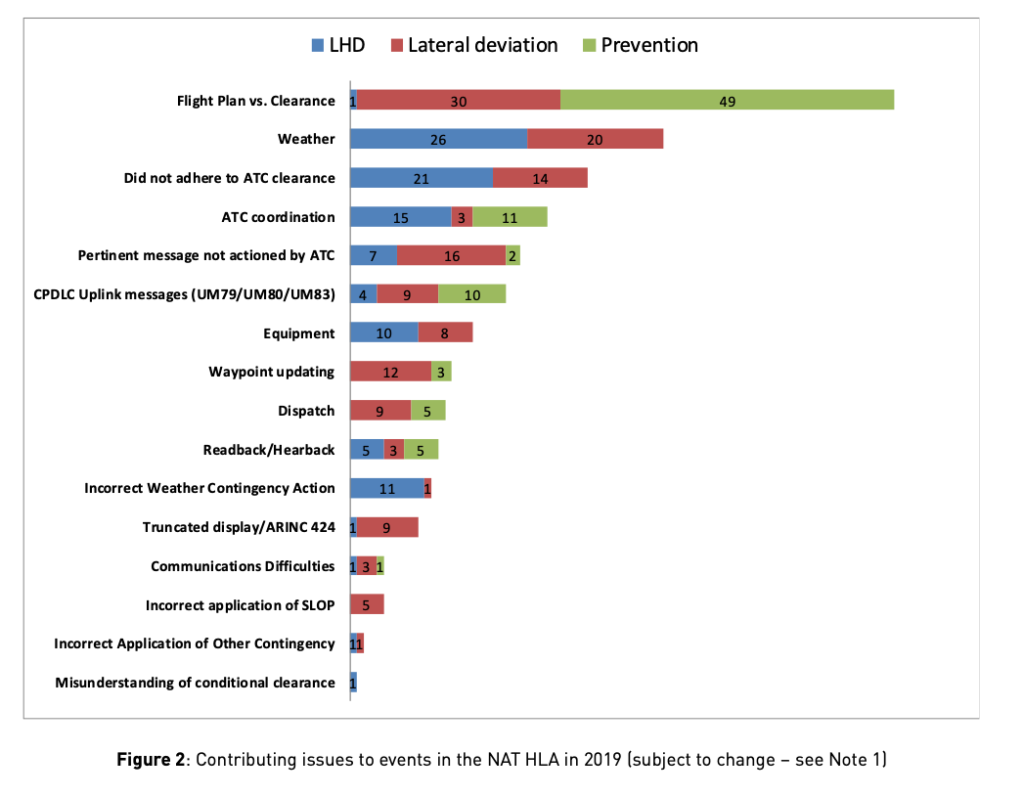
Lateral collision risk estimates reduced, but there were still 80 reported lateral deviations. So we’re flying at the right altitude, but sometimes in the wrong place.

Flight plan versus what ATC actually cleared pilots to do are the top of the list, making up 30% of  the total. 49 of those were prevented by ATC. Not adhering to ATC clearances increased from 10% in 2018, to 13% in 2019, and weather was another biggie making up 17% of all lateral deviations.

ATC coordination errors were also in the top 5 (11%) so don’t congratulate them too much. ATC were also provided with conformance monitoring tools which highlighted cleared versus selected level differences, and route assignment monitoring tools to help them intervene and prevent deviations. With these in place, the performance in the second half of 2019 did improve a lot.

Ok, congratulate them a lot, they’ve made it much safer for us up there.

Overall, what’s the verdict?

No gold star because there were still 266 events reviewed in 2019 by the SPG. These included:

  • 83 large height deviations
  • 118 (actual) lateral deviations including
    • 42 GNEs
    • 44 ATC interventions where ATC prevented pilots making GNEs
  • 73 prevented events where ATCOs stopped aircraft flying an uncoordinated flight profiles or entering the wrong airspace sort of things.

It isn’t always pilots going wrong though. Some of these were down to equipment issues, some down to ATC not responding quick enough. Here is the full breakdown – 

What else is going on up there?

Well, in 2019, when a normal number of aircraft were still flying, they were able to properly monitor the communication and surveillance side of things too, and a whopping 70% of core NAT traffic were using ADS-B. 83% of aircraft were making use of CPDLC over HF radio as well, and the use of these is a big factor in improving the safety and efficiency up there.

The report says this leads to a ‘greater focus on strategic rather than tactical techniques’ which sounds like ‘we are now planning aircraft not to fly near each other’ rather then ‘when aircraft get too close we move them out of each other’s way’.

As a reminder, you have until February 25 to get yourself Datalinkable – the NAT Datalink mandate comes in then.

What next?

2020 data might be a little skewed given a lot less traffic flew, (and many of those who did probably did so after a big gap of not flying), but the overall trend is big improvements. ADS-B is an excellent thing, ATC have a bunch of tools to help them make us safer, and pilot errors are reducing.

There is also a NAT2030 vision plan which is aiming for:

  • more flexibility through ‘dynamic airborne rerouting”
  • improved contingency procedures
  • better comms and surveillance and new technologies
  • a focus on improving the environmental impact
  • and maybe even some new visitors to the region in the shape of unmanned aircraft supersonic aircraft and even balloons

Until then, get out your own balloons and have a little celebration because safety is improving on the NAT. Now put them away. There is still work to be done.

The full report can be checked out here


July 2020 North Atlantic Ops Update

July 2020: There’s a bunch of new things to tell you about the North Atlantic this month! Here’s a summary:
– Two new ICAO NAT Ops Bulletins
– An updated NAT Doc 007 from ICAO (aka the North Atlantic “Ops Bible”)
– A guide for pilots from the FAA about what to do if ATC suddenly has to suspend services
– Some juicy Notams from all the NAT FIRs extending the relaxation of the North Atlantic datalink mandate rules until the end of September.

ICAO NAT Ops Bulletins

Two new ICAO NAT Ops Bulletins have been published this week, but it looks like there’s no need to panic.

First up, there’s 2019_003 Rev 2: Data Link Performance Improvement Options, which is just an updated list of common datalink errors and what to do about them.

Second, there’s a new Bulletin called 2020_002: Surveillance Service in the NAT Region / Flight Crew Operating Procedures. This is a strange one. The message seems to be this: back in the old days, you used to get a call from ATC saying “radar service is terminated” or “surveillance service is terminated” when heading out into the NAT, or when crossing from one oceanic control centre to the next. But nowadays, with improved SSR equipment and ADS-B more widely implemented, you might not get this message anymore.

ICAO NAT Doc 007 (2020, Version 2)

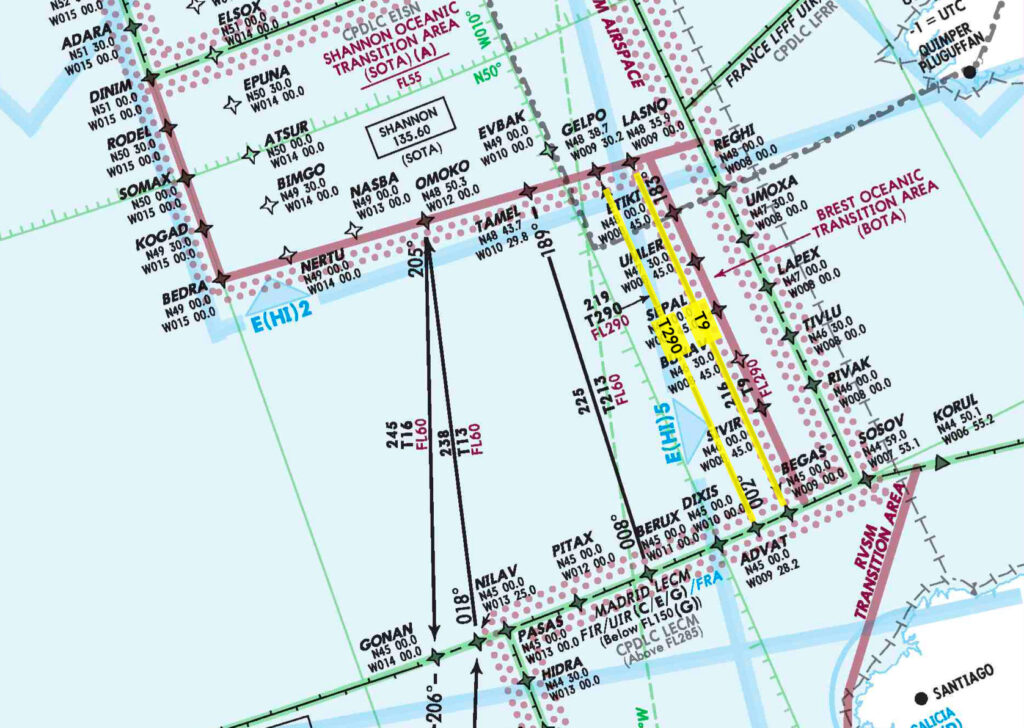
ICAO has published an updated version of the NAT Doc 007, applicable from July 2020. There are only some minor changes from the previous version, concerning the Tango Routes:

  • There’s now a specific note saying that state approval is required to operate on these.
  • There’s also a change to the transponder procedures when using T9 or T290: normally you change transponder code to 2000 30mins after NAT entry, but because of the limited time spent in the NAT HLA when flying on T9 and T290 you should instead make this change 10mins after joining either of those routes.

T9 is southbound only, even levels between FL300-400. T290 is northbound only, odd levels from FL290-410. For more info on the Tango Routes, check out our article here.

What to do during “ATC Zero” events

You’re halfway across the Atlantic when ATC declares that they are suspending all services. TIBA procedures are now in effect. Would you know what to do next? As Covid infections impact ATC facilities, short notice closures are currently a constant risk.

The FAA has published a safety alert for international flight crew with contingency procedures in the event of loss of ATC services in Oceanic airspace. It’s a good one to have in your flight bag. Dispatchers and flight crew are reminded to be thoroughly familiar with AIP specific procedures and traffic management contingency plans for the regions they are operating in. You can read the FAA’s alert here.

They have also published another one for ATC Zero events in Terminal airspace, which you can read here. There have been multiple ‘ATC Zero’ events at major air traffic control centres due to Covid prevention and the subsequent cleaning required. The alert contains important information regarding instrument approach selection, TCAS use, alternate minima, aerodrome lighting and other CTAF procedures at unattended airports. There are also important considerations applicable to Part 121 operations discussed.

NAT Datalink Mandate

EGGX/Shanwick, BIRD/Reykjavik, CZQX/Gander, KZWY/New York Oceanic West and LPPO/Santa Maria have all published Notams extending the relaxation of the North Atlantic datalink mandate rules until the end of September. This is due to the fact that there’s still significantly less traffic because of all the Covid restrictions. Non-datalink mandate compliant aircraft may therefore continue to flight plan and operate across the North Atlantic between FL290-410 until Sept 30. For more info on the NAT Datalink Mandate, check out our article here.

In addition, ICAO are saying that due to the decrease in traffic, there is a significantly higher chance of flights being cleared as requested, and are encouraging operators to file and request their optimal profiles at all stages of the flight. Read ICAO’s guidance here.


For a brief history of the most significant North Atlantic-related ops changes, check out our dedicated article here.


No Room for Error – GNE’s and the North Atlantic

Advances in technology mean that aircraft in the North Atlantic High Level Airspace (NAT HLA) are flying laterally, longitudinally, and vertically closer than ever before. But North Atlantic gross navigational errors (GNE’s), which are lateral off-track deviations of 10nm or more, still occur regularly, and jeopardise the safety of you and the traffic around you. So don’t leave it up to Air Traffic Control (ATC) to discover your GNE! In this article, let’s look at some common human slip up’s that lead to GNE’s, and what we can do to prevent them.

[heading]Pre-Flight[/heading]Operating to the highest standards of navigational performance demands the tedious and careful monitoring of aircraft systems. Unfortunately, humans are by nature not the best monitors. During the long quiet of an oceanic crossing, we can fall victim to cognitive traps such as change blindness, expectation bias, and complacency.

But the potential for error on Atlantic crossings begins well before the first coast-out waypoint. In fact, it begins before take off. The following four areas are where strategies in mitigating a GNE begin.

1) Data Entry

Via ACARS:

Many pilots now use ACARS to automatically downlink the entire flight plan and winds aloft directly to the FMS. But an over-reliance on automation can lead to complacency, and so the more reliable the system, the more complacent we become as monitors. In one incident, a Boeing 747 suffered a GNE of 120nm. The flight plan downlink from ACARS unfortunately contained one bad coordinate that went unnoticed. Once lured into complacency by such reliable technologies, there can be a temptation to omit cross-checking.

What can we learn from this? Always verify the full coordinates in an ACARS downlinked flight plan. Similarly, if several different flight plans were run, ensure that you request your downlink using the most current and filed flight plan number.

Manually:

A manual entry means a pilot inserts the flight plan’s waypoints directly into the aircraft’s flight management system (FMS). But no matter how meticulously one may be, manual data entry can still produce errors. Then how do we guard ourselves against these errors?

Firstly, avoid using ARINC 424 shorthand for programming oceanic points. This has been a factor in many GNE’s, given how easy it is to misplace the letter as a prefix or suffix. For instance, consider how simply misplacing the “N” could cause a drastic lateral deviation:

  • 50N60 = 50N 160W
  • 5060N = 50N 060W

If you have the capability on your aircraft, use the full coordinates, including minutes.

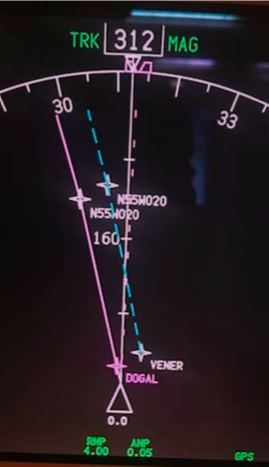
For the last few years, use of half degrees of separation has been on the rise in an attempt to enhance airspace efficiency. But on flight displays units that only show 7 digits, these half degree coordinates are misleadingly displayed as full coordinates. For instance, the half coordinate N55°30’ W020° will display as N55°W020° (see image below, which shows identical waypoint labels for points separated by half a degree!). In this case, it is imperative to view the expanded version of coordinates (degrees and minutes).

Another frequent error leading to GNE’s is transposing numbers during data entry. This commonly occurs when you complete almost the entire crossing along one degree of latitude, then fly the last waypoint at a different latitude. For example, with a cleared route of 57°N 050°W, 57°N 040°W, 57°N 030°W, 56°N 020°W, one can accidentally enter 57°N 020°W. This will put you 60nm off course.

But there is good news! These errors are easy to recognize and avoid by having a specific method of waypoint verification.

2) Waypoint Verification

Whether entered via ACARS or manually, both crew members must come together to perform a thorough cross-check. The following method recommended by ICAO in Doc007 seems to work the best:

  • One pilot reads the waypoint/coordinates, bearing and track from the FMS.
  • On the master document, the other pilot will circle the waypoint to signify the insertion of the correct FULL coordinates in the navigation computers
  • The circled waypoint number is ticked, to signify the relevant track and distance information matches
  • (In flight) The circled waypoint number is crossed out, to signify that the aircraft has overflown the waypoint.

[fancy_box box_style=”default” icon_family=”none” color=”Accent-Color” border_radius=”default” image_loading=”default”]

Cognitive Traps:

Expectation Bias is when your perception is influenced by your preconceptions. It is vital that the second crew member crosschecks from the FMS/CDU to the master document – and not vice versa – thereby increasing the chance of spotting an error.


Pop-up trip hustle – It’s one thing reading about waypoint verification, but it’s another thing actually sitting down and taking the time to do it. Do not be tempted to crosscheck your own work because you’re in a time crunch – it requires at least two separate sets of eyes.[/fancy_box]

3) Initialisation of navigation systems

The navigational integrity of your entire flight is predicated on an accurate starting position. Even a small error with on the ground can translate into a gross error later down the line in flight.

The FMS GPS position and your current parking coordinates (found on the 10-9 pages) must match. Avoid using “last position” function in the FMS – if you were towed overnight, the “last position” will be your previous location, not your current one! Sounds obvious, but mistakes happen.

Inertial systems, once aligned, must also complement the GPS coordinates. Initialisation of inertial navigation systems can take between 6-15 minutes, and errs on the longer side at more northerly latitudes – so be patient! Moving the aircraft during alignment will cause an alignment error. Bottom line: avoid repositioning/towing the aircraft during alignment, even it is to a nearby spot on the same ramp area. Position errors like this cannot be corrected once in flight.

4) Your Master Clock – (iPhones not authorised!)

Since our ETAs for oceanic waypoints must be accurate within +/- 2 minutes, it is vitally important that, prior to entry into the NAT HLA, your master clock is accurately synchronised to UTC. ICAO Doc007 has a list of approved sources from which you can set your aircraft master clock (and your iPhone isn’t one of them!). You are approved to use the GPS time which can be found in the FMS.[fancy_box box_style=”default” icon_family=”none” color=”Accent-Color” border_radius=”default” image_loading=”default”]

Cognitive Trap:

Close to the E/W Greenwich line or close to the equator, you’ll just be on the fringes of the opposing segment. So, take a close look at the E/W or N/S letter coordinates, especially if you are usually accustomed to flying from one particular geographic area.[/fancy_box][heading]Clearances & Communication[/heading]With a move away from spoken communications and towards datalink procedures, requesting, copying and verifying a clearance becomes a much simpler task! But it is still important to know your own limitations in the rare instance that you need to copy a clearance via voice.

Casual radiotelephony should be avoided

Casual radiotelephony can be the source of misunderstanding coordinates or clearances, and so all waypoint coordinates must be read back in detail, adhering strictly to standard ICAO phraseology. An example of standard ICAO phraseology requires enunciation of every individual digit. 52 North, 030 West would be read back as “Fife two north, zero tree zero west” as opposed to “fifty-two north thirty west”. Have no doubt about it, Shanwick can be the most strict in this regard.


Distractions and workload

If your departure airport is close to the oceanic boundary, e.g. Shannon or Miami, the benefit is that you will copy your oceanic clearance on the ground. Unencumbered by distractions typically associated with being in flight, you can focus almost fully on the task at hand. However, most flights pick up an airborne clearance, and it is important to prioritise this for a period of low workload.

Take the example of a Bombardier Global Express crew that narrowly avoided a GNE after copying a clearance. While they were in the midst of crosschecking the clearance with the FMS and climbing to their initial altitude, the flight attendant approached them with an issue. Instead of waiting, one of the pilots attended to the problem. A new waypoint wasn’t entered, and it was later caught by ATC in a position report. Try to avoid non-vital tasks until ALL the steps regarding copying, verifying and inputting a clearance are complete.

Following these simple standard operating procedures (SOPs) step-by-step will guard against clearance errors. If the steps are interrupted for any reason, start again from the beginning.

  • Two pilots monitor and record the clearance. The Pilot Monitoring (PM) will contact clearance delivery, while Pilot Flying (PF) monitors both the primary ATC frequency and the clearance delivery frequency.
  • The PM then records the clearance on the master document. The PF also copies down the clearance separately.
  • Clearance is read back to ATC. Any disparities between both pilots’ interpretations of the clearance must be clarified with ATC.
  • A deliberate cross check of the clearance to the filed flight plan and the FMS is made.

Re-Clearance

According to ICAO Doc007, “In the event that a re-clearance is received when only one flight crew member is on the flight deck…changes should not be executed…until the second flight crew member has returned to the Flight Deck and a proper cross-checking and verification process can be undertaken.” Sorry, they just don’t trust you to do this by yourself, and neither should you!

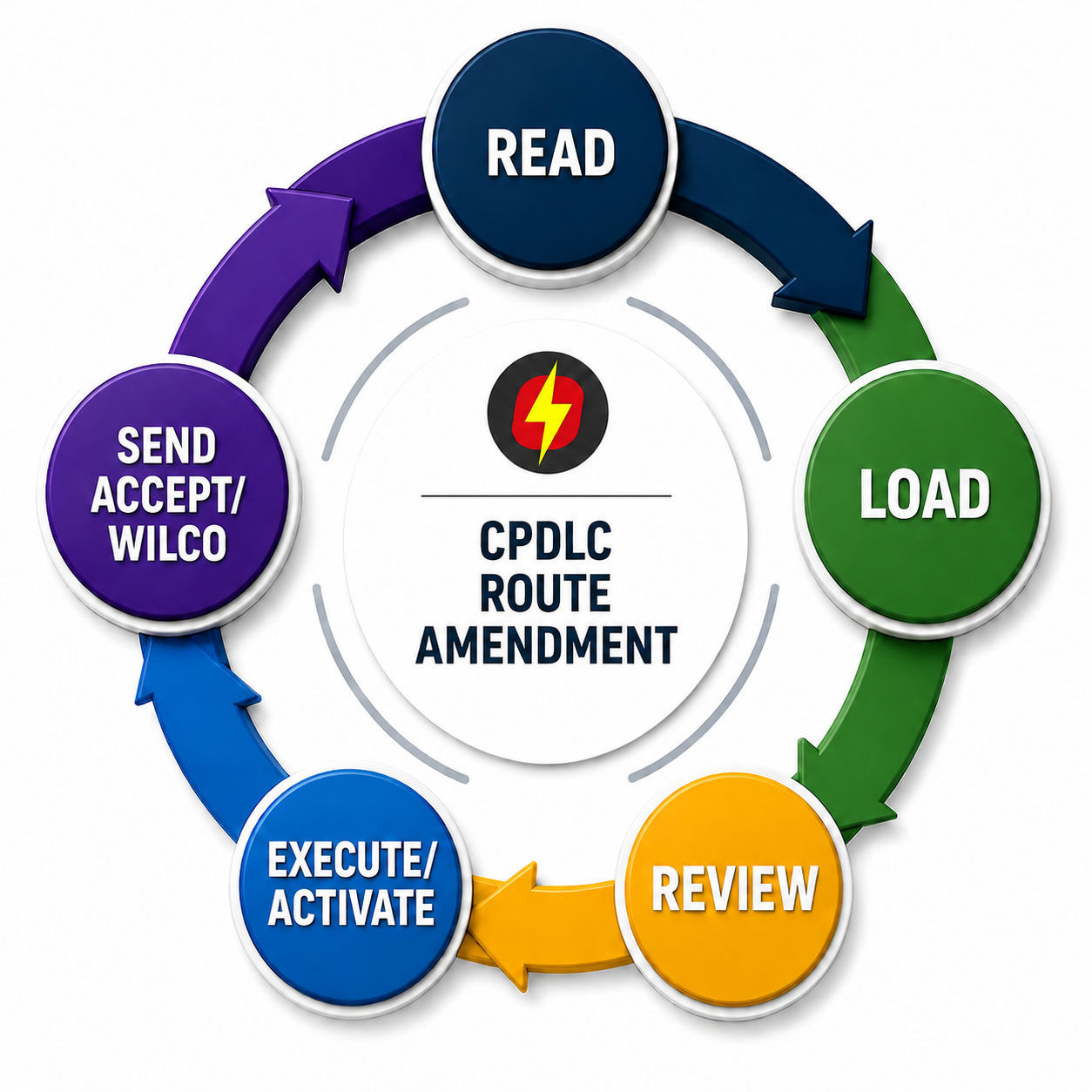
Errors associated with re-clearances, re-routings and/or new waypoints continue to be the most frequent cause of GNE’s. Therefore, a re-clearance or amended clearance should be treated virtually as the start of a new flight and the procedures employed should all be identical to those procedures employed at the beginning of a flight.

  • Both crews note the re-clearance
  • Reply to ATC via ACARS or voice
  • Amend the Master Document
  • Load the new waypoints into the FMS from the updated Master Document
  • One pilot verifies the input of the new waypoints reading from the FMS
  • Verify the new tracks and distances, if possible
  • Prepare a new plotting chart/re-plot in Jeppesen EFB

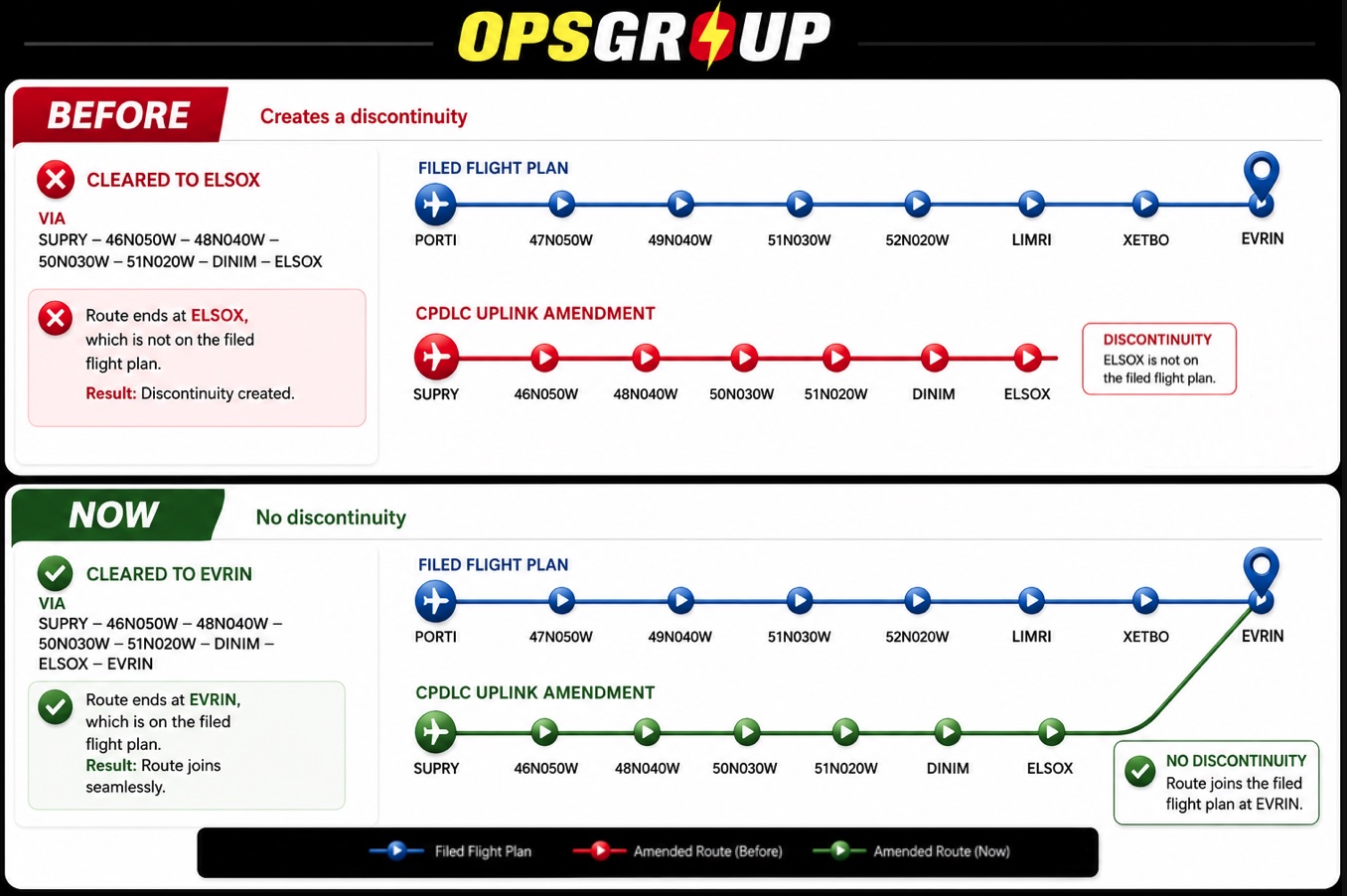
With datalink, you might have the capability to load the new route directly from the ATC message into your FMS flight plan. This will eliminate a transcription error on your part, but you cannot always count on the FMS to load this seamlessly. Oftentimes, if a revised coast-in waypoint doesn’t connect with your originally planned domestic airspace airway, it might cause a discontinuity. Worse, some crew have experienced their entire domestic flight plan drop out, left with only the oceanic portion.

Conditional Clearances – There’s always a catch!

A conditional clearance is an ATC clearance given to an aircraft with certain conditions or restrictions, such as changing a flight level based on a time or place. Conditional clearances add to the operational efficiency of the airspace, but are commonly misinterpreted by flight crews.

Shannon has been known upon first VHF contact to provide lateral conditional clearances on coast-in. For example: “N135AC, after DINIM, direct ELSOX”. Often, crew have been known to read back the correct transmission, but then execute the wrong procedure by proceeding directly to ELSOX.

Why is this happening? In studies of linguistics, verbs (such as ‘direct’) have been noted as having a perceptual priming effect, that more easily grabs our attention at the expense of weaker prepositions (such as ‘from’ or ‘after’). Listen carefully for prepositions. Similarly, in aviation vernacular, the word ‘direct’ means to proceed now to the specified waypoint. As pilots, we can distinguish this meaning with very little effort, and most of the time can expect to proceed present position direct. Thus, we are primed to go direct.

While this isn’t a complex sentence, research indicates that transmissions involving serial recalls (such as “proceed here then here…”) are susceptible to distortion, with the last word or item more commonly interfering with recall of the previous item.

A really simple way to prevent this is to write down clearances as they are being read to you, then read-back the transmission. You can also call attention to a conditional clearance by prefixing their read-back with the word “Verify” or “Confirm” over the radio. Via datalink, sufficient care always must be taken when factoring in all the contents of a clearance before acknowledging the message. The initial phrase “MAINTAIN FLIGHT LEVEL 300” is included to stress that the clearance is conditional. If the message is about to time out, and you need more time to process its contents, reply using “Standby”. Respond at your own pace![fancy_box box_style=”default” icon_family=”none” color=”Accent-Color” border_radius=”default” image_loading=”default”]

Cognitive Trap:

On the longer route segments between New York and Santa Maria, “when able higher” (WAH) reports might be solicited. ATC acknowledgement of a WAH report must not be misconstrued as a conditional clearance to climb. Any climb clearances will be issued separately from a WAH acknowledgement.[/fancy_box][heading]Miscellaneous[/heading]

10-minute Check – put the (Bad) Elf on the shelf for this

One of the best ways to capture a potential GNE and refresh your situational awareness is with the sublimely simple 10-minute check. Ten minutes after waypoint passage, you’ll use your current coordinates to plot your position on your plotting chart. If the coordinates don’t land on the plotted track line, an investigation into the source of the error must begin immediately. It doesn’t hurt to even make additional plots between waypoints too, but ICAO only requires the one 10-minute check.

Today, more pilots are carrying independent GPS units in their flight bags, providing crew with own-ship on their oceanic route map. Tempting though it may be to use this for present position information, it is currently not an approved source of navigation, and should NOT be used in lieu of a 10-minute check.[fancy_box box_style=”default” icon_family=”none” color=”Accent-Color” border_radius=”default” image_loading=”default”]

Cognitive Trap

It is easy to forget about the 10-minute check. Setting a timer once your waypoint passage tasks have been completed will help remind you to do so.[/fancy_box]

Autopilot mode – “Wait, are we supposed to be in heading?”

Incorrect autopilot mode selection has been known to be a factor in GNE’s. On an oceanic crossing, you can bank on being in NAV or LNAV most of the way across the Atlantic. But perhaps you used heading mode to deviate for weather or to intercept a SLOP. It is not uncommon among pilots to spare your passengers two steep banking turns (thanks LNAV!) by manually flying a SLOP intercept in heading mode. But if you forget to re-engage LNAV, you will continue drifting on your merry way, further and further off course.

Distraction, fatigue or complacency are common reasons for losing mode awareness, so the following simple tricks will help mitigate autopilot induced GNE’s.

  • It helps to verbally announce when you are transitioning temporarily into heading mode, to bring both pilots in the loop.
  • Employing sterile cockpit until you’re back in LNAV will help mitigate distractions.
  • In an abundance of caution, you can keep a finger on the heading button or heading dial until you are back in LNAV will serve as a reminder.

[fancy_box box_style=”default” icon_family=”none” color=”Accent-Color” border_radius=”default” image_loading=”default”]

Cognitive Trap:

The flight mode annunciators (FMA’s)  are the most reliable indicators of automation selection – more so than the flight guidance panel! Yet, a study found that pilots pay superficial attention to the FMA’s during critical mode changes. Don’t waste a valuable resource, and do consciously bring the FMA’s into your scan.[/fancy_box]Deliberate cross-checking and monitoring are a critical last line of defense for which we, as pilots, don’t get explicit training, but are nevertheless expected to perform effortlessly. But over the North Atlantic, there is little room for error. So, let’s recap what can be done!

  1. Allow sufficient time on the ground to set up
  2. Closely scrutinise data entry – whether the source is human or ACARS!
  3. Work together on waypoint verification
  4. Don’t work single pilot – always keep all crew in the loop
  5. Deal with clearances and re-clearances methodically

Understanding our vulnerabilities is key to the process of mitigating errors. Armed with an understanding of our own limitations, and an appreciation for the practices and habits mentioned above, a ‘would-be’ GNE can be averted.

Links

ICAO Doc 007 

Global Operational Datalink Document (GOLD)


Two is Not Enough: New NAT Doc 007 (Version 3) – August 2019

NAT Doc 007 is the Bible of the North Atlantic. It’s full of NAT goodness – all the specifics about how to operate your aircraft safely through the complex airspace of the region is here.

And there’s another new edition!

The NAT changes over the last few years have been coming thicker and faster than the sandwiches at Katz’s Deli on the Lower East Side. And now, there’s more. Effective August 7th, 2019, NAT Doc 007, Version 3, is the latest tome to digest. As aviation documents go, it’s written in pretty digestible language. There’s just a lot in it. But this is the first time we’ve had 3 editions of this in one year.

So, we’re going to start naming them after 007 Movies to keep track of them all. This is the “Two is Not Enough” edition.

NAT Doc 007, Version 3, 2019:
Download the full NAT Doc 007.

So, here are the three things that have changed this time:

1. We got new SLOP rules! This is a biggie. Instead of the three previous choices (0, 1, or 2nm), we now have Twenty One choices! More on this below.

2. 99 problems and Datalink is one. The short version: check that you’ve got the latest software update for your datalink.

3. The next datalink mandate (2C) is capped at FL410. This comes in January 30th next year. And so, the Checklist for Dispatchers is updated.

The new SLOP rules

Now, let’s take a closer look at the big change – SLOP (Strategic Lateral Offset Procedure). To get up to speed, check out our full article on SLOP – the how, and why (and where).

The change here is that instead of just being able to SLOP 1 or 2 nm right of track, (or fly the centreline), you go from these three choices to twenty one – you can use any one of 21 Micro-SLOP offsets. Specifically: 0.0 nm, 0.1 nm, 0.2 nm …. OK, you get it. All the way up to 2.0 nm Right of track.
Simple, right?

Not quite. It’s not yet fully clear which of the OCA’s have given the green light for this, even though NAT Doc 007 now says you should Micro-SLOP if you can.
But, phoning around the Oceanic Houses, we’ve got this to tell you:

1. Gander – you can micro-SLOP right now! An AIP amendment will follow soon.
2. Shanwick – you can micro-SLOP right now! A Notam will be published soon, and the AIP will be updated in Dec 2019.
3. New York – they will allow micro-SLOP from 12th Sept 2019, and will update the AIP in Jan 2020.
4. Santa Maria – you can micro-SLOP right now! Nothing published officially yet, but that’s what the good people from the oceanic control centre have told us.
5. Iceland – just like New York, they will allow micro-SLOP here from 12th Sept 2019 as well. When that happens, you will still not be allowed to SLOP below FL285 within the Reykjavik CTA (that’s the domestic part over Iceland, and the airspace over Greenland above FL195). We asked them to publish a Notam about this – and they actually did!! Check it out!
6. Bodo – Nothing official yet, but ATC say they “have no objections” to operators micro-SLOPing right now. (Currently, SLOP is only allowed here above FL285 within the OCA.)

That’s the current picture as of 1100z on Monday 19th Aug.

We will update this as soon as we get more info. Got something for us? Email us!


2019 North Atlantic changes

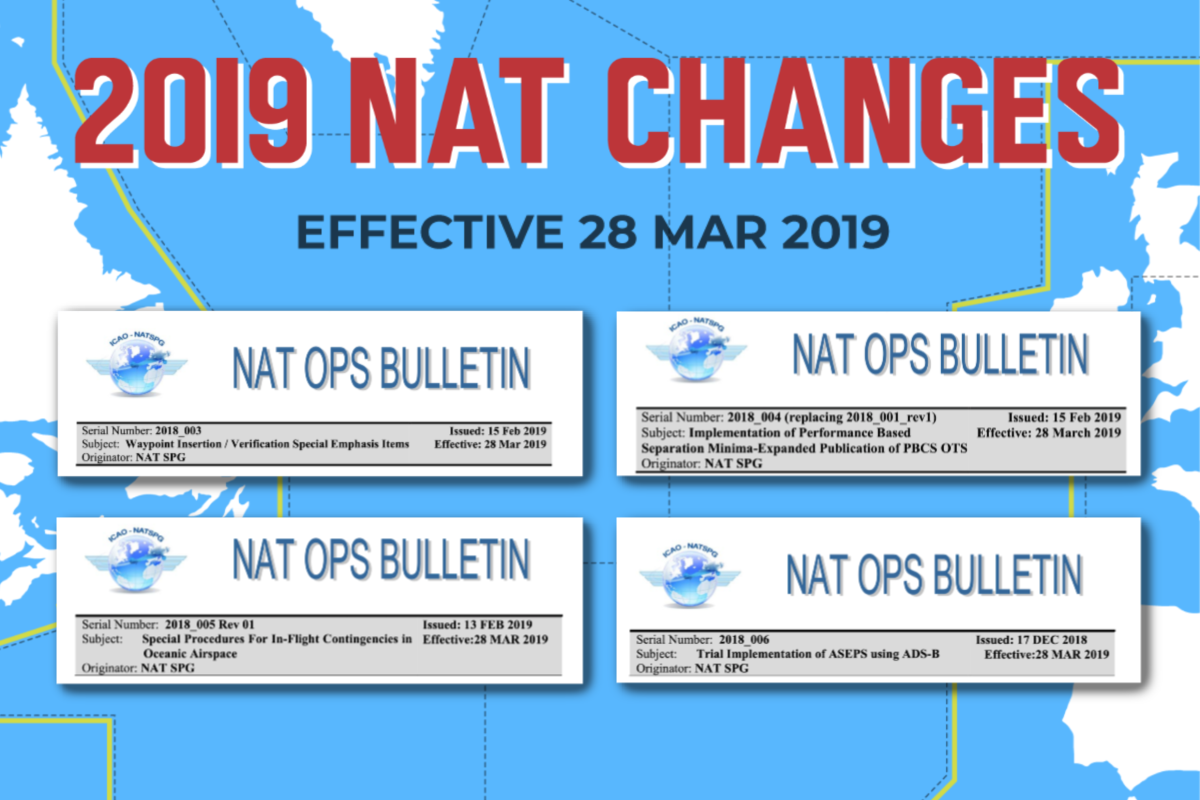
There are four ICAO NAT Ops Bulletins due to go into effect on March 28th, 2019. The PBCS tracks will be expanded, real-time Space-Based ADS-B surveillance and reduced separation standards will be introduced, and the regional contingency and weather deviation procedures will be changed.

You can click on each one, and read them in full:

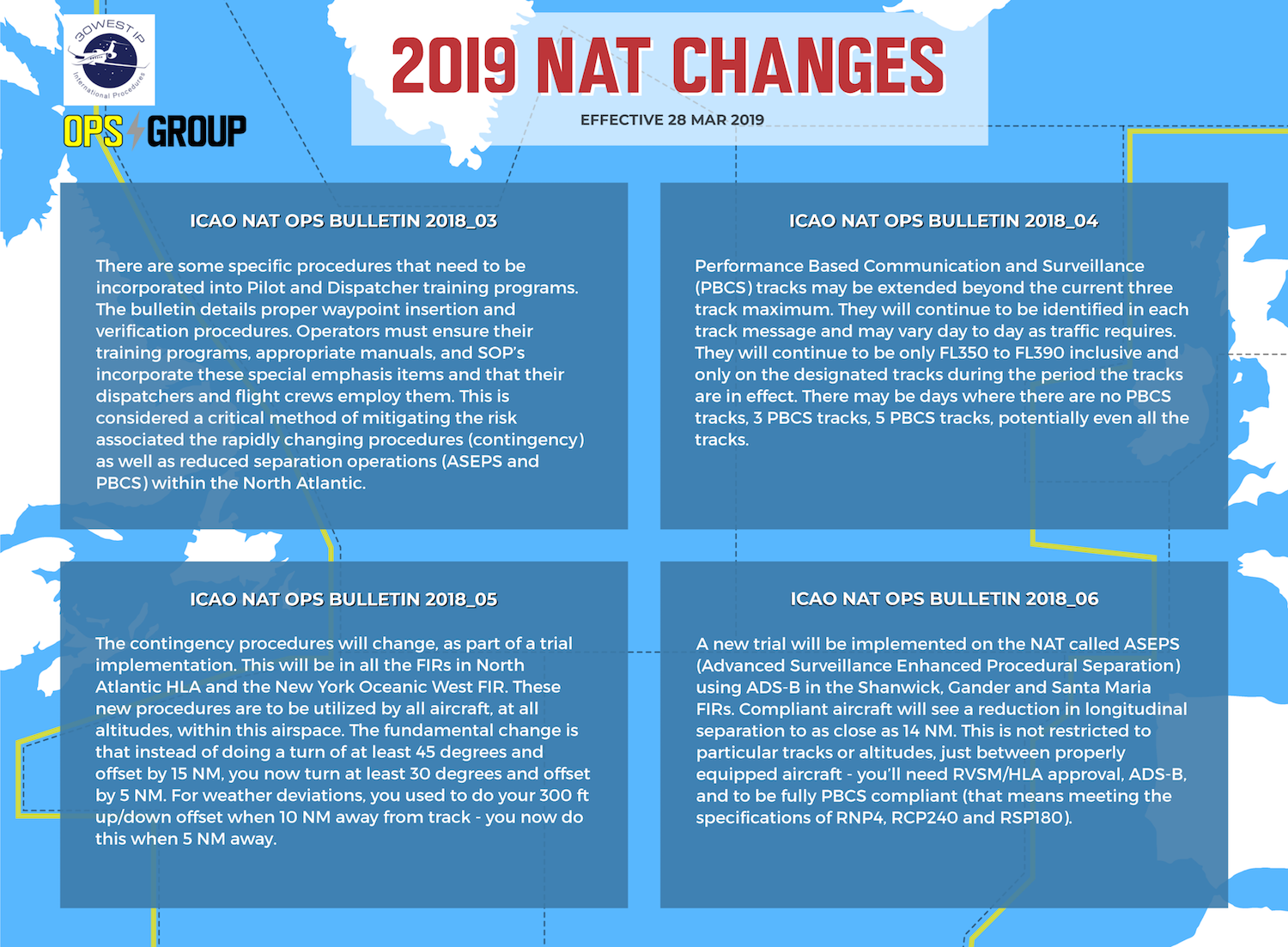
We have had a good look at each of them. Here’s the lowdown:

ICAO NAT Ops Bulletin 2018_03: Waypoint Insertion / Verification Special Emphasis Items
Lowdown: There are some specific procedures that need to be incorporated into Pilot and Dispatcher training programs. The bulletin details proper waypoint insertion and verification procedures. Operators must ensure their training programs, appropriate manuals, and SOP’s incorporate these special emphasis items and that their dispatchers and flight crews employ them. This is considered a critical method of mitigating the risk associated the rapidly changing procedures (contingency) as well as reduced separation operations (ASEPS and PBCS) within the North Atlantic.

ICAO NAT Ops Bulletin 2018_04: Implementation of Performance Based Separation Minima-Expanded Publication of PBCS OTS
Lowdown: Performance Based Communication and Surveillance (PBCS) tracks may be extended beyond the current three track maximum. They will continue to be identified in each track message and may vary day to day as traffic requires. They will continue to be only FL350 to FL390 inclusive and only on the designated tracks during the period the tracks are in effect. There may be days where there are no PBCS tracks, 3 PBCS tracks, 5 PBCS tracks, potentially even all the tracks.

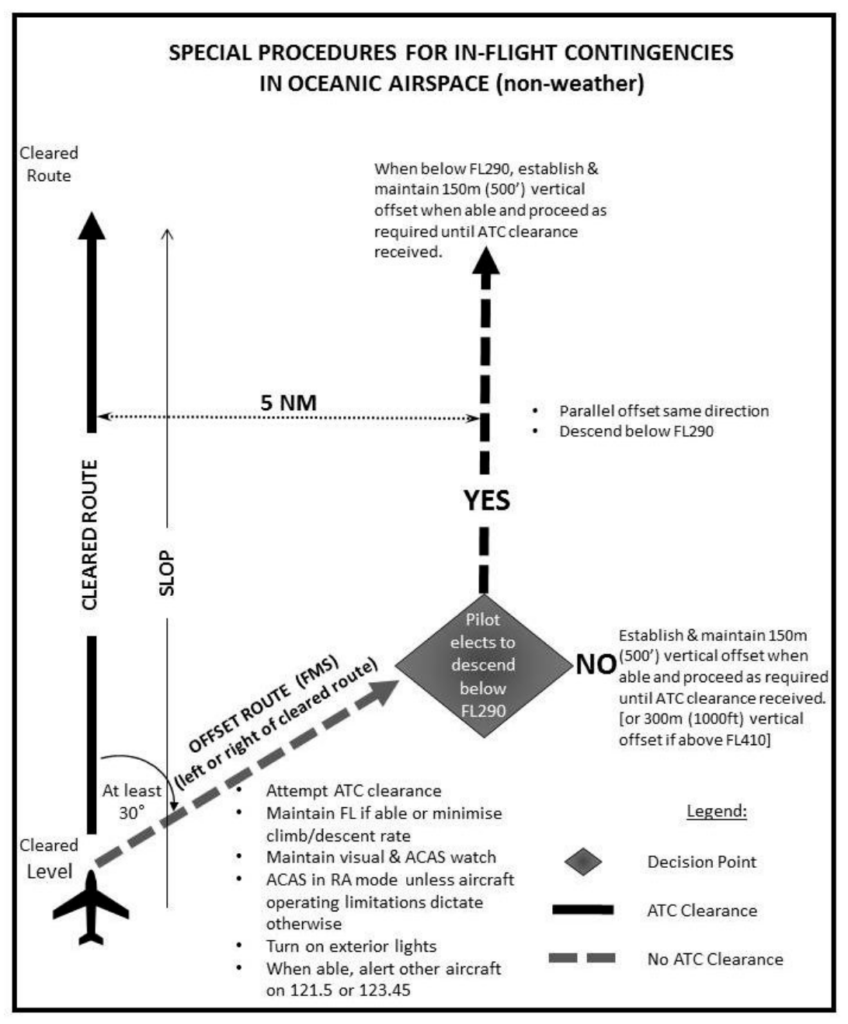
ICAO NAT Ops Bulletin 2018_05: Special Procedures For In-Flight Contingencies in Oceanic Airspace
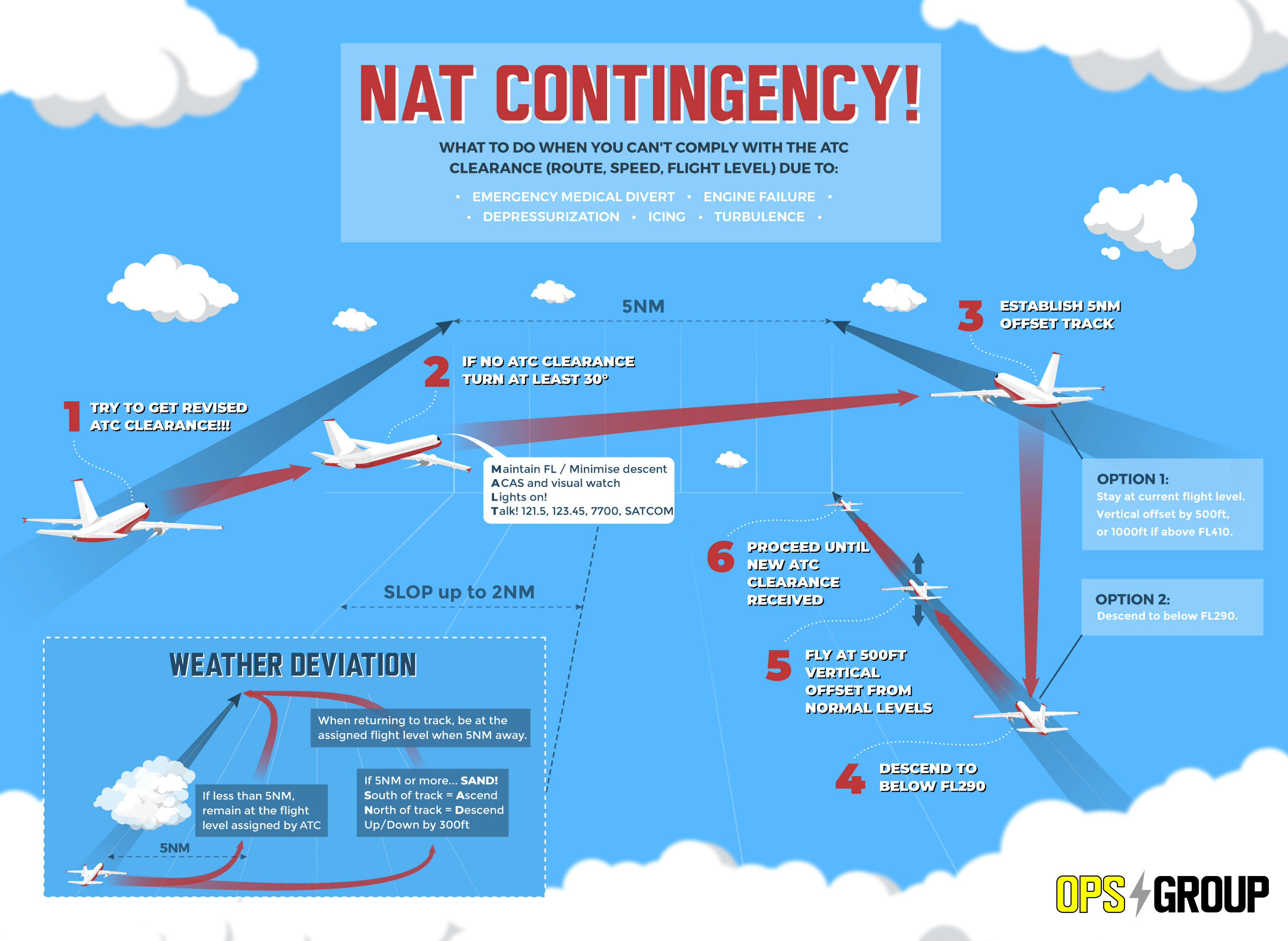
Lowdown: The contingency procedures will change, as part of a trial implementation. This will be in all the FIRs in the NAT Region and the New York Oceanic West FIR. These new procedures are to be utilized by all aircraft, at all altitudes, within this airspace. The fundamental change is that instead of doing a turn of at least 45 degrees and offset by 15 NM, you now turn at least 30 degrees and offset by 5 NM. For weather deviations, you used to do your 300 ft up/down offset when 10 NM away from track – you now do this when 5 NM away. For more info on this, read our article.

ICAO NAT Ops Bulletin 2018_06: Trial Implementation of ASEPS using ADS-B
Lowdown: A new trial will be implemented on the NAT called ASEPS (Advanced Surveillance Enhanced Procedural Separation) using ADS-B in the Shanwick, Gander and Santa Maria FIRs. Compliant aircraft will see a reduction in longitudinal separation to as close as 14 NM. This is not restricted to particular tracks or altitudes, just between properly equipped aircraft – you’ll need RVSM/HLA approval, ADS-B, and to be fully PBCS compliant (that means meeting the specifications of RNP4, RCP240 and RSP180).

So there you have it. We made a couple of handy graphics for all this. Print them out and sellotape them to your cockpit. (If you actually do this, please send us a photo!)

click on the image to open larger version

For a bit more of an in-depth look at the contingency and weather deviation procedures as shown in the image above, read our article.

And if you’re still hungry for more NAT info, we highly recommend you check out the replay of the webinar hosted by Mitch from 30WestIP, titled: ‘A North Atlantic Game Changer, 4 NAT OPS Bulletins all go into effect in one day’. This really breaks down each of the four new Bulletins which take effect from 28th March 2019 – essential viewing if you operate over the North Atlantic! View it here.

Further reading:

  • On 1st Nov 2018 we had a call with 140 OPSGROUP members about upcoming changes on the NAT in 2019, and how we can effect change. OPSGROUP members can find the PDF notes of this in your Dashboard.
  • A big thing driving the ASEPS trial is the rollout of Space-based ADS-B, which is scheduled to complete its deployment by 30 Dec 2018, giving us worldwide, pole-to-pole surveillance of aircraft. For more on that, and how it will affect operations on the NAT specifically, read the article by Mitch Launius here.
  • Use our quick guide to figure out where you are welcome on the NAT, depending on what equipment and training you have.

New NAT Contingency Procedures for 2019

Starting 28th March 2019, there will be some changes to the contingency and weather deviation procedures on the NAT. ICAO has published a new NAT Ops Bulletin with all the details.

Before, there was a lot of confusion around the wording of these two procedures – but ICAO has now made this much clearer, and they have even included a little graphic to help us understand how it will work.

Thing is, it’s still a little clunky. So we decided to make our own version!

What’s new?

The simple answer is this: contingency offsets that previously were 15 NM with actions at 10 NM are basically now all 5 NM offsets with a turn of at least 30 degrees (not 45 degrees).

Rarely do we see ICAO oceanic contingency procedures undergo a formal revision. The last time a major revision occurred was in 2006 when ICAO standardized a 15 NM offset executed with a turn of at least 45 degrees. Prior to that, the North Atlantic and the Pacific had used different offset distances and a 90 degree turn.

Where and when?

A trial implementation is scheduled to begin in the NAT Region and New York Oceanic West starting 28th March 2019. ICAO is expected to formally publish the Standard in an update to PANS-ATM (ICAO Doc 4444) on 5 November 2020.

Why?

To support reduced separation being implemented in conjunction with Advanced Surveillance Enhanced Separation (ASEPS), Space Based ADS-B surveillance. The details for the ASEP trial can be found in NAT OPS Bulletin 2018-006 Trial Implementation of ASEPS using ADS-B.

Old version vs New version – full wording

Here’s the old version, as per the latest version of the NAT Doc 007, paragraph 13.3. (Note – this will be valid UNTIL 27 March 2019):

The aircraft should leave its assigned route or track by initially turning at least 45° to the right or left whenever this is feasible.

An aircraft that is able to maintain its assigned flight level, after deviating 10 NM from its original cleared track centreline and therefore laterally clear of any potentially conflicting traffic above or below following the same track, should:
a) climb or descend 1000 ft if above FL410
b) climb or descend 500 ft when below FL410
c) climb 1000 ft or descend 500 ft if at FL410

An aircraft that is unable to maintain its assigned flight level (e.g due to power loss, pressurization problems, freezing fuel, etc.) should, whenever possible, initially minimise its rate of descent when leaving its original track centreline and then when expected to be clear of any possible traffic following the same track at lower levels and while subsequently maintaining a same direction 15 NM offset track, descend to an operationally feasible flight level, which differs from those normally used by 500 ft if below (or by 1000 ft if above FL410).

Before commencing any diversion across the flow of adjacent traffic or before initiating any turn-back (180°), aircraft should, while subsequently maintaining a same direction 15 NM offset track, expedite climb above or descent below the vast majority of NAT traffic (i.e. to a level above FL410 or below FL290), and then maintain a flight level which differs from those normally used: by 1000 ft if above FL410, or by 500 ft if below FL410. However, if the flight crew is unable or unwilling to carry out a major climb or descent, then any diversion or turn-back manoeuvre should be carried out at a level 500 ft different from those in use within the NAT HLA, until a new ATC clearance is obtained.

And here’s the new version, as per the NAT OPS Bulletin 2018-005 Special Procedures for In-flight Contingencies in Oceanic Airspace (Note – this will be valid FROM 28 March 2019):

If prior clearance cannot be obtained, the following contingency procedures should be employed until a revised clearance is received:

Leave the cleared route or track by initially turning at least 30 degrees to the right or to the left, in order to intercept and maintain a parallel, direction track or route offset 9.3 km (5.0 NM).

Once established on a parallel, same direction track or route offset by 9.3 km (5.0 NM), either:
a) descend below FL 290, and establish a 150 m (500 ft) vertical offset from those flight levels normally used, and proceed as required by the operational situation or if an ATC clearance has been obtained, proceed in accordance with the clearance; or
b) establish a 150 m (500 ft) vertical offset (or 300 m (1000 ft) vertical offset if above FL 410) from those flight levels normally used, and proceed as required by the operational situation, or if an ATC clearance has been obtained, proceed in accordance with the clearance.

Note. — Descent below FL 290 is considered particularly applicable to operations where there is a predominant traffic flow (e.g. east-west) or parallel track system where the aircraft’s diversion path will likely cross adjacent tracks or routes. A descent below FL 290 can decrease the likelihood of: conflict with other aircraft, ACAS RA events and delays in obtaining a revised ATC clearance.

So to reiterate, the important change is that contingency offsets that previously were 15 NM with actions at 10 NM are basically now all 5 NM offsets with a turn of at least 30 degrees (not 45 degrees).

Weather deviations

If you have to deviate from your assigned track due to anything weather-related, there’s a whole different procedure to follow. Again, the NAT Ops Bulletin has all the details for this, but the bottom line seems to be:

For deviations of less than 5 NM, remain at the flight level assigned by ATC.

For deviations of 5 NM or more, when you are at the 5 NM point initiate a change as follows:

If flying EAST, descend left by 300ft, or climb right by 300ft.

If flying WEST, climb left by 300ft, or descend right by 300ft.

In other words – SAND! (South of track = Ascend, North of track = Descend; Up/Down by 300ft)

But remember, going right is probably better – it gets you out of the way of all the SLOP offset traffic that might be coming at you from the opposite direction!

Turnback procedure

In both the NAT Ops Bulletin and the new NAT Doc 007 which will take effect from 28 Mar 2019, ICAO has left out any specific reference to how to divert across the flow of traffic or turn-back procedure, and instead simplified it to just “proceed as required by the operational situation”. Turning back would assume you either employ the 5NM offset as per the new contingency procedure, or else get a new revised clearance.

Bottom line

If you operate in the NAT HLA, we recommend you read and review the NAT Ops Bulletin in its entirety. It’s relatively short but, beginning 28 March 2019, the procedures are expected to be implemented. You might want to prepare changes for your Ops Manuals and checklists too.

Make sure you stay tuned to OPSGROUP for changes that may occur as we approach 28 March 2019!

Further reading:

  • On Nov 1st we had a call with 140 OPSGROUP members about upcoming changes on the NAT in 2019, and how we can effect change. OPSGROUP members can find the PDF notes of this in your Dashboard.
  • A big thing driving the ASEPS trial is the rollout of Space-based ADS-B, which is scheduled to complete its deployment by 30 Dec 2018, giving us worldwide, pole-to-pole surveillance of aircraft. For more on that, and how it will affect operations on the NAT specifically, read the article by Mitch Launius here.
  • Use our quick guide to figure out where you are welcome on the NAT, depending on what equipment and training you have.

First look at NAT changes for 2019

Starting 28th March 2019, a new trial will be implemented on the NAT called ASEPS (Advanced Surveillance Enhanced Procedural Separation) using ADS-B in the Shanwick, Gander and Santa Maria FIRs.

Compliant aircraft will see a reduction in longitudinal separation to as close as 14 NM. This is not restricted to particular tracks or altitudes, just between properly equipped aircraft – you’ll need RVSM/HLA approval, ADS-B, and to be fully PBCS compliant (that means meeting the specifications of RNP4, RCP240 and RSP180). Read this ICAO Bulletin for all the details.

When the ASEPS trial starts, there will also be some changes to the contingency and weather deviation procedures. Before, there was a lot of confusion around the wording of these two procedures – this has now been made much clearer, and they have even included a nice little graphic to help us understand what to do. Read this ICAO Bulletin for all the details.

ICAO have published all these changes in their updated NAT 007 Doc valid for 28th March 2019.

Further reading:

  • On Nov 1st we had a call with 140 Opsgroup members about upcoming changes on the NAT in 2019, and how we can effect change. Opsgroup members can find the PDF notes of this in your Dashboard.
  • A big thing driving the ASEPS trial is the rollout of Space-based ADS-B, which is scheduled to complete its deployment by 30 Dec 2018, giving us worldwide, pole-to-pole surveillance of aircraft. For more on that, and how it will affect operations on the NAT specifically, read the article by Mitch Launius here.
  • Use our quick guide to figure out where you are welcome on the NAT, depending on what equipment and training you have.
  • All the big changes on the NAT in 2018 are covered on our page here.

My first North Atlantic Flight is tomorrow – NAT Ops Guide (Updated 2018)

For the latest changes and updates on the North Atlantic, including our most recent Guides and Charts, use our NAT reference page at flightservicebureau.org/NAT.

Of all the hundreds of questions we see in OPSGROUP, one region stands out as the most asked about – the NAT/North Atlantic. So, we made one of our legendary guides, to get everything into one PDF.  It’s called “My first North Atlantic Flight is tomorrow” – and now we’ve updated it for 2018!

Contents:

  • 1. What’s different about the NAT?
  • 2. Changes in 2018, 2017, 2016, 2015
  • 3. NAT Quick Map – Gander boundary, Shanwick boundary
  • 4. Routine Flight Example #1 – Brussels to JFK (up at 5.45am)

  • 5. Non Routine-Flights: No RVSM, No RNP4, No HF, 1 LRNS, No HLA, No ETOPS, No TCAS, No Datalink – what you can do and where you can go
  • 6. Diversion Airports guide: Narsarsuaq, Sondy, Kef, Glasgow, Dublin, Shannon, Lajes, Fro Bay, Goose Bay, Gander, St. Johns
  • 7. Airport data
  • 8. Overflight permits – routine and special

  • 9. Special NAT procedures: Mach number technique, SLOP, Comms, Oceanic Transition Areas, A successful exit, Screwing it up, Departing from Close Airports
  • 10. North Atlantic ATC contacts for Shanwick, Gander, Iceland, Bodo, Santa Maria, New York – ATC Phone, Radio Station Phone, AFTN, Satcom, CPDLC Logon codes; and adjoining Domestic ATC units – US, Canada, Europe.
  • 11. NAT FPL Codes
  • 12. NAT Flight Levels
  • 13. Flight Plan Filing Addresses by FIR
  • 14. Links, Questions, Guidance

Excerpt from the Routine Flight #1:


Buy a copy ($20)   Get it free – join OPSGROUP

To get your copy – there are three options:

  1. OPSGROUP Members, login to the Dashboard and find it under “Publications > Guides”. All FSB content like this is included in your membership, or
  2. Join OPSGROUP with an individual, team, or department/airline plan, and get it free on joining (along with a whole bunch of other stuff), or
  3. Purchase a copy in the Flight Service Store!

More NAT half-tracks are coming

Update Jan 23: The current phase of the trial for RLatSM Tracks will come to an end on March 29, when PBCS standards will be introduced for the NAT tracks. More info on that here.

Since Dec 2015, there have been three daily NAT tracks spaced by one-half degree between FL350-390. These are officially called ‘RLatSM Tracks’ (Reduced lateral separation minima), but we all just prefer to call them ‘Half-Tracks’.

Separating flights by one-half degree of latitude rather than the standard one degree means that aircraft can be separated laterally by 25nm, which helps improve the efficiency of North Atlantic operations.

In Jan 2018 the Half-Tracks will be expanded from the three that now run each day, first by one additional track and then (maybe) to all NAT Tracks between FL350-390 inclusive. Jan 4 is the earliest day that this might happen, but because they will be decided tactically, it will most likely be the first busy day after Jan 4.

If you want to operate on the RLatSM tracks, you’re going to need CPDLC, ADS-C, and RNP4; along with the other standard pre-requisites for operating in the NAT HLA between FL350-390: an HLA approval, TCAS 7.1, RVSM approval, two LRNS, and a working HF radio. To figure out where you are welcome on the NAT, depending on what equipment and training you have, check out our quick and dirty guide here.

One thing to be cautious of when using the half-degree tracks – most aircraft FMC’s truncate lat/long waypoints to a maximum of 7 characters, so it will often show up as the same waypoint whether you’re operating along whole or half degree waypoints. So when operating on the half-tracks, just remember to double-check the full 13-character representations of the lat/long waypoints when you enter them into the FMC.

For more details about the new RLatSM procedures, have a read of the UK AIC 087/2017 here.


Shanwick Bogus Messages

Just around New Years, a story started growing legs about Bogus CPDLC messages from Shanwick and Gander. In the most worrying version of events, the G550 crew received a “Descend at Max Rate” type message on CPDLC, and when they checked on voice with ATC it hadn’t come from them.

We had lots of replies on this – both by email and in slack, thanks everyone! So here is the event summary as pieced together by the community:

– This was a single event that happened in December, at 0500Z one morning, to a G550
– It was caused by an avionics bug in the FMS – a valid error message was parsed incorrectly and assigned a value of “Descend at max rate” by the FMS, which appeared on the screen.
– Fears of it being some kind of spoofing or hack are unfounded. The initial story spread like wildfire! But ultimately, a non-event.

Confirm Assigned Route

This was the second part of the concerns about CPDLC messages from Shanwick. Lots of crews have been getting an FMS message after passing the Oceanic Entry Point saying “Confirm Assigned Route”. We’ve probably gotten 50 distinct messages/emails/queries on this. Many crews don’t know quite what this is or what to do with it, and many wondered if it was also a “bogus message”.

This is normal. It’s a new procedure, and this message is now automatically sent by Gander, Shanwick, and Iceland. The reason for the message, is to act as a cross check, now that we’re all cruising with 30 miles between us instead of the old school 60. When you do “Confirm Assigned Route”, then ATC knows that you’re both on the same page.

We first mentioned it here in November, have a read. The only recent update is that Gander and Iceland have automated the CPDLC message, so everyone that logs on will get the “Confirm Assigned Route” message.


International Bulletin: Winter is Coming, Updated Canada Requirements

Winter is coming 09NOV With the clocks changing, it’s a reminder that we’re not far away from the snowstorms, deicing delays, cancelled flights, airport shutdowns, and those big invoices for de-icing fluid. Our new author Frank Young has an article.

Updated Canada requirements 09NOV From tomorrow, November 10, an eTA is now mandatory for flights to Canada (for most people), and there’s an update to flying to Canada with a previous conviction. Read the article.


BIKF/Keflavik Long a destination for flight certification testing (because it’s cold and windy), will not accept test flights until February next year, thanks to runway renovation work.

ZZZZ/Worldwide Last week we ran a story about the new ICAO SID/STAR phraseolgies. In short, some countries are implementing, and others aren’t. We’re going to make a list of who’s doing what, so that you as an operator or pilot will have some idea. Can you help us? What is your country doing? Tell us at bulletin@fsbureau.org.

LTBA/Istanbul At about 0100 local time on 6 November, two people on a motorcycle opened fire outside Istanbul Ataturk International Airport, prompting a temporary closure. Reports indicate that authorities apprehended both suspects and did not find additional weapons or explosives on their persons. Officials briefly placed the airport on lockdown but reopened the facility at about 0130. The incident reportedly did not affect flights, and the gunfire harmed no civilians or police officers.

CZZZ/NAT Region The FAA has recently determined that time estimates provided by pilots in oceanic CTAs are less accurate than expected, particularly when adverse weather causes pilots to deviate from the planned course. These inaccurate estimates can compromise the separation of aircraft. Have a read.

YMML/Melbourne Be aware of recent hoax ATC calls. Someone with a handheld radio has been making “go-around” transmissions on the Tower frequency, and at least one aircraft has responded. Airservices says there have been 15 such transmissions in the last few weeks.

CZZZ/Canada The NBAA has issued useful updated info for flying to Canada with previous convictions – Canada is known for refusing entry based on DUI charges. Today, November 9, is also the last day that you can enter Canada without an eTA.

PWAK/Wake Island – an ETOPS alternate – is closed on 11NOV for Veterans Day. They do say they will attend with 30 mins notice, so maybe two ETOPS circles are required for that day. Check other US ETOPS alternates on this date also.

UCZZ/Kyrgyzstan Since 4 November, if you’re staying for longer than 5 days, you must register with the local authorities.

PKMJ/Majuro is downgraded to Cat 6 until November 23, which may affect some operators using this as an ETOPS alt.

EGNX/East Midlands airport has some weekend closures for the next six weeks.

VIZZ/India announced on 8 November that 500 and 1,000 rupee banknotes will cease to be legal tender as of 0000 local on 9 November 2016.

EVLA/Liepaja (one of Latvia’s three international airports) is now closed to all operations. They say they will be open again in Spring 2017. Fingers crossed.

LAZZ/Albania has been experiencing heavy rains, high winds and flooding throughout the country, causing road blockages, school closures, and disruptions in ferry services. The army has been mobilized for rescue and relief operations.

LFLL/Lyon If you’ve been using LFLL as an alternate at weekends, you’ll have to cut that out from December 10th, they don’t want weekend diversions of non-sched flights.

EGKK/Gatwick has advised of a new series of rail strikes that will run through to January next year.

MHTG/Central America FIR reminds operators that a CENAMER notification by AFTN is required for all flights planning to enter the airspace.

MTZZ/Haiti The US has published updated advice for Haiti: U.S. citizens are advised not to travel to the southern peninsula of Haiti, commonly referred to as the “southern claw.” The U.S. Embassy has currently banned unofficial travel to the southern peninsula and allows official travel only after consultation with its security office. There is widespread devastation throughout the southern claw with the most affected areas on the western tip of the peninsula. Travelers can expect difficult travel conditions with roads made impassable by landslides, damaged roads, and bridge failures. There is also widespread damage to buildings and infrastructure, including gas stations and cell towers, loss of electricity, and shortages of food and potable water. U.S. citizens who choose to travel to the southern claw in spite of these risks should carry sufficient water, food, fuel, and medicine to last longer than their anticipated stay. The security environment around the southern claw is fluid and uncertain.

LFOB/Paris Beauvais is closed overnight from 2200 to 0600Z, for 14-25 November inclusive, due to stuff.

HAZZ/Ethiopia On November 8, the Command Post – the body tasked with implementing Ethiopia’s state of emergency – lifted the restriction imposed on foreign diplomats, which restricted them from traveling more than 25 mi/40 km outside of Addis Ababa. The Command Post also lifted and revised several other state of emergency provisions; however, the changes are minor and are not likely to affect the current situation. The curfew and communication restrictions remain in place

NFTF/Tonga Fua’amoto (the main airport) has new operating hours – these are, in UTC: 1600 SUN TO 0530 MON, 1025 MON TO 0800 TUE, 1600 TUE TO 0530 WED, 1000 WED TO 0800 THU,0900 THU TO 1200 THU, 1600 THU TO 0530 FRI, 1600 FRI TO 0800 SAT. They’ll accept div traffic outside these hours, call +676 22 608 – but prefer no surprises on Sundays.

OMAA/Abu Dhabi will see heavy traffic for the Grand Prix on November 27, avoid if possible.

SBZZ/Brazil The office that processes Foreign Civil overlight and landing permits has updated hours of operation: Mon-Fri 1230Z-2230Z.

SBCT/Curitiba airport would like 4 hour PPR notice for non-scheduled flights, and request that you call them on 55-41-3381-1478 to arrange that.

SPJC/Lima, Peru has an upcoming APEC meeting 14-21 November, with a decent increase in traffic expected, and a few restrictions. They’ve also warned pilots to pay attention to radios and transponder codes to avoid them sending up the jets – good advice.

TVSV/ET Joshua Airport is closed due to flooding.

VECC/Kolkata Radio has a new HF frequency: 8861, with hours 1330Z-0130Z. Use this if 6556 or 10066 isn’t working for you.

CZQX/Gander is going to auto-send you a “Confirm Assigned Route” message from 01DEC, on entry into their OCA – if you are FANS 1/A equipped. If you’re not sure how to feel about that, read our previous article.

LCCC/Nicosia There’s a good deal of mil activity – UN, and Russian – in the Cyprus region at the moment. Read the LCCC and surrounding FIR Notams carefully. Oh, and if you’re not up to date on your Greek-Turkish FIR dispute, add LGGG and LTBB to that. As 2016 draws to a close, enough regional history has been published for an entire novel. This weeks Notam series covers the 1923 Lausanne Peace Treaty.

NZZC/New Zealand published a change to SID procedures today, and our brain hurts. We’re not sure if this is related to the 10NOV ICAO SID/STAR changes, or .. something else. If you’ve got it deciphered, let us know. THE STANDARD INSTRUMENT DEPARTURE (SID) SPECIFIES IN BOTH DIAGRAMMATIC AND NARRATIVE FORM ANY OF THE FOLLOWING: THE DIRECTION OF TURN, HEADINGS, TRACK, DISTANCES, SIGNIFICANT POINTS AND ALTITUDE REQUIREMENTS. WHERE TRACKING TO OR FROM A NAVIGATION AID IS NOT POSSIBLE, DESIRED TRACKS ARE SHOWN AND DUE ALLOWANCE FOR WIND IS TO BE MADE. AIRCRAFT ARE TO CONTINUE CLIMBING THROUGHOUT THE SID UNLESS IN COMPLIANCE WITH PUBLISHED ATC MAINTAINS, DEPARTURE MINIMUM SAFE ALTITUDE (MSA) OR AS OTHERWISE INSTRUCTED. WHERE CONTINUOUS CLIMB TO THE END OF THE SID IS NOT REQUIRED A DEPARTURE MSA MAY BE DEPICTED ON THE RELEVANT CHART. THE DEPARTURE MSA REPRESENTS THE LOWEST ALTITUDE FOR OBSTACLE CLEARANCE ALONG THE ENTIRE DEPARTURE ROUTE (INCLUDING TRANSITIONS). IT REMAINS THE PILOT’S RESPONSIBILITY TO MEET SUBSEQUENT ENROUTE MSA/MINIMUM FLIGHT ALTITUDE (MFA)/MRA/MEA REQUIREMENTS APPLICABLE AFTER SID TERMINATION. DEPARTURE MINIMUM SAFE ALTITUDES DO NOT ENSURE CONTROLLED AIRSPACE CONTAINMENT.

OEZZ/Saudi Arabia has issued an extension of the policy that requires all aircraft with a destination in Yemen to first land in OEBH/Bisha – through to 08FEB next year. The only exceptions are the UN, Red Cross, and MSF.

VHHK/Hong Kong is going to move to a new ACC and ATC Tower towards the end of this month. There will be delays. The actual date hasn’t yet been notified, we’ll let you know when we hear.

View the full International Bulletin 09NOV2016


Oceanic Errors

Unfortunately, we don’t fly with three in the cockpit anymore – or even four. The navigators job falls squarely onto the front two seats. Over one weekend in April there was one Gross Navigation Error, and two close calls reported on the North Atlantic.

April 22nd (Friday)
Democratic Republic of the Congo Boeing 727 100 (9QCDC/DRC001) from Santa Maria Island, Azores (LPAZ) to St. John’s NL (CYYT)
At 1235Z, Observed on radar to be over position 4720N 4745W, which was approximately 60 miles north of the cleared route 45N 45W – 47N 50W. The crew reported correctly while in oceanic airspace. The flight was cleared direct to YYT and landed without incident at CYYT. There was no traffic, and no other impact to operations.

April 24th (Sunday)
Neos Airline Boeing 767-300 (INDDL/NOS730) from Ferno, Italy (LIMC) to Havana, Cuba (MUHA)
Cleared via 49N030W 48N040W 45N050W. At 30W, the flight reported 48N040W 44N050W. The aircraft recleared to 45N050W prior to proceeding off course.

Apr 25th (Monday)
Transportes Aereos Portugueses Airbus A330-202 (CSTOO/TAP203) from Lisbon, Portugal (LPPT) to Newark, NJ (KEWR)
Cleared 46N030W 46N040W 45N050W. The aircraft reported proceeding via 46N030W 46N040W 44N050W, as per the original flight plan. The aircraft was recleared via 45N050W prior to proceeding off course.

Did you notice how hard it was to find the error in the above two examples?


Gross Navigation Errors are a really interesting topic, and relevant not just on the North Atlantic but in any Oceanic or Remote airspace where ATC cannot monitor the aircraft tracking.

What defines a GNE? Normally, 25nm: That is, when on “own navigation” the aircraft departs the cleared route by more than 25nm. The NAT Central Monitoring Agency (CMA) now defines a Gross Navigation Error as 10nm instead of 25nm.

Annually, the biggest offenders in order of “market share” are: 1. Corporate/Private, 2. Military/State 3. Civil airlines.

How to Avoid a GNE?
(aka How to avoid a Nastygram from the Authorities):

In general, when operating outside of ATC Radar coverage in any airspace:

  • Crews: Don’t have more than one paper copy of the Flight Plan in the cockpit. Mark the active one “Master Document”. Hide any other copies where you won’t find them.
  • Ops: If you send a new Flight Plan to the crew, tell them what the changes are – especially if you’ve filed a different route in Oceanic or Remote Airspace.
  • Fly the Clearance, not the Filed Plan. This is the biggest gotcha. As soon as you reach the Oceanic Entry Point, or leave radar airspace – refer only to the most recent Clearance from ATC. The filed plan is a request only – sounds obvious, but most GNE’s occur because the crew fly the filed plan although there was a reroute.
  • Be aware of the ‘ARINC424 problem’: In the aircraft FMS, and map display, the current common waypoint format is 5230N for position 52N030W (as prescribed by ARINC 424). To show position 5230N030W – ARINC 424 offers a format N5230. The potential for confusion is clear. ICAO, in NAT Ops Bulletin 3/15, have recommended that operators use the format H5230, if a five-letter FMS format waypoint is required. In addition pilots are recommended to cross check any waypoints that don’t have a ‘name’.
  • Use a plotting chart – it’s mandatory. You don’t have to use ours, but use one.
  • Use an Oceanic/Remote Area Checklist (sample link below).

And specifically on the Atlantic:

  • Read the advice on the Daily Track Message – waypoint cross check, Fly the Clearance (and be sure it is the clearance!)
  • Know the weather deviation procedures: Even with the new “Half Tracks”, there are no changes to the in flight contingency procedures and weather deviation procedures as detailed in PANS ATM Doc444 Para15.2 & 15.2.3.

Here’s some links and resources that we think are really useful:


For regular notices and content like the above, consider joining OPSGROUP.


Did you know MNPS is over? Meet HLA, the new North Atlantic Airspace.

From Feb 4th, 2016, MNPS (Minimum Navigation Performance Specifications) Airspace is being dumped as a term (no loss, really), and replaced by the much more user friendly NAT High Level Airspace or NAT HLA. MNPS first came into being in 1977, and this change is significant in that the requirements for approval to enter the new NAT HLA are updated – you must now have RNP4, or RNP10. Also, the rest of the Atlantic welcomes Bodø Oceanic to the fray – it joins Shanwick, Gander, Reykjavik, New York, and Santa Maria to make up the new NAT HLA, which keep the original vertical profile of FL285-FL420.

In short, that’s all you need to know. You should read our International Ops Notice 01/16 for the full story.


Monday Briefing: New Overflight Map, Typhoon Melor affecting the Philippines

New Overflight Map 14DEC The Airline Cooperative and Flight Service Bureau have finalised the initial version of an online Overflight Permit and Security Map, showing current airspace and security warnings worldwide, together with county by country information on permit requirements. The map is available ot all AO’s at fsbureau.org/map. Read more below.

Typhoon Melor affecting the Philippines 14DEC the center of Typhoon Melor is forecast to move into the central Philippines (near southeastern Luzon) Monday evening local time as the equivalent of a Category 4 hurricane. The current forecast path indicates the Typhoon moving inland towards Legazpi City, Sorsogon City and Gubat are some of the locations. For more details visit the Joint Typhoon Warning Center (JTWC).


EGGX/Shanwick/CZQX/Gander The technical issues affecting the implementation of the RLAT/Reduced Lateral Separation tracks have reportedly been finally resolved and the first publication of the “Half Tracks” is now scheduled for today, 14DEC2015.

LFRR/Brest FIR Most sectors regulated day and night due to new software (ERATO) implementation. High delays. The worst delays are in the following sectors: LFRMZSI, LFRJ, LFRN, LFRVKWS. German departures to USA are advised to consider routing North of Brest airspace via NIK (or North of).

OAKN/Kandahar A Taliban attack took place at the airport on 08DEC, with close to 50 fatalities. The attack was a major security breach, as heavily armed militants were able to enter a fortified area supposed to have been made secure by the Afghan National Security Forces (ANSF).

The ICAO Council adopted a new tracking standard for certain international flights that requires crews to report their aircraft’s positions at least every 15 minutes. It will become effective in March 2016 and applicable 08NOV2018. The new requirement also will be formalized as Amendment 39 to Annex 6—Operation of Aircraft, Part I. Only aircraft with a maximum takeoff weight of more than 59,000 pounds and a passenger seating capacity of more than 19 are affected by the rule. Also, the requirement applies to over oceanic and other remote areas, and where air traffic service is obtaining position information greater than 15-minute intervals.

Central/South America On 10DEC2015, the U.S. Centers for Disease Control and Prevention (CDC) issued a Level 1 Travel Warning for Mexico, El Salvador, Guatemala, Panama, Brazil, Columbia, Paraguay, Suriname and Venezuela, advising travelers to protect themselves against the Zika Virus. Zika is a viral disease transmitted by the Aedes aegypti mosquito, which also carries the dengue and chikungunya viruses.

KSAN/MMTJ San Diego/Tijuana A new pedestrian bridge spanning the U.S.- Mexico border now connects KSAN/San Diego and MMTJ Tijuana. The airport terminal, called Cross Border Xpress, opened last Wednesday and will improve travel for fliers going from Tijuana to the United States.

Kxxx/United States The U.S. House of Representatives voted in support of a measure to tighten control on the Visa Waiver Program, which allows travelers of certain nationalities to enter the U.S. without a visa. Under the new measure, the U.S. will now require visas for anyone who has traveled to Iraq or Syria in the past five years. The measure requires that all countries participating in the visa waiver program share intelligence with the U.S. regarding possible extremists.

FVFA/Victoria Falls Intl A new international passenger terminal opened at Victoria Falls International Airport (FVFA/VFA) on 02DEC.

Zxxx/China Chinese officials lifted a red alert they had put in place on 7 December after heavy smog greatly reduced visibility throughout the city and increased health risks for anyone venturing outdoors. The smog was so heavy it affected operations at nearby airports.  Heavy smog is an annual occurrence in northeast China, and the problem is most severe during the winter months, when the morning fog becomes dense and power plants run at a higher rate to produce electricity for in-home heating. Because of this, you should expect similar alerts to be issued periodically throughout the remainder of the winter.

Yxxx/Australia FIR & Oceanic Changes. REF: AIC H24/14. ADS-B, GNSS and Mode S Transponder Equipment Mandates. Aircraft must be equipped with the mandatory avionics by certain dates. First Implementation date is 04FEB2016.

Cxxx/Canada Nav Canada has issued AIC 30/15 which addresses a proposal for amendment to the International Civil Aviation Organization (ICAO) Global Operational Data Link Document (GOLD) to optimize high frequency (HF) radiotelephony use in the North Atlantic (NAT) Region. The change eliminates NAT Region specific RT phraseology that has been made redundant with the availability of flight data to radio operators.

HCMM/Mogadishu Aden Adden, Somalia On the evening of 13DEC2015, African Union (AU) peacekeepers thwarted a suspected al-Shabaab attack on the Airport. The assailants, who were on speedboats, reportedly attempted to stage a seaborne attack on the facility. Heavy gunfire was reported throughout the encounter. Aden Adde International Airport has not been operational during nighttime hours since 1991. Currently, the airport and its compound host foreign embassies and delegates.

VOMM/Chennai Airport has resumed full operations after recovering from major flooding last week.


View the full International Operations Bulletin for 14DEC2015


Monday Briefing: Thanksgiving ATC Traffic Plan, New Missiles Warning – Baghdad FIR

Thanksgiving ATC Traffic Plan 23NOV The FAA have published details of Traffic Management plans for the east coast of the US during the Thanksgiving holidays, effective 24NOV to 30NOV. The highest volume days will be 25NOV and 29NOV, expect delays on north/south routes to Florida during this period. Read the full details of the airspace initiatives here.

New Missiles Warning – Baghdad FIR 23NOV A NOTAM issued today by the Iraqi CAA indicated anticipated cruise missile traffic across the FIR from the Caspian Sea, leading also to the closure of Erbil Airport until Wednesday. See below for further.


EGGX/CZQX Shanwick/Gander The new NAT Track Structure and Reduced Lateral Separation Minima procdures, initially planned for 12NOV, are now re-planned for Monday 30NOV, following the resolution of computer issues related to the new format.

UIII/Irkustk will close the main runway on 01, 08, 15 and 22DEC from 1210-1450Z for repairs, not available as alternate during these times. As this is a common Polar alternate, check NOTAMS for current information.

UEEE/Yakutsk will close 31DEC-02JAN, not available for movements or as alternate after 0500Z on 31DEC.

EINN/Shannon has a runway closure on 23NOV from 2345Z-0500Z, not available as alternate. Caution before using as NAT alternate on this date. If another ETOPS alternate is required, consider EIDW/Dublin, EGAA/Belfast or EGPF/Glasgow.

ORBB/Baghdad FIR Iraq published the following NOTAM (A0413/15) effective today 23NOV CRUISE MISSILES CROSSING NORTHERN PART OF IRAQ, FROM CASPIAN SEA TO SYRIA,NORTH OF REP OTALO,NO CRUISE MISSILE OPS IN THE REST OF ORBB FIR,FLIGHTS OPERATING AT FL310 OR ABOVE AND FLIGHTS OPERATING AT ORBI,ORNI AND ORMM NOT AFFECTED. SFC – 30000FT MSL, 23NOV 0500Z – 25NOV 0500Z. In addition Erbil and Sulamaini airports will be closed until Wednesday.

OLBA/Beirut FIR Initially issued a NOTAM on 20NOV, closing a large part of the FIR including routes G2/UG2 , R219/UR219, L620/UL620, in response to Russia’s request for a training exercise in their airspace. Subsequently the government reversed their decision, and the NOTAM was cancelled on 22NOV, reference A0293/15.

BKPR/Kosovo Airspace to the north of Kosovo was released from UN/KFOR restriction, to Serbian control, on 20NOV, meaning that arrivals and departures from Europe will no longer have to make a circuitous approach and can depart to the north. Procedures are not yet in place, but technically the airspace is no longer restricted. For most operators this will see a route saving of up to 100nm.

GABS/Bamako, Mali. With great sadness we must report that 6 crew members of Volga-Dnepr Airlines were amongst those killed in the attack on the Radisson Hotel in Bamako on Friday.

KXXX/USA Thanksgiving Holidays 26NOV and 27NOV leading to increased traffic flows across US, but anticipated reduced traffic across the NAT region.

KXXX/USA Runway Closures DTW-RWY 4L/22R CLOSED SEA-RWY 16C/34C CLOSED LAS-RWY 7L/25R CLOSED LAX-RWY 6R/24L CLOSED 23/1430

FJDG/Diego Garcia Parking Stands A6-11 and B4-8, as well as some taxiways, closed for repair effected 19NOV.

NWWW/Noumea continues with runway closures 23-26NOV affecting the main runway.

FABL/Bloemfontein, South Africa will not accept widebody diversions 19-26NOV.

GCCC/Canarias FIR will have a HF outage today 23NOV from 0900-1500Z. In case of non-contact, use CPDLC, or HF via Santa Maria or Sal for relay.

LIXX/Italy ATC Strike planned for 24NOV 1200-1600Z has been postponed, refer NOTAM A8227/2015.

HLLL/Tripoli FIR Additional new southbound route available via RASNO UY751 LOSUL, for those operators using the airspace.

LFEE/Rheims ATC Strike 23NOV/0500Z – 28NOV/0500Z Confirmed for Monday only at this time – NOTAM F2093/15 refers. AOs are advised to reroute, avoiding LFEE area of responsibility. Those that are not able to reroute may expect delay.

RJJJ/Japan FIR will have a comms outage affecting Flight Plan filing on 25NOV, from 1410-1720Z. To avoid delays and missing plans, Flight Plans should be filed earlier than normal to RJJJZQZX for overflights and landings. Refer to J7545/15 for specifics.

SPJC/Lima, Peru Effective 12NOV the Location Indicator for the main airport in Lima, Jorge Chavez, changes from SPIM to SPJC.

TTZP/Piarco ATC has issued a request for operators to include KNYCZZZX when filing plans entering New York Oceanic airspace from the Piarco FIR, or operating east of 58W within the Piarco FIR, in order that New York has details of the aircraft.

With regard to business aviation, but equally interesting for airlines and private operators, the NBAA has published a useful list of the Top10 Issues for International Operators in 2016.


View the full International Operations Bulletin for 23NOV2015