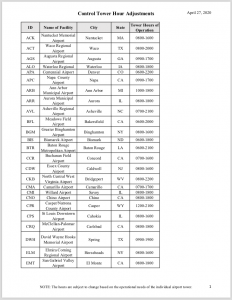
The FAA has published a list of 93 airports which will be getting their tower operating hours cut due to the reduction in traffic caused by the coronavirus pandemic.
Here’s the list of airports, with the new planned tower operating times:
In announcing its plans, the FAA said the following – “These facilities have seen a significant reduction in flights, especially during the evening and nighttime hours, since the pandemic began. Adjusting the operating hours will further protect our employees and reduce the possibility of temporary tower closures from COVID-19 exposures by ensuring enough controllers are available to staff the facilities during peak hours. It also will enable us to allocate difficult-to-source supplies where they are most needed.”
When the towers at these airports are closed overnight, the radar facility with oversight controls the airspace – the FAA plans to begin adjusting the operating hours of some of these facilities later this month. More info is available on the FAA page here.
Your MNPS approval is about to expire (so don’t get banned from the NAT)
written by David Mumford | 28 April, 2020
U.S. operators with the old MNPS approvals issued before 2016 have until 31 Dec 2019 to get these updated if they want to keep flying on the North Atlantic!
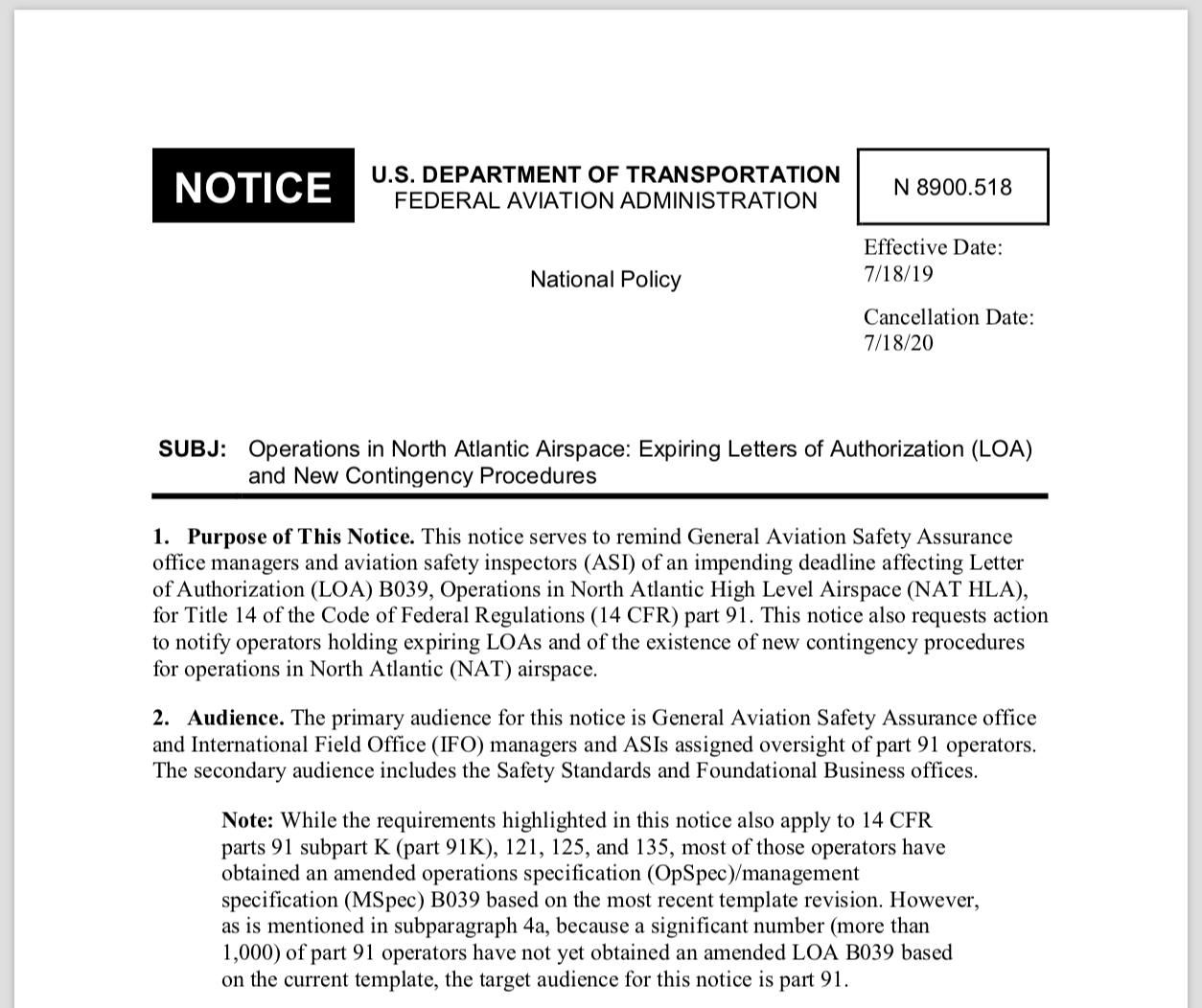
The FAA issued new guidance on this on 18 July 2019:
They say that there could be more than 1,000 GA operators who still have old NAT MNPS approvals, and all these operators will need to get new B039 LOAs to be able to continue flying on the North Atlantic beyond 31 Dec 2019.
The new B039 LOA is for “Operations in the North Atlantic High Level Airspace”. To get it, operators need to provide evidence of compliance with the NAT HLA requirements particularly in regard to RNP 10 equipage, flight crew training (including the new contingency procedures), and have operating procedures in place.
Operators will also need to make sure they have an B036LOA for “Oceanic and Remote Continental Navigation Using Multiple Long-Range Navigation Systems”.
Here’s the lowdown: If you have an old MNPS approval, you need to apply for the B039 LOA very, very soon! The closer we get to the Dec 31 deadline, the stronger the chance that it will take longer for the FAA to process yours, and this means that 2020 will not get off to a good start when you have to explain why you’ve been banned from the NAT! Help yourself, and the FAA, get through this by applying for it as soon as possible.
Mitch Launius is an International Procedures Instructor Pilot with 30West IP and can be contacted through his website: www.30westip.com
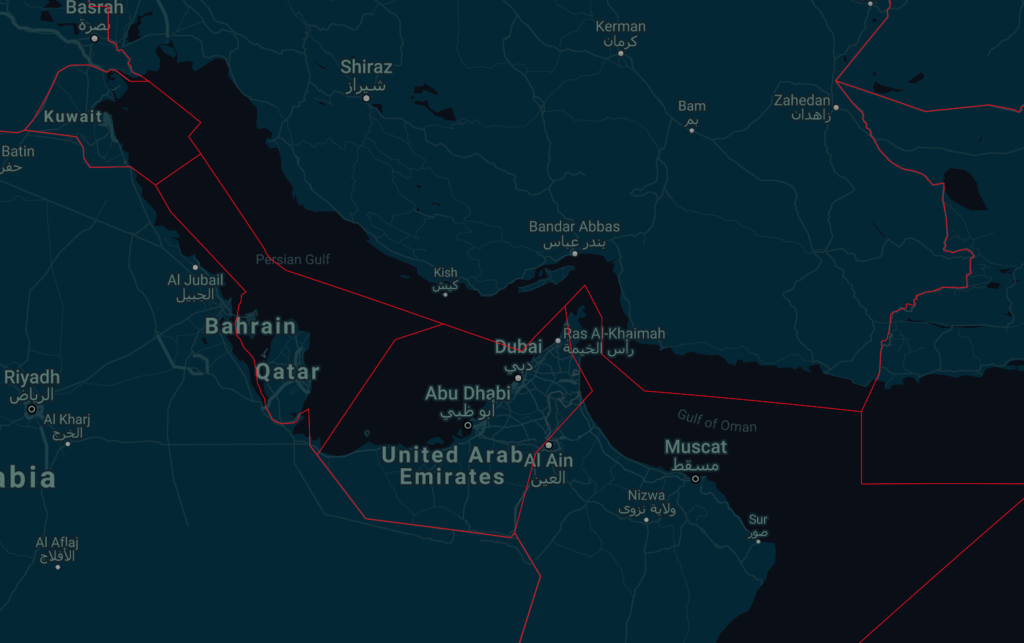
What’s going on in the Strait of Hormuz?
written by David Mumford | 28 April, 2020
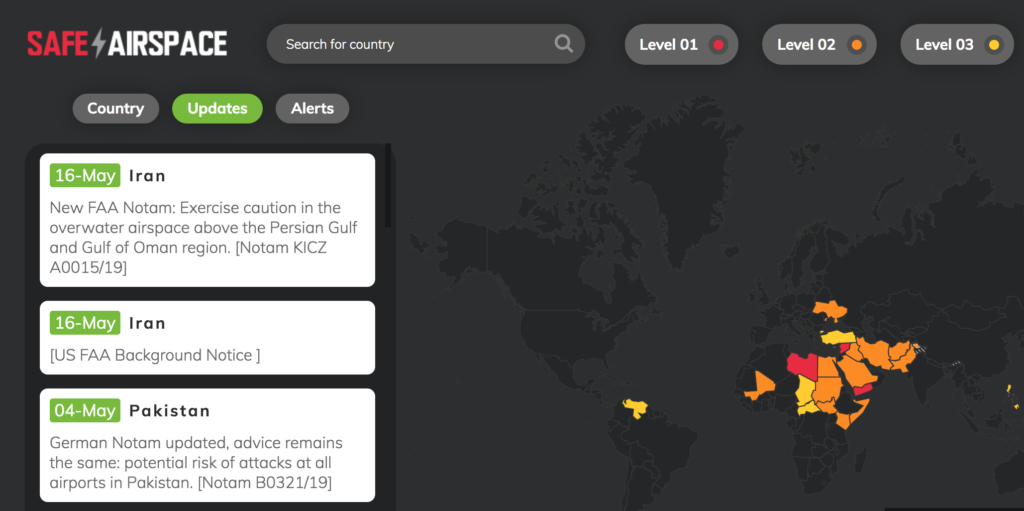
Amid rising tensions between the US and Iran, on 16th May the US FAA issued a new Notam and Background Notice advising operators to exercise caution in the overwater airspace above the Persian Gulf and Gulf of Oman.
The US has deployed warships and planes to the region, and withdrawn embassy staff from Iraq in recent days, and Iran has allegedly placed missiles on boats in the Persian Gulf.
In their Background Notice, the US FAA say that “Iran has publicly made threats to US military operations”, and are concerned about “a possible risk of miscalculation or misidentification, especially during periods of heightened political tension and rhetoric.” They also warn of increased GPS jamming by Iran throughout this region.
The US published another airspace warning for Iran back in September 2018, but that was mainly focussed on the risks of overflying Iran itself due to missilesfired from sites in the far west of the country against targets in Syria. That warning only made passing reference to the Gulf region – the only tangible risk at that time being due to Iran’s “test launches” in the area between Iran and Dubai, where the Iranian military regularly fire missiles during drills to practise blockading the Strait of Hormuz.
In May 2018, the US pulled-out of the Iran nuclear deal, and re-imposed sanctions. Since then, the relationship between the two countries has rapidly gone downhill. This week, the White House Press Secretary said that Washington would continue its “maximum pressure” campaign on Iran, adding the US would like to see “behavioural change” from the country’s leadership.
With the military build-up in the Gulf region, the US government has been quick to defend its actions, but the message seems to be clear: we don’t want war, but we’re ready for one.
As National Security Adviser John Bolton said in a statement this week: “The United States is not seeking war with the Iranian regime… but we are fully prepared to respond to any attack, whether by proxy, the Islamic Revolutionary Guard Corps or regular Iranian forces.”
KICZ NOTAMA0015/19 SECURITY..UNITED STATES OF AMERICA ADVISORY FOR OVERWATER AIRSPACE ABOVE THE PERSIAN GULF AND GULF OF OMAN.
THOSE PERSONS DESCRIBED IN PARAGRAPH A BELOW SHOULD EXERCISE CAUTION WHEN OPERATING IN OVERWATER AIRSPACE ABOVE THE PERSIAN GULF AND THE GULF OF OMAN DUE TO HEIGHTENED MILITARY ACTIVITIES AND INCREASED POLITICAL TENSIONS IN THE REGION, WHICH PRESENT AN INCREASING INADVERTENT RISK TO U.S. CIVIL AVIATION OPERATIONS DUE TO THE POTENTIAL FOR MISCALCULATION OR MIS-IDENTIFICATION. ADDITIONALLY, AIRCRAFT OPERATING IN THE ABOVE-NAMED AREA MAY ENCOUNTER INADVERTENT GPS INTERFERENCE AND OTHER COMMUNICATIONS JAMMING, WHICH COULD OCCUR WITH LITTLE TO NO WARNING.
A. APPLICABILITY. THIS NOTAM APPLIES TO: ALL U.S. AIR CARRIERS AND COMMERCIAL OPERATORS; ALL PERSONS EXERCISING THE PRIVILEGES OF AN AIRMAN CERTIFICATE ISSUED BY THE FAA, EXCEPT SUCH PERSONS OPERATING U.S.-REGISTERED AIRCRAFT FOR A FOREIGN AIR CARRIER; AND ALL OPERATORS OF AIRCRAFT REGISTERED IN THE UNITED STATES, EXCEPT WHERE THE OPERATOR OF SUCH AIRCRAFT IS A FOREIGN AIR CARRIER.
B. PLANNING. THOSE PERSONS DESCRIBED IN PARAGRAPH A PLANNING TO OPERATE IN THE ABOVE-NAMED AREA MUST REVIEW CURRENT SECURITY/THREAT INFORMATION AND NOTAMS; COMPLY WITH ALL APPLICABLE FAA REGULATIONS, OPERATIONS SPECIFICATIONS, MANAGEMENT SPECIFICATIONS, AND LETTERS OF AUTHORIZATION, INCLUDING UPDATING B450.
C. OPERATIONS. EXERCISE CAUTION DURING FLIGHT OPERATIONS DUE TO THE POSSIBILITY OF INTERRUPTIONS TO INTERNATIONAL AIR TRAFFIC DUE TO HEIGHTENED MILITARY ACTIVITIES AND INCREASED POLITICAL TENSIONS IN THE REGION. POTENTIALLY AFFECTED OVERWATER AIRSPACE ABOVE THE PERSIAN GULF AND THE GULF OF OMAN INCLUDES PORTIONS OF THE TEHRAN FIR (OIIX), BAGHDAD FIR (ORBB), KUWAIT FIR (OKAC), JEDDAH FIR (OEJD) , BAHRAIN FIR (OBBB), EMIRATES FIR (OMAE), AND MUSCAT FIR (OOMM). THOSE PERSONS DESCRIBED IN PARAGRAPH A MUST REPORT SAFETY AND/OR SECURITY INCIDENTS TO THE FAA AT +1 202-267-3333.
SFC – UNL,16 MAY 23:11 2019 UNTIL PERM. CREATED: 16 MAY 23:17 2019
FAA Background Information Regarding U.S. Civil Aviation – For the Overwater Airspace Above the Persian Gulf and Gulf Of Oman Region.
Due to increased political tensions and heightened military activities in the region, there is an increasing inadvertent risk to U.S. civil aviation operating in overwater airspace above the Persian Gulf and Gulf of Oman. As a result, on 16 May 2019, the FAA issued Notice to Airmen (NOTAM) KICZ A0015/19, advising U.S. civil flight operations to exercise caution when operating in the above area.
Iran has publicly made threats to U.S. military operations in the Gulf region. In addition, Iran possesses a wide variety of anti-aircraft-capable weapons, including surface-to-air missile systems (SAMs), man-portable air defense systems (MANPADS) and fighter aircraft that are capable of conducting aircraft interception operations. Some of the anti-aircraft-capable weapons have ranges that encompass key international air routes over the Persian Gulf and the Gulf of Oman. Additionally, Iran recently conducted a military exercise in the region, demonstrating their unmanned aircraft system (UAS) capabilities. Although Iran likely has no intention to target civil aircraft, the presence of multiple long-range, advanced anti-aircraftcapable weapons in a tense environment poses a possible risk of miscalculation or misidentification, especially during periods of heightened political tension and rhetoric.
There is also the potential for Iran to increase their use of Global Positioning System (GPS) jammers and other communication jamming capabilities, which may affect U.S. civil aviation operating in overwater airspace over the Persian Gulf and the Gulf of Oman.
The FAA will continue to monitor the risk environment for U.S. civil aviation operating in the region and make adjustments, as necessary, to safeguard U.S. civil aviation.
Your top three PBCS questions answered
written by David Mumford | 28 April, 2020
PBCS has been an ongoing PITA for some time now. We wrote about it back in March. Here are the top three questions we’ve had on it since then – and now we finally have some answers!
Question 1: What happens if I still haven’t received my updated A056 LOA?
After the PBCS tracks were introduced in March 2018,the FAA published a Noticerequiring all N-reg operators to update their A056 LOA authorization – regardless of whether or not they intended to fly these PBCS tracks. For private (Part 91) operators, the deadline to submit the application was 30th September 2018.
There was a barrage of applications, and the FAA still seem to have a bit of a backlog, as even now some operators have still not received their updated approvals.
The FAA’s unofficial policy is that as long as you have applied for a revised LOA, you can continue to use your old authorization after September 30th, while you wait for the new one to be issued.
Bottom line: This means you are allowed to keep flying in the North Atlantic, just not on the PBCS tracks.
Question 2: What about that problem with aircraft with Honeywell systems installed?
Back in March, a latency timer issue with certain Honeywell FMS systems meant that there were bunch of aircraft which weren’t able to get the PBCS approval.
In June, Honeywell issued a service bulletin fix for the issue, available at varying times for different aircraft. Since then, the FAA has been issuing the updated A056 LOA approvals to those aircraft with the Honeywell systems that reflect the new capabilities but the still don’t meet the PBCS requirement of RCP240 due to the latency timer issue.
Bottom line: Now those affected aircraft are able to receive the updated A056 LOA approvals, just with a PBCS restriction – meaning they can continue to operate in the North Atlantic, just not on the PBCS tracks.
Question 3: What the heck is PBCS anyway?
PBCS stands for ‘performance-based communication and surveillance’.
PBCS involves globally coordinated and accepted standards for Required Communication Performance (RCP) and Required Surveillance Performance (RSP), with the goal being to allow the application of reduced lateral and longitudinal separation to aircraft which meet the criteria.
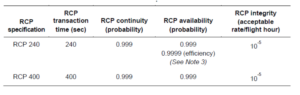
To be PBCS compliant, you basically need CPDLC capable of RCP240 and ADS-C capable of RSP180; this effectively means having a 4 minute comms loop, and 3 minute position reporting.
PBCS has been implemented in various different chunks of airspace around the world, but most notably in the North Atlantic, where the three core daily NAT Tracks are assigned as PBCS tracks between FL350-390. To fly those, you will need to be PBCS compliant (read above) but also have RNP4 (the rest of the NAT only requires RNP10).
Feeling queasy? That’s okay, reading about PBCS makes us feel that way too. If you’re still hungry for more though, check out our recent article on all things PBCS!
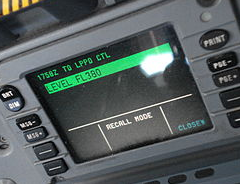
Indy Center kicks off CPDLC trials – the system is live!
written by OPSGROUP Team | 28 April, 2020
The United States is rolling out En Route FANS CPDLC during 2018-19, for all equipped, trained and permitted operators. The FAA’s Advisory Circular AC 90-117 outlines the requirements for U.S. operators.
Trials have begun with KZID/Indianapolis going live with 24/7 ops starting last week.
We also understand that KZME/Memphis and KZKC/Kansas City are still in the testing phase with CPDLC and voice read back happening 1-2 nights per week during the midnight shift.
The current deployment schedule as it stands can be found in this graphic. [if you know what DFV means, let us know!]
How to participate:
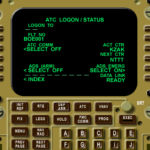
The FANS logon is “KUSA” for the entire country and you may logon at any time. The CPDLC connection will become active after departure, and the crew is notified via a welcome message uplink. If En Route FANS CPDLC enabled airspace is active, you will stay logged on. If the aircraft transitions from En Route FANS CPDLC enabled airspace into non-Data Link airspace with an active CPDLC connection then the connection will terminate approximately seven minutes after exiting.
To participate, file “DAT/FANSE” in Field 18 of the ICAO Flight Plan.
Equipment required is VDL Mode 2, indicated as “J4” in Field 10a of the ICAO Flight Plan.
If an operator wants to use domestic En Route FANS CPDLC andis already usingFANS DCL then the the majority of operations will fall into one of these scenarios:
(1) The operator uses FANS DCL via the “DAT/1FANS2PDC” preference in Field 18 of the ICAO Flight Plan. In that case, update the preference to “DAT/1FANSE2PDC“.
(2) The operator uses FANS DCL via the FAA’s Subscriber Database. In that case, the operator will want to add the entry “DAT/FANSE” in Field 18 of the Flight Plan.
Some things to keep in mind:
Domestic En Route FANS CPDLC enabled airspace will be seamlessly integrated with foreign (Canadian) and Oceanic FANS CPDLC enabled airspace.
The Oceanic Clearance will not be delivered via FANS CPDLC. You will still need to request the clearance via AFIS/ACARS or obtain it via voice.
Have you had the chance to try it out recently? Let us know!
In Short: The performance-based communication and surveillance (PBCS) framework allows for higher safety standards and more efficient airspace use. If your aircraft already has the equipment and you cross the Atlantic or Pacific Oceans often, it’s worth looking into getting your regulatory approval.
PB… what? It’s a good question. We have so many acronyms in aviation, it’s easy to forget what this one stands for and what it really means. So, let’s try and get to the bottom of it.
What is PBCS?
Official answer:
The ICAO performance-based communication and surveillance (PBCS) framework ensures that emerging technologies for communication and surveillance fully support ATM operations and are implemented and operated safely.
In plain speak:
With the technology already available on many aircraft and in the Air Traffic Control facility, aircraft can now fly closer than ever before, especially over non-radar oceanic airspace.
There are two key buzz words, so let’s define them. They are interlinked with RNP – Required Navigation Performance.
RSP – Required Surveillance Officially known as “surveillance data delivery”, often stipulated in the Airplane Flight Manual. Basically, how often does the aircraft send its position to ATC/ground station. There are two specifications, RSP180 and RSP400. The numbers indicate the maximum number of seconds (180 or 400) for the transaction to occur.
RCP – Required Communication ICAO has two specifications, RCP240 and RCP400. Again, the numbers indicate the maximum number of seconds (240 or 400), or “transaction time” taken for the controller to issue an instruction to the crew and for them to receive a response. This could be via CPDLC, HFDL, VDL or SATCOM.
So, we have a loop here, C-N-S.Communication, Navigation and Surveillance. An aircraft sends surveillance information to ATC about where it is; the aircraft stays within confines of RNP navigation requirements and ATC communicates with the aircraft within the required transaction times. Pretty easy!
But why do we need PBCS?
The take away? If all given aircraft in a certain airspace have a lower RSP value and a lower RCP value, we can start putting these aircraft closer together.
Essentially – performance-based separation minima. This allows aircraft to be separated safely according to technological capability rather than “one-size-fits-all” prescriptive distances.
What are the differences from PBN?
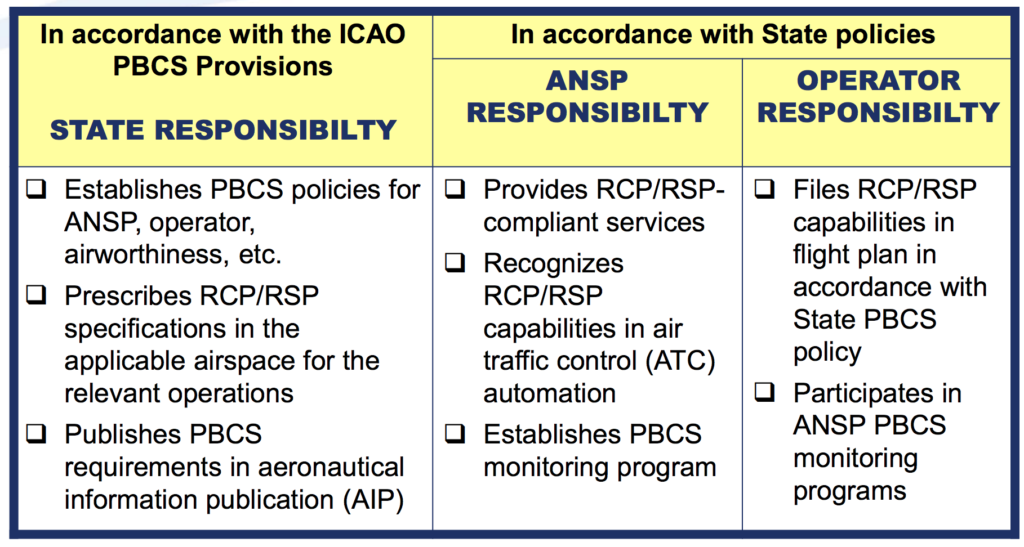
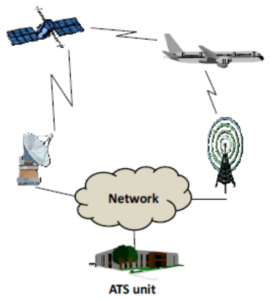
They are similar but there are notable differences. In a simple sense, the PBN (RNP/RNAV) only requires that the operator obtains approval because it focuses on how the equipment works. PBCS (RSP/RCP) however requires the involvement and approval of the air traffic service provider because it’s a two-way communication and surveillance effort. There are dependencies and complexity with the equipment standards on both ends.
In this graphic you can see a high-level summary of who is responsible for what:
Where is it in place?
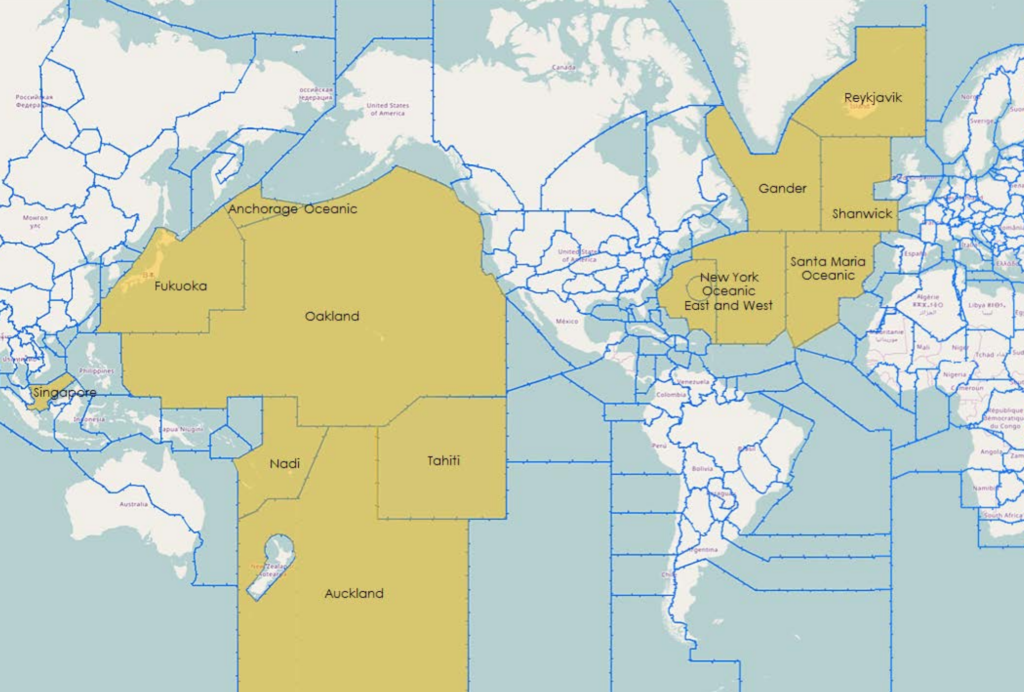
Currently PBCS is in effect in one form or another in the following FIR’s
NZZC/Auckland Oceanic
NFFF/Nadi
KZAK/Oakland Oceanic
PAZN/Anchorage Oceanic
WSJC/Singapore
VCCF/Sri Lanka
NTTT/Tahiti
RJJJ/ Fukuoka
KZNY/New York Oceanic
CZQX/Gander
EGGX/Shanwick
BIRD/ Reykjavik
LPPO/Santa Maria Oceanic
The Air Traffic Service providers of China, Brazil and Indonesia have also shown interest to introduce PBCS in the future.
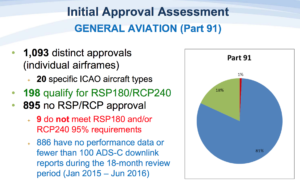
Requirements vary from state-to-state on the exact procedure for obtaining approval. It’s important to note that not all aircraft are automatically PBCS ready (refer to your aircraft manufacturer and your airplane flight manual).
When a PBCS authorization is obtained an operator is required to file both P2 (indicating RCP240) in item 10 and SUR/RSP180 in item 18 of the flight plan, in addition to the J codes for CPDLC and D1 or G1 for ADS-C in item 10.
The correct filing of these two codes will indicate to any ATM ground systems applying performance-based separation minima that the aircraft is eligible for these minima and that the crew have received the relevant training in order to safely operate using the reduced separations.
Will you notice that PBCS standards are being applied to your flight?
Ok this is the funny part of this story. The short answer, probably not.
While it may be easier for RCP240/RSP180 approved aircraft to obtain optimal flight profiles, especially during high traffic periods, and particularly for NAT flights using the OTS, the application of these standards is generally tactical in nature for ATC. An aircraft may not have performance-based separation applied at all on an individual flight, or possibly may never have had it applied to any of its flights. Even if a you have RCP240/RSP180 approvals, if the aircraft nearby does not also have the approvals, the separation standards cannot be applied!
What if I don’t have RCP240 and RSP180 approval?
If you do not have RCP240/RSP180 approvals you will always have the larger separations, e.g. 10-min, applied, and not be eligible for the lower standards in cases where it may be beneficial.
The only airspace that has implemented tracks that will require PBCS to file is in the NAT OTS. There are still non-PBCS tracks in the OTS for which PBCS approvals are notrequired.
All other airspace in which performance-based separation minima are currently applied will allow aircraft with and without RCP240 and RSP180 approvals to enter and use the airspace in a mixed-mode operation.
Will I be penalized if I don’t have it?
Probably not in the short term. In the future as more and more airspace corridors become PBCS only, then it is possible you may be subject to reroutes, delays or the requirement to fly outside of certain flight levels.
So, our conclusion?
PBCS is a great step forward in maximizing efficiency in a busier airspace environment thanks to the advent of better technology. If you fly the NATs often and have an aircraft capable of PBCS certification standards, then yes – do it! The approval process is not overly burdensome, and many modern transatlantic jets already meet most of the technical requirements.
Ultimately, reduced separation standards mean more great air-to-air views. So, pack your camera!
You were in a 4G inverted dive with a Mig 28? -Yes, ma’am. -At what range? -Um, about two meters. -Eh, lieutenant, what were you doing there? -Communicating. Keeping up foreign relations.
Did we miss something, or does something need more explaining? Let us know!
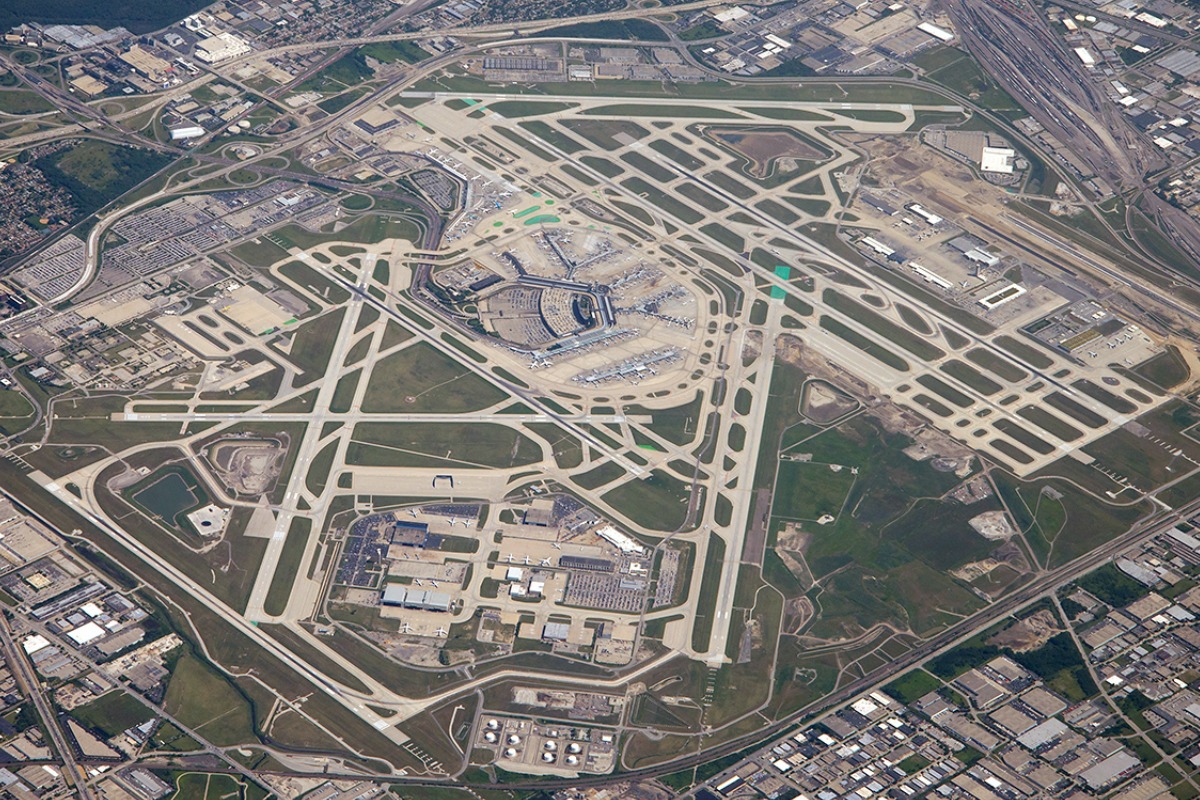
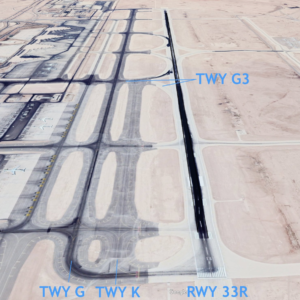
The crew, with thousands of hours experience, took off on a surface that didn’t have runway markings or runway lights. Thankfully no one was seriously hurt. It’s too early to exactly say why this happened, but it’s clear that some sort of “expectation bias” was a factor. Expecting to make the first left turn onto the runway. One has to ask – was ATC monitoring the take off?
Sadly the Riyadh incident is not isolated. There have been a plethora of near misses in the past few years (more details in Extra Reading below).
There have also been more than a few “incidents” of aircraft from C17’s to 747slanding at the wrong airports! The most notable near miss recently was that of an Air Canada A320 nearly landing on a taxiway full of aircraft at KSFO/San Francisco. But it’s happened to Delta and Alaskan Air recently too.
It is an even bigger issue at a General Aviation level (and not just because Harrison Ford did it!). The FAA safety team recently noted;
The FAA Air Traffic Organization (ATO) has advised of an increase in, “Wrong Surface Landing Incidents” in the National Airspace System (NAS).
Incidents include:
Landing on a runway other than the one specified in the ATC clearance (frequently after the pilot provides a correct read back)
Landing on a Taxiway
Lining up with the wrong runway or with a taxiway during approach
Landing at the wrong airport
The FAA published some shocking statistics:
557 “wrong surface landing/approachevents” between 2016-2018. That’s one every other day!
89%occurred during daylight hours
91% occurred with a visibility of 3statue miles or greater
So what to do?
There are numerous ‘best operating practices’ pilots can use to help avoid such incidents.
Be prepared! Preflight planning should include familiarization with destination and alternate airports to include airport location, runway layout, NOTAMs, weather conditions (to include anticipated landing runway)
Reduce cockpit distractions during approach and landing phase of flight.
Use visual cues such as verifying right versus left runways; runway magnetic orientation; known landmarks versus the location of the airport or runway
Be on the lookout for “Expectation Bias” If approaching a familiar airport, ATC might clear you for a different approach or landing runway. Be careful not to fall back on your past experiences. Verify!
Always include the assigned landing runway and your call sign in the read back to a landing clearance
Utilizenavigation equipment such as Localizer/GPS (if available) to verify proper runway alignment
Why are you still getting the Ruudy6 wrong? Stop at 1500!
written by OPSGROUP Team | 28 April, 2020
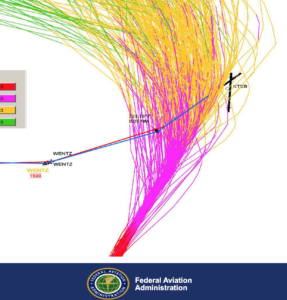
If you’re departing Teterboro any time soon, make sure you stop at 1500 feet – and have a good look at the rest of the RUUDY 6 departure. That’s the message from NY ATC, and the Teterboro Users Group.
The Teterboro Users Group has asked us to remind all pilots that strict compliance is required, especially vertically.
“The most common error being a climb straight to 2000’ without honouring the requirement to cross WENTZ at 1500” – Capt. David Belastock, President, TUG
This week the FAA issued the following notice which explain the issue and the serious consequences of non-compliance, namely the reduced vertical separation with KEWR/Newark arrivals:
Teterboro Airport SID Deviations
Notice Number: NOTC7799
The Ruudy Six departure continues to incur both lateral, but in particular, vertical pilot deviations. Due to the proximity of Newark and other area airports it is imperative to follow the RNAV(RNP1) departure procedure to Performance Based Navigation (PBN) standards. Do not drift left off course to avoid noise monitors. Do not climb above 1500 until passing Wentz intersection. There is only 1000 feet of separation with overhead traffic at Wentz. When issued the clearance to “climb via the SID” all altitude restrictions must be complied with as depicted on the chart.
Attached are excerpts from the Aeronautical Information Manual and the Controllers handbook explaining the Climb Via procedure. An expanded explanation is in chapter 4 and 5 of the AIM.
Further information can be found on the Teterboro Users Group website http://teterborousersgroup.org and in KTEB Notice to Airmen (Letters to Airmen section)
There has been an extensive education campaign underway for a long period including guidance material, pilot meetings, educational podcasts and even a FlightSafety International eLearning course. Despite these efforts, pilot deviations continue to occur.
A great guide has been created by Captain Belastock and its very useful for any crews operating out of KTEB.
Know of any other procedures with unusually high non-compliance?
Let us know!
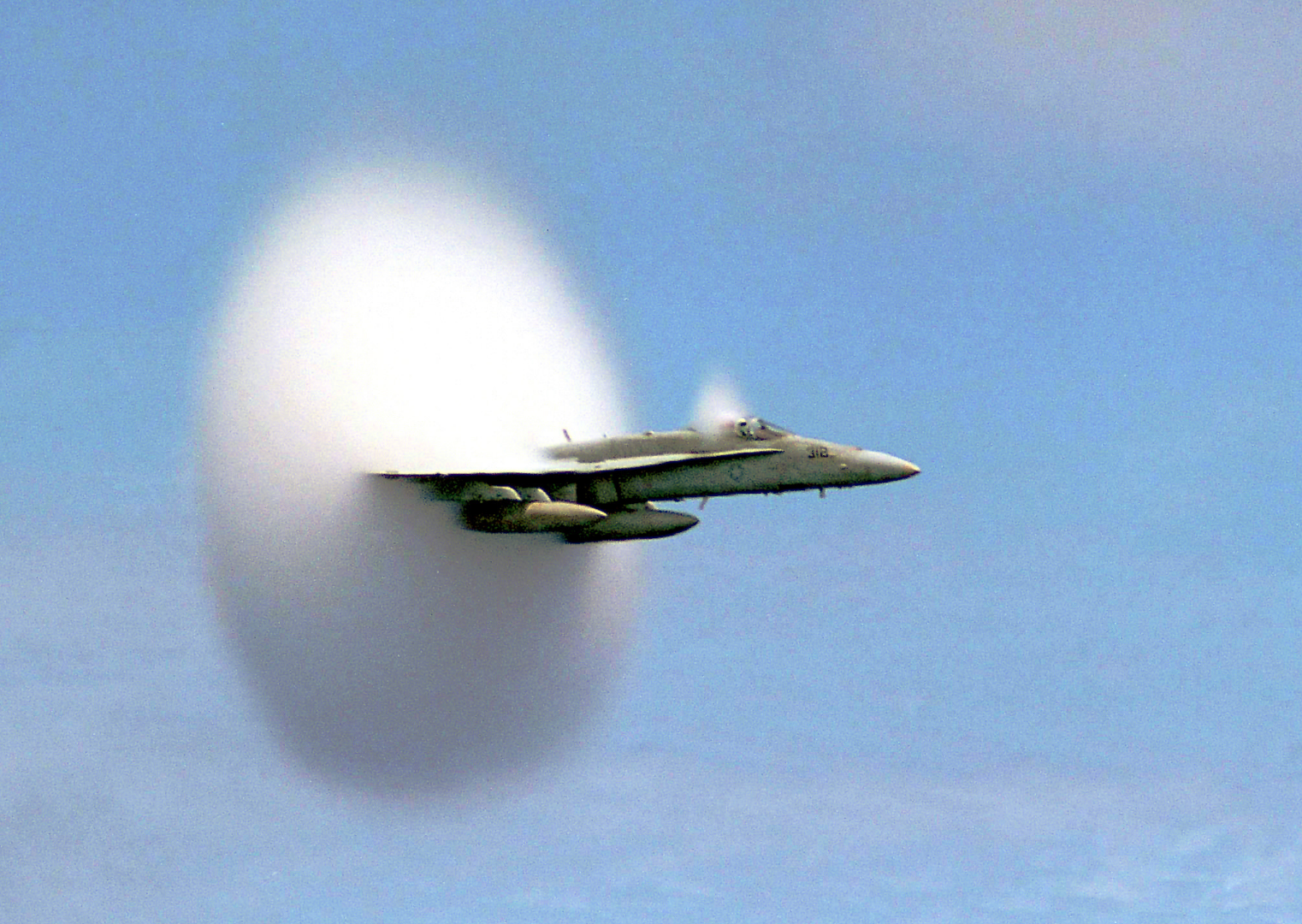
Don’t forget to file MACH number in NY Oceanic Airspace
written by OPSGROUP Team | 28 April, 2020
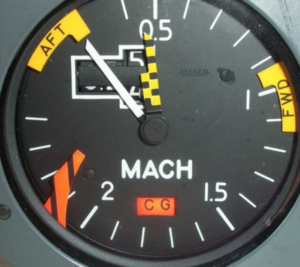
KZWY/New York Oceanic FIR last month published a NOTAM requiring Flight Plans to be submitted with MACH crusing number, rather than TAS in Field 15A for the flight plan. So far, most operators are not doing this. But you should!
This includes flight departing TXKF/Bermuda.
A0178/18 – ALL ACFT ENTERING THE NEW YORK OCEANIC FIR (KZWY), INCLUDING THOSE DEPARTING BERMUDA (TXKF) , MUST FILE A MACH NUMBER INSTEAD OF A SPEED OF KNOTS IN THE EXPECTED CRUISE SPEED FIELD (FIELD 15A) OF THEIR FPL. 03 MAY 17:08 2018 UNTIL 31 MAR 23:59 2019. CREATED: 03 MAY 17:09 2018
Reports are that compliance so far has been low.
So why do it?
NY ARTCC tell us:
This minor adjustment enables the ATC computer system to effectively probe flight plans and proactively offer more favorable routes and/or reroutes.
Most major carriers have taken the advice of numerous government agencies to avoid Syrian airspace altogether; the FAA going as far as calling on all operators flying within 200 nautical miles of the OSTT/Damascus FIR to “exercise caution”. Today, the only airlines flying over the airspace are locally based Syrian airlines, Iraq Airlines and Lebanon’s Middle Eastern Airlines.
These MEA overflights are of interest. The airline is a member of the SkyTeam alliance and has codeshare agreements with several high-profile airlines (Air Canada, Air France, etc.) Despite the repeated warnings of the ongoing dangers associated with overflights of this conflict zone, the airline has chosen to schedule more than half-a-dozen flights over the airspace each day.
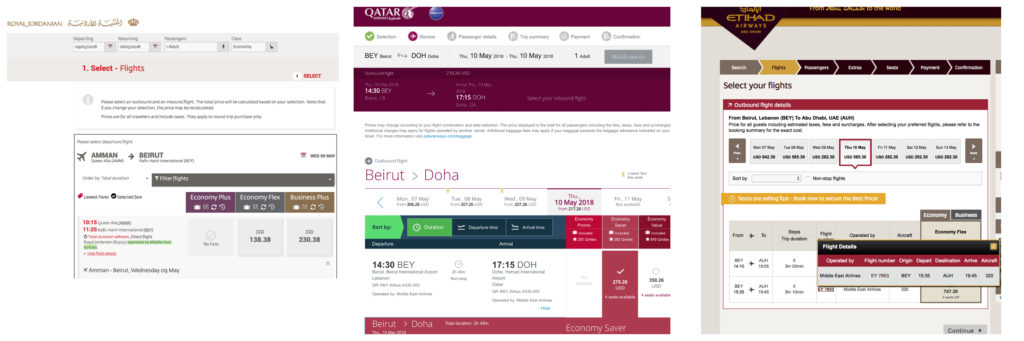
Some of these flights have the usual codeshare practise of other airlines booking their passengers on MEA flights. Our research shows that Etihad Airways, Qatar Airways (Oneworld Alliance) and Royal Jordanian Airlines (Oneworld Alliance) passengers are still being booked on MEA flights to/from Beirut; likely unbeknown to their customers of the increased flight risk. All three airlines continue to service Beirut with their own aircraft, but all three avoid Syrian airspace, naturally accepting the best advice to avoid the area completely.
Something isn’t right here: no warning anywhere about these flights being flown over Syria.
So why is it safe for passengers to overfly Syria on an MEA flight, but not on any of the other airlines? And more importantly, why is MEA still operating over Syria anyway?
It looks like Kuwait Airways will be the next codeshare partner of MEA, so it will be interesting to see whether the issue of the overflight of conflict zones will be discussed.
As always, keep an eye on our Safeairspace map for the latest worldwide updates.
Last minute ATC grab in Congress
written by OPSGROUP Team | 28 April, 2020
On Friday Apr 27, the US House of Representatives approved a long-delayed bill to authorize funding for the FAA, after GA advocates had mobilized earlier in the week to fight-off a last-minute attempt to privatize US ATC.
Late on Tuesday Apr 24, Republican Bill Shuster, chairman of the House Transportation and Infrastructure Committee, introduced a “managers amendment” to the proposed five-year FAA funding bill.
His amendment called for two things:
1. Remove the US ATC system from the FAA and insteadmake it part of the Transportation Department. 2. Allow it to be run by a 13-member advisory board made up mainly by airlines.
“Both of these provisions were drafted in the dark of night, without any opportunity for public debate,” said NBAA.
After last minute lobbying by GA advocates, the two contentious items in the bill were removed.
While Shuster agreed to remove the measures, he reiterated that he “strongly believe[s] Congress must pass real air traffic control reform” and that he sees that happening “somewhere down the line.”
“We are pleased to see this legislation pass the House,” said NBAA President and CEO Ed Bolen. “While the bill is not perfect, a long-term reauthorization is critical to advancing our shared priorities. Equally important, this bipartisan bill will modernize, not privatize air traffic control. We are grateful that members of Congress heard their constituents’ concerns about ATC privatization, and reflected those concerns in bringing this legislation to final passage.”
Kenya airspace threat downgraded
written by David Mumford | 28 April, 2020
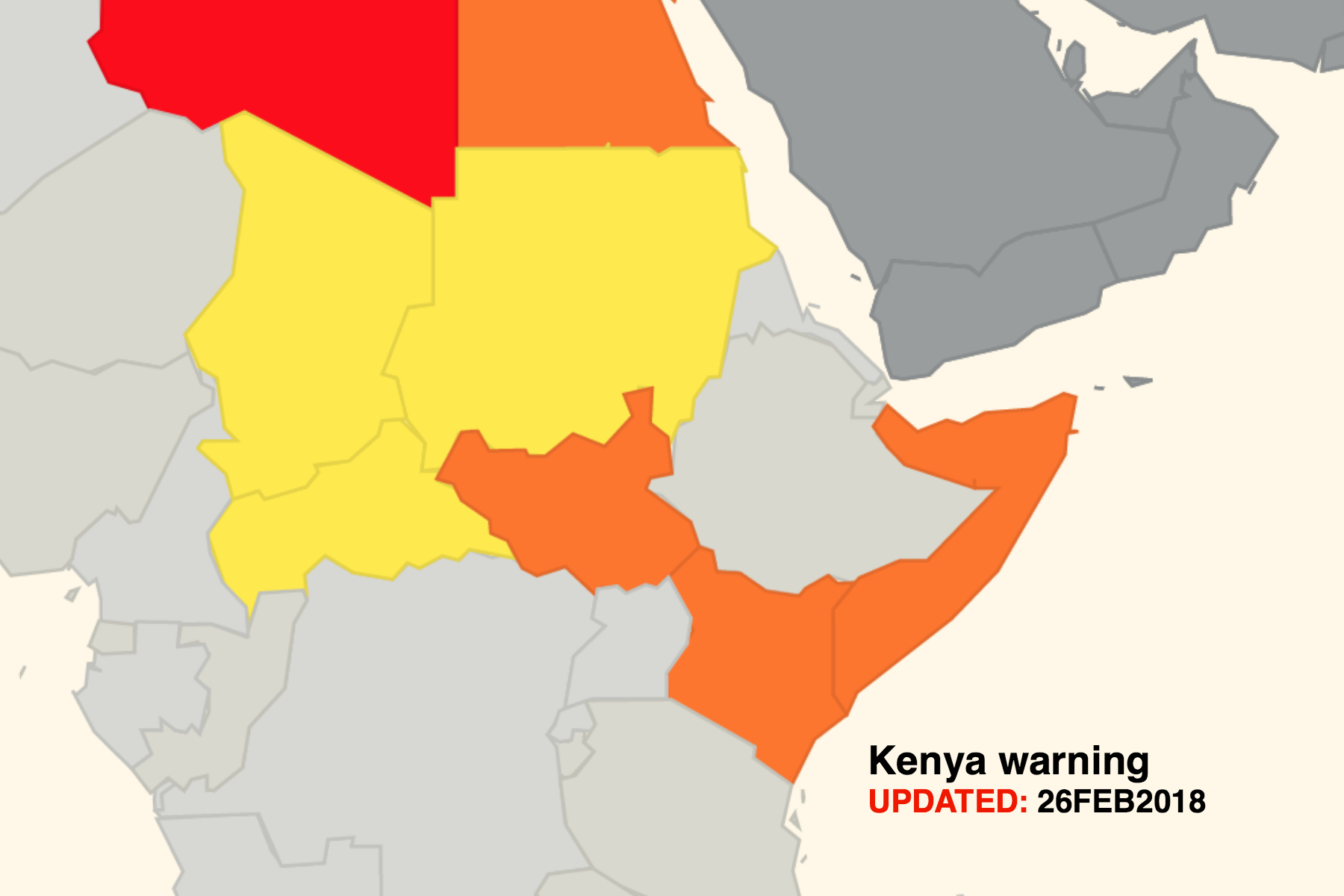
The FAA has revised its warning for Kenyan airspace – the area to ‘exercise caution’ is now limited only to that airspace east of 40 degrees East longitude below FL260 (i.e. the border region with Somalia, and 12nm off the east coast of Kenya). Prior to this, their warning applied to all airspace in Kenya below FL260.
Published on 26 Feb 2018, the warning maintains the same wording to clarify the type of weapons and phases of flight that the FAA is concerned about, specifically:
fire from small arms,
indirect fire weapons (such as mortars and rockets), and
anti-aircraft weapons such as MANPADS.
The scenarios considered highest risk include :
landings and takeoffs,
low altitudes, and
aircraft on the ground.
The updated guidance is intended for US operators and FAA License holders, but in reality is used by most International Operators including EU and Asian carriers, since only four countries currently provide useful information on airspace security and conflict zones.
The Notam uses FL260 as the minimum safe level, though we would suggest, as usual, that a higher level closer to FL300 is more sensible.
You can read the NOTAM in full on our Kenya page onSafeAirspace.net, a collaborative and information sharing tool used by airlines, business jet operators, state agencies, military, and private members of OPSGROUP.
RWSL: Red Means STOP!
written by Cynthia Claros | 28 April, 2020
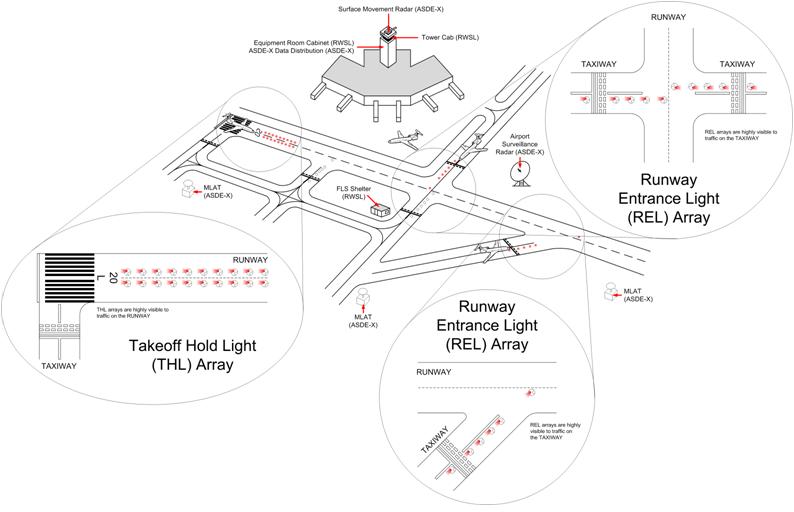
As you may know, the FAA is working on Runway Status Lights (RWSL). It’s a new system that’s live at 20 airports in the US. Basically, you get a nice set of red lights (embedded in the ramp) that tell you whether it’s safe or not to proceed. These lights are installed (or placed or located) at the entrance of the runway and at the start of takeoff. If any of these lights are red, you don’t go. Simple as that.
Diagram of RWSL
These lights are fully automated and completely independent of ATC, which means they do not have a clue if the lights are red or not. This is intentional. If you get clearance from ATC, and you see red lights, the red lights take precedence over the controller. The FAA has issued SAFO17011, stating:
There have been several instances at RWSL airports where flightcrews have ignored the illuminated red in-pavement RWSL lights when issued a clearance by Air Traffic Control (ATC). Illuminated RWSLs mean aircraft/vehicles stop or remain stopped and contact ATC for further direction, relaying to ATC that the RWSLs are illuminated.
This system will be expanding throughout the United States, and you can read more about the system here: FAA Runway Status Lights.
Overflights without a full Airworthiness Certificate
written by Declan Selleck | 28 April, 2020
For many countries, if an aircraft is operating normally, no Overflight or Landing permit is required. Sometimes, however, the aircraft will not meet full airworthiness requirements but is still safe to fly.
New deliveries, ferry flights to a new operator, maintenance flights, or positioning to storage, may all have special circumstances that normally result in the aircraft operating with a Special Airworthiness Certificate.
Special Airworthiness Certificates
The most common type of Special Airworthiness Certificate is a regular Ferry Permit. The FAA call this a ‘Special Flight permit’, EASA’s term is a ‘Permit to Fly’. It is issued by the Country of registration and allows an aircraft to be flown on a specific route and date, eg. for delivery, maintenance, transfer of ownership.
Every aircraft operating on a Special Airworthiness Certificate requires a Special Authorisation from each country being overflown or landed in. This is normally requested from the Ministry of Transport for that country, or the technical department of the Civil Aviation Authority. Official processing times are up to 20 days.
Specific to foreign operators flying to or over the USA, the FAA term for this is ‘Special Flight Authorization’.
EU Blacklist – Special Permit
For Operators that are on the current EU Blacklist under Annex A (airlines that are banned from operating in the European Union) and Annex B (airlines that are permitted to operate in the European Union only under specific conditions), a Special Permit can also be obtained to allow flights that are required to operate to the EU for maintenance or other reasons. A separate permit is required from each EU country enroute.
Together with obtaining a Special Permit for each EU country overflown, SAFA must be notified, and the standard Eurocontrol FPL Alarming system must be deactivated for your flight.
Processing Fees
The cost to obtain a Special Permit is different for each country, according to complexity and Civil Aviation and Ministry of Transport charges.
What’s the easiest way to file a request for a Special Permit?
Many can now be done online through the Flight Service permit tool.
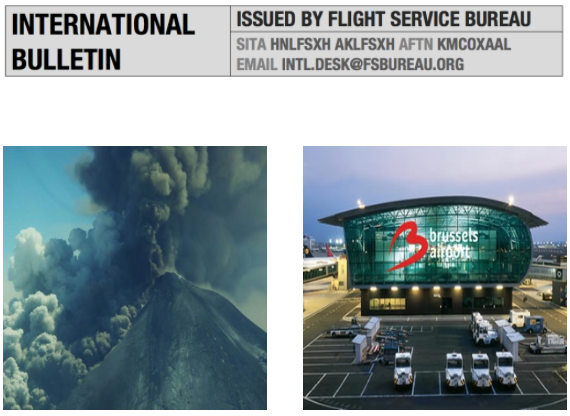
Pavlof Eruption wreaking havoc 30MAR16 Volcano Pavlof erupted on Sunday and is currently on aviation colour code ‘RED’. It has caused havoc for North Pacific, Alaskan and Northern Canadian operations. The latest predictions have the ash upwards of FL400 and extending over Northern Alaska and Canada. You can find the latest information through the Alaskan VAAC.
Brussels Airport remains closed 30MAR16 EBBR is still closed with the possibility of opening later this week. Currently all commercial flights are still prohibited from operating into EBBR. Only ferry, emergency, SAR, State, general aviation and cargo flights are authorized with a slot that can be coordinated through the Belgium Slot Coordination website.
EZZZ/Europe The U.S. State Department along with numerous other countries have issued a Europe wide travel warning in response to the attack in Brussels. While extra vigilance should be exercised it is also a very generic response to a threat that has yet to fully understood from a commercial aviation perspective. If you would like to be kept up to date on specific travel alerts from the U.S. State Department you can sign up through their STEP program.
FAA/United States there have been 583 reported hazards from Aug 22/2015-Jan 31/2015 between aircraft and Drones. None of these incidents have caused any collisions or damage but extra vigilance must be exercised until the FAA can regulate the use of these drones in the terminal areas.
RPHI/Manila has issued an advisory for aircraft operating in the vicinity of the Bulusan Volcano and the Kanlaon Volcano due to an alert level 1 of activity. Flights operating in the vicinity are advised to avoid flying close to the summit.
LFXX/France a general strike has been declared for March 31st. Possible impact to airline operations. Please make sure you check with Eurocontrol or FIR NOTAMs for further restrictions.
FXXX/Nigeria The NNPC or Nigerian National Petroleum Corporation has stated that steps are currently being taken to end the countries fuel shortage but may take upwards up 2 months. Please check with local handlers for the availability aviation fuel supply until the issue is resolved.
LXXX/Turkey has issued a nationwide terror alert and the Israeli Counter-Terrorism Bureau has advised for all of it’s citizens to leave the country. Extra vigilance should be exercised if operating to and from Turkey for the foreseeable future.
UXXX/Russia has stated that aviation authorities are intensifying it’s inspections of aircraft from Russian and International budget carriers in wake of the Rostov-on-Don accident.
DGAC/Ghana FIR issued NOTAM A0128/16 due to VHF freq 130.9 being not reliable for all Oceanic traffic entering ACCRA FIR from the South East due to maintenance. All traffic must contact ACCRA on HF 8903KHZ or logon to ADS-C/CPDC “DGAC” until positive VHF contact is established.
VNKT/Katmandu There have been a few reports that the Tower at VNKT has been reporting erroneous weather to pilots. One example of such a report was “Tower informed us that there was some 3 km of visibility this morning but it to be less than 1.5 km while Kathmandu was engulfed by haze”. If you encounter any issues while operating into VNKT please send us a note to bulletins@fsbureau.org.
VIAR/Amritsar has suspended all night operations for 1 year due to the planned reconstruction of the airports runways.
VTBD/Bangkok Officials approved an expansion that will allow for more aircraft, passengers and vehicle parking. The plan also includes provisions to cut landing fees during off-peak hours at VTBD and VTBS in an effort to increase usage of both airports. The project includes plans to extend the runway, add office buildings, and create additional parking zones for aircraft. The expansion is expected to be completed in 2025.
Angola The Ministry of Health in Angola has reported an ongoing outbreak of yellow fever in Luanda Province. The government of Angola requires all travelers older than 9 months to show proof of yellow fever vaccination on arrival. The CDC has a ‘Watch Level 1, Practice Usual Precautions’ advisory in place.
FAA/United States has issued Advisory Circular 00-30C. It describes the various types of CAT (Clear Air Turbulence) along with avoidance techniques and possible future forecast systems for helping Dispatchers and Pilots in the planning stages for proactive flight planning.
NAT Tracks Change Postponed 16NOV The planned implementation of reduced separation in the Organised Track System (OTS) has been postponed. During final testing, a software issued was identified by ATC, and as a result the previous track structure remains unchanged. New waypoints introduced on 12NOV are useable. A revised implementation date is expected to be announced today, 16NOV.
KLAS/Las Vegas restrictions 17NOV Increased traffic from Monday 16NOV due NBAA Conference. Special Procedures in effect from 14NOV-23NOV affecting KLAS, KHND, and KVGT, refer to this NBAA link for details. If you are visiting the NBAA Conference, you can meet the Flight Service Bureau team at stand C12050 in the Central Hall, and collect your free show pack.
KAUS/Austin A technical problem with ATC equipment in the Austin Tracon will likely lead to delays today; service is being provided by Houston Centre instead, with a Ground Delay Program planned to manage capacity.
KLAS/Las Vegas Increased traffic from Monday 16NOV due NBAA Conference. Special Procedures in effect from 14NOV-23NOV affecting KLAS, KHND, and KVGT. Refer to https://www.nbaa.org/events/bace/2015/air-traffic/. If you are visiting the NBAA Conference, you can meet the Flight Service Bureau team at stand C12050 in the Central Hall, and collect your show pack (you can reserve one here).
KXXX/USA Several incidents reported of laser beams pointed at aircraft, on 13NOV Southwest and American were targeted at KPHX/Phoenix, and on 11NOV three aircraft at KDAL/Dallas Love were illuminated.
KXXX/USASnowbird 2015: The FAA have published details of Traffic Management plans for the east coast of the US during the Thanksgiving holidays, effective 24NOV to 30NOV. The highest volume days will be 25NOV and 29NOV, expect delays on north/south routes to Florida during this period. Read the full details of the airspace initiatives here.
EINN/Shannon Has an overnight runway closure. from 17NOV-20NOV 2300-0500Z for essential maintenance. If another ETOPS alternate is required on these nights consider EIDW/Dublin, EGAA/Belfast or EGPF/Glasgow.
LFXX/France A Notam issued Friday (A4850/15) regarding Border Controls remains in place, in practice the Notam is a reminder to airlines of existing requirements only. Expect delays due security checks at all French Airports, and many closures of public buildings and transport systems in France.
VLVT/Vientiane, Laos has reopened after a runway closure on 13NOV due to a disabled aircraft. An MA60 had aquaplaned and partially blocked the runway.
MNXX/Nicaragua closed its border with Costa Rica on Sunday 15NOV in response to the wave of Cuban migrants moving northward to the United States. Costa Rican officials had previously issued transit visas to approximately 1,200 detained Cuban refugees at the Panamanian border. One Cuban migrant stated that there were approximately 2,000 Cubans waiting on the Costa Rican side of the Nicaraguan border.
NFFN/Nadi, Fiji Refurbished departure lounge opens today 16NOV; the government will spend another 105 million USD to upgrade the Airport further in the coming year.
PAZA/Anchorage FIR Two new waypoints have been added for Polar operations. Those waypoints are LETUN and BAREK.
LFxx/France ATC Industrial action planned for 17NOV has been cancelled.
LIxx/Italy FIR There has been a call for an Italian National Strike, including ENAV ATC personnel, on 24NOV 1200-1600 UTC. More information will be posted as soon as it is available.
PLCH/Christmas Island As per NOTAM A1581/15 Jet A-1 fuel limited in supply. Sched flights to minimize fuel uplift on arrival or maximize tankering into PLCH. Tech stops cannot be made. In effect until 04DEC.
PKMJ/Marshall Island Construction is planned at the eastern end of RWY25; authorities have notified expected delays of up to 30mins including airborne holding.
FMEE/Reunion Airport will be closed from 16NOV-28NOV on Mon, Weds, Fri for surface work. Airfield cannot be used as an alternate except in case of emergency. All traffic services will be provided normally for all aircraft crossing La Reunion TMA. Refer to NOTAM A1452/15.
FAA The FAA is rolling out Controller Pilot Data Link Communications-Departure Clearance (CPDLC-DCL). Currently, only George Bush Intercontinental Airport in Houston, TX (IAH), William P. Hobby Airport in Houston, TX (HOU) and Salt Lake City International Airport in Utah (SLC) are operational, however, the FAA plans to bring 56 airports online by the end of 2016. KTEB/Teterboro is scheduled to be operational by the end of MAR2016.
Monday Briefing: Confusion over Crimea, Kosovo Upper Airspace reopens
written by Declan Selleck | 28 April, 2020
Confusion over Crimea: Special Report Apr 3 : Simferopol ACC re-opened 03APR creating confusion as to who should be providing ATC service in the Crimea region. We have published a Special 6 page International Ops Notice (03/2014) “2014 Airspace and Regulatory Changes in Crimea”.
Kosovo Upper Airspace re-opens Apr 3 : After 15 years, the last remaining chunk of European airspace closed to overflying traffic in the Balkans has reopened. The KFOR sector over Kosovo became available on 03APR, with route savings immediately apparent to operators.
Kxxx/USA Operators should be aware of the new FAA ATC phraseologies effective 03APR. The FAA will implement “climb via” phraseology and procedures for departure operations consistent with existing “descend via” phraseology and procedures. “Climb via” and “descend via” are abbreviated ATC clearances that require compliance with the procedure’s lateral path, associated speed restrictions, and altitude restrictions published on the SID or STAR. Some good information at http://www.nbaa.org/ops/cns/pbn/climb-via/
LLOV/Ovda, Israel will be closed to all flights 01MAY-07MAY
DGAA/Accra, Ghana Until 23JUN, The main runway (03/21) is open daily from 0500-2300Z only; no traffic accepted outside these hours.
LFMN/Nice Change in parking procedure; if approval is granted for parking, but operator changes to another, larger aircraft, then the previous approval will be cancelled. Co-ordinate all aircraft changes with Airport Ops.
YPXM/Christmas Island has reopened after the recent Cyclone in the Indian Ocean.
OSDI/Damascus FIR – For those still overflying, Syria has closed airway L513 from BURSA to LEBOR UFN.
HSSM /Malakal, South Sudan is only accessible with permission from the government security services. This is very difficult to obtain and makes the airport effectively shut.
HSWW /Wau, South Sudan is open without any specific additional permission being required.
MGGT/Guatemala City ChevronTexaco, for any fueling on the east and military ramps from 0900-1600 LT, requires a minimum of 24 hours’ notice.
HLLS/Sebha, Libya remains closed until 07APR.
CAA Closures. Myanamar has an extended closure due to public holidays from 12-21APR. The Chinese CAA are celebrating National Tomb-Sweeping Day on 07APR.
UK Charter Permits. Significant changes to the approval process for Landing Permits for the UK will take effect on 06 APR. CAA will take over the responsibility for issuing approvals from the Department for Transport (DFT). Also, previously, a cabotage objection could be raised by a group of UK Charter Operators – this is removed. A fee is likely to be charged by the CAA for permits from this point forward.
Turkey. Effective 10APR2014 Visa on Arrival is no longer available at Turkish Airports. Visitors must apply online through https://www.evisa.gov.tr/en/ for an e-Visa.
Australia. A reminder to all operators who are not ADS-B equipped, of the restrictions when operating into Australian Airspace effective from 15DEC13. If you not ADS-B equipped you must file with CASA, a Form 208 exemption application 14 days in advance of proposed operations into Australian Airspace. Then operations will be confined to the SSR radar coverage area extending from 200 nm north of Cairns down the East coast to 200 nm west of Adelaide. This is commonly referred to as the J curve. If you intend operating into the Brisbane or Melbourne FIRs from the west and north west of Australia, and are not ADB-B equipped you will be required to operate at FL290 or below.




 The United States is rolling out En Route FANS CPDLC during 2018-19, for all equipped, trained and permitted operators. The FAA’s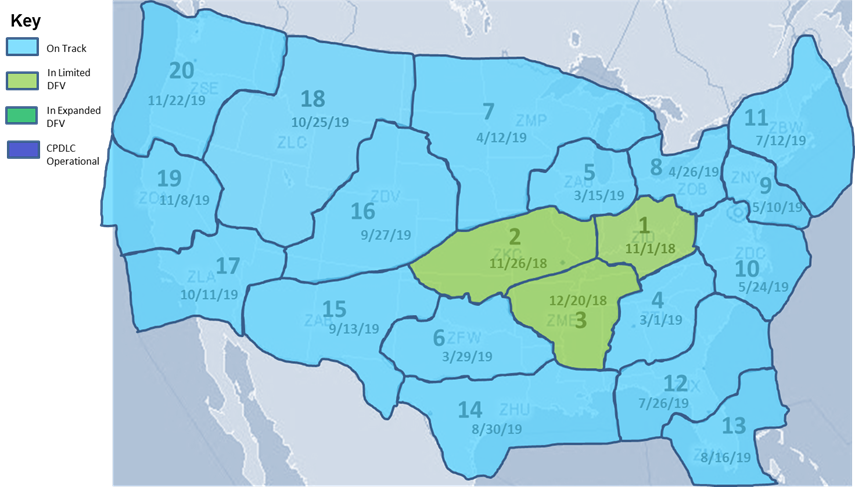
 Have you had the chance to try it out recently?
 There are two key buzz words, so let’s define them. They are interlinked with RNP – Required Navigation Performance.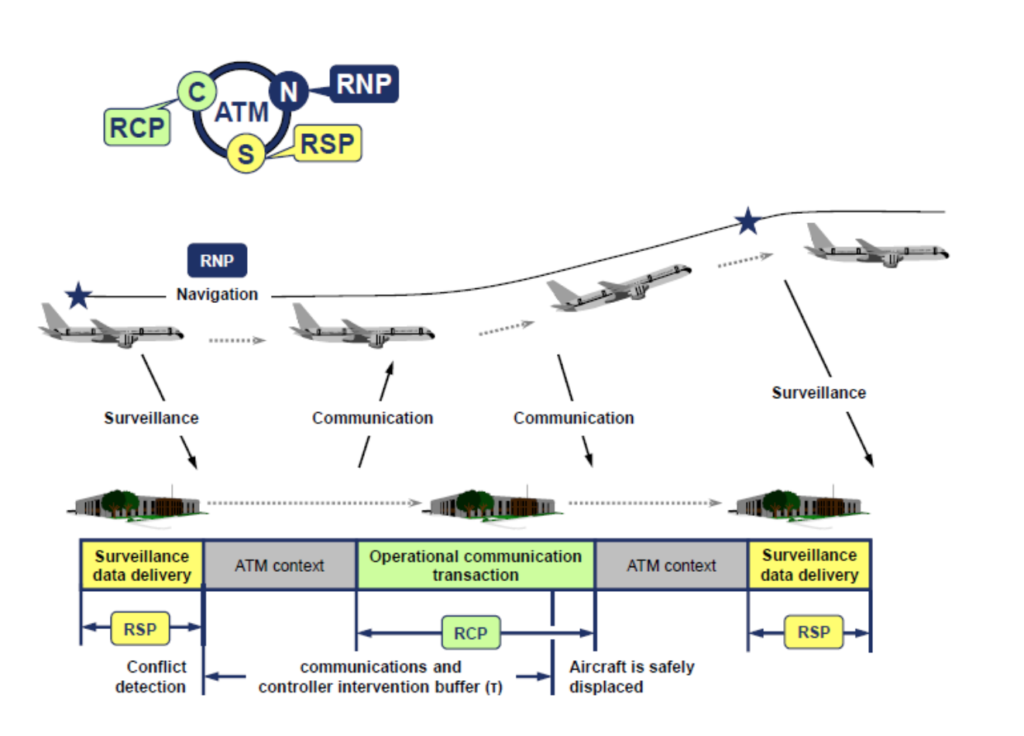
 Requirements vary from state-to-state on the exact procedure for obtaining approval. It’s important to note that not all aircraft are automatically PBCS ready (refer to your aircraft manufacturer and your airplane flight manual).
 Ok this is the funny part of this story. The short answer, probably not.
 If you do not have RCP240/RSP180 approvals you will always have the larger separations, e.g. 10-min, applied, and not be eligible for the lower standards in cases where it may be beneficial.
 There have also been more than a few “incidents” of aircraft from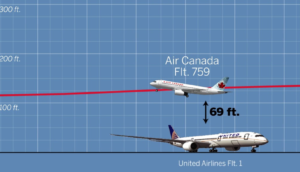

 This week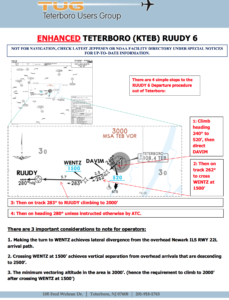
 So why do it?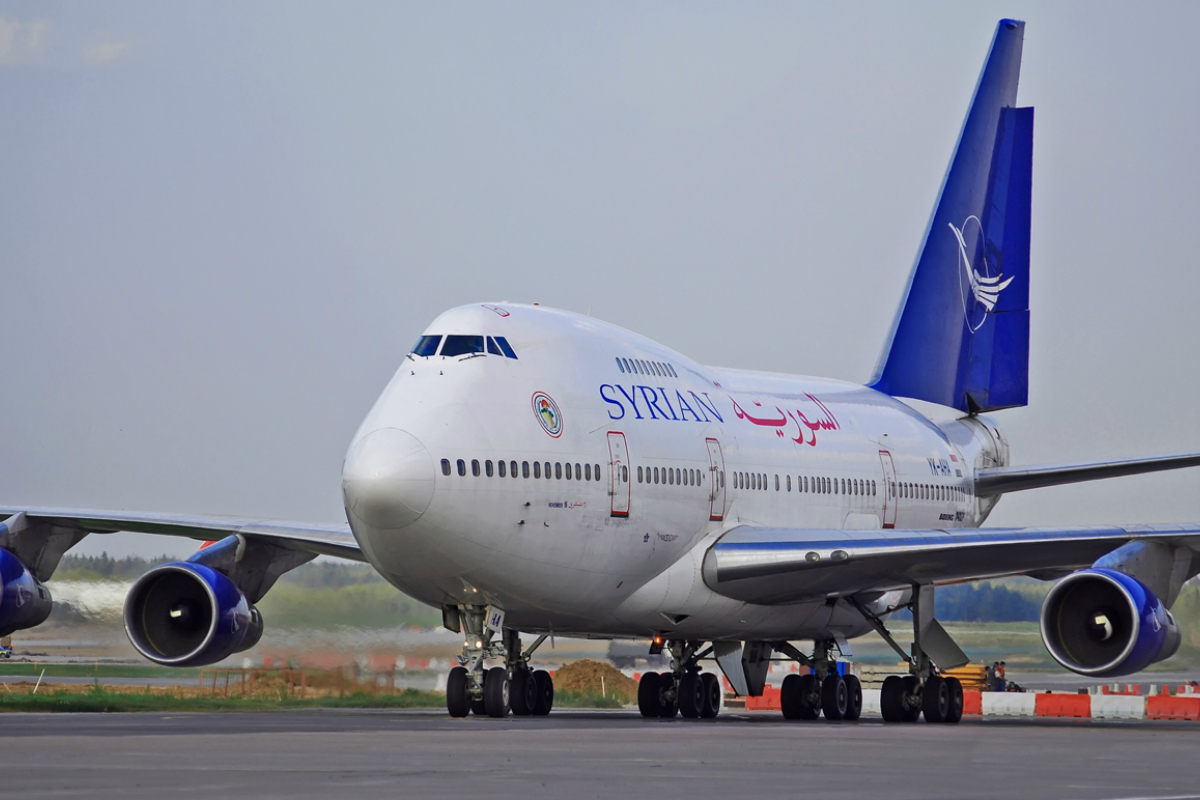
 These MEA overflights are of interest. The airline is a member of the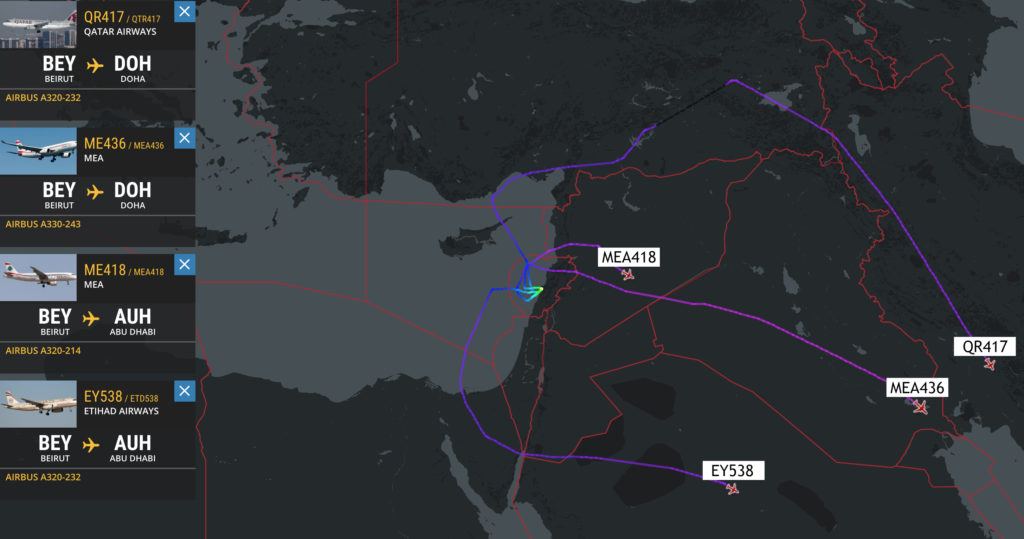

 On Friday Apr 27, the US House of Representatives approved a long-delayed bill to authorize funding for the FAA, after GA advocates had mobilized earlier in the week to fight-off a last-minute attempt to privatize US ATC.