US Border Overflight Exemptions: A How-to Guide

Update Aug 2025: BOEs Move to eAPIS (No More Email Applications)

Until now, getting a Border Overflight Exemption (BOE) was an email game. You’d draft up a message to CBP with your operator details, compliance statement, and a few other bits depending on whether it was a new application, renewal, or name change.

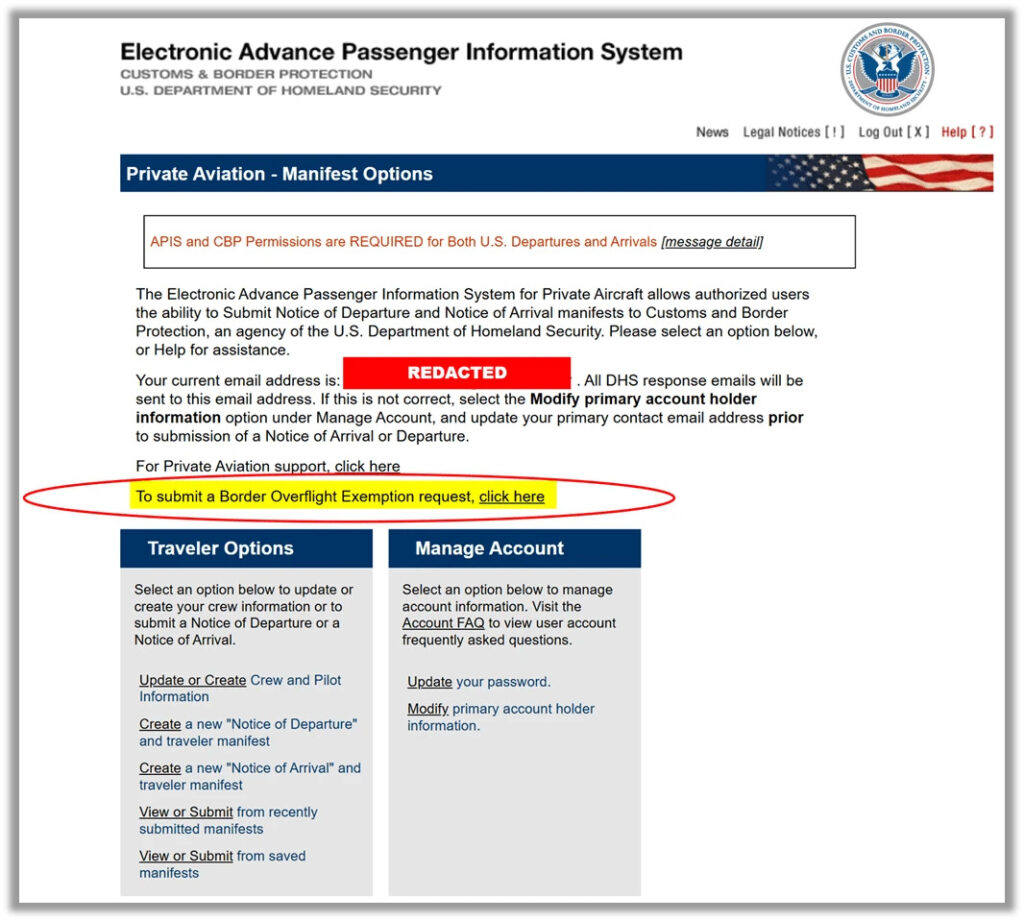
That’s now changed. CBP has shifted BOE applications and renewals into the eAPIS web portal. Instead of emailing back and forth, you log in with your usual eAPIS credentials and hit the new “Border Overflight Exemption” link under the manifest options.

Thanks to the NBAA for this behind-the-scenes screenshot.

CBP says they’ll process these within 30 days or less (same as before). Commercial operators still need to add carrier bond info and confirm customs fees are current, but otherwise it’s a much smoother process. If you use a handler or third-party provider, they’ll continue doing it for you behind the scenes.

New to BOEs? If you’re arriving from the south, CBP normally requires your first landing to be at the nearest southern airport of entry. A Border Overflight Exemption lets you bypass that rule and fly straight to the airport you actually want to reach. More info here.

Original Story Sep 2024: BOE Guide

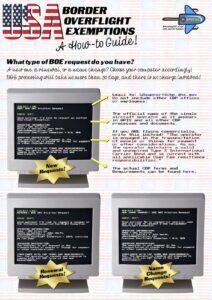
Back in the days when you had to email your BOE requests to CBP and everything was way more painful, we lovingly prepared a 1-page quick-ref cribsheet showing what to do.

But with the Aug 2025 switch to doing all your BOEing via the eAPIS website, that guide is now defunct! We hereby forever consign it to the great FOD bin of history!


US Pre-Clearance: How does it work?

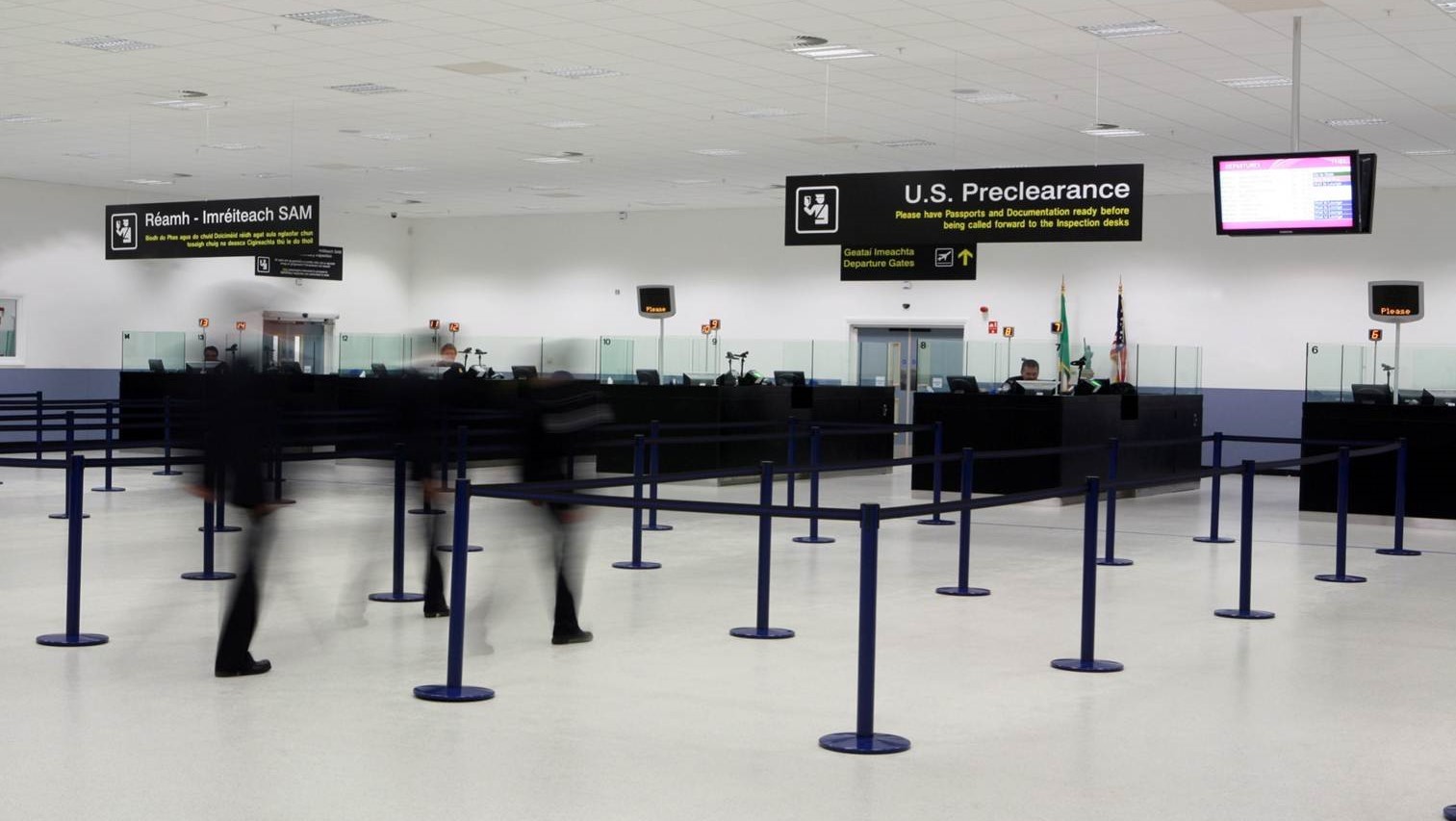
What is US Customs and Border Protection Pre-Clearance?

This service basically allows aircraft flying from certain approved airports direct to the US to complete their entry procedures at their departure airport – instead of on arrival in the US.

Where can I do it?

If you’re a bizav flight (i.e. private or charter), you can only do it at EINN/Shannon and TNCA/Aruba.

Scheduled airline flights can do it at these airports too:

  • The United Arab Emirates – OMAA/Abu Dhabi
  • The Bahamas – MYGF/Freeport or MYNN/Nassau
  • Bermuda – TXKF/Bermuda
  • Canada – CYYC/Calgary, CYEG/Edmonton, CYHZ/Halifax, CYUL/Montreal, CYOW/Ottawa, CYYZ/Toronto, CYVR/Vancouver, or CYWG/Winnipeg
  • Ireland – EIDW/Dublin

Where can I fly to in the US once I’ve Pre-Cleared?

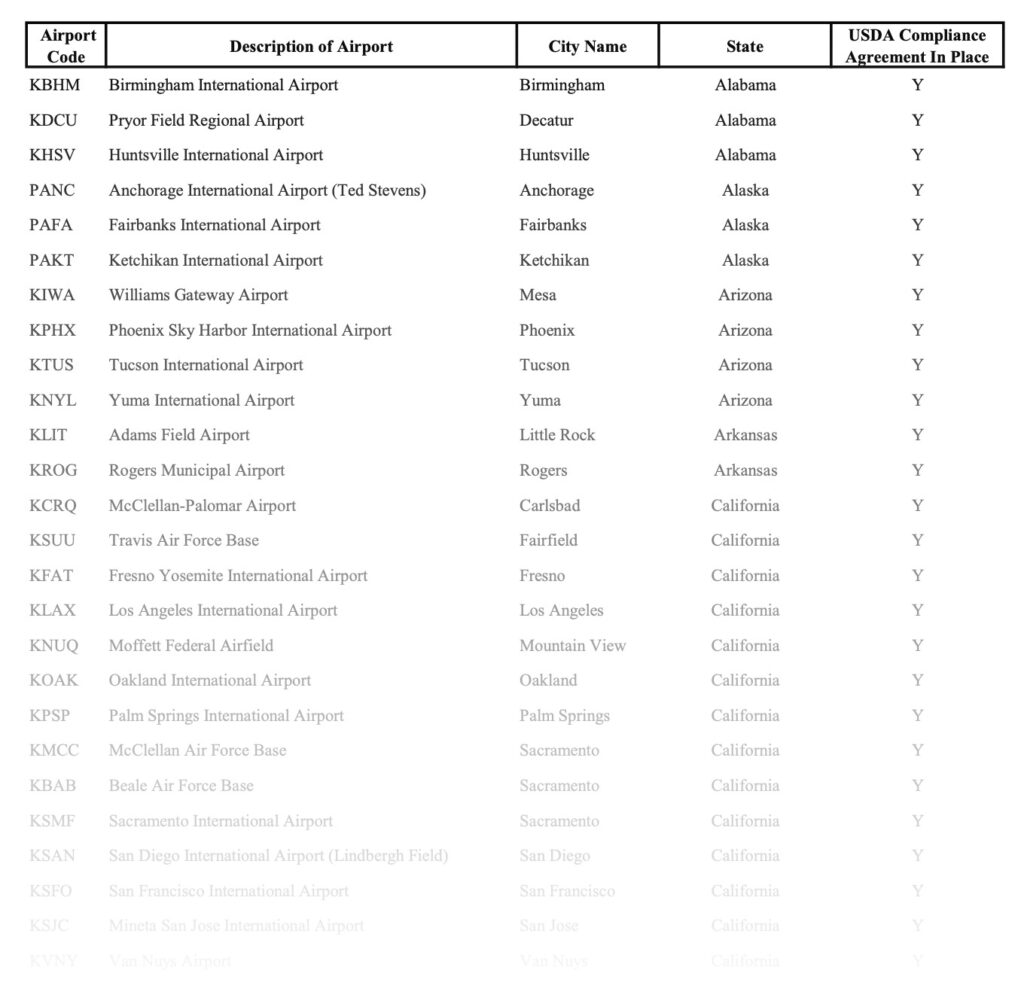
Turns out it’s not that easy to find a list of US airports approved for the arrival of Pre-Cleared aircraft. But thanks to Signature FBO at EINN/Shannon, here is a copy:

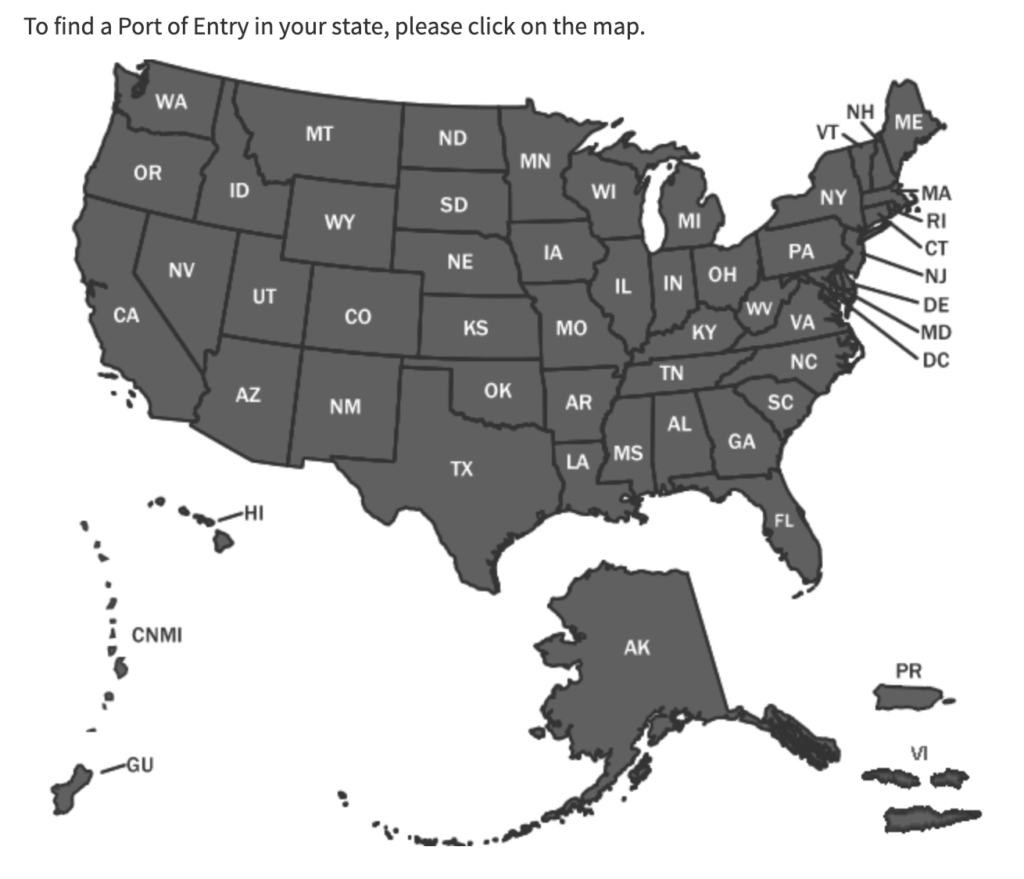
Finding a list of US International Airports of Entry is pretty easy, just go to the CBP website and use their interactive map. But it’s worth noting that not all US International Airports of Entry are on the list of those approved to accept Pre-Cleared flights, due to lack of agriculture agreements, and/or local CBP agreements there.

How does Pre-Clearance work in reality?

US CBP has published this guide on exactly how the Pre-Clearance service works, but here’s the lowdown:

  1. Request the service with CBP – Get in touch with CBP telling them that you want to do it! Pass them a bunch of information – details about the flight, passengers and crew. You can do this step through your ground handler (recommended).
  2. Submit APIS – Slightly tricky here, because for Pre-Clearance you have to submit this no less than one hour before the scheduled Pre-Clearance processing time itself, rather than the departure time from the Pre-Clearance airport. For example, you want to fly from EINN-KALB at 2pm, and you’ve got your Pre-Clearance set up for 1pm, so that means you need to file your APIS no later than 12pm!
  3. Pre-Clearance approval – US CBP will email notice of approval, including the appointment confirmation number.
  4. The Pre-Clearance procedure – When you arrive at the Pre-Clearance airport, CBP will conduct the same procedures as if you were at an airport in the US. Travelers and luggage are screened and the aircraft is inspected.
  5. Departure – Crew, passengers and luggage board the aircraft, and off you go. (And remember – no opening of any aircraft doors from this point before departure!) The kindly CBP chaps you’ve just dealt with will zap your info across to their counterparts at whichever US airport you’re flying to, so everything should be nice and smooth on arrival.
  6. Arrival – Upon arrival in the US, bag up your garbage for CBP to collect. Note that if you have to land somewhere other than where you said you’d be landing in your APIS, Pre-Clearance approval will be voided and you’ll have to go through the normal entry process.

Remember, if you’re a bizav flight, you can only do Pre-Clearance at EINN/Shannon Airport or TNCA/Aruba. So here’s some info specific to both of these airports…

Pre-Clearance at EINN/Shannon

One of the FBOs there is Signature Aviation, and they have provided a summary of what you can expect when you Pre-Clear, with a few more details than the basic summary above. You can download the PDF here, but key points are: you must give 24hrs notice, and the CBP office opening hours are 0900-1700 local each day with out of hours available between 0700-0900 and 1700-2100 local. You can contact them at snn@signatureflight.ie.

Pre-Clearance at TNCA/Aruba

Jet TNCA is the only FBO at Aruba, and they can provide Pre-Clearance to bizav flights. They need 24hrs notice, it costs $315, and CBP there are open from 0930-1100 and 1530-1700 local time each day (not available on afternoons at weekends). You can find more info here, and contact them at ops@jet-tnca.com.

A note on the US Virgin Islands

Technically, airports in the Virgin Islands “offer” this service too, but it’s not really Pre-Clearance in the same sense as at EINN and TNCA – here it’s actually more of a requirement than an optional extra. The US CBP say the following:

For flights leaving the USVI enroute to other United States locations, GA aircraft operators are required to contact CBP in the USVI prior to departure. Aircraft cannot be moved from the U.S. Virgin Islands to other U.S. locations until CBP Agriculture Specialists (CBPAS) have:

  • had the opportunity to inspect the aircraft;
  • crew, and passengers; and
  • the CBPAS has provided clearance for departure from the USVI.

Standard Aviation FBO at TIST/St Thomas say that Customs requires a minimum notice of 2hrs in advance of the appointment time. Appointments are available 7 days a week from 0800-1630 local, and it costs $250. Contact them at ops@sa-stt.com.


US Airport Fact Sheets (CBP)

Did you know there are such things as US Customs & Border Protection Airport General Aviation Fact Sheets?

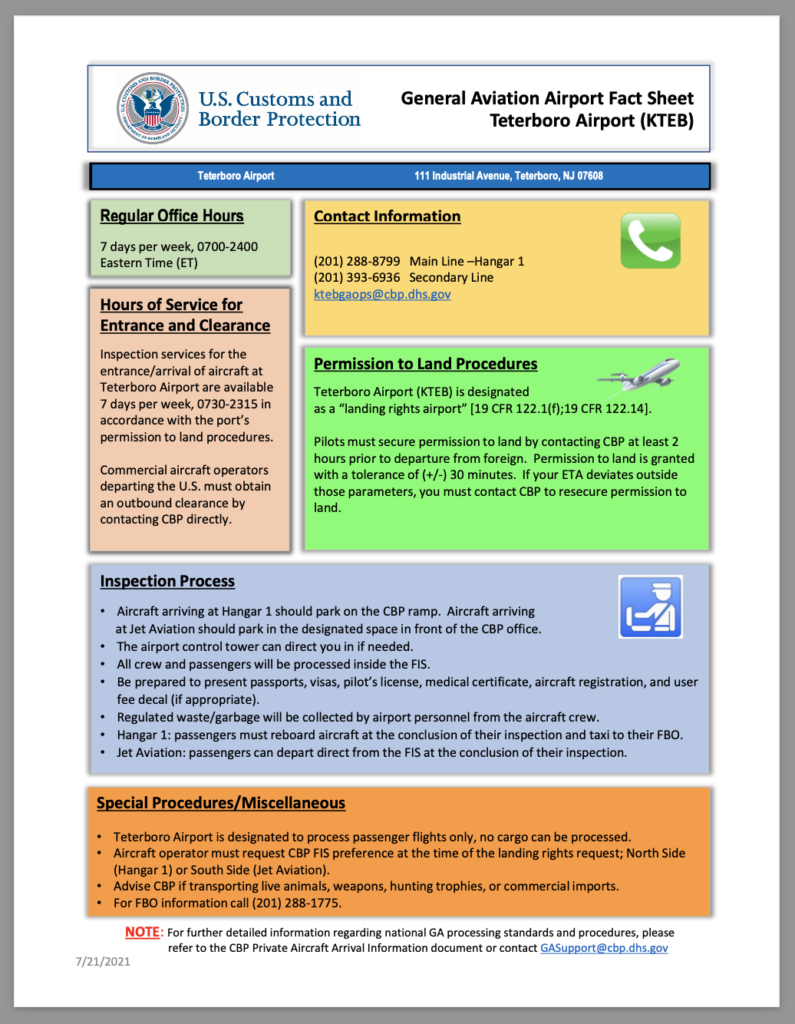
These are 1-page documents written by US CBP about select airports in the US, and they tell pilots pretty much all the important stuff they’d need to know about customs procedures at each one:

  • Opening Hours
  • Contact Info
  • Permission To Land Procedures
  • Some blurb on what to expect for the Inspection Process

What do they look like?

This:

Got any more I can download?

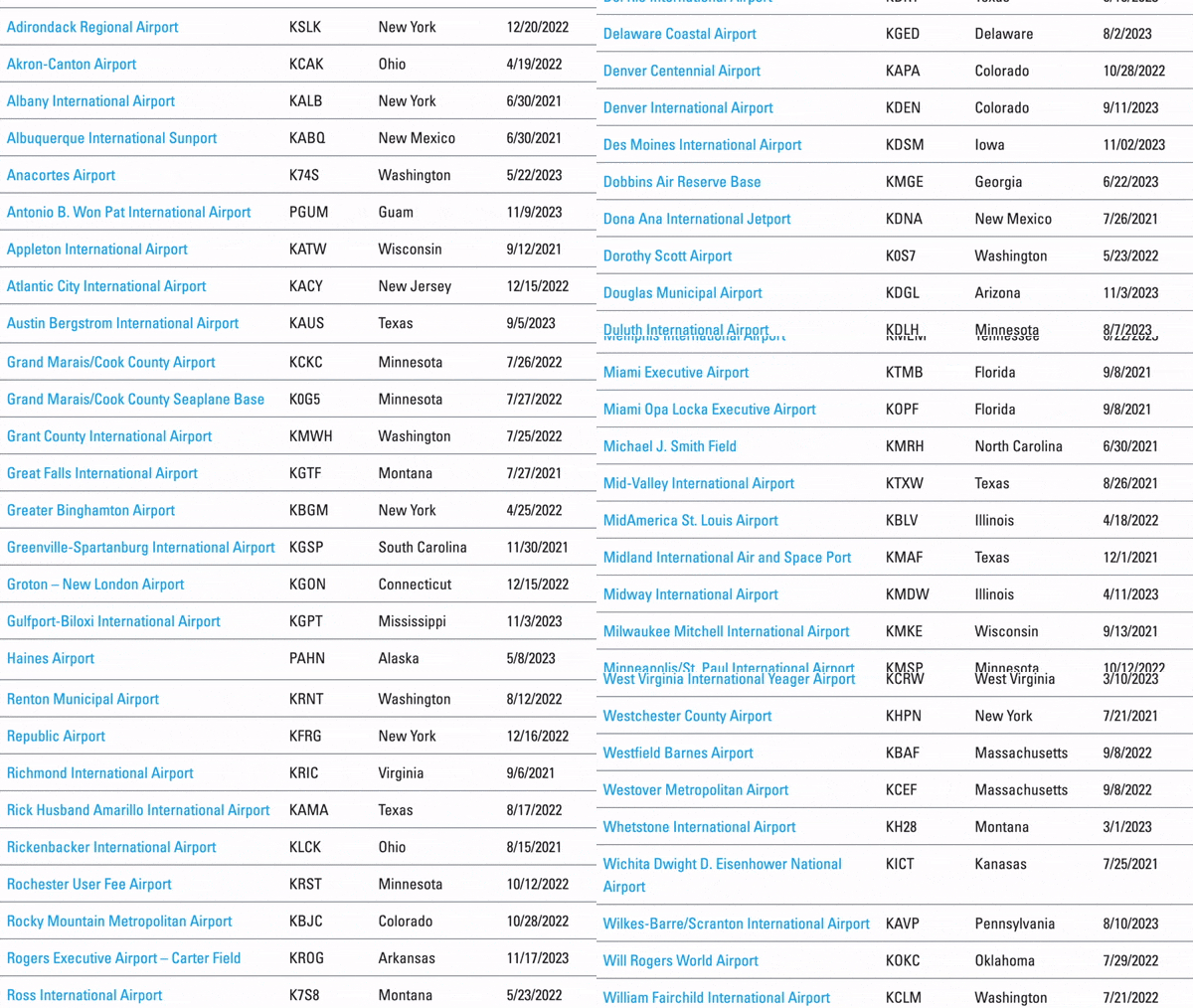
As of Jan 2024, the NBAA is now hosting more than 300 of these Factsheets in a centralized database.

NBAA members can download them here.

If you’re not an NBAA member, we still have a few knocking about from 2023 which you can download for free here:

KBFI/Boeing Field, WA
KBGR/Bangor, ME
KDAL/Dallas Love Field, TX
KELP/El Paso, TX
KFLL/Fort Lauderdale, FL
KFXE/Fort Lauderdale Executive Airport, FL
KHOU/Houston, TX
KHPN/White Plains, NY
KIAD/Washington Dulles, VA
KLAX/Los Angeles, CA
KMIA/Miami, FL
KOPF/Opa-locka Executive, FL
KPBI/Palm Beach, FL
KTEB/Teterboro, NJ
KTMB/Miami Executive, FL
KTUS/Tucson, AZ
TJIG/Fernando Luis Ribas Dominicci, San Juan
TJSJ/Luis Munoz Marin, San Juan
KRIC/Richmond, VA
KPDX/Portland, OR
KCLT/Charlotte, NC
KMEM/Memphis, TN
KSUS/St Louis, MO
KPTK/Oakland County, MI
KFAR/Fargo, ND
KAFW/Fort Worth, TX
KABQ/Albuquerque, NM
KMCO/Orlando, FL
KAUS/Austin, TX
KSJC/San Jose, CA
KMSY/New Orleans, LA

CBP update these Fact Sheets fairly regularly, so if you’re heading somewhere and want the most up-to-date version, contact CBP at that specific airport and ask for the latest copy. It’s also nice to speak to them in person! Tell them about your planned flight, and they’ll tell you what you need to know.

You can email CBP at the address shown in the Fact Sheet, or else contact them at GASupport@cbp.dhs.gov


US: New Rules For Outbound Private Flights

Key Points
  • US CBP have made some changes to APIS procedures for private flights departing from the US.
  • You now need a new APIS for any pax changes, or ETD change of more than 60mins.
  • CBP will also reportedly be increasing spot checks and in-person clearances.

Departing the US

CBP are tightening up the rules private flights departing the US. In a nutshell, the new rule is this:

If you have any pax changes, tail number change, or departure time changes of more than 60 minutes, you now have to file a new APIS – and this needs to be done no later than 60 minutes prior to departure.

These changes are reflected in the new text operators receive when they file their APIS:
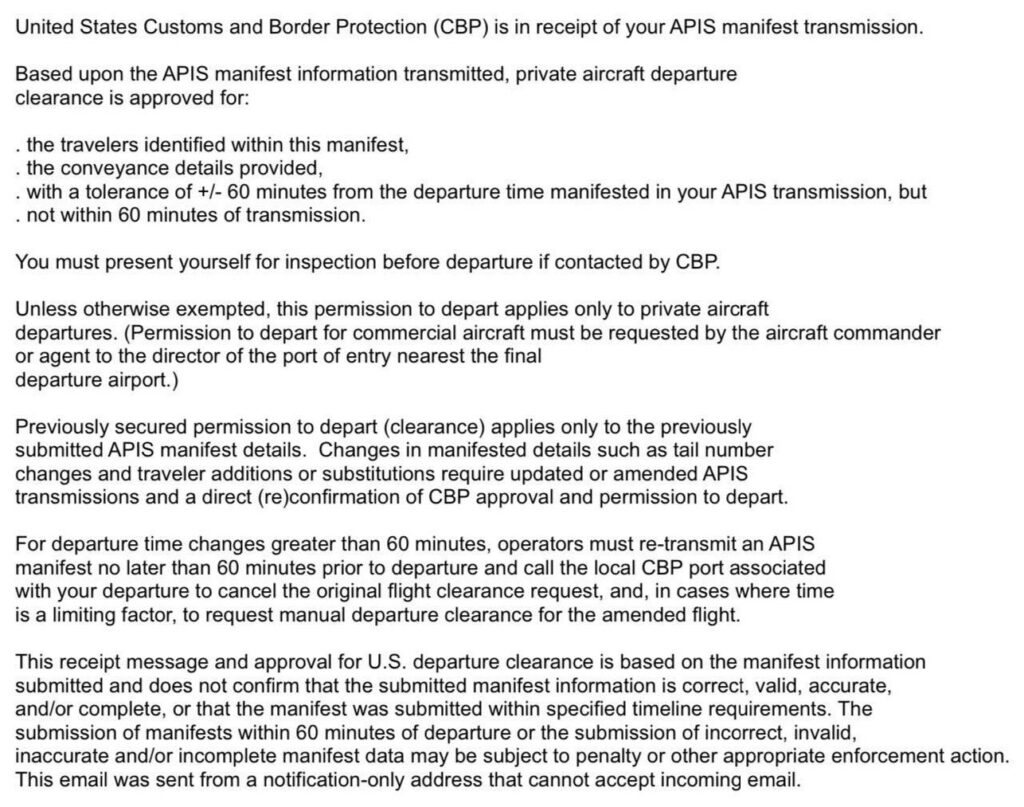
So if you do have to file a new APIS, it must be filed at least 60 mins prior to departure. The new procedure says that if you’re pushed for time you can request “manual departure clearance.” This basically means a phone call to CBP at your departure airport to request permission to depart – and it’s always a good idea to get the name, initials or badge number of the officer you speak to, just in case the early departure is questioned.

Unsolved SOLVED Mysteries!

Thanks to our friends at the NBAA IOC we now have answers to some of the big questions operators had regarding these changes.

1. Just before departure, another pax gets added to the flight. What do we do?
File a new APIS with all the pax info. Remember, your ETD needs to be at least 60mins from the time you file the new APIS, as per the new rules. If you want to leave early, you need to call CBP and ask for manual departure clearance. 

2. What if you’re departing overnight or early in the morning when the CBP office is closed, and you have no one to call for manual clearance?
If you can’t call CBP because the office is closed, you just have to wait 60mins to depart. There’s no out-of-hours fall-back option here. So watch out when planning departures when CBP will be closed! And let your pax know in advance that any last-minute changes are going to cause delays!

3. If one of our pax shows up with a different passport than the one we filed on APIS, must we submit a new one?
Yes. And then, same as above, you have to wait 60mins to depart, or else try calling for manual clearance.

4. If we file with 5 pax but only 4 show up, do we have to file a new APIS?
At the moment, the simple answer is no. This may change in the future though.

5. If our flight cancels altogether, must we call CBP to tell them so?
Yes. If you can’t do this because they are closed, call them in the morning.

6. Can anyone make calls to CBP? (to ask for manual clearance, etc)
Yes. PIC, SIC, handler, or trip support provider are all fine.

7. What if we push back on time but get an ATC delay or something, and have to sit around on the taxiway waiting to depart. If it looks like our departure will fall outside of the 60 minute window, must we file a new APIS and then potentially have to wait another hour?
Ooh, trickiest of trickies! This is a slightly grey area. CBP define your “departure” as being the time you are wheels-up. After you push-back, if you get delayed before you actually depart – there’s no clear cut answer to when you have to depart by. You just have to be able to show that whatever you do is “reasonable and responsible”. CBP will only pursue penalty action if you fail to do this. If you do end up departing after the 60 mins due to delays, make a proactive call to CBP afterwards to explain why. Give them the answer before they ask the question! 

Spot checks!

CBP will be increasing random departure inspections on aircraft departing from the US. The name of the game is simple: always update departure times with CBP!

If they arrive and you’ve departed already, you could be subject to penalty action. 

Many of the recent penalty actions are falling into the following categories

Thanks to Rick Gardner of CST Flight Services for providing this info:

  • Not obtaining Permission To Land. When returning to the US, once you have filed APIS and received the receipt email from DHS, you need to contact CBP at the port of entry and obtain permission to land. This is spelled out in the text of the receipt email from CBP. I always urge pilots to carefully read the receipt email to make sure the airports, dates and numbers of crew and passengers match what you think you transmitted. Yes, pilots are being penalized for failing to do this.
  • Missing Manifest. Some pilots are just failing to file APIS. CBP becomes aware through a variety of different methods so this is not a matter to take lightly.
  • Missing people. The people who were submitted on the manifest are missing and people not on the manifest are on board.
  • Arriving or departing outside the +/- 60-minute tolerance as specified on Airport Fact Sheets or on the Departure receipt email from DHS. In the past pilots did not pay a lot of attention to complying with the times they submitted on departure manifests. CBP has their own ways of detecting non-compliance including the fact that they do randomly conduct departure inspections. If you depart from the US outside of that tolerance, you can be subject to penalty action.

What should you do if you become subject to penalty action?

  • Don’t ignore it. If you get a notification from CBP that a penalty action has been initiated, address it quickly, it’s not going to go away. Penalties can be initiated via a number of different channels within CBP, but the notification will come from CBP General Aviation Headquarters.
  • Own up. By notifying you of a pending penalty action, CBP wants to give you the opportunity to give your side of the story. Explain what you did and why you did it. If you made a mistake, identify what caused the mistake to occur. As PIC you are solely responsible and CBP will not look favorably on attempts to shirk that responsibility by blaming others or by omitting facts. Be honest, tell them what happened, how it happened and why it happened.
  • Corrective action! If you did something wrong, tell CBP what you are doing to ensure that this mistake does not happen again. Outline an action plan on how you are changing your procedures to ensure that you achieve compliance going forward.

Doing this does not guarantee that CBP will withhold the penalty action, CBP handles penalty actions on a case-by-case basis. However, a very significant percentage of penalty actions are resolved during the initial interaction with CBP headquarters. CBP’s expectation of pilots is that we demonstrate that we are trying to act reasonably and responsibly. CBP is looking for compliance, not finding blame.

Professional pilots have a lot on the line because if we receive a penalty, not only can there be a sizeable fine but we also lose our Border Overflight Exemption privileges for any operator we are flying with. In addition, we can lose our Global Entry as well.  If sharing this knowledge from our industry collaboration and ongoing operations keeps just one pilot from getting into trouble, then it is worth it.

More info

For more info on on private flights to the US, check this article.

US no longer limiting international arrivals to 15 airports

From September 14, the US is no longer limiting international arrivals from higher risk countries to specific airports. Under previous rules, any passenger from China, Iran, the Schengen area of Europe, the UK, Ireland and Brazil had to enter the United States through one of fifteen centralised airports capable of providing enhanced health screening. This is no longer be the case.

The previous system was deemed ineffective because so many people who transmit the disease don’t show symptoms. A new approach is being launched, which authorities say will better mitigate the risk of Coronavirus by focusing more on the individual passenger. Here’s how it will work:

  • Pre-departure, in-flight and post-arrival health education for passengers.
  • Robust illness response at airports.
  • Voluntary collection of contact information from passengers using electronic means as proposed by some airlines to avoid long lines, crowding and delays associated with manual data collection.
  • Potential testing to reduce the risk of travel-related transmission of the virus that causes COVID-19 and movement of the virus from one location to another.
  • Country-specific risk assessments to assist passengers in making informed decisions about travel-related risk.
  • Enhancing training and education of partners in the transportation sector and at U.S. ports of entry to ensure recognition of illness and immediate notification to CDC.
  • Post-arrival passenger recommendations for self-monitoring and precautions to protect others, with enhanced precautions, including staying home to the extent possible for 14 days for people arriving from high-risk destinations.

You can read the announcement by the Centers for Disease Control and Prevention here, and confirmation from US CBP here.

Although the 15-airports rule has gone away, all other US rules on inbound travel remain in place. The main one is this – with specific exemptions, foreign nationals are not allowed to enter the US if they have been in any of the following countries within the past 14 days: the European Schengen area, the UK and Ireland, mainland China, Iran, and Brazil. The ‘specific exemptions’ part basically means this: US residents and family members, and flight crew traveling to the United States on C, D or C1/D visas. For more details, check the US Government webpage here.


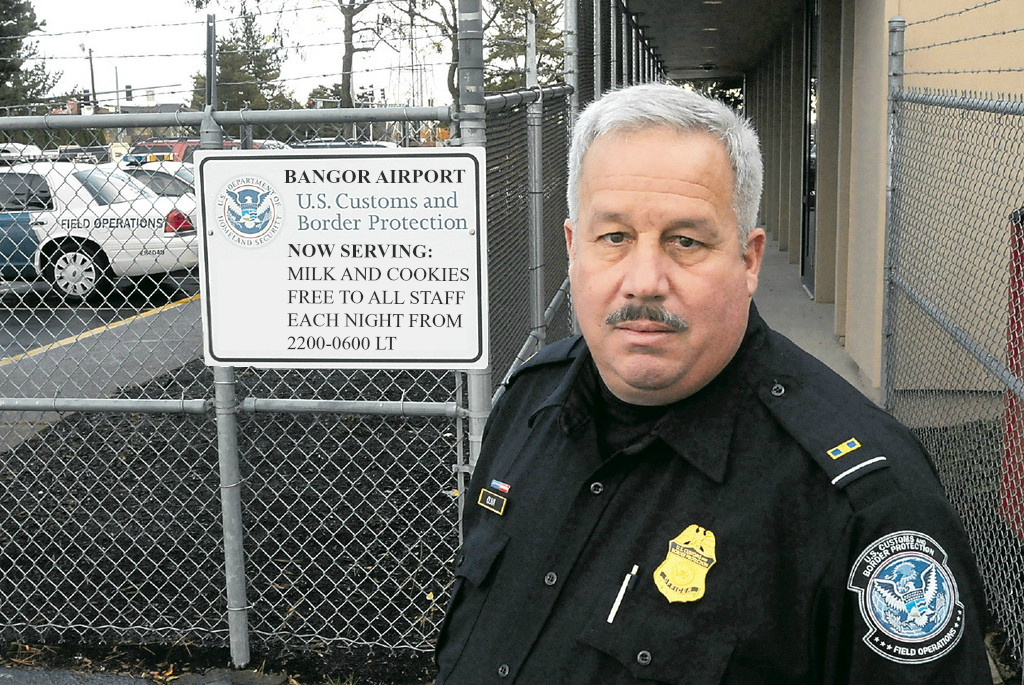
Customs now closed overnight at KBGR/Bangor

Bad news for trans-Atlantic operators! The Customs office at KBGR/Bangor Airport will now be closing each night from 22-06 local time (02-10z).

They used to be open H24, which made Bangor a great option for trans-Atlantic operators wanting to clear U.S. Customs somewhere nice and straightforward overnight. Now with the new changes, you can still request overtime, but Customs needs 24hrs notice to arrange and will only assess on a case-by-case basis.

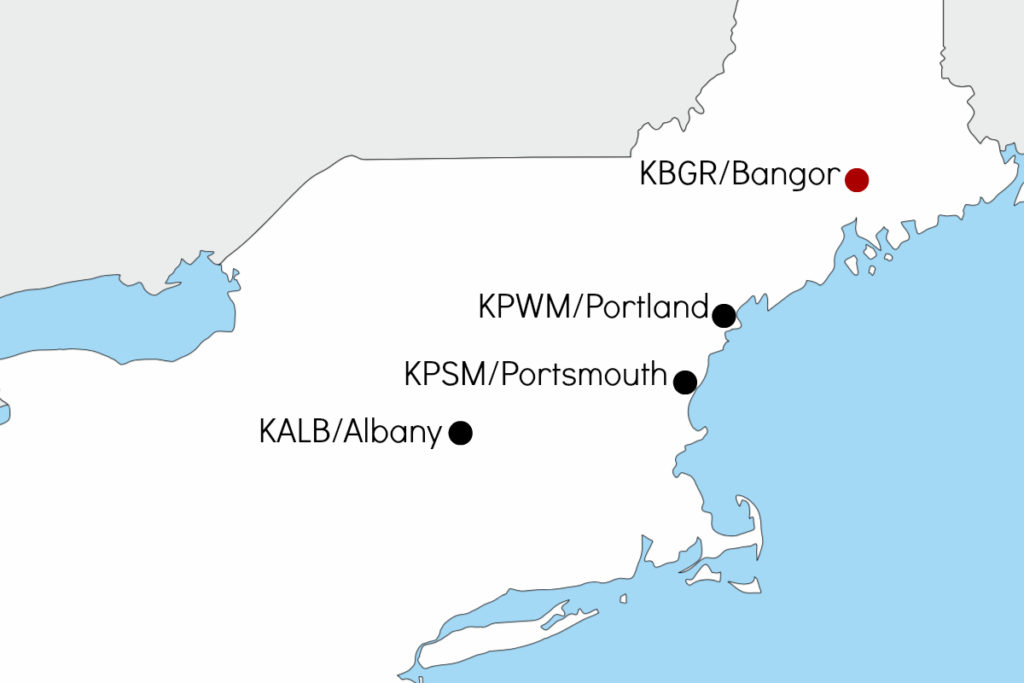
Now it seems that the nearest airport in the region still with Customs available H24 is KBOS/Boston International Airport, and given it’s size, it’s not the most BA/GA friendly at the best of times.

Where else to go? Here are some options:

KALB/Albany
Open 08-22 local time, 7 days a week
Available out-of-hours but minimum 2hrs notice required.

KPSM/Portsmouth
Open 08-17 weekdays only
Available out-of-hours but minimum 24hrs notice required.

KPWM/Portland
Open 07-21 local time, 7 days a week
Available out-of-hours but minimum 24hrs notice required.

Know of anywhere else in the region which provides Customs H24? If we missed somewhere obvious, let us know!