


Key Points
- Following a military coup in April 2023, Sudan airspace remains closed to all civilian flights.
- An Il-76 was reportedly shot down by a surface-to-air missile near Babanusa on Nov 4.
- Multiple conflict-zone warnings exist due to the risk of anti-aircraft fire. The country should be considered dangerous at all levels.
- A Contingency Plan provides limited overflight options via HSPN/Port Sudan, Egypt, Saudi Arabia and South Sudan (where ATC remains suspended above FL245).
Sudan’s airspace (the HSSS/Khartoum FIR) has been largely shut since 2023 and the risk profile has only worsened. Fighting around Khartoum continues, and the reported shootdown near Babanusa shows that overflights remain exposed. A US-backed truce has not reduced the threat environment.
Most operators are now avoiding Sudan entirely, routing through the published contingency corridors or staying in neighbouring FIRs. The lack of ATC above FL245 in South Sudan adds another layer of complexity for anyone trying to cross the region.
Here’s the updated risk briefing…
Context
Sudan remains in a state of civil war between two major powers that used to rule together – the Sudanese Armed Forces (SAF) who control Port Sudan, and a paramilitary group called the Rapid Support Forces (RSF) who control most of Khartoum. You can read more about the background here.
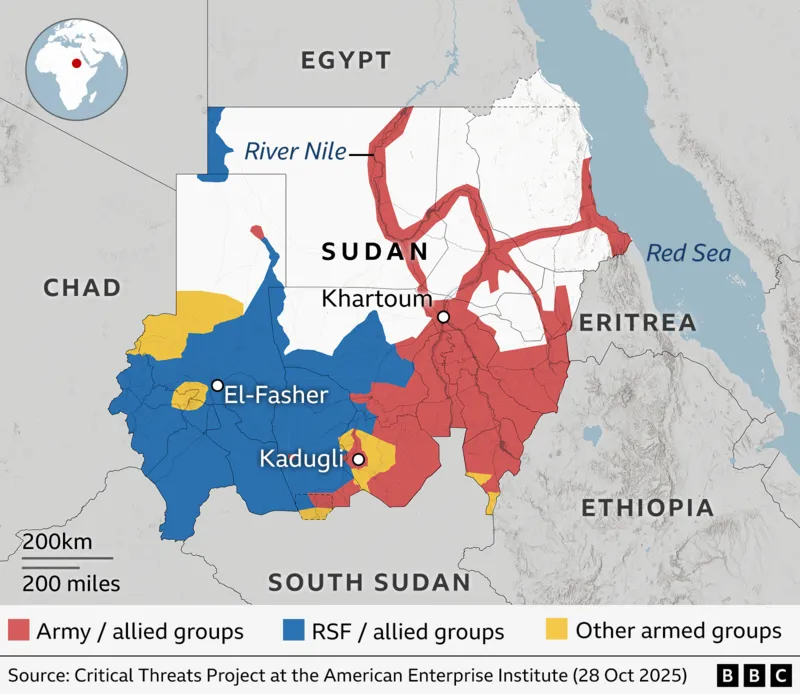
Sudan, a country divided. Image courtesy of the BBC.
The US Government (along with Saudi Arabia, UAE and several other states ) has been actively pursuing a truce that aims to stop the fighting, open humanitarian corridors and rebuild political stability.
Both SAF and RSF have said yes in principle, but not it seems in practice.
And that means risk to civil aviation will persist. There are several sticking points – SAF wants RSF withdrawn from major cities before anything starts. RSF wants overflight guarantees without any kind of intereference. Any neither is willing to budge yet.
Aircraft Shot Down
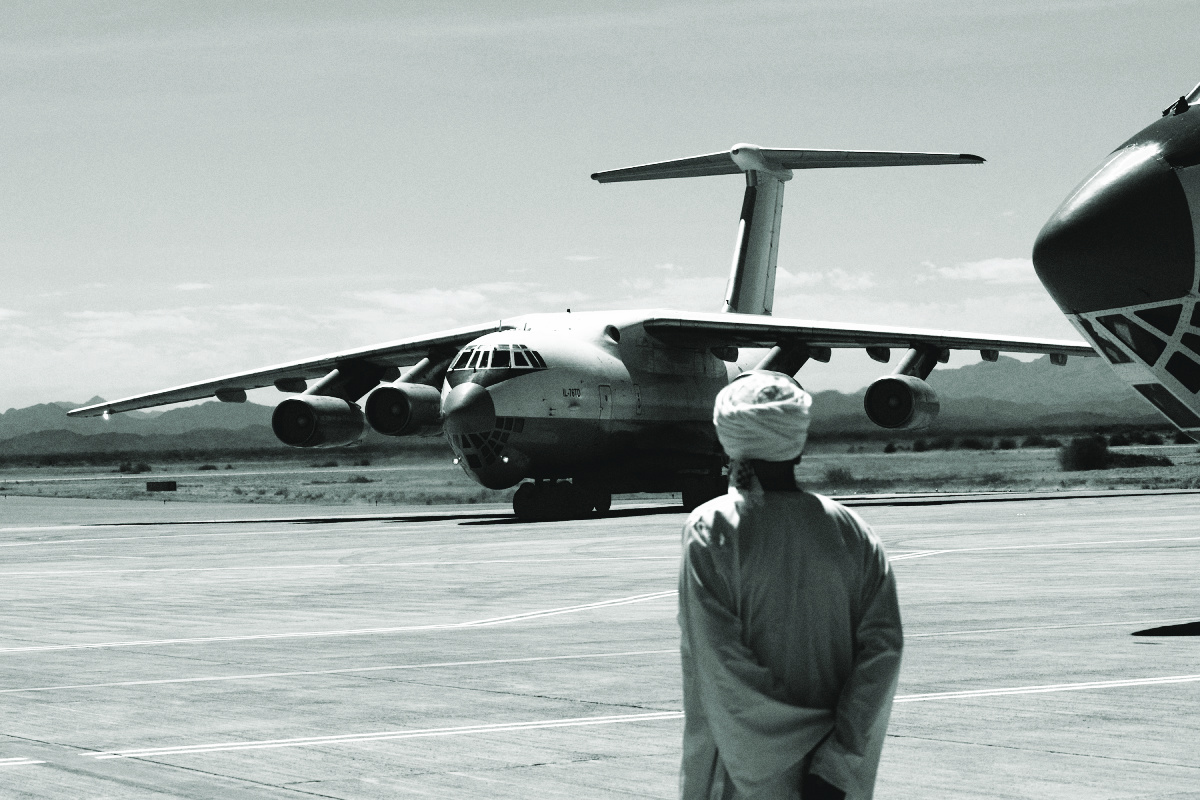
On Nov 4, 2025 an Il-76 transport plane of the Sudanese Armed Forces was reportedly shot down in West Kordofan state, southern Sudan by the RSF.
While the armed forces have indicated a structural failure of the aircraft’s wing was to blame, video footage appears to support the RSF’s claim that it was shot down using a short range air defence system of foreign origin.
If proven true, the incident underpins the presence of anti-aircraft weaponry in Sudanese contested airspace, and that even large transport aircraft are not immune to the risks of mistaken identity. Some intelligence suggests that this includes missile systems capable of reaching aircraft as high as FL500.
Conflicting claims about the incident show how unclear the situation is. Based on what we know, the highest risk is during daylight and in areas close to active fighting.
Recent Drone Strikes
On Nov 7, 2025 the RSF launched coordinated drone attacks against at least four cities: Atbara (River Nile State), El-Obeid, Al-Dailang and Omdurman (west Khartoum). Anti-aircraft fire was also reported.
This indicates that flight operations, especially arrivals and departures near the Khartoum region, face an elevated risk of indirect fire and missile activity. Secondary effects such as air-defence responses and unexpected diversions are also possible, particularly at low levels.
Bottom line: treat Khartoum/Omdurman and nearby airports as high-threat airspace. Even if an airport is “open” for domestic traffic, risk in the surrounding airspace remains dynamic.
Contingency Routes
Following the military coup in April 2023, Sudan remains almost entirely closed to all civilian flights.
Sudan has declared its entire sovereign airspace a single restricted area called “HSR5”, and published contingency procedures for civil traffic. It contains three main options for overflights:
- One north-south overflight route in the far east of the country down over HSPN/Port Sudan airport.
- Some north-south diversionary corridors available via Egypt and Saudi over the Red Sea.
- Some east-west routes over South Sudan.
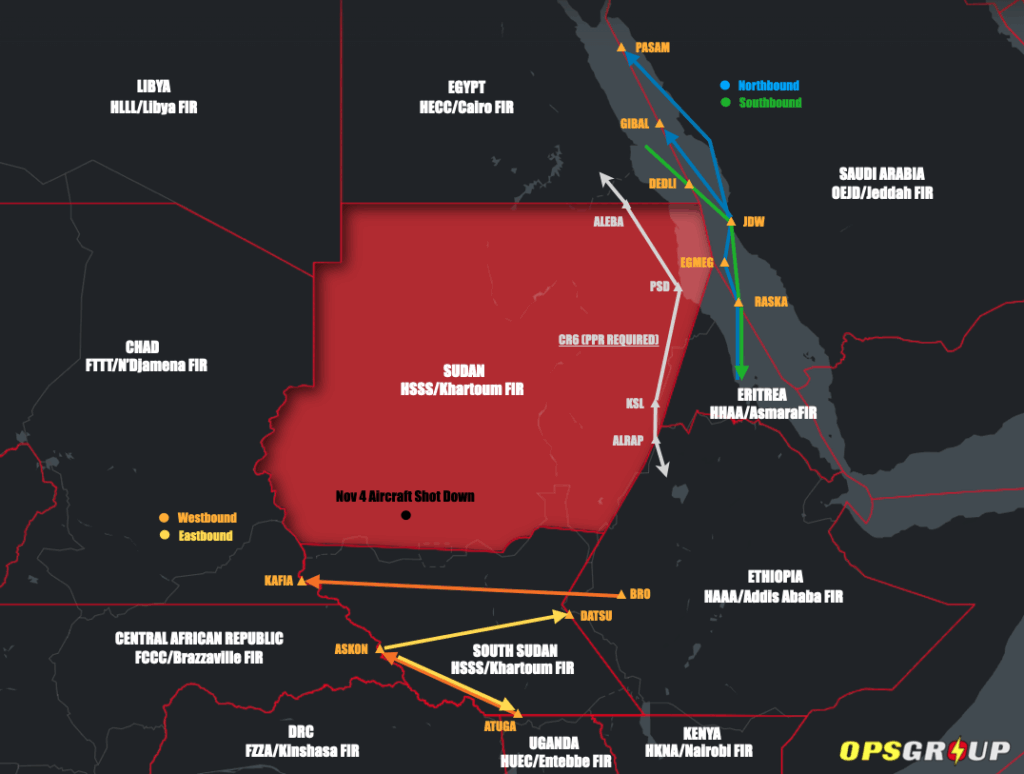
#1: North-South overflight route over HSPN/Port Sudan airport
They call this route ‘CR6’ – and it’s the only published track through Sudan’s restricted area HSR5.
It links the Addis and Cairo FIRs via ALRAP-KSL-PSD-P751-ALEBA. Levels are fixed for safety, FL320 northbound and FL330 southbound. There is no ATC separation, and prior permission is required.
Think of this as a narrow humanitarian corridor – it’s available but not intended to carry normal traffic.
The contingency plan points you to the Sudan AIP (GEN 1.2) for how to get permission, but the short version is this: operators must secure diplomatic clearance before the flight, and you can’t ask airborne. If you are allowed in, make sure you stick to CR6 like glue.
While technically possible, we advise extreme caution. What we don’t know are the safety margins applied to the contingency route or what may be unfolding beneath it.
#2 Red Sea Diversionary Corridors
These allow north-south traffic to move between the HECC/Cairo and OEJD/Jeddah FIRs without touching Sudan at all. They are the safest and cleanest option right now because you stay entirely within Egyptian and Saudi Arabian airspace, skirting the Sudanese coastline.
#3 South Sudan (KFOSS Routes)
KFOSS stands for ‘Khartoum FIR Over South Sudan’ and apply above FL245.
These routes allow for a safe(-ish) east-west crossing of South Sudan without entering Sudan itself. They’re RNAV 5, and mostly bi-directional. You report regularly, keep ADS-B and your transponder on and maintain 15-minute spacing.
One big caveat though – KFOSS routes are uncontrolled. Juba provides traffic advisories only.
Airspace Warnings
Several states (including the UK, France, Canada and Germany) maintain active airspace warnings that advise against entering the HSSS/Khartoum FIR at all levels due to risk of anti-aircraft fire and military activity.
For some reason, US operators technically have no legal restrictions as at the time of writing the FAA has issued no airspace advisories (Notams or SFARs) for Sudanese airspace.
Stay Updated
We will continue to report on any changes to the situation in Sudan as it develops. This includes our Safe Airspace website where you can view all active airspace warnings, along with those that exist in adjacent airspace. Our team keeps this updated around-the-clock.
More on the topic:
- More: Military Coup: Sudan Airspace Closed
- More: Military coup in Sudan: Impact to ops
- More: SafeAirspace: 2021 Update
- More: Sudan Airspace Update: A New Risk
- More: Sudan airspace reopens
More reading:
- Latest: Paris Ramp Checks: Illegal Charters and Tax Avoidance
- Latest: Middle East Airspace – Current Operational Picture
- Latest: Greenland NAT Alternates: March 2026 Update
- Safe Airspace: Risk Database
- Weekly Ops Bulletin: Subscribe
- Membership plans: Why join OPSGROUP?



 Get the famous weekly