



An OPSGROUP member on a recent westbound NAT flight from the Middle East received the following message via CPDLC:
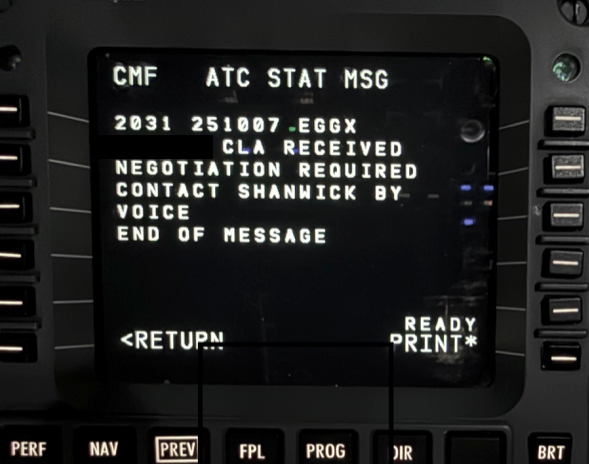
The crew contacted Shanwick via HF, who requested their RNP capability and operational status.
The controller explained that due to their point of departure (OMAA/Abu Dhabi) they wanted to be certain the aircraft had not been contaminated by GPS jamming or spoofing before it entered oceanic airspace.
It’s been a while since we wrote about this procedure, and since then we’ve had this NAT Ops Bulletin published by ICAO telling operators what to do on the NAT if they’ve experienced jamming/spoofing, so we reached out to NATS directly for an update. Here’s what they had to say…
Defensive Measures
NATS reported they continue to receive a large number of flights every day that have been impacted by GPS interference prior to oceanic boundaries.
The issue is that once an aircraft’s navigation system has been ‘contaminated’ by bad GPS data, it may not be possible to recover full RNP capability in flight, even if the normal GPS signal is restored.
These aircraft may no longer meet RNP 4/10 accuracy required in the NAT HLA, even long after the trigger event occurred.
The NAT Ops Bulletin which was published back in Jan 2025 requires crew of NAT-bound aircraft that have encountered GPS interference to notify their first NAT ANSP via RCL. Even if your aircraft shows no lingering effects, ATC still want to know.
NATS advise that late notification by pilots of a RNP degradation (such as approaching an oceanic entry point) greatly increases controller workload. They often need to move other aircraft out of the way to provide increased separation (in some cases from 14nm to 10 minutes), it’s a big deal.
As a result, they are employing defensive controlling measures. Based on previously spoofed/jammed flights and regions of known risks, they may proactively contact flights assessed as higher risk to confirm status before entry – although the exact selection criteria isn’t public. Increased separation will be applied until normal navigation performance is confirmed by the pilots.
In a nutshell, this is why the OPSGROUP member received the message above.
A special thank you to NATS for their help in answering this question.
Jammed or spoofed? You need to let your NAT ANSP know
The NAT Ops Bulletin we keep mentioning – this provides the guidance for NAT traffic on how to manage GNSS interference. Here it is again, so you can’t miss it! ⬇️
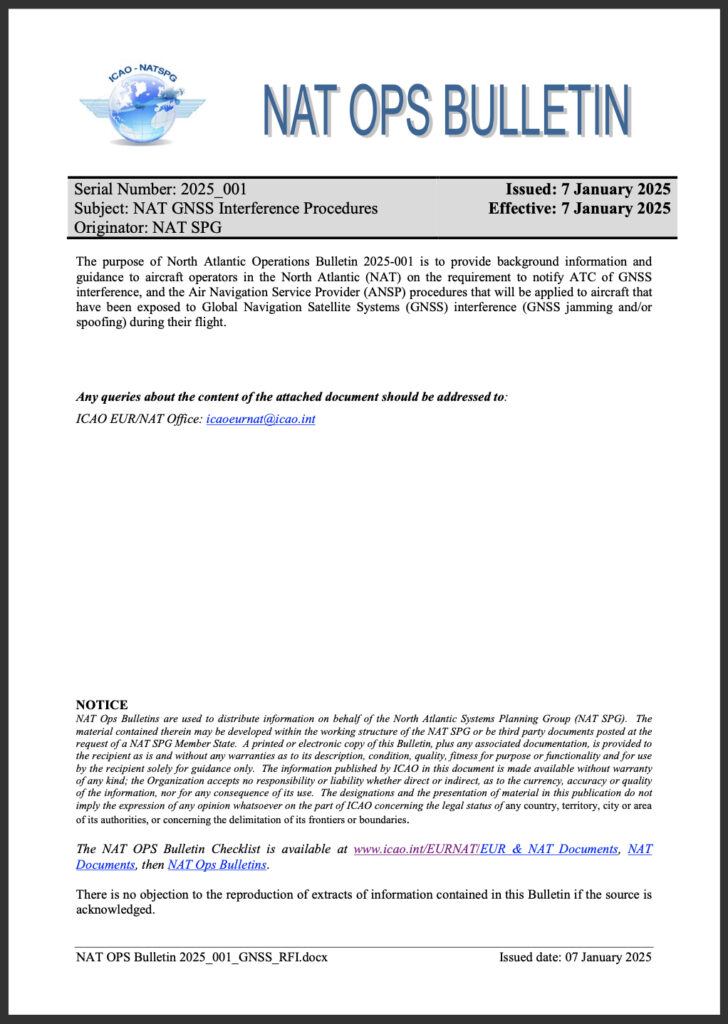
Key takeaway from this: If you suspect or know that your aircraft has encountered any kind of GPS interference (both jamming or spoofing), NAT-bound traffic must let their first NAT ANSP know in the RCL – even if the aircraft appears to have recovered.
This is prefixed by ‘ATC REMARKS/GNSS INTERFERENCE’ and must include details of any system degradations.
A few messages to keep handy are:
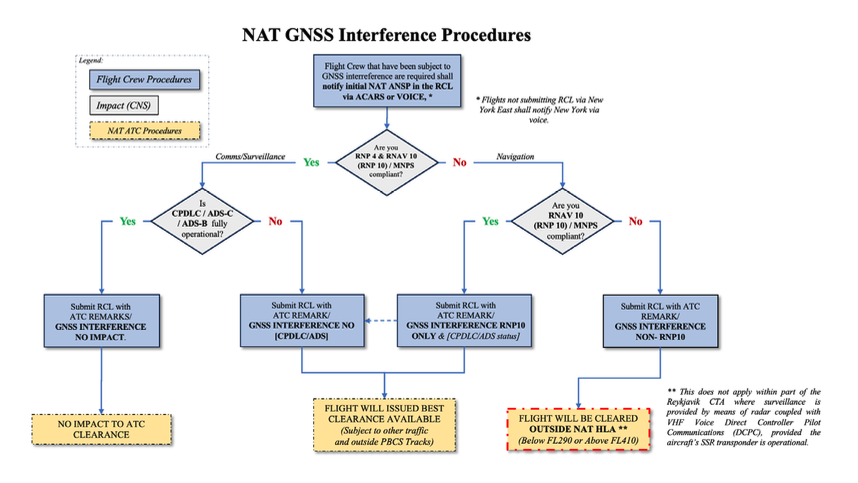
‘ATC REMARKS/GNSS INTERFERENCE NO IMPACT.’
‘ATC REMARKS/GNSS INTERFERENCE NO CPDLC/ADS’
‘ATC REMARKS/GNSS INTERFERENCE RNP 10 ONLY’
‘ATC REMARKS/GNSS INTERFERENCE NON-RNP10
By including your status in the RCL, you are giving ATC a head’s up before you arrive.
In most cases, you will still be allowed in the NAT HLA. A loss of RNP 4 isn’t a deal breaker, as you can still enter under RNP 10. But your clearance may be less optimal (likely level changes) due to the increased separation from other traffic.
The big one to look for is a loss of RNP 10. You will not be cleared into the NAT HLA, and instead will need to remain below FL290 or above FL410. With an obvious fuel impact, this may lead to an unplanned diversion.
The Bulletin includes a handy flow chart that’s worth printing and keeping in your flight bag.
Click for PDF.
Latest ICAO Feedback
The latest three-yearly ICAO Assembly was held in Montreal from Sep 23 – Oct 3.
During the event, ICAO issued its strongest condemnation yet of both Russia and North Korea, directly blaming them for deliberate GNSS interference in violation of the Chicago Convention. Russia, in particular, has been blamed by ICAO for destabilising navigation across European airspace.
We continue to receive regular reports from OPSGROUP members of both jamming and spoofing. Interference is now a regular occurrence in the Baltic region, particularly around Kaliningrad, Eastern Finland, the Baltic Sea, and nearby airspace. Other reports have been received from Germany, Poland and Norway.
Recent airspace incursions, airstrikes and drone activity associated with the ongoing conflict in Ukraine have almost certainly escalated the use of GPS interference as a defensive measure. Civil aviation will continue to operationally grapple with this hazard. With no obvious solution in site, our best defence remains procedures like the one detailed above.
More on the topic:
- More: Timeline of North Atlantic Changes
- More: NAT CPDLC Route Uplinks: Crew Confusion and Errors
- More: New NAT Doc 007: North Atlantic Changes from March 2026
- More: What’s Changing on the North Atlantic?
- More: Shanwick Delays OCR Until Post-Summer 2026
More reading:
- Latest: Paris Ramp Checks: Illegal Charters and Tax Avoidance
- Latest: Middle East Airspace – Current Operational Picture
- Latest: Greenland NAT Alternates: March 2026 Update
- Safe Airspace: Risk Database
- Weekly Ops Bulletin: Subscribe
- Membership plans: Why join OPSGROUP?





 Get the famous weekly








I think we also failed when manufacturers convoluted GPS with our self-contained IRS’s (Hybrid IRS). Yes, they will drift without the updating, but not as much as a spoofed GPS solution will. Having a “Hybrid” that constantly updates the IRS was a neat idea until the GPS poisoned the IRS solution. Also, go Old-School: fly over a gate (vs. direct down the line), use ground based nav-aids to check your position before you head out. Might force us back to -10 from -4, but you won’t end up 60nm off course. Finally, know how to kill-off your GPS. Modern aircraft may have hidden the power source as part of the MMR or other group source so there isn’t a GPS-1/2 CB – know where they are and how to use them.
Mr. Schieff,
I am concerned about the increase in GPS spoofing. Seems to me there is probably a fairly easy “fix” to this. Many military airplanes have an astro navigation system installed. Even back in the ’60s the SR-71 had our beloved “R2D2” that shot two stars and could navigate quite accurately. The F-16 has, or at least had, a similar system and the B-2 does as well. I have to believe that with the advances in computer technology since those days a similar system could easily be installed in modern airplanes. The system wouldn’t necessarily have to navigate the aircraft or provide position updates to any nav systems, but could provide a very early warning of a divergence between GPS calculated position and astro calculated position. Mitigation procedures could be implemented quite quickly before a significant divergence occurs.
Just a thought from an old guy who spent nearly 40 years navigating remote airspace.
Take care and stay safe.
Sincerely,
Mark Barnard
Hi Mark, thanks for taking the time to share this insight. We share the same concern regarding GPS interference. If you haven’t seen it yet, we engaged a large working group of aviation professionals last year to compile a comprehensive report on the issue, including mitigators. You can find it via this link: https://ops.group/blog/gps-spoofing-final-report/. I do hope you find it interesting. I think a future article could indeed focus on potential solutions (such as your suggestion above). As an industry, we certainly need better answers to this growing issue. Kind Regards, Chris.