

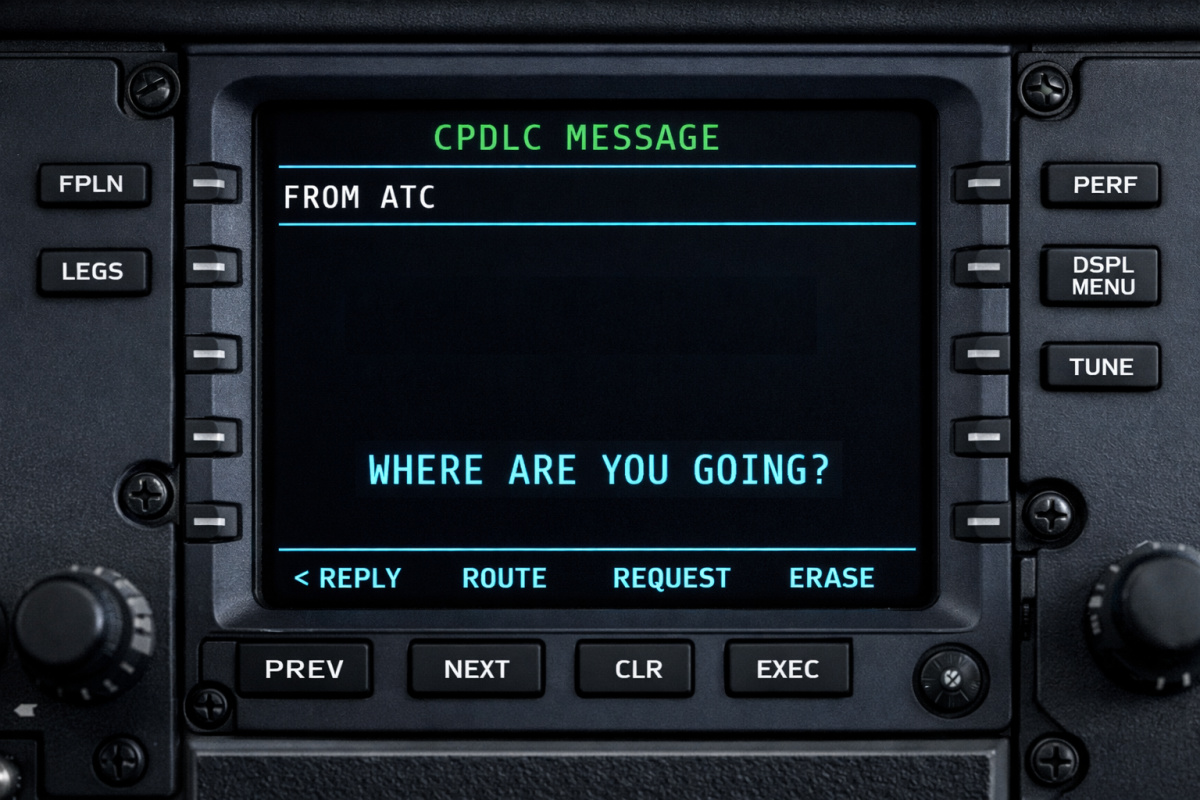

On Jan 27, the FAA published an Information Note for Operators (InFO) warning that crews have been responding to CPDLC route uplinks late or incorrectly when entering or while inside Gander’s oceanic airspace.
Aside from confusion, this has led to increased frequency congestion, controller workload, and interventions to prevent route deviations.
The InFO isn’t regulatory, but it highlights a persistent NAT issue that the FAA wants operators and training departments to address.
Here’s what’s going on.
The Backstory
It’s no surprise there’s confusion. Over the past few years, NAT oceanic procedures have changed significantly.
In 2023, the NAT began transitioning toward Oceanic Clearance Removal (OCR). Gander implemented this change, meaning crews submit a Request for Clearance (RCL) prior to the Oceanic Entry Point. If no change is required, they are considered cleared as filed. If a change is required, ATC issues a specific amended route or level.
In December 2024, Gander began issuing amended oceanic routes and levels via CPDLC following the RCL process. The goal was to standardise amendments via datalink rather than voice, and reduce readback/hearback error opportunities.
It didn’t go smoothly. Reports of confusion followed – especially around how amended routes were being issued and how they were being integrated into the FMS.
In May 2025, NAV CANADA temporarily reverted to issuing pre-oceanic entry amendments by VHF instead. However, Gander has indicated it intends to resume CPDLC route uplinks, potentially before summer 2026.
So this issue isn’t historical. It’s current – and likely to become more relevant again soon.
Crew Error
Gander has reported a significant number of uplinks that are not promptly or correctly actioned.
The typical sequence looks like this:
CPDLC route uplink sent → crew responds “WILCO” → about 5 minutes later ATC sends “CONFIRM ASSIGNED ROUTE” → crew replies with the route string (e.g. N47A RESNO 47N050W 48N040W 49N030W 49N020W MALOT GISTI).
ATC is verifying three things:
- You received the correct clearance.
- You loaded the correct route.
- Your FMS matches what they issued.
The problem arises when crews respond to “CONFIRM ASSIGNED ROUTE” before the new route has actually been loaded and verified in the FMS.
In that case, the system transmits the currently active route – not the newly assigned one. That mismatch generates an alert on the controller’s side.
There’s a second issue as well: misinterpreting certain CPDLC uplinks.
UM79 “CLEARED TO [point] VIA ROUTE CLEARANCE” is not a direct-to clearance. It is a new route to that point.
UM80 “CLEARED ROUTE CLEARANCE” is not “cleared as filed.” It is a new route that must be loaded and executed.
In either case, these errors trigger something called an ‘out-of-conformance alert’ to controllers. This is when small CPDLC errors turn into big ATC workload.
The scale of the issue is not trivial. The North Atlantic Central Monitoring Agency reported 475 lateral errors in 2025 – a 71% increase over the previous year. Total errors across all categories rose 29%, to 600.
Out-Of-Conformance Alerts
Behind the scenes, Gander’s system compares what you are expected to fly with what you are actually flying.
When ATC issues an amended oceanic route or level, this info is entered into their system as a ‘reference trajectory’. Your aircraft reports its actual position and intent via ADS-C, and the system continuously compares the two.
If there is a mismatch – whether because the wrong route was loaded or the wrong route was confirmed – an out-of-conformance alert is generated.
These take time for controllers to clear, cause distraction and add to frequency congestion. These aren’t necessarily a loss of sep, but they are a big deal in busy NAT airspace to prevent potential for traffic situations.
In other words, if you reply to “CONFIRM ASSIGNED ROUTE” before loading it, you’re sending ATC your old one.
So, what does the FAA suggest?
The key takeaway is simple: load the new route, verify it matches the clearance, then confirm it.
The info note lists a bunch of useful resources to help with this, that we have re-produced below:
- NAT Oceanic Clearance Removal Bulletin, 2023_001.
- NAT Oceanic Errors Safety Bulletin (OESB), 2017_002, CPDLC section.
- Advisory Circular (AC) 91-70D, Oceanic and Remote Continental Airspace Operations, paragraph 4.4.3 and Figure 4-1.
- AIP Canada, ENR 7 North Atlantic (NAT) Operations.
- ICAO Global Operational Data Link Document (GOLD) Reroute Procedures.
More Questions?
We’ll try and answer them. If we can’t, we’ll put you in touch with who can. You can reach us on blog@ops.group.
More on the topic:
- More: Timeline of North Atlantic Changes
- More: New NAT Doc 007: North Atlantic Changes from March 2026
- More: What’s Changing on the North Atlantic?
- More: Spoofed Before the NAT? Here’s What to Do
- More: Datalink in Europe: What Are The Rules?
More reading:
- Latest: San Francisco: Side-by-side Parallel Visual Approaches Banned
- Latest: Flying BizAv to Tashkent? Use UZTP, not UZTT
- Latest: London Night Ops: What’s Changing This Summer
- Safe Airspace: Risk Database
- Weekly Ops Bulletin: Subscribe
- Membership plans: Why join OPSGROUP?







 Get the famous weekly