

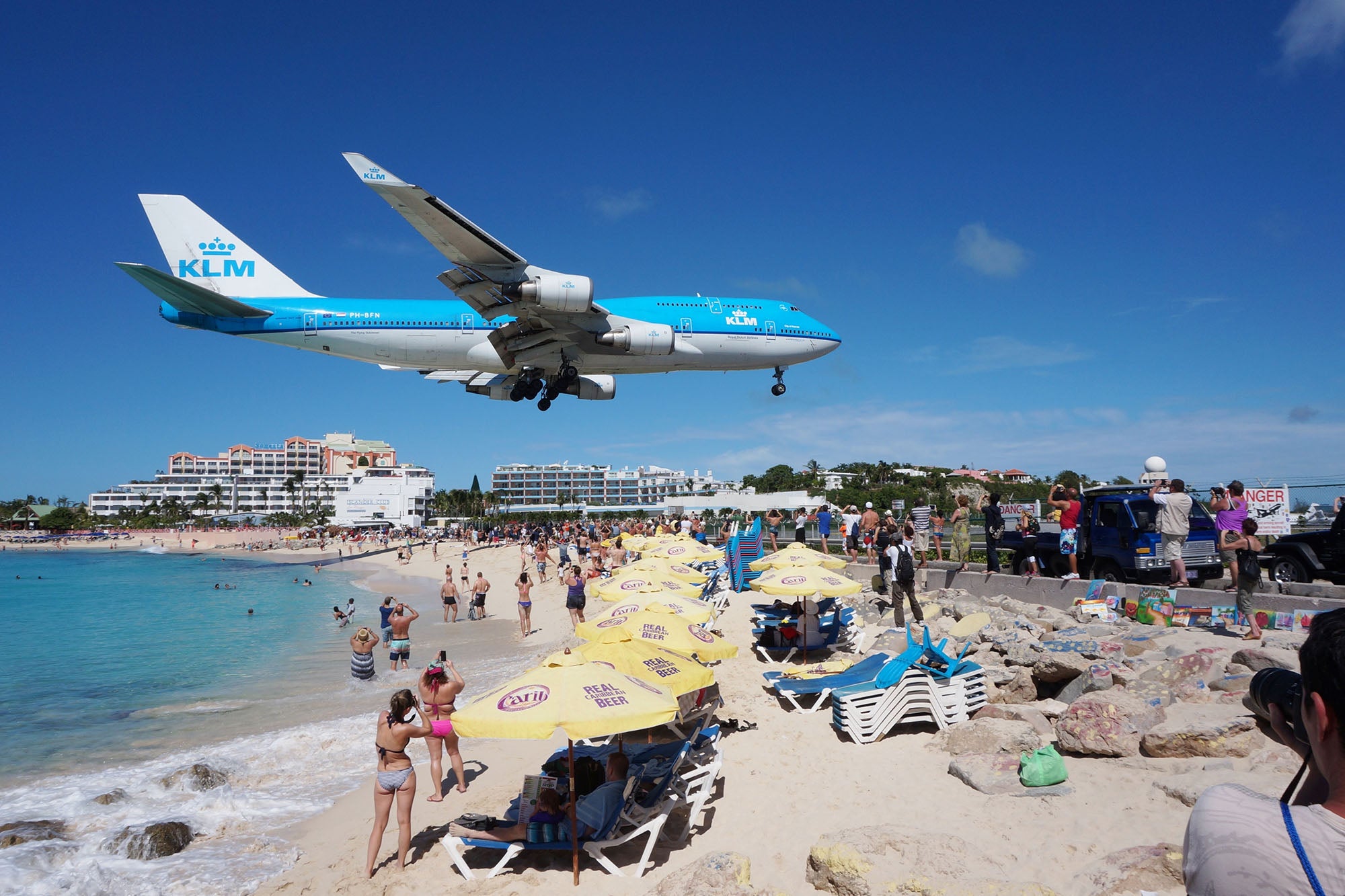

Several Opsgroup members have recently reported arrival holding and diversion risk at TNCM/St Maarten due to ramp congestion, despite having confirmed FBO reservations.
On Feb 18, a member reported being advised of likely holding and possible diversion while enroute. Additional reports followed from crews who operate there regularly.
Here’s what OPSGROUP members had to say:
‘On Feb 16, about two hours out were were advised by Miami that holding and possible diversion was likely due to ramp congestion. Then about 10 minutes later they changed their mind. We heard this happen to multiple aircraft on frequency with us…’
‘I flew in last week – absolutely true. There were five planes in a holding pattern when we arrived. We did four turns in a hold at GAB before being allowed to proceed to the airport. Multiple planes hit minimum fuel and had to divert to other airports. The problem is compounded when the winds shift to runway 10 and the commercial planes require runway 28. You have planes departing from both ends…’
‘We held for 45 minutes waiting for the airport to let GA aircraft land. We had everything booked for some time prior. We heard a couple GA aircraft divert to San Juan. I would strongly advise looking at the 121 schedule when planning an arrival time. There was simply no concrete left…’
‘For GA, it has been more difficult to arrive than during the Xmas/high season. We fly 2-3 times per week and have been told to land after 5pm…’
“This is common, even for airline ops. Single runway with backtracking, in addition to the limited ramp space that can seize up with a missed call or mistake, only exacerbates the compression on the field. ATC is competent and familiar but extremely busy in these situations, so it’s advised to bring extra gas…”
“On arrival 50 miles out we were told no there was no ramp space…parking had been reserved for months. There was an AOG aircraft in our spot. We were told to divert to Anguilla, no parking after call to FBO . Landed St.Kitts and waited until space opened in TNCM at 6 pm…”
Restriction on GA movements
A Notam issued Feb 14 may be contributing to the situation:
A0094/26 NOTAMN
Q) TJZS/QSLXX/IV/NBO//000/150/1802N06307W040
A) TNCM
B) 2602141100 C) 2603300359
E) GA IFR TFC RESTRICTED DLY TO
4 ACFT PER HOUR BTN 11:00 UTC AND 15:59 UTC
2 ACFT PER HOUR BTN 16:00 UTC AND 21:00 UTC
4 ACFT PER HOUR BTN 21:01 UTC AND 03:59 UTC
PRIOR APPROVAL REQUIRED FROM THE RESPECTIVE FIXED BASED
OPERATOR. FLIGHTS NOT APPROVED SHALL NOT BE ACCEPTED
But member reports suggest that even with PPR, arrival delays may still occur during peak periods.
Planning around peak traffic
Currently, the practical advice is simple: check the airline schedule and avoid arriving or departing when the airport is busy with Part 121 traffic.
This can be compounded when winds favour Runway 10 but heavier jets continue using Runway 28 for performance reasons.
As a starting point, there are typically two airline peaks each day at TNCM:
Peak 1 (main wave): Late morning through early evening. Arrivals surge roughly 1130-1500 LT, with departures from about 1430-1830 LT.
Peak 2 (smaller wave): A second departure push between approximately 1930-2100 LT.
So the best bet is to plan for an early morning arrival, or after about 1830 local.
Please keep reporting
Your reports are invaluable to the group – you can submit those (anonymously) via Airport Spy, or directly with the team on blog@ops.group.
More on the topic:
- More: TNCM/SXM Airport Damage
More reading:
- Latest: San Francisco: Side-by-side Parallel Visual Approaches Banned
- Latest: Flying BizAv to Tashkent? Use UZTP, not UZTT
- Latest: London Night Ops: What’s Changing This Summer
- Safe Airspace: Risk Database
- Weekly Ops Bulletin: Subscribe
- Membership plans: Why join OPSGROUP?







 Get the famous weekly