NAT Guide 2025 – My First NAT Flight is Tomorrow

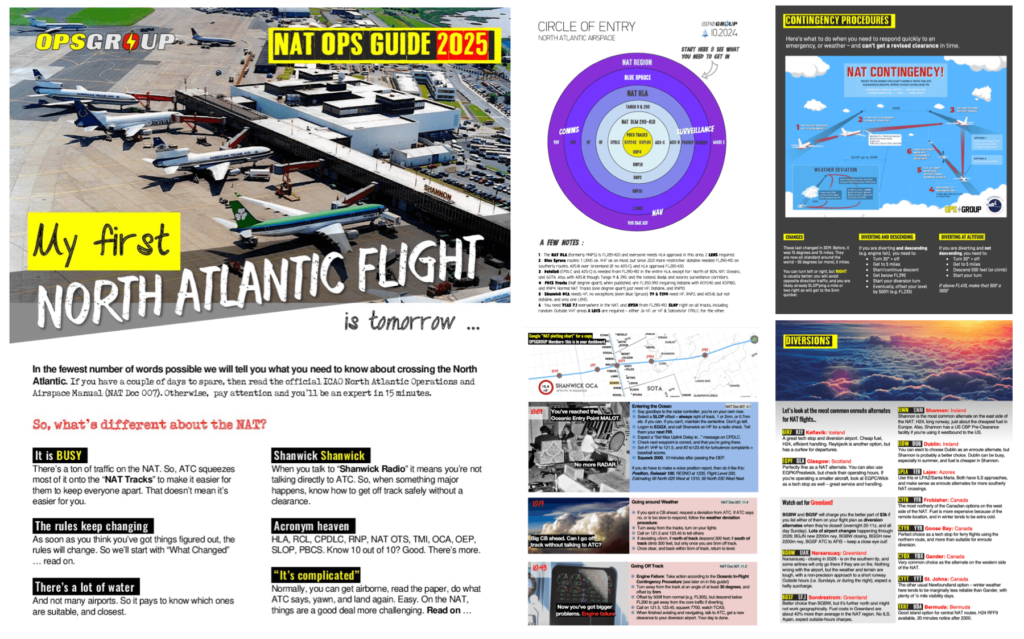
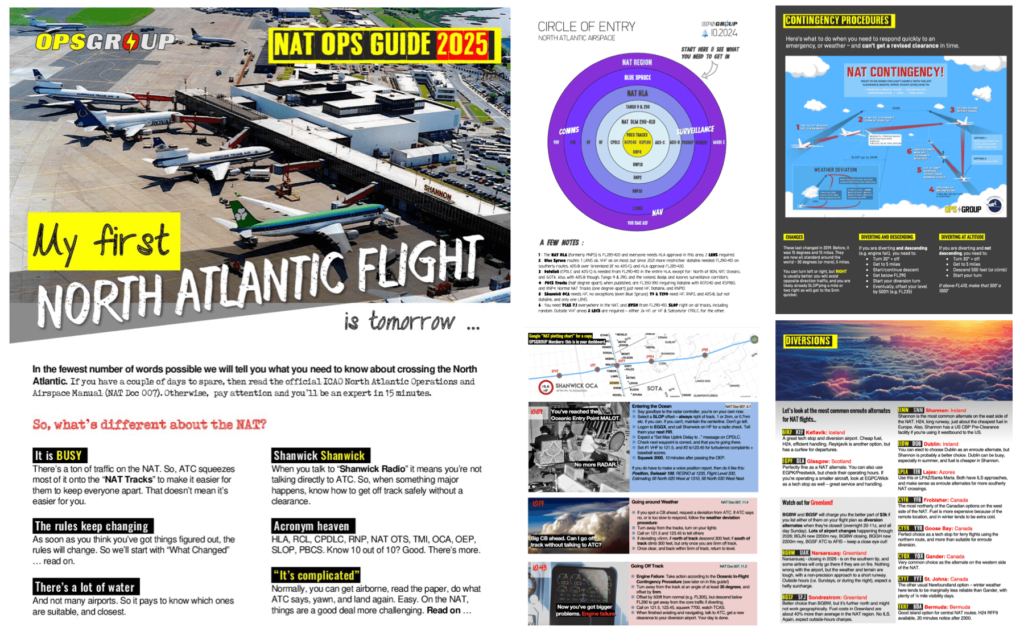
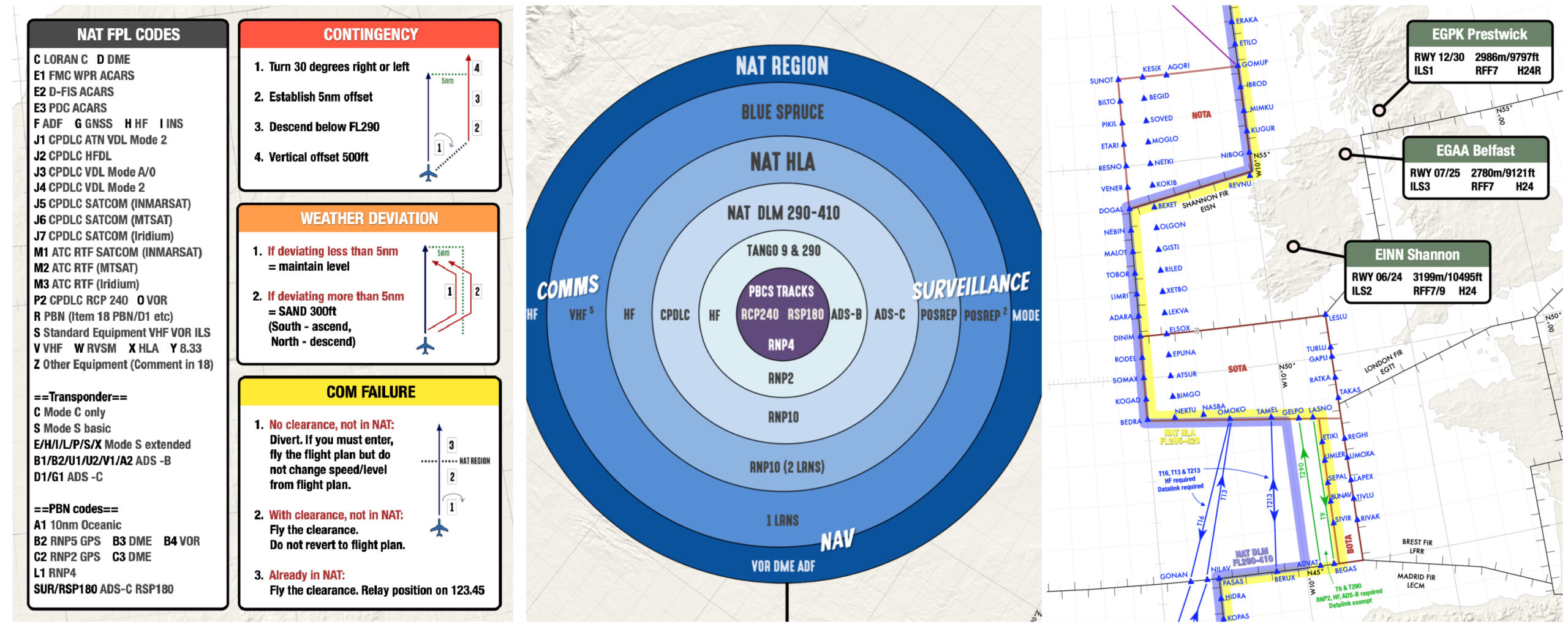
The latest edition (2025) of the NAT Guide (“My First North Atlantic Flight is Tomorrow”) has now been published. This 24-page guide is for pilots and dispatchers, to help you understand the basics of North Atlantic flying.

Contents:

  • 1. What’s different about the NAT?

  • 2. Changes in 2024, 2023, all the way back to 2016.

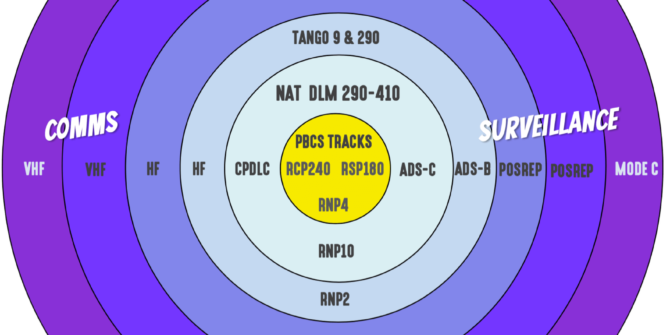
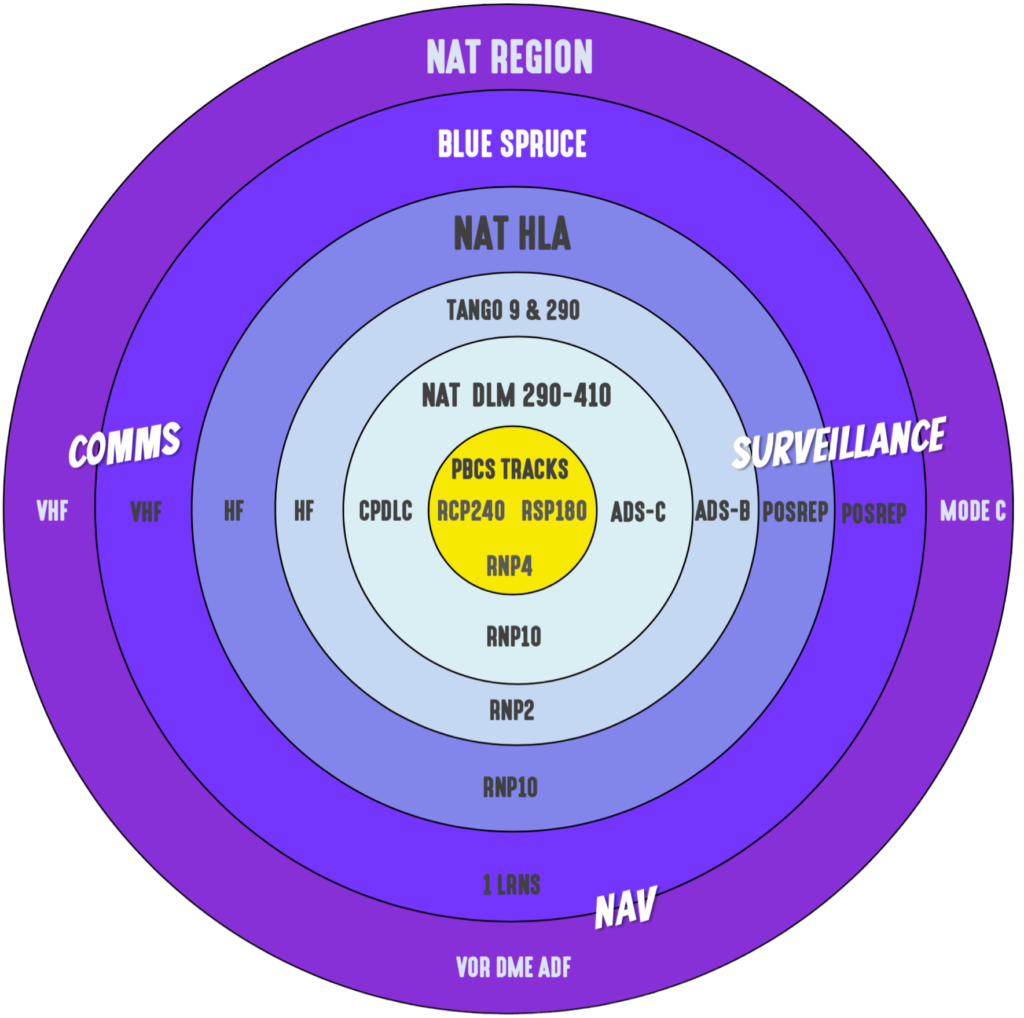
  • 3. (Updated 2024) Circle of Entry – a visual depiction of what equipment is needed to enter the different parts of the NAT region airspace.

  • 4. NAT Quick Map – Gander boundary, Shanwick boundary

  • 5. Routine Flight Example #1 – Brussels to JFK (up at 5.45am) – NAT HLA certification, Oceanic Paperwork, Special requirements, getting an Oceanic Clearance, Equipment failure, Weather deviation, and going off track.

  • 6. Non Routine-Flights: No PBCS, No RVSM, No RNP4, No HF, 1 LRNS, No HLA, No ETOPS, No TCAS, No Datalink – what you can do and where you can go.

  • 7. Diversion Airports guide: A couple of notes on each of the most popular diversion airports from Shannon to Goose Bay: What to expect.

  • 8. Airport data: BGBW Narsarsuaq, BGSF Sondy, BIKF Keflavik, EGPF Glasgow, EGPK Prestwick, LPLA Lajes, LPAZ Santa Maria, EINN Shannon, EIDW Dublin, CYFB Fro Bay, CYYR Goose Bay, CYQX Gander, CYYT St. Johns, LPPR Porto, LPPT Lisbon, TXKF Bermuda.

  • 9. Overflight permits – routine and special, non-standard airworthiness, how to get one.

  • 10. Special NAT procedures: Mach number technique, SLOP, Comms, Oceanic Transition Areas, A successful exit, Screwing it up, Departing from Close Airports

  • 11. North Atlantic ATC contacts – Shanwick, Gander, Iceland, Bodo, Santa Maria, New York – ATC Phone, Radio Station Phone, AFTN, Satcom, CPDLC Logon codes; and adjoining Domestic ATC units – US, Canada, Europe.

  • 12. NAT FPL Codes and Flight Levels

  • 13. The Contingency procedure – weather and diversions

  • 14. Flight Plan Filing Addresses by FIR

  • 15. NAT Clearance or no Clearance, guide to the new RCL process.
  • 16. Common Gotchas: ATC and OPSGROUP Member favorites.

  • 17. Links, Questions, Guidance


There are two options to download a copy of the NAT Guide 2025 (24 pages, 6Mb)


OPSGROUP Members

You can get it in your Dashboard, under Briefings and Guides.


Get it from the OPSGROUP Store

Not a member? Get a copy from the OPSGROUP Store.


NAT Circle of Entry (2025)

For the latest changes and updates on the North Atlantic, including our most recent Guides and Charts, use our NAT reference page at ops.group/blog/nat/

We’ve updated the NAT Circle of Entry for 2025. As always, changes on the NAT continue without pause for breath – this version is the latest information as at October 2024. The Circle of Entry tells you what you need to get into each different sliver of North Atlantic airspace.

Click on the circle to download the more detailed PDF.


We’ve also published a new version of the NAT Guide (“My First North Atlantic Flight is Tomorrow”)

Get a copy here.


OPS CHAT – every Tuesday!

Join the weekly international ops call!

OPS CHAT is a conversation about this week’s changes and dangers affecting International Flight Ops, open to everyone!

It’s on every Tuesday at 1300 UTC.

It’s for Pilots, Dispatchers, ATC, and anyone else involved in international ops – and here are the key things we look at every week:

  • New risks and changes this week affecting airspace, ATC, airports, and international ops
  • The top 5 Ops Alerts published for OpsGroup members this week
  • Conversation and chat
  • Unsolved mysteries – unanswered questions from the Ops Group/Flight Ops slack channels.
  • New member intros and group updates
  • A general Q&A – bring a good Q and we’ll match it with an A.

When is it on? Tuesday at 1300 GMT/UTC/Z. That means: 6am LA (sorry!), 9am New York, 2pm London, 3pm Amsterdam. Bring a timezone appropriate drink (If you’re in a Brooklyn a coffee, if you’re in Berlin a coffee martini?) and join us for a group chat about all things ops.


If you’re stuck on something in particular (a pesky overflight permit for Peru, perhaps …) – ask your question and we’ll find someone that knows. For the weeks highlights, we’ll pop up a few maps and things to help show what’s happening, but mostly this is really just a chat and pretty casual. As you might have gathered.

How long is it on for? Ah, 30 minutes maybe? Or longer if things get interesting.

How do I join? You will need:

  • 1x computer device (example here)
  • Electrical power
  • A face (because we like seeing you)
  • A watch (set an alarm for Tuesday 12.59Z)
  • Aaaand a Zoom registration: here.

So in short – register and then show up. Turn on your video, and take part. Easy!

Any other questions? Email the team!


New Dashboard Tool – Airports and Countries

Hi Members,

If you’re planning a trip somewhere, you might have used the search tool in the Dashboard. We’ve just added a new feature, so read on.

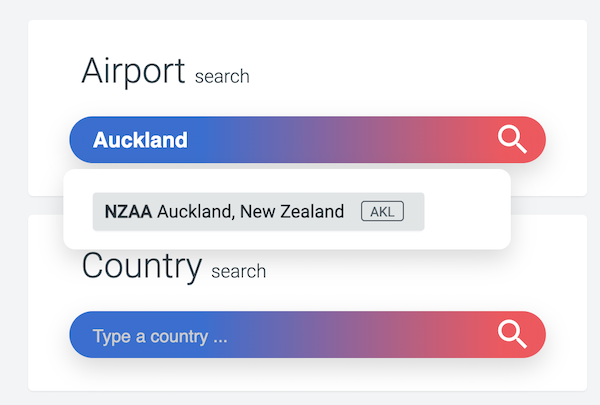
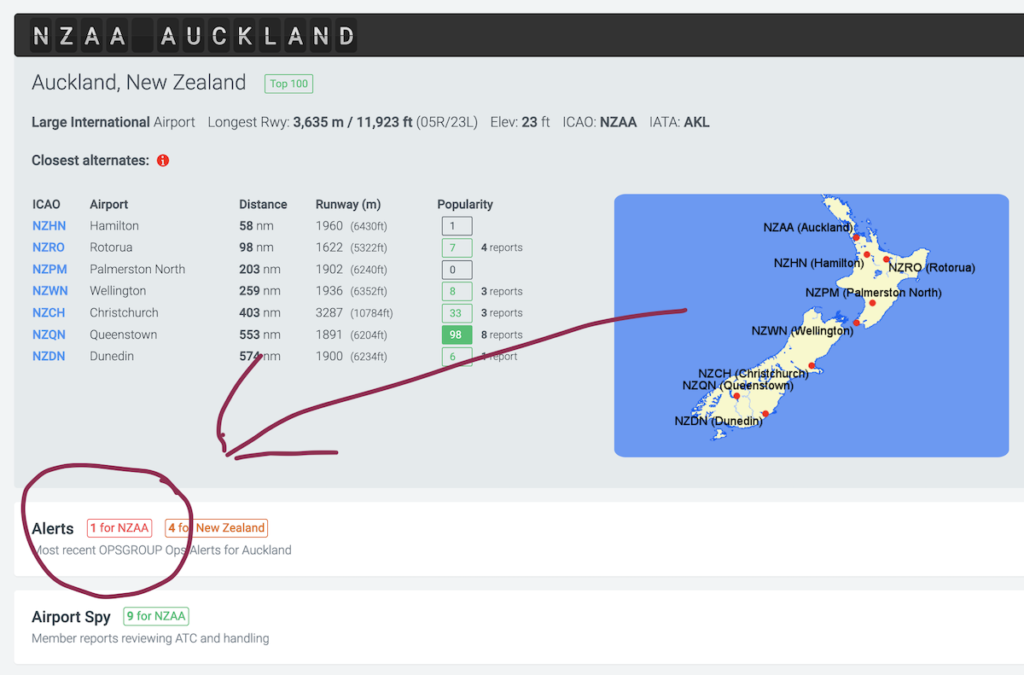
Let’s plan a quick flight to Auckland, NZ. So, on the main Dashboard page, just type “NZAA“, or “Auckl …”


You’ll get this panel showing all the things we know about Auckland in OPSGROUP.

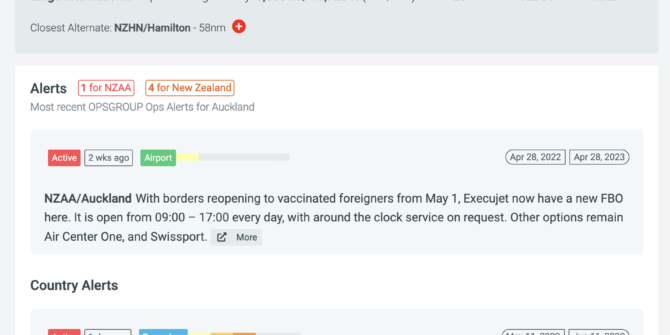
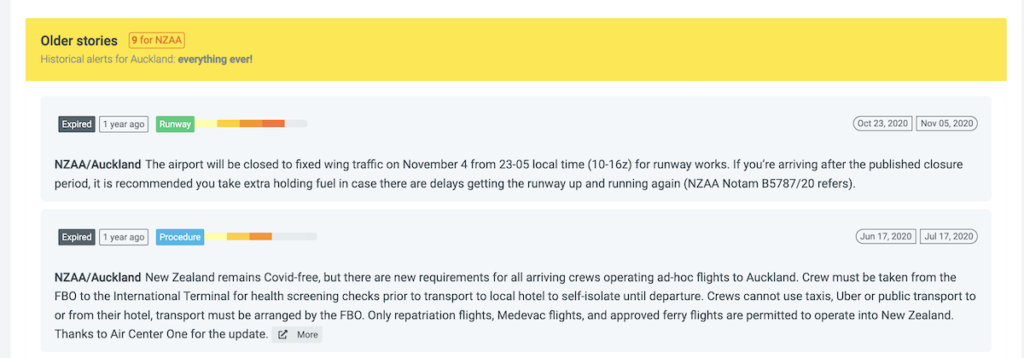
Click on the Alerts tab to see what’s been happening lately, from a flight ops point of view.


Until now, we’ve been showing current alerts, and those that expired in the last 3 months.

But now, we’ve added the option to see all historical alerts.


For both the Airport and Country search pages, you can go back in time to the beginning of OPSGROUP, and see everything ever said about that place. This might be handy to get an overview when operating to somewhere new.

What else?

Keep scrolling down and you’ll see the rest of the tools that will help you with that particular airport.

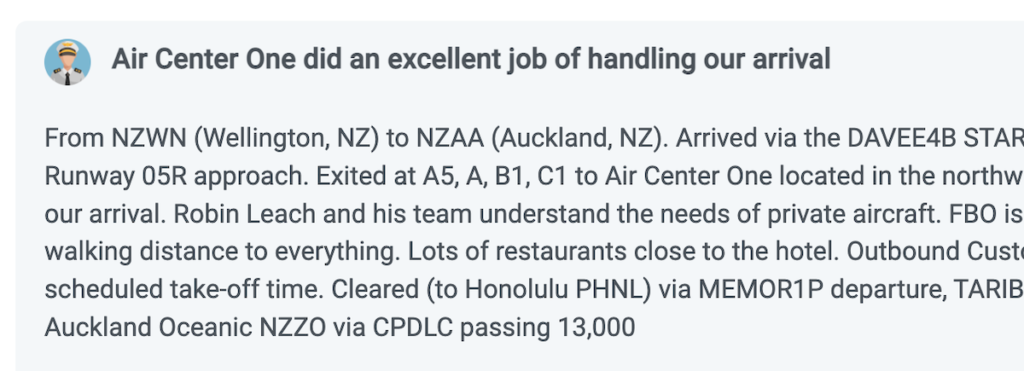
Airport Spy reports from other members …

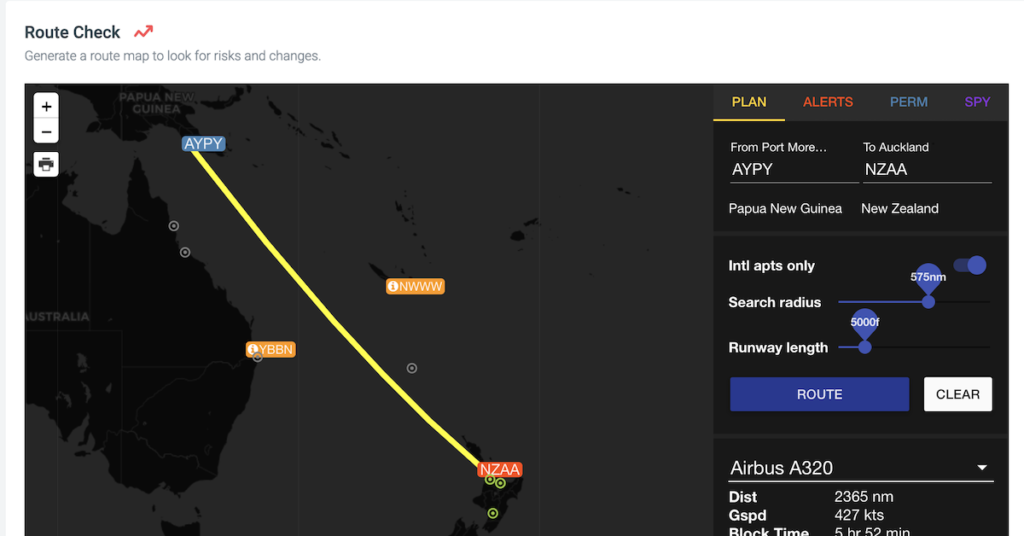
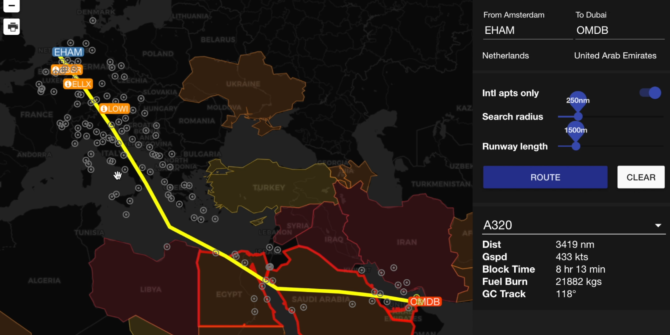
Run a quick Route Check to see what bothersome changes might affect you enroute … and your fuel, time, distance.

Here we’ll plan a flight from Port Moresby to Auckland …


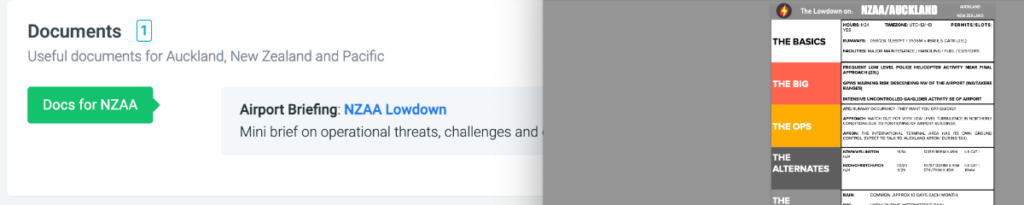
The documents tab usually has some goodies. Excellent, looks like Bec has made a Lowdown for NZAA!


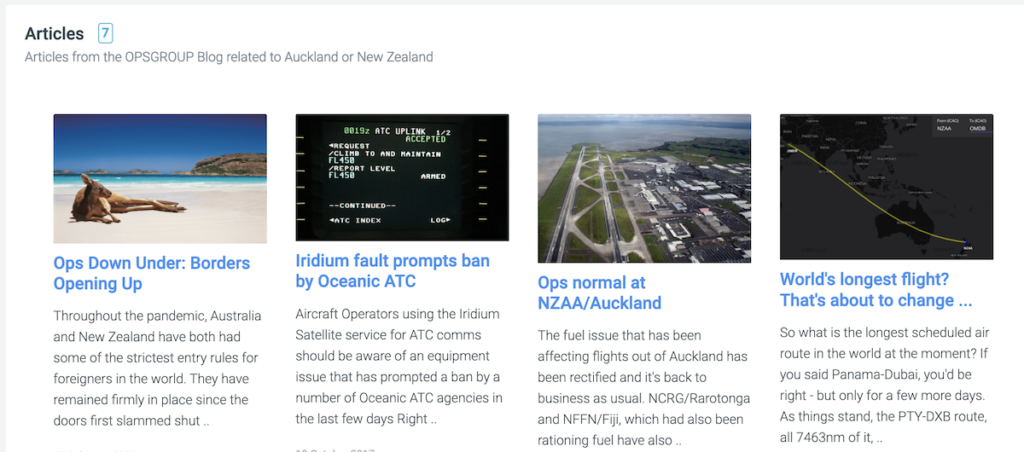
The articles tab should find any blog posts or articles the OPSGROUP Team has written affecting this airport or country.


Not interested in Auckland? Don’t blame you. The rest of New Zealand is far better! 😉 Try a search for NZCH, NZDN, or NZQN – or anywhere else in the world, in the search box at the bottom.


Enjoy! Let us know if you have any questions or we can help at all. We are always adding new features and that works best when you tell us what you need 🙂

Cheers,
The O.G. Team.
team@ops.group


2021 New North Atlantic Plotting & Planning Chart

Hi members!

First, thanks to all the group members who were part of making this. We sat down from scratch and wanted to build the best possible NAT chart we could. A lot of work went into this, and we’re grateful to you all! With this format and structure, we’re also looking at making useful plotting charts for other areas like the Pacific, Africa, etc. – but for now, enjoy this completely updated NAT map for 2021.

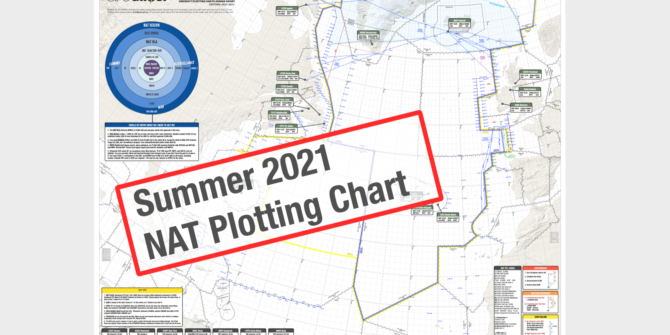
So .. It’s ready! You can grab it in Slack, or in your Dashboard. View it on your iPad or Laptop etc. as a PDF, or print it out as a giant wall map! It prints really well up to 15 feet wide – but you can also just put it onto A3 or A2 size paper.

If you’re not a member, read on for how to get a copy.


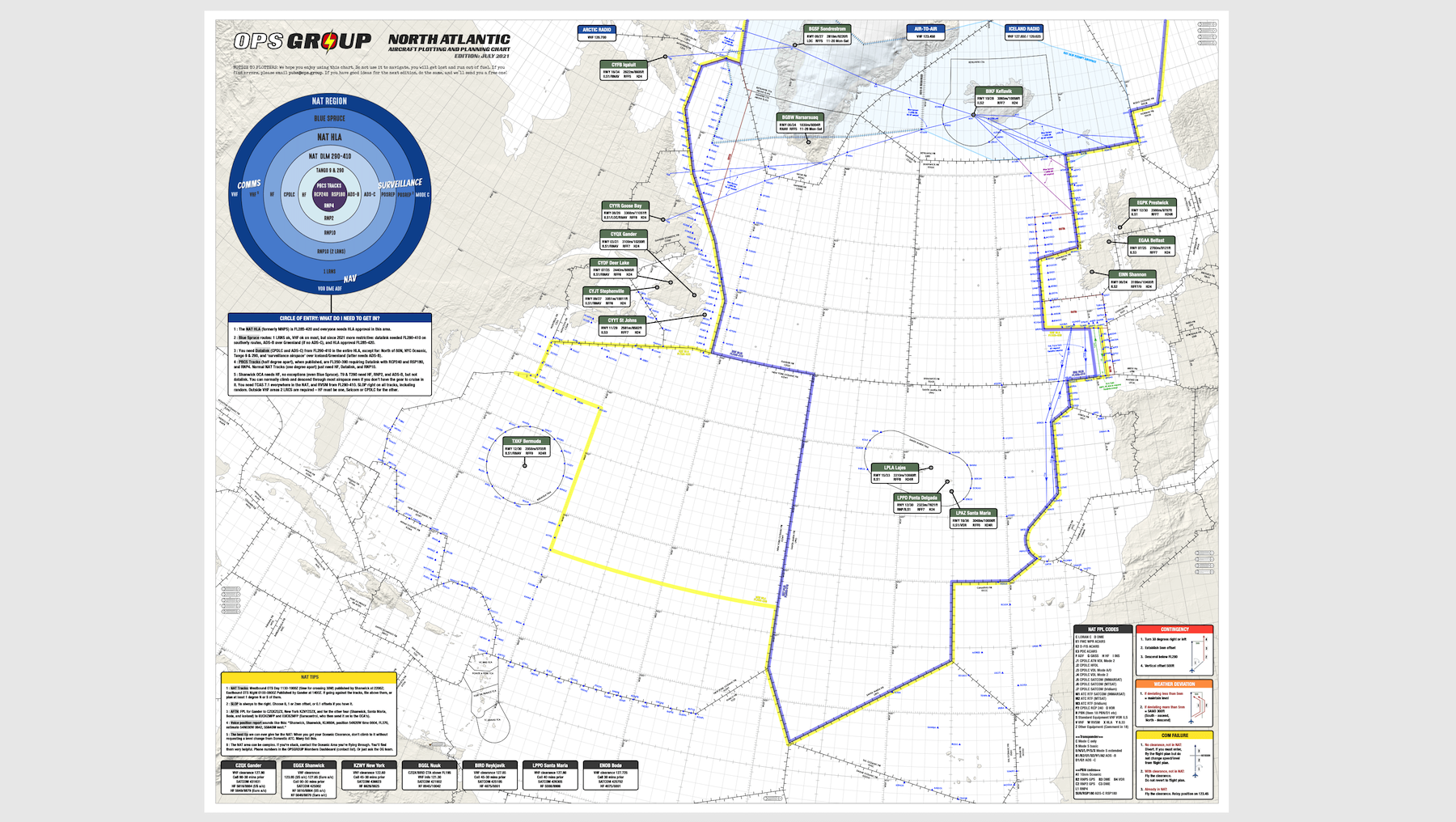
About the 2021 NAT Chart

This chart is completely new – we started from scratch, expanded the coverage area, and then worked as a group to add all the useful things we could think of that a pilot or dispatcher crossing the North Atlantic might need.

New on this chart – effective July 2021:

  • FULLY UDPATED for 2021 post-COVID flying!
  • EXPANDED coverage area – much further down into the Atlantic, and further west.
  • NEW! NAT Tips – using NAT Tracks, SLOP, filing an Oceanic Flight Plan, and helpful tips
  • NEW! Quick reference for contingency, weather, and comms failure with easy graphics.
  • Updated: NAT Airspace Circle of Entry 2021 – easily check what you need for Nav, Comms and ATC Surveillance depending on which bit of the NAT you will be flying through.
  • Additional diversion airports, now 16 total primary NAT alternates with runway, approach, length, RFF, and hours
  • Easy view of boundaries for HLA and DLM/Datalink mandated airspace
  • Updated NAT FPL codes, clearance frequencies, Satcom, and HF
  • Fully updated “South East Corner” with new Tango routes
  • and … Treasure Boxes!

Other chart features:

:: Requirements for NAT tracks, PBCS tracks, datalink mandate.
:: Common NAT Diversion Airports.
:: Runway Orientation, Length, best IFR Approach.
:: RFF Category and Opening hours.
:: NAT FPL Codes and sample FPL.
:: Blue Spruce routes and equipment requirements.
:: All NAT Entry/Exit points with associated required landfall fixes.


How to get the new chart, if you’re not a member?

OPSGROUP members get this and other publications free of charge, all available through your member dashboard.

There have been many changes on the North Atlantic since we published our previous chart in 2019.  Here’s a few things to read up on:

We hope you find it super useful, but also have fun using it!


NOTAM 2021 update: progress, at last

Here’s something you might not have been expecting: at long last, true progress on fixing NOTAMs.

If you’ve been following the story over the last few years, you’ll know that there has been an ever brightening spotlight on the problem. Here at OPSGROUP, we’ve certainly been vocal about the issue. The response to our first blog post back in 2017 was huge, and so we made it our mission: Let’s Fix NOTAMs.

We started out with a campaign to bring attention to the problem: We wrote the Field Guide to Notams, ran a Worst NOTAM competition at EBACE, held a Notam Summit in New York, conducted a pilot and dispatcher survey with 2100 responses, asked OPSGROUP members for support and input, ran a design contest, and through all of this gathered ideas on how to fix things. That led to an updated article in 2019 titled “Why Pilots are reading a Reel of Telegrams in the Cockpit” – which gathered more energy and interest around the problem. We then formed a Notam Team, started the “Fixing Notams” website, worked with other industry groups looking at the issue like the AIS Reform Coalition, and saw the FAA host the first industry gathering on NOTAMs in November 2019. We started a petition to keep momentum going, with 8800 people signing our plea to fix Notams.

In terms of specific solutions, we tried a bunch of things. We built an AI bot with ICAO, called NORM – to see if we could use machine learning to sort out the mess. In the Notam Team, we looked at the problem from the ground up, and looked at building an entirely new system, called N2. We also collaborated further with ICAO to build the Notameter, a tool to analyse the quality of existing Notams. Internally at OPSGROUP, our small team spent many hours researching, pondering, idea generating and data analysing.

The result? Much learning, much discussion, much collaboration – but no concrete results or fixes. This the way of things. NOTAMs are harder than they look. The AI was not able to make sense of Notams in the way we’d hoped, the initial Notameter was interesting but wasn’t changing anything. A brand new system wasn’t going to work: despite the failings, the existing system has buy-in and trust, and attempting to circumvent that with an entirely new mechanism sounds inspiring, but isn’t practical.

But progress doesn’t always come along the path that you expect. And in the quiet, dark days of a Covid-dominated December, a small group of die-hard Notam Fixers formed to continue the battle. Taking all the learnings of the Notam journey over the last few years, we sat down together once a fortnight over the last few months, and forged a new path. Each of us represented our own group of allies in the mission: ICAO, IFAIMA, IFALPA, and OPSGROUP. This togetherness created a renewed energy to solve the problem.

And now, we have traction.

Next month, ICAO will spearhead the launch of a Global Campaign on NOTAM Improvement. Our aim is to solve the Notam Problem in manageable chunks, gathering energy as we solve them and make progress. Rather than re-invent the wheel, we will fix the system from within, starting with the easier aspects and progressing from there. The first phase of this campaign focuses on Old Notams. At any one time, there are about 35,000 active Notams globally, and 20% of these – one in five – are old; in other words, not respecting the existing rules of Notams being issued in principle once only for a maximum of three months (everything else should go into the AIP, an AIC, or some other publication).  We are drawing on the collective cooperation of the AIS community – the Notam Officers – to uphold the rules and get rid of Notams that don’t follow them. The result will be a potential decrease of 7,000 Notams per month, and a 20% reduction in the size of the average briefing packet.

The ICAO Global Campaign on Notam Improvement will kick off with a worldwide webinar on April 8th, for which ICAO has issued an invitation to member states by State Letter. After this, a series of bi-monthly progress webinars will start on June 16th.

The backing of ICAO means we are now tackling the Notam Problem head on, with the fullest force.

The focus on “Old Notams” is just the first phase of this campaign. As well as tackling this particular aspect of the Notam Problem, we will be creating awareness of the wider issue, especially in the AIS community, and forming support mechanisms for AIS offices around the world to deal with not just Old Notams, but also further improvements down the track. In Phase Two, we plan to look more closely at how we can improve the mechanics of the system itself.

NOW, versus Later

An important distinction to make here is that this work is on “NOTAMs, Now“. There is separate, ongoing work in the field of the “Future of NOTAMs”. You may have seen acronyms like SWIM and AIXM, and terms like Digital Notams or Graphical Notams. The FAA, ICAO, Eurocontrol, and other agencies are building a model for the future, when NOTAM’s will change from the current AFTN format and transmission into an internet, or IP based, transmission and following a service-oriented approach. This work is valuable, but with a target implementation date of 2028, has a different focus. Even if it goes smoothly, it would not instigate change until 2028. Needless to say, if we don’t fix the underlying issues now, it may not even solve them then, either.

Thing-Labelling

For the enthusiasts, I’ll delve some more into the Notam Problem, what we’ve learned, and what the next phase of fixing might look like.

In Phase One, the brief is simple and clear: remove Old Notams, and reduce the count. That count – or total volume of Notams – reached about 1.9 million in 2020. Reducing that count by 20% means a reduction in the volume of Notams that pilots are presented with pre-flight. It’s a simple, quick win.

In Phase Two, we will be able to look at the first systemic change – not just reducing the count as in phase one, but finding ways to improve the quality and usability of the system as a whole.

One potential option is how we can label Notams. You might recall we built an Artificial Intelligence bot with ICAO, called NORM. The terms Artificial Intelligence (AI) and Machine Learning are in essence still interchangeable, and the latter makes things easier for most of us to comprehend. Machine learning is really just “Thing Labelling” (see this article from Cassie at Google). Very simply: tell me what this thing is about, and I can do something with it. NORM wasn’t able to “thing label” quite as well as we’d hoped, but the concept remains valid for Notams – if you can tell me what this Notam is about, I can do things with it.

We have a manual thing-labeller for NOTAMs built in: the Q-code. This five letter code, like QFAHX, which means “This NOTAM is about Birds“. The trouble is, that there are far too many choices. There are 179 Subjects (60 AGA, 47 ATM, 40 CNS, 27 Nav Warnings, 5 Other) and 77 Conditions (16 Availability, 16 Changes, 26 Hazards, 19 Limitations). The number of permutations, or possible 5 letter Q-codes, is therefore 13,783.

The result? As you might imagine, the person putting a NOTAM into the system has to choose a Q-code, and with that many choices, the same subject can have a host of different Q-codes. In a review of all Notams issued in 2020, we found 1,063 different Q-codes in common use. In addition, we found that 47% of Aerodrome Notams, and 25% of FIR Notams, used the Q-code “XX” or “XXXX”, which translates as “I don’t quite know which one to use”.

Net result: The Q-code isn’t a reliable thing-labeller as it stands. However, if we refine the number of available Q-codes to a set amount, like 50, or 100, we then have a robust and reliable way of labelling the Notam. And if we have a reliable label, then we can do two magical things: SORT and FILTER them. Sorting means that we can present critical items first (like a runway closure), and Filtering means we can exclude things we don’t care about (Birds, perhaps).

A key item on the Pilot wishlist is “Show me the critical stuff first”. If the NOTAM can be labelled to show “What is this NOTAM about”, it would allow end users (directly, or through the NOTAM distributors like Lido, Jeppesen, ARINC, etc.) to reliably filter and sort them. In other words, Closed Runways appear first and Birds and Grass Cutting appear last, if at all. The magic of refining the Q-code field to achieve this is that we don’t need to build anything new, make any structural changes to a Notam message (exceptionally challenging), nor create a burden on states to invest in new technology. It’s a simple, very effective, tweak.

There are other recognised issues: for example, the Upper Case format, Plain English vs Abbreviations, and in time, I believe we can solve those too.

Getting closer to the solution

For those of you that have been with us for a longer period,  you might remember the little chart I drew a year or two back. Fixing Notams was never going to be easy.
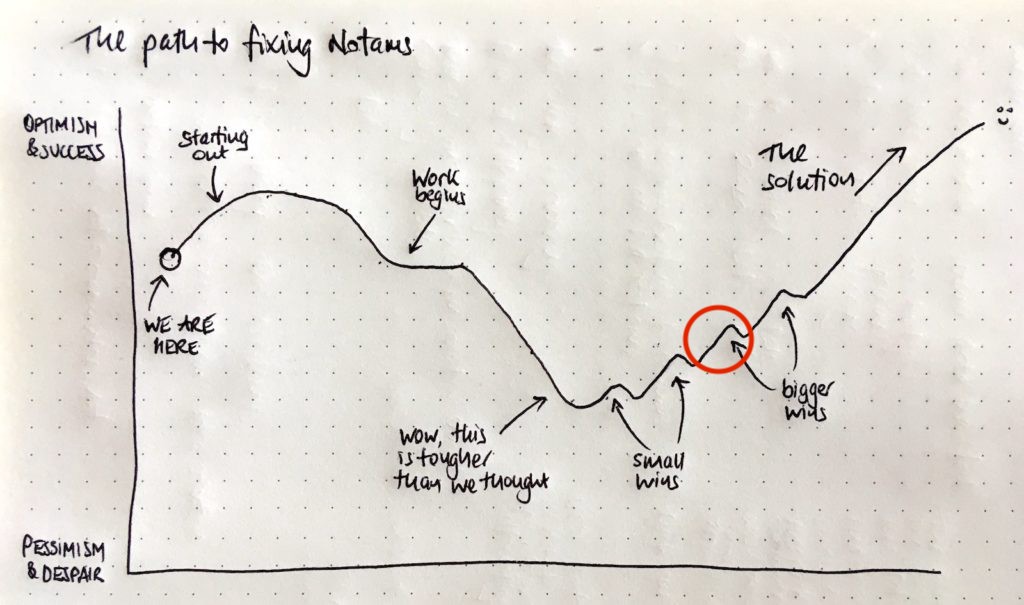
I think we’re somewhere around the red circle area. We have done so much, and we now have global attention, a harmonious, energised group of organizations working on the problem, and as of April 2021, the backing and full force of ICAO in this Global Campaign for Notam Improvement.

I’m excited to see what we can achieve from here.

Further reading and links


GoCrow planning map – 2020 update!

Hi again members!

There’s a new version of GoCrow – the OpsGroup route analysis and planning map…

There’s some cool new stuff:

  • SafeAirspace warnings are now on the map, you’ll see them very clearly. Click on a country for more info.
  • All OpsGroup Alerts will show on the route
  • Permit information is fed directly from the Permit Tool in your dashboard
  • New underlays – all kinds of maps
  • You can print a route briefing.

All of this is still in beta, there are still a few bugs and some design issues to work out, but it’s pretty solid. Have a play with it! Watch the video above to get a better idea of what it can do.

GoCrow is here: https://ops.group/dashboard/gocrow/

Comments welcome!


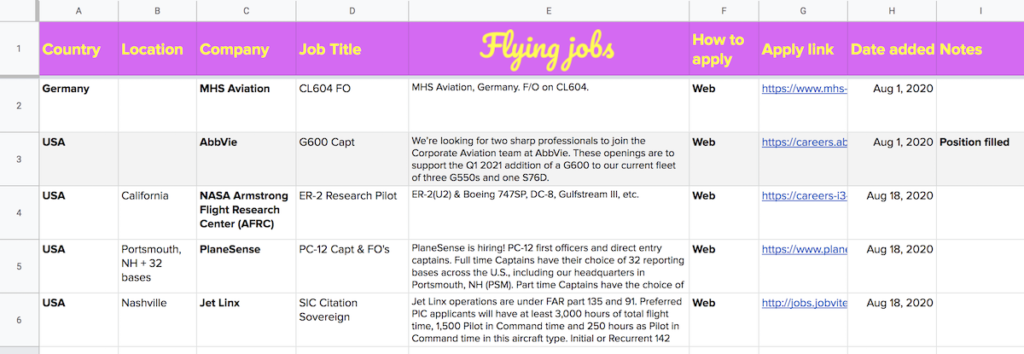
Jobs: our shared spreadsheet

Hi members!

A very simple new little thing in OPSGROUP is now alive …

The idea is wonderfully easy. It’s a shared Google Sheet. All group members have access to add and edit.
If you are looking for a new Flying or Ops job, browse the jobs listed.

If you know of a Flying or Ops job, add it …

There are a handful of jobs in there to get us started, but we need your help to add more.

Got one to add? Jump in and add that job. Just make sure it’s an active position available now, and not some kind of hiring agency resume-collector … 🤦


And that’s it! Hope you find it useful, we’d love any feedback or suggestions for improvement.

Have a lovely week!