Sydney Near Miss!

On November 14, a major runway incursion was narrowly avoided involving an Airbus A380 and Boeing 737. It sounds like the incident may have been caused by an ATC error – although an ATSB investigation is still underway.

Despite millions being spent in recent years to improve runway safety at the airport, this incident is a timely reminder that incursions can and will continue to happen in Sydney.

Here’s a look at why, and what you can do about it.

The Layout.

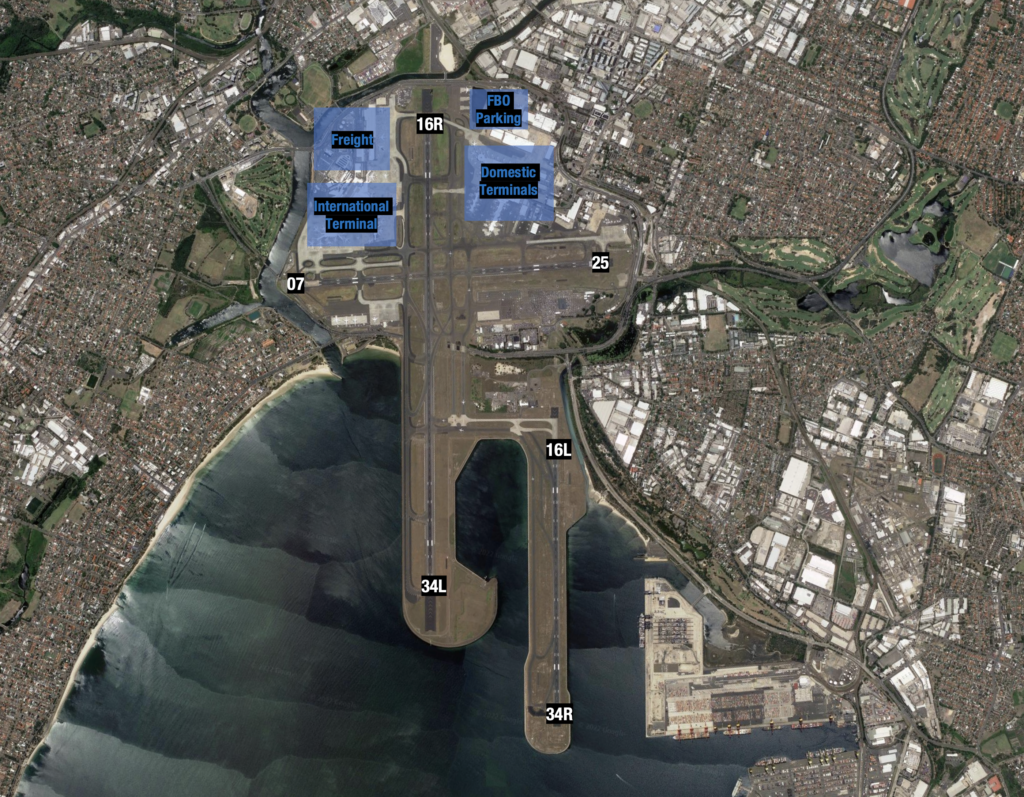
Sydney’s runway layout is complex. There are three runways – two parallel ones (16/34 LR) and another runway that runs perpendicular to them (07/25). The airport itself sits perched on the edge of Botany Bay, with the parallel runways extending well out over water. And all terminals and FBOs are found clustered together on the northern side of the airport, near the 16R threshold.

Which means taxis to/from all the other runways are lengthy and potentially confusing. And during those taxis, almost every aircraft will need to cross a runway. Often twice.

That’s a lot of crossing traffic when you consider that the airport processes up to eighty movements an hour at peak times – it is literally Australia’s busiest.

Mistakes Happen.

Authorities are well aware of the risk of runway incursions at Sydney airport. So much so that they have spent a commendable amount of time and money to improve runway safety.

Possibly the best advancement in recent years has been the installation of stop bar lighting at every single runway holding point, along with improved signage and markings.

And yet mistakes keep happening. The November incident is a great example – here’s what went down.

The November 14 Incident.

  • In CAVOK conditions, a Boeing 737-800 was cleared to land on Runway 25. With their clearance they were informed that an Airbus A380 was holding position on Runway 34 waiting to depart.
  • When the 737 had cleared the intersection of the two runways, the A380 was cleared for take-off and began to roll.
  • After landing the 737 received its taxi clearance from ground which instructed them to cross runway 34L on Golf back to the domestic terminal.
  • As the 737 crew approached the active runway, they were surprised to see it was still occupied with the departing A380. They queried the clearance with ATC who immediately told them to hold short.
  • The closest the two aircraft came to each other was 300m (just shy of 1000’) thanks in part to the vigilance of the 737 crew. While not a particularly close shave, there was potential for this to have become a major accident. Which is why the ATSB are asking questions they are.

Here’s a simple animation of the incident with a bird’s eye view:


What can we learn from this?

Future incursions, although rare, will happen. But there are steps that all crew can take to help reduce those statistics and stay safe.

A good place to start is this. To cross a runway in Sydney always remember the ‘hat-trick.’ You know all about cricket right? Well if you’re headed to Australia, this phrase can also be used to impress Aussies at the bar over a cold Fosters  (disclaimer: no one drinks it there, and whatever you do never call a prawn a shrimp). It means three successes of the same kind. Or in other words: a set of three good things.

So, there are three things that you’ll need:

  • A clearance from ATC
  • Confirmation that the stop bar is out
  • Runway is visually clear out both sides

If any of them are missing (or uncertain), do not enter the runway.

The crew of the 737 above captured a potential accident because at least one of their hat-trick was missing.

Remember the hat-trick every time you cross a runway.

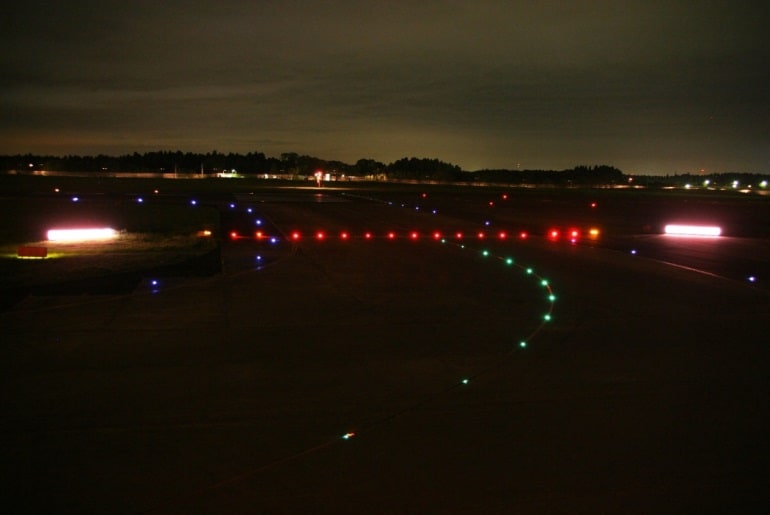
The stop bars themselves are worth a mention too. What’s more obvious than a big row of blazing hot red lights to make you get on the brakes, right? They work really well, but in their simplicity, there can be confusion.

A while back, IFALPA released some pretty good stuff that is still relevant today. You can read it here, but there are a few scenarios to take away:

The stop bar’s out, but we haven’t been cleared…
Stop. An extinguished stop bar on its own is not an indication you are cleared to cross. It may have been turned off in error, or for a preceding aircraft.

We’re cleared, but the stop bar is still lit…
Yep you guessed it, stop. And this happens really often. You’ll need to ask ATC to turn it off. Never, ever cross a lit stop bar.

But didn’t he say we were cleared?

Help from ICAO

Did you know they have a whole manual dedicated to helping controllers and pilots alike avoid runway incursions? You can download it here.

Have some stories of your own to share?

We’d love to hear from you. They don’t need to be from Sydney, but we can all learn from them. You can reach our team completely anonymously at news@ops.group.


Bali bound and no place to go…

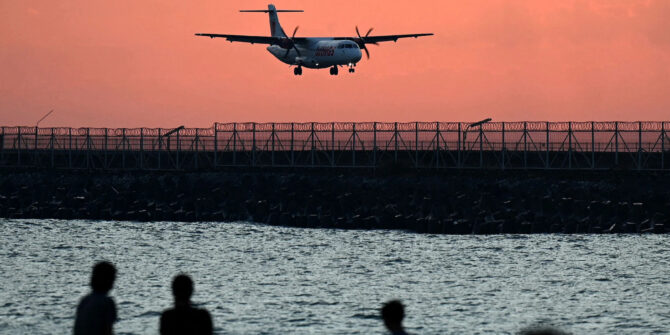
If you’re bound for Bali there are a few things you need to know, especially if it is your first time there. Ops there often seem to get disrupted, and you’ll need the option of having someplace else to go. Figuring out where – especially at night – may be harder than you think.

Let’s take a closer look.

At face value, ops at Bali seem straight forward. The runway is long, there is an instrument approach at both ends, SIDs and STARs link everything up and the place is towered 24/7.

But after years of flying in there with a scheduled operator, the number one biggest threat remained fuel in the tanks when it all went pear-shaped – which it sometimes did.

The airport just seems to have a habit of eroding your fuel margins. You may be carrying a healthy alternate enroute, but beware of giving it all away while holding once you arrive.

Delays and short notice closures.

The airport is especially vulnerable to them, and they can be unpredictable. Here’s why.

 1. Weather 

If you’re flying into Bali during rainy season (November – March), weather is likely to be a major factor. Like clockwork, towering cumulus clouds strengthen throughout the day into powerful thunderstorms in the afternoon and evening.

While the TAF may look identical day in and out, it is luck of the draw whether the airport itself will be affected. And when it is, traffic backs up quickly.

 2. Volcanic Ash 

Indonesia rests on the western portion of the Ring of Fire which renders it the third most volcanically active region on earth. There are no less than one hundred and forty-seven volcanoes there, seventy-six of which are currently active.

Eruptions are frequent and occur with little warning causing major disruptions to airports throughout the country – and extensive ash plumes. They can close airports like Bali for days on end, like one did in 2017. And the situation can develop when you’re already airborne.

The closest volcano to WADD/Bali airport is less than 40nm away.

Mount Agung erupted in 2017, closing Bali for several days. Courtesy: IBTimes UK

 3. VIP Movements 

Yep, someone important is inbound. And guess who has to make way? The airport often gets closed for short periods for VIP movements. You’ll find them in the Notams from time-to-time. Take it from me – apply a healthy buffer to either side as ATC will not necessarily be able to provide you with an accurate time the airport will re-open while you’re racing around that holding pattern.

4. Traffic Jams 

WADD/Denpasar is Indonesia’s second busiest airport second only to Jakarta. Which means it sees a lot of traffic. It also occupies a busy air corridor linking Europe to Oceania. Controllers manage a steady flow of both regional and international traffic from both directions.

It can be difficult to predict the effect of this ahead of time, but it is not unusual to hold inbound on your STAR. And you likely won’t have a head’s up beforehand that it is coming. Extra fuel for traffic holding is absolutely necessary.

 5. Congested Frequencies 

If you’re getting low on fuel, make a decision early. Don’t wait.

ATC has to manage large pieces of airspace here. On Ujung especially it can be challenging getting heard. Controllers are often managing multiple frequencies – it may seem like you’re being ignored, but you may not be able to hear everyone else talking to controllers over the top of you.

The language barrier can also be an issue – English will likely not be your controller’s first language, and their accents can make them hard to understand. The moral of the story is to be assertive on the radio, and speak slowly and clearly. Try and stick to standard phraseology such as ‘minimum fuel.’ And don’t take a back seat when trying to get an urgent request granted.

But where to go?

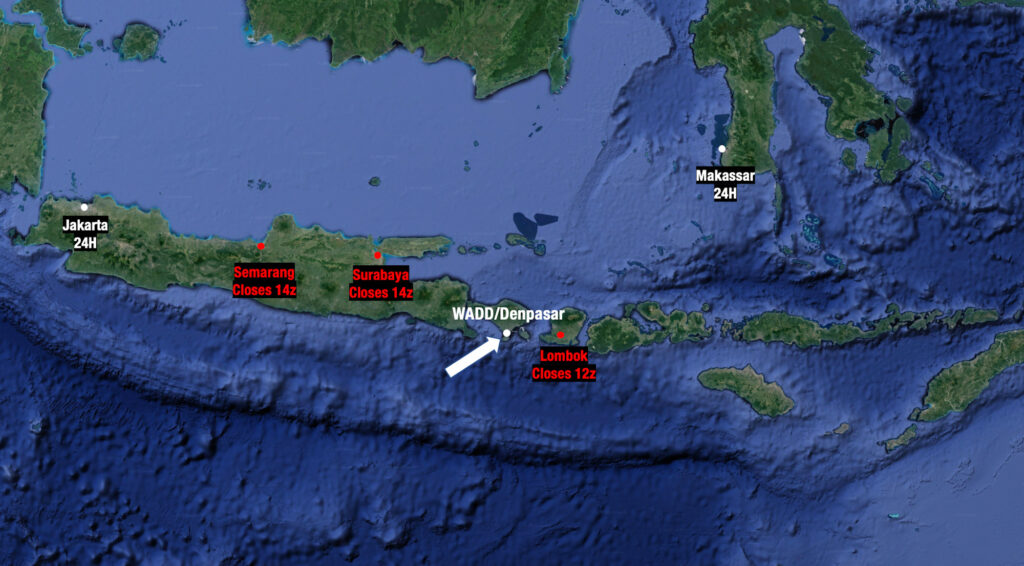
If you’re heading into Bali late, you’ll need to pay special attention to alternate planning. All the airports in the region still have special operating hours in place to “avoid the spread of Covid”, as per their notams. At present, WADD/Bali itself is open until 18z (02:00am local) but its closest alternatives are not.

Lombok (WADL/Praya), 85nm. Closed each night from 12z (20:00 local). [Notam B2226/22, valid until Feb 19].

Surabaya (WARR/Juanda) , 160nm. Closed each night from 14z (22:00 local). [Notam A2938/22, valid until Feb 18, actually due to runway closure for works].

Semarang (WAHS/Semarang), 295nm. Closed each night from 12z (20:00 local). [Notam B2231/22, valid until Feb 18].

If it’s late, you’ll need to carry more fuel than usual to reach WAAA/Makassar 320nm away, or WIII/Jakarta 512nm away.

And finally – watch out for terrain!

There are some big hills out there. If you’re flying into Bali, there’s a good chance you may yourself under radar vectors at night or in IMC nearby. Protect your aircraft – keep a close eye on where you are relative to that terrain at all times. Especially when it’s busy!

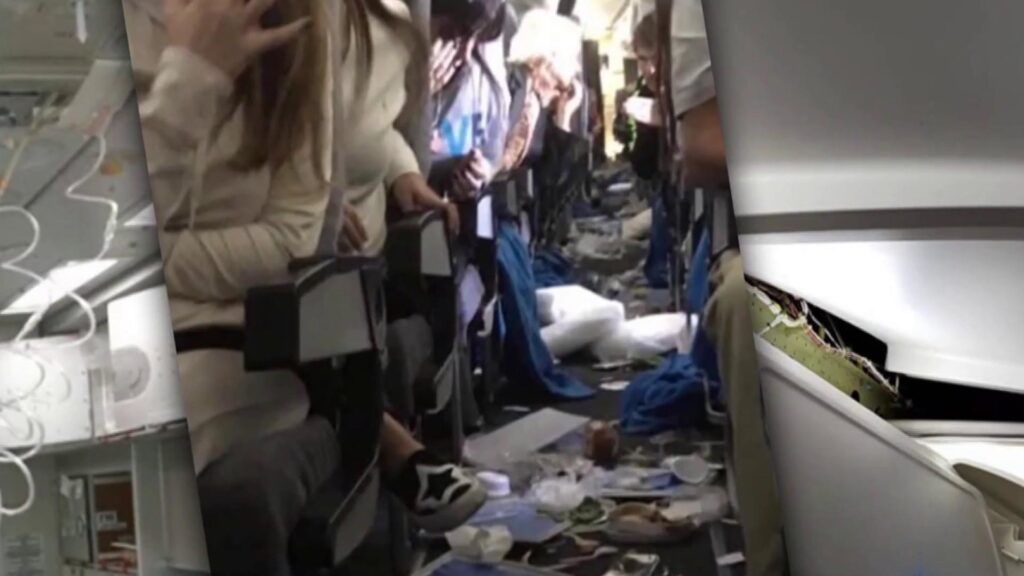
Aircraft arriving from or departing to the northwest need to be particularly wary. Sector MSA just north of the airport rises steeply to 9700’. Further west you’ll find Central and East Java with grid MORAs as high as 14,000’. Also be aware of escape routes if your cabin springs a leak.


Danger in Denver: Collision Risk

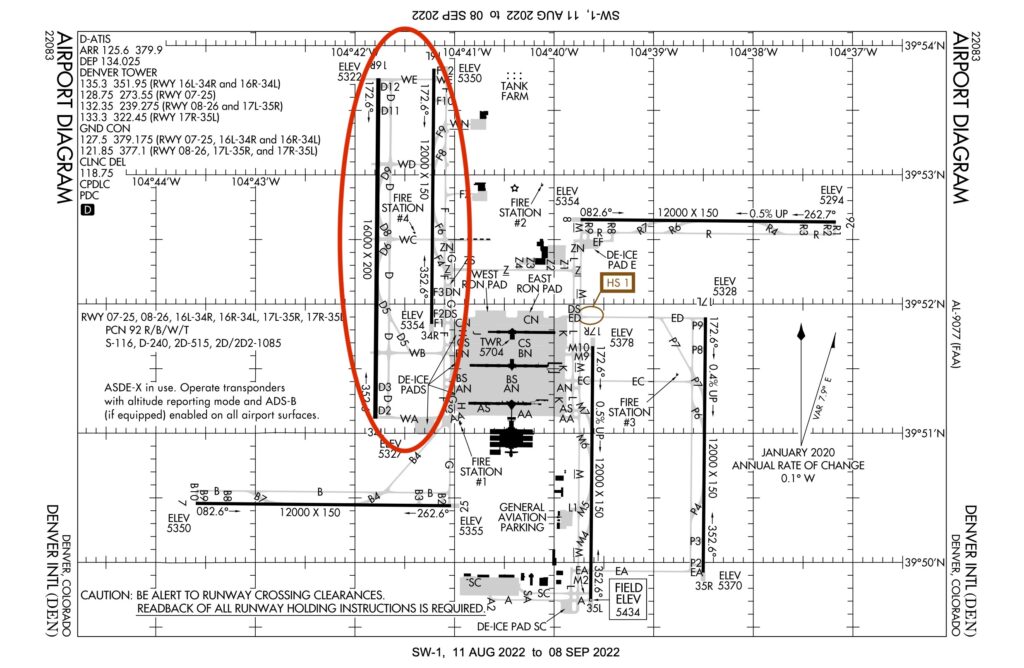
On August 3, the FAA put out a new Safety Alert (SAFO) for KDEN/Denver. Here it is if you want a read.

The issue is the high number of TCAS alerts being recorded when aircraft are shooting parallel approaches to Runways 16L/16R.

It turns out that TCAS, high elevation, and reduced separation aren’t a great mix, and the FAA are worried there are chances of a collision.

Here’s a breakdown of the situation.

Elbow to Elbow.

Since 2004, KDEN has been operating two parallel runways (16L and R). The two runways sit literally elbow to elbow, with only 2600’ (709m) between them. For simultaneous close parallel approaches, 3600′ separation between runway centrelines is generally required. In Denver, typically two separate controllers are feeding traffic onto the approach cones for each runway, which means coordination can be a challenge.

From early on it became apparent that nuisance TCAS alerts were a problem. The FAA sought to fix the issue, and so in June 2019 Denver TRACON started separating aircraft vertically by 1000’ in case someone busted through a localizer.

Trouble is, this didn’t fix the issue. Instead, now the majority of TCAS events are happening when aircraft are established on the final approach course. The big threat here is the number of folk selecting TA only (a good 20%), and there is now a healthy dose of desensitisation thrown into the mix from so many nuisances warnings in the past.

Then there’s the elevation.

Fun fact: TCAS becomes more sensitive with altitude. Or in other words, the trigger thresholds for both TAs and RAs increase the higher you get.

Enter Denver – the ‘Mile High City’ – called that because it sits exactly a mile above sea level. That’s around a 5,300’ elevation.

The next iteration of TCAS, (the romantically named ACAS XO), promises better tolerances for these conditions but it’s not here yet, so right now users of TCAS 7.1 get all the warnings when all the warnings are not necessary.

What the FAA are concerned about.

Operate into Denver, and the threat of simultaneous parallel approaches isn’t new, but awareness of the threats needs to be improved. The basic idea is folk should:

  • Have an awareness of how the close in approach setup might increase the threat
  • Brief how operating in TA only mode adds to this
  • Know exactly where to be and what’s around by listening out on the radio and monitoring TCAS carefully
  • Think about to remember to re-select TA/RA mode in the event of a missed approach
  • Be aware of how nuisance TCAS cautions and warnings may desensitize crew.

In fact, this could be useful guidance anywhere where there are similar operational and environmental conditions which might increase the risk of collision.


New US Terrorism Warning: What’s the impact to aviation?

On August 2, the US Department of State updated its worldwide terrorism warning for the first time since 2019 – terrorist groups around the world may be actively planning attacks on US interests. This follows news on July 31 that the leader of a major terrorist organisation was killed during a military operation in Afghanistan.

My flight is tomorrow, what does this all mean?

For starters, no new airspace warnings have been issued due to the recent events. But it is equally important that operators (especially N-registered ones) heed the information that is already out there.

This comes from a combination of FAA SFARs, KICZ Notams and Background Information notes.

In the most dangerous airspace, the FAA bans US operators at all levels. In which case, the decision to overfly is an easy one because it has already been made for you. You just can’t do it.

But it’s not always that clear cut. Risk may be present, but not enough of it to justify closing entire pieces of airspace. So the FAA carries out assessments and decides on what precautions operators should take to stay safe.

This is where the lines start to get a little blurry because these assessments take time, and security risks can evolve more quickly than the papers can be signed. In other words, what was safe yesterday may not be safe today.

And so operators may need to re-evaluate their exposure to known risks, based on what is happening right now. With that in mind, here are some hotspots US aircraft are permitted to overfly that we think deserve a second look.

Iraq

Back in October, the FAA lifted its long running Notam barring US operators from entering the ORBB/Baghdad FIR. The SFAR is now in effect, meaning overflights are technically okay provided you stay above FL320. But just because you can, doesn’t mean you should.

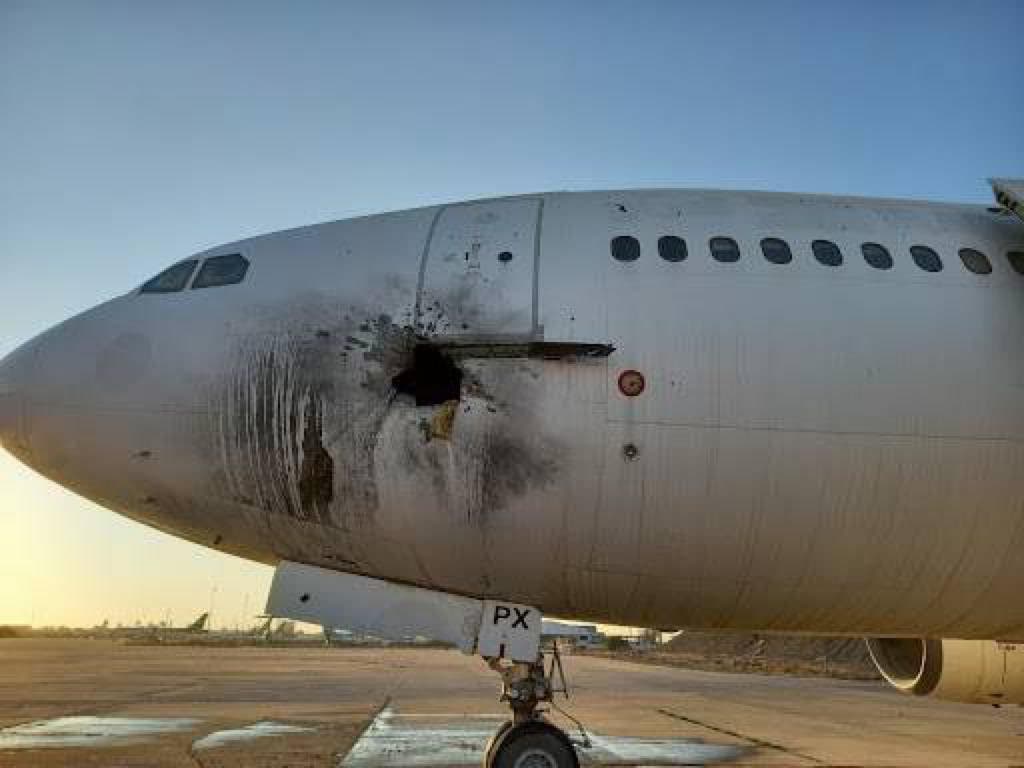
Militant groups are active throughout the country and are known to have access to anti-aircraft weaponry. The have also have a proven track record of targeting US interests in the country. Scour through the OPSGROUP archives and you’ll see report after report of rocket, drone and mortar attacks on ORBI/Baghdad along with other regional airports.

Our advice hasn’t changed – avoid overflights at all levels if possible. Although the eastern airways UM860, UM688 and UL602 are frequently used and considered safe options by some major carriers.

See: SFAR 77, Background Info Note.

Mali

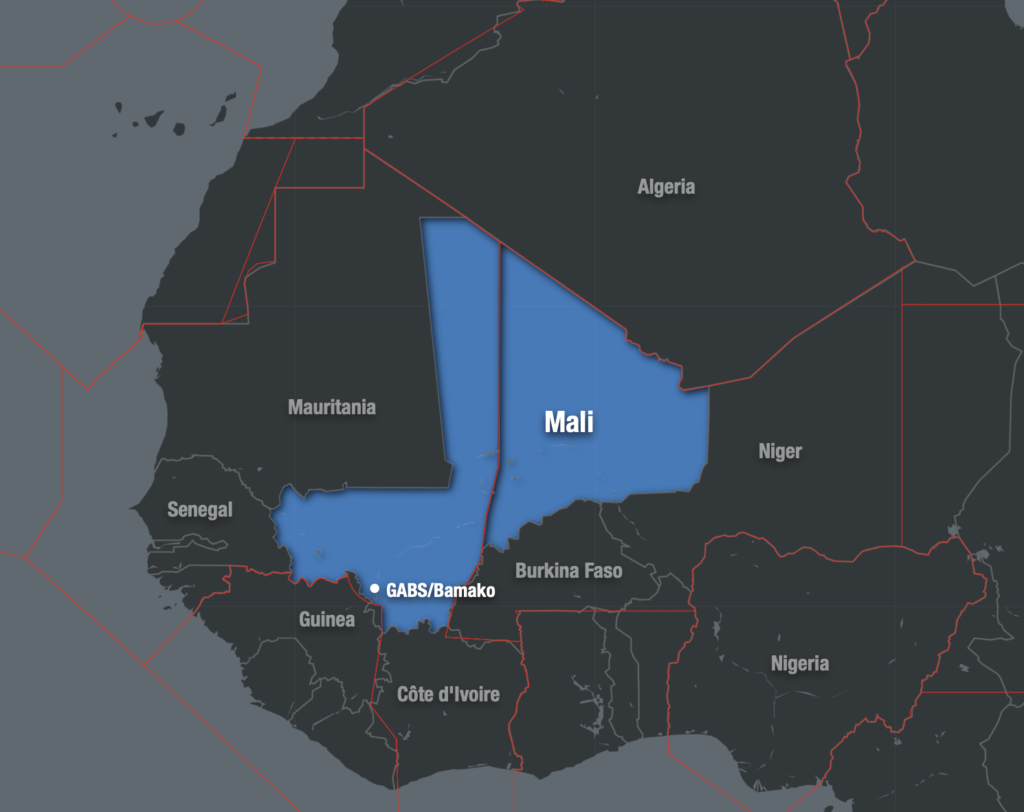
The FAA currently advises US operators to use extra caution if overflying Mali below FL260. The main issue is the ever-fragile security situation on the ground. The FAA cites extremist or militant groups that may actively target civil aircraft with various weapons.

And things seem to be getting worse. On July 29, the US Embassy ordered the urgent departure of non-emergency US Government employees due to the risk of terrorism. Which is a warning sign for us that these risks may be escalating.

See: KICZ Notam A0009/22, FAA Background Information.

Somalia

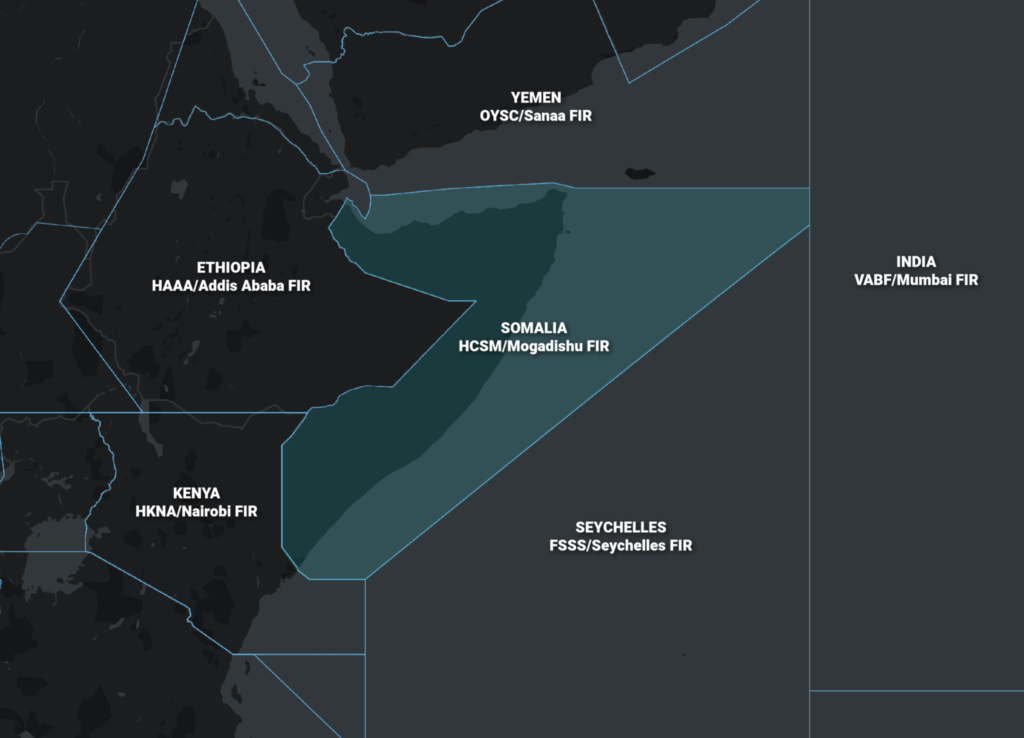
The FAA currently allows US operators to overfly the HCSM/Mogadishu FIR above FL260. It’s important to remember though that the security situation on the ground there is unstable – especially since a controversial election back in April.

Terrorist groups are active in the country, and may have been motivated by recent events. These groups have a proven track record of targeting civilians and aviation interests. In June this year news broke that several local carriers were considering suspending flights over security concerns onboard aircraft and at airports.

There is also currently an active trial of Class A airspace throughout the Mogadishu FIR, which means Somalia may be seeing higher numbers of overflights than normal. The problem is that emergencies and diversions may put aircraft at risk, especially US-registered tail numbers.

See: SFAR 107, KICZ Notam A0028/19.

Egypt

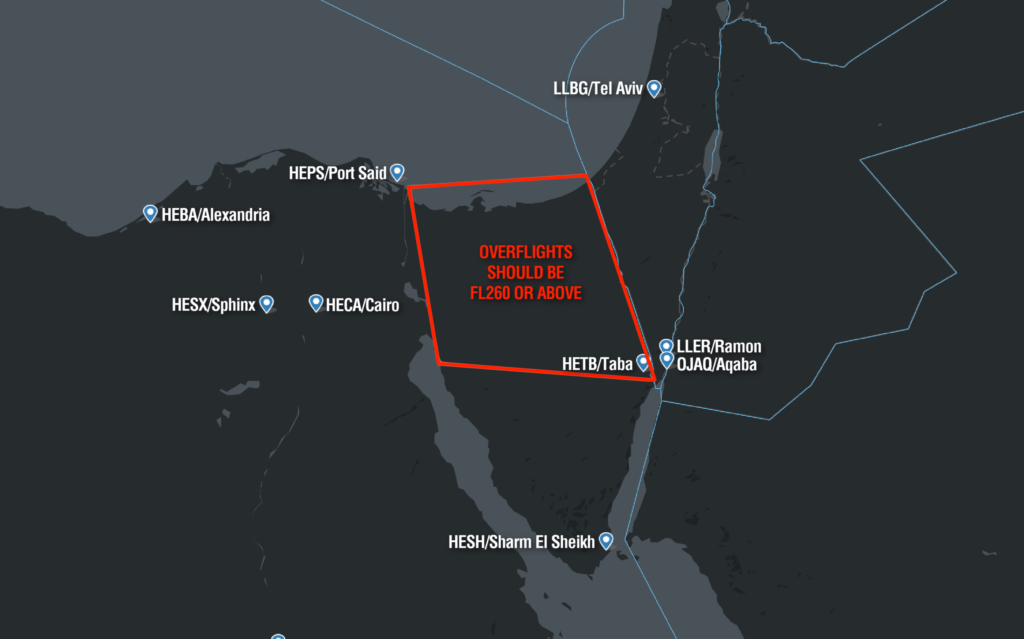
Back in March the FAA lifted its airspace warning for the HECC/Cairo FIR. It previously advised operators to stay above FL260 over the Sinai Peninsula – in the east of the country dividing the Red Sea from the Med.

The issue was the presence of extremist groups who may attempt to target civil aircraft. It’s not clear what improvements led to the warning being lifted, but other countries have kept theirs in place – including the UK and Germany.

Recent events have proven that all is not well. An attack in Western Sanai in May this year was one of the most significant in the past two years – and was a clear indicator that terrorist groups are still active in the region. If they have been motivated by the happenings in Afghanistan, this may put aircraft at renewed risk.

Where else to look.

As things change, airspace warnings get updated. For US operators the starting point is here – it contains everything officially put out by the FAA.

There’s also safeairspace.net – our conflict zone and risk database. The OPSGROUP team keeps this updated as new information comes to hand. You can view a global risk briefing by clicking here.


Morocco ATC Strike Cancelled!

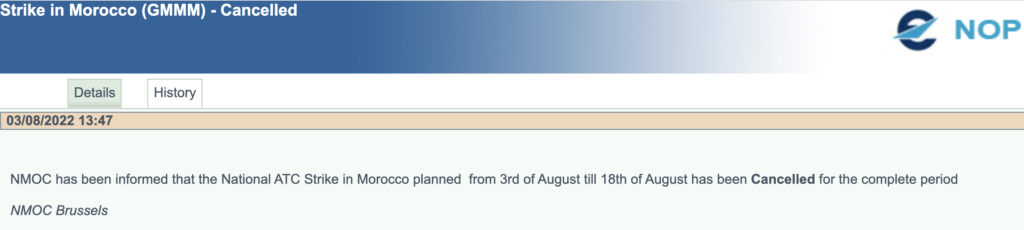
Update 1500z Aug 3: And bam! Just like that, the ATC strike in Morocco is cancelled! There’s no more info yet, but normal ops now expected for the whole period Aug 3-18. So say Eurocontrol on the NOP site.

—————–

Story from Aug 2:

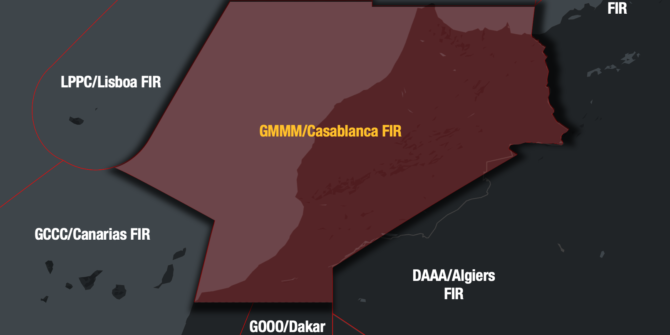
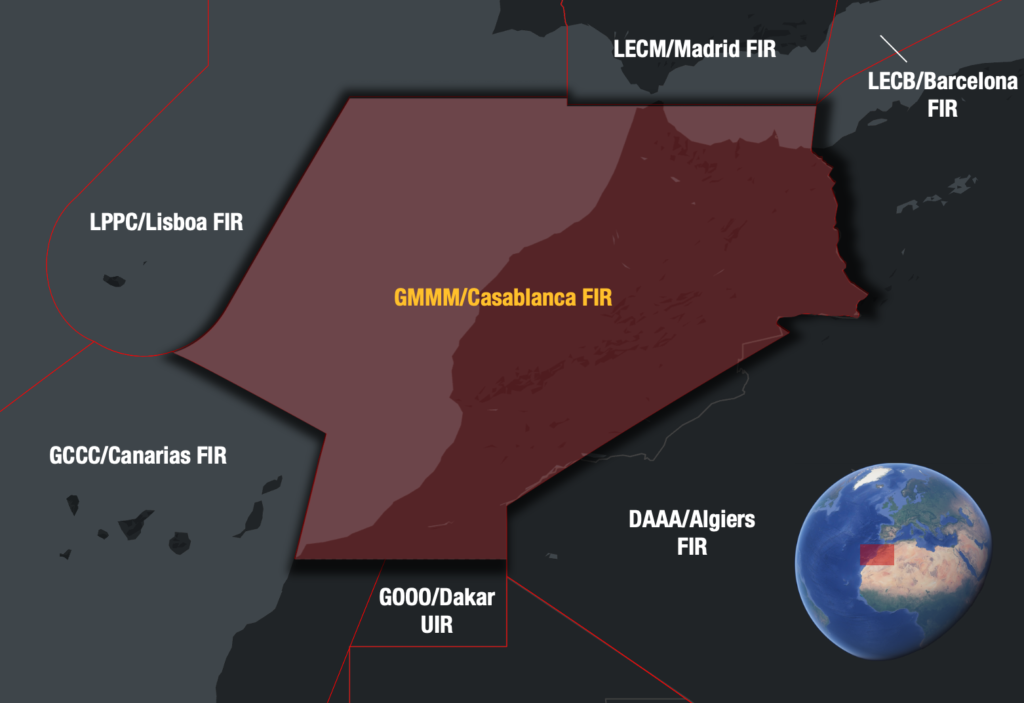
News broke last week that Moroccan ATC are threatening to strike for a full two weeks from August 3 – 18, and it will affect the entire GMMM/Casablanca FIR. Similar strikes elsewhere typically last just hours or at worst a day or two.

While it will not be a complete walk-out, the airspace may be heavily restricted – a busy air corridor linking Western Europe to Sub-Saharan Africa and South America. On average Moroccan airspace services over a thousand flights a day, and ATC want to put the brakes on hard.

It’s all found in this letter written by the union responsible. Here’s our breakdown of what it says, along with some nice pictures.

Let Me In!

If you want to come in, you had better get in line. If the strike goes ahead, only one aircraft per hour will be allowed through each entry point to the GMMM/Casablanca FIR.

Trickle effect at airports.

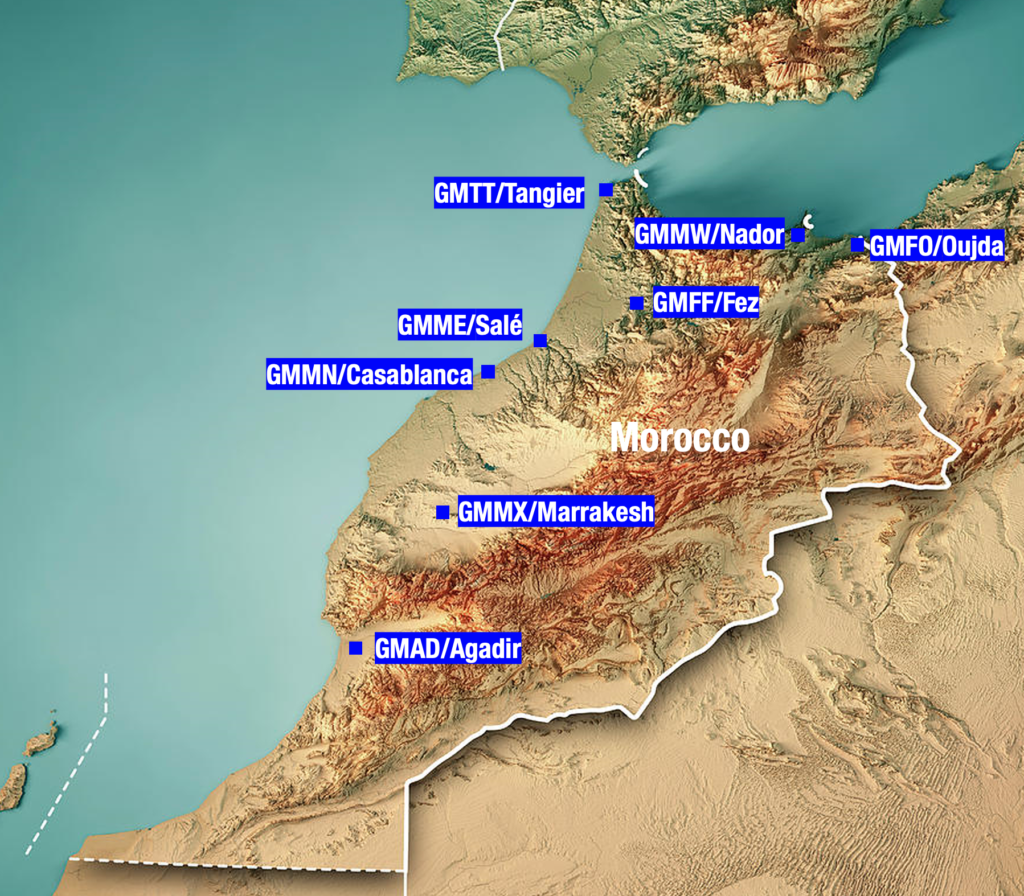
All major airports in Morocco will be affected by heavy restrictions on aircraft movements. In each case, only two aircraft will be allowed depart each hour.

Who’s not affected?

There will be limited exemptions, but they won’t apply to most operations. Aircraft engaged in state, RFF, medevac or humanitarian ops will be exempt. And if you experience an emergency, of course you’ll be allowed in asap.

You will also be able to get special handling permission by including ‘STS/AFTMX’ in Item 18 of your flight plan to get around the restrictions. This will be by prior approval only though. To ask for it, you’ll need to contact the CAA directly. You can reach them at civilair@menara.ma or on +212 537 67 94 07.

Watch out for Western Sahara

If you’re hoping to avoid the hold-ups in the GMMM/Casablanca FIR, you may be tempted to route further south over the Western Saharan region.

Something to be aware of first – there are still active airspace warnings in place for this disputed territory. Despite being quiet in the news lately,  there is a long running conflict happening there. Anti-aircraft weaponry has previously been identified as a possible threat to low flying aircraft below FL200. The risk to overflights in the upper flight levels is very low, but take extra care if planning for diversions or emergencies.

You can read a full briefing on the situation here. We’ve also written this article which may also help.

Right now it’s just a “potential” strike.

The nature of industrial action is that it can be hard to predict until it actually happens. On August 1, Eurocontrol advised the strike was imminent but also noted that the GMMM Notams were conspicuously quiet. We also reached out directly to the Moroccan CAA, but so far *crickets*.

Other ATC strikes in Africa

It must be the season! Also be aware that on August 25 another major strike is planned affecting five FIRs in Western Africa, along with another over Madagascar in the east. You can read more about that one here.


Ethiopia Airspace Update

Update – July 26, 2022

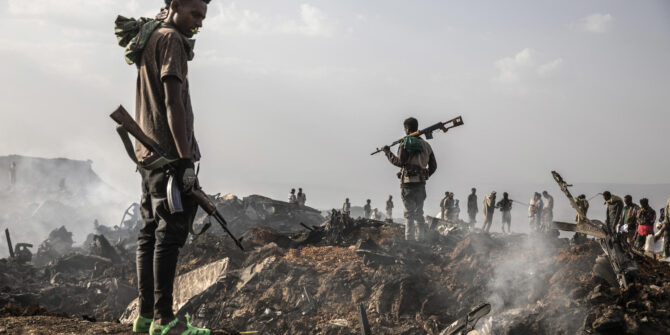
There has been no major fighting in Ethiopia’s northern Tigray region since late Dec 2021. A ceasefire agreed in March 2022 has mostly been upheld, and Ethiopia’s federal and Tigray regional governments look set for negotiations soon.

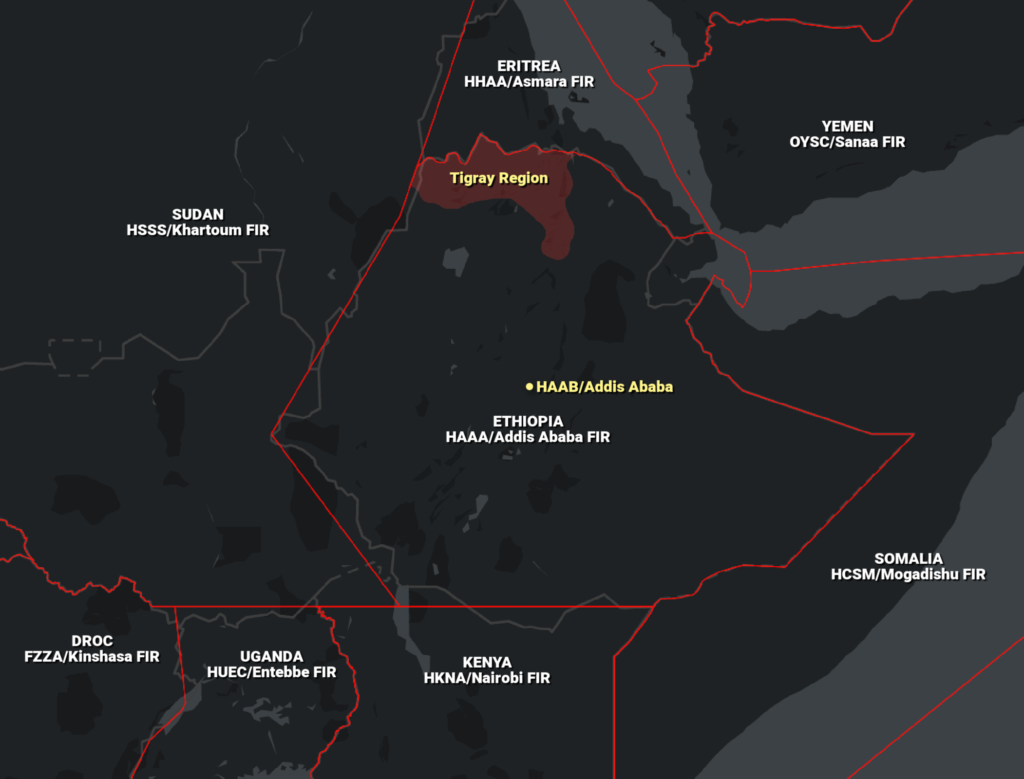
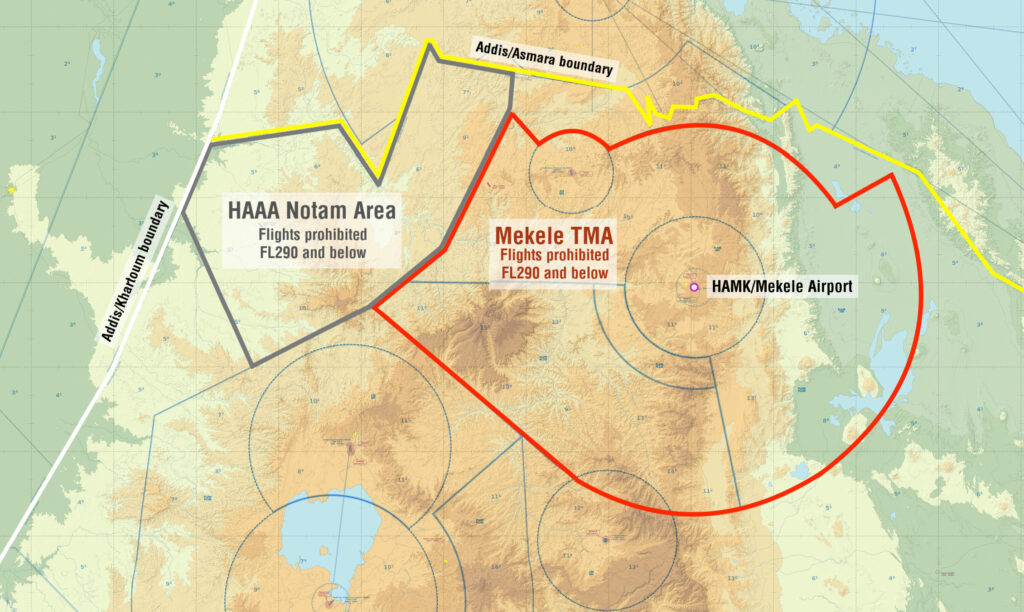
For the time being though, airspace in the north of the country should still be avoided – several states maintain active airspace warnings for the HAAA/Addis FIR, and Ethiopia still have a Notam in place banning all flights at FL290 and below.

Here’s the current version of the Notam, the content of which hasn’t changed since its first iteration:

HAAA A0220/22 - FLIGHT IS PROHIBITED TO FLY AT OR BELOW FL290 WITHIN
MEKELE TMA AND WITHIN THE AIRSPACE DEFINED BY JOINING
THE FOLLOWING SUCCESSIVE POINTS AND LINES
135914.7N 0362048.9E
130042.8N 0365122.9E
ETOBU(132132N 0373433E)
TILUD(134116N 0375950E)
EVITO(142911N 0382424E)
THE COMMON FIR BOUNDARY BETWEEN ADDIS AND ASMARA AND
THE COMMON FIR BOUNDARY BETWEEN ADDIS AND KHARTOUM
REF AIP SUP A 04/2021. GND - FL290, 27 MAY 09:00 2022 UNTIL 27 AUG 09:00 2022. 
CREATED: 27 MAY 09:00 2022

Better yet, here’s a picture of what this actually looks like:

Update – Nov 18, 2021:

  • The US published a new airspace warning and Background Information Note for Ethiopia, cautioning against overflights of the HAAA/Addis Ababa FIR below FL290. The conflict between the Ethiopian military and opposition forces had intensified. Aircraft below FL290 were at increased risk from anti-aircraft fire.
  • The US, the UK, Germany and France all issued security warnings advising their citizens to leave immediately.

Update – Nov 9, 2021:

  • Ethiopia is on the verge of civil war. The government declared a six-month nationwide state of emergency on Nov 2, following increased fighting between the Ethiopian military and opposition forces in the Tigray region in the north of the country.
  • Concern that ATC services in the HAAA/Addis FIR may be affected with little notice. Overflights of Ethiopia may be at increased risk of anti-aircraft fire at all levels.
  • Several factors impacting risk to overflights: military aircraft being used in combat roles, unmanned aircraft operating in region, unstable political situation on the ground, and conflict spilling over into adjacent regions. All of this pointed to an increased risk of misidentification and miscalculation – aircraft mistaken for something of military interest, or simply caught in the crossfire.
  • Opposition forces in Tigray have access to conventional surface-to-air missile systems that can reach aircraft as high as FL260. They have also previously shown an intent to target aviation interests with rockets and ballistic missile attacks on airports within the region, as well as across the border in Eritrea. Other military interests in the area have weapons capable of reaching much higher – including the Ethiopian military. More sophisticated systems are present in or near the region that are capable of reaching as high as FL490. For context, in August 1999 the Ethiopian military shot down a Learjet near the border with Eritrea. Then in May 2020 they also downed an Embraer 120 in Somalia. Both were misidentified.

Further reading

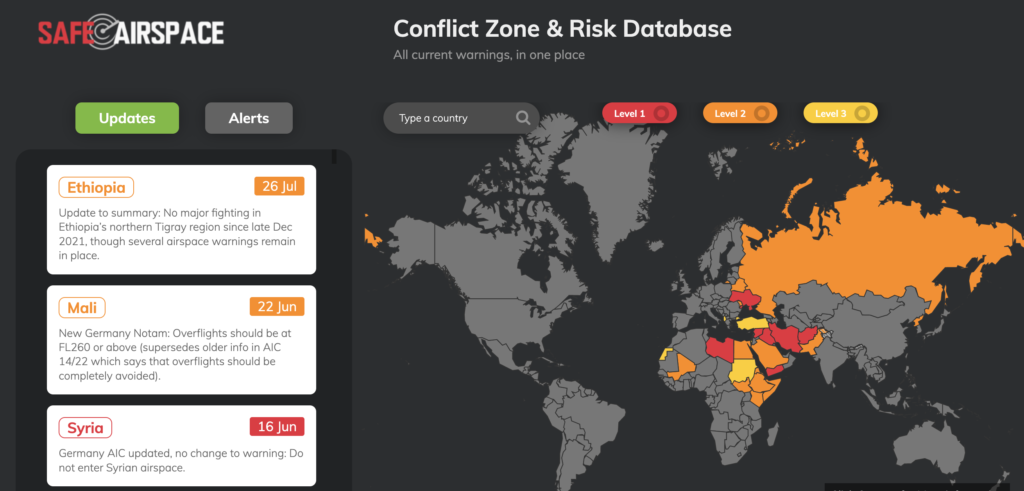
SafeAirspace.net is our conflict zone and risk database. Click here for a full briefing on the situation in Ethiopia.


Hedging Bets: Why Africa is Low on Fuel

Scour the OPSGROUP vault over the past twelve months, and you’ll find a bunch of alerts we’ve posted about jet fuel shortages. In fact, we even wrote an article about the problem.

You’ll also see that a disproportionate number of them are for Africa – or more accurately, Sub-Saharan Africa. Also known as the epicentre of ‘tricky tech stops.’

Cape Verde, Nigeria, Sierra Leone, Senegal, Zimbabwe, Burundi, and South Africa have all graced our news feed in recent times for being low on gas. The problem for ops is that it is no coincidence. And for the next year at least, fuel availability is set to become public enemy number one there for flight planners and pilots alike…

Feeling the pinch.

From an air travel perspective Covid is (more or less) behind us, and demand for jet fuel is surging. But at the same time, the world’s ability to produce it has fallen for the first time in three decades. Sanctions on Russia have been a big part of this – not surprising considering it produces ten percent of the world’s oil.

The pinch becomes higher prices for everyone. In more developed economies, supply isn’t a problem – the turbulence of the market is absorbed with price hikes. Which is why refuelling jets at your local FBO has become so eye-waveringly expensive. But if your pockets are deep enough, the fuel is there to be used.

But this just isn’t the case in less developed regions –  especially Africa, which is facing its worst supply shortage in forty years.

Drip Feeding

Many sub-Saharan countries have limited ability to refine their own oil domestically. And the refineries often operate below capacity. And so they are reliant on imports – so much so that the continent ships in three quarters of what it needs.

The problem then becomes the balance sheets of importers. Their pockets aren’t that deep, so they can only import small amounts at a time, effectively drip feeding their economies.

Combine the two issues, and there just isn’t much room for fuel reserves to ride out any bumps in the road. This strategy of storing less and refining less can be risky, especially in 2022.  It leaves African countries extremely vulnerable to market forces they can’t predict or control – exactly what is happening right now. Local crises such as civil war can also deepen the problem.

Hedging Bets

It’s no secret that oil exporters are in it to make money – like most businesses. The big gamble is what will happen next. When prices are low, exporters may store oil in expectation of things picking up again. This often takes the form of full oil tankers, which can supply African countries with small shipments of oil while in transit.

But right now, jet fuel is in demand. Fuel hedging doesn’t help either. Importers hedge their bets and if they think that more prices rises are coming, they enter into contract to secure prices now as it will save them money later. That’s where the cash flow to buy and store it comes in handy. Many African countries aren’t that lucky, and their lines of supply have been drying up as bullish prices charge on.

The result? Long term fuel shortages, and no guarantees things will get better in a hurry.

Crystal Ball

So, if fuel shortages at African airports are so intrinsically related to global prices, what does the future hold? There may be some relief on the horizon.

The super-charged rise of oil (and therefore jet fuel prices) is set to slow down, and in some forecasts even abate. But none show an outright collapse from the giddy heights they have reached today.

But of course, this is all conjecture. As Covid taught us, the world and the reaction of markets are unpredictable. Things have a habit of going either way, driven by forces we often don’t see coming. But while the cost of jet fuel remains high, shortages are set to become a feature of the landscape for operations in Africa for some time yet.


No SELCAL On The NAT?

ICAO are hurriedly upgrading the SELCAL system to allow for new codes. There’s only a finite number of them available, and double ups are becoming are a problem. The potential for more than one aircraft to receive the same call in the same airspace is cause for concern.

ICAO have been onto it for some time, and on November 3 there is a soft deadline for Air Navigation Service Providers (ANSPs) to upgrade their ground equipment to communicate with the new codes.

But there is a problem on the NAT. Most of the ANSPs won’t be ready in time. Which means if an aircraft has one of the new codes, for up to six months they will not have SELCAL when crossing the pond.

Here’s a quick rundown of why, and what the impact will be.

SELCAL 101

If you are one of the few who already know what ’32-tone’ SELCAL is, top marks and feel free to skip this part.

If you don’t, fear not. This ain’t no radio shack, but a little bit of tech stuff will help here. All you need to know is the alphabet and how to count to ten. Chances are if you’re flying a plane, you already have that covered. Let me explain.

Unless you actually like the soothing sounds of static for hours on end, or distorted mumblings from halfway across the globe, chances are you have heard of Selective Calling (SELCAL). It does the listening, so we don’t have to.

In a nutshell it is a signaling system that lets us know via HF or VHF when ATC is trying to get a hold of us, so we don’t need to listen out all the time.

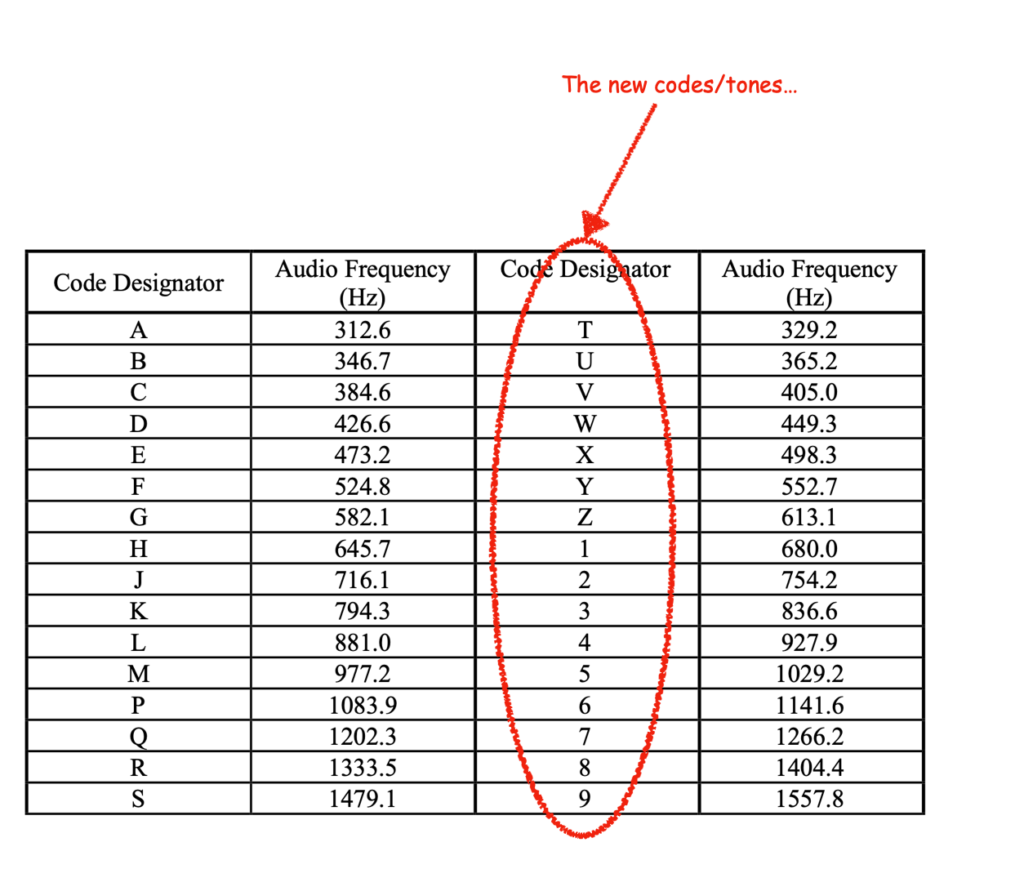
Here’s how it works. On the ground a SELCAL encoder transmits four audio tones at a time. Each tone is assigned a letter. When the four tones correspond to your aircraft’s four-letter code, a decoder in your avionics hears it and triggers a SELCAL with a noise and flashing light. That’s your cue to call ATC back. Simple.

Enter the problem. Until now, only 16 letters (and therefore tones) have been available. That means there are just shy of 11,000 codes for aircraft to use. And so far, 37,000 have been allocated. Which means double ups. And the problem isn’t going away.

There is an increasing risk that multiple aircraft in the same airspace may receive the same SELCAL, and that could spell danger. ICAO knows that, and so they’re adding 16 new tones (comprised of letters and numbers). That will bring the total to 32. And voila, ‘32-tone’ SELCAL.

This will create almost a quarter of a million unique code options and will cut the problem off at the knees.

But there’s a problem on the NAT…

On the ground, ANSPs need to upgrade their SELCAL encoders to include the new tones. ICAO has set them a target of November 3 to get it done.

However, three of the five ANSPs covering the NAT region (Gander, Shanwick and Santa Maria) have already indicated they won’t be ready until at least Spring next year. In the interim, they won’t be able to issue SELCALs to aircraft featuring the new codes (ones that contain T-Z or 1-9).

It’s not clear yet how many operators this will affect, so Nav Canada has reached out looking for more info.

They want to hear from you if:

  • You are planning on equipping your aircraft with the capability to use the new codes.
  • You have already applied for one.

You can email that info to kelly.mcilwaine@navcanada.ca, and cc in ocarrollk@iata.org. They want hear from you before August 31.

What will the procedure be without it?

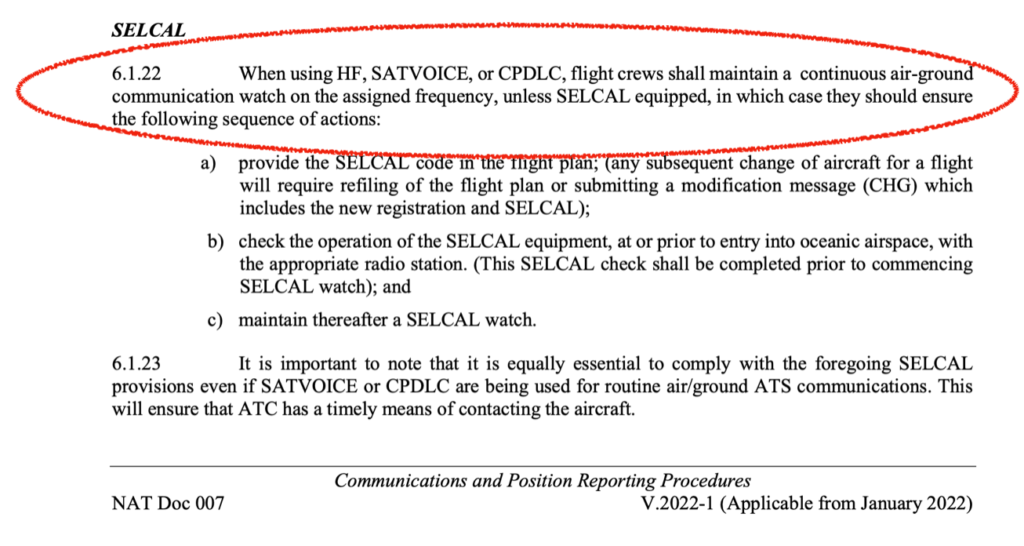
NAT Doc 007 (6.1.22) seems to have the answer, and it’s not great. As a general rule, any aircraft that can’t be reached by SELCAL must maintain a listening watch on the assigned frequency – and unfortunately that means hours of annoying static (even if your CPDLC is working just fine). Hardly ideal.

Nav Canada has confirmed to us that this will indeed will be the case. An AIC will soon be published, which is due out in September.



Need more info?

You can read more on ICAO’s SELCAL upgrade project here.

Or feel free to reach out to us directly on news@ops.group and we’ll do our best to help find the answers you’re looking for.


Go-Arounds Aren’t Normal

Go-arounds are often described as routine. And the guiding principle is that we should be ready to execute them safely, accurately, and immediately on every approach, and without hesitation.

It sounds good on paper, but this expectation is among a myriad of niceties we tell ourselves that all competent pilots have covered. And I’m not sure I agree.

For starters go-arounds aren’t routine. They’re just not.

We know this to be true. On average, a long-haul pilot will do one every five to ten years.

Secondly there are the reasons behind them. Weather related go-arounds tend not to be the ones we’re struggling with. Why? Here’s one suggestion –  because when conditions are marginal, we are ready for it – we’ve briefed it, we believe it may happen. Our brains are primed for action.

But what about when we’re not expecting it – when we’re not primed? When the weather is good, the airplane is on rails and sign-off is within arm’s reach. Are we as prepared then?  

Incident histories are littered with go-arounds gone awry, and they often have a major trend in common – the crew weren’t ready for them. Because the reason for the go-around was unexpected, it wasn’t routine.

And when we encounter a non-routine event, we become fallible to limitations that all pilots possess in times of surprise or emergencies. Enter our ‘inner ape.’ It’s hard to tame, so when we have an emergency we fall back on one particular mantra. Ape repellent, if you will – ‘aviate, navigate, communicate.’ The idea is to break down an overwhelming situation into manageable chunks.

So why then are we failing to apply the same idea to unexpected go arounds?

A healthy dose of ‘deer in headlights’ might be the answer. It’s no secret that when we are surprised, our brains stop for moment. It is hard wired into us from the days when we were running away from woolly mammoths.

Our instinct is to act now, and think later. And those big ol’ TOGA switches are a huge trigger. Once we push them, it’s on. We are bombarded with rapid fire mode changes, oodles of thrust, noise, configuration changes, high nose attitudes, and typically we’re going up faster than a fart in a bath.

Our brains can switch into overload mode – there is too much information coming at us and too fast to stay ahead of the airplane, or even with it.

Here’s a couple of scenarios to mull over – how would you manage your airplane?

  • You’re instructed to go-around above the published missed approach altitude.
  • ATC instructs you ‘caution traffic 1 o’clock 2 miles. Cancel published missed, maintain 1500′, turn left heading 180 degrees, expect visual circuit.’
  • The pilot flying is about to bust through your missed approach altitude, but isn’t responding to you or ATC.

Had we not briefed the missed approach as routine, along with the runway lighting, expected taxiway turn-off and our parking bay, we might be more prepared. But the evidence is suggesting that we’re not.

Our approach to go-around training, along with other abnormals, needs to focus on the unexpected, the non-routine. The industry has already discovered that we learn less when we know what is coming in the sim, and that the real world is rarely as forgiving.

Danger Club returns!

We’re starting the conversation at sunset. Almost dark. A French Bee A350 is landing in Paris Orly, after an 11 hour flight from SFO. Almost home. But 3 miles out, the machine says “WINDSHEAR“, and the flight goes from routine to 🤡 go-around circus 🤡 in about 10 seconds.

The F/O checks out. Startled and frozen. The captain is now single pilot, but doesn’t know it. The airplane doesn’t know it either, so keeps flying- busting the altitude, heading for departing traffic. But nobody’s flying it.

Here’s your challenge: park any judgement on the crew at the door. Step inside DANGER CLUB, and ask, with your curious-raccoon-mind: “How could this happen to me?”

This is where we might start, but we don’t know where we’re going with this one …

> Go-Arounds ain’t always easy (even if they tell us they should be)
> How bad can startle be?
> How do we get ourselves back in the game?
> Was this all the Captains doing? (Even if the report focuses on the FO)
> Do we HAVE to go-around right away?

That’s where we start … this Thursday, July 14, at 1730Z.
Will you join us, curious raccoon?

> The (very readable) accident report is here.
> Also, there is an excellent – as always – video from Mentour Pilot  about the whole incident. Highly recommend!


Hong Kong: New Runway Opening

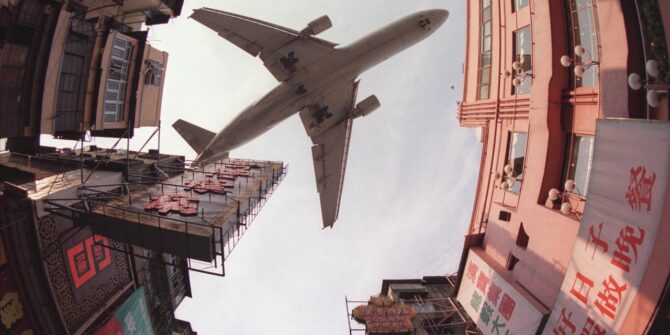
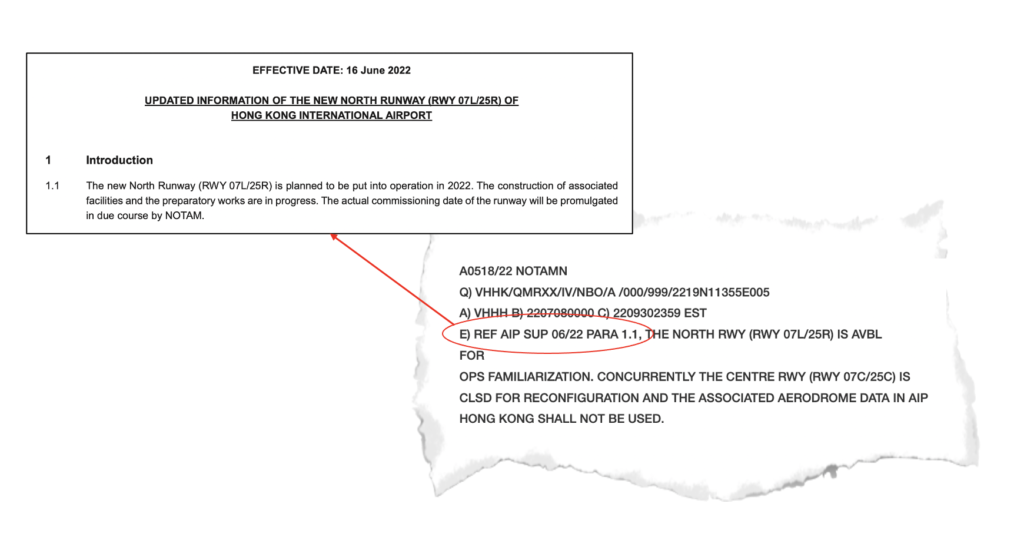
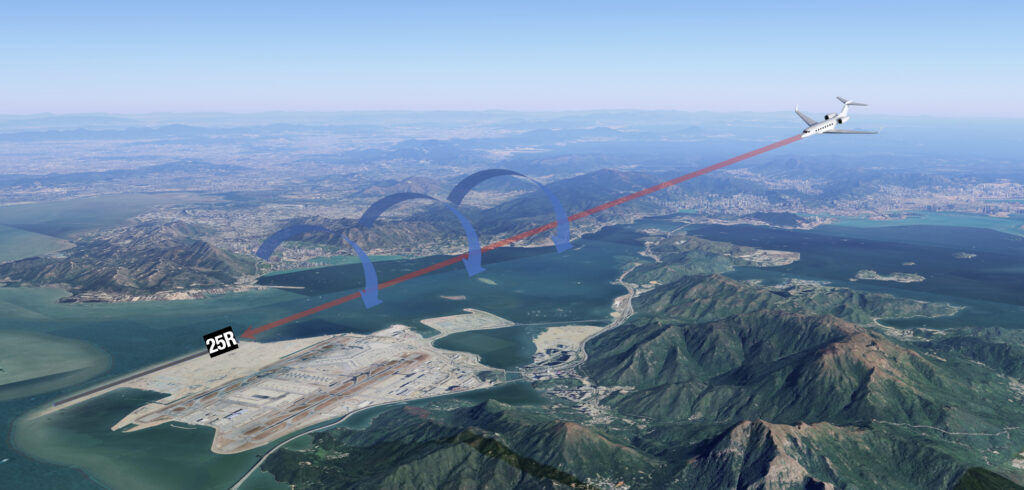
In Honkers, things are about to change. The airport’s shiny new northerly runway (07L/25R) will become operational on July 8 – earlier than expected. Although there will still be some restrictions on its use.

AIP SUP 6/22 (an 111-page ‘über-sup’) which literally swallowed a bunch of other smaller sups, was published back in April with everything you might want to know about the new runway.

Now that you stand a pretty good chance of actually using it, let us help you out by hand-picking some of the more vital ‘need-to-know’ info to keep you out of trouble.

The basics.

The recently constructed 07L/25R is  12,467′ (3,800m long) and 197′ (60m) wide.

There are ILS/LOC approaches at both ends. There are also RNP (AR) approaches, but as their names suggest, you’ll need prior approval to shoot those.

Runway 07L is also equipped with CAT II goodies (25R is CAT I only). A big head’s up though – you need to get permission from HK authorities to conduct low viz ops at VHHH before you get there. There’s a form to fill out, and of course you’ll also need to provide evidence of your state-issued approval (OpSpec C060 for US operators).

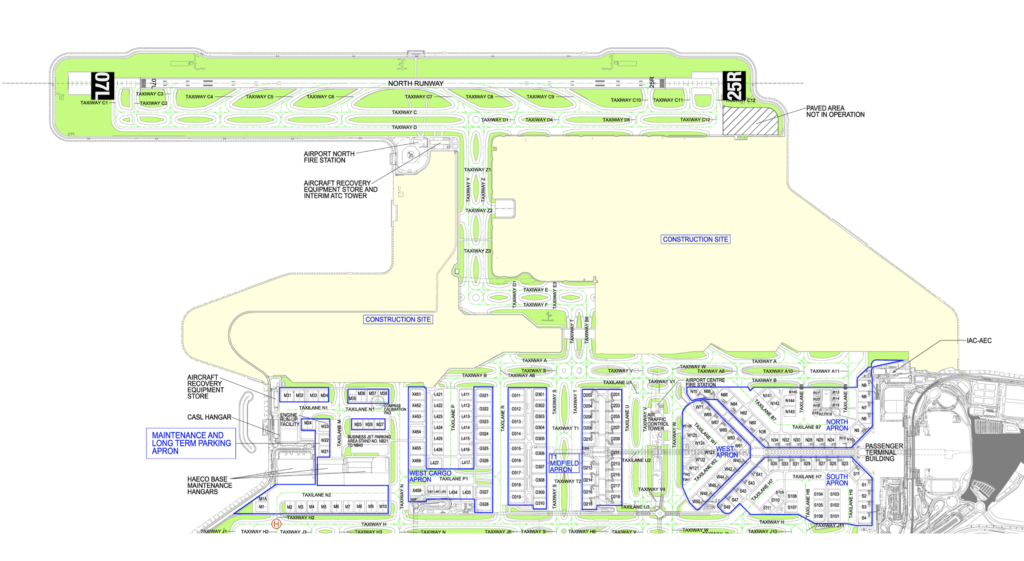
As you would expect, along with the runway will be a bunch of new taxiways too. The layout is quite straight forward:

The new ‘normal’ configuration.

The new runway (07L/25R) will normally be used for arrivals, while the southerly runway (07R/25L) will be used for departures. When winds are light or easterly, expect to land on 07L for noise abatement which is preferred.

Squashed in the middle is 07C/25C. It will be closed from July 7 until further notice, but recalled if another runway becomes blocked.

Keep an eye out for routine closures for maintenance, which may reduce the airport to single runway ops at quieter times. The weekly schedule for those closures has been published in this (much more bite-sized) SUP.

Watch those ‘fly-overs.’

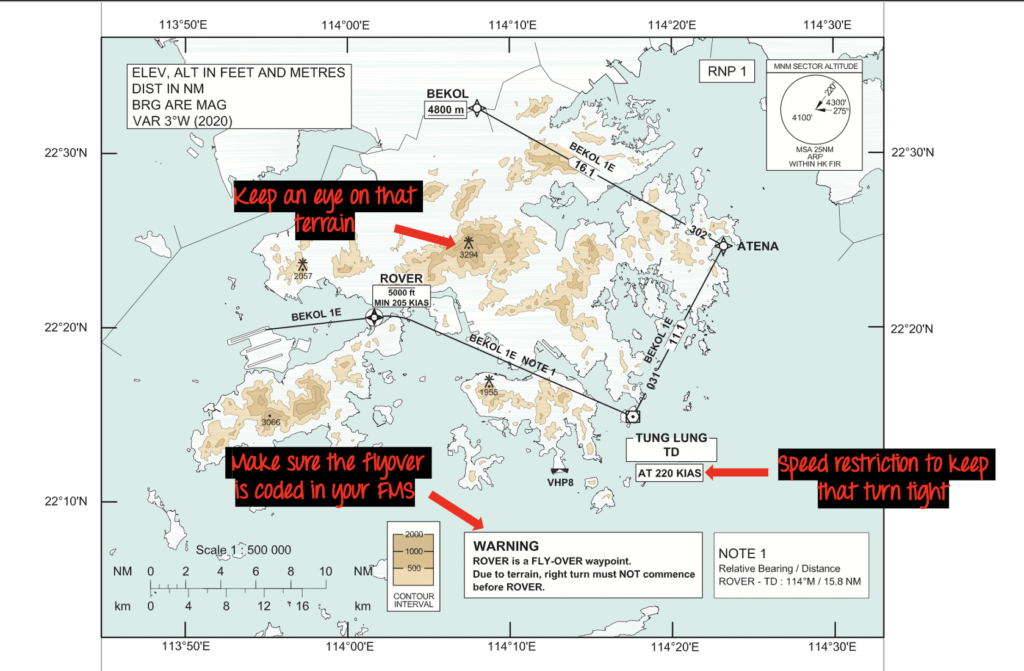
There are new RNAV SIDs and STARs for 07L/25R. Tracking is straight forward, but the major thing to look out for are fly-over waypoints. They can be lost a little in the noise of a chart, but if there is a circle around a waypoint, turn-anticipation is a no-no. Make sure the fly-over is correctly coded in your FMS. There are also speed restrictions to keep your turn radius down. The reason for these is to keep traffic well clear of high terrain just a stone’s throw away – spot heights within a mile or two of the airport reach as high as 2000.’

Wind shear.

High terrain north of the airport means that in some conditions, wind shear is a real problem.

The new runway is the closest of all of them to those hills, which means it may be the most susceptible.

Be on alert when the wind is from the Northwest through to the Northeast above 20kts, it’s going to be sporty – especially if landing on 25R. Carry fuel for a comfortable missed approach, and possible diversion.

Bad signals and false captures.

ILS interference has long been reported at VHHH due to the effects of the terrain around it. It can lead to nasty stuff like false captures and excessive descent rates. Boeing aircraft are especially susceptible (although don’t ask us why). It is often recommended that the LOC is captured first, before arming the glide slope. This has been reported on both existing runways, and so it stands to reason the new one (07L/25R) will be no different. Keep an eye on the chart notes for this one. If it happens to you, its really important to report it – there’s a form available here.

IFALPA warning…

IFALPA has issued a safety bulletin for the new runway (07L/25R). Due to terrain, the ILS is broken into two parts – an RNAV transition, and the approach itself which are found on two different charts. The bulletin has useful recommendations to stay on the correct profile, and to avoid nuisance GPWS warnings – essentially slow down and configure early. It’s also important not to arm the glideslope before the point TOPUN, due to the risk of false captures.

We need your help!

As the new runway configuration gets up and running, we’d love to hear any feedback from operators heading in there. You can reach us on news@ops.group. Or if you’d prefer, you can submit a report to Airport Spy.


Declassified: New Crew Rules in Japan

On June 13, crew entry rules were eased – under certain conditions, you no longer have to isolate in your hotel room. It’s great news for layovers – icy cold Asahi beer and delicious gyoza await.

The problem is where to find that information. The guidance online is all for passengers. So, we reached out to a local agent, who provided us with an ‘Administrative Circular’ recently issued by Japan’s CAA with all the rules just for crew.

But for some reason, we are not allowed to share it. Why? We’re not sure – it is apparently top secret. Before it becomes mission impossible and self-destructs, here is a rundown of what it contains. But you’ll have to take our word for it…

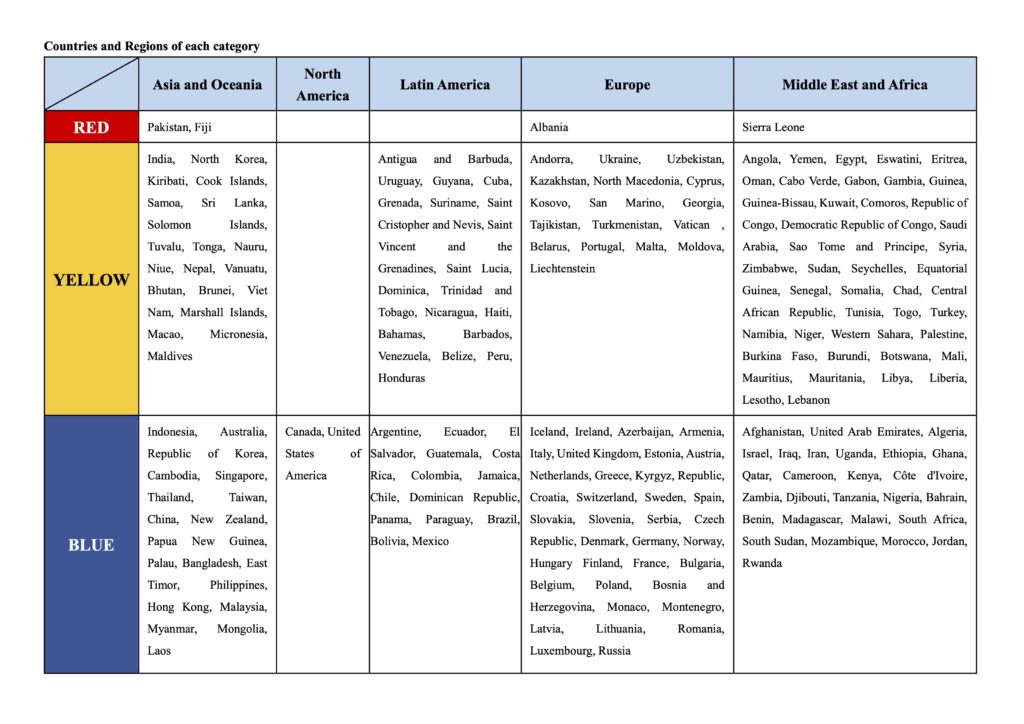
Blue, Yellow and Red

Japan has broken the world’s countries down into three categories – yep you guessed it, the colours above.

The rules you need to follow depend on where you have been in the past fourteen days – the most restrictive country applies.

Blue Countries:

This includes the US, Canada and much of Western Europe. If you haven’t been outside the list of blue countries, you will only need to provide a Covid test that is less than 72 hours old – more on that in a moment.

There is no need to provide proof of vaccination.

Yellow Countries:

Many South American, Caribbean and Eastern European countries fall into this category.

If you’ve been in one of these, you will need the same test as above with the additional requirement of being triple vaccinated – yep, all three jabs of an approved vaccine.

Red Countries:

There’s only a few of these. At the time of writing, just Pakistan, Fiji, Albania and Sierra Leone .

Unfortunately, if you have been in one of them, you will need to isolate in the hotel in addition to all the other requirements.

What Covid tests are accepted?

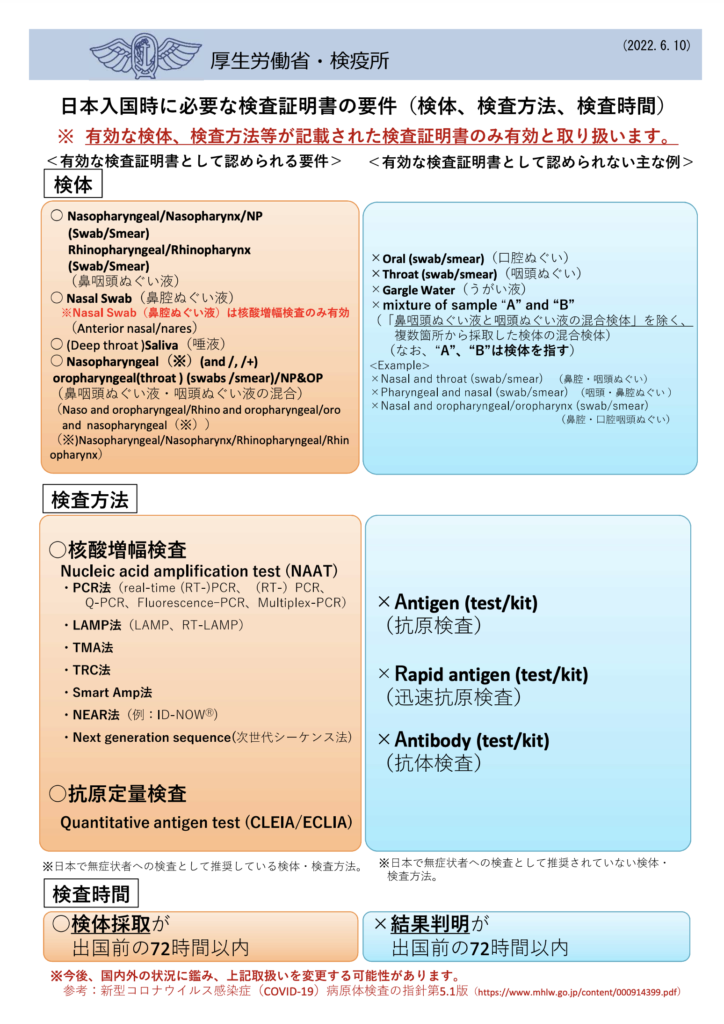
You can view the list in full here, which of course includes the gold standard PCR test.

The biggest gotcha is that rapid antigen tests (the super easy ones you can do at home) are not allowed. They are what are known as ‘qualitative’ antigen tests, and Japan has said no bueno. ‘Quantitative’ antigen tests are allowed, but they are not the same thing.

Here’s a little graphic that might help you get your head around which tests are okay for entry. Some of the details are in Japanese, but effectively the ones on the left in are okay, the ones on the right with crosses are no good.

A word about vaccines too.

 Any vaccine certificate must be issued by the government, or other official source. In either English or Japanese is fine.

You need to have received one of the following:

  • Pfizer
  • Astra Zeneca
  • Moderna
  • Janssen
  • Bharat Biotech
  • Novavax

In some cases, a single dose counts as two. You can also mix vaccine doses. More on that here.

I don’t meet some of these requirements – can I still go?

 Yep! But you’ll have to isolate in a hotel and use private transport to and from the airport.

Can I present a ‘Certificate of Recovery’ instead of a Covid test?

 It’s not mentioned in the official guidance, but local agents advise the answer is no. At this stage, you’ll have to stick to the guidelines above if you don’t want to isolate.

What do operators have to do?

Effectively screen all crew for symptoms beforehand – anyone with signs of cold and flu are not allowed to operate to Japan.

In flight, if someone starts feeling unwell, the operator needs to let the authorities know – the crew member will be tested on arrival. It will then be on the operator to get the rest of the crew tested too.

Just a note though – pilots and cabin crew are considered as being in ‘segregated’ areas. So there is no need to test a pilot if a flight attendant becomes unwell, and vice versa.

So, there you have it.

Crew are free to enjoy their layovers in Japan, as long as they meet these requirements. It also goes without saying that common precautions apply when out of your hotel – including hand washing and mask wearing.

Never washed your hands before? We’ve got you covered. Here is a detailed ‘how-to’ video along with some soothing electric keyboard.

Still have a question?

Reach out to us on news@ops.group, and we’d be happy to help.


US: 5G Rollout Near Airports Delayed Until 2023

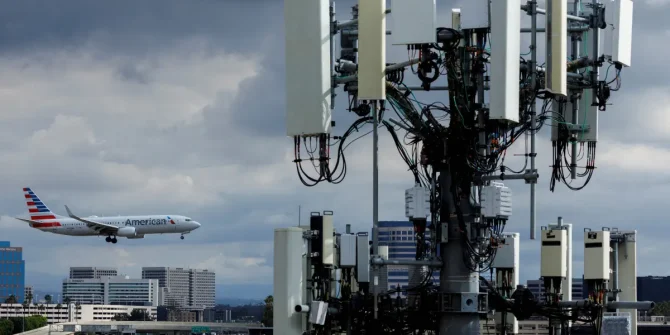
Six months have passed since the FAA hurriedly reached an agreement with Telecoms AT&T and Verizon to delay switching on powerful new 5G antennas near major airports.

That agreement was set to expire on July 5. And the original concerns haven’t gone away – 5G can still interfere with radio altimeters, and the industry is still scrambling for a fix.  If safety buffer zones were to stop buffering at larger airports, where low visibility landings are more common, the impact would have become even worse.

However, on Friday the FAA released its first update since February – and the news is good…

A new agreement

AT&T and Verizon have agreed to extend the delay until July 2023 to allow the FAA and operators more time to get their ducks in a row.

There is compromise happening on both sides of the deal. While the FAA hasn’t gone into the specifics, they have said there is now a phased rollout plan to make sure that both sides are kept happy.

The FAA will begin work to identify which airports are safe enough for the Telecoms to start enhancing their services there right away, without turning everything on.

On the flip side, there will be more time for operators of aircraft fitted with radio altimeters vulnerable to interference to replace them, or install special filters. Regional aircraft are particularly affected by this.

Considering that the first customers are only just now receiving these filters from the radio altimeter manufacturers, the original goalposts were always fairly ambitious.

A new FAA deadline for operators to complete work on their fleets is set for the end of the year, and this time it looks to be firm. The Telecoms are expecting to be let loose at the end of the new deal.

In the meantime

The status quo – existing restrictions will remain in place. Back in January over a thousand Notams (1,478 to be precise) were issued when 5G hit the proverbial fan. Many of them restrict the use of Autoland, HUD to Touchdown, and Synthetic Vision Systems at specific airports. The FAA has also published a guide that explains the different types of Notams and what those limitations mean for operators at various airports.

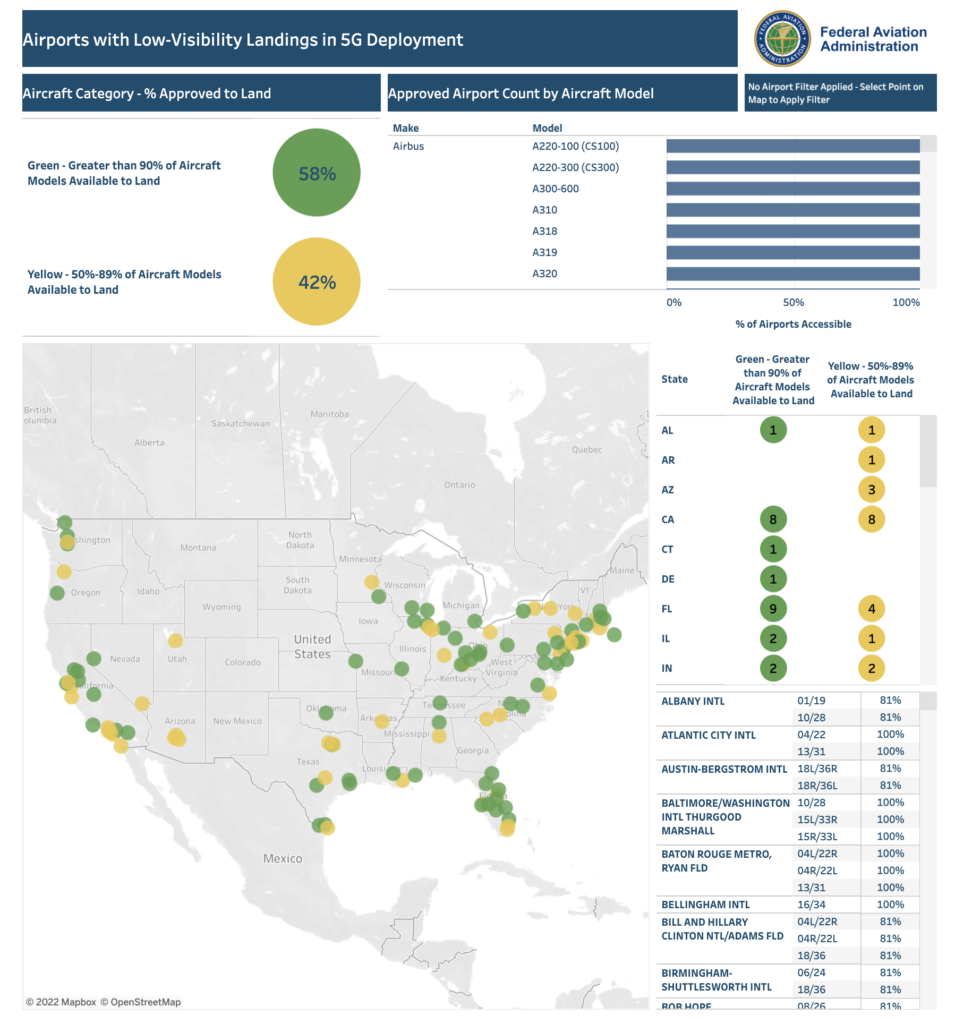
The FAA has also since provided a number of exemptions for more common passenger jets to continue with low visibility landings. You can view those through the FAA’s handy map here.

Unfortunately, the support for business jets has not been as forthcoming. If your aircraft doesn’t have an exemption, you’ll have to stick to the Notams, which means paying extra special attention to the weather and alternate planning when it’s looking murky out there.

Buffers will also remain in place at several major airports to make sure that low visibility landings can continue without causing major headaches for operators. You can view that list here.

Other things to look at

If you’d like to know more about the problem with 5G networks and aviation in more detail, we wrote a blog article earlier this year that would be a great place to start.

There’s also the FAA’s official 5G website, where updates like the one above are published.

Get in touch

If you have other questions, we’d be happy to help. You can reach us on news@ops.group.


Aloha, RIMPAC: Major Military Exercise in Hawaii

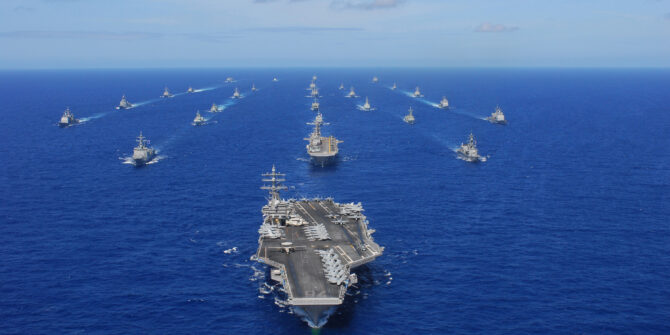
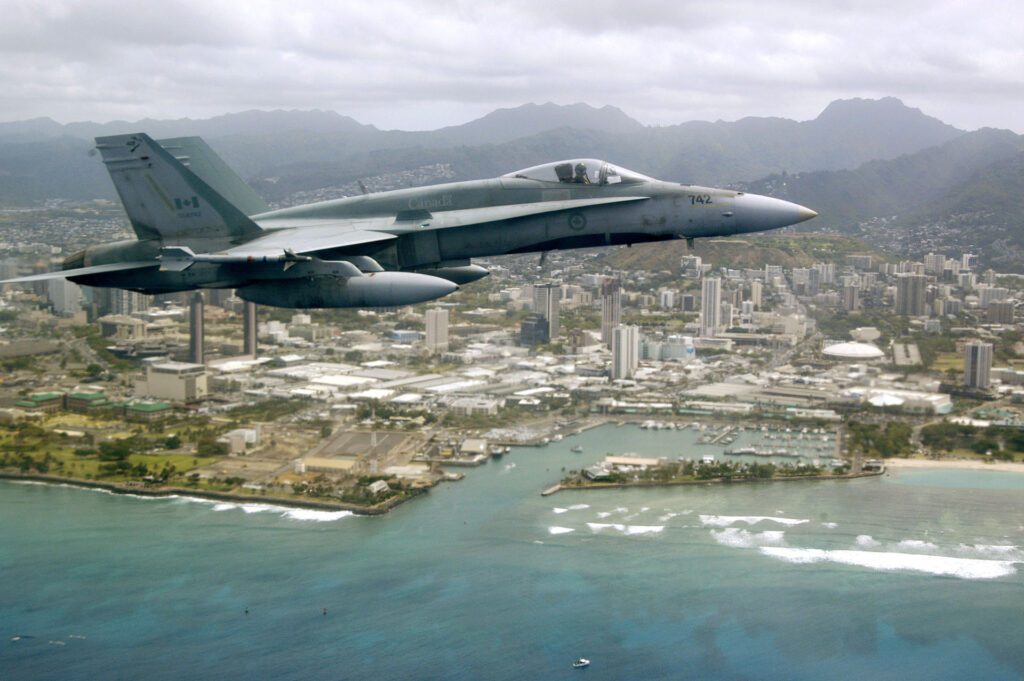
From June 29 – August 4, the world’s largest military exercise will be happening near Hawaii. It’s called the Rim of the Pacific Exercise, or RIMPAC for short.

It’s a big deal – this year over twenty-six major nations (including the US, Canada, the UK, and Australia) are taking part in extensive naval and aerial activity happening every day through a lengthy period.

If you’re operating into (or near) Hawaii during the exercise, it’d be a good idea to brief on what to expect. The FAA’s Impact Statement is the official guidance, but it’s a solid read. If you’re after something a little more bite-sized, we’ve got you covered.

Here’s a breakdown on the biggest need-to-know info…

Let’s Talk About Airspace

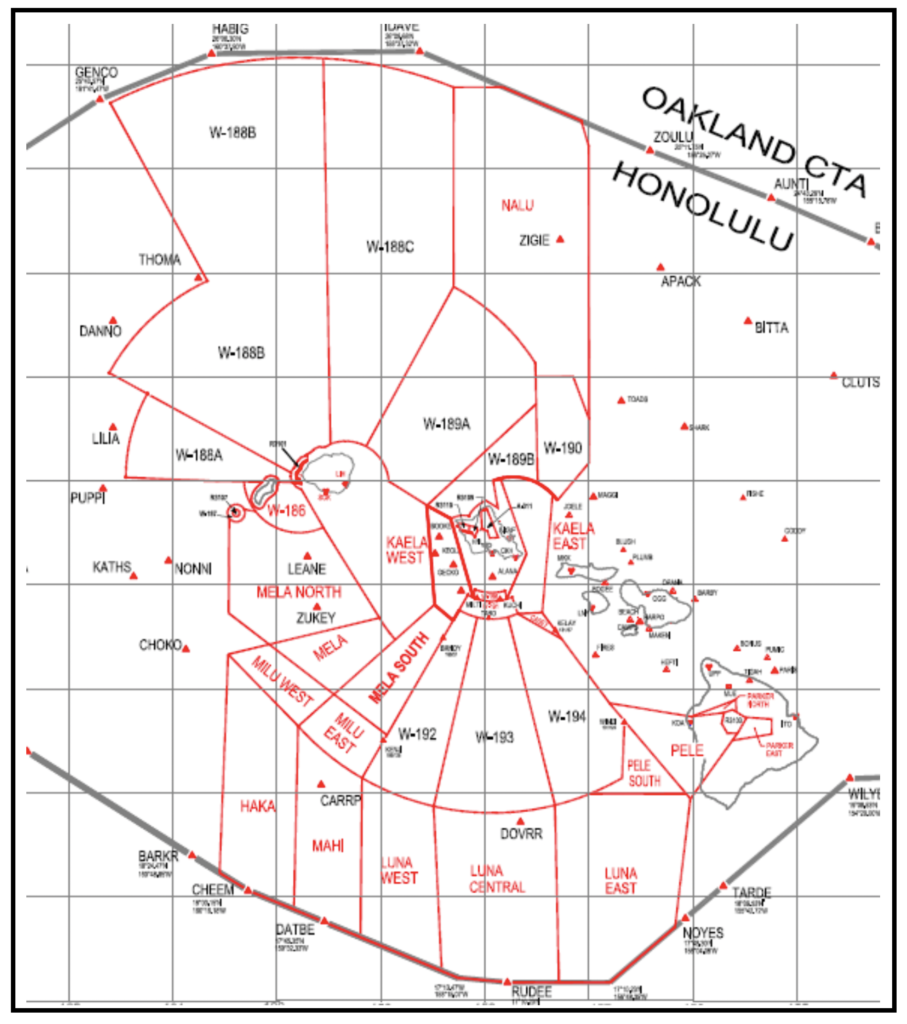
The vast majority of RIMPAC will be contained within Special Use Airspace. The usual suspects will be included – all permanent warning and restricted areas on your charts, along with other types of special use airspace with  scary looking abbreviations like ‘ATCAA,’ ‘ALTRV,’ and fancy names like ‘Nalu,’ ‘Haka’ and ‘Luna.’

Big picture – don’t go into the red boxes when they’re active (more on that in a sec).

Before you tackle the official FAA Impact Statement, for the love of Pete have a map open next to it. Once you can see where all this airspace actually is, as I learned, things suddenly get a lot easier – luckily the FAA has put one together:

Righto, timings.

Even though RIMPAC starts earlier, most of the actual flying won’t kick off until July 11.

As a general rule, any restricted airspace that goes high (Surface to FL600) will be active each day between 07:00 – 22:00 HST (17-08z). Outside of these times, any restrictions will generally be low level (less than 12,000’).

But, there are some exceptions to look out for. Got that map ready? Bueno…

The big one is that MILU East, MILU South, W-192/3/4 (all south of Oahu) will remain in effect 24/7, and at all levels.

There are also some subtle differences to timings for W189B and W190 which also extend up high. These are only active from mid-afternoon.

What will be the impact?

Just remember: 15 minutes. It seems to be the magic number.

You can still file as per normal, but if you’re operating on an affected route (including some PACOTS), you’ll have to accept delays for re-routes of up to 15 minutes. Which means more contingency fuel.

Here are the routes that the FAA’s guidance specifically mentions:

To/from Asia:

PACOT tracks 11/12 and A/B between Hawaii and the Far East.

To/from the US:

If you’re routing between the Pacific Northwest and Hawaii, try and plan above FL290. If you’re unable to, ‘Nalu’ will get in the way. ATC will be able to vector you onto another airway (A331), but it will mean a reroute. If you can stay above, there will be no impact.

If you’re headed to or from the Pacific Southwest, ‘Mahi’ and ‘Haka’ will affect flights at all levels, with the same delays.

To/from the South Pacific:

Flights between Hawaii and Tahiti, Fiji and Samoa will be impacted by Luna West, Central and East can also expect reroutes.

The FAA advise in all cases, the delays will not be worse than fifteen minutes (and that’s a worst case scenario).

What about Hono?

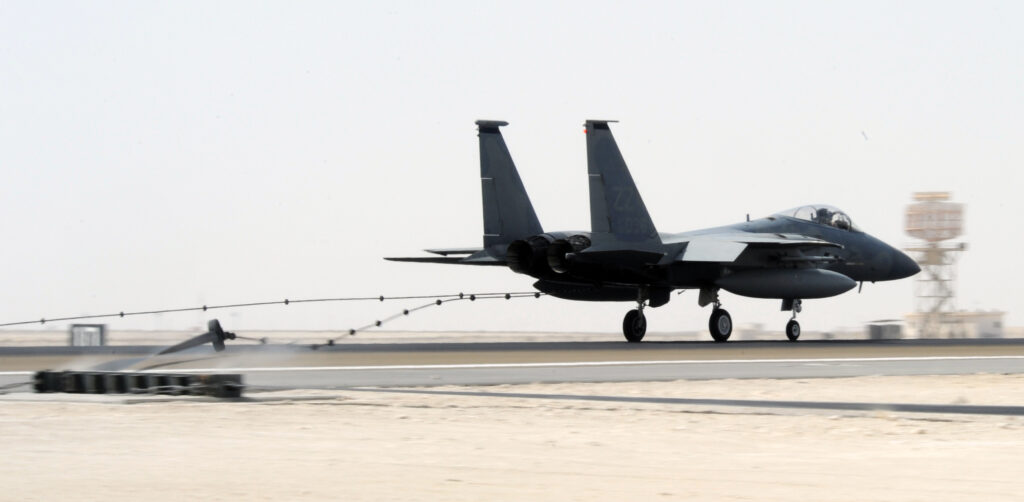
Retractable barriers are present on three of PHNL/Honolulu’s four runways, which are used to simulate carrier landings – pretty neat huh?

The only downside is that when a capture is needed, that runway will be unavailable for forty-five minutes. The FAA advise that this could cause delays of up to fifteen minutes while ATC juggles things around.

Then there’s the two nearby military airports – PHIK/Hickam and PHNG/Kaneoehe Bay. As they will be used to house a number of military aircraft transiting to and from the exercise (the rest will be on a carrier), ATC may need to implement flow control at PHNL/Honolulu to keep things within capacity. Again, nothing worse than 15 minutes…see, the magic number.

I need to speak to someone.

The FAA has listed two contacts over at the Honolulu Control Facility:

John Wennes – john.h.wennes@faa.gov, 808-840-6161

Antonio Carrilho – Antonio.a.carrilho@faa.gov, 808-840-6203

Or give the OPSGROUP team a shout on team@ops.group, and we’ll do our best to help.


Always Listening: Black Boxes in the Cloud

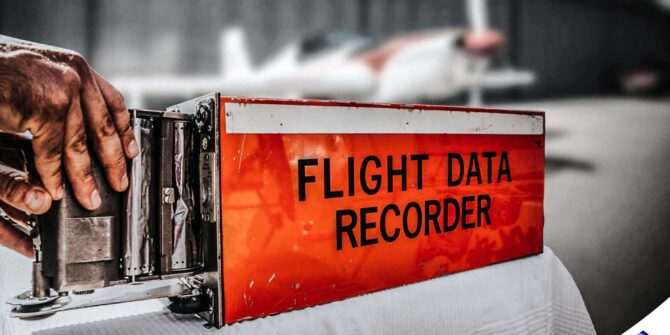
The problem with black boxes is that they are attached to the airplane.

Although their contents are invaluable for figuring out the cause of an accident, if we can’t find the airframe, we don’t get the answers.

It took two years to find Air France 447, while Malaysian 370 remains lost to this day. The industry seems to be becoming more aware that there is something wrong with the way we have been tracking, searching for, and finding accident aircraft.

And as part of this, there is an emerging push for black box data to be streamed live during a flight using internet-based technology.

From a safety perspective, it makes sense. But from a practical standpoint, it’s not all smooth sailing. Here’s a brief look at how these new technologies might work, and why organisations such as IFALPA, along with some pilots, are still pushing back.

The ‘Cloud’.

Storing data in the cloud is becoming a reality with both flight data and voice. All you really need is an internet connection to let the magic happen.

With that in mind, the idea is that black box data could be streamed to the cloud constantly. Meaning it is immediately available to safety investigators if or when an accident or incident happens.

ICAO.

As a result of accidents like the ones mentioned above, ICAO is implementing a mandate for new aircraft with MTOWs over 27,000kg (60,000lbs) due to come into effect from 2023.

It’s an extension of their Global Aeronautical Distress and Safety System, or simply ‘GADSS’ – their initiative to make tracking and finding aircraft in emergencies much more efficient.

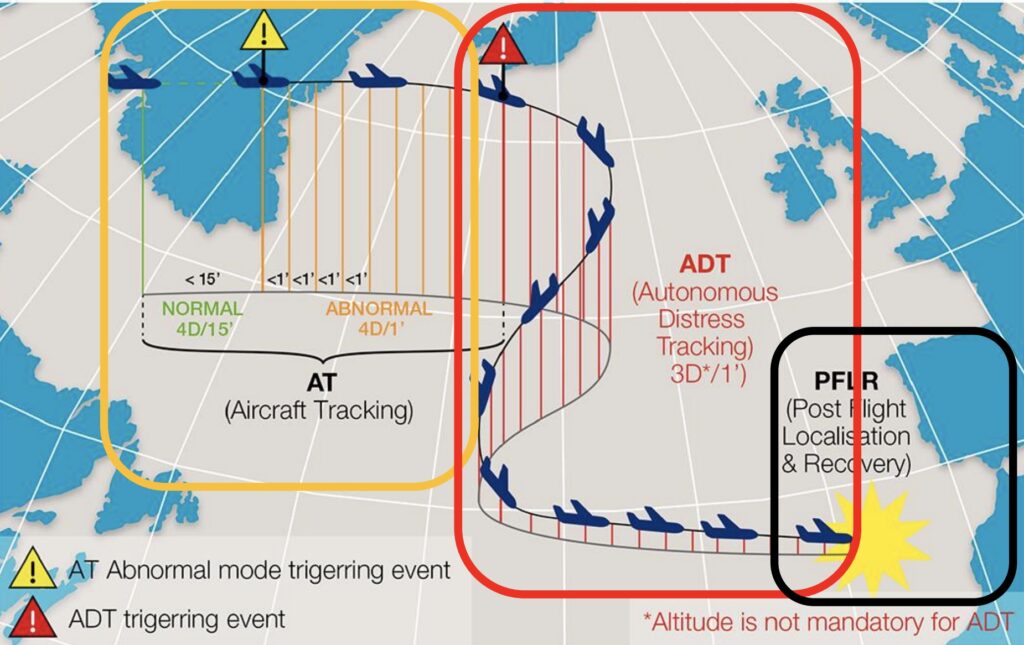
A big part of it is that onboard equipment will need to recognise abnormal or emergency conditions from parameters such as speed or unusual attitudes automatically, and then begin broadcasting very accurate position reports as often as once a minute – as opposed to the 15 minutes when ops are normal.

Big Tech.

Technologies are being developed to allow manufacturers to comply with these GADSS requirements, and in some cases they are taking things one stop further – to include flight data streaming.

Take Satellite Communication heavy hitter Inmarsat for example. Their ‘Black Box in a Cloud’ solution allows data to be live streamed via the internet, to the ground as soon as there is sign of trouble.

Honeywell and Curtiss-Wright have also joined forces to develop new recorders capable of continuous transmission to their own facilities on the ground.

IFALPA says nay…for now anyway.

So on the face of it, black box streaming seems like a no-brainer.

But there are still concerns. On May 9, IFALPA published a position paper on just this issue – and it seems they’re not on board yet, due to security concerns.

Streaming flight data on the internet may open the door to those wanting to leak, or corrupt it. It is important that the media and public domain don’t get a hold it before investigations have taken place, and there may even be those with more malicious intent who want to alter it in some way.

And there are no existing technologies that are 100% secure. IFALPA argue that as the technology develops, so too must our ability to protect it. And until then, IFALPA will remain opposed to it.

Other problems.

It’s not just security either. Here are some other roadblocks that live flight data streaming faces:

Privacy – across the board there may be push back from crew who, understandably, don’t want their voices recorded and broadcast to the internet. It may be for similar reasons why the industry has resisted the use of cockpit video recordings for the past two decades, despite the desires of the ATSB.

Cost – The suggestion of retrofitting this type of technology to existing airframes would be timely and very costly. And in the current industry environment, there is likely to be significant push-back on introducing additional expenses.

Speed – Have you ever tried to stream a movie on that hideously long red-eye? It can be notoriously slow and unreliable – especially in more remote parts of the world. Flight data recorders also save an immense amount of data, which means satellite time and storage could become uber-expensive.

For live flight data streaming to be effective and reliable, the logistics behind it also need to be rock solid. And there are concerns we’re not there yet.

Live flight data streaming will eventually become the new normal. But how long that takes depends on the aviation’s ability to overcome these hurdles.


Busy Week in LA: Special Flight Procedures

It’s a busy few days in the skies of Los Angeles this week.

A major political event – The Summit of The Americas – is happening there from June 6-10. A number of TFRs will become active affecting access to numerous airports throughout the LA Basin.

The FAA has now published the details, so let’s took a closer look.

Update on Restricted Airspace

It looks as if some newer TFRs were issued after we posted this post. First up, check the list because we can’t predict changes and they do happen.

But right now, we can see a few more like 2/5019, 2/5016, 2/5015 which might get in your way if you’re not a scheduled commercial service. These don’t supersede the other, they are for shorter time periods. But they are a lot more prohibitive (particularly if you’re a GA or private flight wanting to get into KLAX).

Restricted Airspace

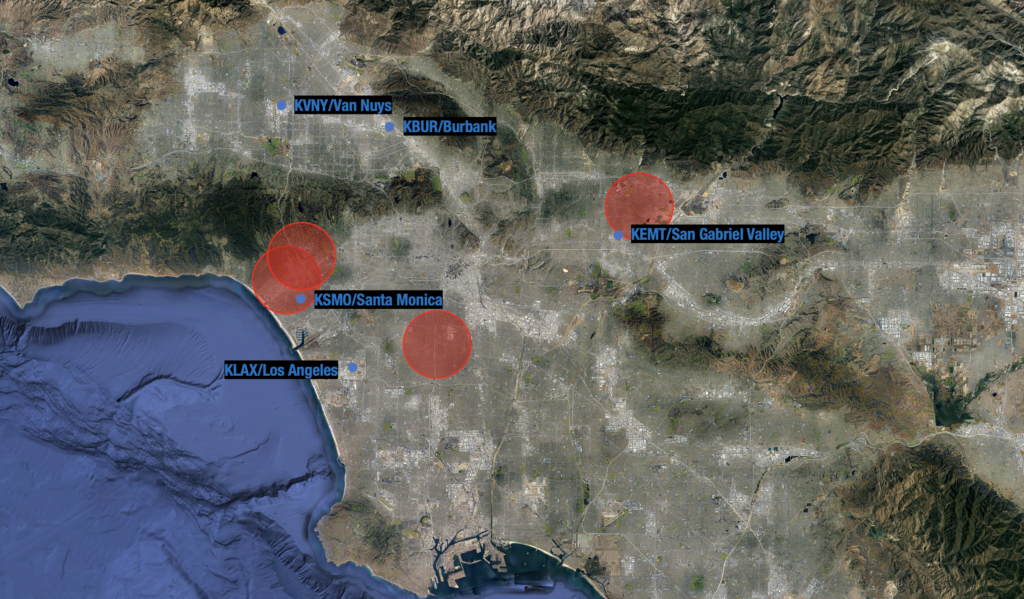
There will be four TFRs becoming active in the LA area. Three of them are further west near Santa Monica and Central LA, while the fourth is out east near Pomona. The upper limit of all of them is 2,999’.

They will be active each day of the event at various times which you can access here.

If you’re operating on a valid flight plan in or out of KLAX/Los Angeles, KSMO/Santa Monica or KEMT/San Gabriel Valley then you won’t be affected.

Otherwise only essential traffic will be allowed through – SAR, medical, fire-fighting, or if you’re experiencing an emergency.

If you are allowed into one, make sure you’re squawking a discrete code. The FAA are reminding us that the timings and positions of the TFRs are subject to last minute changes, so keep an eye on the Notams too. The current one is FDC 2/4276 – and it’s a solid read. So, here’s a picture, because we like pictures more.

Impact

The majority of VIP movements will be via KLAX/Los Angeles. Although they are possible at other airports too.

Traffic may be given priority to enter the queue which means potential holding, slow-downs or delaying vectors. The impact will likely be minor, but a little common sense may prevail here – consider topping the tanks off with some extra contingency fuel just in case.

The largest impacts will be felt at KVNY/Van Nuys and KBUR/Burbank – flights in and out of these are not exempt from the TFR restrictions, so if you’re heading in or out of one, here is what to expect:

Head-to-Head

 Or in other words, opposite direction operations at both airports (weather permitting). It is not a normal configuration, and may take a little extra briefing – especially when it comes to traffic and runway awareness.

STARs (and not the Hollywood Type)

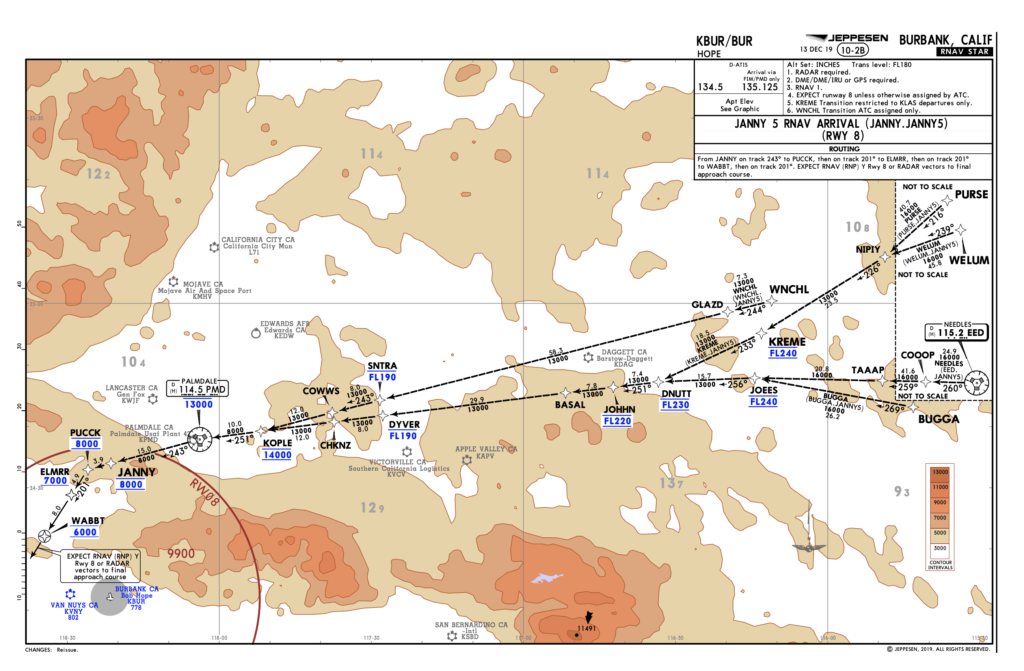
 Over at KBUR/Burbank arrivals from the east can expect and plan for the JANNY 5 when the TFRs are active. This will temporarily replace the usual THRNE 3.

Overflights

SOCAL Terminal Area Control traffic which usually routes via V186, V201 and V459 can expect to fly via the Palmdale (PMD) VOR instead.

Other tower en-route control (TEC) routes may be unavailable during the next few days too.

I still have questions…

Detailed information on the TFR can be found on the FAA’s official website, here. Or if you still have a conundrum to solve, you can contact Flight Service 800-992-7433.

Otherwise get in touch with us on team@ops.group and we’ll do our best to help!


Oshkosh 22′: Special IFR Flight Procedures

It’s that time of year again – Oshkosh 22’ is just around the corner. The world-famous air show is happening this year from July 25 – 31.

And as you’d expect, it’s going to be big. In fact, it will have the highest concentration of airplanes in the world. Over 10,000 of them to be precise, along with more than 700,000 fans.

To help with the influx of traffic, special air procedures have been published. They’re effective from July 21 – 31 and apply to several airports in the region, not just KOSH/Oshkosh itself.

You may not be headed in for the show, but if you are chartered to take people there (or anywhere near it), it’s time to start planning.

At over thirty pages, the official doc is a solid read. To get you started, here’s a bite-sized summary of the major points for regular turbine IFR operators.

Special Procedures – Managing the flow

There are thirteen airports in the Oshkosh area that the generic procedures apply to. In a nutshell, if you’re headed to one, you will need to take part in the IFR Reservation Program. Or in other words, if you’re non-scheduled, you’ll need a slot.

Big things to know for arrivals:

  • They will become available at 17z on July 18, here.
  • They won’t be issued more than 72 hours in advance.
  • You have to confirm your slot within 12-24 hours of your flight (or you’ll lose it).
  • You must include your final confirmation number in your flight plan.

Ops tip: When working out your ETA, they suggest adding 30 minutes for delays (along with fuel).

The good news is that things are a little easier for departures – only KOSH/Oshkosh itself requires a slot through the same process.

Filing your flight plan

A little common sense prevails here – file early. You can file an IFR plan up to 22 hours in advance. At seven of the Oshkosh area airports, only approved IFR routes in an out are allowed. For arrivals click here, for departures click here.

Picking up your IFR clearance

If you’re departing any airport within 600nm of KOSH (even if you’re not headed near the show), it’s a good idea to get your clearance on the ground to save on airborne delays.

Within 150nm, airborne clearances will be no-bueno, so don’t try it. ATC won’t issue them.

Another ops tip: Avoid plans with multiple stops. ATC advise it is better to file separate plans for each leg.

Airport Specific Procedures

Three airports have their own specific procedures (in addition to the above). Let’s take a look.

KOSH/Oshkosh

If you’re headed into Oshkosh itself and the weather is good (ceiling 4,500’+, visibility > 5’), turbine aircraft are asked to cancel IFR at 60nm and transition to the arrival below.

Make sure you grow eyes in the back of your head for other traffic, it’s going be busy.

When you land, you’ll need a nice big sign to show where you’ll be parking to show marshals outside of the left window. Unless you’re staying for the show, it will likely be ‘FBO’ for the Basler Ramp (assuming you have arranged this beforehand).

Chances are though, most non-scheduled charters won’t be operating into KOSH/Oshkosh. Here are the next two closest options.

KFLD/Fond du Lac

  • Distance from Oshkosh: 14nm
  • Longest runway: 5941’ (1800m)
  • Parking: Fond du Lack Skyport (920-922-6000)

The FBO is only open between the hours of 06:30 and 21:00LT.

The biggest gotcha is there will be a temporary control tower in place from July 23 – 31, operating between 07:00 and 20:30LT (closing a bit earlier on the last day).

You’ll need to contact them at 10nm inbound. They’re expecting things to be really busy to – so take fuel for holding. They also recommend you arrive before sunset for safety.

If the weather is good, expect to cancel IFR and fly a visual approach.

KATW/Appleton

  •  Distance from Oshkosh: 17nm
  • Longest runway: 8003’ (2439m).
  • Parking: Appleton Flight Center (920-738-3034)

The airport is controlled between 05:30 and 23:00 LT every day.

The Main Event Itself

KOSH/Oshkosh will closed to all non-air show traffic during the actual displays.

The action will happen in a TFR within a 5nm radius of the airport up to 16,000.’ It will be active each afternoon during the event dates, and on two evenings – July 27 and 30. The exact timings will be published here, during which time the airport will be closed.

Need more help?

The official notice is the place to start – it’s lengthy, but it’s written in plain language which we like.

If you’re having difficulty reserving an IFR slot, contact the Airport Reservation Office at (540) 422-4246.

If your question is about something else, you can reach us on news@ops.group and we’ll do our best to help, or find the right person who can.


OPSCHAT Summary May 31

Hi Everyone,

It was another great OPSCHAT call this week hosted by Rebecca, with the help of returning quiz master Dave.

You can watch the full replay on your Member’s Dashboard.

Here’s a roundup of what we talked about:

The Big News

  • Sri Lanka – A new VCCF Notam has been issued telling operators to tanker in fuel. A domestic crisis there has lead to widespread fuel shortages along with security issues. We talk about alternative options for fuel stops.
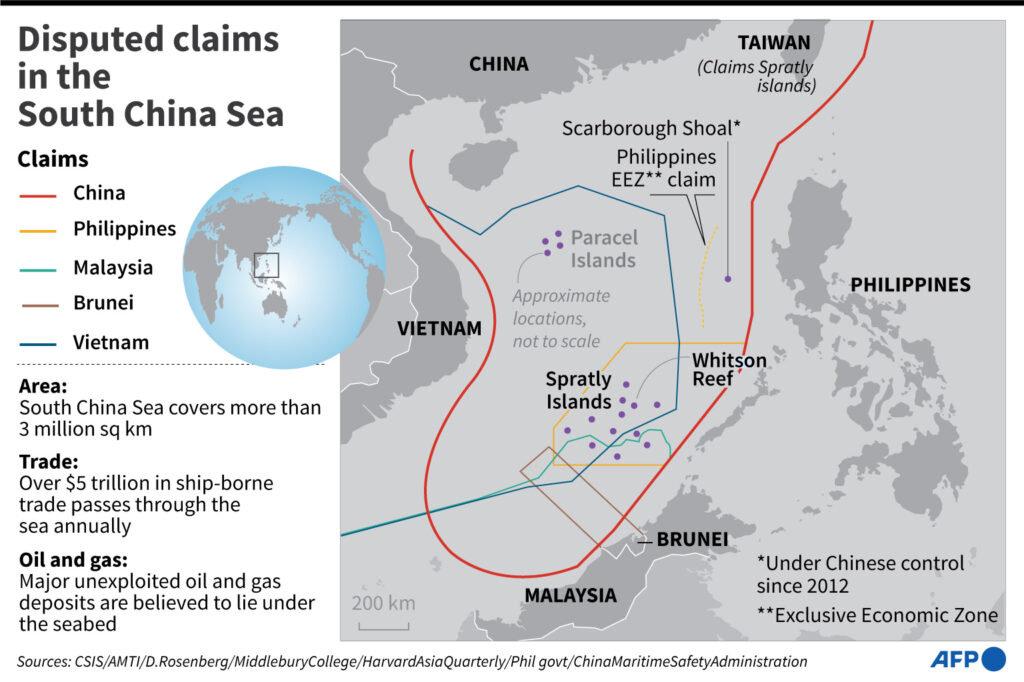
  • East China Sea – Unverified footage emerged this week of a missile launch filmed from the flight deck of a commercial airliner. No official sources have released a statement. Real or not, we briefly touch upon the ongoing dispute in the region and what to look out for.
  • Canada – Construction is causing delays at CYYZ/Toronto. But in better news, a new list of 47 smaller airports has been published which can now be used as a point of entry.
  • Bermuda – A TCAS mandate is on the horizon for next year. Some aircraft will be exempt – we take a look at the specifics.
  • The NAT – A military exercise will affect some tango routes on June 1 and 2 – keep an eye on the Notams if you’re flying those tracks in the next 48 hours. [NOW CANCELLED]

Unsolved Mysteries

Bahamas: The new ‘Click2Clear’ system has left us scratching our heads. Does anyone have solid intel on who needs to use it, and who doesn’t?

EU LISA: That old chestnut. We still don’t have all the answers, but we’ve received a solid update, and discuss the latest we know.

OPSQUIZ

Dave was back to host this week’s OPSQUIZ. Congrats to this week’s winner, “Leroy”. A juicy prize is on its way to you…

As always, we’re here to help with any operational support, info or questions. You can reach us on news@ops.group, or via the slack channels #flightops and #questions.

To watch the replay of the OPSCHAT in full: head over to the dashboard. We hold a new one every week on Tuesdays at 2000z, click here to register and join us live. See you next week!


What’s going on at Schiphol?

In the past few weeks and months, we’ve been reporting on delays at major European airports. But one in particular has been making headlines more than any other – Amsterdam’s EHAM/Schiphol.

Overcrowding and understaffing have been causing multi-hour queues to clear security, or collect baggage. In fact, things have gotten so bad that airport authorities previously closed roads and asked major carriers to cancel their flights there. And it looks like there is more to come.

But why Schiphol, and why now? There’s more to it than simply the Northern Summer. Let’s take a closer look at what’s happening there.

The Perfect Storm

The trouble at Schiphol is a unique brew of delay-inducing ingredients, all happening at the same time:

  • Industrial action
  • Surging demand
  • Staffing
  • Weather

Strikes

On April 23, airport staff went on an unannounced strike which brought ops to a grinding halt for several hours. The airport became overcrowded with passengers unable to travel, and authorities scrambled to close road access to the airport before things got any worse.

The news is that this may be about to happen again. A major union of airport workers (FNV) has announced their intention to strike from June 1 over pay and conditions – the impact could last for several days.

Crowds

It’s good news for the industry, but not so much for airports struggling to play catch-up. EHAM/Schiphol is one of the busiest airports by pax numbers in Europe, based on the latest stats. It’s streaks ahead of Frankfurt, Munich and even big hitter, Heathrow.

All those passengers are causing a log jam, and some aren’t happy about it. On May 22, news broke that a threatening security situation developed at security by passengers stuck in forever-queues, when staff began to feel unsafe  – some even walked off the job. Military police were called in to calm the situation down before processing resumed. Which brings us to the next issue – staff, or lack thereof.

Getting more people

With Covid restrictions easing, passenger levels are steadily increasing, but staffing levels are lagging behind – it takes time to find and train new manpower. It is an emerging problem in a resurgent industry, with airports across the globe reporting similar problems. It seems that Schiphol is one of the worst affected.

Those Pesky Clouds

Talk about the straw that broke the camel’s back, but the weather has also been playing a role. Or more specifically, clouds have been.

On May 24, Eurocontrol reported that low clouds were delaying inbound flights due to arrivals being regulated with holding or other delaying actions. Perhaps the only good news is that summer is just around the corner, and with it, better conditions for flying.

Outlook

With the crowds going nowhere, and strikes on the horizon, it seems things will get worse before they get better. While impacts on the ground may be bigger for scheduled operators, airborne delays affect everyone.

What are the alternatives?

The good news is that there are a couple of good options nearby which may keep you clear from the log jam.

EHRD/Rotterdam

It’s only 24nm away, and about a fifty-minute drive to Amsterdam Central. It’s the nearest international option with customs.

Handling:

EHEH/Eindhoven

A little further afield at 56nm, about an hour and fifteen minutes on the road.

Handling:

Stay updated

For major delays, the best place to stay informed is the Eurocontrol website here, which is updated around the clock.


OPSCHAT Summary May 24

Hi Members,

We had another busy OPSCHAT call this week, including the return of the weekly quiz with the help of Quiz Master Dave.

You can watch the full replay on your Member’s Dashboard.

Here’s a roundup of what we talked about:

The Big News

  • Cuba – The US Govt is set to lift airport restrictions on US commercial operators in Cuba – the big news is that Havana will no longer be the only option. There’s been no news yet on whether the ban on private ops will be lifted.
  • Las Vegas – The three big airports KLAS/Las Vegas, KHND/Henderson and KVGT/North Las Vegas will see very high traffic volumes this Memorial Day weekend. Expect holding and other delays, and consider extra fuel.
  • France – Two big events are happening at almost the same time in Southern France – the Cannes Film Festival and Monaco F1 Grand Prix. Special procedures are in place at both LFMD/Cannes and LFMN/Nice airports.
  • Europe – UEFA Soccer finals are happening in both Tirana (Albania) on May 25, and Paris on May 28. We talk about the impact to ops, and how to find more info.
  • Europe (again) – Look out for the ADS-B mandate which comes into effect on June 7 next year. Unless you’re flying something very small, or very slow, your ride will likely be affected.

Unsolved Mysteries

East Hampton Airport – has anyone had any luck actually getting hold of the incoming approvals needed to land or use the instrument approaches?

Saudi Arabia – the crew visa is only valid for 72 hours. Is there anyway to get an extension beforehand, that doesn’t cost the earth?

OPSQUIZ

Dave took the wheel this week, and hosted another quiz. Congratulations to this week’s winner who is all the way down in Auckland, New Zealand. Well done! Here’s a sample question from this week: Which major European airport closed briefly last week due to a building fire? Join us next time as we have great prizes on offer, all hand picked by our quirky team!

As always, we’re here to help with any operational support, info or questions. You can reach us on news@ops.group, or via the slack channels #flightops and #questions.

To watch the replay of the OPSCHAT in full: head over to the dashboard. We hold a new one every week on Tuesdays at 2000z, click here to register and join us live. See you next week!


Formula 1 & Movie Stars: Special Procedures in Southern France

In Southern France, two of the biggest events of the year are taking place almost simultaneously – and it’s the perfect storm for an influx of private jet traffic to the region’s main airports.

The Cannes Film Festival has just started, and will run until May 28. This is followed by the Formula 1 Monaco Grand Prix on May 29.  As one of the most famous events in motorsport, it attracts huge crowds. Both these events are happening within 50nm of each other.

As a result, the nearest major airports, LFMD/Cannes and LFMN/Nice will see much higher traffic volumes than normal – and both airports are heavily restricting operations.

Three AIP SUPs have been issued for the events . Don’t feel like delving into all of them? We don’t blame you. Here’s a quick summary of what they cover.

LFMD/Cannes

AIP SUP 052/22 has the deets here.

The apron is going to be full. The airport isn’t normally coordinated, but you’ll need a slot if operating in or out between May 17 – 30. You’ll get a slot ID that needs to go into Item 18 on your ICAO flight plan.

Even if you like to manage things yourself, the use of handling agents will be mandatory during this time.

Also, if you’re planning on a short hop to LFMN/Nice on May 28-30, no bueno. More on that below.

Monaco

Monaco itself doesn’t have an airport. In fact, it is the second smallest country in the world and is found on France’s Côte d’Azur – its south-eastern coast. Inside Monaco is the district of Monte Carlo, where the race is taking place.

The majority of passengers for the Grand Prix will enter via LFMN/Nice which is found around 20nm further west along the coast.

LFMN/Nice

AIP SUP 058/22 is the one to check here.

  • All arriving and departing aircraft operating at Nice from May 24 -30 will also need to co-ordinate a time slot. You can either request one directly, or ask your handling agent to get one for you.
  • You won’t be eligible for a slot unless your handler has guaranteed you a parking space when you get there – so make sure there is room for your ride first.
  • When filing your flight plan, commercial operators won’t need to include their slot ID number. But if your arrival or departure time is outside your allocated slot, your plan will bounce back.

Restricted airspace.

Info on this is published in yet another SUP – this one: AIP SUP 107/22

  • From May 28 – May 30, special restrictions will apply to all traffic.
  • All VFR ops will be banned, and IFR flights will not be allowed between LFMN/Nice and LFMD/Cannes, which is a little further west along the coast.
  • There will be intensive low level helicopter traffic to look out for. For IFR traffic departing on a SID, it is important to follow published climb gradients and altitude requirements.
  • If you don’t think your ride will make it, you’ll need to let ATC know with your start up request. In that case you may get hit with a delay, but don’t spring it on them at the last minute.
  • A temporary restricted area will be in effect which will primarily affect traffic over the event, and at LFMN/Nice airport, and will apply from surface to 3,500’.
  • If you’re operating on a valid flight plan, the impact will pretty minor. Just make sure you are in contact with Nice Tower on 122.375, and follow their instructions. You’ll need permission to enter it.

The big question, who will win?

Not only is he the championship leader, but Ferrari driver Charles Leclerc is also a local to Monaco. He’s the home favourite to top the podium on race day.

Some useful contacts.


LFMD/Cannes Airport Authority +33 (0) 4 89 88 98 28.

Handling

Skyvalet  +33 (0) 4 93 90 41 10, operations-acm@cote-azur.aeroport.fr


LFMN/Nice Airport Authority +33 (0) 4 93 17 21 18. If you’re looking to get a slot approval directly from them, email nice-caz-agta-ld@aviation-civille.gouv.fr.

Handling

Menzies +33 (0) 4 83 76 26 02, Florence.augustyniak@johnmenzies.aero

Signature +33 (0) 4 93 21 82 18, NCE@signatureflight.fr

Swissport  +33 (0) 4 93 21 58 12, nce.operations@swissportexecutive.com


OPSCHAT Summary May 17

Hi Members,

It was another busy OPSCHAT this week!

You can watch the full replay on your Member’s Dashboard.

Here’s a roundup of what we talked about:

The Big News

  • Europe – Some Schengen Area countries have extended their internal border controls for another six months due to “security concerns”: Austria, Denmark, Germany, Norway, Sweden, and France. The EU aren’t happy about this because it’s questionable whether there’s really any new threat here. The impact to ops is essentially delays – all passengers and crew will have their passport details checked thoroughly as if they were arriving from outside of the region.
  • United States – There are ops updates for several airports. KCOS/Colorado Springs has been affected this week by grass fires, KASE/Aspen is open again, there are long delays at KIAD/Washington Dulles due to runway work, KHTO/East Hampton has new operating rules, and PPR is needed for non-sched ops at KBOS/Boston until late June.
  • Switzerland -The World Economic Forum is happening from May 20 – 26. Airport and airspace restrictions will apply. We take a look in more detail.
  • Jamaica – The entire MKJK/Kingston FIR went ATC zero on May 12 due to a strike. More are possible. Be familiar with contingency procedures if headed there. We talk about what they are, and where to find them.
  • Sri Lanka – There is widespread civil unrest, a notam has been issued advising operators to tanker fuel as it is unlikely to be available. Security is a problem for layovers – avoid if possible.

Unsolved Mysteries

Can pilots use contingency procedures on the NAT when refusing a climb/descent clearance from ATC? We get various points of view from the group.

Danger Club!

We’re holding our next session on Wednesday, May 18 at 1900z and we think it is going to be a good one. Click to register here, and feel free to invite a friend!

As always, we’re here to help with any operational support, info or questions. You can reach us on news@ops.group, or via the slack channels #flightops and #questions.

To watch the replay of the OPSCHAT in full: head over to the dashboard. We hold a new one every week on Tuesdays at 2000z, click here to register and join us live. See you next week!


New Dashboard Tool – Airports and Countries

Hi Members,

If you’re planning a trip somewhere, you might have used the search tool in the Dashboard. We’ve just added a new feature, so read on.

Let’s plan a quick flight to Auckland, NZ. So, on the main Dashboard page, just type “NZAA“, or “Auckl …”


You’ll get this panel showing all the things we know about Auckland in OPSGROUP.

Click on the Alerts tab to see what’s been happening lately, from a flight ops point of view.


Until now, we’ve been showing current alerts, and those that expired in the last 3 months.

But now, we’ve added the option to see all historical alerts.


For both the Airport and Country search pages, you can go back in time to the beginning of OPSGROUP, and see everything ever said about that place. This might be handy to get an overview when operating to somewhere new.

What else?

Keep scrolling down and you’ll see the rest of the tools that will help you with that particular airport.

Airport Spy reports from other members …

Run a quick Route Check to see what bothersome changes might affect you enroute … and your fuel, time, distance.

Here we’ll plan a flight from Port Moresby to Auckland …


The documents tab usually has some goodies. Excellent, looks like Bec has made a Lowdown for NZAA!


The articles tab should find any blog posts or articles the OPSGROUP Team has written affecting this airport or country.


Not interested in Auckland? Don’t blame you. The rest of New Zealand is far better! 😉 Try a search for NZCH, NZDN, or NZQN – or anywhere else in the world, in the search box at the bottom.


Enjoy! Let us know if you have any questions or we can help at all. We are always adding new features and that works best when you tell us what you need 🙂

Cheers,
The O.G. Team.
team@ops.group


Are you ADS-Being watched?

ADS-B is quickly becoming mandated around the world – especially for IFR aircraft operating in busy controlled airspace at higher levels.

One of the major benefits of this is it provides ‘radar-like’ coverage where radar isn’t possible. They no longer have to wait many minutes for the next bit of info about where you are. Now aircraft can be tracked  “as good as” live.

But this means you are trackable by, well, anyone, and it’s got some wondering whether this is an issue?

‘B’ equals Big Benefits.

The ‘B’ stands for broadcast and this is what makes this system so great. Your aircraft continually broadcasts its precise GPS position, along with other info through a Mode S transponder, to any receiver listening.

The biggest benefit seen so far is probably over the North Atlantic where ADS-B allows controllers to “see you” a lot better. Not literally see you, but receive info on where you are with a lot of accuracy and most importantly in a decent time frame (a mere snippet of a second).

The benefit is it allows for reduced separation.

But the Problem is also the ‘B.’

Anyone with the right ears (including near airports) can listen in, and see who you are, where you are and what you’re doing. You can literally buy ADS-B receivers on Ebay for less than a hundred dollars.

Take a look at FlightRadar and select the ‘ADS-B’ visibility on and suddenly the map fills up with many, many aircraft.

But this isn’t the main concern.

An aircraft’s ADS-B broadcast also contains a unique ICAO aircraft address –  specific to every airplane and directly linked to the tail number. Which means folk can not only track an aircraft, but see a lot of information about it that the operator might not want any old Joe Bloggs seeing.

If someone knows your tail number, it is pretty easy to discover who owns the aircraft, and even the address of the person registered to it.

And this is the concern. ADS-B has created a privacy and potentially even a security issue.

How can we be less visible?

If you are flying in USA domestic airspace then the FAA have two systems you can sign up to.

First up LADD, which stands for ‘Limiting Aircraft Data Displayed’.

This came into place from the ‘2018 HR 254 FAA Reauthorization Bill: Section 566, Right to Privacy When Using Air Traffic Control System’ as a replacement for the old BARR (Block Aircraft Registry Request) system.

This scrubs your data out of the FAA SWIM feed – the place where commercial tracking providers get their info.

You have two levels of privacy you can opt for. One that removes it all so these sites get none of your data, and one that allows tracking providers to still track you (the airplane owner or operator might like this), but not publish the data to the general public.

Then there is PIA – the Privacy ICAO aircraft address program where you can request an ‘alternate, temporary ICAO aircraft address which will not be assigned to the owner in the Civil Aviation Registry’.

Let’s Talk Hexes.

How does the PIA program work?

Well, your aircraft has a HEX code assigned to it – the unique 24-bit ICAO address. This is linked to the registration number which is registered in the Civil Aviation Registry, along with a bunch of private information about the aircraft and its owner.

So via the PIA system, you can get a different code assigned to your aircraft. One that isn’t linked to the tail number. This doesn’t stop your aircraft being tracked, but does mean not identifying data will be published because no-one can find it now.

These don’t solve the whole problem though.

There are several big limitations to know about.

Firstly, the FAA can only tell the commercial providers what to do with the data they receive from SWIM. Unfortunately, there are a lot of random trackers out there who have their own ways of tracking you, and the FAA has absolutely no power to stop them. Which is why getting the HEX changed is useful.

But, both LADD and PIA also only work in US domestic airspace which means as soon as you leave this and head into somewhere like the Deep Waters routes for example (which is Oceanic and managed but not owned by the US) then the FAA can no longer stipulate what is available and what isn’t.

The Atlantic, Pacific, off the East coast of the USA, and of course anywhere else in the world, still has the same problem.

Then there is the actual hassle of changing your ICAO HEX code. It has to be changed within a lot of your aircraft systems and involves a fairly lengthy maintenance process.

The NBAA are on it.

As usual, the very helpful NBAA are looking out for you already, and are working with the FAA to improve the timeframe it takes for your PIA request to be processed (currently within 60 days). And they are working to see if things like multiple codes could be an option.

There is also discussion as to how the programs can be extended into non-US domestic airspace.

So if you want to register, how can you?

All of it can be done via the FAA website.
File your LADD request here.
Head to this page for more info on the PIA.

If you want some more info?

The NBAA did an excellent podcast on this not so long ago which you can listen to here.

There is a good article on it here as well courtesy of ‘Plane and Pilot’.


Opschat Summary May 3

Hi Members,

We had another busy OPSCHAT call this week, with the return of our weekly OPSQUIZ and a new champion.

You can watch the full replay on your Member’s Dashboard.

Here’s a roundup of what we talked about:

  • Poland – A mass ATC walkout has been avoided. Ops normal for now, but look out for July 10 which is the new deadline for an agreement.
  • Europe – An alarming fake Notam has been doing the rounds alluding to big restrictions on foreign operators due to a fuel shortage. EASA has confirmed it’s fake. Also, look out for big military exercises happening in Italy, France and Finland.
  • China – Entry rules are still super restrictive. Flights to Guangzhou and Beijing are being cancelled. Unknown impact for crew.
  • Amsterdam – Ongoing disruptions at EHAM/Schiphol due to runway closures, strikes and staff shortages. Has anyone been there recently?

Unsolved mysteries

Crew quarantine in China: We’re still looking for answers. Is there anyway to avoid three weeks in a hotel? And if so, where?

Fuel prices on the US East Coast: They’re soaring, but we’re hearing rumours of great deals. Do you know where to find them?

Approach bans: Can ATC stop you from flying an approach due to the weather, or is that specific to the UK/Ireland?

Pringles: Bec’s cautionary tale.

OPSQUIZ

Mark’s back to host, and we have a new champion this week! Congratulations! Here is a sample question from this week: When receiving radar vectors, who is legally responsible for terrain clearance? Join us next time as we have great prizes on offer, all hand picked by the team!

As always, we’re here to help with any operational support, info or questions. You can reach us on news@ops.group, or via the slack channels #flightops and #questions.

To watch the replay of the OPSCHAT in full: head over to the dashboard. We hold a new one every week on Tuesdays at 2000z, click here to register and join us live. See you next week!


South East Asia: Open for Business

The world is steadily emerging from the pandemic, and the Northern Hemisphere has arguably been leading the charge.

South-East Asia on the other hand has been lagging behind. The region’s countries have resisted joining the world’s ‘new normal’, instead relying on strict ‘zero-covid’ strategies that kept foreigners out, citizens in hotel quarantine, and crews cooped up in hotels. Until now.

In recent weeks and months, we have seen several major announcements from these countries that at last, they are willing to re-join the rest of the world – and that’s good news for the industry.

Here’s a rundown of the biggest changes happening right now.

Singapore

The News

From April 1, fully vaccinated foreigners (from anywhere) are once again be able enter the city-state without quarantine.

The existing ‘Vaccinated Travel Lane (VTL)’ scheme has been scrapped. For operators this means that passenger flights flying into the Lion City will no longer need approval to operate under strict VTL protocols.

Passenger Rules

For fully vaccinated passengers, click here.

For non-vaccinated passengers, click here. *Special approval is required, and in most cases non-vaccinated foreigners will not be allowed. Seven days of self-quarantine also applies.

Crew Rules

There are new rules for crew – one set for vaccinated crew (no restrictions on movement), and another set for unvaccinated crew (you have to stay in one of three approved hotels, and you’re confined to your room!).

But watch out for one important stipulation: if any crew are unvaccinated, ALL of you have to follow the unvaccinated set of rules.

Check new CAAS Circular 18/2022 Rev 2 for full details.

Malaysia

The News

It’s also good. From April 1, the country completely reopened to fully vaccinated passengers with no quarantine. Foreigners also no longer need to seek approval before travelling.

Passenger Rules

They’re complicated. And depend on vaccination status (they also take into account whether you have received a booster dose).

You can find that information here, but here’s a picture, because pictures are always better:

Crew Rules

Crew can only enter Malaysia through WMSA/Subang, WMKK/Kuala Lumpur or WMKL/Langkawi airports.

In all cases they require a PCR test that is less than 72 hours old at time of arrival. Subang seems to be the best option, with no quarantine or maximum stay. In Kuala Lumpur crew can only stay for 24 hours and must isolate in the hotel, while in Langkawi crew can stay for 72 hours and don’t have to isolate if they follow the same rules as tourists.

Indonesia

What’s the news?

They’ve dropped quarantine for both passengers and crew throughout the entire country. This follows a successful trial on the holiday island of Bali.

Passenger Rules

They’ll need a PCR test taken within 48 hours before departure for Indonesia. Keep in mind this can be a tight turn around for busy labs – the global standard seems to be 72 hours.

Crew Rules

You’ll need a certificate or card proving you are fully vaccinated, along with a PCR test. The rules are a little easier for crew – you have 72 hours to get that done before you leave for Indonesia. There will also be a travel declaration to fill out, but you’ll be free to leave the hotel and enjoy your layover.

Vietnam

What’s the news?

Borders are now open to all foreigners, with no quarantine, as long as they hold a valid visa. Watch out for this gotcha though: the only visas available on arrival are currently for business travellers (not tourists). Everyone else will need to apply beforehand online. There’s a long list of countries that this applies to (including the US, Canada and UK) which you can access here. There are also visa exemptions available for select countries, see the image below.

Passenger Rules

They’ll need to get tested first, and there’s two options. A PCR test that is less than 72 hours old, or a rapid antigen test that is less than 24 hours old – both at time of departure for Vietnam. There’s an opt clause too, if they can’t provide proof of a test they can still travel but will need to get tested within 24 hours of touching down.

Crew Rules

Local agents advise that all the same requirements apply to crew as for passengers (including a valid visa or exemption) – that is if you want to enter the country.

Japan

What’s the news?

Ok, so not really South-East-Asia but we thought we’d include it anyway – given that Japan lifted its entry ban on foreigners from over a hundred countries on April 8 (including the US and UK). One big gotcha though – tourists will still have to wait. Pax will need to be entering for business, study or some other essential reason.

Passenger Rules

Depending on their vaccination status, where they are travelling from, and whether they are identified as a close contact of a positive case, they may be subject to up to 7 full days of quarantine and/or self-isolation on arrival.

For Japan’s horribly complex entry rules in their official format, click here.

Crew Rules

The crew rules remain a bit of a mystery. We’ve had some reports from crew saying they were unable to apply for any of the visas available to passengers (business, study, etc).

We haven’t seen any published rule changes here from how it worked before – crew can enter on a ‘shore pass’ arranged through their handler, but must self-isolate in the hotel for 7 days or until departure.

Opsgroup members have reported the following: “The guidance we received from our company is that crew members must stay in their rooms but can leave the hotel for exercise and to obtain food to bring back to eat in the room. No dining out, no shopping for anything other than food to eat in your room. We enter on a shore pass. For quarantine, we fill out two forms that ask about where we have been in the world and if we are feeling healthy, where we are staying, and if we have transportation (another quarantine requirement is that we don’t use public transportation). We also sign a pledge that we are going to follow the rules. They then give us a quarantine card to go with our shore pass. When we arrive for our return trip, we initial a paper saying that we followed the rules.”

If you’re considering a trip to Japan, try contacting a local handler (iajops@interavia.co.jp and fltops@aeroworks.jp are decent options) and check if there’s any update to these rules – especially those for crew (and please let us know what you find out!)

A note on Thailand.

Borders have been open to foreigners for a while now via three main entry schemes:

  • Test and Go (a quarantine free option)
  • Sandbox (restricted movement)
  • Alternative Quarantine Scheme (quarantine reduced to five days from April 1).

The main news is that in all cases the requirement for passengers to get tested before arriving has been scrapped from April 1. Crew can make use of the same schemes and enter under the same conditions as pax.

For more info on passenger entry rules, check out the official page here, as well as the handy checklist document put together by local handling agent Asia Flight Services (eff Apr 6).

Still closed for business.

Not all of South East Asia is open to foreigners yet, watch out for these ones:

Myanmar – International passenger flights are still not allowed to land. Visas are not currently being issued for foreigners.

Brunei – Entry is still severely restricted. Any foreigner needs approval first and non-essential travel is off limits.

Laos – Special permission is still required for foreigners, and tourism is a no-go.

Unsure? Ask the team.

Entry rules change quickly and can be frustratingly confusing to get your head around. If there is a specific country you are looking for info on, try the #questions channel in Slack, or reach out to us at team@ops.group and we’ll do our best to help you find the answers you’re looking for.