


Key Points
- Private flights: Technically banned. US BIS requires a license for any US-built aircraft (or aircraft with more than 10% US parts), regardless of where it’s registered or where it’s flying from — and those applications for private flights are almost always denied.
- Commercial flights: If there’s any US link to the flight (a US person, company, someone physically in the US, or a USD payment), then OFAC rules apply — meaning the trip must fit into one of 12 allowed categories. You’ll also need to use the BIS AVS license exception (max stay in Cuba 7 days), apply to DOT for route/frequency approval (if you’re a US operator). If you’re heading from Cuba to the US you’ll need to land at a CBP-designated southern airport of entry.
- Overflights: Fine, but pay NAV fees or risk being blocked. US operators must use a third-party vendor to arrange both the overflight permit and payment of fees.
- Landings: Relatively straightforward on the Cuba side of things: Cuban permit (3 days), local handler/sponsor, e-visa on arrival.
- Insurance: Many policies exclude Cuba. US underwriters may not honour claims unless you’ve confirmed the trip in advance.
Thinking of flying to Cuba?
Here’s the part most operators miss — and honestly, we missed it too until we dug into the rules. Almost every modern bizjet in the world is either US-built or contains enough US technology (>10%) to fall under US export law. And under those rules, private flights to Cuba are technically banned. It doesn’t matter where the aircraft is registered, who owns it, or where it’s flying from — if it’s US-origin, the US government decides whether it can go. And for private flights, the answer is almost always “no.”
This guide explains why, who the US “gatekeepers” are, and what you need to clear if you want to operate to Cuba. We’ve split it into two parts – Legal Stuff and Operational Stuff – so you can see both the law and the logistics.
Legal Stuff
Are you even legally allowed to fly to Cuba? For most operators, the answer isn’t obvious — because three US agencies can have a say. Two of them are the real gatekeepers:
BIS (Bureau of Industry and Security): Decides whether your aircraft can go, under US export control law.
OFAC (Office of Foreign Assets Control): Regulates the people and the money — who’s onboard, who’s paying, and whether the trip fits into one of 12 legal travel categories.
The third one only matters if you’re a US airline or charter operator:
DOT (Department of Transportation): Controls which routes and how many flights US carriers can operate to Cuba. Foreign operators can ignore this.
So let’s take a look at these in a bit more detail…
Gatekeeper #1: BIS (US Bureau of Industry and Security)
BIS is why almost no private bizjets can legally fly to Cuba.
Under US export law, any aircraft that’s US-built or contains more than 10% US parts is treated as a US-origin item. Flying such an aircraft to Cuba — from anywhere in the world — counts as an export or reexport under the EAR rules.
It doesn’t matter where the aircraft is registered, who owns it, or who’s onboard — BIS only cares about the aircraft’s origin and content.
Here’s what that means in practice:
-
Private flights: Need a BIS license, and BIS applies a policy of denial. In other words, your application will almost never be approved.
-
Commercial flights (airline or charter): Can operate under the AVS license exception. You don’t apply for a license each time, but you must self-certify that the flight meets the AVS conditions:
-
The aircraft remains under your control (can’t be handed to a Cuban entity).
-
Stay capped at 7 days.
-
Records must be kept to prove compliance.
-
What BIS told us: Even we weren’t sure at first — so we asked them directly: what about a US-built, foreign-registered jet flying privately to Cuba from outside the US? Their answer: it’s still treated as an export/reexport. Unless AVS (commercial) applies, a license is required — and private-flight licenses are almost never approved.
Gatekeeper #2: OFAC (US Office of Foreign Assets Control)
If BIS decides whether the aircraft can go, OFAC decides whether the people and money are allowed. And like BIS, OFAC’s reach is global — if there’s a US link, it doesn’t matter where the flight starts or where the aircraft is registered.
What triggers OFAC: Any one of these is enough to put the entire flight under OFAC rules:
- A US person (citizen, resident, company, or anyone physically in the US) is involved, or
- The transaction touches the US financial system (eg. a USD payment).
Example: A French-registered Falcon flying Paris–Havana still needs OFAC compliance if a single US passenger is onboard or the payment is in USD.
What’s allowed: Tourism is banned. Instead, OFAC only permits travel under 12 specific categories (family visits, journalism, education, humanitarian work, etc).
How you comply: If your purpose clearly fits one of the 12 categories, you don’t apply in advance. You operate under a general license — but you must keep records proving the trip qualified. If the trip doesn’t fit a general license, you need a specific license. These are rarely granted outside humanitarian or official cases and can take months to obtain.
In short: Any US link brings OFAC into play, anywhere in the world — and if your purpose isn’t one of the 12 categories, you’re not going.
Gatekeeper #3: DOT (US Department of Transportation)
DOT controls which routes US airlines and charter operators are allowed to fly — and how many flights can operate.
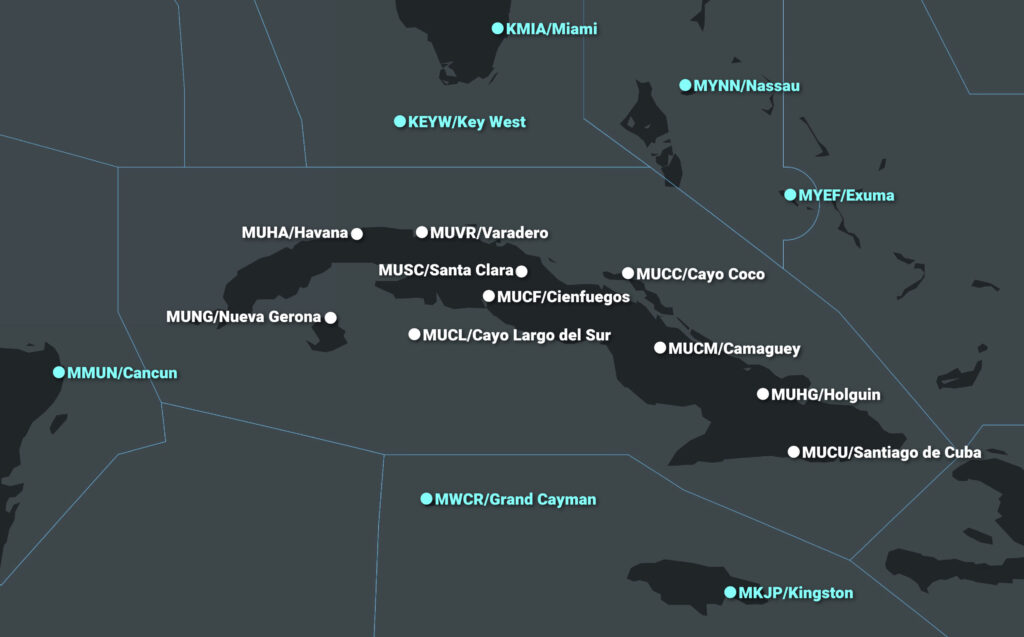
In 2020 they banned all US charter flights to Cuba except MUHA/Havana, but that ban was lifted in 2022. Today, US airlines and charter operators can apply for service to multiple Cuban airports, but only within the limits set by DOT. They decide both the destinations and the number of flights allowed.
DOT rules do not apply to foreign operators.
Gatekeeper #4: FAA (US Federal Aviation Administration)
Maybe surprisingly, for Cuba ops, the FAA isn’t in the gatekeeper role! The FAA’s focus is safety and air navigation, not sanctions or export rules.
If BIS and OFAC say a flight is ok, the FAA won’t block it just because the destination is Cuba.
The FAA issues airspace warnings for some countries, but not for Cuba — there are no FAA restrictions on flights heading here.
Operational Stuff
Goodness, wasn’t that tedious! Now for the slightly more interesting operational stuff to watch out for.
Cuba Overflights
If your route passes through the MUFH/Havana FIR and enters Cuba’s inner ADIZ or overflies the island itself, you will need to get an overflight permit and pay the associated fees.
For non-US operators, the process is straightforward – set up a customer number with the Cuban authorities and apply directly, often with same-day turnaround if submitted during business hours. US operators will generally need to use an approved permit vendor.
There are several overwater routes in the northwest corner of Cuban airspace where a permit is not required:
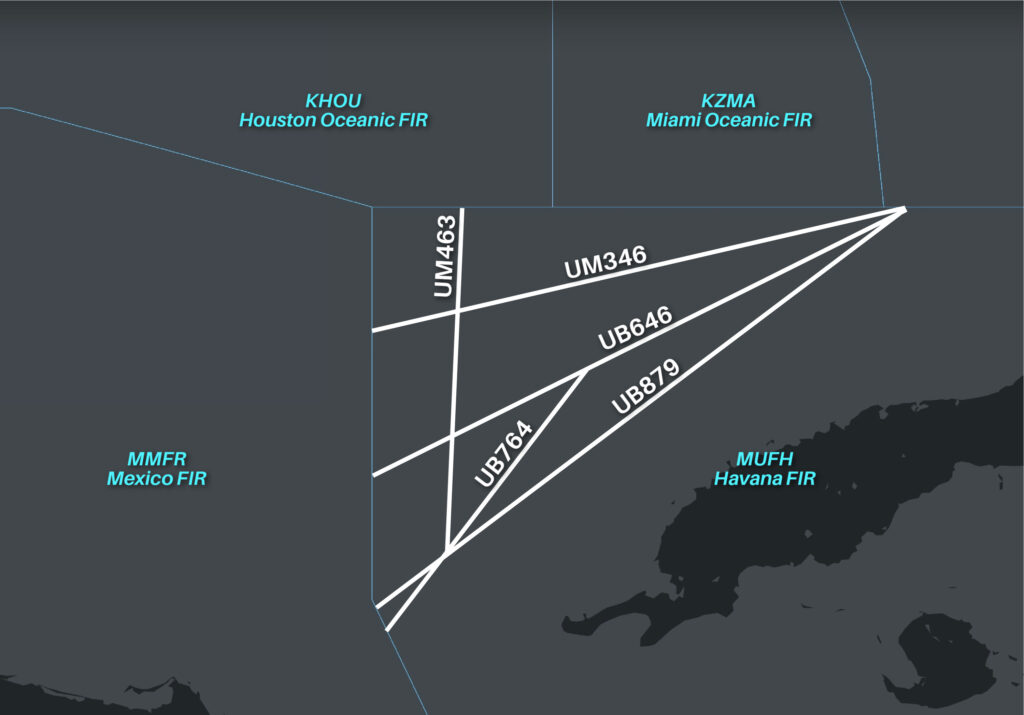
However, these still incur NAV fees, and if you don’t pay them it can result in your aircraft tail number being blocked from Cuban airspace in the future. NAV fees must be paid to ECNA in Euros, and unpaid fees can build up quietly until you are denied entry on a later flight.
For more info on Cuba overflights and how to sort all this out, check our briefing here.
Cuba Landings
Getting approval on the Cuba side of things is usually very straightforward – secure the landing permit, arrange handling, and off you go.
US BIS 7-day limit: Remember, under the US BIS rules, US-built aircraft operating under the AVS exception are only allowed to stay in Cuba for a max of 7 consecutive days.
Landing permit: All flights to Cuba need a landing permit, regardless of the aircraft’s registry or departure point. The Cuban CAA requires at least 3 working days’ notice to process the request.
Handling: You must have a local ground handler in Cuba. The CAA won’t issue a permit without proof of handling support. In the past we’ve worked with the handling agent C2C Travel in Cuba, who were extremely helpful with arranging all services. Contact fabrice@c2ctravel.com.
Local receiving party (“sponsor”): Permits are only granted if you list a local contact or business sponsor in Cuba. If you don’t have one, your handler may be able to provide this.
Visas: Pax and crew get an e-visa on arrival with the help of a handling agent. Everyone has to fill a form online before arrival at this site.
Insurance: Watch out here, as many aviation policies exclude Cuba entirely, leaving flights there uninsured. Even if covered, US underwriting or reinsurance can block payouts due to sanctions. Confirm Cuba is included and sanctions-proof — and get written confirmation from your broker.
Cuba-US Flights
Commercial operators can depart for Cuba from any US customs-designated airport.
But on the return leg from Cuba, US CBP requires you to land at the first designated US airport of entry that is nearest to your point of crossing the US border or coastline (in some cases, there’s some flexibility here where you don’t actually have to land at the “first” airport — check our briefing for more info.)
If you want to land at a different airport instead, you will need a Border Overflight Exemption in advance.
The current list of approved southern airports of entry is published by CBP and includes key gateways in Florida, Texas, and other southern states:
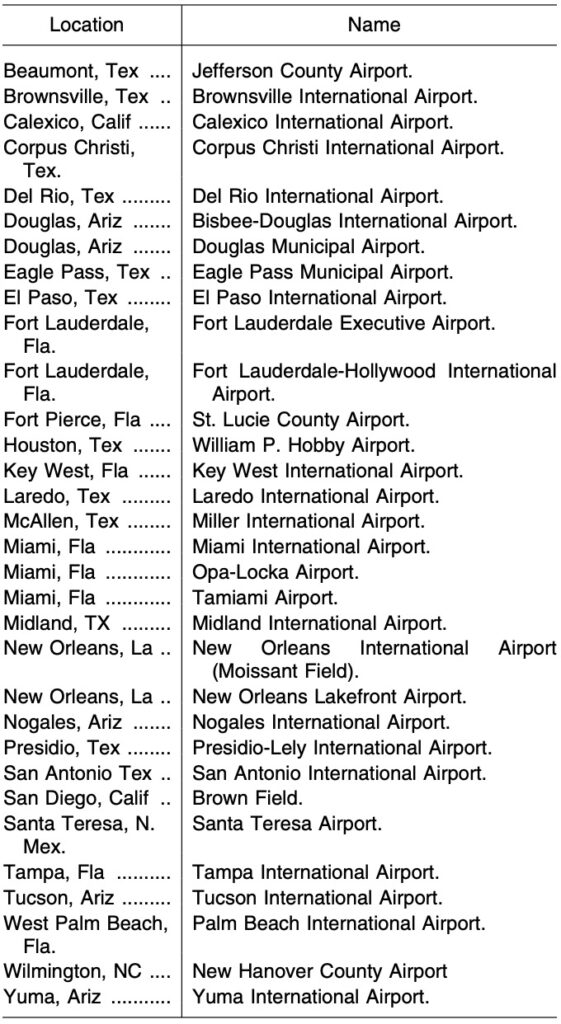
This rule applies to both US and foreign-registered aircraft arriving from Cuba, and CBP will enforce it strictly, so plan your routing and arrival airport accordingly.
Been to Cuba?
Please let us know! You can also reach us directly on news@ops.group, or file an Airport Spy report.
OPSGROUP members can access the full Airport Spy database via the members dashboard here.

More on the topic:
- More: Clarifying Cuba Overflight Permits and NAV Fees
- More: U.S. cracks down on scheduled flights to Cuba
- More: Total ban on US private flights to Cuba
- More: New rules for flying from the U.S. to Cuba
- More: Matthew – Airports update 1400LT Wednesday
More reading:
- Latest: NAT Pack 2026: All the North Atlantic goodies
- Latest: New 2026 NAT Oceanic Checklist
- Latest: The Bahamas wants your cash
- Safe Airspace: Risk Database
- Weekly Ops Bulletin: Subscribe
- Membership plans: Why join OPSGROUP?





 Get the famous weekly