

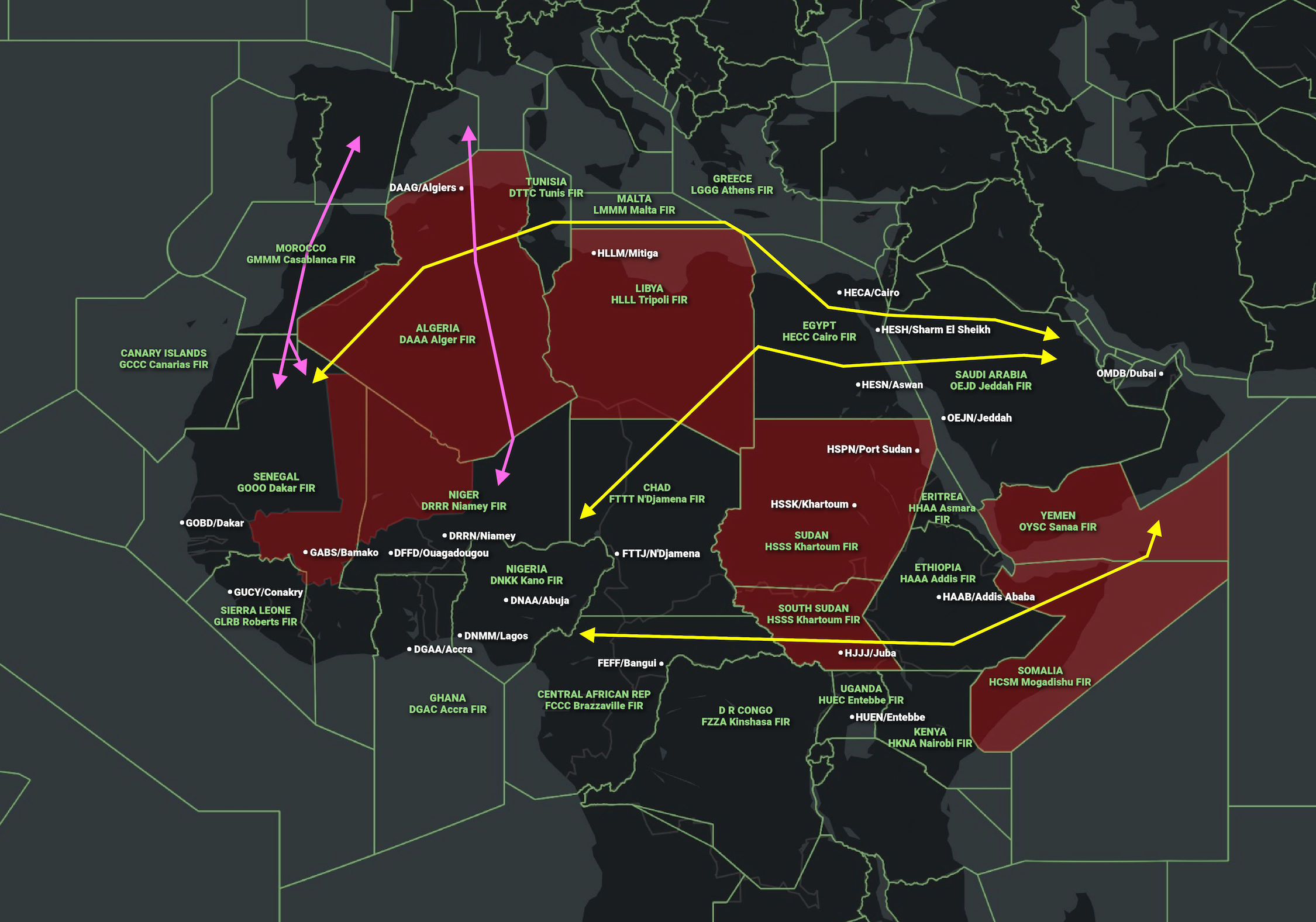

Flying into or out of West Africa is becoming increasingly tricky, with operators having to navigate a patchwork of airspace bans, conflict zones, and overflight restrictions. Two directions present the most complexity: north to Europe, and east to the Middle East.
OPSGROUP members can download this map to see exactly how these restrictions affect routing.
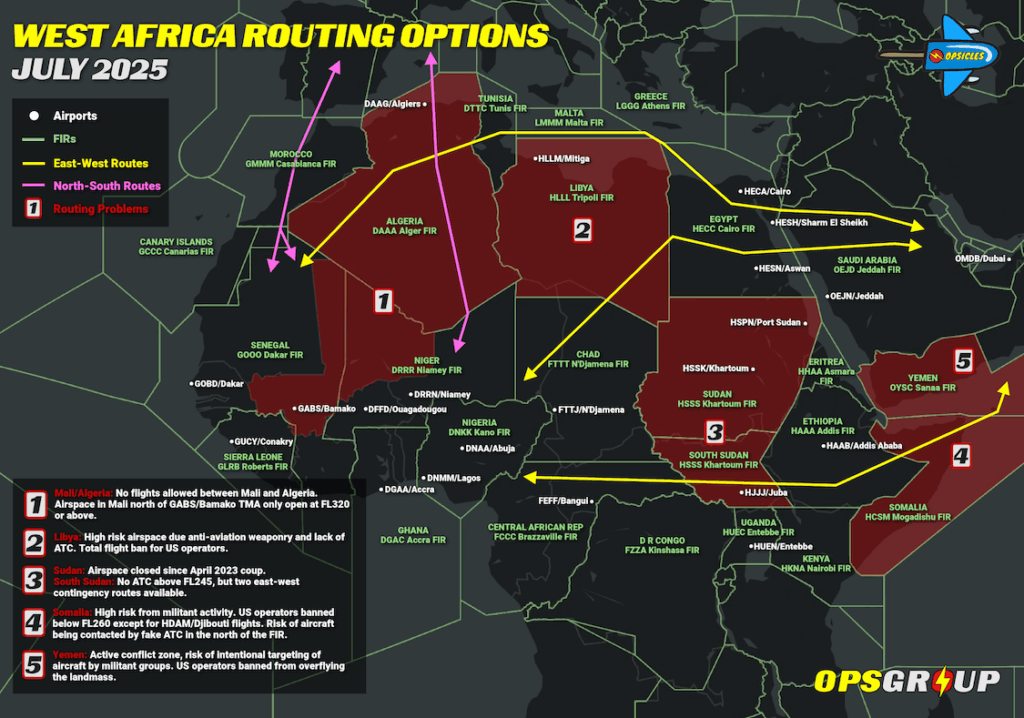
Click to download PDF.
There’s a cluster of major airports in West Africa — from Lagos to Accra to Dakar — that handle the bulk of international traffic in the region.
But getting to these hubs from Europe or the Middle East is complicated by airspace risks and closures in five key areas: Mali/Algeria, Libya, Sudan/South Sudan, Somalia, and Yemen.
Here’s a more detailed look at each of these.
Mali/Algeria
- Northern Mali remains a war zone — ongoing since 2012.
- MANPADS, rockets, and mortars pose a threat to low-flying aircraft.
- US advises caution at all flight levels; several states restrict ops below FL250/260.
- Overflights above FL320 permitted, per long-standing Notams from GOOO/Dakar and DRRR/Niamey FIRs.
- Airports GATB, GAGO, GAKL should be avoided.
- A reciprocal airspace ban with Algeria (since April 2025) prohibits all flights between the two countries — even overflights.
- Routing via Mauritania remains open. Algerian ATC may reroute flights via Niger.
- More info here.
Libya
- Active conflict zone since 2014.
- HLLL/Tripoli FIR is high-risk. Total ban for US and UK operators.
- Threats include misidentification by air defense systems, militia threats near Tripoli, and unreliable ATC.
- Frequent radar and comms outages; some flights rely on Malta ATC for guidance.
- Strongly advised to avoid all Libyan airspace, regardless of altitude. However, some airline flights between West Africa and the Middle East operate over the south-eastern corner of the HLLL/Tripoli FIR between Egypt and Chad rather than routing around Libya to the north or via South Sudan to the south.
- More info here.
Sudan/South Sudan
- Airspace fully closed since the April 2023 coup.
- HSSK/Khartoum Airport is shut; no Notams are being issued.
- There are some contingency routes available for flights to HSPN/Port Sudan, but security remains volatile.
- Several states prohibit overflights due to military activity and anti-aircraft threats.
- In South Sudan, there’s no ATC above FL245, but two east-west contingency routes are available for overflights.
- South Sudan is open for flights to HJJJ/Juba.
- More info here.
Somalia
- Government control is limited; attacks by extremist militants are ongoing.
- US prohibits flights below FL260 (except overwater to/from HDAM/Djibouti).
- Risk of being targeted at lower altitudes by anti-aircraft weapons.
- Reports of unauthorized ATC units issuing contacting aircraft and issuing them instructions in the northern part of the HCSM/Mogadishu FIR – genuine ATC here will only issue level changes by
CPDLC or SATCOM. - More info here.
Yemen
- Active warzone — avoid all land portions of the Sanaa FIR (OYSC).
- US operators permitted to use offshore routes UT702 and M999.
- Other states allow overwater-only routing, avoiding the landmass.
- Threats include drones, missiles, and intentional targeting by militants.
- Military strikes by Saudi Arabia and Israel have been ongoing for a few years.
- More info here.
Routing Options: West Africa to Europe
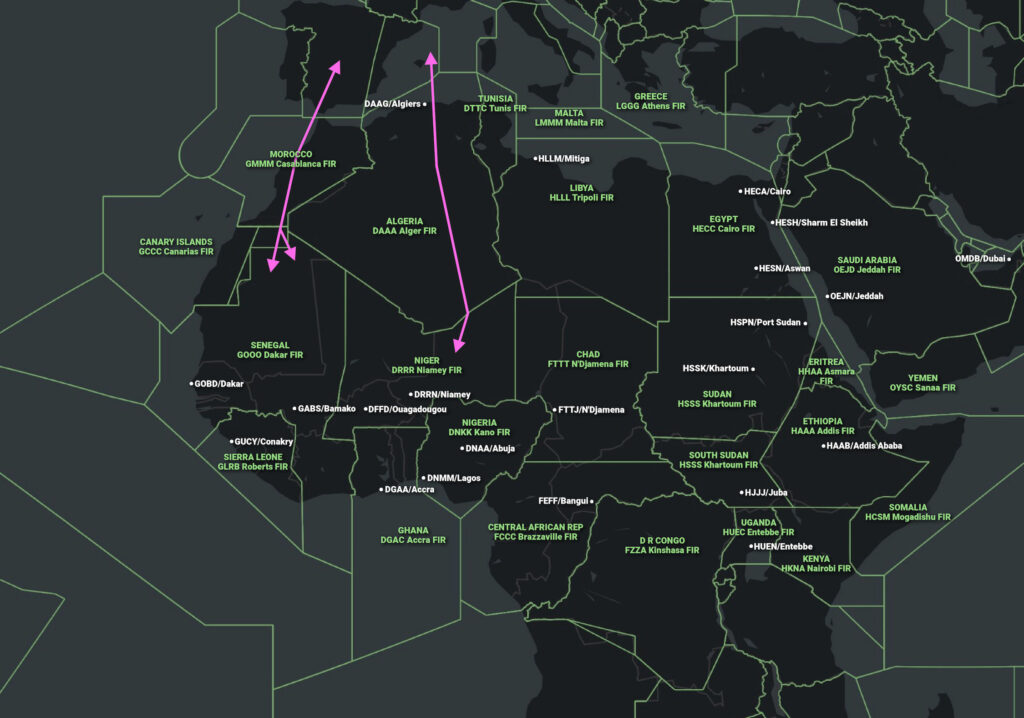
Two main options here:
Central route via Niger/Algeria: Due to the Mali-Algeria airspace ban, overflights between these two countries is not possible. Add to that the security risks at the lower levels in northern Mali, many operators choose to avoid Mali entirely by routing east into Niger, and then turning north into Algerian airspace from there.
Western route via the Atlantic: Flights route westward over the Atlantic, before turning northeast via the Canary Islands or Morocco and into Europe. This route bypasses the entire Sahel region and avoids any involvement with Mali or Algeria. Common for flights heading to Western Europe (eg. Spain, France, Portugal).
Routing Options: West Africa to the Middle East
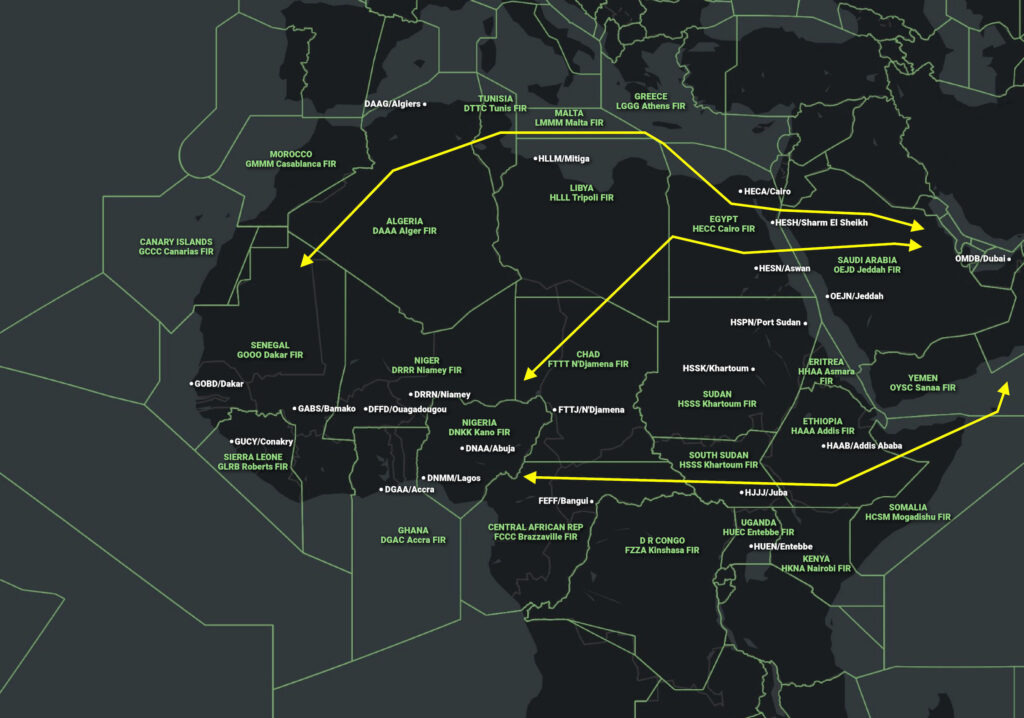
With Libya risky, Sudan closed, and Somalia/Yemen partially restricted, operators have three main options:
Central route via Libya: The shortest option routes east from Chad into the southeastern corner of Libya, then across Egypt into the Middle East. This path clips Libyan airspace, and while still considered high-risk, some airlines are using it. ATC reliability is poor, but the routing avoids longer detours.
Southern route via South Sudan: This uses one of two east-west contingency routes above FL245, then crosses Ethiopia and exits via the Gulf of Aden off the coast of Yemen and on towards the Middle East. This avoids Libya and Sudan entirely, but adds an extra 500NM or so when compared with the central route. If South Sudan isn’t viable, flights may reroute even further south via Uganda or Kenya.
Northern route avoiding Libya: This takes a northern dogleg through Niger and Algeria, then across Tunisia and Malta and into Egypt. This route avoids all high-risk airspace but is the longest of the three. It’s commonly used by operators with stricter risk thresholds or where insurance policies exclude Libyan or South Sudanese airspace.
If you’re flying any of these routings (or know of any clever alternatives we haven’t covered here), we’d love to hear from you. Email us at blog@ops.group — we’ll update this briefing and help keep other pilots and operators in the know!

More on the topic:
- More: Mali: Airspace Risk Update
- More: EASA Removes CZIBs: Middle East Risk Gets Harder to Read
- More: Free Route Airspace in Africa
- More: Airspace Risk Update – Important Changes You May Have Missed
- More: Military Coup: Sudan Airspace Closed
More reading:
- Latest: The Unlucky 13: US Customs Gotchas for BizAv
- Latest: Hong Kong: The 2026 BizAv Guide
- Latest: FAA Mobile Clearance Tool: No More Verbal Ping Pong
- Safe Airspace: Risk Database
- Weekly Ops Bulletin: Subscribe
- Membership plans: Why join OPSGROUP?







 Get the famous weekly