FAA Airspace SLOP Mini Guide

Strategic Lateral Offset Procedures (SLOP) in FAA-Controlled Oceanic Airspace and the Anchorage FIR are based off the ICAO Doc 4444 SLOP rules, and can be found in the FAA AIP ENR section 7.1.

I don’t want to read the FAA AIP ENR section 7.1

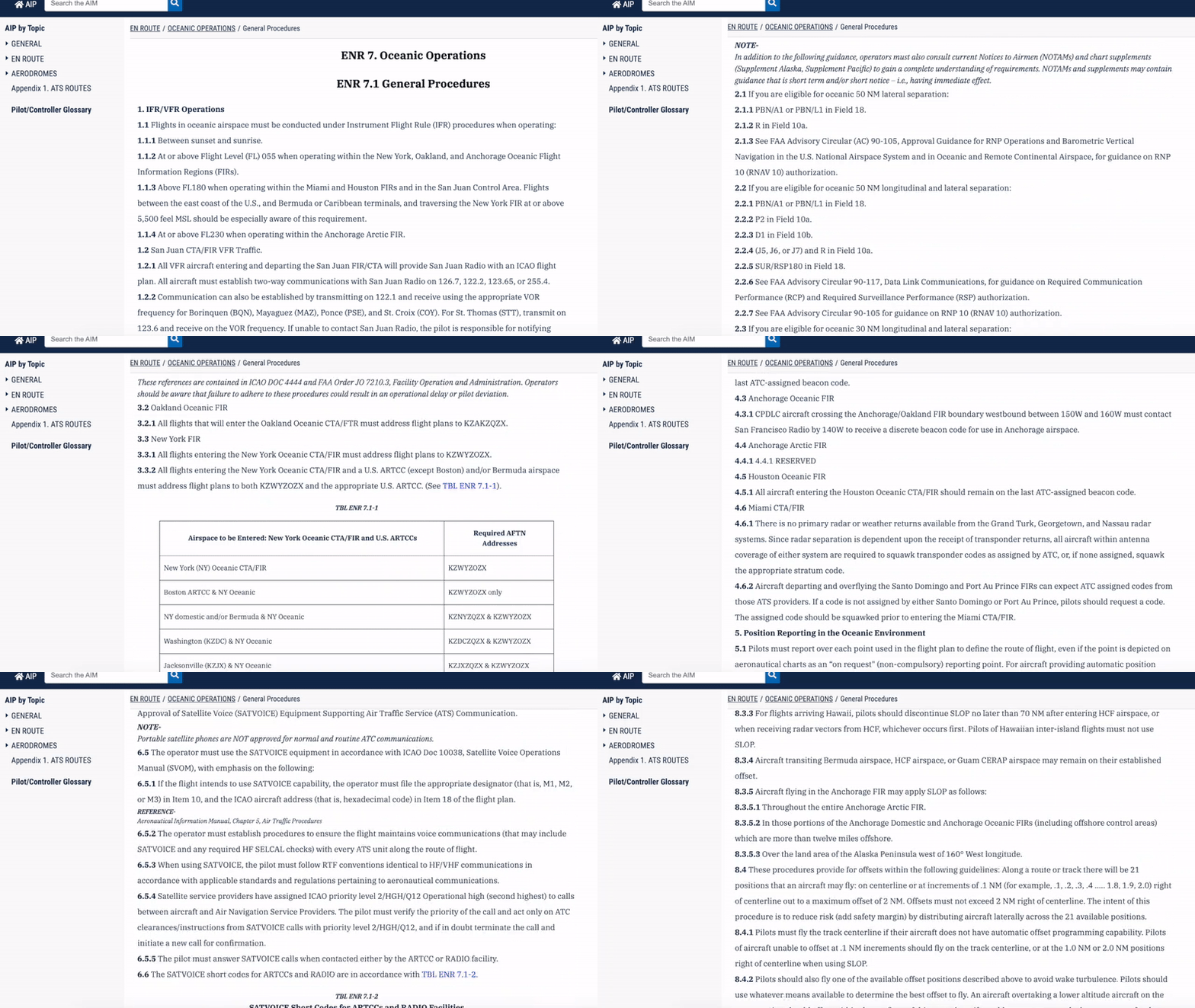
No, neither do we. Here’s what that experience looks like:

Handy info, but fairly brutal on the eyes and soul.

Is there another way to get this info?

Indeed there is!

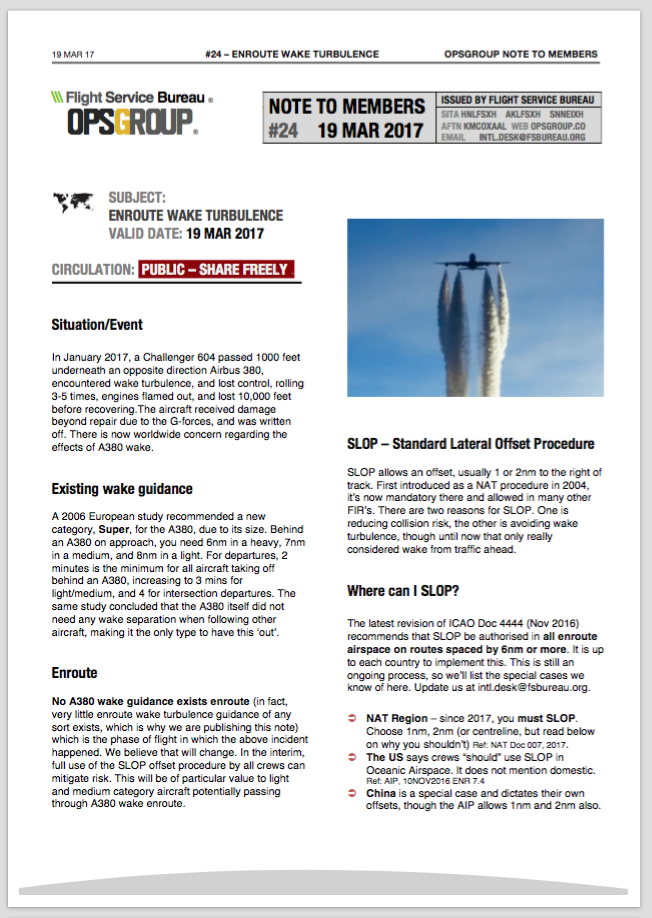
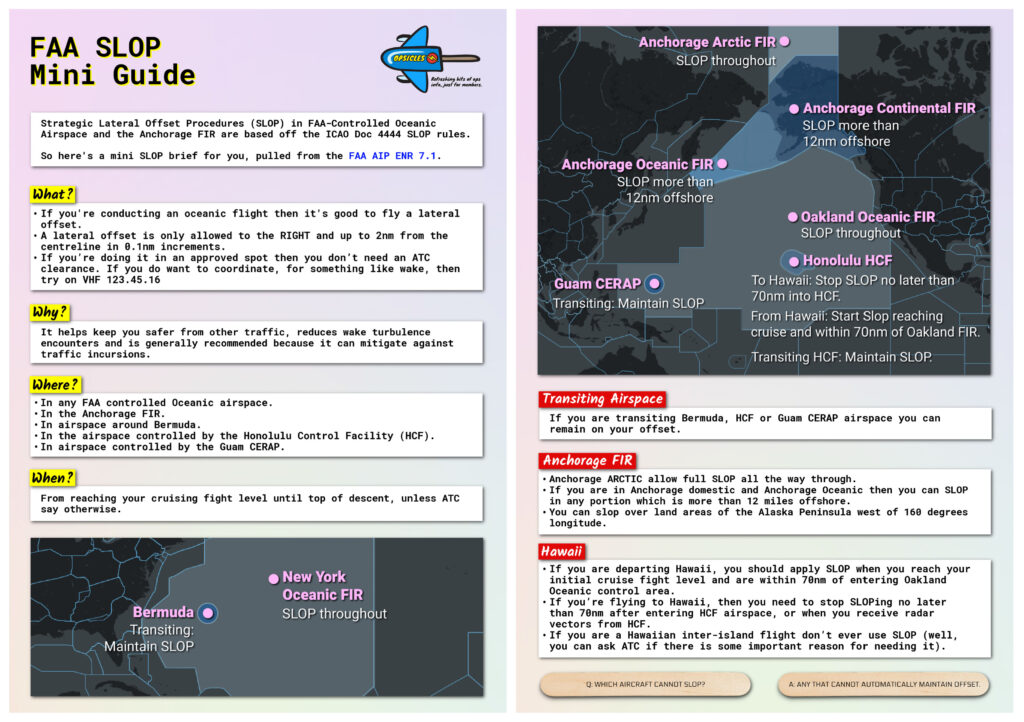
We took all the excellent info provided by the FAA with regards to SLOP rules in FAA airspace, and turned it into a quick guide – complete with a simple map of the rules for the different regions.

OPSGROUP members can download a copy for free here.

If you’re not an OPSGROUP member, but you’d like to be, you can join here. (Or you could just screenshot the image above instead – if you’d like a grainy, pixelated JPEG instead of the full, juicy PDF).

We’re going to be publishing more of these little docs over the next few months. We’re calling them “Opsicles” – refreshing bits of ops info, just for members. So keep an eye out for the next installment!


Safety on the NAT: B+ with room for improvement

The eighth Annual Safety Report for the North Atlantic Region is out, and it looks good. A solid B+ for pilots and ATC alike.

But there is still room for performance improvement, so here are the highlights from the report to focus on.

Did anyone fly in 2020?

The number of flight hours in the NAT HLA through 2020 was 892,137 which was unsurprisingly a decrease on the 2019 hours (2,063,908 in case you’re wondering).

The peak week was July 15-21 when it saw 5,621 flights crossing, compared to 13,733 for the peak week of 2019.

If you want to check and compare all the stats to 2019 then here is our post on that.

What have they been monitoring?

Safety Performance in the NAT HLA is monitored and measured in 12 areas. The targets for 6 of these were achieved in 2019, while 2020 achieved an impressive 8.

The biggest improvements seem to be:

  • Less Large Height Deviations where Datalink was not in use
  • A reduction in the amount of time aircraft with datalink spent at the wrong flight level
  • A reduction in the number of GNE events involving aircraft with datalink

How likely are you to fly into someone else?

Much of the safety focus in the NAT really boils down to this – it is an area of reduced separation and high density traffic. So, they also worked out the risk of collision and in 2020 it reduced by 74%, which is probably down to less aircraft but also to less mess-ups. 

SLOP is one of the main factors in reducing this number. And it doesn’t just reduce the risk of collision, it reduces your risk of running into wake turbulence as well. So keep up that slopping, up to 2nm right (and 0.1nm increments).

Who’s to blame for the times it did go wrong?

Ok, ok, the purpose of the report is not to point fingers, but to understand where improvements can be made.

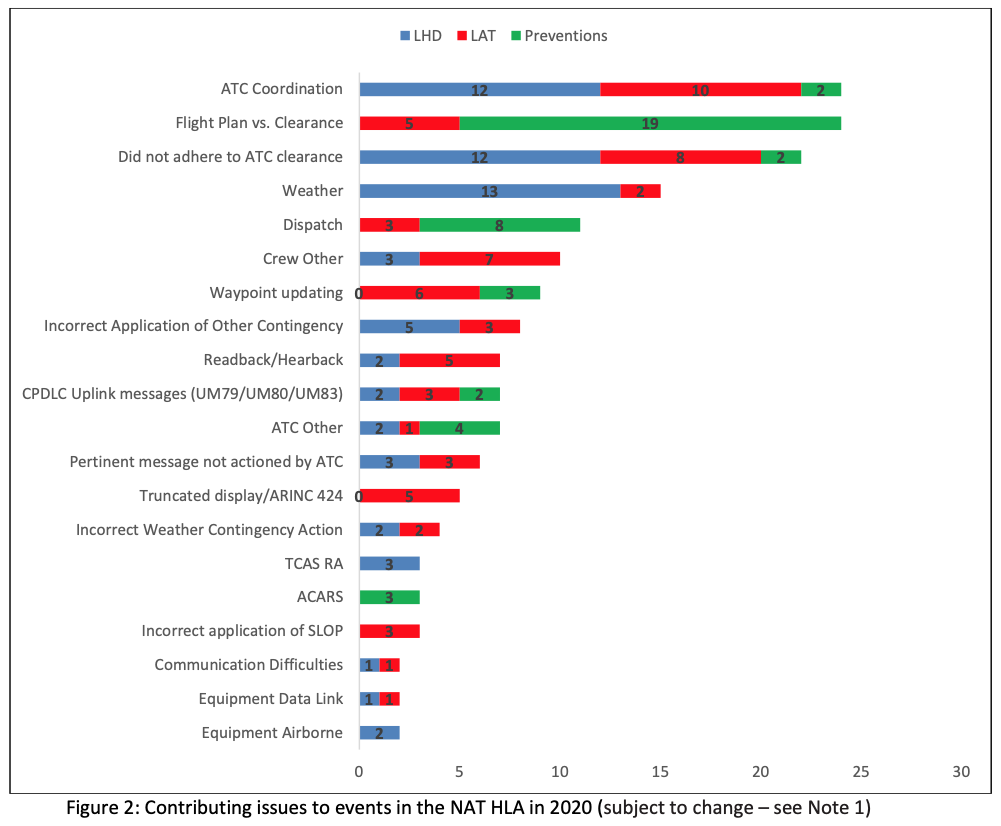
The Top 10 factors in errors haven’t really changed – ATC coordination errors are top, closely followed by “crew other” (which pretty much means crew not doing what they’re told, messing up etc) and then interestingly application of contingency (other than weather).

So here is a quick recap on those Contingency Procedures to follow

Some facts and figures

Since 2019, 70% of core NAT traffic has been using ADS-B.

There have been no accidents in the NAT since at least 2017. 2020 also saw no losses of lateral separation for the first time since 2017.

They did see 47 LHDs, 57 Lateral Deviations (15 were GNEs, the other 13 were caught and corrected by ATC), 26 coordination events, 1 longitudinal loss of separation and 30 events they prevented where someone was basically just flying the wrong flight profile.

18% of events were down to ATC coordination between different ATC sectors.

18% also came down to fight plan versus clearance issues.

11% were weather related. 

Issues with dispatch contributed another 8% and everything else was down to, well, lots of other things.

How can we improve?

Follow the Golden Rules of operating in the NAT HLA:

  • Have the Right Equipment: If you ain’t sure then check out our Circle of Entry.
  • Have a Clearance: If you can’t get it on CPDLC then have those HF or VHF frequencies ready for a voice clearance, and make sure you read it back and confirm it correctly.
  • Check your Route: This means flying what you’ve actually been told to fly which means checking what is in the airplane box matches what is in the clearance. It probably should say ‘flight profile’ because it means route, altitude and speed.
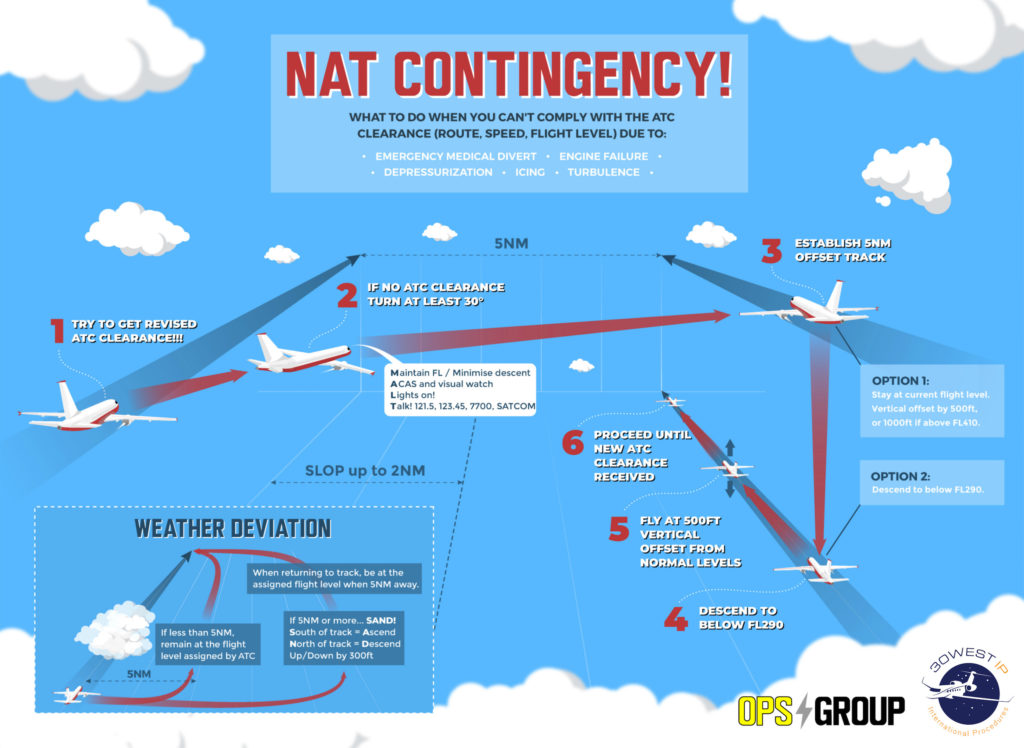
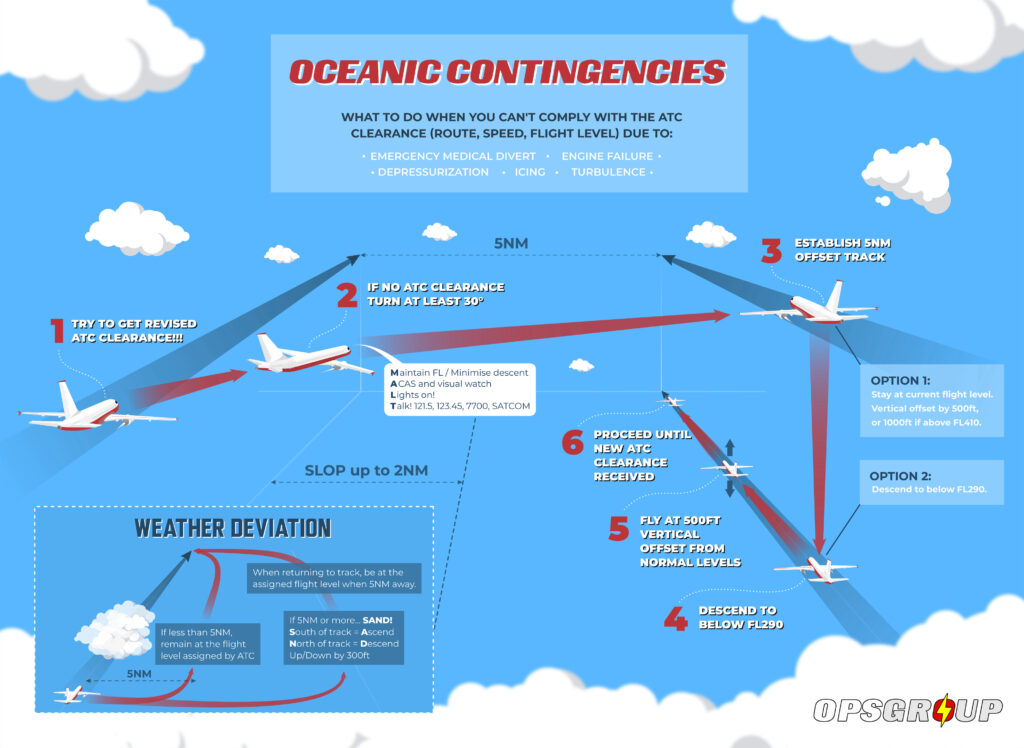
  • Know your Contingencies: We added the picture above to help. Read more about this here.

And don’t forget to SLOP.

Keep up to date on NAT info

Photo @Algkalv from Wikimedia Commons


The 511 on the Nov 5th ICAO changes

A whole bunch of procedural stuff will be changing from 5 Nov 2020, with the release of a new amendment to ICAO’s Procedures for Air Navigation Services document. There will be changes to Oceanic Contingency and Weather Deviation Procedures, Wake Turbulence Separation, SLOP Procedures, and how the FAA defines Gross Navigation Errors.

What is the PANS-ATM (ICAO Doc 4444)?

Procedures for Navigation Services – Air Traffic Management. In other words, the ‘go to’ manual for aircrews who operate internationally. It explains in detail the standard procedures you can expect to be applied by air traffic services around the world, and what they expect in return.

Here is a summary of the most important changes coming on 5 Nov 2020. Thanks to Guy Gribble at International Flight Resources for this update.

Oceanic Contingency Procedures

Basically, what you should do if you need deviate from your flight path without a clearance. Weather avoidance, turbulence, depressurisation, engine failure – you get the picture. Published procedures are changing: there will be one standard set of Contingency and Weather Deviation Procedures for all oceanic airspace worldwide.

If you’ve been flying in the North Atlantic Region over the past year and a half, you’ll be familiar with how it works – the new procedures were introduced there back in March 2019, and now they’re being rolled out everywhere.

The main change here is that Contingency offsets which previously were 15 NM are basically now all 5 NM offsets with a turn of at least 30 degrees (not 45 degrees).

For more on this, check out our article.

Wake Turbulence

Flight Plan Category
There will be a new wake turbulence category for flight plans:

No longer will ‘Heavy’ rule the skies. ‘Super’ is about to be added, which will cover the largest aircraft including the A380-800, and Antonov 225. You will even get to say it after your callsign on initial contact with ATC.

ICAO Doc 8643 will shortly include all aircraft which qualify for the category.

You’ll need to tell them your category in Flight Plan Item #9 too. For Super, the letter ‘J’ is what you’ll need to include.

Here’s the new line up:

J – SUPER (Check Doc 8643 to see if you qualify)
H – HEAVY (Max take-off weight greater than 136,000kg/300,000Lbs)
M – MEDIUM (Max take-off weight greater than 7,000kg/15,500Lbs)
L – LIGHT (Max take-off weight less than or equal to 7,000kg/15,500Lbs)

Wake Turbulence Separation Categories
Countries may choose to use the ICAO wake turbulence codes above to determine how much room to give you from preceding traffic, or they can elect to use a grouping.

Currently, ICAO groupings are based simply on weight and there’s only three of them. The problem with that approach is that sometimes the separation provided is excessive which slows down the flow of traffic and creates unnecessary delays.

The US and Europe were on to it when several years ago the FAA and Eurocontrol joined forces to look at the wake characteristics of aircraft in more detail. They came up with a better system – it was a process known as Aircraft Wake Turbulence Re-Categorization or simply, RECAT.

Turns out that when you take into account factors such as approach speeds, wing characteristics and handling abilities of various aircraft it is possible to safely reduce separation.

As a result, six new categories were created. You can read about those in FAA SAFO #12007 and EU-RECAT 1.5 if you would like to know more.

The point is, ICAO is now adopting those categories.

So why does it matter?
Because the separation applied when following smaller aircraft may be reduced to as low as 2.5nm on approach. Closer than you may be accustomed to.

Out with the old, in with the new. Here’s what you can expect to see in November:

Old:
HEAVY (H) – aircraft of 136,000kg or more
MEDIUM (M) – aircraft less than 136,000kg but more than 7,000kg
LIGHT (L) – aircraft of 7,000kg or less

New:
GROUP A – ≥136,000kg and a wingspan ≤80m but >74.68m
GROUP B – ≥136,000kg and a wingspan ≤74.68m but >53.34m
GROUP C – ≥136,000kg and a wingspan ≤53.34 m but >38.1m
GROUP D – <136,000kg but >18,600kg and a wingspan >32m
GROUP E – <136,000kg but >18,600kg and a wingspan ≤32m but >27.43m
GROUP F – <136,000kg but >18,600kg and a wingspan ≤27.43m
GROUP G – <18,600 kg or less (no wingspan criterion)

Separation standards will soon be published accordingly.

Strategic Lateral Offset Procedures (SLOP)

Wait, what?
As a result of extremely high levels of accuracy in modern navigation systems, if an error in height occurs there is a much higher chance of collision. It is also greatly increases the chance of an encounter with wake turbulence.

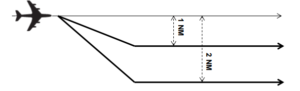
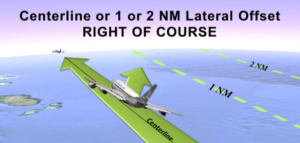
In some airspace, when the lateral separation applied or the distance between adjacent parallel routes is greater than 6nm, aircraft can deviate up to 2nm right of track without a clearance. This is what is known as SLOP.

The way in which it is applied is changing
Where the lateral separation minima or spacing between route centerlines is 15NM or more; offsets to the right of the centerline will allowed up to 2nm.

When the lateral separation minima or space between route centrelines is less than 15nm (but more than 6nm), you will be able offset up to 0.5nm right of track.

So, it is important you are familiar with what kind of lateral separation is being applied in the airspace you are operating.

The FAA will change their definition of GNE’s

On 5 Nov 2020, the US FAA will change their definition of Gross Navigation Errors to mean anything more than 10nm (down from 25nm), to align with ICAO’s 10nm definition that currently exists on the NAT HLA. So after this date, the FAA will require you report all lateral errors, 10nm or greater worldwide.

More on this from Guy Gribble at International Flight Resources:

“Keep in mind that ATC does not always advise a crew that it files a report; therefore, the FAA inspector will try and contact the crew as soon as possible so the crew will remember details of the event. ATC keeps voice and communications records for between 30-45 days. New York Radio and San Francisco Radio keep voice communications for 30 days. The FAA directs that oceanic error investigations should be complete within 45 days of the incident.”
One Contingency Procedure to rule them all

From 5 Nov 2020, there will be one standard set of Contingency and Weather Deviation Procedures for all oceanic airspace worldwide.

If you’ve been flying in the North Atlantic Region over the past year and a half, you’ll be familiar with how it works – the new procedures were introduced there back in March 2019, and now they’re being rolled out everywhere.

The FAA has already published a Notice to say that these procedures will take effect in US oceanic airspace from 5 Nov 2020, and ICAO is expected to formally publish the Standard in an update to PANS-ATM (ICAO Doc 4444) to take effect from the same date.

Rarely do we see worldwide oceanic contingency procedures undergo a formal revision. The last time a major revision occurred was in 2006 when ICAO standardized a 15 NM offset executed with a turn of at least 45 degrees. Prior to that, the North Atlantic and the Pacific had used different offset distances and a 90 degree turn.

Wait… what are “contingency procedures”?

These are basically any time you have to do things differently if you need to deviate from your cleared route, and for one reason or another you cannot get permission from ATC first.

Why would you need to bust your clearance? You may not have the ability or capacity to communicate with ATC, or they may not be able to respond to your request quickly enough for a variety of reasons – meteorological conditions (severe turbulence and weather avoidance), aircraft performance, loss of pressurisation, immediate diversion, or a loss of navigational accuracy.

What are the new procedures?

The short answer
Contingency offsets that previously were 15 NM are basically now all 5 NM offsets with a turn of at least 30 degrees (not 45 degrees).

The long answer
Read the FAA Notice.

The slightly less long answer
– Turn at least 30 degrees (reduced from 45) to the left or right of track and establish yourself on a parallel track that is offset by 5nm (reduced from 15).
– The direction of turn is up to you, but you should consider airways around you – the likely direction of other aircraft, the applicable SLOP procedures, the direction of your diversion airport and of course terrain. (If going left or right is a 50/50 choice, going right is probably better – it gets you out of the way of all the SLOP offset traffic that might be coming at you from the opposite direction!)
– When established on your offset track, maintain an altitude that is vertically offset by 500 feet from normal levels (or 1000 feet if above FL410).
– In areas of parallel airways, it is recommended you descend below FL290.
– Watch your TCAS, and if possible, keep your eyes outside for other aircraft.
– Make sure your transponder is set to TA/RA (if able).
– Be seen – turn on as many exterior lights as possible.
– Squawk 7700.
– Try and talk to ATC via voice or CPDLC, and declare a PAN PAN, or MAYDAY.
– Establish comms with other aircraft on 121.5 MHz or 123.45 MHz. Make a position/intention report as you would in TIBA procedures.

The best answer
A picture! So often the best answer. And this one’s pretty neat. Not least because you can click on it, download it, print it out, and put it in your flight bag to take with you. (If you’d also like to laminate it, we’re ok with that).

Weather deviations

If you have to deviate from your assigned track due to anything weather-related, there’s a whole different procedure to follow.

Here’s what to do:

  • In the first instance, up the urgency with the phrase “WEATHER DEVIATION REQUIRED.” ATC will attempt to provide separation, and if they can’t they will ask you to advise your intentions.
  • If you intend to deviate, let them know. Say something like – “I am deviating under PIC emergency authority. At 5 NM from course I will employ the Weather Deviation contingency.”

Then apply the following:

  • Declare a PAN.
  • Deviate away from other airways if practical.
  • Talk to other aircraft on 121.5 and 123.45.
  • Keep an eye on your TCAS and outside.
  • Turn on all your exterior lights.

For deviations of less than 5 NM, remain at the flight level assigned by ATC.

For deviations of 5 NM or more, when you are at the 5 NM point initiate a change as follows:

If flying EAST, descend left by 300ft, or climb right by 300ft.

If flying WEST, climb left by 300ft, or descend right by 300ft.

In other words – SAND! (South of track = Ascend, North of track = Descend; Up/Down by 300ft)

Once you are back on track, resume your cleared level. If you’re already deviating and cannot get a clearance to deviate further. Change your level immediately in accordance with the table above.

Turnback procedure

The new guidance has left out any specific reference to how to divert across the flow of traffic or turn-back procedure, and instead simplified it to just “proceed as required by the operational situation”. Turning back would assume you either employ the 5NM offset as per the new contingency procedure, or else get a new revised clearance.

Bottom line

Download the pic, and give the new procedures a good read (they’re not actually that long). Beginning 5 Nov 2020, the new procedures are expected to be implemented. You might want to prepare changes for your ops manuals and checklists too.


Why, How and Where should you SLOP?

In Short: Strategic Lateral Offset Procedures (SLOP) costs nothing and increases flight safety. If the airspace permits it, you should be “randomly” offsetting, especially across the North Atlantic. Left is for losers – don’t SLOP left of track.

Update: August 2019 – you can now “MicroSLOP” in the NAT. Check out the changes.

We had a discussion in OpsGroup recently about SLOP (Strategic Lateral Offset Procedures) and it elicited some interesting responses, as well as some confusion.

So – Why, How and Where should you SLOP?

Why?

GPS technology allows modern jets to fly very accurately, too accurately it turns out sometimes! Aircraft can now essentially fly EXACTLY over an airway/track laterally (think less than 0.05NM), separated only by 1000FT vertically. A risk mitigation strategy was proposed over non-radar airspace to allow pilots to fly 1-2 nautical miles laterally offset from their track, randomly, to increase flight safety in case of any vertical separation breakdown.
How did we get here?

Navigation paradox

What we just described is known as the navigation paradox. The research shows that “increases in navigational precision” actually increases the collision risk – huh?

Here are some interesting stats to consider:

  • In a simulation, aircraft cruising at random altitudes have five times fewer collisions.
  • During a 2000 study, it was shown that hemispherical cruising altitude rules resulted in six times more mid-air collisions than random cruising altitude non compliance.
  • If more randomness was applied to the hemispherical cruising level model, the navigational paradox risk could have been largely reduced and up to 30 midair collisions avoided (up to 2006). Including the tragic GOL 2006 accident.

So we get it; the rules of the air, sometimes inject risk to flight safety due to their lack of randomness.

A way to reduce risk and inject randomness?

It was 2004 when SLOP was adopted in the most congested non-radar airspace in the world, namely the North Atlantic.
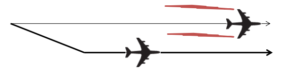
Although the Navigation Paradox is the reason SLOP was introduced and continues to be implemented, there are some nice risk mitigation side-effects too: wake turbulence reduction (at times), contingency buffers if you experience severe turbulence and can’t maintain altitude (“level busts”), etc.

SLOP therefore reduces the risk between traffic which is not operating in accordance with the correct air traffic control clearance or where an error has been made in the issue of an air traffic control clearance.

Still, there is a large number (>40%) of aircraft not adopting these procedures even though they are now mandatory on the NAT.

If >40% of pilots are using SLOP 0 (meaning no offset at all), what does that matter? That means half the flights are operating over the same lateral paths and all it takes is one minor vertical deviation for there to be a significant loss of separation.

The daily NAT track message always reminds pilots to employ SLOP procedures:

FOR STRATEGIC LATERAL OFFSET AND CONTINGENCY PROCEDURES FOR OPS IN 
NAT FLOW REFER TO NAT PROGRAMME COORDINATION WEBSITE WWW.PARIS.ICAO.INT.
SLOP SHOULD BE STANDARD PROCEDURE, NOT JUST FOR AVOIDING WX/TURB.

How should you SLOP?

Consider some best practice advice:

  • LEFT IS FOR LOSERSnever offset LEFT. On bi-directional routes a LEFT offset will INCREASE collision risk rather than decrease it. There are areas in the NAT Region where bi-directional traffic flows are routinely used. And there are times when opposite direction traffic may be encountered in any part of the Region. Once upon a time (between introduction of RVSM and pre-SLOP, it was ok to go LEFT, not anymore!)The only exception would be in certain airspace where ATC request you to SLOP LEFT (e.g. China).
  • The system works best when every 2 out of 3 crossings you fly, you apply an offset. Shanwick says this generally means at least 1 out of 3 aircraft are slopping.
  • You don’t need to ask ATC for approval; you can SLOP from the NAT entry point to the NAT exit point.
  • Only offset if your FMC has the function to do so – do not do it manually.
  • Good airmanship applies here. What’s happening around you? Who is above, below and near you on the same track. Co-ordinate on 123.45 if needed.
  • 2nm RIGHT is the maximum approved SLOP.
  • Flip a coin to decide like some do! Captain is PF? 1R going west; First Officer 2R going east etc. Studies show that on the NAT, 40% do 1R and only 20% go 2R. Don’t be afraid to go the full 2R!
  • If you are overtaking someone, the ICAO guidance in NAT DOC 007 is to apply SLOP so as to create the “least amount of wake turbulence for the aircraft being overtaken”.

Where though?

Our friend Eddie at Code 7700 gave a great comprehensive list so here it is verbatim.

  • Africa, almost all remote locations employ SLOP. Check the Jeppesen Airways Manual / Air Traffic Control / State Rules and Procedures – Africa) to be sure. Rule of thumb: if you are in radar contact, you probably should not SLOP.
    • One notable exception where they don’t want you to SLOP is in the HKNA/Nairobi FIR. The AIP states: “SLOP is not applicable in the Nairobi FIR due to efficient surveillance and communication systems.” (We do remind you however that recently in the Nairobi FIR, a 767 and 737, both at FL370 came a little too close for comfort).
  • Australia is another special case. You may only offset in the OCA, and, if you’re still on radar, then you need to tell ATC, both when starting the offset, or changing it. Within domestic CTA airspace, you must fly centerline. (According to Australian guidance in Jeppesen Pages).
  • China, on routes A1, L642, M771, and N892 (according to China guidance in Jeppesen Pages). In some areas they employ their unique SLOP offsets, but do allow the standard 1 nm and 2 nm offsets.
  • New York, Oakland and Anchorage Oceanic FIRs (according to U.S. FAA guidance).
  • Oceanic airspace in the San Juan FIR (according to U.S. FAA guidance).
  • North Atlantic Track Region: SLOP is mandatory (according to the North Atlantic Operations and Airspace Manual).
  • The Pacific (including the NOPAC, Central East Pacific (CEP) and Pacific Organized Track System (PACOTS) (according to U.S. FAA guidance).
  • South Pacific airspaces (according to U.S. FAA guidance).
FAQ:
  • Should I SLOP crossing the Atlantic even if I’m on a random route or above the published NAT FL’s?

Yes! You should especially do it then. There is a higher chance of opposite direction traffic. That extra mile or two (randomly selected of course) could be a life saver!

  • What about micro-slop?

That is lateral offsets between 0 and 1 nm (0.1 etc). ICAO mentions “LOP provisions as specified in ICAO PANS-ATM Doc.4444 were amended 13 November 2014 to include the use of “micro-offsets” of 0.1 Nms for those aircraft with this FMS capability. Appropriate guidance for the use of this amended procedure in the North Atlantic is under study and hence pending.”

And now, since August 2019, this is beginning to be approved for operations on the NAT. Read the update!


We might have missed something or maybe we didn’t cover your specific question?

Drop us a line and will do our best to answer.

Bottom line, SLOP costs nothing but increases flight safety.


The Impact of Space-Based ADS-B on International Operations

I can distinctly remember the build up to and roll out of GPS navigations systems. Like so many of us, I was excited to see this new technology integrated into my cockpit. The idea that I would have the capability to accurately determine my position anywhere in the world was exciting!

It’s hard to overstate the significance of GPS navigation on the international operation of aircraft, particularly when operating in oceanic airspace. Today we are about to reach a similar milestone that could be even more significant – the introduction of a Space-Based Automatic Dependent Surveillance Broadcast (SB ADS-B) monitoring system.

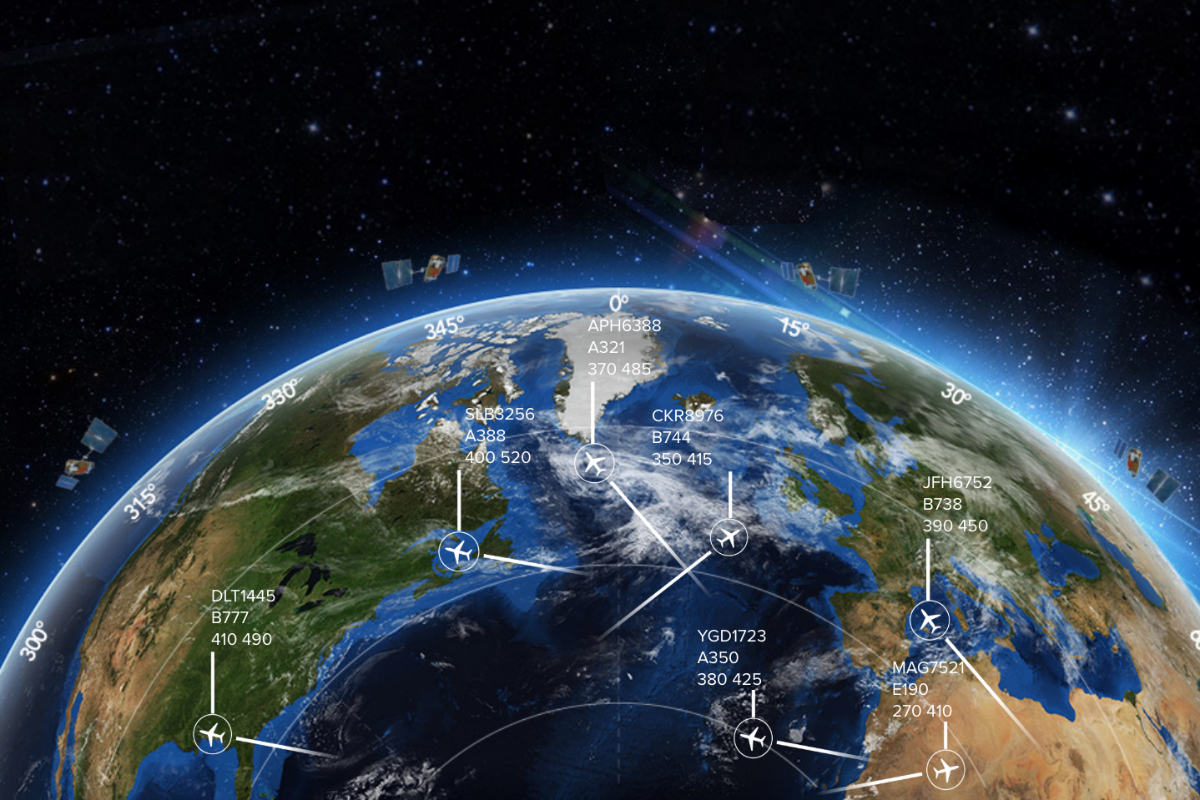
When SB ADS-B completes its deployment (scheduled 30 December 2018), we will achieve worldwide, pole-to-pole surveillance of aircraft. This goes beyond a pilot knowing his or her own location. This opens up the ability for ATC to locate any ADS-B equipped aircraft anywhere in the world. With the US and EU ADS-B requirements approaching in 2020, aircraft that operate internationally will almost certainly be ADS-B equipped.

A brief history of Space-Based ADS-B

SB ADS-B technology has been placed into service by a commercial company, Aireon, and not a governmental entity, which has enabled it to be brought to operational status in a much shorter timeline than most other government implementations.

Although Aireon was initially established in 2012 to provide civilian surveillance services, the disappearance of Malaysia Flight 370 changed the industry. The inability to locate the aircraft forced industry regulators to consider how improved aircraft tracking might have helped to resolve the location of the aircraft in distress and prevent a future disaster. In response to this concern, ICAO created a standard for aircraft tracking designated as the Global Aeronautical Distress Safety System (GADSS). Aireon responded by creating a low-cost tracking solution based on aircraft ADS-B equipage utilizing the SB ADS-B network to meet that tracking requirement faster and cheaper than many of the alternatives.

This implementation takes advantage of the same ADS-B 1090ES systems already installed in most aircraft, not requiring any additional investment or modification from operators who currently comply with ICAO ADS-B approved 1090ES systems. Compare this to the evolving and evasive FANS 1/A+ requirements that have placed many operators in the position of having to upgrade aircraft (at great expense) only to find they are not PBCS and/or U.S. domestic compliant. Quite a contrast.

What are the benefits?

The primary advantage of the introduction of surveillance into oceanic operations will be a reduction in separation. Initially, this will be applied to in-trail spacing (longitudinal separation) and potentially reduce that separation to as close as 14 Nautical Miles (NM). The current longitudinal standard for data link approved aircraft is 5 minutes or approximately 50NM. The introduction would significantly increase the capacity of the most fuel-efficient routes and altitudes. The trial implementation is not expected to be restricted to specified tracks or altitudes, just between properly equipped aircraft.

Another key advantage of SB ADS-B is that the system is based on an active constellation of 66 low earth orbit satellites with geo-synchronous orbits that provide worldwide coverage. The system will also have 9 backup satellites available in orbit as well. The information on worldwide aircraft location will be in the system, it’s just a matter of having it sent to ATC control panels that are properly equipped to display the information. The SB ADS-B system operates independently from the ADS-B ground stations and can provide a direct data feed to air navigation service providers (ANSPs).

The primary targets for Aireon SB ADS-B services are ANSPs such as the FAA, EASA, Africa’s ASECNA, South Africa, New Zealand, Singapore, etc. This brings tremendous value to areas like Africa and Southeast Asia where ANSP’s face unique challenges involving infrastructure. Placing a network of ground-based ADS-B receivers in remote areas can expose them to vandalism or theft. As an example, a recently installed ILS system in Benin, Nigeria was stolen!

What does my aircraft need to be compliant?

In order for SB ADS-B separation reduction to be applied, aircraft will be required to be ADS-B and fully PBCS compliant. The controlling agency will determine eligibility based on the flight plan filing codes for ADS-B and PBCS. Let’s recall that the PBCS requires FANS 1/A+ approval with RCP240, RSP180, and RNP 4 capabilities. Just add ADS-B, NAT HLA, and RVSM equipage and approval and you’re ready! That is a lot of approvals, plus let’s not forget, TCAS Version 7.1 and Enhanced Mode S Transponder equipage is required as well.

Where will it be implemented?

Initial trial use of SB ADS-B for surveillance and separation will begin in Canada’s Edmonton Flight Information Region (FIR) in the first quarter of 2019. This will be followed by a planned trial launch in the North Atlantic (NAT) on 29 March 2019. The NAT oceanic surveillance trial program will be employed in both in Gander and Shanwick’s oceanic FIRs. Santa Maria will also introduce ADS-B separation standards, but that program will initially be limited to ground-based ADS-B operations.

We anticipate a mid-December 2018 release of a North Atlantic Ops Bulletin detailing the trial implementation which will be referred to as “Advanced Surveillance-Enhanced Procedural Separation” (ASEPS). This is to be followed by ICAO publishing the associated standards for ASEPS in a 5 November 2019 update to Procedures for Air Navigation Services – Air Traffic Management (PANS-ATM) Document 4444. This would move the ASEPS program beyond trial use and allow implementation of ASEPS based operations worldwide.

The final specifics involved in the trial program will be detailed in Canadian and United Kingdom Aeronautical Information Publications (AIPs), most likely involving a release of Aeronautical Information Circulars (AICs) to formally initiate the trial programs.

The NAT HLA does not anticipate requiring ADS-B for airspace entry but simply employing it as available. The impending U.S. and EU ADS-B requirements in 2020 will help ensure common equipage.

The introduction of ASEPS reduced separation standards in oceanic and remote regions will also impact contingency procedures for operators in the NAT HLA. To address this concern ICAO has created new contingency procedures for oceanic and remote operations which will also be identified in the November 2019 update to Procedures for Air Navigation Services – Air Traffic Management (PANS-ATM) Document 4444.

We expect the mid-December release of an additional North Atlantic Ops Bulletin detailing the trial implementation of these new contingency procedures in the NAT HLA airspace to be implemented with ASEPS. These new contingency procedures will initially only be used in the NAT HLA but, after the ICAO approval in November 2019, they may be implemented in other oceanic regions as well.

It would be important to note that the ASEPS target date for implementation, 29 March 2019, is also the target date for the expansion of the PBCS tracks in the North Atlantic Organized Track System. Add in the change in contingency procedures and that is a lot of moving parts, all happening at the same time, in the most congested oceanic airspace in the world.

One thing we don’t anticipate changing on March 2019 is strategic lateral offset procedures (SLOP). Changes may follow down the road but it’s not on the calendar now.

Let’s all get ready for a busy spring in the North Atlantic!

Mitch Launius is an International Procedures Instructor Pilot with 30West IP and can be contacted through his website: www.30westip.com


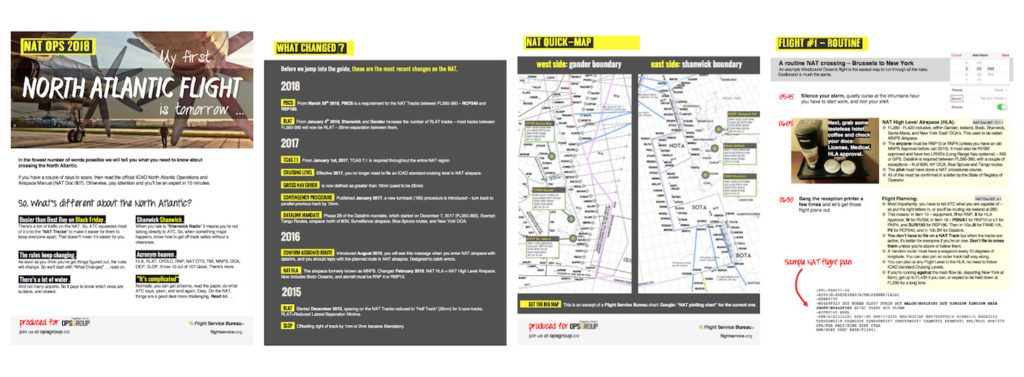
My first North Atlantic Flight is tomorrow – NAT Ops Guide (Updated 2018)

For the latest changes and updates on the North Atlantic, including our most recent Guides and Charts, use our NAT reference page at flightservicebureau.org/NAT.

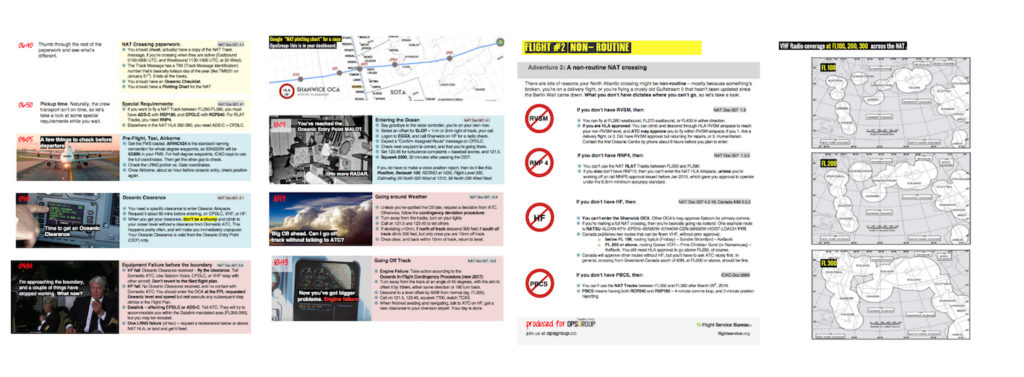
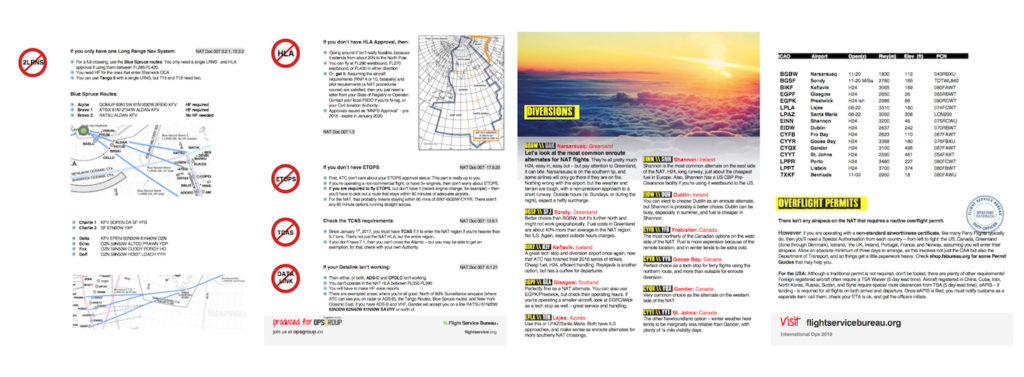
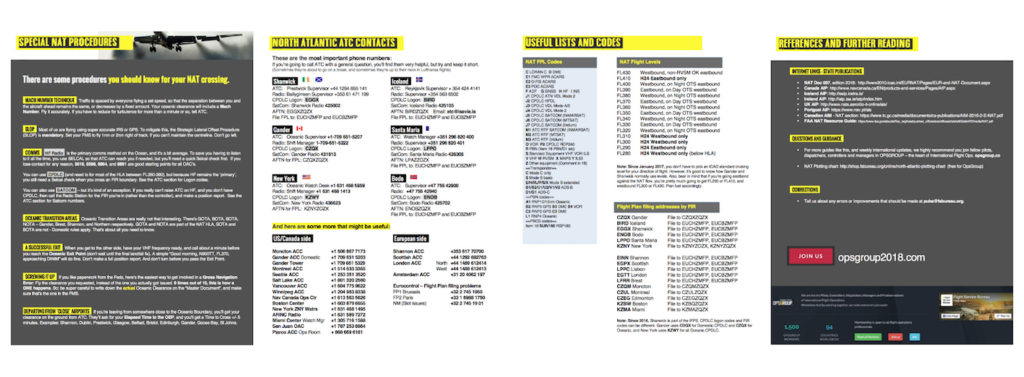
Of all the hundreds of questions we see in OPSGROUP, one region stands out as the most asked about – the NAT/North Atlantic. So, we made one of our legendary guides, to get everything into one PDF.  It’s called “My first North Atlantic Flight is tomorrow” – and now we’ve updated it for 2018!

Contents:

  • 1. What’s different about the NAT?
  • 2. Changes in 2018, 2017, 2016, 2015
  • 3. NAT Quick Map – Gander boundary, Shanwick boundary
  • 4. Routine Flight Example #1 – Brussels to JFK (up at 5.45am)

  • 5. Non Routine-Flights: No RVSM, No RNP4, No HF, 1 LRNS, No HLA, No ETOPS, No TCAS, No Datalink – what you can do and where you can go
  • 6. Diversion Airports guide: Narsarsuaq, Sondy, Kef, Glasgow, Dublin, Shannon, Lajes, Fro Bay, Goose Bay, Gander, St. Johns
  • 7. Airport data
  • 8. Overflight permits – routine and special

  • 9. Special NAT procedures: Mach number technique, SLOP, Comms, Oceanic Transition Areas, A successful exit, Screwing it up, Departing from Close Airports
  • 10. North Atlantic ATC contacts for Shanwick, Gander, Iceland, Bodo, Santa Maria, New York – ATC Phone, Radio Station Phone, AFTN, Satcom, CPDLC Logon codes; and adjoining Domestic ATC units – US, Canada, Europe.
  • 11. NAT FPL Codes
  • 12. NAT Flight Levels
  • 13. Flight Plan Filing Addresses by FIR
  • 14. Links, Questions, Guidance

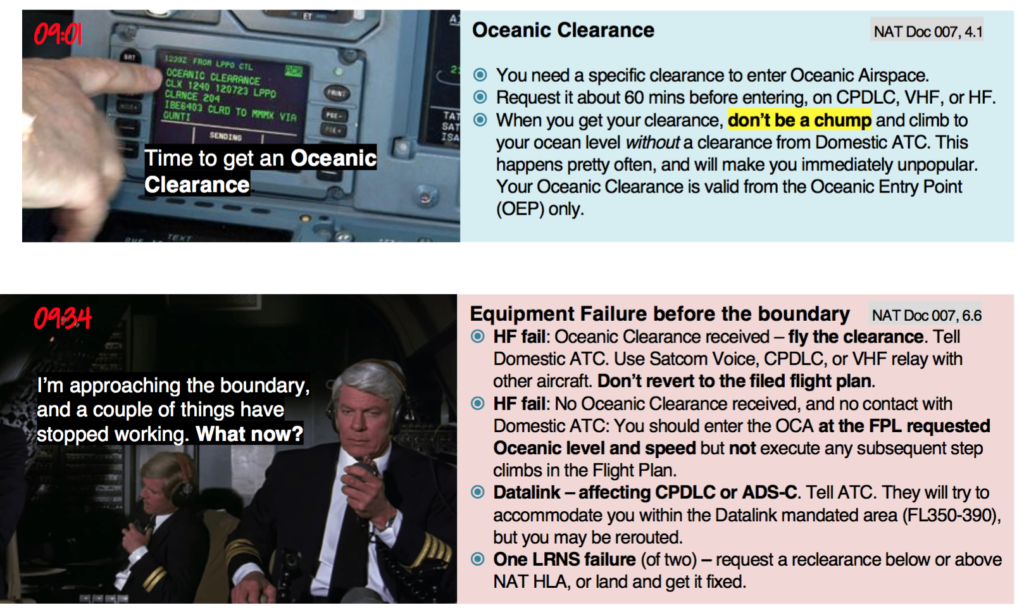
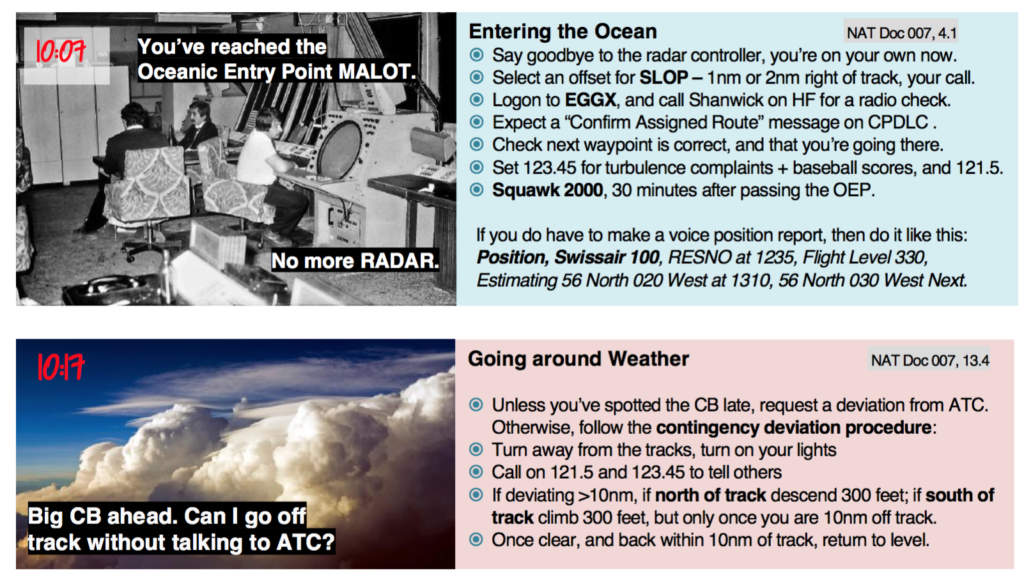
Excerpt from the Routine Flight #1:


Buy a copy ($20)   Get it free – join OPSGROUP

To get your copy – there are three options:

  1. OPSGROUP Members, login to the Dashboard and find it under “Publications > Guides”. All FSB content like this is included in your membership, or
  2. Join OPSGROUP with an individual, team, or department/airline plan, and get it free on joining (along with a whole bunch of other stuff), or
  3. Purchase a copy in the Flight Service Store!


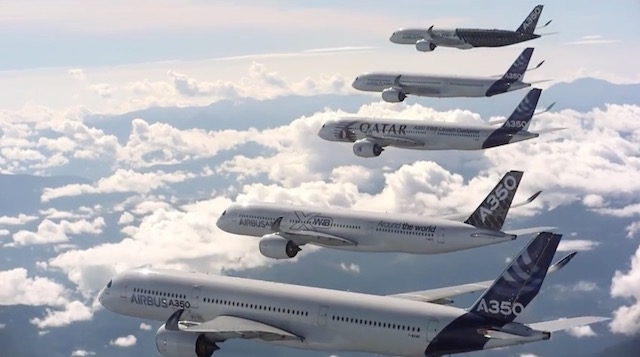
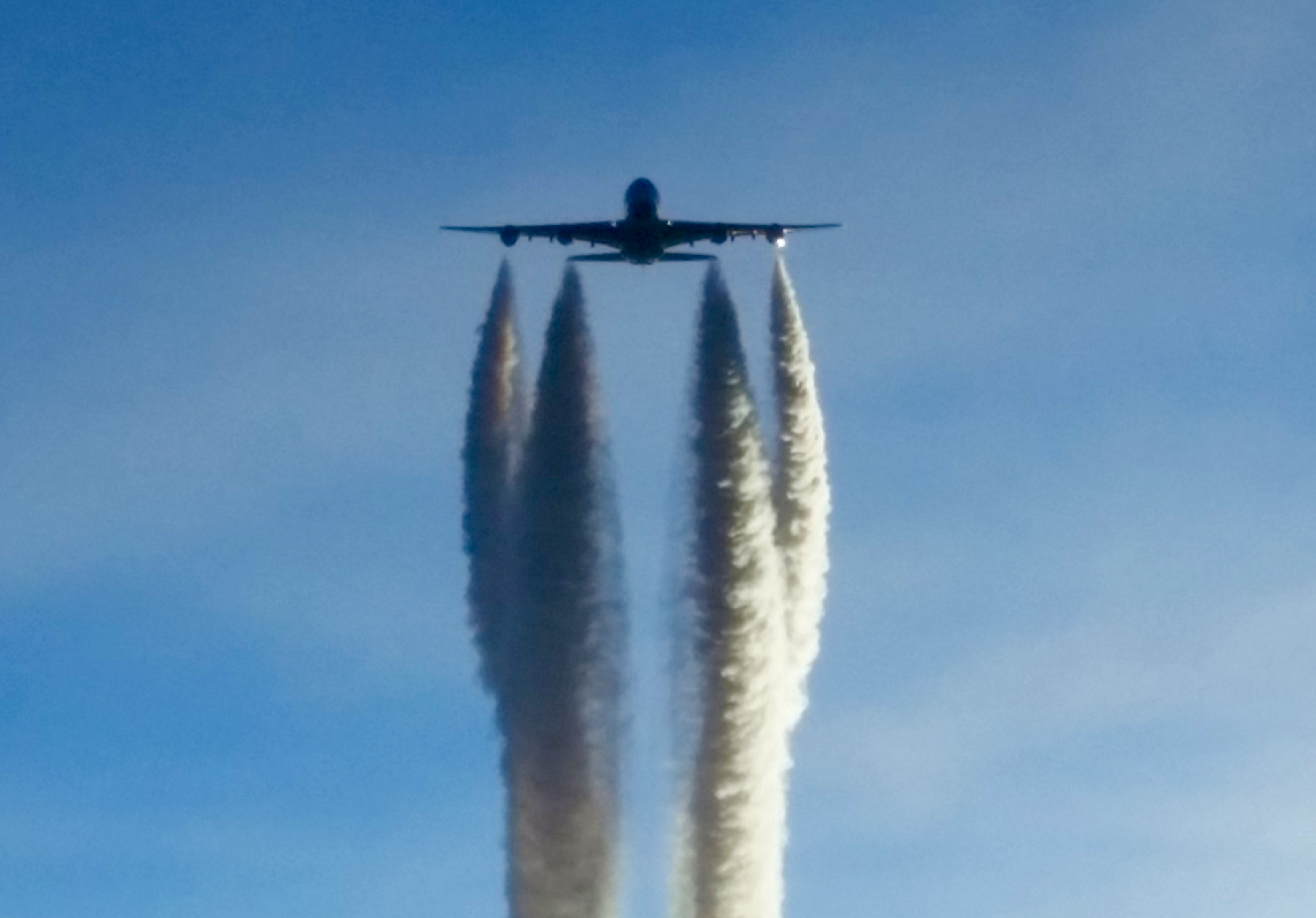
This is what an Airbus 380 looks like when it’s coming to get you

  • New guidance issued to OpsGroup by Flight Service Bureau
  • New warnings to be issued by Air Traffic Controllers – EASA SIB to follow
  • Updated 2017 SLOP offset procedures


With the A380 vs Challenger 604 incident,
there is now growing concern amongst aircrews about the effects of the A380’s wake turbulence.

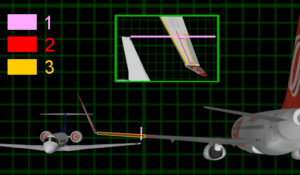
In this incident, reported by the Aviation Herald, a Challenger 604 at FL340 operating from Male-Abu Dhabi passed an A380 opposite direction at FL350, one thousand feet above, about 630nm southeast of Muscat, Oman, over the Arabian Sea. A short time later (1-2 minutes) the aircraft encountered wake turbulence sending the aircraft into an uncontrolled roll, turning the aircraft around at least 3 times (possibly even 5 times), both engines flamed out, the aircraft lost about 10,000 feet until the crew was able to recover the aircraft, restart the engines and divert to Muscat. The aircraft received damage beyond repair due to the G-forces, and was written off.

This is a recovery that is in the same category as the ‘Miracle on the Hudson’, and the DHL A-300 recovery in Baghdad. Envision the alternate scenario, which was far more likely: Challenger 604 business jet missing in remote part of the Indian Ocean. Last contact with was a HF radio check with Mumbai. No recent satellite logons. Position uncertain. Search and Rescue attempt called off after 15 days. Nothing found. Probable cause: flew into CB.

Thanks to the remarkable job by the crew, we don’t have to guess. We know what happened. And now, there are questions.

We’ve seen this story before

Back in 1992/3, two back-to-back fatal crashes (a Citation, and a Westwind) were attributed to the unusual wake turbulence pattern of the Boeing 757. In fact, at the time, NOAA said it was the most intense wake they had ever seen. In December 1993, the FAA told controllers to increase the separation, and warn aircraft following a 757 of its presence.

This was 10 years after entry into service of the 757, which had its first revenue flight in 1983.

Sound familiar? The A380 had its first revenue flight in 2007. We are 10 years down the track, and it’s very tempting to apply the logic that because this degree of incident hasn’t happened before, it’s a one-off. An outlier. That the crew reacted erroneously to a small wake upset at the limit of their flight envelope. This is both unlikely, and, given the potential threat to other crews, a dangerous perspective.

The last review of A380 wake turbulence was done in 2006, primarily by Airbus. As a result, a new category was required – “Super“, in addition to the existing Light, Medium, and Heavy, for use by controllers when applying the minimum separation on approach and departure. However, no additional considerations were applied for enroute wake turbulence.

Most pointedly, the review concluded that the A380 did not need any wake turbulence separation itself, because of its size. The A380 is the only aircraft in the world to have this “out”. It’s a beast. Even an Antonov 124 or Boeing 747 needs 4nm from the traffic ahead.

New guidance

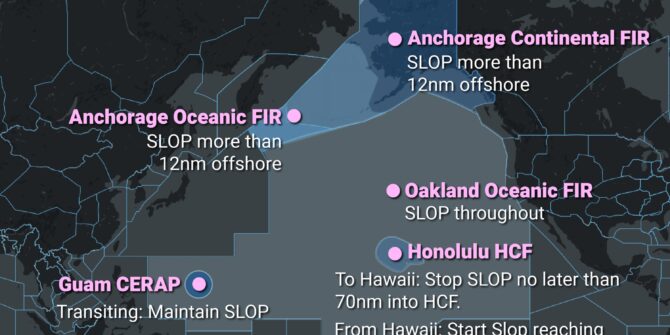
Given the incident, the similarity to the B757 story, and that quiet pointers towards a bigger risk, Flight Service Bureau has issued guidance to OpsGroup members, in Note to Members #24 (March 19th, 2017), which can be downloaded publicly here. The highlights are:

  • As Aircrew, use SLOP whenever you can.
  • As Controllers, be mindful of smaller aircraft passing underneath A380’s.
  • Avoid flying the centreline if you can. SLOP 0 is not an offset. Choose 1nm or 2nm.
  • Note the new SLOP rules from ICAO in the 16th edition of Doc 4444.
  • Expect guidance from EASA and the FAA to follow

With very recent updates to both NAT Doc 007 and ICAO Doc 4444, the rules for SLOP are a little different than before.

Download the OPSGROUP Note to Members #24 – Enroute Wake Turbulence.