Crisis in Iran: Elevated Airspace Risk

Key Points:
  • Iran remains highly unstable, with elevated risk to civil aviation.
  • Severe internet disruption has been in place since Jan 8, with broader communications affected.
  • The OIIX/Tehran FIR was closed at short notice for several hours on Jan 14, with no public explanation.
  • EASA recommends avoiding Iranian airspace at all levels due to misidentification risk.

Situation in Iran

Beginning in late December, large-scale political protests spread across major cities due to a worsening economic crisis.

These escalated in recent weeks, with many demanding a change of political leadership. The Government has responded with a violent crack-down. Large numbers of casualties have been reported amid arbitrary arrests and severe internet disruption since Jan 8, with wider communications also affected.

Several countries (including the US) have urged their citizens to leave the country immediately.

Potential for US Military Intervention

In response to humanitarian concerns, the US Government has implied military intervention remains a possibility should violence against protesters continues.

If this were to occur, Iran has repeatedly warned it will retaliate by targeting US military bases and other assets throughout the region.

Some effects of this threat have already been felt, including the partial removal of personnel as a precautionary measure at Al-Udeid Air Base in Qatar – the largest US military base in the Middle East. Although the threat level has reportedly been downgraded in the past few days.

Airspace Risk

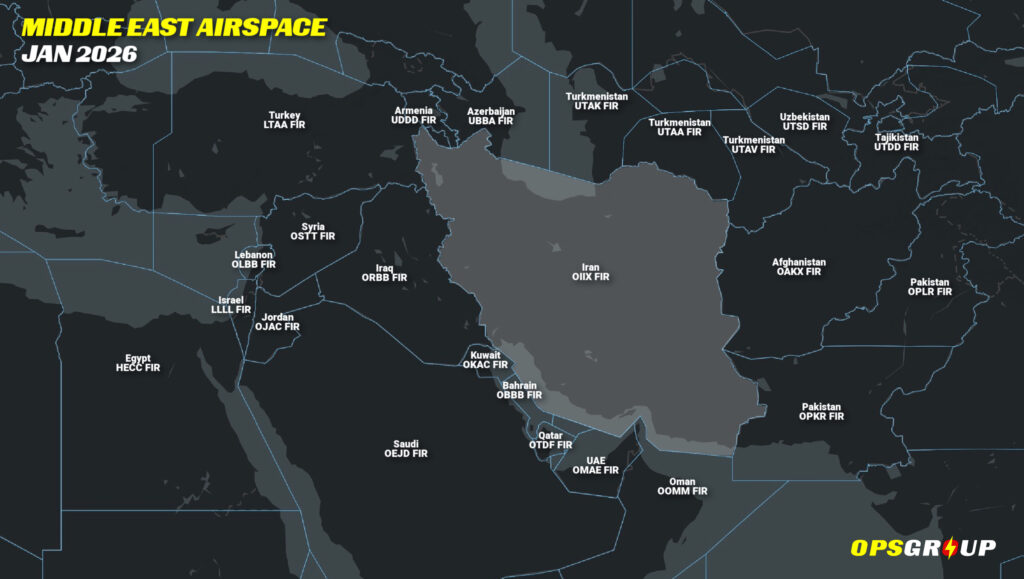
The current crisis has further increased risk to aircraft operating in or near Iranian airspace (the OIIX/Tehran FIR).

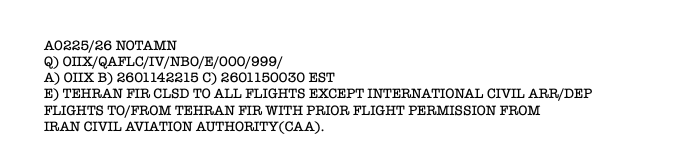
On Jan 14, the following Notam was issued unexpectedly closing the OIIX/Tehran FIR for several hours overnight, with no public explanation from Iranian authorities:

Previous events have shown that these types of closures can occur when security or military activity is taking place including a risk of missile launches or air defence operations.

Then on Jan 16, EASA upgraded its warning for Iranian airspace by publishing a new Conflict Zone Information Bulletin (CZIB) for Iran and neighbouring airspace. It suggests that recent events (including the possibility of foreign intervention) have likely placed air defence systems at a heightened sense of alert. Civil aircraft are at increased risk of misidentification.

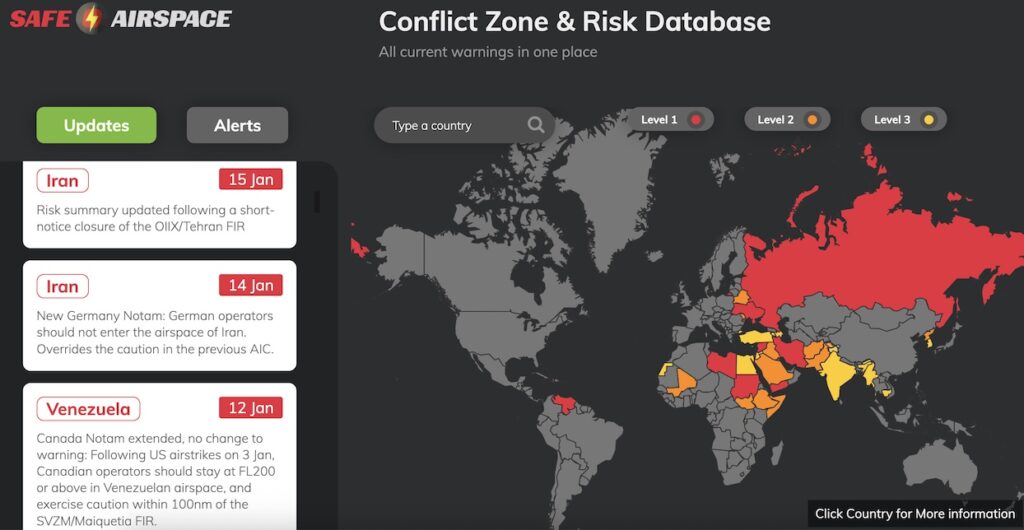
It’s worth noting that most operators already avoid Iranian airspace. Several states (including the US, UK, France, Canada and Germany) either actively prohibit or at least strongly advise against entering. At safeairspace.net, we maintain a ‘Level 1 – Do Not Fly’ warning.

However, when referencing adjacent airspace, things become a little more ambiguous. EASA’s CZIB advises caution when overflying neighbouring countries where US military assets are present. This notably includes Qatar, Bahrain, Kuwait, the UAE, Saudi Arabia, Jordan, Iraq, Syria and Turkey.

Special care should be used on the major air corridor that skirts the western boundary of Iran via Iraqi airspace (airways UL602, UM860 and UM688) where GPS interference (including the more insidious spoofing) is prevalent.

We know of at least one incident in the past where an aircraft almost inadvertently strayed into Iranian airspace without a clearance while suffering from navigation error.

From a broader perspective, EASA are also alluding to the possibility of regional escalation should the situation deteriorate – especially in the event of retaliatory strikes against military targets.

Continue to monitor the situation

Iran sits alongside the main Europe-Middle East transit corridor via Iraq/Kuwait/Bahrain, and the June 2025 Israel-Iran missile exchange showed how quickly events inside Iran can trigger widespread airspace closures and warnings across the region.

If further military activity involving Iran escalates, expect little warning – for Europe-Middle East flights, the longer routing via Egypt/Saudi has been the more stable option and keeps you further clear of Iranian airspace.

We’ll continue to issue any updates via Opsgroup and Safeairspace.net. You can also reach us at blog@ops.group if you have any info to share.


Dodging Danger: The Three Routes Through the Middle East

Navigating the airspace of the Middle East has become a major headache for international operators.

In recent times, risk to civil aviation in the region has changed at a pace we have never seen before.

Transits are now faced with a common conundrum: it no longer seems to be a simple question of ‘is this route safe?’ but instead, of one’s own appetite for known risks.

There simply is no ‘risk-zero’ route available.

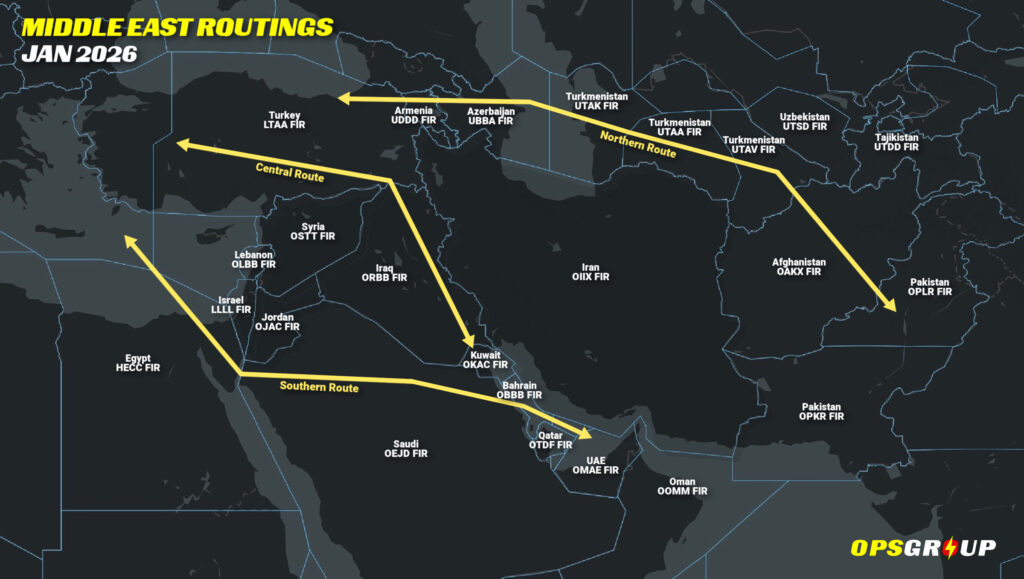
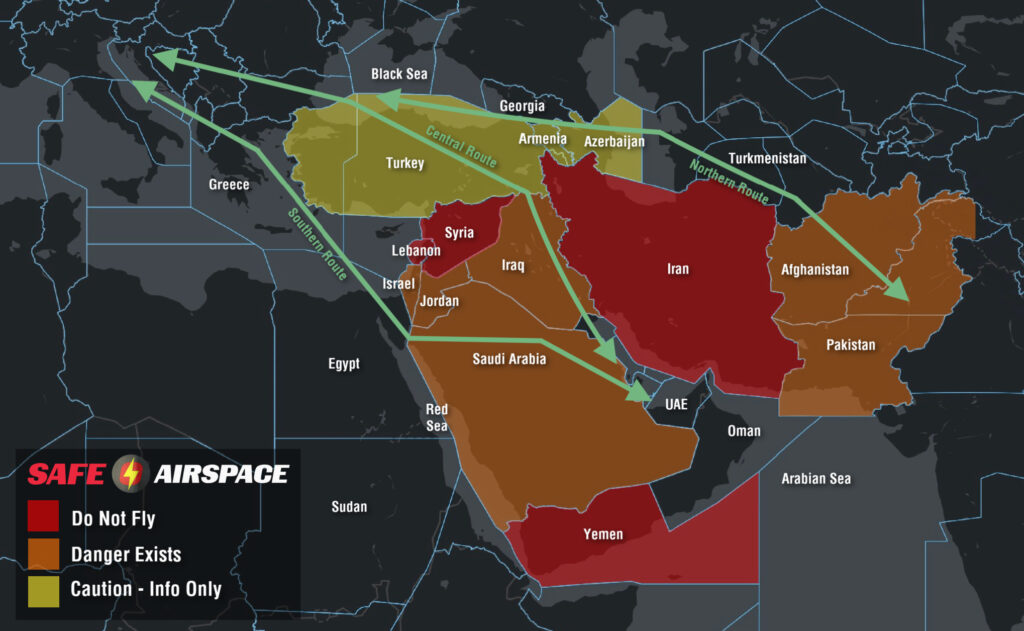
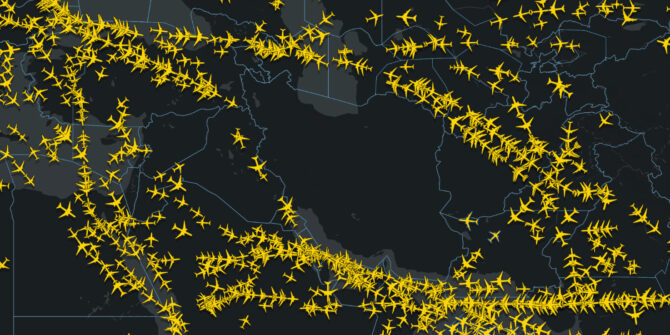
Therefore, a common question that bizav operators are asking OPSGROUP is ‘what are the major airlines doing?’ A snapshot of flight tracking right now shows that Middle Eastern transits are managing risk through the use of three distinct routes:

  • South via Saudi Arabia and Egypt
  • Central via Eastern Iraq and Turkey.
  • North via the Stans and the Caspian Sea.
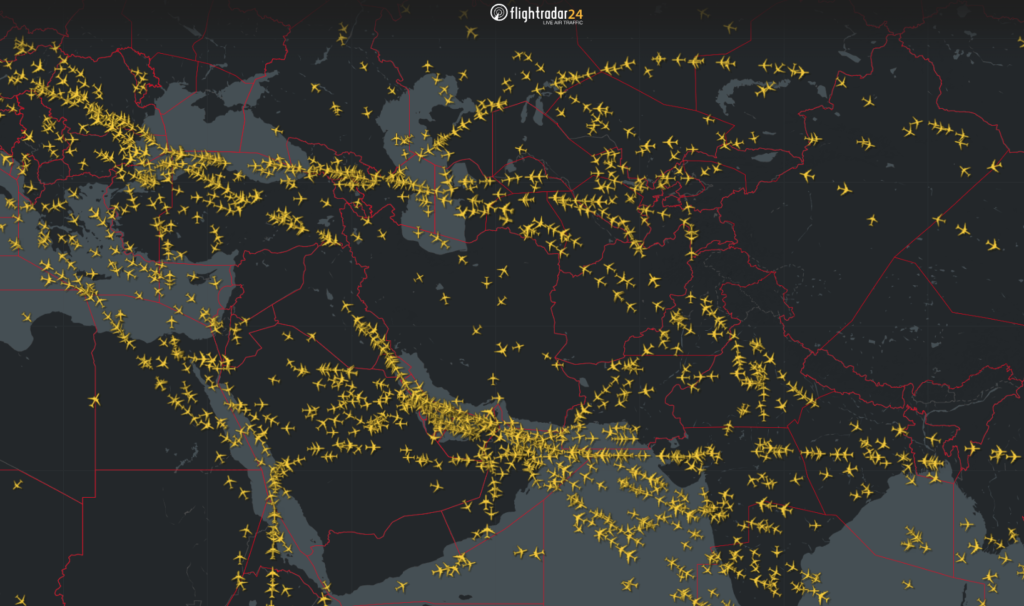
This article provides a brief risk profile for each of these routes to help operators carry out their own risk assessments when choosing a route to fly.

A Note About Risk

OPSGROUP also runs safeairspace.net – a database of all state-issued airspace warnings, along with risk briefings for each country in plain simple English.

We take into account both official advisories, recent and past events, advice from other specialists and potential for emerging risk when making a risk assessment.

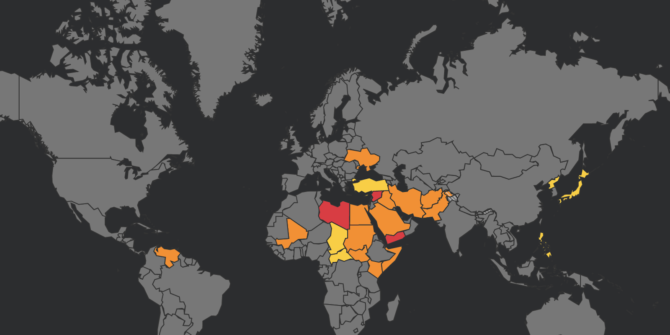
To keep things simple we have three levels:

  • Level 1 Do Not Fly (Red)
  • Level 2 Danger Exists (Orange)
  • Level 3 Caution (Yellow).

None of the three routes above enter any country’s airspace we have classified as ‘Do Not Fly.’

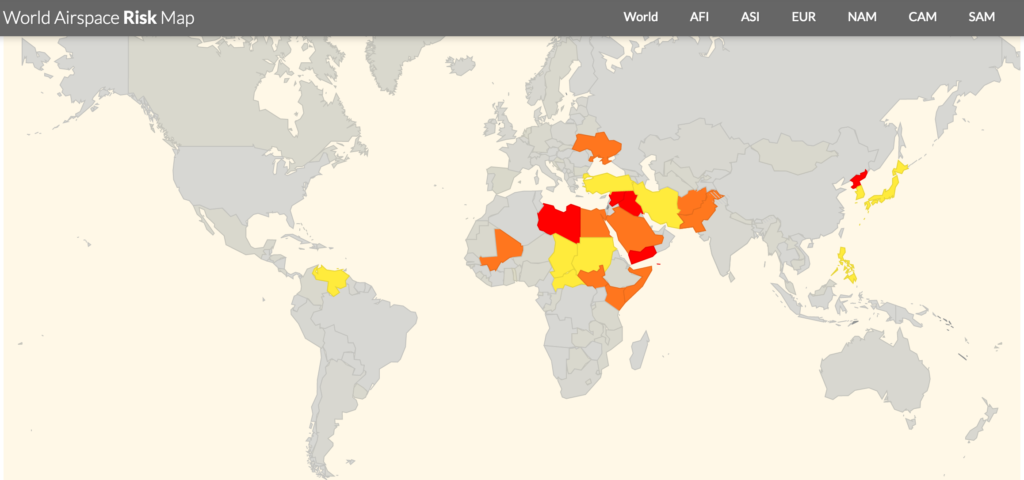
For the rest, you’ll see the map below is color coded according to the same risk profile.
The Southern Route

This route begins with a lengthy crossing of Saudi Arabia, steering clear of Israeli and Lebanese airspace to the north before crossing the Red Sea into Egypt.

It’s considered advantageous because it keeps tracks miles down (compared to the Northern Route) and avoids the potential for a sudden escalation of hostilities between Israel and Iran.

From a contingency perspective, it also provides safer diversion options than a transit of Iraq.

But now for the more-risky stuff.

The Houthi Campaign:

There is currently heightened risks to civil aviation in this area.

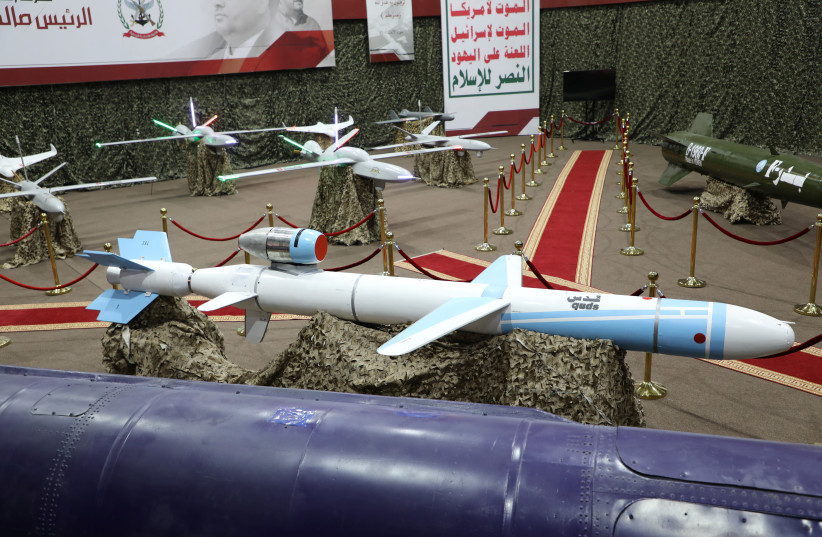
Houthi Rebels in Yemen are currently engaged in a long-term campaign to use missiles and drones to target Israel (therefore infringing the Jeddah FIR) along with shipping channels in the Red Sea.

The military response to these activities is the use of air defence systems to destroy them.

The latest incident occurred on Nov 3, where a crew witnessed the interception of a missile at a similar level in open airspace near Jeddah. OPSGROUP members can access a special briefing on this latest event here.
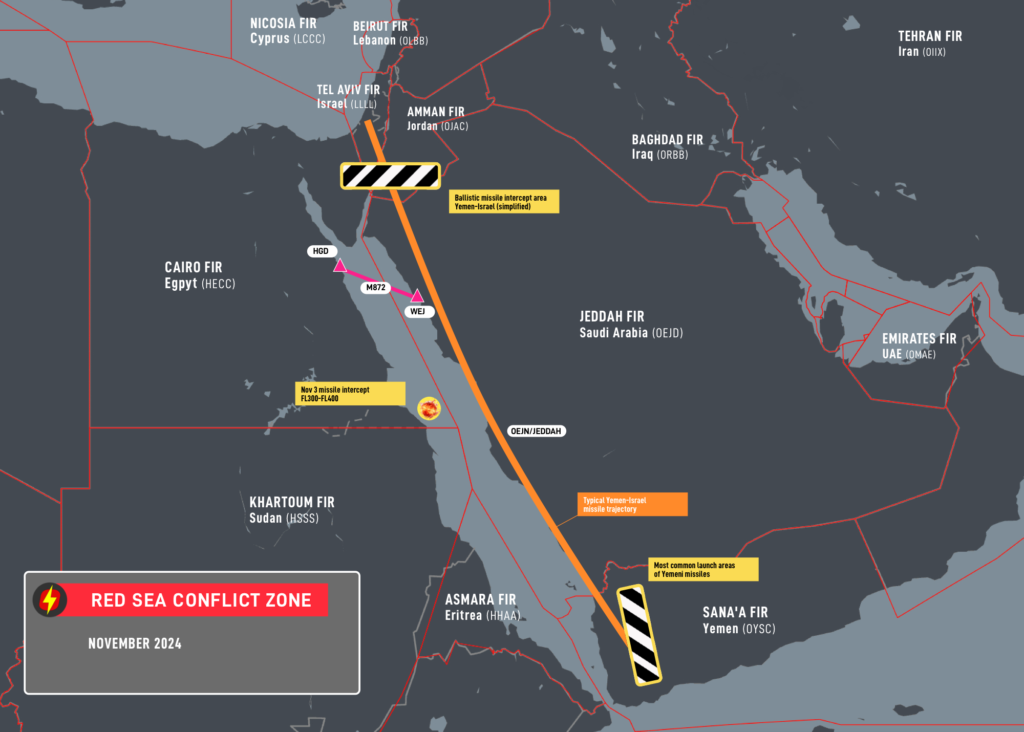
Of particular concern to aircraft at altitude is the use of ballistic missiles which originate from Western Yemen and are destroyed by defensive intercepts while on descent toward their target – which puts the airspace of Northern Saudi Arabia at heightened risk given its proximity to Israel and Gaza.

This essentially creates three risks to overflying aircraft – a direct hit by a missile (extremely unlikely), debris fields from inflight break ups or successful interceptions, and misidentification.

For the latter, many well-known incidents affecting civil aviation have come from mistaken identity. Malaysia 17, Ukraine 752 and Iran Air 652 were all due to misidentification.

Egypt ATC Congestion:

 OPSGROUP has received several recent member reports of severe frequency congestion in the Cairo FIR apparently due to ATC overload.

One crew even reported that during an entire portion between the North Coast of Egypt to the Red Sea (MMA – M872 – SILKA) that they were unable to talk to ATC.
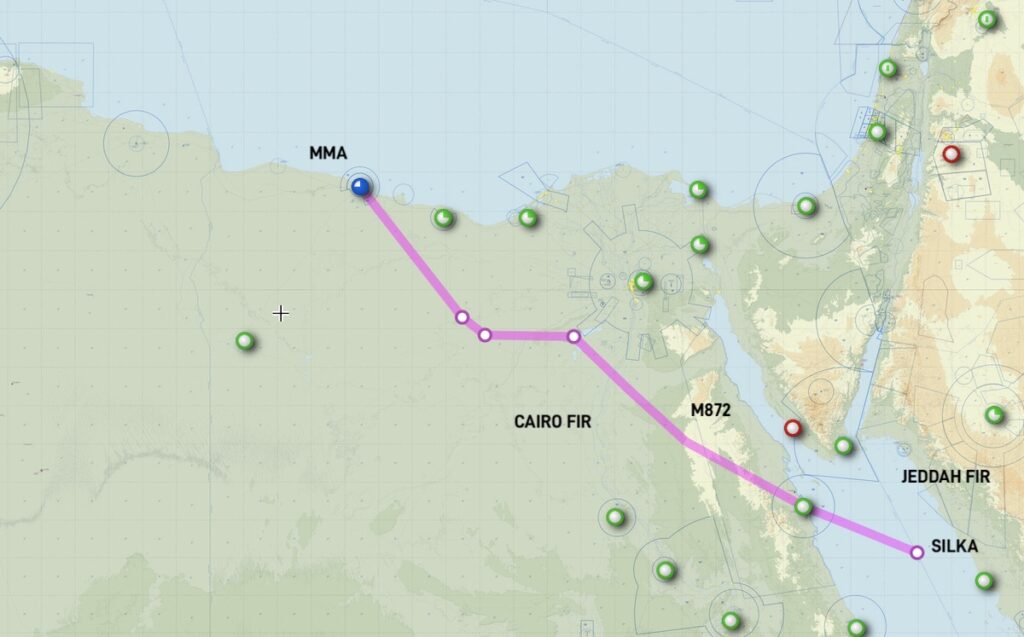
The corridor is much busier than usual which may present latent threats. Good airmanship at this time would be to keep a close eye on TCAS, ensure all anti-collision lights are on and consider the use of a PAN call if a deviation becomes necessary without a clearance.

We have approached both the Egyptian CAA and ANSP for feedback and have yet to receive a response.  If you have experienced this yourself in the HECC/Cairo FIR, please get in touch with us at team@ops.group.

The Central Route

This more conventional route tracks northwards along the Persian Gulf before an extended transit of Eastern Iraq using the UM860 and UM688 airways which run parallel to Iranian airspace before crossing Turkey and a southern portion of the Black Sea.

The overriding question from this route is “is it safe to overfly Iraq?”

In our opinion, yes but with some disclaimers.

UM860/UM688 Airways:

The UM860/UM688 have been considered safe for a long time. And prior to 2021, remained the only option available for US operators to enter the Baghdad FIR at all.

They continue to see heavy traffic by major carriers and can be considered a viable option.

When using them, an important consideration is their proximity to Iranian airspace. Due to the recent escalation in hostilities between Israel and Iran, many states prohibit operators from entering the Tehran FIR due the risk of anti-aircraft fire at all levels.

Extensive GPS interference (including spoofing) can be expected in Northern Iraq and on at least one occasion has led an aircraft to almost inadvertently enter Iranian airspace without a clearance.
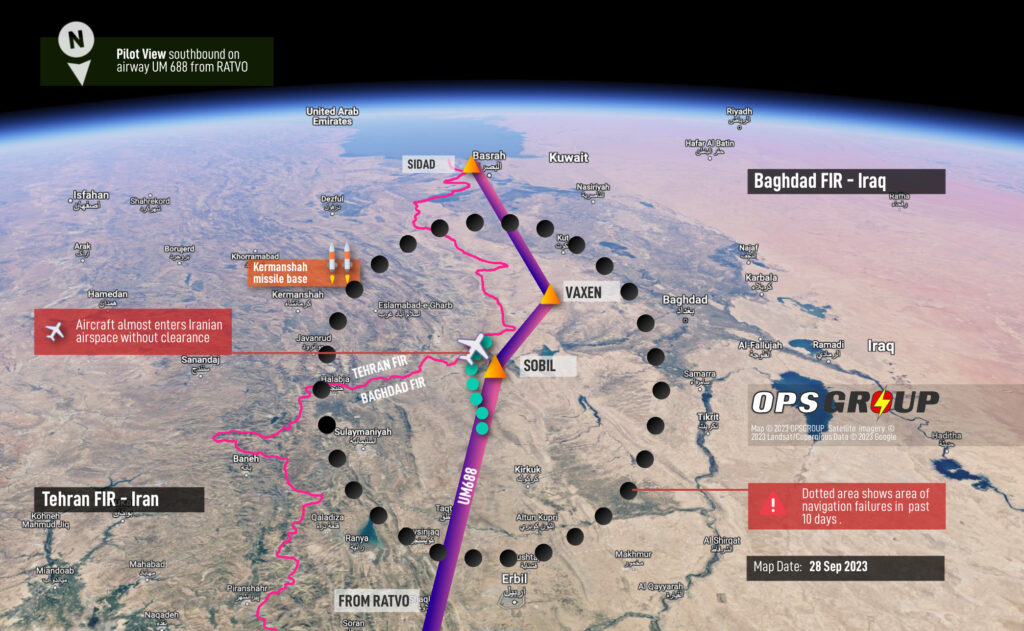
Extra vigilance for the early signs of GPS interference is essential for the safety of this route, along with early notification to air traffic control if it is suspected. Radar vectors remain your best fail safe.

Also beware of the potential for sudden closures of the ORBB/Baghdad FIR should further fighting occur between Israel and Iran. It closed completely during recent Israeli airstrikes and remains geographically sandwiched between the two, along with Jordan and Syria.

Free Routing:

In 2021, the FAA changed the rules. A new SFAR was issued that allowed N-reg overflights anywhere in Iraqi airspace, provided they’re conducted at or above FL320, which has opened-up new options for free routing.

Great for fuel, but arguably not safety. We continue to advise against flights away from the above airways due to well publicized risks of militant and terrorist activity which may target civil aircraft with anti-aircraft weaponry.

They may also be misidentified by air defense systems targeting drones which are frequently used to conduct attacks in Northern Iraq that originate from Turkey and Iran.

Crew and passenger safety is also an important concern should an emergency landing be required.

Turkey (beware of GPS interference):

We maintain a low-risk rating of caution for Turkey. As two of the three routes in this article include a lengthy overflight of the country, it is worth touching upon why any risk rating has been applied at all.

There is minor risk to overflights from misidentification by local militia who infrequently target Turkish military aircraft with anti-aircraft weaponry. This risk is predominantly near the border with Syria and Iraq where a higher level of airborne military traffic and UAS is present.

Far more prevalent is GPS interference – there have been frequent reports of both jamming and spoofing by aircraft well inside Turkish airspace. It appears to be common throughout the LTAA/Ankara FIR, especially anywhere near the border with Iran or Iraq. PIREPs also extend to Turkish airspace over the Black Sea. Reports share very similar symptoms: Un-commanded turns, position errors, and multiple GPWS warnings. The spoofed locations tend to center on Sevastopol on the Crimean Peninsula – a difference of between 120-250nm from the actual aircraft position. OPSGROUP members can access a special briefing on this hazard here.

The Northern Route

This is the route being favored between destinations in Europe and India/South East Asia.

It begins with a transit of Pakistan, before an uncontrolled crossing of Afghanistan and into Turkmenistan. A westerly turn is then made cross the Caspian Sea, Azerbaijan, Armenia and Turkey before rejoining the central route over the Black Sea.

While a fairly conservative option, it is the longest in terms of track miles.

Afghanistan:

For all intents and purposes, airspace safety in the Kabul FIR has not changed since the Taliban re-assumed control of the country in late September 2021.

The entire FIR remains uncontrolled and there is no guarantee of crew or passenger safety if you need to land. In that sense it remains the most important consideration in the selection of this route.

With that said, adjacent FIRs are managing the entry and exit of traffic and separating them with miles-in-trail and level restrictions.

Once inside, fairly robust contingency procedures (including the use of TIBA) appear to be working, with major carriers the likes of Lufthansa and KLM making safe crossings every day.
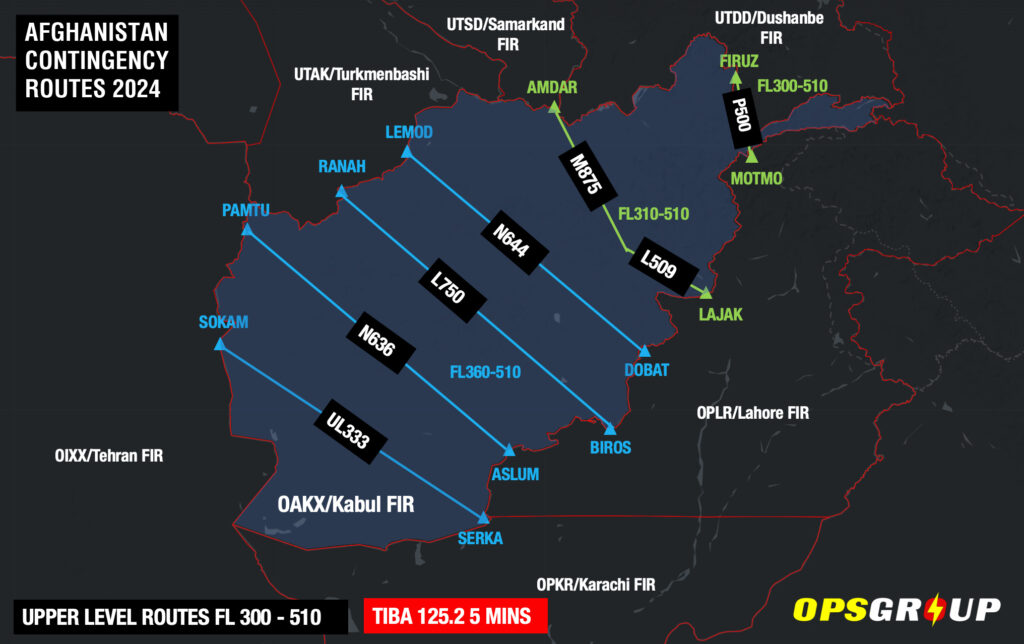
Aside from potential insurance complications of extended flight in uncontrolled airspace, it seems the predominant risk for overflights is what happens if you have an emergency and need to divert.

The overriding consensus (along with common sense) is don’t land in Afghanistan. In our recent article we explained it would be wise to consider it akin to ditching i.e. a last resort. Careful consideration of critical fuel scenarios to clear the Kabul FIR in event of de-pressurization, engine failure or both is essential to moderate this risk.

Azerbaijan and Armenia:

We maintain a level of caution for overflights of these countries given their history of conflict, but for now the risk to overflights remains low.

A ceasefire agreement is in place, and most states have lifted their airspace warnings for the YDDD/Yerevan and UBBA/Baku FIRs.

When sporadic fighting has occurred, it has been confined to border regions. A contingency to keep to mind is the use of northerly waypoints BARAD, DISKA and ADEKI to avoid the area and transit from Azerbaijan through Georgia instead.

Stay Informed

The situation in the Middle East has recently proven that airspace risk can change quickly and without warning.

Overflights need to stay informed and have good contingencies in place to manage unexpected re-routes and airspace closures, along with suitable diversion airports.

OPSGROUP issues Ops Alerts for members on a daily basis, but our risk and security alerts are also available for free on safeairspace.net which our team keeps updated around the clock.

If you have more questions, you can get in touch with us on team@ops.group. We’d love to hear from you.
Rumbles Over Riyadh: A New Threat?

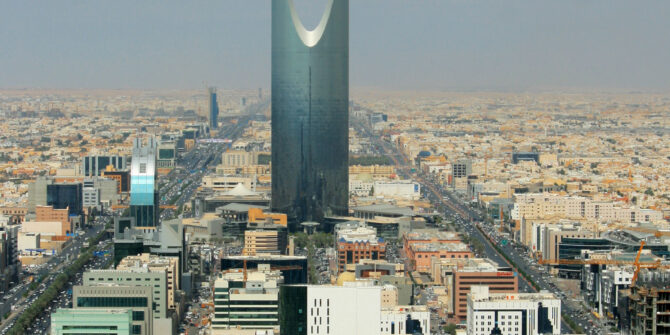
You might have seen the headlines a week or so ago. On January 23, Saudi Arabia’s capital Riyadh was attacked by a ‘hostile air target’ – likely an explosive ‘kamikaze’ drone. Saudi air defences destroyed it, causing a loud explosion over the city and flight disruptions at OERK/Riyadh.

Then a few days later it happened again. Another big bang in the skies of Riyadh and more flight disruptions. Plenty of people caught it on camera. But the silence from official channels was deafening.

So what? Isn’t there is always stuff in the news about drones over there?

Yes. They’re sporadically sent over the border from Yemen by the Houthi – the folk who overthrew the Yemeni government back in 2014. Southern regions are usually the worst hit and occasionally Jeddah and Riyadh are targeted just to remind Saudi Arabia that they can.

But here’s the kicker: this time it probably wasn’t them.

How Do You Know?

Firstly, the Houthi have adamantly denied they were to blame. They’ve actually gone out of their way to distance themselves from the attack. So why should we believe them? Because of the status quo – they want to make headlines. Their attacks on Saudi Arabia are a demonstration of their firepower and willingness to target anywhere in the country. They’re even known to claim responsibility for attacks that weren’t theirs.

Secondly, someone else has already put their hand up for the attack – a group of militants in Iraq called the Alwiya Waad al Haq. The Who? The ‘Brigades of the Righteous Promise’. It’s a fancy name but the takeaway is this: someone new is apparently taking shots at Saudi Arabia from Iraq.

Here’s why

Saudi Arabia and Iran don’t get along. The reasons are long and complicated and you can read more about them here. But in a nutshell, religious differences and a desire for regional dominance are the cause of the ongoing conflict. The attacks on Riyadh are a worry because they may reflect a changing way that Iran asserts its dominance throughout the Persian Gulf – by proxy.

Proxy conflicts are a thing. It means when someone is doing the hands-on fighting for somebody else. Remember those Brigades of the Righteous Promise people? It is alleged that Iran may have put have put them up to it, and supplied the firepower to do it.

There’s no shortage of independent militia in Iraq. They’re difficult to trace and new ones emerge seemingly from nowhere – so much so that they’re sometimes known as ‘shadow militia.’ In reality, they are usually a cover for larger and much more well-known groups. In this case, possibly the Hezbollah – one of Iran’s largest proxies.  By hiding behind different names they can cause confusion, unpredictability and can divert blame away from the prime suspects.

It is possible that Iran may now start using these proxies more often for attacks on its regional adversaries.

So why is this an aviation issue?

We get twitchy when anyone is firing things into the sky. This way of fighting is unpredictable and the weapons being used are getting more sophisticated and can cover large distances.

Case in point. Back to the Brigade guys – since their alleged attack on Riyadh they have since threatened to attack the Burj Khalifa in Dubai, and also Abu Dhabi airport. Whether or not their threats can be taken seriously remains to be seen – but if the attack on Riyadh is anything to go by, they might have the weapons and intent to do it.

For aircraft, there are a few threats to be aware of:

  • Misidentification by sophisticated air defence systems.
  • Being caught in the cross fire.
  • Simply being in the wrong place at the wrong time. Airports are often a prime target.

What can we do about it?

Continue to monitor Safeairspace.net for airspace warnings – it is our database of airspace risk and we update it all the time. Head over there and take a look – there are multiple warnings for the Persian Gulf region including four ‘no fly’ countries: Syria, Iraq, Iran and Yemen.

Understand ESCAT rules. Or you might know them as SCATANA. Either way they are a protocol for getting you out of dangerous airspace and fast. ATC may divert you clear of an FIR or ask you to land. They’re in use in Southern Saudi Arabia – but can be applied at short notice to any airspace where the risk is high. ESCAT procedures are published in GEN 1.6 of Saudi Arabia’s AIP. If you don’t have a login, you can see the relevant section here.

Lastly, carry out your own risk assessment and know what’s going on down there. Just because airspace is open doesn’t mean that it’s safe.


New features – Conflict Zone & Risk Database

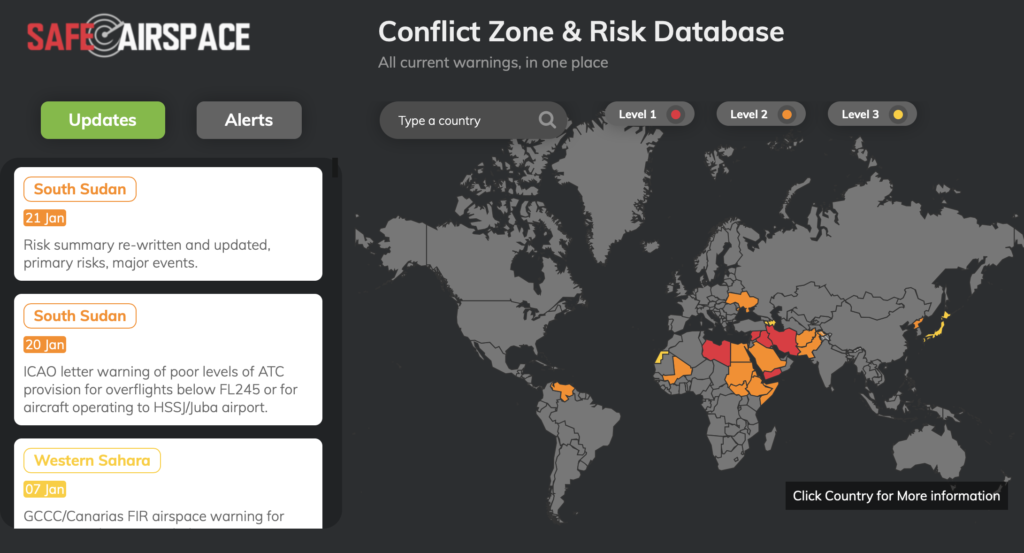
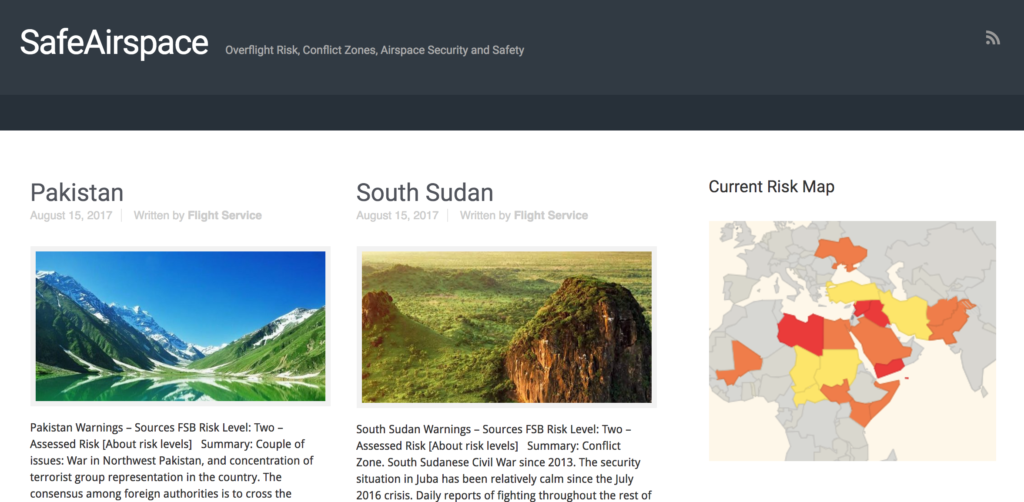
To make it even easier to get a current risk picture for International Flight Ops, we’ve added a bunch of new features to the Conflict Zone & Risk Database at SafeAirspace.net.

Thank you to all OPSGROUP members – all our airlines, aircraft operators, pilots, dispatchers, and industry colleagues who’ve made this possible. Now we have a simple, single source of information for all risk warnings, analysis, that includes our Risk Radar project (so for the first time we can see what other operators are doing), all state warnings, and the ability to auto-generate a live Summary PDF of the current situation.

Start at SafeAirspace.net, where you have the current risk map, and feed of Updates and Alerts:

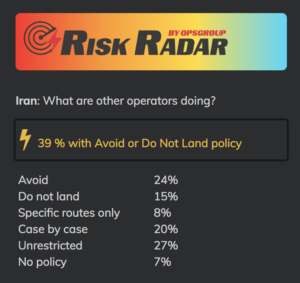
On each country page, you will now see Risk Radar information like this:

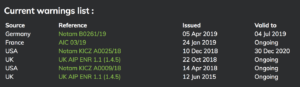
For each country, you’ll see the current list of warnings, both from the country concerned and other states:

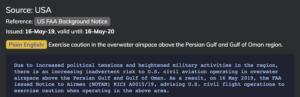
Scrolling down, you’ll get the current Notam/AIC/AIP reference and a copy of the text:

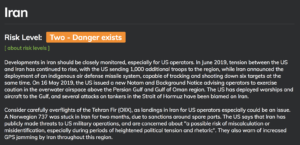
For each country, there is a Summary and Analysis, so you get some background on why these warnings exist:

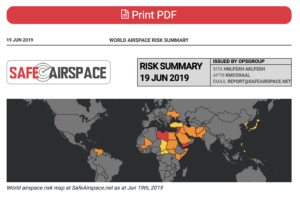
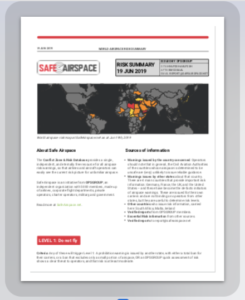
A new feature is the ability to generate a live summary into a PDF, so you can print out everything into one document to share with your crew, dispatchers, and security team:


You can download an example of the PDF, generated on June 19th, 2019, here:

PDF Summary – World Airspace Risk at SafeAirspace.net


Download PDF, 800kb

You can generate your own live PDF here.

About the Conflict Zone & Risk Database

The Conflict Zone & Risk Database provides a single, independent, and eternally free resource for all airspace risk warnings, so that airlines and aircraft operators can easily see the current risk picture for unfamiliar airspace.

Safe Airspace is an initiative from OPSGROUP, an independent organisation with 5000 members, made up of airlines, corporate flight departments, private operators, charter operators, military, and government.

The Conflict Zone & Risk Database was launched in September 2016 as the lifespan of the ICAO CZIR was coming to a close, keeping the work ICAO did on the project alive, and providing the autonomous platform needed to make the concept work.

Objective – one single source

A single source for all risk warnings issued about an individual country, independent of any political or commercial motivation, so that a pilot, flight dispatcher, security department, or anyone responsible for flight safety can quickly and easily see the current risk picture.

Oversight and independence

The CZ&RD is managed by OPSGROUP. Because we are outside the chain of government, we are responsible only to our member airlines and aircraft operators, and more importantly, to the people ensuring a safe flight operation, and to the passengers that fly on our aircraft. For this reason, all information pertinent to a country can be assured to be carried here.

Eternally free

To remain completely independent of any bias, and to ensure that everybody has access, the Conflict Zone & Risk Database is completely free of charge. We have no commercial interest in publishing this information, it exists as a public service because our members care deeply about flight safety.

Contacting us

We rely on your input. If you have information to add, please email report@safeairspace.net. You can also use this address to discuss any content here. The collaborative effort is our focus. We’re still a team of humans, and we miss stuff. If you see something missing here, please tell us!

All submissions are anonymous, and our only concern is for the safety of all airspace users – the crew and the passengers. We appreciate your help.


Stuck in Iran for over 2 months

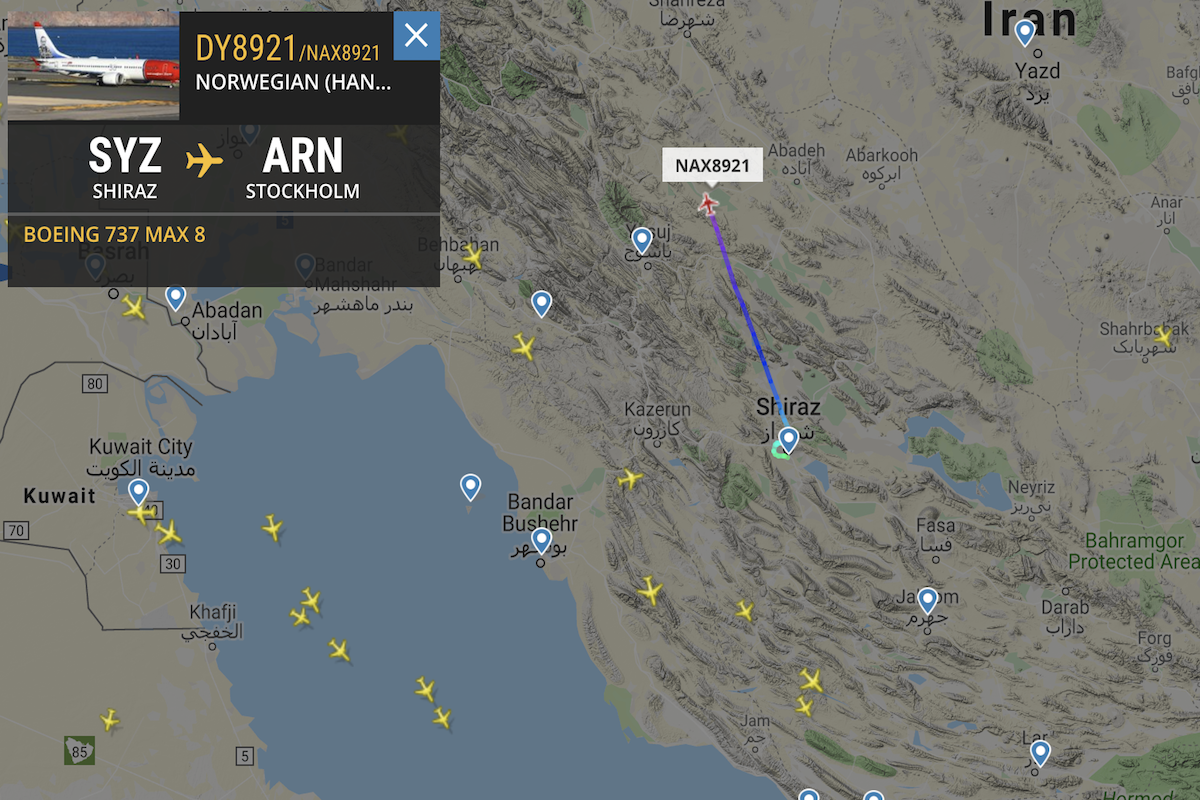
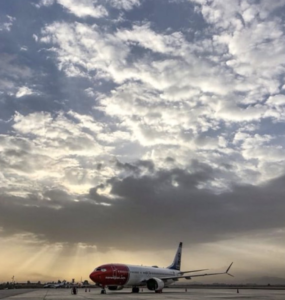
On Feb 23, the Norwegian B737 which had been stuck in Iran for two months after an in-flight diversion finally departed OISS/Shiraz, and landed back at Stockholm’s ESSA/Arlanda airport.

The brand new Norwegian Boeing 737 MAX8 was flying from Dubai to Oslo on Dec 14 when it encountered engine problems that necessitated a diversion to Shiraz.

With the U.S. sanctions currently in place against Iran, it made it very difficult to obtain approval to get the required spare parts over to Iran to fix the aircraft – Norwegian were only able to do so after negotiating a workaround with the U.S. Office of Foreign Asset Control.

The real complication here came from the fact that the aircraft needed a replacement LEAP-1B engine. The engine is a 50/50 ownership split between GE (USA) & Safran (France). The U.S. export restrictions apply to any company that wants to sell or resell goods to Iran that contain more than 10 percent aviation parts or technology from the United States.

In the end, the aircraft was out of service for over two months, no doubt costing the airline a fortune in lost revenue. It’s unclear who will be picking up the bill for “extra” complications of getting the permits with Iran, but that will be a costly exercise also.
The lesson?

Consider your overflight diversion options. If a checklist calls for a diversion to the nearest suitable airport and that airport is in a country with limited diversion support or (in this case) complicated requirements for sourcing replacement parts – is it worth the risk?

Have you operated to anywhere in Iran recently? Let us know how it went!

Further reading


Why are we still flying airline passengers over war zones?

Here’s the level of inconsistency we’ve reached in international air transport: we take each passenger, scrutinize their booking, check the no-fly-list, watch them on CCTV, pull them apart at TSA, remove anything sharper than a pen, question them, x-ray the bags, run Explosive Trace Detection tests, screen the hold baggage, background check every member of the crew, and then, once they’ve all boarded, fly this ultra-secure airplane straight into a war zone.

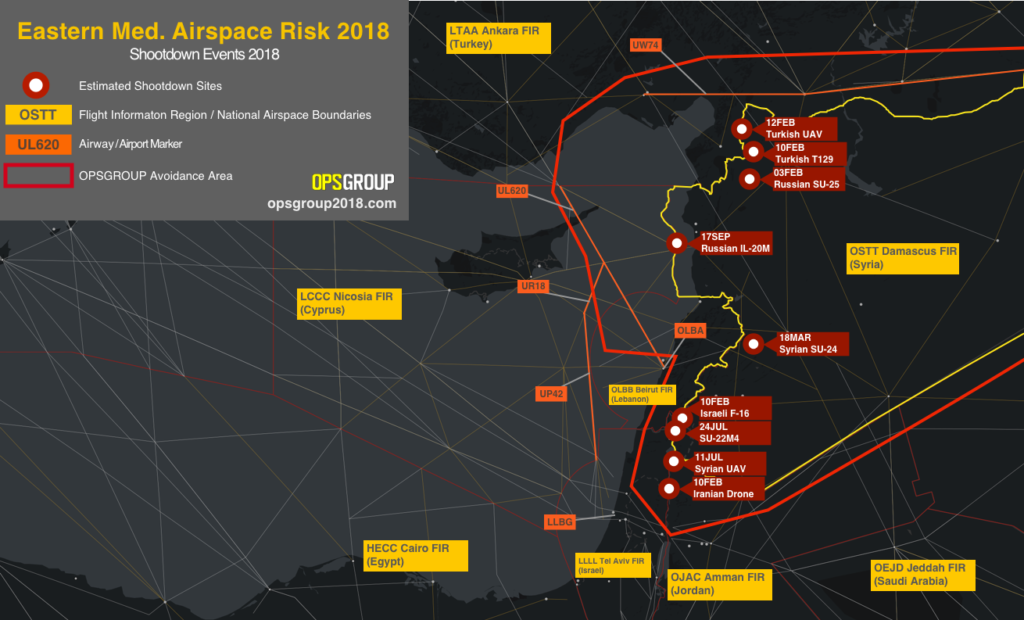
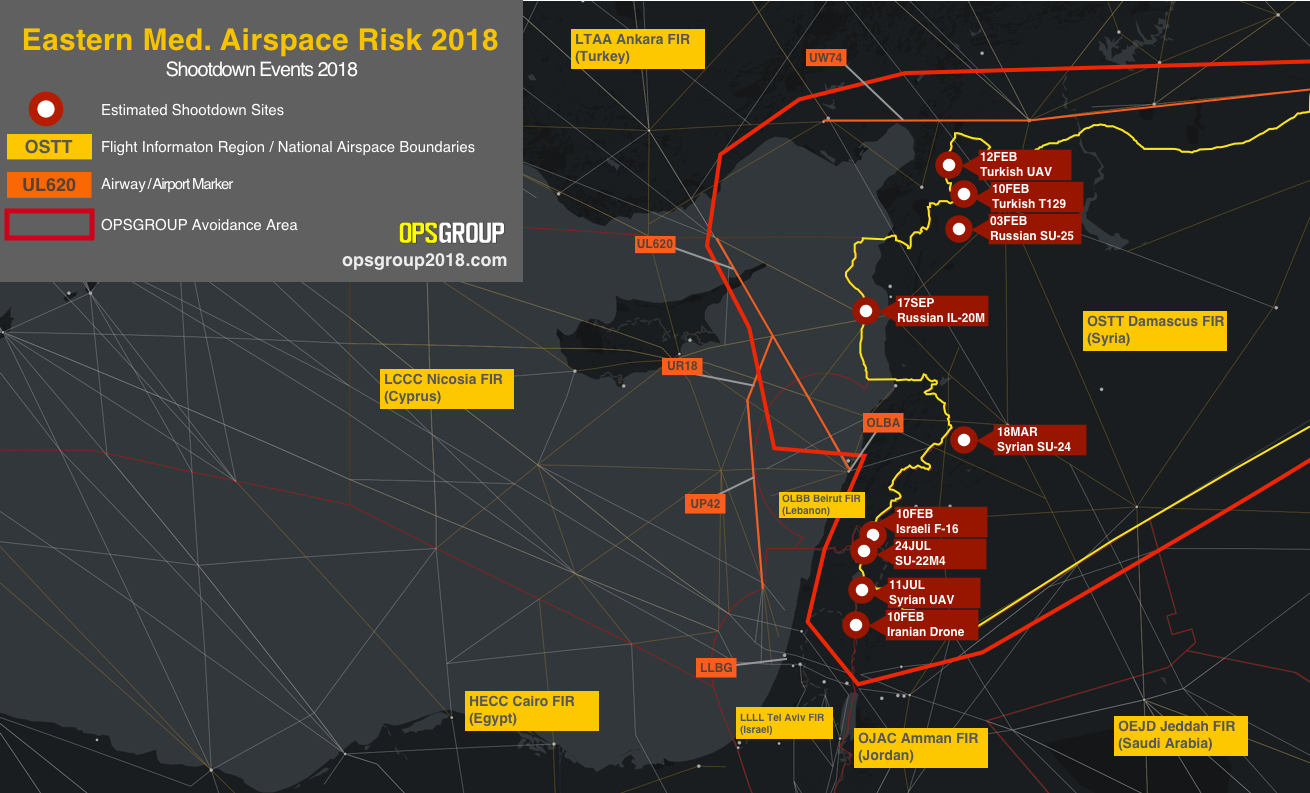
Welcome to the Eastern Mediterranean. It’s an active conflict zone. The Russian naval build up there this month is the largest since Moscow’s intervention in Syria began in 2015. Over Syria, 9 aircraft have been shot down this year.

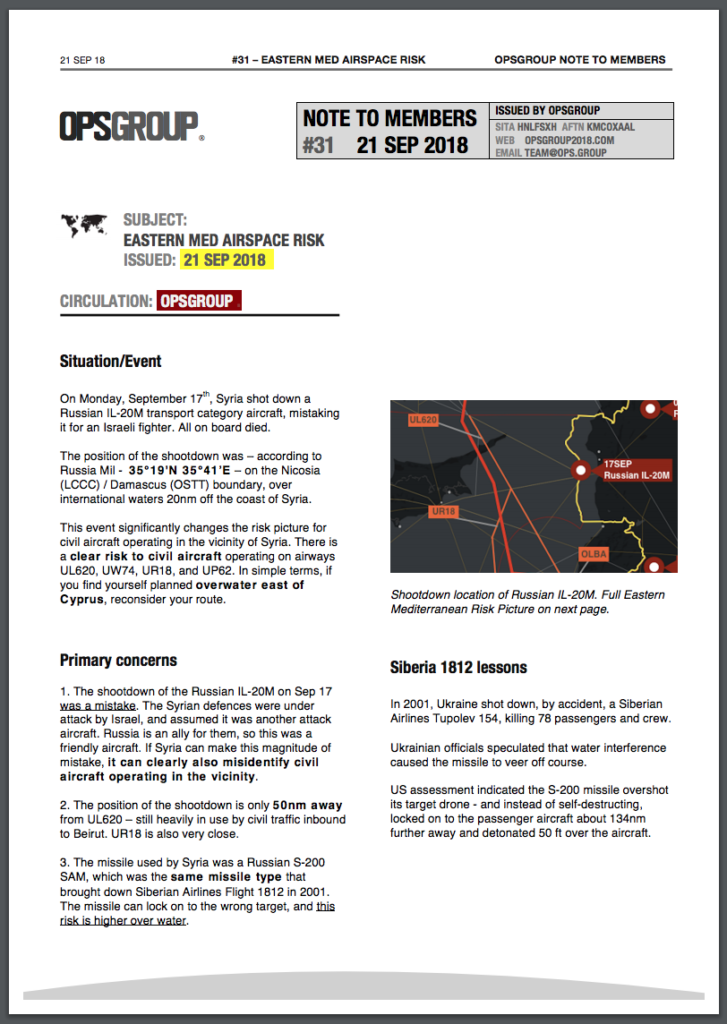
The most recent was on Monday night this week, when Syria came under attack from Israel fighter jets, and started firing indiscriminately at anything off the coast that looked like a threat. They wanted to shoot something down, and they did — except it was a friend, not foe. They took out a Russian Ilyushin IL-20M transport category airplane. Even on the worst radar, that doesn’t look anything like an Israeli F-16.

50 miles away from where the Russian aircraft plunged into the sea on Monday night is the international airway UL620, busy with all the big name airline traffic heading for Beirut and Tel Aviv. If Syria can mistakenly shoot down a Russian ally aircraft, they can also take out your A320 as you cruise past.

And yet, most airlines continue to operate. Are we really so comfortable with operating in conflict zones again?

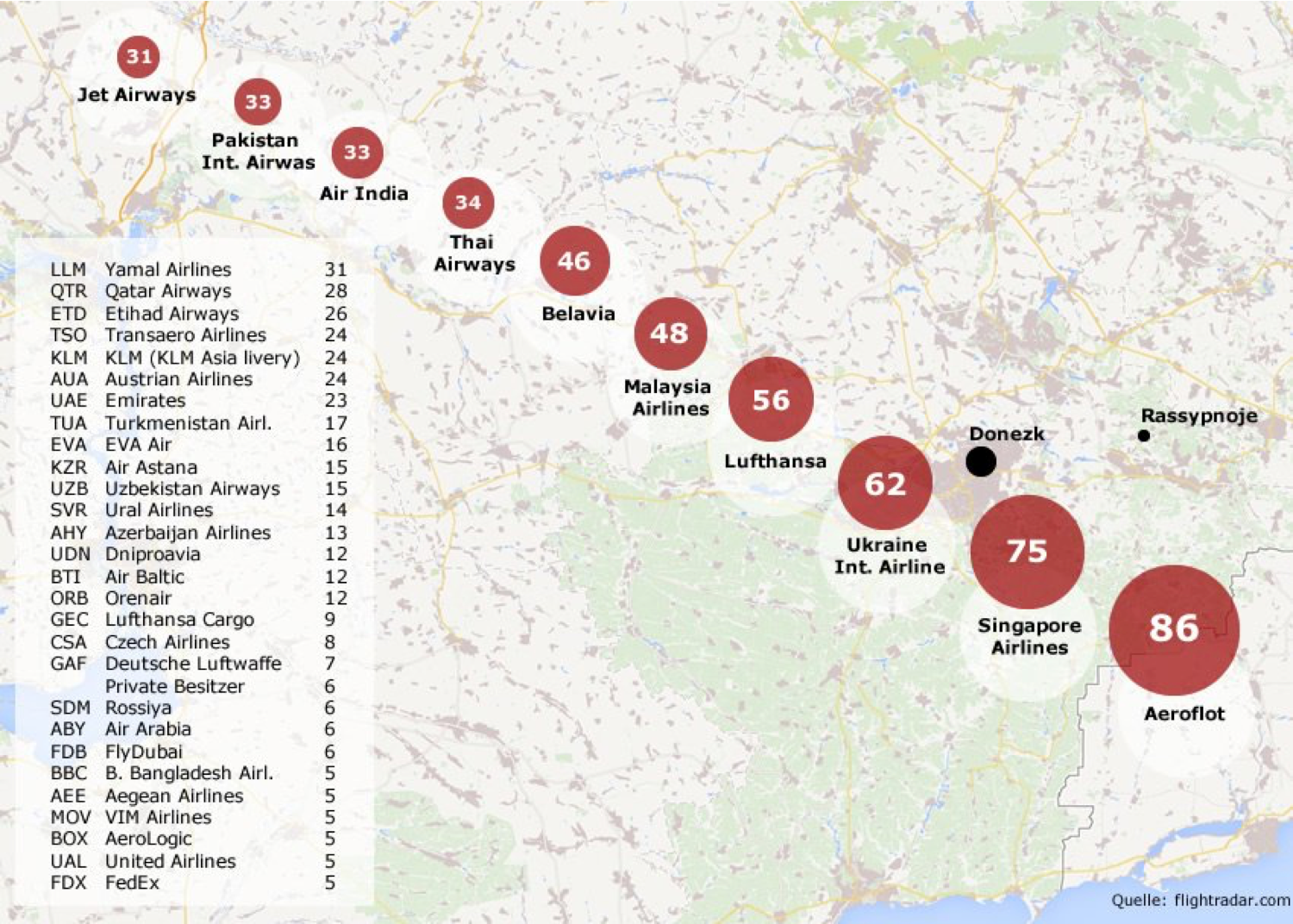
The lessons of MH17 seem to be fading fast. It’s a little over four years since 298 people lost their lives over Ukraine one summer afternoon, thanks to an errant missile fired during a civil war at an aircraft that they thought was a military threat. “Why were they over a war zone”, everyone cried afterwards.

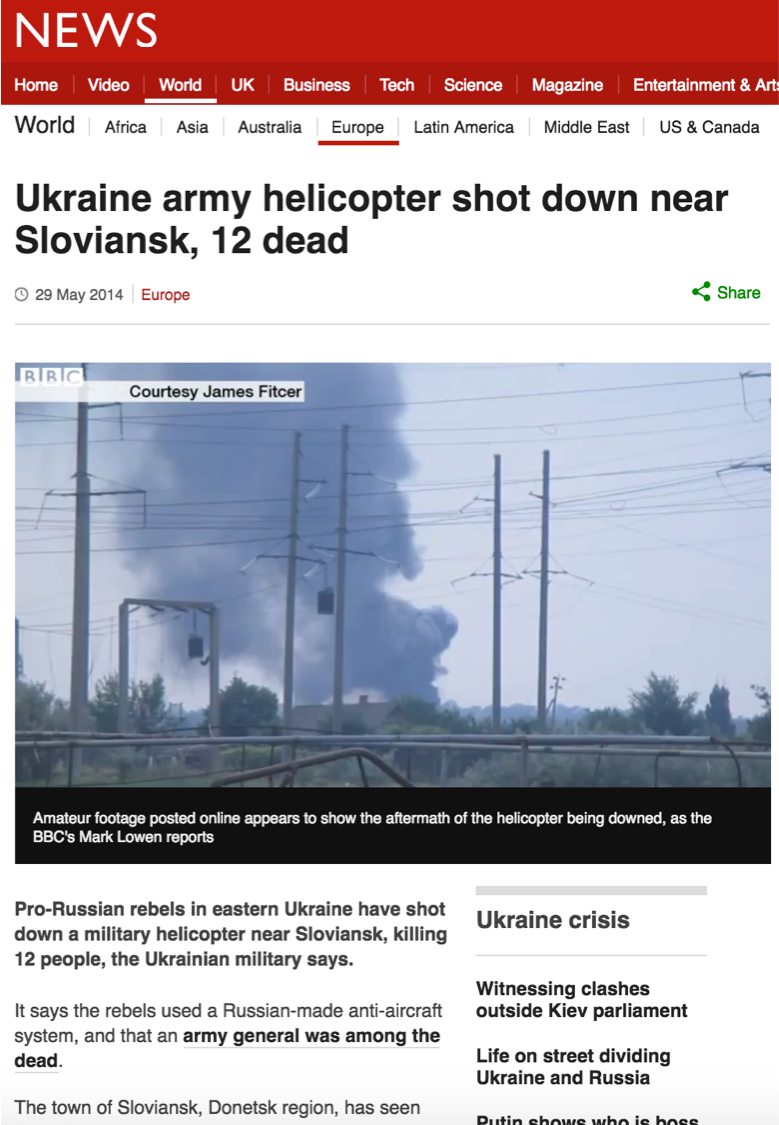
Well, we all were. Me too. I was a pilot for Austrian Airlines at the time. I recall one morning in Vienna, some months before MH17. Boarding the last of the passengers, my BBC news app flashed up a story about a helicopter being shot down in eastern Ukraine .

As we were headed east, with my colleague in the cockpit, we quickly plotted the position on our enroute chart, and noted that it was really close to our route. Maybe 30 miles north. “We might see something interesting!”, we said, and pushed back. We didn’t, nor did we think much more about it.

Do you see the thought process though? Before MH17, we didn’t consider the risks to our aircraft from war zones. Especially being so high. Helicopters might be getting shot down, but we’re at 35,000 feet. No problem.

This is why all of these airlines — mine, at the time, included — operated on the route.


Image: Der Spiegel

And then it happened, and none of us could quite believe it.

But we learned. “Conflict Zone” became a buzzword. We had task forces and committees, whitepapers and promises, and — myself included — talked at length about how this happened, why, and how to avoid it in the future.

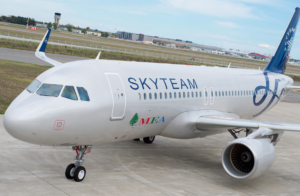
And yet, here we are flying unsuspecting passengers along the Syrian border. If you’re unsuspecting enough, and buy a SkyTeam codeshare ticket — you’ll actually overfly Syria on the Honey Badger airline of the region, Middle East Airlines.

Here we are flying passengers in the Eastern Mediterranean war zone. Why is this happening?

My guess: because we don’t think anything bad is going to happen, because the airspace boundary lines on the charts make that little bit of sea near Cyprus feel different from that little bit of sea near Syria, but mainly because there is no clear guidance from Aviation Authorities.

Let’s start with Cyprus. The Nicosia FIR has a big chunk of unsafe airspace. The Russian aircraft on Monday was shot down on the Nicosia FIR boundary. What do the Notams say? Take a look. There are 97 of them. Mostly about fireworks at local hotels. Critical stuff indeed. Then there are 20 or 30 about “Russian naval exercises”. A clue, perhaps, but where is the black and white “An Aircraft was Shot Down on our Border on Monday?” . Or, since we are still using teletype to communicate Notams to crews, “AN AIRCRAFT WAS SHOT DOWN ON OUR BORDER ON MONDAY”. Wait, we have to abbreviate that, and use codes, for some reason. “ACFT SHOT DOWN ON FIR BDY 17SEP”. That’s better.

What about Turkey? Anything on the Eastern Mediterranean risk? Let’s have a look. Nope, just 132 Bullshit Notams, and something about an AWACS aircraft. See you back here in 30 minutes when you’ve read them all.

Remember, I’m being a pilot, an airline, a dispatcher, trying to find information on the Risk in the Eastern Mediterranean. And this is how hard it is.

EASA (European Aviation Safety Agency), how are you doing? Let’s start here, at the “Information on Conflict Zones”. Paragraph 2 tells us that ICAO have a Central Repository on Conflict Zones, launched in 2015.

No, they don’t. That died — quite a long time ago. This is where it used to live. So, there is no ICAO Central Repository on Conflict Zones. There is a new ICAO document with guidance on managing Conflict Zone risk (and it’s a bloody good one, too) — but where is the picture of current risk?

Let’s plough on through the EASA site. Aha! Seems we have a Conflict Zone alerting system, and Conflict Zone bulletins. Here they all are: https://ad.easa.europa.eu/czib-docs/page-1

The last one on Syria was issued on April 17th. But it seems to be just a list of Notams issued by other states. And these are out of date. The German Notam has expired, the French AIC has been replaced.

And there’s no guidance. No Map. No routes to avoid. Nothing about Cyprus, or Beirut. No mention of the Russian shootdown. No mention of the 9 aircraft shot down this year.

How am I supposed to know, as an operator, or pilot, what the risks are and where to avoid. We’re getting closer to the point here. You’re not supposed to rely on the Aviation Authority. That is their message. You must conduct your own risk assessment. You must research and find out about the risks yourself.

You are on your own.

If you’re a big airline, that’s probably fine. You’ll make your own decisions about where to fly, anyhow. But what about everybody else?

While OpsGroup works hard to get information out to our members — and we spend a lot of time researching risk — I would greatly prefer that we didn’t have to.

Aviation Authorities must issue better guidance for the aircraft entering their areas.

Let me remind you. Airlines are operating 50 miles from a position where an airplane was shot down at night, by a missile type that’s already taken out a passenger airliner by mistake, fired by a beleaguered Syrian defence post, at a friendly aircraft that they did not take time to identify.

And the guidance to operators from Authorities: NIL.


Opsgroup has now published Note 31: Airspace Risk in the Eastern Mediterranean. There is a clear risk to civil aircraft operating on airways UL620, UW74, UR18, and UP62. In simple terms, if you find yourself planned overwater east of Cyprus, reconsider your route.

Further reading:


OPSGROUP featured on Al Jazeera

As a group of 4000 pilots, dispatchers, and controllers, we stand for safety ahead of commerce. Al Jazeera interviewed our founder, Mark Zee, about the current risk in Ethiopian airspace created by the ATC strike, and why we care so much about getting the truth out to our members.

https://www.facebook.com/flightservicebureau/videos/244638736242463/?t=1


The risks posed to civil aircraft by surface-to-air missiles

In Short: Worldwide the SAM threat is deemed to be “low” by ICAO with the caveat that this can change quickly when flying over or near conflict zones. The best risk mitigation is centred around which airspace you are operating over and what information you have access to. As we have explained before: There is no safe altitude from a large SAM.

What are surface-to-air missiles, and who has them?
Surface-to-air missiles (SAMs) are large, complex units, with the capability of reaching aircraft at cruising levels well above 25,000 ft, and they are designed to be operated by trained military personnel.

They are distinct from Man Portable Air Defence Systems (MANPADS), which are the smaller, shoulder-launched systems, the most dangerous of which being the FIM-92 Stinger which has an operational ceiling of 26,000 ft.

SAM systems vary but they are all designed to track and destroy military targets in flight. Due to the size and predictable flight paths, civil aircraft represent easy and highly vulnerable targets.

Many SAMs are mobile and can be moved quickly between locations. Many are located on warships. It is estimated that more than 70 States around the world have acquired SAMs as part of their military capability. A small number of non-State actors (i.e. militant groups) have also reportedly acquired SAMs, but as they require a radar system as part of the mechanism, they may not have the technical capability to use them. To date, SAMs have never been used by terrorists.

What has happened in the past?

There have been three documented occurrences where aircraft destruction has occurred due to SAM attacks.

The risk of intentional attack

To date, no documented case of intentional SAM attack on a civilian aircraft has been identified. In the case of MH17 and Iran Air, both occurred during periods of military conflict or high tension, whilst Siberia flight 1812 was shot down during a military training exercise.

ICAO say that “with regard to the States and non-State actors that currently do have access to SAMs, there is no reason to believe that the intent currently exists to target civil aviation deliberately.” And with regards to terrorist groups (as opposed to militarized forces), they say that “even where intent may exist there is currently no evidence of capability (in terms of hardware and trained personnel).”

Overall, the current risk to aviation from intentional SAM attack is therefore currently assessed to be low, the key caveat being to avoid overflying airspace over territory where terrorist groups tend to operate – normally areas of conflict where there is a breakdown of State control.

The risk of unintentional attack

Past events show us that the higher risk to civil aviation is from unintended and unintentional attacks when flying over or near conflict zones – missiles fired at military aircraft which miss their target, missiles fired at civil aircraft which have been misidentified as military aircraft, and missiles fired by State defence systems intended to shoot down other missiles.

Areas where there are armed conflicts going on clearly present an increased risk of an unintentional attack. But when assessing the risk of overflying a particular conflict zone, here are some more specific questions to consider:

Are there increased levels of military aircraft flying around in the region?

This could be anything from fighter jets being operated in a combat role, or for hostile reconnaissance; remotely piloted aircraft; or military aircraft used to transport troops or equipment. If military aircraft are one of the most likely targets for intentional attacks, then the chances of civil aircraft being mistakenly targeted increases in those areas where there are lots of military aircraft zipping around.

Are there likely to be a bunch of poorly trained or inexperienced personnel operating SAMs in the region?

This may be difficult to evaluate, but the risk is likely to be highest where SAMs may have been acquired by non-State actors. The risk is also likely to be higher in places where there is less of a robust command and control procedure for launching missiles, thus increasing the risk of misidentification of civil aircraft.

Is the territory below the airspace fully controlled by the State?

If not, and there are some areas controlled by militant or terrorist groups, the information on the presence and type of weaponry in such areas, as well as the information on who controls them, may not be readily available. In such regions, the information promulgated by the State about the risks to airspace safety may therefore not be 100% reliable.

Does the route pass over or near anywhere of particular importance in the context of the conflict?

These could be areas or locations that may be of strategic importance or sensitivity in the conflict, such as key infrastructure or military sites, which might be considered potential targets for air attack and would therefore be more likely to be guarded by SAMs.


Ultimately, risk mitigation is centred around which airspace you are operating over and what information you have access to. But as has been reported in the past, history has shown us that badly-written information published by the State often does little to highlight the real dangers posed by overflying conflict zones.

There is some evidence to suggest that more States are starting to provide better guidance and information to assist operators in making appropriate routing decisions, but we think this still has some way to go.
That is why we have been running our safe airspace map to provide guidance to assist operators in determining whether to avoid specific airspaces around the world.


Extra Reading:


Who is still flying over Syria?

We have reported recently on the complex airspace picture and dangers associated with the ongoing Syrian conflict.

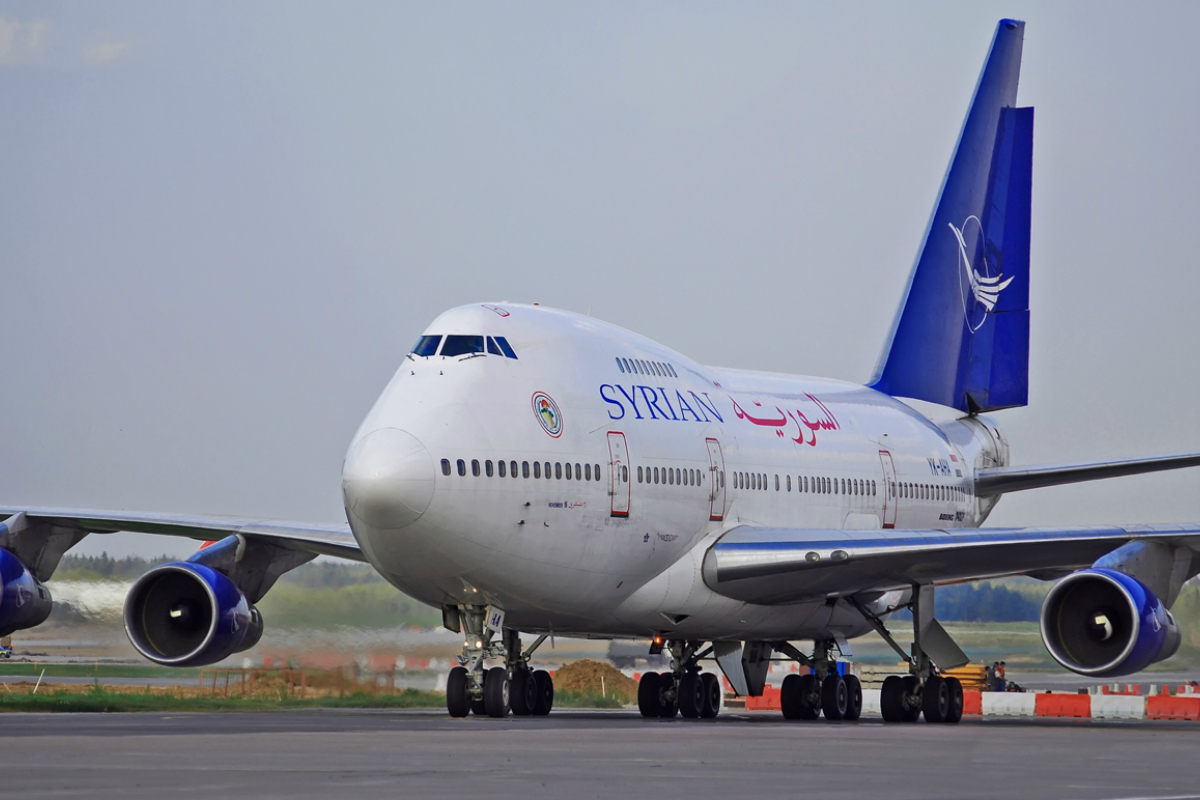
Most major carriers have taken the advice of numerous government agencies to avoid Syrian airspace altogether; the FAA going as far as calling on all operators flying within 200 nautical miles of the OSTT/Damascus FIR to “exercise caution”.  Today, the only airlines flying over the airspace are locally based Syrian airlines, Iraq Airlines and Lebanon’s Middle Eastern Airlines.

These MEA overflights are of interest. The airline is a member of the SkyTeam alliance and has codeshare agreements with several high-profile airlines (Air Canada, Air France, etc.) Despite the repeated warnings of the ongoing dangers associated with overflights of this conflict zone, the airline has chosen to schedule more than half-a-dozen flights over the airspace each day.
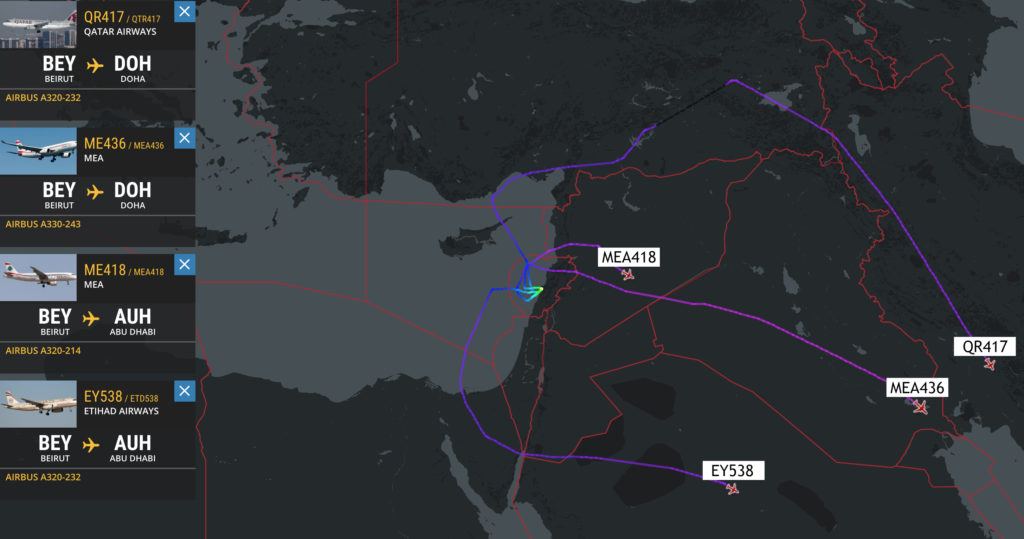
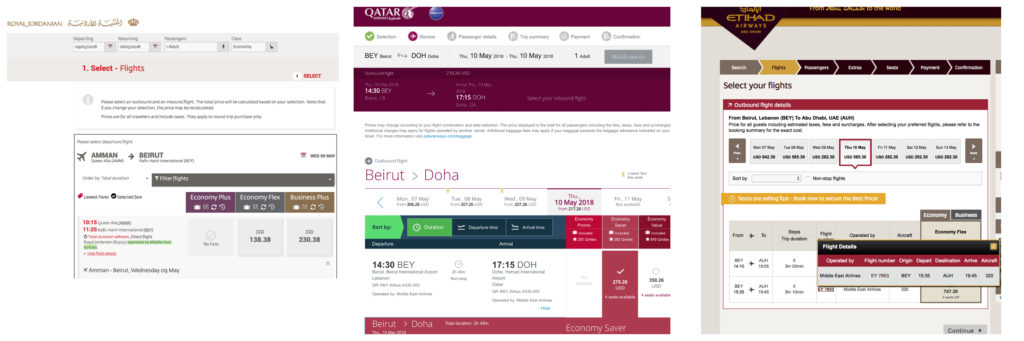
Some of these flights have the usual codeshare practise of other airlines booking their passengers on MEA flights. Our research shows that Etihad Airways, Qatar Airways (Oneworld Alliance) and Royal Jordanian Airlines (Oneworld Alliance) passengers are still being booked on MEA flights to/from Beirut; likely unbeknown to their customers of the increased flight risk. All three airlines continue to service Beirut with their own aircraft, but all three avoid Syrian airspace, naturally accepting the best advice to avoid the area completely.

Something isn’t right here: no warning anywhere about these flights being flown over Syria.

So why is it safe for passengers to overfly Syria on an MEA flight, but not on any of the other airlines? And more importantly, why is MEA still operating over Syria anyway?

It looks like Kuwait Airways will be the next codeshare partner of MEA, so it will be interesting to see whether the issue of the overflight of conflict zones will be discussed.

As always, keep an eye on our Safeairspace map for the latest worldwide updates.


Qatar airspace update – military jets intercepting civil flights

In short: The situation is volatile and constantly changing, even by the hour. Military interception has been reported so the best advice is to be vigilant with sticking to assigned routes for all operations around the region.

The airspace blockade of Qatar has been ongoing since June 2017 with little end in sight.

But over the past few months, tensions have been escalating;

Here is the latest operational information we have:

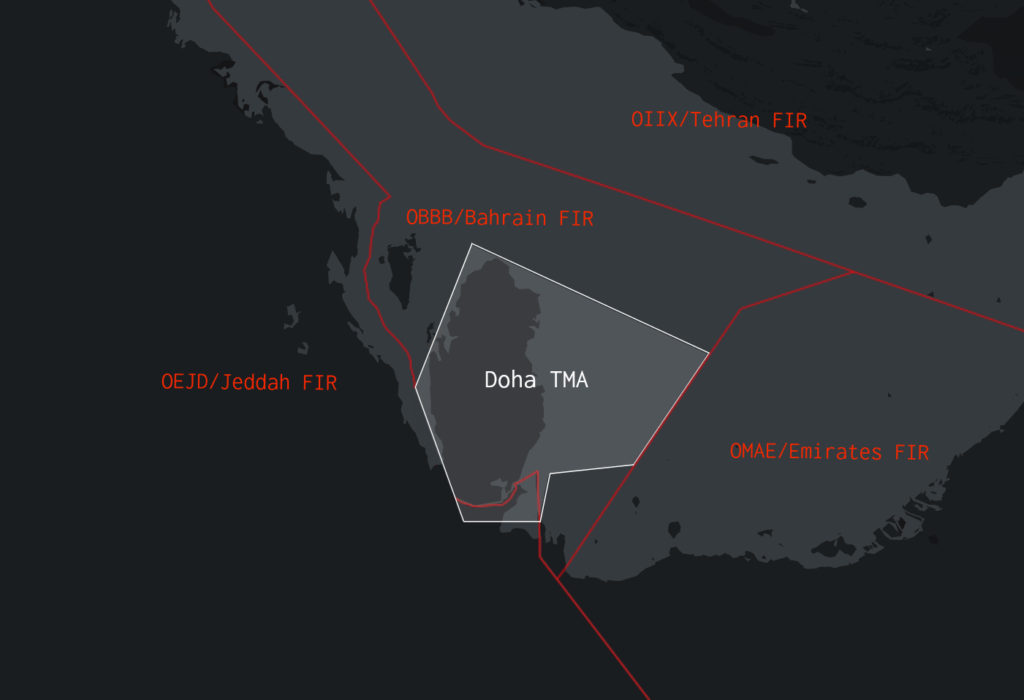
A reminder that Qatar does not have its own FIR. It sits entirely within the Bahrain FIR- you will find Qatar airspace NOTAMs under OBBB. The Doha TMA extends SFC to FL245. Above this sits the Bahrain UIR.

Bahrain and Egypt have relaxed some of their initial restrictions. Saudi and UAE have not.

The current state of play as of 6 April 2018.


_________________________________________________________________________

Have you been through the region recently? Can you provide an update?

Extra Reading:

Some fascinating reporting about what this whole blockade is all about.

  • How a ransom for Royal falconers reshaped the Middle East” – New York Times
  • What the falcons up with Qatar?” – NPR Podcast


Kenya airspace threat downgraded

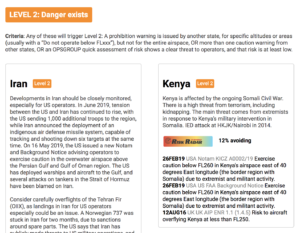
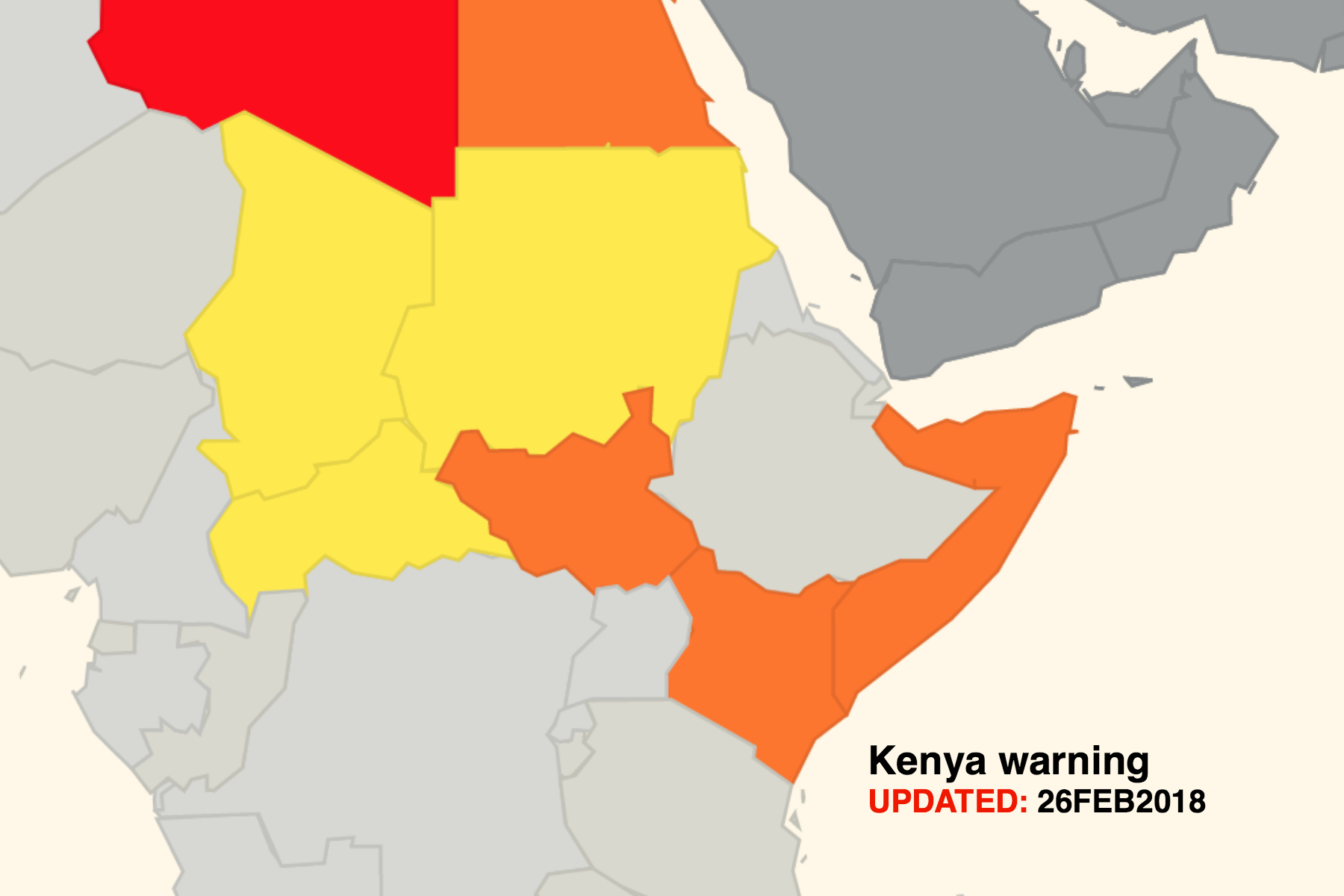
The FAA has revised its warning for Kenyan airspace – the area to ‘exercise caution’ is now limited only to that airspace east of 40 degrees East longitude below FL260 (i.e. the border region with Somalia, and 12nm off the east coast of Kenya). Prior to this, their warning applied to all airspace in Kenya below FL260.

Published on 26 Feb 2018, the warning maintains the same wording to clarify the type of weapons and phases of flight that the FAA is concerned about, specifically:

  • fire from small arms,
  • indirect fire weapons (such as mortars and rockets), and
  • anti-aircraft weapons such as MANPADS.

The scenarios considered highest risk include :

  • landings and takeoffs,
  • low altitudes, and
  • aircraft on the ground.

The updated guidance is intended for US operators and FAA License holders, but in reality is used by most International Operators including EU and Asian carriers, since only four countries currently provide useful information on airspace security and conflict zones.

The Notam uses FL260 as the minimum safe level, though we would suggest, as usual, that a higher level closer to FL300 is more sensible.

You can read the NOTAM in full on our Kenya page on SafeAirspace.net, a collaborative and information sharing tool used by airlines, business jet operators, state agencies, military, and private members of OPSGROUP.


Think twice before entering this airspace. Overflight Risk areas in August 2017.

One of our primary missions at FSB is to monitor the world’s airspace and report on new risks to civil aviation. When enough changes occur, we update our “Unsafe Airspace Summary“.

Today, we published a new summary effective 16AUG2017 – version “INDIA”.

First up, the map as things stand:

Red is Level 1 – Avoid this Airspace
Orange is Level 2 – Assessed Risk
Yellow is Level 3 – Caution.

A live version of this map is always updated at safeairspace.net


What’s changed since the last summary?

  • Somalia is downgraded to Level 2, so there are now five Level 1 – Avoid countries: Libya, Iraq, Syria, Yemen, and North Korea.
  • Saudi Arabia is upgraded to Level 2, due to assessed risk in the southwestern portion of the FIR (Yemen border area)
  • French Guyana no longer a threat as strikes and airspace closures have ended
  • Addition of JapanVenezuela and South Korea at Level 3 – Caution advised

If you have ops to any of these countries, make sure to have a read of the risk information. A full library is at safeairspace.net.


Download the latest summary


What altitude is ‘safe enough’ to overfly a Conflict Zone?

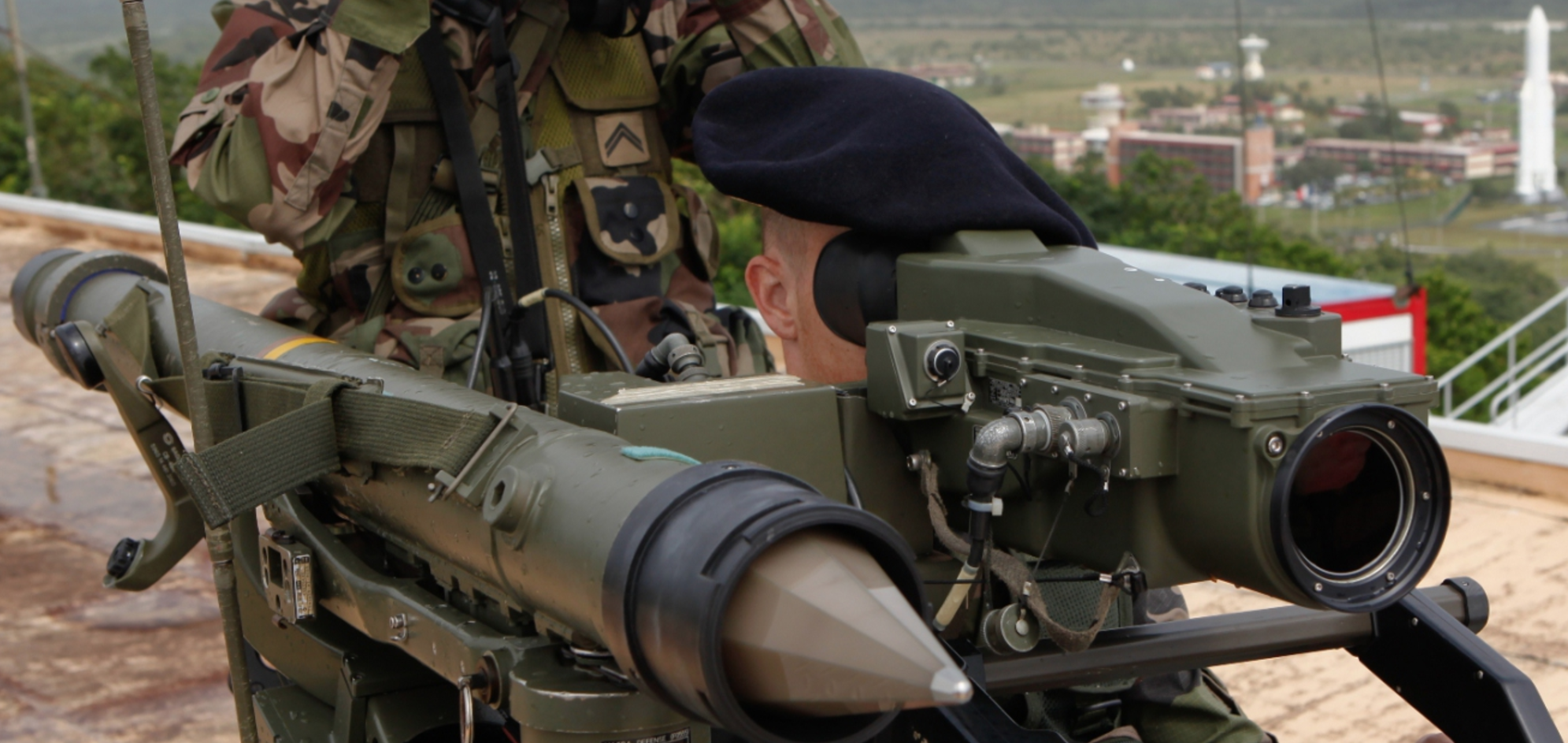
Most conflict zone guidance from Aviation Authorities is based on the risk posed by MANPADS – Man Portable Air Defence Systems, or more descriptively – Shoulder Launched Surface to Air Missiles (SAMS).

Large-Unit SAM attacks on aircraft are uncommon – MH17, removed from the sky by a Russian-made Buk missile, was the first aircraft to be shot down by a large SAM unit since a Siberia Airlines Tupolev in 2001. These large units – requiring a radar system as part of the mechanism – have never been used by terrorists. Almost all incidences involving large-unit SAMs have involved misidentification. There is no safe altitude from a large SAM.

MANPADS, on the other hand, represent a greater threat to aircraft in 2017. These shoulder-launched systems are very portable, and far more likely to fall into the wrong hands. Common ranges are in the 10,000 – 15,000 ft range. The most dangerous is the FIM-92 Stinger, which has an operational ceiling of 26,000 ft (and there is concern that these have reached anti-government rebels in Syria)

The internationally promulgated standard safe altitude for overflight has now become about 25,000 ft AGL. Most CAA/State guidance is issued based on this number. There are two important points for aircraft operators to note:

    • That is 25,000 feet Above Ground Level. A missile could easily be launched from a mountain, or higher ground, so if you take 25,000 feet as your safety margin, make sure to add the terrain elevation beneath. In South Sudan, for example – Juba is at 2,000 feet – most of the country is at about this height. So 27,000 feet should be the minimum safe level, and you can work with FL270.
    • This is based on the assumption that we’re not worried about Stingers. Especially in the Middle East, a higher safe altitude might be better. FL300 seems like a good place to start.


References: