FAA Warns on Runway Length Data and Overrun Risk

On Jan 21, the FAA issued a new Information Note for Operators after identifying cases where incorrect runway length data was being used for performance planning.

The concern is straightforward. Using the wrong numbers can skew takeoff or landing calculations, which is why the FAA says performance planning should be based on declared distances from the Chart Supplement.

What exactly is the issue?

The FAA notes that many crews default to runway lengths taken from airport diagrams, charts, FMS databases or commercial planning tools.

The issue is that these sources may not include declared distances (TORA, TODA, ASDA and LDA) which are the figures used to meet regulatory performance requirements and can differ significantly from the physical runway length.

The FAA’s concern is that crews may misunderstand declared distances, omit them entirely, or rely on FMS or third-party data that has not been updated after changes.

So a quick clarification on how runway lengths are defined helps…

About runways

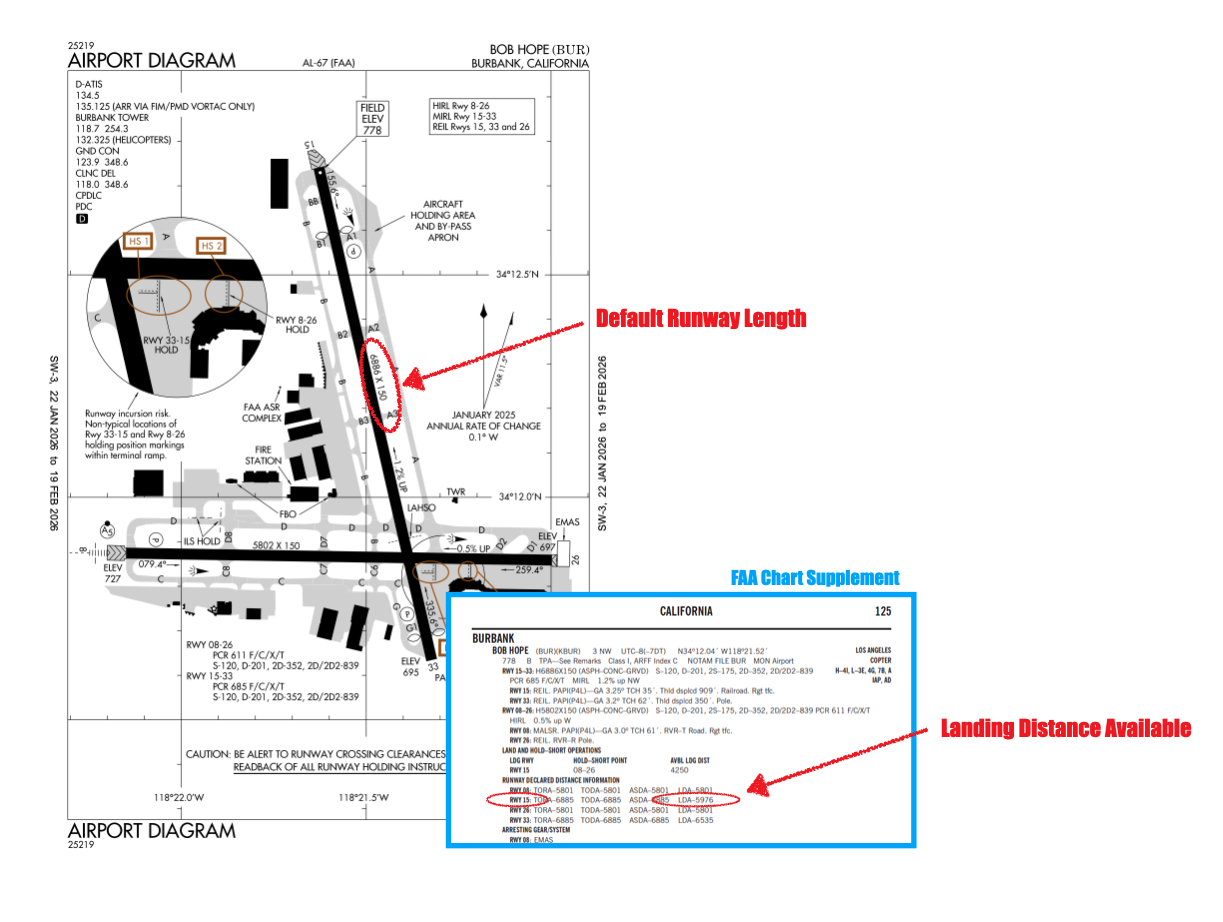
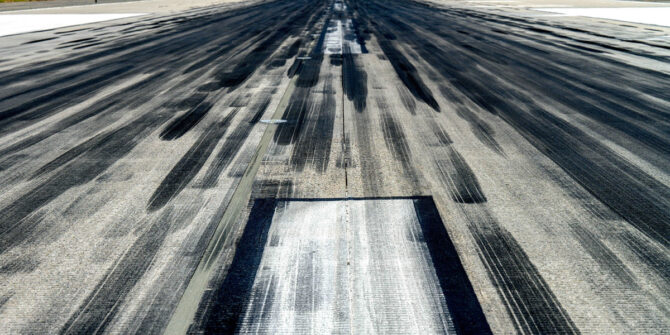
When we talk about default runway length, we are talking about the physical length of the runway surface. It’s what you see on charts, airport diagrams and other sources of info.

It represents exactly that – pavement from end to end. It may include unusable bits (such as displaced thresholds, closed portions etc) and is often a single number with no context.

It doesn’t tell you how much runway is legally available for takeoff or landing and can significantly overstate what you can actually use (more on that later).

Declared distances, on the other hand, are the official, performance-relevant runway lengths published by the airport authority via the FAA Chart Supplement and other validated sources.

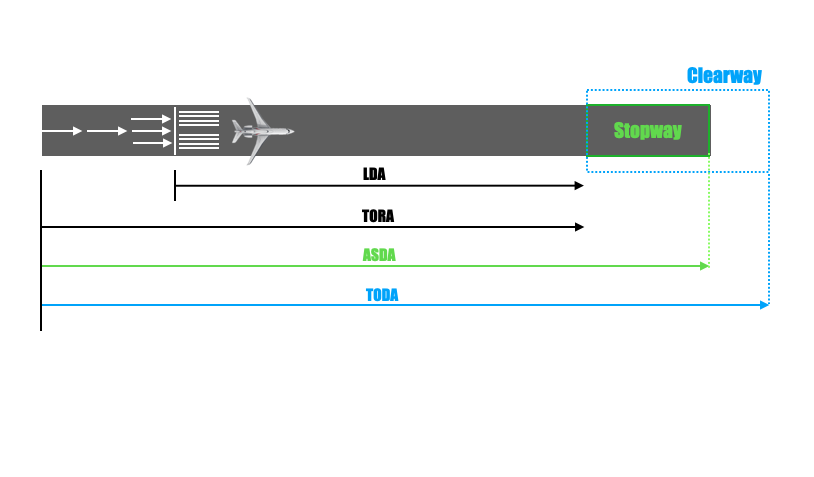
A brief reminder of what these distances include (and critically, don’t):

Takeoff Run Available (TORA). Think of this as how much runway you can accelerate on. It includes useable pavement only, starting at the take-off threshold. It doesn’t include clearways or stopways.

Takeoff Distance Available (TODA). How much distance you have to get airborne (i.e. TORA) plus the distance required to clear obstacles in the initial climb segment (clearways). Crucially, it doesn’t include stopways (usable in a rejected takeoff).

Accelerate-Stop Distance Available (ASDA). Think of this of how much distance you have if you reject the takeoff. It includes TORA and stopways. It doesn’t include clearways.

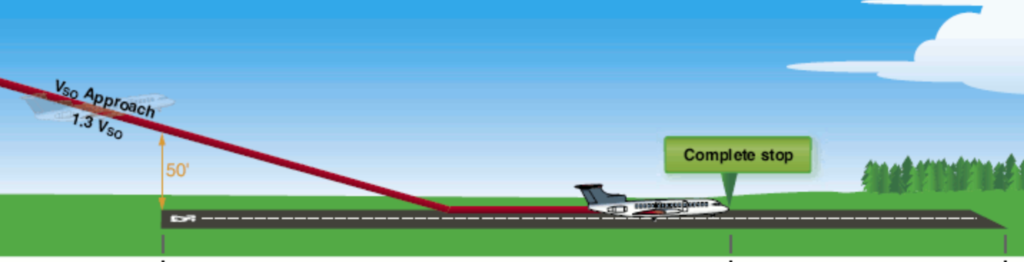
Landing Distance Available (LDA). How much runway you actually have to stop after touchdown. This includes usable pavement from the landing threshold to the end of the runway. It doesn’t include pavement before a displaced threshold, stopways or clearways.

Here’s what this all looks like:

Under the FAA regs, these distances are the authoritative performance numbers. They override any single runway length shown elsewhere. That’s the key point.

Real world example

But that’s enough theory. A good real-world example is KBUR/Burbank Runway 15, where the published runway length and the declared landing distance are not the same.

Many charts and planning tools show a runway length of 6,886 ft. But the FAA Chart Supplement lists an LDA of 5,976 ft due to a displaced threshold for obstacle clearance.

If crews plan landing performance using the longer figure, they may be overestimating available runway by about 900 ft. Add tailwind, a wet surface, or a performance-limiting MEL, and that margin can disappear quickly.

That’s exactly the scenario the FAA is trying to prevent.

So what’s the FAA’s advice?

For performance calcs, the FAA says crews should use published declared distances, not the physical runway length. Just because pavement exists doesn’t mean it’s legally usable.

That expectation needs to be reflected in procedures, training and day-to-day practice.

Crews also need to be clear on which runway lengths their performance tools are actually using.

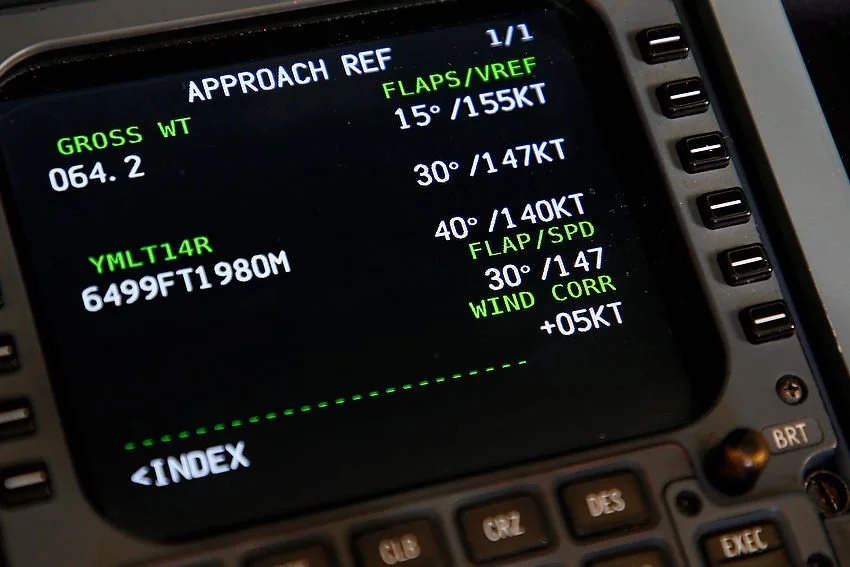
Be aware that the FMS runway length is not LDA, ASDA or TODA.

Operators should also review FMS databases and third-party performance tools, understand their limitations, and check that the data is current.

Have you spotted something risky out there?

Share it (anonymously) with the group! You can reach us via blog@ops.group, Airport Spy or Report-A-Thing.


Testing Times At Teterboro: Closures and Challenges

Aside from being the oldest operating airport in the New York City area, KTEB/Teterboro is far from quiet.

In the good ol’ pre-Covid days of 2019 it saw over 124,000 aircraft movements – that’s 340 every single day. And even last year in the height of the pandemic, it was well on the way back to those levels.

It is also unique for a few reasons. The first is that it is weight limited – if your ride is heavier than 100,000 pounds (45,000kg-ish), then you can’t land there without a waiver. Which means there is no airline traffic, making it exclusively the realm of GA and business aviation operators.

It is also nestled among some of the busiest airspace in the world. The field itself is only 6nm from downtown Manhattan. Which means traffic in and out of there has to compete with the seemingly constant flows of nearby big hitters KLGA/LaGuardia, KJFK/New York, and especially KEWR/Newark.

This tricky combination creates unique operational challenges for controllers and pilots alike. And now things are going to get even more complicated. Here’s why…

A runway is off to rehab.

Or perhaps more accurately, Runway 06/24 is being rehabilitated. Which is a fancy way of saying it needs to be repaired.

 Unfortunately, this is also time consuming. So, a bunch of runway closures have been scheduled at KTEB running all the way into next year at night and on weekends.

During these closures Runway 01/19 will be in use for arrivals and departures which can be hugely disruptive to operations – especially in two scenarios:

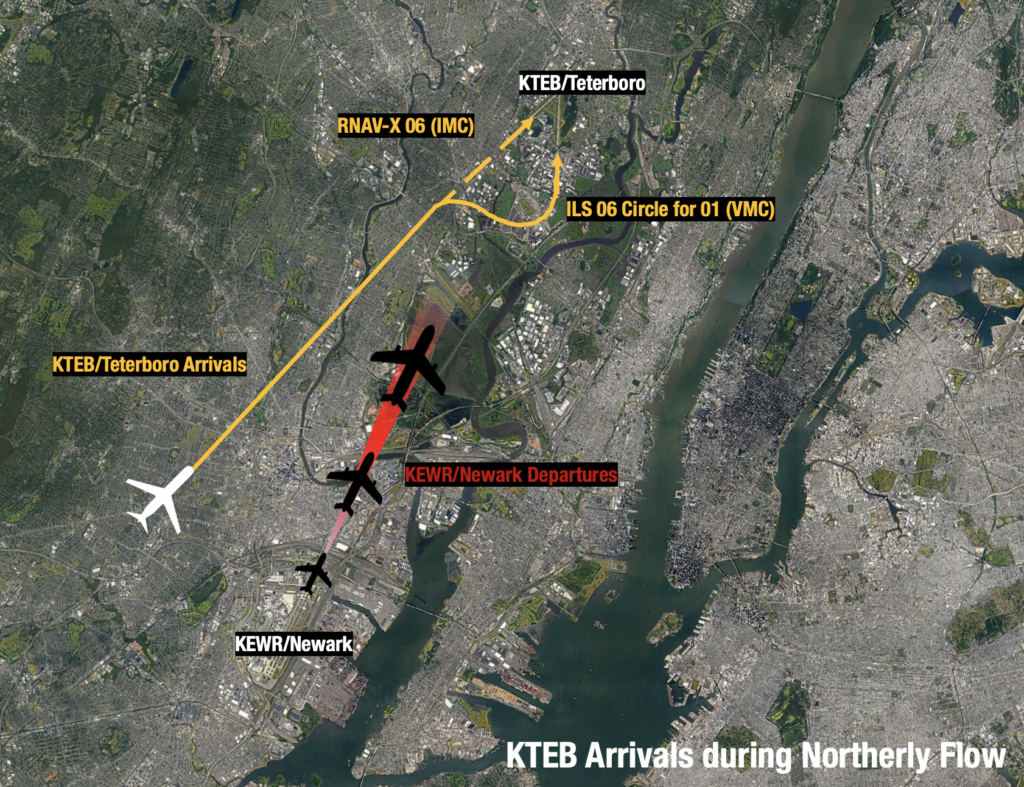
Runway 01 Arrivals (Northerly Flow)

When Runway 06 is closed, arriving traffic can expect one of two approaches.

If the weather is good.

 You can expect the ILS approach runway 06, circle to land 01 to keep you clear of Newark. But beware, it can be a challenging approach for a few reasons. Code 7700 has published a fantastic briefing that is almost a compulsory read if you’re unfamiliar with ops there.

Some other common sense prevails too – make sure the approach is carefully briefed beforehand. It’s tight, and easy to get unstable so crew co-ordination is going to be important to keep the old SA up.

If the weather is not so good.

You can expect an RNAV-X approach onto Runway 06 – runway closures are weather dependent. The Port Authority of New York and New Jersey have confirmed they will open it back up.

When are we going to see an instrument approach for Runway 01?

 Good question, the problem is that Newark gets in the way again. The Teterboro User’s Group are hard at work with the FAA to come up with one, but the process is by nature slow. Within months is the goal, but not quite soon enough to help during these works.

Runway 19 Departures (Southerly Flow)

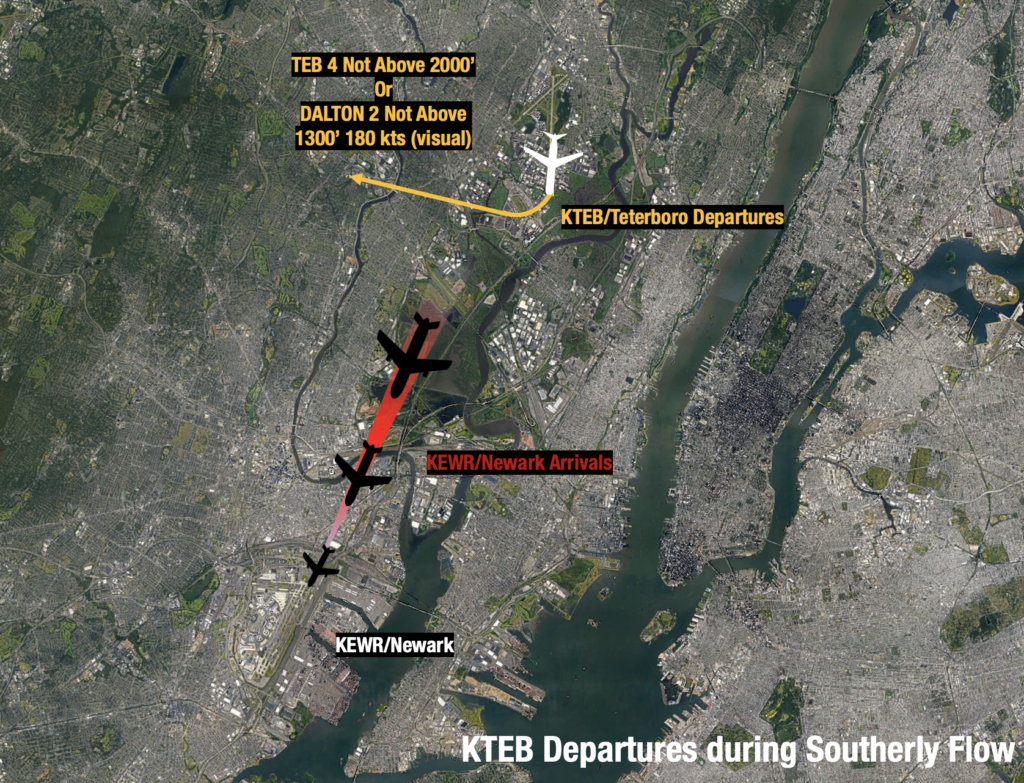
This is when you can expect big delays, as Runway 19 points straight at Newark.

Expect the Teterboro 4 Departure by default. But a head’s up – for every single aircraft that launches out of Teterboro on this SID, NY TRACON needs to find a 10nm gap in arrivals at Newark. And that means a lot of waiting. There may be a better option…

Consider the Dalton.

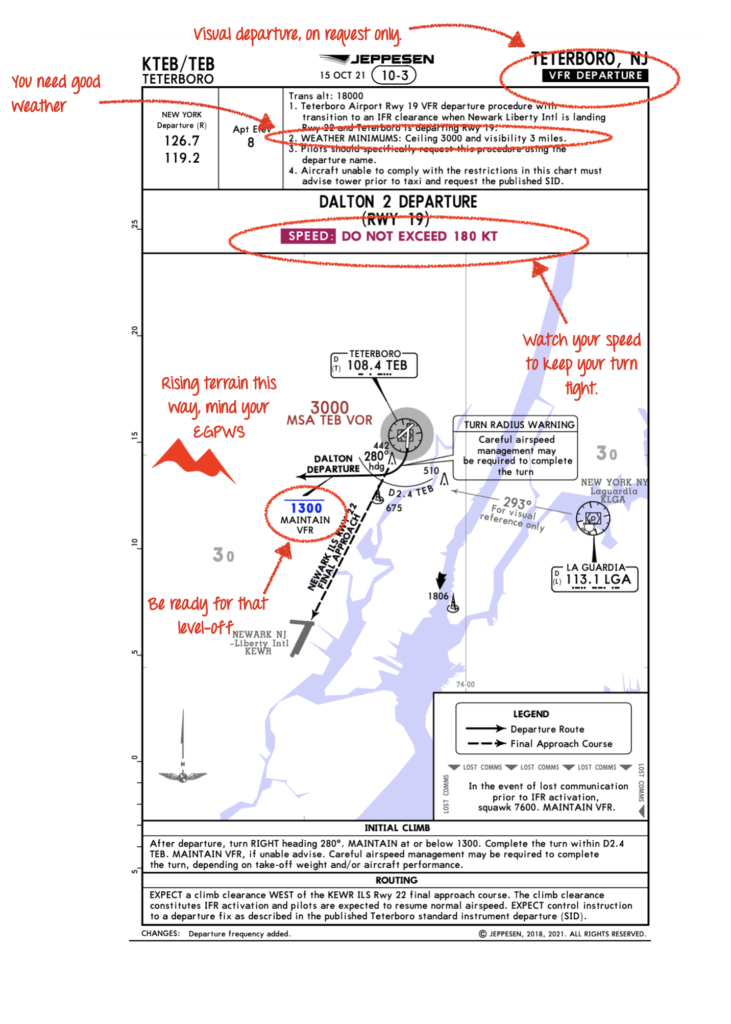
The what? The Dalton Two Departure. It’s unique because it allows aircraft to depart Teterboro visually, before transitioning to your IFR flight plan – and it’s by pilot request only when the weather is better than 3000 – 3.

The Teterboro User’s Group worked with the FAA to get this one off the ground (no pun intended). It is essentially a right-hand turn after departure onto a westerly heading, at or below 1300 feet. You’ll need to keep your speed back too.

The spacing required is effectively halved. Don’t be put off by the phrase expect indefinite delays either. It’s ATC’s way of telling you they don’t know how long it’ll be. But local operators confirm delays are never worse than the standard TEB 4, and more often than not, better.

But before you light the fires, there are a couple of gotchas. It’s going to get busy – the low level-off happens quickly in high performance jets, especially at light weights. So be ready for it. Also, the westerly heading points you (visually) towards rising terrain and there have been reports of EGPWS warnings as a result.

Teterboro isn’t the only option.

If you don’t have the appetite for all of this and are looking for more straight forward options, here are a couple to consider:

KHPN/White Plains It’s 25nm from Manhattan – about a 40-minute drive in normal traffic. It has two runways, the longest being 6549’ (1996m) long.

KMMU/Morristown About the same distance away with a slightly longer 50-minute drive. It also has two runways with the lengthiest option of 5,998’ (1,828m).

Local operators in New York have told us that even though the drive is a little longer, the overall travel time is often less when you avoid delays in and out of KTEB.

Look out for full airport closures too.

There are also eight complete airport closures scheduled for KTEB coming up, some lasting up to 38 hours: 

July 1 – August 31: Six closures are planned on weekends, from Friday 10pm until Sunday 12pm (local time).

October 1 – November 3: Two closures are planned from Sunday 12:01am – 12pm (local time).

 The exact dates will be confirmed by Notam.

Need more support?

Reach out to the friendly folk at TUG (the Teterboro User’s Group). They’re experts on ops at KTEB, they post weekly construction bulletins on their website and are more than happy to help operators out with advice. Also a special thank you to David Belastock – the President of TUG. This write up would not have been possible without his experience and generous support of OPSGROUP.

We made an Airport Lowdown for KTEB a while back, which you can see here. We had help (since we’ve never flown in there), but if you spot anything to add or change then let us know.

Or you can talk to the OPSGROUP team directly on team@ops.group. We’d love to hear from you.


Wrong Runway, Wrong Airport, Wrong Country

Even with today’s levels of planning, monitoring and onboard safety systems, aircraft are still managing to land at the wrong airports, crew are still mistaking one runway for another, and even (occasionally) heading to the wrong country entirely.

Here is a look how and why these rather embarrassing, and potentially dangerous mistakes happen, and how to avoid them.

Wrong Runway.

Landing on the wrong runway is a hazardous event which poses a major traffic collision risk. It also has potentially big performance implications and by that we mean the chance of a runway excursion.

EASA Safety Information Bulletin 2018-06 looked at reports filed by European operators between 2007 and 2017 and found 82 occurrences of aircraft landing on the wrong runway. An average of 8 a year might not seem high, but the consequences of an aircraft landing on the wrong runway could be catastrophic so even one is really one to many.
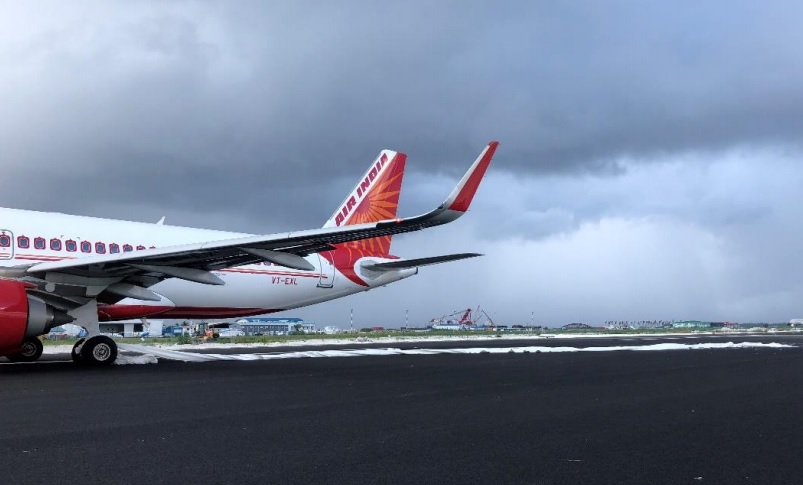
*Thankfully* the majority of incidences occur in visual flight conditions and are a result of visual illusions or misidentification during visual approaches and side step manoeuvres. So, instances of crew just aiming at the wrong runway.

While ‘being visual’ might mean a traffic collision risk is lower, the risk of performance issues and runway excursions remains high.

There are numerous airports worldwide which present a risk due to their runway orientation, approaches and prevailing conditions. KJFK/New York’s Carnasie approach has seen several an aircraft incorrectly establish inbound for runway 13R instead of 13L following the inbound turn, particularly when there are crosswinds which affect the “picture” (the runway doesn’t appear in the window where you expect it to).

There are also instances of mistaken clearances. Like the one that took place in July 2020.

United Airlines flight UA57 was on finals for runway 09L at LFPG/Paris Charles de Gaulle when ATC incorrectly cleared them to land runway 09R. The crew, used to sidestep procedures in the USA, failed to query the clearance which was unusual for Paris and instead commenced a low level turn to runway 09R. An EasyJet aircraft already lining up on 09R for departure reported the conflict on the radio and the United Airlines flight initiated a go-around from 260 feet AGL. 

While an initial investigation into this has raised probable causes primarily resulting from the ATC mental slip, a sidestep at that altitude should be a visual manoeuvre. The crew of the United Airlines should have spotted the aircraft already on a runway which they were turning towards at 300 feet. The FAA have released a new SAFO related to this.

So being visual does not always reduce the traffic collision risk after all.
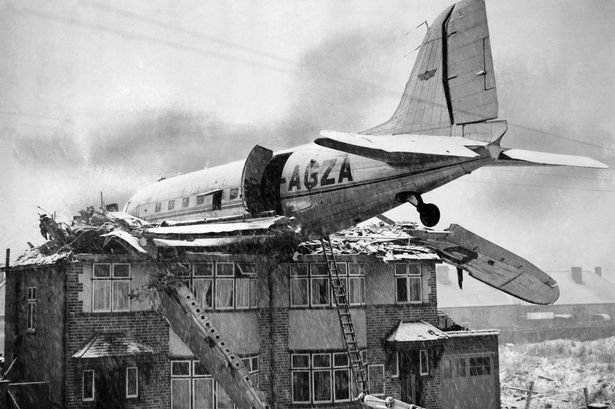
Then there are the more concerning ‘not aiming for a runway at all’ events.

The KSFO/San Francisco Air Canada incident in 2017 is a serious example of visual cues going wrong. The Air Canada A320 was cleared to land runway 28R. However, they had missed a Notam advising that runway 28L was closed and, expecting to see an open runway to their left, mistook 28R for 28L and aligned themselves with an active taxiway.

The aircraft missed traffic on the taxiway by between 10-20 feet during their go-around.

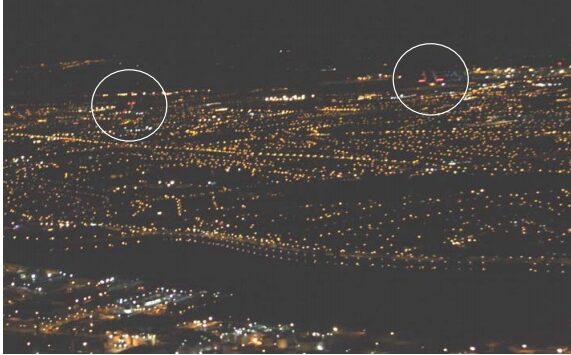
In 2007, an MD-83 routing from Lisbon to Dublin was carrying out an approach at night to Dublin runway 34. There was a prevailing wind of 260/12 which orientated the aircraft heading to 336° in order to maintain the inbound track of 342°. The crew mistook a 16 storey lit building for the runway and aimed for it, carrying out a missed approach from 1700 feet (around 200 feet above the building).
TNCM/Princess Juliana airport in Sint Maarten is known for a large hotel to the left of runway which, in hazy or rainy conditions, can be mistaken for the runway due to it being more conspicuous than the runway.

Then there was the KLM crew who managed to mistake taxiway B for a runway on takeoff from EHAM/Schiphol…

So how to avoid making this mistake?

The recurring factor throughout all of these is visual illusions and incorrectly interpreted visual clues. Not looking at stuff, or not looking at stuff right. 

Of course, it is easy to say that from the comfort of a chair, on the ground.

Sat in the pilot seat, barrelling towards said ground at several hundred feet per minute with everything else going on around you as well… less easy. But there are some fairly common sense methods of identifying threats and errors before they become a problem.

The FAA released SAFO 17010 following the KSFO incident. It provides some ‘best practices’ for accomplishing an approach and landing on the correct airport surface:

  • Any visual approach, or visual segment of an approach, should be well briefed and monitored.
  • Known risks (such as hotels that somehow look more like the runway than the runway) should be talked about. If there is a chance of visual illusions, talk about them and talk about what you expect to see.
  • Think about the wind and where you will actually need to be looking in order to see the runway. It might not be straight ahead.
  • Fly a stabilised approach.
  • Monitor things like height, heading, to make sure they make sense. And back it all up with Navaids and other information if that is available.
Wrong Airport.

Landing at the wrong airport also happens!

One analysis found at least 150 flights by US carriers landed (or almost landed) in the wrong airport between the 1990s and 2014. Not including totally valid diversions of course.

The most common reason for wrong airport landings is down to pilot error once again – both visual and procedural.

In 2017, a Delta flight 2845 landed at the wrong Minneapolis airport. They were due to touchdown in KRAP/Rapid City, but mistook nearly Ellsworth air force base for their intended airport. Both have the similar runway orientations (although that’s really the only similarity – Rapid City has two runways which possibly should have been a giveaway).

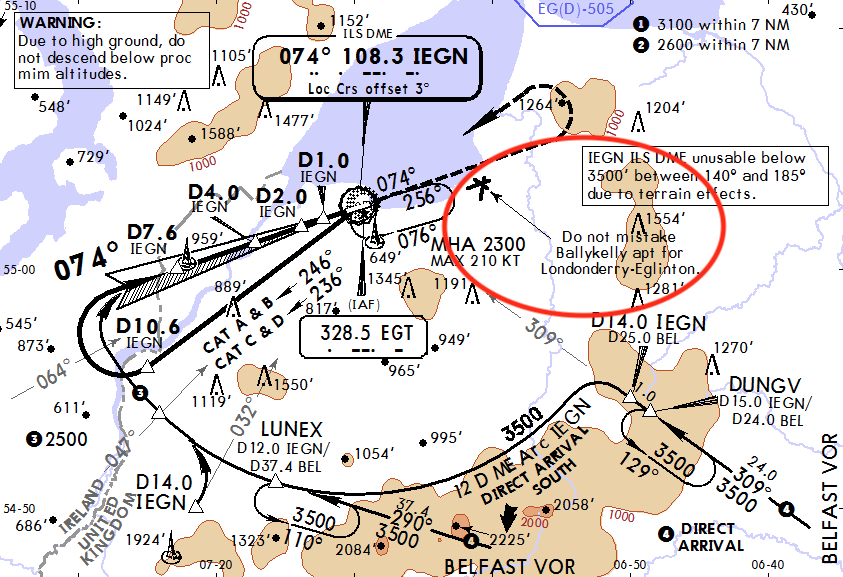
In 2006, a Ryanair flight aiming for EGAE/Londonderry-Eglinton ended up landing at a military base in Ballykelly 5 miles away, again just due to a misidentification of the airport.

Ethiopian airlines suffered two near embarrassments when two of their airplanes both tried to land at the wrong airport in Zambia. Actually, one of them did. Destined for Ndola, both mistook the new (and unopened) Copperbelt for their destination airport.

The fix remains the same:

  • Brief what you expect to see.
  • Brief how you expect to get there.
  • Check and monitor that other clues – navaids, waypoints, airport layout – make sense!
  • A lot of airport charts also have warnings on them when there is another airport nearby which has been known to trick pilots in the past. Look out for these.
  • Many aircraft have systems which monitor their position in relation to what you told it (in the box) you were going to fly it. If your airplane is beeping, blaring or swearing at you then it is trying to tell you something – don’t ignore it!
Are these just embarrassing stories?

Unfortunately, there is a much more serious side. The wrong airport might be a commercial, logistical problem, but the real big risk comes down to that runway performance again.

Of the 150 or so near/actual landings at wrong airports which took place in the US since the 1990s, there were 35 actual landings and 23 of these occurred at airports where the runways were shorter than those at the intended destination.

In 2014, Southwest flight 4013 aiming for KBBG/Branson airport accidentally touched down at KPLK/Clark Downtown airport instead. Branson’s runway is 7140’. Clark’s is 3738’.

A Boeing Dreamlifter made a similar error when routing to McConnell Air Base but instead touched down at Jabara airport, on a runway only 6,101 feet long.

The critical safety issue here is the performance – the fact it hasn’t been checked and that it might not therefore be, well, ok.

And if it is happily ok, then you might still be looking at a bit of an issue getting the airplane back out again. Much like our Dreamlifter friends found out.

Wrong Country.

Finally, wrong countries. A much rarer occurrence but possibly the most embarrassing should it happen.

A British Airways flight (in all fairness it was actually a German aviation business operating on behalf of BA) managed to fly to EGPH/Edinburgh instead of EDDL/Düsseldorf after a paper work mix up had the crew sent totally the wrong flight plan.

However, since the flight was planned and fuelled for Edinburgh this only really impacted the rather put-out passengers. 

A potentially more serious incident happened in 2015 when an Air Asia crew had to divert back to Melbourne, Australia, after the pilot incorrectly input the route from Sydney to South Africa instead of WMKK/Kuala Lumpur.

Given the fairly different direction you have to wonder how far they got before they, or ATC, spotted something was up?

Fancy a bit more reading?

NASA have a handy analysis on visual traps that is worth a read.

Check out the FAA’s project on ‘runway surface events’ here – including some info on the ASDE-X project which uses surface radar to detect when an aircraft might be lining up on a taxiway for departure.
SNOWTAMS slip into a new style

ICAO will be updating the format of SNOWTAMs later this year – the special issue Notams that deal with surface condition reports and contaminated runways. They have published updated guidance on how SNOWTAMs should be issued when the changes take effect on November 4, 2021.

Here’s a summary of what’s changing, what the new style SNOWTAM will look like, plus a handy chart to help you decode them…

The Friction Task Force

There is such a thing, and we can only assume they wear skintight suits and body surf down runways to measure the friction. Anyway, they make recommendations on global reporting formats and also how to assess runway surface conditions.

It is quite a big thing. A lot of accidents happen because runway friction is not reported correctly. Or rather, pilots don’t understand it/choose to ignore it. Just ask (several) crews flying into UEEE/Yakutsk about it.

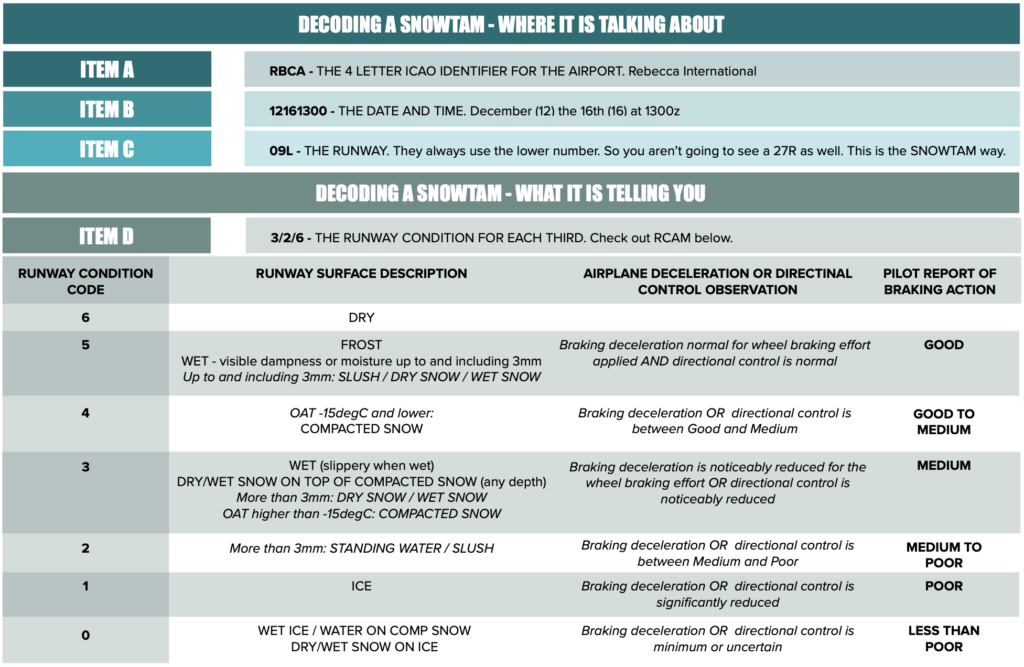
But if you check out the RCAM (Runway Condition Assessment Matrix) below, you will notice that offering a braking action is the preferred method nowadays. Friction coefficients are not so useful.

What is a SNOWTAM?

It is a special series Notam that provides a surface condition report to let pilots know what is on the runway, how much of that is on the runway, and what they can expect their airplane to do (braking wise) on said runway.

So, it is something that basically tells the pilot: “Watch out, slippery!” in a rather complicated sort of way.

SNOWTAMS use metric units, and a bunch of codes for deciphering. More about that later on.

What are ICAO changing?

As of 4 November 2021, the maximum validity of a SNOWTAM will be 8 hours. Currently they are 24 hours and a lot can change in that time meaning you have to try and discover what is still valid and relevant and what is not.

With the new ones, if they don’t say anything different after 8 hours then you can assume the runway surface condition is good and normal again. If anything changes, they will release a new one which will automatically replace the old one.

Each SNOWTAM will get its own serial number for identifying it.

What else is in the Guidance?

TTAAiiii CCCC MMYYGGgg (BBB)

Yep, that is written in it. It is an abbreviated heading demonstrating how certain things should be written. For example:

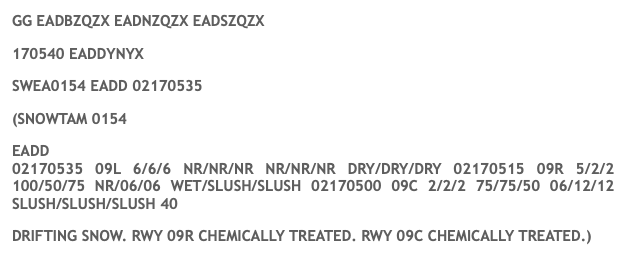
This is an example of how the new style SNOWTAM will look. Not a huge difference to the old ones, but here is a decode for you anyway.

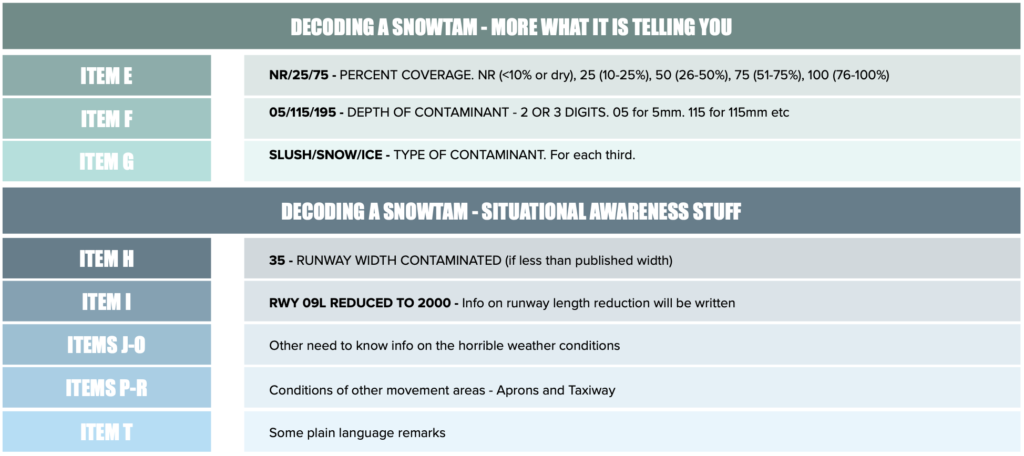
  • GG EAD etc etc is who produced it. Not super relevant for pilots.
  • Snowtam 0154 is the serial number of the Snowtam
  • EADD is where we get interested. That is the airport identifier. Issued on the 17th February at 0535
  • Runway 09L 
  • It then gives the runway condition code for each runway third, as determined by the RCAM (runway condition assessment matrix). 6/6/6/ means dry/dry/dry.
  • Next up is the percentage coverage. NR means less than 10% or dry. Hence the many NRs
  • This SNOWTAM then moves onto 09R because frankly 09L was quite boring and dry.
  • 09R is 5/2/2 (good, medium-poor, medium-poor according to RCAM). 100% covered, 50% covered, 50% covered) and NR/06/06 is the depth – dry/ 6mm/6mm of wet/Slush/Slush
  • Then it moves onto another runway…. blah blah blah

The last bit is another change – this gives you “Situational Awareness” – a free text (i.e. real human language) section reporting other important stuff you might want to know.

A decoding device

We aren’t going to be there to decode for you, so here is a decoding device we made earlier (by copying the ICAO one and adding some nice colours).

You might also want to download something like the SNOWTAM app on your smartphone (just make sure whatever you use is correct against your company manuals).

Why these changes?

Well, in order to make SNOWTAMS better, because they are fairly important. You might get some frosty toes if you step in a puddle of slushy snow, but you’re going to get more than cold feet if you go skidding off the end of a runway.

SNOWTAMs are there to make winter weather safer. They give critical information about the state of the runway, and this should be plugged into whatever performance calculating device your airplane needs you to use so that you can see whether you will stop before, or after, the end of the runway.


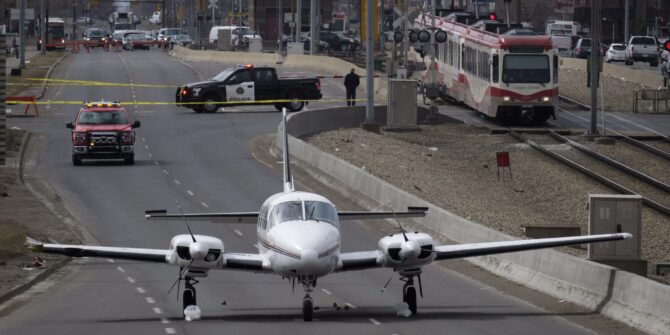
Runway? Who needs one when you have a taxiway!

It’s happened again.

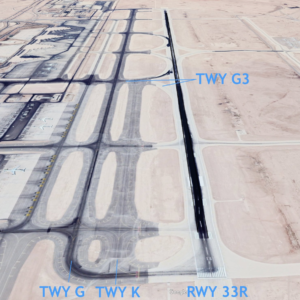
Around midnight on a perfectly clear night last week in Riyadh, a Jet Airways 737 tried to take off on a taxiway. The crew mistaking a new taxiway for a runway!

The crew, with thousands of hours experience, took off on a surface that didn’t have runway markings or runway lights. Thankfully no one was seriously hurt.  It’s too early to exactly say why this happened, but it’s clear that some sort of “expectation bias” was a factor. Expecting to make the first left turn onto the runway. One has to ask – was ATC monitoring the take off?

After the tragic Singapore 747 accident in Taipei, technology was developed to audibly notify crew if they were about to depart “ON TAXIWAY”. This is known as the Runway Awareness and Advisory System (RAAS).

Sadly the Riyadh incident is not isolated. There have been a plethora of near misses in the past few years (more details in Extra Reading below).

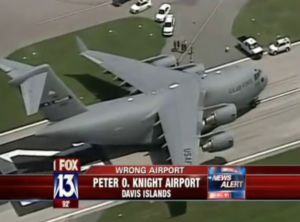
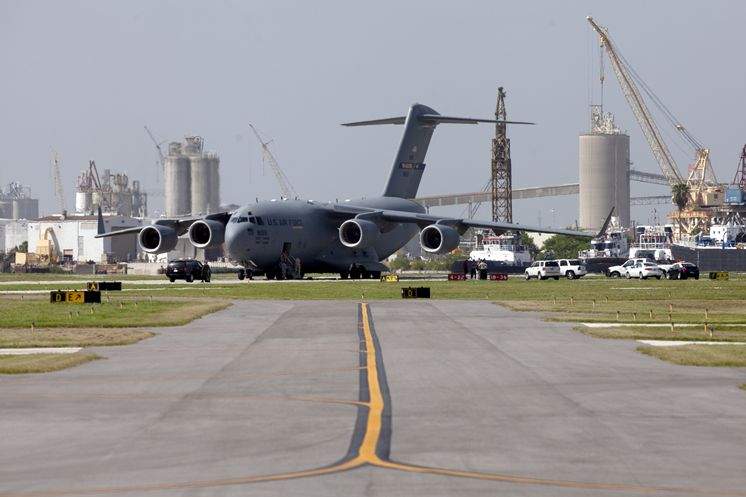
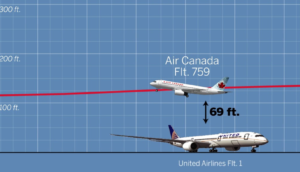
There have also been more than a few “incidents” of aircraft from C17’s to 747s landing at the wrong airports! The most notable near miss recently was that of an Air Canada A320 nearly landing on a taxiway full of aircraft at KSFO/San Francisco. But it’s happened to Delta and Alaskan Air recently too.
It is an even bigger issue at a General Aviation level (and not just because Harrison Ford did it!). The FAA safety team recently noted;

The FAA Air Traffic Organization (ATO) has advised of an increase in, “Wrong Surface Landing Incidents” in the National Airspace System (NAS).

Incidents include:

  • Landing on a runway other than the one specified in the ATC clearance (frequently after the pilot provides a correct read back)
  • Landing on a Taxiway
  • Lining up with the wrong runway or with a taxiway during approach
  • Landing at the wrong airport

The FAA published some shocking statistics:

  • 557wrong surface landing/approach events” between 2016-2018. That’s one every other day!
  • 89% occurred during daylight hours
  • 91% occurred with a visibility of 3 statue miles or greater


So what to do?

There are numerous ‘best operating practices’ pilots can use to help avoid such incidents.

  • Be prepared! Preflight planning should include familiarization with destination and alternate airports to include airport location, runway layout, NOTAMs, weather conditions (to include anticipated landing runway)
  • Reduce cockpit distractions during approach and landing phase of flight.
  • Use visual cues such as verifying right versus left runways; runway magnetic orientation; known landmarks versus the location of the airport or runway
  • Be on the lookout for “Expectation Bias” If approaching a familiar airport, ATC might clear you for a different approach or landing runway.  Be careful not to fall back on your past experiences.  Verify!
  • Always include the assigned landing runway and your call sign in the read back to a landing clearance
  • Utilize navigation equipment such as Localizer/GPS (if available) to verify proper runway alignment

It’s worth spending a few minutes watching this.

Extra Reading


Bad NOTAMS = Runway overruns in Hamburg

If you’re headed to Hamburg, watch out. The runway is shortened, and the Notams are vague.

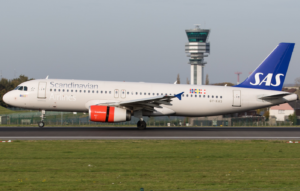
Poorly written NOTAMs struck again this week in Hamburg, Germany, when an A320 and a B737 both overran Runway 05 on landing – the first by SAS on May 11  and the second by Ryanair on May 15.

Runway 05 in EDDH/Hamburg has been undergoing works and a litany of related NOTAMs and AIP SUP were issued to explain.

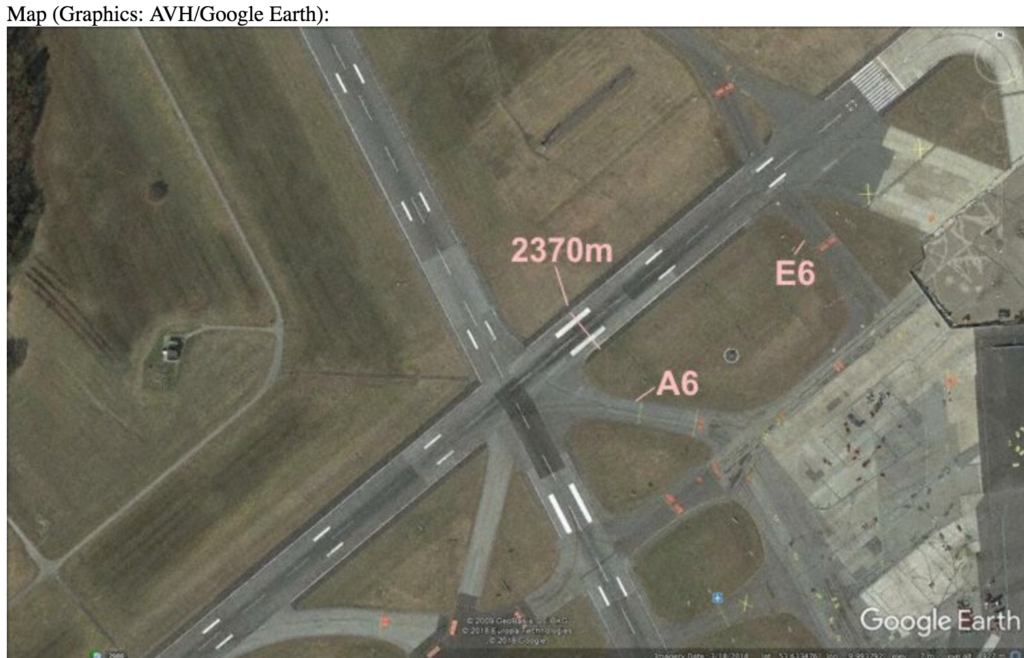
A1608/18 – RWY 05 LDA 2370M. 12 APR 04:00 2018 UNTIL 23 MAY 21:00 2018. CREATED: 05 APR 09:50 2018

A1605/18 – SHORTENED DECLARED DISTANCES FOR RWY 05/23. AIP SUP IFR 09/18 REFERS. 12 APR 04:00 2018 UNTIL 23 MAY 21:00 2018. CREATED: 05 APR 09:42 2018

A2223/18 – TWY A1, A3, A4, A5 CLOSED. 02 MAY 10:26 2018 UNTIL 01 JUL 04:00 2018. CREATED: 02 MAY 10:27 2018

A2044/18 – ILS RWY 05 NOT AVBL. AIP SUP IFR 09/18 REFERS. 23 APR 09:17 2018 UNTIL 23 MAY 21:00 2018. CREATED: 23 APR 09:17 2018

A1725/18 – CONSTRUCTION EQUIPMENT IN DEP SECTOR ALL IFR DEPARTURES RWY 05. PSN WITHIN AN AREA 533810N 0095948E AND 533805N 0100023E. MAX ELEV 89 FT. NOT MARKED AND LIGHTED. SUP 09 2018, CONSTRUCTION WORK EDDH REFER. 12 APR 04:00 2018 UNTIL 23 MAY 20:00 2018. CREATED: 09 APR 13:10 2018

A1609/18 – RWY 23 CLOSED FOR ARR. 12 APR 04:00 2018 UNTIL 23 MAY 21:00 2018. CREATED: 05 APR 09:52 2018

Despite this, both were unable to stop before the last open exit (A6) and vacated further down the runway. Thankfully both resulted in no injury because all construction equipment was kept clear of, and beyond, taxiway E6.

A better NOTAM may have been:

RWY 05 IS SHORTER THAN USUAL DUE TO CONSTRUCTION WORK AT 23 END. REDUCED LANDING DISTANCE IS 2370M. LAST TAXIWAY OPEN FOR EXIT IS A6. CONSTRUCTION EQUIPMENT ON RUNWAY BEYOND TAXIWAY A6. 

You get the idea. Concise and plain language in one NOTAM to make it clear what the issue is and the consequences of going beyond 2370m of runway.

They did, to their credit, try and tidy it up since the incidents:

A2563/18 – RWY 05 CLSD EAST OF TWY A6. RWY 05 LDA 2370M. RWY 05 NON STANDARD TDZ AND AIMING POINT MARKINGS AT 400M FM THR ISO 300M. ADJUST LDG PERF ACCORDINGLY. 17 MAY 16:30 2018 UNTIL 23 MAY 21:00 2018. CREATED: 17 MAY 16:31 2018

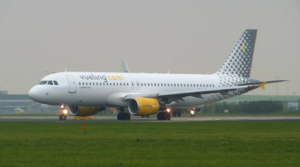
In another serious incident associated with these runway works, a Vueling A320 (another foreign operator) nearly landed at the wrong airport on May 11. Thankfully ATC intervened on that one.
All incidents are now the subject of investigation.

Naturally it’s imperative for crew and disptachers to check and read all NOTAMS thoroughly. But with over 40 current just for EDDH/Hamburg right now, it’s easy to understand why things get missed.

Until then “adjust landing performance accordingly”.

Extra Viewing:


RWSL: Red Means STOP!

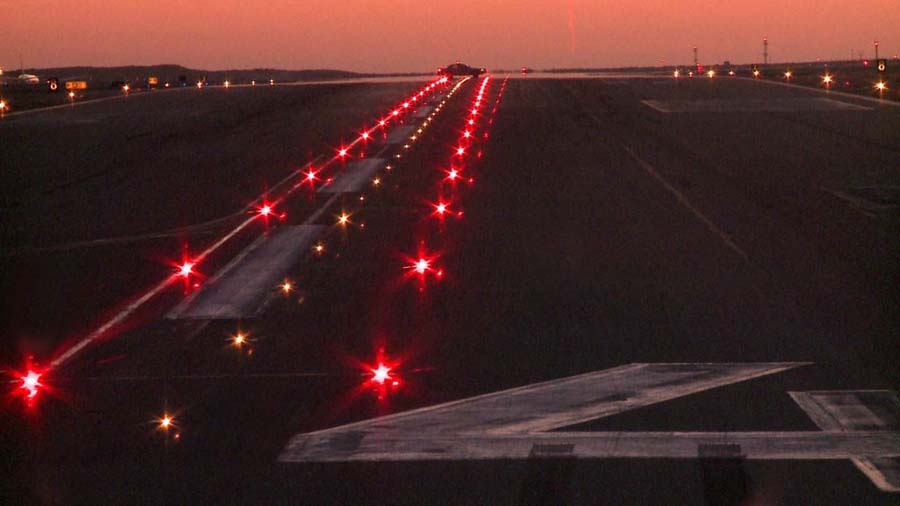
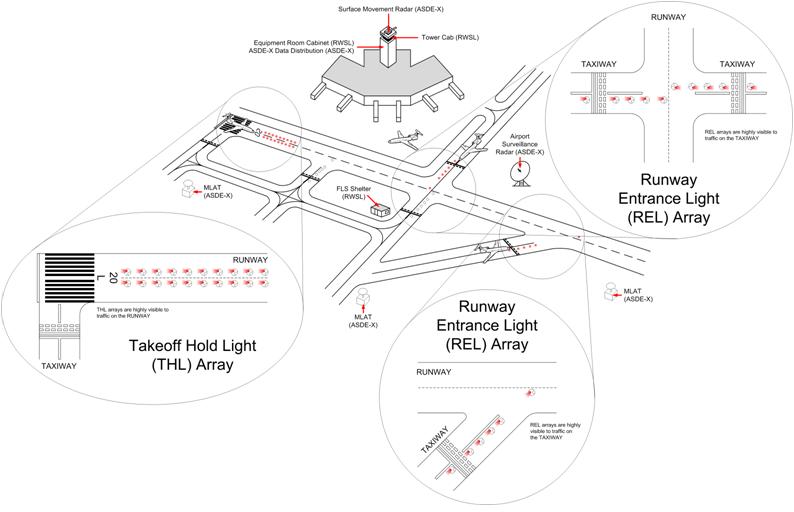
As you may know, the FAA is working on Runway Status Lights (RWSL). It’s a new system that’s live at 20 airports in the US. Basically, you get a nice set of red lights (embedded in the ramp) that tell you whether it’s safe or not to proceed. These lights are installed (or placed or located) at the entrance of the runway and at the start of takeoff. If any of these lights are red, you don’t go. Simple as that.

These lights are fully automated and completely independent of ATC, which means they do not have a clue if the lights are red or not. This is intentional. If you get clearance from ATC, and you see red lights, the red lights take precedence over the controller. The FAA has issued SAFO17011, stating:

There have been several instances at RWSL airports where flightcrews have ignored the illuminated red in-pavement RWSL lights when issued a clearance by Air Traffic Control (ATC). Illuminated RWSLs mean aircraft/vehicles stop or remain stopped and contact ATC for further direction, relaying to ATC that the RWSLs are illuminated.

This system will be expanding throughout the United States, and you can read more about the system here: FAA Runway Status Lights.


Runway Damage at Manila

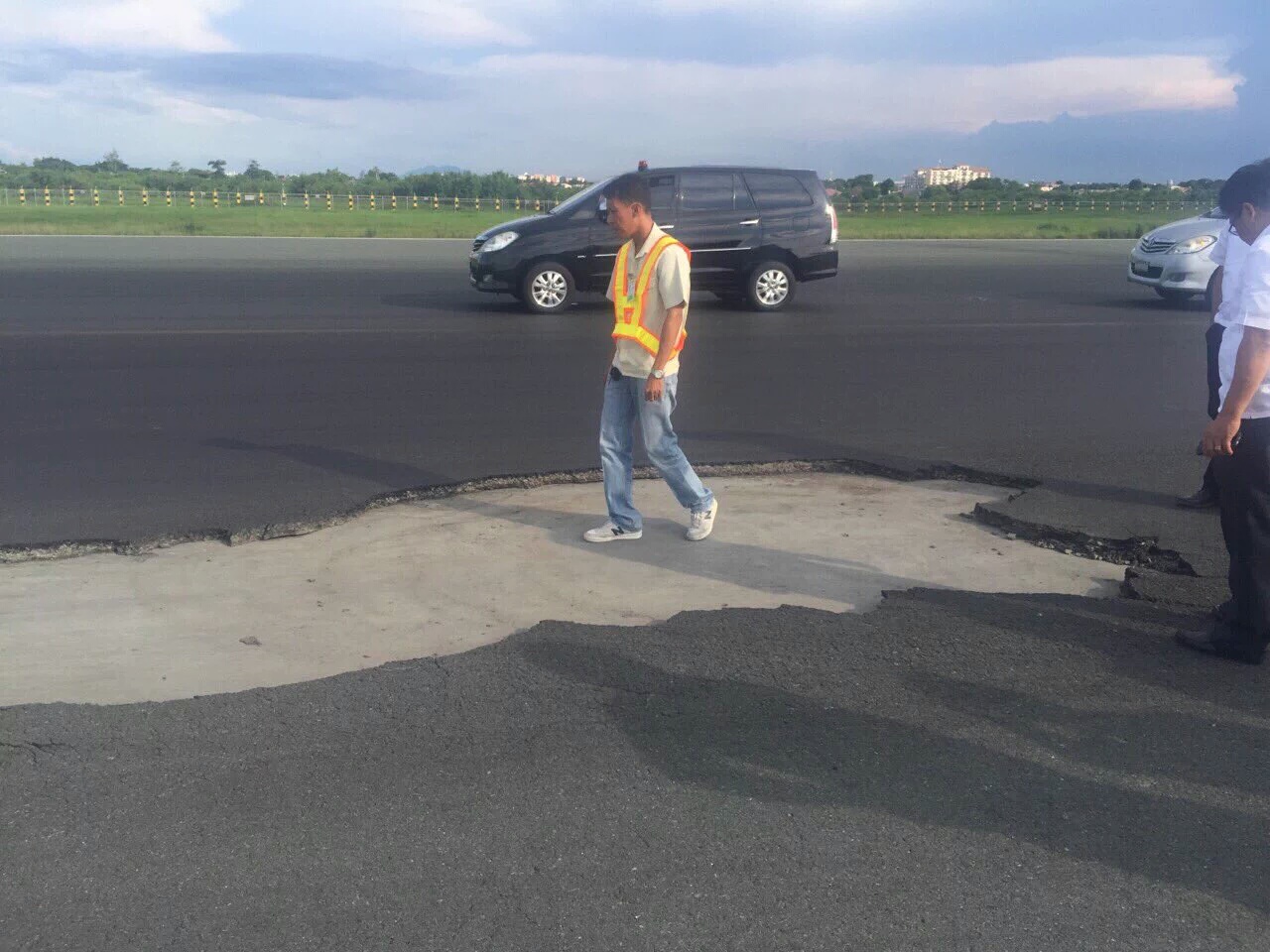
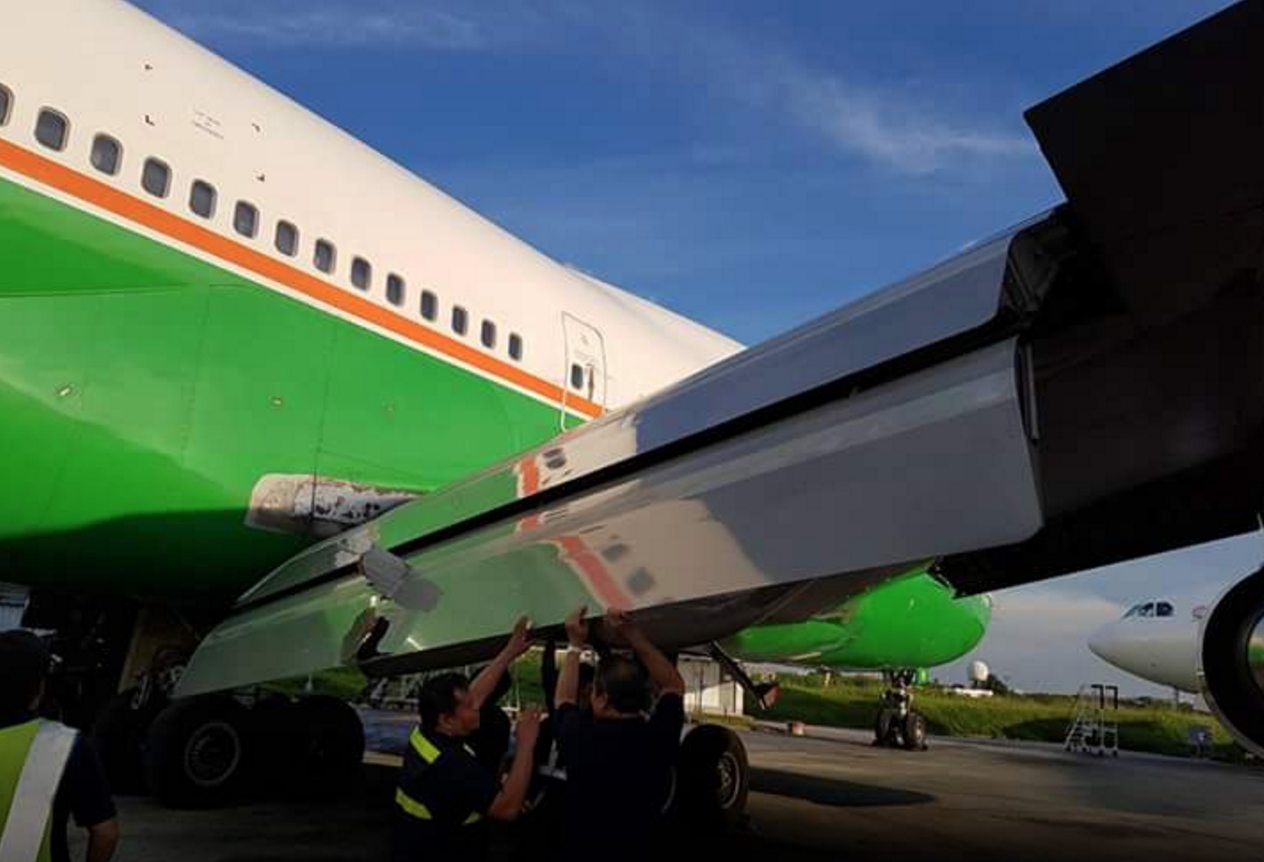
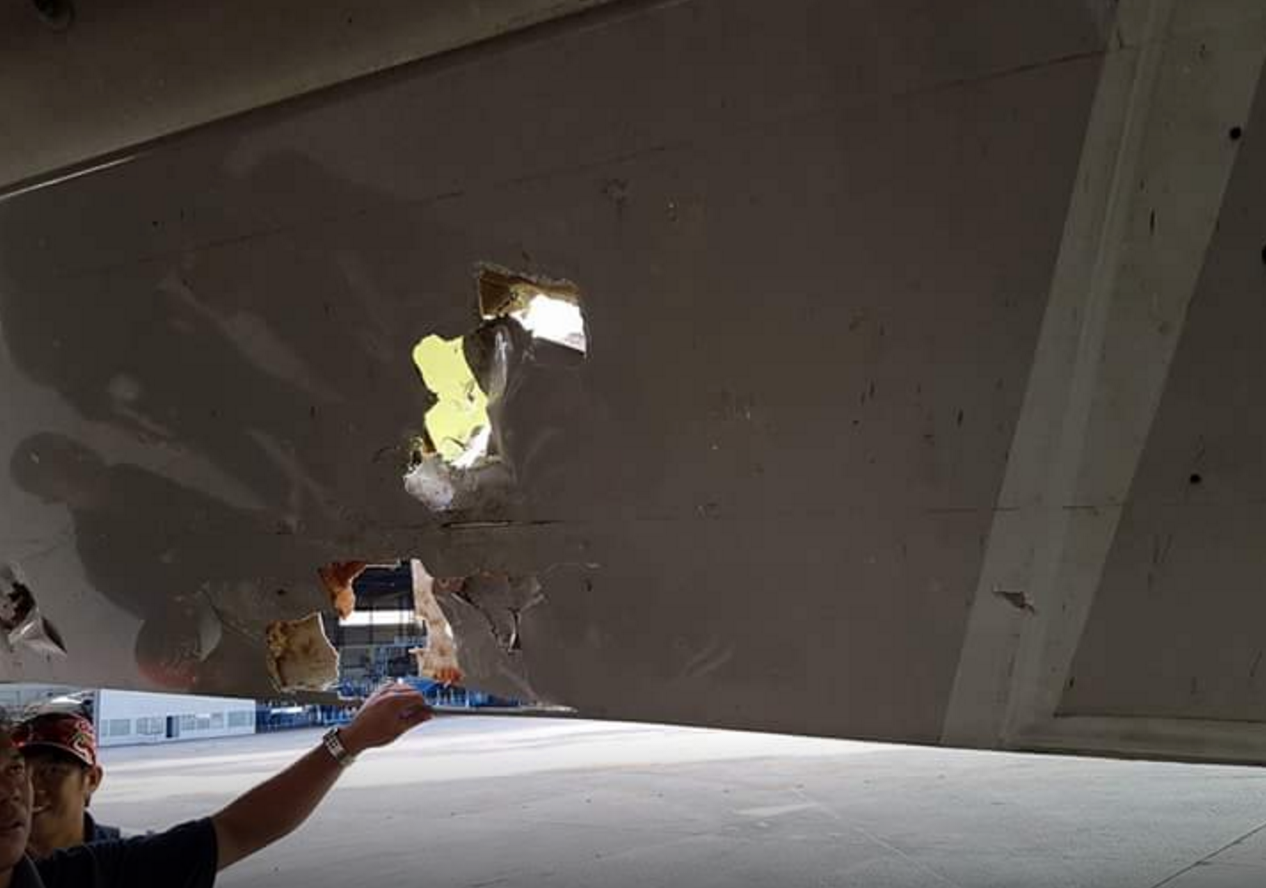
The main runway at RPLL/Manila, RWY 06/24, was closed on Monday 18JUL after heavy rain caused large chunks of asphalt to disintegrate. One of the last aircraft to land, shown below, suffered damage to an inboard flap section.

At least 10 flights diverted to Clark International Airport (RPLC/CRK), 50nm northwest of the city.

The runway was tentatively reopened on Tuesday, but consideration to future similar issues should be given, if further rain occurs.

Flaps Damage