GAR Procedure for UK Flights

Update Jan 2026

The UK’s Electronic Travel Authorisation (ETA) scheme enters full enforcement on 25 Feb 2026. From this date, when submitting a General Aviation Report (GAR), all pax must hold valid permission to travel, either a UK/Irish passport, valid visa, or a valid ETA. GAR submissions may now return a “No Record of Valid Permission to Travel” response if this requirement isn’t met. There are some crew exemptions, but these are complicated so review the latest UK Home Office FAQ for details. Ensure all documentation is checked in advance to avoid delays or denied entry, and remember the fine for a GAR screw up is hefty and falls onto the PIC!

Update Sep 2025

Since April 2024, there have been major changes to the UK’s General Aviation Report (GAR) submission for international flights. Here’s a reminder of what you need to know.

  • The GAR form is now required for departures (not just arrivals).
  • You have to submit it via an online portal, or through a third-party app (no longer directly to UK Border Force via email).
  • If you get it wrong, you can now get fined up to £10,000 (there were no fines before). These apply to both the operator AND the captain.

These rules apply to all international flights arriving/departing the UK (including within the Common Travel Area: Ireland, the Isle of Man and the Channel Islands). Details on how the rules work within the CTA are explained below.

You can read the rules in full on the UK Government website, but here’s a summary of the main points:

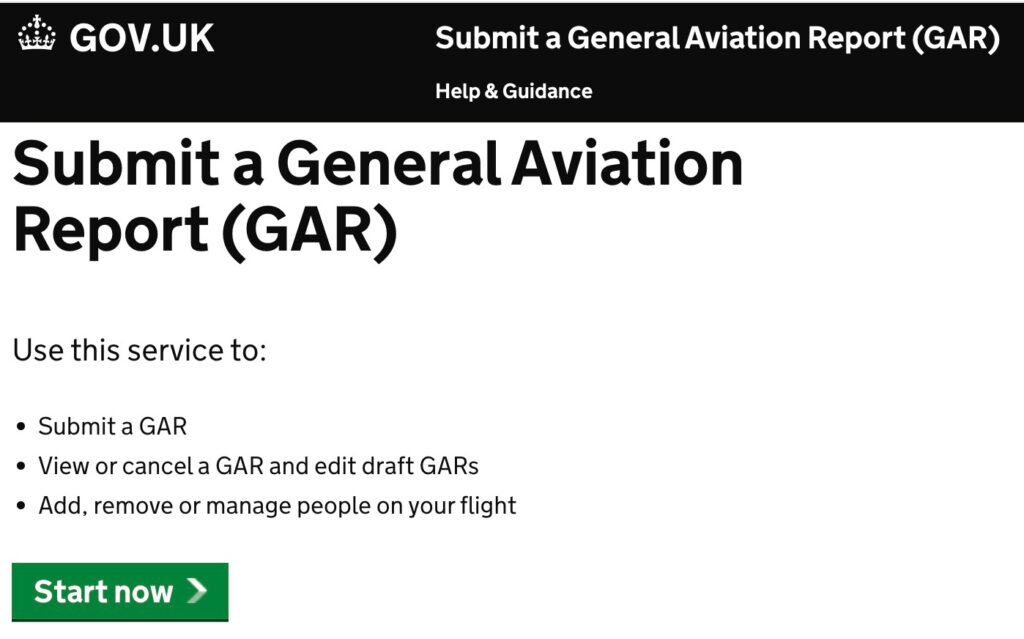
How to submit the GAR

You need to submit info online about the flight and crew/pax, no earlier than 48 hours and no later than 2 hours prior to the expected time of departure. There are 3 ways to do this:

1. The government’s free-to-use online portal.
Alternatively, you can download this GAR template (Excel doc), complete it electronically and upload it to the portal.

2. Approved third-party applications: Rocket Route, OnlineGAR

3. Direct connections: FB01, Streamlane, Mobile-Edge, PnrGo

More info on the UK government site here.

After you submit the GAR, you should get a response telling you whether that crew/pax is allowed to travel. It will be one of the following (thanks to our friends at FlyingInIreland for this table):

Response Message Action
Valid permission to travel The Home Office can find a valid permission to travel for the person. Pilots, operators and agents are not required to check visas, but Passport or Travel Document checks still apply. They must check that the passport or travel document presented is genuine and valid, and that the person is the rightful holder.

For more information on checking passports and travel documents click here Guidance on examining identity documents (publishing.service.gov.uk)

Authority to carry granted Pilots, operators and agents are required to check visas for Visa Nationals. Passport or Travel Document checks apply for all passengers. They must check that the passport or travel document presented is genuine and valid and that the person is the rightful holder.

For more information on checking passports and travel documents click here Guidance on examining identity documents (publishing.service.gov.uk) Follow this link to check visa requirements Check if you need a UK visa – GOV.UK (www.gov.uk)

Authority to carry refused. DO NOT BOARD. This response message will not be displayed on the screen. Pilots, operators and agents will be instructed not to board an individual (NO BOARD) via a call and email when Authority to Carry (ATC) has been refused.

Because fines apply if the GAR is submitted incorrectly, many handling agents may no longer be willing to do it on your behalf.

If you’re not already using a third-party application, the safest option is to set up an online account and handle the submission yourself.

Common Travel Area flights (Ireland, Channel Islands, Isle of Man, Northern Ireland)

Flying within the CTA is where GAR rules can catch people out. On top of the standard UK GAR, there are two extra layers to watch.

First, some destinations have their own local GAR forms. The Channel Islands (EGJJ/Jersey, EGJBGuernsey) require local GARs inbound and outbound, and the Isle of Man/EGNS has its own form too. Requirements can vary, so best practice is to confirm with your local handler. Opsgroup member report: At EGJJ/Jersey, Border Force has at times required full residential addresses for crew and pax, and commercial operators also need local permits separate from UK CAA permits.

Second, the 12-hour police rule. If you are flying to or from the CTA and using a UK aerodrome that is not police-designated, extra steps apply. For private flights, you need to notify the local police at least 12 hours in advance. For commercial flights, it’s stricter: you must obtain prior police approval before operating from a non-designated aerodrome. Opsgroup member report: A flight originally planned from EGKB/Biggin Hill to EGJJ/Jersey made a last-minute stop in EGTK/Oxford. Because Oxford is not police-designated, the 12-hour rule kicked in. The crew had filed a GAR only a few hours before departure, so Border Police enforced the rule and the jet was stuck in Oxford overnight.

For Northern Ireland, the designated ports are EGAC/Belfast City, EGAA/Belfast Intl, and EGAE/City of Derry. If you use any other airport, you must notify the local police at least 12 hrs in advance (GAR@psni.pnn.police.uk).

You can find the full list of police-designated aerodromes in Annex A of the official UK GAR guidance.

Getting it wrong

Again, check the official guidance on this, but here’s what “getting it wrong” basically means:

  • Failing to provide correct info about the flight and people on board.
  • Not submitting it within the required timeframe (no earlier than 48 hours and no later than 2 hours prior to the expected time of departure).
  • Not doing it in the fight format (i.e. through the web portal or via an approved third party).

The big things to know / watch out for:

  • Fines: Getting it wrong could mean a fine for the “owner or agent and captain”. So that means the operator AND captain are subject to enforcement action and fines. These start at £5,000 for first-time offenders (ouch!), subsequent breaches start at £7500, followed by the maximum of £10,000.
  • Errors on the GAR submission: Watch out for incorrect spelling of names, omitting middle names, not using the full names exactly as shown on passports, and incorrect crew assignment (which pilot is the PIC). Anything like this is likely to get you a “warning” from UK Customs on arrival, and potentially a fine if it happens again. Opsgroup member report: At EGPH/Edinburgh, Border Force issued a non-compliance report because a crew member’s middle name was missing from the GAR, even though it appeared on the GenDec. All given names (including middle names) must be included in GAR submissions. When using the GAR portal, enter the middle name(s) in the “Given name(s)” field along with the first name. 
  • Last minute changes: Bad news. If you get an extra passenger last minute, or someone shows up with a different passport than the one you sent on the GAR submission, you have to file a new GAR and then wait 2 hours until you depart. Same applies if you change your arrival airport in the UK. One exception here: if a passenger was provided on the GAR and they do not travel, a new GAR is not required to be submitted.
  • Diverts: If you have to divert due to weather, that’s fine. If this happens, UK Border Force want you to call them if you can, on +44 300 123 2012. Make sure you’re diverting to the alternate listed on your flight plan (should also be an international airport with Customs). If you’re diverting somewhere other than what’s listed on your flight plan (i.e. it’s an emergency), call UK Border Force after you land to explain.
  • Late departures: If the flight will operate on the same day, albeit later, no new GAR submission is required. If a flight is delayed to the next calendar day, a new GAR must be submitted.
  • Early departures: If you depart early headed to the UK, don’t update the GAR! Opsgroup member report: We had a flight to UK that departed 45 mins early, so we thought it wise to update the GAR to correct ETA. This resulted in a UK Customs warning for ‘submitting’ a GAR once flight airborne (8hr leg). We’ve been told that we should not have updated the ETA and it is UK Customs’ responsibility to keep up to date with the ETA.
More info

Check out this page from PnrGo. It has a bunch more info for pilots and operators, including a recent webinar recording plus an extensive Q&A on this topic.


London Night Ops: What’s Changing This Summer
Key Points
  • EGGW/Luton will allow a limited number of BizAv night slots this summer (14 Jun – 17 Sep), a rare exception linked to upcoming runway works.
  • EGSS/Stansted now has only 10 BizAv night slots per week, shared between all FBOs, available until the end of October (unless extended).
  • EGWU/Northolt will have restricted civilian ops hours in Jun, Jul and Aug due to control tower works impacting ATC staffing, with no weekend flying at all in Jul and Aug.
  • EGMC/Southend is not available H24. It operates daily from 0600 to 0130 local time, with no night operations permitted – including for QC1 or quieter aircraft.

Unlike previous summers, EGGW/Luton is making a one-off exception this year by allowing a small number of BizAv night slots, to help manage capacity during upcoming runway works. However, availability is extremely limited, slots are tightly controlled, and subject to withdrawal if airline delays eat into the night hours. EGMC/Southend is no longer a viable late-night option. It now operates strictly between 0600 and 0130 local time, with no movements allowed outside those hours – regardless of aircraft noise level.

All times shown below are local time!

EGLL/Heathrow & EGKK/Gatwick

Slots for bizav flights are almost never issued at night, as there is a noise quota system in place between 2300-0700. There might be a few daytime slots available – best bet is to contact a local handler and they will try to sort you out. There’s only one FBO at these airports, both Signature: lhr@signatureflight.co.uk and lgw@signatureflight.co.uk

EGGW/Luton

There’s a change to night operations this summer. The airport will allow a limited number of night slots for BizAv. Between 14 Jun – 17 Sep, up to 100 ad-hoc night slots will be granted for flights between 2300-0659 local time, but only for quieter aircraft. Best to check with your local handler whether your aircraft qualifies. These slots are shared across all operators and will be allocated on a first-come, first-served basis. This is a one-off exception, linked to upcoming runway works. Slots will be tightly controlled and may be withdrawn if airline delays push into night hours. A few different FBOs to choose from:

Signature: ltn@signatureflight.co.uk
Harrods: ltnops@harrodsaviation.com

EGSS/Stansted

After a full ban on BizAv night slots between 2300-0600 local time from June 1 to Sep 30, limited availability has now returned. Local FBOs confirm that just 10 night slots per week in total are being allocated, shared between all handlers at Stansted. This arrangement is in place until the end of October, though it may be extended through April 2026 before further summer restrictions are reintroduced. A few different FBOs to choose from:

Inflite Jet Centre: operations@inflite.co.uk
Universal: uk@universalaviation.aero
Harrods: stnops@harrodsaviation.com (Harrods operate two FBOs here: The Knightsbridge and The Brompton)

EGLC/London City

Open: 0630-2130 weekdays, 0630-1230 Sat and 1230-2130 Sun. There are slots available between these times. jetcentre@londoncityairport.com are who you need to speak to for handling and slot assistance there.

EGTK/London Oxford

Open: 0630-2230 and up to 2359 on request, seven days a week.

The thing you probably want to know about Oxford is while it takes just over an hour to drive to London, making it the furthest away of all the “London” airports, it also charges much less in handling fees. You can contact the FBO at ops@londonoxfordairport.com

EGLF/Farnborough

Open: 0700-2200 weekdays, 0800-2000 weekends – but no extensions possible. Farnborough is a dedicated business aviation airport and can be contacted at ops@farnboroughairport.com

EGKB/Biggin Hill

Open: 0630-2300 weekdays, 0800-2200 weekends. On UK bank holidays, weekend hours apply. Biggin Hill is one to consider for smaller corporate and charter operations. A dedicated bizav airport, only 12 miles outside of central London, and no slots required. A couple of FBOs to choose from:

Executive Handling: handling@bigginhillairport.com
Jetex: fbo-bqh@jetex.com

EGWU/Northolt

Normally open: Monday to Friday 0800-2000, Sat 0800-1500 and Sun 1200-1900. So not great for night flights, but pretty handy otherwise as Northolt is one of the closest GA-accessible airports to central London, as well as the closest airport to EGLL/Heathrow (8 miles away).  But this summer (Jun through Aug), opening hours for civilian ops are being restricted due to infrastructure works at the control tower impacting ATC staffing.

In Jun, ops are limited to Monday to Friday 0800-1800 and Sunday 1000-1700 local time, with Saturday fully closed. In Jul and Aug, weekday hours return to 0800-2000, but there will be no weekend flying at all, as the airport will be open for military traffic only. Any bookings outside these hours will need to be moved or cancelled.

Bear in mind it’s a dual use military/civil airport, so you’ll need PPR, but they’re normally quite quick to approve this.

Universal is the FBO here: northolt@universalaviation.aero. Check here for more info.

EGMC/Southend

Open daily from 0600 to 0130 local time. No operations including for QC1 or quieter aircraft are permitted outside of these hours. Extensions are not possible and night operations are not allowed under any circumstances.

You can contact London Southend Jet Centre FBO here: ops@londonsjc.com

EGBB/Birmingham

Correct, not a London airport! Just a bonus one for you, because outside of all those listed above, this is probably the next closest airport to London that is open at night. Two FBO options here, both open H24 – but night time operations are available on request and subject to additional out-of-hours fees:

XLR Executive Jet Centre: jetcentre@xlrbirmingham.com

Signature: bhx@signatureflight.co.uk

Send us your spy reports!

Send us your Airport Spy reports for all these airports so we can share the gotchas, the things to know, contacts to contact and anything else useful.

What’s Airport Spy? Well, you write a quick little postcard with “what happened” when you went to some airport somewhere. Then you, and others (that’s the magic), can refer to your notes for future flights to the same place.
London Airports Top Tips

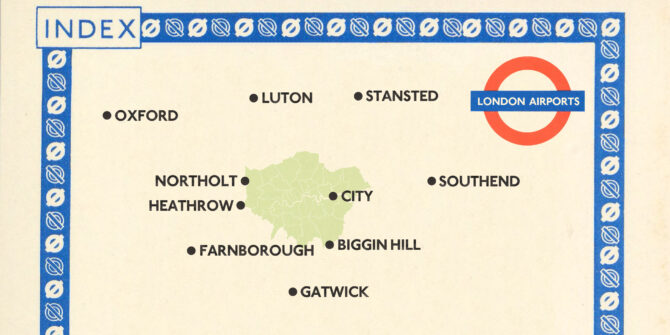
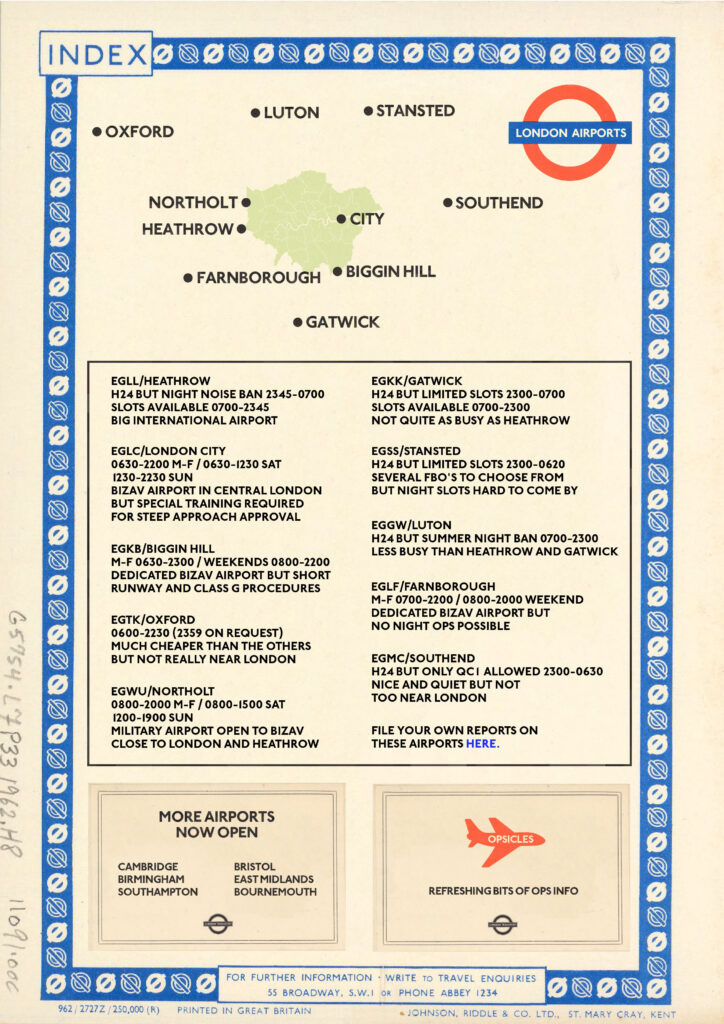
Here’s some basic info we put together on the London Airport options, made with help from the London Underground tube map publishers, circa 1962.

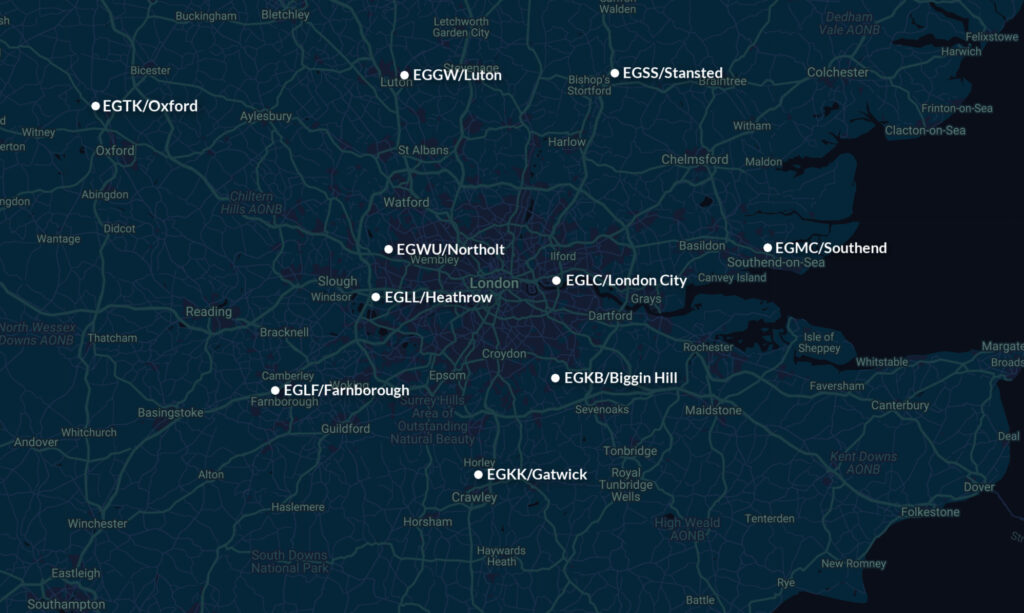
How many airports are there around London?

Well, you have the big international ones – EGLL/Heathrow, EGKK/Gatwick and EGSS/Stansted. 

Then you have EGMC/Southend which is also quite big but a bit less big really, it mainly just serves European routes really. Same for EGGW/Luton. FYI – both of these are officially ‘London’ as well. 

Then you have smaller or predominantly business aviation airports – EGLC/London City, EGLF/Farnborough (not a London, but closeish), EGTK/Oxford Kidlington (this is a London), EGKB/Biggin Hill (really near London but not called London) and EGWU/Northolt (8nm from Heathrow and actually a military base).

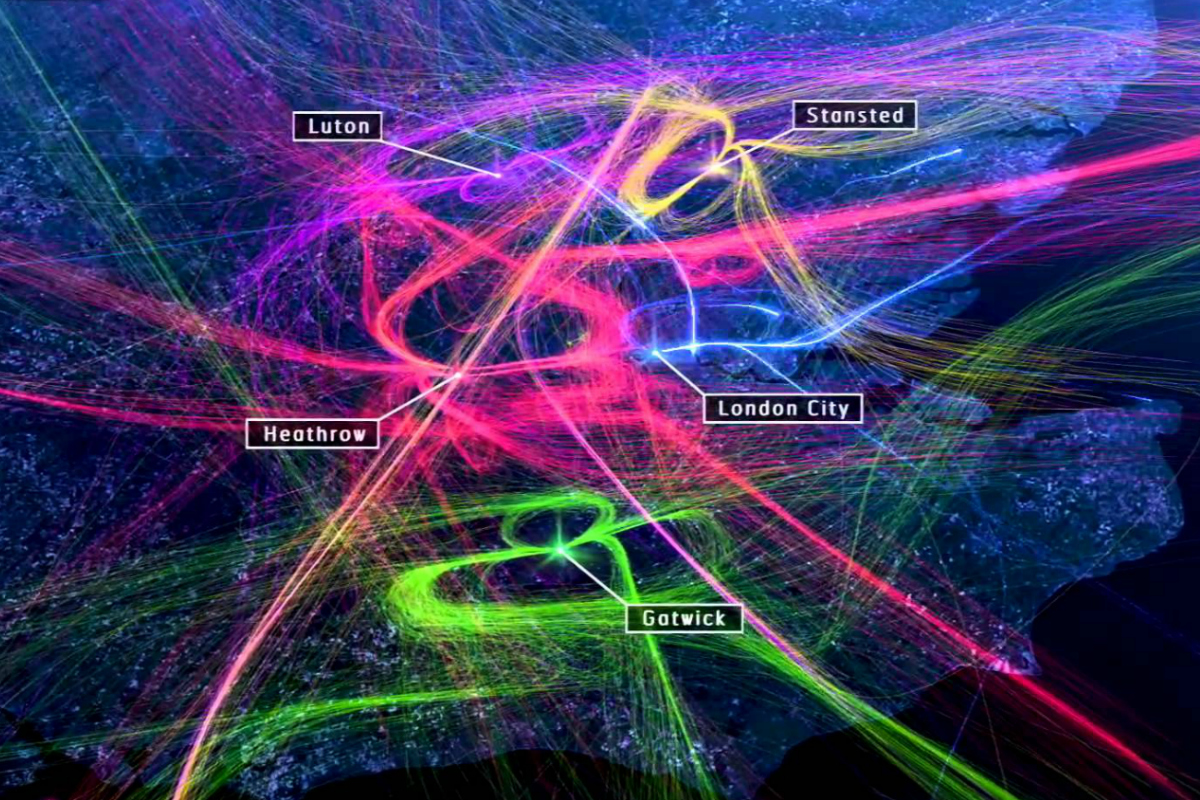
Back in 2015, the UK handled something like 2 million flights a year and 1.2 million of them were in and out of the 5 main London airports. In fact, here’s a cool video of 24 hours in London (also from 2015 so probably wildly inaccurate at this point, but has some nice neon colours.)

Right, so, it’s busy. What are some things you need to know.

  • The constant frequency changes. So many of them. But generally well managed on ATC.
  • The headings after departure. For reasons known only to ATC, it seems to be easier for them to manage all the traffic out of the London area by keeping you on a heading for lengthy times.
  • Transition levels and altitudes. Not set at a specific number – they can change with the weather, and at different airports. Watch out if there are extreme QNHs going on.
  • The airspace. Actually, this can have its own section…

The airspace.

It only has 3 FIRs – London, Scottish and Shanwick, although these are split in UIRs as well.

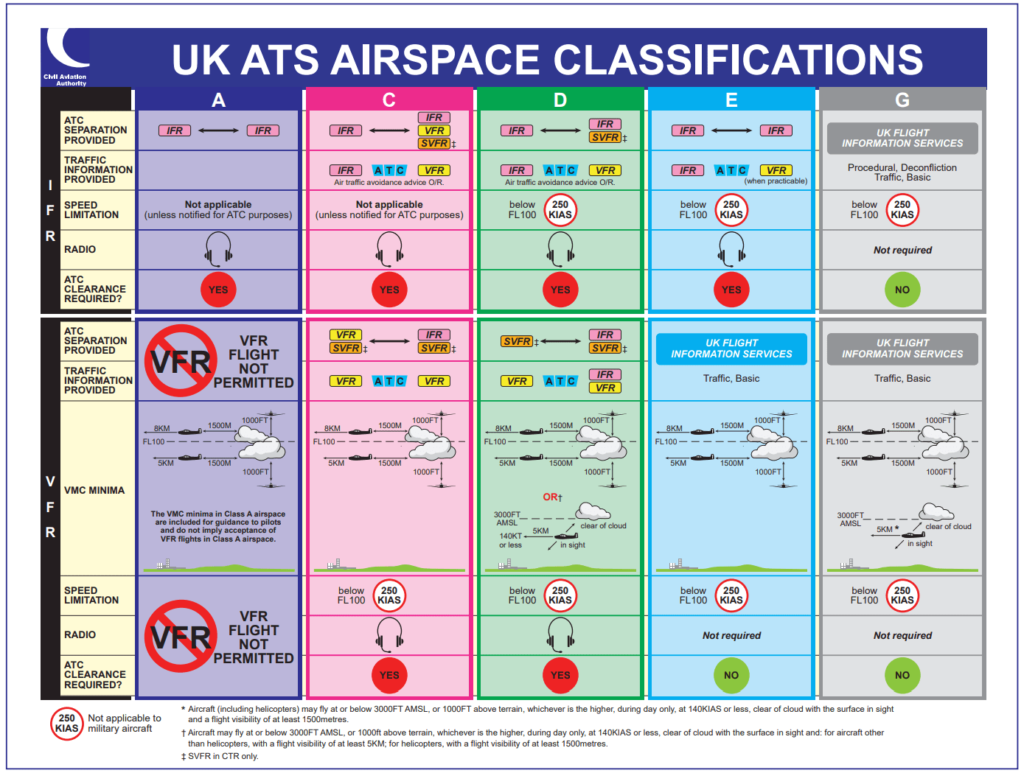
All the airspace in the UK is split into 7 types classes – A to G. Here is a picture:

I will point out, in case you miss it, that Class G is uncontrolled.

Class G airspace (and Class E a bit)

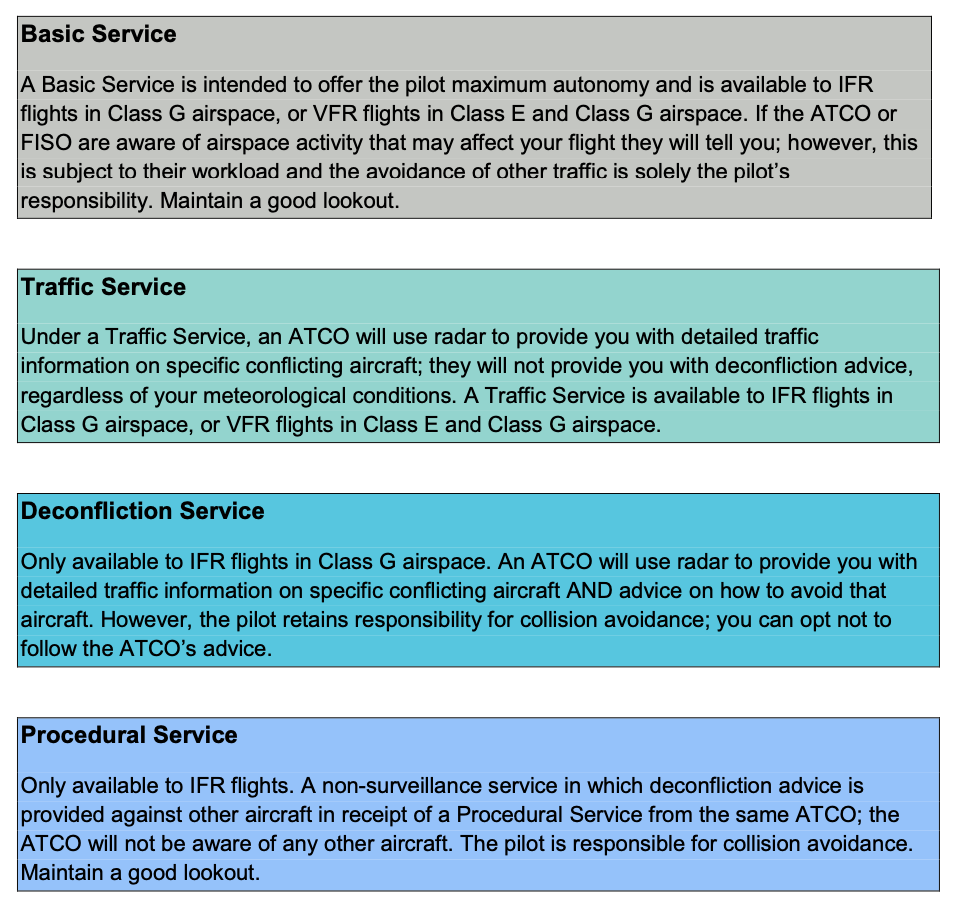
If you’re in Class G (and some class E if you’re VFR) then you get Flight Information Services. These work like this:

  • Basic service. ATC might tell you about activities that might affect you if they have time. Up to you to miss it all.
  • Traffic service. The use a radar to tell you about specific conflicting aircraft. You only get this if they have time, and still up to you to not fly into it.
  • Deconfliction service. This is only for IFR flights in class G. It’s basically the traffic service but they’ll throw in some ‘how to miss it’ guidance as well, which you can ignore if you want.
  • Procedural service. I don’t really understand this so have just copied and pasted their description – Only available to IFR flight. A non-surveillance service in which deconfliction advice is provided against other aircraft in receipt of a Procedural Service from the same ATCO; the ATCO will not be aware of any other aircraft.

All this information is in here, with some more information if you need to know more. 

When will you ever be in Class G?

Remember this started as a post about London, sort of? Well, now it is a post about Biggin Hill specifically, because that’s where you – a BizAv aircraft maybe routing over from the US on some nice business trip – might find yourself in Class G airspace.

First, let’s talk Air Traffic Zones (ATZ). If the longest runway is longer than 1850m, then these zones are generally 2000’ high and 2.5nm around the aerodrome – if shorter than that you generally have a 2nm ring.

To go in or out of an ATZ you need to either:

  • Have permission from the ATC unit there if it has one
  • Have information from flight information service if it has one
  • If there is no ATC or FIS, then be talking to an air/ground communication service.

Read more here.

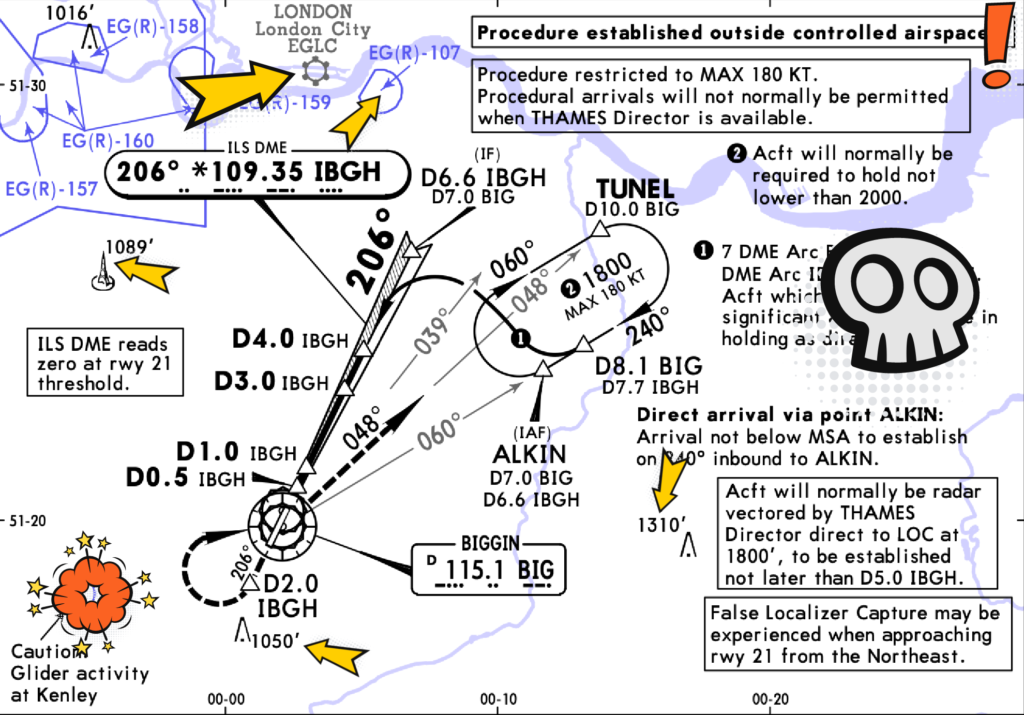
So, Biggin Hill has an ATZ and it’s a funny sized one and it’s right in Class G airspace, and if you fly there you probably want to know about the procedures to go in before you.

Biggin Hill stuff

We were told this by a very helpful Opsgroup member who had just been there.

It is in class G, has an ATZ, and a tower. The tower give you all the permissions and clearances you need.

Right above Biggin Hill you’re straight up into Class A (2500’). Your instrument approach starts below Class A and is outside the ATZ… so many non radio carrying, non transponder transmitting aircraft could be wafting about all around you. You might get one of those service I mentioned above, but you might not, and you will always have to make sure you don’t fly into stuff. So watch out.

Also because of its airspace, you can probably expect some extra track miles as you head in and out from the west. Arriving –  count on an extra 15 minutes, departing – be prepared for an extra 10 minutes or so.

They also only really land onto runway 21, and if you depart 21 then it’s an EARLY right hand turn for noise abatement.

Here’s an Airport Lowdown on all of this.

Finally, some other bits on other London airports.

1. Don’t go to London City unless you have been trained (it needs prior training) and your aircraft is certified for steep approaches or its going to get quite embarrassing fairly quickly. If you are going to London City then take a look at the platform and missed approach altitudes because they’re low. Why? Because it is directly under the flight paths for Heathrow and Gatwick.

2. Don’t head to Heathrow without a bit of fuel for holding. You usually hold for Heathrow. 

3. Don’t fly level for too long if you’re heading to Heathrow. They have quite strict NABT arrival procedures and you might get fined (and will definitely get shamed!) if you don’t try and do a CDA.

4. Don’t plan on using many of them at night. Really, Southend and Stansted are your only options at night – everywhere else is either closed or has noise curfews in place. Here’s something we said on that.

5. If you’re not from the UK you’re more than likely going to need to register for a TCO before December 2022 if you want to operate any kind of commercial flight into the UK. It looks like a hideous process and we don’t know much about it so if you have questions, email these folk – TCO@caa.co.uk

6. London is awesome. If you want some recommendations on top spots to visit then ask.


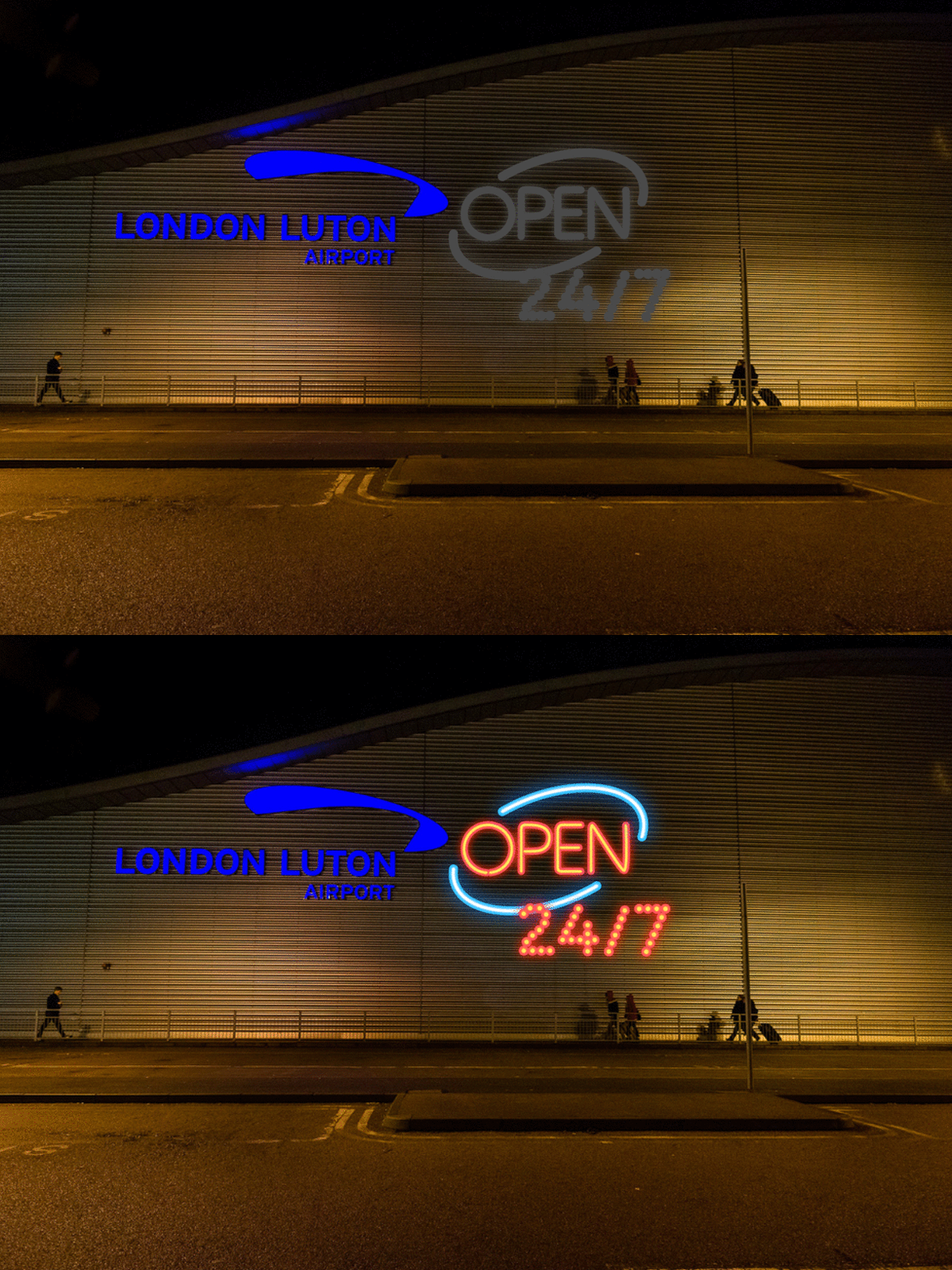
London Luton now available for night flights again

The summer ban on GA/BA night flights ended on Oct 1, and the airport is now available H24 again.

Throughout last year’s winter period there was a strict weekly quota on how many ad-hoc flights were allowed to operate at night, but this has been increased significantly this year, so there should be no problem getting night slots now.

The nighttime noise restrictions for EGLL/Heathrow, EGKK/Gatwick, and EGSS/Stansted are still in place, making nighttime GA/BA operations to these airports limited.

Here’s a rundown of the current restrictions:

  • EGMC/Southend (40 miles from London) & EGBB/Birmingham (115 miles from London) are the only airports with no restrictions (thus far).
  • EGLL/Heathrow & EGGK/Gatwick: Pretty much a no-go zone for business aviation these days
  • EGLC/London City: closed from 1030pm to 0630am
  • EGWU/Northolt: closed from 8pm to 8am on weekdays (although the airport is currently closed to all flights until mid-November for runway and apron refurbishments)
  • EGLF/Farnborough: closed from 10pm to 7am on weekdays
  • EGKB/Biggin Hill: closed from 11pm to 6.30am on weekdays, and 10pm to 8am on weekends

Further Reading:


The diversion dilemma over London

A few months back an Air Canada A330 suffered a hydraulic failure as it started it’s Atlantic crossing from France to Canada. The crew decided to turn back and wanted to divert to EGLL/London Heathrow – this was denied.

Since then, other reports have been received of other aircraft requesting similar non-emergency diversions over the UK and them being denied. We understand the “non-acceptance of diverts” policy is in place for EGGW/Luton, EGSS/Stansted and even as far away as EGHH/Bournemouth. It is important to note however that if you declare an emergency (PAN/MAYDAY) – then all bets are off and you can divert wherever you like.

This week we saw EGGW/Luton go as far as publishing a NOTAM to that effect.

A2663/18 – DIVERTS SHALL ONLY BE ACCEPTED FOR ACFT THAT HAVE DECLARED AN  EMERGENCY.

So what’s going on?

We understand it’s a mix of things.

  1. With the heavy summer traffic situation all across London (which is being compounded by the various curfew and overnight flight limitations) it seems that the major airports don’t want an aircraft landing and disabling their runway.
  2. We have heard specific concerns stating that there is nowhere to park overflow aircraft. One aircraft might be manageable but multiple during peak disruption maybe not so easy.
  3. Some Opsgroup members have reported that the main driver of this policy at EGGW/Luton and EGSS/Stansted may be down to ‘their fear of adverse publicity on social media’ regarding aircraft sitting there waiting to go somewhere else and passengers tweeting away the problems with the airport and its facilities.
  4. Luton also put forward the argument that they do not want to interrupt the home-based operators by allowing other operators in. However, at the same time they are automatically denying home-based operators a diversion unless you declare an emergency.
  5. Border Control has also bought into the argument, especially at EGSS/Stansted, saying their manning levels can’t cope with an influx of extra passengers at short notice.

There are a whole host of other factors at play which make diversions in the London area a headache, particularly at night time. Opsgroup member Diego Magrini from Jet Concierge Club sums it up nicely:

“Minor airports close early in the evening, for example EGSC/Cambridge, EGTK/Oxford, EGLF/Farnborough, EGWU/Northolt. These would all be very good alternatives, but become unavailable pretty early. Let’s be honest: no business jet want to divert to EGLL/Heathrow or EGKK/Gatwick (costs, slots, friendliness, etc), and most cannot go to EGLC/London City due to training and approval. This is of course on top of Heathrow and Gatwick not accepting diversions most of the time, or not having slots available. Some airports outside London, although open and accepting traffic, do not have an FBO presence during the night, and this cannot be arranged at short notice for a diversion. Combining all of this in the very short timeframe of a diversion can be very tricky!”


There is a cool video that shows just how busy London does get on any given day….

If you have any further knowledge or recent experience to share, please let us know!

Extra Reading


Dubai to London – which way is best?

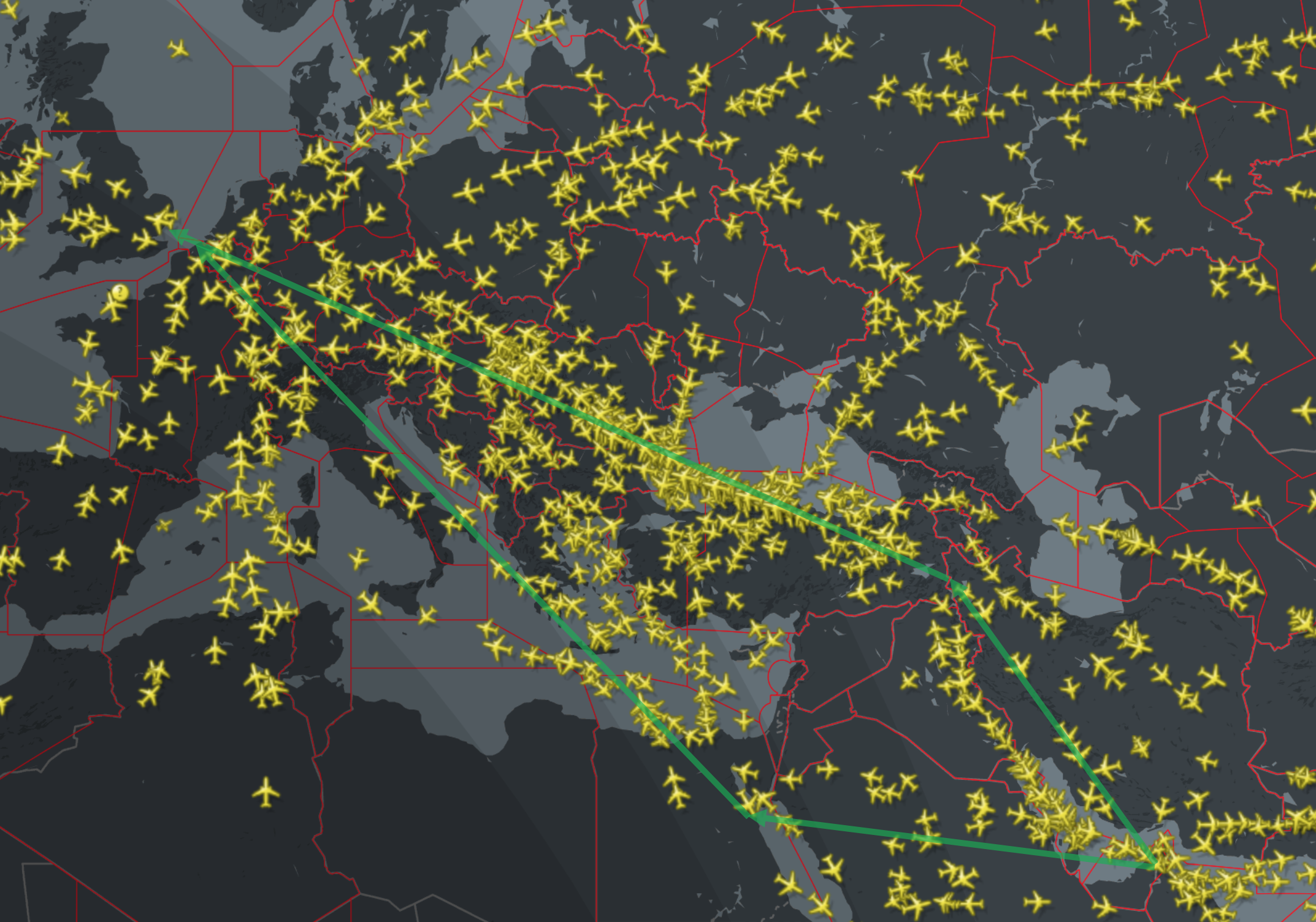
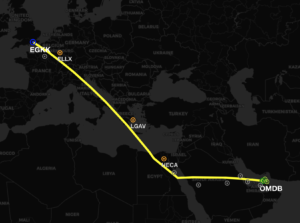
In Short: Two main options, via Saudi and Egypt (safer, cheaper but longer) or via Iran and Turkey (shorter, busier and geo-politically more unstable). It’s a complicated planning climate at present. Review regularly based on latest risk factors.   

There are more business aviation operators flying between the Middle East and Europe than ever before. So we took the time to look over the route options between the two regions. For our example we will be using a flight from Dubai to London, but similar operational considerations are valid for the plethora of route combinations through this whole region.
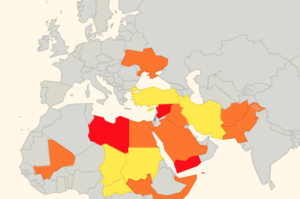
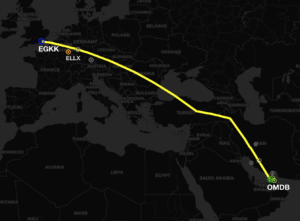
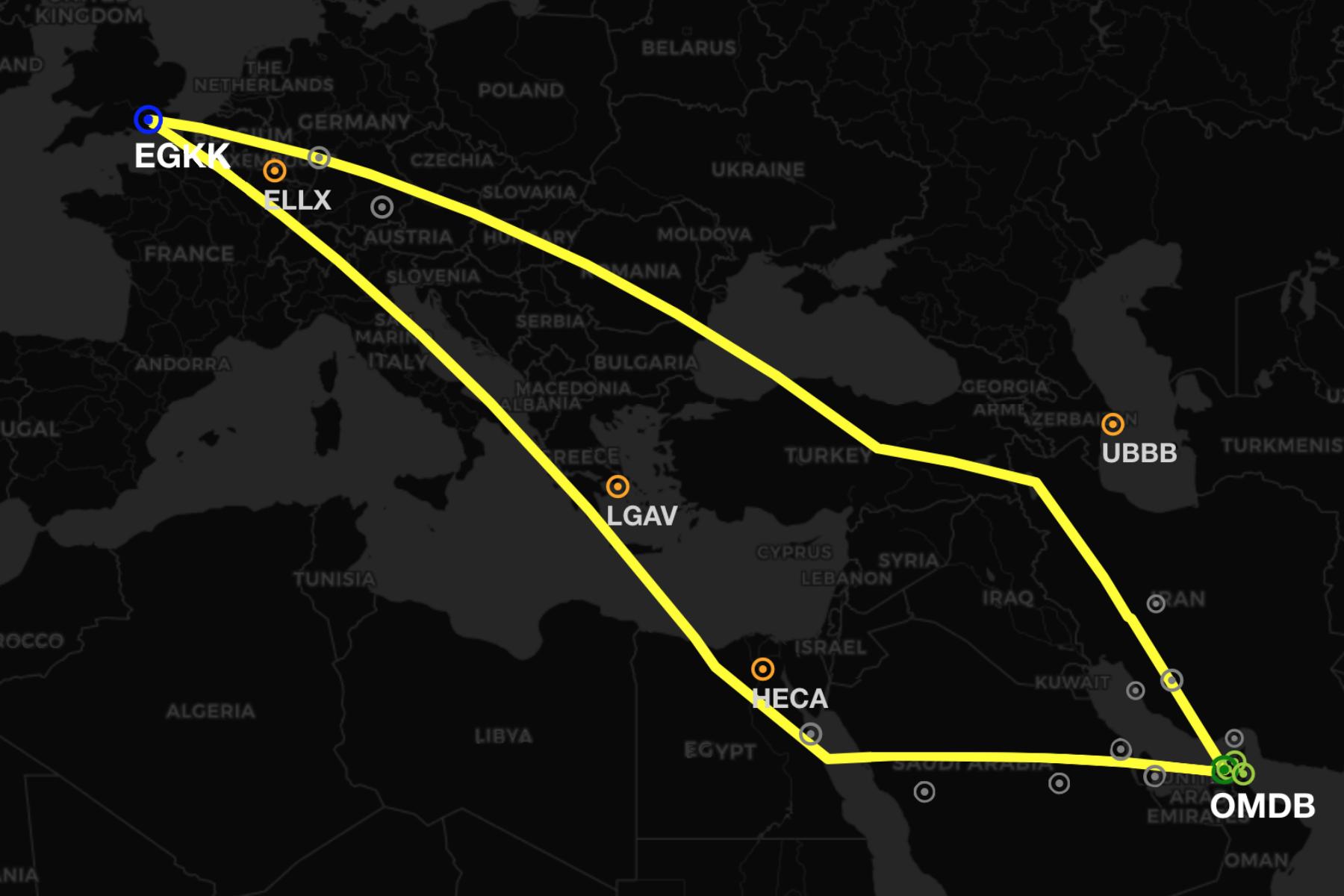
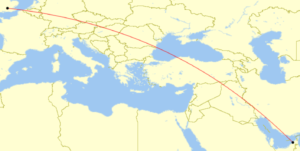
Firstly, we are sure you are a frequent visitor to our safe airspace website. Updated all the time with the latest notes and risk recommendations based on the latest intel. So, first things first, we want to avoid Syria, Libya and the Sinai Peninsula. As you can see however, this is a complicated geo-political region for flight planning. The direct great circle route would take us through Syria and would be around 3125nm. But that isn’t going to work. So, what else we got?

We will look at the two ways to head over the region. One is via Iran, Turkey and onwards to Europe. The other over Saudi Arabia and Egypt towards Europe.

Option 1: Iran/Turkey

Safety: Both Iran and Turkey are FSB Risk Level: Three – Caution. Iran is involved in the ongoing conflict with Syria and several Russian missiles crossed the Tehran FIR and several busy international routes. There are also increased tensions between the USA and Iran at present – if you had to divert in an N-reg aircraft, Iran would not be the friendliest of places to do so. Turkey borders with Syria and we have received multiple reports of GPS interference in the area.

Distance: an extra 100nm.

Time: About 15 minutes longer than great circle route.

Ease and Cost: Iran has higher overflight costs and for US based operators a reminder of the sanctions for dealing directly with Iran, or agencies in Iran. You’ll want to use an approved agent if you’re from the US (i.e.–not an Iranian company). Iran doesn’t work on Fridays, so be aware there. Turkish overflight costs are reasonable and remember that Turkish authorities require the use of an agent to apply for permits.

Traffic: The biggest issue with this route is that everyone is using it! It’s congested with a lot of airline traffic. It’s a major corridor for Asia-Europe flights also. So, getting the levels you want, and off route deviations are more complicated. Things get busy, as you can see!

Option 2: Saudi/Egypt

Safety: In terms of airspace warnings and risk, this route is slightly better. We have rated Saudi and Egypt airspace as FSB Risk Level: Two – Assessed Risk. Beyond the Sinai Peninsula and the Saudi/Yemen border, generally there is less of a chance of airspace security risks at present.
Distance: An extra 300nm from the great circle.

Time: Around 45 minutes longer.

Ease and Cost: Saudi and Egyptian airspace are generally a cheaper option ($1,000USD+). In Egypt, by law you have to get your permit through an Egyptian agent, but it’s a straight forward process. In Saudi, again, using an agent is best; they normally have three-day lead time – so keep that in mind. Also remember that the CAA only work Sun-Wed during office hours.

Traffic: For most of the day, much less of a traffic bottle neck.


Bottom line

Of the two options, routing via Saudi/Egypt is cheaper, and safer (as long as you steer clear of Egypt’s Sinai Peninsular and Saudi’s border with Yemen), but it’s going to take slightly longer.

What about Iraq?

We don’t think it’s a good idea. There’s a lot of information out there saying certain airways are ok but only at higher levels. But if you needed to get down fast, or even make an unexpected landing, Iraq isn’t the place you would want to go at present. Treat with caution.

Which one is your favourite choice? Let us know!

Further reading:


Just about nowhere to land in London at night this summer

Jet noise! It seems that Londoners are sick of it. Corporate operators watch out; London basin airports of EGGW/Luton, EGSS/Stansted, EGKK/Gatwick, EGLL/Heathrow, EGKB/Biggin Hill, EGWU/Northolt, EGLF/Farnborough and EGTK/Oxford airports are now effectively closed or restricted for overnight flights.

EGGW/Luton is the biggest hit with a curfew this summer: from 1 June to 30 September, arrivals/departures will be prohibited between 23-7 local time each night.

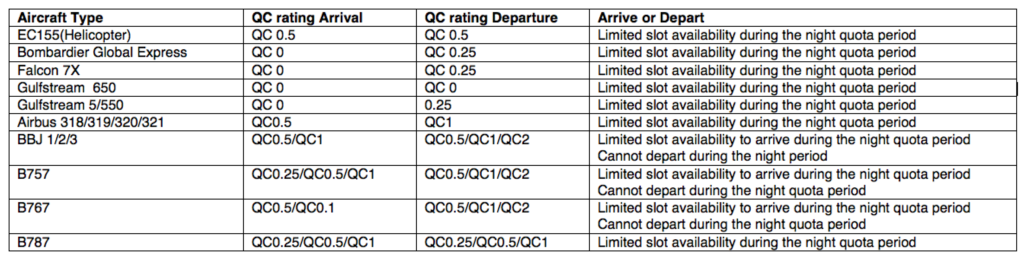
Over at EGSS/Stansted, where local authorities have already reduced the number of night-time slots for GA/BA to just 10 per week, new noise restrictions have also been introduced which mean that aircraft rated above QC1 are unlikely to receive slot approval at all during the night period:

Who’s to blame?

Local airlines, mainly the low-cost ones. Late arrivals have used up much of the cumulative noise footprint at both airports.

So, what’s left?
  • EGMC/Southend (40 miles away) & EGBB/Birmingham (115 miles away) are the only airports with no restrictions (thus far).
  • EGLL/Heathrow & EGGK/Gatwick: Pretty much a no-go zone for business aviation these days
  • EGLC/London City: closed from 1030pm to 0630am
  • EGWU/Northolt: closed from 8pm to 8am on weekdays
  • EGLF/Farnborough: closed from 10pm to 7am on weekdays
  • EGKB/Biggin Hill: closed from 11pm to 6.30am on weekdays, and 10pm to 8am on weekends
Who’s most affected?

Transatlantic crossings that plan to arrive in London late at night (after a morning departure from the US) or late-night London departures. Plan ahead and speak with your FBO so you don’t get stuck in a noisy bind.

Extra Reading: