Three Ways To Escape From New York

Key Points
  • If you’re flying out of the New York area, expect delays. ATC staffing and tech issues, along with heavy traffic, are causing slowdowns.
  • But there are three lesser-known routing options (SERMN, Deep Water, TEC) that can get you airborne faster – if you’re willing to fly lower, carry extra fuel, and meet a few added requirements.

In the middle of last year, the FAA transferred control of Newark’s airspace from New York TRACON (N90) to Philadelphia TRACON’s Area C due to a shortage of staff.

And it hasn’t been smooth sailing. Philly itself is understaffed, and has reported several failures recently with data sent from New York via aging copper lines affecting both radar and communication equipment.

Recent murmurings from OPSGROUP members indicate EDCT delays are rife – even at outlier airports. We’re talking hours here, not minutes.

And in the short term at least, it looks like things will get worse before they get better.

The Memorial Day Weekend set records for US air travel, and the Summer peak is nearly upon us.

A couple of weeks back some clever folk from the NBAA, FAA and the Teterboro Users Group (TUG) got together to talk about the recent disruptions in the Northeast and what to do about it. You can view a replay of their excellent session here.

Some of the juiciest intel was the use of not-so-secret ATC routes to significantly reduce departure delays and get you clear of New York’s airspace post-haste.

In fact, three less conventional route options were discussed to help you escape the Big Apple.

A Quick Word on Fuel

A recurring theme here is ‘operational flexibility.’ None of these options will save you fuel, only time.

To use these routes, you will need to carry more. In some cases enough to operate at low level (less than 10,000’) for up to 100nm. But letting ATC know you are willing and capable of flying them may well see you jump an extremely long queue for conventional routes.

Escape Plan #1: SERMN Routes

When weather gets in the way of things, the FAA has a literal playbook of strategic options to help manage high volumes of traffic. You can find it here.

Within this playbook, is something called SERMN Routes. SERMN stands for SWAP Escape Routes – Metro New York. SWAP stands for severe weather avoidance plan. With me so far?

They comprise a low-level game plan to help ATC manage traffic out of the NY Metro area when the regular routes are not available due to nasty build-ups.

When this happens, ATC has three plays available (depending on the direction you’re headed):

🏈 SERMN North (BUF, ROC, SYR, YYZ etc). Example routing ex KTEB: COATE → LAAYK → STUBN →BENEE → BUF→ KROC. Jets capped at 10,000′ until exiting NY  Center’s airspace.

🏈  SERMN South (DCA, CLT, ATL etc). Example routing ex KTEB: ELVAE → COL → DIXIE → T303 → LEEAH → T315→ TAPPA→ THHMP→ CAVLR6→ KIAD Jets capped at 8,000′.

🏈  SERMN East – (BOS, North Eastern Corridor). Example routing ex KTEB: BREZY → V39 → CMK → V3 → WOONS → KBOS. Jets capped at 9,000.’

Their aim is to get you under weather and away from traffic.
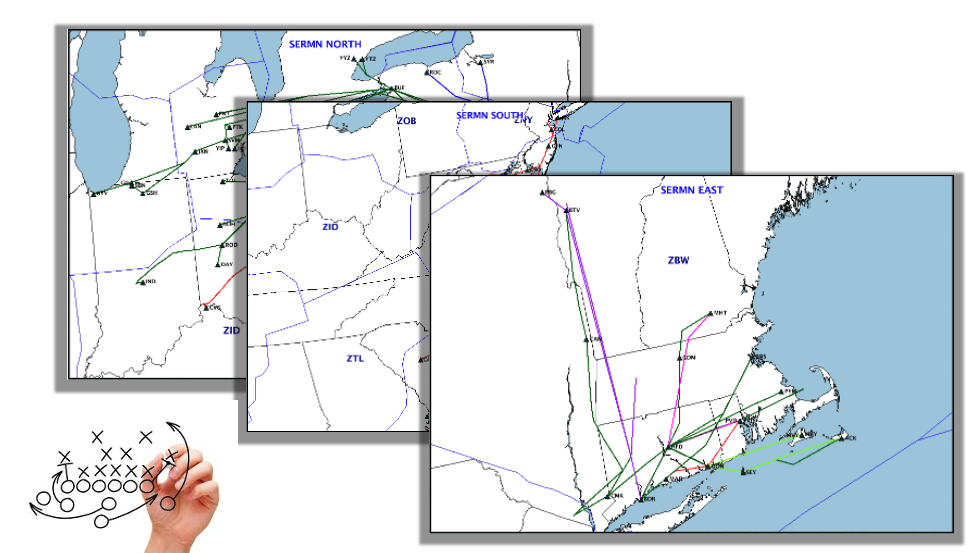
Click for the SERMN routes in the FAA’s National Severe Weather Playbook.

But here’s the kicker (football pun intended). You don’t necessarily need bad weather to fly em.’ If hit with a departure delay, communicate with Clearance Delivery that you’re fuelled and willing to accept a SERMN route. Or any of the other routes below (TEC and Deep Water) for that matter.

If you can get it, it may be good option to beat the crowds.

Hey, what about SERMN West?

It doesn’t actually exist, for a few reasons. Predominantly because western departures from the NY Metro area are heavily managed by other established routes such as J80 and J6.

Westbound traffic is also not as typically constrained by adjacent airspace as those aircraft headed in the other directions – and in any case there are other plays in the play book available for westbound traffic, they just don’t carry the title SERMN.

Escape Plan #2: Deep Water Routes

Another option to consider are Deep Water routes which run north and south off the coast between the Northeast and Florida.

If you have the right gear on board, don’t be afraid to get your feet wet.

The FAA advises they can be useful routes out of the area by getting you out of the way of traffic and restricted airspace along the coast.

But before you dive on in, it’s important you are familiar with the requirements of these routes to fly them.

For instance, in NY Oceanic airspace if you are not RNP 4 or 10 capable you need to let ATC know so that they can apply additional separation. If you do have RNP 4/10, you need to comply with those requirements which includes holding the appropriate Opspec/LOA and having the right equipment on board (such as two independent long range navigation systems).

And don’t forget your survival gear either – which can include lift vests, a raft, survival kits, an ELT and pyrotechnic signalling devices depending on what part of the law you’re operating under. You can find these under FARs 91.509, 135.167 and 121.339.

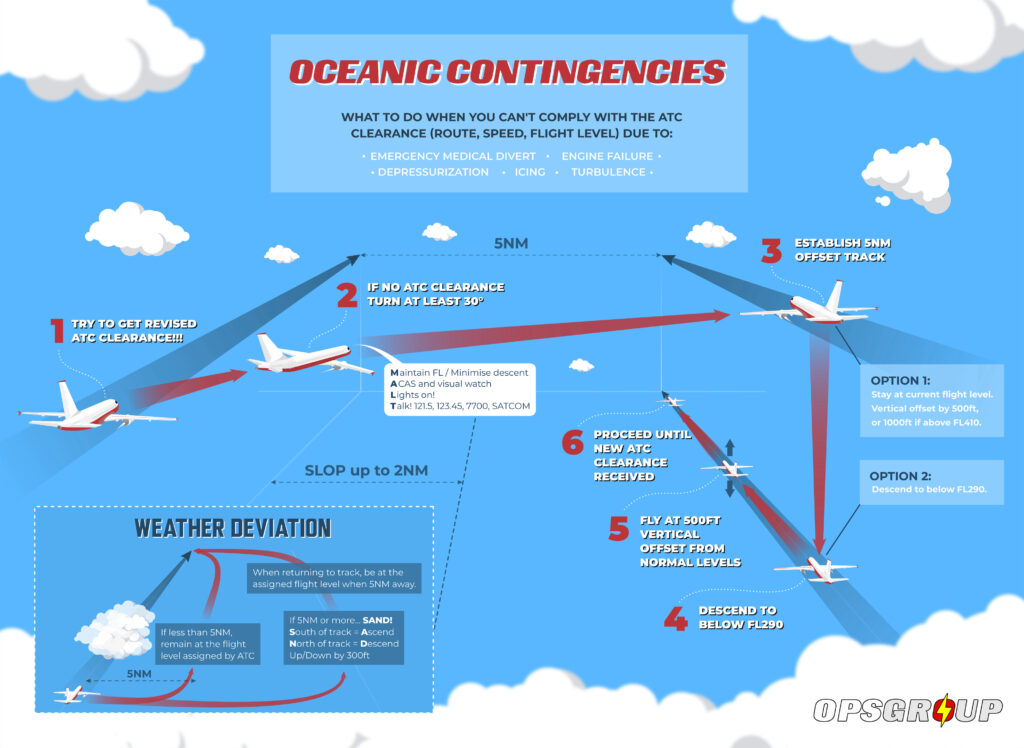
It’s also important you’re thoroughly familiar with the contingency procedures for oceanic airspace including what to do in the event of a navigation failure (especially loss of RNP capability).
Click for PDF.

Escape Plan #3: TEC Routes

If you’re not headed far from New York, consider the use of FAA TEC Routes (Tower Enroute Control).

These are low-altitude IFR routings (typically 5000 –  17,000’) used for short-distance flights (usually less than 500nm) and often link nearby metropolitan centres.
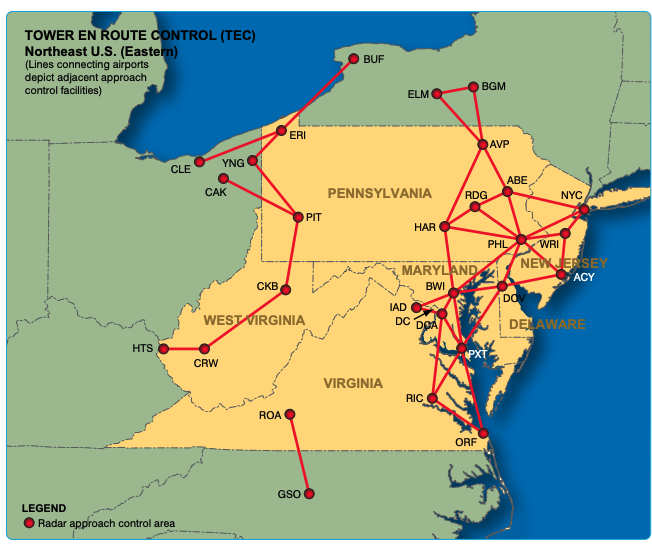
The idea behind them is to keep aircraft within TRACON (Terminal Radar Approach Control) without the need to hand them off to enroute centers. They are by design, simple and efficient.

These routes reduce controller workload, and keep you away from busier airways. They are typically used by turbo-prop aircraft, so let delivery know you have the fuel to fly them as they may not be immediately considered for jets.

You can find the NE TEC routes in the FAA Chart Supplement here.

Finally, stay clued in.

You can avoid delays by predicting when and where they are most likely. The FAA provides a head’s up via three useful sources – fly.faa.gov, nasstatus.faa.gov and X (formerly Twitter). This includes daily briefings on incoming weather, disruptions and the plans in place to mitigate against them.

New York Southbound: FAA Suggested Routes to Spring Break

Spring is upon us, and so is Spring Break. Traffic volumes into Florida and the Caribbean typically surge in the coming weeks.

Up in New York, this is causing a traffic jam over the WHITE departure fix for southbound GA traffic departing KTEB/Teterboro and KHPN/Westchester .

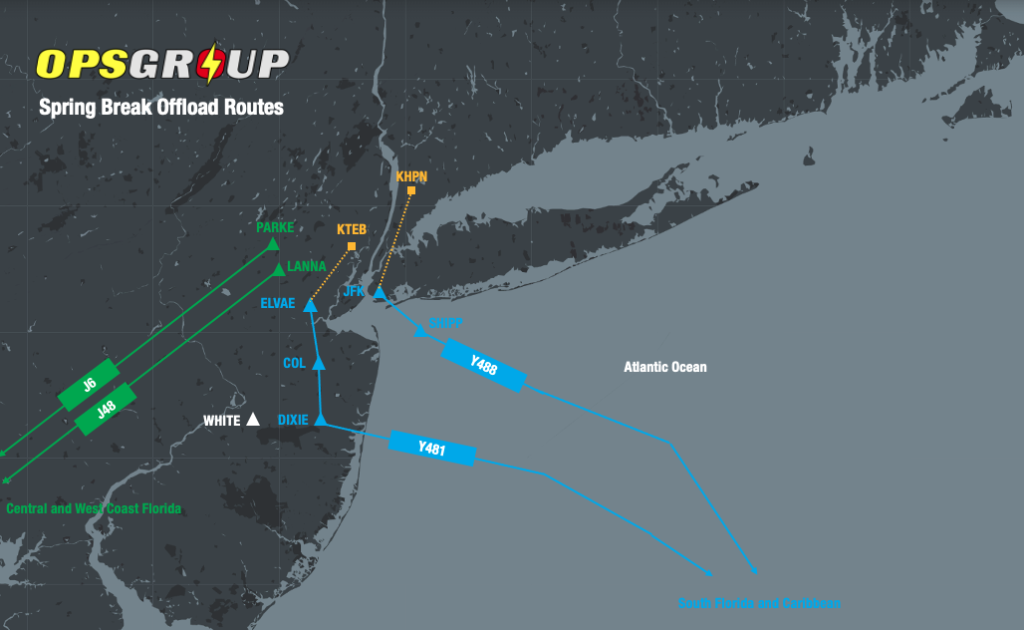
The FAA has issued a request to operators to consider filing via alternative ‘offload’ routes instead during peak times – specifically, Thursday to Saturday.

This will help expedite departures from FBO ramps and reduce mile-in-trail delays over WHITE.

Here’s a quick look at those alternative options.

Departing for West Coast Florida:

File via: PARKE.J6.HVQ or LANNA.J48

Departing for South Florida and the Caribbean (*must be deep water capable):

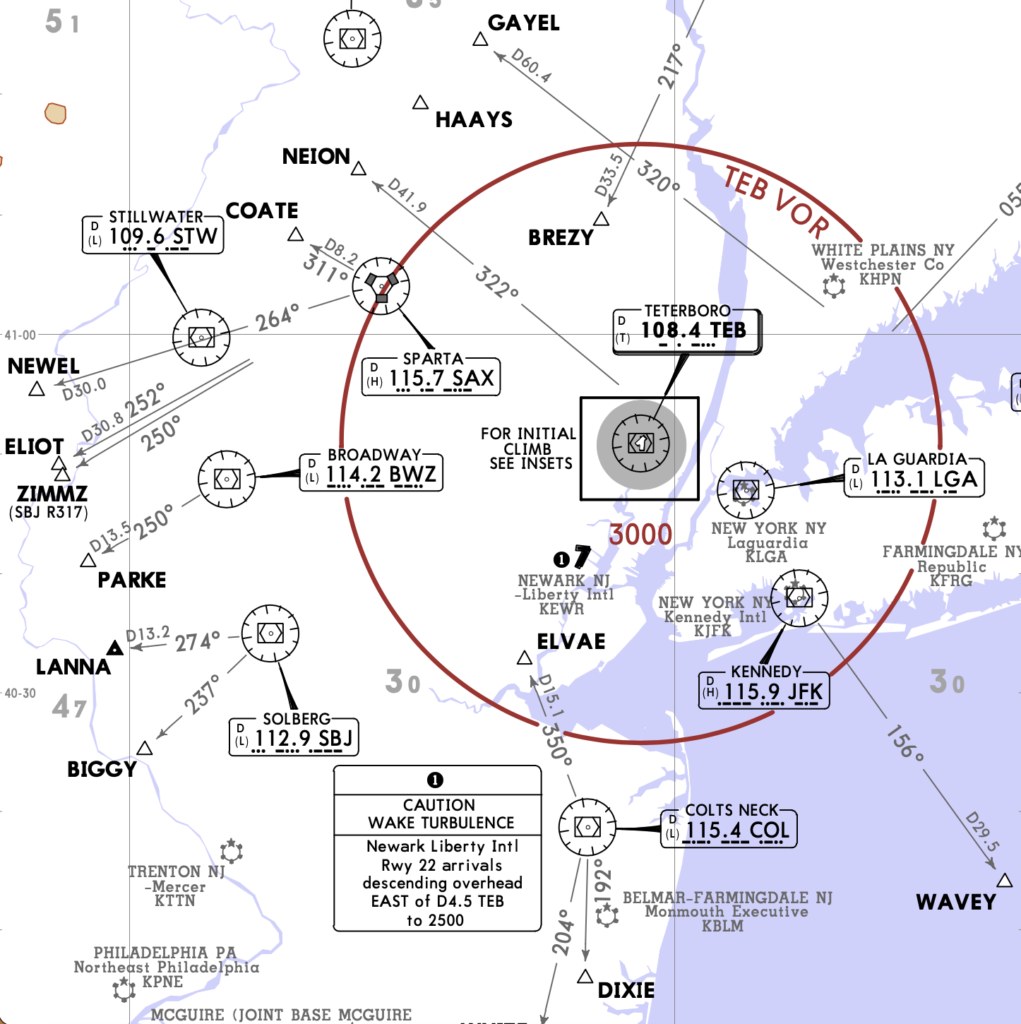
KTEB/Teterboro – File via: ELVAE.COL.DIXIE.Y481

KHPN/Westchester – File via: JFK.SHIPP.Y488

And here’s what that looks like on a map:

One other route to consider.

If departing KHPN/Westchester between 1000 and 2000z for any Florida destination, the FAA also suggests considering filing via HPN.JFK.WAVEY.EMJAY.Q167.ZJAAY.KALDA. We asked the FAA about the timings, and they were advised this is due to peak flow in and out of KJFK/New York.

It’s just an ask.

You can still plan via WHITE if you’d like too, but expect extra delays.

The best place to keep an eye on operational disruptions (including any ground delays) is the FAA NAS Status website, which you can find here.


Teterboro: RIP the RUUDY SIX

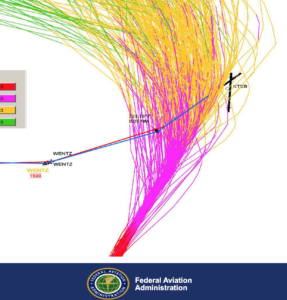
For some time now, the problematic RUUDY 6 SID out of KTEB has been causing trouble. In fact, just prior to the pandemic the FAA reported it had resulted in nearly two hundred pilot violations in just six years.

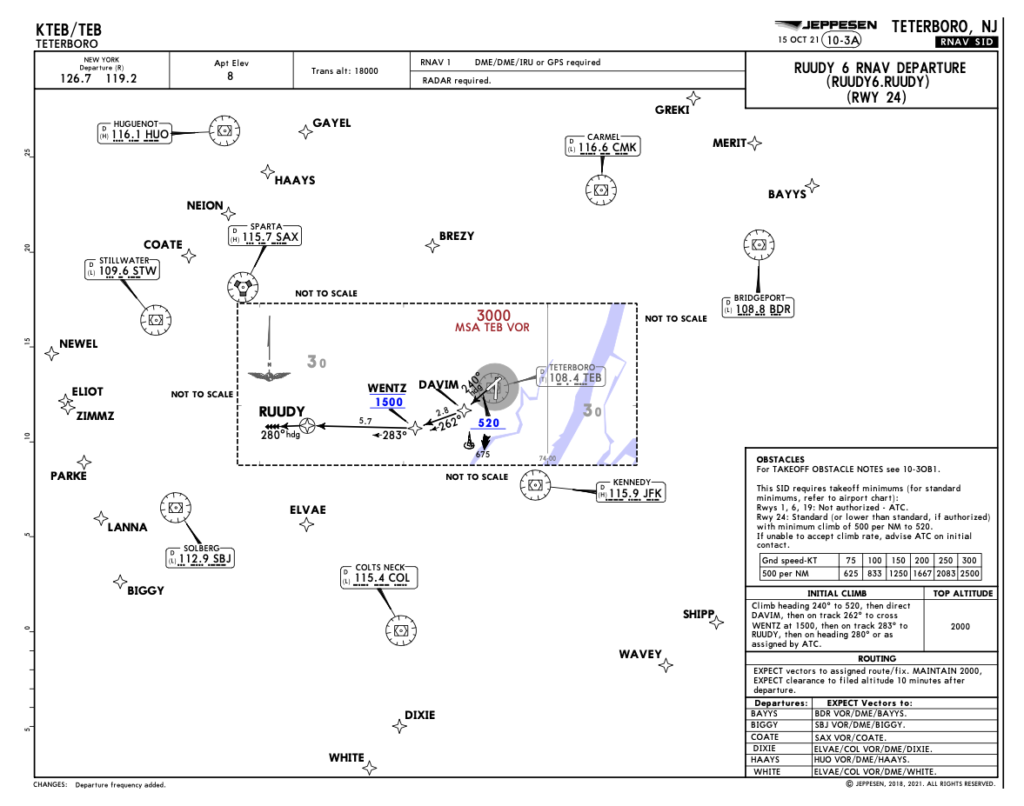
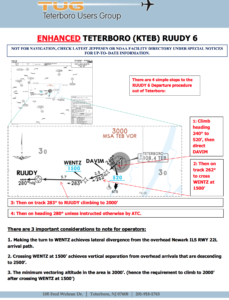
If you’re not familiar with it, it is a departure from Runway 24. Here’s the chart:

The reason for the high number of deviations is cause for debate with both lateral and vertical excursions reported. In the case of the latter, one suggestion is that the procedure itself isn’t that clear. For instance, a typical IFR clearance out of TEB includes the phrase “climb via the SID.”

Take another look at the chart – it requires a level off at 1500’ and an instruction to maintain 2000’.

This can be interpreted in two different ways – either to maintain 1500’ until cleared to 2000’, OR to continue climb to 2000’ passing the waypoint WENTZ.

The Teterboro Users Group (TUG) since clarified the latter is correct, given there are actually three things going on at once:

  • A turn to WENTZ to separate aircraft on Newark’s 22L ILS above.
  • A level restriction at WENTZ to keep aircraft away from aircraft descending to 2500’ above.
  • Achieving the minimum vectoring altitude for the area – hence the subsequent climb to 2000.’

And all of this while managing the energy of high-performance business jets shortly after take-off into some of the busiest airspace in the world. There is little room to get things wrong.

But people were, and quite consistently. And so, work began to develop a clearer SID to replace the troublesome RUUDY.

Welcome Wentz.

On July 11 that finally happened with the publication of the new WENTZ ONE SID – almost.

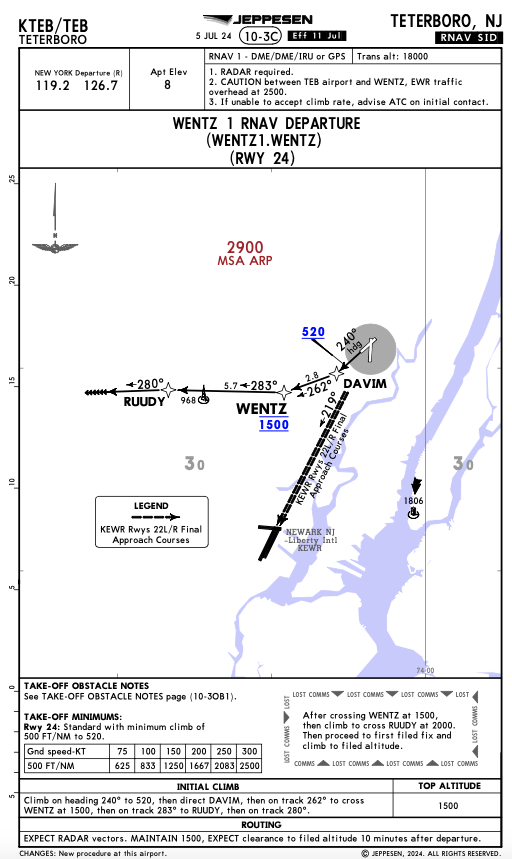
The WENTZ ONE is effectively an improvement to remove the ambiguity. It does away with the step climb to 2000’, instead requiring aircraft using it to maintain the one level – 1500’.

ATC will issue any subsequent climb instruction.

Here’s what the new procedure looks like:

Here’s the kicker though, while the charts have been published, no one is flying it just yet. Why?

TUG explains that this is due to FAA controller training requirements, which are essential. Given the pending relocation of Newark’s airspace from NY TRACON to Philadelphia TRACON it is difficult to predict exactly when this process will be finished.

So, while the plate will appear in your EFB, expect the RUUDY SIX for a short while yet.

What about an instrument approach to Runway 01?

While we have you here – there is another problem pilots need to contend with at TEB.

An instrument approach to Runway 01, or lack thereof.

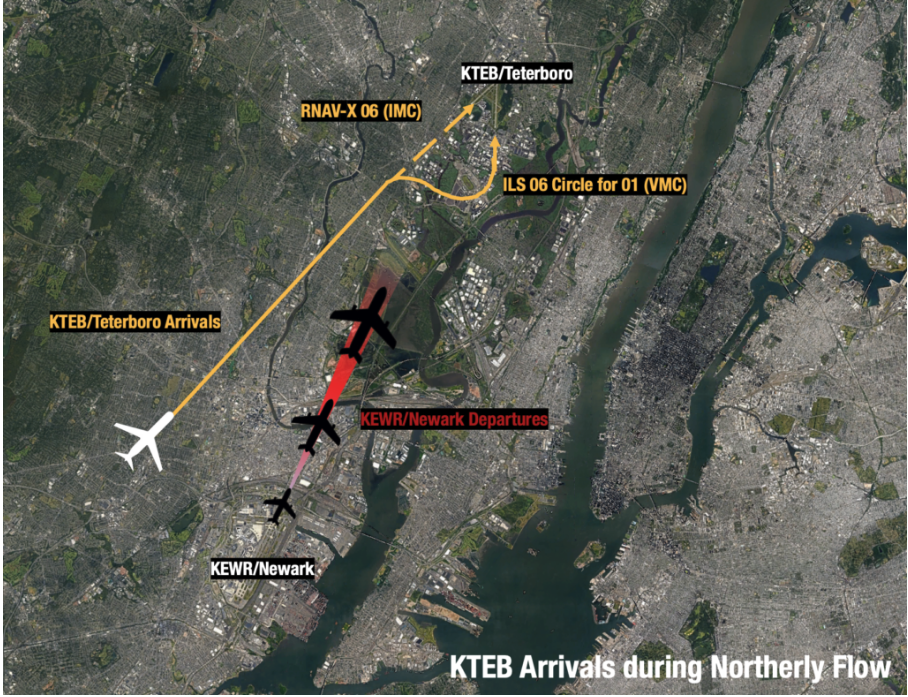
Right now, the common procedure is the ILS 06, circle-to-land 01 to keep you clear of Newark.

This approach is challenging for a number of reasons. If you’re not familiar with those, check out Code 7700’s full briefing here.

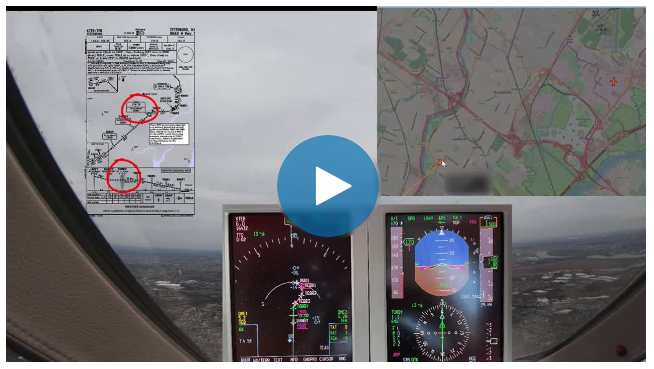
For some time now TUG has been advocating tirelessly for a proper RNAV approach which is long since overdue. There has been some progress for some Honeywell users. Since last year there has been a coded FMS visual approach that replicates the visual to Runway 01, but with lateral guidance and vertical guidance using familiar waypoints DANDY and TORBY. It does this with moderate angles of bank and a gentle 3.5 degree slope alleviating some of the existing threats of the procedure.

You can watch that approach below:

With regards to a publicly available instrument approach to KTEB’s 01, TUG advises we will need to wait a while longer yet. They will have a formal update for us later this year.


New York ATC is grumpy for a reason

This started off as (and still really is) a very specific post just aimed at folk who operate into KTEB/Teterboro – because the runway 06/24 rehab project has begun!

So we copied all the information from the Teterboro User’s Group site and threw it into here. But then we realised the ‘problem’ with KTEB is that it’s very, very close to a lot of other bigger airports…

So if you operate into KEWR/Newark, KLGA/La Guardia or KJFK/New York Kennedy then we reckon it’s worth a read too. Because you might not realise what is going on underneath you and having an idea of the lay of the land (so to speak) is useful for that old SA we all harp on about…

So Teterboro is back in rehab?

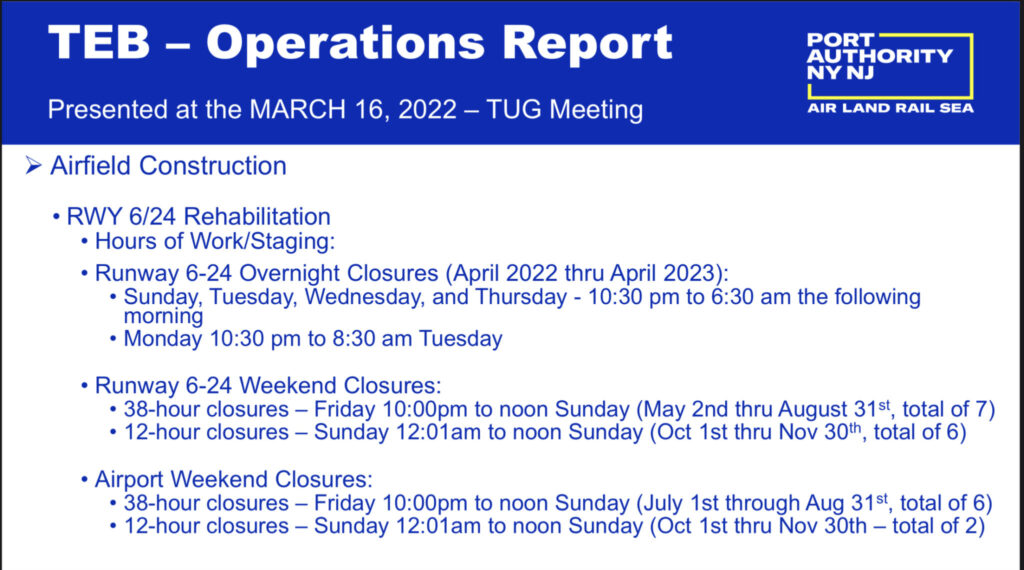
They have a whole 11 months of works (to April 2023) planned for runway 06/24. Mostly it means closures, and these are pretty much all planned over night and on weekends.

Overnight closure timings:

  • Sunday, Tuesday, Wednesday, Thursday 22:30 – 06:30
  • Monday 22:30 – 08:30

Weekend Runway closure times and dates:

  • Friday 22:00 – Sunday 12:00 (until August 31)
  • Sunday 12:01 – Sunday 23:59 (until November 30)

Weekend Airport closure times and dates:

  • Friday 22:00 – Sunday 12:00 (July 1 until August 31)
  • Sunday 12:01 – Sunday 23:59 (October 1 to November 30)

But it is more than just the closures that you need to think about if you operate in here.

Arrival Stuff

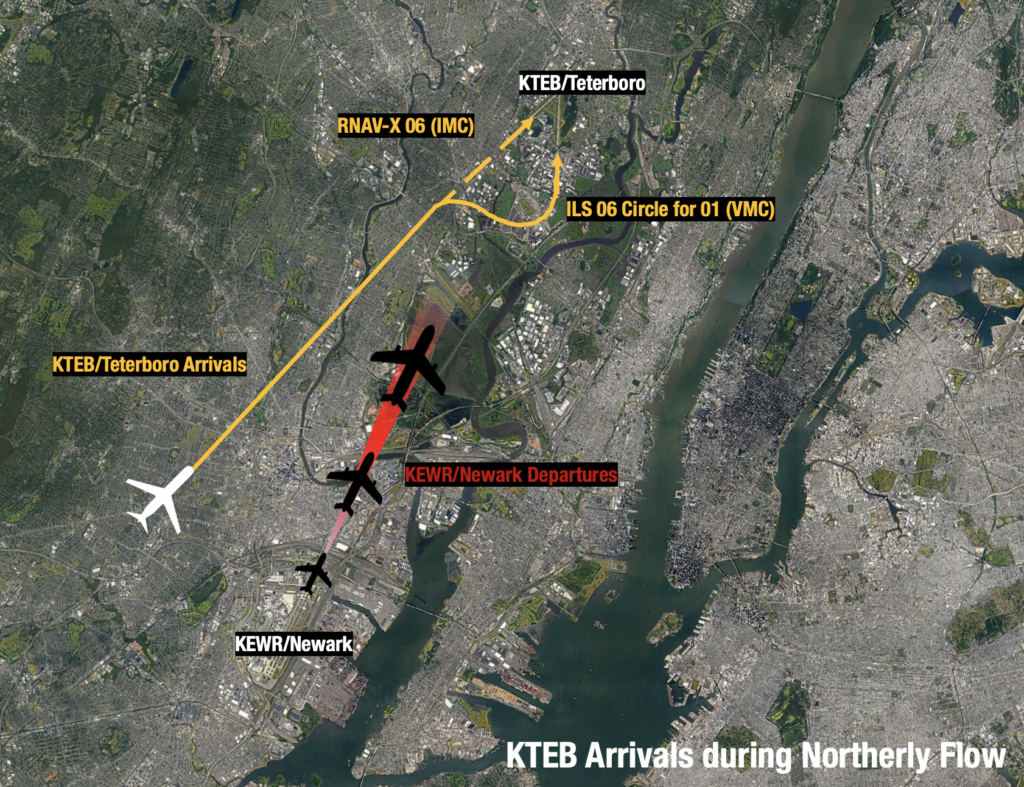
Northerly Flow:

Depending on wind and weather, and what’s happening at KEWR/Newark you can usually expect an ILS 6 with a Circle to Rwy 1 or the RNAV (GPS) X Rwy 6

They are trying to bring in lateral and vertical guidance for Rwy 1. Watch this space. The circle to Rwy 1 is a nasty little thing so check out their guidance on it.

Departure Stuff

Southerly Flow

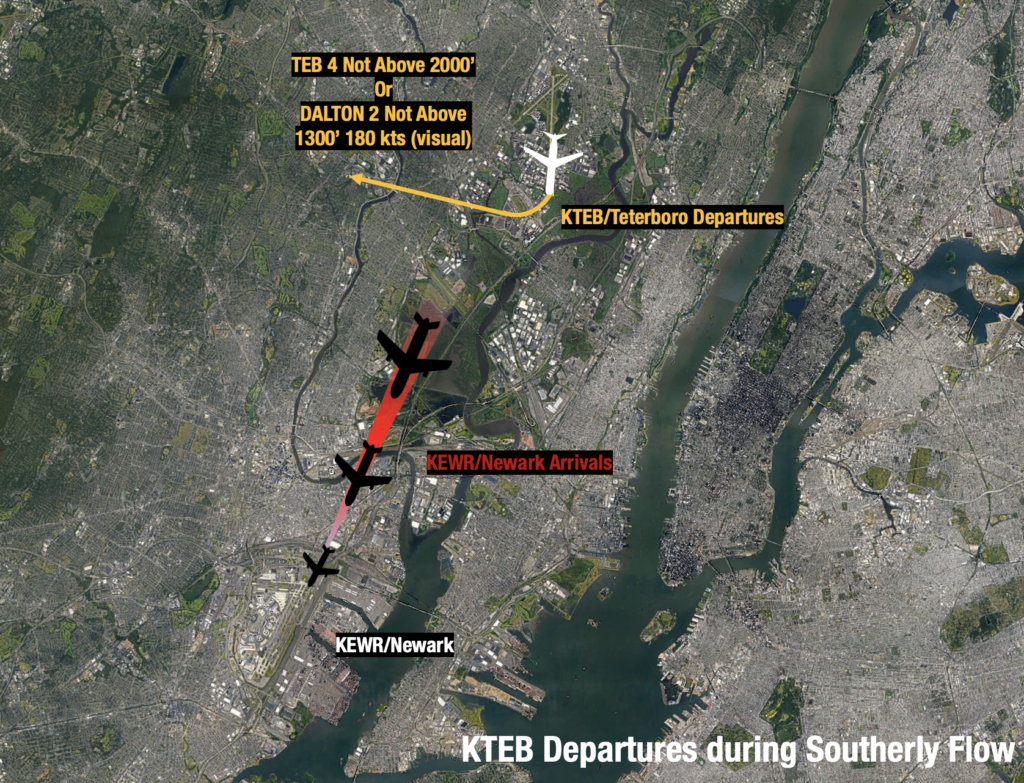
If its a southerly flow you can expect the Teterboro 4 SID which means delays.

Why?

Because they try to keep a 10nm gap between KEWR/Newark 22L arrivals and KTEB 19 departures. Which is why there is also the Dalton 2 visual departure (which only needs a 5nm gap).

Expect an infinite delay…

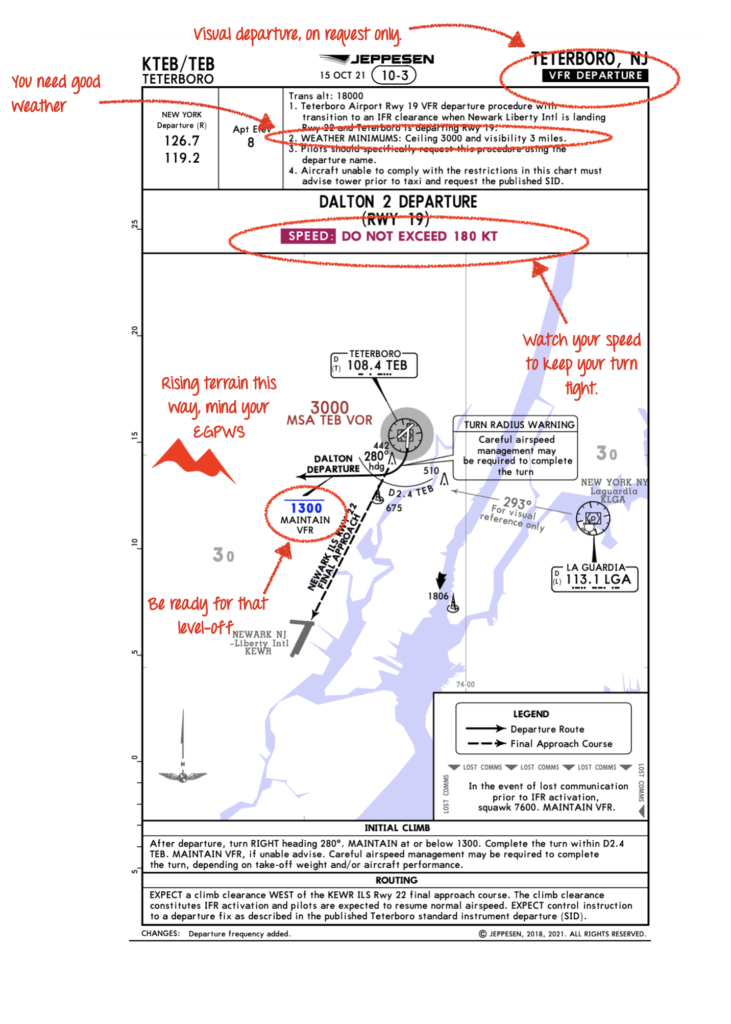
Well, that sounds bad. It doesn’t actually necessarily mean a lengthy delay though, particularly if you can accept the Dalton 2. The Dalton 2 keeps you down at 1,300’ and 180 knots in VFR until clear of all the KEWR traffic then you can expect a transition to an IFR clearance.

There is a meeting!

Yep, there is, on June 15 at 10:00 am EST. Organised through the Teterboro Users Group (TUG) which we strongly recommend you getting yourself in on if you do operate here and aren’t already in on it.

What else is going on down there though?

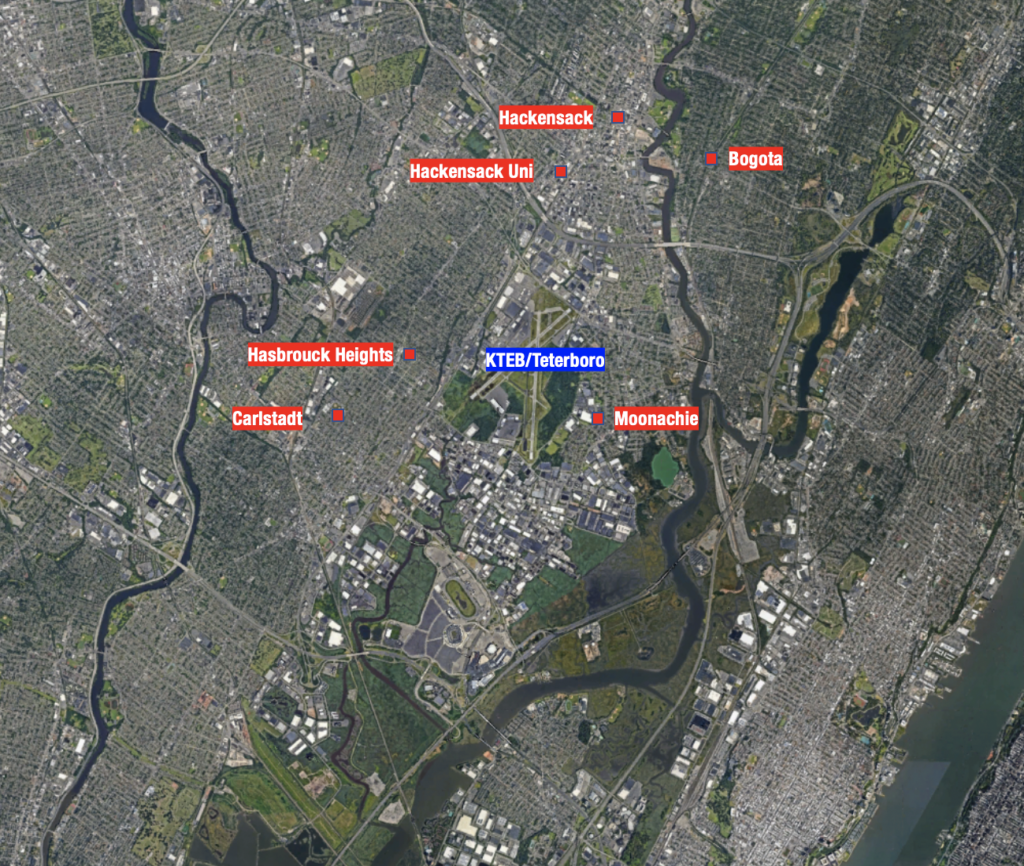
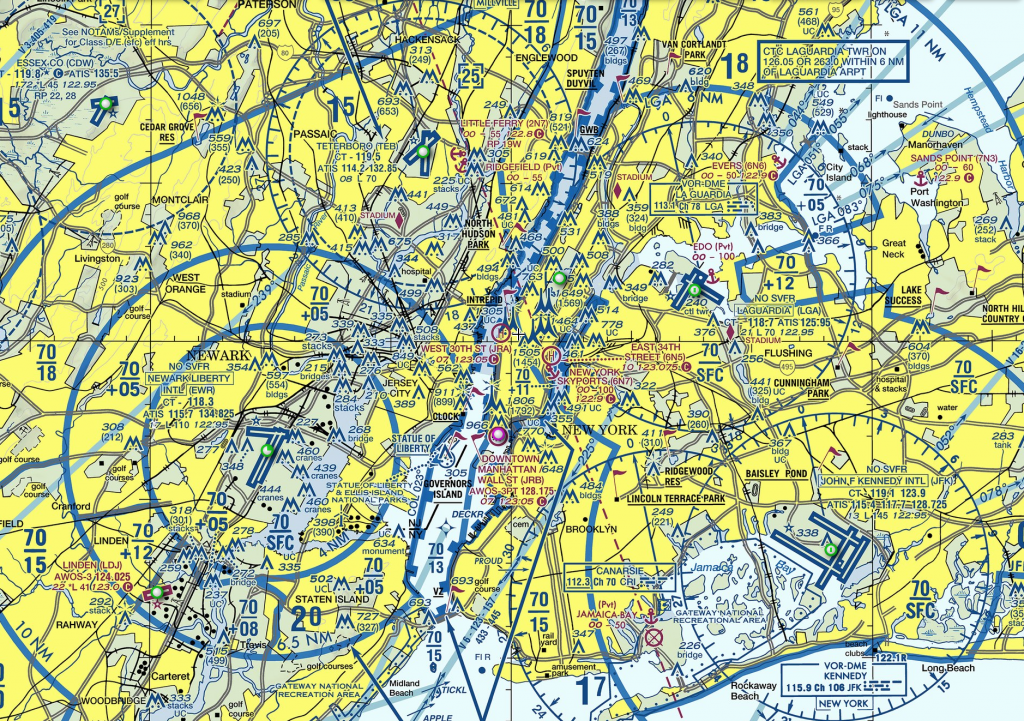
Well, like we mentioned, you’ve got several major international airports to consider as well, and some smaller executive airports and a military base. We counted and found more than 10 just in the immediate proximity to Teterboro.

KJFK, KEWR and KLGA have the dubious titles of ranking first, third, and fourth for worst delays in the nation. They are looking at ways to improve this, but most of them involve building more runways which won’t necessarily help poor old KTEB stuck underneath the every growing traffic flow.

Then there is the weather.

The east coast of the US gets hit with some pretty heavy storms. In April, a single day of bad weather saw over 4500 flights into the east coast delayed and the knock on effect across the busy airspace is considerable.


Testing Times At Teterboro: Closures and Challenges

Aside from being the oldest operating airport in the New York City area, KTEB/Teterboro is far from quiet.

In the good ol’ pre-Covid days of 2019 it saw over 124,000 aircraft movements – that’s 340 every single day. And even last year in the height of the pandemic, it was well on the way back to those levels.

It is also unique for a few reasons. The first is that it is weight limited – if your ride is heavier than 100,000 pounds (45,000kg-ish), then you can’t land there without a waiver. Which means there is no airline traffic, making it exclusively the realm of GA and business aviation operators.

It is also nestled among some of the busiest airspace in the world. The field itself is only 6nm from downtown Manhattan. Which means traffic in and out of there has to compete with the seemingly constant flows of nearby big hitters KLGA/LaGuardia, KJFK/New York, and especially KEWR/Newark.

This tricky combination creates unique operational challenges for controllers and pilots alike. And now things are going to get even more complicated. Here’s why…

A runway is off to rehab.

Or perhaps more accurately, Runway 06/24 is being rehabilitated. Which is a fancy way of saying it needs to be repaired.

 Unfortunately, this is also time consuming. So, a bunch of runway closures have been scheduled at KTEB running all the way into next year at night and on weekends.

During these closures Runway 01/19 will be in use for arrivals and departures which can be hugely disruptive to operations – especially in two scenarios:

Runway 01 Arrivals (Northerly Flow)

When Runway 06 is closed, arriving traffic can expect one of two approaches.

If the weather is good.

 You can expect the ILS approach runway 06, circle to land 01 to keep you clear of Newark. But beware, it can be a challenging approach for a few reasons. Code 7700 has published a fantastic briefing that is almost a compulsory read if you’re unfamiliar with ops there.

Some other common sense prevails too – make sure the approach is carefully briefed beforehand. It’s tight, and easy to get unstable so crew co-ordination is going to be important to keep the old SA up.

If the weather is not so good.

You can expect an RNAV-X approach onto Runway 06 – runway closures are weather dependent. The Port Authority of New York and New Jersey have confirmed they will open it back up.

When are we going to see an instrument approach for Runway 01?

 Good question, the problem is that Newark gets in the way again. The Teterboro User’s Group are hard at work with the FAA to come up with one, but the process is by nature slow. Within months is the goal, but not quite soon enough to help during these works.

Runway 19 Departures (Southerly Flow)

This is when you can expect big delays, as Runway 19 points straight at Newark.

Expect the Teterboro 4 Departure by default. But a head’s up – for every single aircraft that launches out of Teterboro on this SID, NY TRACON needs to find a 10nm gap in arrivals at Newark. And that means a lot of waiting. There may be a better option…

Consider the Dalton.

The what? The Dalton Two Departure. It’s unique because it allows aircraft to depart Teterboro visually, before transitioning to your IFR flight plan – and it’s by pilot request only when the weather is better than 3000 – 3.

The Teterboro User’s Group worked with the FAA to get this one off the ground (no pun intended). It is essentially a right-hand turn after departure onto a westerly heading, at or below 1300 feet. You’ll need to keep your speed back too.

The spacing required is effectively halved. Don’t be put off by the phrase expect indefinite delays either. It’s ATC’s way of telling you they don’t know how long it’ll be. But local operators confirm delays are never worse than the standard TEB 4, and more often than not, better.

But before you light the fires, there are a couple of gotchas. It’s going to get busy – the low level-off happens quickly in high performance jets, especially at light weights. So be ready for it. Also, the westerly heading points you (visually) towards rising terrain and there have been reports of EGPWS warnings as a result.

Teterboro isn’t the only option.

If you don’t have the appetite for all of this and are looking for more straight forward options, here are a couple to consider:

KHPN/White Plains It’s 25nm from Manhattan – about a 40-minute drive in normal traffic. It has two runways, the longest being 6549’ (1996m) long.

KMMU/Morristown About the same distance away with a slightly longer 50-minute drive. It also has two runways with the lengthiest option of 5,998’ (1,828m).

Local operators in New York have told us that even though the drive is a little longer, the overall travel time is often less when you avoid delays in and out of KTEB.

Look out for full airport closures too.

There are also eight complete airport closures scheduled for KTEB coming up, some lasting up to 38 hours: 

July 1 – August 31: Six closures are planned on weekends, from Friday 10pm until Sunday 12pm (local time).

October 1 – November 3: Two closures are planned from Sunday 12:01am – 12pm (local time).

 The exact dates will be confirmed by Notam.

Need more support?

Reach out to the friendly folk at TUG (the Teterboro User’s Group). They’re experts on ops at KTEB, they post weekly construction bulletins on their website and are more than happy to help operators out with advice. Also a special thank you to David Belastock – the President of TUG. This write up would not have been possible without his experience and generous support of OPSGROUP.

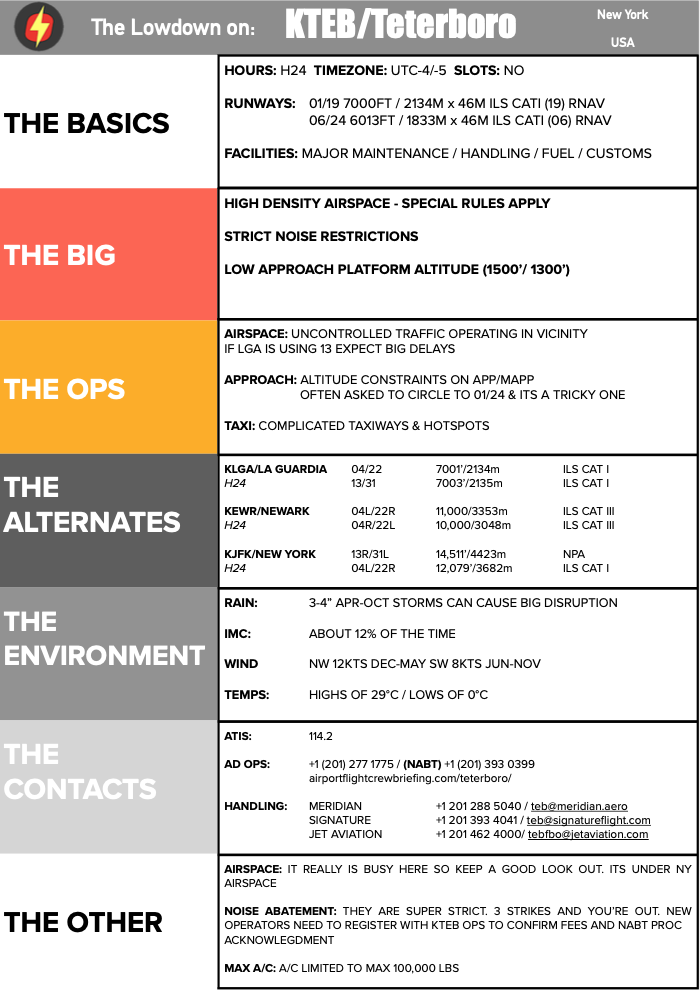
We made an Airport Lowdown for KTEB a while back, which you can see here. We had help (since we’ve never flown in there), but if you spot anything to add or change then let us know.

Or you can talk to the OPSGROUP team directly on team@ops.group. We’d love to hear from you.


Changes at Teterboro: What you might have missed

The skies over New York have been quieter over the past year or so, and it’s not hard to guess why. With lower traffic levels, there have been a number of operational changes at nearby KTEB/Teterboro. Here’s a rundown of what you might have missed recently…

Noise is a bigger issue than ever

It may seem ironic, but Covid hasn’t helped. With less airplanes in the skies, nearby residents have become more aware of Teterboro’s noise, and complaints have been on the rise.

If you’re headed to KTEB, be aware that there are extensive noise abatement procedures. There’s a handy summary of these available online, but here are some of the biggest gotchas to get you started.

If your ride is a jet and you’re new to KTEB, you’ll need permission first. There’s a form to fill out for that.

The most noise sensitive time is between 22:00 and 06:00LT, and it’s when you’re the most likely to get yourself into trouble. There’s a ‘voluntarily restraint’ in place after 23:00  – in other words if your flight isn’t essential, it should wait.

Sprinkled through the surrounding suburbs are noise monitoring devices, and there are strict decibel limits. The most restrictive is Runway 24 at night (only 80dB). Bust em’, and you can be served a violation – too many of those and you can say sayonara to operating there. And they take two years to expire.

The least noise sensitive area is to the south of the airport. So if departing on the back of the clock and the weather is playing ball, try to use Runway 19 for departures and Runway 01 for arrivals.

Speaking of noise, the new RNAV X RWY 19

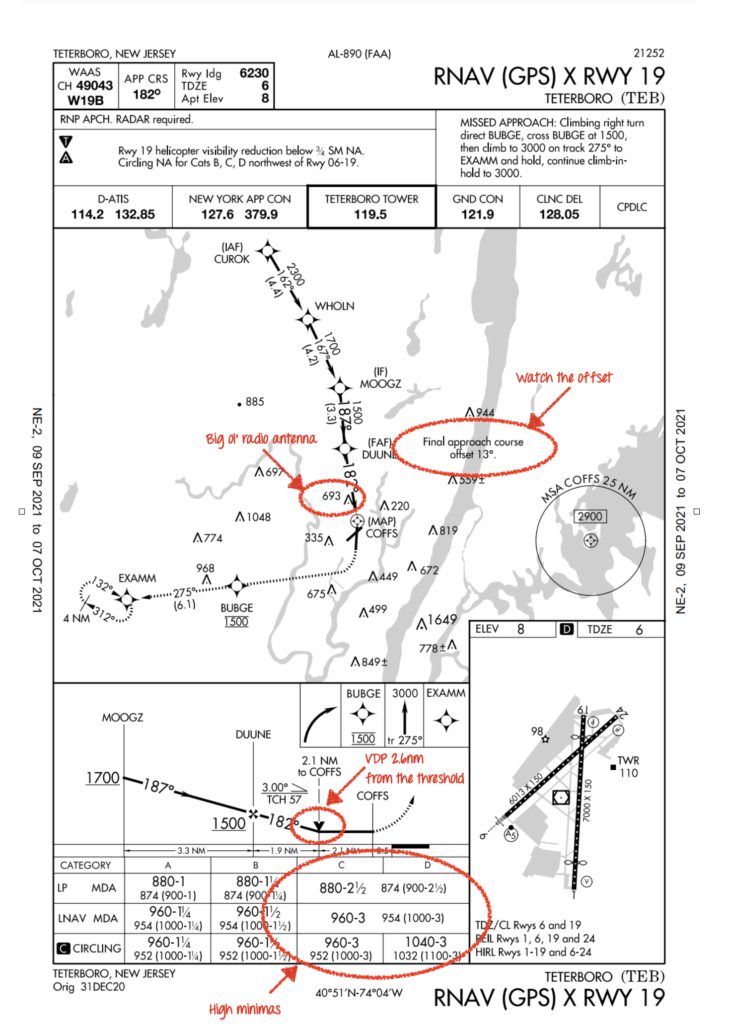
Back in July, an offset RNAV noise sensitive approach was introduced for Runway 19. It’s a quieter alternative to the straight-in ILS. It’s recommended for night ops at KTEB on request (and you may hear it mentioned on the ATIS). But there’s some important stuff you should know before you go ahead and shoot it.

If conditions are less than ‘tropical’, keep in mind the approach is significantly offset (13 degrees) and minimas are high. The visual descent point is almost three miles from the threshold. There’s also a big unfriendly radio antenna at the business end of the approach. At the VDP on the correct 3 degree path, you’ll be uncomfortably close to it – check out this article for just how close.

What’s the moral of the story? In marginal conditions, the approach can quickly become challenging – consider the ILS if in doubt.

Escape Routes

Tired of waiting at the hold? We don’t blame you!

There are new departure routes to help business jet operators get airborne out of KTEB when the weather is bad, or New York’s majors airports are especially busy. New York TRACON is responsible for co-ordinating those with the tower.

A head’s up though – they are designed with the performance of business jets in mind and may require steeper climb profiles than you’re used to.

You need to fly them from start to finish too. Don’t accept the clearance unless you are sure you can meet the requirements, and asking for track shortening after wheels up is a no-no.

Works

Construction and runway maintenance are ongoing. Single runway closures are common and can happen during the day. The good news is that full closures are pretty rare.

Something to look out for – if Runway 06/24 is closed in southerly conditions, extended delays are common at KTEB due to the flow at nearby KEWR/Newark, just 10nm to the South. You might need to carry some extra gas.

The Teterboro Users Group publish weekly Maintenance Bulletins for Runway and Taxiway closures which you can access here. Of course, if you prefer your info capitalised and abbreviated, you’ll find the information in  Notams too.

Covid

We’re all well over it. But there are some procedures to follow, especially if operating an international flight into KTEB.

US Customs and Border Protection are up and running at the airport, but will only accept international arrivals between 07:15 and 23:15 local. Don’t show up after hours. Standard CDC rules apply here including the pre-travel testing requirement for all pax.

For a full break down of these and other health protocols, you can view a full rundown here.

Have we missed something?

We’d love to hear from you! You can reach us at blog.team@ops.group.

Also check out our recent Airport Lowdown for KTEB/Teterboro – it’s the biggest threats all in one place, built by pilots who have been there.


Escape From New York: How To Get In & Out of Teterboro (2019)

There’s nothing that will drain a smartphone battery quicker than a ground delay in Teterboro. Preflight complete, flight plan loaded, passengers onboard (they were actually on time for a change), engines started and – wait for it – you are instructed to contact “ground metering.” The word itself can make the stomach drop.

Yes, a line of thunderstorms is moving in, but it’s not quite solid. Most of my route does not look affected, but far better minds than mine have determined that diverting traffic require them to close my entry gate, as well as most of the surrounding ones. I receive an Expect Departure Clearance Time (EDCT) of over three and a half hours away!

Normally I make it as far as taxiing just short of TEB’s RWY 24 before the controllers present me with such a lovely ground delay and instruct me to park in the “penalty box.” This time I hadn’t even left the chocks (I wasn’t even actually supposed to start the engines before contacting “metering”, but of course I didn’t admit that mistake to the controller).
Ground delays due to weather or traffic saturation are not uncommon in Teterboro. We have to hand it to the Teterboro ATC staff for efficiently controlling one of the busiest GA airports in the world (about 174,000 arrivals a year). They not only deal with all the complications that come with being located under some of the most congested airspace in the world, they patiently work everyday with a bunch of A-list pilot personalities that think their schedules are more important than any delays. Well done, you ninjas of New Jersey!

Weather, traffic and pilots aren’t the only issues they’ve been dealing with lately. Improvement projects have been steadily grinding along for the past year and a half. And guess what? There’s even more to come!

So, after I inform my passengers of this delay, allow me to hop back up in the cockpit and let’s discuss some Teterboro info with the help from our good friend Dave Belastock, President of the Teterboro User Group. Perhaps you heard him speak on the latest OpsChat, but, if not, we’re going to dive in a little deeper.Oh, by the way, don’t be offended while I analyze my fantasy football scores on my phone; I’m a multi-tasker, and we’ve got three and half hours – well three now – to go and I’ve got 85% battery life on my phone left.
 

EDCT: T minus 3:00, battery 85%

The Entry

Getting into Teterboro can often be a frustrating game. When calling for a clearance at your departure airport, wagers can be made that an EDCT will be issued. Gone are the days in which operators would file a nearby airport (KMMU/Morristown, KHPN/White Plains, etc.) and change the destination to TEB enroute to avoid such ground delays. I’ve never tried it, but I did witness a former chief pilot broach the subject with clearance delivery at a Midwestern airport about attempting this. “If you to try that stunt, I’ll route you through Florida,” was the controller’s response.

But getting the heads-up on delays may depend upon early filing. The FAA’s Traffic Management Unit coordinates the flow programs into airports experiencing delays. According to one TMU official, “Get your flight plan filed prior to program implementation (at least a day in advance) and try not to change that proposal time. The command center ‘optimizer’ computer will issue releases/slots based on those times. And your flight plan won’t drop out of the system until 2 hours after your EDCT.”

I’ve had service providers tell me that the earlier you file, the higher up you are on the departure list. I never knew if this was true or not, but it may look like it certainly has a partial effect.


EDCT: T minus 2 hrs 30 mins, battery 67%.

Upon arrival into Teterboro, you will watch your TCAS light up like a Galactica arcade game, especially on a clear day. Glider activity near the MUGZY waypoint on the LVZ STAR to the northwest and GA traffic from multiple small airports flock below you. And the question usually comes up once you are beneath Newark’s Class B airspace: “What speed should we be going?”

The answer is of course 200 knots. But more than once I have been angrily asked by a controller what my speed was and, after answering 200 knots, speed reductions were quickly mandated to traffic following behind me. Thus, there was a perception that NY Tracon needed you to keep your speed up into TEB. But no controller may authorize an aircraft to exceed 200kts under Class B. If it makes you feel better to report your speed reduction, be my guest. But the answer is 200kts.

Those familiar with TEB approaches understand that you must certainly be on your game and brief your approach. The ILS RWY 6, including the circle to land RWY 1, has a mandatory altitude of 1500 feet at DANDY that pilots are still not making before intercepting the glide slope. The circle procedure can be tricky, especially with a tall antennae to the south of the airport. And if winds are gusty from the northwest expect turbulence from the distant hills. In 2017, a Learjet became unstable during this approach, stalled and crashed as the crew were unprepared for the approach. Early briefing and proficient monitoring will ensure a safe and simple approach.


EDCT: T minus 2 hrs, battery 50%.

Belastock mentions that a new RNAV GPS RWY 19 with LPV mins is expected to be published in December. Some aircraft flying a coupled ILS RWY 19 with the localizer captured at 2000 feet have experienced an uncommanded climb due to a false glide slide capture. This glide slope perturbation is triggered by aircraft moving on taxiway Q across RWY 19 and passing in front of the glide slope antennae, which briefly deflects the signal downward enough to satisfy capture parameters. Once the taxiing aircraft has cleared the glide slope critical area, the beam returns to its proper angle. If you have Approach mode armed, the autopilot may grab the temporarily deflected glide slope and then pitch up when the signal returns to normal. Close monitoring and quick action are required to prevent an altitude deviation. The GPS approach would circumnavigate this potential issue.

And speaking of that turn between UNVIL and TUGGZ to intercept the final approach course, you could very well see VFR aircraft just below you. You are outside Class D airspace at that point so separation requirements aren’t necessary. While other NY area airports have communication requirements for VFR traffic transitioning near congested airspace, TEB has none. TUG is currently working with the FAA to create a Class D transition area to the north to require communication. Fingers crossed.


EDCT: T minus 1hr 30 mins, battery 42%.

The Escape

RWY 6-24 is going to see substantial improvement in 2020. Currently, the plan is to close the runway several evenings through the summer, starting the day after Memorial Day through Labor Day. “Port Authority of NY and NJ staff have worked diligently to create a schedule that would least affect operators,” explained Belastock. “We are anticipating RWY 6-24 to close from 10pm Saturday nights until noon on Sundays. And then there will be two 24-hour closures beginning at 10pm Friday through Saturday night at dates to be determined.”

This will inevitably switch up the normal departure procedures. Whereas the RUUDY RNAV departure (we’ll discuss good ol’ RUUDY in a second) is the traditional departure, the alternative will be the DALTON 2 departure.

“Do you ever wonder why you have to hold short of RWY 24 for an extended period of time waiting for an IFR release?” asks Belastock. “That’s because NY Tracon requires a 10nm separation between you and the overflying Newark traffic.” The Dalton departure, however, is a VFR-IFR departure.

VFR? Really?

Yep, just as the instrument departure plate reads, aircraft depart VFR – 3 sm visibility and 3000’ ceilings are required – and when handed over to the departure controller, the IFR flight plan is activated. Theoretically there is no gap required between the VFR Teterboro departures and IFR Newark arrivals. But consideration was taken between all stakeholders, and a 5nm gap between TEB and EWR traffic was agreed upon. “TEB clearance can’t solicit the departure. You must request it and have a published departure plate available in the cockpit,” said Belastock.

Though this could mean a reduction in release time, if there is a delay in progress controllers can only offer an “indefinite delay” for traffic or weather issues, whereas they can give you a set time if using the other IFR departures. “Actually, NY Tracon is encouraging it. They want pilots and controllers comfortable with it,” said Belastock.

As for the RUUDY RNAV departure, good news! Pilot deviations are decreasing. Belastock and TUG worked closely with training facilities as well as OPSGROUP to get the word out. I even noticed the RUDDY departure was included in my latest recurrent simulator training. With the altitude restriction and noise abatement restrictions pilots need to be extremely situationally aware. “We don’t want to tell pilots how to fly their aircraft,” said Belastock. “But we need them to be fully aware of how the departure operates.”


EDCT: T minus 1:15, battery 37%.

The Window of Opportunity

My eyes are burning a bit from so much screen time on my phone. I query Gate Hold again – just like the other 73 pilots that are trying to chime in. Yep, that’s me you’re rolling your eyes at.  My EDCT time is actually extended further even though the weather is past my entry gate. “Is there anything we can do to get out of here,” I reply with a frustration.

“Can you fly a final altitude of 14,000 feet?”

Confusion mixes with a sense of impending opportunity. “Standby,” I answer. I always take extra fuel out of TEB, but I’m sure there cannot be enough to fly that low. I run the numbers…and, I’ll be damned, we can make the destination with a safe fuel reserve.

“Actually, yes we can,” I reply excitedly. “Start your engines and contact ground control,” comes the reply. As I taxi past all the other waiting aircraft, I couldn’t help but feel a sense of guilt…and some pleasure as well.

We departed on the RUUDY departure, flew west while climbing to 14,000 feet talking to NY Center and several approach controllers. When we were handed off to Cleveland Center, we requested a more appropriate cruising altitude and given it without question.

I later called TEB tower to see how this “gift” actually occurred. “It doesn’t happen often. But since your entry gate and route were getting so saturated with diverting traffic, you couldn’t fly it at your filed altitude. But this wasn’t the case for the lower altitudes,” explained the controller. “I can’t offer it unless you specifically ask. But even then it probably won’t be granted.”

I’ve been flying in and out of TEB for 15 years, and I’m still often learning new details about its operation. Perhaps I’ll keep this tool in my back pocket for the next great escape.


Escape from Teterboro .. FL400 or above

Skip the line up at Teterboro! The FAA has launched an initiative to allow some high-performance business aviation aircraft an escape route during SWAP events to mitigate delays at KTEB and KHPN. The goal is to offer flights that are filed to cruise at FL400 and above an exclusive route that would get them above the airline traffic. This route may add a few extra miles but will minimize ground delays.

As the FAA is required to test the route for ATC automation and familiarity, they are seeking pilots willing to participate in this test as early as this weekend, preferably in the morning, before traffic demand peaks. Aircraft participating in the test would be routed over GREKI and then on to westerly or southwesterly destinations.

If you’re willing to participate in the test this weekend, please at your earliest opportunity contact FAA Deputy Director System Operations, East-North Warren Strickland: warren.strickland@faa.gov

If you’re unable to participate in this weekend’s test, please advise Warren of other dates that may work for you.


Why are you still getting the Ruudy6 wrong? Stop at 1500!

If you’re departing Teterboro any time soon, make sure you stop at 1500 feet – and have a good look at the rest of the RUUDY 6 departure. That’s the message from NY ATC, and the Teterboro Users Group.

The FAA has reported over 112 pilot deviations on the KTEB/Teterboro RUUDY 6  SID.

The Teterboro Users Group has asked us to remind all pilots that strict compliance is required, especially vertically.

“The most common error being a climb straight to 2000’ without honouring the requirement to cross WENTZ at 1500” – Capt. David Belastock, President, TUG

This week the FAA issued the following notice which explain the issue and the serious consequences of non-compliance, namely the reduced vertical separation with KEWR/Newark arrivals:

Teterboro Airport SID Deviations

Notice Number: NOTC7799

The Ruudy Six departure continues to incur both lateral, but in particular, vertical pilot deviations. Due to the proximity of Newark and other area airports it is imperative to follow the RNAV(RNP1) departure procedure to Performance Based Navigation (PBN) standards. Do not drift left off course to avoid noise monitors. Do not climb above 1500 until passing Wentz intersection. There is only 1000 feet of separation with overhead traffic at Wentz. When issued the clearance to “climb via the SID” all altitude restrictions must be complied with as depicted on the chart.

Attached are excerpts from the Aeronautical Information Manual and the Controllers handbook explaining the Climb Via procedure. An expanded explanation is in chapter 4 and 5 of the AIM.

Further information can be found on the Teterboro Users Group website http://teterborousersgroup.org and in KTEB Notice to Airmen (Letters to Airmen section)

There has been an extensive education campaign underway for a long period including guidance material, pilot meetings, educational podcasts and even a FlightSafety International eLearning course. Despite these efforts, pilot deviations continue to occur.

A great guide has been created by Captain Belastock and its very useful for any crews operating out of KTEB.

Know of any other procedures with unusually high non-compliance?

Let us know!