Greenland closes its airports to (nearly) all passenger flights
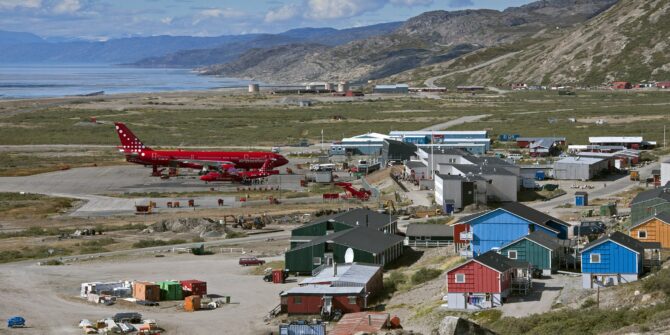
Greenland have closed (nearly) ALL their airports to international passenger flights.

Well, apart from ones that come from Denmark. But don’t go thinking you can make a quick stop off there first, they’ve even specified those are not allowed.

There is a provision for you to get special permission if you are transporting someone particularly important to the Greenland economy, but beyond that, no pax.

Here is the NOTAM:

BGGL SONDRESTROM FIR/FIC
A0621/20 – COVID-19: FLIGHT RESTRICTIONS.
ALL CIVIL FLIGHTS FROM OUTSIDE BGGL FIR, ARE BANNED FROM LANDING AT AERODROMES WITHIN BGGL FIR. FOLLOWING EXEMPTIONS APPLY:

1. FLIGHTS FROM AERODROMES IN DENMARK

1A. FLIGHTS ORIGINATING IN OTHER COUNTRIES THAN DENMARK, WITH INTERMEDIATE STOP IN DENMARK BEFORE CONTINUING TO GREENLAND, ARE NOT EXEMPTED FROM THE BAN.

2. FLIGHTS TO BGTL. SPECIAL PERMISSION MAY BE OBTAINED FROM THE DANISH TRANSPORT-, HOUSING- AND CONSTRUCTION AUTHORITY FOR THE PURPOSE OF TRANSPORT OF PERSONS WITH PARTICULAR IMPORTANCE TO THE ECONOMY OF SOCIETY. FURTHER INFORMATION ABOUT RESTRICTIONS AND PROCEDURE FOR THE APPLICATION FOR SPECIAL PERMISSION CAN BE OBTAINED VIA THE FOLLOWING LINK: HTTPS://TBST.DK/EN/CIVIL-AVIATION. THE FLIGHT RESTRICTIONS DO NOT IMPACT THE USE OF AERODROMES AS ETOPS ALTERNATE OR FOR EMERGENCIES.

Still confused? Fear not, the government have now published a full clarification of the rules here – in plain language (which we like very much).

Can I do a tech stop?

Yes! Ferry flights and tech stops (gas and go) can continue – but you’ll need to remain onboard.

Overnight tech stops are not allowed without special permission.

Can I pick up passengers in Greenland?

Yes! You are allowed to ferry an empty aircraft to collect passengers. You just can’t bring them in.

What about ETOPS? Polar Alternates?

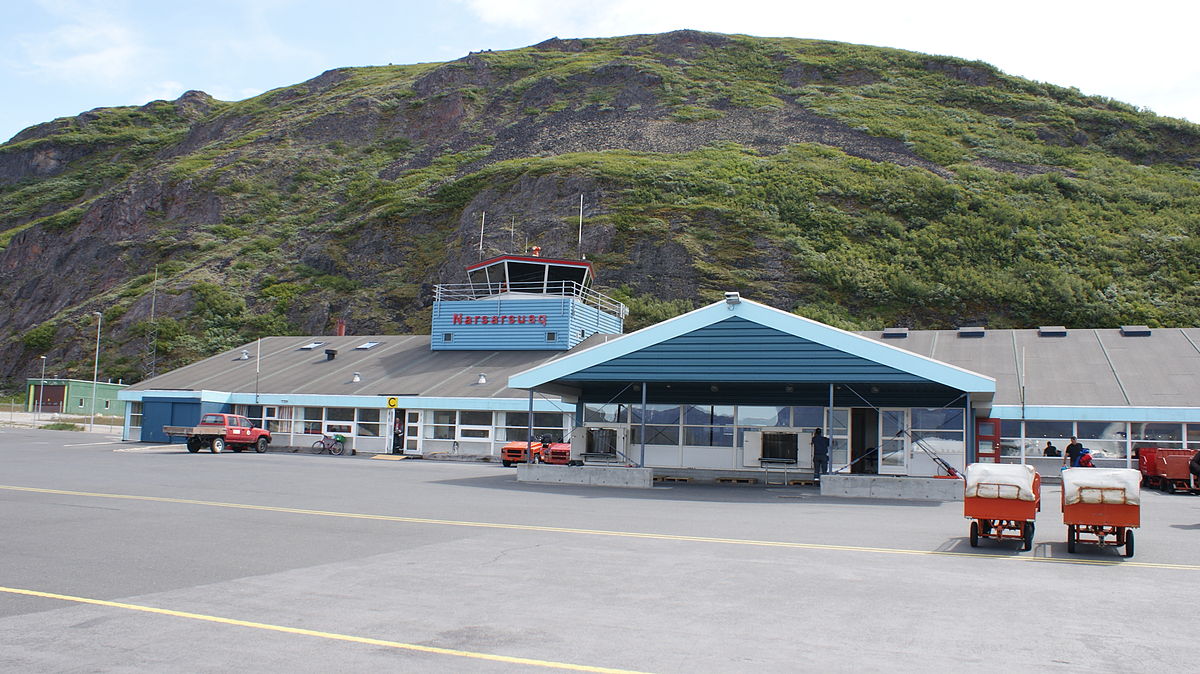
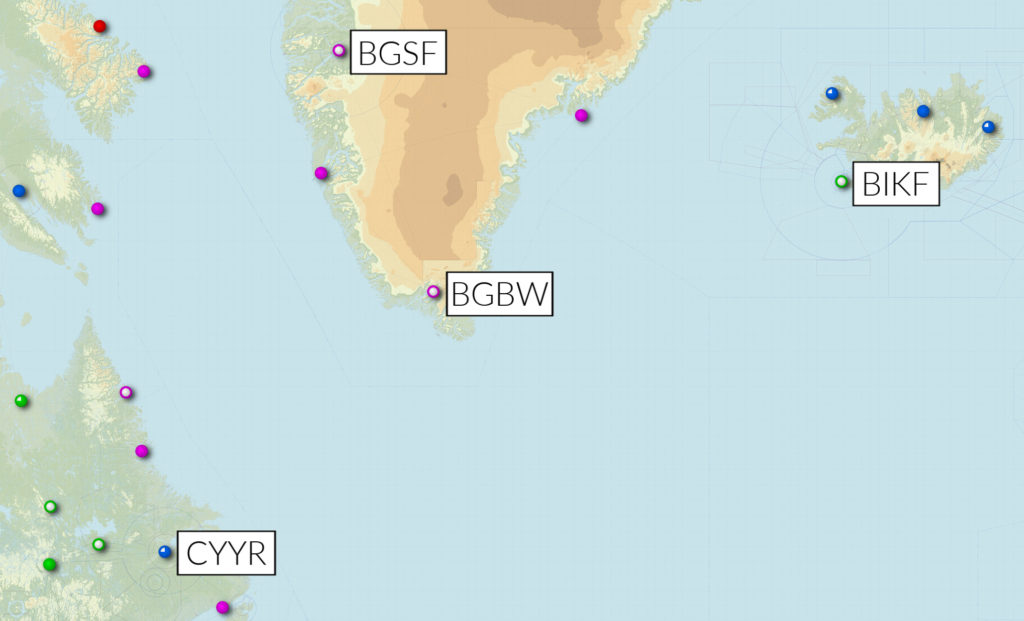
Yes! These are still permitted at BGBW/Narsarsuaq and BGSF/Kangerlussuaq. But watch out for extra charges if filing one of these airports on your flight plan as an alternate.

BGTL/Thule is only open to emergency diverts – not as a planning alternate because it’s a military airfield which has no passenger facilities.

Who is this going to impact?

Mainly anyone who wants to bring in passengers for entry to Greenland. If you want to do it, you will need to apply for a special exemption at least 48 hours in advance. And you’ll need a really good excuse.

Greenland serves as an important spot for ETOPS aircraft, and for an en-route alternate for polar operations – to repeat, you can still use BGBW and BGSF as ETOPS alternates.
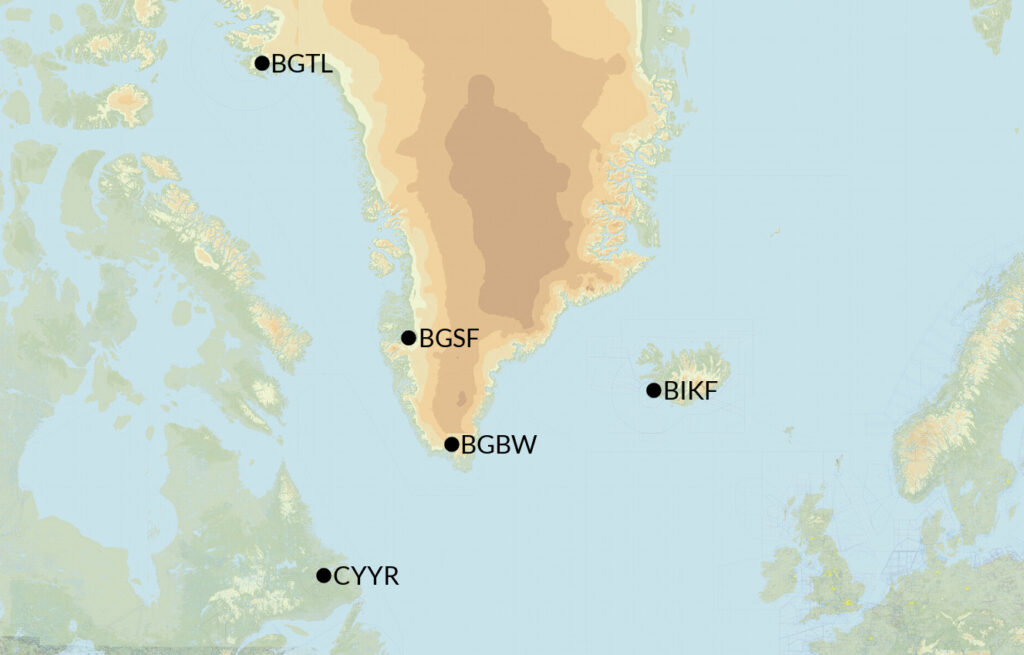
 

So far they think the rule will remain in place until the end of January next year. Given the current mutated mink situation Denmark have found themselves in, we don’t expect it to reopen sooner.


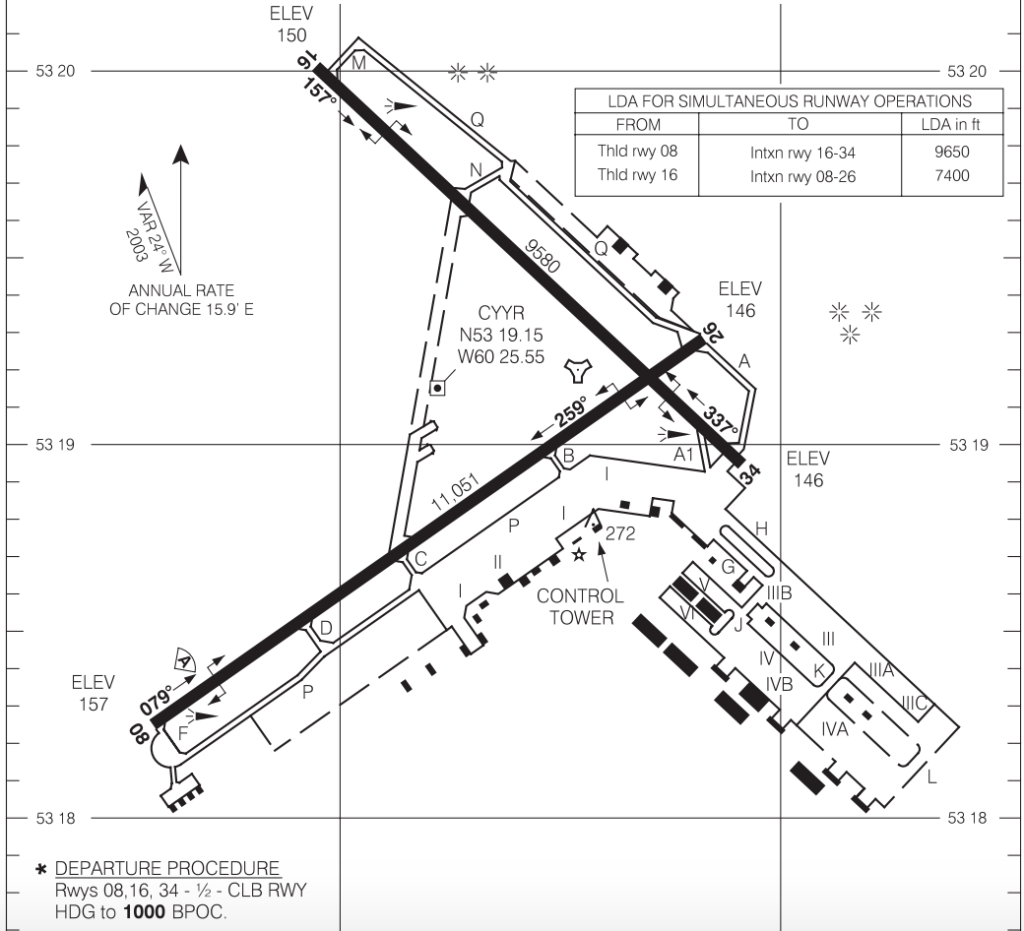
Goose Bay: “Our runway is broken”

Larger jets will not be allowed to land on three out of four runways at Goose Bay for the next three months, as they’ve found cracks after the winter thaw. 

The airport has settled on a final version of their “Our runway is broken” Notam, and it looks like this:

05/037 – CYYR RWY 08, 26 AND 34 NOT AVBL FOR ACFT WITH TIRE PRESSURE OF 1.0MPA (145 PSI) OR GREATER AND ACFT WITH ACN/PCN OF 40 OR GREATER, EXC MEDEVAC AND AVBL AS EXTENDED RANGE TWIN-ENGINE OPS (ETOPS) ALTERNATE. 
21 MAY 14:01 2019 UNTIL 17 AUG 23:59 2019. CREATED: 21 MAY 14:06 2019

So not the most pilot-friendly piece of information! Unless you happen to know your tire pressure off-hand, best head for RWY 16, which is the only one that remains fully open and operational to all aircraft (the only reason RWY 34 is restricted is because aircraft using that runway touch-down on the intersection with RWY 08/26 – which is where some of the cracking damage has been found).

The Notam does state that the other three runways at CYYR can still be used an ETOPS alternate, meaning that you’re allowed to divert there in an emergency regardless of size, weight, tire pressure, or ACN. However, with the deteriorating runway conditions they’re also warning of possible aircraft damage due to loose sealant and asphalt:

05/038 (190206) – CYYR RWY 08/26 SFC IS DETERIORATING AND CRACKING AND MAY PRODUCE FOREIGN OBJECT DEBRIS (LOOSE SEALANT AND ASPHALT) ACFT DAMAGE MAY OCCUR. 23 MAY 18:20 2019 UNTIL 23 AUG 23:59 2019. CREATED: 23 MAY 18:24 2019

ACN vs PCN

The mention of “ACN/PCN” in Goose Bay’s Notam made us close our eyes and try to imagine a world where Notams just made immediate sense.

Knowing your tire pressure is one thing, but trying to work out your ACN number is a much more tricky business, as it has to factor in the aircraft’s maximum centre of gravity, maximum ramp weight, wheel spacing, tire pressure, and other factors. Your AFM should have a bunch of pages which tell you this (or you can have a quick look here instead).

Once you know your ACN number (or rather, ‘numbers’ – as there are different ACN numbers for each aircraft depending on the strength of the runway you’ll be landing on), you can then check it against the runway PCN number – the number issued for each runway which tells you what kind of surface it is, how strong it is, and what level of stress it is able to withstand.

Ultimately, if your aircraft’s ACN is equal to or less than the runway’s PCN, you’re good to go.

In the AIP, Goose Bay’s runway PCN is 076FBXU. The important bits here: 

  • the PCN number here is 76
  • the F means that the runway is ‘Flexible’ (i.e. made of asphalt rather than concrete)
  • the B means it is of ‘Medium’ strength
  • the X means it has maximum tire pressure of 1.75 MPa. 

So, under normal circumstances, CYYR has a runway PCN of 76, meaning most aircraft would be able to operate here:

But with all the runway cracking that’s been going on, Goose Bay’s PCN number is no longer accurate. It’s probably safer to assume the B is more like a D right now – runway strength ‘Very low’. And the new CYYR Notam suggests the new PCN number is 40 (as aircraft with an ACN number higher than that are not allowed to go there).

Other NAT alternates?

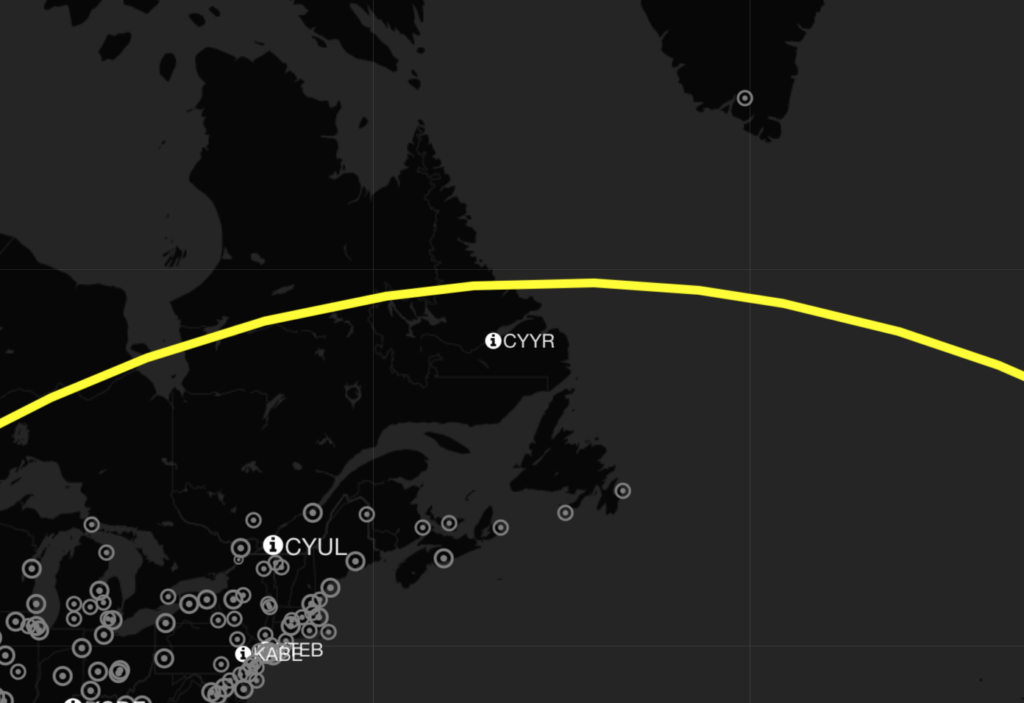
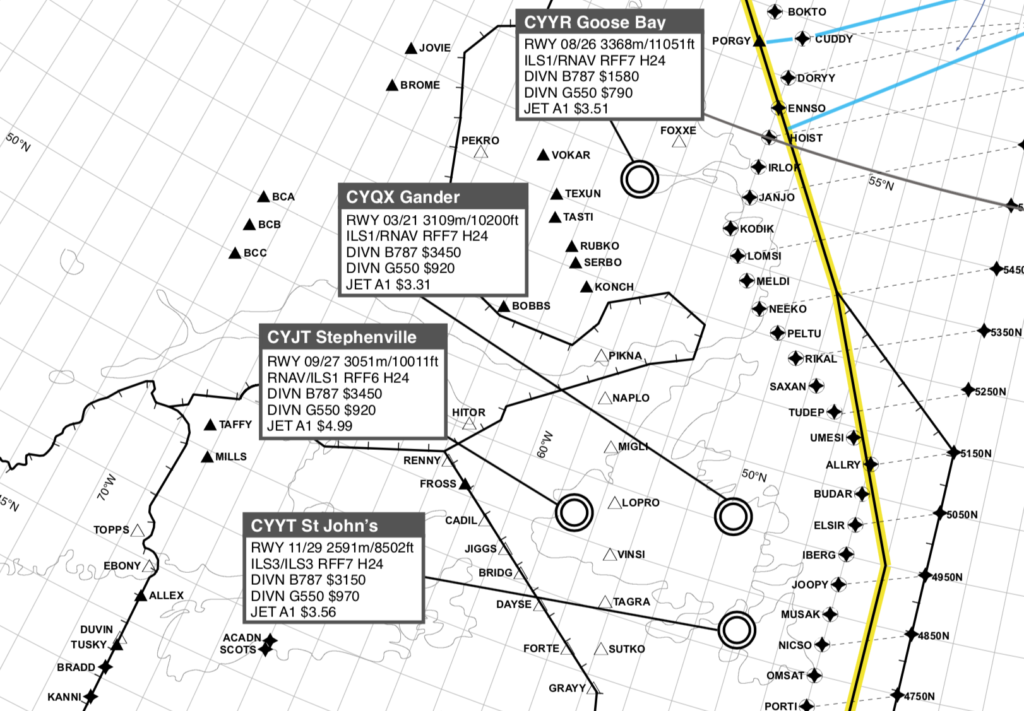
A quick check on GoCrow shows us there’s really nothing available to the north of CYYR:

But there are some decent options to the south:

This isn’t the first time Goose Bay has had problems with its runways. In Nov 2017, the airport was closed due to ‘sticky’ runways – during snow removal crack sealant was found on vehicles after they were used on the runways.

Further reading:

  • United Airlines has downgraded Goose Bay Airport’s suitability for diversions, after one of its flights with 250 passengers on board diverted there on 19th Jan 2019, and was then forced to spend 16 hours on the ground as there were not enough customs staff available to process everyone on board to enter Canada. Customs opening hours at the airport are 8am to midnight daily.

Greenbacks and Greenland – $3000 to file as an alternate

Trans-atlantic operators who have been putting RALT/BGBW or RALT/BGSF on their flight plans have been receiving hefty invoices post-flight.

Both BGBW/Narsarsuaq and BGSF/Kangerlussuaq are popular airports to use in flight planning as an emergency divert and for ETOPS, as they are perfectly positioned right in the middle of the big empty chunk of nothing that exists between the east coast of Canada and Iceland.

Both airports are open Mon-Sat 11-20z (8am-5pm local time), and completely closed on Sundays and on public holidays (watch out for these sneaky ones!).

So if you file a flight plan with either as alternates from Mon-Sat 11-20z, you won’t get charged.

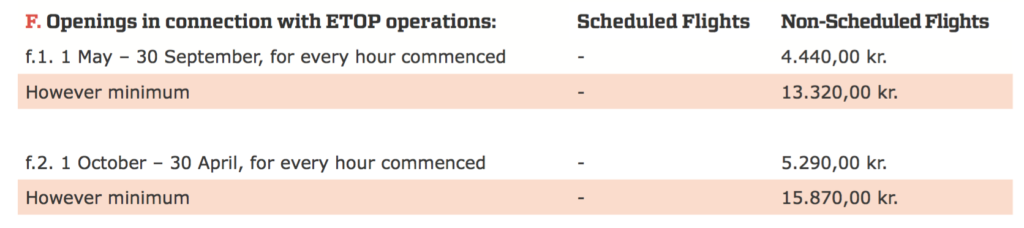
But outside these hours, you will get charged. It gets slightly complicated here: the charges in the box below apply when they stay open for you to use as an ETOPS alternate at any time that they are closed (which is between 20-11z), but there’s an extra 10% charge on top of that for any time they are closed and fast asleep in bed, (which is between 00-08z). Got it?

Important to note: these get charged even if you don’t actually divert to BGBW/BGSF. 15,870 Danish Krone equates to $2585 USD!

If you want them to stay open for you to use as an ETOPS alternate, you need to put RALT/BGBW or RALT/BGSF in your flight plan – they’ll see it, and will stay open for at the times you need. But bear in mind that if they’re closed already at the time you file your flight plan, they won’t see it! So they prefer you to do it properly and arrange everything in advance by email: get in touch with them at PPR@mit.gl

If you get an invoice from a company called Global Aviation Data A/S, unfortunately it’s not a scam email – they are the guys who work with Greenland Airports to collect the monies owed when operators request these airports to stay open for them.

The really interesting thing is this – if more than one operator asks BGBW/BGSF to stay open for them at the same time, the costs are not shared between these operators – they both have to pay the standard fees! That’s great news for the Government of Greenland, who will be getting paid multiple times by different operators for BGBW/BGSF to stay open at the same time!


Islands of the South Atlantic – enroute ETOPS and diversion options

Operating a flight across the South Atlantic is complicated by very limited en-route diversion options.

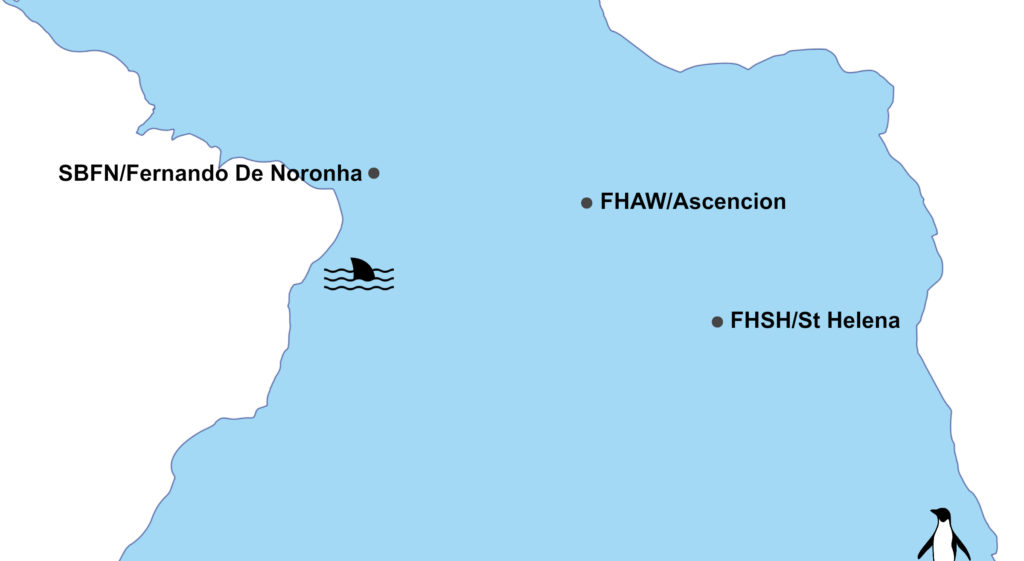
There are only really three airports worth considering between Brazil and Africa, south of the equator. All have their own complexities.

Your three best bets:

Operational Considerations:

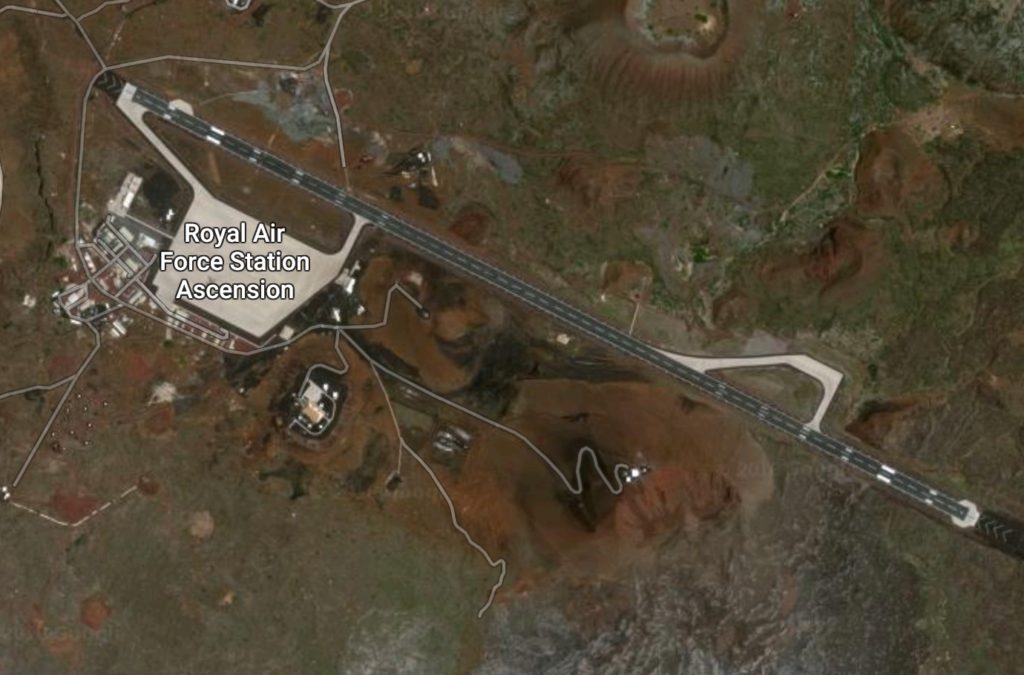
FHAW/RAF Ascension Island

Wideawake Airfield (FHAW) is a military facility operated jointly by the USAF and the RAF. Under the terms of the joint agreement, only state aircraft are authorized to land at Ascension. A monthly RAF flight arrives from the UK and weekly USAF C17 movement occurs.
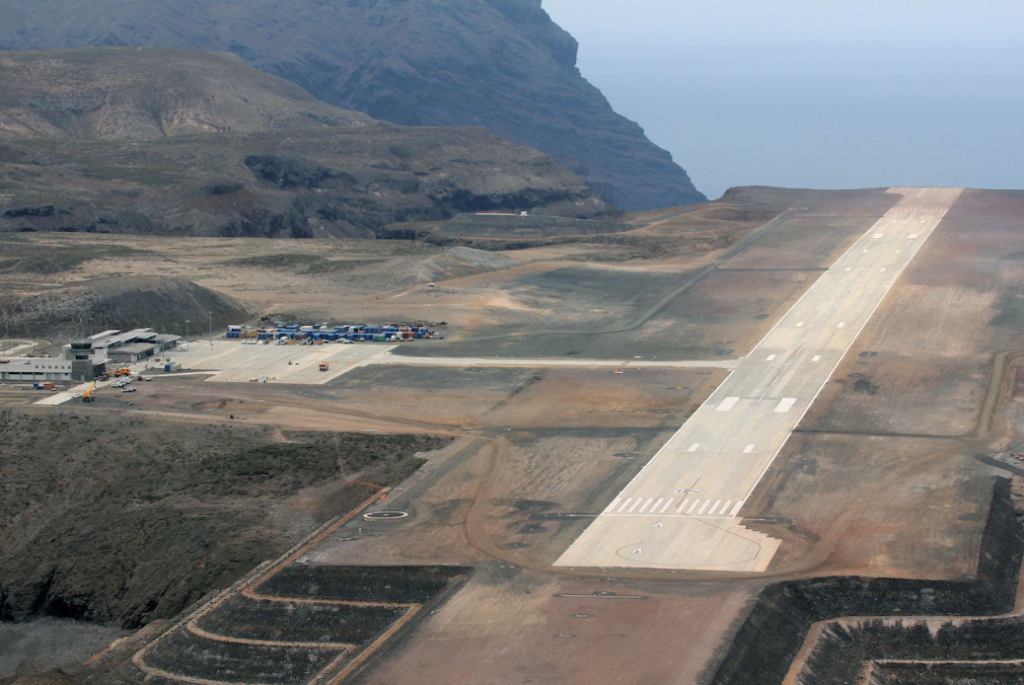
We have also been advised by local authorities that “the runway is beyond its life cycle and we have imposed aircraft maximum weight limitations on its use to extend its operation”.

Because of these restrictions, passenger links to/from UK were stopped.

To file as an ETOPS/EDTO alternate or not?

The official line is here.

“The US Air Force has agreed its airfields may be identified as ETOPS emergency landing sites for flight planning purposes. This is consistent with the policy that an aircraft can land at any US Air Force airfield if the pilot determines there is an inflight emergency that would make continued flight unsafe. However, we also understand there are published criteria for ETOPS airfields and our policy concerning emergency use is not agreement or certification that Air Force airfields meet those criteria.

Ascension Island is a remote location with resources (accommodations, medical, hangars, crash/fire/rescue, etc) limited to levels essential for support of assigned personnel and the military mission. The airfield is available “as is” for emergency use only as indicated above. Whilst FHAW may be declared as an alternate for ETOPS flight planning purposes, it cannot be used as a weather alternate, except for flights departing from or destined for St Helena.”

However! After we enquired with local authorities, we received the following response:

“As this is a USAF military only field, it is not allowable to nominate as an ETOPS alternate. There are no lodging facilities here on the island, and there is only very limited medical capability.

We will always accept an emergency divert and have done so in the recent past. Nomination as an alternate drives a set of requirements that we do not meet – hotel, medical, 24 hour operations, etc. Since we cannot meet those requirements, nomination is not allowed. If an aircraft were to experience and emergency and need to land, we would make do with what we have.”

As we have reported in the past, it can be costly to nominate enroute alternates sometimes.
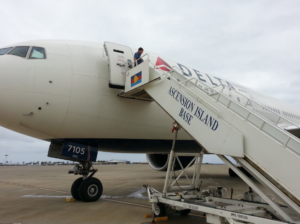
Famously, a Delta 777 diverted to Ascension back in 2013 after experiencing engine troubles.

Either way- it’s another ‘interesting’ approach.


FHSH/St Helena

This is a new airport.

It’s windy! It is subject to “severe” windshear and the runway is on top of a mountain and it’s short! There is only limited flights to/from Namibia with an E190 and a monthly flight connects onwards to RAF Ascension.

Even the first commercial flight there need to ‘go-around’ due to the wind.

It was closed shortly after it opened due to these safety concerns, but it’s back up and running now.


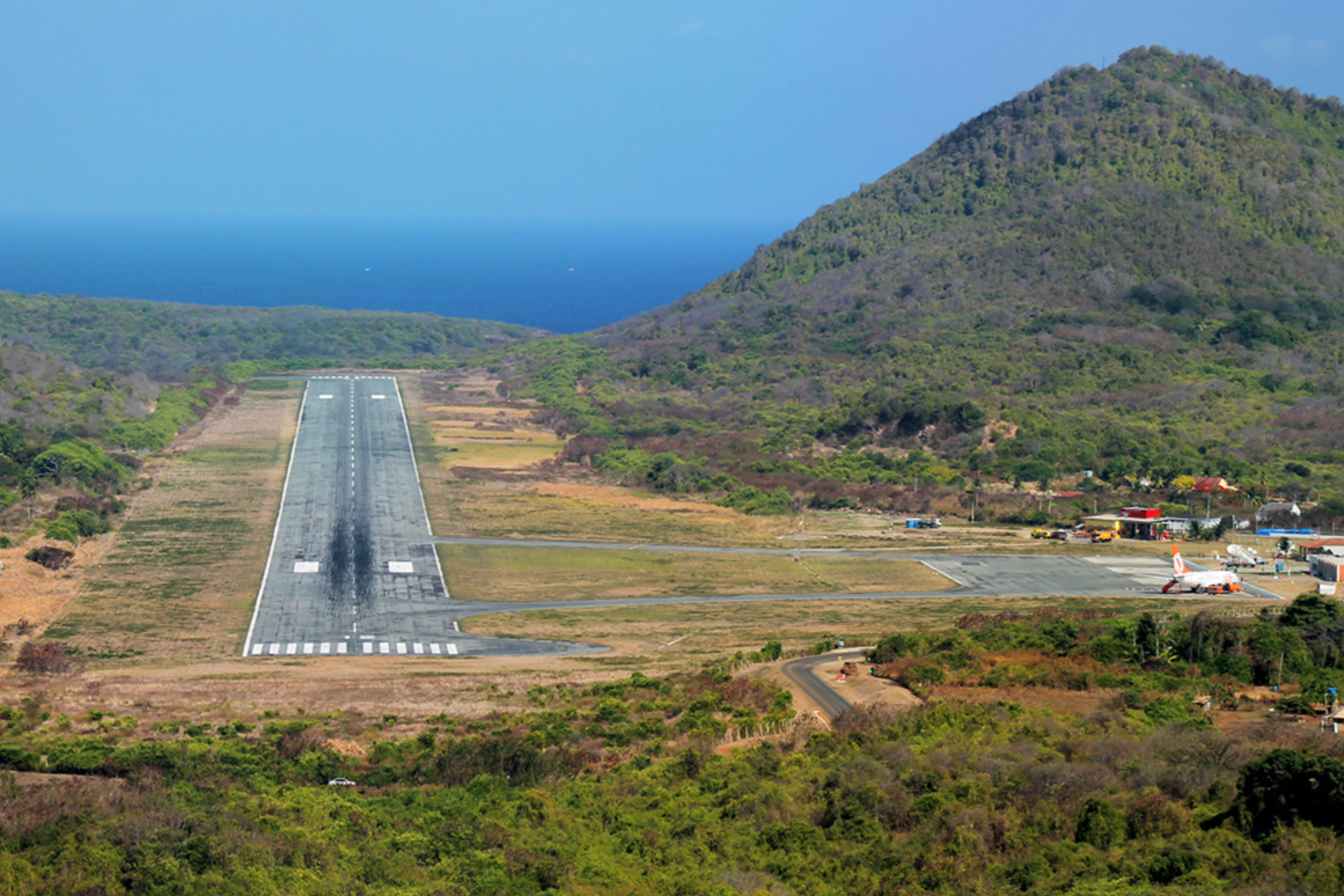
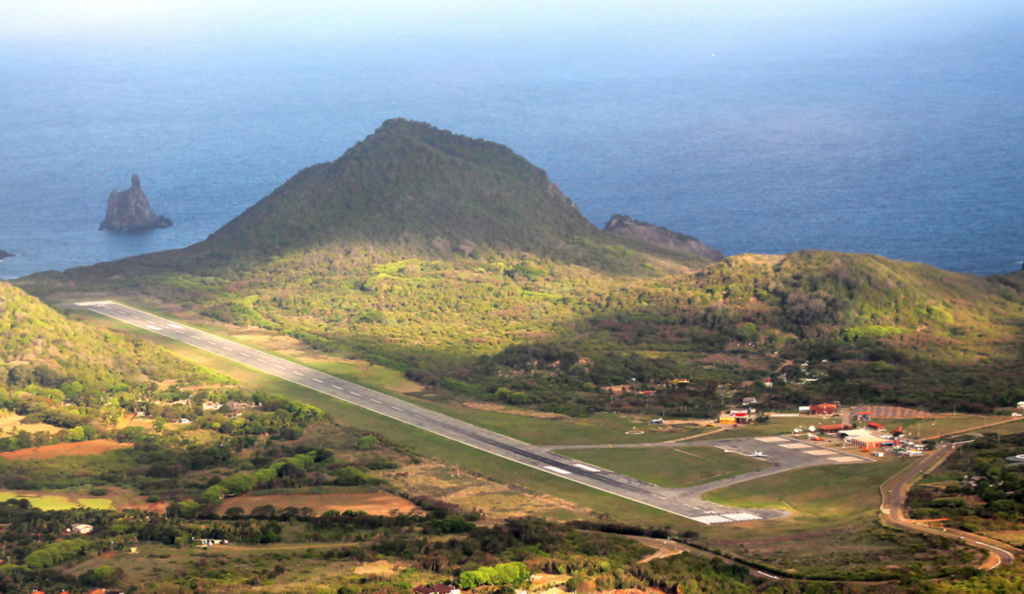
SBFN/Fernando De Noronha

Small island airport. Very scenic on approach and great beaches! Limited ground handling and parking options. Close to the ITCZ – susceptible to unstable weather at times. Regular commercial flights from the island and popular tourist destination with appropriate passenger facilities. Fire fighting only CAT 5. PPR – expect to pay for parking by the hour. Not an airport of entry and no fuel available to non-Brazilian military aircraft. Handling all done by island island administration and special permit landing permit required. Also important to note that the runway will be closed for maintenance between 2001 and 1131 UTC, between May 24th until Dec 31st, 2018 and that all runway lights are unavailable also.

Extra Reading:

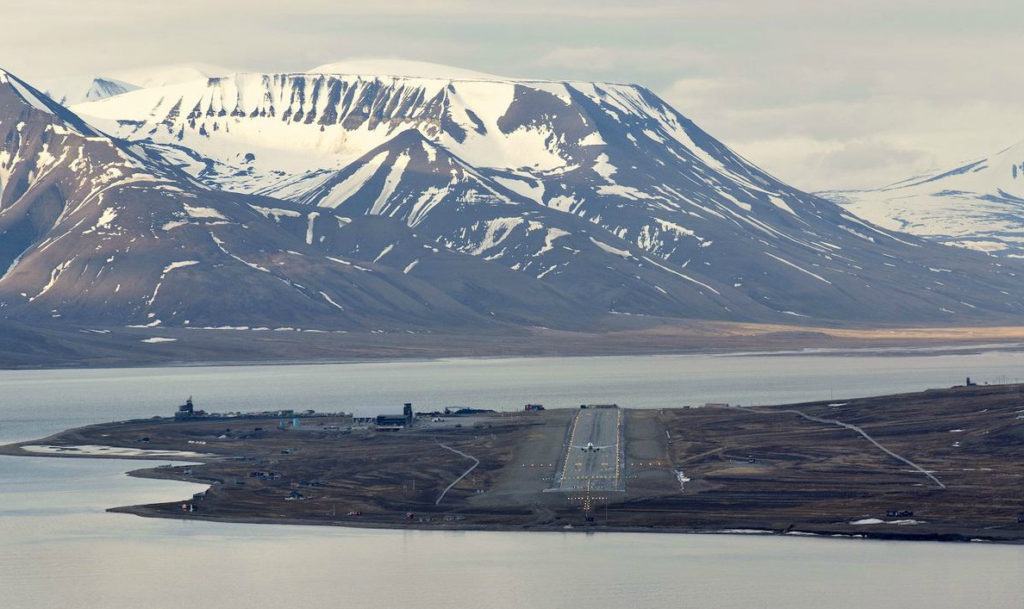
ENSB: No more direct flights, emergency diverts still OK

This is now officially a domestic airport – international arrivals are no longer permitted.

We asked the Norwegian CAA the million-dollar question: can ENSB still be used as an ETOPS or emergency enroute alternate?

Their response: “ENSB now being a domestic airport, it shall not be used as an alternate airport in normal flight planning, but in case of emergency, medical – or flight safety related, the airport may be used.”

In other words, if you are planning a Polar flight and want to use ENSB as an ETOPS or emergency enroute alternate, you can. 

We also spoke with the ATC tower at the airport: they confirmed that you can still use ENSB as an emergency divert, and they have someone there on duty H24. The normal RFF category is 8.

So why has the airport been downgraded from international to domestic?

It seems it has something to do with the authorities desire to limit the amount of charter fights operating directly to Svalbard. Now, if you want to go there you will first have to go to one of Norway’s international airports to clear customs, and then continue on to Svalbard as a domestic flight. The Norwegian CAA say direct international charter flights may still be allowed “in the interests of tourism”, but it seems this will be the exception rather than the rule.

Interestingly, you can still fly to ENSB direct from Russia, as they have a separate agreement from 1974 regarding the use of  the airport – which is unaffected by this new rule.

Even more interesting is that when you get to Svalbard, if you decide to leave the main town of Longyearbyen, it is a legal requirement to carry a gun, and to know how to use it – they’re not joking about those polar bears.


St. Helena – no hope for opening?

St. Helena is 4000km east of Rio de Janeiro; the only means of travelling to this remote island in the South Atlantic is through a five day sea voyage from Cape Town, with schedules of only once in every three weeks – making St. Helena one of the most remotely populated places on earth.

There have been many considerations for an airport on St. Helena since 1943, but it was only in 2005 that actual plans were announced. In 2011, the British government agreed to assist in the payment for the new airstrip.

The Airport was scheduled to open on 26 April 2016 but St.Helena Government announced an indefinite delay to the opening due to safety concerns from windshear. An Implementation Flight was conducted by (British Airways) Comair with a Boeing 737-800 aircraft to gather data on turbulence and windshear on the approach to Runway 20 (from the North). The results gathered and the conditions experienced concluded that additional work and preparation are need to ensure safe operations of scheduled passenger flights to and from St. Helena Airport.

So, for now, it seems pretty clear that the project is abandoned, because windshear isn’t something you can fix. It may be that it could open during specific times of the year when predominant wind direction is different, but for now, all that is certain is uncertainty.

Reference Material: