Testing Times: More than just a stick up the nose
In the last few weeks, several major countries have announced that pre-departure Covid testing of all international passengers is now compulsory. And it is up to the operators to make sure that this happens.

It is now mandatory for anyone travelling to the UK, Australia and Canada from anywhere. The US will follow suit from January 26.

Covid testing is set to become a common part of our aviation landscape for the foreseeable future. Until a vaccine has had time to work, people will need to be tested to move around the world freely.

But what type of Covid test do I need?

Just google ‘Covid test’ and prepare for confusion. There are different types of test out there, and to make matters worse, there are multiple confusing names for the same test. Ask a passenger and the chances are that many will not understand why a rapid test at the airport isn’t enough to board their flight.
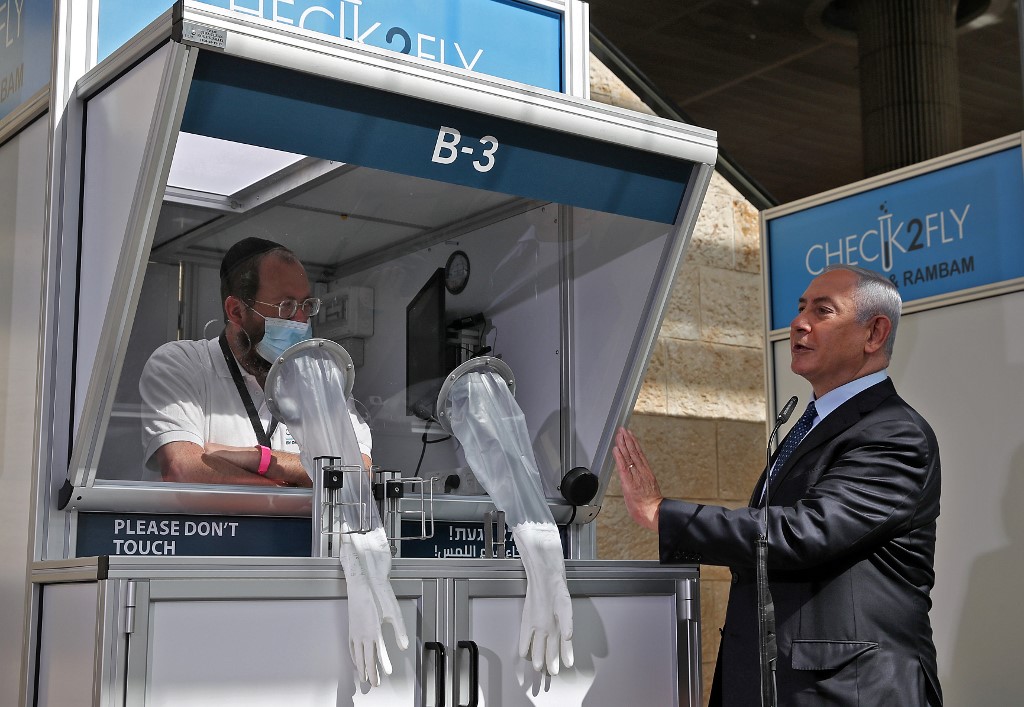
Rapid testing at the airport is convenient, but it may not be enough to get you in when you arrive.

So here is a super basic breakdown of the types of tests out there and how they work…

Covid Test 101

Covid tests can do two things:

  1. They can tell you’ve had it in the past by looking at your blood (Antibody test), or –
  2. They can detect if you actively have the virus by looking at your mucus or saliva (Diagnostic test).

Antibody tests = Cannot tell if you are actively sick and contagious. So for travel, they are pretty much useless.

Diagnostic tests = There are a bunch of highly technical names floating around out there but the good news is that there are only a couple of types – Molecular tests (PCR) and Antigen Tests. (The bad news is you’re getting a stick up the nose either way.)

  • Molecular tests (PCR). The gold standard in testing. These tests are super accurate and work by detecting the nucleic acid left behind by the virus. This is what most countries require. The downside is the results take much longer and it is difficult to test a whole bunch of people quickly. There are home kits available but most of the time you’ll need a lab to test you.
  • Antigen Tests. When people say ‘Rapid Test’ this what they mean. These tests are quick, cheap and work by looking for a piece of coating on the virus. You still get swabbed but the results come back far quicker. They are what you see in airports. So what’s the issue? They’re not as accurate and can return false negatives. In most cases borders just won’t accept them.
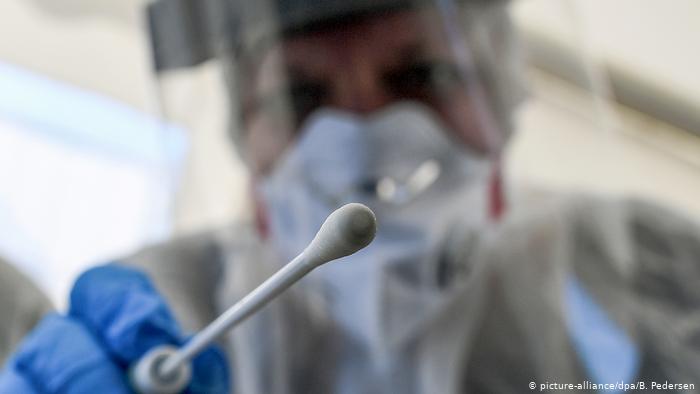
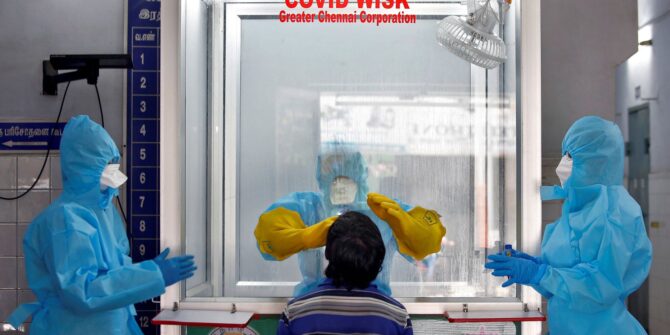
Is this a PCR or Antigen test? They both look exactly the same to passengers.

So what’s the issue with antibody tests?

All they do is look for anti-bodies in your blood and your body has to build up those defences. It can take up to 14 days after you first catch the virus before they can be detected. You can be sick and contagious before the test will even detect them. To make matters worse there is no evidence you can’t catch Covid again even if you have already had it. So what’s the point of them? They help authorities work out just how far the virus has gone out there.
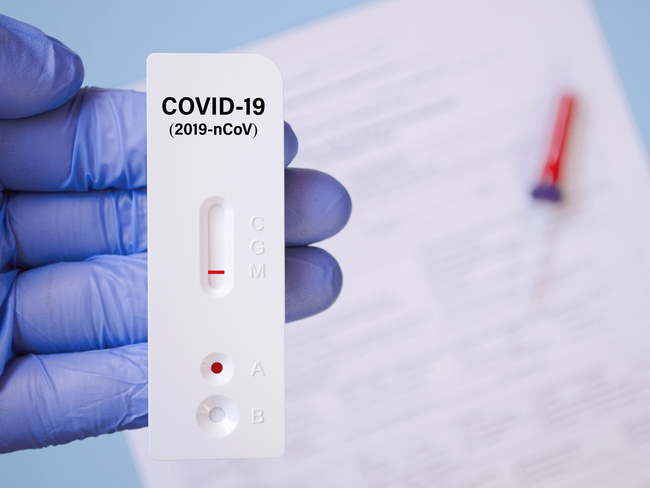
An anti-body test. No anti-bodies, but you might have had Covid already for two weeks…

Moving Forward…

With rapidly changing testing rules around the world it will become super important to make sure you and your passengers get the right kind of test. Most of the time the one you will need is a PCR test. Rapid testing at airports is convenient and looks the same but in most cases just won’t cut the mustard.

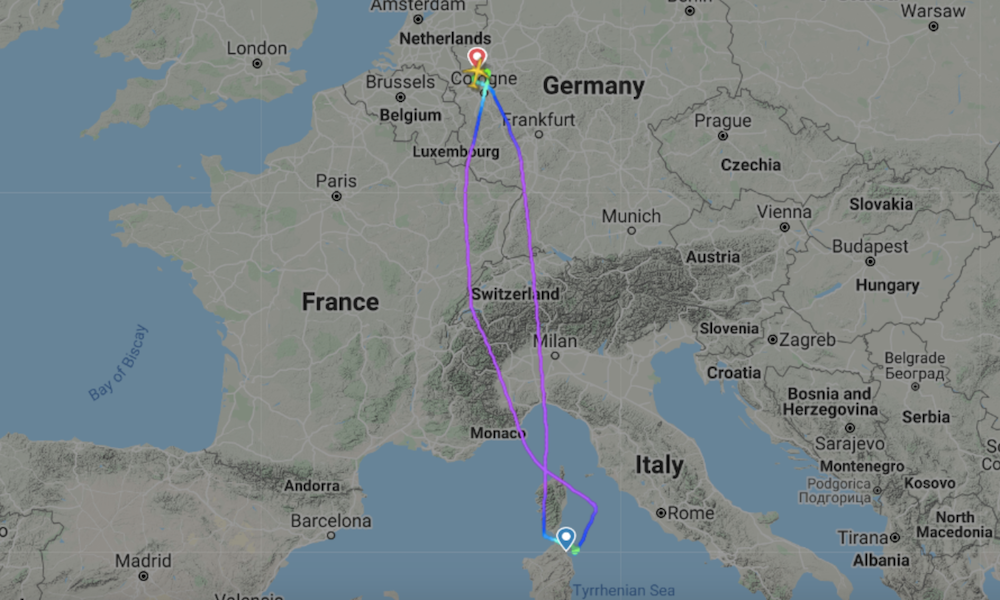
Eurowings flight to nowhere highlights Notam problems

Confused about whether you’re allowed to fly to Italy at the moment? You’re not the only one!

A Eurowings (Lufthansa’s European low-cost subsidiary) flight from EDDL/Dusseldorf to LIEO/Olbia ended up diverting back to Germany this week, after discovering the airport was actually closed to commercial traffic.

Yes, there was a Notam, and yes, it looks like they missed it – though that’s maybe not surprising given the Notams being pumped out on the national LIBB/LIMM/LIRR codes at the moment saying how pretty much all airports across the country have now reopened – including LIEO!
So let’s play a game of ‘spot the difference’. Here’s the National one, published on May 19:

A3028/20 (Issued for LIBB LIMM LIRR) COVID-19:
ALL FLIGHTS ARRIVING/DEPARTING TO/FM ITALY MUST COMPLY WITH THE REQUIREMENTS OF THE DECREE OF THE PRESIDENT OF THE MINISTERIAL COUNCIL OF 17 MAY 2020 ON FOLLOWING AIRPORTS: LIPY, LIBD, LIME, LIPE, LIEE, LICC, LIRQ, LIMJ, LICA, LICD, LIMC, LIRN, LIEO, LICJ, LICG, LIBP, LIRP, LIRA, LIRF, LIMF AND LIPZ, COMMERCIAL FLIGHTS, COMMERCIAL FLIGHTS ON DEMAND (AEROTAXI) AND GENERAL AVIATION FLIGHTS ARE ALLOWED.
GENERAL AVIATION ACTIVITY AND COMMERCIAL AVIATION ACTIVITY ON DEMAND (AEROTAXI) WITH AIRCRAFT HAVING MAXIMUM APPROVED CABIN CONFIGURATION EQUAL OR LESS THAN 19 SEATS, CARGO FLIGHTS AND POSTAL SERVICE ARE ALLOWED ON ALL REMAINING AIRPORTS.
GENERAL AVIATION ACTIVITY, COMMERCIAL AVIATION ACTIVITY ON DEMAND (AEROTAXI)WITH AIRCRAFT HAVING MAXIMUM APPROVED CABIN CONFIGURATION EQUAL OR LESS THAN 19 SEATS ARE ALLOWED ON AIRFIELDS/HELISURFACES/HYDROSURFACES MANAGED/AUTHORIZED/OCCASIONALS, WITHIN THE LIMITS OF APPLICABLE AUTHORIZATIONS IN COMPLANCE WITH THE PROVISIONS OF THE DECREE OF THE PRESIDENT OF THE COUNCIL OF MINISTERS OF 17 MAY 2020
RMK: GENERAL AVIATION ACTIVITY AND A COMMERCIAL AVIATION FLIGHT ON DEMAND ON LIRF IS NOT PERMITTED.
19 MAY 11:16 2020 UNTIL 02 JUN 22:00 2020 ESTIMATED.
CREATED: 19 MAY 11:27 2020

And here’s the one for LIEO/Olbia, published two days later on May 21:

B2520/20 – COVID-19.
AERODROME CLOSED TO COMMERCIAL AVIATION TRAFFIC IN COMPLIANCE WITH REGIONE SARDEGNA DECREE 23 OF 17TH MAY 2020.
RMK: GENERAL AVIATION ACTIVITY AND COMMERCIAL AVIATION ACTIVITY ON DEMAND (AEROTAXI) WITH AIRCRAFT HAVING MAXIMUM CABIN CONFIGURATION EQUAL OR LESS THAN 19 SEATS ARE APPROVED IN COMPLIANCE WITH MINISTRY OF INFRASTRUCTURE AND TRANSPORTATION DECREE 207/2020 AND REGIONE SARDEGNA DECREE 23 OF 17TH MAY 2020.
REF AIP AD 2 LIEO 1-1. 21 MAY 15:14 2020 UNTIL 02 JUN 22:00 2020 ESTIMATED.
CREATED: 21 MAY 15:14 2020

The national one says the airport is open, the local one says the airport is closed – a classic case of Notamisery

A number of news reports on this incident have been quick to criticise the operator — and also the crew — for this oversight. We’re not sure we really feel like jumping on that particular bandwagon. We could talk at length about The Notam Problem (indeed, we have done so, here, here, here, and here, and also here).

The Notam problem is clear: we have an antiquated, cumbersome, ineffective, frustrating, dangerous system. Pilots are missing the essential few pieces of information, unable to hear the call of criticality in a cacophony of irrelevant noise. And it obviously doesn’t help when one Italian sends you a Notam saying an airport is open, and another Italian sends you one saying it’s closed.

These are also “unusual times” – we keep hearing those words in the news, but it’s true. Two months in to the Covid-19 pandemic, it feels like “ops : normal” is still a long way off for most of us – whatever job we do in aviation, wherever we fly. People are tired. The changes are constant. A spokesperson for Eurowings summed this up pretty well in a statement released after this incident at Olbia: Against the background of the current corona crisis, the situation at numerous airports in Europe is very dynamic, which is manifested in the large amount of information provided on operating hours or airport closures that are often changed at short notice as well as daily changes in entry regulations in the various countries.” 

As this incident shows, wherever you’re headed, whatever you read in a Notam, it’s always worth double-checking exactly what’s allowed at the airport you’re flying to. Don’t be afraid to give them a call. If you need to find some local airport contacts, the Flock website is one of the best free contact databases we’ve seen so far (and no, they don’t pay us to say that!)

In related news – Italy has said it will start allowing unrestricted travel to and from European countries, with no quarantine requirement, from June 3. No official word yet on when restrictions will be lifted on flights to and from countries outside of Europe – but the external borders of the EU remain closed to non-essential travel until June 15 at the earliest. More on that here.


We got some checklists for you …

This is an extract from the OPSGROUP Covid-19 Supermanual, version 0.9 – May 11, 2020


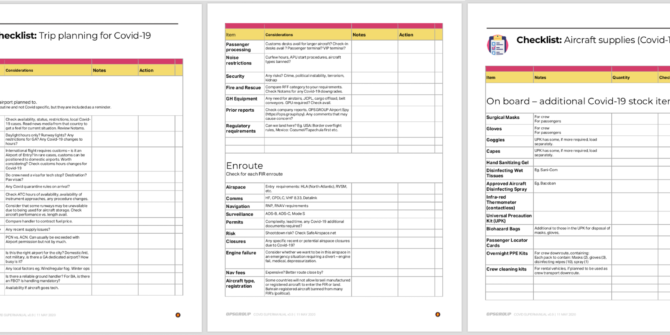
Trip planning Checklists for Covid-19

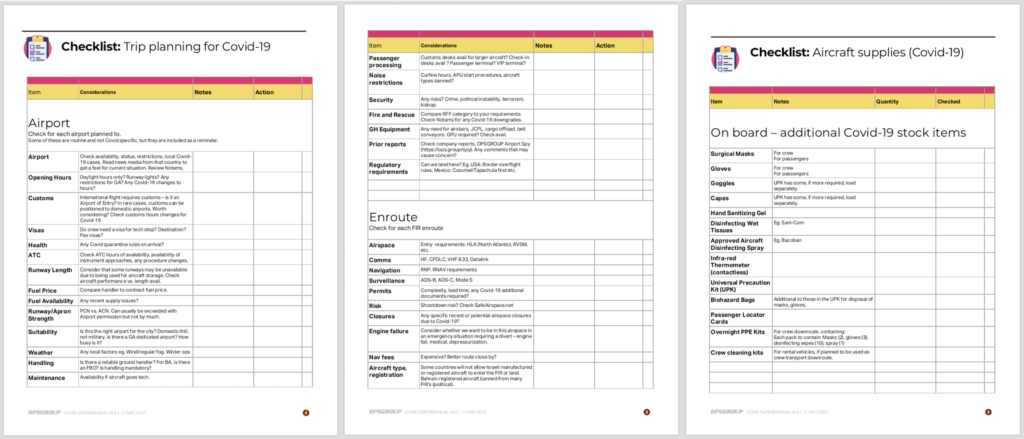
At the back of the group Covid-19 Supermanual we have 5 pages of checklists, which you can download here.

  • Airport
  • Enroute
  • Permits
  • Regulatory and Documents
  • Aircraft Supplies 


What else is in the manual?

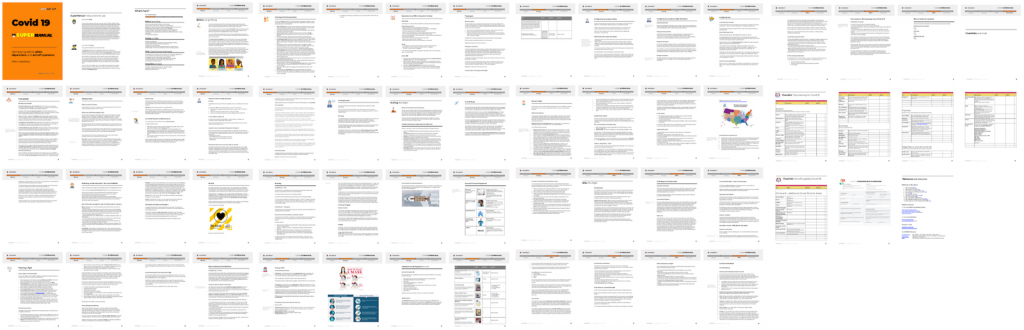
We’ve divided the manual into four areas around phases of flight: Before, During, After … and a Checklists section.

Before we go flying

About Covid, Precautions, Off duty crew and staff
Going to work, Health Check, Illness at work, Dispatchers
Flight Crew – Fit to fly, License, medical and recency, keeping aircraft and crew current
Wellbeing and Mental Health: How to find calm, Be Kind
Planning a flight, Crew pairings and planning
Aircraft cleaning and preparation, Risks: Hand Sanitizers, Dangerous Good regulations
Catering and Food preparation, Operations to an FBO or Executive Terminal, Passengers
Arriving at work, Briefings

During our flight

In-flight considerations
Aircraft Setup, Boarding, Temperature Checks, Baggage, Seating
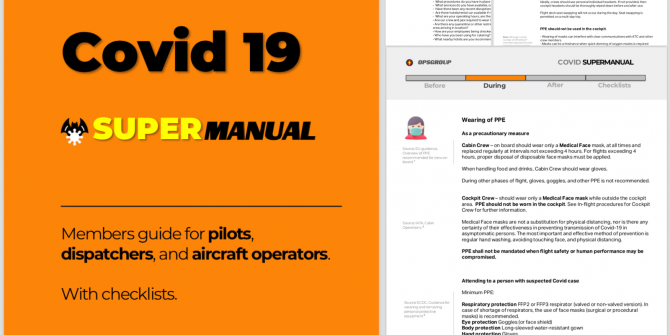
Wearing of PPE (Personal Protective Equipment)
Additional Aircraft Equipment
In flight Crew procedures: Pilots, Flight Attendants, In-flight Service
Illness in Flight – Crew actions, Dispatch actions, Cleaning procedure

After – back home (or downroute)

Disembarking
Tech Stops and Turnarounds, Interim Cleaning, Walkaround
Arrival at Destination, Waste Disposal, Cleaning at outstation
Overnights/Layovers, Hotel guidance, Crew PPE kits
Crew Illness away from Home base
AOG/Unplanned overnight
Arrival at Home base,
Aircraft Cleaning, Cockpit cleaning
Crew exposure, Contact tracing

Checklists

Checklist: Trip planning in Covid-19
Checklist: Aircraft supplies
Passenger Health Screening form example

For more about the Covid-19 Supermanual contents, and to download a copy, use this link.


Hand sanitizers on board: Fire risks

This is an extract from the OPSGROUP Covid-19 Supermanual, version 0.9 – May 11, 2020


Hand Sanitizers – fire risk

In a documented case in May 2020, an individual suffered first and second degree burns when they made contact with a metal surface and a static discharge ignited the still wet hand sanitizer. Hand sanitizer gels contain large concentrations of alcohol. Once the hand sanitizer is applied, individuals must make sure the gel has suitable time to dry. Alcohol vapors can ignite if exposed to an ignition source, such as light switches or cigarette lighters. Crews should be made aware of this risk, especially in the aircraft operating environment. Original source here.

Dangerous Goods exemption requirements

Alcohol-based hand sanitizers are classified as dangerous goods and are not specifically permitted by the IATA Dangerous Goods Regulations and ICAO Technical Instructions for the Safe Transport of Dangerous goods by Air (DGR 2.5, ICAO Technical Instructions Part 1;2.2) .

Operators that wish to add alcohol-based hand sanitizer to the items carried in galleys or installed in lavatories will need to request authorization from their civil aviation authority (State of the Operator) in accordance with the provision that is set out in Part 1;2.2.1 a) of the ICAO Technical Instructions.

IATA recommends that the request for authorization addresses the following:

– The classification and UN number of the hand sanitizer. For example, UN 1987, Alcohols, n.o.s. (ethyl alcohol mixture), UN 1170, Ethanol solution. However, the safety data sheet from the manufacturer of the hand sanitizer should be checked for the classification;

– The quantity of hand sanitizer in each container and the number of containers to be carried on the aircraft;
– What steps will be taken to ensure that the hand sanitizer is kept away from sources of heat or ignition;

– Provision of information to crew members on the carriage of the hand sanitizer. For example, that crew members will be advised on the procedures through a bulletin or other appropriate method.

Crews can take hand sanitizers as carry on, each bottle max 0.5L, under the IATA Dangerous Goods regulations, total for toiletries is 2L.


What else is in the manual?

We’ve divided the manual into four areas around phases of flight: Before, During, After … and a Checklists section.

Before we go flying

About Covid, Precautions, Off duty crew and staff
Going to work, Health Check, Illness at work, Dispatchers
Flight Crew – Fit to fly, License, medical and recency, keeping aircraft and crew current
Wellbeing and Mental Health: How to find calm, Be Kind
Planning a flight, Crew pairings and planning
Aircraft cleaning and preparation, Risks: Hand Sanitizers, Dangerous Good regulations
Catering and Food preparation, Operations to an FBO or Executive Terminal, Passengers
Arriving at work, Briefings

During our flight

In-flight considerations
Aircraft Setup, Boarding, Temperature Checks, Baggage, Seating
Wearing of PPE (Personal Protective Equipment)
Additional Aircraft Equipment
In flight Crew procedures: Pilots, Flight Attendants, In-flight Service
Illness in Flight – Crew actions, Dispatch actions, Cleaning procedure

After – back home (or downroute)

Disembarking
Tech Stops and Turnarounds, Interim Cleaning, Walkaround
Arrival at Destination, Waste Disposal, Cleaning at outstation
Overnights/Layovers, Hotel guidance, Crew PPE kits
Crew Illness away from Home base
AOG/Unplanned overnight
Arrival at Home base,
Aircraft Cleaning, Cockpit cleaning
Crew exposure, Contact tracing

Checklists

Checklist: Trip planning in Covid-19
Checklist: Aircraft supplies
Passenger Health Screening form example

For more about the Covid-19 Supermanual contents, and to download a copy, use this link.


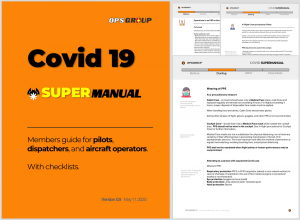
Covid SuperManual for Flight Operations

Hi members,

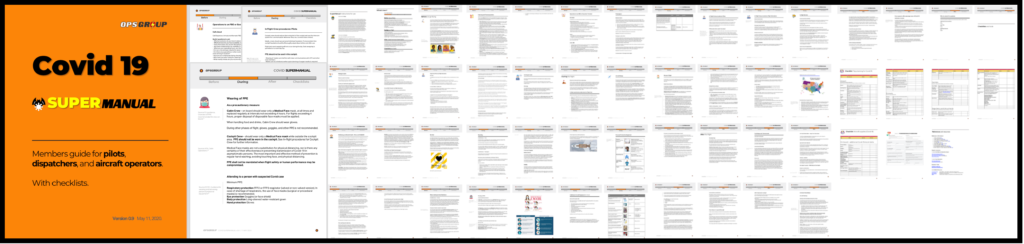
The OPSGROUP Covid-19 SuperManual is ready! Before we get into it, a BIG thank you to everyone that took part in this huge effort. The team here received 100 or so individual Operations Manuals and Flight Ops Bulletins, and that’s what this ‘Super Manual’ is: a collation of all of the group knowledge and procedures around Covid.

This is OPSGROUP at its best – you guys coming together to share your piece of the puzzle, and then we put them all together and get the full picture out to the whole group. So, well done everyone!


What’s in the “Covid Super Manual” ?


We’ve divided the manual into four areas around phases of flight: Before, During, After … and a Checklists section.

Before we go flying

About Covid, Precautions, Off duty crew and staff
Going to work, Health Check, Illness at work, Dispatchers
Flight Crew – Fit to fly, License, medical and recency, keeping aircraft and crew current
Wellbeing and Mental Health: How to find calm, Be Kind
Planning a flight, Crew pairings and planning
Aircraft cleaning and preparation, Risks: Hand Sanitizers, Dangerous Good regulations
Catering and Food preparation, Operations to an FBO or Executive Terminal, Passengers
Arriving at work, Briefings

During our flight

In-flight considerations
Aircraft Setup, Boarding, Temperature Checks, Baggage, Seating
Wearing of PPE (Personal Protective Equipment)
Additional Aircraft Equipment
In flight Crew procedures: Pilots, Flight Attendants, In-flight Service
Illness in Flight – Crew actions, Dispatch actions, Cleaning procedure

After – back home (or downroute)

Disembarking
Tech Stops and Turnarounds, Interim Cleaning, Walkaround
Arrival at Destination, Waste Disposal, Cleaning at outstation
Overnights/Layovers, Hotel guidance, Crew PPE kits
Crew Illness away from Home base
AOG/Unplanned overnight
Arrival at Home base,
Aircraft Cleaning, Cockpit cleaning
Crew exposure, Contact tracing

Checklists

Checklist: Trip planning in Covid-19
Checklist: Aircraft supplies
Passenger Health Screening form example


Some things to highlight
: these were the most discussed areas in the SuperManual work group:

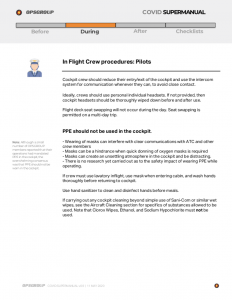
  • Cockpit PPE, to wear or not to wear. Although there is no specific guidance (yet) from authorities, the vast majority of operators are opting for the rule “No PPE to be worn on the Flight Deck” – considering the risks and impact on ATC comms, intra-crew comms, quick donning of oxygen masks, and the unknown potential impact of wearing masks and gloves. We have therefore opted for this play-it-safe approach – the safety of the flight comes before any potential (and seemingly unlikely) benefit from wearing masks while flying.
  • Dangerous Goods regulations. Operators need to check the rules as they apply to your own operation, but for most, carrying hand sanitizers on board in galleys and cabins requires approval from your Aviation Authority.
  • Aircraft Cleaning. Before you rush to wipe everything down, check the section on cleaning for some materials that should not be used as they will degrade the paintwork and cause damage to aircraft parts.
  • Illness in Flight. We saw this in almost every manual, with some wildly differing versions. So, in the SuperManual, there are 2 full pages on how to handle this, have a read.


How to use the SuperManual

  • Use it as a “Oh, I hadn’t thought of that” – read through and see what might apply to your operation
  • Remember that OPSGROUP is a mix of operators: some airline, some corporate, charter, private ops, military, and others. Not everything will apply to your operation. So, when you copy and paste into your own manual, apply common sense
  • Use the sources in the left column to double check the latest situation and guidance from authorities. Things are changing fast, and this might be out of date soon. Also, it might just be plain wrong. Don’t believe everything you read!

Example page with source notes:

Take part in the next round

  • This is version 0.9. We might not get to a v1.0 for a while, until more of the manual is backed up by official guidance, but this is everything we’ve seen and know in the group right now.
  • If you want the next version sent to you directly, send us what you have. As with all the 100 or so manuals we’ve already received, none of the original manual is shared or identified, everything is anonymous, and once we’ve had a look we’ll delete the manual. Top secret stuff, we know!

Download the Covid SuperManual:

  • Get it in your Dashboard: right here
  • Or, check your email – all members received a copy on publication.


Wednesday, May 13th @ 4pm Eastern, 8pm UTC

A special OpsChat around Flight Operations and Covid-19, to coincide with the release of the OPSGROUP Covid-19 SuperManual. More on that here.

A recording of the OpsChat will be available in the Dashboard shortly.


Questions?

Let us know – team@ops.group. We’d love to hear feedback on the manual, what might make it better, additions, corrections, improvements … and if you have a manual to share for the next version, please do send it to us.

Cheers,
The OPSGROUP Team.


OPSCHAT: 13th May 2020 – Flight Ops and Covid

It won’t look anything like the cheesy corporate picture above, but we’re going to have a special OpsChat around Flight Operations and Covid-19, to coincide with the release of the OPSGROUP Covid-19 SuperManual.

When: Wednesday, May 13th @ 4pm Eastern, 8pm UTC
(Weds 1pm San Francisco, 4pm New York, 9pm London, 10pm Berlin, Thurs 4am Hong Kong, 8am Auckland)


We’ll focus on these areas:

  • Going to work, Health Check, Illness at work, Dispatchers
  • Flight Crew: Fit to fly, License, medical, keeping aircraft and crew current
  • Wellbeing and Mental Health: How to find calm, Be Kind
  • Aircraft cleaning and preparation, Risks: Hand Sanitizers, Dangerous Good regulations
  • Aircraft Setup, Boarding, Temperature Checks, Baggage, Seating
  • Wearing of PPE (Personal Protective Equipment)
  • Additional Aircraft Equipment
  • In flight Crew procedures: Pilots, Flight Attendants, In-flight Service
  • Illness in Flight – Crew actions, Dispatch actions, Cleaning procedure
  • Overnights/Layovers, Hotel guidance, Crew PPE kits
  • Crew Illness away from Home base

Join us – the usual way, register here, get Zoom, and jump on at 4pm EST on Wednesday.

Have a look at the OPSGROUP Covid-19 SuperManual, we’ll get into that on the call.