The Art of the Threat Based Briefing

Have your briefings become a “one-size fits all solution serving as a repository for redundant verbal crew crosschecks of highly automated, highly reliable systems”?

If the briefings at your operation sound a bit like that, then read on for some suggestions on ways you might fix ‘em up…

First up, a reminder of why we brief?

We brief because we want to try to identify anything that might mess up our flight up, and work out how to stop it before it gets the chance to. That includes identifying anything silly the other person might be planning on doing, so it’s good to include them on it too.

The word ‘brief’ actually means a bunch of things – of short duration, a set of instructions, underwear – which all seem fairly appropriate to what we are using it for (underwear being the inner line of support, defence and protection when things get really scary…)
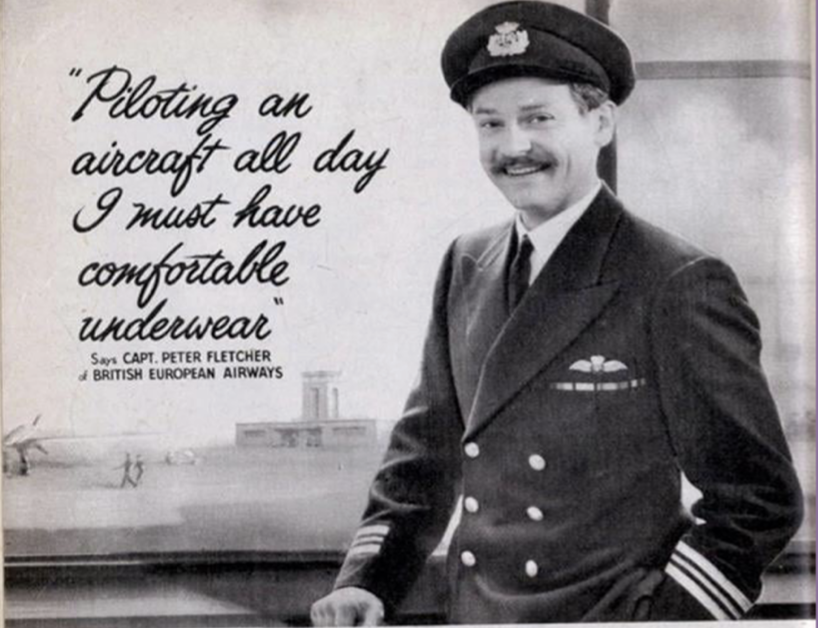
Briefs are important.

So, what do we want our brief to contain?

We want our briefing to cover any threats and possible errors we spot out in the big wide world, and we also want it to involve some ideas on how to mitigate against these.

If you’re not sure then we find this list handy. If you say yes to any of these, talk about it:

  • Does something feel scary?
  • Does something look hard?
  • Does anything seem weird?
  • Is there a chance you’ll do something stupid?

And what don’t we want it to contain?

  • Too much waffle.
  • Too much explaining ‘how to fly’ to the person next to you (they probably know already).
  • Stating the obvious or listing SOPs that you both know anyway.
  • A plan for absolutely everything possible, including what to do if a Pterodactyl attacks. It just isn’t necessary.

Any of these will definitely result in your co-pilot shutting off and not listening even to the bits you do need them to hear.

So how do we do this?

Well, we can play a sort of ‘I-Spy’ game.

I spy with my little eye, something beginning with M.”

“Merr.. Muu…Maaa…Mountain?”

“Yes, one point to the co-pilot!”

Or we can be a little more structured about it and follow a method which helps remind us of the big stuff to look out for. We have one to share, which is summed up in the nice tidy acronym: C-TWO-F-U. You might like it, you might not. But here it is.

C is for Charts

We probably want to take a fairly close look at these since they are what we need to follow, and they often lay out some of the big threats for us.

Taxi charts, arrival, departure, approach charts… A quick confirmation of the date to make sure it is the valid one is important, but after that really you are looking to do two things here:

  1. Look for anything unusual, threatish or dangerous on the charts. A lot of them include some really useful little notes actually. 
  2. It is no good briefing a chart to death if it isn’t what you then fly. A confirmation that what you’re talking about is what you’ve programmed into the box (tracks, altitudes, speed constraints etc) is also important. Think of it as briefing your airplane too.
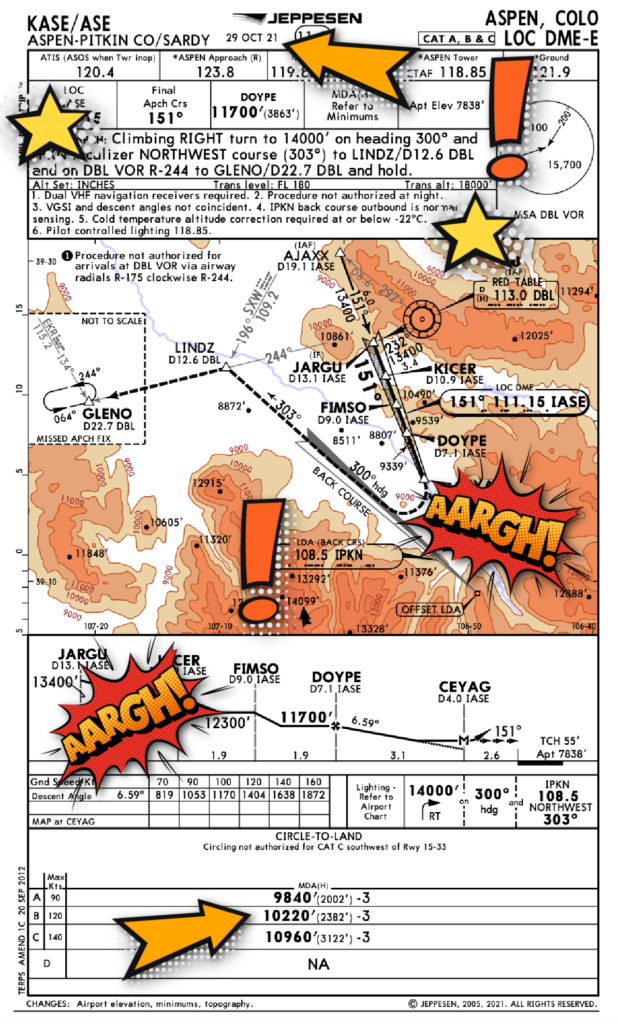
To be honest, a bad example because everything on here is horrifying and worth pointing out.

T is for Terrain

Why does terrain get its own section? Well, because it’s big and if you get it wrong it’s nasty. C-FITs (Controlled Flight Into Terrain) are one of the biggest common accident types. From 2001-2020, CFIT accidents were the second largest category (21%) behind LOC-I (33%).

So, take a look at the terrain and more importantly what it might do to you.

  • Turbulence.
  • Weird turns required.
  • Mega RODs (after you’re over it).
  • Constraints on the way out. Or the way in for that matter.
  • High elevation.
  • Climb performance problems.
  • Missed approach gradient problems.

But remember – don’t just scare the pilot next to you with a list of horrifying ‘death threats’ – try to explain how you reckon you should deal with it all as well.

W is for Weather

Another big one. Review it for that specific flight. No point talking about wind shear if it’s a lovely calm day – what would be the point?

It isn’t a lovely calm day? Well, whatcha gonna do about it? Which heading do you want to avoid that mega storm? Do you maybe want to run the performance again since the runway is covered in ice?

O is for Operational

You might have covered some of this earlier so don’t go re-listing it all again. Here are some ideas though:

  • Aircraft: Talk about any MELs, CDLs, random or specific procedures you might have to consider for that flight. 
  • Airport: Are there any NOTAMs, specific procedures (Noise Abatement Procedures perhaps?), altimeter setting procedures (metric, or low transition alts)? 
  • Crew: Talk about yourselves, any threats there? I like to mention things like how irritable I might be because I didn’t have lunch.
  • How you’ll fly it all: Share your autopilot usage plans and stuff like that.
  • Performance: A good time to check this and make sure you’ve done it, and you’ve set it up in the box properly in terms of speeds, flex, all that stuff.

F is for Fuel

Check you have what you wanted and check it’s still what you need.

U is for yoU?

I added this in because I thought ‘FU’ sounded funny. Really this is just a last “any questions?” Or a “anything I’ve missed that yoU can think of?” moment.
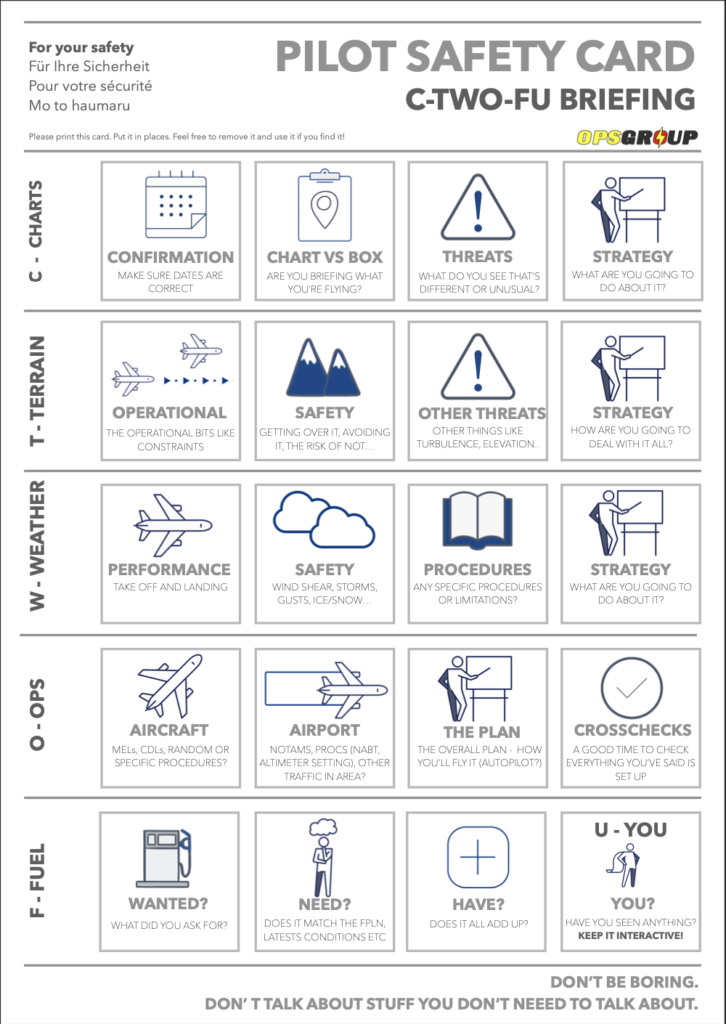
Here’s something we made for you. Click on it for the printable one.

How do we brief?

If we do the briefing out loud then it definitely helps – few of us are mind readers. If you make it interactive – well then now you’ve got two pilots both thinking about it and working it out together. Bonus.

I said it before, a quick reminder again – a good threat based briefing is about identifying threats specific for that day, for that flight, and then coming up with strategies for preventing them.

What?: A steeper than normal approach gradient? Ok, great, spotted it.

Why?: That could be a threat to our stabilisation and speed control. So what to do about it?

How?: Configure early, get the PM to keep an eye on that speed, be prepared to go-around if it becomes unstabilized.

Any other methods?

Airbus have recently changed their recommended briefing method and it is now super simple. All SOPs, standard stuff, checks etc are out, and the briefing now follows this format:

PM: Begins the briefing with the general plan – runway, SID, stop altitude and any extra fuel

PF: Talks through the general strategy – how to get to the runway (including any taxi hotspots), how to fly the SID (use of automation), any Notams or operational stuff to affect it all, and any other relevant stuff specific for that flight on that day.

PM: Raises any threats they spot

PF: Talks through how to mitigate those threat.

Watch it in action here (and you don’t have to be Airbus to use this!)

Brief done!

That’s the why, the what and the how…

A decent threat based briefing any time you head in or out of any airport is important. If you’ve just been there earlier that day, maybe don’t repeat the whole thing all over again though.

And what about when you are heading to an airport you are not familiar with? At Opsgroup we like to put together Airport Lowdowns. These are briefing aids that you might find handy because they include information from other members (other people who have been there before!) to try and give you a heads up on what to expect.

They are just trying to capture some of those Big Threats that you might want to think about and talk about in your briefings. You can find them in the Documents Library on your Dashboard, but if you want email us and we’ll see if we can put together one for you.
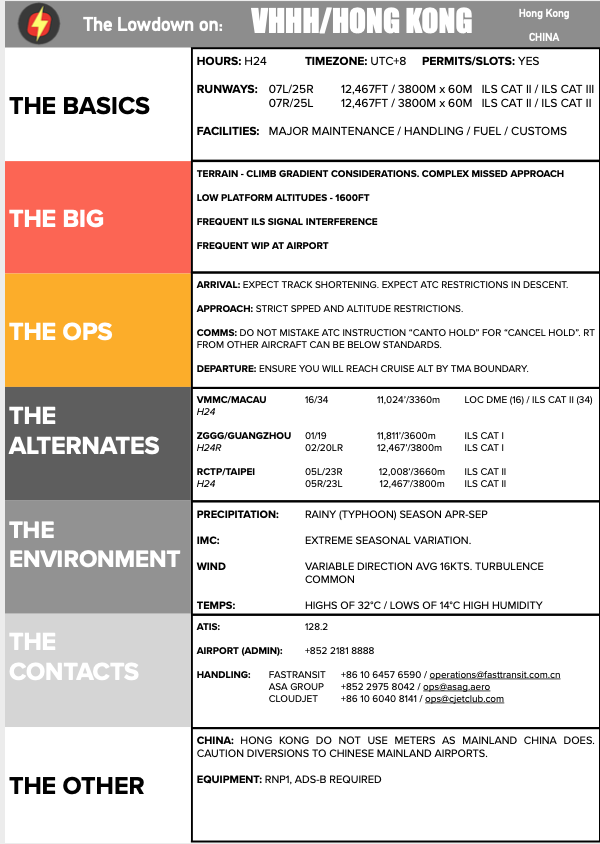
The Lowdowns look like this

Further Reading

  • Here’s the article on how arrival and departure briefings might not be up to scratch, which sparked the lightbulb for us with our article.
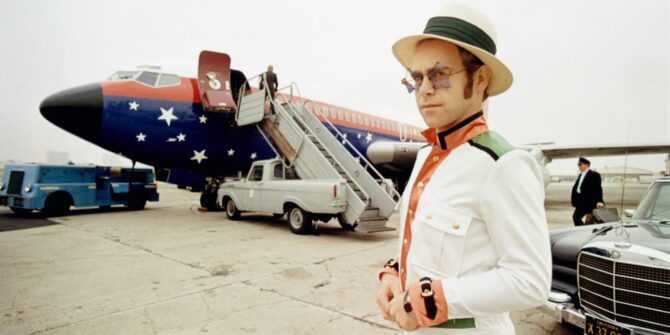
Introducing: Airport Operational Lowdowns

Ever been bamboozled when flying into airports you’ve never been to before? You’re on your approach and all looks good – straightforward, easy, no threats – and then, they cut 50nm off your arrival track and suddenly you’re high and fast and this is when your co-pilot (who has been there before) turns around and says – “Oh yeah, they always do that!”

Or what about that airport where they built a really big hanger in a really silly spot, and you don’t find out about the wind shear off it until you are there, at 30 feet, battling with it?

Calling All Pilots… 

  • All pilots who operate into random, challenging or interesting airports.
  • All pilots who do not operate into the same airports regularly.
  • And all operators, ATC, anyone with a bit of knowledge about an airport for that matter.

Following on from our OpsChat where some of you raised the idea of briefings on specific airports, we have started to put these together…

What’s the idea?

The idea is a lot of pilots, particularly corporate folk (but this is still for everyone) might not have access to loads of shared information on specific airports. If you do not fly somewhere regularly, or do not work for a big airline, then the only information you will have on certain airports is what you can read off the charts and in the AOIs.

But we all know there are airports out there which have specific challenges you only discover when you operate in. The useful, practical, operational stuff. The threats, risks and gotchas that you discover with experience.

Introducing: Operational Lowdowns

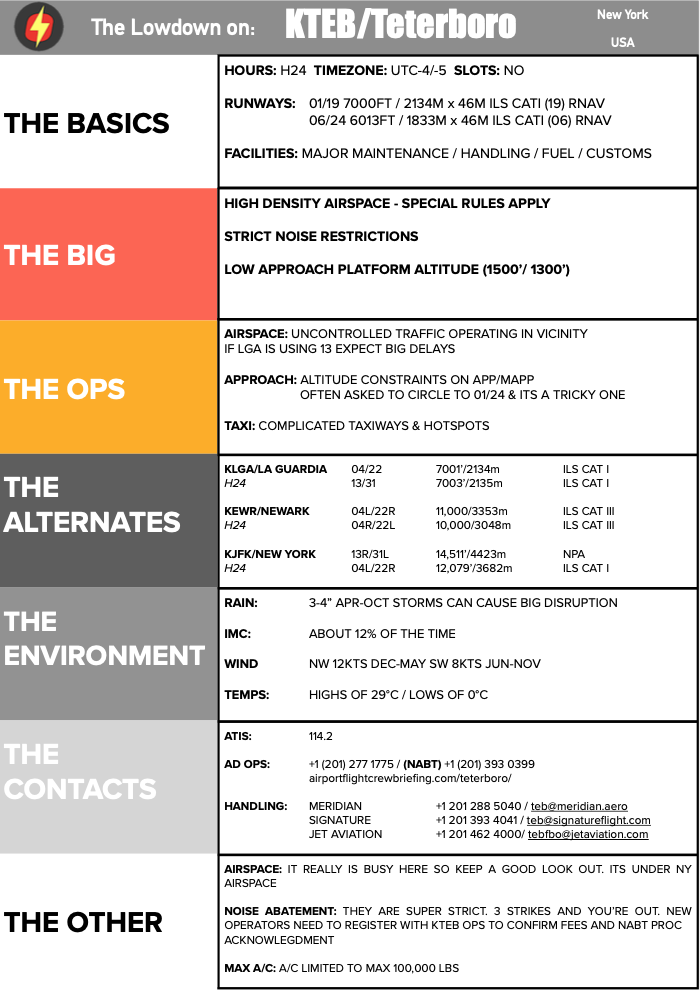
Our Operational Lowdowns are our new way of trying to share this information between you all.

If you have experience going into an airport and spotted something unusual, odd, tricky or interesting then send in that Airport Spy report. Or even drop us an email with a full lowdown about it.

If you are operating into a new airport and want some additional info before you go, then check the airport on our Airport Spy app – there might already be a Lowdown Briefing in there. If there isn’t, let us know and we will do some digging and try and put one together for you.

Sharing is caring…

… and it is also safety!

Knowing about specific operational challenges, environmental threats and tricky procedures before you get there, so you can BRIEF about it and come up with a plan to mitigate any risks, is important.

So we hope you find these useful, and keep getting in touch with info you have to share, and what info you would like to know.

Take a look at the Operational Lowdown for KTEB if you want to see what we’re talking about 😃 ✈️


November Ops Chat

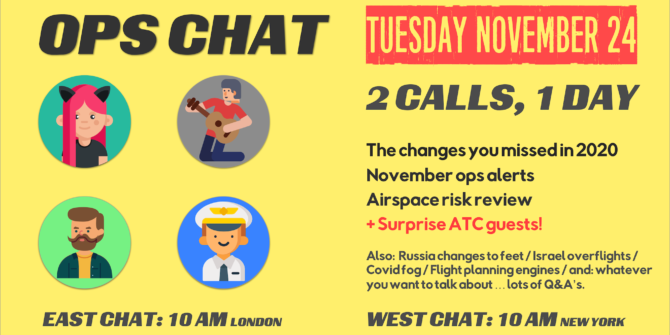
We have decided to run not one, but two Ops Chats on Tuesday November 24th!

Why two calls?

The calls have been getting bigger and bigger. So, we’re runing two so there’s more time to talk, answer questions, and make sure that if you want to get a chance to take part, you can. And also, so that you don’t have to stay up until midnight (or worse) if you’re not in the United States.

Who can join?

This is an open call. If you work in international flight ops, you’re welcome to join us.

So, when should I set my alarm for?

The date is Tuesday, November 24th.

Chat 1, the EAST-CHAT is at 10am London time. (10am London, 11am Berlin, 2pm Dubai, 6pm Singapore, or 1000Z)
Register and save your spot at ops.group/eastchat

We will have some lunch.

Chat 2, the WEST-CHAT is at 10am New York time (9 am Paris (Texas), 7 am Forks of Salmon (California, or 1500Z).
Register at ops.group/westchat

So, pick the time that suits you best and join us for a chat. Or, join us for both chats. Your choice!

What are we chatting about?

  • We are getting to the end of this year, and the plan is to get out from the Covid fog and take a look at what else has been going on in 2020.
  • There have been some big changes, and in case you have missed them, we will give you brief rundown of what they are.
  • We will look over the “highlights” of November’s ops alerts.
  • There will be a 2020 Airspace risk review looking at Conflict Zones and changes this year.

Get your questions ready

You can be nice and send these through early (email us) so we can look clever answering them, or you can put us on the spot. But we love questions so prepare some for us.


Monday Briefing: Sinai Airspace avoided, Low Vis creates day of chaos

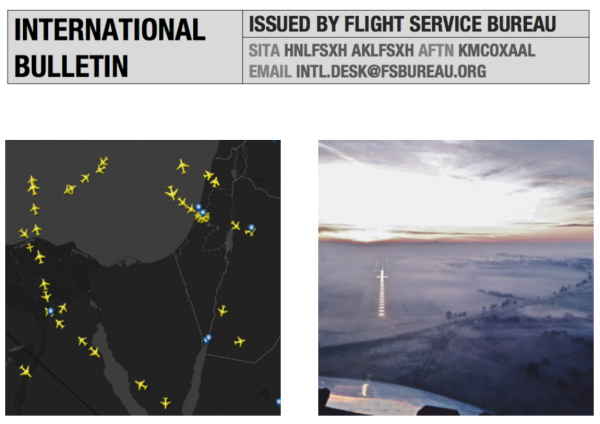
02NOV2015 HECC/Cairo has requested that traffic through PASOS point on the boundary with LCCC/Nicosia FIR be rerouted, effectively closing airway UL550 and the Sinai peninsula. Shown on radar image above, most traffic is avoiding the area that an A321 crashed in on Saturday. No definite link is being made but Authorities and Operators are naturally cautious.

02NOV2015 Conditions perfect for fog across the UK and western Europe are causing widespread delays this morning. Unusually, almost all airports from EGCC/Manchester to EDDF/Frankfurt are affected by the same conditions, with many airports down to 100 metres vis. Most not accepting diversions. See below for further.


EXXX/Europe High delays in most Airports in a square containing EGCC/Manchester, EBBR/Brussels, EDDF/Frankfurt, and EDDH/Hamburg. Total of approx 120,000 slot delay minutes in Eurocontrol system. Other high delay airports include EHAM, EGLL, EGKK, EGSS. Check NOTAMs as most are not accepting diversions either. Fog forecast to be similar again overnight.

VTBB/Bangkok FIR A minimum departure interval of 4-8 minutes between same direction departures is in force from 30OCT for aircraft departing VTCC VTCT VTUU VTUD VTSP VTSG VTSF VTSB VTSM AND VTSS. Delays during peak hours are expected.

UUBC/Grabtsevo New Russian Airport now fully operational with 2200m runway (12/30) and able to accommodate international traffic up to A320/737 size.

UHSS/Yuzhno Sakhalinsk, a common Polar alternate, is closed due runway repairs 1200-2100Z until 01DEC and therefore not available as ALTN for Flight Planning.

NTTA/Tahiti will be without radar on 03NOV after 1800Z. As with all radar outages there is potential for delays and restrictions.

KXXX/USA Runway current closures: BWI-RWY 10/28, SEA-RWY 16C/34C, LAS-RWY 7L-25R.

KSFO/San Francisco will close Taxiway Q and B on 07/08NOV to resolve a pavement issue. This will create a one-in-one-out restriction for aircraft taxiing to and from all gates west of Taxiway Q1. Specifically, this will affect United Airlines, SFOs largest customer, as a majority of its gates are west of Q1. Additionally, the proximity of the closure area to Taxiway B1 will render B1 unusable due to insufficient wing tip and jet blast clearance with the construction area. The loss of Taxiway B1 means that access to the end-around Taxiway Z will be unavailable.

HKXX/Kenya No longer possible to obtain a visa on arrival for passengers. Must now be arranged prior to arrival online at https://account.ecitizen.go.ke/register.

SOOO/Cayenne FIR, South Atlantic – Aircraft not FANS 1A equipped, east of 50W in the Cayenne FIR, can now expect a maximum level of FL310 westbound.

EXXX/Europe The European Business Aviation Association (EBAA) is providing a new tool to calculate Passenger Taxes payable in EU countries. The “PaxTax” tool calculates the total passenger tax for the flight, and breaks down the cost for both departure and arrival for the respective national taxing authorities.

YBBN/Brisbane New $45m international terminal opened 28OCT after 18 months of construction. The facility can handle 7.5m pax annually.

VNxx/NEPAL Fuel supply update: China will supply fuel to Nepal for the first time ever, in response to a dire fuel shortage caused by disrupted supply lines with India. China will supply 1.3 million liters of gasoline, which will be transported to Kathmandu from the border via 100 tanker trucks. Please continue to check local NOTAMs for fuel availability.

DNxx/Nigeria FIR Widespread reports of a strike forcing the closure of Nigeria’s airspace have been deemed unreliable, per the Nigerian CAA. There is unrest and occasional industrial action, but no risk of airspace being closed.

Timezone Changes As DST ends in the Northern Hemisphere, series of clock changes completed on 01NOV as US ended Daylight Savings. Most of Europe completed theirs on 25OCT. Most northern countries are now on Standard Time.

View the complete International Operations Bulletin for 02NOV2015.


Monday Briefing: Security in Caracas, Tripoli, UK Permit rules

Security issues rule out Venezuela, Libya Mar 23: SVMI/Caracas, Venezuela, and HLLT/Tripoli, Libya, should be off your tech stop or charter lists for the foreseeable future. Both airports have been subject to rising security risks over the last months, reaching a climax last week with a bomb attack on RWY 09/27 in Tripoli and increased civil unrest in Caracas.

New rules for UK Permits Mar 23 : Significant changes to the approval process for Landing Permits for the UK will take effect on 06 APR. CAA will take over the responsibility for issuing approvals from the Department for Transport (DFT). Also, previously, a cabotage objection could be raised by a group of UK Charter Operators – this is removed. A fee is likely to be charged by the CAA for permits from this point forward.

SVMI/Caracas, Venezuela Public unrest has raised tensions in the capital to the point where several airlines have suspended service, including Air Canada this past week. Coupled with the security issue is a payment issue, with the Venezuelan government not releasing ticket payments. SVMI remains open and operational, but not recommended. For tech stops, consider TNCC/Curacao just to the north.

Uxxx/Crimea Region. Following the referendum on 16MAR, Crimea is now officially Russian Territory. This places the Simferopol FIR under Russian Control, but service is still provided by Ukraine. Simferopol Sectors 3,4 and 5 are now controlled by Odesa, and Sectors 1 and 2 are controlled by Dnipropetrvosk. UKFF/Simferopol and UKFB/Sevastopol are closed to civil traffic. No decision has yet been made by the Russian CAA as to whether permits will be required to overfly Crimea. It seems unlikely that there will be any change to the present ‘no permit required’ situation in the coming weeks at least, though when Simferopol Airport reopens we would anticipate Landing Permits being required through Russia.

VTSP/Phuket – International restrictions due to construction until 31MAR. Slot and PPR require 48HR PN, Landing Permit requests should allow 10 days.

LIxx/Italy ATC Industrial action announced for 30MAR 1030-1430Z. For this and subsequent strikes, ENAC, the Italian provider, will accept a limited number of pre-arranged flights from each AO.

EHAA/Amsterdam FIR Due to Nuclear Summit in the Hague on 24 and 25MAR, most of the FIR is accessible by Prior Permission only, including all flights to EHAM, EHRD, EHEH. Contact nss.ppr@minienm.nl or +31 (0) 577453696.
LLOV/Ovda, Israel will be closed to all flights 01MAY-07MAY

DGAA/Accra, Ghana Until 23JUN, The main runway (03/21) is open daily from 0500-2300Z only; no traffic accepted outside these hours.

YPXM/Christmas Island is closed and unmanned at present due to a Cyclone.

HLLT/Tripoli, Libya was subject to a bomb attack on Friday. The device was placed on the centerline of RWY09/27 overnight and detonated with a timer. Most regular operators cancelled flights immediately, with no set date to resume operations.

OSDI/Damascus FIR – For those still overflying, Syria has closed airway L513 from BURSA to LEBOR UFN.
UK Charter Permits. Significant changes to the approval process for Landing Permits for the UK will take effect on 06 APR. CAA will take over the responsibility for issuing approvals from the Department for Transport (DFT). Also, previously, a cabotage objection could be raised by a group of UK Charter Operators – this is removed. A fee is likely to be charged by the CAA for permits from this point forward.

Turkey. Effective 10APR2014 Visa on Arrival is no longer available at Turkish Airports. Visitors must apply online through https://www.evisa.gov.tr/en/ for an e-Visa.

Australia. A reminder to all operators who are not ADS-B equipped, of the restrictions when operating into Australian Airspace effective from 15DEC13. If you not ADS-B equipped you must file with CASA, a Form 208 exemption application 14 days in advance of proposed operations into Australian Airspace. Then operations will be confined to the SSR radar coverage area extending from 200 nm north of Cairns down the East coast to 200 nm west of Adelaide. This is commonly referred to as the J curve. If you intend operating into the Brisbane or Melbourne FIRs from the west and north west of Australia, and are not ADB-B equipped you will be required to operate at FL290 or below.

URSS/Sochi Starting from 20JAN, including period of XXII Winter Olympic Games and XI Winter Paralympic Games 2014, airlines are obliged to send the passenger manifest with exact Name, Surname, Passport number and series, or other ID, Ticket number, 24 hours prior to departure and no less then 4 hours prior to departure – passenger manifest changes, when operating to Sochi International airport (IATA code-AER). Information should be sent to the following e-mails: Checkin_DIsp@aer.basel.aero, Chief_smena_SAB@aer.basel.aero. See NOTAM A3075, A4018.