Bali bound and no place to go…
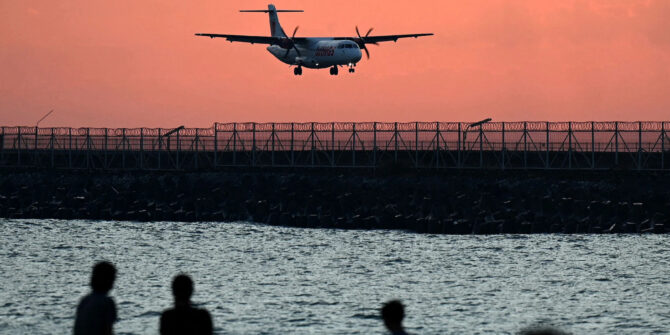
If you’re bound for Bali there are a few things you need to know, especially if it is your first time there. Ops there often seem to get disrupted, and you’ll need the option of having someplace else to go. Figuring out where – especially at night – may be harder than you think.

Let’s take a closer look.

At face value, ops at Bali seem straight forward. The runway is long, there is an instrument approach at both ends, SIDs and STARs link everything up and the place is towered 24/7.

But after years of flying in there with a scheduled operator, the number one biggest threat remained fuel in the tanks when it all went pear-shaped – which it sometimes did.

The airport just seems to have a habit of eroding your fuel margins. You may be carrying a healthy alternate enroute, but beware of giving it all away while holding once you arrive.

Delays and short notice closures.

The airport is especially vulnerable to them, and they can be unpredictable. Here’s why.

 1. Weather 

If you’re flying into Bali during rainy season (November – March), weather is likely to be a major factor. Like clockwork, towering cumulus clouds strengthen throughout the day into powerful thunderstorms in the afternoon and evening.

While the TAF may look identical day in and out, it is luck of the draw whether the airport itself will be affected. And when it is, traffic backs up quickly.
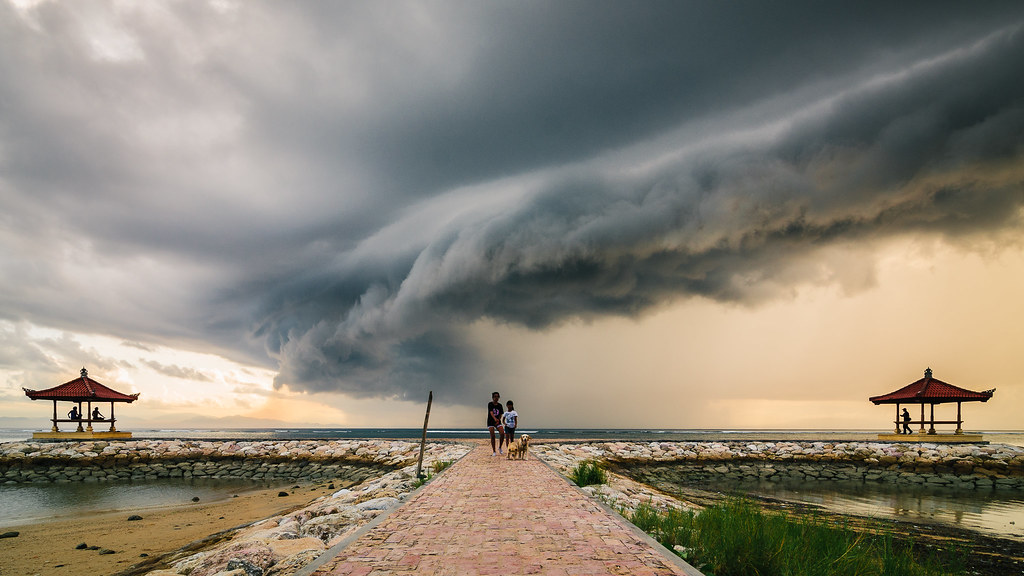
Severe thunderstorms are common in Bali during the wet season.

 2. Volcanic Ash 

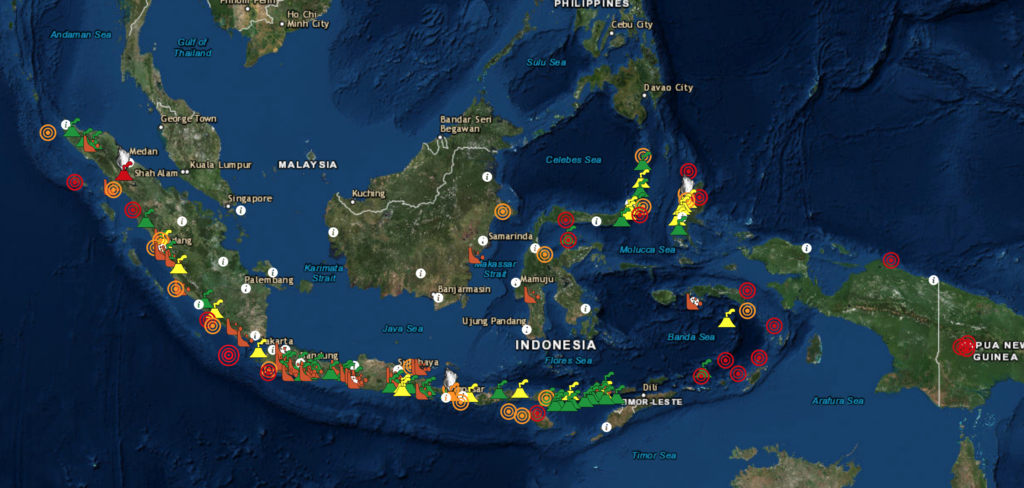
Indonesia rests on the western portion of the Ring of Fire which renders it the third most volcanically active region on earth. There are no less than one hundred and forty-seven volcanoes there, seventy-six of which are currently active.

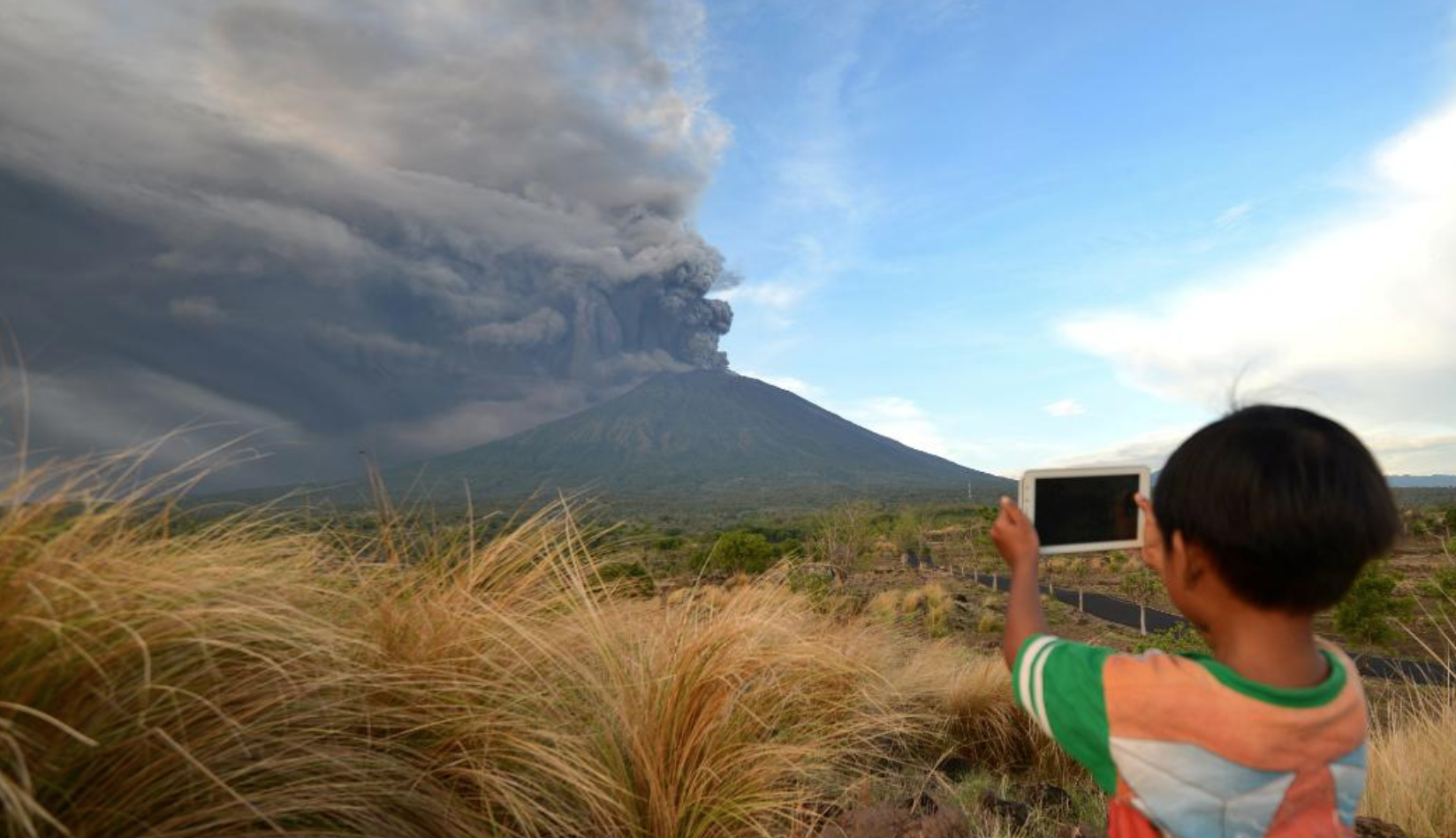
Eruptions are frequent and occur with little warning causing major disruptions to airports throughout the country – and extensive ash plumes. They can close airports like Bali for days on end, like one did in 2017. And the situation can develop when you’re already airborne.

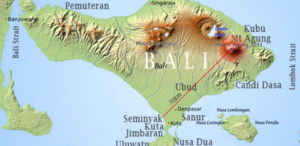
The closest volcano to WADD/Bali airport is less than 40nm away.

Mount Agung erupted in 2017, closing Bali for several days. Courtesy: IBTimes UK

 3. VIP Movements 

Yep, someone important is inbound. And guess who has to make way? The airport often gets closed for short periods for VIP movements. You’ll find them in the Notams from time-to-time. Take it from me – apply a healthy buffer to either side as ATC will not necessarily be able to provide you with an accurate time the airport will re-open while you’re racing around that holding pattern.
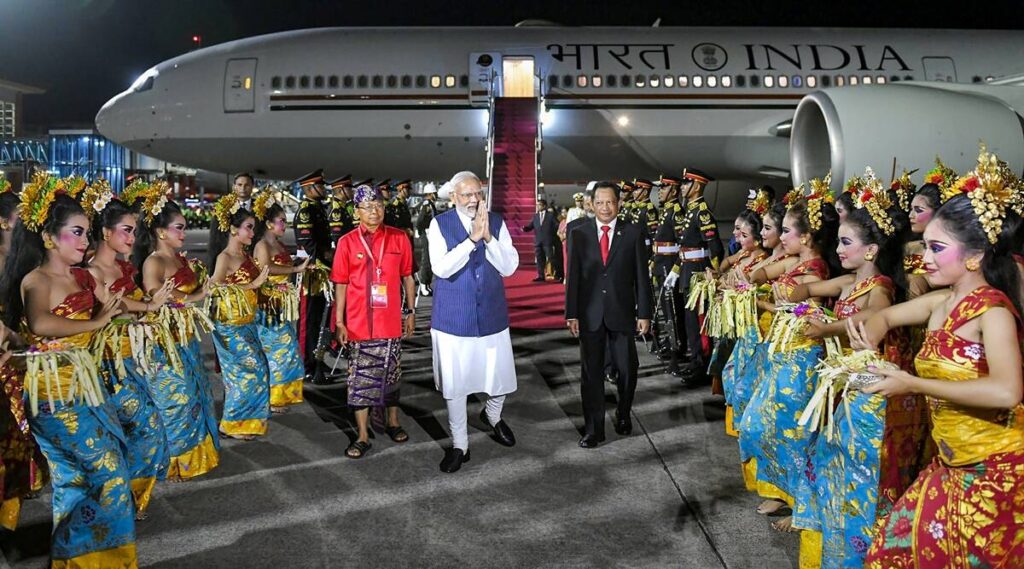
VIP movements can occasionally close the airport.

4. Traffic Jams 

WADD/Denpasar is Indonesia’s second busiest airport second only to Jakarta. Which means it sees a lot of traffic. It also occupies a busy air corridor linking Europe to Oceania. Controllers manage a steady flow of both regional and international traffic from both directions.

It can be difficult to predict the effect of this ahead of time, but it is not unusual to hold inbound on your STAR. And you likely won’t have a head’s up beforehand that it is coming. Extra fuel for traffic holding is absolutely necessary.

 5. Congested Frequencies 

If you’re getting low on fuel, make a decision early. Don’t wait.

ATC has to manage large pieces of airspace here. On Ujung especially it can be challenging getting heard. Controllers are often managing multiple frequencies – it may seem like you’re being ignored, but you may not be able to hear everyone else talking to controllers over the top of you.

The language barrier can also be an issue – English will likely not be your controller’s first language, and their accents can make them hard to understand. The moral of the story is to be assertive on the radio, and speak slowly and clearly. Try and stick to standard phraseology such as ‘minimum fuel.’ And don’t take a back seat when trying to get an urgent request granted.

But where to go?

If you’re heading into Bali late, you’ll need to pay special attention to alternate planning. All the airports in the region still have special operating hours in place to “avoid the spread of Covid”, as per their notams. At present, WADD/Bali itself is open until 18z (02:00am local) but its closest alternatives are not.

Lombok (WADL/Praya), 85nm. Closed each night from 12z (20:00 local). [Notam B2226/22, valid until Feb 19].

Surabaya (WARR/Juanda) , 160nm. Closed each night from 14z (22:00 local). [Notam A2938/22, valid until Feb 18, actually due to runway closure for works].

Semarang (WAHS/Semarang), 295nm. Closed each night from 12z (20:00 local). [Notam B2231/22, valid until Feb 18].

If it’s late, you’ll need to carry more fuel than usual to reach WAAA/Makassar 320nm away, or WIII/Jakarta 512nm away.
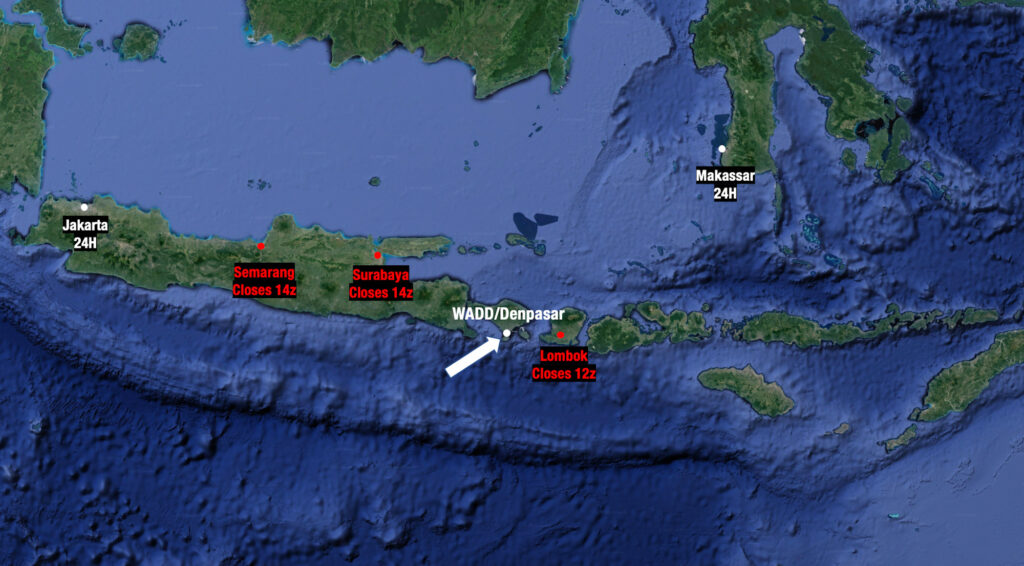
Three of Denpasar’s closest alternates close at night.

And finally – watch out for terrain!

There are some big hills out there. If you’re flying into Bali, there’s a good chance you may yourself under radar vectors at night or in IMC nearby. Protect your aircraft – keep a close eye on where you are relative to that terrain at all times. Especially when it’s busy!

Aircraft arriving from or departing to the northwest need to be particularly wary. Sector MSA just north of the airport rises steeply to 9700’. Further west you’ll find Central and East Java with grid MORAs as high as 14,000’. Also be aware of escape routes if your cabin springs a leak.

Ongoing Bali volcanic threat – update

Update June 29, 2018:

Following the volcanic eruption on Jun 28 at Bali’s Mount Agung, the airport has been closed all morning today, Jun 29, and only just reopened at 1430 local time (0630z). Over 500 flights have already been cancelled as a result. Big delays expected all day and into the weekend. Further closures due to volcanic ash are still possible.

Per latest report from Darwin VAAC, there is a volcanic ash cloud observed up to FL160 in the area, but they predict winds will carry the ash southwest toward Java, Indonesia’s most densely populated island.


In Short: Continued vigilance required for operations to Bali; The alert level for Mt Agung eruption remains at 3 (on a scale of 1-4). Last ash plume on 26 March rose to at least an altitude of 11,650 ft.

When Mount Agung erupted in November 2017, airlines faced travel chaos as flights were cancelled due to the lingering ash cloud. Since then, visitor arrivals have dropped by more than 70 percent. Facing $1bn in lost tourist revenue, the Indonesian government is trying to lure tourists back to the holiday island.

The 3,000metre high volcano sits roughly 70 kilometres away from the tropical paradise’s main airport and popular tourist areas.

In a Volcano Observatory Notice for Aviation (VONA), Volcanological Survey of Indonesia (PVMBG) reported that at 1009 on 26 March an event at Agung generated an ash plume that rose at least to an altitude of 3.6 km (11,650 ft) a.s.l. and drifted NW. The Alert Level remained at 3 (on a scale of 1-4) and the exclusion zone continued at a 4-km radius.

Best up-to-date information:

The current one to watch:

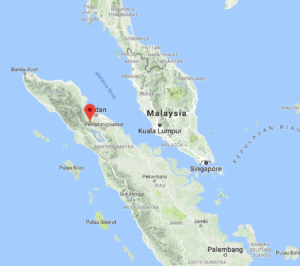
Mount Sinabung – located in Medan, Indonesia is also very active at the moment (last spewing ash on Friday April 6) and may disrupt air operations to Malaysia and Singapore.
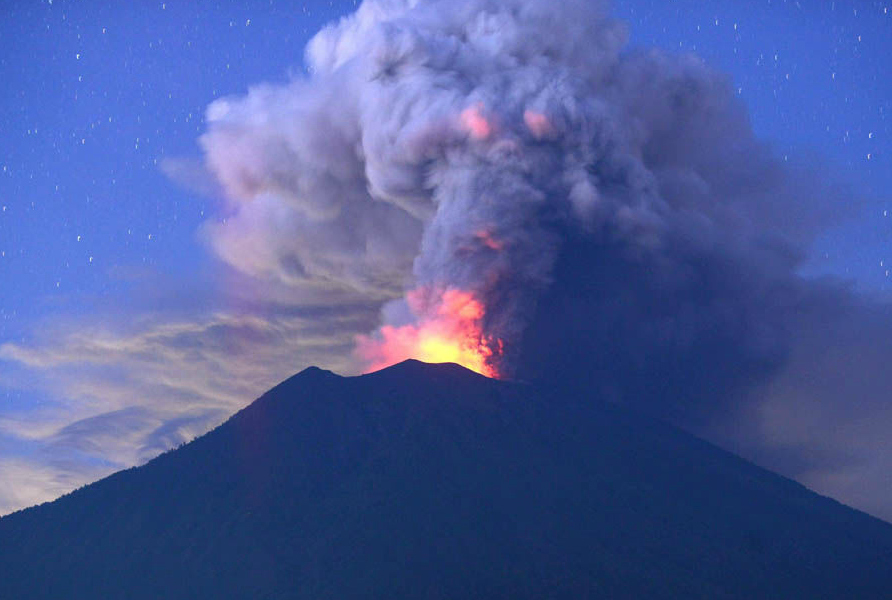
Current Aviation Color Code: RED, Eruption with volcanic ash cloud at 09:07 UTC (16:07 local). Eruption and ash emission is continuing. Ash-cloud moving to west – south. Best estimate of ash-cloud top is around 23872 FT (7460 M) above sea level, may be higher than what can be observed clearly. Source of height data: ground observer.”

We will keep an eye on this one.

Mount Sinabung roared back to life in 2010 for the first time in 400 years. After another period of inactivity it erupted once more in 2013, and has remained highly active since.

If you have travelled through the region lately and can provide members with more of an update, please get in touch. 


Bali – Airport Status

Volcanic eruptions from Bali’s Mount Agung earlier last week forced the closure of WADD/Denpasar and WADL/Lombok airports, as volcanic ash spread across both islands.

Here’s the current situation at the airports on Dec 4:

  • WADD/Bali: Re-opened on Nov 29. (Although the airport will be closed for runway repair from 18-23z daily [except Saturdays] until Dec 31).
  • WADL/Lombok: Re-opened on Nov 30. 
  • WARR/Juanda: Open and operating. So far has not been affected at all by the volcanic ash. (Although the airport will be closed for runway repair from 16-22z daily until Jan 06).

Although Mount Agung has now stopped emitting ash, another large eruption is still likely. The local monitoring agency are registering powerful and continuous tremors, and authorities have ordered locals and journalists within 10km of the volcano to evacuate. Further intermittent airport closures are possible, depending on wind direction.

We will keep this page updated with the latest news as we get it.


Midweek Briefing: Where is Zika, Elevated North Korea Risk

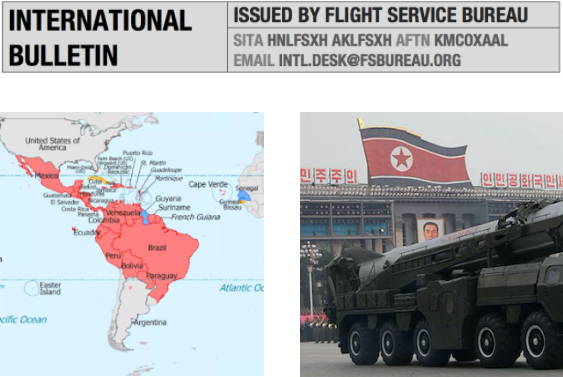
Where is Zika? 24AUG With the again-increasing levels of Zika infection worldwide, this updated map will be useful to operators. Check Zika Map.

North Korean Risk Elevated 24AUG We’ve published an updated Unsafe Airspace Summary today, which elevates North Korea to Level 2 in our warning list. In 2016, there have been increased instances of medium-range ballistic missile (MRBM) launches without prior warning. Read the article


DIAP/Ivory Coast issued a Notam last Friday advising of ‘serious risks to safety’ when operating through the Tripoli FIR. Not many operators are entering this airspace, but it’s unusual for a non-adjoining country to issue advice like this, so we’ll mention it.

SPZO/Cuzco, Peru is busy at the moment; non-scheduled and GA flights cannot park overnight, and there are Traffic Management procedures inbound. Don’t forget if operating to Cuzco that special crew training is required.

WADD/Bali Authorities have stepped up security measures at all the entry points on the island, following recent reports of an alleged plot to carry out attacks.

HKNW/Nairobi WIlson is operating normally again after a Police helicopter crashed on take off on Monday, near the control tower.

LLZZ/Israel Israeli aircraft attacked mortar positions in southwestern Syria near the border with the Golan Heights on 22AUG. The airstrikes were apparently in response to mortar fire from the Syrian side of the border.

RJAA/Tokyo Narita is open again after the passage of Typhoon Mindulle. The control tower at Narita was evacuated due to strong winds, the first time this has happened since the 9.0 earthquake in March 2011.

WIZZ/Indonesia has warned its neighbours that haze from forest fires is beginning to cross the Malacca Strait. In 2015 the smog affected Malaysia, Singapore, and Thailand, causing disruptions throughout the region, closing airports and delaying flights.

EDDT/Berlin Tegel Aircraft larger than ICAO Code D, and parking longer than 3 hours, approval of Traffic Management is required. Contact verkehrsplanung-txl@berlin-airport.de, in place until 30Sep.

VEZZ/India Couple of new ICAO codes here, VASD is Shirdi Airport, and VEPY is Pakyong Airport. AFTN connections not yet set up.

LBPD/Plovdiv Reports of lasers directed at departing aircraft. Notify ATC with any details if experienced.

FOZZ/Gabon If you’re arriving into Libreville International Airport you can submit an online visa application at least 72 hours before the date of travel and collect your visa on arrival

BGTL/Thule Updated hours for Radar service – 1100-1900Z Mon-Fri only.

NTAA/Tahiti has a bunch of night-time closures until 03SEP; this is an isolated aerodrome so check carefully in advance of ops.

NWWW/Noumea has ongoing staff shortages in ATC, and therefore interruptions in opening hours for the airport. Check before operating.

VDZZ/Cambodia has introduced a new tourism and business multiple-entry visa, which will allow foreigners to stay in the country for up to three years. The visa will become available on 1 September. The current visa grants visitors a 14-to-31-day stay.

LCLK/Larnaca New ATC Controllers being trained (under supervision)—be nice to them!

FMMM/Antananarivo has a new disinsection procedure for flights arriving from Mauritius; also, all flights from Mauritius must operate to FMMM first before other airports in Madagascar.

HCSM/Mogadishu Due to HF Difficulties, all aircraft in Mogadishu FIR with Satcom are requested to contact Mogadishu FIC on Satcom.  Inmarsat 46601, phones +251-20-762274 or +254-20-2365679.

View the full International Bulletin 24AUG2016


Midweek Briefing 03AUG: TSA/eAPIS increase in US fines, Vanuatu Runway concerns

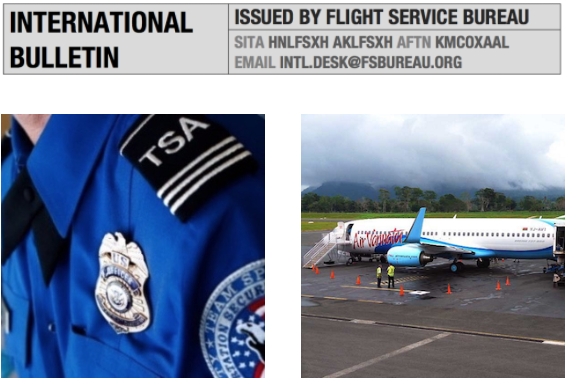
TSA/eAPIS increase in US fines 03AUG Fines and penalties for getting your CBP Arrival/Departure manifest wrong will increase from 01AUG. That means, screw up the eAPIS and you are looking at a potential fine of $1,312. Read the article.

Vanuatu Runway concerns 03AUG Following interim repairs to the runway in Port Vila (NVVV/VLI) earlier this year, concerns have been raised once again about the condition of the runway, with diversions on Monday. Read the article.


LFPZ/Paris Airports Couple of upgrades in progress, LFPO has 06/24 closed until 29AUG, and LFPG is installing a new ILS until 03OCT; both will cause some delays.

YZZZ/Australia The Australian Border Force have announced a strike for Friday, 12 August. This marks a resumption of Industrial Action in Australia after a 3 month ‘ceasefire’ was agreed. The strike period is 24 hours, precise impact not yet clear, but AQIS/Biosecurity/Quarantine will also take part to some degree.

OMDB/Dubai is reopening with a single runway following a full airport closure early on 03AUG due to 777 crash.

UIII/Irkutstk has no air starter available for large aircraft until the end of August.Irkutsk is a common enroute diversion airport.

ZKZZ/North Korea is back in action with the missile launches again, on 03AUG they fired two ballistic missiles, one of which landed in Japanese waters inside the country’s economic exclusion zone. Another missile reportedly exploded immediately after the launch. The missiles were fired at 2250 UTC on 2 August from a region southwest of the North Korean capital city of Pyongyang.

MZZZ/Caribbean Tropical Storm Earl, multiple weather warnings for Jamaica, Caymans, Belize, Guatemala, Mexico.

VABB/Mumbai continues their Continuous Descent Approach trials in the TMA. Interestingly, part of the procedure calls for pilots to call in on 121.9 after landing and report the total amount of fuel saved (how do you work that out?), and then send a detailed brief by email to cdomumbai@aai.aero. We forecast a relatively empty inbox.

AGGH/Honiara has some surface damage on the International Apron, taxi slowly.

SBZZ/Brazil On 02AUG, the mayor of Rio de Janeiro declared 4 August a new public holiday for the Olympic Games. The extra holiday comes after the mayor has already designated 5, 18 and 22 August as public holidays in Rio de Janeiro, and after the city experienced severe traffic congestion with the implementation of Olympic-designated lanes. On 1 August, the Olympic tracks caused more than 60 mi/100 km of traffic jams, with the worst traffic taking place on the Linha Amarela.

DZZZ/Lome UTA Following changes last year to the airspace over Benin and Togo (the two long thin countries squeezed between Ghana and Nigeria) – there’s still some confusion over who does what. In simple: Low Level (FL240 and below) is controlled by Cotonou Approach. High Level (FL250 and above) is controlled by Lome ACC.

EGGW/London Luton will close overnight weekends in November for some big repair work.

HLLL/Tripoli FIR Airstrikes this week by the USAF

LHPP/Pecs has no Jet A1 at the moment, back on 05AUG.

HEZZ/Egypt On 01AUG, reports announced that a semi-private company would take over responsibility for passenger and luggage screening at Sharm el-Sheikh International Airport (HESH/SSH). The same company, which is a joint public-private entity, will take over security at Terminal 2 of Cairo International Airport (HECA/CAI) beginning in October 2016 when the terminal is scheduled to reopen. The company will later take over screening procedures at Hurghada (HEGN/HRG), Borg el-Arab (HEBA/HBE), Marsa Alam (HEMA/RMF), Aswan (HESN/ASW) and Luxor (HELX/LXR) airports. Egyptian police will continue to be responsible for perimeter security around Egyptian airports, including the terminal and the tarmac.

LOWS/Salzburg starts a multilateration (MLAT) trial on 05SEP. Keep your Mode S on, they ask.

SBBZ/Brazil Olympic Games kick off in a few days, if you are operating to Brazil read through the current NOTAMS carefully, there are a bunch of flow restrictions, special routes, and procedures.

FABL/Bloemfontein is carrying out major works during August. Diversions not accepted. Jet A1 is supplied by bowser during this time, and not hydrant as this is also being worked on.

LTZZ/Turkey – post Coup. As of 01AUG, the situation in Turkey continues to stabilize, as the government continues to step up security measures and conduct operations to detain alleged coup plotters. Turkey remains under a state of emergency, which allows the government to drastically restrict civil liberties, and will likely remain so for the next three months. Raids and security operations are continuing throughout the country. Travellers should note that Turkish authorities have reportedly been conducting ID checks in the busier areas of Istanbul. 

 Demonstrations have continued over the past several days. While the threat of violence remains a concern at demonstrations throughout Turkey, most have been conducted peacefully. Travellers should nevertheless take care to avoid such gatherings as a precaution, because violence can occur with little notice. Additionally, terrorists have targeted major demonstrations in the past.

FLFI/Lusaka ACC have called out some AFTN addressing issues, if you are operating to land in Zamabia, then file to FLKKZAZX and FLHNZAZX respectively. OMMM/Muscat ACC has a radar-less day on 18th August, 0600-1700Z. Turn that TCAS up.

WADL/Lombok, Bali has reopened after a closure on Monday 01AUG due to the eruption of Mt. Rinjani. The last closure was in OCT2015.

View the full International Bulletin 03AUG2016