Communication Breakdown on the NAT

Lost comm procedures in the NAT HLA (or when you’re trying to get into the NAT HLA) are a complex and confusing thing, so here is our “Natter on the NAT” – a recap on what to do when nobody wants to talk to you.

You aircraft has lost everything it uses to communicate.

The likelihood of every communication system you have breaking all at once is fairly minimal, and given the equipment requirements to enter the NAT HLA, you are going to have more than just VHF onboard. You will also have HF, datalink, probably SATCOM…

But if it does happen (maybe a freak bolt of mega lightning or something) then the first thing to do is still try each system, including back up boxes, and your headset for that matter.

Still no luck? Don’t panic. While you can’t hear anyone, or talk to anyone, they can all still hear and talk to each other. So you are the only uncoordinated thing out there right now. First up, let ATC know by squawking 7600.
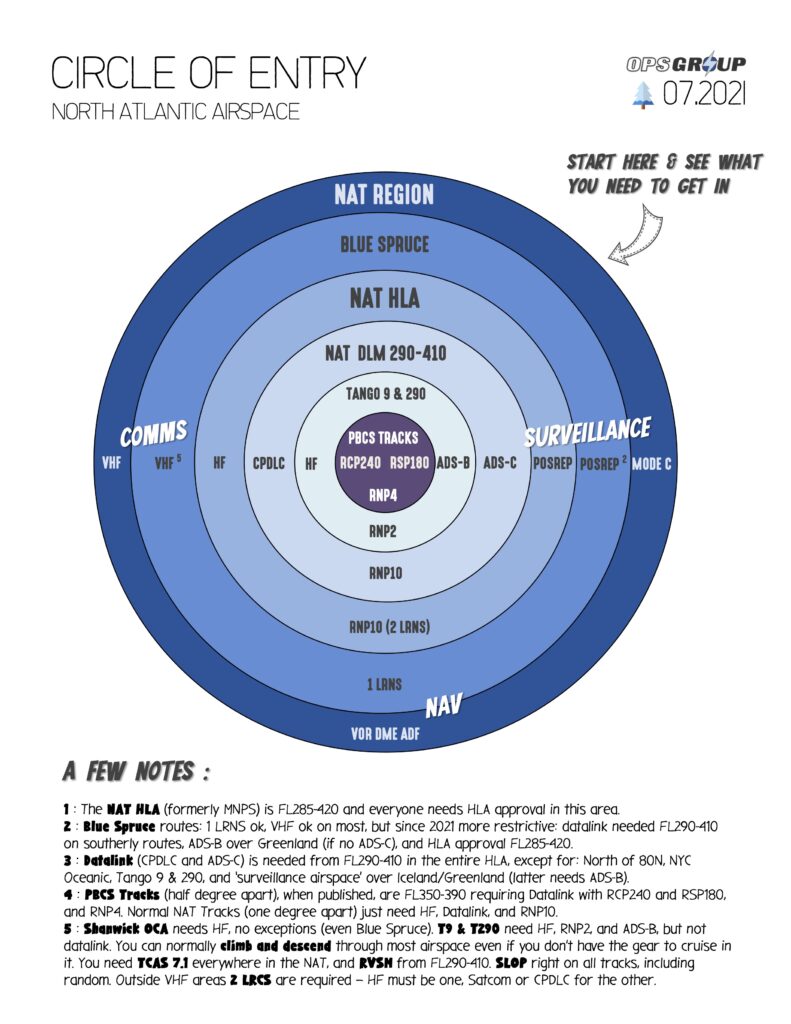
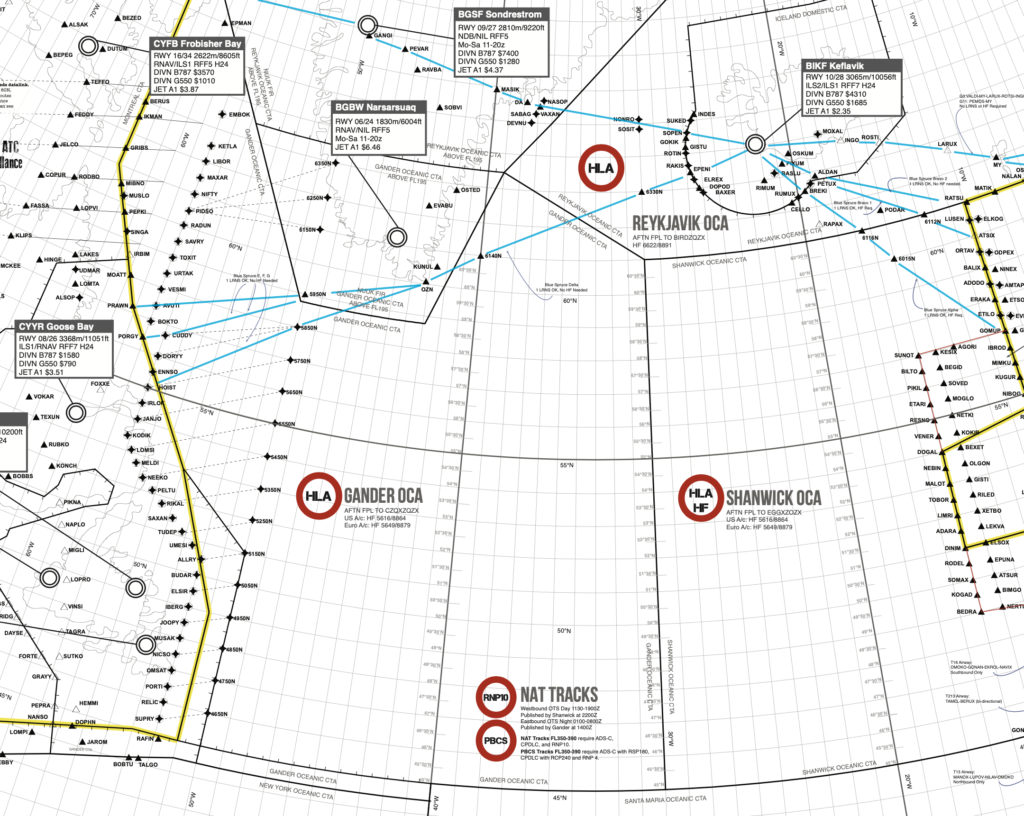
This shows the minimum equipment you need for the NAT HLA.

The next thing to do depends on where in the NAT you are.

Already in it? Great, simple. You already have a clearance and you already know where you are going, so carry on as you are, transmit blind, and once you exit follow the lost comm procedures for the place you are entering.

Not in it, but have a clearance? This is up to you really. You have your clearance (and have confirmed it) so ATC know that you know that they know that you know what you are cleared to do. So if you want to stick to in and head on in you can, but you are going to have to maintain your speed, level etc all the way through. And if you have a weather issue or an emergency you are also going to be on your own.

No clearance yet? This one is a bit tougher. It probably isn’t the best plan to head in (following your flight planned route), especially if you are heading into Shanwick. Shanwick have diversion procedures in place to take you to Shannon and the best idea might be to head there and get yourself fixed.

The exact wording is “it is strongly recommended that a pilot experiencing communications failure whilst still in SHANNON FIR/UIR/SOTA/NOTA does not enter SHANWICK Oceanic Control Area”.

The Irish AIP have the procedures for comms failure if planning on entering and they are worth a read. They have a pretty handy summary of what to do for Shanwick in there.

It is unlikely you will ever lose every system. Check backup boxes and attempt contact via other methods.

You have lost HF

If you’re already in, there isn’t much you can do. Stick to your clearance and keep in contact on CPDLC. Remember, HF frequencies are pretty rubbish at the best of times so if you discovered the failure while trying to make an HF call, then try a different frequency.

Lower ones work better at night, higher ones by day, and always try the middle ones for good measure. Have a quick glance at space weather too because if there are geomagnetic storms forecast it could be there is a general HF blackout going on that is affecting everyone.

Collins Aerospace publish a daily list of HF frequency assignments for their side (the US side) of the North Atlantic and you can find them here.  Worth a look before you fly, if you’re going to be in the US North Atlantic area.

The Comms requirements changed a bit in February 2021, and basically, what they say, is that you need two long-range comms systems if routing anywhere outride VHF coverage. One of these has to be HF.

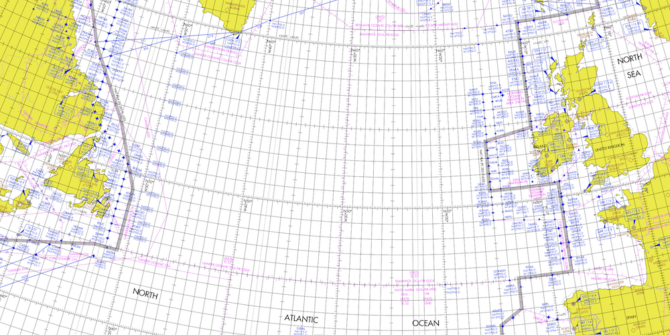
Here is a particularly horrible picture of where VHF has got you covered.

If you’re flying at FL300, this is your VHF coverage.

You can route through if your HF was already broken and you told ATC in advance (Item 18 on the flight plan) and they gave you the thumbs up, but if you are heading there and it goes suddenly before entry then you are going to need to talk to ATC.

Shanwick OCA needs HF, no exceptions (not even the Blue Spruce routes that fall within the Shackwick OCA) so don’t go diverting immediately but do get talking (on whatever else you have available) to sort it out before you enter.

We might as well cover HF blackouts while we’re here.

These happen when space weather happens. They aren’t super common and they are usually minor (lasting 10 minutes or less). But when they do happen, everyone can lose HF, including ATC.

You probably should make position reports on 123.45 to be on the safe side because there might be no coordination between traffic and ATC for the period of the blackout. Keep trying different methods to get hold of ATC as well (but don’t get all crazy at them though – they will be busy and will contact you when able).

Now, because coordination between ATC and everyone else is an issue, they actually don’t want everyone diverting all over the place, so stick with your clearances. The big point here is – if you don’t have a NAT clearance yet, you need to stick to your DOMESTIC clearance. That means you have to stick with what you were most recently told to do, not what you filed for on your flight plan.
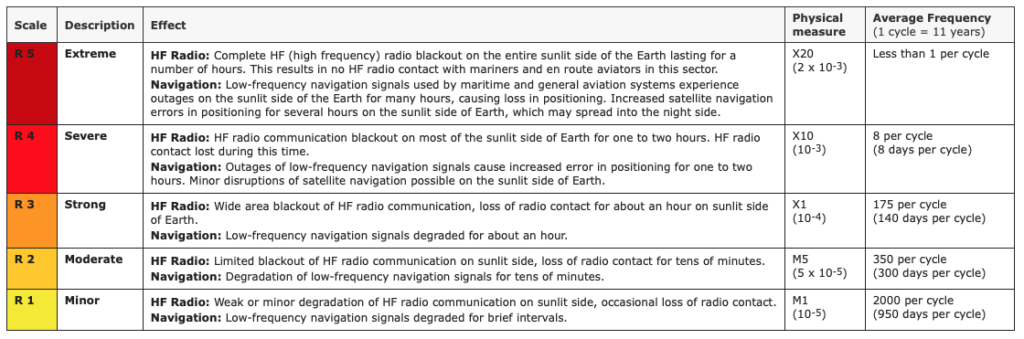
The NOAA scales – anything above R1 or R2 is rare.

Datalink problems.

So your texting system is on the blink? Unfortunately, the Datalink Mandate is in force now so you need this to enter. If you ask ATC nicely (and have everything else working) they might still let you in.  

You don’t need it if you are north of 80N, in NYC Oceanic, on Tango 9 or 290 route, or in the ‘surveillance airspace’ over Iceland/Greenland. So if you can re-route via any of this, that might be a good plan. Otherwise you do also have the option of flying above or below the NAT HLA (so below FL290 or above FL410) if your aircraft (and your fuel) can do that.

Remember, datalink uses CPDLC and ADS-C so if either of them is broken, your datalink probably is as well.

SATCOM

Most datalink systems also require SATCOM – so while you don’t need it to use it, if your aircraft needs it for the Datalink to work, then what we said above applies.

Let’s talk ATC – Strikes.

An ATC strike is *usually notified in advance. The chances of them walking out without warning is fairly remote. So if you know about it beforehand, plan accordingly. If it happens while you’re there, treat it as an ATC Zero event.

ATC Zero.

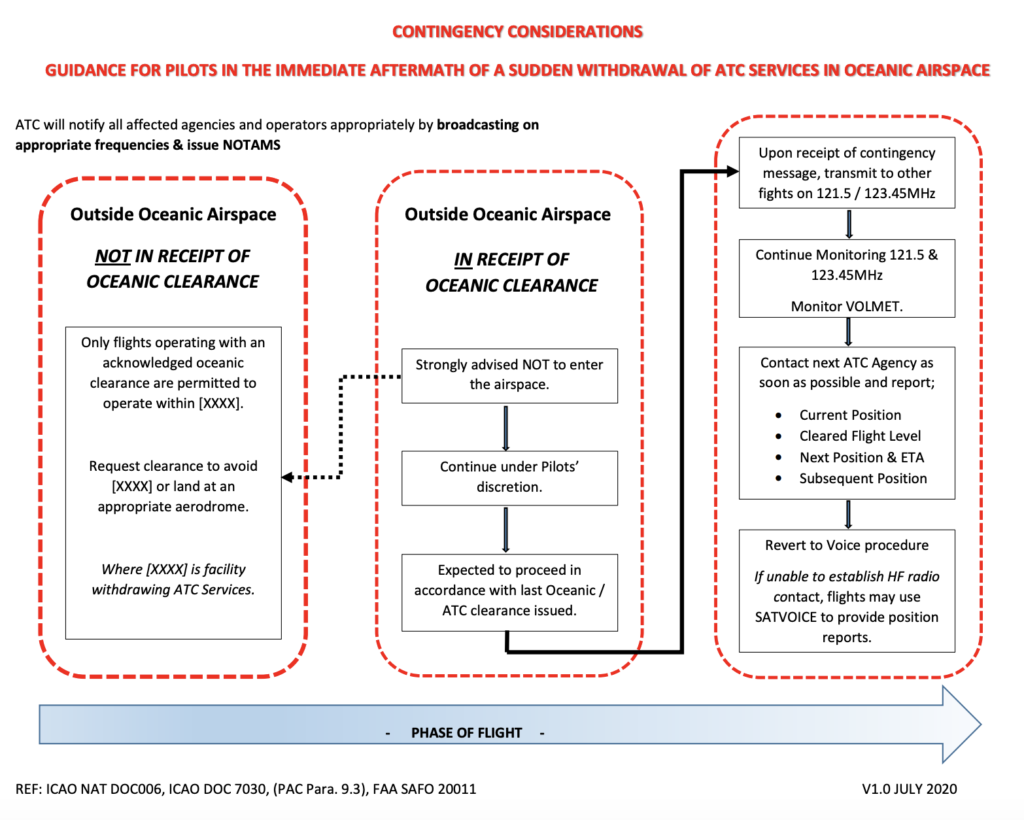
There is no-one out there. Maybe they had to evacuate? There was some sort of emergency or major technical issue that’s has taken down an entire ATC provider? Occasionally it is Notam-ed, but in that case you won’t have been given clearance to head through, so we are talking those unforeseen sudden zero events.

Each region has its own contingency procedures which you can find in their AIP, or better still in NAT Doc 006, which was also updated in Feb 2021.

These routes are really for when big stuff happens – the entire ATC for a sector is evacuated for example. In most cases, other units will try and manage control as best they are able, but it will be fairly limited.

So, if you’re already inside, continue and start trying to make contact with the next sector (as they will hopefully be managing control as much as they can). If it is a big ATC zero event you are probably going to have to follow the contingency routes to exit the NAT HLA (rather than your clearance) but this will be ‘activated’ by whichever ATC is taking over control.

If you already have your clearance to enter you can, and you can transmit position reports on 123.45, but it is not really advisable. The best plan is to organise a re-routing.

If you don’t already have a clearance then you aren’t going to be able to enter the ATC zero bit and you will need to plan a re-route around the affected sector.

Feeling the need to read more?

Here are some handy links to things on the subject.

Changes to NAT Doc 006 – our blog post summarising what these were.

The Irish AIP (again) in case you missed the link earlier.

The GOLD Manual (2017 edition) – for all your Datalink info.

Opsgroup Member?

Then click here to download our handy little Comms Issues on the NAT “Opsicle” – a refreshing bit of ops info, just for members.
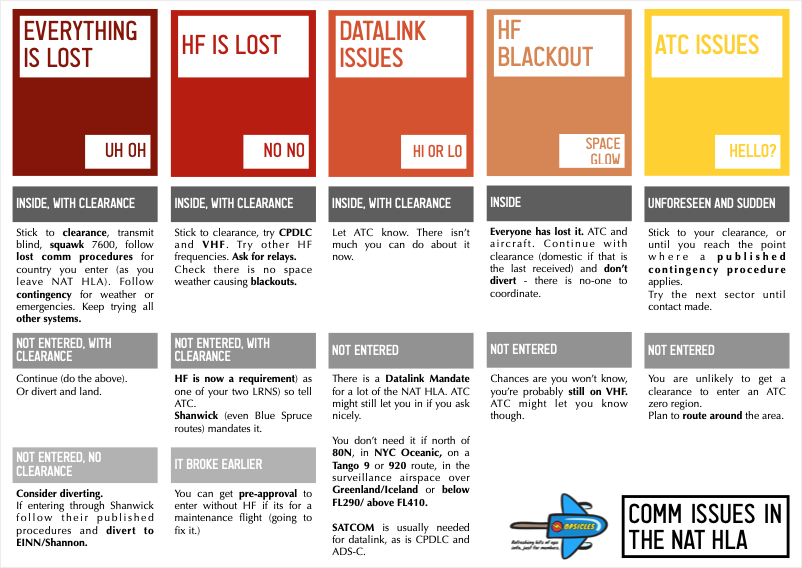
OPSGROUP members: click to download PDF.

If you’re not an OPSGROUP member, but you’d like to be, you can join here.


ATC Zero in Class A Airspace: Is It Dangerous?

IFALPA has issued a new safety bulletin this week expressing concerns that existing US FAA contingency procedures that allow aircraft to continue using Class A airspace during ‘ATC Zero’ events are inadequate. They argue that the procedures expose aircraft to unacceptable risk and that more needs to be done to ensure their safety.

ATC Zero Events have become more common

Before Covid, ATC Zero events were quite rare. They’d usually only occur if controllers were forced to evacuate a facility. Fire, a force of nature, bomb threat – those sorts of things.

But then Covid came along and as we all know, it is super contagious. Amidst border closures and quarantine and testing rules, a new threat began to emerge in our skies.

ATC facilities began to be impacted by Covid infections, and short notice closures for cleaning have become a constant risk.

Last year we published an article on how to manage ATC Zero events in Oceanic Airspace after the New York ARTCC shut down affecting traffic crossing the NAT. The US FAA were sufficiently concerned that they published their own SAFO.

However since then the US has continued to be affected by ATC Zero events over land which affect large portions of Class A airspace, often for hours at a time.

What the FAA have to say about it

The FAA are satisfied that it is safe for aircraft to continue using Class A airspace when no ATC services are available, as long as you follow contingency procedures.

What contingency procedures?

Well, they can be broken down into two parts.

  1. When an ATC Zero event is scheduled, a NOTAM will be published. It will restrict traffic to specific routes through the affected airspace which contain compulsory reporting points. If you don’t intend to the fly the prescribed routes, you’re not allowed in.
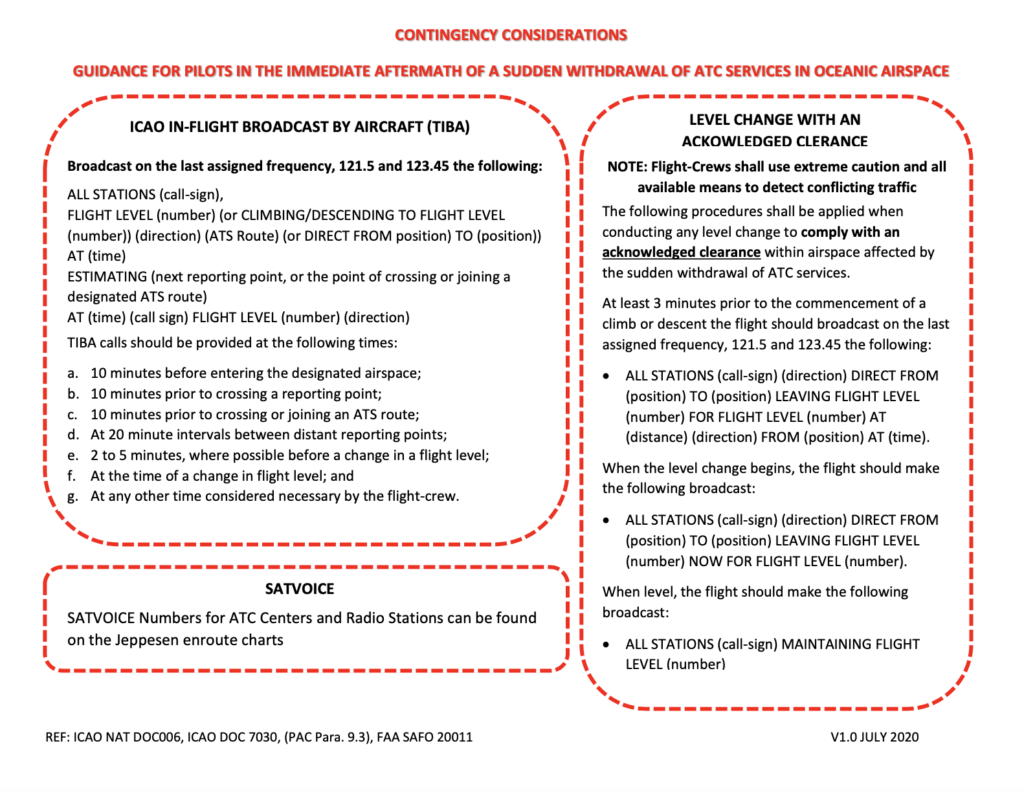
  2. TIBA – Traffic Information Broadcasts by Aircraft. The FAA expects you to use them. Recent feedback from members who have operated under these conditions indicate that many aircraft either don’t know, or are choosing not to use them while operating in ATC Zero airspace. That in itself is concerning.

So what exactly are the TIBA procedures?

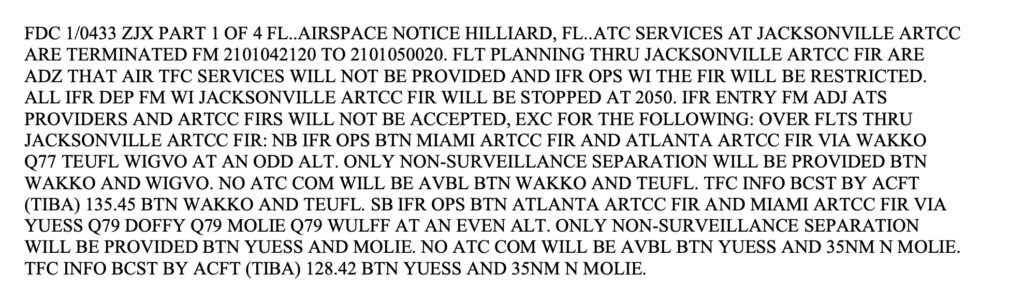
You can find them in ICAO Annex 11, or buried in lengthy NOTAMs if you prefer your procedures capitalised, abbreviated and barely punctuated.

Here’s a quick unofficial rundown:

1. Dial up your TIBA frequency. If you have two VHF comms, leave one on the normal ATS frequency to listen out for a controller.

2. Maintain a listening watch on the TIBA frequency.

3. In most cases you’ll need to remember ’10 minutes’. A radio call is required 10 minutes before entering the affected airspace, or if you have just taken off from an airport within the airspace as soon as you can.

4. Enroute, you’ll need to make routine position reports:

  • 10 minutes before crossing a reporting point
  • 10 minutes before you cross or join an airway.
  • And if your waypoints are really far apart, make a call every 20 minutes.

5. If you’re changing levels you need to make a radio call 2-5 minutes beforehand.

So what do you actually need to say?

The short answer: Who you are, what level you’re at, where you are and where you’re going next.

The slightly longer answer:

- ALL STATIONS
-  Call Sign
- FLIGHT LEVEL
- AIRWAY (or direct to/from)
- POSITION AT TIME
- ESTIMATING (next reporting point or crossing/joining airway) 
  AT TIME AND FLIGHT LEVEL

Don’t forget to listen

It’s important to remember: When you enter Class A airspace during an ATC Zero event, you are responsible for your own separation. You’re on your own. Which means you need to hear and be heard.

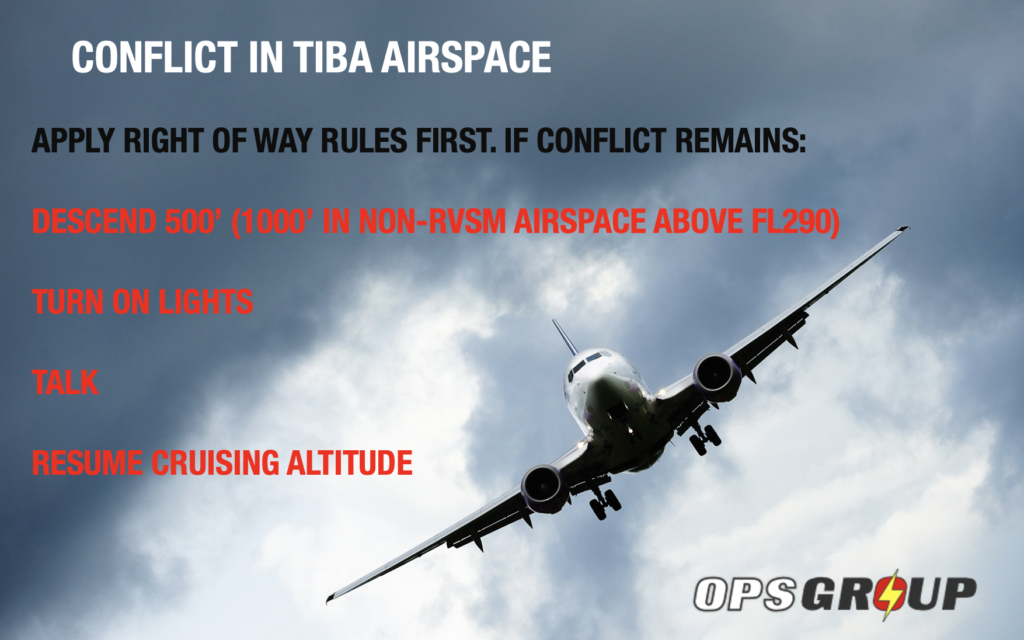
What if a conflict is likely?

There’s a procedure for that too. If you can’t solve the problem with right of way rules, here’s what you need to do:

So why are IFALPA worried?

For starters, there may be aircraft operating in Class A airspace without TCAS which greatly increases the risk of a collision. Secondly there is a lack of training standards about how to apply the contingency procedures. Lastly given that no one is watching, you may be exposed to other aircraft breaching the regs.

Until things change, they recommend you avoid the affected airspace by flight planning around it. If that’s not practical here are their suggestions:

  • Minimise the risk by taking the shortest possible path through it.
  • Make sure you review the contingency procedures beforehand.
  • Make sure there are no procedures in your in your manuals that will be affected by a lack of ATC.
  • Submit a safety report afterwards.

The threat remains

ATC Zero events are likely to continue in the near term, along with the risks they pose. It is important that pilots take those properly into account before they enter affected airspace.

Love them or hate them, sticking to the contingency procedures like glue is everyone’s biggest risk mitigator until new or better ones eventually come along.


Planning for “ATC Zero” events in Oceanic Airspace

You’re halfway across the Atlantic when ATC declares that they are suspending all services. TIBA procedures are now in effect. Would you know what to do next? As Covid infections impact ATC facilities, short notice closures are currently a constant risk. With the possibility of an entire oceanic ATC area being shut down due to Covid, there are some big questions to consider, and to factor in to your planning: Are you tankering enough fuel if you suddenly have to fly around large sections of oceanic airspace? Where are your ETPs? Do you have a wet footprint?

Back in 2011, there was an incident where transatlantic flights were not allowed to enter CYQX/Gander oceanic airspace due to a smoke situation in ATC control centre which meant that controllers had to be evacuated. They issued a Notam, but that wasn’t much use to the traffic en-route at the time, which all had to be re-routed around the CYQX/Gander Oceanic FIR – a vast portion of oceanic airspace.

Fast forward to March of this year, where New York Air Route Traffic Control Center was forced to temporarily close due to a controller testing positive for Covid-19. The affected airspace restricted flights into New York area airports, with aircraft having to take longer routes in order to avoid closed sectors, as well as Oceanic airspace which stretches from New York past Bermuda and services flights heading to the Caribbean, Europe, South America, and Africa.

The New York ARTCC is not the only ATC center that has been affected over the past few months due to controllers coming down sick with coronavirus. Eleven sites across the US, including at major airports in New York, Chicago, and Las Vegas, have been temporarily closed for cleaning, affected flight operations. Some facilities have been closed for several days leaving inbound and departing aircraft left to their own devices for taxi, take-off, and landing.

NAT Doc 006 is the official go-to manual to check what happens during these “ATC Zero” events on the North Atlantic, but the spate of recent ATC shutdowns in the US led the FAA to re-examine the increased potential for these situations occurring during the Covid crisis, and in early July they published a SAFO as a result.

The NAT Doc 006 and the US SAFO are great resources, but here are two more which you might not know about!

Code7700.com has published an excellent 2-page crib sheet with clear guidance for pilots on what to do in these situations. You can download it here:

And 30WestIP.com have recorded a video webinar discussing this topic in more detail, which you can view here:


July 2020 North Atlantic Ops Update

July 2020: There’s a bunch of new things to tell you about the North Atlantic this month! Here’s a summary:
– Two new ICAO NAT Ops Bulletins
– An updated NAT Doc 007 from ICAO (aka the North Atlantic “Ops Bible”)
– A guide for pilots from the FAA about what to do if ATC suddenly has to suspend services
– Some juicy Notams from all the NAT FIRs extending the relaxation of the North Atlantic datalink mandate rules until the end of September.

ICAO NAT Ops Bulletins

Two new ICAO NAT Ops Bulletins have been published this week, but it looks like there’s no need to panic.

First up, there’s 2019_003 Rev 2: Data Link Performance Improvement Options, which is just an updated list of common datalink errors and what to do about them.

Second, there’s a new Bulletin called 2020_002: Surveillance Service in the NAT Region / Flight Crew Operating Procedures. This is a strange one. The message seems to be this: back in the old days, you used to get a call from ATC saying “radar service is terminated” or “surveillance service is terminated” when heading out into the NAT, or when crossing from one oceanic control centre to the next. But nowadays, with improved SSR equipment and ADS-B more widely implemented, you might not get this message anymore.

ICAO NAT Doc 007 (2020, Version 2)

ICAO has published an updated version of the NAT Doc 007, applicable from July 2020. There are only some minor changes from the previous version, concerning the Tango Routes:

  • There’s now a specific note saying that state approval is required to operate on these.
  • There’s also a change to the transponder procedures when using T9 or T290: normally you change transponder code to 2000 30mins after NAT entry, but because of the limited time spent in the NAT HLA when flying on T9 and T290 you should instead make this change 10mins after joining either of those routes.

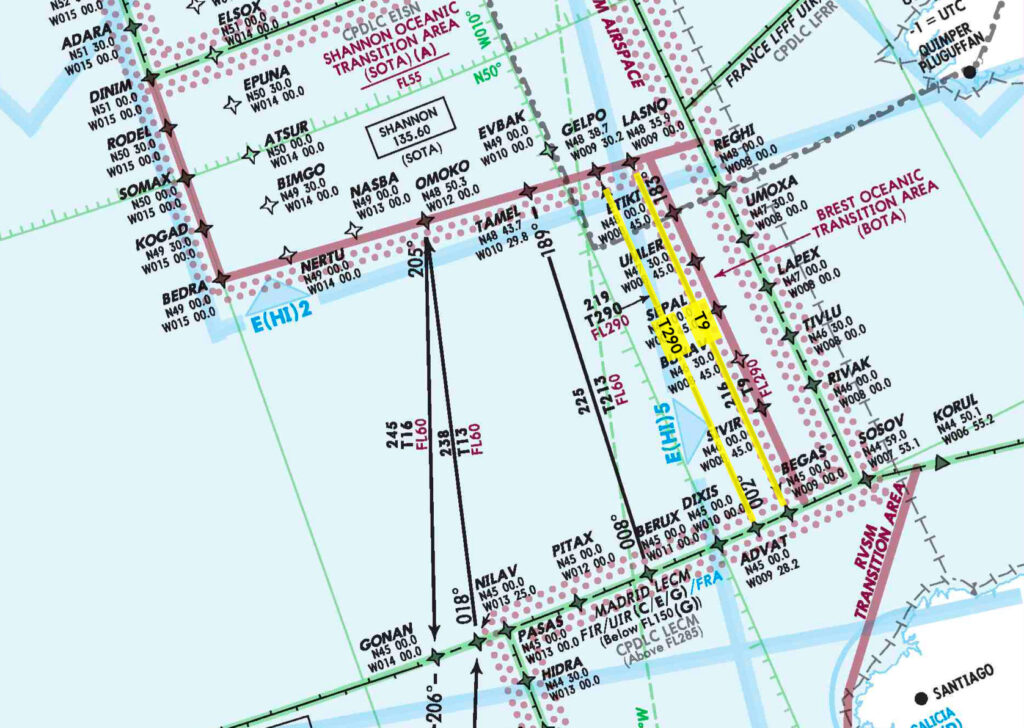
T9 is southbound only, even levels between FL300-400. T290 is northbound only, odd levels from FL290-410. For more info on the Tango Routes, check out our article here.

What to do during “ATC Zero” events

You’re halfway across the Atlantic when ATC declares that they are suspending all services. TIBA procedures are now in effect. Would you know what to do next? As Covid infections impact ATC facilities, short notice closures are currently a constant risk.

The FAA has published a safety alert for international flight crew with contingency procedures in the event of loss of ATC services in Oceanic airspace. It’s a good one to have in your flight bag. Dispatchers and flight crew are reminded to be thoroughly familiar with AIP specific procedures and traffic management contingency plans for the regions they are operating in. You can read the FAA’s alert here.

They have also published another one for ATC Zero events in Terminal airspace, which you can read here. There have been multiple ‘ATC Zero’ events at major air traffic control centres due to Covid prevention and the subsequent cleaning required. The alert contains important information regarding instrument approach selection, TCAS use, alternate minima, aerodrome lighting and other CTAF procedures at unattended airports. There are also important considerations applicable to Part 121 operations discussed.

NAT Datalink Mandate

EGGX/Shanwick, BIRD/Reykjavik, CZQX/Gander, KZWY/New York Oceanic West and LPPO/Santa Maria have all published Notams extending the relaxation of the North Atlantic datalink mandate rules until the end of September. This is due to the fact that there’s still significantly less traffic because of all the Covid restrictions. Non-datalink mandate compliant aircraft may therefore continue to flight plan and operate across the North Atlantic between FL290-410 until Sept 30. For more info on the NAT Datalink Mandate, check out our article here.

In addition, ICAO are saying that due to the decrease in traffic, there is a significantly higher chance of flights being cleared as requested, and are encouraging operators to file and request their optimal profiles at all stages of the flight. Read ICAO’s guidance here.


For a brief history of the most significant North Atlantic-related ops changes, check out our dedicated article here.